

- Industry Size (2026)
- USD 453.0 Mn
- Forecast (2036)
- USD 1380.0 Mn
- CAGR (2026 to 2036)
- 11.0%
PFAS-Free Aqueous Food Packaging Coatings Market Size, Market Forecast and Outlook By FMI
In 2025, the PFAS-free aqueous food packaging coatings market surpassed a value of USD 415.0 million. Based on Future Market Insights’ analysis, demand is estimated to grow to USD 453.0 million in 2026 and USD 1,380.0 million by 2036. FMI projects a CAGR of 11.0% during the forecast period.
Raised compliance thresholds reset minimum capability and bring forward upgrades, pre-qualified vendors clear committees faster. Revenue scales from USD 415.0 million to USD 1,380.0 million at 11.0% CAGR. In January 2025, federal regulators declared 35 PFAS-containing food contact notifications for grease-proofing agents no longer effective [1]. Procurement concentrates in immediate windows, and incumbents with certified pfas-free barrier coatings for food paper gain win rate.
Summary of PFAS-Free Aqueous Food Packaging Coatings
- PFAS-Free Aqueous Food Packaging Coatings Market Definition
- Formulations provide water-based, fluorochemical-free grease resistance for food contact substrates.
- Demand Drivers in the Market
- Imminent regulatory phase-outs of legacy fluorinated compounds dictate substrate transitions.
- Brand commitments toward home-compostable and recyclable fiber packaging expedite aqueous substitution.
- Chemical formulators scaling bio-based emulsion capacity reduce structural premium pricing.
- Key Segments Analyzed in the FMI Report
- Coating Type: Dominant acrylic aqueous coatings (38%) versus polyurethane and bio-based blends.
- End-Use Packaging Type: Paperboard food packaging (46% of total volume) versus flexible films, labels, and corrugated formats.
- Geography: High-growth North America and Europe (United States 12.3%, Germany 11.8%) versus expanding Asia-Pacific (China 11.2%, India 11.0%).
- Analyst Opinion at FMI
- Ismail Sutaria, Principal Consultant for Packaging at Future Market Insights, opines, "In our updated PFAS-Free Aqueous Food Packaging Coatings Market analysis, my team and I have identified regulatory displacement as the core market accelerator. As global bans on fluorochemicals intensify, packaging converters are under immediate pressure to validate alternative barrier chemistries. The real challenge is not innovation, it is industrial scalability. Coatings must deliver grease resistance, heat tolerance, and runnability on existing high-speed lines without compromising fiber recovery."
- Strategic Implications/Executive Takeaways
- Prioritize water-based compostable certifications to clear brand sustainability audits quickly.
- Secure localized chemical blending capacity to navigate volatile import lead times.
- Target paperboard quick-service applications to capture highest immediate compliance spending.
- Methodology
- Validated through first-hand corporate production and capacity data.
- Zero reliance on speculative third-party market research reports.
- Based on verifiable industrial benchmarks and verified sources.
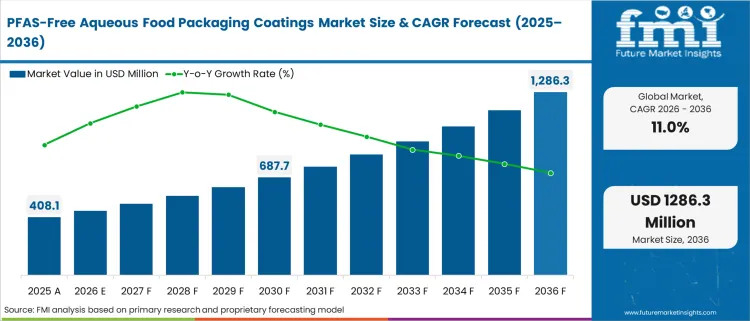
PFAS-Free Aqueous Food Packaging Coatings Market Key Takeaways
| Metric | Details |
|---|---|
| Industry Size (2026) | USD 453.0 million |
| Industry Value (2036) | USD 1,380.0 million |
| CAGR (2026-2036) | 11.0% |
As noted by Alex Noake, Senior Vice President and Managing Director at Sabert Europe, "The launch of PULPUltra positions our customers ahead of upcoming regulatory changes on PFAS and sustainability, while offering superior strength and heat resistance" [2]. Protocol changes shift committees from optional to required capability. Vendors with certified fluorine-free barrier coatings progress within a single budget cycle, accelerating enterprise adoption.
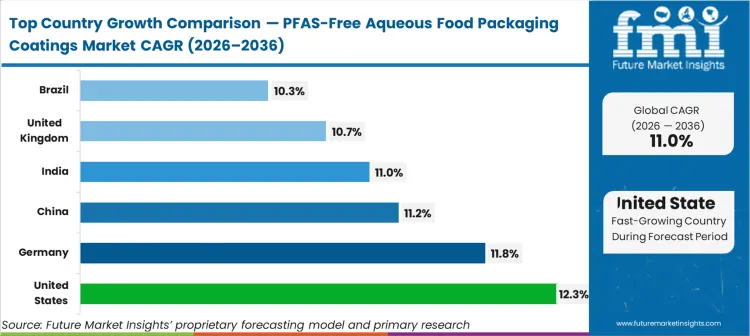
Across North America, Europe, Asia Pacific, and Latin America, growth concentrates where regulatory phase-outs align with procurement windows. Country dispersion mirrors compliance exposure; the United States, Germany, China, India, the United Kingdom, and Brazil clear procurement faster on verifiable chemical safety and direct food-contact capability.
PFAS-Free Aqueous Food Packaging Coatings Market Definition
PFAS-free aqueous food packaging coatings comprise water-based barrier systems devoid of intentionally added per- and polyfluoroalkyl substances, engineered to provide grease, water, and oil resistance. Formulators apply these chemical barriers directly to fiber or paperboard substrates, ensuring consumer safety. Buyers prioritize formulations satisfying strict composability standards and recycling-friendly water-based barrier coatings for fiber-based EU packaging regulations.
PFAS-Free Aqueous Food Packaging Coatings Market Inclusions
Industry valuation counts acrylic, polyurethane, and bio-based polymer blend coatings designed specifically for food contact applications. Revenue metrics incorporate direct business-to-business sales of liquid aqueous dispersions to converters. Scope covers coatings applied to paperboard, corrugated boxes, and flexible films, directly supporting barrier coated papers integration.
PFAS-Free Aqueous Food Packaging Coatings Market Exclusions
Assessments omit solvent-based coatings, ultraviolet-cured chemistry, and any formulations containing legacy fluoropolymers or fluorinated compounds. Finished ready-to-use packaging products fall outside measurement boundaries. Revenue tracking excludes non-food industrial applications and general architectural PFAS-free powder coatings.
PFAS-Free Aqueous Food Packaging Coatings Market Research Methodology
- Primary Research: Analysts conduct targeted interviews with chemical formulators, polymer scientists, and packaging converters to verify supply-side capacity and adoption timelines.
- Desk Research: Output models integrate regulatory phase-out schedules from environmental agencies and corporate sustainability disclosures.
- Market-Sizing and Forecasting: Top-down compliance mandate modeling meets bottom-up facility capacity tracking to yield base-year valuations.
- Data Validation and Update Cycle: Baseline metrics undergo cross-referencing against independent testing lab certifications and raw material import volumes prior to publication.
Segmental Analysis
PFAS-Free Aqueous Food Packaging Coatings Market Analysis by Coating Type
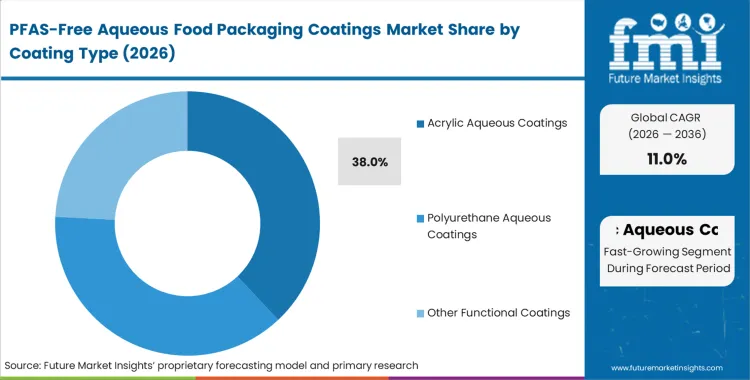
Acrylic Aqueous Coatings command 38% of the market in 2026. Transitioning from legacy fluorochemicals, converters select acrylic systems for reliable water and grease resistance without compromising recyclability. Solenis expanded TopScreen aqueous portfolios with new testing data in August 2025, validating European Union recyclability requirements for fiber substrates [3]. Formulators blend acrylic polymers to achieve required oxygen transmission rates for short-shelf-life applications. As per FMI's projection, formulation scale-up lowers unit costs against specialized bio-blends, securing adoption across high-volume paperboard runs.
- Formulation trigger: Regulatory phase-outs of fluorinated chemistries are driving a shift toward verified water-based barrier formulations. Ink and coating suppliers are accelerating compliant product launches, while brands fast-track reformulation and supplier qualification to meet tightening regulatory timelines.
- Procurement shift: Fast-food networks mandate verifiable chemical safety, changing converter purchasing behavior. Over sixty Fortune 500 corporations committed to PFAS-free targets by 2025 to 2030, reshaping material sourcing [5]. Suppliers holding food-safe certifications capture volume orders.
- Capacity move: Chemical manufacturers expand local blending operations to fulfill surging regional demand. Roquette initiated a USD 50 million scale-up of starch-based alternatives in 2025 [6]. Localized production shields buyers from supply chain bottlenecks.
PFAS-Free Aqueous Food Packaging Coatings Market Analysis by End-Use Packaging Type
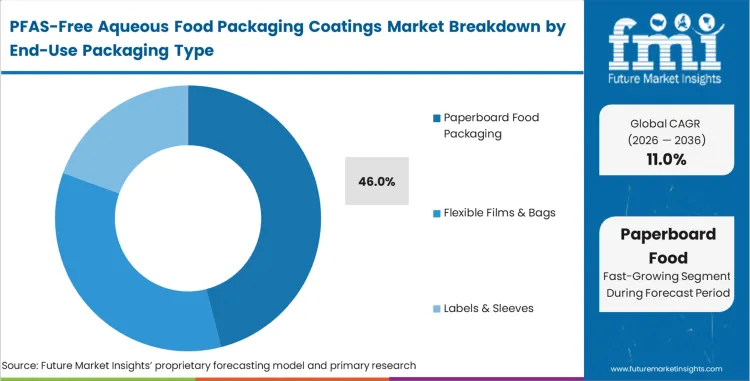
Quick-service restaurants are steadily replacing plastic clamshell packaging with compostable paperboard and molded fiber trays, increasing demand for high-performance, water-based grease resistance solutions. In February 2026, Yangi commercialized a dry fiber tray technology with integrated aqueous barriers, meeting strict foodservice performance standards [7]. To support these applications, formulators carefully manage coating viscosity for efficient high-speed flexographic printing on porous recycled boards. FMI estimates that fast-food chains are phasing out fluorinated legacy materials in favor of certified, compliant suppliers. Brand owners also specify strict oxygen transmission rates to preserve product freshness, particularly in baked goods. As this shift accelerates across global foodservice channels, paperboard food packaging accounts for 46% of total share in 2026.
- Procurement trigger: Regulatory mandates and corporate climate commitments are accelerating demand for certified compostable and recyclable packaging materials. Converters are scaling advanced barrier technologies and securing production capacity early to align with upcoming environmental compliance timelines.
- Technology shift: Converters replace polyethylene lamination with repulpable liquid dispersions. Mitsubishi Chemical developed a barrier coating resin for oil-resistant paper-based environments targeting commercialization in FY2026 [9]. Operators test these dispersions for thermal stability.
- Supply-side move: Formulators blend starch derivatives to enhance oil holdout. INX International partnered with Impermea Materials in September 2025 to scale OLEO-PAK 4100 plastic-free barriers [10]. Distributors bridge the gap between niche formulators and massive carton producers.
PFAS-Free Aqueous Food Packaging Coatings Market Drivers, Restraints, and Opportunities
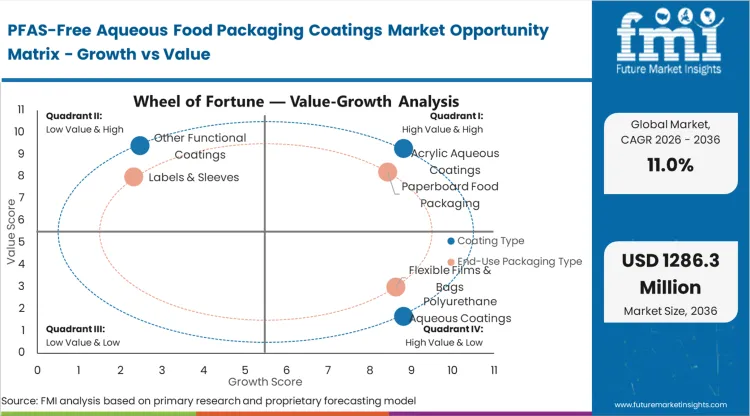
Legislative mandates acting as compliance gates force immediate elimination of historical grease-proofing agents. Environmental protection agencies reclassify fluorinated compounds, exposing packaging converters to severe penalties. Procurement teams abandon non-compliant inventory, hastening USA barrier coatings for packaging implementation across quick-service restaurants. FMI analysts opine that regulatory mandates eliminate alternative pathways, guaranteeing aqueous adoption. In April 2025, New Mexico enacted comprehensive prospective phase-outs banning consumer products with intentionally added fluorochemicals [11]. Suppliers capturing certified capacity early dictate pricing terms during shortage windows.
Performance disparities in extreme temperature applications create implementation friction for operators. Conventional aqueous systems struggle to match legacy fluoropolymer resistance against boiling liquids or high-fat bakery items. Barrier performance gaps require costly thicker coating applications or secondary laminations. Seventeen United States jurisdictions introduced 2025 legislation prohibiting fluorochemicals in single-use containers, dictating retail procurement strategies despite these performance hurdles [12]. Converters mitigate risk through phased rollouts, blending bio-polymers with acrylics to balance cost physics against required shelf-life metrics.
- Regulatory capture: Substrate suppliers achieving early compostable certification capture premium enterprise contracts. Vermont banned fluorinated packaging compounds effective January 2026, forcing quick-service chains to execute immediate substrate transitions [13].
- Bio-based integration: Scale-up of agricultural feedstocks lowers unit economics for sustainable barrier alternatives. Stora Enso introduced Aqua dispersion-barrier boards in 2025, yielding recyclable liquid resistance [14].
- Retailer specification: Grocery networks standardize strict material lists, hastening barrier coatings for packaging transitions. Washington State restricted priority fluorochemicals in food packaging during 2025, mandating safer alternatives [15].
Regional Analysis
Based on the regional analysis, the PFAS-Free Aqueous Food Packaging Coatings market is segmented into North America, Latin America, Europe, East Asia, South Asia, Oceania and Middle East & Africa across 40+ countries. The full report also offers market attractiveness analysis based on regional trends.
.webp "Top Country Growth Comparison Pfas Free Aqueous Food Packaging Coatings Market Cagr (2026 2036)")
| Country | CAGR (2026 to 2036) |
|---|---|
| United States | 12.3% |
| Germany | 11.8% |
| China | 11.2% |
| India | 11.0% |
| United Kingdom | 10.7% |
| Brazil | 10.3% |
Source: Future Market Insights (FMI) analysis, based on proprietary forecasting model and primary research
North America PFAS-Free Aqueous Food Packaging Coatings Analysis
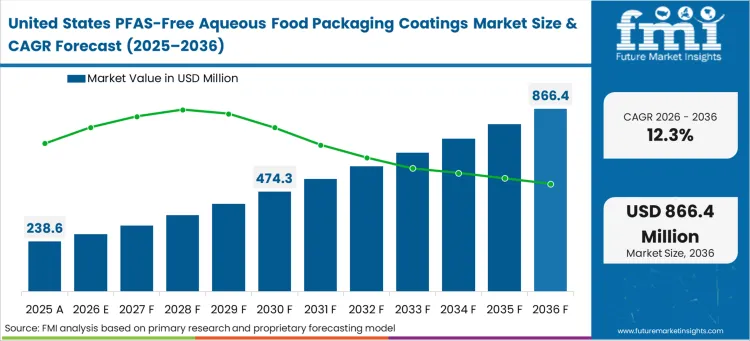
Stringent state-level legislation compels aggressive replacement economics across North America. Converters face hard deadlines, shifting capital expenditures toward verifiable water-based barrier capability. Supply chains localize blending capacity to secure uninterrupted foodservice operations. As per FMI's projection, state-level bans penalize non-compliance, hastening procurement and boosting demand for PFAS-free slip leveling coating additives.
- United States: Demand for PFAS-free aqueous food packaging coatings in the United States is set to grow at 12.3% CAGR through 2036, supported by decentralized state legislation before procurement and budgeting cycles translate into higher deployment volumes. Colorado expanded its Consumer Protection Act with food packaging restrictions receiving ongoing enforcement in 2025 [16]. Suppliers capturing certified capacity early dictate pricing terms.
FMI’s report includes extensive North America coverage. Canada and Mexico represent critical opportunistic nodes as cross-border brand harmonization prompts secondary market phase-outs. Buyers monitor federal alignment trends shaping North American free trade packaging specifications.
Europe PFAS-Free Aqueous Food Packaging Coatings Analysis
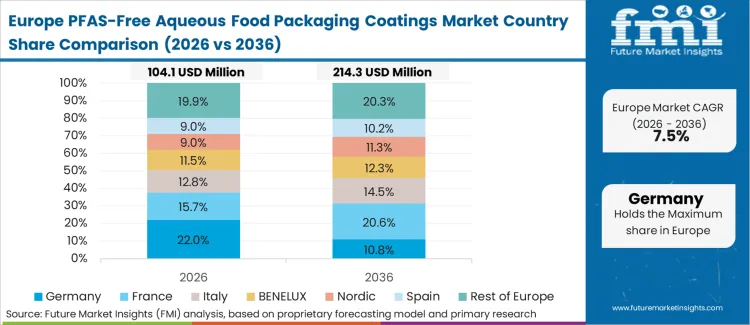
Circular economy mandates elevate recycling integration, forcing chemical suppliers to validate aqueous dispersion compatibility with paper mill repulping operations. Directives limit trace contamination, shifting formulation physics. According to FMI's estimates, directives limit trace contamination and force the adoption of safe fluorine-free oil and grease repellent polymers. Converters abandon non-compliant inventory to satisfy extended producer responsibility schemes.
- Germany: In Germany, stricter recycling quotas are accelerating the shift toward PFAS-free aqueous food packaging coatings, encouraging manufacturers to upgrade processing technologies. Companies such as ACTEGA advanced high-performance water-based barrier solutions in 2025 to fully replace plastic films [17]. As brands move early to secure compliant capacity ahead of state-level implementation timelines, the sector is projected to grow at an 11.8% CAGR from 2026 to 2036.
- United Kingdom: The demand for PFAS-Free Aqueous Food Packaging Coatings in the UK is expected to grow at a 10.7% CAGR from 2026 to 2036 as extended producer responsibility taxes strengthen the connection between adoption-led investment and operational limitations. Chapelton Board introduced the Sustaina Pack PFAS-free fibre-based board range using alternative aqueous barrier chemistries in June 2025 [18]. Operators demand verified chemical safety alongside thermal stability.
FMI’s report includes deep Europe tracking. France, Italy, and Spain show strong potential as quick-service restaurants implement continent-wide sustainable material pledges. Suppliers navigate divergent national recycling definitions demanding localized adaptation.
Asia Pacific PFAS-Free Aqueous Food Packaging Coatings Analysis
Export-oriented manufacturing realigns raw material inputs to satisfy strict Western compliance gates. Domestic brands simultaneously adopt sustainable packaging standards to improve urban waste management. FMI analysts opine that lead time volatility redirects spend to localized capacity and interchangeable PFAS-free easy open can coatings designs. Manufacturers secure verifiable testing protocols to guarantee international shipment acceptance.
- China: China's landscape is forecast to expand at 11.2% CAGR through 2036, as export compliance and market participants respond with scaled deployment plans. Xampla collaborated with DIC Group in December 2025 to introduce plant-based coatings across Asian foodservice networks [19]. Brands replace historical fluorinated compounds to clear border inspections.
- India: Growth across India is estimated at 11.0% CAGR through 2036, catalyzed by urban foodservice expansion that increases value of reliability and compliance in buyer criteria. Archroma introduced bio-based aqueous barrier solutions targeting compostable packaging expansion in 2025 [20]. Quick-service chains establish robust local procurement pipelines.
FMI’s report includes detailed Asia Pacific insights. Japan, South Korea, and Indonesia offer substantial conversion volumes as regional governments mandate circular economy targets. Converters evaluate localized bio-polymer extraction capabilities to reduce reliance on imported chemical emulsions.
Latin America PFAS-Free Aqueous Food Packaging Coatings Analysis
Agricultural export dominance requires compliant bulk packaging to clear strict European Union border inspections. Regional producers evaluate cost-effective aqueous barriers capable of withstanding high humidity environments during ocean transit. As per FMI's projection, pricing discipline remains critical as buyers balance performance against currency fluctuations, pushing the adoption of alternative pfas-free release inks for flexible packaging. Multinationals inject capital into localized testing infrastructure to hasten qualification.
- Brazil: Brazil is likely to see barrier revenues increase at 10.3% CAGR during 2026 to 2036, given agricultural export mandates and resulting push for capacity and workflow upgrades. Multi-state United States bans force Brazilian exporters to transition substrate chemistry immediately. Converters secure pre-treated roll stock to streamline production.
FMI’s report includes comprehensive Latin America evaluation. Argentina and Chile present expansion opportunities as forestry sectors integrate forward into treated paperboard production. Material suppliers monitor regional trade agreements influencing sustainable packaging tariffs.
Competitive Aligners for Market Players
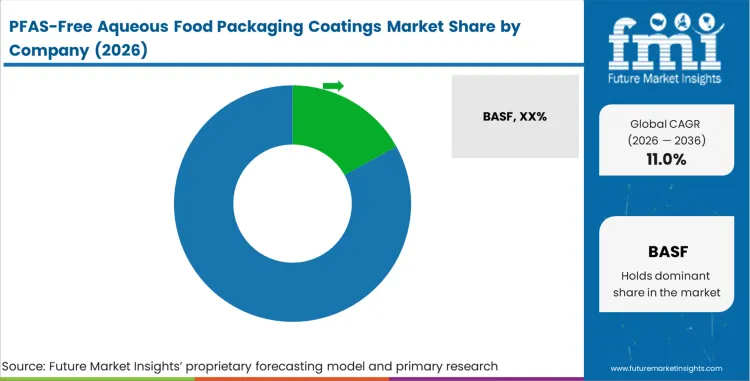
Market structure penalizes underinvested formulators, rewarding chemical conglomerates possessing extensive regulatory certification infrastructure. Suppliers holding home-compostable and direct food-contact clearances capture enterprise accounts instantly. Scale permits massive pilot testing across diverse paperboard grades, ensuring formulation stability.
Backward integration into bio-based feedstocks insulates leaders from volatile petrochemical pricing swings. Integrated players execute stable long-term contracts, capturing dominant share among global fast-food networks. Isolated specialty formulators face severe margin compression during raw material spikes.
Agile commercialization pipelines differentiate winners navigating fragmented international regulations. Companies proving immediate repulpability secure preferred vendor status within circular economy frameworks. Laggards lacking transparent chemical life-cycle data lose access to lucrative multinational retail brands.
Recent Developments
The report includes full coverage of key trends from competitive benchmarking. Some of the recent developments covered in the reports:
- In December 2025, Tetra Pak collaborated with García Carrión to deploy aseptic paper-based barriers eliminating legacy polymers. [8]
- In September 2025, Flint Group introduced DecaCode water-based barrier ranges targeting strict recyclable paperboard compliance. [4]
Key Players in PFAS-Free Aqueous Food Packaging Coatings Market
- BASF
- Solenis
- Michelman
- Kemira
- Siegwerk
- Huhtamaki
- AkzoNobel
- Sun Chemical
Scope of the Report
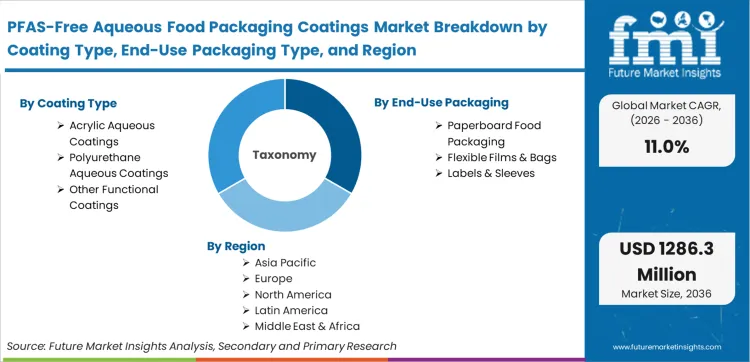
| Metric | Value |
|---|---|
| Quantitative Units | USD 453.0 million (2026) to USD 1,380.0 million (2036), at a CAGR of 11.0% |
| Market Definition | PFAS-free aqueous food packaging coatings comprise water-based barrier systems devoid of intentionally added fluorochemicals, engineered to provide grease, water, and oil resistance for food contact substrates. |
| Coating Type Segmentation | Acrylic Aqueous Coatings, Polyurethane Aqueous Coatings, Bio-based/Polymer Blend Coatings, Other Functional Coatings |
| End-Use Packaging Type Segmentation | Paperboard Food Packaging, Flexible Films & Bags, Labels & Sleeves, Corrugated & Boxboard, Others |
| Regions Covered | North America, Latin America, Europe, East Asia, South Asia, Oceania, Middle East and Africa |
| Countries Covered | United States, Canada, Mexico, Brazil, Argentina, Germany, France, United Kingdom, Italy, Spain, China, India, Japan, South Korea, Indonesia, Australia and 40 plus countries |
| Key Companies Profiled | BASF, Solenis, Michelman, Kemira, Siegwerk, Huhtamaki, AkzoNobel, Sun Chemical |
| Forecast Period | 2026 to 2036 |
| Approach | Hybrid top-down and bottom-up market modeling, validated through primary interviews with coating manufacturers and food packaging producers, supported by trade data benchmarking and regulatory compliance assessments for PFAS-free solutions |
PFAS-Free Aqueous Food Packaging Coatings Market Analysis by Segments
Coating Type:
- Acrylic Aqueous Coatings
- Polyurethane Aqueous Coatings
- Bio-based/Polymer Blend Coatings
- Other Functional Coatings
End-Use Packaging Type:
- Paperboard Food Packaging
- Flexible Films & Bags
- Labels & Sleeves
- Corrugated & Boxboard
- Others
Region:
- Asia Pacific
- India
- China
- Japan
- South Korea
- Indonesia
- Australia & New Zealand
- ASEAN
- Rest of Asia Pacific
- Europe
- Germany
- Italy
- France
- United Kingdom
- Spain
- Benelux
- Nordics
- Central & Eastern Europe
- Rest of Europe
- North America
- United States
- Canada
- Mexico
- Latin America
- Brazil
- Argentina
- Chile
- Rest of Latin America
- Middle East & Africa
- Kingdom of Saudi Arabia
- United Arab Emirates
- South Africa
- Turkey
- Rest of Middle East & Africa
Bibliography
- [1] U.S. Food and Drug Administration (FDA). (2025, January). Authorized uses of PFAS in food contact applications.
- [2] Sabert Corporation Europe. (2026, January). Press release.
- [3] Solenis. (2025, August). Press release.
- [4] Flint Group. (2025, September). Press release.
- [5] Intel Market Research. (2025, September). Industry analyses.
- [6] Roquette. (2025). Investor disclosures.
- [7] Yangi. (2026, February). Product announcement.
- [8] Tetra Pak. (2025, December). Press release.
- [9] Mitsubishi Chemical Group. (2026, January). Corporate release.
- [10] INX International Ink Co. (2025, September). Press release.
- [11] Food Packaging Forum. (2025, July). New Mexico HB 212: PFAS in food packaging.
- [12] Association of State and Territorial Health Officials (ASTHO). (2025, July). States continue to address PFAS.
- [13] Food Packaging Forum. (2025, July). Vermont PFAS food packaging ban.
- [14] Stora Enso. (2025). Corporate reports.
- [15] Washington State Department of Ecology. (2025, April). Safer Products for Washington program update.
- [16] Promotional Products Association International (PPAI). (2025, October). Colorado state law summaries.
- [17] ACTEGA GmbH. (2025). Corporate updates.
- [18] Chapelton Board. (2025, June). Product launch announcement.
- [19] Xampla. (2025, December). Corporate release.
- [20] Archroma. (2025). Corporate announcements.
This bibliography is provided for reader reference and is not exhaustive. The full report contains the complete reference list and detailed citations.
This Report Addresses
- Market intelligence to enable structured strategic decision making across mature and emerging resin economies
- Market size estimation and 10 year revenue forecasts from 2026 to 2036, supported by validated capacity and trade benchmarks
- Growth opportunity mapping across functional liquid formulations with emphasis on food-safe compliance transitions
- Segment and regional revenue forecasts covering bakery, foodservice, retail, and flexible packaging applications
- Competition strategy assessment including integration models, cost survivability positioning, and compliance capability benchmarking
- Product reformulation and emission compliance tracking including FDA, TSCA, and European Union aligned grades
- Regulatory impact analysis covering phase-out mandates, compostability thresholds, and export driven specification upgrades
- Market report delivery in PDF, Excel, PPT, and interactive dashboard formats for executive and operational use
Frequently Asked Questions
How large is the demand for PFAS-Free Aqueous Food Packaging Coatings in the global market in 2026?
Demand for PFAS-Free Aqueous Food Packaging Coatings in the global market is estimated to be valued at USD 453.0 million in 2026.
What will be the market size of PFAS-Free Aqueous Food Packaging Coatings in the global market by 2036?
Market size for PFAS-Free Aqueous Food Packaging Coatings is projected to reach USD 1,380.0 million by 2036.
What is the expected demand growth for PFAS-Free Aqueous Food Packaging Coatings in the global market between 2026 and 2036?
Demand for PFAS-Free Aqueous Food Packaging Coatings in the global market is expected to grow at a CAGR of 11.0% between 2026 and 2036.
Which Coating Type is poised to lead global sales by 2026?
Acrylic Aqueous Coatings are expected to lead global sales, capturing approximately 38% of volume share in 2026 as cost-effective barrier performance scales rapidly.
How significant is the role of Paperboard Food Packaging in driving PFAS-Free Aqueous Food Packaging Coatings adoption in 2026?
Paperboard Food Packaging represents a critical segment, projected to hold a substantial 46% share of total demand in 2026 as quick-service restaurants replace plastic clam-shells.
What is driving demand in the United States?
Strict state-level legislative bans and decentralized phase-outs of legacy fluorochemicals force aggressive replacement economics.
What compliance standards or regulations are referenced for the United States?
Colorado expanded its Consumer Protection Act with food packaging restrictions dictating compliance benchmarks.
What is the United States growth outlook in this report?
The United States is projected to grow at a CAGR of 12.3% during 2026 to 2036.
Why is Europe described as a priority region in this report?
Circular economy mandates elevate recycling integration, forcing chemical suppliers to validate aqueous dispersion compatibility with paper mill repulping operations.
What type of demand dominates in Europe?
Regulatory-driven replacement demand for recyclable, direct food-contact safe barriers dominates regional consumption.
What is the Germany growth outlook in this report?
Germany is projected to expand at a CAGR of 11.8% during 2026 to 2036.
Does the report cover China in its regional analysis?
Yes, China is included within East Asia under the regional scope of analysis.
What are the sources referred to for analyzing China?
Company primary disclosures tracking localized capacity expansions and export-oriented compliance testing certifications inform Chinese analysis.
What is the main demand theme linked to China in its region coverage?
Export-oriented manufacturing realigns raw material inputs to satisfy strict Western compliance gates and international shipment standards.
Does the report cover India in its regional analysis?
Yes, India is included within South Asia under the regional coverage framework.
What is the main India related demand theme in its region coverage?
Urban foodservice expansion increases the value of reliability and compliance in buyer criteria.
What is the United Kingdom growth outlook in this report?
The United Kingdom is projected to grow at a CAGR of 10.7% from 2026 to 2036.
What is the Brazil growth outlook in this report?
Brazil is projected to expand at a CAGR of 10.3% during 2026 to 2036.
Which product formats or configurations are strategically important for North America supply chains?
Pre-treated paperboard roll stock and high-viscosity acrylic formulations remain strategically important to bypass secondary processing delays.
What is PFAS-Free Aqueous Food Packaging Coatings and what is it mainly used for?
PFAS-free aqueous food packaging coatings comprise water-based barrier systems devoid of fluorochemicals, utilized to provide grease and oil resistance for food contact substrates.
What does PFAS-Free Aqueous Food Packaging Coatings mean in this report?
PFAS-free aqueous food packaging coatings mean liquid dispersions applied to substrates to replace historical fluorinated compounds in commercial packaging.
What is included in the scope of this PFAS-Free Aqueous Food Packaging Coatings report?
Scope covers acrylic, polyurethane, and bio-based formulations applied to paperboard, corrugated boxes, and flexible films.
What is excluded from the scope of this report?
Solvent-based coatings, ultraviolet-cured chemistry, legacy fluoropolymers, finished packaging items, and non-food industrial applications are excluded.
What does market forecast mean on this page?
Market forecast represents a model-based projection built on defined regulatory phase-out assumptions for strategic planning purposes.
How does FMI build and validate the PFAS-Free Aqueous Food Packaging Coatings forecast?
The forecast is developed using hybrid top-down compliance modeling and bottom-up capacity tracking, validated against raw material import volumes.
Preview the report firsthand - request a free sample
Get SampleGet the brochure for pricing and purchase details.
Get PDFTable of Content
- Executive Summary
- Global Market Outlook
- Demand-side Trends
- Supply-side Trends
- Technology Roadmap Analysis
- Analysis and Recommendations
- Market Overview
- Market Coverage / Taxonomy
- Market Definition / Scope / Limitations
- Research Methodology
- Chapter Orientation
- Analytical Lens and Working Hypotheses
- Market Structure, Signals, and Trend Drivers
- Benchmarking and Cross-market Comparability
- Market Sizing, Forecasting, and Opportunity Mapping
- Research Design and Evidence Framework
- Desk Research Programme (Secondary Evidence)
- Company Annual and Sustainability Reports
- Peer-reviewed Journals and Academic Literature
- Corporate Websites, Product Literature, and Technical Notes
- Earnings Decks and Investor Briefings
- Statutory Filings and Regulatory Disclosures
- Technical White Papers and Standards Notes
- Trade Journals, Industry Magazines, and Analyst Briefs
- Conference Proceedings, Webinars, and Seminar Materials
- Government Statistics Portals and Public Data Releases
- Press Releases and Reputable Media Coverage
- Specialist Newsletters and Curated Briefings
- Sector Databases and Reference Repositories
- FMI Internal Proprietary Databases and Historical Market Datasets
- Subscription Datasets and Paid Sources
- Social Channels, Communities, and Digital Listening Inputs
- Additional Desk Sources
- Expert Input and Fieldwork (Primary Evidence)
- Primary Modes
- Qualitative Interviews and Expert Elicitation
- Quantitative Surveys and Structured Data Capture
- Blended Approach
- Why Primary Evidence is Used
- Field Techniques
- Interviews
- Surveys
- Focus Groups
- Observational and In-context Research
- Social and Community Interactions
- Stakeholder Universe Engaged
- C-suite Leaders
- Board Members
- Presidents and Vice Presidents
- R&D and Innovation Heads
- Technical Specialists
- Domain Subject-matter Experts
- Scientists
- Physicians and Other Healthcare Professionals
- Governance, Ethics, and Data Stewardship
- Research Ethics
- Data Integrity and Handling
- Primary Modes
- Tooling, Models, and Reference Databases
- Desk Research Programme (Secondary Evidence)
- Data Engineering and Model Build
- Data Acquisition and Ingestion
- Cleaning, Normalisation, and Verification
- Synthesis, Triangulation, and Analysis
- Quality Assurance and Audit Trail
- Market Background
- Market Dynamics
- Drivers
- Restraints
- Opportunity
- Trends
- Scenario Forecast
- Demand in Optimistic Scenario
- Demand in Likely Scenario
- Demand in Conservative Scenario
- Opportunity Map Analysis
- Product Life Cycle Analysis
- Supply Chain Analysis
- Investment Feasibility Matrix
- Value Chain Analysis
- PESTLE and Porter’s Analysis
- Regulatory Landscape
- Regional Parent Market Outlook
- Production and Consumption Statistics
- Import and Export Statistics
- Market Dynamics
- Global Market Analysis 2021 to 2025 and Forecast, 2026 to 2036
- Historical Market Size Value (USD Million) Analysis, 2021 to 2025
- Current and Future Market Size Value (USD Million) Projections, 2026 to 2036
- Y-o-Y Growth Trend Analysis
- Absolute $ Opportunity Analysis
- Global Market Pricing Analysis 2021 to 2025 and Forecast 2026 to 2036
- Global Market Analysis 2021 to 2025 and Forecast 2026 to 2036, By Coating Type
- Introduction / Key Findings
- Historical Market Size Value (USD Million) Analysis By Coating Type , 2021 to 2025
- Current and Future Market Size Value (USD Million) Analysis and Forecast By Coating Type , 2026 to 2036
- Acrylic Aqueous Coatings
- Polyurethane Aqueous Coatings
- Other Functional Coatings
- Acrylic Aqueous Coatings
- Y-o-Y Growth Trend Analysis By Coating Type , 2021 to 2025
- Absolute $ Opportunity Analysis By Coating Type , 2026 to 2036
- Global Market Analysis 2021 to 2025 and Forecast 2026 to 2036, By End-Use Packaging Type
- Introduction / Key Findings
- Historical Market Size Value (USD Million) Analysis By End-Use Packaging Type, 2021 to 2025
- Current and Future Market Size Value (USD Million) Analysis and Forecast By End-Use Packaging Type, 2026 to 2036
- Paperboard Food Packaging
- Flexible Films & Bags
- Labels & Sleeves
- Paperboard Food Packaging
- Y-o-Y Growth Trend Analysis By End-Use Packaging Type, 2021 to 2025
- Absolute $ Opportunity Analysis By End-Use Packaging Type, 2026 to 2036
- Global Market Analysis 2021 to 2025 and Forecast 2026 to 2036, By Region
- Introduction
- Historical Market Size Value (USD Million) Analysis By Region, 2021 to 2025
- Current Market Size Value (USD Million) Analysis and Forecast By Region, 2026 to 2036
- North America
- Latin America
- Western Europe
- Eastern Europe
- East Asia
- South Asia and Pacific
- Middle East & Africa
- Market Attractiveness Analysis By Region
- North America Market Analysis 2021 to 2025 and Forecast 2026 to 2036, By Country
- Historical Market Size Value (USD Million) Trend Analysis By Market Taxonomy, 2021 to 2025
- Market Size Value (USD Million) Forecast By Market Taxonomy, 2026 to 2036
- By Country
- USA
- Canada
- Mexico
- By Coating Type
- By End-Use Packaging Type
- By Country
- Market Attractiveness Analysis
- By Country
- By Coating Type
- By End-Use Packaging Type
- Key Takeaways
- Latin America Market Analysis 2021 to 2025 and Forecast 2026 to 2036, By Country
- Historical Market Size Value (USD Million) Trend Analysis By Market Taxonomy, 2021 to 2025
- Market Size Value (USD Million) Forecast By Market Taxonomy, 2026 to 2036
- By Country
- Brazil
- Chile
- Rest of Latin America
- By Coating Type
- By End-Use Packaging Type
- By Country
- Market Attractiveness Analysis
- By Country
- By Coating Type
- By End-Use Packaging Type
- Key Takeaways
- Western Europe Market Analysis 2021 to 2025 and Forecast 2026 to 2036, By Country
- Historical Market Size Value (USD Million) Trend Analysis By Market Taxonomy, 2021 to 2025
- Market Size Value (USD Million) Forecast By Market Taxonomy, 2026 to 2036
- By Country
- Germany
- UK
- Italy
- Spain
- France
- Nordic
- BENELUX
- Rest of Western Europe
- By Coating Type
- By End-Use Packaging Type
- By Country
- Market Attractiveness Analysis
- By Country
- By Coating Type
- By End-Use Packaging Type
- Key Takeaways
- Eastern Europe Market Analysis 2021 to 2025 and Forecast 2026 to 2036, By Country
- Historical Market Size Value (USD Million) Trend Analysis By Market Taxonomy, 2021 to 2025
- Market Size Value (USD Million) Forecast By Market Taxonomy, 2026 to 2036
- By Country
- Russia
- Poland
- Hungary
- Balkan & Baltic
- Rest of Eastern Europe
- By Coating Type
- By End-Use Packaging Type
- By Country
- Market Attractiveness Analysis
- By Country
- By Coating Type
- By End-Use Packaging Type
- Key Takeaways
- East Asia Market Analysis 2021 to 2025 and Forecast 2026 to 2036, By Country
- Historical Market Size Value (USD Million) Trend Analysis By Market Taxonomy, 2021 to 2025
- Market Size Value (USD Million) Forecast By Market Taxonomy, 2026 to 2036
- By Country
- China
- Japan
- South Korea
- By Coating Type
- By End-Use Packaging Type
- By Country
- Market Attractiveness Analysis
- By Country
- By Coating Type
- By End-Use Packaging Type
- Key Takeaways
- South Asia and Pacific Market Analysis 2021 to 2025 and Forecast 2026 to 2036, By Country
- Historical Market Size Value (USD Million) Trend Analysis By Market Taxonomy, 2021 to 2025
- Market Size Value (USD Million) Forecast By Market Taxonomy, 2026 to 2036
- By Country
- India
- ASEAN
- Australia & New Zealand
- Rest of South Asia and Pacific
- By Coating Type
- By End-Use Packaging Type
- By Country
- Market Attractiveness Analysis
- By Country
- By Coating Type
- By End-Use Packaging Type
- Key Takeaways
- Middle East & Africa Market Analysis 2021 to 2025 and Forecast 2026 to 2036, By Country
- Historical Market Size Value (USD Million) Trend Analysis By Market Taxonomy, 2021 to 2025
- Market Size Value (USD Million) Forecast By Market Taxonomy, 2026 to 2036
- By Country
- Kingdom of Saudi Arabia
- Other GCC Countries
- Turkiye
- South Africa
- Other African Union
- Rest of Middle East & Africa
- By Coating Type
- By End-Use Packaging Type
- By Country
- Market Attractiveness Analysis
- By Country
- By Coating Type
- By End-Use Packaging Type
- Key Takeaways
- Key Countries Market Analysis
- USA
- Pricing Analysis
- Market Share Analysis, 2025
- By Coating Type
- By End-Use Packaging Type
- Canada
- Pricing Analysis
- Market Share Analysis, 2025
- By Coating Type
- By End-Use Packaging Type
- Mexico
- Pricing Analysis
- Market Share Analysis, 2025
- By Coating Type
- By End-Use Packaging Type
- Brazil
- Pricing Analysis
- Market Share Analysis, 2025
- By Coating Type
- By End-Use Packaging Type
- Chile
- Pricing Analysis
- Market Share Analysis, 2025
- By Coating Type
- By End-Use Packaging Type
- Germany
- Pricing Analysis
- Market Share Analysis, 2025
- By Coating Type
- By End-Use Packaging Type
- UK
- Pricing Analysis
- Market Share Analysis, 2025
- By Coating Type
- By End-Use Packaging Type
- Italy
- Pricing Analysis
- Market Share Analysis, 2025
- By Coating Type
- By End-Use Packaging Type
- Spain
- Pricing Analysis
- Market Share Analysis, 2025
- By Coating Type
- By End-Use Packaging Type
- France
- Pricing Analysis
- Market Share Analysis, 2025
- By Coating Type
- By End-Use Packaging Type
- India
- Pricing Analysis
- Market Share Analysis, 2025
- By Coating Type
- By End-Use Packaging Type
- ASEAN
- Pricing Analysis
- Market Share Analysis, 2025
- By Coating Type
- By End-Use Packaging Type
- Australia & New Zealand
- Pricing Analysis
- Market Share Analysis, 2025
- By Coating Type
- By End-Use Packaging Type
- China
- Pricing Analysis
- Market Share Analysis, 2025
- By Coating Type
- By End-Use Packaging Type
- Japan
- Pricing Analysis
- Market Share Analysis, 2025
- By Coating Type
- By End-Use Packaging Type
- South Korea
- Pricing Analysis
- Market Share Analysis, 2025
- By Coating Type
- By End-Use Packaging Type
- Russia
- Pricing Analysis
- Market Share Analysis, 2025
- By Coating Type
- By End-Use Packaging Type
- Poland
- Pricing Analysis
- Market Share Analysis, 2025
- By Coating Type
- By End-Use Packaging Type
- Hungary
- Pricing Analysis
- Market Share Analysis, 2025
- By Coating Type
- By End-Use Packaging Type
- Kingdom of Saudi Arabia
- Pricing Analysis
- Market Share Analysis, 2025
- By Coating Type
- By End-Use Packaging Type
- Turkiye
- Pricing Analysis
- Market Share Analysis, 2025
- By Coating Type
- By End-Use Packaging Type
- South Africa
- Pricing Analysis
- Market Share Analysis, 2025
- By Coating Type
- By End-Use Packaging Type
- USA
- Market Structure Analysis
- Competition Dashboard
- Competition Benchmarking
- Market Share Analysis of Top Players
- By Regional
- By Coating Type
- By End-Use Packaging Type
- Competition Analysis
- Competition Deep Dive
- BASF
- Overview
- Product Portfolio
- Profitability by Market Segments (Product/Age /Sales Channel/Region)
- Sales Footprint
- Strategy Overview
- Marketing Strategy
- Product Strategy
- Channel Strategy
- Solenis
- Michelman
- Kemira
- Siegwerk
- Huhtamaki
- AkzoNobel
- Sun Chemical
- BASF
- Competition Deep Dive
- Assumptions & Acronyms Used


