

- Industry Size (2026)
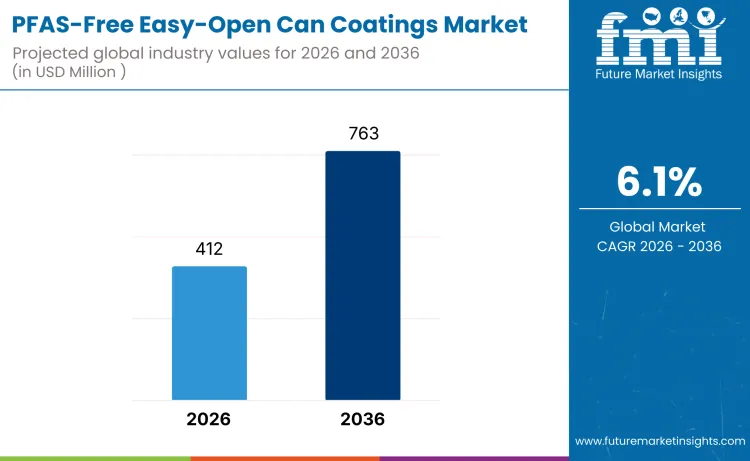
- USD 412 Mn
- Forecast (2036)
- USD 763 Mn
- CAGR (2026 to 2036)
- 6.10%
PFAS-Free Easy-Open Can Coatings Market Forecast and Outlook 2026 to 2036
The global PFAS-free easy-open can coatings market, valued at USD 412.76 million in 2026, is projected to grow to USD 763.50 million by 2036, with a CAGR of 6.10%. The market is driven by increasing regulatory restrictions on PFAS (per- and polyfluoroalkyl substances) and the growing consumer preference for safer, eco-friendly food packaging solutions.
Acrylic-based coatings, which represent 30% of the market share, are the leading product type due to their superior performance and chemical resistance. Liquid coatings, which account for 45% of the product form segment, dominate due to their ease of application and versatility in can coating applications. The growth is further supported by the food and beverage industry’s shift toward sustainable and safer packaging alternatives.
Quick Stats for PFAS-Free Easy-Open Can Coatings Market
- PFAS-Free Easy-Open Can Coatings Market Value (2026): USD 412 million
- PFAS-Free Easy-Open Can Coatings Market Forecast Value (2036): USD 763 million
- PFAS-Free Easy-Open Can Coatings Market Global Forecast CAGR: 6.10%
- Leading Product Form in PFAS-Free Easy-Open Can Coatings Market: Liquid coatings (45%)
- Key Growth Regions in PFAS-Free Easy-Open Can Coatings Market: China, India, USA, UK, Japan
- Top Players in PFAS-Free Easy-Open Can Coatings Market: PPG Industries, AkzoNobel, Sherwin-Williams, BASF, Axalta Coating Systems, RPM International, Nippon Paint
PFAS-Free Easy-Open Can Coatings Market Key Takeaways
| Metric | Value |
|---|---|
| Industry Sales Value (2026) | USD 412 million |
| Industry Forecast Value (2036) | USD 763 million |
| Industry Forecast CAGR (2026 to 2036) | 8.5% |
What Is Driving the Demand for PFAS Free Easy Open Can Coatings Globally?
The demand for PFAS‑free easy‑open can coatings globally is shaped by rising regulatory restrictions on per‑ and polyfluoroalkyl substances (PFAS) and increasing scrutiny of chemical safety in food contact materials. Historically, PFAS compounds were widely used in easy‑open can coatings to provide corrosion resistance and facilitate smooth peel‑off performance. Regulatory actions in key markets have tightened allowable uses of PFAS due to concerns about persistence, bioaccumulation, and potential health impacts, prompting food and beverage producers, packaging converters, and can manufacturers to seek alternative coating technologies.
Consumer awareness of chemical safety and demand for cleaner, more transparent ingredient and packaging claims have also influenced brand owners to adopt PFAS‑free solutions. These factors have converged to push formulators toward novel polymer and resin systems that can deliver corrosion protection and easy‑open functionality without PFAS chemistries. As a result, the global packaging industry is increasingly specifying PFAS‑free coatings in can production for foods, beverages, and other applications where easy‑open features are valued.
Future demand for PFAS‑free easy‑open can coatings is expected to grow as global standards and regulations continue to evolve and solidify around restrictions on PFAS use. Expansion of PFAS regulation in additional regions and adoption of stricter compliance requirements by food safety authorities will accelerate the transition to alternative coatings. Continued growth in global packaged food and beverage consumption supports the ongoing use of easy‑open formats, particularly in ready‑to‑eat meals, beverages, pet foods, and convenience food segments.
Technical advancements in coating development are likely to improve performance parity with legacy PFAS‑based systems, enhancing adoption among manufacturers that require high corrosion resistance and reliable easy‑open characteristics. Demand will also be influenced by supply chain readiness, cost competitiveness of alternative formulations, and how quickly converters and can producers adapt production lines to accommodate new coatings. Overall, the global PFAS‑free easy‑open can coatings market will be shaped by a combination of regulatory pressure, innovation in coating technologies, and brand priorities for safety and compliance.
What Are the Key Segments in Global PFAS Free Easy Open Can Coatings Market?
The global PFAS‑free easy‑open can coatings market is segmented by coating type and product form. Acrylic‑based coatings account for 30% of the market share as a key non‑PFAS alternative in food and beverage can coatings. In terms of product form, liquid coatings dominate with 45% of the market share. The shift toward PFAS‑free solutions is driven by regulatory action and consumer demand for safer packaging chemistries.
Which Coating Type Drives PFAS‑Free Easy‑Open Can Coatings Demand Globally?
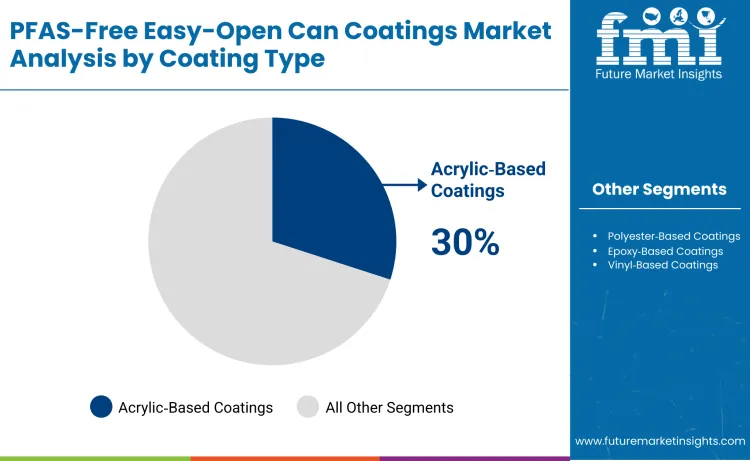
Acrylic‑based coatings hold approximately 30% of the global PFAS‑free easy‑open can coatings market. These coatings are widely used as alternatives to traditional PFAS and fluorochemical chemistries, balancing performance with regulatory compliance in food contact applications. Acrylic chemistries can be engineered to meet food safety and performance requirements without using per‑ and polyfluoroalkyl substances, supporting their adoption across beverage and food cans where PFAS‑related restrictions and health concerns are rising. The demand is reinforced by ongoing global regulatory pressure to eliminate PFAS from food packaging and enhance product safety.
Which Product Form Drives PFAS‑Free Easy‑Open Can Coatings Demand Globally?
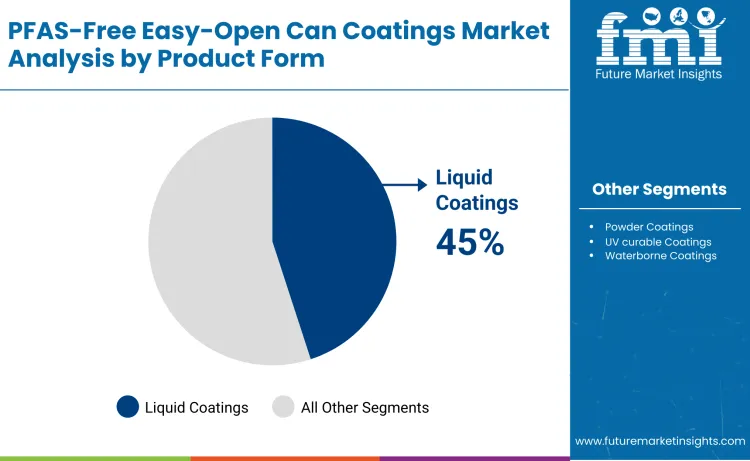
Liquid coatings are the leading product form in the global PFAS‑free easy‑open can coatings market, representing 45% of the total share. Liquid coatings provide ease of application, uniform coverage, and compatibility with existing coating lines used in can manufacturing. Their dominance reflects the practical benefits in manufacturing processes and performance requirements of food and beverage can ends. As the can coatings industry transitions toward PFAS‑free solutions, liquid formulations continue to be widely adopted due to their adaptability and effectiveness in achieving desired barrier, corrosion resistance, and easy‑open properties without relying on PFAS chemistries.
What are the Key Trends of the Global PFAS Free Easy Open Can Coatings Market?
The global PFAS‑free easy‑open can coatings market is being shaped by rising demand for safer and environmentally acceptable packaging solutions. Easy‑open can coatings that exclude per‑ and polyfluoroalkyl substances are increasingly adopted across food, beverage, pet food, and industrial packaging to meet stricter safety standards and growing consumer preference for clean ingredient lists. Manufacturers are reformulating coatings to deliver reliable performance without hazardous chemistries. Growth is supported by regulatory pressure on legacy chemistries and increased use of canned products worldwide as consumers seek convenience and quality.
What are the Key Drivers for the Global PFAS‑Free Easy‑Open Can Coatings Market?
Key drivers include regulatory action on harmful substances that encourages adoption of PFAS‑free alternatives. Governments and standards bodies in many regions are imposing stricter limits on legacy fluorinated chemistries in food contact materials, which incentivises conversion to safer coatings. Rising consumer awareness of chemical safety and preference for packaging that aligns with health and environmental values further drives demand. Growth in packaged foods and beverages globally supports uptake of easy‑open technology. Furthermore brand owners seeking to differentiate through sustainable credentials and meet retailer requirements are increasingly specifying PFAS‑free coatings.
What are the Restraints for the Global PFAS‑Free Easy‑Open Can Coatings Market?
One key restraint is technical performance concerns where PFAS‑free coatings may require optimization to match the lubrication, release and durability historically provided by fluorinated systems. Reformulation can involve significant research and development cost, which may slow adoption by smaller producers. Higher cost of alternative coating chemistries relative to legacy options may also limit uptake in cost‑sensitive segments. Supply chain transition challenges, including qualification of new materials and compatibility with existing can manufacturing lines, create barriers. Variability in global regulatory timelines may reduce urgency for conversion in some regions.
What is the Global Demand Outlook for PFAS-Free Easy-Open Can Coatings?
The demand for PFAS-free easy-open can coatings is projected to grow across various countries, with China leading the market at a CAGR of 11%. India follows closely with a growth rate of 10%, while the USA is expected to grow at 9%. The UK is projected to grow at 8%, and Japan at 7%. The increasing awareness regarding environmental and health impacts of PFAS (per- and polyfluoroalkyl substances), combined with growing regulatory pressures for PFAS-free alternatives in food packaging, is driving the demand for these coatings globally. Additionally, the growing adoption of eco-friendly packaging solutions in the beverage and food industries is contributing to this market expansion.
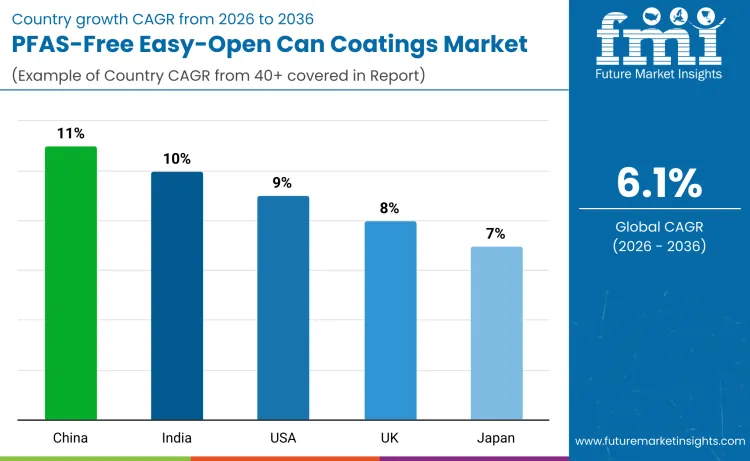
| Country | CAGR (2026 to 2036) |
|---|---|
| China | 11% |
| India | 10% |
| USA | 9% |
| UK | 8% |
| Japan | 7% |
What is Driving the Growth of PFAS-Free Easy-Open Can Coatings in China?
China is projected to experience the highest growth in the PFAS-free easy-open can coatings market, with a projected CAGR of 11%. The country's rapidly expanding beverage and food packaging industries are the primary drivers of this demand. As China continues to prioritize environmental sustainability and reduce the use of harmful chemicals, PFAS-free coatings are becoming a preferred solution for food and beverage can manufacturers. The growing regulatory pressures in China to phase out PFAS in packaging materials, combined with increasing consumer demand for safer, eco-friendly products, are fueling the adoption of PFAS-free can coatings. Furthermore, as China strengthens its commitment to sustainability and green packaging solutions, the demand for these coatings is expected to rise significantly in the coming years.
Why is the PFAS-Free Easy-Open Can Coatings Market Expanding in India?
In India, the demand for PFAS-free easy-open can coatings is projected to grow at a CAGR of 10%. India’s food and beverage packaging sector is evolving rapidly, with an increasing shift towards more sustainable, non-toxic materials. With rising consumer awareness about health risks associated with PFAS chemicals, there is a growing push for PFAS-free alternatives in packaging. The country’s stringent regulations on harmful chemicals in food and beverage packaging are further promoting the adoption of PFAS-free coatings. As India’s food and beverage industry expands, there is greater emphasis on adopting environmentally friendly materials that comply with international sustainability standards, driving the demand for PFAS-free coatings.
How is the PFAS-Free Easy-Open Can Coatings Market Growing in the USA?
In the USA, the PFAS-free easy-open can coatings market is projected to grow at a CAGR of 9%. The USA has been at the forefront of regulatory changes regarding harmful chemicals in consumer products, with increasing pressure to eliminate PFAS from food packaging. As more companies in the food and beverage sector embrace sustainable practices, PFAS-free coatings are gaining traction. Additionally, the rising consumer demand for non-toxic, eco-friendly products is driving manufacturers to seek safer alternatives to traditional coatings. The US government’s support for green initiatives and its role in the global push for cleaner packaging materials further contribute to the growth of PFAS-free coatings in the market.
What is Contributing to the Growth of PFAS-Free Easy-Open Can Coatings in the UK?
In the UK, the PFAS-free easy-open can coatings market is projected to grow at a CAGR of 8%. The UK has been proactive in addressing the environmental and health risks posed by PFAS, with stringent regulations requiring the phase-out of such chemicals from packaging materials. As a result, UK-based packaging manufacturers are increasingly adopting PFAS-free alternatives. The growing demand for sustainable packaging solutions in the UK food and beverage industry, coupled with increasing awareness of the harmful effects of PFAS, is driving this transition. As sustainability becomes a higher priority for both businesses and consumers, the demand for PFAS-free easy-open can coatings in the UK is expected to continue to rise.
What is Influencing the Growth of PFAS-Free Easy-Open Can Coatings in Japan?
In Japan, the demand for PFAS-free easy-open can coatings is projected to grow at a CAGR of 7%. Japan has long been committed to environmental protection and sustainability, and the demand for eco-friendly packaging solutions is increasing. With growing awareness about the health and environmental impacts of PFAS, there is an increasing push to replace PFAS-based coatings in food and beverage packaging. Japan’s food and beverage industry, which has traditionally relied on sustainable materials, is now adopting PFAS-free coatings to meet the rising regulatory requirements and consumer expectations for safe, non-toxic packaging. The trend towards green packaging and consumer health consciousness will continue to drive the demand for PFAS-free easy-open can coatings in Japan.
What is the Competitive Landscape for the Global PFAS Free Easy Open Can Coatings Market?
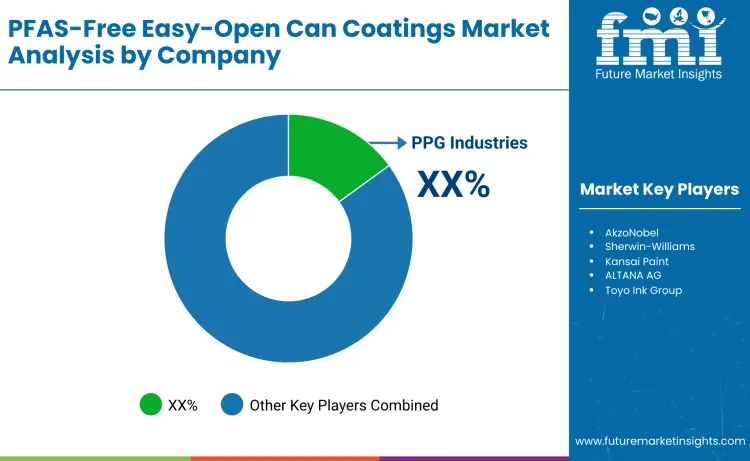
Global demand for PFAS‑free easy‑open can coatings has accelerated as food and beverage producers, packaging converters and regulators seek safer, more sustainable alternatives to traditional fluorochemical formulations. Concerns about environmental persistence and health impacts of per‑ and polyfluoroalkyl substances (PFAS) have driven both industry and regulatory pressure to eliminate these substances from food contact materials. Easy‑open can coatings that are free of PFAS offer corrosion resistance, lubricant properties and peelability while reducing potential regulatory risk and aligning with broader environmental, social and governance priorities.
Growth in global beverage, canned food and specialty packaging markets - combined with rising consumer awareness of ingredient safety and sustainability - supports the transition toward PFAS‑free technologies. Key end uses include soft drinks, beer, pet food, ready meals and other packaged products where reliability of opening performance and coating safety are critical. As major brands commit to chemical transparency and safer materials, uptake of PFAS‑free coating systems continues to spread across regions including North America, Europe and Asia Pacific.
On the supply side several major coatings and materials companies compete to lead the global PFAS‑free easy‑open can coating market. PPG Industries is widely regarded as a leading player with extensive market presence and technical expertise in advanced coatings. Other significant competitors include AkzoNobel, Sherwin‑Williams, BASF, Axalta Coating Systems, RPM International, and Nippon Paint. These firms offer a range of polymer and coating technologies tailored for corrosion protection, food‑contact compliance and processing performance without relying on PFAS chemistries.
Competition among suppliers centers on product performance (durability, adhesion, ease of opening), regulatory compliance with evolving food safety standards, capacity to supply at scale to global can manufacturers, and ability to support customers with formulation and application expertise. Firms that combine strong global distribution networks, robust research and development, and proven PFAS‑free performance are best positioned to capture growth as the industry shifts toward safer, sustainable coating solutions in food and beverage packaging.
Key Players
- PPG Industries
- AkzoNobel
- Sherwin‑Williams
- BASF
- Axalta Coating Systems
- RPM International
- Nippon Paint
Scope of the Report
| Items | Values |
|---|---|
| Quantitative Units (2026) | USD Million |
| Coating Type | Acrylic-based coatings, Polyester-based coatings, Epoxy-based coatings, Vinyl-based coatings, Oleoresin coatings, Others |
| Product Form | Liquid coatings, Powder coatings, UV curable coatings, Waterborne coatings, Solventborne coatings |
| Application | Beverage cans, Food cans, Aerosol cans, Specialty packaging cans |
| End-Use Industry | Beverage industry, Food industry, Personal care products, Pharmaceuticals, Industrial products |
| Technology | Thermoset coatings, Thermoplastic coatings |
| Packaging Type | Two-piece cans, Three-piece cans, Drawn and iron (D&I) cans |
| Companies | PPG Industries, AkzoNobel, Sherwin-Williams, BASF, Axalta Coating Systems, RPM International, Nippon Paint |
| Regions Covered | North America, Latin America, Western Europe, Eastern Europe, South Asia and Pacific, East Asia, Middle East & Africa |
| Countries Covered | United States, Canada, Mexico, Brazil, Argentina, Germany, France, United Kingdom, Italy, Spain, Netherlands, China, India, Japan, South Korea, ANZ, GCC Countries, South Africa |
| Additional Attributes | Dollar by sales by coating type, product form, application, end-use industry, technology, and region. Includes market trends towards PFAS-free alternatives, performance of coatings in various applications, cost-effectiveness, sustainability practices, regulatory compliance, impact of environmental concerns on demand, market share and competitive positioning of key companies, and the role of coatings in enhancing can durability, functionality, and ease of use. |
Key Segments in the PFAS-Free Easy-Open Can Coatings Market
By Coating Type:
- Acrylic‑based coatings
- Polyester‑based coatings
- Epoxy‑based coatings
- Vinyl‑based coatings
- Oleoresin coatings
- Others
By Product Form:
- Liquid coatings
- Powder coatings
- UV curable coatings
- Waterborne coatings
- Solventborne coatings
By Application:
- Beverage cans
- Food cans
- Aerosol cans
- Specialty packaging cans
By End Use Industry:
- Food industry
- Beverage industry
- Personal care products
- Pharmaceuticals
- Industrial products
By Technology:
- Thermoset coatings
- Thermoplastic coatings
By Packaging Type:
- Two‑piece cans
- Three‑piece cans
- Drawn and iron (D&I) cans
By Region:
- Asia Pacific
- China
- India
- Japan
- South Korea
- ASEAN
- Rest of Asia Pacific
- Europe
- Germany
- United Kingdom
- France
- Italy
- Spain
- Nordic
- BENELUX
- Rest of Europe
- North America
- United States
- Canada
- Mexico
- Latin America
- Brazil
- Chile
- Rest of Latin America
- Middle East & Africa
- Kingdom of Saudi Arabia
- Other GCC Countries
- Turkey
- South Africa
- Other African Union
- Rest of Middle East & Africa
Frequently Asked Questions
How big is the PFAS-Free Easy-Open Can Coatings market?
The market is valued at USD 412.76 million in 2026 and is expected to grow at a CAGR of 6.10%, reaching USD 763 million by 2036.
What is the growth outlook for the PFAS-Free Easy-Open Can Coatings market?
The market is projected to grow at a CAGR of 6.10% from 2026 to 2036.
Which region is expected to experience the fastest growth in the PFAS-Free Easy-Open Can Coatings market?
China is expected to lead with a growth rate of 11%, driven by increased demand for eco-friendly packaging solutions.
What are the key applications of PFAS-Free Easy-Open Can Coatings?
PFAS-Free Easy-Open Can Coatings are primarily used in the food and beverage packaging industry to ensure safer, more sustainable products.
Who is the major player in the PFAS-Free Easy-Open Can Coatings market?
The leading player in the market is PPG Industries.
Preview the report firsthand - request a free sample
Get SampleGet the brochure for pricing and purchase details.
Get PDFTable of Content
- Executive Summary
- Market Overview
- Global Market Value, 2020-2026
- Global Market Forecast, 2026-2036
- Market Dynamics
- Drivers
- Restraints
- Opportunities
- Regulatory & Standards Landscape
- Technology & Material Innovation Outlook
- Market Segmentation Analysis
- By Resin Type
- Epoxy powder coatings
- Polyester powder coatings
- Epoxy-polyester hybrid powder coatings
- Polyurethane powder coatings
- Acrylic powder coatings
- Other resin types
- By Technology
- Thermosetting powder coatings
- Thermoplastic powder coatings
- By Additive Type
- Flow control additives
- Degassing agents
- Curing agents
- Anti-cratering additives
- Surface modifiers
- Texture additives
- Others
- By Application
- Appliances
- Automotive components
- Architectural products
- Furniture and fixtures
- Industrial machinery
- Electrical and electronics
- Consumer goods
- By End-Use Industry
- Manufacturing
- Automotive
- Construction
- Consumer durables
- Industrial equipment
- Infrastructure
- By Sales Channel
- Direct to OEMs
- Distributors
- E-commerce channels
- By Performance Grade
- Standard grade
- Premium grade
- High performance grade
- By Resin Type
- Regional Outlook
- North America
- Latin America
- Western Europe
- Eastern Europe
- South Asia & Pacific
- East Asia
- Middle East & Africa
- Country-Level Outlook
- United States
- Canada
- Mexico
- Brazil
- Argentina
- Germany
- France
- United Kingdom
- Italy
- Spain
- Netherlands
- China
- India
- Japan
- South Korea
- ANZ
- GCC Countries
- South Africa
- Competitive Landscape
- Market Structure Overview
- Company Positioning
- Strategic Initiatives
- Key Player Profiles
- Scope of the Report
- Research Methodology
- Assumptions & Acronyms
- Research Methodology


