

- Industry Size (2026)
- USD 820.8 Mn
- Forecast (2036)
- USD 1772.0 Mn
- CAGR (2026 to 2036)
- 8.0%
Fluorine-Free Oil & Grease Repellent Polymers Market Forecast and Outlook 2026 to 2036
The fluorine-free oil and grease repellent polymers market is forecasted to reach from USD 820.8 million in 2026 to USD 1,772.0 million by 2036, progressing at a CAGR of 8.0%. Procurement behavior in this market is being shaped primarily by regulatory exposure and performance assurance rather than price competition alone. Purchasing decisions are increasingly influenced by buyer risk aversion, as transitions away from PFAS-based systems carry operational and reputational consequences if barrier performance is inconsistent.
As a result, preference is given to suppliers with validated application data, food-contact approvals, and proven scalability across substrates. Vendor relationships are often maintained once materials are qualified, as switching costs include reformulation work, line trials, certification updates, and potential disruption to downstream customers. Lock-in effects are reinforced where polymers are tailored to specific coating weights, curing conditions, or substrate grades. At the same time, procurement strategies are being diversified to mitigate supply risk, favoring vendors with regional manufacturing presence and regulatory transparency. These factors collectively result in disciplined purchasing cycles and gradual, substitution-led volume growth.
Quick Stats for Fluorine-Free Oil & Grease Repellent Polymers Market
- Fluorine-Free Oil & Grease Repellent Polymers Market Value (2026): USD 820.8 Million
- Fluorine-Free Oil & Grease Repellent Polymers Market Forecast Value (2036): USD 1,772.0 Million
- Fluorine-Free Oil & Grease Repellent Polymers Market Forecast CAGR 2026 to 2036: 8.0%
- Leading Substrate in Fluorine-Free Oil & Grease Repellent Polymers Market: Textiles & Nonwovens (42% share)
- Key Growth Regions in Fluorine-Free Oil & Grease Repellent Polymers Market: Asia Pacific, Europe, North America, Latin America, Middle East & Africa
- Top Key Players in Fluorine-Free Oil & Grease Repellent Polymers Market: Archroma, Rudolf Group, HeiQ, Pulcra Chemicals, DyStar, CHT Group, BASF SE, Daikin, Solvay
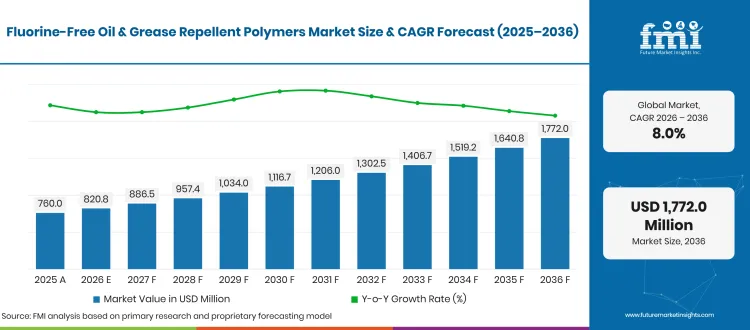
Fluorine-Free Oil & Grease Repellent Polymers Market Key Takeaways
| Metric | Value |
|---|---|
| Fluorine-Free Oil & Grease Repellent Polymers Market Value (2026) | USD 820.8 Million |
| Fluorine-Free Oil & Grease Repellent Polymers Market Forecast Value (2036) | USD 1,772.0 Million |
| Fluorine-Free Oil & Grease Repellent Polymers Market Forecast CAGR 2026 to 2036 | 8.0% |
Why is the Demand for Fluorine-Free Oil & Grease Repellent Polymers Growing?
The fluorine-free oil and grease repellent polymers market is expanding rapidly as regulators and brand owners move away from fluorinated chemistries due to environmental and health concerns. Food packaging, textiles, paper coatings, and consumer products are under increasing pressure to eliminate PFAS while maintaining functional barriers against oil, grease, and moisture. This is driving demand for alternative polymer systems such as modified polyesters, polyurethanes, acrylics, and bio-based coatings that can meet application requirements without fluorine.
Performance parity and formulation trade-offs are central to adoption decisions. Unlike traditional fluoropolymers, fluorine-free systems often require optimized coating weights, multilayer structures, or crosslinking strategies to achieve comparable repellency. Converters and formulators are evaluating these polymers based on oil holdout, grease resistance, heat sealability, recyclability compatibility, and food-contact compliance. Suppliers that provide application-specific grades and validated performance data are helping customers shorten qualification timelines and reduce conversion risk.
Scale deployment and regulatory alignment are further accelerating market growth. As global bans and restrictions on PFAS expand across Europe, North America, and parts of Asia Pacific, companies are standardizing fluorine-free solutions across product portfolios rather than treating them as niche alternatives. Demand is rising in foodservice packaging, molded fiber, flexible packaging, and technical textiles. For polymer producers and formulators, competitive advantage increasingly depends on delivering reliable repellency performance at scale, consistent supply, and clear regulatory documentation positioning fluorine-free oil and grease repellent polymers as a high-growth, compliance-driven segment within advanced functional materials.
How is the Fluorine-Free Oil & Grease Repellent Polymers Market Structured by Substrate and Application?
The fluorine-free oil & grease repellent polymers market is segmented by substrate and application, reflecting how surface chemistry and end-use performance requirements influence polymer selection. By substrate, textiles and nonwovens represent the leading segment, as these materials require effective barrier performance while maintaining breathability and hand feel. Other substrates include paper and paperboard and other porous materials used in industrial formats. By application, food contact and packaging account for the largest demand, followed by apparel and technical textiles, industrial and institutional uses, and other niche applications where oil and grease resistance is essential.
Why Do Textiles And Nonwovens Lead Substrate Adoption In The Fluorine-Free Oil & Grease Repellent Polymers Market?
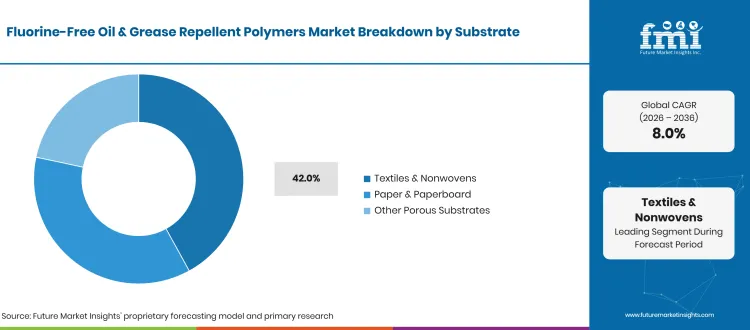
Textiles and nonwovens account for 42% share of the fluorine-free oil & grease repellent polymers market because these substrates are widely used in packaging, hygiene products, and technical fabrics that require resistance to oils and fats. Polymer treatments are applied to fibers and fabrics to prevent penetration while preserving flexibility and softness. Manufacturers favor textile-based substrates due to large production volumes and compatibility with padding, spraying, and coating processes. Demand is driven by disposable and reusable textile formats across multiple industries. These scale-driven and processing-compatible factors explain why textiles and nonwovens remain the dominant substrate segment.
Why Does Food Contact And Packaging Dominate Application Demand In The Fluorine-Free Oil & Grease Repellent Polymers Market?
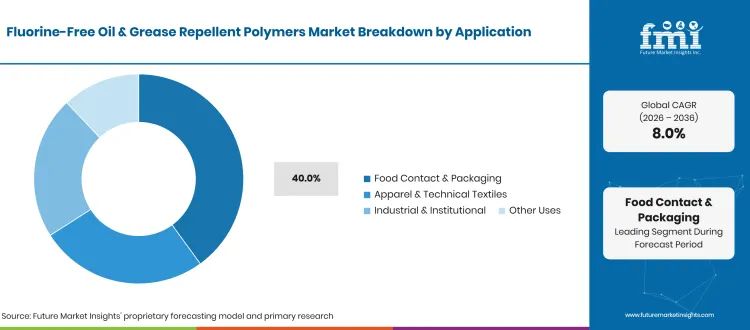
Food contact and packaging applications hold 40% share of the fluorine-free oil & grease repellent polymers market because packaging materials must prevent oil and grease migration while maintaining structural integrity. Paper-based and textile-based food packaging formats rely on repellent polymer coatings to protect contents and preserve handling performance. High consumption volumes in takeaway food, ready-to-eat meals, and food service packaging sustain continuous demand. Manufacturers prioritize consistent barrier performance across varying food types. These high-volume usage patterns and functional requirements explain why food contact and packaging remain the leading application segment.
What are the Key Dynamics of the Fluorine-Free Oil & Grease Repellent Polymers Market?
The fluorine-free oil & grease repellent polymers market is driven by demand for surface treatments that deliver effective repellency without using long-chain fluorochemistries. These polymers are formulated to impart oil and grease resistance on textiles, food packaging, upholstery, carpets, and industrial fabrics while addressing concerns over persistent fluorinated substances. For polymer producers, formulators, and finishers, repellency performance, durability through use and laundering, ease of application, and compatibility with substrate chemistries are critical selection criteria. Adoption is influenced by performance expectations in specific applications and material cost competitiveness versus legacy fluorinated systems.
How do Application and Industry Trends Shape This Market?
Application and industry trends are shaping the fluorine-free oil & grease repellent polymers market as manufacturers seek alternatives that balance performance with regulatory and consumer expectations. Growth in sustainable packaging for food service, performance workwear, home textiles, and hospitality linens drives interest in waterborne and solvent-free repellent chemistries. Advances in polymer engineering such as hyperbranched polymer architectures, silicone-based repellents, and biomimetic surface chemistries-enhance barrier performance while reducing reliance on high-global-warming-potential carriers. Cross-industry focus on uniform, repeatable application processes (spray, pad, or coating lines) encourages development of polymers that integrate with existing finishing equipment and support consistent manufacturing throughput.
Why do Performance Trade-Offs and Qualification Cycles Restrain Market Growth?
Performance trade-offs and qualification cycles restrain growth in the fluorine-free oil & grease repellent polymers market because achieving repellency that matches high-end fluorinated finishes remains challenging in some demanding applications. Fluorine-free polymers often deliver excellent water repellency and good soil resistance, but may fall short of the extreme oil/grease resistance required for heavy industrial or high-soiling conditions without additional formulation complexity. Qualification cycles for new chemistries can be lengthy, requiring extensive wash/abrasion durability testing and application validation, which increases time to market and cost for brand owners and fabric finishers. These barriers can temper adoption in segments where absolute high-performance oil resistance is prioritized.
How is the Fluorine-Free Oil & Grease Repellent Polymers Market Growing across Key Countries?
The fluorine-free oil and grease repellent polymers market is expanding rapidly as packaging, textiles, paper, and specialty coating manufacturers transition away from fluorinated chemistries while maintaining functional barrier performance. These polymers are increasingly used in food packaging, molded fiber products, nonwoven materials, and industrial papers where resistance to oils and fats is required without relying on fluorinated compounds. Country-wise growth varies based on regulatory pressure, scale of packaging and paper production, and adoption of alternative barrier technologies. High-growth markets are driven by fast substitution cycles and large consumer goods industries, while mature regions emphasize performance validation and compatibility with existing converting processes.
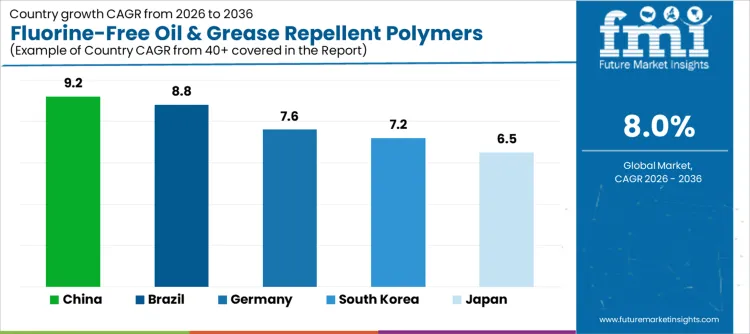
| Country | CAGR (%) |
|---|---|
| China | 9.2 |
| Brazil | 8.8 |
| Germany | 7.6 |
| South Korea | 7.2 |
| Japan | 6.5 |
Why Is China Leading the Fluorine-Free Oil & Grease Repellent Polymers Market?
China’s fluorine-free oil and grease repellent polymers market is expanding at a CAGR of 9.2% during 2026 to 2036, driven by the country’s massive food packaging, paper, and molded fiber manufacturing base. As brand owners and converters rapidly replace fluorinated treatments, demand is rising for polymer-based barrier solutions compatible with paperboard, pulp molding, and flexible packaging. Growth is particularly strong in takeaway food packaging, bakery papers, and quick-service restaurant applications. Chinese manufacturers prioritize polymers that provide effective grease resistance, processability on high-speed coating and sizing equipment, and cost efficiency for large-volume applications. Domestic chemical suppliers benefit from scale, enabling rapid commercialization and competitive pricing. Procurement decisions emphasize performance consistency, supply reliability, and compatibility with existing converting lines. As China’s packaging exports expand, demand is increasing for fluorine-free solutions aligned with international regulatory expectations.
Why Is Brazil Emerging as a High-Growth Market for Fluorine-Free Repellent Polymers?
Brazil’s fluorine-free oil and grease repellent polymers market is growing at a CAGR of 8.8% during 2026 to 2036, supported by rising demand from foodservice packaging, paper products, and molded fiber applications. As converters shift away from traditional fluorinated coatings, interest is increasing in polymer-based solutions that deliver acceptable grease resistance under warm and humid conditions. Brazilian buyers prioritize cost-performance balance, coating efficiency, and compatibility with local paper grades. Adoption is strongest in fast-food packaging, bakery wraps, and disposable tableware. Procurement decisions often favor suppliers offering technical application support and regional availability. Market growth is supported by expansion of food delivery services, rising packaged food consumption, and gradual upgrading of paper and packaging performance standards.
How Is Germany Supporting Demand for Fluorine-Free Oil & Grease Repellent Polymers?
Germany’s fluorine-free oil and grease repellent polymers market is expanding at a CAGR of 7.6% during 2026 to 2036, driven by strict material regulations and strong demand for high-performance paper and packaging solutions. German converters focus on precision coating, repeatable barrier performance, and compatibility with recycling-oriented paper streams. Buyers prioritize polymers with predictable grease resistance, low odor, and stable performance across food contact applications. Adoption is driven by performance validation rather than rapid volume substitution. Procurement decisions favor suppliers with robust technical documentation, certified food-contact compliance, and long-term supply assurance. Market growth is reinforced by Germany’s leadership in engineered packaging and specialty paper production.
How Is South Korea Expanding Use of Fluorine-Free Repellent Polymers?
South Korea’s fluorine-free oil and grease repellent polymers market is growing at a CAGR of 7.2% during 2026 to 2036, supported by demand from food packaging, nonwovens, and specialty paper applications. Manufacturers increasingly adopt polymer-based repellents to meet export-market requirements and improve material acceptance across global brands. Buyers emphasize coating uniformity, compatibility with high-speed converting, and consistent barrier performance. Adoption is strongest in premium packaging and export-oriented applications. Procurement decisions are influenced by supplier technical capability and product consistency. Market growth is supported by steady expansion of packaged food and paper-based consumer products.
What Is Driving Demand for Fluorine-Free Oil & Grease Repellent Polymers in Japan?
Japan’s fluorine-free oil and grease repellent polymers market is expanding at a CAGR of 6.5% during 2026 to 2036, driven by a strong focus on material reliability, food safety, and controlled performance. Japanese converters adopt fluorine-free solutions cautiously, emphasizing repeatability and long-term functional stability. Buyers prioritize low migration, consistent grease resistance, and compatibility with precision coating processes. Adoption is gradual but steady, centered on high-quality food packaging and specialty paper products. Procurement decisions favor suppliers with established performance records and detailed technical validation. Market growth is supported by incremental substitution of legacy treatments and continued demand for high-quality paper-based packaging solutions.
How Are Companies Competing in the Fluorine-Free Oil & Grease Repellent Polymers Market?
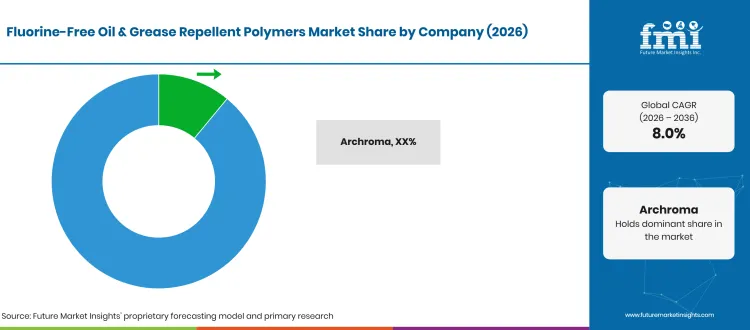
Competition in the fluorine-free oil and grease repellent polymers market is shaped by functional performance, environmental compliance, and ease of integration into textile and surface treatment processes. As sustainability expectations tighten and fluorinated chemistries fall out of favor due to regulatory and consumer pressure, suppliers are differentiating through polymer design that balances repellency with durability, washability, and process compatibility.
Archroma and its legacy Huntsman Textile Effects portfolio anchor the market with fluorine-free repellents tailored for fabrics, nonwovens, and performance wear. Their product materials emphasize balanced surface energy reduction, wash durability, and compatibility with existing padding and finishing lines. Rudolf Group competes through bio-based and polymer-derived repellent systems engineered for low environmental impact and high comfort feel, stressing reliable oil and grease resistance in outdoor and workwear applications.
Specialty material innovators further diversify competitive positioning. HeiQ differentiates via integrated functional finishes that pair repellency with antimicrobial or moisture-management properties, offering multi-functional value. Pulcra Chemicals and DyStar emphasize tailored polymer architectures delivering wash-fast repellent performance compatible with both natural and synthetic fibers. CHT Group adds competitive breadth with cross-linked and reactive repellent systems that enhance durability and process stability.
Large chemical manufacturers bring scale and R&D depth. BASF SE offers fluorine-free repellents derived from novel polymer backbones with verified performance profiles and broad application support. Daikin extends its range with non-fluorinated options that aim to match traditional repellency while reducing environmental concerns. Solvay leverages barrier chemistry expertise to support fluorine-free repellents within broader surface-functional portfolios. Across suppliers, competitive advantage is defined by verified repellency performance, environmental credentials, and seamless integration into finishing processes rather than price alone.
Key Players in Fluorine-Free Oil & Grease Repellent Polymers Market
- Archroma
- Huntsman Textile Effects (now Archroma)
- Rudolf Group
- HeiQ
- Pulcra Chemicals
- DyStar
- CHT Group
- BASF SE
- Daikin (fluorine-free ranges)
- Solvay (barrier chemistries)
Scope of Report
| Attribute | Details |
|---|---|
| Market Size Unit | USD Million |
| Substrate Covered | Textiles & Nonwovens, Paper & Paperboard, Other Porous Substrates |
| Application Covered | Food Contact & Packaging, Apparel & Technical Textiles, Industrial & Institutional Applications, Other Uses |
| Countries Covered | China, Japan, South Korea, India, Australia & New Zealand, ASEAN, Rest of Asia Pacific, Germany, United Kingdom, France, Italy, Spain, Nordic, BENELUX, Rest of Europe, United States, Canada, Mexico, Brazil, Chile, Rest of Latin America, Kingdom of Saudi Arabia, Other GCC Countries, Turkey, South Africa, Other African Union, Rest of Middle East & Africa |
| Regions Covered | Asia Pacific, Europe, North America, Latin America, Middle East & Africa |
| Key Companies Profiled | Archroma, Rudolf Group, HeiQ, Pulcra Chemicals, DyStar, CHT Group, BASF SE, Daikin, Solvay |
| Additional Attributes | Dollar sales by substrate and application are evaluated across packaging, textile finishing, and industrial surface treatment value chains. The scope analyzes polymer chemistry approaches replacing fluorinated repellents, including silicone, hydrocarbon, and bio-based barrier systems. Country-level assessment reflects regulatory pressure on PFAS, adoption of sustainable finishing technologies, food-contact compliance, and performance trade-offs between repellency, durability, and recyclability. |
Fluorine-Free Oil & Grease Repellent Polymers Market by Key Segments
Substrate:
- Textiles & Nonwovens
- Paper & Paperboard
- Other Porous Substrates
Application:
- Food Contact & Packaging
- Apparel & Technical Textiles
- Industrial & Institutional
- Other Uses
Region:
- Asia Pacific
- China
- Japan
- South Korea
- India
- Australia & New Zealand
- ASEAN
- Rest of Asia Pacific
- Europe
- Germany
- United Kingdom
- France
- Italy
- Spain
- Nordic
- BENELUX
- Rest of Europe
- North America
- United States
- Canada
- Mexico
- Latin America
- Brazil
- Chile
- Rest of Latin America
- Middle East & Africa
- Kingdom of Saudi Arabia
- Other GCC Countries
- Turkey
- South Africa
- Other African Union
- Rest of Middle East & Africa
Bibliography
- American Society for Testing and Materials. (2023). ASTM D2307‑23: Standard test method for thermal endurance of electrical insulating varnishes.
- Association of Electrical and Electronic Insulation Professionals. (2024). Electrical insulation varnishes: Processing considerations for VPI and dip‑and‑bake systems
- International Electro technical Commission. (2024). IEC 60455‑3‑8: Resin-based reactive compounds used for electrical insulation-Specifications for individual materials-Part 3‑8: High temperature insulating varnishes. IEC.
- National Institute of Standards and Technology. (2024). Polyimide materials in high‑temperature electrical insulation: Reliability, ageing, and dielectric integrity (NIST technical report). USA Department of Commerce.
- Organisation for Economic Co-operation and Development. (2023). Guidance on polymer degradation and thermal ageing for high‑reliability applications (OECD Environment, Health and Safety Publications). OECD.
Frequently Asked Questions
How big is the fluorine-free oil & grease repellent polymers market in 2026?
The global fluorine-free oil & grease repellent polymers market is estimated to be valued at USD 820.8 Million in 2026.
What will be the size of fluorine-free oil & grease repellent polymers market in 2036?
The market size for the fluorine-free oil & grease repellent polymers market is projected to reach USD 1,772.0 Million by 2036.
How much will be the fluorine-free oil & grease repellent polymers market growth between 2026 and 2036?
The fluorine-free oil & grease repellent polymers market is expected to grow at a 8.0% CAGR between 2026 and 2036.
What are the key product types in the fluorine-free oil & grease repellent polymers market?
The key product types in fluorine-free oil & grease repellent polymers market are textiles & nonwovens, paper & paperboard and other porous substrates.
Which application segment to contribute significant share in the fluorine-free oil & grease repellent polymers market in 2026?
In terms of application, food contact & packaging segment to command 40.0% share in the fluorine-free oil & grease repellent polymers market in 2026.
Preview the report firsthand - request a free sample
Get SampleGet the brochure for pricing and purchase details.
Get PDFTable of Content
- Executive Summary
- Global Market Outlook
- Demand-side Trends
- Supply-side Trends
- Technology Roadmap Analysis
- Analysis and Recommendations
- Market Overview
- Market Coverage / Taxonomy
- Market Definition / Scope / Limitations
- Market Background
- Market Dynamics
- Drivers
- Restraints
- Opportunity
- Trends
- Scenario Forecast
- Demand in Optimistic Scenario
- Demand in Likely Scenario
- Demand in Conservative Scenario
- Opportunity Map Analysis
- Product Life Cycle Analysis
- Supply Chain Analysis
- Investment Feasibility Matrix
- Value Chain Analysis
- PESTLE and Porter’s Analysis
- Regulatory Landscape
- Regional Parent Market Outlook
- Production and Consumption Statistics
- Import and Export Statistics
- Market Dynamics
- Global Market Analysis 2021 to 2025 and Forecast, 2026 to 2036
- Historical Market Size Value (USD Million) Analysis, 2021 to 2025
- Current and Future Market Size Value (USD Million) Projections, 2026 to 2036
- Y-o-Y Growth Trend Analysis
- Absolute $ Opportunity Analysis
- Global Market Pricing Analysis 2021 to 2025 and Forecast 2026 to 2036
- Global Market Analysis 2021 to 2025 and Forecast 2026 to 2036, By Substrate
- Introduction / Key Findings
- Historical Market Size Value (USD Million) Analysis By Substrate , 2021 to 2025
- Current and Future Market Size Value (USD Million) Analysis and Forecast By Substrate , 2026 to 2036
- Textiles & Nonwovens
- Paper & Paperboard
- Other Porous Substrates
- Textiles & Nonwovens
- Y-o-Y Growth Trend Analysis By Substrate , 2021 to 2025
- Absolute $ Opportunity Analysis By Substrate , 2026 to 2036
- Global Market Analysis 2021 to 2025 and Forecast 2026 to 2036, By Application
- Introduction / Key Findings
- Historical Market Size Value (USD Million) Analysis By Application, 2021 to 2025
- Current and Future Market Size Value (USD Million) Analysis and Forecast By Application, 2026 to 2036
- Food Contact & Packaging
- Apparel & Technical Textiles
- Industrial & Institutional
- Other Uses
- Food Contact & Packaging
- Y-o-Y Growth Trend Analysis By Application, 2021 to 2025
- Absolute $ Opportunity Analysis By Application, 2026 to 2036
- Global Market Analysis 2021 to 2025 and Forecast 2026 to 2036, By Region
- Introduction
- Historical Market Size Value (USD Million) Analysis By Region, 2021 to 2025
- Current Market Size Value (USD Million) Analysis and Forecast By Region, 2026 to 2036
- North America
- Latin America
- Western Europe
- Eastern Europe
- East Asia
- South Asia and Pacific
- Middle East & Africa
- Market Attractiveness Analysis By Region
- North America Market Analysis 2021 to 2025 and Forecast 2026 to 2036, By Country
- Historical Market Size Value (USD Million) Trend Analysis By Market Taxonomy, 2021 to 2025
- Market Size Value (USD Million) Forecast By Market Taxonomy, 2026 to 2036
- By Country
- USA
- Canada
- Mexico
- By Substrate
- By Application
- By Country
- Market Attractiveness Analysis
- By Country
- By Substrate
- By Application
- Key Takeaways
- Latin America Market Analysis 2021 to 2025 and Forecast 2026 to 2036, By Country
- Historical Market Size Value (USD Million) Trend Analysis By Market Taxonomy, 2021 to 2025
- Market Size Value (USD Million) Forecast By Market Taxonomy, 2026 to 2036
- By Country
- Brazil
- Chile
- Rest of Latin America
- By Substrate
- By Application
- By Country
- Market Attractiveness Analysis
- By Country
- By Substrate
- By Application
- Key Takeaways
- Western Europe Market Analysis 2021 to 2025 and Forecast 2026 to 2036, By Country
- Historical Market Size Value (USD Million) Trend Analysis By Market Taxonomy, 2021 to 2025
- Market Size Value (USD Million) Forecast By Market Taxonomy, 2026 to 2036
- By Country
- Germany
- UK
- Italy
- Spain
- France
- Nordic
- BENELUX
- Rest of Western Europe
- By Substrate
- By Application
- By Country
- Market Attractiveness Analysis
- By Country
- By Substrate
- By Application
- Key Takeaways
- Eastern Europe Market Analysis 2021 to 2025 and Forecast 2026 to 2036, By Country
- Historical Market Size Value (USD Million) Trend Analysis By Market Taxonomy, 2021 to 2025
- Market Size Value (USD Million) Forecast By Market Taxonomy, 2026 to 2036
- By Country
- Russia
- Poland
- Hungary
- Balkan & Baltic
- Rest of Eastern Europe
- By Substrate
- By Application
- By Country
- Market Attractiveness Analysis
- By Country
- By Substrate
- By Application
- Key Takeaways
- East Asia Market Analysis 2021 to 2025 and Forecast 2026 to 2036, By Country
- Historical Market Size Value (USD Million) Trend Analysis By Market Taxonomy, 2021 to 2025
- Market Size Value (USD Million) Forecast By Market Taxonomy, 2026 to 2036
- By Country
- China
- Japan
- South Korea
- By Substrate
- By Application
- By Country
- Market Attractiveness Analysis
- By Country
- By Substrate
- By Application
- Key Takeaways
- South Asia and Pacific Market Analysis 2021 to 2025 and Forecast 2026 to 2036, By Country
- Historical Market Size Value (USD Million) Trend Analysis By Market Taxonomy, 2021 to 2025
- Market Size Value (USD Million) Forecast By Market Taxonomy, 2026 to 2036
- By Country
- India
- ASEAN
- Australia & New Zealand
- Rest of South Asia and Pacific
- By Substrate
- By Application
- By Country
- Market Attractiveness Analysis
- By Country
- By Substrate
- By Application
- Key Takeaways
- Middle East & Africa Market Analysis 2021 to 2025 and Forecast 2026 to 2036, By Country
- Historical Market Size Value (USD Million) Trend Analysis By Market Taxonomy, 2021 to 2025
- Market Size Value (USD Million) Forecast By Market Taxonomy, 2026 to 2036
- By Country
- Kingdom of Saudi Arabia
- Other GCC Countries
- Turkiye
- South Africa
- Other African Union
- Rest of Middle East & Africa
- By Substrate
- By Application
- By Country
- Market Attractiveness Analysis
- By Country
- By Substrate
- By Application
- Key Takeaways
- Key Countries Market Analysis
- USA
- Pricing Analysis
- Market Share Analysis, 2025
- By Substrate
- By Application
- Canada
- Pricing Analysis
- Market Share Analysis, 2025
- By Substrate
- By Application
- Mexico
- Pricing Analysis
- Market Share Analysis, 2025
- By Substrate
- By Application
- Brazil
- Pricing Analysis
- Market Share Analysis, 2025
- By Substrate
- By Application
- Chile
- Pricing Analysis
- Market Share Analysis, 2025
- By Substrate
- By Application
- Germany
- Pricing Analysis
- Market Share Analysis, 2025
- By Substrate
- By Application
- UK
- Pricing Analysis
- Market Share Analysis, 2025
- By Substrate
- By Application
- Italy
- Pricing Analysis
- Market Share Analysis, 2025
- By Substrate
- By Application
- Spain
- Pricing Analysis
- Market Share Analysis, 2025
- By Substrate
- By Application
- France
- Pricing Analysis
- Market Share Analysis, 2025
- By Substrate
- By Application
- India
- Pricing Analysis
- Market Share Analysis, 2025
- By Substrate
- By Application
- ASEAN
- Pricing Analysis
- Market Share Analysis, 2025
- By Substrate
- By Application
- Australia & New Zealand
- Pricing Analysis
- Market Share Analysis, 2025
- By Substrate
- By Application
- China
- Pricing Analysis
- Market Share Analysis, 2025
- By Substrate
- By Application
- Japan
- Pricing Analysis
- Market Share Analysis, 2025
- By Substrate
- By Application
- South Korea
- Pricing Analysis
- Market Share Analysis, 2025
- By Substrate
- By Application
- Russia
- Pricing Analysis
- Market Share Analysis, 2025
- By Substrate
- By Application
- Poland
- Pricing Analysis
- Market Share Analysis, 2025
- By Substrate
- By Application
- Hungary
- Pricing Analysis
- Market Share Analysis, 2025
- By Substrate
- By Application
- Kingdom of Saudi Arabia
- Pricing Analysis
- Market Share Analysis, 2025
- By Substrate
- By Application
- Turkiye
- Pricing Analysis
- Market Share Analysis, 2025
- By Substrate
- By Application
- South Africa
- Pricing Analysis
- Market Share Analysis, 2025
- By Substrate
- By Application
- USA
- Market Structure Analysis
- Competition Dashboard
- Competition Benchmarking
- Market Share Analysis of Top Players
- By Regional
- By Substrate
- By Application
- Competition Analysis
- Competition Deep Dive
- Archroma
- Overview
- Product Portfolio
- Profitability by Market Segments (Product/Age /Sales Channel/Region)
- Sales Footprint
- Strategy Overview
- Marketing Strategy
- Product Strategy
- Channel Strategy
- Huntsman Textile Effects (now Archroma)
- Rudolf Group
- HeiQ
- Pulcra Chemicals
- DyStar
- CHT Group
- BASF SE
- Daikin (fluorine-free ranges)
- Solvay (barrier chemistries)
- Archroma
- Competition Deep Dive
- Assumptions & Acronyms Used
- Research Methodology


