

- Industry Size (2026)
- USD 117 Mn
- Forecast (2036)
- USD 338.2 Mn
- CAGR (2026 to 2036)
- 11.2%
PFAS-Free Release Inks for Flexible Packaging Market Forecast and Outlook 2026 to 2036
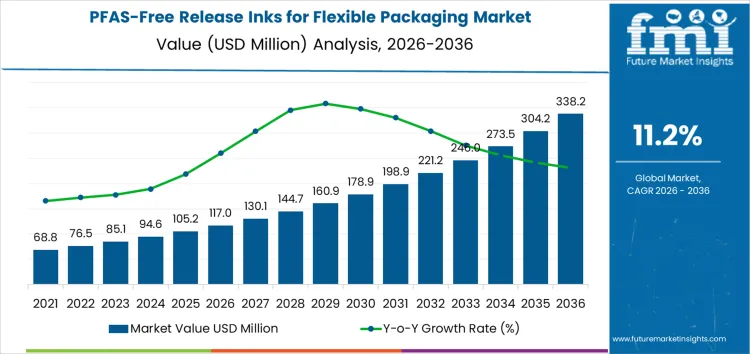
The PFAS-Free release inks for flexible packaging market is valued at USD 117 million in 2026 and is projected to reach USD 338.2 million by 2036, reflecting a CAGR of 11.2%. Growth during this period is shaped by regulatory substitution pressure, functional performance parity requirements, and process compatibility with existing printing lines. Cost structures reflect reformulation expense, alternative slip chemistry sourcing, and extended validation cycles. Release performance must be maintained without fluorinated additives across varied substrates. Suppliers achieving consistent release behavior under high-speed converting retain pricing stability. Procurement decisions prioritize compliance certainty and operational continuity over incremental cost savings.
Between 2026 and 2036, adoption patterns are influenced by buyer risk management and qualification inertia. Packaging converters favor inks with documented PFAS-free compliance and repeatable press performance. Vendor lock-in develops through press settings, substrate pairing, and customer approval files. Switching costs remain elevated due to retesting requirements and customer brand exposure. Fragmentation persists across end-use formats where release requirements vary. At the same time, consolidation occurs within high-volume applications where reformulation investment can be amortized. Market outcomes are determined by regulatory confidence and process reliability rather than price competition alone.
Quick Stats for PFAS Free Release Inks for Flexible Packaging Market
- PFAS Free Release Inks for Flexible Packaging Market Value (2026): USD 117 million
- PFAS Free Release Inks for Flexible Packaging Market Forecast Value (2036): USD 338.2 million
- PFAS Free Release Inks for Flexible Packaging Market Forecast CAGR (2026–2036): 11.2%
- Leading Packaging Format in PFAS Free Release Inks for Flexible Packaging Market: Flexible pouches
- Key Growth Regions in PFAS Free Release Inks for Flexible Packaging Market: Asia Pacific, Europe, North America
- Top Players in PFAS Free Release Inks for Flexible Packaging Market: Sun Chemical (DIC), Siegwerk, Flint Group, INX International, Hubergroup
What Is the Growth Forecast for PFAS Free Release Inks for Flexible Packaging Market through 2036?
Food safety scrutiny and packaging material compatibility define the early growth phase of the PFAS free release inks for flexible packaging market between 2026 and 2031. During this period, the market expands from USD 117 million to USD 176 million, adding USD 59 million in value. Annual progression from USD 67 million to USD 117 million reflects increasing substitution of legacy release systems in labels, sachets, and specialty flexible packaging formats. Historical growth was constrained by limited alternatives meeting release performance requirements. Forward expansion in this phase is supported by improved ink chemistry, reliable release behavior on high speed presses, and growing acceptance by converters supplying food and consumer goods packaging.
Specification alignment and broader packaging line adoption drive growth from 2031 to 2036. Over this period, the market increases from USD 176 million to USD 338.2 million, adding USD 166 million and representing the stronger expansion window. Annual values rise from USD 193 million to USD 338.2 million, indicating accelerating year over year momentum. Earlier demand focused on niche applications and early adopters, while future growth reflects wider rollout across mainstream flexible packaging formats. Higher production volumes, consistent print performance, and alignment with evolving regulatory expectations support sustained expansion as PFAS free release inks become standard materials in flexible packaging operations.
PFAS Free Release Inks for Flexible Packaging Market Key Takeaways
| Metric | Value |
|---|---|
| Market Value (2026) | USD 117 million |
| Forecast Value (2036) | USD 338.2 million |
| Forecast CAGR (2026–2036) | 11.2% |
What Is Driving Demand in the PFAS-Free Release Inks for Flexible Packaging Market?
Demand for PFAS-free release inks in flexible packaging is driven by safety and compliance pressures unique to food contact and consumer goods rather than traditional ink preferences. Conventional release inks used in flexible film liners and peelable labels often contained fluorinated chemistries that provided low surface energy and predictable release behaviour. Over time, evidence accumulated that certain PFAS compounds persist in the environment and can migrate into food or recycle streams. Brand owners and converters encountered regulatory scrutiny and testing failures when legacy fluorinated inks were detected in finished packaging, especially where direct or headspace contact with food occurred. Early adoption of PFAS-free alternatives emerged in categories with strict safety standards, such as baby food pouches or pharmaceutical packaging, where detectable residues posed compliance risks.
Future growth will be shaped by expanding regulatory restrictions, procurement specifications tied to safety documentation, and material circularity requirements rather than incremental performance preference alone. Governments and standards bodies are defining limits on extractable and migratable substances in food contact applications, prompting packaging suppliers to specify inks that meet designated safety thresholds without fluorinated components. Advances in polymer and additive technology are enabling release performance that approaches legacy systems while eliminating persistent chemistries. Flexible packaging producers are embedding PFAS-free criteria into quality control protocols and supplier audits to ensure compliance across diverse substrates and processing conditions.
What Factors Are Affecting the Demand for PFAS Free Release Inks for Flexible Packaging Market in Terms of Packaging Format and Ink Technology?
The PFAS free release inks market for flexible packaging is driven by regulatory restrictions on fluorinated chemistries, brand compliance commitments, and rising scrutiny of food contact materials. Demand centers on ink systems that deliver controlled release and non-stick performance without persistent substances. Adoption depends on packaging format requirements, curing constraints, and compatibility with existing printing lines. Market leadership reflects regulatory acceptance, scalability, and functional reliability rather than legacy release performance associated with PFAS chemistries.
What Is Driving Leadership by Packaging Format in the PFAS Free Release Inks Market?
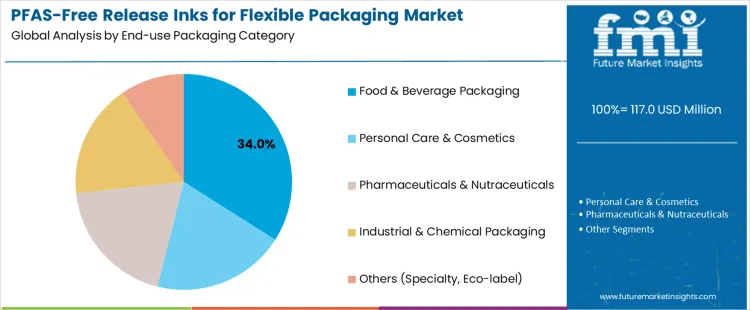
Flexible pouches account for about 34% of demand because they represent the largest and fastest growing flexible packaging format across food, personal care, and household products. Pouches rely on release inks for controlled opening, sealing performance, and machinability during filling and forming operations. High production volumes and standardized pouch structures favor early transition to PFAS free systems that meet compliance requirements without disrupting line efficiency. Brand owners prioritize pouches for regulatory alignment because they are often used for direct food contact, increasing exposure risk. The broad adoption of stand up and spouted pouches reinforces consistent ink consumption. Converters favor release inks that perform reliably across multilayer laminates used in pouch construction. These factors concentrate demand within flexible pouches as the leading format.
Wraps, films, bags, sachets, labels, and sleeves contribute secondary demand. Wraps and films emphasize surface release for high speed packaging but involve thinner ink layers. Bags and sachets operate at lower unit values. Labels and sleeves prioritize print quality over release function. Other flexible formats adopt PFAS free inks selectively. Packaging format leadership therefore reflects volume scale, food contact exposure, and operational criticality rather than total number of flexible packaging variants in use.
What Is Driving Leadership by Ink Technology in the PFAS Free Release Inks Market?

Water based PFAS free release inks account for about 42% of demand because they align with solvent reduction goals while delivering acceptable release performance. These inks support regulatory compliance, low odor operation, and compatibility with food packaging standards. Printers favor water based systems due to easier handling, lower fire risk, and integration with existing flexographic equipment. Advances in polymer chemistry have improved release behavior without fluorinated additives, supporting broader adoption. Water based inks also simplify waste management and reporting, which is increasingly important for converters serving multinational brands. Their suitability for high volume pouch and film printing reinforces leadership.
Solvent based, UV, EB curable, and bio based PFAS free inks serve complementary roles. Solvent systems offer robustness on challenging substrates but face emission constraints. UV and EB inks deliver fast curing but require capital investment. Bio based inks address sustainability positioning but face consistency limits. Ink technology leadership therefore reflects regulatory alignment, operational familiarity, and scalability rather than maximum release efficiency under niche conditions.
How Are PFAS-Free Release Inks Being Applied Across Flexible Packaging?
Use appears in food, beverage, and consumer goods packaging where non-stick performance is required without per- and polyfluoroalkyl substances (PFAS). Manufacturers adopt PFAS-free release inks for paper, films, and laminates to enable easy product release from molds, trays, or pouches while complying with regulatory and environmental standards. Packaging converters integrate these inks in high-speed printing and laminating processes to maintain clarity, adhesion, and functional performance. These applications reflect operational and safety priorities rather than aesthetic objectives, with adoption driven by compliance, sustainability, and production efficiency.
What Operational and Material Conditions Support Adoption of PFAS-Free Release Inks?
Selection aligns with substrates that require consistent adhesion, release performance, and compatibility with inks, adhesives, and coatings. Formulations are optimized for curing speed, thermal stability, and resistance to chemical interactions during packaging processes. Production lines monitor ink application, drying, and laminating conditions to maintain uniform coverage and functional reliability. Quality control evaluates release performance, adhesion, and regulatory compliance for food-contact and consumer safety standards. These conditions emerge from operational efficiency, material integrity, and environmental compliance priorities in structured flexible packaging workflows.
Which Practical Considerations Limit Wider Use of PFAS-Free Release Inks?
Performance may vary compared with traditional PFAS-based inks, requiring careful formulation and process control. Higher material costs can influence adoption in low-margin or high-volume packaging segments. Compatibility with diverse substrates, adhesives, and laminates must be validated to maintain release performance. Regulatory approvals and eco-certifications differ by region, adding operational oversight. These factors lead to selective deployment where sustainability, release reliability, and regulatory compliance justify incremental cost, process monitoring, and workflow adaptation in flexible packaging production.
What is the Demand for PFAS Free Release Inks for Flexible Packaging by Country?
| Country | CAGR (%) |
|---|---|
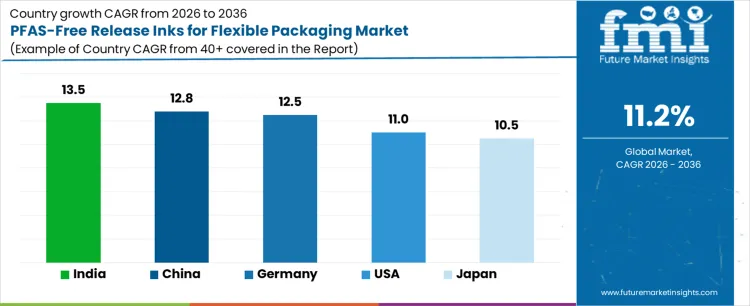
| Germany | 12.5% |
| USA | 11.0% |
| Japan | 10.5% |
| China | 12.8% |
| India | 13.5% |
The demand for PFAS free release inks for flexible packaging varies across countries, driven by sustainable packaging adoption, regulatory restrictions on PFAS, and growth in food and beverage packaging. India leads with a 13.5% CAGR, supported by rapid expansion of flexible packaging, rising consumer awareness, and adoption of environmentally friendly printing solutions. China follows at 12.8%, driven by large scale packaging production, regulatory compliance, and demand for sustainable materials. Germany records 12.5%, shaped by strict environmental regulations and mature packaging markets. The USA grows at 11.0%, reflecting adoption in food, personal care, and industrial packaging. Japan posts 10.5%, supported by regulatory compliance and sustainable packaging initiatives.
How are PFAS-free release inks expanding applications in flexible packaging in Germany?
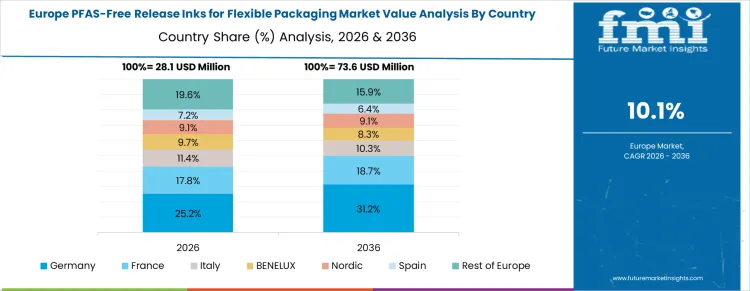
In Germany, the PFAS-free release inks for flexible packaging market is growing at a CAGR of 12.5% through 2036, driven by regulatory restrictions on PFAS chemicals, increasing demand for food-safe packaging, and growth in the processed food sector. Manufacturers are adopting PFAS-free inks to maintain release performance, enhance environmental compliance, and improve consumer safety. Demand is concentrated in industrial flexographic printing hubs, packaging production facilities, and food packaging plants. Compared to China, adoption emphasizes strict regulatory compliance and high-quality printing standards over high-volume deployment. Domestic suppliers provide chemically stable, high-performance inks suitable for recurring printing and packaging cycles.
- Industrial flexographic hubs, packaging facilities, and food plants drive adoption
- Inks ensure PFAS-free compliance and reliable release properties
- Domestic suppliers provide high-performance, chemically stable solutions
- Recurring printing and packaging cycles sustain adoption
How are consumer safety and packaging innovation driving growth in the United States?
In the United States, revenue is growing at a CAGR of 11% through 2036, supported by rising awareness of chemical safety, adoption of PFAS-free materials, and expansion of flexible food packaging. Manufacturers are integrating PFAS-free release inks to reduce chemical migration, maintain release performance, and comply with FDA regulations. Demand is concentrated in industrial printing hubs, flexible packaging facilities, and food processing plants. Compared to Germany, adoption emphasizes operational efficiency and high-volume industrial deployment. Domestic suppliers provide durable, food-safe inks suitable for recurring printing and packaging operations.
- Industrial printing hubs, flexible packaging facilities, and food processing plants drive adoption
- Inks reduce chemical migration and maintain release performance
- Domestic suppliers provide durable, food-safe solutions
- Recurring printing and packaging operations sustain adoption
How are industrial standards and packaging efficiency driving adoption in Japan?
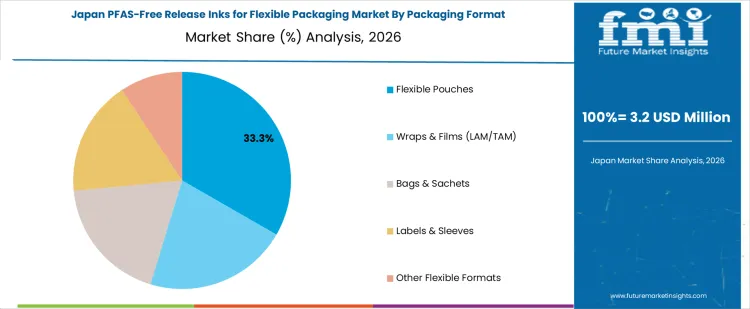
In Japan, the market is expanding at a CAGR of 10.5% through 2036, fueled by precision manufacturing, food safety standards, and high-quality packaging requirements. Manufacturers are adopting PFAS-free release inks to ensure chemical safety, maintain adhesion and release properties, and support sustainability initiatives. Demand is concentrated in flexographic printing hubs, industrial packaging facilities, and food processing clusters. Compared to India, adoption emphasizes precision and quality rather than high-volume production. Domestic suppliers provide high-performance, chemically compatible inks suitable for recurring printing and quality assurance cycles.
- Flexographic printing hubs, industrial packaging facilities, and food clusters drive adoption
- Inks maintain chemical safety and release properties
- Domestic suppliers provide high-performance, chemically compatible solutions
- Recurring printing and quality assurance cycles sustain adoption
How are large-scale production and environmental regulations supporting growth in China?
In China, the market is growing at a CAGR of 12.8% through 2036, supported by rapid expansion of flexible packaging, government restrictions on PFAS, and increasing food safety awareness. Manufacturers are integrating PFAS-free release inks to reduce chemical exposure, ensure reliable release performance, and meet regulatory standards. Demand is concentrated in industrial printing hubs, packaging production zones, and food manufacturing plants. Compared to Germany, adoption emphasizes high-volume production and large-scale integration. Domestic suppliers provide cost-effective, high-performance inks suitable for recurring printing and packaging operations.
- Industrial printing hubs, packaging production zones, and food plants drive adoption
- Inks reduce chemical exposure and maintain release performance
- Domestic suppliers provide cost-effective, high-performance solutions
- Recurring printing and packaging operations sustain adoption
How are sustainable packaging initiatives driving market growth in India?
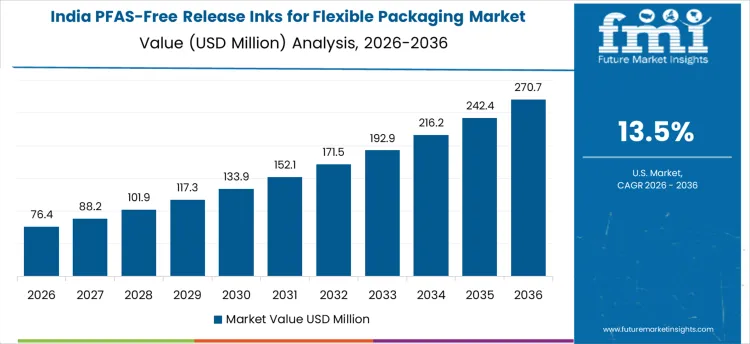
In India, the market is expanding at a CAGR of 13.5% through 2036, driven by increasing consumer awareness of chemical safety, growth in flexible food packaging, and regulatory encouragement for PFAS-free materials. Manufacturers are adopting PFAS-free release inks to ensure compliance, enhance release performance, and improve environmental sustainability. Demand is concentrated in industrial printing hubs, packaging facilities, and food processing plants. Compared to Japan, adoption emphasizes large-scale deployment and volume-driven production. Domestic suppliers provide high-performance, eco-friendly inks suitable for recurring printing and packaging cycles.
- Industrial printing hubs, packaging facilities, and food processing plants drive adoption
- Inks ensure compliance, improve release performance, and support sustainability
- Domestic suppliers provide high-performance, eco-friendly solutions
- Recurring printing and packaging cycles sustain adoption
Which Strategic Approaches Define Competition in the PFAS Free Release Inks for Flexible Packaging Market under Regulatory and Print Performance Constraints?
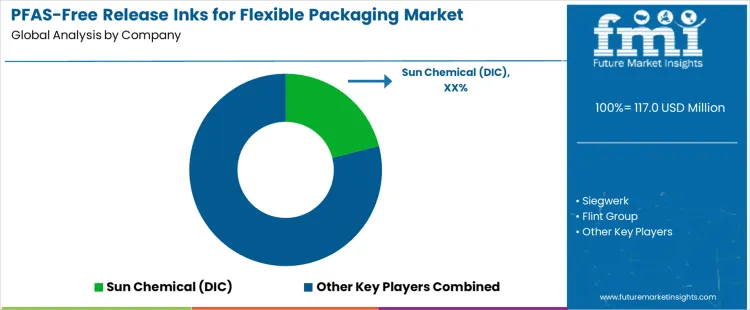
Competition in the PFAS free release inks for flexible packaging market is shaped by how effectively suppliers replace fluorinated slip and release functionality without disrupting print quality or press efficiency. Sun Chemical, part of DIC, and Siegwerk compete by rebuilding release behavior through alternative polymer architectures and surface energy control rather than direct chemical substitution. Their strategies emphasize consistency across substrates, controlled coefficient of friction, and predictable performance during lamination, slitting, and pouch forming. Flint Group positions PFAS free release inks within broader ink system transitions, supporting converters that must requalify entire print stacks to meet brand and regulatory requirements.
Converter alignment and implementation support define secondary competitive dynamics. INX International emphasizes press side robustness, offering PFAS free release inks designed to tolerate process variability and mixed substrate portfolios. Hubergroup competes through formulation discipline and documentation strength, targeting applications subject to heightened brand owner audits and food contact scrutiny. Across the market, strategies prioritize conservative reformulation, extensive press trials, and coordination with adhesives and films to manage downstream interactions. Competitive advantage depends on minimizing disruption during regulatory driven changeovers, maintaining print efficiency, and providing confidence that release performance remains stable over time.
Key Players in the PFAS Free Release Inks for Flexible Packaging Market
- Sun Chemical (DIC)
- Siegwerk
- Flint Group
- INX International
- Hubergroup
Scope of the Report
| Items | Values |
|---|---|
| Quantitative Units | USD million |
| Type | Water-based PFAS-free release inks, solvent-based PFAS-free release inks, UV and EB curable PFAS-free inks, bio-based PFAS-free release inks |
| Application | Flexible pouches, wraps and films, bags and sachets, labels and sleeves, other flexible packaging formats |
| End User | Flexible packaging converters, food and beverage brand owners, personal care and cosmetics packaging producers, pharmaceutical and nutraceutical packaging manufacturers |
| Regions Covered | Asia Pacific, Europe, North America, Latin America, Middle East & Africa |
| Countries Covered | India, China, Germany, USA, Japan, and other major flexible packaging production markets |
| Key Companies Profiled | Sun Chemical (DIC), Siegwerk, Flint Group, INX International, Hubergroup |
| Additional Attributes | Dollar sales by packaging format and ink technology, regional adoption trends linked to PFAS regulation and food contact compliance, competitive landscape based on release performance parity and reformulation capability, validation and qualification requirements across flexible packaging lines, compatibility with laminates, adhesives, and high-speed converting processes |
Frequently Asked Questions
How big is the pfas-free release inks for flexible packaging market in 2026?
The global pfas-free release inks for flexible packaging market is estimated to be valued at USD 117.0 million in 2026.
What will be the size of pfas-free release inks for flexible packaging market in 2036?
The market size for the pfas-free release inks for flexible packaging market is projected to reach USD 338.2 million by 2036.
How much will be the pfas-free release inks for flexible packaging market growth between 2026 and 2036?
The pfas-free release inks for flexible packaging market is expected to grow at a 11.2% CAGR between 2026 and 2036.
What are the key product types in the pfas-free release inks for flexible packaging market?
The key product types in pfas-free release inks for flexible packaging market are flexible pouches, wraps & films (lam/tam), bags & sachets, labels & sleeves and other flexible formats.
Which ink technology segment to contribute significant share in the pfas-free release inks for flexible packaging market in 2026?
In terms of ink technology, water-based pfas-free release inks segment to command 42.0% share in the pfas-free release inks for flexible packaging market in 2026.
Preview the report firsthand - request a free sample
Get SampleGet the brochure for pricing and purchase details.
Get PDFTable of Content
- Executive Summary
- Global Market Outlook
- Demand-side Trends
- Supply-side Trends
- Technology Roadmap Analysis
- Analysis and Recommendations
- Market Overview
- Market Coverage / Taxonomy
- Market Definition / Scope / Limitations
- Market Background
- Market Dynamics
- Drivers
- Restraints
- Opportunity
- Trends
- Scenario Forecast
- Demand in Optimistic Scenario
- Demand in Likely Scenario
- Demand in Conservative Scenario
- Opportunity Map Analysis
- Product Life Cycle Analysis
- Supply Chain Analysis
- Investment Feasibility Matrix
- Value Chain Analysis
- PESTLE and Porter’s Analysis
- Regulatory Landscape
- Regional Parent Market Outlook
- Production and Consumption Statistics
- Import and Export Statistics
- Market Dynamics
- Global Market Analysis 2021 to 2025 and Forecast, 2026 to 2036
- Historical Market Size Value (USD Million) Analysis, 2021 to 2025
- Current and Future Market Size Value (USD Million) Projections, 2026 to 2036
- Y-o-Y Growth Trend Analysis
- Absolute $ Opportunity Analysis
- Global Market Pricing Analysis 2021 to 2025 and Forecast 2026 to 2036
- Global Market Analysis 2021 to 2025 and Forecast 2026 to 2036, By Packaging Format
- Introduction / Key Findings
- Historical Market Size Value (USD Million) Analysis By Packaging Format , 2021 to 2025
- Current and Future Market Size Value (USD Million) Analysis and Forecast By Packaging Format , 2026 to 2036
- Flexible Pouches
- Wraps & Films (LAM/TAM)
- Bags & Sachets
- Labels & Sleeves
- Other Flexible Formats
- Flexible Pouches
- Y-o-Y Growth Trend Analysis By Packaging Format , 2021 to 2025
- Absolute $ Opportunity Analysis By Packaging Format , 2026 to 2036
- Global Market Analysis 2021 to 2025 and Forecast 2026 to 2036, By Ink Technology
- Introduction / Key Findings
- Historical Market Size Value (USD Million) Analysis By Ink Technology, 2021 to 2025
- Current and Future Market Size Value (USD Million) Analysis and Forecast By Ink Technology, 2026 to 2036
- Water-Based PFAS-Free Release Inks
- Solvent-Based PFAS-Free Release Inks
- UV and EB Curable PFAS-Free Inks
- Bio-Based PFAS-Free Release Inks
- Water-Based PFAS-Free Release Inks
- Y-o-Y Growth Trend Analysis By Ink Technology, 2021 to 2025
- Absolute $ Opportunity Analysis By Ink Technology, 2026 to 2036
- Global Market Analysis 2021 to 2025 and Forecast 2026 to 2036, By End-use Packaging Category
- Introduction / Key Findings
- Historical Market Size Value (USD Million) Analysis By End-use Packaging Category, 2021 to 2025
- Current and Future Market Size Value (USD Million) Analysis and Forecast By End-use Packaging Category, 2026 to 2036
- Food & Beverage Packaging
- Personal Care & Cosmetics
- Pharmaceuticals & Nutraceuticals
- Industrial & Chemical Packaging
- Others (Specialty, Eco-label)
- Food & Beverage Packaging
- Y-o-Y Growth Trend Analysis By End-use Packaging Category, 2021 to 2025
- Absolute $ Opportunity Analysis By End-use Packaging Category, 2026 to 2036
- Global Market Analysis 2021 to 2025 and Forecast 2026 to 2036, By Region
- Introduction
- Historical Market Size Value (USD Million) Analysis By Region, 2021 to 2025
- Current Market Size Value (USD Million) Analysis and Forecast By Region, 2026 to 2036
- North America
- Latin America
- Western Europe
- Eastern Europe
- East Asia
- South Asia and Pacific
- Middle East & Africa
- Market Attractiveness Analysis By Region
- North America Market Analysis 2021 to 2025 and Forecast 2026 to 2036, By Country
- Historical Market Size Value (USD Million) Trend Analysis By Market Taxonomy, 2021 to 2025
- Market Size Value (USD Million) Forecast By Market Taxonomy, 2026 to 2036
- By Country
- USA
- Canada
- Mexico
- By Packaging Format
- By Ink Technology
- By End-use Packaging Category
- By Country
- Market Attractiveness Analysis
- By Country
- By Packaging Format
- By Ink Technology
- By End-use Packaging Category
- Key Takeaways
- Latin America Market Analysis 2021 to 2025 and Forecast 2026 to 2036, By Country
- Historical Market Size Value (USD Million) Trend Analysis By Market Taxonomy, 2021 to 2025
- Market Size Value (USD Million) Forecast By Market Taxonomy, 2026 to 2036
- By Country
- Brazil
- Chile
- Rest of Latin America
- By Packaging Format
- By Ink Technology
- By End-use Packaging Category
- By Country
- Market Attractiveness Analysis
- By Country
- By Packaging Format
- By Ink Technology
- By End-use Packaging Category
- Key Takeaways
- Western Europe Market Analysis 2021 to 2025 and Forecast 2026 to 2036, By Country
- Historical Market Size Value (USD Million) Trend Analysis By Market Taxonomy, 2021 to 2025
- Market Size Value (USD Million) Forecast By Market Taxonomy, 2026 to 2036
- By Country
- Germany
- UK
- Italy
- Spain
- France
- Nordic
- BENELUX
- Rest of Western Europe
- By Packaging Format
- By Ink Technology
- By End-use Packaging Category
- By Country
- Market Attractiveness Analysis
- By Country
- By Packaging Format
- By Ink Technology
- By End-use Packaging Category
- Key Takeaways
- Eastern Europe Market Analysis 2021 to 2025 and Forecast 2026 to 2036, By Country
- Historical Market Size Value (USD Million) Trend Analysis By Market Taxonomy, 2021 to 2025
- Market Size Value (USD Million) Forecast By Market Taxonomy, 2026 to 2036
- By Country
- Russia
- Poland
- Hungary
- Balkan & Baltic
- Rest of Eastern Europe
- By Packaging Format
- By Ink Technology
- By End-use Packaging Category
- By Country
- Market Attractiveness Analysis
- By Country
- By Packaging Format
- By Ink Technology
- By End-use Packaging Category
- Key Takeaways
- East Asia Market Analysis 2021 to 2025 and Forecast 2026 to 2036, By Country
- Historical Market Size Value (USD Million) Trend Analysis By Market Taxonomy, 2021 to 2025
- Market Size Value (USD Million) Forecast By Market Taxonomy, 2026 to 2036
- By Country
- China
- Japan
- South Korea
- By Packaging Format
- By Ink Technology
- By End-use Packaging Category
- By Country
- Market Attractiveness Analysis
- By Country
- By Packaging Format
- By Ink Technology
- By End-use Packaging Category
- Key Takeaways
- South Asia and Pacific Market Analysis 2021 to 2025 and Forecast 2026 to 2036, By Country
- Historical Market Size Value (USD Million) Trend Analysis By Market Taxonomy, 2021 to 2025
- Market Size Value (USD Million) Forecast By Market Taxonomy, 2026 to 2036
- By Country
- India
- ASEAN
- Australia & New Zealand
- Rest of South Asia and Pacific
- By Packaging Format
- By Ink Technology
- By End-use Packaging Category
- By Country
- Market Attractiveness Analysis
- By Country
- By Packaging Format
- By Ink Technology
- By End-use Packaging Category
- Key Takeaways
- Middle East & Africa Market Analysis 2021 to 2025 and Forecast 2026 to 2036, By Country
- Historical Market Size Value (USD Million) Trend Analysis By Market Taxonomy, 2021 to 2025
- Market Size Value (USD Million) Forecast By Market Taxonomy, 2026 to 2036
- By Country
- Kingdom of Saudi Arabia
- Other GCC Countries
- Turkiye
- South Africa
- Other African Union
- Rest of Middle East & Africa
- By Packaging Format
- By Ink Technology
- By End-use Packaging Category
- By Country
- Market Attractiveness Analysis
- By Country
- By Packaging Format
- By Ink Technology
- By End-use Packaging Category
- Key Takeaways
- Key Countries Market Analysis
- USA
- Pricing Analysis
- Market Share Analysis, 2025
- By Packaging Format
- By Ink Technology
- By End-use Packaging Category
- Canada
- Pricing Analysis
- Market Share Analysis, 2025
- By Packaging Format
- By Ink Technology
- By End-use Packaging Category
- Mexico
- Pricing Analysis
- Market Share Analysis, 2025
- By Packaging Format
- By Ink Technology
- By End-use Packaging Category
- Brazil
- Pricing Analysis
- Market Share Analysis, 2025
- By Packaging Format
- By Ink Technology
- By End-use Packaging Category
- Chile
- Pricing Analysis
- Market Share Analysis, 2025
- By Packaging Format
- By Ink Technology
- By End-use Packaging Category
- Germany
- Pricing Analysis
- Market Share Analysis, 2025
- By Packaging Format
- By Ink Technology
- By End-use Packaging Category
- UK
- Pricing Analysis
- Market Share Analysis, 2025
- By Packaging Format
- By Ink Technology
- By End-use Packaging Category
- Italy
- Pricing Analysis
- Market Share Analysis, 2025
- By Packaging Format
- By Ink Technology
- By End-use Packaging Category
- Spain
- Pricing Analysis
- Market Share Analysis, 2025
- By Packaging Format
- By Ink Technology
- By End-use Packaging Category
- France
- Pricing Analysis
- Market Share Analysis, 2025
- By Packaging Format
- By Ink Technology
- By End-use Packaging Category
- India
- Pricing Analysis
- Market Share Analysis, 2025
- By Packaging Format
- By Ink Technology
- By End-use Packaging Category
- ASEAN
- Pricing Analysis
- Market Share Analysis, 2025
- By Packaging Format
- By Ink Technology
- By End-use Packaging Category
- Australia & New Zealand
- Pricing Analysis
- Market Share Analysis, 2025
- By Packaging Format
- By Ink Technology
- By End-use Packaging Category
- China
- Pricing Analysis
- Market Share Analysis, 2025
- By Packaging Format
- By Ink Technology
- By End-use Packaging Category
- Japan
- Pricing Analysis
- Market Share Analysis, 2025
- By Packaging Format
- By Ink Technology
- By End-use Packaging Category
- South Korea
- Pricing Analysis
- Market Share Analysis, 2025
- By Packaging Format
- By Ink Technology
- By End-use Packaging Category
- Russia
- Pricing Analysis
- Market Share Analysis, 2025
- By Packaging Format
- By Ink Technology
- By End-use Packaging Category
- Poland
- Pricing Analysis
- Market Share Analysis, 2025
- By Packaging Format
- By Ink Technology
- By End-use Packaging Category
- Hungary
- Pricing Analysis
- Market Share Analysis, 2025
- By Packaging Format
- By Ink Technology
- By End-use Packaging Category
- Kingdom of Saudi Arabia
- Pricing Analysis
- Market Share Analysis, 2025
- By Packaging Format
- By Ink Technology
- By End-use Packaging Category
- Turkiye
- Pricing Analysis
- Market Share Analysis, 2025
- By Packaging Format
- By Ink Technology
- By End-use Packaging Category
- South Africa
- Pricing Analysis
- Market Share Analysis, 2025
- By Packaging Format
- By Ink Technology
- By End-use Packaging Category
- USA
- Market Structure Analysis
- Competition Dashboard
- Competition Benchmarking
- Market Share Analysis of Top Players
- By Regional
- By Packaging Format
- By Ink Technology
- By End-use Packaging Category
- Competition Analysis
- Competition Deep Dive
- Sun Chemical (DIC)
- Overview
- Product Portfolio
- Profitability by Market Segments (Product/Age /Sales Channel/Region)
- Sales Footprint
- Strategy Overview
- Marketing Strategy
- Product Strategy
- Channel Strategy
- Siegwerk
- Flint Group
- INX International
- Hubergroup
- Sun Chemical (DIC)
- Competition Deep Dive
- Assumptions & Acronyms Used
- Research Methodology


