

- Industry Size (2026)
- USD 26946.4 Mn
- Forecast (2036)
- USD 38379.3 Mn
- CAGR (2026 to 2036)
- 3.6%
USA Flexible Plastic Packaging Market Forecast and Outlook 2026 to 2036
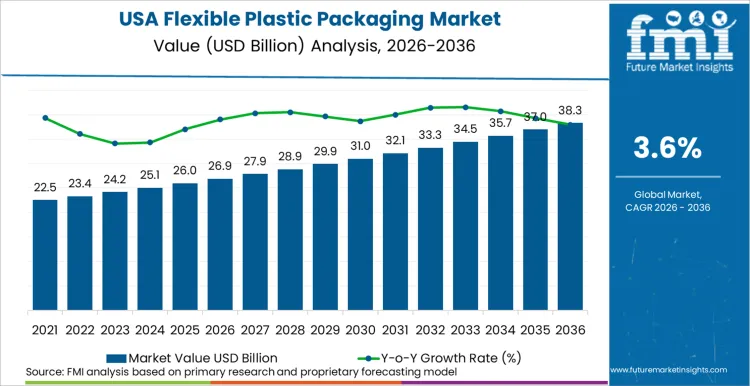
The USA flexible plastic packaging sector is on track to achieve a valuation of USD 38,379.3 million by 2036, expanding from USD 26,946.4 million in 2026 at a CAGR of 3.6%. As per Future Market Insights, expansion is structurally underpinned by the material substitution trend from rigid to flexible formats across food, healthcare, and e-commerce packaging, combined with the industry's response to state-level EPR legislation and recyclability mandates.
The Flexible Packaging Association (FPA) reported that USA flexible packaging shipments reached USD 39.7 billion in 2024, with flexible formats increasingly displacing corrugated and rigid containers in protein, snack, and healthcare packaging applications. This substitution trend compels flexible packaging converters to invest in mono-material recyclable films, high-barrier flexible structures, and recycle-ready laminations. Simultaneously, state-level EPR laws in California, Oregon, Colorado, and Maine are creating binding producer responsibility frameworks that impose recyclability and recycled content requirements on flexible packaging.
Dan Felton, President and CEO of the Flexible Packaging Association, stated: 'We are chasing corrugated. I have some belief that we may overtake corrugated sometime in the US in the next five years, perhaps.' This confirms that the USA flexible packaging industry views itself as a structural growth category taking share from rigid formats rather than a mature sector competing within existing boundaries. FMI is of the opinion that the Amcor-Berry Global combination creates the scale necessary to fund the recyclability R&D and mono-material conversion investments required to meet EPR mandates while maintaining competitive pricing against rigid alternatives.
The competitive landscape in 2025 and 2026 has been reshaped by transformational M&A and capacity investment. Amcor and Berry Global announced a definitive agreement to combine in an all-stock transaction with approximately USD 37 billion in enterprise value in November 2024, with closing expected mid-2025. Sonoco Products entered into a definitive agreement to sell its Thermoformed and Flexibles Packaging (TFP) business to Toppan Holdings for approximately USD 1.8 billion in December 2024, with closing in April 2025.
Amcor announced one of its largest-ever investments to install new equipment for flexible packaging capacity expansion through the first half of 2026. Peter Konieczny, CEO of Amcor, stated that 'this transformational acquisition establishes Amcor as the global leader in consumer packaging and dispensing solutions for nutrition and health.' As per FMI, this combination of mega-mergers, divestitures, and capacity expansion confirms that the USA flexible plastic packaging market is entering a consolidation phase where only companies with scale economics and recyclability capabilities can compete effectively under the emerging EPR regulatory framework.
Key Takeaways
The USA flexible plastic packaging market is shaped by a consolidating power structure where Amcor (post-Berry Global merger), Sealed Air (CD&R-owned), Sonoco (post-TFP divestiture), and ProAmpac command the majority of converted flexible film supply. FMI analysts observe that the Amcor-Berry combination creates a company with unmatched scale in both flexible films and dispensing solutions, potentially setting pricing benchmarks that mid-tier converters cannot match.
Pricing asymmetry in the USA flexible plastic packaging market exists between commodity PE films (USD 1.50 to 2.50 per kg) and high-barrier, mono-material recyclable laminates (USD 4 to 8 per kg). As per FMI, EPR mandates will progressively shift demand toward the premium recyclable segment, compressing margins for converters who cannot offer recycle-ready alternatives.
Sourcing fragility is concentrated in resin supply chain volatility and recycled content availability. The USA flexible packaging industry consumes over 5 million tons of PE and PP resins annually, with pricing tied to natural gas and crude oil markets. Recycled flexible film content remains limited to below 10% of total supply due to contamination challenges. FMI opines that mechanical and chemical recycling capacity for flexible films will be the binding constraint for EPR compliance over the next five years.
Brand and compliance risks center on the patchwork of state-level EPR laws that create different recyclability and recycled content requirements across California, Oregon, Colorado, and Maine. Brand owners distributing nationally must design packaging to meet the most stringent state requirement, effectively making California's SB 54 the de facto national standard. FMI is of the opinion that federal packaging legislation, if enacted, would simplify compliance but is unlikely before 2028.
Geographic leverage within the USA is concentrated in the food, healthcare, and e-commerce sectors, which collectively drive over 80% of flexible packaging demand. The Southeast and Midwest account for the largest flexible packaging manufacturing capacity, while California is the largest consumer market and the most stringent regulatory environment.
The executive reframing for the USA flexible plastic packaging market is that recyclability compliance is now a market access requirement, not a sustainability initiative. FMI analysts emphasize that packaging procurement executives must evaluate flexible packaging suppliers on mono-material recyclability capability, recycled content sourcing, and EPR compliance documentation alongside traditional cost and barrier performance metrics.
Summary of USA Flexible Plastic Packaging Market
What Is Growth Outlook for USA Flexible Plastic Packaging Market as per Future Market Insights Projection?
Future Market Insights projects the USA flexible plastic packaging market to expand at a CAGR of 3.6% from 2026 to 2036, increasing from USD 26,946.4 Million in 2026 to USD 38,379.3 Million by 2036.
FMI Research Approach: FMI proprietary forecasting model based on FPA shipment data, rigid-to-flexible substitution rates, and EPR compliance cost modeling.
How Do FMI Analysts Perceive USA Flexible Plastic Packaging Market to Evolve?
FMI analysts perceive the market evolving toward mono-material recyclable films and high-barrier flexible structures where EPR compliance, recycled content mandates, and post-merger scale economics determine competitive positioning.
FMI Research Approach: State-level EPR legislation tracking (CA SB 54, OR, CO, ME) and Amcor-Berry merger filings.
Which Country Holds Largest Share in Global USA Flexible Plastic Packaging Market?
The United States is the sole country in this market scope, with the Southeast and Midwest hosting the largest manufacturing capacity and California representing the largest consumer market.
FMI Research Approach: FMI state-level revenue modeling by flexible packaging shipments and manufacturing facility density.
How Large Will USA Flexible Plastic Packaging Market Be by 2036?
The USA flexible plastic packaging market is projected to reach USD 38,379.3 Million by 2036.
FMI Research Approach: FMI long-term revenue forecast derived from food packaging demand projections and material substitution rate modeling.
What Is Definition of USA Flexible Plastic Packaging Market?
The USA flexible plastic packaging market includes revenue from converted flexible plastic films, pouches, bags, wraps, and laminates sold for food, healthcare, personal care, and industrial packaging applications within the United States.
FMI Research Approach: FMI market taxonomy and inclusion-exclusion framework.
What Are Globally Unique Trends Shaping USA Flexible Plastic Packaging Market?
Globally unique trends include the Amcor-Berry Global mega-merger creating a USD 37 billion packaging leader, state-level EPR legislation establishing binding recyclability mandates, and the FPA forecast that flexible packaging may overtake corrugated in USA market share.
FMI Research Approach: Amcor-Berry merger filings and FPA annual industry data.
USA Flexible Plastic Packaging Market Key Takeaways
| Metric | Details |
|---|---|
| Industry Size (2026) | USD 26,946.4 Million |
| Industry Value (2036) | USD 38,379.3 Million |
| CAGR (2026 to 2036) | 3.6% |
Source: Future Market Insights (FMI) analysis, based on proprietary forecasting model and primary research
Key Success Factors Driving the USA Flexible Plastic Packaging Sector
Adoption of Recyclable Materials in the USA Flexible Plastic Packaging Industry
The USA flexible plastic packaging industry has gained more recycle quality as it leads ahead to join support for the environment. Major brand leaders including brands like PepsiCo and Unilever that set the first front in pioneering single-material pouches along with other varieties of plastics -based package structures have been well-embraced consumers demand for greener packaging options for circulation and nondeposition wastes from landfills.
Growth of E-commerce and Impact on Flexible Packaging
The e-commerce industry in the United States has been a major boost to the flexible plastic packaging market. E-commerce retailers require strong and protective packaging solutions to shield against the stresses of transportation, including bubble mailers and flexible polybags. Companies like Amazon and Walmart have taken lightweight, cost-effective packing solutions that can ensure the safe delivery of products while minimizing shipment costs and environmental impact.
Challenges in Recycling Flexible Plastic Packaging
Recycling flexible plastic packaging is a huge challenge even in the USA market. One of the reasons is that the multi-layered structures commonly used to provide improved barrier properties hinder recycling. Now, new technologies are emerging in the direction of developing single-material recyclable packaging solutions.
The real improvement, however, requires huge investment in recycling infrastructure. Consumer education is also crucial regarding appropriate disposal methods for the improvement of recycling rates.
Sales Analysis of USA Flexible Plastic Packaging (2021 to 2025) vs Demand Forecast (2026 to 2036)
Increased adoption by the food and beverages industry, based on requirements in that area, such as longer shelf lives, ease in portability and consumer convenience for plastic packaging Flexible, mainly The market should be expected to continue shifting, especially towards solutions with recyclable and compostable packaging as more prominence is given on being sustainable; The market growth rate will exhibit an exponential scale till 2035, where consumer preference combined with environmental stringent regulations are continuously being increased.
With greater dependence on advancements in material technology and recycling capacities, future growth of flexible plastic packaging is poised. Because the importance given by brands towards green practices would increasingly require inclusion of flexible plastic packaging in the strategy for a sustainable product to address the requirement set by both regulators and consumers, sustainability becomes the continuing impetus behind a market which keeps itself changing in line with developing trends.
Market Structure and Concentration Analysis for USA Flexible Plastic Packaging
Tier 1 company leaders are characterized by high production technology and a wide product portfolio. These market leaders are distinguished by their extensive expertise in manufacturing and reconditioning across multiple packaging formats and a broad geographical reach, underpinned by a robust consumer base.
They provide a wide range of series including reconditioning, recycling, and manufacturing utilizing the latest technology and meeting the regulatory standards providing the highest quality. Prominent companies within Tier 1 include Berry Global Group, Inc., Sonoco Products Company, Amcor Group GmbH, Sealed Air Corporation, Novolex Holdings Inc.
Tier 2 companies are characterized by a strong presence overseas and strong market knowledge. These market players have good technology and ensure regulatory compliance but may not have advanced technology and wide USA reach. Prominent companies in Tier 2 include Printpack Inc., ProAmpac LLC, C-P Flexible Packaging, American Packaging Corporation, Sigma Plastics Group Inc.
Tier 3 includes the majority of small-scale companies operating at the local presence and serving niche markets. These companies are notably oriented towards fulfilling local market demands and are consequently classified within the tier 3 share segment.
They are small-scale players and have limited geographical reach. Tier 3, within this context, is recognized as an unorganized market, denoting a sector characterized by a lack of extensive structure and formalization when compared to organized competitors.
USA Flexible Plastic Packaging Market by Material Type, Format, Application, and End Use
The section contains information about the leading segments in the industry. By material type, oil base polymers are projected to grow at a CAGR of 3.9% through 2025 to 2036. Additionally, food end uses are predicted to grow at a CAGR of 5.1%.
MAP (Modified Atmospheric Packaging) by Packaging Type to Dominate the Flexible Plastic Packaging Market in terms of Value
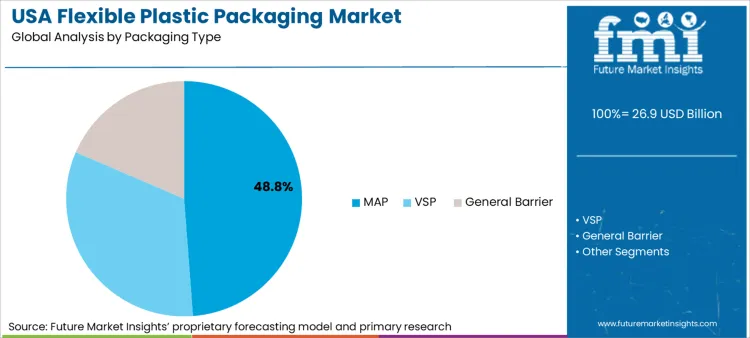
| Packaging Type | Value Share (2036) |
|---|---|
| MAP (Modified Atmospheric Packaging) | 48.8% |
MAP in the United States is expected to be market leader, in terms of value. There is now a significant drive towards food safety and quality, with Modified Atmosphere Packaging being applied on premium foodstuffs like fresh poultry, seafood, and artisan cheeses. They ensure that there's a controlled atmosphere which keeps the food fresh and increases shelf life.
For instance, MAP is commonly applied in the United States in organic meat packaging as well as pre-cut meal kits that offer convenience along with quality maintenance. The pattern of using MAP is also going to expand with fresh-cut fruits and ready-to-eat meals following consumer demand for freshness and convenience.
Films and Wraps are the Most Preferred Flexible Plastic Packaging Products
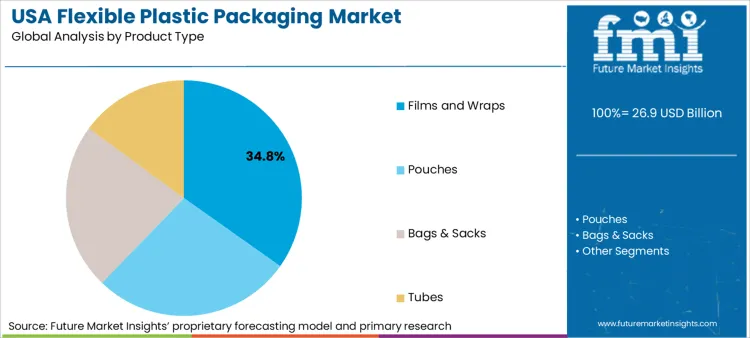
| Product Type | Value Share (2036) |
|---|---|
| Films and Wraps | 34.8% |
Films and wraps are the largest products in flexible plastic packaging in the USA. These are widely used in baked goods, frozen foods, and fresh fruits and vegetables due to their superior moisture and oxygen barrier property. For instance, polypropylene films extensively find usage for snack packaging because they maintain crunchiness and freshness.
Stretch films are widely used in the logistics and industrial sectors to hold pallet loads in place and ensure products remain safe in transit. Following the USA's sustainability goals, the demand for recyclable and biodegradable films is rising to meet both consumer and regulatory expectations for more sustainable packaging options.
Competitive Landscape of the USA Flexible Plastic Packaging Industry
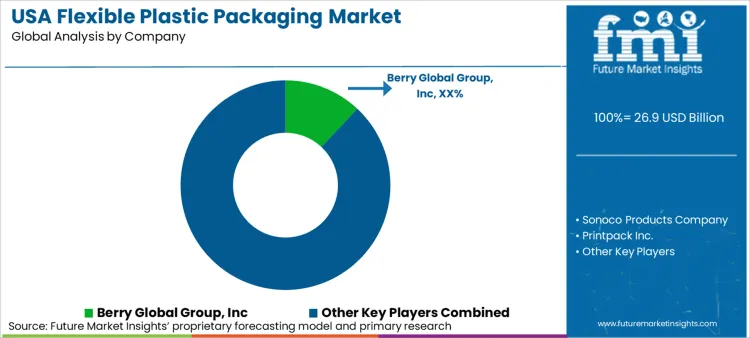
Key players operating in the flexible plastic packaging market are investing in the development of innovative sustainable solutions and also entering into partnerships. Key flexible plastic packaging providers have also been acquiring smaller players to grow their presence to further penetrate the flexible plastic packaging market across multiple regions.
Recent Developments:
- In November 2024, Amcor and Berry Global announced a definitive agreement to combine in an all-stock transaction with approximately USD 37 billion in enterprise value, creating the global leader in consumer packaging.
- In December 2024, Sonoco Products entered into a definitive agreement to sell its Thermoformed and Flexibles Packaging business to Toppan Holdings for approximately USD 1.8 billion, with closing in April 2025.
- In November 2025, Amcor announced one of its largest-ever investments to install new state-of-the-art equipment for flexible packaging capacity expansion through the first half of 2026.
Key Companies Operating in the USA Flexible Plastic Packaging Sector
- Berry Global Group, Inc.
- Sonoco Products Company
- Printpack Inc.
- ProAmpac LLC
- Novolex Holdings Inc.
- Amcor Group GmbH
- C-P Flexible Packaging
- American Packaging Corporation
- Sealed Air Corporation
- Sigma Plastics Group Inc.
Market Definition
The USA flexible plastic packaging market represents revenue generated from the manufacture and sale of converted flexible plastic films, pouches, bags, wraps, and laminates for food, healthcare, personal care, and industrial packaging applications within the United States. The market measures the value of printed and laminated flexible packaging sold to brand owners, food manufacturers, and healthcare companies.
Inclusions cover stand-up pouches and flat pouches, flexible film laminates (multi-layer and mono-material), shrink and stretch films for food packaging, medical and pharmaceutical flexible packaging, e-commerce mailer bags, and recycle-ready and recycled content flexible films. Pre-made and form-fill-seal formats are included.
Exclusions include rigid plastic containers (bottles, jars, tubs), corrugated packaging, paper-based flexible packaging without a plastic component, and agricultural films. Raw resin sales not converted into packaging and industrial stretch wrap for pallet unitization are outside the scope.
Scope of Report
| Items | Values |
|---|---|
| Quantitative Units (2026) | USD 26,946.4 Million |
| Product Type | Stand-Up Pouches, Flat Pouches, Flexible Laminates, Shrink and Stretch Films, Medical Flexible Packaging, E-Commerce Mailers |
| Material Type | PE (LDPE, LLDPE, HDPE), PP (OPP, BOPP, CPP), PET, Nylon/PA, EVOH Barrier, Recycled Content Films |
| End-Use / Channel | Food and Beverage Brands, Healthcare and Pharmaceutical, Personal Care and Household, E-Commerce, Pet Food and Animal Nutrition |
| Regions Covered | Northeast USA, Southeast USA, Midwest USA, Western USA, Southwest USA |
| Countries Covered | United States (50 states) |
| Key Companies Profiled | Amcor (post-Berry merger), Sealed Air (CD&R), ProAmpac, Toppan (post-Sonoco TFP), Novolex, TC Transcontinental, Coveris |
| Additional Attributes | Revenue analysis by end-use sector and film structure, EPR compliance readiness tracking, mono-material recyclability adoption rates, recycled content sourcing analysis, and post-merger competitive landscape assessment |
Key Segments in the USA Flexible Plastic Packaging Industry
By Product Type:
- Stand-Up Pouches
- Flat Pouches and Sachets
- Flexible Film Laminates
- Shrink and Stretch Films
- Medical and Pharmaceutical Flexible Packaging
E-Commerce Mailers and Bags
- By Material Type:
- Polyethylene (PE) Films
- Polypropylene (PP/OPP/BOPP) Films
- PET Films
- Nylon and PA Films
- EVOH Barrier Films
- Mono-Material Recyclable Films
By Region:
- Northeast USA
- Southeast USA
- Midwest USA
- Western USA
- Southwest USA
Bibliography
- Amcor plc. (2024, November). Berry Global combination agreement announcement. Amcor Newsroom.
- Sonoco Products Company. (2024, December). TFP business sale to Toppan Holdings announcement. Sonoco Investor Relations.
- Flexible Packaging Association. (2025, March). 2024 USA flexible packaging shipment data. FPA.
- Amcor plc. (2025, November). North American flexible packaging capacity expansion investment announcement. Amcor Newsroom.
Frequently Asked Questions
What is the current market size for USA Flexible Plastic Packaging?
The market is valued at USD 26,946.4 Million in 2026, driven by rigid-to-flexible substitution and EPR-mandated recyclability investment.
What is the projected CAGR?
The market is projected to grow at a CAGR of 3.6% from 2026 to 2036.
What are the fastest-growing segments?
Mono-material recyclable films and e-commerce flexible mailers are the fastest-growing segments, driven by EPR compliance and online retail expansion.
What are the primary market drivers?
Rigid-to-flexible material substitution, state-level EPR legislation, and the Amcor-Berry merger creating scale economics are the primary drivers.
Who are the leading suppliers?
Amcor (post-Berry merger), Sealed Air, ProAmpac, and Toppan are key players, differentiating through recyclable film technology, scale economics, and EPR compliance capability.
Preview the report firsthand - request a free sample
Get SampleGet the brochure for pricing and purchase details.
Get PDFTable of Content
- Executive Summary
- Global Market Outlook
- Demand-side Trends
- Supply-side Trends
- Technology Roadmap Analysis
- Analysis and Recommendations
- Market Overview
- Market Coverage / Taxonomy
- Market Definition / Scope / Limitations
- Research Methodology
- Chapter Orientation
- Analytical Lens and Working Hypotheses
- Market Structure, Signals, and Trend Drivers
- Benchmarking and Cross-market Comparability
- Market Sizing, Forecasting, and Opportunity Mapping
- Research Design and Evidence Framework
- Desk Research Programme (Secondary Evidence)
- Company Annual and Sustainability Reports
- Peer-reviewed Journals and Academic Literature
- Corporate Websites, Product Literature, and Technical Notes
- Earnings Decks and Investor Briefings
- Statutory Filings and Regulatory Disclosures
- Technical White Papers and Standards Notes
- Trade Journals, Industry Magazines, and Analyst Briefs
- Conference Proceedings, Webinars, and Seminar Materials
- Government Statistics Portals and Public Data Releases
- Press Releases and Reputable Media Coverage
- Specialist Newsletters and Curated Briefings
- Sector Databases and Reference Repositories
- FMI Internal Proprietary Databases and Historical Market Datasets
- Subscription Datasets and Paid Sources
- Social Channels, Communities, and Digital Listening Inputs
- Additional Desk Sources
- Expert Input and Fieldwork (Primary Evidence)
- Primary Modes
- Qualitative Interviews and Expert Elicitation
- Quantitative Surveys and Structured Data Capture
- Blended Approach
- Why Primary Evidence is Used
- Field Techniques
- Interviews
- Surveys
- Focus Groups
- Observational and In-context Research
- Social and Community Interactions
- Stakeholder Universe Engaged
- C-suite Leaders
- Board Members
- Presidents and Vice Presidents
- R&D and Innovation Heads
- Technical Specialists
- Domain Subject-matter Experts
- Scientists
- Physicians and Other Healthcare Professionals
- Governance, Ethics, and Data Stewardship
- Research Ethics
- Data Integrity and Handling
- Primary Modes
- Tooling, Models, and Reference Databases
- Desk Research Programme (Secondary Evidence)
- Data Engineering and Model Build
- Data Acquisition and Ingestion
- Cleaning, Normalisation, and Verification
- Synthesis, Triangulation, and Analysis
- Quality Assurance and Audit Trail
- Market Background
- Market Dynamics
- Drivers
- Restraints
- Opportunity
- Trends
- Scenario Forecast
- Demand in Optimistic Scenario
- Demand in Likely Scenario
- Demand in Conservative Scenario
- Opportunity Map Analysis
- Product Life Cycle Analysis
- Supply Chain Analysis
- Investment Feasibility Matrix
- Value Chain Analysis
- PESTLE and Porter’s Analysis
- Regulatory Landscape
- Regional Parent Market Outlook
- Production and Consumption Statistics
- Import and Export Statistics
- Market Dynamics
- Global Market Analysis 2021 to 2025 and Forecast, 2026 to 2036
- Historical Market Size Value (USD Million) Analysis, 2021 to 2025
- Current and Future Market Size Value (USD Million) Projections, 2026 to 2036
- Y-o-Y Growth Trend Analysis
- Absolute $ Opportunity Analysis
- Global Market Pricing Analysis 2021 to 2025 and Forecast 2026 to 2036
- Global Market Analysis 2021 to 2025 and Forecast 2026 to 2036, By Packaging Type
- Introduction / Key Findings
- Historical Market Size Value (USD Million) Analysis By Packaging Type , 2021 to 2025
- Current and Future Market Size Value (USD Million) Analysis and Forecast By Packaging Type , 2026 to 2036
- MAP
- VSP
- General Barrier
- MAP
- Y-o-Y Growth Trend Analysis By Packaging Type , 2021 to 2025
- Absolute $ Opportunity Analysis By Packaging Type , 2026 to 2036
- Global Market Analysis 2021 to 2025 and Forecast 2026 to 2036, By Product Type
- Introduction / Key Findings
- Historical Market Size Value (USD Million) Analysis By Product Type, 2021 to 2025
- Current and Future Market Size Value (USD Million) Analysis and Forecast By Product Type, 2026 to 2036
- Films and Wraps
- Pouches
- Bags & Sacks
- Tubes
- Films and Wraps
- Y-o-Y Growth Trend Analysis By Product Type, 2021 to 2025
- Absolute $ Opportunity Analysis By Product Type, 2026 to 2036
- Global Market Analysis 2021 to 2025 and Forecast 2026 to 2036, By Region
- Introduction
- Historical Market Size Value (USD Million) Analysis By Region, 2021 to 2025
- Current Market Size Value (USD Million) Analysis and Forecast By Region, 2026 to 2036
- North America
- Latin America
- Western Europe
- Eastern Europe
- East Asia
- South Asia and Pacific
- Middle East & Africa
- Market Attractiveness Analysis By Region
- North America Market Analysis 2021 to 2025 and Forecast 2026 to 2036, By Country
- Historical Market Size Value (USD Million) Trend Analysis By Market Taxonomy, 2021 to 2025
- Market Size Value (USD Million) Forecast By Market Taxonomy, 2026 to 2036
- By Country
- USA
- Canada
- Mexico
- By Packaging Type
- By Product Type
- By Country
- Market Attractiveness Analysis
- By Country
- By Packaging Type
- By Product Type
- Key Takeaways
- Latin America Market Analysis 2021 to 2025 and Forecast 2026 to 2036, By Country
- Historical Market Size Value (USD Million) Trend Analysis By Market Taxonomy, 2021 to 2025
- Market Size Value (USD Million) Forecast By Market Taxonomy, 2026 to 2036
- By Country
- Brazil
- Chile
- Rest of Latin America
- By Packaging Type
- By Product Type
- By Country
- Market Attractiveness Analysis
- By Country
- By Packaging Type
- By Product Type
- Key Takeaways
- Western Europe Market Analysis 2021 to 2025 and Forecast 2026 to 2036, By Country
- Historical Market Size Value (USD Million) Trend Analysis By Market Taxonomy, 2021 to 2025
- Market Size Value (USD Million) Forecast By Market Taxonomy, 2026 to 2036
- By Country
- Germany
- UK
- Italy
- Spain
- France
- Nordic
- BENELUX
- Rest of Western Europe
- By Packaging Type
- By Product Type
- By Country
- Market Attractiveness Analysis
- By Country
- By Packaging Type
- By Product Type
- Key Takeaways
- Eastern Europe Market Analysis 2021 to 2025 and Forecast 2026 to 2036, By Country
- Historical Market Size Value (USD Million) Trend Analysis By Market Taxonomy, 2021 to 2025
- Market Size Value (USD Million) Forecast By Market Taxonomy, 2026 to 2036
- By Country
- Russia
- Poland
- Hungary
- Balkan & Baltic
- Rest of Eastern Europe
- By Packaging Type
- By Product Type
- By Country
- Market Attractiveness Analysis
- By Country
- By Packaging Type
- By Product Type
- Key Takeaways
- East Asia Market Analysis 2021 to 2025 and Forecast 2026 to 2036, By Country
- Historical Market Size Value (USD Million) Trend Analysis By Market Taxonomy, 2021 to 2025
- Market Size Value (USD Million) Forecast By Market Taxonomy, 2026 to 2036
- By Country
- China
- Japan
- South Korea
- By Packaging Type
- By Product Type
- By Country
- Market Attractiveness Analysis
- By Country
- By Packaging Type
- By Product Type
- Key Takeaways
- South Asia and Pacific Market Analysis 2021 to 2025 and Forecast 2026 to 2036, By Country
- Historical Market Size Value (USD Million) Trend Analysis By Market Taxonomy, 2021 to 2025
- Market Size Value (USD Million) Forecast By Market Taxonomy, 2026 to 2036
- By Country
- India
- ASEAN
- Australia & New Zealand
- Rest of South Asia and Pacific
- By Packaging Type
- By Product Type
- By Country
- Market Attractiveness Analysis
- By Country
- By Packaging Type
- By Product Type
- Key Takeaways
- Middle East & Africa Market Analysis 2021 to 2025 and Forecast 2026 to 2036, By Country
- Historical Market Size Value (USD Million) Trend Analysis By Market Taxonomy, 2021 to 2025
- Market Size Value (USD Million) Forecast By Market Taxonomy, 2026 to 2036
- By Country
- Kingdom of Saudi Arabia
- Other GCC Countries
- Turkiye
- South Africa
- Other African Union
- Rest of Middle East & Africa
- By Packaging Type
- By Product Type
- By Country
- Market Attractiveness Analysis
- By Country
- By Packaging Type
- By Product Type
- Key Takeaways
- Key Countries Market Analysis
- USA
- Pricing Analysis
- Market Share Analysis, 2025
- By Packaging Type
- By Product Type
- Canada
- Pricing Analysis
- Market Share Analysis, 2025
- By Packaging Type
- By Product Type
- Mexico
- Pricing Analysis
- Market Share Analysis, 2025
- By Packaging Type
- By Product Type
- Brazil
- Pricing Analysis
- Market Share Analysis, 2025
- By Packaging Type
- By Product Type
- Chile
- Pricing Analysis
- Market Share Analysis, 2025
- By Packaging Type
- By Product Type
- Germany
- Pricing Analysis
- Market Share Analysis, 2025
- By Packaging Type
- By Product Type
- UK
- Pricing Analysis
- Market Share Analysis, 2025
- By Packaging Type
- By Product Type
- Italy
- Pricing Analysis
- Market Share Analysis, 2025
- By Packaging Type
- By Product Type
- Spain
- Pricing Analysis
- Market Share Analysis, 2025
- By Packaging Type
- By Product Type
- France
- Pricing Analysis
- Market Share Analysis, 2025
- By Packaging Type
- By Product Type
- India
- Pricing Analysis
- Market Share Analysis, 2025
- By Packaging Type
- By Product Type
- ASEAN
- Pricing Analysis
- Market Share Analysis, 2025
- By Packaging Type
- By Product Type
- Australia & New Zealand
- Pricing Analysis
- Market Share Analysis, 2025
- By Packaging Type
- By Product Type
- China
- Pricing Analysis
- Market Share Analysis, 2025
- By Packaging Type
- By Product Type
- Japan
- Pricing Analysis
- Market Share Analysis, 2025
- By Packaging Type
- By Product Type
- South Korea
- Pricing Analysis
- Market Share Analysis, 2025
- By Packaging Type
- By Product Type
- Russia
- Pricing Analysis
- Market Share Analysis, 2025
- By Packaging Type
- By Product Type
- Poland
- Pricing Analysis
- Market Share Analysis, 2025
- By Packaging Type
- By Product Type
- Hungary
- Pricing Analysis
- Market Share Analysis, 2025
- By Packaging Type
- By Product Type
- Kingdom of Saudi Arabia
- Pricing Analysis
- Market Share Analysis, 2025
- By Packaging Type
- By Product Type
- Turkiye
- Pricing Analysis
- Market Share Analysis, 2025
- By Packaging Type
- By Product Type
- South Africa
- Pricing Analysis
- Market Share Analysis, 2025
- By Packaging Type
- By Product Type
- USA
- Market Structure Analysis
- Competition Dashboard
- Competition Benchmarking
- Market Share Analysis of Top Players
- By Regional
- By Packaging Type
- By Product Type
- Competition Analysis
- Competition Deep Dive
- Berry Global Group, Inc
- Overview
- Product Portfolio
- Profitability by Market Segments (Product/Age /Sales Channel/Region)
- Sales Footprint
- Strategy Overview
- Marketing Strategy
- Product Strategy
- Channel Strategy
- Sonoco Products Company
- Printpack Inc.
- ProAmpac LLC
- Novolex Holdings Inc.
- Amcor Group GmbH
- Berry Global Group, Inc
- Competition Deep Dive
- Assumptions & Acronyms Used


