

- Industry Size (2026)
- USD 995.4 Mn
- Forecast (2036)
- USD 2189.1 Mn
- CAGR (2026 to 2036)
- 8.2%
Fluorine-Free Barrier Coatings Market Forecast and Outlook 2026 to 2036
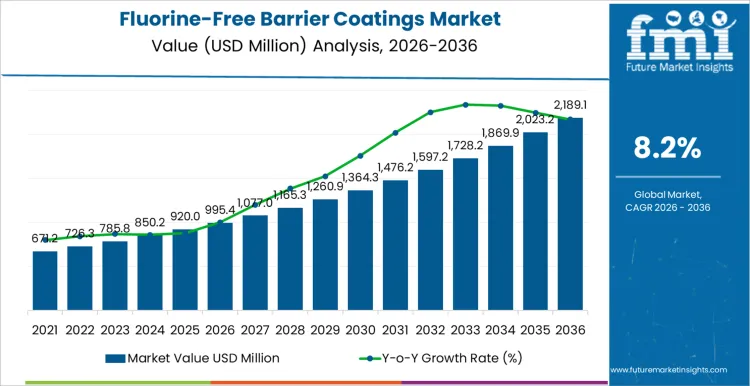
The fluorine-free barrier coatings market is likely to value from USD 995.4 million in 2026 to USD 2,189.1 million by 2036, advancing at a CAGR of 8.20%. Commercial performance in this market is being shaped less by headline growth and more by disciplined execution under regulatory pressure. Pricing power remains constrained, as buyers actively benchmark alternatives and resist cost escalation during PFAS-driven transitions. While demand visibility is improving due to mandatory phase-outs, volume predictability varies by substrate and end-use, with food packaging offering steadier offtake than emerging industrial applications. Buyer leverage is high during qualification stages, where converters expect extensive technical support, trial materials, and performance guarantees before committing to scale. Once approved, switching costs increase, but procurement remains cautious, often dual-sourcing to manage supply and performance risk. Margin outcomes are therefore influenced by application mix, coat-weight efficiency, and the ability to support customers through conversion without excessive customization. Commercial success depends on operational reliability and customer retention rather than rapid price-led expansion.
Quick Stats for Fluorine-Free Barrier Coatings Market
- Fluorine-Free Barrier Coatings Market Value (2026): USD 995.4 Million
- Fluorine-Free Barrier Coatings Market Forecast Value (2036): USD 2,189.1 Million
- Fluorine-Free Barrier Coatings Market Forecast CAGR 2026 to 2036: 8.20%
- Leading Substrate in Fluorine-Free Barrier Coatings Market: Paper & Board (44% share)
- Leading End-Use Sector in Fluorine-Free Barrier Coatings Market: Food & Beverage Packaging (46% share)
- Key Growth Regions in Fluorine-Free Barrier Coatings Market: Asia Pacific, Europe, North America, Latin America, Middle East & Africa
- Top Key Players in Fluorine-Free Barrier Coatings Market: BASF SE, Arkema, Dow, Mondi Group, Stora Enso, Sappi, Michelman Inc., AkzoNobel, Solenis, Kemira
Fluorine-Free Barrier Coatings Market Key Takeaways
| Metric | Value |
|---|---|
| Fluorine-Free Barrier Coatings Market Value (2026) | USD 995.4 Million |
| Fluorine-Free Barrier Coatings Market Forecast Value (2036) | USD 2,189.1 Million |
| Fluorine-Free Barrier Coatings Market Forecast CAGR 2026 to 2036 | 8.20% |
How are PFAS Phase-Out Mandates and Packaging Performance Requirements Driving the Fluorine-Free Barrier Coatings Market?
The fluorine-free barrier coatings market is expanding as regulators and brand owners accelerate the elimination of PFAS from food contact materials and packaging. Paperboard, molded fiber, flexible packaging, and specialty paper applications are transitioning to alternative barrier systems that deliver grease, oil, moisture, and oxygen resistance without fluorinated chemistries. For converters and brand owners, adoption is no longer optional-compliance timelines and retailer mandates are making fluorine-free solutions a baseline requirement across product portfolios.
Performance equivalence and process compatibility are central to purchasing decisions. Fluorine-free barrier coatings often rely on engineered polymer blends, crosslinking strategies, or multilayer structures to achieve required barrier levels. Converters evaluate these coatings based on grease holdout, heat sealability, printability, recyclability, and runnability on existing coating and converting lines. Suppliers that can demonstrate consistent performance at practical coat weights and provide guidance on line settings and drying profiles are reducing conversion risk and accelerating qualification.
Scale economics and portfolio standardization are further reinforcing market growth. As global brands standardize packaging specifications across regions, demand is shifting toward fluorine-free coatings that can be deployed at high volumes with stable supply and clear food-contact documentation. Growth in takeaway food, e-commerce packaging, and molded fiber formats is sustaining long-term demand. For coating suppliers, competitive advantage increasingly depends on application-specific performance validation, regulatory clarity, and the ability to support large-scale rollouts positioning fluorine-free barrier coatings as a core, compliance-driven material class in next-generation packaging.
How is the Fluorine-Free Barrier Coatings Market Structured by Substrate and End-Use Sector?
The fluorine-free barrier coatings market is segmented by substrate and end-use sector, reflecting how coating compatibility and performance requirements vary across packaging and industrial formats. By substrate, paper and board represent the leading segment, driven by widespread use in packaging applications that require effective barrier protection without altering recyclability or stiffness. Other substrates include flexible films and additional materials used in industrial and logistics packaging. By end-use sector, food and beverage packaging dominates demand, followed by consumer and household products, industrial and e-commerce packaging, and other niche sectors requiring moisture, grease, or gas barrier performance.
Why Do Paper and Board Lead Substrate Adoption in the Fluorine-Free Barrier Coatings Market?
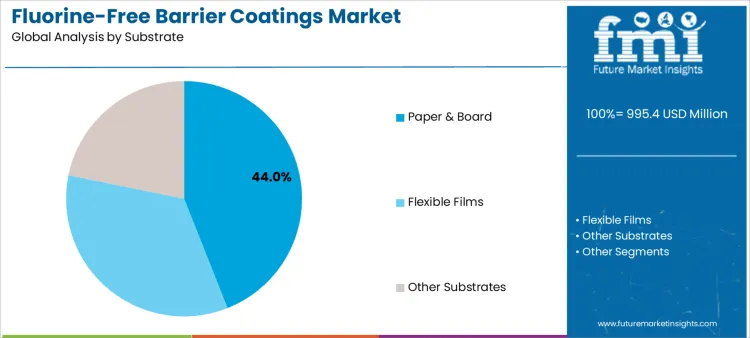
Paper and board account for 44% share of the fluorine-free barrier coatings market because these substrates are extensively used in cartons, trays, wraps, and foodservice packaging. Barrier coatings enhance resistance to moisture, grease, and oxygen while preserving the rigidity and printability of paper-based formats. Coatings can be applied using existing coating and converting equipment, supporting cost-efficient scale-up. High consumption volumes in retail and food packaging drive consistent demand. These compatibility, volume, and processing advantages explain why paper and board remain the dominant substrate segment.
Why Does Food and Beverage Packaging Dominate End-Use Demand in the Fluorine-Free Barrier Coatings Market?
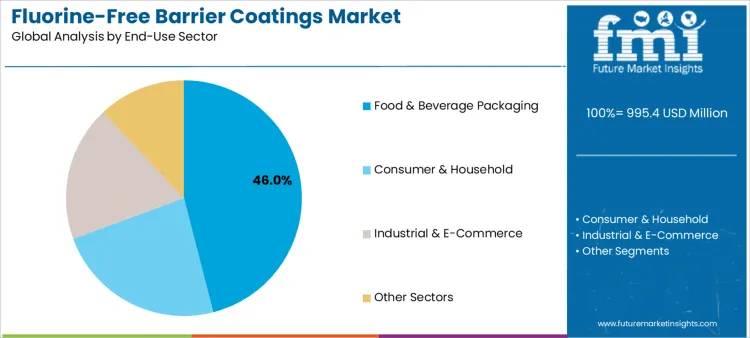
Food and beverage packaging holds 46% share of the fluorine-free barrier coatings market because packaging must protect contents from moisture, oils, and external contamination while maintaining product quality. Barrier-coated paper and flexible packaging formats are widely used for beverages, dry foods, frozen items, and takeaway meals. High packaging turnover and strict performance requirements drive steady coating consumption. Brand owners and converters prioritize coatings that deliver reliable barrier performance across diverse food categories. These high-volume usage patterns and functional packaging needs explain why food and beverage packaging remains the leading end-use sector.
What are the Key Dynamics of the Fluorine-Free Barrier Coatings Market?
The fluorine-free barrier coatings market is driven by increasing demand for safe, high-performance protective coatings across packaging, textiles, paper products, and specialty industrial applications where oil, grease, water, and moisture resistance are required. Fluorine-free technologies provide barrier protection without per- and polyfluoroalkyl substances (PFAS), aligning with evolving regulatory frameworks and customer expectations. For coating suppliers, formulators, and converters, barrier performance, durability through use and handling, application versatility, and compatibility with existing production lines are key criteria that influence material selection and long-term adoption.
How do Application Trends and Industry Requirements Shape This Market?
Application trends and industry requirements are shaping the fluorine-free barrier coatings market as users seek alternatives that deliver reliable protection while meeting regulatory and safety expectations. In food packaging, coatings must resist grease and moisture to maintain product quality and shelf life, while supporting recyclability and processing efficiency. In textiles and paper, demand for water and soil repellency without PFAS drives development of silicone, wax, and polymer-based barrier systems that integrate into lamination and finishing processes. Growth in consumer goods, automotive interiors, and industrial fabrics expands application breadth. Suppliers that engineer barrier coatings tailored to specific substrate performance profiles enhance converter confidence and shorten qualification cycles.
Why do Performance Challenges and Qualification Cycles Restrain Market Growth?
Performance challenges and qualification cycles restrain growth in the fluorine-free barrier coatings market because matching the high oil and grease resistance of fluorinated chemistries remains technically demanding in some demanding end uses. Formulators must balance barrier performance with processing requirements, adhesion, flexibility, and appearance without compromising substrate properties or manufacturing throughput. Extensive qualification testing such as durability through use, wash/abrasion resistance, and regulatory compliance assessments extends development timelines and increases cost for brands and converters. Variability in substrate types and use conditions further complicates formulation optimization and slows adoption where established fluorinated systems set high performance expectations.
How is the Fluorine-Free Barrier Coatings Market Growing across Key Countries?
The fluorine-free barrier coatings market is expanding rapidly as packaging, paper, molded fiber, and specialty material producer’s transition away from fluorinated chemistries while maintaining resistance to moisture, oils, and gases. These coatings are increasingly applied in food packaging, disposable tableware, flexible papers, and industrial substrates where regulatory acceptance and functional performance must coexist. Country-wise growth varies based on scale of packaging production, speed of material substitution, and adoption of alternative barrier technologies. High-growth markets are driven by large consumer goods industries and fast regulatory alignment, while mature regions emphasize performance validation, recyclability compatibility, and process integration.
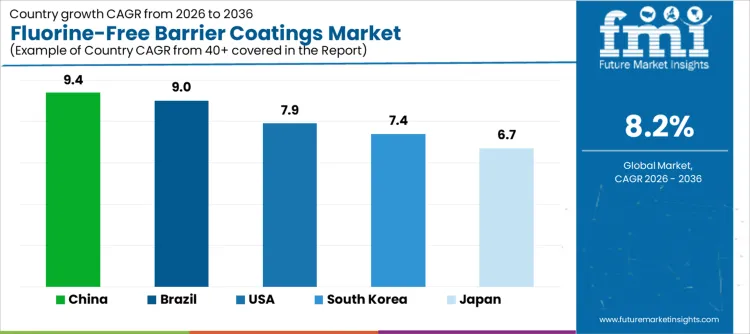
| Country | CAGR (%) |
|---|---|
| China | 9.4 |
| Brazil | 9.0 |
| United States | 7.9 |
| South Korea | 7.4 |
| Japan | 6.7 |
Why Is China Leading the Fluorine-Free Barrier Coatings Market?
China’s fluorine-free barrier coatings market is expanding at a CAGR of 9.4% during 2026 to 2036, driven by the country’s massive packaging, paperboard, and molded fiber manufacturing base. As foodservice brands, exporters, and packaging converters rapidly phase out fluorinated treatments, demand is rising for polymer- and bio-based barrier coatings compatible with paper, pulp, and flexible substrates. Growth is particularly strong in takeaway food packaging, ready-metal containers, and consumer goods wrapping. Chinese manufacturers prioritize coatings that deliver oil, grease, and moisture resistance while maintaining runnability on high-speed coating and converting lines. Cost efficiency, scalability, and availability of local supply are key decision factors. Domestic coating suppliers benefit from large-scale production capabilities and rapid formulation iteration, enabling fast commercialization across diverse packaging formats. Procurement decisions emphasize coating performance consistency, food-contact compliance, and compatibility with existing production equipment. As China’s packaging exports grow, demand is increasing for fluorine-free barrier coatings aligned with international regulatory expectations.
Why Is Brazil Emerging as a High-Growth Market for Fluorine-Free Barrier Coatings?
Brazil’s fluorine-free barrier coatings market is growing at a CAGR of 9.0% during 2026 to 2036, supported by rising demand from food packaging, paper products, and molded fiber applications. As converters move away from fluorinated coatings, interest is increasing in alternative barrier solutions that perform reliably under warm and humid climatic conditions. Adoption is strongest in fast-food packaging, bakery wraps, disposable tableware, and agricultural packaging. Brazilian buyers prioritize cost-performance balance, ease of application, and compatibility with locally produced paper grades. Fluorine-free barrier coatings are valued for improving resistance to oils and moisture while maintaining printability and converting efficiency. Adoption remains progressive, reflecting the need for performance validation across diverse end-use formats. Procurement decisions often favor suppliers offering technical application support, regional manufacturing presence, and stable supply.
What Is Driving Demand for Fluorine-Free Barrier Coatings in the United States?
The United States fluorine-free barrier coatings market is expanding at a CAGR of 7.9% during 2026 to 2036, driven by strong demand from food packaging, consumer goods, and molded fiber packaging segments. Brand owners and converters are actively transitioning toward non-fluorinated barrier solutions to meet evolving regulatory and retailer requirements. Demand is strongest in paper-based foodservice packaging, frozen food cartons, and specialty consumer packaging. USA buyers emphasize barrier performance consistency, food-contact compliance, and compatibility with recycling-oriented paper streams. Fluorine-free coatings are increasingly selected for their ability to integrate into existing coating lines without major process changes. Adoption is focused on performance-critical applications rather than low-cost substitution alone. Procurement decisions prioritize supplier credibility, technical documentation, and long-term availability. Market growth is reinforced by packaging innovation, expansion of molded fiber formats, and increasing adoption of paper-based alternatives to plastic packaging.
How Is South Korea Expanding Use of Fluorine-Free Barrier Coatings?
South Korea’s fluorine-free barrier coatings market is growing at a CAGR of 7.4% during 2026 to 2036, supported by demand from food packaging, specialty papers, and export-oriented consumer goods. Manufacturers increasingly adopt fluorine-free coatings to align with international market requirements and brand specifications. Buyers emphasize coating uniformity, compatibility with high-speed converting, and stable barrier performance across different substrates. Adoption is strongest in premium packaging formats and export-focused applications. Procurement decisions are influenced by supplier technical capability, consistency of coating performance, and compliance with global food-contact standards. Market growth is supported by steady growth in packaged food production and paper-based consumer products.
What Is Driving Adoption of Fluorine-Free Barrier Coatings in Japan?
Japan’s fluorine-free barrier coatings market is expanding at a CAGR of 6.7% during 2026 to 2036, driven by a strong focus on material reliability, food safety, and controlled functional performance. Japanese converters adopt alternative barrier coatings cautiously, emphasizing repeatability, low migration, and compatibility with precision coating processes. Buyers prioritize predictable moisture and oil resistance, clean surface characteristics, and stable performance during storage and use. Adoption is gradual but steady, centered on high-quality food packaging and specialty paper applications. Procurement decisions favor suppliers with established technical validation, consistent quality, and long-term supply assurance. Market growth is supported by incremental replacement of fluorinated coatings and continued demand for premium paper-based packaging solutions.
How are Companies Competing in the Fluorine-Free Barrier Coatings Market?
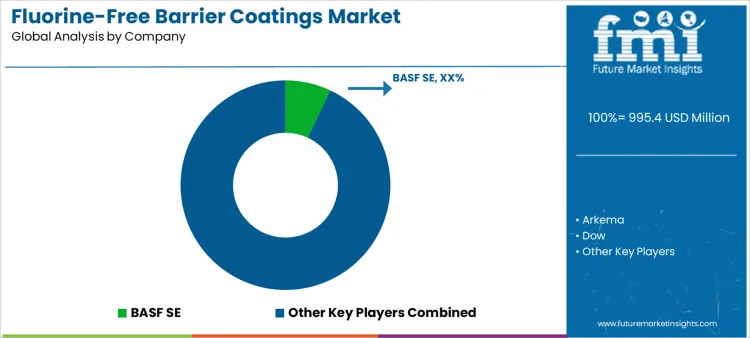
Competition in the fluorine-free barrier coatings market is driven by proven barrier performance (oxygen, moisture, and grease), sustainability credentials, and compatibility with high-speed packaging lines. As regulatory and consumer pressure steers the industry away from PFAS-based coatings, suppliers are advancing chemistries that deliver reliable protection for food, beverage, and specialty industrial substrates without fluorinated components.
BASF SE positions its fluorine-free barrier coatings around proprietary polymer technologies that balance barrier efficacy with low environmental impact. Its materials emphasize tailored formulations for flexible packaging, cartons, and paperboard while supporting industrial coating processes. Arkema competes with functional polymer resins that deliver moisture and grease resistance, highlighting ease of integration into extrusion-coating and dispersion coating lines.
Global chemical leaders extend competitiveness through portfolio breadth and performance tuning. Dow offers fluorine-free barrier systems designed for food contact compliance and processing reliability, with product information stressing balanced mechanical properties and film clarity. Mondi Group, Stora Enso, and Sappi differentiate through application-verified barrier coatings aligned with paper-based packaging platforms and renewable substrates.
Specialty coating and chemical formulators add depth to the competitive landscape. Michelman Inc. focuses on high-performance fluorine-free barrier chemistries tailored for specific packaging demands, with emphasis on process robustness and consistency. AkzoNobel brings cross-industry experience to barrier technology, while Solenis and Kemira compete through functional barrier additives and coating aids that enhance application stability and throughput. Across all suppliers, differentiation is defined by validated barrier performance, sustainability alignment, and seamless integration into high-speed production rather than price alone.
Key Players in Fluorine-Free Barrier Coatings Market
- BASF SE
- Arkema
- Dow
- Mondi Group (barrier technologies)
- Stora Enso
- Sappi
- Michelman Inc.
- AkzoNobel
- Solenis
- Kemira
Scope of Report
| Attribute | Details |
|---|---|
| Market Size Unit | USD Million |
| Substrate Covered | Paper & Board, Flexible Films, Other Substrates |
| End-Use Sector Covered | Food & Beverage Packaging, Consumer & Household Products, Industrial & E-Commerce Packaging, Other Sectors |
| Countries Covered | China, Japan, South Korea, India, Australia & New Zealand, ASEAN, Rest of Asia Pacific, Germany, United Kingdom, France, Italy, Spain, Nordic, BENELUX, Rest of Europe, United States, Canada, Mexico, Brazil, Chile, Rest of Latin America, Kingdom of Saudi Arabia, Other GCC Countries, Turkey, South Africa, Other African Union, Rest of Middle East & Africa |
| Regions Covered | Asia Pacific, Europe, North America, Latin America, Middle East & Africa |
| Key Companies Profiled | BASF SE, Arkema, Dow, Mondi Group, Stora Enso, Sappi, Michelman Inc., AkzoNobel, Solenis, Kemira |
| Additional Attributes | Dollar sales by substrate and end-use sector are evaluated across paper-based, flexible, and hybrid packaging formats. The scope assesses fluorine-free barrier technologies including water-based polymers, bio-coatings, and multilayer solutions addressing grease, moisture, and oxygen resistance. Country-level analysis reflects PFAS regulations, food-contact compliance, recyclability requirements, and adoption of sustainable packaging coatings across consumer and industrial markets. |
Fluorine-Free Barrier Coatings Market by Key Segments
Substrate:
- Paper & Board
- Flexible Films
- Other Substrates
End-Use Sector:
- Food & Beverage Packaging
- Consumer & Household
- Industrial & E-Commerce
- Other Sectors
Region:
- Asia Pacific
- China
- Japan
- South Korea
- India
- Australia & New Zealand
- ASEAN
- Rest of Asia Pacific
- Europe
- Germany
- United Kingdom
- France
- Italy
- Spain
- Nordic
- BENELUX
- Rest of Europe
- North America
- United States
- Canada
- Mexico
- Latin America
- Brazil
- Chile
- Rest of Latin America
- Middle East & Africa
- Kingdom of Saudi Arabia
- Other GCC Countries
- Turkey
- South Africa
- Other African Union
- Rest of Middle East & Africa
Bibliography
- Müller, K., Schmid, M., & Fischer, P. (2024). Advances in grease‑ and moisture‑resistant coatings for fiber‑based packaging without fluorinated compounds. Packaging Technology and Science, 37(4), 289-304.
- International Organization for Standardization. (2024). ISO 2528: Sheet materials-Determination of water vapour transmission rate (WVTR)-Gravimetric method. ISO.
- USA Food and Drug Administration. (2024). Food contact substances: Technical guidance for non‑fluorinated grease‑ and moisture‑resistant coatings. FDA Center for Food Safety and Applied Nutrition
- United Nations Environment Programme. (2024). Global assessment of PFAS alternatives in packaging and consumer product applications. UNEP Chemicals and Health Branch.
- Food and Agriculture Organization of the United Nations. (2024). Paper‑based and fiber‑based food packaging: Barrier coating technologies, safety, and sustainability considerations. FAO Agrifood Systems and Food Safety Division.
Frequently Asked Questions
How big is the fluorine-free barrier coatings market in 2026?
The global fluorine-free barrier coatings market is estimated to be valued at USD 995.4 million in 2026.
What will be the size of fluorine-free barrier coatings market in 2036?
The market size for the fluorine-free barrier coatings market is projected to reach USD 2,189.1 million by 2036.
How much will be the fluorine-free barrier coatings market growth between 2026 and 2036?
The fluorine-free barrier coatings market is expected to grow at a 8.2% CAGR between 2026 and 2036.
What are the key product types in the fluorine-free barrier coatings market?
The key product types in fluorine-free barrier coatings market are paper & board, flexible films and other substrates.
Which end-use sector segment to contribute significant share in the fluorine-free barrier coatings market in 2026?
In terms of end-use sector, food & beverage packaging segment to command 46.0% share in the fluorine-free barrier coatings market in 2026.
Preview the report firsthand - request a free sample
Get SampleGet the brochure for pricing and purchase details.
Get PDFTable of Content
- Executive Summary
- Global Market Outlook
- Demand-side Trends
- Supply-side Trends
- Technology Roadmap Analysis
- Analysis and Recommendations
- Market Overview
- Market Coverage / Taxonomy
- Market Definition / Scope / Limitations
- Market Background
- Market Dynamics
- Drivers
- Restraints
- Opportunity
- Trends
- Scenario Forecast
- Demand in Optimistic Scenario
- Demand in Likely Scenario
- Demand in Conservative Scenario
- Opportunity Map Analysis
- Product Life Cycle Analysis
- Supply Chain Analysis
- Investment Feasibility Matrix
- Value Chain Analysis
- PESTLE and Porter’s Analysis
- Regulatory Landscape
- Regional Parent Market Outlook
- Production and Consumption Statistics
- Import and Export Statistics
- Market Dynamics
- Global Market Analysis 2021 to 2025 and Forecast, 2026 to 2036
- Historical Market Size Value (USD Million) Analysis, 2021 to 2025
- Current and Future Market Size Value (USD Million) Projections, 2026 to 2036
- Y-o-Y Growth Trend Analysis
- Absolute $ Opportunity Analysis
- Global Market Pricing Analysis 2021 to 2025 and Forecast 2026 to 2036
- Global Market Analysis 2021 to 2025 and Forecast 2026 to 2036, By Substrate
- Introduction / Key Findings
- Historical Market Size Value (USD Million) Analysis By Substrate , 2021 to 2025
- Current and Future Market Size Value (USD Million) Analysis and Forecast By Substrate , 2026 to 2036
- Paper & Board
- Flexible Films
- Other Substrates
- Paper & Board
- Y-o-Y Growth Trend Analysis By Substrate , 2021 to 2025
- Absolute $ Opportunity Analysis By Substrate , 2026 to 2036
- Global Market Analysis 2021 to 2025 and Forecast 2026 to 2036, By End-Use Sector
- Introduction / Key Findings
- Historical Market Size Value (USD Million) Analysis By End-Use Sector, 2021 to 2025
- Current and Future Market Size Value (USD Million) Analysis and Forecast By End-Use Sector, 2026 to 2036
- Food & Beverage Packaging
- Consumer & Household
- Industrial & E-Commerce
- Other Sectors
- Food & Beverage Packaging
- Y-o-Y Growth Trend Analysis By End-Use Sector, 2021 to 2025
- Absolute $ Opportunity Analysis By End-Use Sector, 2026 to 2036
- Global Market Analysis 2021 to 2025 and Forecast 2026 to 2036, By Region
- Introduction
- Historical Market Size Value (USD Million) Analysis By Region, 2021 to 2025
- Current Market Size Value (USD Million) Analysis and Forecast By Region, 2026 to 2036
- North America
- Latin America
- Western Europe
- Eastern Europe
- East Asia
- South Asia and Pacific
- Middle East & Africa
- Market Attractiveness Analysis By Region
- North America Market Analysis 2021 to 2025 and Forecast 2026 to 2036, By Country
- Historical Market Size Value (USD Million) Trend Analysis By Market Taxonomy, 2021 to 2025
- Market Size Value (USD Million) Forecast By Market Taxonomy, 2026 to 2036
- By Country
- USA
- Canada
- Mexico
- By Substrate
- By End-Use Sector
- By Country
- Market Attractiveness Analysis
- By Country
- By Substrate
- By End-Use Sector
- Key Takeaways
- Latin America Market Analysis 2021 to 2025 and Forecast 2026 to 2036, By Country
- Historical Market Size Value (USD Million) Trend Analysis By Market Taxonomy, 2021 to 2025
- Market Size Value (USD Million) Forecast By Market Taxonomy, 2026 to 2036
- By Country
- Brazil
- Chile
- Rest of Latin America
- By Substrate
- By End-Use Sector
- By Country
- Market Attractiveness Analysis
- By Country
- By Substrate
- By End-Use Sector
- Key Takeaways
- Western Europe Market Analysis 2021 to 2025 and Forecast 2026 to 2036, By Country
- Historical Market Size Value (USD Million) Trend Analysis By Market Taxonomy, 2021 to 2025
- Market Size Value (USD Million) Forecast By Market Taxonomy, 2026 to 2036
- By Country
- Germany
- UK
- Italy
- Spain
- France
- Nordic
- BENELUX
- Rest of Western Europe
- By Substrate
- By End-Use Sector
- By Country
- Market Attractiveness Analysis
- By Country
- By Substrate
- By End-Use Sector
- Key Takeaways
- Eastern Europe Market Analysis 2021 to 2025 and Forecast 2026 to 2036, By Country
- Historical Market Size Value (USD Million) Trend Analysis By Market Taxonomy, 2021 to 2025
- Market Size Value (USD Million) Forecast By Market Taxonomy, 2026 to 2036
- By Country
- Russia
- Poland
- Hungary
- Balkan & Baltic
- Rest of Eastern Europe
- By Substrate
- By End-Use Sector
- By Country
- Market Attractiveness Analysis
- By Country
- By Substrate
- By End-Use Sector
- Key Takeaways
- East Asia Market Analysis 2021 to 2025 and Forecast 2026 to 2036, By Country
- Historical Market Size Value (USD Million) Trend Analysis By Market Taxonomy, 2021 to 2025
- Market Size Value (USD Million) Forecast By Market Taxonomy, 2026 to 2036
- By Country
- China
- Japan
- South Korea
- By Substrate
- By End-Use Sector
- By Country
- Market Attractiveness Analysis
- By Country
- By Substrate
- By End-Use Sector
- Key Takeaways
- South Asia and Pacific Market Analysis 2021 to 2025 and Forecast 2026 to 2036, By Country
- Historical Market Size Value (USD Million) Trend Analysis By Market Taxonomy, 2021 to 2025
- Market Size Value (USD Million) Forecast By Market Taxonomy, 2026 to 2036
- By Country
- India
- ASEAN
- Australia & New Zealand
- Rest of South Asia and Pacific
- By Substrate
- By End-Use Sector
- By Country
- Market Attractiveness Analysis
- By Country
- By Substrate
- By End-Use Sector
- Key Takeaways
- Middle East & Africa Market Analysis 2021 to 2025 and Forecast 2026 to 2036, By Country
- Historical Market Size Value (USD Million) Trend Analysis By Market Taxonomy, 2021 to 2025
- Market Size Value (USD Million) Forecast By Market Taxonomy, 2026 to 2036
- By Country
- Kingdom of Saudi Arabia
- Other GCC Countries
- Turkiye
- South Africa
- Other African Union
- Rest of Middle East & Africa
- By Substrate
- By End-Use Sector
- By Country
- Market Attractiveness Analysis
- By Country
- By Substrate
- By End-Use Sector
- Key Takeaways
- Key Countries Market Analysis
- USA
- Pricing Analysis
- Market Share Analysis, 2025
- By Substrate
- By End-Use Sector
- Canada
- Pricing Analysis
- Market Share Analysis, 2025
- By Substrate
- By End-Use Sector
- Mexico
- Pricing Analysis
- Market Share Analysis, 2025
- By Substrate
- By End-Use Sector
- Brazil
- Pricing Analysis
- Market Share Analysis, 2025
- By Substrate
- By End-Use Sector
- Chile
- Pricing Analysis
- Market Share Analysis, 2025
- By Substrate
- By End-Use Sector
- Germany
- Pricing Analysis
- Market Share Analysis, 2025
- By Substrate
- By End-Use Sector
- UK
- Pricing Analysis
- Market Share Analysis, 2025
- By Substrate
- By End-Use Sector
- Italy
- Pricing Analysis
- Market Share Analysis, 2025
- By Substrate
- By End-Use Sector
- Spain
- Pricing Analysis
- Market Share Analysis, 2025
- By Substrate
- By End-Use Sector
- France
- Pricing Analysis
- Market Share Analysis, 2025
- By Substrate
- By End-Use Sector
- India
- Pricing Analysis
- Market Share Analysis, 2025
- By Substrate
- By End-Use Sector
- ASEAN
- Pricing Analysis
- Market Share Analysis, 2025
- By Substrate
- By End-Use Sector
- Australia & New Zealand
- Pricing Analysis
- Market Share Analysis, 2025
- By Substrate
- By End-Use Sector
- China
- Pricing Analysis
- Market Share Analysis, 2025
- By Substrate
- By End-Use Sector
- Japan
- Pricing Analysis
- Market Share Analysis, 2025
- By Substrate
- By End-Use Sector
- South Korea
- Pricing Analysis
- Market Share Analysis, 2025
- By Substrate
- By End-Use Sector
- Russia
- Pricing Analysis
- Market Share Analysis, 2025
- By Substrate
- By End-Use Sector
- Poland
- Pricing Analysis
- Market Share Analysis, 2025
- By Substrate
- By End-Use Sector
- Hungary
- Pricing Analysis
- Market Share Analysis, 2025
- By Substrate
- By End-Use Sector
- Kingdom of Saudi Arabia
- Pricing Analysis
- Market Share Analysis, 2025
- By Substrate
- By End-Use Sector
- Turkiye
- Pricing Analysis
- Market Share Analysis, 2025
- By Substrate
- By End-Use Sector
- South Africa
- Pricing Analysis
- Market Share Analysis, 2025
- By Substrate
- By End-Use Sector
- USA
- Market Structure Analysis
- Competition Dashboard
- Competition Benchmarking
- Market Share Analysis of Top Players
- By Regional
- By Substrate
- By End-Use Sector
- Competition Analysis
- Competition Deep Dive
- BASF SE
- Overview
- Product Portfolio
- Profitability by Market Segments (Product/Age /Sales Channel/Region)
- Sales Footprint
- Strategy Overview
- Marketing Strategy
- Product Strategy
- Channel Strategy
- Arkema
- Dow
- Mondi Group (barrier technologies)
- Stora Enso
- Sappi
- Michelman Inc.
- AkzoNobel
- Solenis
- Kemira
- BASF SE
- Competition Deep Dive
- Assumptions & Acronyms Used
- Research Methodology


