

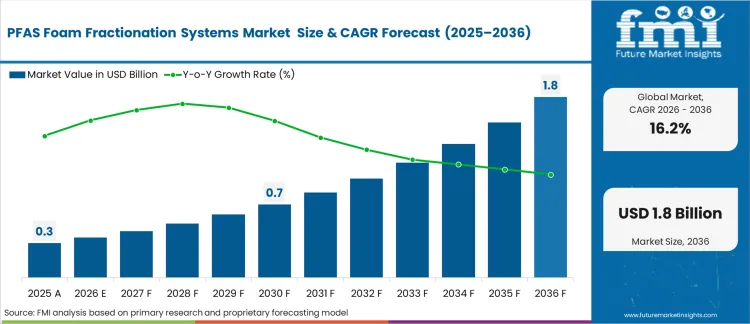
- Industry Size (2026)
- USD 0.4 Bn
- Forecast (2036)
- USD 1.8 Bn
- CAGR (2026 to 2036)
- 16.2%
PFAS Foam Fractionation Systems Market Size, Market Forecast and Outlook By FMI
The PFAS foam fractionation systems market was valued at USD 0.3 billion in 2025. Industry is poised to cross USD 0.4 billion in 2026 at a CAGR of 16.2% during the forecast period. Demand outlook carries the valuation to USD 1.8 billion through 2036 as the escalating costs of spent carbon disposal force asset owners to adopt volume-reduction technologies prior to ultimate destruction.
The shift from traditional Granular Activated Carbon (GAC) to surface-active separation targets a critical liability for waste management facilities and military bases. Legacy filtration methods merely transfer contaminants from water to solid media, generating massive secondary waste streams. Operators who delay transitioning to high-concentration fractionation lose their ability to control off-site disposal liabilities as hazardous transport regulations tighten. The real bottleneck isn't removing the compounds from bulk water; it is managing the concentrated secondary waste, driving the absolute necessity for systems that reduce landfill leachate treatment volumes by up to 99%, often alongside advanced PFAS filtration and treatment media.
The capability to natively pair fractionation with on-site destruction marks the critical threshold for mass adoption. Capital project directors must validate off-the-shelf electrochemical oxidation integration before the EPA compliance deadline. Crossing this technical gate eliminates off-site transport entirely, establishing a true zero-liability closed-loop architecture that complements any broader United States water treatment system.
Summary of PFAS Foam Fractionation Systems Market
- PFAS Foam Fractionation Systems Market Definition
- The PFAS foam fractionation systems market encompasses specialized aeration hardware and separation modules designed to exploit the surfactant properties of forever chemicals, isolating them into a concentrated foamate without consumable adsorption media.
- Demand Drivers in the Market
- The EPA's National Primary Drinking Water Regulation forces municipal utility directors to deploy highly efficient pretreatment extraction systems.
- Exorbitant hazardous waste disposal fees compel landfill operators to drastically reduce the physical volume of their concentrated leachate byproducts.
- Department of Defense site cleanup mandates drive military environmental contractors to secure mobile, deployable separation units for immediate groundwater containment.
- Key Segments Analyzed in the FMI Report
- Integrated/Hybrid Systems: 55.4% share in 2026, as separating contaminants natively with destruction mechanisms eliminates the liabilities of off-site transport.
- Landfill Leachate Treatment: 42.1% share in 2026, as municipal water plants reject untreated leachate, forcing waste management operators to deploy on-site concentration.
- Military & Defense: 38.5% share in 2026, as the mandate to remediate legacy aqueous film-forming foam (AFFF) sites forces aggressive volume-reduction strategies.
- United States: 18.5% compound growth, driven by massive federal infrastructure allocations specifically targeting military base remediation.
- Analyst Opinion at FMI
- Nikhil Kaitwade, Principal Consultant for Chemicals and Materials, opines, "In my analysis, I have observed that the true bottleneck is managing the secondary waste stream, not merely separating the chemicals from bulk water. The reliance on disposable media creates an unsustainable logistical loop. Actors who fail to address the highly concentrated foamate directly on-site will face exponential hazardous waste disposal costs as landfill restrictions tighten."
- Strategic Implications / Executive Takeaways
- Capital project directors must mandate native destruction pairings within their fractionation procurement specifications before the impending regulatory deadlines.
- Technology vendors should forge strategic alliances with electrochemical oxidation specialists to offer complete, closed-loop mineralization systems.
- Military environmental contractors must accelerate the deployment of containerized separation skids to prevent further plume migration and secure recurring remediation funding.
- Methodology
- Primary Research: FMI conducted detailed technical interviews with principal environmental engineers, water utility operators, and remediation directors to validate technology adoption timelines.
- Desk Research: Analysts aggregated public standards documentation from regulatory bodies, corporate hardware launch sheets, and national infrastructure grant programs.
- Market-Sizing and Forecasting: The model applies a bottom-up methodology starting with global installed base metrics for environmental separation nodes and projecting the conversion rate to active fractionation.
- Data Validation and Update Cycle: Segment forecasts undergo cross-validation against quarterly capital expenditure reports from major environmental remediation firms.
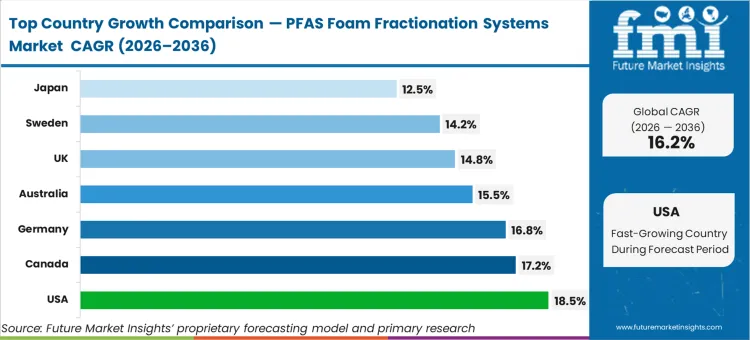
The United States advances at 18.5% driven by federal infrastructure allocations specifically targeting military base remediation. Canada tracks at 17.2% as regional water boards enforce strict effluent limits on industrial discharges. Germany records a 16.8% expansion anchored by stringent EU directives on persistent organic pollutants. Australia follows at 15.5% due to proactive state-level PFAS bans and early adoption of foam separation technologies. The United Kingdom expands at 14.8%, while Sweden registers a 14.2% rate due to municipal network upgrades. Japan grows at 12.5% trajectory anchored by semiconductor facility wastewater compliance. This spread exists structurally because nations with heavy historical aqueous film-forming foam (AFFF) usage mandate faster remediation timelines.
PFAS Foam Fractionation Systems Market Key Takeaways
| Metric | Details |
|---|---|
| Industry Size (2026) | USD 0.4 billion |
| Industry Value (2036) | USD 1.8 billion |
| CAGR (2026-2036) | 16.2% |
Source: Future Market Insights (FMI) analysis, based on proprietary forecasting model and primary research
PFAS Foam Fractionation Systems Market Definition
The PFAS foam fractionation systems market encompasses specialized aeration hardware and integrated separation modules designed to exploit the surfactant properties of per- and polyfluoroalkyl substances. By injecting engineered micro-bubbles into contaminated water columns, these systems force fluorinated compounds to aggregate at the air-water interface, generating a highly concentrated foamate. This process effectively isolates the pollutants from bulk water streams without the use of consumable adsorption media.
PFAS Foam Fractionation Systems Market Inclusions
The market scope includes surface-active separation vessels, micro-bubble injection manifolds, automated foam skimming hardware, and integrated PFAS water treatment skids that pair fractionation with secondary destruction technologies. Mobile containerized units deployed for rapid site remediation, as well as the specialized cationic surfactants occasionally dosed to enhance short-chain recovery, fall firmly within the defined parameters. Advanced PFAS detection devices utilized within these loops are also considered.
PFAS Foam Fractionation Systems Market Exclusions
Traditional Granular Activated Carbon (GAC) vessels and standard ion-exchange resin systems lacking engineered air-injection capabilities are explicitly excluded. General-purpose municipal aeration blowers not specifically configured for high-efficiency surfactant extraction, as well as standalone off-site hazardous waste incineration services, fall outside the valuation boundaries.
PFAS Foam Fractionation Systems Market Research Methodology
- Primary Research: Analysts engaged with remediation site managers, municipal water utility directors, and specialized environmental engineering consultants to map the specific decision gates triggering aeration equipment upgrades.
- Desk Research: The data collection phase aggregated compliance roadmaps from the EPA, the European Chemicals Agency (ECHA), and specific Department of Defense remediation schedules to gauge deployment timelines.
- Market-Sizing and Forecasting: The baseline value derives from a bottom-up aggregation of commercial foam fractionation skid shipments, applying region-specific regulatory compliance curves to project future adoption velocity.
- Data Validation and Update Cycle: Projections are rigorously tested against publicly reported capital expenditure guidance from leading environmental service providers and global waste management conglomerates.
Segmental Analysis
PFAS Foam Fractionation Systems Market Analysis by Technology Configuration
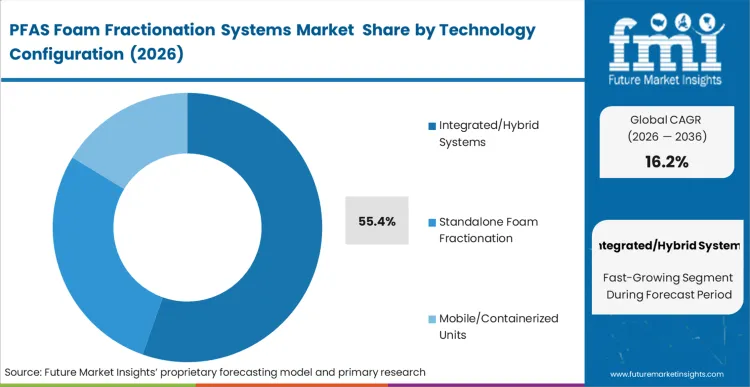
Integrated/hybrid systems commands a dominant 55.4% share in 2026, driven by the structural reality that separating contaminants is only half the compliance equation. Municipalities and defense contractors specifying these endpoints integrate foam separation natively with destruction mechanisms to eliminate the liabilities of off-site transport. By fusing concentration steps with electrochemical water treatment or utilizing specific advanced oxidation chemicals, facility owners achieve complete mineralization of the fluorinated carbon tail. According to FMI's estimates, this unified architecture drastically reduces secondary waste handling fees compared to standard industrial filtration. Capital project directors prioritizing these hybrid skids secure regulatory closure, whereas those relying on standalone separation face compounding hazardous waste disposal costs as landfill acceptance criteria tighten.
- Destruction pairing: Natively integrated oxidation modules eliminate the need to transport highly concentrated foamate across state lines. Facilities utilizing this approach achieve permanent liability eradication.
- Concentration metrics: Advanced baffling and air-injection controls reduce the final waste volume by over 99%. Operators relying on this efficiency bypass the logistical bottlenecks of spent carbon regeneration.
- Footprint consolidation: Combining the separation and destruction phases onto a single skid minimizes the required real estate for retrofits. Procurement leads deploying these units streamline their overall installation timelines.
PFAS Foam Fractionation Systems Market Analysis by Application
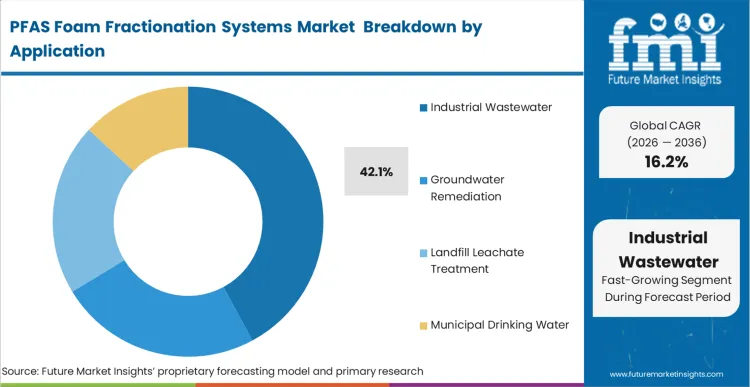
The critical operational gap of managing highly concentrated, complex wastewater streams positions landfill leachate treatment as the leading application, expected to capture 42.1% share in 2026. Municipal water treatment plants increasingly reject untreated leachate, forcing waste management operators to deploy on-site groundwater remediation systems to meet strict discharge permits. Utilizing surface-active separation prevents the rapid fouling of traditional membranes and carbon filters caused by high organic loads, effectively acting like specialized water and wastewater treatment chemicals. As per FMI's projection, isolating the fluorosurfactants via engineered air bubbles provides a robust pretreatment step. Site engineers executing these upgrades maintain continuous leachate discharge, whereas those who fail to adopt this solution face total facility shutdowns due to local regulatory embargoes.
- Fouling prevention: Removing surface-active compounds prior to membrane filtration extends the lifecycle of downstream reverse osmosis elements. Maintenance teams leveraging this sequence drastically reduce consumable replacement budgets.
- Co-contaminant resilience: The air-water interface partitioning remains effective even in the presence of heavy organic background loads. Process engineers designing these treatment trains bypass the interference issues that plague traditional ion-exchange resins.
- Discharge compliance: Achieving sub-part-per-trillion detection limits allows operators to safely release treated effluent back into municipal networks. Facility owners crossing this regulatory gate avoid catastrophic operational halts.
PFAS Foam Fractionation Systems Market Analysis by End Use
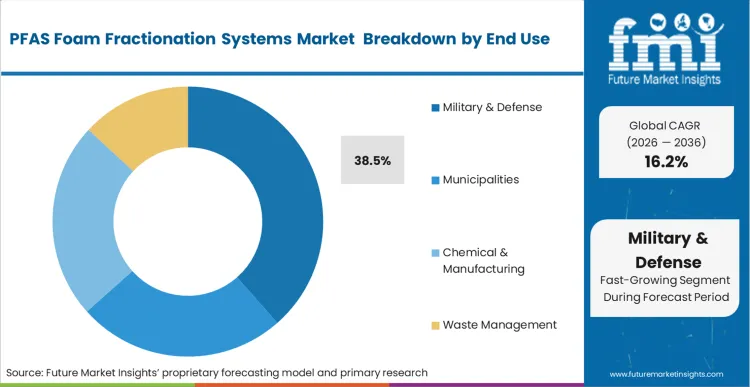
The military & defense segment is securing a 38.5% segment share in 2026 as the department of defense mandate to remediate legacy Aqueous Film-Forming Foam (AFFF) sites forces the military & defense sector to adopt aggressive volume-reduction strategies. Base commanders and environmental contractors face immense pressure to treat millions of gallons of contaminated groundwater without generating equally massive quantities of hazardous waste management liabilities. This is crucial as operations pivot toward adopting PFAS free firefighting foams. FMI analysts opine that foam fractionation uniquely satisfies this requirement by physically stripping the surfactants using only air. Implementing these mobile systems allows rapid deployment across geographically dispersed military installations. Defense procurement officers who fail to specify high-concentration separation technologies will rapidly exhaust their remediation budgets on secondary waste disposal alone.
- AFFF extraction: Tailored aeration mechanics specifically target the long-chain fluorinated compounds prevalent in military firefighting foams. Contractors operating these systems achieve rapid site containment during the initial response phase.
- Deployment velocity: Containerized fractionation skids allow for immediate mobilization to remote or restricted access military zones. Logistics directors utilizing these assets accelerate the overall site commissioning schedule.
- Budget preservation: Shrinking the ultimate waste volume minimizes the recurring expenses associated with high-temperature incineration. Program managers capitalizing on this efficiency reallocate funds to further site investigation efforts.
PFAS Foam Fractionation Systems Market Drivers, Restraints, and Opportunities
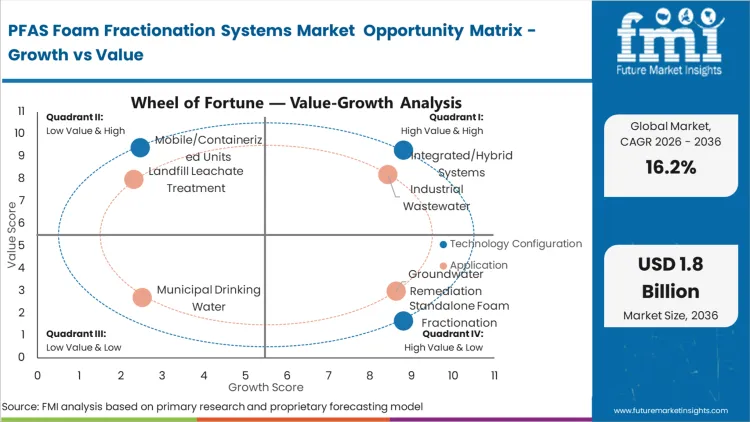
The promulgation of the EPA's National Primary Drinking Water Regulation enforces strict maximum contaminant levels, forcing municipal utility directors to aggressively upgrade their core infrastructure. This regulatory mandate renders passive, high-volume media filtration financially unviable over the long term due to the massive costs of spent media regeneration. Asset owners upgrading legacy treatment plants face a binary choice: continue paying exponential disposal fees or invest in active fractionation to shrink the waste footprint, a shift similarly observed in the transition to PFAS replacement chemistries for textiles. Transitioning to a micro-bubble separation architecture drastically minimizes consumable operational expenses. Facilities that fail to modernize their extraction layers risk catastrophic public liabilities and immediate regulatory fines.
The intricate optimization of air-to-water ratios and bubble sizing required to effectively float short-chain PFAS compounds creates significant operational friction for conventional plant operators. Designing these mass-transfer parameters across varying water chemistry matrices demands specialized hydrodynamic expertise that most rural municipalities lack internally. To mitigate this skill gap, environmental engineering firms increasingly offer automated, sensor-driven skids that self-adjust injection rates based on real-time influent monitoring.
Opportunities in the PFAS Foam Fractionation Systems Market
- Surfactant enhancement: Injecting targeted cationic surfactants dramatically improves the bubble-attachment rate of highly mobile short-chain compounds. Process engineers who implement this dosing strategy achieve comprehensive regulatory compliance across the entire chemical spectrum, replacing outdated fluorine free oil and grease repellent polymers.
- Containerized mobilization: Shrinking the entire separation sequence into a standard shipping container allows environmental contractors to rapidly deploy containerized water treatment assets to emergency spill zones. Rapid-response teams utilizing this format outbid competitors burdened by fixed-infrastructure construction timelines.
- Direct destruction pairing: Natively coupling the foam output directly into an electrochemical oxidation cell enables immediate on-site mineralization. Hardware vendors providing this unified closed-loop solution capture a massive premium over pure separation providers.
Regional Analysis
Based on the regional analysis, the PFAS Foam Fractionation Systems market is segmented into North America, Europe, Asia Pacific, Latin America, Middle East & Africa across 40 plus countries.
.webp "Top Country Growth Comparison Pfas Foam Fractionation Systems Market Cagr (2026 2036)")
| Country | CAGR (2026 to 2036) |
|---|---|
| United States | 18.5% |
| Canada | 17.2% |
| Germany | 16.8% |
| Australia | 15.5% |
| United Kingdom | 14.8% |
| Sweden | 14.2% |
| Japan | 12.5% |
Source: Future Market Insights (FMI) analysis, based on proprietary forecasting model and primary research
North America PFAS Foam Fractionation Systems Market Analysis
The aggressive implementation of the EPA's National Primary Drinking Water Regulation establishes a strict legal enforcement era across the region. This policy-led transformation forces municipal utilities and defense contractors to rapidly abandon legacy separation methods in favor of high-efficiency volume reduction. In FMI's view, the allocation of billions in federal infrastructure funding exclusively for emerging contaminants eliminates the capital constraints that previously stalled large-scale deployment. By transitioning to integrated destruction architectures, regional asset owners mitigate long-term environmental liabilities associated with off-site transport, echoing safety protocols used for PFAS free powder coatings. This compliance pressure directly fuels the demand for advanced water and wastewater treatment skids capable of achieving near-zero detection limits.
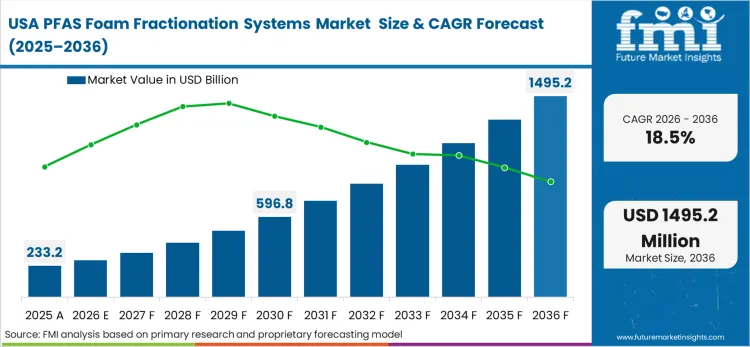
- United States: The United States' defense sector enforces strict site remediation timelines across its vast network of legacy AFFF contamination zones. This massive containment effort drives an 18.5% compound annual rate through 2036. Clean Earth's recent installation of a foam fractionation unit at its Detroit facility highlights the push to treat highly concentrated aqueous materials natively, much like handling complex PFAS free slip leveling coating additives. Capital project directors utilizing these systems shrink their hazardous waste footprints substantially.
- Canada: Regional water authorities in Canada must operate under tightening provincial effluent limits that target industrial manufacturing discharges. This specific constraint anchors Canada to a 17.2% annual expansion through the decade. Facilities deploying surface-active separation bypass the rapid fouling of conventional filters. Facility owners crossing this performance threshold secure long-term operational continuity.
Europe PFAS Foam Fractionation Systems Market Analysis
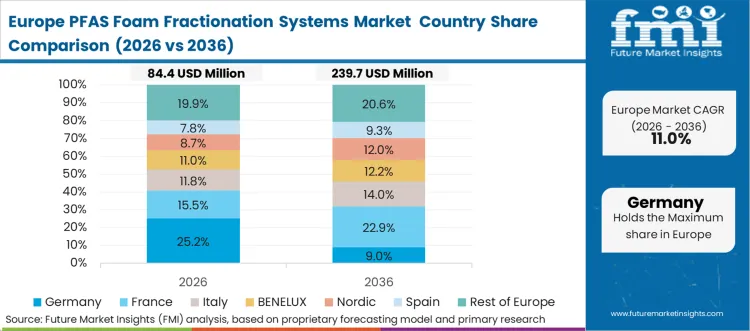
Stringent directives under the European Union's REACH framework penalize the continued accumulation of persistent organic pollutants in regional waterways. This regulatory environment accelerates the adoption of physical separation technologies that do not rely on single-use consumable media. Based on FMI's assessment, the regional push toward circular economy principles heavily favors fractionation, as it eliminates the carbon footprint associated with incinerating spent filtration resins. Upgrading municipal and industrial treatment trains to include engineered aeration provides the necessary resilience to handle complex co-contaminants, akin to substituting safer PFAS free easy open can coatings. Facility directors recognize that maintaining outdated adsorption methods severely limits their ability to pass stringent environmental audits.
- Germany: Germany's advanced chemical manufacturing base requires robust pretreatment systems to isolate fluorinated surfactants before they reach municipal sewers. This industrial imperative is advancing at 16.8% compound between 2026 and 2036. Process engineers relying on these fractionation modules protect their downstream biological treatment assets. Industrial asset operators avoiding this upgrade face crippling non-compliance fines.
- United Kingdom: The United Kingdom's privatized water utilities face intense public and regulatory scrutiny to eliminate emerging contaminants from drinking water catchments. Tracking 14.8% annual growth to 2036, this pressure forces rapid infrastructure modernization. Engineering contractors deploying targeted aeration capture both long and short-chain compounds effectively. Sourcing directors utilizing these methods drastically reduce secondary media disposal costs.
- Sweden: Municipalities in Sweden operate under strict Nordic environmental mandates that prioritize permanent contaminant extraction over temporary containment. Sustaining a 14.2% CAGR to 2036, local councils aggressively fund pilot destruction programs. Technology vendors supplying these integrated skids establish highly defensible compliance records, similar to those required for PFAS-free aqueous food packaging coatings. Procurement specification leads lacking these capabilities forfeit access to lucrative municipal tenders.
Asia Pacific PFAS Foam Fractionation Systems Market Analysis
Rapid industrialization and the concentration of high-tech manufacturing dictate distinct adoption velocities across the eastern corridor. This infrastructure-led growth requires robust water management architectures capable of processing massive daily volumes of complex trade waste. According to FMI's estimates, the localized expansion of semiconductor fabrication and textile production directly fuels the need for specialized surfactant removal tools. By building native fractionation capabilities into greenfield industrial parks, regional asset owners bypass the costly retrofit hurdles that plague older manufacturing centers. The integration of these scalable systems forms the critical prerequisite for maintaining global export compliance, particularly when handling hazardous streams parallel to those demanding PFAS-free EV battery fire protection coatings.
- Australia: Proactive state-level bans on fluorinated firefighting foams force environmental agencies to aggressively remediate vast tracts of contaminated groundwater. This aggressive policy stance is projected at 15.5% compound growth over the forecast period. Remediation specialists leveraging surface-active separation concentrate the toxins for localized destruction. Network operators capturing this foamate eliminate the extreme logistical costs of long-distance hazardous transport.
- Japan: Japan's semiconductor fabrication complex operates to wafer-handling purity standards that demand ultra-clean process water recycling. Expanding at a 12.5% CAGR between 2026 and 2036, the sector continuously invests in advanced micro-bubble extraction. Plant automation leads must validate zero-contaminant baselines to ensure multi-axis robotic transfer systems perform flawlessly, reducing trace pollutants much like the transition to PFAS-free release inks for flexible packaging. System integrators failing to provide these low-footprint solutions are excluded from the next fab expansion cycle.
FMI's report includes extensive coverage of the broader Asia Pacific and Latin American water remediation sectors. The rapid localization of pharmaceutical manufacturing across these developing hubs forces contract manufacturers to deploy unified treatment architectures to satisfy stringent global brand traceability requirements, expanding sustainable practices akin to the adoption of fluorine free barrier coatings.
Competitive Aligners for Market Players
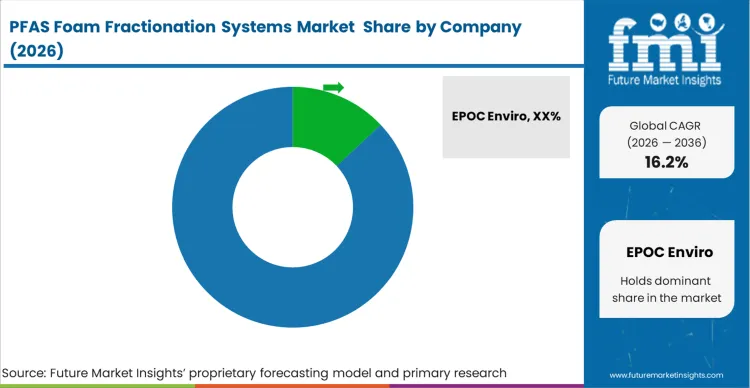
The environmental remediation sector is moderately consolidated around a few specialized water engineering conglomerates and highly focused technology startups. This structure exists because validating and commercializing effective extraction hardware requires intense capital investment and successful large-scale municipal pilot programs. Companies like EPOC Enviro, Ovivo Inc., and Clean Earth currently lead by proving their systems can handle complex, multi-contaminant water matrices. Procurement specification leads evaluating these vendors prioritize overall volume reduction metrics and secondary waste handling protocols above initial capital expenditure.
Vendors actively partnering with secondary destruction technology providers command a distinct structural advantage over pure separation manufacturers. Because the ultimate goal is mineralization, companies that bundle foam fractionation with electrochemical oxidation or hydrothermal alkaline treatment eliminate a massive logistical headache for the buyer. FMI expects the PFAS filtration media and equipment landscape to heavily favor these end-to-end integrators, much as sustainable trends favor PFAS-free barrier coatings for food paper. A challenger entering this space must possess either a novel method for floating highly recalcitrant short-chain compounds or a pre-established alliance with a destruction specialist to succeed against incumbents offering integrated PFAS-free powder coating texture additives.
To avoid vendor lock-in, massive utility networks and defense agencies actively sponsor open-platform testing and dual-source procurement programs. Buyers want the flexibility to upgrade the aeration diffusers or swap the destruction module without replacing the entire containment vessel, an adaptability equally prized in sectors using PFAS-free pearlescent pigment systems or fluorine free oil and grease repellents. This inherent tension limits the pricing power of dominant OEMs, forcing them to compete aggressively on consumable energy efficiency and service contracts. Through 2036, the market will likely experience targeted consolidation as larger engineering firms absorb niche fractionation startups to quickly acquire proprietary air-injection intellectual property.
Key Players in PFAS Foam Fractionation Systems Market
- EPOC Enviro
- Ovivo Inc.
- Clean Earth (Enviri Corporation)
- Evocra
- Oxyle
- SUEZ Group
- Veolia Water Technologies
- CDM Smith
Scope of the Report
| Metric | Value |
|---|---|
| Quantitative Units | USD 0.4 billion to USD 1.8 billion, at a CAGR of 16.2% |
| Market Definition | The PFAS foam fractionation systems market encompasses specialized aeration hardware and integrated separation modules designed to exploit the surfactant properties of per- and polyfluoroalkyl substances, generating a highly concentrated foamate without consumable adsorption media. |
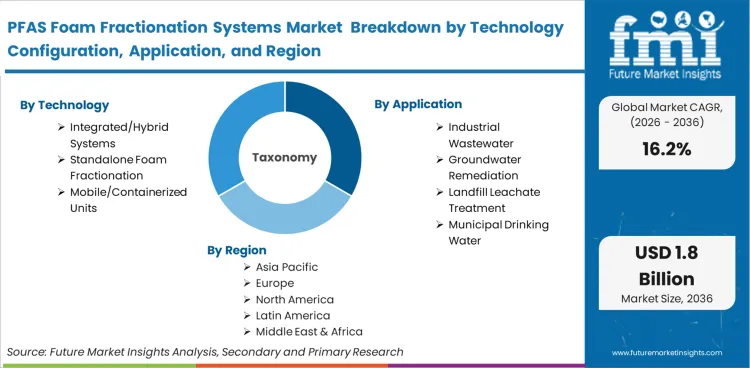
| Technology Configuration Segmentation | Standalone Foam Fractionation, Integrated/Hybrid Systems, Mobile/Containerized Units |
| Application Segmentation | Groundwater Remediation, Landfill Leachate Treatment, Industrial Wastewater, Municipal Drinking Water |
| End Use Segmentation | Municipalities, Military & Defense, Chemical & Manufacturing, Waste Management |
| Regions Covered | North America, Europe, Asia Pacific, Latin America, Middle East & Africa |
| Countries Covered | United States, Canada, Germany, Australia, United Kingdom, Sweden, Japan, and 40 plus countries |
| Key Companies Profiled | EPOC Enviro, Ovivo Inc., Clean Earth, Evocra, Oxyle, SUEZ Group, Veolia Water Technologies, CDM Smith |
| Forecast Period | 2026 to 2036 |
| Approach | The baseline value derives from a bottom-up aggregation of commercial foam fractionation skid shipments, applying region-specific regulatory compliance curves to project future adoption velocity. Forecasts are validated against capital expenditure reports from major environmental remediation firms. |
Source: Future Market Insights (FMI) analysis, based on proprietary forecasting model and primary research
Per- and polyfluoroalkyl substances (PFAS) Foam Fractionation Systems Market Analysis by Segments
-
Technology Configuration:
- Standalone Foam Fractionation
- Integrated/Hybrid Systems
- Mobile/Containerized Units
-
Application:
- Groundwater Remediation
- Landfill Leachate Treatment
- Industrial Wastewater
- Municipal Drinking Water
-
End Use:
- Municipalities
- Military & Defense
- Chemical & Manufacturing
- Waste Management
-
Region:
- North America
- United States
- Canada
- Europe
- Germany
- United Kingdom
- Sweden
- Rest of Europe
- Asia Pacific
- Australia
- Japan
- Rest of Asia Pacific
- Latin America
- Brazil
- Mexico
- Middle East & Africa
- Saudi Arabia
- South Africa
- North America
Bibliography
- MDPI. (2025, May 27). Remediating Per- and Polyfluoroalkyl Substances (PFAS)-Contaminated Water by Foam Fractionation and Electrochemical Oxidation. Environments.
- Enviri Corporation. (2025, October 07). Clean Earth Installs New Foam Fractionation Unit to Remediate PFAS. Enviri Newsroom.
- Royal Society of Chemistry. (2025, July 28). Removal of long- and short-chain PFAS from groundwater by foam fractionation. Environmental Science: Water Research & Technology.
- American Chemical Society. (2024, November 12). Foam Fractionation as an Efficient Method for the Separation and Recovery of Surfactants and Surface-Inactive Agents: State of the Art. ACS Omega.
- National Center for Biotechnology Information. (2025, October 22). Life Cycle Assessment and Life Cycle Costing Analysis for Removing Per- and Polyfluoroalkyl Substances from Landfill Leachate with Foam Fractionation Technology. PMC.
- Department of Defense. (2024, March 14). Per- and Polyfluoroalkyl Substances (PFAS) Cleanup Progress Report. Defense.gov.
This bibliography is provided for reader reference. The full FMI report contains the complete reference list with primary source documentation.
This Report Addresses
- Market intelligence to support strategic decision making across foam generation skids, skimming automated hardware, and secondary destruction couplings unique to this market
- Market size estimation and 10-year revenue forecasts from 2026 to 2036, supported by environmental compliance tracking and municipal remediation capital expenditure data
- Growth opportunity mapping across standalone and integrated hybrid configurations with emphasis on the rapid commercialization of native closed-loop electrochemical oxidation pairings
- Segment and regional revenue forecasts covering critical landfill leachate treatment deployments across aggressive regulatory enforcement zones in North America and Europe
- Competition strategy assessment including closed-loop capability integration, consumable energy efficiency optimization, and municipal pilot program validation
- Capability development tracking including high-volume continuous extraction frameworks, EPA compliance milestones, and short-chain surfactant enhancement protocols discussed in this article
- Market access analysis covering federal infrastructure grant pathways, military cleanup procurement channels, and privatized utility bidding criteria
- Market report delivery in PDF, Excel, PPT, and interactive dashboard formats for executive strategy, regional environmental compliance planning, and operational benchmarking use
Frequently Asked Questions
How large is the PFAS foam fractionation systems market in 2026?
Demand for PFAS foam fractionation systems in the global market is estimated to be valued at USD 0.4 billion in 2026, driven by an urgent need to replace consumable media that generate massive secondary waste.
What will it be valued at by 2036?
Market size is projected to reach USD 1.8 billion by 2036 as the escalating costs of spent carbon disposal force asset owners to adopt physical volume-reduction technologies.
What CAGR is projected?
The industry is expected to grow at a CAGR of 16.2%, a rate defensibly supported by hard regulatory deadlines and massive federal infrastructure allocations.
Which Technology Configuration segment leads?
Integrated/hybrid systems accounts for 55.4% share in 2026 because fusing concentration steps natively with destruction mechanisms eliminates the liabilities of off-site transport entirely.
Which Application segment leads?
Landfill leachate treatment emerges as the leader, ensuring municipal water treatment plants can accept pre-treated effluent without suffering rapid membrane fouling from high organic loads.
Which end use segment leads?
Military & defense captures 38.5% of the market as base commanders face intense pressure to treat millions of gallons of contaminated groundwater caused by legacy AFFF firefighting operations.
What drives rapid growth?
Strict EPA maximum contaminant levels combined with the exorbitant hazardous waste disposal fees associated with traditional granular activated carbon usage force rapid adoption.
What is the primary restraint?
The intricate hydrodynamic optimization of air-to-water ratios required to effectively float short-chain PFAS compounds creates significant operational friction for conventional plant operators.
Which country grows fastest?
The United States grows fastest at 18.5%, propelled directly by the billions allocated under the Bipartisan Infrastructure Law specifically targeting emerging contaminants and military base remediation.
What specific regulatory mandate is accelerating this market?
The EPA's National Primary Drinking Water Regulation (NPDWR), which establishes ultra-low enforcement limits for six distinct PFAS compounds.
How does foam fractionation differ from traditional GAC?
Instead of trapping chemicals in a physical carbon media that eventually requires incineration, fractionation exploits the surfactant properties of PFAS to float them into a micro-volume foam, reducing waste bulk by 99%.
How do the top vendors compete in this space?
Leading environmental contractors compete primarily on volume-reduction metrics and the ability to natively couple their separation hardware with continuous electrochemical oxidation destruction modules.
How are smaller utilities managing the complex integration of these systems?
Engineering firms increasingly provide automated, sensor-driven containerized skids that self-adjust injection rates, mitigating the lack of specialized hydrodynamic expertise at rural facilities.
Why is Canada exhibiting strong growth?
Regional water authorities in Canada operate under tightening provincial effluent limits targeting industrial manufacturing discharges, accelerating the need for continuous pre-treatment capabilities.
How do co-contaminants impact foam fractionation performance?
Unlike traditional ion-exchange resins that suffer from rapid competitive fouling, air-water interface partitioning remains highly effective even in the presence of heavy organic background loads.
What makes short-chain PFAS removal challenging?
Shorter carbon-chain compounds are less hydrophobic and surface-active, requiring finely tuned bubble sizing or the addition of cationic surfactants to effectively force them into the foam layer.
Are there secondary markets for the concentrated foamate?
No; the primary objective is to route the highly toxic foamate directly into a destruction module, completely mineralizing the carbon-fluorine bonds to eliminate long-term liability.
How does Germany fit into the European demand landscape?
Germany’s advanced chemical manufacturing base requires robust pretreatment systems to isolate fluorinated surfactants before they reach and potentially damage municipal biological treatment assets.
How critical are mobile units to the defense sector?
Containerized fractionation skids allow for immediate mobilization to remote or restricted access military zones, accelerating the initial containment of migrating groundwater plumes.
Why are open-platform architectures preferred by large buyers?
Massive utility networks want the flexibility to upgrade aeration diffusers or swap destruction modules without being locked into a single OEM's proprietary replacement cycle.
How do systems integrators validate performance prior to installation?
Firms conduct extensive bench-scale treatability studies to optimize the specific air-to-water ratio required for the unique water chemistry profile of each individual site.
Is Japan a significant market for these systems?
Yes; Japan's semiconductor fabrication complex continually invests in advanced micro-bubble extraction to maintain the ultra-clean process water required for next-generation robotic transfer systems.
Preview the report firsthand - request a free sample
Get SampleGet the brochure for pricing and purchase details.
Get PDFTable of Content
- Executive Summary
- Global Market Outlook
- Demand-side Trends
- Supply-side Trends
- Technology Roadmap Analysis
- Analysis and Recommendations
- Market Overview
- Market Coverage / Taxonomy
- Market Definition / Scope / Limitations
- Research Methodology
- Chapter Orientation
- Analytical Lens and Working Hypotheses
- Market Structure, Signals, and Trend Drivers
- Benchmarking and Cross-market Comparability
- Market Sizing, Forecasting, and Opportunity Mapping
- Research Design and Evidence Framework
- Desk Research Programme (Secondary Evidence)
- Company Annual and Sustainability Reports
- Peer-reviewed Journals and Academic Literature
- Corporate Websites, Product Literature, and Technical Notes
- Earnings Decks and Investor Briefings
- Statutory Filings and Regulatory Disclosures
- Technical White Papers and Standards Notes
- Trade Journals, Industry Magazines, and Analyst Briefs
- Conference Proceedings, Webinars, and Seminar Materials
- Government Statistics Portals and Public Data Releases
- Press Releases and Reputable Media Coverage
- Specialist Newsletters and Curated Briefings
- Sector Databases and Reference Repositories
- FMI Internal Proprietary Databases and Historical Market Datasets
- Subscription Datasets and Paid Sources
- Social Channels, Communities, and Digital Listening Inputs
- Additional Desk Sources
- Expert Input and Fieldwork (Primary Evidence)
- Primary Modes
- Qualitative Interviews and Expert Elicitation
- Quantitative Surveys and Structured Data Capture
- Blended Approach
- Why Primary Evidence is Used
- Field Techniques
- Interviews
- Surveys
- Focus Groups
- Observational and In-context Research
- Social and Community Interactions
- Stakeholder Universe Engaged
- C-suite Leaders
- Board Members
- Presidents and Vice Presidents
- R&D and Innovation Heads
- Technical Specialists
- Domain Subject-matter Experts
- Scientists
- Physicians and Other Healthcare Professionals
- Governance, Ethics, and Data Stewardship
- Research Ethics
- Data Integrity and Handling
- Primary Modes
- Tooling, Models, and Reference Databases
- Desk Research Programme (Secondary Evidence)
- Data Engineering and Model Build
- Data Acquisition and Ingestion
- Cleaning, Normalisation, and Verification
- Synthesis, Triangulation, and Analysis
- Quality Assurance and Audit Trail
- Market Background
- Market Dynamics
- Drivers
- Restraints
- Opportunity
- Trends
- Scenario Forecast
- Demand in Optimistic Scenario
- Demand in Likely Scenario
- Demand in Conservative Scenario
- Opportunity Map Analysis
- Product Life Cycle Analysis
- Supply Chain Analysis
- Investment Feasibility Matrix
- Value Chain Analysis
- PESTLE and Porter’s Analysis
- Regulatory Landscape
- Regional Parent Market Outlook
- Production and Consumption Statistics
- Import and Export Statistics
- Market Dynamics
- Global Market Analysis 2021 to 2025 and Forecast, 2026 to 2036
- Historical Market Size Value (USD Million) Analysis, 2021 to 2025
- Current and Future Market Size Value (USD Million) Projections, 2026 to 2036
- Y-o-Y Growth Trend Analysis
- Absolute $ Opportunity Analysis
- Global Market Pricing Analysis 2021 to 2025 and Forecast 2026 to 2036
- Global Market Analysis 2021 to 2025 and Forecast 2026 to 2036, By Technology Configuration
- Introduction / Key Findings
- Historical Market Size Value (USD Million) Analysis By Technology Configuration , 2021 to 2025
- Current and Future Market Size Value (USD Million) Analysis and Forecast By Technology Configuration , 2026 to 2036
- Integrated/Hybrid Systems
- Standalone Foam Fractionation
- Mobile/Containerized Value (USD Million)s
- Integrated/Hybrid Systems
- Y-o-Y Growth Trend Analysis By Technology Configuration , 2021 to 2025
- Absolute $ Opportunity Analysis By Technology Configuration , 2026 to 2036
- Global Market Analysis 2021 to 2025 and Forecast 2026 to 2036, By Application
- Introduction / Key Findings
- Historical Market Size Value (USD Million) Analysis By Application, 2021 to 2025
- Current and Future Market Size Value (USD Million) Analysis and Forecast By Application, 2026 to 2036
- Industrial Wastewater
- Groundwater Remediation
- Landfill Leachate Treatment
- Municipal Drinking Water
- Industrial Wastewater
- Y-o-Y Growth Trend Analysis By Application, 2021 to 2025
- Absolute $ Opportunity Analysis By Application, 2026 to 2036
- Global Market Analysis 2021 to 2025 and Forecast 2026 to 2036, By End Use
- Introduction / Key Findings
- Historical Market Size Value (USD Million) Analysis By End Use, 2021 to 2025
- Current and Future Market Size Value (USD Million) Analysis and Forecast By End Use, 2026 to 2036
- Military & Defense
- Municipalities
- Chemical & Manufacturing
- Waste Management
- Military & Defense
- Y-o-Y Growth Trend Analysis By End Use, 2021 to 2025
- Absolute $ Opportunity Analysis By End Use, 2026 to 2036
- Global Market Analysis 2021 to 2025 and Forecast 2026 to 2036, By Region
- Introduction
- Historical Market Size Value (USD Million) Analysis By Region, 2021 to 2025
- Current Market Size Value (USD Million) Analysis and Forecast By Region, 2026 to 2036
- North America
- Latin America
- Western Europe
- Eastern Europe
- East Asia
- South Asia and Pacific
- Middle East & Africa
- Market Attractiveness Analysis By Region
- North America Market Analysis 2021 to 2025 and Forecast 2026 to 2036, By Country
- Historical Market Size Value (USD Million) Trend Analysis By Market Taxonomy, 2021 to 2025
- Market Size Value (USD Million) Forecast By Market Taxonomy, 2026 to 2036
- By Country
- USA
- Canada
- Mexico
- By Technology Configuration
- By Application
- By End Use
- By Country
- Market Attractiveness Analysis
- By Country
- By Technology Configuration
- By Application
- By End Use
- Key Takeaways
- Latin America Market Analysis 2021 to 2025 and Forecast 2026 to 2036, By Country
- Historical Market Size Value (USD Million) Trend Analysis By Market Taxonomy, 2021 to 2025
- Market Size Value (USD Million) Forecast By Market Taxonomy, 2026 to 2036
- By Country
- Brazil
- Chile
- Rest of Latin America
- By Technology Configuration
- By Application
- By End Use
- By Country
- Market Attractiveness Analysis
- By Country
- By Technology Configuration
- By Application
- By End Use
- Key Takeaways
- Western Europe Market Analysis 2021 to 2025 and Forecast 2026 to 2036, By Country
- Historical Market Size Value (USD Million) Trend Analysis By Market Taxonomy, 2021 to 2025
- Market Size Value (USD Million) Forecast By Market Taxonomy, 2026 to 2036
- By Country
- Germany
- UK
- Italy
- Spain
- France
- Nordic
- BENELUX
- Rest of Western Europe
- By Technology Configuration
- By Application
- By End Use
- By Country
- Market Attractiveness Analysis
- By Country
- By Technology Configuration
- By Application
- By End Use
- Key Takeaways
- Eastern Europe Market Analysis 2021 to 2025 and Forecast 2026 to 2036, By Country
- Historical Market Size Value (USD Million) Trend Analysis By Market Taxonomy, 2021 to 2025
- Market Size Value (USD Million) Forecast By Market Taxonomy, 2026 to 2036
- By Country
- Russia
- Poland
- Hungary
- Balkan & Baltic
- Rest of Eastern Europe
- By Technology Configuration
- By Application
- By End Use
- By Country
- Market Attractiveness Analysis
- By Country
- By Technology Configuration
- By Application
- By End Use
- Key Takeaways
- East Asia Market Analysis 2021 to 2025 and Forecast 2026 to 2036, By Country
- Historical Market Size Value (USD Million) Trend Analysis By Market Taxonomy, 2021 to 2025
- Market Size Value (USD Million) Forecast By Market Taxonomy, 2026 to 2036
- By Country
- China
- Japan
- South Korea
- By Technology Configuration
- By Application
- By End Use
- By Country
- Market Attractiveness Analysis
- By Country
- By Technology Configuration
- By Application
- By End Use
- Key Takeaways
- South Asia and Pacific Market Analysis 2021 to 2025 and Forecast 2026 to 2036, By Country
- Historical Market Size Value (USD Million) Trend Analysis By Market Taxonomy, 2021 to 2025
- Market Size Value (USD Million) Forecast By Market Taxonomy, 2026 to 2036
- By Country
- India
- ASEAN
- Australia & New Zealand
- Rest of South Asia and Pacific
- By Technology Configuration
- By Application
- By End Use
- By Country
- Market Attractiveness Analysis
- By Country
- By Technology Configuration
- By Application
- By End Use
- Key Takeaways
- Middle East & Africa Market Analysis 2021 to 2025 and Forecast 2026 to 2036, By Country
- Historical Market Size Value (USD Million) Trend Analysis By Market Taxonomy, 2021 to 2025
- Market Size Value (USD Million) Forecast By Market Taxonomy, 2026 to 2036
- By Country
- Kingdom of Saudi Arabia
- Other GCC Countries
- Turkiye
- South Africa
- Other African Union
- Rest of Middle East & Africa
- By Technology Configuration
- By Application
- By End Use
- By Country
- Market Attractiveness Analysis
- By Country
- By Technology Configuration
- By Application
- By End Use
- Key Takeaways
- Key Countries Market Analysis
- USA
- Pricing Analysis
- Market Share Analysis, 2025
- By Technology Configuration
- By Application
- By End Use
- Canada
- Pricing Analysis
- Market Share Analysis, 2025
- By Technology Configuration
- By Application
- By End Use
- Mexico
- Pricing Analysis
- Market Share Analysis, 2025
- By Technology Configuration
- By Application
- By End Use
- Brazil
- Pricing Analysis
- Market Share Analysis, 2025
- By Technology Configuration
- By Application
- By End Use
- Chile
- Pricing Analysis
- Market Share Analysis, 2025
- By Technology Configuration
- By Application
- By End Use
- Germany
- Pricing Analysis
- Market Share Analysis, 2025
- By Technology Configuration
- By Application
- By End Use
- UK
- Pricing Analysis
- Market Share Analysis, 2025
- By Technology Configuration
- By Application
- By End Use
- Italy
- Pricing Analysis
- Market Share Analysis, 2025
- By Technology Configuration
- By Application
- By End Use
- Spain
- Pricing Analysis
- Market Share Analysis, 2025
- By Technology Configuration
- By Application
- By End Use
- France
- Pricing Analysis
- Market Share Analysis, 2025
- By Technology Configuration
- By Application
- By End Use
- India
- Pricing Analysis
- Market Share Analysis, 2025
- By Technology Configuration
- By Application
- By End Use
- ASEAN
- Pricing Analysis
- Market Share Analysis, 2025
- By Technology Configuration
- By Application
- By End Use
- Australia & New Zealand
- Pricing Analysis
- Market Share Analysis, 2025
- By Technology Configuration
- By Application
- By End Use
- China
- Pricing Analysis
- Market Share Analysis, 2025
- By Technology Configuration
- By Application
- By End Use
- Japan
- Pricing Analysis
- Market Share Analysis, 2025
- By Technology Configuration
- By Application
- By End Use
- South Korea
- Pricing Analysis
- Market Share Analysis, 2025
- By Technology Configuration
- By Application
- By End Use
- Russia
- Pricing Analysis
- Market Share Analysis, 2025
- By Technology Configuration
- By Application
- By End Use
- Poland
- Pricing Analysis
- Market Share Analysis, 2025
- By Technology Configuration
- By Application
- By End Use
- Hungary
- Pricing Analysis
- Market Share Analysis, 2025
- By Technology Configuration
- By Application
- By End Use
- Kingdom of Saudi Arabia
- Pricing Analysis
- Market Share Analysis, 2025
- By Technology Configuration
- By Application
- By End Use
- Turkiye
- Pricing Analysis
- Market Share Analysis, 2025
- By Technology Configuration
- By Application
- By End Use
- South Africa
- Pricing Analysis
- Market Share Analysis, 2025
- By Technology Configuration
- By Application
- By End Use
- USA
- Market Structure Analysis
- Competition Dashboard
- Competition Benchmarking
- Market Share Analysis of Top Players
- By Regional
- By Technology Configuration
- By Application
- By End Use
- Competition Analysis
- Competition Deep Dive
- EPOC Enviro
- Overview
- Product Portfolio
- Profitability by Market Segments (Product/Age /Sales Channel/Region)
- Sales Footprint
- Strategy Overview
- Marketing Strategy
- Product Strategy
- Channel Strategy
- Ovivo Inc.
- Clean Earth (Enviri Corporation)
- Evocra
- Oxyle
- SUEZ Group
- Veolia Water Technologies
- CDM Smith
- EPOC Enviro
- Competition Deep Dive
- Assumptions & Acronyms Used


