

- Industry Size (2026)
- USD 3.0 Bn
- Forecast (2036)
- USD 8.0 Bn
- CAGR (2026 to 2036)
- 10.3%
PFAS Filtration & Treatment Media Market Forecast and Outlook 2026 to 2036
The PFAS filtration & treatment media market is expected to reach USD 3.0 billion in 2026, and will likely increase further to USD 8.0 billion by 2036. FMI expects this landscape to progress at a 10.3% CAGR from 2026 to 2036. Several important developments characterize this trajectory.The U.S. EPA’s finalization of the National Primary Drinking Water Regulation (NPDWR) remains the most significant demand driver for the filtration media sector. While legal challenges in 2025 led the EPA to extend some compliance deadlines for PFOA and PFOS to 2031, the mandatory monitoring requirements starting in 2027 have already triggered large-scale procurement.
Public water systems serving approximately 100 million people are now legally required to implement solutions to meet MCLs as low as 4.0 parts per trillion. This regulatory certainty has shifted the market from reactive testing to long-term capital expenditure, exemplified by American Water’s 2025 nine-year exclusive agreement with Calgon Carbon to secure filtration media and equipment across 10 states.
This regulatory certainty has shifted the market from reactive testing to long-term capital expenditure, exemplified by American Water’s 2025 nine-year exclusive agreement with Calgon Carbon to secure filtration media and equipment across 10 states. Regarding this strategic pivot, M. Susan Hardwick, Chief Executive Officer of American Water, stated:
"American Water remains steadfast in our commitment to protect our customers and the communities we serve by meeting or surpassing federal and local drinking water standards, including those regulations put forth by the U.S. EPA related to PFAS. Our partnership with Calgon Carbon is a critical element in ensuring our facilities will continue to have the necessary equipment, supplies and ongoing services to comply with current PFAS regulations and do so in an environmentally responsible way."-January 15, 2025, Source: Calgon Carbon Official Press Release
The landscape is undergoing a structural transformation as major chemical producers exit the PFAS space. 3M Company officially confirmed the completion of its goal to phase out all PFAS manufacturing by the end of 2025, a move that affects more than 22,000 items in its portfolio and closes a $1.2 billion annual revenue stream in PFAS-containing products.
BASF SE has progressed with its global phase-out of PFAS formulations. This mass departure of Tier-1 manufacturers has created a dual impact: it has intensified the urgency for "PFAS-free" alternative media and consolidated the market for remediation technologies as industries scramble to manage legacy contamination and find compliant replacements for mission-critical applications.
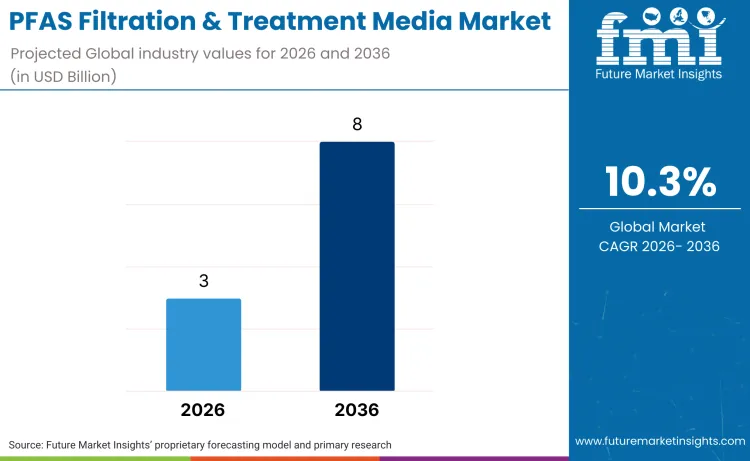
Summary of PFAS Filtration & Treatment Media Market
What is Growth Outlook for PFAS Filtration & Treatment Media Market as per Future Market Insights Projection?
Future Market Insights projects the PFAS filtration & treatment media market to expand at a CAGR of 10.3% from 2026 to 2036, increasing from USD 3.0 billion in 2026 to USD 8.0 billion by 2036.
FMI Research Approach: FMI proprietary forecasting model integrating enforceable drinking water standards, defense-sector PFAS discharge mandates, and long-term municipal and industrial treatment infrastructure investments.
How do FMI Analysts Perceive PFAS Filtration & Treatment Media Market to Evolve?
FMI analysts perceive the market evolving from episodic remediation toward permanent, compliance-driven treatment infrastructure, where utilities and industrial operators are compelled to secure long-lifecycle filtration media ahead of mandatory monitoring and enforcement timelines. Demand is increasingly anchored in multi-year capital expenditure rather than short-term testing or cleanup activity.
FMI Research Approach: Assessment of national drinking water regulations, defense and industrial discharge compliance frameworks, and utility procurement behavior.
Which Country Holds Largest Share in Global PFAS Filtration & Treatment Media Market?
China holds the largest share of the global PFAS filtration & treatment media market, supported by centralized environmental enforcement, large-scale industrial wastewater treatment deployment, and accelerated investment in long-term filtration infrastructure aligned with national environmental protection targets.
FMI Research Approach: Country-level modeling based on industrial water treatment capacity, regulatory compliance intensity, and capital allocation toward PFAS remediation across manufacturing hubs.
How Large will the PFAS Filtration & Treatment Media Market Be by 2036?
The global PFAS filtration & treatment media market is projected to reach USD 8.0 billion by 2036.
FMI Research Approach: Long-term revenue forecasting derived from mandatory PFAS monitoring requirements, municipal infrastructure upgrades, and industrial wastewater treatment compliance.
What is the Definition of PFAS Filtration & Treatment Media Market?
The PFAS filtration & treatment media market comprises engineered sorbents, ion exchange resins, membrane systems, and hybrid media designed to remove per- and polyfluoroalkyl substances from drinking water, groundwater, and industrial aqueous streams to meet ultra-low regulatory thresholds.
FMI Research Approach: FMI market taxonomy and inclusion–exclusion framework covering media technologies, regulated end-use environments, and compliance-oriented treatment applications.
What are some Globally Unique Trends Shaping PFAS Filtration & Treatment Media Market?
Globally unique trends include the transition from advisory PFAS monitoring to legally enforceable treatment mandates, growing reliance on granular activated carbon and ion exchange systems, and increasing integration of capture media with validated destruction pathways to reduce long-term environmental and legal liability.
FMI Research Approach: Synthesis of regulatory enforcement trends, municipal and industrial compliance strategies, and technology validation outcomes across major PFAS-affected regions.
PFAS Filtration & Treatment Media Market Key Takeaways
| Metric | Value |
|---|---|
| Expected Value (2026E) | USD 3.0 billion |
| Projected Valued (2036F) | USD 8.0 billion |
| CAGR (2026-2036) | 10.3% |
Source: FMI analysis based on primary research and proprietary forecasting model
Why is the PFAS Filtration & Treatment Media Market Growing?
Expansion of PFAS filtration and treatment media demand is driven by a transition from advisory to mandatory international compliance thresholds. The European Commission implemented new regulations on January 12, 2026, establishing a harmonized limit of 0.1 µg/L for a group of 20 PFAS substances across all member states. This recast Drinking Water Directive requires systematic monitoring for the first time, compelling utilities to integrate advanced treatment steps to address exceedances. National-level enforcement is even more aggressive in specific regions; Germany has adopted the 0.1 µg/L "sum of PFAS-20" parameter as a strict legal requirement, necessitating immediate infrastructure upgrades to maintain public health standards.
Legislative mandates in the defense sector are further catalyzing large-scale procurement. The Department of Defense PFAS Discharge Prevention Act, introduced in 2025, requires the Secretary of Defense to modify stormwater discharge permits for every DOD facility to include quarterly PFAS monitoring. This mandate forces the implementation of best management practices and control technologies across 700 potentially contaminated installations. Market volume is supported by the FY2026 Defense Budget, which targets the reduction of toxic runoff from firefighting foams to protect surrounding drinking water sources.
Commercial-scale validation of destruction technologies has reduced the long-term liability profile for industrial operators. A September 2025 joint study by the EPA and DOD confirmed that high-temperature incineration achieves destruction removal efficiencies between 99.95% and 99.9999% for nine PFAS chemicals. These results, verified against the latest OTM-50 and Method 0010 emission standards, allow industries to pivot toward end-to-end solutions that combine capture media with permanent thermal elimination. Modular innovations are also increasing adoption; LANXESS equipped a 190,000-liter-per-hour mobile treatment plant in Belgium in late 2024 using its Lewatit TP 108 DW ion exchange resin, demonstrating the scalability of selective media in decentralized applications.
Segment Profile of PFAS Filtration & Treatment Media Market
The market segmentation of PFAS filtration and treatment media is defined by the technical maturation of established sorbents and a transition toward high-reliability municipal infrastructure. While emerging technologies like specialized membranes and novel bio-sorbents are gaining traction in industrial niches, the landscape remains anchored by technologies that offer proven operational simplicity and compliance defensibility.
Does Granular Activated Carbon (GAC) Maintain Its Technical Lead?
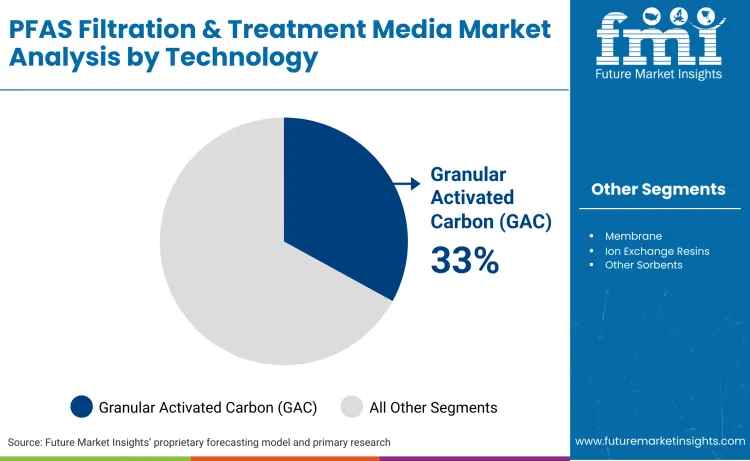
Granular activated carbon (GAC) holds a 33% market share due to its role as a versatile, "cradle-to-grave" solution for both long- and short-chain PFAS. Its dominance is reinforced by the dual-value proposition of adsorption and thermal reactivation, which allows spent media to be recycled while achieving over 99.99% contaminant destruction. Recent industry showcases, such as Haycarb’s WQA 2025 exhibition, highlight the shift toward specialized coconut shell-based carbons engineered with tailored pore structures to maximize the adsorption of high-mobility "forever chemicals" while maintaining a lower carbon footprint than traditional coal-based media.
The technical evolution of GAC is increasingly focused on enhancing lifecycle efficiency through continuous processing. SUEZ’s proprietary Carbazur® Simplex reactors, deployed in full-scale industrial pilots through late 2025, utilize a continuous GAC renewal system that extends media life according to specific micropollutant loads. This automation addresses the volatility of PFAS concentrations in groundwater, allowing industrial operators to optimize media consumption rates and reduce the frequency of manual change-outs during the 2026 regulatory cycle.
Why is Municipal Drinking Water the Primary Driver of Adoption?
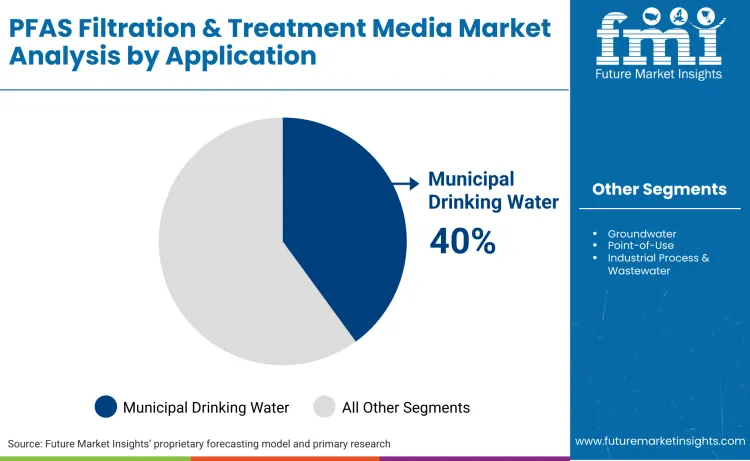
Municipal Drinking Water represents a 40% market share, emerging as the single largest application segment as utilities move from monitoring to mandatory treatment. This segment’s growth is fueled by massive public financing, including the USD 1 billion in Clean Water State Revolving Fund allocations for FY2022–FY2026 dedicated specifically to emerging contaminants. These funds enable mid-sized and small public water systems to transition from sampling to the construction of permanent filtration trains necessary to meet the 4.0 ppt federal thresholds.
Growth is evidenced by Northern Europe's adoption of aggressive national targets that exceed baseline EU requirements. Denmark’s Ministry of Environment has enforced a national limit of 0.002 µg/L for a sum of four specific PFAS (PFOA, PFOS, PFNA, PFHxS) as of 2025, while Sweden’s Livsmedelsverket is implementing similar 4 ppt thresholds. These regulations are forcing a front-loaded investment in high-performance filtration media across Nordic municipal networks, creating a localized market for advanced ion exchange and hybrid GAC systems that can reach ultra-low detection limits.
What Drives Demand for PFAS Filtration & Treatment Media?
The global PFAS filtration market is undergoing an accelerated transition from voluntary monitoring to a strict legal enforcement era. Japan and Canada exemplify this shift with mandates taking full effect in mid 2026 that impose near zero tolerance thresholds for PFOA and PFOS in both mineral water and industrial supply chains. These regulations necessitate the immediate adoption of high efficiency media as water producers and distributors must enhance testing procedures to maintain market access.
Infrastructure development is influenced by the reclassification of hazardous substances in major manufacturing hubs such as South Korea. The National Institute of Chemical Safety has finalized reforms that subject mixtures with as little as 0.1 percent toxic content to stringent protective measures.
This regulatory pressure is matched by the emergence of new contaminants on monitoring lists such as the UK DWI PFAS48 which now identifies persistent polyfluorinated surfactants. These developments signify that filtration media must now address a broader and more complex spectrum of molecules than previously required.
Technical innovation is moving toward circular and carbon neutral solutions to offset the environmental cost of remediation. The introduction of solvent free ion exchange resins using renewable feedstocks allows utilities to meet water safety standards while simultaneously satisfying corporate sustainability mandates.
Confidence in long term treatment trains has also been bolstered by large scale validation of thermal destruction. Recent studies confirming that high temperature incineration can eliminate forever chemicals at a commercial scale provide a clear pathway for municipal and industrial actors to mitigate legacy liabilities through 2026 and beyond.
How is PFAS Filtration & Treatment Media Demand evolving in Key Countries?
The country-level analysis of the PFAS filtration & treatment media market reflects a localized approach to remediation, where growth is dictated by specific regional health advisories, industrial discharge permits, and sub-national legislation.
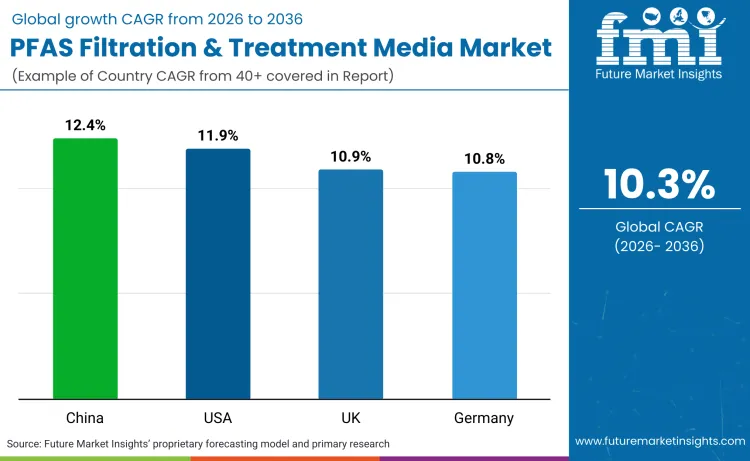
| Country | CAGR (2026-2036) |
|---|---|
| USA | 11.9% |
| UK | 10.9% |
| Germany | 10.8% |
| China | 12.4% |
Source: Future Market Insights (FMI) analysis, based on proprietary forecasting model and primary research
How is State-Level Activism widening prospects for PFAS Filtration & Treatment Media in USA?
USA, projected to expand at an 11.9% CAGR, is driven by aggressive state-level mandates that outpace federal guidelines. In early 2026, Minnesota’s Amara’s Law and Colorado’s Senate Bill 24-081 transitioned into critical enforcement phases, prohibiting intentionally added PFAS in several consumer categories and increasing pressure on industrial wastewater pre-treatment.
Player-wise development shows activities such as Solenis’ expansion of its portfolio of PFAS-free chemical solutions for the pulp and paper industry to meet these localized 2026 bans, stimulating demand for specialized filtration media capable of handling complex industrial process water.
Will the New National PFAS Plan Redefine UK’s PFAS Filtration & Treatment Media Infrastructure?
Expanding at a 10.9% CAGR, UK’s market is reacting to the Department for Environment, Food & Rural Affairs (Defra) PFAS Plan published on February 3, 2026. This framework initiates a statutory consultation for drinking water limits and introduces strict Best Available Techniques (BAT) for industrial site operators.
Utilities like Severn Trent Water have responded by investing £123 million into Tier 2 treatment works, specifically targeting GAC-based second-stage filtration at sites like Church Wilne to satisfy the Drinking Water Inspectorate’s new risk-reduction obligations.
Can Technical Standardization stabilize Growth of PFAS Filtration & Treatment Media Market in Germany?
Germany’s 10.8% CAGR is underpinned by the formal implementation of the "sum of PFAS-20" limit of 0.1 µg/L as of January 12, 2026. This legal certainty has prompted the Technologiezentrum Wasser (TZW) to standardize the Granular Carbon Selection Test (GCS-Test), allowing municipalities to validate the efficacy of renewable media like palm kernel-based activated carbon. CarboTech has optimized specialized steam-activated carbons to meet these DIN EN 12915-1 standards, ensuring high-throughput removal for German utilities facing the first wave of 2026 compliance audits.
Is China Transitioning Toward a Compliance-Driven Sector?
China leads global growth with a 12.4% CAGR, fueled by the Ministry of Ecology and Environment’s HCFC phase-out management plan effective July 1, 2026. This regulatory pivot compels chemical manufacturers to adopt advanced wastewater treatment trains.
Wanhua Chemical has integrated internationally-leading water reuse technologies into its 1.6 million-ton specialty polyolefin project in Fuzhou, targeting a 95% efficiency rate. This move reflects a broader national shift where large-scale industrial players are securing long-term filtration assets to align with China’s 14th Five-Year Plan for high-end new materials and environmental protection.
How is Competition assuming shape in PFAS Filtration & Treatment Media Market?
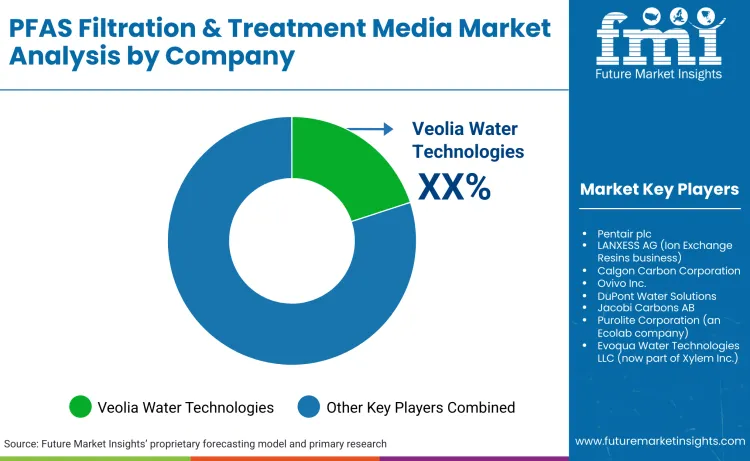
An end-to-end service model that integrates contaminant detection, capture, and final destruction increasingly defines the competitive structure of the PFAS filtration and treatment media market. Leading players are moving away from being simple media suppliers toward becoming holistic environmental security partners. This strategy is primarily driven by the need to mitigate long-term forever chemical liabilities for municipal and industrial clients. By controlling the entire lifecycle, firms are able to secure multi-year service contracts and capitalize on the shift from episodic remediation to continuous compliance monitoring.
Strategic differentiation is also manifesting through aggressive portfolio realignment and geographic expansion. The market is witnessing a wave of structural separations, where conglomerates are spinning off their water-focused divisions into independent, agile entities capable of pursuing dedicated M&A in the PFAS space.
Market players are securing their footholds by obtaining first-of-their-kind regulatory licenses in emerging hubs like Southeast Asia, establishing a first-mover advantage as localized PFAS limits come into force. This decentralized approach, supported by mobile and modular treatment units, allows companies to rapidly respond to hotspot contaminations at military bases and industrial sites without the lead times required for permanent infrastructure.
- In June 2025, Veolia Water Technologies, inaugurated one of the largest PFAS treatment facilities in the United States, located in Delaware, capable of processing 30 million gallons of water daily. This project is a cornerstone of its BeyondPFAS offering, which provides integrated testing and disposal.
- Ovivo Inc. significantly enhanced its onsite destruction capabilities in 2024 through the strategic acquisition of E2metrix and an exclusive licensing agreement with Evocra for ozone foam fractionation. These moves culminated in the late 2024 launch of its "Obreak" and "Olift" solutions, which combine concentration and electrochemical oxidation technologies.
- In 2025, Jacobi Carbons AB expanded its mobile filter unit rental fleet, offering vessels ranging from 200 liters to 20 cubic meters. This service allows industrial clients to adhere to local compliance audits using a bespoke, case-by-case approach that pairs advanced activated carbon with technical support for optimal contact time and removal.
Key Players Profiled
- Veolia Water Technologies
- Pentair plc
- LANXESS AG (Ion Exchange Resins business)
- Calgon Carbon Corporation
- Ovivo Inc.
- DuPont Water Solutions
- Jacobi Carbons AB
- Purolite Corporation (an Ecolab company)
- Evoqua Water Technologies LLC (now part of Xylem Inc.)
- SUEZ Water Technologies & Solutions
Market Definition
The PFAS filtration & treatment media market comprises engineered materials designed to capture, remove, or isolate per- and PFAS from water and aqueous process streams. These media are deployed to address contamination in drinking water, groundwater, and industrial effluents, where ultra-low regulatory thresholds and long-term health risks require reliable, high-efficiency removal of both short- and long-chain PFAS compounds. The market reflects the transition of PFAS control from episodic remediation toward permanent, compliance-driven treatment infrastructure.
The report includes filtration and treatment media such as granular activated carbon (GAC), ion exchange resins, membranes, and other specialized sorbents used in municipal drinking water systems, groundwater remediation, point-of-use treatment, and industrial process or wastewater applications. It covers media supplied for fixed and mobile treatment systems, including solutions designed for adsorption, selective exchange, regeneration, and compatibility with downstream destruction technologies such as thermal reactivation or incineration, across regulated markets worldwide.
The scope excludes PFAS analytical testing services, monitoring equipment, and destruction technologies that do not involve a filtration or media-based capture step. It also excludes non-aqueous remediation solutions, soil treatment without water-phase separation, finished treatment plants or vessels, and legacy water treatment media not designed or qualified for PFAS removal under current regulatory standards.
Scope of Report
| Items | Values |
|---|---|
| Quantitative Units (2026) | USD 3.0 billion |
| Technology | Granular Activated Carbon, Membrane, Ion Exchange Resins, Other Sorbents |
| Application | Municipal Drinking Water, Groundwater, Point-of-Use, Industrial Process & Wastewater |
| Regions Covered | North America, Western Europe, Eastern Europe, East Asia, South Asia & Pacific, Latin America, Middle East & Africa |
| Countries Covered | China, USA, UK, Germany and 40+ Countries |
| Key Companies Profiled | Veolia Water Technologies, Pentair plc, LANXESS AG (Ion Exchange Resins business), Calgon Carbon Corporation, Ovivo Inc., DuPont Water Solutions (DuPont de Nemours, Inc.), Jacobi Carbons AB, Purolite Corporation (an Ecolab company), Evoqua Water Technologies LLC (part of Xylem Inc.), SUEZ Water Technologies & Solutions (SUEZ SA) |
PFAS Filtration & Treatment Media Market by Key Segments
Technology
- Granular Activated Carbon
- Membrane
- Ion Exchange Resins
- Other Sorbents
Application
- Municipal Drinking Water
- Groundwater
- Point-of-Use
- Industrial Process & Wastewater
Region
- North America
- Western Europe
- Eastern Europe
- East Asia
- South Asia & Pacific
- Latin America
- Middle East & Africa
Bibliography
- Interstate Technology & Regulatory Council. (2024). PFAS treatment technologies and design considerations. ITRC PFAS Team Technical Guidance.
- U.S. Department of Defense. (2025). Evaluation of PFAS destruction and disposal technologies for aqueous media. Strategic Environmental Research and Development Program (SERDP).
- Calgon Carbon Corporation. (2025). Granular activated carbon systems for PFAS removal in municipal drinking water. Technical Application Bulletin.
- LANXESS AG. (2024). Selective ion exchange resins for PFAS removal in drinking water and industrial effluents. Water Treatment Technology Report.
- Technology Centre Water (TZW). (2025). Standardized testing of activated carbon for PFAS-20 removal under DIN EN 12915-1. TZW Research Publication.
- Drinking Water Inspectorate. (2026). PFAS monitoring, risk assessment, and treatment guidance for water companies in England and Wales. UK Government Technical Guidance.
- Danish Ministry of Environment. (2025). National drinking water quality requirements for per- and polyfluorinated substances (PFAS). Environmental Protection Agency Denmark Technical Order.
Frequently Asked Questions
How large is the PFAS filtration and treatment media market from a materials perspective?
The market is valued at around USD 3.0 billion in 2026, reflecting rising demand for high-performance sorbent and resin systems used in regulated water and industrial treatment applications.
What material characteristics are driving demand for PFAS treatment media?
Demand is driven by the need for high adsorption selectivity, stability across short- and long-chain PFAS, regenerability, and compatibility with downstream destruction technologies such as thermal reactivation or incineration.
Why do granular activated carbon and ion exchange resins dominate material selection?
Granular activated carbon-based materials offer proven removal efficiency, scalable deployment, and compliance defensibility, making them preferred choices for utilities and industrial operators facing enforceable PFAS limits.
Which application environments account for the highest material consumption?
Municipal drinking water systems lead demand due to permanent infrastructure requirements, followed by industrial process water and groundwater remediation where media performance must be validated under variable contaminant loads.
What constraints limit faster adoption of advanced PFAS treatment materials?
Key constraints include higher lifecycle costs, feedstock and regeneration logistics, and the need to validate media performance across evolving PFAS regulatory lists, which lengthens qualification cycles.
Preview the report firsthand - request a free sample
Get SampleGet the brochure for pricing and purchase details.
Get PDFTable of Content
- Executive Summary
- PFAS Filtration & Treatment Media Market Forecast and Outlook (2026-2036)
- Why is the PFAS Filtration & Treatment Media Market Growing?
- Transition from Advisory Limits to Enforceable Thresholds
- Municipal CAPEX Shift toward Long-term Treatment Trains
- Defense and Industrial Discharge Monitoring Mandates
- Segment Profile of PFAS Filtration & Treatment Media Market
- By Technology
- By Application
- By Region
- What Drives Demand for PFAS Filtration & Treatment Media?
- Ultra-low Compliance Targets and Audit Defensibility
- Lifecycle Cost, Regeneration, and Disposal Pathways
- Expanding PFAS Lists and Treatment Complexity
- How is PFAS Filtration & Treatment Media Demand evolving in Key Countries?
- United States
- United Kingdom
- Germany
- China
- How is Competition assuming shape in PFAS Filtration & Treatment Media Market?
- Key Players Profiled
- Veolia Water Technologies
- Pentair plc
- LANXESS AG (Ion Exchange Resins business)
- Calgon Carbon Corporation
- Ovivo Inc.
- DuPont Water Solutions
- Jacobi Carbons AB
- Purolite Corporation (an Ecolab company)
- Evoqua Water Technologies LLC (now part of Xylem Inc.)
- SUEZ Water Technologies & Solutions
- Market Definition
- Scope of Report
- PFAS Filtration & Treatment Media Market by Key Segments
- Bibliography
- Frequently Asked Questions (FAQs)


