

- Industry Size (2026)
- USD 0.8 Bn
- Forecast (2036)
- USD 1.7 Bn
- CAGR (2026 to 2036)
- 7.8%
High-Temperature Glass and Basalt Hybrid Yarns Market Forecast and Outlook 2026 to 2036
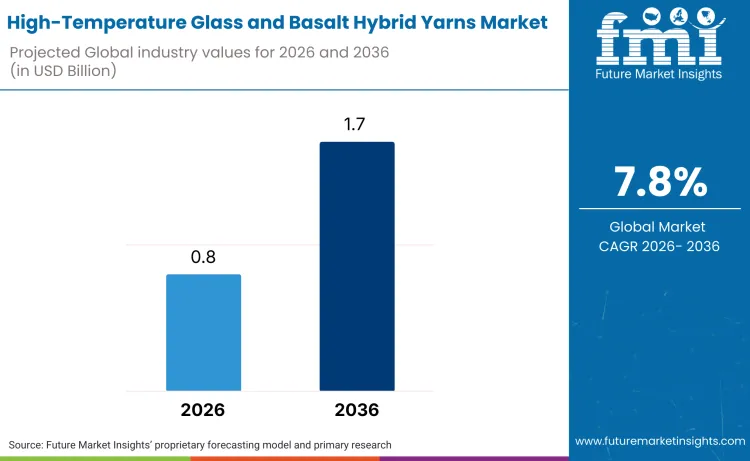
The high-temperature glass and basalt hybrid yarns market will likely total USD 0.8 billion in 2026, expected to increase to USD 1.7 billion by 2036, advancing at a CAGR of 7.8%. FMI anticipates demand visibility for high-temperature glass and basalt hybrid yarns improves after 2026 as wind blade platforms, battery enclosure systems, and fire-barrier programs move from pilot sourcing into contracted supply. Reinforcement materials are now screened earlier in the procurement cycle for thermal stability, recyclability, and certification performance, reducing tolerance for post-design material substitutions.
Major producers are reallocating capital away from standard construction rovings toward higher-margin hybrid yarn lines engineered for continuous thermal exposure. This shift is being driven less by branding strategy and more by OEM requirements for materials that endure repeated thermal cycling without forcing tooling changes or production-line redesigns.
Capacity access has become a decisive competitive factor. Producers that secure melting capacity and stable basalt feedstock early are shortening lead times and locking in preferred-supplier positions, while late entrants face permitting delays, energy-cost volatility, and equipment bottlenecks. Output expansion by ISOMATEX and sustained revenue momentum at China Jushi indicate that competition is consolidating around suppliers with both process control and raw material access.
Order books are increasingly tied to long-cycle wind energy, grid-hardening, electric vehicle, and data center projects, reducing exposure to short-cycle construction demand. In parallel, material development teams are being evaluated on recycled content thresholds and lifecycle emissions alongside mechanical and thermal performance, accelerating the adoption of hybrid yarn systems that narrow the gap between aerospace-grade and industrial-scale reinforcement materials.
"In total, we now have a highly profitable launch point for future growth, and excitingly, we have even stronger long-term growth ahead. Today, we are upgrading our original Springboard plan to now add $11 billion in incremental annualized sales by the end of 2028, up from our original $8 billion." - Wendell Weeks, Chairman and CEO, Corning Incorporated, January 28, 2026.
Summary of High-Temperature Glass and Basalt Hybrid Yarns Market
What is Growth Outlook for High-Temperature Glass and Basalt Hybrid Yarns Market as per Future Market Insights Projection?
Future Market Insights projects the high-temperature glass and basalt hybrid yarns market to expand at a CAGR of 7.8% from 2026 to 2036, increasing from USD 0.8 billion in 2026 to USD 1.7 billion by 2036.
FMI Research Approach: FMI proprietary forecasting model integrating specification-led reinforcement demand across wind energy, electric mobility, fire-protection systems, and infrastructure reinforcement programs.
How do FMI Analysts Perceive High-Temperature Glass and Basalt Hybrid Yarns Market to Evolve?
FMI analysts perceive the market transitioning from trial-based material substitution toward specification-locked reinforcement platforms, where thermal cycling tolerance, fire safety compliance, and lifecycle emissions screening are embedded early in design and procurement workflows. Hybrid yarns are increasingly favored over single-fiber alternatives due to their balanced performance and manufacturing continuity.
FMI Research Approach: Evaluation of OEM material qualification behavior, regulatory fire-safety standards, and lifecycle assessment criteria influencing reinforcement material selection.
Which Country Holds Largest Share in Global High-Temperature Glass and Basalt Hybrid Yarns Market?
China holds the largest share of the global high-temperature glass and basalt hybrid yarns market, supported by vertically integrated glass fiber capacity, secure basalt feedstock access, and rapid execution of large-scale wind energy and infrastructure projects.
FMI Research Approach: Country-level supply and demand modeling based on fiber melting capacity, hybrid yarn output, and alignment with renewable energy and infrastructure investment pipelines.
How Large Will High-Temperature Glass and Basalt Hybrid Yarns Market Be by 2036?
The global high-temperature glass and basalt hybrid yarns market is projected to reach USD 1.7 billion by 2036.
FMI Research Approach: Long-term revenue forecasting derived from contracted demand visibility in wind energy, battery enclosures, fire-barrier systems, and thermal insulation applications.
What defines the High-Temperature Glass and Basalt Hybrid Yarns Market?
The high-temperature glass and basalt hybrid yarns market comprises inorganic hybrid yarn systems engineered by combining continuous glass fibers and basalt fibers to deliver sustained thermal stability, fire resistance, and mechanical reinforcement under elevated and cyclic temperature conditions across industrial and infrastructure applications.
FMI Research Approach: FMI market taxonomy and inclusion-exclusion framework covering hybrid fiber architectures, yarn forms, and specification-driven end uses.
What are some Globally Unique Trends Shaping High-Temperature Glass and Basalt Hybrid Yarns Market?
Key trends include the integration of lifecycle emissions screening into reinforcement specifications, rising adoption of hybrid yarns for battery enclosures and fire-protection systems, and growing preference for balanced glass-basalt architectures that enable high-temperature performance without disrupting established manufacturing processes.
FMI Research Approach: Synthesis of regulatory fire-safety requirements, energy transition policies, and OEM material qualification trends across major regions.
High-Temperature Glass and Basalt Hybrid Yarns Market Key Takeaways
| Metric | Value |
|---|---|
| Expected Value (2026E) | USD 0.8 billion |
| Projected Value (2036F) | USD 1.7 billion |
| CAGR (2026-2036) | 7.8% |
Source: FMI analysis based on primary research and proprietary forecasting model
Why is the High-Temperature Glass and Basalt Hybrid Yarns Market Growing?
The high-temperature glass and basalt hybrid yarns market is advancing primarily on the back of regulation-led material substitution. Sustainability mandates are pushing manufacturers to account for lifecycle impact alongside performance, and basalt fiber is gaining acceptance due to its lower energy intensity and chemical-free production compared to conventional E-glass. Rather than full material replacement, hybridization is emerging as the preferred strategy, allowing producers to reduce carbon footprint while retaining established processing behavior and mechanical reliability.
Fire safety regulations are acting as a direct and immediate demand trigger, particularly with the expansion of Battery Energy Storage Systems and EV infrastructure. Stricter standards from authorities such as NFPA are raising minimum requirements for non-combustibility and thermal stability under extreme heat. This is accelerating the shift toward inorganic, high-temperature textile reinforcements, with glass-basalt hybrid yarns increasingly specified for battery enclosures, fire curtains, and thermal barriers due to their heat tolerance and manufacturing compatibility.
Demand is further supported by aerospace, defense, and infrastructure applications where durability and thermal performance are critical. Industry analysis from SL Chemtech links rising fiber consumption to increased use of Ceramic Matrix Composites, while infrastructure owners are favoring non-corrosive reinforcements to extend service life in aggressive environments. Research from MDPI and enforcement actions by the Ministry of Textiles are reinforcing this shift, positioning hybrid yarns as a specification-driven solution rather than a discretionary material choice.
How is High-Temperature Glass & Basalt Hybrid Yarns Market Segmented?
Why do Glass-Basalt Hybrid Yarns Lead Fiber Blend Adoption?
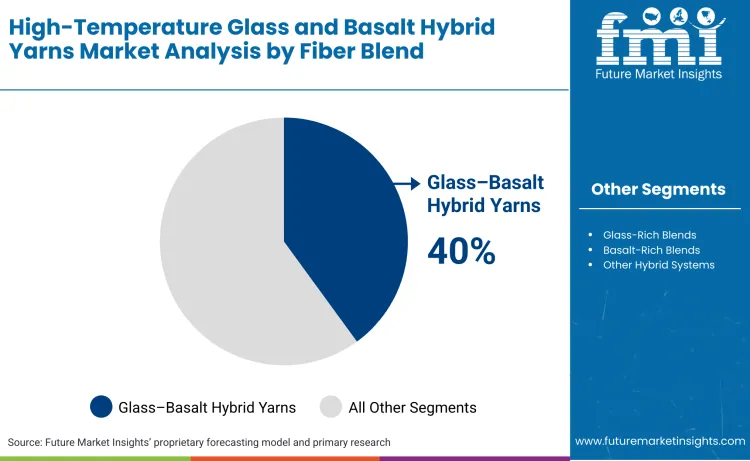
Glass-basalt hybrid yarns account for 40% of demand because they deliver a controlled balance between thermal resistance, mechanical strength, and cost stability. By combining the process familiarity of glass fiber with the higher temperature tolerance and chemical durability of basalt, these hybrids perform reliably across insulation and fire-exposed environments without pushing manufacturing costs into specialty territory.
Their uptake is also shaped by production practicality. Glass-basalt blends run smoothly on existing spinning and twisting infrastructure, limiting breakage and variability during downstream processing. More extreme glass-rich or basalt-rich formulations tend to introduce stiffness, handling challenges, or cost premiums that restrict broader adoption. The dominance of hybrid blends reflects a preference for balanced performance over single-fiber optimisation.
Why Does Thermal Insulation and Lagging Dominate Application Demand?
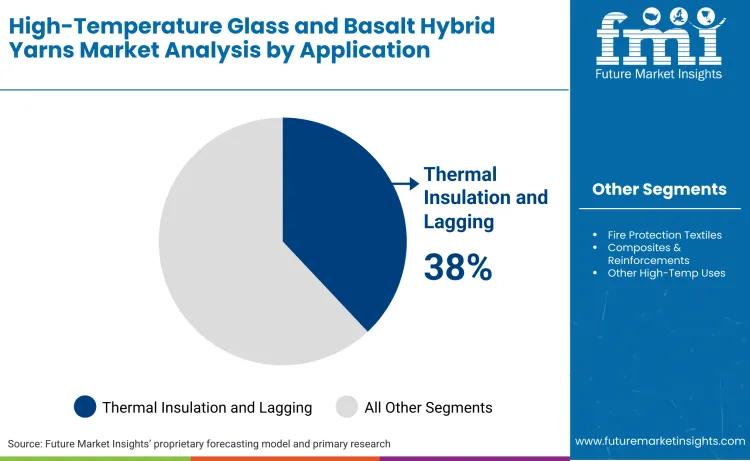
Thermal insulation and lagging represent 38% of application demand because these uses operate continuously under elevated temperatures rather than short-duration thermal events. Industrial piping, furnaces, and equipment insulation require yarn systems that maintain structural integrity and thermal stability over long service cycles, making hybrid glass-basalt constructions well suited to the task.
Demand is reinforced by maintenance-driven replacement cycles. Insulation systems are inspected and renewed as part of routine plant operations, creating steady consumption rather than project-based spikes. Fire protection textiles and composite reinforcements tend to follow episodic demand patterns tied to new installations or upgrades, while insulation remains a constant operational requirement.
Why do Roving and Twist Yarns Lead by Form?
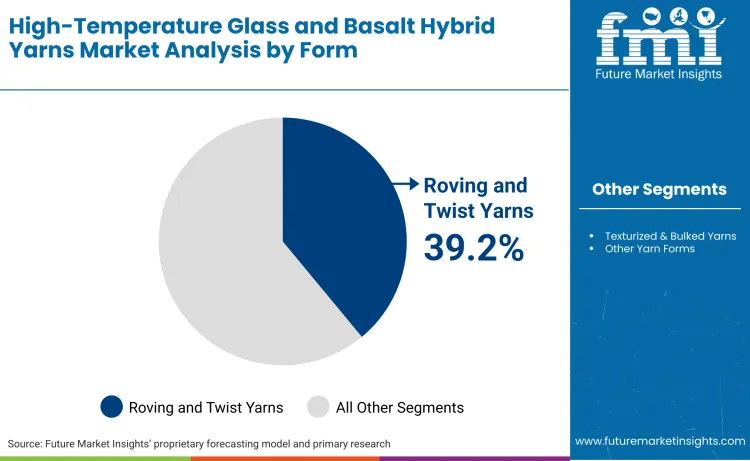
Roving and twist yarns account for 39.3% of total volume because they offer the most versatile format for high-temperature textile processing. These yarn forms provide uniform filament alignment and tensile consistency, which are critical when weaving, braiding, or winding materials destined for thermal insulation and reinforcement applications.
Their dominance is tied to downstream compatibility. Roving and twist constructions integrate efficiently into both textile and composite manufacturing workflows, allowing producers to serve multiple end uses without changing yarn architecture. More specialised formats such as texturised or bulked yarns address niche performance needs but lack the same cross-application flexibility.
What Influences the High-Temperature Glass & Basalt Hybrid Yarns Market’s Growth?
The market for high-temperature glass and basalt hybrid yarns is pushed forward less by spontaneous customer switching and more by deliberate government action. Industrial policy, public funding, and regulatory requirements are shaping demand, especially in countries that treat advanced materials as part of national infrastructure rather than optional industrial upgrades.
China remains the clear global leader, thanks to unmatched scale, low production costs, and fast project execution. State-backed, vertically integrated producers have moved beyond basic glass rovings and are now targeting higher-value hybrid yarns for batteries, electric vehicles, and heavy infrastructure. While volume still underpins China’s position, competition and oversupply are forcing producers to focus more on performance and application-specific differentiation to defend margins.
India is taking a similar approach, but with a strong domestic focus. Through the National Technical Textiles Mission, government funding is used to build local capability in specialty fibers for infrastructure resilience, fire protection, and agricultural use. Instead of pushing aggressively into exports, India is prioritizing standards, public procurement linkages, and long-term capacity development. This slows near-term scaling but provides a more predictable, policy-supported demand base.
In USA, UK, and EU, the story looks different. Demand growth is driven less by cost advantages and more by resilience, compliance, and supply security. Regulatory frameworks push manufacturers toward materials that are traceable, recyclable, and reliable under extreme conditions. Demand is smaller in volume but far more specification-driven, favoring suppliers that can meet strict performance and regulatory thresholds.
Structural challenges remain across all regions. China’s capacity dominance has intensified price pressure, limiting profitability and pushing producers toward engineered hybrids rather than volume expansion. In the US and Europe, older glass-processing infrastructure, lengthy permitting, and dependence on mature manufacturing technologies slow commercialization despite strong research funding. India faces its own friction: tighter quality controls have improved standards but increased compliance costs and temporarily restricted access to advanced imported equipment.
Where opportunity does exist, it is focused on defined, high-value uses. Applications such as battery enclosures, aerospace thermal protection, and corrosion-resistant infrastructure demand precise thermal performance, controlled stiffness, and long service life rather than broad material substitution. Policy-linked procurement and strategic project designations are helping reduce investment risk and improve demand visibility.
The biggest risk sits outside technology itself. Geopolitical fragmentation, export controls, and diverging standards risk splitting supply chains. Progress in ceramics and next-generation composites could replace hybrid yarns in some high-end applications if cost and performance trade-offs shift.
Analysis of High-Temperature Glass & Basalt Hybrid Yarns Market by Key Countries
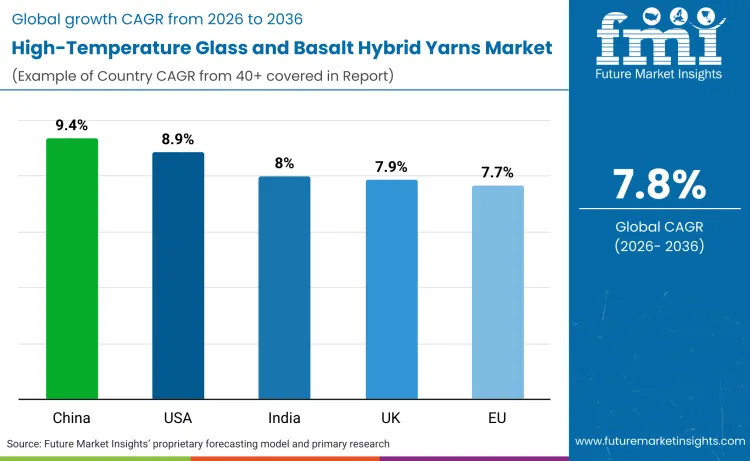
| Country | CAGR (2026-2036) |
|---|---|
| China | 9.4% |
| USA | 8.9% |
| India | 8.0% |
| UK | 7.9% |
| EU | 7.7% |
Source: FMI analysis based on primary research and proprietary forecasting model
Will China’s Aggressive Wind Strategy Lock in Global Leadership?
China’s position in the high-performance fiber market is shifting from sheer scale toward deeper technological integration. Rather than acting primarily as a volume supplier, the country is aligning materials manufacturing with long-term renewable energy infrastructure needs. The commissioning of China Jushi’s zero-carbon glass fiber facility reflects this change. Designed specifically for offshore wind applications, the plant supports turbine blades that are growing larger, heavier, and more structurally complex, elevating high-temperature basalt-glass hybrid yarns from optional reinforcements to essential structural inputs.
This expansion has created internal pressure. China’s overwhelming capacity has compressed domestic pricing, forcing leading producers such as Sinoma to move beyond core fiber production. The strategic response has been vertical integration, particularly into electric-vehicle platforms. Chinese firms are increasingly developing basalt-glass hybrid battery enclosures that provide superior thermal protection, allowing them to comply with tightening safety expectations while sustaining margins in both domestic and export markets despite rising trade friction.
Can USA Close a Long-Standing Technology Gap Through ARPA-E?
USA is approaching the hybrid yarn market from a fundamentally different direction. Rather than competing on volume, federal policy is being used to modernize a legacy glass and fiber sector that has relied on outdated technologies for decades. Targeted funding from the USA Department of Energy, deployed through ARPA-E, is aimed at replacing conventional glazing systems with next-generation vacuum-insulated glass that delivers substantially higher thermal performance.
This transition is driving new demand for hybrid yarns with exceptional strength and low thermal conductivity, particularly as spacers and reinforcements in advanced building envelopes. At the same time, the United States is prioritizing ultra-dense energy storage systems for defense, aerospace, and industrial use, where advanced thermal barriers are critical. While domestic basalt processing capacity remains limited compared to Asia, the strategic emphasis on high-value insulating glass and aerospace-grade hybrids positions US manufacturers firmly in premium, technology-driven market segments.
Is India’s National Technical Textiles Mission a Path to Strategic Autonomy?
India’s approach is focused on self-reliance through structured government intervention. Under the National Technical Textiles Mission, the country is systematically reducing its dependence on imported high-performance fibers. Research programs are increasingly centered on basalt-glass hybrids for infrastructure, geotechnical reinforcement, and agricultural applications. By mandating the use of certified, fire-resistant materials in public projects, the government is creating assured domestic demand to justify investment in local manufacturing capacity.
Regulatory constraints remain a near-term challenge. Import controls and quality mandates have forced manufacturers to modernize looms and processing lines, slowing output during the transition. Momentum is building around seismic-resistant infrastructure. Basalt hybrid reinforcement is evaluated for rail corridors, retaining structures, and bridge components, where corrosion resistance and tensile performance offer long-term durability advantages over conventional materials.
Can the UK Defend Its Offshore Advantage as Manufacturing Consolidates?
UK is positioning itself as a global validation hub rather than a mass producer. Investment in advanced offshore wind testing infrastructure has made the country a critical proving ground for next-generation turbine blades operating under extreme mechanical and environmental stress. This role generates sustained demand for hybrid yarns capable of withstanding fatigue loading and harsh marine exposure, reinforcing the UK’s importance in material qualification and performance benchmarking.
Domestic glass fiber manufacturing faces structural pressure from high operating costs. In response, the market is shifting toward deepwater and floating wind technologies, where weight reduction and durability are paramount. Initiatives linked to European Marine Energy Centre are advancing floating wind concepts that rely heavily on hybrid fibers. UK’s market is therefore evolving toward high-value services, testing, and engineering expertise rather than volume-driven production.
How is EU’s Critical Raw Materials Act Reshaping Hybrid Supply Chains?
In the European Union, regulation has become a defining market force. The Critical Raw Materials Act has reframed hybrid yarn production around domestic processing, recycling, and supply resilience. As a result, recyclability and circular performance are no longer optional attributes. Producers are investing in alternative sizing chemistries and secondary applications for fiber waste to demonstrate compliance alongside mechanical performance.
Material security remains the region’s central constraint, particularly for basalt and high-purity silica. Policy responses are increasingly focused on substitution research and domestic extraction initiatives. A parallel trend is the designation of fiber projects as infrastructure of public interest, which accelerates permitting and construction timelines. This shift is enabling faster deployment of hybrid yarn facilities aligned with Europe’s broader energy transition and infrastructure modernization goals.
How does the Competitive Landscape appear in the High-Temperature Glass & Basalt Hybrid Yarns Market?
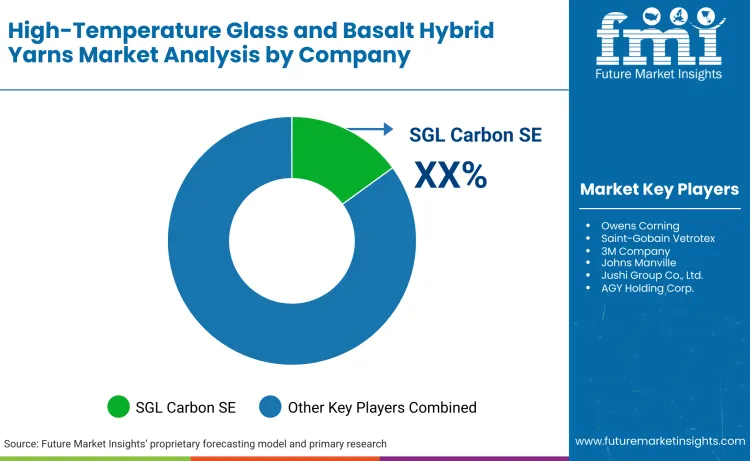
The high-temperature glass and basalt hybrid yarns market is shifting from an application-driven niche into a structured industrial segment. Early-stage fragmentation driven by trial use and narrow specifications is giving way to demand shaped by regulation, thermal safety standards, and infrastructure investment cycles. As hybrid yarns become standard inputs in energy systems, mobility platforms, and critical infrastructure, competition increasingly favors producers that can scale output, control material quality, and meet rising performance and sustainability requirements.
Scale and integration define influence. Owens Corning maintains its position through a global manufacturing footprint and a focus on engineered glass systems for wind energy and infrastructure. Margin protection is driven by formulation expertise and supply reliability rather than price competition. China Jushi functions as the global volume and cost benchmark. Its rapid capacity expansion supports dominance in wind energy and industrial reinforcement, particularly in price-sensitive markets. Saint-Gobain Vetrotex occupies a more selective role, concentrating on specified, high-performance products for construction and infrastructure where compliance, durability, and service life drive procurement.
Alongside these producers are companies whose influence comes from performance rather than scale. Isomatex serves aerospace, medical, and industrial customers requiring tight control of thermal and mechanical properties. Kamenny Vek remains a leading continuous basalt fiber producer, with higher-modulus grades enabling basalt-glass systems to compete with premium glass fibers in structural applications. Sinoma Taishan Fiberglass sits between scale and specialization, combining capacity with growing technical depth in high-silica and hybrid yarns.
Competition centers on capacity expansion, geographic diversification, and hybrid material design. Automotive and energy storage applications are accelerating demand for solutions balancing thermal stability, fire resistance, and weight. Established glass producers are investing in advanced formulations to defend differentiation as basalt adoption increases.
Market control remains concentrated among a limited group of global glass producers, while basalt suppliers are more fragmented. Entry barriers remain high due to capital intensity, specialized melting technology, and long qualification cycles that reinforce incumbent positions. HG GBF Basalt Fiber and Sichuan Weibo New Material Group are gaining traction through infrastructure-focused expansion aligned with public investment priorities.
Key Players Profiled
- SGL Carbon SE
- Owens Corning
- Saint-Gobain Vetrotex
- 3M Company
- Johns Manville
- Jushi Group Co., Ltd.
- AGY Holding Corp.
- Kamenny Vek
- Mafic S.A.
- KCC Basalt Fiber
Market Definition
The high-temperature glass and basalt hybrid yarns market comprises inorganic hybrid yarn systems engineered by combining continuous glass fibers and basalt fibers to deliver sustained thermal stability, fire resistance, and mechanical reinforcement under elevated and cyclic temperature conditions. These yarns are designed for applications where prolonged heat exposure, non-combustibility, and dimensional stability are critical performance requirements, including energy infrastructure, electric mobility systems, fire-protection textiles, and industrial insulation. Adoption is specification-driven, with materials increasingly selected during early design and certification stages rather than substituted post-design.
This report includes glass-basalt hybrid yarns, glass-rich and basalt-rich blends, and other inorganic hybrid yarn architectures used in thermal insulation and lagging, fire-protection textiles, composite reinforcements, and other high-temperature technical applications. Coverage extends to yarn forms such as roving, twist, and selected engineered formats that are compatible with textile, composite, and insulation manufacturing processes. The scope also incorporates demand shaped by fire-safety regulations, energy transition programs, infrastructure modernization, and lifecycle emissions considerations influencing material selection across regions.
This report excludes single-fiber glass yarns or basalt yarns sold without a hybrid architecture, as well as ceramic fibers, carbon fibers, and polymer-based high-temperature yarns that fall outside glass-basalt hybrid systems. Finished insulation products, fire curtains, composite components, and end-use assemblies are excluded when sold as final goods rather than yarn inputs. The scope also excludes applications where temperature resistance is incidental rather than a core functional requirement, along with non-textile fire-protection hardware and structural materials not processed in yarn form.
Scope of Report
| Items | Values |
|---|---|
| Quantitative Units (2026) | USD 0.8 billion |
| Fiber Blend | Glass-Basalt Hybrid Yarns, Glass-Rich Blends, Basalt-Rich Blends, Other Hybrid Systems |
| Application | Thermal Insulation & Lagging, Fire Protection Textiles, Composites & Reinforcements, Other High-Temp Uses |
| Form | Roving & Twist Yarns, Texturized & Bulked Yarns, Other Yarn Forms |
| Regions Covered | North America, Western Europe, Eastern Europe, East Asia, South Asia & Pacific, Latin America, Middle East & Africa |
| Countries Covered | China, USA, India, UK and 40+ Countries |
| Key Companies Profiled | SGL Carbon SE, Owens Corning, Saint-Gobain Vetrotex, 3M Company, Johns Manville, Jushi Group Co., Ltd., AGY Holding Corp., Kamenny Vek, Mafic S.A., KCC Basalt Fiber |
Source: Future Market Insights analysis, supported by a proprietary forecasting model and primary research
High-Temperature Glass & Basalt Hybrid Yarns Market Key Segments
Fiber Blend:
- Glass-Basalt Hybrid Yarns
- Glass-Rich Blends
- Basalt-Rich Blends
- Other Hybrid Systems
Application:
- Thermal Insulation & Lagging
- Fire Protection Textiles
- Composites & Reinforcements
- Other High-Temp Uses
Form:
- Roving & Twist Yarns
- Texturized & Bulked Yarns
- Other Yarn Forms
Region:
- North America
- Western Europe
- Eastern Europe
- East Asia
- South Asia & Pacific
- Latin America
- Middle East & Africa
Bibliography
- International Energy Agency. (2024). Wind energy materials and manufacturing requirements for next-generation turbine systems. IEA.
- USA Department of Energy. (2024). Thermal management and fire-barrier materials for battery energy storage and electric vehicles. DOE.
- MDPI Materials Research Editorial Board. (2024). Advances in basalt and glass hybrid fibers for high-temperature composite applications. Materials.
- SL Chemtech Research Institute. (2024). Ceramic matrix composites and inorganic fiber demand trends in high-temperature environments. SL Chemtech.
Frequently Asked Questions
What is the current size of the high-temperature glass and basalt hybrid yarns market?
The market is valued at around USD 0.8 billion in 2026, reflecting growing specification-led adoption across energy, mobility, and fire-protection applications.
What is the long-term growth outlook for this market?
Demand is expected to grow steadily through 2036 as hybrid yarns become locked into design specifications for wind energy, battery enclosures, and high-temperature insulation systems.
Which applications are driving demand for glass–basalt hybrid yarns?
Thermal insulation and lagging applications anchor demand, supported by fire-protection textiles, composite reinforcements, and energy infrastructure exposed to continuous or cyclic high temperatures.
How does regional demand vary across major markets?
China leads due to integrated glass capacity and alignment with wind and infrastructure investment, while demand in the US, Europe, and the UK is driven by fire-safety regulation, energy transition projects, and resilience-focused procurement.
What factors are constraining faster adoption of hybrid yarn systems?
High capital intensity, feedstock access constraints, and long qualification cycles limit rapid capacity expansion, while competition from alternative high-temperature materials poses a longer-term substitution risk.
Preview the report firsthand - request a free sample
Get SampleGet the brochure for pricing and purchase details.
Get PDFTable of Content
- Executive Summary
- High-Temperature Glass and Basalt Hybrid Yarns Market Introduction
- Market Definition
- Market Scope
- Market Taxonomy
- Research Methodology
- Study Framework
- Assumptions and Limitations
- Data Sources
- Market Estimation and Forecasting Approach
- High-Temperature Glass and Basalt Hybrid Yarns Market Dynamics
- Drivers
- Restraints
- Opportunities
- Trends
- Global High-Temperature Glass and Basalt Hybrid Yarns Market Analysis 2021 to 2025 and Forecast 2026 to 2036
- Global High-Temperature Glass and Basalt Hybrid Yarns Market Analysis by Fiber Blend
- Global High-Temperature Glass and Basalt Hybrid Yarns Market Analysis by Application
- Global High-Temperature Glass and Basalt Hybrid Yarns Market Analysis by Yarn Form
- Global High-Temperature Glass and Basalt Hybrid Yarns Market Analysis by Region
- North America High-Temperature Glass and Basalt Hybrid Yarns Market Analysis
- United States
- Canada
- Western Europe High-Temperature Glass and Basalt Hybrid Yarns Market Analysis
- Germany
- United Kingdom
- France
- Italy
- Spain
- BENELUX
- Nordics
- Eastern Europe High-Temperature Glass and Basalt Hybrid Yarns Market Analysis
- Poland
- Russia
- Rest of Eastern Europe
- East Asia High-Temperature Glass and Basalt Hybrid Yarns Market Analysis
- China
- Japan
- South Korea
- South Asia & Pacific High-Temperature Glass and Basalt Hybrid Yarns Market Analysis
- India
- ASEAN
- Australia & New Zealand
- Latin America High-Temperature Glass and Basalt Hybrid Yarns Market Analysis
- Brazil
- Rest of Latin America
- Middle East & Africa High-Temperature Glass and Basalt Hybrid Yarns Market Analysis
- GCC
- South Africa
- Rest of Middle East & Africa
- Competitive Landscape Analysis
- Key Players Profiled
- Market Definition and Scope
- Market Segmentation Analysis
- Bibliography
- Frequently Asked Questions


