

- Industry Size (2026)
- USD 1860 Mn
- Forecast (2036)
- USD 6716.1 Mn
- CAGR (2026 to 2036)
- 13.70%
Hybrid PCR and Bio-Resin Polymer Market Forecast and Outlook 2026 to 2036
The hybrid PCR and bio-resin polymer market is expected to grow from USD 1,860 million in 2026 to USD 6,716.1 million by 2036, registering a CAGR of 13.70%. It reflects a strategic shift away from single-path sustainability materials toward blended polymer systems that balance carbon reduction with functional reliability. Hybrid PCR-bio formulations are gaining relevance as brand owners and converters seek flexibility in meeting recycled-content targets while preserving processing efficiency and product performance.
Commercial adoption is influenced less by headline sustainability claims and more by the ability to manage feedstock variability, cost exposure, and qualification risk across large production volumes. Demand is concentrated in packaging and consumer goods where material substitution can be executed without extensive tooling changes. Value creation increasingly depends on formulation adaptability, supply assurance, and technical support rather than resin origin alone. Between 2026 and 2036, growth quality will be determined by suppliers’ capability to deliver consistent hybrid blends at scale while navigating bio-resin availability, PCR volatility, and evolving regulatory acceptance across end-use markets.
Quick Stats for Hybrid PCR and Bio-Resin Polymer Market
- Hybrid PCR and Bio-Resin Polymer Market Value (2026): USD 1,860 Million
- Hybrid PCR and Bio-Resin Polymer Market Forecast Value (2036): USD 6,716.1 Million
- Hybrid PCR and Bio-Resin Polymer Market Forecast CAGR 2026 to 2036: 13.7%
- Leading Polymer System in Hybrid PCR and Bio-Resin Polymer Market: PCR + Bio-Based Blends (50% share)
- Key Growth Regions in Hybrid PCR and Bio-Resin Polymer Market: Asia Pacific, Europe, North America
- Key Players in Hybrid PCR and Bio-Resin Polymer Market: BASF SE, Mondi plc, Dow Inc., Danimer Scientific, Inc., Mitsubishi Chemical Group Corporation, Toray Industries, Inc., Kingfa Sci. & Tech. Co., Ltd., Wanhua Chemical Group Co., Ltd.
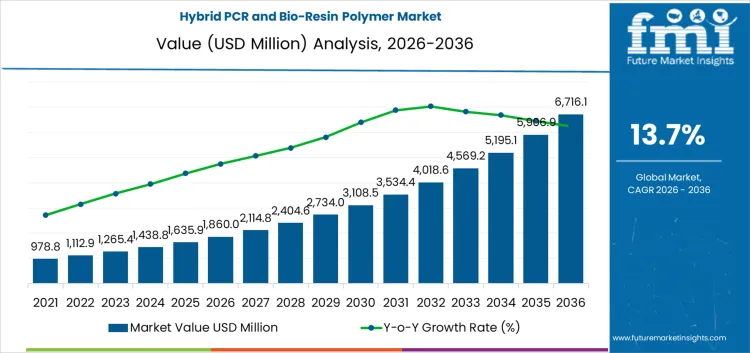
Hybrid PCR and Bio-Resin Polymer Market Key Takeaways
| Metric | Value |
|---|---|
| Hybrid PCR and Bio-Resin Polymer Market Value (2026) | USD 1,860 Million |
| Hybrid PCR and Bio-Resin Polymer Market Forecast Value (2036) | USD 6,716.1 Million |
| Hybrid PCR and Bio-Resin Polymer Market Forecast CAGR 2026 to 2036 | 13.70% |
How are Performance Balancing and Decarbonization Targets Accelerating the Hybrid PCR and Bio-Resin Polymer Market?
The hybrid PCR and bio-resin polymer market is expanding as manufacturers seek materials that simultaneously reduce carbon footprint and maintain performance parity with virgin plastics. Blending post-consumer recycled content with bio-based resins allows brand owners to balance sustainability metrics recycled content and renewable feedstocks without over-reliance on a single material pathway. For polymer producers and compounders, this is shifting demand toward engineered blends that deliver predictable mechanical properties, processing stability, and aesthetic consistency across variable feedstocks.
Qualification complexity is a primary driver of supplier selection. Hybrid formulations must perform reliably in extrusion, injection molding, and thermoforming while meeting regulatory, food-contact, or durability requirements depending on end use. Buyers are prioritizing suppliers that can fine-tune blend ratios, manage interfacial compatibility, and control variability through additives and compounding expertise. Providing validated data, lifecycle assessments, and application-specific testing support is increasingly essential to shorten customer approval cycles.
Scale-up economics and supply assurance are shaping long-term contracts. Bio-resin availability, PCR quality variability, and price volatility require flexible sourcing and formulation strategies. Manufacturers that can offer modular formulations adaptable to regional feedstocks and support customers with dual-sourcing and performance guarantees are gaining strategic advantage. As consumer goods, packaging, and durable applications expand adoption, the hybrid PCR and bio-resin polymer market is emerging as a high-growth segment where material science, compliance readiness, and supply-chain resilience collectively determine competitive positioning.
How is the Hybrid PCR and Bio-Resin Polymer Market Structured by End Use and Polymer System?
The hybrid PCR and bio-resin polymer market is segmented by end use and polymer system, reflecting how material performance, cost targets, and processing compatibility guide formulation choices. By end use, FMCG and food packaging leads adoption, supported by high material volumes and standardized conversion processes. Other end uses include consumer goods and durables, premium and electronics products, mass packaging, FMCG and agriculture, and bio-circular packaging applications that apply hybrid polymers at different inclusion levels. By polymer system, PCR plus bio-based blends form the leading configuration, while hybrid engineering polymers, bio-modified PCR resins, and cost-optimised hybrid polymers serve application-specific mechanical, aesthetic, and processing needs.
Why Do FMCG and Food Packaging Lead End-Use Demand in the Hybrid PCR and Bio-Resin Polymer Market?
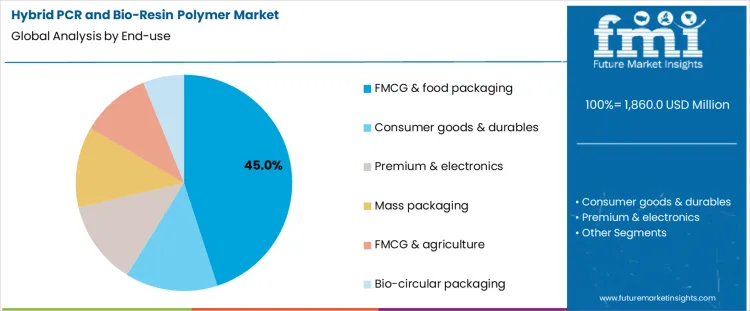
FMCG and food packaging account for 45% share of the hybrid PCR and bio-resin polymer market because these segments consume large volumes of rigid and flexible plastics on a continuous basis. Packaging formats such as bottles, containers, trays, and films rely on polymers that balance mechanical strength, barrier performance, and high-speed processability. Hybrid PCR and bio-resin systems allow converters to fine-tune material properties while maintaining compatibility with existing extrusion, injection molding, and thermoforming lines. High SKU counts and rapid product turnover encourage early adoption of adaptable resin systems. For polymer suppliers, FMCG and food packaging offer predictable demand, repeat orders, and long-term supply programs, reinforcing their leading position.
Why Do PCR Plus Bio-Based Blends Dominate Polymer System Selection?
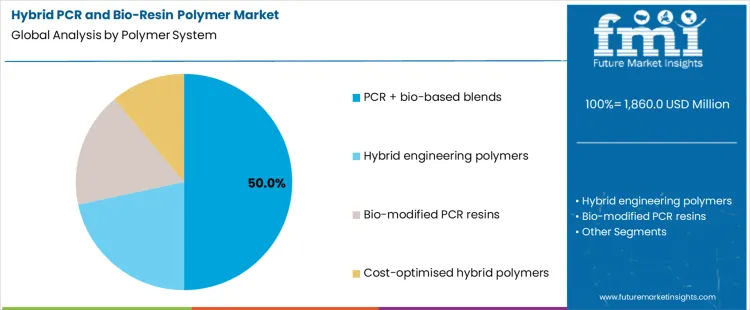
PCR plus bio-based blends hold 50% share of the hybrid PCR and bio-resin polymer market because they combine recycled polymer content with bio-derived modifiers to improve consistency and performance. These blends help address variability in recycled feedstock by stabilizing melt flow, impact resistance, and surface quality. Compounders prefer blend-based systems because formulations can be adjusted for different applications without major equipment changes. Compatibility with common polyolefin and polyester processing routes supports broad adoption across packaging and consumer goods. For resin producers, blend systems enable scalable production and standardized grades. This flexibility, performance tuning capability, and manufacturing efficiency explain their dominance among polymer systems.
What are the Key Dynamics of the Hybrid PCR and Bio-Resin Polymer Market?
The hybrid PCR and bio-resin polymer market revolves around engineered polymer blends that combine post-consumer recycled (PCR) materials with bio-derived resins to meet performance criteria required in packaging, consumer goods, automotive, and durable applications. Demand is influenced by brand strategies to diversify material portfolios, balance cost structures, and leverage alternative feedstocks without compromising mechanical properties such as tensile strength, impact resistance, and processing stability. For resin compounders and suppliers, achieving consistent quality especially in hybrid compositions with widely varying base polymers is central to market adoption. Supply visibility of both PCR and bio-resin inputs and technical backing for converters remains a core competitive consideration.
How are Material Formulation and Processing Trends Shaping This Market?
Material formulation and processing trends are shaping the hybrid PCR and bio-resin polymer market through tailored blend architectures, optimized additive packages, and compatibility enhancers that improve performance and processing behavior. Compounders are developing coupling agents, impact modifiers, and tailored compatibilizers to address inherent polarity or crystallinity differences between PCR streams and bio-resins, enabling more predictable extrusion, injection molding, and thermoforming outcomes. Broadening the processing window and reducing cycle variability are critical for converters operating high-speed production. For suppliers, providing application-specific grades and detailed processing guides enhances customer trust and reduces qualification cycles in converters’ tool rooms and pilot lines.
Why Do Feedstock Variability and Technical Consistency Challenges Restrain Market Growth?
Feedstock variability and technical consistency challenges restrain growth in the hybrid PCR and bio-resin polymer market. Post-consumer recycled streams often exhibit fluctuations in composition, residual contaminants, and melt flow characteristics, creating challenges when blending with bio-resin inputs that they vary by source and manufacturing method. Achieving uniform dispersion of PCR particles and bio-resin components without hotspots or weak interfaces demands precise compounding and quality control. Variability in mechanical and thermal properties can impact part performance, increasing reliance on extensive in-house testing and longer qualification cycles for converters. These technical barriers raise development costs, slow adoption, and tighten margins for compounders and suppliers.
What is the Country-Wise Outlook for the Hybrid PCR and Bio-Resin Polymer Market?
Hybrid PCR and bio-resin polymers combine post-consumer recycled resins with bio-based materials to balance cost control, performance stability, and regulatory acceptance across packaging and consumer goods applications. Country-level adoption varies based on polymer processing capability, brand qualification practices, availability of bio-resin feedstocks, and willingness to adopt blended material systems. Mature markets emphasize material consistency and qualification discipline, while high-growth regions focus on scale, cost optimization, and rapid substitution of conventional polymers. Market value increasingly depends on formulation flexibility, supply reliability, and the ability to meet diverse application requirements across food, consumer goods, and industrial uses.
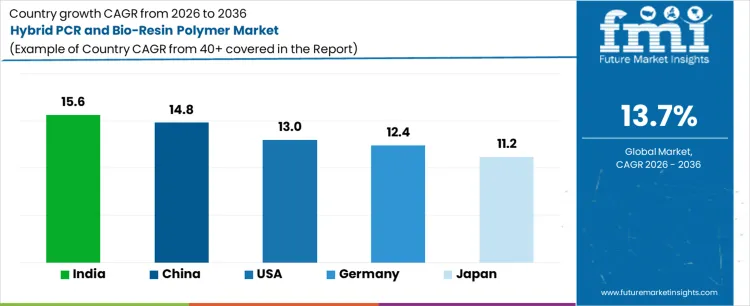
| Country | CAGR (%) |
|---|---|
| India | 15.6 |
| China | 14.8 |
| United States | 13.0 |
| Germany | 12.4 |
| Japan | 11.2 |
How Is Germany Advancing Structured Adoption of Hybrid PCR and Bio-Resin Polymers?
Demand for hybrid PCR and bio-resin polymer in Germany is developing through disciplined material qualification rather than rapid substitution, expanding at a CAGR of 12.4% during 2026-2036. Adoption is anchored in high-specification packaging, consumer durables, and industrial components where performance predictability is critical. German converters evaluate hybrid formulations against strict benchmarks for mechanical stability, thermal resistance, and processing repeatability before approval. Blends are typically introduced in controlled product families, with scale-up occurring only after extended validation. Buyers emphasize formulation transparency, batch-to-batch consistency, and compatibility with existing extrusion and injection molding infrastructure. Procurement decisions are led by engineering and quality teams rather than commercial buyers, resulting in longer qualification cycles but higher supplier stickiness. Market value accrues to compounders offering application-specific hybrids, strong documentation, and long-term technical collaboration. Germany represents a stability-driven market where success depends on reliability, precision, and sustained performance assurance.
What Is Shaping the USA Market for Hybrid PCR and Bio-Resin Polymers?
In the United States, hybrid PCR and bio-resin polymer adoption is closely tied to brand-driven material flexibility, with the market growing at a CAGR of 13.0% during 2026-2036. USA consumer goods and packaging companies prioritize formulations that balance recycled content, visual quality, and processing efficiency across diverse product lines. Hybrid polymers are deployed simultaneously across multiple applications, including rigid packaging, household goods, and selected durable products. Buyers emphasize scalability, rapid formulation customization, and the ability to support geographically distributed manufacturing sites. Qualification timelines are shorter than in Europe, enabling faster commercialization. Procurement decisions favor suppliers with modular formulation platforms, responsive technical service, and consistent supply capability. Market value is driven by speed, adaptability, and cost-performance optimization rather than exhaustive pre-validation. The USA represents a commercialization-led market where competitive advantage lies in flexibility and time-to-market execution.
Why Is China Scaling Hybrid PCR and Bio-Resin Polymer Usage So Rapidly?
Sale of hybrid PCR and bio-resin polymer in China is expanding at a CAGR of 14.8% during 2026-2036, shaped by high-volume manufacturing economics and aggressive material substitution. Adoption is driven by the need to balance recycled content requirements with cost control and throughput efficiency. Chinese converters deploy hybrid formulations across mass-market packaging and consumer goods where performance thresholds are defined by functional adequacy rather than premium specifications. Buyers prioritize availability, price stability, and consistent processing behavior under high-output conditions. Rollouts are rapid and often occur across multiple product lines simultaneously. Procurement favors suppliers with localized compounding capacity, large-scale production, and short lead times. Qualification cycles are brief, with performance validated at scale rather than through extended lab testing. China represents a volume-driven market where competitiveness depends on supply reliability, cost efficiency, and operational robustness.
How Does Japan Apply a Precision-Led Model to Hybrid PCR and Bio-Resin Polymers?
Japan’s hybrid PCR and bio-resin polymer market follows a cautious, precision-oriented adoption pathway, growing at a CAGR of 11.2% during the forecast period. Japanese manufacturers emphasize tight control over formulation behavior, long-term durability, and processing stability. Hybrid materials are introduced incrementally, often starting with non-critical components before expansion into core product applications. Buyers require extensive material characterization, consistent batch performance, and detailed technical documentation. Ecosystem trust and supplier reputation play a central role in procurement decisions. Qualification cycles are methodical, with strong resistance to frequent formulation changes once approved. Volumes are moderate, but performance expectations are exceptionally high. Market value accrues to suppliers demonstrating technical rigor, long-term commitment, and reliable support. Japan represents a quality-driven market where predictability and governance outweigh speed or scale.
Why Is India the Fastest-Growing Market for Hybrid PCR and Bio-Resin Polymers?
Demand for hybrid PCR and bio-resin polymer in India is experiencing rapid expansion, registering a CAGR of 15.6% during 2026-2036, driven by accelerated material substitution across packaging and consumer goods. Adoption is largely greenfield-led, with hybrid polymers integrated early into new product development programs. Buyers prioritize affordability, processing flexibility, and availability across fragmented manufacturing and distribution ecosystems. Hybrid formulations are favored for their ability to deliver acceptable performance while controlling raw material costs. Qualification cycles are relatively short, enabling fast deployment across multiple applications. Procurement decisions emphasize adaptable formulations, local production support, and quick technical assistance. Market value is created through scalability and responsiveness rather than customization depth. India represents a high-growth market where success depends on speed, cost-efficiency, and the ability to serve diverse converter capabilities at scale.
What Shapes Competition in the Hybrid PCR and Bio-Resin Polymer Market?
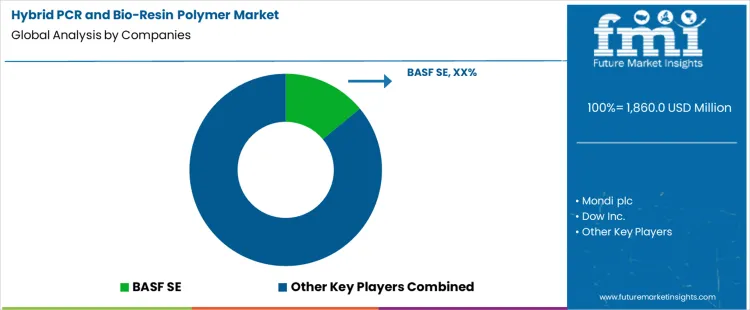
Competition in the hybrid PCR and bio-resin polymer market is driven by verified sustainability credentials, material performance balance, and documented processing compatibility critical to brand owners, compounders, and OEM material engineers. BASF SE positions its hybrid solutions through technical materials that highlight integrated PCR content with bio-based monomers, offering balance between mechanical strength and reduced carbon footprint. Brochures emphasize validated bio-content percentages and compliance with global eco-label standards, appealing to consumer goods and automotive sectors seeking credible circularity claims. Mondi plc competes with high-clarity hybrid polymers tailored for flexible packaging; its official product literature underscores a blend of renewable content and recyclability while maintaining sealability and barrier performance compatible with existing packaging lines.
Large materials producers leverage portfolio scale and customization. Dow Inc. markets hybrid PCR/bio-resin solutions with datasheets that document tensile, thermal, and processing properties aligned with extrusion and injection molding applications. Official literature emphasizes PCR traceability frameworks and validated performance across diverse end uses. Danimer Scientific, Inc. differentiates through targeted biopolymer blends incorporating PCR streams with documented biodegradability and performance metrics, positioning its grades for specific markets such as consumer packaging and single-use items where compostability is valued.
Asian and specialty engineering resin suppliers add competitive breadth through tailored formulations and regional support. Mitsubishi Chemical Group Corporation and Toray Industries, Inc. focus on hybrid polymers with technical materials highlighting balanced mechanical properties and high PCR incorporation compatible with automotive and consumer electronics housings. Kingfa Sci. & Tech. Co., Ltd. and Wanhua Chemical Group Co., Ltd. emphasize cost-optimized hybrid PCR/bio-resin compounds with brochures detailing processing windows, impact strength, and thermal stability for mass-market applications. Across all players, differentiation is built on brochure-verified sustainability claims, documented PCR/bio content, and process integration readiness rather than price alone.
Key Players in Hybrid PCR and Bio-Resin Polymer Market
- BASF SE
- Mondi plc
- Dow Inc.
- Danimer Scientific, Inc.
- Mitsubishi Chemical Group Corporation
- Toray Industries, Inc.
- Kingfa Sci. & Tech. Co., Ltd.
- Wanhua Chemical Group Co., Ltd.
Scope of Report
| Attribute | Description |
|---|---|
| Quantitative Unit | USD Million |
| End-use | FMCG & Food Packaging, Consumer Goods & Durables, Premium & Electronics, Mass Packaging, FMCG & Agriculture, Bio-Circular Packaging |
| Polymer System | PCR + Bio-Based Blends, Hybrid Engineering Polymers, Bio-Modified PCR Resins, Cost-Optimised Hybrid Polymers |
| Countries Covered | China, Japan, South Korea, India, Australia & New Zealand, ASEAN, Rest of Asia Pacific, Germany, United Kingdom, France, Italy, Spain, Nordic, BENELUX, Rest of Europe, United States, Canada, Mexico, Brazil, Chile, Rest of Latin America, Kingdom of Saudi Arabia, Other GCC Countries, Turkey, South Africa, Other African Union, Rest of Middle East & Africa |
| Regions Covered | Asia Pacific, Europe, North America, Latin America, Middle East & Africa |
| Key Companies Profiled | BASF SE, Mondi plc, Dow Inc., Danimer Scientific, Inc., Mitsubishi Chemical Group Corporation, Toray Industries, Inc., Kingfa Sci. & Tech. Co., Ltd., Wanhua Chemical Group Co., Ltd. |
| Additional Attributes | Dollar sales by end-use and polymer system are evaluated across hybrid sustainable material applications. The report includes country-level demand assessment, growth projections for 2026-2036, analysis of performance versus sustainability trade-offs, evaluation of bio-content certification and PCR compatibility, competitive benchmarking of material suppliers, and assessment of adoption trends across packaging, consumer goods, and industrial polymer value chains. |
Hybrid PCR and Bio-Resin Polymer Market by Key Segments
End-use
- FMCG & food packaging
- Consumer goods & durables
- Premium & electronics
- Mass packaging
- FMCG & agriculture
- Bio-circular packaging
Polymer System
- PCR + bio-based blends
- Hybrid engineering polymers
- Bio-modified PCR resins
- Cost-optimised hybrid polymers
Region:
- Asia Pacific
- China
- Japan
- South Korea
- India
- Australia & New Zealand
- ASEAN
- Rest of Asia Pacific
- Europe
- Germany
- United Kingdom
- France
- Italy
- Spain
- Nordic
- BENELUX
- Rest of Europe
- North America
- United States
- Canada
- Mexico
- Latin America
- Brazil
- Chile
- Rest of Latin America
- Middle East & Africa
- Kingdom of Saudi Arabia
- Other GCC Countries
- Turkey
- South Africa
- Other African Union
- Rest of Middle East & Africa
Bibliography
- European Commission. (2024). Plastics strategy and recycled content regulations under the Circular Economy Action Plan. European Union.
- European Environment Agency. (2023). Bio-based plastics: sustainability, market adoption, and environmental impacts. EEA.
- United Nations Environment Programme. (2023). Global Plastic Pollution Assessment and pathways for circular polymers. UNEP.
Frequently Asked Questions
How big is the hybrid PCR and bio-resin polymer market in 2026?
The global hybrid PCR and bio-resin polymer market is estimated to be valued at USD 1,860.0 million in 2026.
What will be the size of hybrid PCR and bio-resin polymer market in 2036?
The market size for the hybrid PCR and bio-resin polymer market is projected to reach USD 6,716.1 million by 2036.
How much will be the hybrid PCR and bio-resin polymer market growth between 2026 and 2036?
The hybrid PCR and bio-resin polymer market is expected to grow at a 13.7% CAGR between 2026 and 2036.
What are the key product types in the hybrid PCR and bio-resin polymer market?
The key product types in hybrid PCR and bio-resin polymer market are fmcg & food packaging, consumer goods & durables, premium & electronics, mass packaging, fmcg & agriculture and bio-circular packaging.
Which polymer system segment to contribute significant share in the hybrid PCR and bio-resin polymer market in 2026?
In terms of polymer system, PCR + bio-based blends segment to command 50.0% share in the hybrid PCR and bio-resin polymer market in 2026.
Preview the report firsthand - request a free sample
Get SampleGet the brochure for pricing and purchase details.
Get PDFTable of Content
- Executive Summary
- Global Market Outlook
- Demand-side Trends
- Supply-side Trends
- Technology Roadmap Analysis
- Analysis and Recommendations
- Market Overview
- Market Coverage / Taxonomy
- Market Definition / Scope / Limitations
- Market Background
- Market Dynamics
- Drivers
- Restraints
- Opportunity
- Trends
- Scenario Forecast
- Demand in Optimistic Scenario
- Demand in Likely Scenario
- Demand in Conservative Scenario
- Opportunity Map Analysis
- Product Life Cycle Analysis
- Supply Chain Analysis
- Investment Feasibility Matrix
- Value Chain Analysis
- PESTLE and Porter’s Analysis
- Regulatory Landscape
- Regional Parent Market Outlook
- Production and Consumption Statistics
- Import and Export Statistics
- Market Dynamics
- Global Market Analysis 2021 to 2025 and Forecast, 2026 to 2036
- Historical Market Size Value (USD Million) Analysis, 2021 to 2025
- Current and Future Market Size Value (USD Million) Projections, 2026 to 2036
- Y-o-Y Growth Trend Analysis
- Absolute $ Opportunity Analysis
- Global Market Pricing Analysis 2021 to 2025 and Forecast 2026 to 2036
- Global Market Analysis 2021 to 2025 and Forecast 2026 to 2036, By End-use
- Introduction / Key Findings
- Historical Market Size Value (USD Million) Analysis By End-use , 2021 to 2025
- Current and Future Market Size Value (USD Million) Analysis and Forecast By End-use , 2026 to 2036
- FMCG & food packaging
- Consumer goods & durables
- Premium & electronics
- Mass packaging
- FMCG & agriculture
- Bio-circular packaging
- FMCG & food packaging
- Y-o-Y Growth Trend Analysis By End-use , 2021 to 2025
- Absolute $ Opportunity Analysis By End-use , 2026 to 2036
- Global Market Analysis 2021 to 2025 and Forecast 2026 to 2036, By Polymer System
- Introduction / Key Findings
- Historical Market Size Value (USD Million) Analysis By Polymer System, 2021 to 2025
- Current and Future Market Size Value (USD Million) Analysis and Forecast By Polymer System, 2026 to 2036
- PCR + bio-based blends
- Hybrid engineering polymers
- Bio-modified PCR resins
- Cost-optimised hybrid polymers
- PCR + bio-based blends
- Y-o-Y Growth Trend Analysis By Polymer System, 2021 to 2025
- Absolute $ Opportunity Analysis By Polymer System, 2026 to 2036
- Global Market Analysis 2021 to 2025 and Forecast 2026 to 2036, By Region
- Introduction
- Historical Market Size Value (USD Million) Analysis By Region, 2021 to 2025
- Current Market Size Value (USD Million) Analysis and Forecast By Region, 2026 to 2036
- North America
- Latin America
- Western Europe
- Eastern Europe
- East Asia
- South Asia and Pacific
- Middle East & Africa
- Market Attractiveness Analysis By Region
- North America Market Analysis 2021 to 2025 and Forecast 2026 to 2036, By Country
- Historical Market Size Value (USD Million) Trend Analysis By Market Taxonomy, 2021 to 2025
- Market Size Value (USD Million) Forecast By Market Taxonomy, 2026 to 2036
- By Country
- USA
- Canada
- Mexico
- By End-use
- By Polymer System
- By Country
- Market Attractiveness Analysis
- By Country
- By End-use
- By Polymer System
- Key Takeaways
- Latin America Market Analysis 2021 to 2025 and Forecast 2026 to 2036, By Country
- Historical Market Size Value (USD Million) Trend Analysis By Market Taxonomy, 2021 to 2025
- Market Size Value (USD Million) Forecast By Market Taxonomy, 2026 to 2036
- By Country
- Brazil
- Chile
- Rest of Latin America
- By End-use
- By Polymer System
- By Country
- Market Attractiveness Analysis
- By Country
- By End-use
- By Polymer System
- Key Takeaways
- Western Europe Market Analysis 2021 to 2025 and Forecast 2026 to 2036, By Country
- Historical Market Size Value (USD Million) Trend Analysis By Market Taxonomy, 2021 to 2025
- Market Size Value (USD Million) Forecast By Market Taxonomy, 2026 to 2036
- By Country
- Germany
- UK
- Italy
- Spain
- France
- Nordic
- BENELUX
- Rest of Western Europe
- By End-use
- By Polymer System
- By Country
- Market Attractiveness Analysis
- By Country
- By End-use
- By Polymer System
- Key Takeaways
- Eastern Europe Market Analysis 2021 to 2025 and Forecast 2026 to 2036, By Country
- Historical Market Size Value (USD Million) Trend Analysis By Market Taxonomy, 2021 to 2025
- Market Size Value (USD Million) Forecast By Market Taxonomy, 2026 to 2036
- By Country
- Russia
- Poland
- Hungary
- Balkan & Baltic
- Rest of Eastern Europe
- By End-use
- By Polymer System
- By Country
- Market Attractiveness Analysis
- By Country
- By End-use
- By Polymer System
- Key Takeaways
- East Asia Market Analysis 2021 to 2025 and Forecast 2026 to 2036, By Country
- Historical Market Size Value (USD Million) Trend Analysis By Market Taxonomy, 2021 to 2025
- Market Size Value (USD Million) Forecast By Market Taxonomy, 2026 to 2036
- By Country
- China
- Japan
- South Korea
- By End-use
- By Polymer System
- By Country
- Market Attractiveness Analysis
- By Country
- By End-use
- By Polymer System
- Key Takeaways
- South Asia and Pacific Market Analysis 2021 to 2025 and Forecast 2026 to 2036, By Country
- Historical Market Size Value (USD Million) Trend Analysis By Market Taxonomy, 2021 to 2025
- Market Size Value (USD Million) Forecast By Market Taxonomy, 2026 to 2036
- By Country
- India
- ASEAN
- Australia & New Zealand
- Rest of South Asia and Pacific
- By End-use
- By Polymer System
- By Country
- Market Attractiveness Analysis
- By Country
- By End-use
- By Polymer System
- Key Takeaways
- Middle East & Africa Market Analysis 2021 to 2025 and Forecast 2026 to 2036, By Country
- Historical Market Size Value (USD Million) Trend Analysis By Market Taxonomy, 2021 to 2025
- Market Size Value (USD Million) Forecast By Market Taxonomy, 2026 to 2036
- By Country
- Kingdom of Saudi Arabia
- Other GCC Countries
- Turkiye
- South Africa
- Other African Union
- Rest of Middle East & Africa
- By End-use
- By Polymer System
- By Country
- Market Attractiveness Analysis
- By Country
- By End-use
- By Polymer System
- Key Takeaways
- Key Countries Market Analysis
- USA
- Pricing Analysis
- Market Share Analysis, 2025
- By End-use
- By Polymer System
- Canada
- Pricing Analysis
- Market Share Analysis, 2025
- By End-use
- By Polymer System
- Mexico
- Pricing Analysis
- Market Share Analysis, 2025
- By End-use
- By Polymer System
- Brazil
- Pricing Analysis
- Market Share Analysis, 2025
- By End-use
- By Polymer System
- Chile
- Pricing Analysis
- Market Share Analysis, 2025
- By End-use
- By Polymer System
- Germany
- Pricing Analysis
- Market Share Analysis, 2025
- By End-use
- By Polymer System
- UK
- Pricing Analysis
- Market Share Analysis, 2025
- By End-use
- By Polymer System
- Italy
- Pricing Analysis
- Market Share Analysis, 2025
- By End-use
- By Polymer System
- Spain
- Pricing Analysis
- Market Share Analysis, 2025
- By End-use
- By Polymer System
- France
- Pricing Analysis
- Market Share Analysis, 2025
- By End-use
- By Polymer System
- India
- Pricing Analysis
- Market Share Analysis, 2025
- By End-use
- By Polymer System
- ASEAN
- Pricing Analysis
- Market Share Analysis, 2025
- By End-use
- By Polymer System
- Australia & New Zealand
- Pricing Analysis
- Market Share Analysis, 2025
- By End-use
- By Polymer System
- China
- Pricing Analysis
- Market Share Analysis, 2025
- By End-use
- By Polymer System
- Japan
- Pricing Analysis
- Market Share Analysis, 2025
- By End-use
- By Polymer System
- South Korea
- Pricing Analysis
- Market Share Analysis, 2025
- By End-use
- By Polymer System
- Russia
- Pricing Analysis
- Market Share Analysis, 2025
- By End-use
- By Polymer System
- Poland
- Pricing Analysis
- Market Share Analysis, 2025
- By End-use
- By Polymer System
- Hungary
- Pricing Analysis
- Market Share Analysis, 2025
- By End-use
- By Polymer System
- Kingdom of Saudi Arabia
- Pricing Analysis
- Market Share Analysis, 2025
- By End-use
- By Polymer System
- Turkiye
- Pricing Analysis
- Market Share Analysis, 2025
- By End-use
- By Polymer System
- South Africa
- Pricing Analysis
- Market Share Analysis, 2025
- By End-use
- By Polymer System
- USA
- Market Structure Analysis
- Competition Dashboard
- Competition Benchmarking
- Market Share Analysis of Top Players
- By Regional
- By End-use
- By Polymer System
- Competition Analysis
- Competition Deep Dive
- BASF SE
- Overview
- Product Portfolio
- Profitability by Market Segments (Product/Age /Sales Channel/Region)
- Sales Footprint
- Strategy Overview
- Marketing Strategy
- Product Strategy
- Channel Strategy
- Mondi plc
- Dow Inc.
- Danimer Scientific, Inc.
- Mitsubishi Chemical Group Corporation
- Toray Industries, Inc.
- Kingfa Sci. & Tech. Co., Ltd.
- Wanhua Chemical Group Co., Ltd.
- BASF SE
- Competition Deep Dive
- Assumptions & Acronyms Used
- Research Methodology


