

- Market Size (2026)
- USD 268.4 Mn
- Forecast (2036)
- USD 412.9 Mn
- CAGR (2026 to 2036)
- 4.4%
Polymer Vials Market Size, Market Forecast and Outlook By FMI
Summary of the Polymer Vials Market
- Demand and Growth Drivers
- Pharmaceutical demand for break-resistant, lightweight vial formats is likely to sustain adoption of polymer vials as alternatives to glass in injectable drug packaging applications.
- Growth in biologics and vaccine manufacturing is expected to increase procurement of sterile polymer vials that meet stringent regulatory and compatibility requirements.
- Supply chain risk mitigation following glass shortage concerns is likely to accelerate pharmaceutical company diversification toward polymer vial sourcing through 2036.
- Product and Segment View
- Glass is likely to account for 54.2% of the material used segment, reflecting sustained procurement across primary end-use categories.
- Crimp neck is likely to account for 38.5% of the neck type segment, reflecting sustained procurement across primary end-use categories.
- Liquid Drugs is likely to account for 57.8% of the storage type segment, reflecting sustained procurement across primary end-use categories.
- Geography and Competitive Outlook
- South Korea is likely to remain a key market at 4.7%, supported by rapid pharmaceutical manufacturing expansion.
- USA is likely to sustain growth at 4.6%, driven by large pharmaceutical and biologics manufacturing base.
- Companies that combine product breadth with end-use customer access and regional distribution are likely to strengthen competitive positioning during the forecast period.
- Analyst Opinion
- Ismail Sutaria, Principal Consultant at FMI says, 'Pharmaceutical supply chain diversification from glass to polymer is accelerating, driven by breakage risk mitigation and biologics packaging requirements. Producers with validated COC and COP formulations, established regulatory filings, and manufacturing scale are positioned to capture long-term pharmaceutical contracts during the forecast period.'
- The polymer vials market is evolving from niche pharmaceutical packaging toward a mainstream alternative to glass for injectable drug containment.
- Adoption is increasing due to biologics manufacturing growth, vaccine production expansion, and supply chain risk mitigation.
- Demand is further supported by weight reduction and breakage prevention advantages during cold chain transport.
- Suppliers with validated extractable and leachable profiles and established regulatory filings are likely to gain preferred vendor status.
Key Takeaways, Market Size, and Forecast
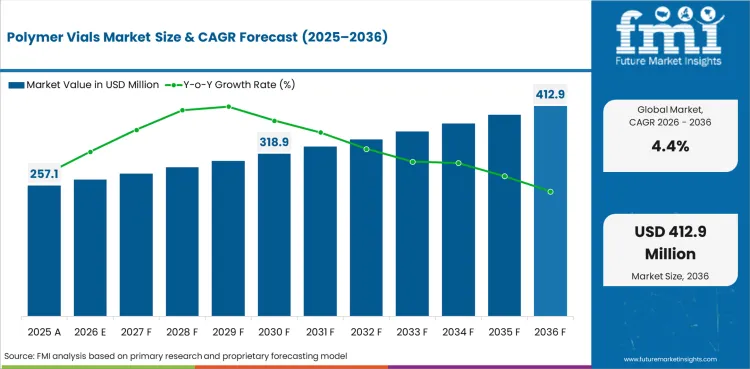
- The polymer vials market was valued at USD 257.1 million in 2025.
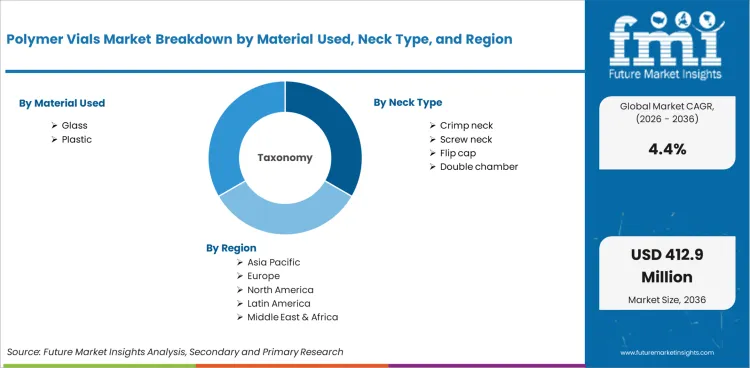
- The market is projected to reach USD 268.4 million in 2026 and USD 412.9 million by 2036, growing at a CAGR of 4.4%.
- By 2036, the Polymer Vials Market is expected to be worth USD 412.9 million.
- From 2026 to 2036, the market is projected to expand at a CAGR of 4.4%.
- The market is projected to create an incremental opportunity of USD 144.5 million between 2026 and 2036.
- In 2026, liquid drugs are expected to account for 57.8% of the storage type segment, driven by consistent pharmaceutical procurement of sterile, break-resistant vial formats for injectable drug packaging where glass breakage risk and supply chain fragility create demand for polymer alternatives.
- South Korea (4.7%) and USA (4.6%) are two of the fastest growing markets in the world.
Polymer Vials Market Definition
The polymer vials market includes pharmaceutical vials manufactured from polymer substrates including cyclic olefin copolymer (COC), cyclic olefin polymer (COP), and other plastics, used for packaging injectable drugs, biologics, vaccines, and other sterile pharmaceutical products.
Polymer Vials Market Inclusions
Market scope encompasses all commercially traded polymer vials categorized by material used (glass, polymer including COC, COP, PE, PP), neck type (crimp neck, screw neck, snap-on neck), storage type (liquid drugs, powder drugs, lyophilized drugs), size (2 ml, 5 ml, 10 ml, 20 ml, others), and distribution channel (direct sales, distributors, online platforms). The range of revenue sizes is from 2026 to 2036.
Polymer Vials Market Exclusions
The scope does not include glass-only pharmaceutical vials, plastic bottles for oral medications, or polymer containers used exclusively for non-pharmaceutical laboratory applications.
Polymer Vials Market Research Methodology
- Primary Research: FMI analysts conducted interviews with manufacturers, end-use procurement teams, and distribution partners across key markets.
- Desk Research: Combined data from industry associations, regulatory filings, trade publications, and manufacturer disclosures.
- Market sizing and forecasting: Bottom-up aggregation across product types, end-use applications, and regional adoption curves, validated against industry benchmarks.
- Data validation: Cross-checked every quarter against production data, trade statistics, and manufacturer-reported figures.
Why is the Polymer Vials Market Growing?
- Pharmaceutical demand for break-resistant, lightweight vials is creating structured procurement of polymer alternatives to traditional glass formats, particularly for injectable drug and vaccine packaging.
- Growth in biologics manufacturing and multi-dose vaccine programs is increasing demand for sterile polymer vials that meet regulatory compatibility and containment integrity requirements.
- South Korea (4.7%) and the USA (4.6%) lead growth, reflecting strong pharmaceutical manufacturing bases and active drug packaging modernization programs.
The polymer vials market reflects pharmaceutical industry diversification from glass to polymer packaging for injectable drug delivery. Glass still accounts for 54.2% of the material segment, but polymer alternatives are gaining share in applications where breakage risk, weight reduction, and supply chain resilience are procurement priorities. Crimp neck vials account for 38.5% of the neck type segment, reflecting pharmaceutical preference for secure, tamper-evident closure systems.
Liquid drugs represent 57.8% of the storage type segment, reflecting the primary application of polymer vials in injectable formulation packaging. The 10 ml size accounts for 26.3% of the size segment, representing the standard format for single-dose and multi-dose injectable drug products. Direct sales account for 46.5% of distribution, reflecting the contract-based procurement model between vial manufacturers and pharmaceutical companies.
Biologics and vaccine manufacturing represent the highest-growth demand categories for polymer vials. These products require packaging that combines sterility assurance, extractable and leachable compliance, and break resistance during cold chain storage and transport. Polymer vials with cyclic olefin copolymer (COC) and cyclic olefin polymer (COP) substrates meet these requirements while offering weight and breakage advantages over glass.
Market Segmentation Analysis
- Glass accounts for 54.2% of the material used segment, reflecting consistent demand across primary commercial applications.
- Crimp neck accounts for 38.5% of the neck type segment, reflecting consistent demand across primary commercial applications.
- Liquid Drugs accounts for 57.8% of the storage type segment, reflecting consistent demand across primary commercial applications.
The polymer vials market is segmented by material used, neck type, storage type, size, distribution channel. Each segmentation dimension reflects distinct procurement patterns and end-use requirements that shape competitive positioning.
Insights into the Glass Material Used Segment
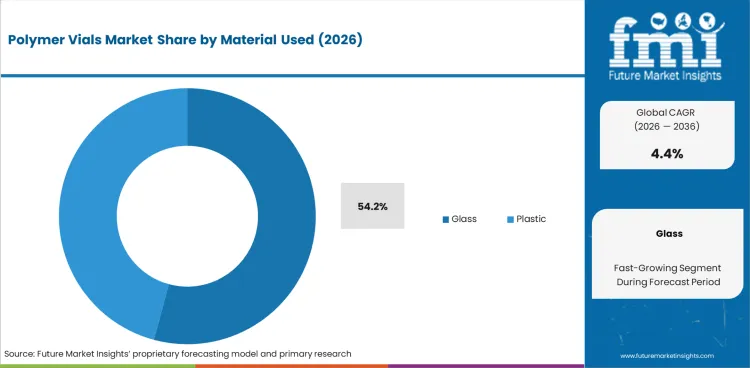
In 2026, glass is expected to account for 54.2% of the material used segment. Demand reflects procurement preferences in primary end-use applications where performance consistency and cost efficiency are critical selection criteria.
Competitive positioning within this segment depends on production scale, quality consistency, and the ability to meet evolving specifications. Suppliers with established relationships and flexible manufacturing are likely to maintain share.
Insights into the Crimp neck Neck Type Segment
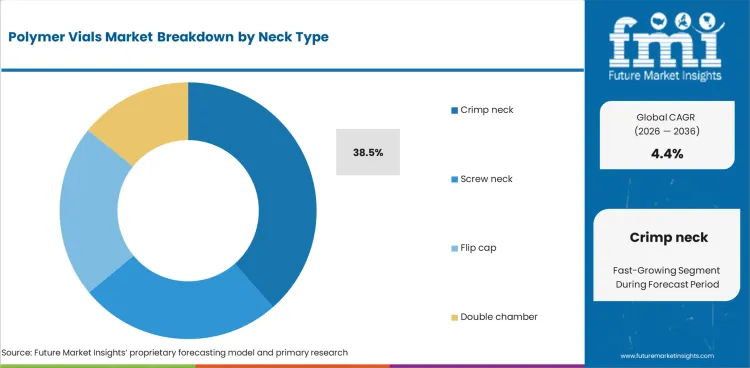
In 2026, crimp neck is expected to account for 38.5% of the neck type segment. Demand reflects procurement preferences in primary end-use applications where performance consistency and cost efficiency are critical selection criteria.
Competitive positioning within this segment depends on production scale, quality consistency, and the ability to meet evolving specifications. Suppliers with established relationships and flexible manufacturing are likely to maintain share.
Polymer Vials Market Drivers, Restraints, and Opportunities
- Pharmaceutical supply chain diversification and breakage risk mitigation are creating sustained demand for polymer vials as alternatives to glass in injectable drug packaging.
- Higher per-unit costs compared to glass and the need for extensive extractable and leachable testing create adoption barriers for cost-sensitive generic drug manufacturers.
- Growth in biologics and vaccine programs requiring cold chain integrity and break resistance is accelerating pharmaceutical procurement of polymer vial formats.
The polymer vials market reflects pharmaceutical packaging modernization, with growth shaped by supply chain resilience needs, biologics manufacturing expansion, and regulatory compatibility requirements.
Glass Supply Chain Risk Mitigation
Pharmaceutical companies experienced glass vial supply constraints during pandemic-era vaccine production surges. This experience accelerated strategic diversification toward polymer vial sourcing to reduce dependency on concentrated glass supply chains.
Cost Premium versus Glass
Polymer vials carry a per-unit cost premium over glass, particularly for COC and COP formulations that meet pharmaceutical extractable and leachable standards. This cost differential limits adoption in cost-sensitive generic drug packaging but is acceptable for high-value biologics and specialty products.
Biologics and Vaccine Packaging Demand
Biologic drugs and vaccines require packaging that maintains sterility, resists breakage during cold chain transport, and demonstrates low extractable and leachable profiles. Polymer vials meet these requirements while reducing weight and breakage-related product loss.
Analysis of Polymer Vials Market By Key Countries
.webp "Top Country Growth Comparison Polymer Vials Market Cagr (2026 2036)")
| Country | CAGR |
|---|---|
| South Korea | 4.7% |
| USA | 4.6% |
| Europe | 4.5% |
| UK | 4.2% |
| Japan | 4.1% |
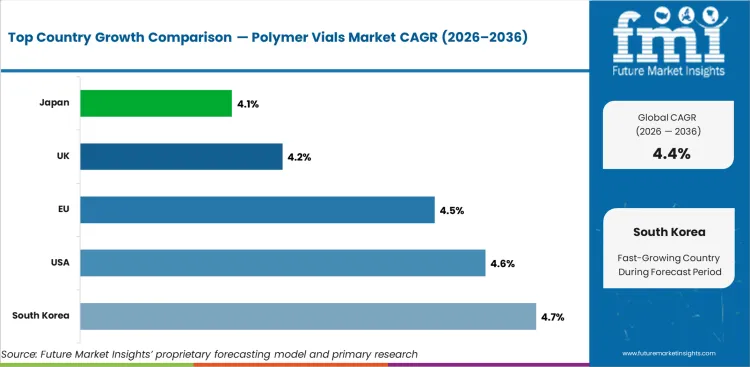
- South Korea leads with 4.7%, supported by rapid pharmaceutical manufacturing expansion.
- USA at 4.6% reflects large pharmaceutical and biologics manufacturing base.
- EU (4.5%) sustains growth through strong pharmaceutical manufacturing infrastructure.
The global polymer vials market is expected to grow at a rate of 4.4% per year from 2026 to 2036. The study covers more than 30 countries, and the main markets are listed below.
Demand Outlook for Polymer Vials Market in South Korea
South Korea is expected to grow at 4.7% through 2036, reflecting rapid pharmaceutical manufacturing expansion, biosimilar production growth, and active adoption of modern drug packaging technologies.
- Pharmaceutical expansion accelerates vial procurement growth.
- Biosimilar production drives modern packaging adoption.
- Technology adoption culture supports packaging modernization.
Future Outlook for Polymer Vials Market in USA
USA is expected to grow at 4.6% through 2036, reflecting large pharmaceutical and biologics manufacturing base, active drug packaging modernization programs, and FDA regulatory pathways for polymer container closure systems.
- Biologics manufacturing expansion drives polymer vial procurement.
- FDA container closure guidance supports polymer adoption pathways.
- Supply chain diversification accelerates non-glass sourcing.
Opportunity Analysis of Polymer Vials Market in Europe
Europe is expected to grow at 4.5% through 2036, reflecting strong pharmaceutical manufacturing infrastructure, EMA regulatory frameworks for polymer packaging, and vaccine production capacity expansion.
- Vaccine production investment sustains vial demand.
- EMA regulatory frameworks support polymer container adoption.
- Pharmaceutical manufacturing base drives consistent procurement.
In-depth Analysis of Polymer Vials Market in UK
UK is expected to grow at 4.2% through 2036, reflecting pharmaceutical manufacturing growth, biologics production expansion, and NHS procurement modernization favoring supply chain resilient packaging.
- Pharmaceutical growth sustains demand for modern vial formats.
- Biologics production expansion increases polymer vial procurement.
- NHS procurement modernization favors resilient packaging.
Sales Analysis of Polymer Vials Market in Japan
Japan is expected to grow at 4.1% through 2036, reflecting advanced pharmaceutical manufacturing, strict packaging quality standards, and biologics production investment.
- Strict quality standards drive premium vial specification.
- Biologics investment increases polymer vial demand.
- Advanced manufacturing supports quality-certified production.
Competitive Landscape and Strategic Positioning
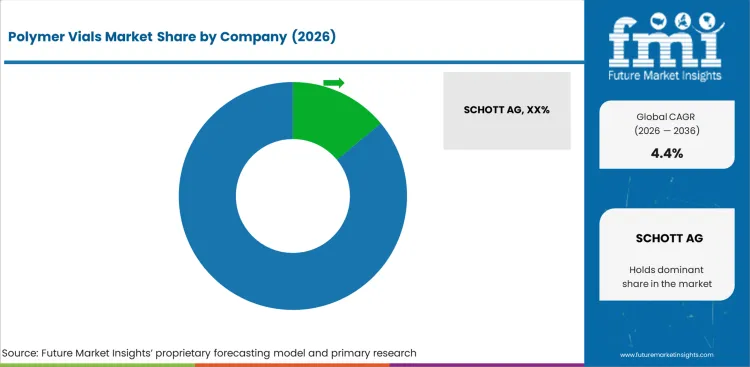
- SCHOTT AG and Gerresheimer AG lead through broad product portfolios and established end-use customer relationships.
- Mid-tier producers compete through regional specialization and targeted product development for specific application segments.
- New entrants are focusing on sustainability-differentiated products and specialized high-value applications to establish market presence.
SCHOTT AG holds a strong position through manufacturing scale and established relationships. Gerresheimer AG competes through complementary capabilities and regional distribution strength.
West Pharmaceutical Services, Inc. and Bormioli Pharma S.p.A. maintain positions through specialized offerings and technical service capabilities.
Barriers include established supply chain relationships, regulatory approval, manufacturing scale economics, and technical expertise. Strategic priorities include cost optimization, sustainability compliance, and geographic expansion.
Key Companies in the Polymer Vials Market
Key global companies leading the polymer vials market include:
- SCHOTT AG, Gerresheimer AG, West Pharmaceutical Services, Inc. hold leading positions through manufacturing infrastructure and broad product portfolios.
- Bormioli Pharma S.p.A., SiO2 Materials Science have established regional presence through specialized offerings.
- Daikyo Seiko Ltd., Nipro Corporation, Stevanato Group S.p.A. represent emerging participants with growth potential through technology differentiation.
Competitive Benchmarking: Polymer Vials Market
| Company | Material Expertise | Sterility Assurance | Pharma Partnerships | Geographic Reach |
|---|---|---|---|---|
| SCHOTT AG | High | High | High | Global |
| Gerresheimer AG | High | Medium | High | Global |
| West Pharmaceutical Services, Inc. | Medium | Medium | Medium | Global |
| Bormioli Pharma S.p.A. | Medium | Moderate | Medium | Regional |
| SiO2 Materials Science | Moderate | Moderate | Moderate | Regional |
| Daikyo Seiko Ltd. | Moderate | Low | Moderate | Regional |
| Nipro Corporation | Low | Low | Low | Niche |
| Stevanato Group S.p.A. | Low | Low | Low | Niche |
| Corning Life Sciences | Low | Low | Low | Niche |
Source: Future Market Insights competitive analysis, 2026.
Key Players in the Polymer Vials Market
Major Global Players
- SCHOTT AG
- Gerresheimer AG
- West Pharmaceutical Services, Inc.
- Bormioli Pharma S.p.A.
- SiO2 Materials Science
Emerging Players/Startups
- Daikyo Seiko Ltd.
- Nipro Corporation
- Stevanato Group S.p.A.
- Corning Life Sciences
- Datwyler Holding Inc.
Report Scope and Coverage
| Metric | Value |
|---|---|
| Quantitative Units | USD 268.4 Million to USD 412.9 Million, at a CAGR of 4.4% |
| Market Definition | The polymer vials market encompasses polymer-based pharmaceutical vials made from cyclic olefin copolymer, cyclic olefin polymer, and other plastic substrates used for injectable drug, biologics, and vaccine containment. |
| Regions Covered | North America, Latin America, Europe, East Asia, South Asia and Pacific, Middle East and Africa |
| Countries Covered | USA, UK, Europe, Japan, South Korea, 30 plus countries |
| Key Companies Profiled | SCHOTT AG, Gerresheimer AG, West Pharmaceutical Services, Inc., Bormioli Pharma S.p.A., SiO2 Materials Science |
| Forecast Period | 2026 to 2036 |
| Approach | Hybrid bottom-up and top-down methodology starting with verified transaction data, projecting adoption velocity across segments and regions. |
Segmentation
Polymer Vials Market Segmented by Material Used:
- Glass
- Plastic
Polymer Vials Market Segmented by Neck Type:
- Crimp neck
- Screw neck
- Flip cap
- Double chamber
Polymer Vials Market Segmented by Storage Type:
- Liquid Drugs
- Powder
- Tablets
Polymer Vials Market Segmented by Size:
- 2 ml
- 5 ml
- 10 ml
- 15 ml
- 50 ml
- 100 ml
Polymer Vials Market Segmented by Distribution Channel:
- Direct sales
- Pharmacies Medical Stores
- E commerce
- Others
Polymer Vials Market by Region:
- North America
- USA
- Canada
- Mexico
- Latin America
- Brazil
- Chile
- Rest of Latin America
- Western Europe
- Germany
- UK
- Italy
- Spain
- France
- Nordic
- BENELUX
- Rest of Western Europe
- Eastern Europe
- Russia
- Poland
- Hungary
- Balkan & Baltic
- Rest of Eastern Europe
- East Asia
- China
- Japan
- South Korea
- South Asia and Pacific
- India
- ASEAN
- Australia & New Zealand
- Rest of South Asia and Pacific
- Middle East & Africa
- Kingdom of Saudi Arabia
- Other GCC Countries
- Turkiye
- South Africa
- Other African Union
- Rest of Middle East & Africa
Research Sources and Bibliography
- USA Food and Drug Administration. (2024). FDA Guidance on Container Closure Systems for Packaging Human Drugs and Biologics. FDA.
- European Medicines Agency. (2024). EMA Guidelines on Plastic Immediate Packaging Materials for Medicinal Products. EMA.
- World Health Organization. (2024). WHO Technical Report on Vaccine Packaging and Cold Chain Requirements. WHO.
- International Organization for Standardization. (2024). ISO 11040: Prefilled Syringes and Vials, Polymer Components. ISO.
- Parenteral Drug Association. (2025). PDA Technical Report on Polymer Packaging for Injectable Pharmaceuticals. PDA.
This bibliography is provided for reader reference. The full Future Market Insights report contains the complete reference list with publication dates, URLs, and supporting data for all cited works.
This Report Answers
- Estimating the size of the market and revenue from 2026 to 2036.
- Segmentation analysis across all product, application, and end-use categories.
- Regional insights covering more than 30 markets worldwide.
- Technology and material analysis relevant to market applications.
- Competitive landscape assessment including company benchmarking.
- Identification of investment opportunities across high-growth segments and regions.
- Supply chain analysis and distribution channel assessment.
- Data delivery in PDF and Excel formats.
Frequently Asked Questions
What is the global market demand for Polymer Vials Market in 2026?
In 2026, the global polymer vials market is expected to be worth USD 268.4 million.
How big will the Polymer Vials Market be in 2036?
By 2036, the polymer vials market is expected to be worth USD 412.9 million.
How much is demand for Polymer Vials Market expected to grow between 2026 and 2036?
Between 2026 and 2036, demand for the polymer vials market is expected to grow at a CAGR of 4.4%.
Which Storage Type segment is likely to lead globally in 2026?
Liquid Drugs is expected to account for 57.8% of the storage type segment in 2026, reflecting strong end-use demand across primary commercial applications.
What is causing demand to rise in South Korea?
South Korea is expected to grow at 4.7% through 2036, reflecting rapid pharmaceutical manufacturing expansion, biosimilar production growth, and active adoption of modern drug packaging technologies.
What is causing demand to rise in USA?
USA is expected to grow at 4.6% through 2036, reflecting large pharmaceutical and biologics manufacturing base, active drug packaging modernization programs, and FDA regulatory pathways for polymer container closure systems.
What does this report mean by 'Polymer Vials Market definition'?
The polymer vials market encompasses polymer-based pharmaceutical vials made from cyclic olefin copolymer, cyclic olefin polymer, and other plastic substrates used for injectable drug, biologics, and vaccine containment.
How does FMI make the Polymer Vials Market forecast and validate it?
Forecasting models use a hybrid bottom-up and top-down approach, starting with verified transaction data and validating against industry production statistics and manufacturer disclosures.
Preview the report firsthand - request a free sample
Get SampleGet the brochure for pricing and purchase details.
Get PDFTable of Content
- Executive Summary
- Global Market Outlook
- Demand-side Trends
- Supply-side Trends
- Technology Roadmap Analysis
- Analysis and Recommendations
- Market Overview
- Market Coverage / Taxonomy
- Market Definition / Scope / Limitations
- Research Methodology
- Chapter Orientation
- Analytical Lens and Working Hypotheses
- Market Structure, Signals, and Trend Drivers
- Benchmarking and Cross-market Comparability
- Market Sizing, Forecasting, and Opportunity Mapping
- Research Design and Evidence Framework
- Desk Research Programme (Secondary Evidence)
- Company Annual and Sustainability Reports
- Peer-reviewed Journals and Academic Literature
- Corporate Websites, Product Literature, and Technical Notes
- Earnings Decks and Investor Briefings
- Statutory Filings and Regulatory Disclosures
- Technical White Papers and Standards Notes
- Trade Journals, Industry Magazines, and Analyst Briefs
- Conference Proceedings, Webinars, and Seminar Materials
- Government Statistics Portals and Public Data Releases
- Press Releases and Reputable Media Coverage
- Specialist Newsletters and Curated Briefings
- Sector Databases and Reference Repositories
- FMI Internal Proprietary Databases and Historical Market Datasets
- Subscription Datasets and Paid Sources
- Social Channels, Communities, and Digital Listening Inputs
- Additional Desk Sources
- Expert Input and Fieldwork (Primary Evidence)
- Primary Modes
- Qualitative Interviews and Expert Elicitation
- Quantitative Surveys and Structured Data Capture
- Blended Approach
- Why Primary Evidence is Used
- Field Techniques
- Interviews
- Surveys
- Focus Groups
- Observational and In-context Research
- Social and Community Interactions
- Stakeholder Universe Engaged
- C-suite Leaders
- Board Members
- Presidents and Vice Presidents
- R&D and Innovation Heads
- Technical Specialists
- Domain Subject-matter Experts
- Scientists
- Physicians and Other Healthcare Professionals
- Governance, Ethics, and Data Stewardship
- Research Ethics
- Data Integrity and Handling
- Primary Modes
- Tooling, Models, and Reference Databases
- Desk Research Programme (Secondary Evidence)
- Data Engineering and Model Build
- Data Acquisition and Ingestion
- Cleaning, Normalisation, and Verification
- Synthesis, Triangulation, and Analysis
- Quality Assurance and Audit Trail
- Market Background
- Market Dynamics
- Drivers
- Restraints
- Opportunity
- Trends
- Scenario Forecast
- Demand in Optimistic Scenario
- Demand in Likely Scenario
- Demand in Conservative Scenario
- Opportunity Map Analysis
- Product Life Cycle Analysis
- Supply Chain Analysis
- Investment Feasibility Matrix
- Value Chain Analysis
- PESTLE and Porter’s Analysis
- Regulatory Landscape
- Regional Parent Market Outlook
- Production and Consumption Statistics
- Import and Export Statistics
- Market Dynamics
- Global Market Analysis 2021 to 2025 and Forecast, 2026 to 2036
- Historical Market Size Value (USD Million) Analysis, 2021 to 2025
- Current and Future Market Size Value (USD Million) Projections, 2026 to 2036
- Y-o-Y Growth Trend Analysis
- Absolute $ Opportunity Analysis
- Global Market Pricing Analysis 2021 to 2025 and Forecast 2026 to 2036
- Global Market Analysis 2021 to 2025 and Forecast 2026 to 2036, By Material Used
- Introduction / Key Findings
- Historical Market Size Value (USD Million) Analysis By Material Used , 2021 to 2025
- Current and Future Market Size Value (USD Million) Analysis and Forecast By Material Used , 2026 to 2036
- Glass
- Plastic
- Glass
- Y-o-Y Growth Trend Analysis By Material Used , 2021 to 2025
- Absolute $ Opportunity Analysis By Material Used , 2026 to 2036
- Global Market Analysis 2021 to 2025 and Forecast 2026 to 2036, By Neck Type
- Introduction / Key Findings
- Historical Market Size Value (USD Million) Analysis By Neck Type, 2021 to 2025
- Current and Future Market Size Value (USD Million) Analysis and Forecast By Neck Type, 2026 to 2036
- Crimp neck
- Screw neck
- Flip cap
- Double chamber
- Crimp neck
- Y-o-Y Growth Trend Analysis By Neck Type, 2021 to 2025
- Absolute $ Opportunity Analysis By Neck Type, 2026 to 2036
- Global Market Analysis 2021 to 2025 and Forecast 2026 to 2036, By Storage Type
- Introduction / Key Findings
- Historical Market Size Value (USD Million) Analysis By Storage Type, 2021 to 2025
- Current and Future Market Size Value (USD Million) Analysis and Forecast By Storage Type, 2026 to 2036
- Liquid Drugs
- Powder
- Tablets
- Liquid Drugs
- Y-o-Y Growth Trend Analysis By Storage Type, 2021 to 2025
- Absolute $ Opportunity Analysis By Storage Type, 2026 to 2036
- Global Market Analysis 2021 to 2025 and Forecast 2026 to 2036, By Size
- Introduction / Key Findings
- Historical Market Size Value (USD Million) Analysis By Size, 2021 to 2025
- Current and Future Market Size Value (USD Million) Analysis and Forecast By Size, 2026 to 2036
- 2 ml
- 5 ml
- 10 ml
- 15 ml
- 50 ml
- 100 ml
- 2 ml
- Y-o-Y Growth Trend Analysis By Size, 2021 to 2025
- Absolute $ Opportunity Analysis By Size, 2026 to 2036
- Global Market Analysis 2021 to 2025 and Forecast 2026 to 2036, By Distribution Channel
- Introduction / Key Findings
- Historical Market Size Value (USD Million) Analysis By Distribution Channel, 2021 to 2025
- Current and Future Market Size Value (USD Million) Analysis and Forecast By Distribution Channel, 2026 to 2036
- Direct sales
- Pharmacies Medical Stores
- E commerce
- Others
- Direct sales
- Y-o-Y Growth Trend Analysis By Distribution Channel, 2021 to 2025
- Absolute $ Opportunity Analysis By Distribution Channel, 2026 to 2036
- Global Market Analysis 2021 to 2025 and Forecast 2026 to 2036, By Region
- Introduction
- Historical Market Size Value (USD Million) Analysis By Region, 2021 to 2025
- Current Market Size Value (USD Million) Analysis and Forecast By Region, 2026 to 2036
- North America
- Latin America
- Western Europe
- Eastern Europe
- East Asia
- South Asia and Pacific
- Middle East & Africa
- Market Attractiveness Analysis By Region
- North America Market Analysis 2021 to 2025 and Forecast 2026 to 2036, By Country
- Historical Market Size Value (USD Million) Trend Analysis By Market Taxonomy, 2021 to 2025
- Market Size Value (USD Million) Forecast By Market Taxonomy, 2026 to 2036
- By Country
- USA
- Canada
- Mexico
- By Material Used
- By Neck Type
- By Storage Type
- By Size
- By Distribution Channel
- By Country
- Market Attractiveness Analysis
- By Country
- By Material Used
- By Neck Type
- By Storage Type
- By Size
- By Distribution Channel
- Key Takeaways
- Latin America Market Analysis 2021 to 2025 and Forecast 2026 to 2036, By Country
- Historical Market Size Value (USD Million) Trend Analysis By Market Taxonomy, 2021 to 2025
- Market Size Value (USD Million) Forecast By Market Taxonomy, 2026 to 2036
- By Country
- Brazil
- Chile
- Rest of Latin America
- By Material Used
- By Neck Type
- By Storage Type
- By Size
- By Distribution Channel
- By Country
- Market Attractiveness Analysis
- By Country
- By Material Used
- By Neck Type
- By Storage Type
- By Size
- By Distribution Channel
- Key Takeaways
- Western Europe Market Analysis 2021 to 2025 and Forecast 2026 to 2036, By Country
- Historical Market Size Value (USD Million) Trend Analysis By Market Taxonomy, 2021 to 2025
- Market Size Value (USD Million) Forecast By Market Taxonomy, 2026 to 2036
- By Country
- Germany
- UK
- Italy
- Spain
- France
- Nordic
- BENELUX
- Rest of Western Europe
- By Material Used
- By Neck Type
- By Storage Type
- By Size
- By Distribution Channel
- By Country
- Market Attractiveness Analysis
- By Country
- By Material Used
- By Neck Type
- By Storage Type
- By Size
- By Distribution Channel
- Key Takeaways
- Eastern Europe Market Analysis 2021 to 2025 and Forecast 2026 to 2036, By Country
- Historical Market Size Value (USD Million) Trend Analysis By Market Taxonomy, 2021 to 2025
- Market Size Value (USD Million) Forecast By Market Taxonomy, 2026 to 2036
- By Country
- Russia
- Poland
- Hungary
- Balkan & Baltic
- Rest of Eastern Europe
- By Material Used
- By Neck Type
- By Storage Type
- By Size
- By Distribution Channel
- By Country
- Market Attractiveness Analysis
- By Country
- By Material Used
- By Neck Type
- By Storage Type
- By Size
- By Distribution Channel
- Key Takeaways
- East Asia Market Analysis 2021 to 2025 and Forecast 2026 to 2036, By Country
- Historical Market Size Value (USD Million) Trend Analysis By Market Taxonomy, 2021 to 2025
- Market Size Value (USD Million) Forecast By Market Taxonomy, 2026 to 2036
- By Country
- China
- Japan
- South Korea
- By Material Used
- By Neck Type
- By Storage Type
- By Size
- By Distribution Channel
- By Country
- Market Attractiveness Analysis
- By Country
- By Material Used
- By Neck Type
- By Storage Type
- By Size
- By Distribution Channel
- Key Takeaways
- South Asia and Pacific Market Analysis 2021 to 2025 and Forecast 2026 to 2036, By Country
- Historical Market Size Value (USD Million) Trend Analysis By Market Taxonomy, 2021 to 2025
- Market Size Value (USD Million) Forecast By Market Taxonomy, 2026 to 2036
- By Country
- India
- ASEAN
- Australia & New Zealand
- Rest of South Asia and Pacific
- By Material Used
- By Neck Type
- By Storage Type
- By Size
- By Distribution Channel
- By Country
- Market Attractiveness Analysis
- By Country
- By Material Used
- By Neck Type
- By Storage Type
- By Size
- By Distribution Channel
- Key Takeaways
- Middle East & Africa Market Analysis 2021 to 2025 and Forecast 2026 to 2036, By Country
- Historical Market Size Value (USD Million) Trend Analysis By Market Taxonomy, 2021 to 2025
- Market Size Value (USD Million) Forecast By Market Taxonomy, 2026 to 2036
- By Country
- Kingdom of Saudi Arabia
- Other GCC Countries
- Turkiye
- South Africa
- Other African Union
- Rest of Middle East & Africa
- By Material Used
- By Neck Type
- By Storage Type
- By Size
- By Distribution Channel
- By Country
- Market Attractiveness Analysis
- By Country
- By Material Used
- By Neck Type
- By Storage Type
- By Size
- By Distribution Channel
- Key Takeaways
- Key Countries Market Analysis
- USA
- Pricing Analysis
- Market Share Analysis, 2025
- By Material Used
- By Neck Type
- By Storage Type
- By Size
- By Distribution Channel
- Canada
- Pricing Analysis
- Market Share Analysis, 2025
- By Material Used
- By Neck Type
- By Storage Type
- By Size
- By Distribution Channel
- Mexico
- Pricing Analysis
- Market Share Analysis, 2025
- By Material Used
- By Neck Type
- By Storage Type
- By Size
- By Distribution Channel
- Brazil
- Pricing Analysis
- Market Share Analysis, 2025
- By Material Used
- By Neck Type
- By Storage Type
- By Size
- By Distribution Channel
- Chile
- Pricing Analysis
- Market Share Analysis, 2025
- By Material Used
- By Neck Type
- By Storage Type
- By Size
- By Distribution Channel
- Germany
- Pricing Analysis
- Market Share Analysis, 2025
- By Material Used
- By Neck Type
- By Storage Type
- By Size
- By Distribution Channel
- UK
- Pricing Analysis
- Market Share Analysis, 2025
- By Material Used
- By Neck Type
- By Storage Type
- By Size
- By Distribution Channel
- Italy
- Pricing Analysis
- Market Share Analysis, 2025
- By Material Used
- By Neck Type
- By Storage Type
- By Size
- By Distribution Channel
- Spain
- Pricing Analysis
- Market Share Analysis, 2025
- By Material Used
- By Neck Type
- By Storage Type
- By Size
- By Distribution Channel
- France
- Pricing Analysis
- Market Share Analysis, 2025
- By Material Used
- By Neck Type
- By Storage Type
- By Size
- By Distribution Channel
- India
- Pricing Analysis
- Market Share Analysis, 2025
- By Material Used
- By Neck Type
- By Storage Type
- By Size
- By Distribution Channel
- ASEAN
- Pricing Analysis
- Market Share Analysis, 2025
- By Material Used
- By Neck Type
- By Storage Type
- By Size
- By Distribution Channel
- Australia & New Zealand
- Pricing Analysis
- Market Share Analysis, 2025
- By Material Used
- By Neck Type
- By Storage Type
- By Size
- By Distribution Channel
- China
- Pricing Analysis
- Market Share Analysis, 2025
- By Material Used
- By Neck Type
- By Storage Type
- By Size
- By Distribution Channel
- Japan
- Pricing Analysis
- Market Share Analysis, 2025
- By Material Used
- By Neck Type
- By Storage Type
- By Size
- By Distribution Channel
- South Korea
- Pricing Analysis
- Market Share Analysis, 2025
- By Material Used
- By Neck Type
- By Storage Type
- By Size
- By Distribution Channel
- Russia
- Pricing Analysis
- Market Share Analysis, 2025
- By Material Used
- By Neck Type
- By Storage Type
- By Size
- By Distribution Channel
- Poland
- Pricing Analysis
- Market Share Analysis, 2025
- By Material Used
- By Neck Type
- By Storage Type
- By Size
- By Distribution Channel
- Hungary
- Pricing Analysis
- Market Share Analysis, 2025
- By Material Used
- By Neck Type
- By Storage Type
- By Size
- By Distribution Channel
- Kingdom of Saudi Arabia
- Pricing Analysis
- Market Share Analysis, 2025
- By Material Used
- By Neck Type
- By Storage Type
- By Size
- By Distribution Channel
- Turkiye
- Pricing Analysis
- Market Share Analysis, 2025
- By Material Used
- By Neck Type
- By Storage Type
- By Size
- By Distribution Channel
- South Africa
- Pricing Analysis
- Market Share Analysis, 2025
- By Material Used
- By Neck Type
- By Storage Type
- By Size
- By Distribution Channel
- USA
- Market Structure Analysis
- Competition Dashboard
- Competition Benchmarking
- Market Share Analysis of Top Players
- By Regional
- By Material Used
- By Neck Type
- By Storage Type
- By Size
- By Distribution Channel
- Competition Analysis
- Competition Deep Dive
- SCHOTT AG
- Overview
- Product Portfolio
- Profitability by Market Segments (Product/Age /Sales Channel/Region)
- Sales Footprint
- Strategy Overview
- Marketing Strategy
- Product Strategy
- Channel Strategy
- Gerresheimer AG
- West Pharmaceutical Services, Inc.
- Bormioli Pharma S.p.A.
- SiO2 Materials Science
- SCHOTT AG
- Competition Deep Dive
- Assumptions & Acronyms Used


