

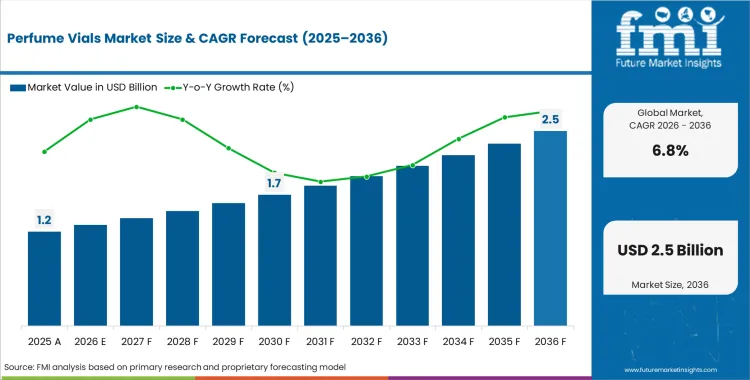
- Industry Size (2026)
- USD 1.2 Bn
- Forecast (2036)
- USD 2.3 Bn
- CAGR (2026 to 2036)
- 6.8%
Perfume Vials Market Size, Market Forecast and Outlook By FMI
The perfume vials market was valued at USD 1.1 billion in 2025. The market is projected to reach USD 1.2 billion in 2026 and USD 2.3 billion by 2036, expanding at a CAGR of 6.8% during the forecast period. Glass vials are expected to lead material demand with a 61.3% share in 2026. Sampling and travel vials under 5ml are projected to remain the leading capacity segment with a 42.8% share in 2026. Prestige and luxury fragrances are expected to lead end-use demand with a 47.6% share in 2026.
Summary of Perfume Vials Market
- Key Drivers
- Fragrance discovery culture: Consumer preference for sampling and trialing fragrances before full-size purchase is driving structural growth in vial formats, with brands using sample vials as the primary new-customer acquisition and conversion tool.
- E-commerce fragrance sampling programs: Online fragrance retail platforms and subscription sampling services are creating sustained volume demand for sealed, leak-proof vials that travel safely and reliably through postal and parcel distribution networks.
- Luxury packaging premiumization: Prestige fragrance brands are investing in refined vial aesthetics including heavy-gauge glass, metal collars, and custom closure systems that elevate the sampling and unboxing experience as a brand communication event.
- Key Segments Analyzed in the Report
- Material: glass, aluminum, polymer, and others
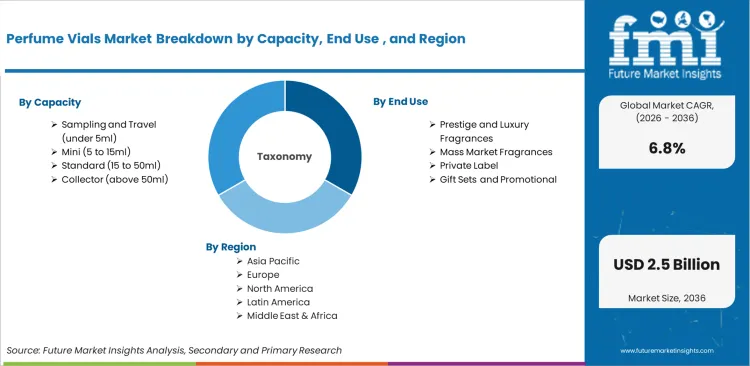
- Capacity: sampling and travel (under 5ml), mini (5 to 15ml), standard (15 to 50ml), collector (above 50ml)
- End use: prestige and luxury fragrances, mass market fragrances, private label, gift sets and promotional
- Region: North America, Latin America, Western Europe, Eastern Europe, East Asia, South Asia and Pacific, and Middle East and Africa
- Analyst Opinion
- Ismail Sutaria, Sr. Consultant at FMI says, "Perfume vials are a precision packaging category where aesthetics and logistics performance must coexist. The sampling economy is the structural tailwind that will sustain volume growth through 2036, but value will concentrate with producers who can pair craft-level glass quality with the reliability and scale that omnichannel fragrance brands require to run global sampling programs."
Perfume Vials market Definition
The perfume vials market includes small-format primary packaging containers designed to hold fragrance formulations for sampling, travel, gifting, collection, and promotional use. It covers glass, aluminum, and polymer vials ranging from miniature sample formats under 5ml to collector presentations above 50ml, including atomizer, splash, and sealed formats used in prestige, mass market, private label, and gift set fragrance applications. These formats serve fragrance discovery programs, e-commerce sampling, retail gifting, duty-free retail, and loyalty and promotional campaigns where compact, high-quality fragrance packaging drives consumer engagement.
Perfume Vials market Inclusions
- Sales of primary fragrance packaging vials in glass, metal, and polymer formats for sampling, travel, gifting, and promotional fragrance applications.
- Revenue from atomizer vials, sealed sample vials, miniature spray formats, and collector presentation vials used by prestige, mass market, and private label fragrance brands.
- All commercial demand across global fragrance packaging supply chains for vials used in retail, e-commerce, duty-free, subscription, and promotional distribution channels.
Perfume Vials market Exclusions
- Full-size primary fragrance flacons, bottles, and spray systems sold as standalone retail units outside the sampling, travel, and gifting vial category.
- Secondary packaging including boxes, cartons, sleeves, and displays that contain fragrance vials but are not themselves the primary fragrance container.
- Non-fragrance vials used in cosmetics, pharmaceutical, or laboratory applications that are not sold for fragrance containment.
Perfume Vials market Research Methodology
This study evaluates the perfume vials market by material, capacity, and end use using 2025 as the base year and 2026 to 2036 as the forecast period in value terms. Evidence inputs include fragrance industry trade association data, luxury packaging market research, annual reports from glass and specialty packaging companies, e-commerce fragrance platform disclosures, and first-party product documentation from leading vial manufacturers. Market estimates are built through triangulation of fragrance market sampling investment, subscription sampling service subscriber volumes, e-commerce packaging intensity, and the migration of luxury brands toward premium vial aesthetics in gifting and loyalty programs.
Key Drivers, Restraints, and Trends in Perfume Vials market
Drivers
Perfume vial demand is expanding on the back of structural shifts in how fragrance is discovered, purchased, and gifted. The rise of online fragrance retail and subscription discovery services has made the sample vial the primary commercial instrument through which brands acquire and convert new customers, creating a volume demand base that is independent of full-size retail cycles. Simultaneously, luxury brands are treating vials as premium brand communication objects, investing in heavy glass, refined closures, and custom forms that justify higher price per unit and create collectability. The combination of high-volume sampling demand and premium format investment is widening the market across both ends of the price spectrum.
Restraints
Glass vials, which dominate the market, create fragility and weight challenges in e-commerce fulfillment that require protective secondary packaging and add cost to sampling programs. The hazardous material classification of alcohol-based fragrance formulations limits air freight options and adds regulatory compliance cost for brands running cross-border sampling campaigns. Counterfeit risk in the luxury segment also pushes brands to invest in security packaging features such as laser etching, tamper-evident closures, and holographic authentication that add to unit cost without contributing to the consumer fragrance experience.
Trends
Miniature spray atomizer vials are growing faster than simple splash-application formats as consumers and brands prefer metered application that preserves fragrance integrity and allows more controlled sensory evaluation. Refillable vial systems with standardized closure interfaces are being introduced by premium brands as a sustainability response that also creates repeat customer touchpoints and loyalty program mechanics. Personalization through custom engraving, color tinting, and limited-edition vial designs is becoming a competitive differentiator in gift, collector, and brand anniversary applications where the vial itself is the product rather than merely the container.
Segmental Analysis
Perfume Vials market Analysis by Product Type
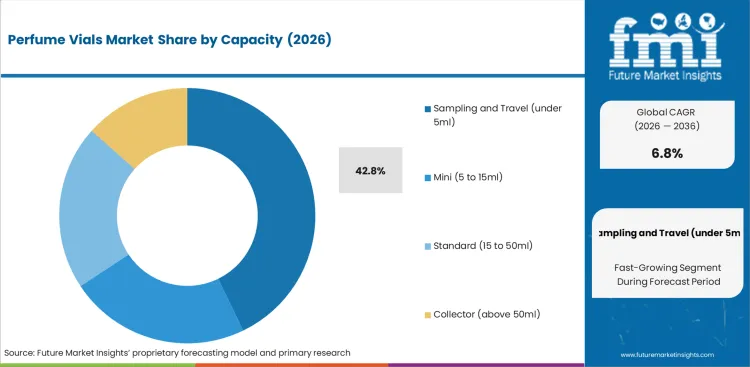
Sampling and travel vials under 5ml are projected to hold 42.8% of market value in 2026. This segment is the primary commercial engine for fragrance discovery programs, subscription boxes, and e-commerce sample packs. The recurring nature of sampling campaigns means repurchase cycles are faster than any other capacity segment, driving sustained volume demand throughout the forecast period. Brands are investing in sealed atomizer formats and custom-printed sampling vials that carry brand identity effectively in the compact format, converting the sampling transaction into an ongoing brand impression.
Perfume Vials market Analysis by End Use Industry
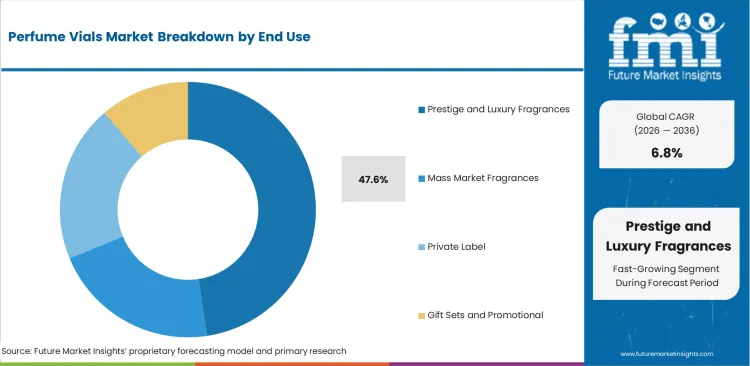
Prestige and luxury fragrances account for 47.6% of demand in 2026 because brand equity in this segment demands premium glass quality, precise dimensional tolerances, and custom closure systems that mass market alternatives cannot match. Luxury brands view the vial as a brand communication instrument and customer experience vehicle, which supports higher average selling prices and willingness to invest in bespoke vial development programs. The segment also drives disproportionate innovation in vial aesthetics and materials, creating reference formats that subsequently influence mass market and private label vial design directions.
Competitive Aligners for Market Players
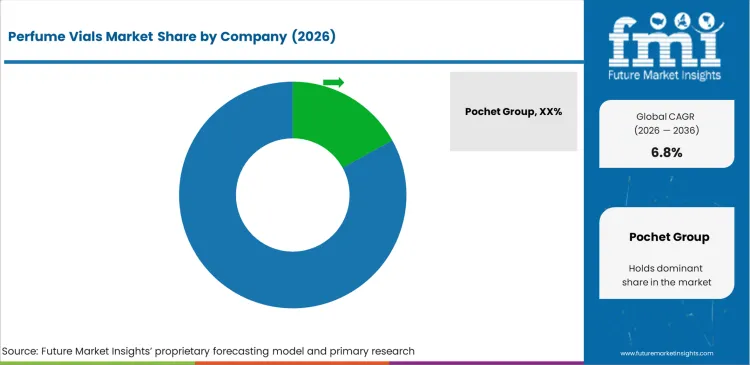
Competitive advantage in perfume vials is concentrated among producers with glassmaking precision, decorating capability, closure engineering, and the customer development support that luxury fragrance brands require for bespoke vial creation. Scale matters in the sampling segment where large brands need reliable high-volume supply of consistent sealed or atomizer formats. Producers who combine craft-level quality with industrial supply reliability will hold the strongest position across both the luxury and sampling segments. Sustainability documentation including recycled glass content certification and weight reduction data is also becoming a procurement requirement as luxury brands respond to retailer and regulatory sustainability expectations.
Key Players in Perfume Vials market
- Pochet Group
- Verescence
- Bormioli Luigi
- Heinz-Glas GmbH
- Albea Group
- Stoelzle Glass Group
- Vitro Packaging
- Gerresheimer AG
- SGD Pharma
- Piramal Glass
Strategic Outlook by FMI on Perfume Vials market
FMI sees the perfume vials market growing consistently through 2036, anchored by the structural role of sampling in fragrance brand acquisition and supported by continued luxury packaging investment in premium vial formats. The highest value will accrue to producers with precision glassmaking capability, bespoke development programs, and the production reliability to support global sampling campaigns. Sustainability will become an increasing procurement factor, and producers who invest early in recycled glass content validation and lightweight design will hold a competitive advantage as luxury brand sustainability commitments tighten.
Scope of the Report
| Market Value | USD 1.1 billion in 2025 to USD 2.3 billion by 2036 |
|---|---|
| CAGR | 6.8% from 2026 to 2036 |
| Base Year | 2025 |
| Forecast Period | 2026 to 2036 |
| Material Segmentation | Glass, Aluminum, Polymer, Others |
| Capacity Segmentation | Sampling and Travel (under 5ml), Mini (5 to 15ml), Standard (15 to 50ml), Collector (above 50ml) |
| End Use Segmentation | Prestige and Luxury Fragrances, Mass Market Fragrances, Private Label, Gift Sets and Promotional |
| Regions Covered | North America, Latin America, Western Europe, Eastern Europe, East Asia, South Asia and Pacific, Middle East and Africa |
Bibliography
- Groupe Pochet. 2025. Rapport RSE 2024-2025.
- Verescence. 2025. Sustainability Report 2024-2025.
- Glass Packaging Institute. 2025. A Circular Future for Glass.
- Glass Packaging Institute. 2025. Glass Recycling Facts & Benefits.
- International Fragrance Association. 2024. IFRA Standards Documentation.
- International Fragrance Association. 2024. IFRA Standards Library.
Frequently Asked Questions
How large is the perfume vials market and what is the growth outlook to 2036?
The market was valued at USD 1.1 billion in 2025 and is projected to reach USD 2.3 billion by 2036, growing at a CAGR of 6.8%, driven by the structural role of fragrance sampling in brand acquisition and continued luxury packaging premiumization.
Why does glass dominate the perfume vial material category?
Glass leads with a 61.3% share in 2026 because it preserves fragrance integrity, delivers the visual and tactile premium that luxury brands require, and is chemically inert to alcohol-based fragrance formulations, making it the preferred material from both performance and brand positioning perspectives.
What is driving the sampling and travel vial segment specifically?
The convergence of online fragrance retail, subscription discovery services, and brand investment in trial-to-purchase conversion programs is creating sustained structural demand for sealed and atomizer travel vials. This segment's recurring procurement cycles make it the most volume-consistent part of the market.
Which regions are growing fastest in the perfume vials market?
East Asia and Middle East and Africa are the fastest-growing regions, driven by rising prestige fragrance consumption in China and South Korea and by the deep fragrance culture and gifting tradition in Gulf Cooperation Council countries.
How are fragrance brands responding to sustainability pressure in vial packaging?
Brands are introducing refillable vial systems with standardized closure interfaces, specifying recycled glass content in procurement, and investing in lightweight vial designs that reduce material intensity while maintaining the premium aesthetics that luxury fragrance consumers expect.
Preview the report firsthand - request a free sample
Get SampleGet the brochure for pricing and purchase details.
Get PDFTable of Content
- Executive Summary
- Global Market Outlook
- Demand-side Trends
- Supply-side Trends
- Technology Roadmap Analysis
- Analysis and Recommendations
- Market Overview
- Market Coverage / Taxonomy
- Market Definition / Scope / Limitations
- Research Methodology
- Chapter Orientation
- Analytical Lens and Working Hypotheses
- Market Structure, Signals, and Trend Drivers
- Benchmarking and Cross-market Comparability
- Market Sizing, Forecasting, and Opportunity Mapping
- Research Design and Evidence Framework
- Desk Research Programme (Secondary Evidence)
- Company Annual and Sustainability Reports
- Peer-reviewed Journals and Academic Literature
- Corporate Websites, Product Literature, and Technical Notes
- Earnings Decks and Investor Briefings
- Statutory Filings and Regulatory Disclosures
- Technical White Papers and Standards Notes
- Trade Journals, Industry Magazines, and Analyst Briefs
- Conference Proceedings, Webinars, and Seminar Materials
- Government Statistics Portals and Public Data Releases
- Press Releases and Reputable Media Coverage
- Specialist Newsletters and Curated Briefings
- Sector Databases and Reference Repositories
- FMI Internal Proprietary Databases and Historical Market Datasets
- Subscription Datasets and Paid Sources
- Social Channels, Communities, and Digital Listening Inputs
- Additional Desk Sources
- Expert Input and Fieldwork (Primary Evidence)
- Primary Modes
- Qualitative Interviews and Expert Elicitation
- Quantitative Surveys and Structured Data Capture
- Blended Approach
- Why Primary Evidence is Used
- Field Techniques
- Interviews
- Surveys
- Focus Groups
- Observational and In-context Research
- Social and Community Interactions
- Stakeholder Universe Engaged
- C-suite Leaders
- Board Members
- Presidents and Vice Presidents
- R&D and Innovation Heads
- Technical Specialists
- Domain Subject-matter Experts
- Scientists
- Physicians and Other Healthcare Professionals
- Governance, Ethics, and Data Stewardship
- Research Ethics
- Data Integrity and Handling
- Primary Modes
- Tooling, Models, and Reference Databases
- Desk Research Programme (Secondary Evidence)
- Data Engineering and Model Build
- Data Acquisition and Ingestion
- Cleaning, Normalisation, and Verification
- Synthesis, Triangulation, and Analysis
- Quality Assurance and Audit Trail
- Market Background
- Market Dynamics
- Drivers
- Restraints
- Opportunity
- Trends
- Scenario Forecast
- Demand in Optimistic Scenario
- Demand in Likely Scenario
- Demand in Conservative Scenario
- Opportunity Map Analysis
- Product Life Cycle Analysis
- Supply Chain Analysis
- Investment Feasibility Matrix
- Value Chain Analysis
- PESTLE and Porter’s Analysis
- Regulatory Landscape
- Regional Parent Market Outlook
- Production and Consumption Statistics
- Import and Export Statistics
- Market Dynamics
- Global Market Analysis 2021 to 2025 and Forecast, 2026 to 2036
- Historical Market Size Value (USD Million) Analysis, 2021 to 2025
- Current and Future Market Size Value (USD Million) Projections, 2026 to 2036
- Y-o-Y Growth Trend Analysis
- Absolute $ Opportunity Analysis
- Global Market Pricing Analysis 2021 to 2025 and Forecast 2026 to 2036
- Global Market Analysis 2021 to 2025 and Forecast 2026 to 2036, By Capacity
- Introduction / Key Findings
- Historical Market Size Value (USD Million) Analysis By Capacity , 2021 to 2025
- Current and Future Market Size Value (USD Million) Analysis and Forecast By Capacity , 2026 to 2036
- Sampling and Travel (under 5ml)
- Mini (5 to 15ml)
- Standard (15 to 50ml)
- Collector (above 50ml)
- Sampling and Travel (under 5ml)
- Y-o-Y Growth Trend Analysis By Capacity , 2021 to 2025
- Absolute $ Opportunity Analysis By Capacity , 2026 to 2036
- Global Market Analysis 2021 to 2025 and Forecast 2026 to 2036, By End Use
- Introduction / Key Findings
- Historical Market Size Value (USD Million) Analysis By End Use, 2021 to 2025
- Current and Future Market Size Value (USD Million) Analysis and Forecast By End Use, 2026 to 2036
- Prestige and Luxury Fragrances
- Mass Market Fragrances
- Private Label
- Gift Sets and Promotional
- Prestige and Luxury Fragrances
- Y-o-Y Growth Trend Analysis By End Use, 2021 to 2025
- Absolute $ Opportunity Analysis By End Use, 2026 to 2036
- Global Market Analysis 2021 to 2025 and Forecast 2026 to 2036, By Region
- Introduction
- Historical Market Size Value (USD Million) Analysis By Region, 2021 to 2025
- Current Market Size Value (USD Million) Analysis and Forecast By Region, 2026 to 2036
- North America
- Latin America
- Western Europe
- Eastern Europe
- East Asia
- South Asia and Pacific
- Middle East & Africa
- Market Attractiveness Analysis By Region
- North America Market Analysis 2021 to 2025 and Forecast 2026 to 2036, By Country
- Historical Market Size Value (USD Million) Trend Analysis By Market Taxonomy, 2021 to 2025
- Market Size Value (USD Million) Forecast By Market Taxonomy, 2026 to 2036
- By Country
- USA
- Canada
- Mexico
- By Capacity
- By End Use
- By Country
- Market Attractiveness Analysis
- By Country
- By Capacity
- By End Use
- Key Takeaways
- Latin America Market Analysis 2021 to 2025 and Forecast 2026 to 2036, By Country
- Historical Market Size Value (USD Million) Trend Analysis By Market Taxonomy, 2021 to 2025
- Market Size Value (USD Million) Forecast By Market Taxonomy, 2026 to 2036
- By Country
- Brazil
- Chile
- Rest of Latin America
- By Capacity
- By End Use
- By Country
- Market Attractiveness Analysis
- By Country
- By Capacity
- By End Use
- Key Takeaways
- Western Europe Market Analysis 2021 to 2025 and Forecast 2026 to 2036, By Country
- Historical Market Size Value (USD Million) Trend Analysis By Market Taxonomy, 2021 to 2025
- Market Size Value (USD Million) Forecast By Market Taxonomy, 2026 to 2036
- By Country
- Germany
- UK
- Italy
- Spain
- France
- Nordic
- BENELUX
- Rest of Western Europe
- By Capacity
- By End Use
- By Country
- Market Attractiveness Analysis
- By Country
- By Capacity
- By End Use
- Key Takeaways
- Eastern Europe Market Analysis 2021 to 2025 and Forecast 2026 to 2036, By Country
- Historical Market Size Value (USD Million) Trend Analysis By Market Taxonomy, 2021 to 2025
- Market Size Value (USD Million) Forecast By Market Taxonomy, 2026 to 2036
- By Country
- Russia
- Poland
- Hungary
- Balkan & Baltic
- Rest of Eastern Europe
- By Capacity
- By End Use
- By Country
- Market Attractiveness Analysis
- By Country
- By Capacity
- By End Use
- Key Takeaways
- East Asia Market Analysis 2021 to 2025 and Forecast 2026 to 2036, By Country
- Historical Market Size Value (USD Million) Trend Analysis By Market Taxonomy, 2021 to 2025
- Market Size Value (USD Million) Forecast By Market Taxonomy, 2026 to 2036
- By Country
- China
- Japan
- South Korea
- By Capacity
- By End Use
- By Country
- Market Attractiveness Analysis
- By Country
- By Capacity
- By End Use
- Key Takeaways
- South Asia and Pacific Market Analysis 2021 to 2025 and Forecast 2026 to 2036, By Country
- Historical Market Size Value (USD Million) Trend Analysis By Market Taxonomy, 2021 to 2025
- Market Size Value (USD Million) Forecast By Market Taxonomy, 2026 to 2036
- By Country
- India
- ASEAN
- Australia & New Zealand
- Rest of South Asia and Pacific
- By Capacity
- By End Use
- By Country
- Market Attractiveness Analysis
- By Country
- By Capacity
- By End Use
- Key Takeaways
- Middle East & Africa Market Analysis 2021 to 2025 and Forecast 2026 to 2036, By Country
- Historical Market Size Value (USD Million) Trend Analysis By Market Taxonomy, 2021 to 2025
- Market Size Value (USD Million) Forecast By Market Taxonomy, 2026 to 2036
- By Country
- Kingdom of Saudi Arabia
- Other GCC Countries
- Turkiye
- South Africa
- Other African Union
- Rest of Middle East & Africa
- By Capacity
- By End Use
- By Country
- Market Attractiveness Analysis
- By Country
- By Capacity
- By End Use
- Key Takeaways
- Key Countries Market Analysis
- USA
- Pricing Analysis
- Market Share Analysis, 2025
- By Capacity
- By End Use
- Canada
- Pricing Analysis
- Market Share Analysis, 2025
- By Capacity
- By End Use
- Mexico
- Pricing Analysis
- Market Share Analysis, 2025
- By Capacity
- By End Use
- Brazil
- Pricing Analysis
- Market Share Analysis, 2025
- By Capacity
- By End Use
- Chile
- Pricing Analysis
- Market Share Analysis, 2025
- By Capacity
- By End Use
- Germany
- Pricing Analysis
- Market Share Analysis, 2025
- By Capacity
- By End Use
- UK
- Pricing Analysis
- Market Share Analysis, 2025
- By Capacity
- By End Use
- Italy
- Pricing Analysis
- Market Share Analysis, 2025
- By Capacity
- By End Use
- Spain
- Pricing Analysis
- Market Share Analysis, 2025
- By Capacity
- By End Use
- France
- Pricing Analysis
- Market Share Analysis, 2025
- By Capacity
- By End Use
- India
- Pricing Analysis
- Market Share Analysis, 2025
- By Capacity
- By End Use
- ASEAN
- Pricing Analysis
- Market Share Analysis, 2025
- By Capacity
- By End Use
- Australia & New Zealand
- Pricing Analysis
- Market Share Analysis, 2025
- By Capacity
- By End Use
- China
- Pricing Analysis
- Market Share Analysis, 2025
- By Capacity
- By End Use
- Japan
- Pricing Analysis
- Market Share Analysis, 2025
- By Capacity
- By End Use
- South Korea
- Pricing Analysis
- Market Share Analysis, 2025
- By Capacity
- By End Use
- Russia
- Pricing Analysis
- Market Share Analysis, 2025
- By Capacity
- By End Use
- Poland
- Pricing Analysis
- Market Share Analysis, 2025
- By Capacity
- By End Use
- Hungary
- Pricing Analysis
- Market Share Analysis, 2025
- By Capacity
- By End Use
- Kingdom of Saudi Arabia
- Pricing Analysis
- Market Share Analysis, 2025
- By Capacity
- By End Use
- Turkiye
- Pricing Analysis
- Market Share Analysis, 2025
- By Capacity
- By End Use
- South Africa
- Pricing Analysis
- Market Share Analysis, 2025
- By Capacity
- By End Use
- USA
- Market Structure Analysis
- Competition Dashboard
- Competition Benchmarking
- Market Share Analysis of Top Players
- By Regional
- By Capacity
- By End Use
- Competition Analysis
- Competition Deep Dive
- Pochet Group
- Overview
- Product Portfolio
- Profitability by Market Segments (Product/Age /Sales Channel/Region)
- Sales Footprint
- Strategy Overview
- Marketing Strategy
- Product Strategy
- Channel Strategy
- Verescence
- Bormioli Luigi
- Heinz-Glas GmbH
- Albea Group
- Stoelzle Glass Group
- Vitro Packaging
- Gerresheimer AG
- SGD Pharma
- Piramal Glass
- Pochet Group
- Competition Deep Dive
- Assumptions & Acronyms Used


