

- Industry Size (2026)
- USD 590.0 Mn
- Forecast (2036)
- USD 1475.6 Mn
- CAGR (2026 to 2036)
- 9.6%
Biogenic Filler-Loaded Polymer Compounds for Paper–Plastic Hybrid Parts Market Forecast and Outlook 2026 to 2036
The biogenic filler-loaded polymer compounds for paper-plastic hybrid parts are valued at USD 590.0 million in 2026 and are projected to reach USD 1,475.6 million by 2036, registering a CAGR of 9.6%. Growth over this period is rooted in structural material substitution rather than broad sustainability adoption. These compounds occupy an intermediate position between mineral-filled plastics and fiber-reinforced composites, enabling partial polymer displacement while preserving stiffness, dimensional stability, and molding precision. Value concentration occurs in formulations capable of accommodating heterogeneous filler morphology and moisture variability without destabilizing melt flow, pressure profiles, or cycle repeatability. Competitive performance increasingly depends on compatibilization chemistry, filler surface treatment, and compound homogeneity rather than renewable content percentage alone.
Quick Stats for Biogenic Filler-Loaded Polymer Compounds for Paper-Plastic Hybrid Parts Market
- Biogenic Filler-Loaded Polymer Compounds for Paper-Plastic Hybrid Parts Value (2026): USD 590.0 million
- Biogenic Filler-Loaded Polymer Compounds for Paper-Plastic Hybrid Parts Forecast Value (2036): USD 1,475.6 million
- Biogenic Filler-Loaded Polymer Compounds for Paper-Plastic Hybrid Parts Forecast CAGR (2026-2036): 9.6%
- Leading Compound Type by Demand: Cellulose-Filled Thermoplastic Compounds
- Fastest-Growing Countries: China, India, Germany, USA, Japan
- Key Players: Avient Corporation, BASF SE, LyondellBasell, Borealis, Covestro
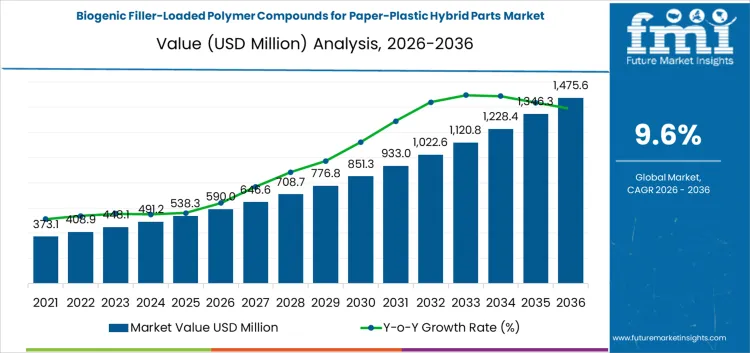
Expansion between 2026 and 2036 follows component-level qualification rather than category-wide replacement. Penetration advances in applications where hybrid compounds reduce material intensity without forcing tooling redesign or part geometry modification. Lightweight structural parts, packaging elements, and interior substrates represent primary integration zones due to tolerance for moderate modulus shifts and surface texture variation. Compound development is governed by engineering constraints involving filler loading ceilings, impact resistance retention, and recyclability under mixed-material recovery streams. Scaling remains limited by processing window stability, pellet consistency, and regional variability in biogenic feedstock characteristics. Growth progression aligns with engineering validation cycles defined by reproducibility, yield stability, and long-term processing reliability rather than accelerated substitution mandates.
Biogenic Filler-Loaded Polymer Compounds for Paper–Plastic Hybrid Parts Market Key Takeaways
| Metric | Value |
|---|---|
| Market Value (2026) | USD 590.0 million |
| Market Forecast Value (2036) | USD 1,475.6 million |
| Forecast CAGR (2026-2036) | 9.6% |
Why is the Demand for Biogenic Filler-Loaded Polymer Compounds for Paper–Plastic Hybrid Parts Market Growing Globally?
Demand for biogenic filler-loaded polymer compounds used in paper–plastic hybrid parts is growing globally due to rising emphasis on sustainable materials, circular economy goals, and regulatory pressure to reduce reliance on virgin plastics. Biogenic fillers derived from plant, agricultural, or forestry by-products such as cellulose, lignin, and starch enhance polymer formulations by improving stiffness, reducing density, and decreasing fossil feedstock content without significantly compromising processing performance. Manufacturers in automotive interiors, consumer goods, packaging, and construction integrate paper–plastic hybrid parts to achieve lightweighting, improved carbon footprint, and cost-effective reinforcement.
Government mandates and industry initiatives in multiple regions restrict single-use plastics and incentivize use of renewable inputs within engineered polymer systems, which increases adoption of filler-integrated compounds. Injection molding, extrusion, and thermoforming operations benefit from tailored material solutions that maintain mechanical integrity and surface appearance in hybrid components. Advances in compounding technology improve filler dispersion, interfacial adhesion, and consistency across production batches. Brands and OEMs pursue sustainable material claims and supply chain traceability, reinforcing demand for compounds that align with environmental compliance and performance requirements. Growth in bio-based material standards, green procurement policies, and consumer preference for eco-aligned products supports ongoing uptake of biogenic filler-loaded polymer compounds in global hybrid parts markets.
How Is the Global Biogenic Filler-Loaded Polymer Compounds for Paper–Plastic Hybrid Parts Market Structured?
Global demand for biogenic filler-loaded polymer compounds for paper–plastic hybrid parts is driven by material substitution strategies aimed at reducing fossil-based polymer content while maintaining functional performance. These compounds integrate renewable fillers into thermoplastic matrices to improve stiffness, surface texture, and sustainability credentials. Adoption is supported by regulatory pressure on plastic reduction, corporate material circularity goals, and growing acceptance of hybrid materials in structural and semi-structural applications. Compound developers focus on balancing filler dispersion, mechanical integrity, and processability to enable compatibility with conventional molding and extrusion platforms.
Which Compound Type Holds the Largest Share of Global Demand?
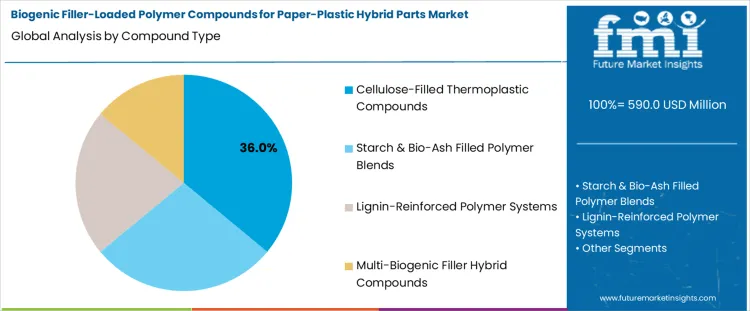
Cellulose-filled thermoplastic compounds account for the largest share at 36.0%, reflecting their strong balance between renewable content, mechanical reinforcement, and processing familiarity. Cellulose fillers provide predictable rheology, improved stiffness, and enhanced surface feel, making them suitable for a wide range of hybrid parts. Starch and bio-ash filled polymer blends represent 28.0% of demand, driven by cost-sensitive applications and interest in utilizing agricultural byproducts for material circularity. Lignin-reinforced polymer systems hold 22.0%, supported by increased availability of lignin from bio-refineries and its contribution to UV resistance and rigidity. Multi-biogenic filler hybrid compounds account for 14.0%, used in advanced formulations seeking combined performance benefits from multiple renewable sources.
Key Points
- Cellulose-filled compounds lead due to balanced performance and scalability
- Starch and bio-ash blends support cost and residue utilization objectives
- Lignin systems expand use of bio-refinery byproducts
Which Biogenic Filler Source Dominates Material Selection Globally?
Wood and pulp-derived cellulose represents the dominant filler source at 38.0%, supported by consistent quality, established supply chains, and compatibility with thermoplastic processing. These fillers offer reliable fiber morphology and moisture control, enabling repeatable compound performance. Agricultural residue-based fillers account for 30.0%, reflecting growing interest in valorizing crop byproducts such as husks and straw while reducing raw material waste. Lignin and bio-refinery byproducts hold 20.0%, driven by sustainability positioning and functional benefits such as color stability and thermal performance. Algae and novel bio-fillers represent 12.0%, remaining at an exploratory stage due to variability in supply and higher processing complexity.
Key Points
- Cellulose dominates due to supply stability and processing consistency
- Agricultural residues support waste valorization strategies
- Novel bio-fillers remain limited to specialized formulations
Which Application Segment Generates the Highest Global Demand?
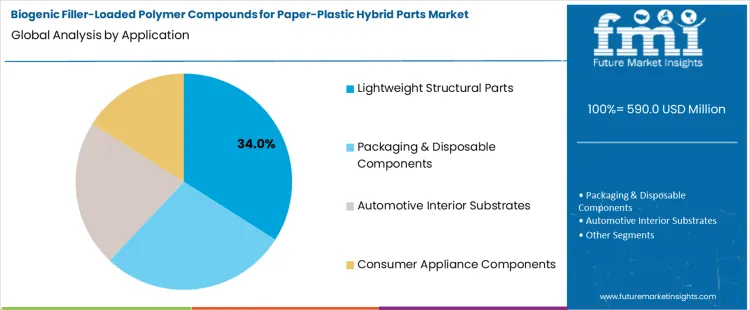
Lightweight structural parts account for 34.0% of global demand, reflecting use in components requiring stiffness, dimensional stability, and reduced material weight. These parts benefit from biogenic fillers that enhance rigidity without significant density increase. Packaging and disposable components represent 28.0%, driven by sustainability targets and regulatory pressure to reduce virgin plastic usage in high-volume items. Automotive interior substrates hold 22.0%, where hybrid compounds provide tactile differentiation and improved sustainability narratives while meeting interior performance requirements. Consumer appliance components account for 16.0%, constrained by durability, heat resistance, and aesthetic consistency requirements.
Key Points
- Lightweight structural parts lead due to performance and weight advantages
- Packaging adoption reflects plastic reduction initiatives
- Automotive interiors balance sustainability and material performance
What are the Key Dynamics in the Biogenic Filler-Loaded Polymer Compounds for Paper–Plastic Hybrid Parts Market?
Global demand rises as manufacturers in automotive, consumer electronics, appliances, and packaging adopt biogenic filler-loaded polymer compounds that integrate renewable particulate fillers such as cellulose, wood flour, and agricultural byproducts with thermoplastic resins. These compounds support paper–plastic hybrid parts that reduce fossil content, improve sustainability profiles, and maintain requisite mechanical performance. Adoption aligns with corporate environmental commitments, regulatory pressure to reduce carbon intensity, and consumer preference for materials with biogenic content across North America, Europe, Asia-Pacific, and Latin America. Usage includes interior components, housings, trim panels, and structural features where hybrid material solutions balance performance and eco-credentials.
How do sustainability mandates and material performance expectations shape adoption?
Original equipment manufacturers and brand owners increasingly specify biogenic filler-loaded compounds to meet renewable content targets, recycled content mandates, and lifecycle assessments that influence procurement decisions. Hybrid parts combining paper fibers with engineered polymers deliver competitive stiffness, impact resistance, and reduced weight compared with neat thermoplastics, supporting fuel efficiency and product durability goals. Material engineers optimize filler loading, dispersion quality, and interface adhesion to achieve mechanical property consistency and dimensional stability required by design specifications. Retail and industrial markets emphasize demonstrable environmental gains without compromising functional performance, reinforcing investment in tailored compound development and validation across applications.
How do cost pressures, processing complexity, and regulatory variation influence market scalability?
Biogenic filler-loaded polymer compounds often involve higher raw material costs and quality control demands relative to commodity polymers, affecting cost competitiveness in price-sensitive segments. Processing hybrid compounds requires equipment capable of managing heterogeneous filler distributions, moisture control, and shear profiles that influence morphology and cycle times, increasing operational complexity. Variability in biogenic filler quality, particle size, and compatibility with polymer matrices necessitates robust formulation and testing protocols to ensure reproducible performance. Regulatory frameworks governing bio-based content claims, carbon accounting, and material labeling differ across regions, shaping compliance and marketing strategies for global distribution. Long-term growth depends on continued innovation in cost-effective, high-performance compound systems and harmonized standards that support validated sustainability claims without compromising part integrity across diverse paper–plastic hybrid applications worldwide.
How Is Demand for Biogenic Filler-Loaded Polymer Compounds for Paper–Plastic Hybrid Parts Evolving Globally?
Demand for biogenic filler-loaded polymer compounds for paper–plastic hybrid parts is increasing globally due to material lightweighting goals, plastic reduction mandates, and need for recyclable hybrid structures. China leads with a 10.1% CAGR, supported by large-scale substitution of conventional plastics in packaging and consumer goods. India follows at 9.8%, driven by cost-sensitive sustainability adoption and regulatory pressure. Germany records 9.6%, reflecting engineering-led integration of bio-fillers into technical components. USA posts a 9.3% CAGR, shaped by brand-led sustainability targets and material innovation. Japan records 9.1%, supported by precision manufacturing and controlled material qualification. Growth reflects shift toward polymer compounds incorporating cellulose, lignin, and mineralized bio-fillers for hybrid part performance.
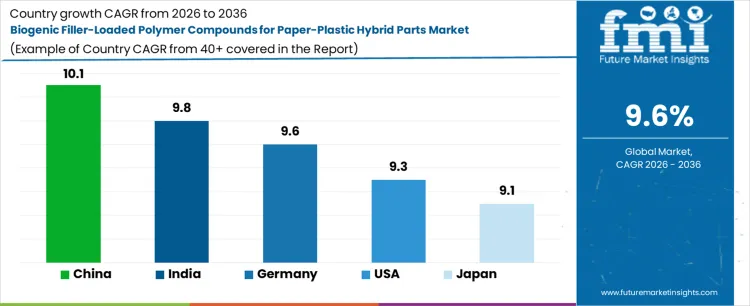
| Country | CAGR (%) |
|---|---|
| China | 10.1% |
| India | 9.8% |
| Germany | 9.6% |
| USA | 9.3% |
| Japan | 9.1% |
What is driving strong adoption of biogenic filler-loaded polymer compounds in China?
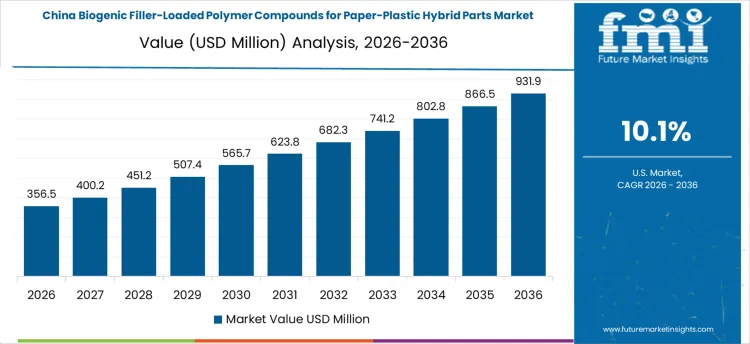
China demand is driven by industrial-scale efforts to reduce virgin plastic usage while maintaining mechanical performance. CAGR of 10.1% reflects increasing use of polymer compounds loaded with cellulose fibers, agricultural residues, and bio-mineral fillers. Manufacturers supplying packaging, consumer electronics, and household goods adopt hybrid compounds compatible with existing molding processes. Regulatory direction on plastic reduction accelerates material substitution. Domestic compounders scale production of bio-filled formulations with controlled dispersion and flow behavior. Equipment compatibility and cost efficiency remain key adoption drivers. Growth remains scale-driven and policy-aligned, supported by manufacturing localization and rapid material transition across multiple end-use sectors.
- Large-scale plastic substitution initiatives
- Use of cellulose and bio-mineral filler systems
- Compatibility with existing molding infrastructure
- Scaling of domestic bio-filled compound production
How is India sustaining growth in biogenic filler-loaded polymer compound usage?
India demand reflects increasing focus on cost-effective sustainability and hybrid material adoption. CAGR of 9.8% is supported by use of biogenic fillers to reduce polymer content while improving stiffness and dimensional stability. Packaging and consumer product manufacturers prioritize affordable formulations compatible with mass production. Government sustainability programs influence material selection. Domestic compounders experiment with locally sourced agricultural fillers to manage costs. Processing simplicity and supply reliability guide adoption. Growth remains manufacturing-led and cost-aligned, supported by gradual replacement of pure plastics with hybrid compound systems.
- Cost-driven sustainability adoption
- Use of locally sourced agricultural fillers
- Focus on stiffness and material reduction
- Gradual transition from pure plastics
What supports Germany’s steady expansion in biogenic filler-loaded polymer compounds?
Germany demand reflects engineering-led sustainability integration and stringent material performance standards. CAGR of 9.6% is supported by adoption of bio-filled polymer compounds in automotive interiors, technical housings, and premium packaging. Manufacturers require predictable rheology, fiber dispersion control, and long-term stability. Regulatory alignment supports validated material transitions. Compounders invest in precision formulation and quality assurance. Collaboration between material developers and OEMs accelerates adoption. Growth remains technology-led and quality-focused, supported by advanced processing standards and lifecycle assessment requirements.
- Engineering-driven material validation
- Adoption in automotive and technical components
- Emphasis on dispersion and performance consistency
- Strong collaboration across material value chain
What factors are shaping demand growth in the USA for biogenic filler-loaded compounds?
USA demand is shaped by corporate sustainability commitments, material innovation programs, and brand-led packaging redesign. CAGR of 9.3% reflects increased use of biogenic fillers in hybrid polymer parts for consumer goods and logistics packaging. Manufacturers seek compounds that balance sustainability claims with mechanical reliability. Compatibility with existing tooling influences adoption speed. Domestic compounders offer application-specific bio-filled formulations. Growth remains brand-led and compliance-focused, aligned with environmental reporting requirements and gradual material substitution strategies.
- Brand-driven sustainability commitments
- Demand for reliable hybrid material performance
- Compatibility with existing tooling
- Expansion of application-specific compound offerings
Why is Japan showing measured growth in biogenic filler-loaded polymer compound adoption?
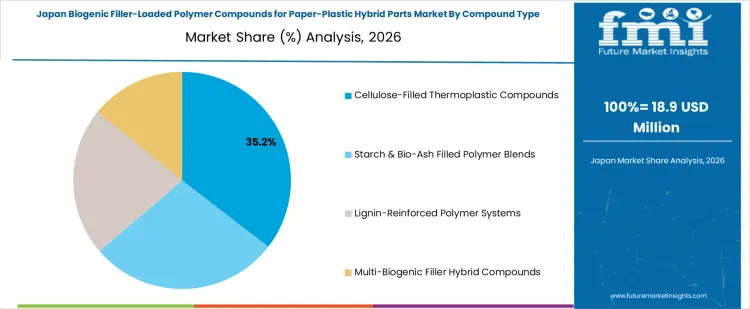
Japan demand reflects cautious material qualification and emphasis on precision manufacturing. CAGR of 9.1% is supported by selective adoption of biogenic filler-loaded compounds in consumer products and lightweight components. Manufacturers prioritize surface finish, dimensional accuracy, and long-term reliability. Material qualification cycles remain stringent. Compound suppliers focus on consistency and controlled filler morphology. Growth remains quality-driven and technology-aligned, supported by disciplined engineering standards and incremental integration of hybrid materials.
- High standards for precision and surface quality
- Controlled and selective material adoption
- Emphasis on consistency and reliability
- Incremental integration of hybrid compounds
What is the competitive landscape of demand for biogenic filler-loaded polymer compounds for paper–plastic hybrid parts globally?
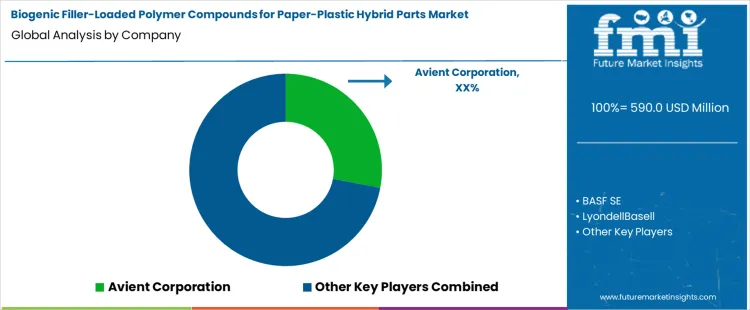
Demand for biogenic filler-loaded polymer compounds for paper–plastic hybrid parts is driven by lightweighting targets, recyclability mandates, and substitution of mineral fillers with renewable content. These compounds are used in packaging, consumer goods, and automotive interior components where stiffness, dimensional stability, and reduced fossil content are required. Buyers evaluate filler dispersion quality, mechanical property retention, moisture sensitivity, processing window, and compatibility with injection molding and extrusion. Procurement teams prioritize suppliers with controlled biogenic filler sourcing, compound consistency, and documentation supporting renewable content claims. Trend in the global market reflects increased adoption of cellulose, lignin, and bio-ash fillers to balance performance with sustainability requirements.
Avient Corporation holds leading positioning through engineered polymer compounds incorporating biogenic fillers tailored for hybrid material applications. BASF SE supplies compound platforms and bio-filled polymer solutions aligned with performance and sustainability objectives. LyondellBasell supports demand with polypropylene and polyethylene compounds modified for fiber and biogenic filler integration. Borealis contributes specialty polyolefin compounds and material development programs focused on renewable and circular materials. Covestro participates through engineering polymer compounds and material innovation supporting hybrid part design. Competitive differentiation depends on filler-polymer compatibility, mechanical performance consistency, processing reliability, and ability to scale bio-filled compounds for industrial production.
Key Players in the Biogenic Filler-Loaded Polymer Compounds for Paper–Plastic Hybrid Parts Market
- Avient Corporation
- BASF SE
- LyondellBasell
- Borealis
- Covestro
Scope of the Report
| Items | Values |
|---|---|
| Quantitative Units | USD million |
| Compound Type | Cellulose-Filled Thermoplastic Compounds; Starch & Bio-Ash Filled Polymer Blends; Lignin-Reinforced Polymer Systems; Multi-Biogenic Filler Hybrid Compounds |
| Biogenic Filler Source | Wood & Pulp-Derived Cellulose; Agricultural Residue-Based Fillers; Lignin & Bio-Refinery Byproducts; Algae & Novel Bio-Fillers |
| Application | Lightweight Structural Parts; Packaging & Disposable Components; Automotive Interior Substrates; Consumer Appliance Components |
| Regions Covered | Asia Pacific, Europe, North America, Latin America, Middle East & Africa |
| Countries Covered | China, India, Germany, USA, Japan, and 40+ countries |
| Key Companies Profiled | Avient Corporation; BASF SE; LyondellBasell; Borealis; Covestro |
| Additional Attributes | Dollar sales by compound type and biogenic filler source; adoption trends for filler-loaded polymer compounds enabling paper–plastic hybrid part lightweighting; mechanical performance, stiffness-to-weight ratio, and impact resistance metrics; compatibility with injection molding and thermoforming processes; filler dispersion, moisture sensitivity, and recyclability considerations; compliance with sustainability, bio-content disclosure, and materials safety standards influencing compound selection. |
Biogenic Filler-Loaded Polymer Compounds for Paper–Plastic Hybrid Parts Market by Segment
Compound Type:
- Cellulose-Filled Thermoplastic Compounds
- Starch & Bio-Ash Filled Polymer Blends
- Lignin-Reinforced Polymer Systems
- Multi-Biogenic Filler Hybrid Compounds
Biogenic Filler Source:
- Wood & Pulp-Derived Cellulose
- Agricultural Residue-Based Fillers
- Lignin & Bio-Refinery Byproducts
- Algae & Novel Bio-Fillers
Application:
- Lightweight Structural Parts
- Packaging & Disposable Components
- Automotive Interior Substrates
- Consumer Appliance Components
Region:
- Asia Pacific
- China
- Japan
- South Korea
- India
- Australia & New Zealand
- ASEAN
- Rest of Asia Pacific
- Europe
- Germany
- United Kingdom
- France
- Italy
- Spain
- Nordic
- BENELUX
- Rest of Europe
- North America
- United States
- Canada
- Mexico
- Latin America
- Brazil
- Chile
- Rest of Latin America
- Middle East & Africa
- Kingdom of Saudi Arabia
- Other GCC Countries
- Turkey
- South Africa
- Other African Union
- Rest of Middle East & Africa
Frequently Asked Questions
How big is the biogenic filler-loaded polymer compounds for paper-plastic hybrid parts market in 2026?
The global biogenic filler-loaded polymer compounds for paper-plastic hybrid parts market is estimated to be valued at USD 590.0 million in 2026.
What will be the size of biogenic filler-loaded polymer compounds for paper-plastic hybrid parts market in 2036?
The market size for the biogenic filler-loaded polymer compounds for paper-plastic hybrid parts market is projected to reach USD 1,475.6 million by 2036.
How much will be the biogenic filler-loaded polymer compounds for paper-plastic hybrid parts market growth between 2026 and 2036?
The biogenic filler-loaded polymer compounds for paper-plastic hybrid parts market is expected to grow at a 9.6% CAGR between 2026 and 2036.
What are the key compound types in the biogenic filler-loaded polymer compounds for paper-plastic hybrid parts market?
The key compound types in biogenic filler-loaded polymer compounds for paper-plastic hybrid parts market are cellulose-filled thermoplastic compounds, starch & bio-ash-filled polymer blends, lignin-reinforced polymer systems and multi-biogenic filler hybrid compounds.
Which compound type segment will contribute significant share in the biogenic filler-loaded polymer compounds for paper-plastic hybrid parts market in 2026?
In terms of compound type, cellulose-filled thermoplastic compounds segment to command 36.0% share in the biogenic filler-loaded polymer compounds for paper-plastic hybrid parts market in 2026.
Preview the report firsthand - request a free sample
Get SampleGet the brochure for pricing and purchase details.
Get PDFTable of Content
- Executive Summary
- Global Market Outlook
- Demand-side Trends
- Supply-side Trends
- Technology Roadmap Analysis
- Analysis and Recommendations
- Market Overview
- Market Coverage / Taxonomy
- Market Definition / Scope / Limitations
- Market Background
- Market Dynamics
- Drivers
- Restraints
- Opportunity
- Trends
- Scenario Forecast
- Demand in Optimistic Scenario
- Demand in Likely Scenario
- Demand in Conservative Scenario
- Opportunity Map Analysis
- Product Life Cycle Analysis
- Supply Chain Analysis
- Investment Feasibility Matrix
- Value Chain Analysis
- PESTLE and Porter’s Analysis
- Regulatory Landscape
- Regional Parent Market Outlook
- Production and Consumption Statistics
- Import and Export Statistics
- Market Dynamics
- Global Market Analysis 2021 to 2025 and Forecast, 2026 to 2036
- Historical Market Size Value (USD Million) Analysis, 2021 to 2025
- Current and Future Market Size Value (USD Million) Projections, 2026 to 2036
- Y-o-Y Growth Trend Analysis
- Absolute $ Opportunity Analysis
- Global Market Pricing Analysis 2021 to 2025 and Forecast 2026 to 2036
- Global Market Analysis 2021 to 2025 and Forecast 2026 to 2036, By Compound Type
- Introduction / Key Findings
- Historical Market Size Value (USD Million) Analysis By Compound Type , 2021 to 2025
- Current and Future Market Size Value (USD Million) Analysis and Forecast By Compound Type , 2026 to 2036
- Cellulose-Filled Thermoplastic Compounds
- Starch & Bio-Ash Filled Polymer Blends
- Lignin-Reinforced Polymer Systems
- Multi-Biogenic Filler Hybrid Compounds
- Cellulose-Filled Thermoplastic Compounds
- Y-o-Y Growth Trend Analysis By Compound Type , 2021 to 2025
- Absolute $ Opportunity Analysis By Compound Type , 2026 to 2036
- Global Market Analysis 2021 to 2025 and Forecast 2026 to 2036, By Biogenic Filler Source
- Introduction / Key Findings
- Historical Market Size Value (USD Million) Analysis By Biogenic Filler Source, 2021 to 2025
- Current and Future Market Size Value (USD Million) Analysis and Forecast By Biogenic Filler Source, 2026 to 2036
- Wood & Pulp-Derived Cellulose
- Agricultural Residue-Based Fillers
- Lignin & Bio-Refinery Byproducts
- Algae & Novel Bio-Fillers
- Wood & Pulp-Derived Cellulose
- Y-o-Y Growth Trend Analysis By Biogenic Filler Source, 2021 to 2025
- Absolute $ Opportunity Analysis By Biogenic Filler Source, 2026 to 2036
- Global Market Analysis 2021 to 2025 and Forecast 2026 to 2036, By Application
- Introduction / Key Findings
- Historical Market Size Value (USD Million) Analysis By Application, 2021 to 2025
- Current and Future Market Size Value (USD Million) Analysis and Forecast By Application, 2026 to 2036
- Lightweight Structural Parts
- Packaging & Disposable Components
- Automotive Interior Substrates
- Consumer Appliance Components
- Lightweight Structural Parts
- Y-o-Y Growth Trend Analysis By Application, 2021 to 2025
- Absolute $ Opportunity Analysis By Application, 2026 to 2036
- Global Market Analysis 2021 to 2025 and Forecast 2026 to 2036, By Region
- Introduction
- Historical Market Size Value (USD Million) Analysis By Region, 2021 to 2025
- Current Market Size Value (USD Million) Analysis and Forecast By Region, 2026 to 2036
- North America
- Latin America
- Western Europe
- Eastern Europe
- East Asia
- South Asia and Pacific
- Middle East & Africa
- Market Attractiveness Analysis By Region
- North America Market Analysis 2021 to 2025 and Forecast 2026 to 2036, By Country
- Historical Market Size Value (USD Million) Trend Analysis By Market Taxonomy, 2021 to 2025
- Market Size Value (USD Million) Forecast By Market Taxonomy, 2026 to 2036
- By Country
- USA
- Canada
- Mexico
- By Compound Type
- By Biogenic Filler Source
- By Application
- By Country
- Market Attractiveness Analysis
- By Country
- By Compound Type
- By Biogenic Filler Source
- By Application
- Key Takeaways
- Latin America Market Analysis 2021 to 2025 and Forecast 2026 to 2036, By Country
- Historical Market Size Value (USD Million) Trend Analysis By Market Taxonomy, 2021 to 2025
- Market Size Value (USD Million) Forecast By Market Taxonomy, 2026 to 2036
- By Country
- Brazil
- Chile
- Rest of Latin America
- By Compound Type
- By Biogenic Filler Source
- By Application
- By Country
- Market Attractiveness Analysis
- By Country
- By Compound Type
- By Biogenic Filler Source
- By Application
- Key Takeaways
- Western Europe Market Analysis 2021 to 2025 and Forecast 2026 to 2036, By Country
- Historical Market Size Value (USD Million) Trend Analysis By Market Taxonomy, 2021 to 2025
- Market Size Value (USD Million) Forecast By Market Taxonomy, 2026 to 2036
- By Country
- Germany
- UK
- Italy
- Spain
- France
- Nordic
- BENELUX
- Rest of Western Europe
- By Compound Type
- By Biogenic Filler Source
- By Application
- By Country
- Market Attractiveness Analysis
- By Country
- By Compound Type
- By Biogenic Filler Source
- By Application
- Key Takeaways
- Eastern Europe Market Analysis 2021 to 2025 and Forecast 2026 to 2036, By Country
- Historical Market Size Value (USD Million) Trend Analysis By Market Taxonomy, 2021 to 2025
- Market Size Value (USD Million) Forecast By Market Taxonomy, 2026 to 2036
- By Country
- Russia
- Poland
- Hungary
- Balkan & Baltic
- Rest of Eastern Europe
- By Compound Type
- By Biogenic Filler Source
- By Application
- By Country
- Market Attractiveness Analysis
- By Country
- By Compound Type
- By Biogenic Filler Source
- By Application
- Key Takeaways
- East Asia Market Analysis 2021 to 2025 and Forecast 2026 to 2036, By Country
- Historical Market Size Value (USD Million) Trend Analysis By Market Taxonomy, 2021 to 2025
- Market Size Value (USD Million) Forecast By Market Taxonomy, 2026 to 2036
- By Country
- China
- Japan
- South Korea
- By Compound Type
- By Biogenic Filler Source
- By Application
- By Country
- Market Attractiveness Analysis
- By Country
- By Compound Type
- By Biogenic Filler Source
- By Application
- Key Takeaways
- South Asia and Pacific Market Analysis 2021 to 2025 and Forecast 2026 to 2036, By Country
- Historical Market Size Value (USD Million) Trend Analysis By Market Taxonomy, 2021 to 2025
- Market Size Value (USD Million) Forecast By Market Taxonomy, 2026 to 2036
- By Country
- India
- ASEAN
- Australia & New Zealand
- Rest of South Asia and Pacific
- By Compound Type
- By Biogenic Filler Source
- By Application
- By Country
- Market Attractiveness Analysis
- By Country
- By Compound Type
- By Biogenic Filler Source
- By Application
- Key Takeaways
- Middle East & Africa Market Analysis 2021 to 2025 and Forecast 2026 to 2036, By Country
- Historical Market Size Value (USD Million) Trend Analysis By Market Taxonomy, 2021 to 2025
- Market Size Value (USD Million) Forecast By Market Taxonomy, 2026 to 2036
- By Country
- Kingdom of Saudi Arabia
- Other GCC Countries
- Turkiye
- South Africa
- Other African Union
- Rest of Middle East & Africa
- By Compound Type
- By Biogenic Filler Source
- By Application
- By Country
- Market Attractiveness Analysis
- By Country
- By Compound Type
- By Biogenic Filler Source
- By Application
- Key Takeaways
- Key Countries Market Analysis
- USA
- Pricing Analysis
- Market Share Analysis, 2025
- By Compound Type
- By Biogenic Filler Source
- By Application
- Canada
- Pricing Analysis
- Market Share Analysis, 2025
- By Compound Type
- By Biogenic Filler Source
- By Application
- Mexico
- Pricing Analysis
- Market Share Analysis, 2025
- By Compound Type
- By Biogenic Filler Source
- By Application
- Brazil
- Pricing Analysis
- Market Share Analysis, 2025
- By Compound Type
- By Biogenic Filler Source
- By Application
- Chile
- Pricing Analysis
- Market Share Analysis, 2025
- By Compound Type
- By Biogenic Filler Source
- By Application
- Germany
- Pricing Analysis
- Market Share Analysis, 2025
- By Compound Type
- By Biogenic Filler Source
- By Application
- UK
- Pricing Analysis
- Market Share Analysis, 2025
- By Compound Type
- By Biogenic Filler Source
- By Application
- Italy
- Pricing Analysis
- Market Share Analysis, 2025
- By Compound Type
- By Biogenic Filler Source
- By Application
- Spain
- Pricing Analysis
- Market Share Analysis, 2025
- By Compound Type
- By Biogenic Filler Source
- By Application
- France
- Pricing Analysis
- Market Share Analysis, 2025
- By Compound Type
- By Biogenic Filler Source
- By Application
- India
- Pricing Analysis
- Market Share Analysis, 2025
- By Compound Type
- By Biogenic Filler Source
- By Application
- ASEAN
- Pricing Analysis
- Market Share Analysis, 2025
- By Compound Type
- By Biogenic Filler Source
- By Application
- Australia & New Zealand
- Pricing Analysis
- Market Share Analysis, 2025
- By Compound Type
- By Biogenic Filler Source
- By Application
- China
- Pricing Analysis
- Market Share Analysis, 2025
- By Compound Type
- By Biogenic Filler Source
- By Application
- Japan
- Pricing Analysis
- Market Share Analysis, 2025
- By Compound Type
- By Biogenic Filler Source
- By Application
- South Korea
- Pricing Analysis
- Market Share Analysis, 2025
- By Compound Type
- By Biogenic Filler Source
- By Application
- Russia
- Pricing Analysis
- Market Share Analysis, 2025
- By Compound Type
- By Biogenic Filler Source
- By Application
- Poland
- Pricing Analysis
- Market Share Analysis, 2025
- By Compound Type
- By Biogenic Filler Source
- By Application
- Hungary
- Pricing Analysis
- Market Share Analysis, 2025
- By Compound Type
- By Biogenic Filler Source
- By Application
- Kingdom of Saudi Arabia
- Pricing Analysis
- Market Share Analysis, 2025
- By Compound Type
- By Biogenic Filler Source
- By Application
- Turkiye
- Pricing Analysis
- Market Share Analysis, 2025
- By Compound Type
- By Biogenic Filler Source
- By Application
- South Africa
- Pricing Analysis
- Market Share Analysis, 2025
- By Compound Type
- By Biogenic Filler Source
- By Application
- USA
- Market Structure Analysis
- Competition Dashboard
- Competition Benchmarking
- Market Share Analysis of Top Players
- By Regional
- By Compound Type
- By Biogenic Filler Source
- By Application
- Competition Analysis
- Competition Deep Dive
- Avient Corporation
- Overview
- Product Portfolio
- Profitability by Market Segments (Product/Age /Sales Channel/Region)
- Sales Footprint
- Strategy Overview
- Marketing Strategy
- Product Strategy
- Channel Strategy
- BASF SE
- LyondellBasell
- Borealis
- Covestro
- Avient Corporation
- Competition Deep Dive
- Assumptions & Acronyms Used
- Research Methodology


