

- Industry Size (2026)
- USD 922.3 Mn
- Forecast (2036)
- USD 2085.3 Mn
- CAGR (2026 to 2036)
- 8.50%
Depolymerization Catalysts Market Forecast and Outlook 2026 to 2036
The depolymerization catalysts market is anticipated to grow from USD 922.3 million in 2026 to USD 2,085.3 million by 2036, advancing at a CAGR of 8.50%. Value creation in this market is shaped less by catalyst sales volume and more by where catalysts sit within the chemical recycling cost stack. Depolymerization catalysts represent a relatively small share of total project capex, yet they exert disproportionate influence over conversion efficiency, energy consumption, and monomer purity factors that directly affect operating margins. Pricing power is therefore concentrated among suppliers whose catalysts deliver longer lifetimes, lower deactivation rates, and consistent performance across variable waste streams.
Early-stage recyclers often accept premium catalyst pricing to de-risk scale-up and secure stable output quality, reinforcing margin concentration at the technology-proven end of the supplier base. As projects move from pilot to commercial scale, cost scrutiny increases, but switching barriers remain high due to process integration and qualification requirements. Between 2026 and 2036, value capture is expected to favor catalyst providers embedded in proprietary depolymerization platforms rather than commodity catalyst suppliers competing on price alone.
Quick Stats for Depolymerization Catalysts Market
- Depolymerization Catalysts Market Value (2026): USD 922.3 Million
- Depolymerization Catalysts Market Forecast Value (2036): USD 2,085.3 Million
- Depolymerization Catalysts Market Forecast CAGR 2026 to 2036: 8.50%
- Leading Catalyst Type in Depolymerization Catalysts Market: Metal-Based Catalysts (38% share)
- Key Growth Regions in Depolymerization Catalysts Market: Asia Pacific, Europe, North America, Latin America, Middle East & Africa
- Top Key Players in Depolymerization Catalysts Market: Clariant AG, BASF SE, Johnson Matthey, Evonik Industries AG, Mitsubishi Chemical Group, SK Geo Centric, Indorama Ventures, Eastman Chemical Company, Loop Industries, Ineos Styrolution
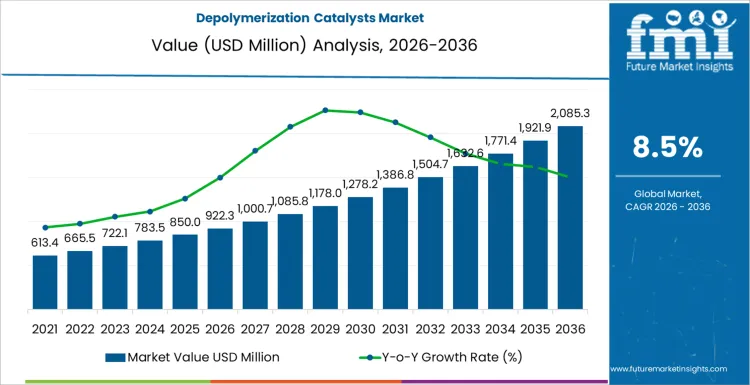
Depolymerization Catalysts Market Key Takeaways
| Metric | Value |
|---|---|
| Depolymerization Catalysts Market Value (2026) | USD 922.3 Million |
| Depolymerization Catalysts Market Forecast Value (2036) | USD 2,085.3 Million |
| Depolymerization Catalysts Market Forecast CAGR 2026 to 2036 | 8.50% |
How Is Advanced Chemical Recycling Infrastructure Driving Demand for Depolymerization Catalysts?
The depolymerization catalysts market is expanding rapidly as chemical recycling technologies move from pilot scale toward commercial deployment. Mechanical recycling faces limitations with mixed, contaminated, or multilayer plastic waste, creating a strong need for catalytic systems that can selectively break polymer chains back into monomers or valuable intermediates. Depolymerization catalysts enable controlled cleavage reactions in processes such as glycolysis, methanolysis, hydrolysis, and hydrogenolysis, supporting higher recovery yields and improved product purity. As brand owners and polymer producers invest in circular feedstock solutions, catalyst-enabled depolymerization is becoming a central pathway for closing material loops.
Catalyst efficiency, selectivity, and durability are key parameters influencing technology adoption. End users assess depolymerization catalysts based on conversion rates, resistance to deactivation by additives or contaminants, and compatibility with different polymer streams, including PET, polyamides, polyurethanes, and polyolefins. Homogeneous and heterogeneous catalyst systems are being engineered to operate at lower temperatures and pressures, reducing energy intensity and operating costs. The ability to tune catalysts for specific polymer chemistries and reaction pathways is allowing recyclers to optimize throughput while maintaining consistent output quality.
Policy alignment and downstream demand for recycled monomers are further accelerating market growth. Regulatory mandates for recycled content, extended producer responsibility frameworks, and sustainability targets are pushing investments in chemical recycling infrastructure worldwide. At the same time, polymer manufacturers are seeking drop-in recycled monomers that meet virgin-equivalent specifications for use in packaging, textiles, and engineering plastics. For catalyst suppliers, competitive advantage increasingly depends on process integration know-how, long catalyst lifetimes, and collaborative development with recyclers and resin producers positioning depolymerization catalysts as a foundational enabler of scalable chemical recycling ecosystems.
How is the Depolymerization Catalysts Market Segmented by Feedstock and Catalyst Technology?
The depolymerization catalysts market is organized by polymer feedstock and catalyst technology, reflecting how polymer chemistry and reaction mechanisms shape catalyst demand. PET and polyester streams form the largest feedstock segment, as their chemical structure allows efficient catalytic breakdown into reusable intermediates. Other feedstocks include polyurethanes, mixed plastics and polyolefin streams, and additional polymers that require specialized catalytic approaches. From a technology perspective, metal-based catalysts are most widely used, supported by organocatalysts, enzymatic systems, and other emerging catalyst concepts developed to address feedstock diversity and process efficiency.
What Makes PET and Polyester Streams the Primary Feedstock in the Depolymerization Catalysts Market?
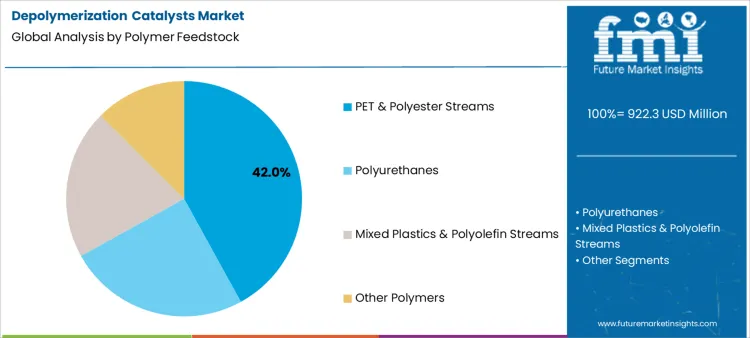
PET and polyester streams represent 42% share of the depolymerization catalysts market because their ester linkages are highly responsive to catalytic cleavage routes such as glycolysis, methanolysis, and hydrolysis. These polymers are manufactured in large volumes for packaging, textile fibers, and industrial components, ensuring steady and predictable feedstock availability. Process operators benefit from uniform chemical structure, which delivers stable reaction kinetics and high monomer recovery yields. Existing industrial plants, reactors, and downstream purification systems are already optimized for polyester depolymerization, reducing operational risk. This combination of abundant feedstock supply, established processing infrastructure, and reliable recovery efficiency explains why PET and polyester streams remain the dominant feedstock choice.
Why are Metal-Based Catalysts Preferred Across Depolymerization Processes?
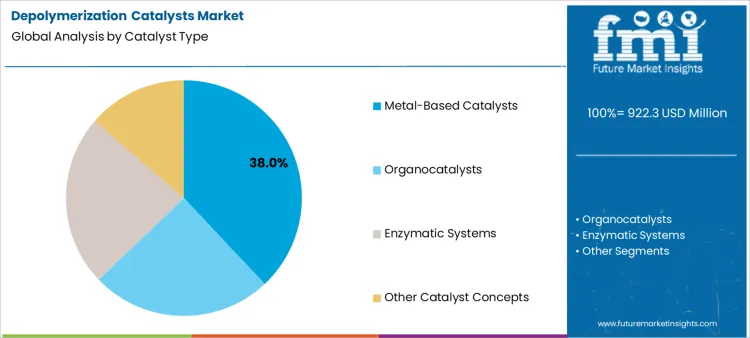
Metal-based catalysts account for 38% share of the depolymerization catalysts market because they provide high catalytic activity and thermal stability under demanding industrial conditions. These catalysts accelerate polymer chain scission, enabling faster reaction rates and higher throughput compared with alternative systems. Producers favor metal-based catalysts for their compatibility with existing reactor designs and ability to handle fluctuations in feedstock composition. Their robustness supports continuous processing without frequent catalyst replacement. Regeneration and reuse capabilities further improve cost efficiency in large-scale operations. These advantages in reaction efficiency, durability, and scalability explain why metal-based catalysts remain the preferred option across most depolymerization processes.
What are the Key Dynamics of the Depolymerization Catalysts Market?
The depolymerization catalysts market is driven by growing demand for chemical recycling technologies that convert plastic and polymer waste back into monomers, fuels, or value-added chemicals. Depolymerization catalysts enable controlled breakdown of polymers such as PET, polyamides, polyolefins, and polyurethanes under thermal, catalytic, or solvent-based processes. Rising pressure to reduce plastic waste, improve material circularity, and recover high-purity feedstocks is accelerating adoption across recycling, petrochemical, and specialty chemical sectors. For catalyst manufacturers and technology providers, catalytic efficiency, selectivity, thermal stability, and compatibility with mixed or contaminated waste streams are key factors influencing commercialization and long-term deployment.
How Do Application Trends and Industry Requirements Shape This Market?
Application trends and industry requirements are shaping the depolymerization catalysts market as stakeholders seek scalable and economically viable recycling solutions. In PET and polyester recycling, catalysts must enable high monomer recovery yields while maintaining product purity suitable for food-grade or engineering applications. For polyolefin and mixed plastic waste, catalysts are increasingly designed to support chemical feedstock recycling pathways that integrate with existing refinery and petrochemical infrastructure. Industrial users require catalysts that operate under moderate conditions, reduce energy consumption, and tolerate additives, dyes, and fillers present in post-consumer waste. Technology developers that tailor catalyst systems to specific polymer types and process routes improve operational reliability and adoption confidence.
Why Do Technical Complexity and Economic Constraints Restrain Market Growth?
Technical complexity and economic constraints restrain growth in the depolymerization catalysts market, particularly during scale-up from pilot to commercial operations. Catalyst deactivation due to impurities, coke formation, or thermal degradation increases replacement frequency and operating costs. Achieving consistent performance across heterogeneous waste streams remains challenging, requiring precise control of reaction conditions and feedstock preprocessing. High capital expenditure for depolymerization facilities, combined with uncertain feedstock availability and fluctuating virgin polymer prices, impacts project viability. Lengthy validation cycles and regulatory approvals further slow adoption, especially for recycled outputs intended for food contact or high-performance applications.
How is the Depolymerization Catalysts Market Growing across Key Countries?
The depolymerization catalysts market is expanding rapidly as chemical producers, recyclers, and material manufacturers focus on converting plastic and polymer waste back into usable monomers, fuels, or chemical intermediates. These catalysts are essential in thermal, catalytic, and chemical depolymerization processes, enabling higher conversion efficiency, selectivity, and process control. Country-wise growth varies based on scale of polymer waste generation, investment in advanced recycling infrastructure, and adoption of chemical recycling technologies. High-growth markets are driven by large plastic consumption bases and rapid capacity additions, while mature regions emphasize catalyst efficiency, process economics, and integration with existing chemical plants.
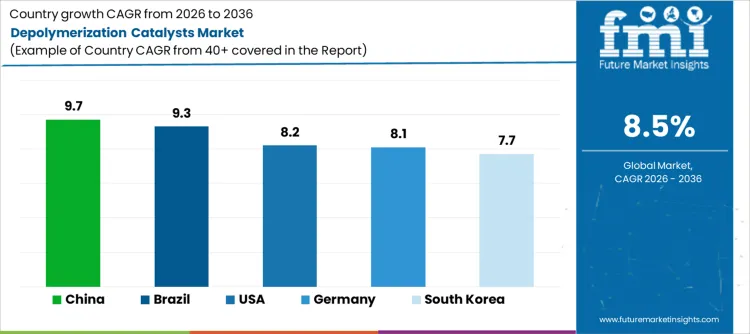
| Country | CAGR (%) |
|---|---|
| China | 9.7 |
| Brazil | 9.3 |
| United States | 8.2 |
| Germany | 8.1 |
| South Korea | 7.7 |
Why is China Leading the Depolymerization Catalysts Market?
Demand for depolymerization catalysts in China is expanding at a CAGR of 9.7% during 2026 to 2036, driven by the country’s large polymer production base and growing deployment of chemical recycling technologies. As plastic waste volumes increase, chemical companies and recyclers are investing in depolymerization routes to recover monomers from PET, polyolefins, and engineering plastics. Catalysts play a central role in improving conversion rates, lowering reaction temperatures, and enhancing product selectivity. Chinese operators prioritize catalysts that deliver high activity, long operational life, and tolerance to mixed or contaminated feedstocks. Domestic catalyst manufacturers benefit from strong integration with petrochemical complexes and the ability to scale production rapidly. Pilot projects are increasingly transitioning into commercial-scale operations, accelerating catalyst consumption. Procurement decisions emphasize cost-performance balance, supply reliability, and adaptability to different polymer streams.
Why is Brazil Emerging as a High-Growth Market for Depolymerization Catalysts?
Sale of depolymerization catalysts in Brazil is growing at a CAGR of 9.3% during 2026 to 2036, supported by rising interest in chemical recycling and growing availability of post-consumer plastic waste. As mechanical recycling reaches its technical limits for certain polymer streams, depolymerization processes are being evaluated to improve material recovery and reduce landfill dependency. Brazilian operators value catalysts that perform effectively under variable feedstock quality and deliver stable yields across different polymer types. Adoption is concentrated in pilot and early commercial facilities linked to petrochemical producers and waste management companies. Cost efficiency and process robustness are key decision factors. Procurement decisions often favor suppliers offering technical process support and catalysts adaptable to evolving depolymerization technologies. Market growth is supported by gradual scale-up of chemical recycling projects and increasing participation of Brazil’s petrochemical sector in advanced polymer recovery initiatives.
What is Driving Demand for Depolymerization Catalysts in the United States?
The United States depolymerization catalysts market is expanding at a CAGR of 8.2% during 2026 to 2036, driven by strong investment in chemical recycling infrastructure and advanced polymer recovery technologies. Depolymerization catalysts are widely used in processes targeting PET, polystyrene, polyamides, and mixed plastic waste streams. USA. operators emphasize catalyst selectivity, stability, and compatibility with continuous processing systems. Demand is strongest from integrated chemical companies and technology developers scaling commercial depolymerization plants. Catalysts that enable lower energy consumption and higher monomer purity are increasingly preferred. Procurement decisions prioritize long-term catalyst performance, technical validation, and supplier collaboration. Market growth is reinforced by increasing commercialization of depolymerization technologies and growing demand for recycled feedstocks in chemical manufacturing.
How is Germany Supporting Growth in the Depolymerization Catalysts Market?
Demand for depolymerization catalysts in Germany is growing at a CAGR of 8.1% during 2026 to 2036, supported by advanced chemical recycling initiatives and strong engineering expertise in catalytic processes. German companies focus on optimizing depolymerization efficiency, product purity, and process integration within existing chemical plants. Catalysts are selected for their precision, reproducibility, and long operational lifetimes. Adoption is driven by performance optimization rather than rapid capacity expansion. German operators place strong emphasis on process control and material traceability. Procurement decisions favor suppliers with proven catalytic technologies, detailed performance data, and the ability to support customized reactor designs. Market growth is reinforced by Germany’s leadership in chemical engineering and continuous development of advanced recycling solutions.
How is South Korea Expanding Use of Depolymerization Catalysts?
Sale of depolymerization catalysts in South Korea is expanding at a CAGR of 7.7% during 2026 to 2036, driven by increasing investment in advanced polymer recycling and integration with petrochemical manufacturing. Depolymerization catalysts are increasingly used to process engineering plastics and multilayer polymer waste streams that are difficult to recycle mechanically. South Korean operators emphasize catalyst efficiency, consistency, and compatibility with high-throughput processing. Adoption is strongest in export-oriented chemical companies aiming to incorporate recovered monomers into existing production lines. Procurement decisions are influenced by supplier technical capability, catalyst longevity, and alignment with industrial process requirements. Market growth is supported by steady expansion of chemical recycling capacity and continued demand for high-quality recycled polymer intermediates.
How are Companies Competing in the Depolymerization Catalysts Market?
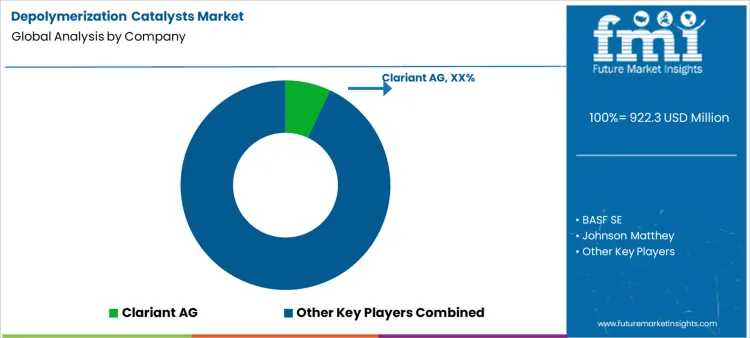
Competition in the depolymerization catalysts market is defined by catalytic efficiency, selectivity for targeted polymer streams, and integration with commercial chemical recycling processes that matter to recyclers, polymer manufacturers, and brand owners. As depolymerization gains traction for converting end-of-life plastics into monomers or value-added feedstocks, suppliers are differentiating through tailored catalyst formulations that deliver high conversion rates, minimal side reactions, and robust performance under industrial conditions.
Major specialty chemical producers leverage deep catalysis expertise to optimize performance in diverse depolymerization chemistries. Clariant AG positions its catalyst portfolios with documentation highlighting tunable active sites and enhanced selectivity for targeted polymer backbones, supporting glycolysis, methanolysis, and hydrolysis routes. BASF SE competes by integrating depolymerization catalysts with broader recycling technology frameworks, emphasizing catalyst stability and lifetime under repetitive thermal and chemical cycles.
Established catalysis and materials science leaders extend competitive depth. Johnson Matthey offers engineered catalysts optimized for controlled breakdown of polyesters and polyamides, with product materials highlighting active phase dispersion and resistance to deactivation. Evonik Industries AG and Mitsubishi Chemical Group differentiate through high-precision catalysts designed for depolymerization pathways that align with downstream purification and monomer recovery.
Strategic joint ventures and recycling integrators blur traditional supplier roles by pairing catalyst technology with full depolymerization systems. SK Geo Centric and related partnerships emphasize integrated catalyst development within commercial recycling plants. Indorama Ventures leverages recycling partnerships to optimize catalyst selection for specific waste streams. Eastman Chemical Company, Loop Industries, and collaborations involving Ineos Styrolution focus on catalyst-centric depolymerization processes for PET, polystyrene, and other polymers. Across the market, competitive advantage is defined by catalyst performance, process integration, and pathway efficiency rather than material cost alone.
Key Players in Depolymerization Catalysts Market
- Clariant AG
- BASF SE
- Johnson Matthey
- Evonik Industries AG
- Mitsubishi Chemical Group
- SK Geo Centric / Advanced Recycling JVs
- Indorama Ventures (recycling partnerships)
- Eastman Chemical Company
- Loop Industries (catalyst-based processes)
- Ineos Styrolution (chemical recycling collaborations)
Scope of Report
| Attribute | Details |
|---|---|
| Market Size Unit | USD Million |
| Polymer Feedstock Covered | PET & Polyester Streams, Polyurethanes, Mixed Plastics & Polyolefin Streams, Other Polymers |
| Catalyst Type Covered | Metal-Based Catalysts, Organocatalysts, Enzymatic Systems, Other Catalyst Concepts |
| Countries Covered | China, Japan, South Korea, India, Australia & New Zealand, ASEAN, Rest of Asia Pacific, Germany, United Kingdom, France, Italy, Spain, Nordic, BENELUX, Rest of Europe, United States, Canada, Mexico, Brazil, Chile, Rest of Latin America, Kingdom of Saudi Arabia, Other GCC Countries, Turkey, South Africa, Other African Union, Rest of Middle East & Africa |
| Regions Covered | Asia Pacific, Europe, North America, Latin America, Middle East & Africa |
| Key Companies Profiled | Clariant AG, BASF SE, Johnson Matthey, Evonik Industries AG, Mitsubishi Chemical Group, SK Geo Centric / Advanced Recycling JVs, Indorama Ventures, Eastman Chemical Company, Loop Industries, Ineos Styrolution |
| Additional Attributes | Dollar sales of depolymerization catalysts are analyzed by polymer feedstock and catalyst technology across chemical recycling and advanced material recovery pathways. The scope evaluates catalyst activity, selectivity, operating temperature and pressure windows, tolerance to mixed or contaminated feedstocks, and recyclate quality outcomes. Country-level analysis reflects regulatory mandates on plastic waste reduction, investment in chemical recycling infrastructure, brand commitments to circular polymers, and the commercialization pace of depolymerization technologies across PET, polyurethane, and mixed plastic streams. |
Depolymerization Catalysts Market by Key Segments
Polymer Feedstock
- PET & Polyester Streams
- Polyurethanes
- Mixed Plastics & Polyolefin Streams
- Other Polymers
Catalyst Type
- Metal-Based Catalysts
- Organocatalysts
- Enzymatic Systems
- Other Catalyst Concepts
Region
- Asia Pacific
- China
- Japan
- South Korea
- India
- Australia & New Zealand
- ASEAN
- Rest of Asia Pacific
- Europe
- Germany
- United Kingdom
- France
- Italy
- Spain
- Nordic
- BENELUX
- Rest of Europe
- North America
- United States
- Canada
- Mexico
- Latin America
- Brazil
- Chile
- Rest of Latin America
- Middle East & Africa
- Kingdom of Saudi Arabia
- Other GCC Countries
- Turkey
- South Africa
- Other African Union
- Rest of Middle East & Africa
Bibliography
- International Energy Agency. (2023). the role of chemical recycling in reducing plastic waste and emissions. IEA.
- United Nations Environment Programme. (2023). turning off the tap: How the world can end plastic pollution and create a circular economy. UNEP.
- USA. Department of Energy. (2023). Advanced polymer recycling technologies for a circular materials economy. Office of Energy Efficiency and Renewable Energy.
- National Renewable Energy Laboratory. (2023). Catalytic depolymerization pathways for plastic waste valorization. NREL.
Frequently Asked Questions
How big is the depolymerization catalysts market in 2026?
The global depolymerization catalysts market is estimated to be valued at USD 922.3 million in 2026.
What will be the size of depolymerization catalysts market in 2036?
The market size for the depolymerization catalysts market is projected to reach USD 2,085.3 million by 2036.
How much will be the depolymerization catalysts market growth between 2026 and 2036?
The depolymerization catalysts market is expected to grow at a 8.5% CAGR between 2026 and 2036.
What are the key product types in the depolymerization catalysts market?
The key product types in depolymerization catalysts market are pet & polyester streams, polyurethanes, mixed plastics & polyolefin streams and other polymers.
Which catalyst type segment to contribute significant share in the depolymerization catalysts market in 2026?
In terms of catalyst type, metal-based catalysts segment to command 38.0% share in the depolymerization catalysts market in 2026.
Preview the report firsthand - request a free sample
Get SampleGet the brochure for pricing and purchase details.
Get PDFTable of Content
- Executive Summary
- Global Market Outlook
- Demand-side Trends
- Supply-side Trends
- Technology Roadmap Analysis
- Analysis and Recommendations
- Market Overview
- Market Coverage / Taxonomy
- Market Definition / Scope / Limitations
- Market Background
- Market Dynamics
- Drivers
- Restraints
- Opportunity
- Trends
- Scenario Forecast
- Demand in Optimistic Scenario
- Demand in Likely Scenario
- Demand in Conservative Scenario
- Opportunity Map Analysis
- Product Life Cycle Analysis
- Supply Chain Analysis
- Investment Feasibility Matrix
- Value Chain Analysis
- PESTLE and Porter’s Analysis
- Regulatory Landscape
- Regional Parent Market Outlook
- Production and Consumption Statistics
- Import and Export Statistics
- Market Dynamics
- Global Market Analysis 2021 to 2025 and Forecast, 2026 to 2036
- Historical Market Size Value (USD Million) Analysis, 2021 to 2025
- Current and Future Market Size Value (USD Million) Projections, 2026 to 2036
- Y-o-Y Growth Trend Analysis
- Absolute $ Opportunity Analysis
- Global Market Pricing Analysis 2021 to 2025 and Forecast 2026 to 2036
- Global Market Analysis 2021 to 2025 and Forecast 2026 to 2036, By Polymer Feedstock
- Introduction / Key Findings
- Historical Market Size Value (USD Million) Analysis By Polymer Feedstock, 2021 to 2025
- Current and Future Market Size Value (USD Million) Analysis and Forecast By Polymer Feedstock, 2026 to 2036
- PET & Polyester Streams
- Polyurethanes
- Mixed Plastics & Polyolefin Streams
- Other Polymers
- PET & Polyester Streams
- Y-o-Y Growth Trend Analysis By Polymer Feedstock, 2021 to 2025
- Absolute $ Opportunity Analysis By Polymer Feedstock, 2026 to 2036
- Global Market Analysis 2021 to 2025 and Forecast 2026 to 2036, By Catalyst Type
- Introduction / Key Findings
- Historical Market Size Value (USD Million) Analysis By Catalyst Type, 2021 to 2025
- Current and Future Market Size Value (USD Million) Analysis and Forecast By Catalyst Type, 2026 to 2036
- Metal-Based Catalysts
- Organocatalysts
- Enzymatic Systems
- Other Catalyst Concepts
- Metal-Based Catalysts
- Y-o-Y Growth Trend Analysis By Catalyst Type, 2021 to 2025
- Absolute $ Opportunity Analysis By Catalyst Type, 2026 to 2036
- Global Market Analysis 2021 to 2025 and Forecast 2026 to 2036, By Region
- Introduction
- Historical Market Size Value (USD Million) Analysis By Region, 2021 to 2025
- Current Market Size Value (USD Million) Analysis and Forecast By Region, 2026 to 2036
- North America
- Latin America
- Western Europe
- Eastern Europe
- East Asia
- South Asia and Pacific
- Middle East & Africa
- Market Attractiveness Analysis By Region
- North America Market Analysis 2021 to 2025 and Forecast 2026 to 2036, By Country
- Historical Market Size Value (USD Million) Trend Analysis By Market Taxonomy, 2021 to 2025
- Market Size Value (USD Million) Forecast By Market Taxonomy, 2026 to 2036
- By Country
- USA
- Canada
- Mexico
- By Polymer Feedstock
- By Catalyst Type
- By Country
- Market Attractiveness Analysis
- By Country
- By Polymer Feedstock
- By Catalyst Type
- Key Takeaways
- Latin America Market Analysis 2021 to 2025 and Forecast 2026 to 2036, By Country
- Historical Market Size Value (USD Million) Trend Analysis By Market Taxonomy, 2021 to 2025
- Market Size Value (USD Million) Forecast By Market Taxonomy, 2026 to 2036
- By Country
- Brazil
- Chile
- Rest of Latin America
- By Polymer Feedstock
- By Catalyst Type
- By Country
- Market Attractiveness Analysis
- By Country
- By Polymer Feedstock
- By Catalyst Type
- Key Takeaways
- Western Europe Market Analysis 2021 to 2025 and Forecast 2026 to 2036, By Country
- Historical Market Size Value (USD Million) Trend Analysis By Market Taxonomy, 2021 to 2025
- Market Size Value (USD Million) Forecast By Market Taxonomy, 2026 to 2036
- By Country
- Germany
- UK
- Italy
- Spain
- France
- Nordic
- BENELUX
- Rest of Western Europe
- By Polymer Feedstock
- By Catalyst Type
- By Country
- Market Attractiveness Analysis
- By Country
- By Polymer Feedstock
- By Catalyst Type
- Key Takeaways
- Eastern Europe Market Analysis 2021 to 2025 and Forecast 2026 to 2036, By Country
- Historical Market Size Value (USD Million) Trend Analysis By Market Taxonomy, 2021 to 2025
- Market Size Value (USD Million) Forecast By Market Taxonomy, 2026 to 2036
- By Country
- Russia
- Poland
- Hungary
- Balkan & Baltic
- Rest of Eastern Europe
- By Polymer Feedstock
- By Catalyst Type
- By Country
- Market Attractiveness Analysis
- By Country
- By Polymer Feedstock
- By Catalyst Type
- Key Takeaways
- East Asia Market Analysis 2021 to 2025 and Forecast 2026 to 2036, By Country
- Historical Market Size Value (USD Million) Trend Analysis By Market Taxonomy, 2021 to 2025
- Market Size Value (USD Million) Forecast By Market Taxonomy, 2026 to 2036
- By Country
- China
- Japan
- South Korea
- By Polymer Feedstock
- By Catalyst Type
- By Country
- Market Attractiveness Analysis
- By Country
- By Polymer Feedstock
- By Catalyst Type
- Key Takeaways
- South Asia and Pacific Market Analysis 2021 to 2025 and Forecast 2026 to 2036, By Country
- Historical Market Size Value (USD Million) Trend Analysis By Market Taxonomy, 2021 to 2025
- Market Size Value (USD Million) Forecast By Market Taxonomy, 2026 to 2036
- By Country
- India
- ASEAN
- Australia & New Zealand
- Rest of South Asia and Pacific
- By Polymer Feedstock
- By Catalyst Type
- By Country
- Market Attractiveness Analysis
- By Country
- By Polymer Feedstock
- By Catalyst Type
- Key Takeaways
- Middle East & Africa Market Analysis 2021 to 2025 and Forecast 2026 to 2036, By Country
- Historical Market Size Value (USD Million) Trend Analysis By Market Taxonomy, 2021 to 2025
- Market Size Value (USD Million) Forecast By Market Taxonomy, 2026 to 2036
- By Country
- Kingdom of Saudi Arabia
- Other GCC Countries
- Turkiye
- South Africa
- Other African Union
- Rest of Middle East & Africa
- By Polymer Feedstock
- By Catalyst Type
- By Country
- Market Attractiveness Analysis
- By Country
- By Polymer Feedstock
- By Catalyst Type
- Key Takeaways
- Key Countries Market Analysis
- USA
- Pricing Analysis
- Market Share Analysis, 2025
- By Polymer Feedstock
- By Catalyst Type
- Canada
- Pricing Analysis
- Market Share Analysis, 2025
- By Polymer Feedstock
- By Catalyst Type
- Mexico
- Pricing Analysis
- Market Share Analysis, 2025
- By Polymer Feedstock
- By Catalyst Type
- Brazil
- Pricing Analysis
- Market Share Analysis, 2025
- By Polymer Feedstock
- By Catalyst Type
- Chile
- Pricing Analysis
- Market Share Analysis, 2025
- By Polymer Feedstock
- By Catalyst Type
- Germany
- Pricing Analysis
- Market Share Analysis, 2025
- By Polymer Feedstock
- By Catalyst Type
- UK
- Pricing Analysis
- Market Share Analysis, 2025
- By Polymer Feedstock
- By Catalyst Type
- Italy
- Pricing Analysis
- Market Share Analysis, 2025
- By Polymer Feedstock
- By Catalyst Type
- Spain
- Pricing Analysis
- Market Share Analysis, 2025
- By Polymer Feedstock
- By Catalyst Type
- France
- Pricing Analysis
- Market Share Analysis, 2025
- By Polymer Feedstock
- By Catalyst Type
- India
- Pricing Analysis
- Market Share Analysis, 2025
- By Polymer Feedstock
- By Catalyst Type
- ASEAN
- Pricing Analysis
- Market Share Analysis, 2025
- By Polymer Feedstock
- By Catalyst Type
- Australia & New Zealand
- Pricing Analysis
- Market Share Analysis, 2025
- By Polymer Feedstock
- By Catalyst Type
- China
- Pricing Analysis
- Market Share Analysis, 2025
- By Polymer Feedstock
- By Catalyst Type
- Japan
- Pricing Analysis
- Market Share Analysis, 2025
- By Polymer Feedstock
- By Catalyst Type
- South Korea
- Pricing Analysis
- Market Share Analysis, 2025
- By Polymer Feedstock
- By Catalyst Type
- Russia
- Pricing Analysis
- Market Share Analysis, 2025
- By Polymer Feedstock
- By Catalyst Type
- Poland
- Pricing Analysis
- Market Share Analysis, 2025
- By Polymer Feedstock
- By Catalyst Type
- Hungary
- Pricing Analysis
- Market Share Analysis, 2025
- By Polymer Feedstock
- By Catalyst Type
- Kingdom of Saudi Arabia
- Pricing Analysis
- Market Share Analysis, 2025
- By Polymer Feedstock
- By Catalyst Type
- Turkiye
- Pricing Analysis
- Market Share Analysis, 2025
- By Polymer Feedstock
- By Catalyst Type
- South Africa
- Pricing Analysis
- Market Share Analysis, 2025
- By Polymer Feedstock
- By Catalyst Type
- USA
- Market Structure Analysis
- Competition Dashboard
- Competition Benchmarking
- Market Share Analysis of Top Players
- By Regional
- By Polymer Feedstock
- By Catalyst Type
- Competition Analysis
- Competition Deep Dive
- Clariant AG
- Overview
- Product Portfolio
- Profitability by Market Segments (Product/Age /Sales Channel/Region)
- Sales Footprint
- Strategy Overview
- Marketing Strategy
- Product Strategy
- Channel Strategy
- BASF SE
- Johnson Matthey
- Evonik Industries AG
- Mitsubishi Chemical Group
- SK Geo Centric / Advanced Recycling JVs
- Indorama Ventures (recycling partnerships)
- Eastman Chemical Company
- Loop Industries (catalyst-based processes)
- Ineos Styrolution (chemical recycling collaborations)
- Clariant AG
- Competition Deep Dive
- Assumptions & Acronyms Used
- Research Methodology


