

- Industry Size (2026)
- USD 457.8 Mn
- Forecast (2036)
- USD 1083.8 Mn
- CAGR (2026 to 2036)
- 9.00%
Organocatalysts for Polyol Conversion Market Size, Market Forecast and Outlook By FMI
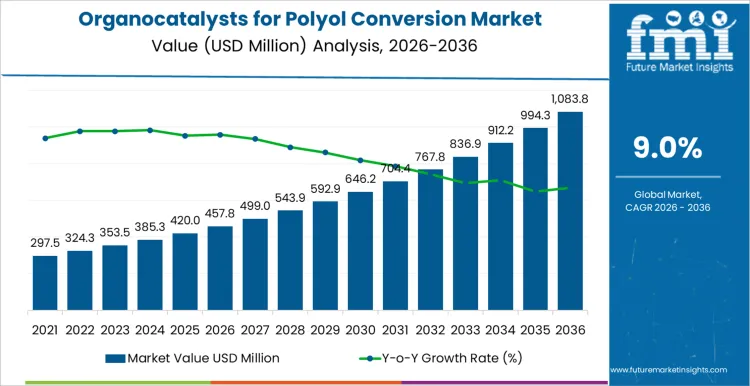
The organocatalysts for polyol conversion market is expected to expand from USD 457.8 million in 2026 to USD 1,083.8 million by 2036, growing at a CAGR of 9.00%. Procurement behavior in this market is shaped by a strong preference for process reliability and predictable outcomes rather than short-term cost savings. Organocatalysts are typically qualified deep within formulation and process design stages, resulting in cautious buyer behavior and extended evaluation cycles. Purchasing decisions are heavily influenced by risk aversion, particularly where catalysts affect cure profiles, foam structure, or downstream material performance.
Summary of Organocatalysts for Polyol Conversion Market
- Market Snapshot
- The organocatalysts for polyol conversion market is valued at USD 457.8 million in 2026.
- The organocatalysts for polyol conversion market is projected to reach USD 1,083.8 million by 2036.
- The market is expected to grow at a CAGR of 9.00% during 2026 to 2036.
- Demand and Growth Drivers
- Demand is driven by the shift toward metal-free catalysis to eliminate residue-related toxicity and processing issues.
- Adoption is increasing due to the need for precise reaction control and improved product purity in polymer manufacturing.
- Regulatory restrictions on heavy metals are accelerating the use of organocatalysts in polyurethane and specialty polymer applications.
- Product and Segment View
- Ring-opening polymerization and polyol building reactions account for 38% of the market share.
- Construction and insulation represent 30% of total end-use demand due to high consumption of polyurethane foams.
- Organocatalysts are widely used in esterification, transesterification, and urethane formation processes across polymer systems.
- Geography and Competitive Outlook
- China leads growth with a CAGR of 10.2% between 2026 and 2036.
- Brazil follows with a CAGR of 9.8%, supported by expanding polyurethane production capacity.
- Competition is concentrated among major chemical companies including Evonik Industries AG, BASF SE, Covestro AG, Huntsman Corporation, and Dow Chemical Company.
Vendor selection is often narrowed to suppliers with proven technical support and application-specific validation data. Once adopted, organocatalysts tend to become embedded within standardized formulations, creating implicit vendor lock-in and raising switching costs due to requalification requirements and potential performance variability. Buyers prioritize consistency, documentation, and long-term availability over aggressive pricing. Outcomes are increasingly determined by supplier credibility and integration depth rather than transactional volume, reinforcing stable but selective demand dynamics through 2036.
Organocatalysts for Polyol Conversion Market Key Takeaways
| Metric | Value |
|---|---|
| Organocatalysts for Polyol Conversion Market Value (2026) | USD 457.8 Million |
| Organocatalysts for Polyol Conversion Market Forecast Value (2036) | USD 1,083.8 Million |
| Organocatalysts for Polyol Conversion Market Forecast CAGR 2026 to 2036 | 9.00% |
What is driving the Shift toward Metal-Free Catalysis in Polyol Conversion Processes?
The organocatalysts for polyol conversion market is expanding as manufacturers seek alternatives to metal-based catalysts in polyurethane, polyester, and specialty polymer production. Organocatalysts enable efficient activation and transformation of polyols in reactions such as esterification, transesterification, and urethane formation without introducing metal residues that can affect color stability, toxicity profiles, or downstream processing. Their use is gaining traction in applications where product purity, regulatory compliance, and controlled reaction pathways are critical, including flexible and rigid foams, coatings, adhesives, and elastomers.
Process controllability and formulation flexibility are central to adoption decisions. End users evaluate organocatalysts based on catalytic efficiency at low loadings, selectivity across primary and secondary hydroxyl groups, and compatibility with a wide range of polyol chemistries, including petrochemical-based and bio-derived polyols. Compared with conventional metal catalysts, organocatalysts offer tunable reaction kinetics, reduced side reactions, and improved processing windows, allowing formulators to better manage pot life, cure speed, and final material properties in complex polymer systems.
Regulatory pressure and innovation in sustainable materials are further reinforcing market growth. Restrictions on heavy metals and increasing scrutiny of catalyst residues in consumer-facing products are encouraging the transition toward metal-free catalytic systems. At the same time, growth in bio-based polyols, recycled feedstock integration, and advanced polyurethane formulations is creating demand for catalysts that align with evolving sustainability and performance requirements. For suppliers, competitive positioning increasingly depends on application-specific catalyst design, technical collaboration with formulators, and the ability to support next-generation polyol conversion processes establishing organocatalysts as a high-growth segment within specialty polymer chemistry.
How Is The Organocatalysts For Polyol Conversion Market Organized By Reaction Pathway And End-Use Sector?
The organocatalysts for polyol conversion market is organized by reaction type and end-use sector, reflecting how catalyst functionality aligns with downstream polymer and material requirements. By reaction pathway, ring-opening polymerization and polyol building reactions form the leading segment, as organocatalysts enable controlled molecular weight development and uniform polyol structures. Other reaction types include transesterification and modification routes, CO₂ incorporation chemistries, and additional polyol conversion reactions used for tailored formulations. By end-use sector, construction and insulation applications account for the largest share, followed by automotive and transport, furniture and bedding, and other industrial sectors requiring consistent polyol performance.
Why Do Ring-Opening Polymerization And Polyol Building Reactions Drive Organocatalyst Demand?
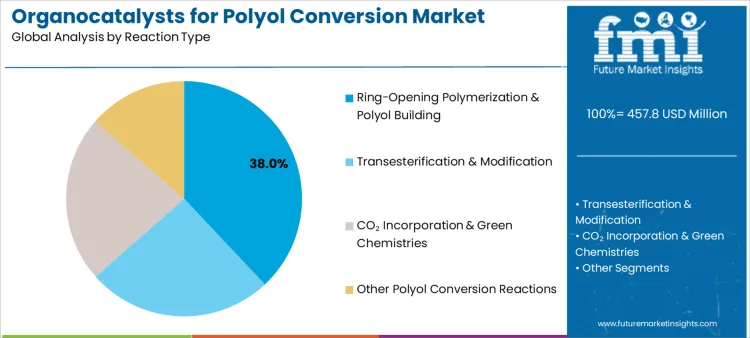
Ring-opening polymerization and polyol building reactions account for 38% share of the organocatalysts for polyol conversion market because these reactions require precise control over chain growth and functional group placement. Organocatalysts provide selective activation without introducing metal residues, enabling predictable polyol architectures. Manufacturers rely on these reactions to produce polyols with consistent viscosity, reactivity, and molecular distribution. The ability to fine-tune properties supports use across foams, elastomers, and coatings. Established processing routes and compatibility with diverse monomer systems further reinforce adoption. These control, versatility, and processing advantages explain their leading position.
Why Does Construction and Insulation Lead End-Use Adoption in the Organocatalysts for Polyol Conversion Market?
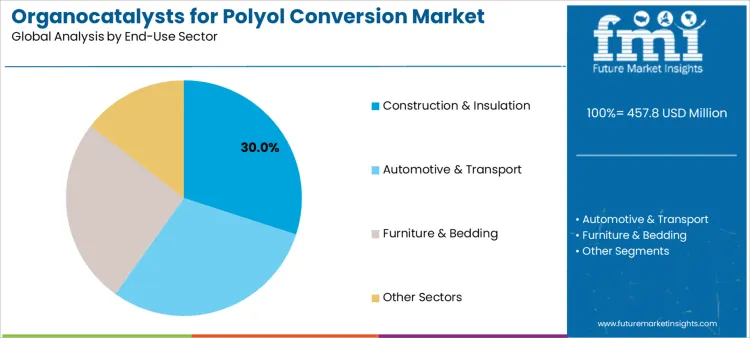
Construction and insulation hold 30% share of the organocatalysts for polyol conversion market because polyols are a core input for rigid and flexible foam systems used in buildings. These applications require consistent foam structure, mechanical strength, and thermal performance. Organocatalysts support controlled polyol synthesis that translates into reliable foam expansion and curing behavior. Large construction volumes and demand for insulation materials sustain steady catalyst consumption. Manufacturers prioritize reaction efficiency and formulation stability to support high-throughput foam production. These volume-driven and performance-critical requirements explain why construction and insulation remain the dominant end-use sector.
What are the Key Dynamics of the Organocatalysts for Polyol Conversion Market?
The organocatalysts for polyol conversion market is driven by demand for efficient, metal-free catalytic systems used in the transformation of polyols into value-added intermediates and specialty chemicals. Organocatalysts enable reactions such as esterification, etherification, transesterification, and selective functionalization under controlled conditions, supporting applications in polyurethanes, coatings, resins, lubricants, and specialty polymers. Growing emphasis on process control, product purity, and compatibility with sensitive formulations is increasing adoption across chemical manufacturing and polymer processing. For catalyst suppliers and chemical producers, catalytic activity, selectivity, thermal stability, and ease of separation are key criteria influencing material selection and long-term use.
How Do Application Trends and Industry Requirements Shape This Market?
Application trends and industry requirements are shaping the organocatalysts for polyol conversion market as manufacturers seek alternatives to metal-based catalysts that reduce contamination risk and simplify downstream processing. In polyurethane and polyester systems, organocatalysts support precise control over reaction rates and molecular architecture, enabling consistent product quality. In specialty chemical and resin applications, demand for catalysts that operate under mild conditions and accommodate diverse polyol structures is growing. Process scalability, compatibility with continuous production, and regulatory acceptance further influence catalyst choice. Suppliers that tailor organocatalyst chemistries to specific reaction pathways and substrate profiles strengthen adoption and qualification outcomes.
Why Do Performance Optimization and Scale-Up Challenges Restrain Market Growth?
Performance optimization and scale-up challenges restrain growth in the organocatalysts for polyol conversion market, particularly when transitioning from laboratory-scale reactions to commercial production. Achieving consistent catalytic performance across varying polyol feedstocks and reaction conditions requires extensive formulation and process tuning. Sensitivity to moisture, impurities, or temperature variations can affect catalyst efficiency and selectivity. Cost considerations and limited long-term performance data in large-scale operations extend validation timelines. These factors slow adoption among conservative industrial users that prioritize proven reliability and predictable process economics.
How is the Organocatalysts for Polyol Conversion Market Growing across Key Countries?
The organocatalysts for polyol conversion market is expanding rapidly as chemical producers and polymer manufacturers adopt metal-free catalytic systems to improve reaction selectivity, process control, and downstream product purity. Organocatalysts are increasingly used in polyol modification, transesterification, carbonation, and upgrading reactions that support production of specialty polyols for polyurethanes, coatings, elastomers, and advanced materials. Country-wise growth varies based on scale of polyol production, adoption of advanced catalytic routes, and integration of specialty chemicals into downstream polymer value chains. High-growth markets are driven by capacity expansion and process innovation, while mature regions focus on catalyst efficiency, reproducibility, and industrial-scale validation.
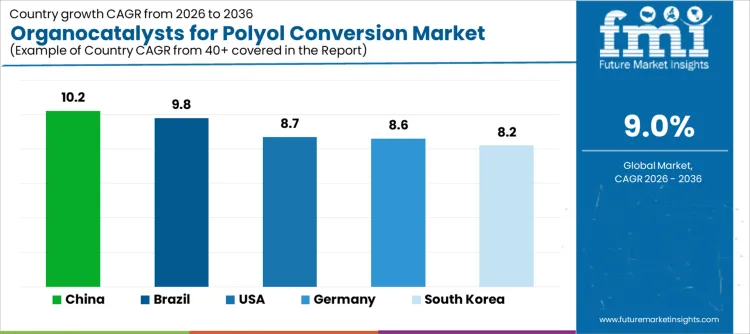
| Country | CAGR (%) |
|---|---|
| China | 10.2% |
| Brazil | 9.8% |
| United States | 8.7% |
| Germany | 8.6% |
| South Korea | 8.2% |
Why Is China Leading the Organocatalysts for Polyol Conversion Market?
China’s organocatalysts for polyol conversion market is expanding at a CAGR of 10.2% during 2026 to 2036, driven by rapid growth in polyurethane raw materials, specialty polyols, and downstream polymer manufacturing. Chinese chemical producers are increasingly adopting organocatalysts to achieve precise control over polyol functionality, molecular weight distribution, and reaction kinetics while avoiding metal residues in finished products. Demand is strong in flexible and rigid polyurethane foams, coatings, and elastomer applications. Manufacturers prioritize organocatalysts that deliver high activity, thermal stability, and compatibility with continuous processing. Domestic catalyst suppliers benefit from close integration with polyol producers and the ability to scale formulations for large-volume industrial use. Adoption is accelerating as producers upgrade processes to support higher-performance polymer systems.
Why is Brazil Emerging as a High-Growth Market for Organocatalysts in Polyol Conversion?
Brazil’s organocatalysts for polyol conversion market is growing at a CAGR of 9.8% during 2026 to 2036, supported by expansion of polyurethane production and increasing focus on upgrading locally produced polyols. Chemical manufacturers are adopting organocatalysts to improve process efficiency and product consistency in foam, coating, and adhesives applications. Brazilian producers value catalysts that offer stable performance under variable processing conditions and compatibility with existing reaction infrastructure. Adoption is strongest in flexible foams, industrial coatings, and construction-related polymer systems. Growth remains rapid as producer’s transition from conventional catalytic approaches to more selective organocatalytic routes. Procurement decisions often favor suppliers providing technical process support and catalysts adaptable to multiple polyol formulations. Market growth is supported by expansion of domestic polymer manufacturing and increasing integration of specialty chemical processes.
What is Driving Demand for Organocatalysts for Polyol Conversion in the United States?
The United States organocatalysts for polyol conversion market is expanding at a CAGR of 8.7% during 2026 to 2036, driven by demand from specialty polyol production, advanced polyurethane systems, and high-performance materials. USA. producers adopt organocatalysts to achieve precise reaction control, minimize side reactions, and support consistent polymer performance in demanding applications. Buyers emphasize catalyst selectivity, reproducibility, and scalability for continuous and batch processes. Demand is strongest in specialty foams, elastomers, coatings, and engineered polymer systems. Adoption is performance-driven rather than volume-driven. Procurement decisions prioritize long-term catalyst stability, technical validation, and supplier collaboration. Market growth is reinforced by continued innovation in polyurethane chemistry and growing demand for tailored polyol structures.
How is Germany Supporting Growth in the Organocatalysts for Polyol Conversion Market?
Germany’s organocatalysts for polyol conversion market is growing at a CAGR of 8.6% during 2026 to 2036, supported by strong demand from specialty chemicals, automotive polymers, and high-performance polyurethane applications. German producers emphasize precision chemistry, controlled reactivity, and reproducible outcomes, making organocatalysts attractive alternatives to traditional systems. Catalysts are selected for their ability to deliver narrow molecular weight distributions and predictable functionalization. Adoption is driven by process optimization and product quality rather than rapid capacity expansion. Procurement decisions favor suppliers with strong technical documentation, consistent catalyst quality, and the ability to support customized reaction pathways. Market growth is reinforced by Germany’s leadership in advanced polymer engineering and specialty chemical manufacturing.
How Is South Korea Expanding Use of Organocatalysts for Polyol Conversion?
South Korea’s organocatalysts for polyol conversion market is expanding at a CAGR of 8.2% during 2026 to 2036, driven by demand from electronics, automotive, and advanced materials manufacturing. Organocatalysts are increasingly used to produce specialty polyols required for high-performance polyurethane components and precision polymer applications. Buyers emphasize catalyst efficiency, consistency, and compatibility with high-throughput processing environments. Adoption is strongest in export-oriented manufacturing where tight material specifications are critical. Procurement decisions are influenced by supplier technical capability, catalyst reliability, and alignment with global polymer quality standards. Market growth is supported by continued investment in advanced materials and specialty polymer value chains.
How Are Companies Competing in the Organocatalysts for Polyol Conversion Market?
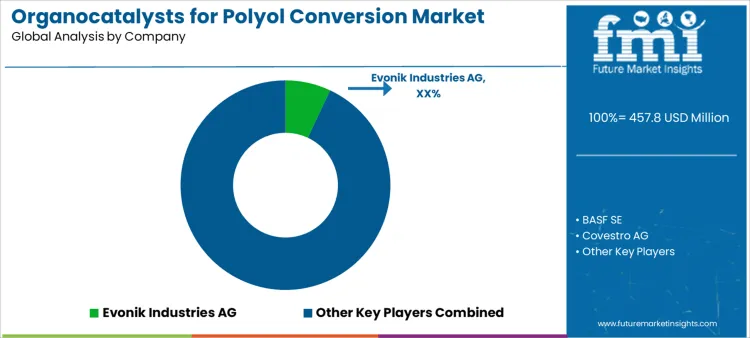
Competition in the organocatalysts for polyol conversion market is driven by catalytic efficiency, selectivity, and compatibility with advanced polymer and specialty chemical processes that matter to formulators and OEM material engineers. Organocatalysts are increasingly sought for polyol conversion pathways including urethane, polyester, and polycarbonate polyol synthesis where metal-free catalysis, reduced toxicity, and fine control over molecular architecture deliver performance benefits in coatings, adhesives, elastomers, and high-performance thermoplastics.
Large specialty chemical producers leverage deep catalytic expertise and broad resin portfolios to differentiate their offerings. Evonik Industries AG positions its organocatalysts around balanced activity and selectivity tailored to specific polyol systems, emphasizing precise control over conversion pathways, reduced side reactions, and stable performance in industrial operations. BASF SE competes by integrating organocatalysts into broader polyol and polymer additive platforms, focusing on catalysts that enhance reaction rates without introducing metal residues, supporting high-performance foam and elastomer systems.
Global materials leaders broaden competition through tailored catalytic systems and regulatory alignment. Covestro AG and Huntsman Corporation emphasize organocatalysts designed for controlled reactivity and compatibility with next-generation polyol chemistries. Dow Chemical Company and Mitsubishi Chemical Group focus on catalysts that balance process efficiency with downstream material properties such as mechanical strength and thermal performance.
Emerging and regionally diversified suppliers add competitive breadth with specialized catalysts engineered for niche polyol applications. Wanhua Chemical Group and LANXESS AG offer organocatalyst options aimed at both commodity and technical polyol conversions. Clariant AG and Oxea (OQ Chemicals heritage) differentiate through tailored catalyst portfolios that support specific end-use targets. Across all suppliers, competitive advantage is defined by catalyst performance consistency, process integration support, and alignment with sustainability expectations rather than catalyst pricing alone.
Key Players in Organocatalysts for Polyol Conversion Market
- Evonik Industries AG
- BASF SE
- Covestro AG
- Huntsman Corporation
- Dow Chemical Company
- Mitsubishi Chemical Group
- Wanhua Chemical Group
- LANXESS AG
- Clariant AG
- Oxea (OQ Chemicals)
Scope of Report
| Attribute | Details |
|---|---|
| Market Size Unit | USD Million |
| Reaction Type Covered | Ring-Opening Polymerization & Polyol Building, Transesterification & Modification, CO₂ Incorporation & Green Chemistries, Other Polyol Conversion Reactions |
| End-Use Sector Covered | Construction & Insulation, Automotive & Transport, Furniture & Bedding, Other Sectors |
| Countries Covered | China, Japan, South Korea, India, Australia & New Zealand, ASEAN, Rest of Asia Pacific, Germany, United Kingdom, France, Italy, Spain, Nordic, BENELUX, Rest of Europe, United States, Canada, Mexico, Brazil, Chile, Rest of Latin America, Kingdom of Saudi Arabia, Other GCC Countries, Turkey, South Africa, Other African Union, Rest of Middle East & Africa |
| Regions Covered | Asia Pacific, Europe, North America, Latin America, Middle East & Africa |
| Key Companies Profiled | Evonik Industries AG, BASF SE, Covestro AG, Huntsman Corporation, Dow Chemical Company, Mitsubishi Chemical Group, Wanhua Chemical Group, LANXESS AG, Clariant AG, Oxea (OQ Chemicals) |
| Additional Attributes | Dollar sales of organocatalysts for polyol conversion are analyzed by reaction pathway and end-use sector across polyurethane and specialty polymer value chains. The scope evaluates catalytic efficiency, selectivity, reaction control, compatibility with bio-based and recycled feedstocks, and replacement of metal-based catalysts. Country-level analysis reflects growth in polyurethane insulation and foam demand, tightening regulations on catalyst toxicity and emissions, increasing adoption of metal-free and low-VOC systems, and investment in sustainable and CO₂-based polyol technologies. |
Organocatalysts for Polyol Conversion Market by Key Segments
Reaction Type:
- Ring-Opening Polymerization & Polyol Building
- Transesterification & Modification
- CO₂ Incorporation & Green Chemistries
- Other Polyol Conversion Reactions
End-Use Sector:
- Construction & Insulation
- Automotive & Transport
- Furniture & Bedding
- Other Sectors
Region:
- Asia Pacific
- China
- Japan
- South Korea
- India
- Australia & New Zealand
- ASEAN
- Rest of Asia Pacific
- Europe
- Germany
- United Kingdom
- France
- Italy
- Spain
- Nordic
- BENELUX
- Rest of Europe
- North America
- United States
- Canada
- Mexico
- Latin America
- Brazil
- Chile
- Rest of Latin America
- Middle East & Africa
- Kingdom of Saudi Arabia
- Other GCC Countries
- Turkey
- South Africa
- Other African Union
- Rest of Middle East & Africa
Bibliography
- Djomo, S. N., et al. (2023). Organocatalysis: A metal‑free approach to polymer and material synthesis. Catalysis Reviews, 65(4), 345-392.
- Organocatalysts for degradable polyesters and biomedical polymers. (2025). In Organocatalysis in Polymer Synthesis (pp. 245-278). Wiley.
- USA. Executive Office of the President, Sustainable Chemistry Strategy Team. (2024). Federal Sustainable Chemistry Strategic Plan. Federal Sustainable Chemistry Initiative.
- United Nations Environment Programme. (2023). Global Framework on Chemicals: Life‑cycle approach to safe and sustainable chemical use. UNEP.
- Silva, G. J. S., et al. (2023). Organocatalysts in polyester and polyurethane synthesis: Advances in structure-property control and sustainability.
Frequently Asked Questions
How big is the organocatalysts for polyol conversion market in 2026?
The global organocatalysts for polyol conversion market is estimated to be valued at USD 457.8 million in 2026.
What will be the size of organocatalysts for polyol conversion market in 2036?
The market size for the organocatalysts for polyol conversion market is projected to reach USD 1,083.8 million by 2036.
How much will be the organocatalysts for polyol conversion market growth between 2026 and 2036?
The organocatalysts for polyol conversion market is expected to grow at a 9.0% CAGR between 2026 and 2036.
What are the key product types in the organocatalysts for polyol conversion market?
The key product types in organocatalysts for polyol conversion market are ring-opening polymerization & polyol building, transesterification & modification, co₂ incorporation & green chemistries and other polyol conversion reactions.
Which end-use sector segment to contribute significant share in the organocatalysts for polyol conversion market in 2026?
In terms of end-use sector, construction & insulation segment to command 30.0% share in the organocatalysts for polyol conversion market in 2026.
Preview the report firsthand - request a free sample
Get SampleGet the brochure for pricing and purchase details.
Get PDFTable of Content
- Executive Summary
- Global Market Outlook
- Demand-side Trends
- Supply-side Trends
- Technology Roadmap Analysis
- Analysis and Recommendations
- Market Overview
- Market Coverage / Taxonomy
- Market Definition / Scope / Limitations
- Market Background
- Market Dynamics
- Drivers
- Restraints
- Opportunity
- Trends
- Scenario Forecast
- Demand in Optimistic Scenario
- Demand in Likely Scenario
- Demand in Conservative Scenario
- Opportunity Map Analysis
- Product Life Cycle Analysis
- Supply Chain Analysis
- Investment Feasibility Matrix
- Value Chain Analysis
- PESTLE and Porter’s Analysis
- Regulatory Landscape
- Regional Parent Market Outlook
- Production and Consumption Statistics
- Import and Export Statistics
- Market Dynamics
- Global Market Analysis 2021 to 2025 and Forecast, 2026 to 2036
- Historical Market Size Value (USD Million) Analysis, 2021 to 2025
- Current and Future Market Size Value (USD Million) Projections, 2026 to 2036
- Y-o-Y Growth Trend Analysis
- Absolute $ Opportunity Analysis
- Global Market Pricing Analysis 2021 to 2025 and Forecast 2026 to 2036
- Global Market Analysis 2021 to 2025 and Forecast 2026 to 2036, By Reaction Type
- Introduction / Key Findings
- Historical Market Size Value (USD Million) Analysis By Reaction Type, 2021 to 2025
- Current and Future Market Size Value (USD Million) Analysis and Forecast By Reaction Type, 2026 to 2036
- Ring-Opening Polymerization & Polyol Building
- Transesterification & Modification
- CO₂ Incorporation & Green Chemistries
- Other Polyol Conversion Reactions
- Ring-Opening Polymerization & Polyol Building
- Y-o-Y Growth Trend Analysis By Reaction Type, 2021 to 2025
- Absolute $ Opportunity Analysis By Reaction Type, 2026 to 2036
- Global Market Analysis 2021 to 2025 and Forecast 2026 to 2036, By End-Use Sector
- Introduction / Key Findings
- Historical Market Size Value (USD Million) Analysis By End-Use Sector, 2021 to 2025
- Current and Future Market Size Value (USD Million) Analysis and Forecast By End-Use Sector, 2026 to 2036
- Construction & Insulation
- Automotive & Transport
- Furniture & Bedding
- Other Sectors
- Construction & Insulation
- Y-o-Y Growth Trend Analysis By End-Use Sector, 2021 to 2025
- Absolute $ Opportunity Analysis By End-Use Sector, 2026 to 2036
- Global Market Analysis 2021 to 2025 and Forecast 2026 to 2036, By Region
- Introduction
- Historical Market Size Value (USD Million) Analysis By Region, 2021 to 2025
- Current Market Size Value (USD Million) Analysis and Forecast By Region, 2026 to 2036
- North America
- Latin America
- Western Europe
- Eastern Europe
- East Asia
- South Asia and Pacific
- Middle East & Africa
- Market Attractiveness Analysis By Region
- North America Market Analysis 2021 to 2025 and Forecast 2026 to 2036, By Country
- Historical Market Size Value (USD Million) Trend Analysis By Market Taxonomy, 2021 to 2025
- Market Size Value (USD Million) Forecast By Market Taxonomy, 2026 to 2036
- By Country
- USA
- Canada
- Mexico
- By Reaction Type
- By End-Use Sector
- By Country
- Market Attractiveness Analysis
- By Country
- By Reaction Type
- By End-Use Sector
- Key Takeaways
- Latin America Market Analysis 2021 to 2025 and Forecast 2026 to 2036, By Country
- Historical Market Size Value (USD Million) Trend Analysis By Market Taxonomy, 2021 to 2025
- Market Size Value (USD Million) Forecast By Market Taxonomy, 2026 to 2036
- By Country
- Brazil
- Chile
- Rest of Latin America
- By Reaction Type
- By End-Use Sector
- By Country
- Market Attractiveness Analysis
- By Country
- By Reaction Type
- By End-Use Sector
- Key Takeaways
- Western Europe Market Analysis 2021 to 2025 and Forecast 2026 to 2036, By Country
- Historical Market Size Value (USD Million) Trend Analysis By Market Taxonomy, 2021 to 2025
- Market Size Value (USD Million) Forecast By Market Taxonomy, 2026 to 2036
- By Country
- Germany
- UK
- Italy
- Spain
- France
- Nordic
- BENELUX
- Rest of Western Europe
- By Reaction Type
- By End-Use Sector
- By Country
- Market Attractiveness Analysis
- By Country
- By Reaction Type
- By End-Use Sector
- Key Takeaways
- Eastern Europe Market Analysis 2021 to 2025 and Forecast 2026 to 2036, By Country
- Historical Market Size Value (USD Million) Trend Analysis By Market Taxonomy, 2021 to 2025
- Market Size Value (USD Million) Forecast By Market Taxonomy, 2026 to 2036
- By Country
- Russia
- Poland
- Hungary
- Balkan & Baltic
- Rest of Eastern Europe
- By Reaction Type
- By End-Use Sector
- By Country
- Market Attractiveness Analysis
- By Country
- By Reaction Type
- By End-Use Sector
- Key Takeaways
- East Asia Market Analysis 2021 to 2025 and Forecast 2026 to 2036, By Country
- Historical Market Size Value (USD Million) Trend Analysis By Market Taxonomy, 2021 to 2025
- Market Size Value (USD Million) Forecast By Market Taxonomy, 2026 to 2036
- By Country
- China
- Japan
- South Korea
- By Reaction Type
- By End-Use Sector
- By Country
- Market Attractiveness Analysis
- By Country
- By Reaction Type
- By End-Use Sector
- Key Takeaways
- South Asia and Pacific Market Analysis 2021 to 2025 and Forecast 2026 to 2036, By Country
- Historical Market Size Value (USD Million) Trend Analysis By Market Taxonomy, 2021 to 2025
- Market Size Value (USD Million) Forecast By Market Taxonomy, 2026 to 2036
- By Country
- India
- ASEAN
- Australia & New Zealand
- Rest of South Asia and Pacific
- By Reaction Type
- By End-Use Sector
- By Country
- Market Attractiveness Analysis
- By Country
- By Reaction Type
- By End-Use Sector
- Key Takeaways
- Middle East & Africa Market Analysis 2021 to 2025 and Forecast 2026 to 2036, By Country
- Historical Market Size Value (USD Million) Trend Analysis By Market Taxonomy, 2021 to 2025
- Market Size Value (USD Million) Forecast By Market Taxonomy, 2026 to 2036
- By Country
- Kingdom of Saudi Arabia
- Other GCC Countries
- Turkiye
- South Africa
- Other African Union
- Rest of Middle East & Africa
- By Reaction Type
- By End-Use Sector
- By Country
- Market Attractiveness Analysis
- By Country
- By Reaction Type
- By End-Use Sector
- Key Takeaways
- Key Countries Market Analysis
- USA
- Pricing Analysis
- Market Share Analysis, 2025
- By Reaction Type
- By End-Use Sector
- Canada
- Pricing Analysis
- Market Share Analysis, 2025
- By Reaction Type
- By End-Use Sector
- Mexico
- Pricing Analysis
- Market Share Analysis, 2025
- By Reaction Type
- By End-Use Sector
- Brazil
- Pricing Analysis
- Market Share Analysis, 2025
- By Reaction Type
- By End-Use Sector
- Chile
- Pricing Analysis
- Market Share Analysis, 2025
- By Reaction Type
- By End-Use Sector
- Germany
- Pricing Analysis
- Market Share Analysis, 2025
- By Reaction Type
- By End-Use Sector
- UK
- Pricing Analysis
- Market Share Analysis, 2025
- By Reaction Type
- By End-Use Sector
- Italy
- Pricing Analysis
- Market Share Analysis, 2025
- By Reaction Type
- By End-Use Sector
- Spain
- Pricing Analysis
- Market Share Analysis, 2025
- By Reaction Type
- By End-Use Sector
- France
- Pricing Analysis
- Market Share Analysis, 2025
- By Reaction Type
- By End-Use Sector
- India
- Pricing Analysis
- Market Share Analysis, 2025
- By Reaction Type
- By End-Use Sector
- ASEAN
- Pricing Analysis
- Market Share Analysis, 2025
- By Reaction Type
- By End-Use Sector
- Australia & New Zealand
- Pricing Analysis
- Market Share Analysis, 2025
- By Reaction Type
- By End-Use Sector
- China
- Pricing Analysis
- Market Share Analysis, 2025
- By Reaction Type
- By End-Use Sector
- Japan
- Pricing Analysis
- Market Share Analysis, 2025
- By Reaction Type
- By End-Use Sector
- South Korea
- Pricing Analysis
- Market Share Analysis, 2025
- By Reaction Type
- By End-Use Sector
- Russia
- Pricing Analysis
- Market Share Analysis, 2025
- By Reaction Type
- By End-Use Sector
- Poland
- Pricing Analysis
- Market Share Analysis, 2025
- By Reaction Type
- By End-Use Sector
- Hungary
- Pricing Analysis
- Market Share Analysis, 2025
- By Reaction Type
- By End-Use Sector
- Kingdom of Saudi Arabia
- Pricing Analysis
- Market Share Analysis, 2025
- By Reaction Type
- By End-Use Sector
- Turkiye
- Pricing Analysis
- Market Share Analysis, 2025
- By Reaction Type
- By End-Use Sector
- South Africa
- Pricing Analysis
- Market Share Analysis, 2025
- By Reaction Type
- By End-Use Sector
- USA
- Market Structure Analysis
- Competition Dashboard
- Competition Benchmarking
- Market Share Analysis of Top Players
- By Regional
- By Reaction Type
- By End-Use Sector
- Competition Analysis
- Competition Deep Dive
- Evonik Industries AG
- Overview
- Product Portfolio
- Profitability by Market Segments (Product/Age /Sales Channel/Region)
- Sales Footprint
- Strategy Overview
- Marketing Strategy
- Product Strategy
- Channel Strategy
- BASF SE
- Covestro AG
- Huntsman Corporation
- Dow Chemical Company
- Mitsubishi Chemical Group
- Wanhua Chemical Group
- LANXESS AG
- Clariant AG
- Oxea (OQ Chemicals)
- Evonik Industries AG
- Competition Deep Dive
- Assumptions & Acronyms Used
- Research Methodology


