

- Industry Size (2026)
- USD 280.0 Mn
- Forecast (2036)
- USD 753.1 Mn
- CAGR (2026 to 2036)
- 10.4%
Cold-Process Dispersible Natural Pigment Systems for Indie Formulators Market Forecast and Outlook 2026 to 2036
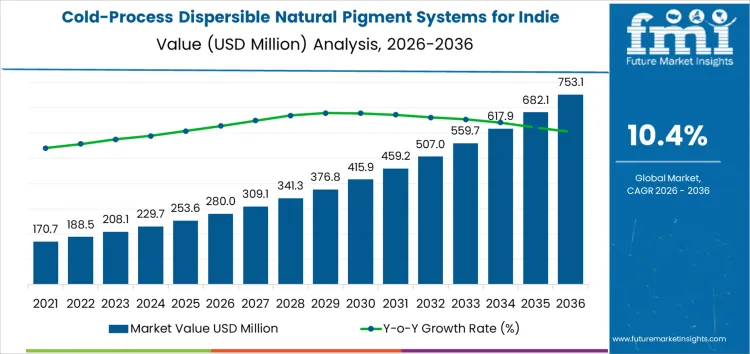
The cold-process dispersible natural pigment systems for indie formulators market is valued at USD 280.0 million in 2026 and is expected to reach USD 753.1 million by 2036, reflecting a CAGR of 10.4%. Growth during this period is primarily linked to changes in formulation economics and production accessibility rather than expansion of finished cosmetic volumes. Independent brands increasingly operate without thermal processing, specialized dispersion equipment, or large production runs. Pigment systems engineered for ambient-temperature incorporation reduce formulation risk, shorten development cycles, and limit energy dependence. Natural origin pigments sourced from botanical and mineral inputs support clean labeling expectations while fitting regulatory definitions used across multiple jurisdictions. Stability under room-temperature conditions and tolerance to variable base chemistries determine commercial adoption more than shade novelty or finish effects.
Demand concentrates around pigment systems that enable predictable outcomes in decentralized and small-scale manufacturing environments. Batch consistency, dispersion reliability, and tolerance to formulation variability influence supplier selection more strongly than visual differentiation. Pre-treated and pre-dispersed pigments reduce formulation error rates and material waste, which is critical for producers operating with limited inventory buffers. Regulatory pressure on labeling accuracy and impurity thresholds further reinforces preference for standardized, documentation-ready pigment inputs. Supplier capability to support low minimum order volumes and provide formulation guidance shapes purchasing decisions. Growth remains anchored in process simplification, reproducibility, and regulatory alignment rather than trend-driven color development or premium positioning.
Quick Stats for Cold-Process Dispersible Natural Pigment Systems for Indie Formulators Market
- Cold-Process Dispersible Natural Pigment Systems for Indie Formulators Market Value (2026): USD 280.0 million
- Cold-Process Dispersible Natural Pigment Systems for Indie Formulators Market Forecast Value (2036): USD 753.1 million
- Forecast CAGR (2026–2036): 10.4%
- Leading Pigment System Type in Global Demand: Cold-Process Dispersible Botanical Pigments
- Fastest-Growing Countries: India, China, USA, South Korea, Germany
- Key Players in Global Demand: Sensient Technologies, Clariant AG, DSM-Firmenich, Sun Chemical, BASF SE
Cold-Process Dispersible Natural Pigment Systems for Indie Formulators Market Key Takeaways
| Metric | Value |
|---|---|
| Market Value (2026) | USD 280.0 million |
| Market Forecast Value (2036) | USD 753.1 million |
| Forecast CAGR (2026-2036) | 10.4% |
Why is the Demand for Cold-Process Dispersible Natural Pigment Systems for Indie Formulators Market Growing?
Demand for cold-process dispersible natural pigment systems for indie formulators is growing globally due to rising participation in small batch and artisanal cosmetic production. Indie brands and formulation hobbyists require pigment systems that integrate smoothly into cold-process workflows without the need for elevated heat or complex equipment, which supports consistent color dispersion, stability, and aesthetic performance. Natural pigment systems derived from mineral and botanical sources align with consumer and regulatory expectations for clean, transparent, and eco-friendly ingredients, which reinforces adoption among indie formulators prioritizing ingredient integrity.
Formulators benefit from pigments engineered for rapid wetting, high chroma, and compatibility with diverse base materials such as oils, butters, and gel carriers used in cold-process recipes. Regulatory frameworks in multiple regions emphasize safety, accurate labeling, and restricted substance compliance, which encourages use of pigment systems designed for broad jurisdictional acceptance. Growth in direct-to-consumer and e-commerce channels increases market access for indie brands, which strengthens demand for reliable raw materials that support repeatable formulation outcomes. Advances in pigment chemistry improve stability, batch-to-batch consistency, and shelf life, enhancing product quality without requiring heat driven dispersion techniques. Consumer interest in unique, small brand cosmetic offerings further stimulates uptake of cold-process compatible natural pigments worldwide.
How Is the Cold-Process Dispersible Natural Pigment Systems for Indie Formulators Market Structured?
Demand for cold-process dispersible natural pigment systems among indie formulators is driven by low-capital manufacturing models, room-temperature processing needs, and emphasis on ingredient transparency. Indie brands favor pigments compatible with water-based systems, minimal equipment, and short development cycles. Global demand reflects growth of small-batch cosmetics, private label production, and rapid formulation testing where dispersion efficiency, processing simplicity, and natural positioning determine pigment system selection.
Which Pigment System Type Holds the Largest Share of Global Demand?
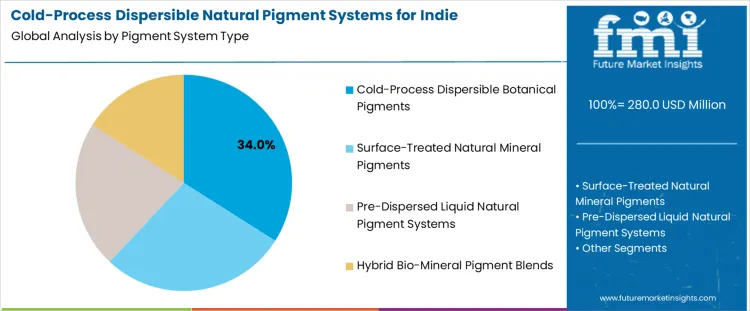
Cold-process dispersible botanical pigments hold 34.0%, representing the largest share of global demand. These pigments disperse efficiently at ambient temperatures, supporting small-scale production without heating or specialized equipment. Surface-treated natural mineral pigments follow at 28.0%, offering improved wettability and color consistency while retaining mineral-origin positioning. Pre-dispersed liquid natural pigment systems account for 22.0%, reducing formulation time and minimizing dispersion errors in small batches. Hybrid bio-mineral pigment blends represent 16.0%, adopted where balance between chromatic performance and natural sourcing is required.
Key Points:
- Botanical pigments lead due to room-temperature dispersion
- Surface treatment improves consistency for indie production
- Pre-dispersed systems reduce formulation complexity
Which Processing Compatibility Segment Drives the Highest Global Demand?
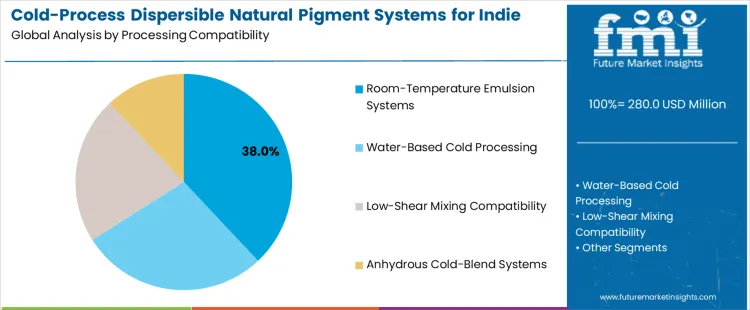
Room-temperature emulsion systems account for 38.0%, making this the leading processing compatibility segment globally. Indie formulators rely on emulsions that form without heat input to reduce energy use and process risk. Water-based cold processing follows at 28.0%, reflecting widespread use of aqueous systems in clean beauty formulations. Low-shear mixing compatibility represents 22.0%, supporting manual or small-mixer production environments. Anhydrous cold-blend systems hold 12.0%, used selectively for balms and oil-based products with simplified processing requirements.
Key Points:
- Room-temperature emulsions support low-energy production
- Water-based systems align with clean formulation trends
- Low-shear compatibility suits small-batch equipment
Which Application Segment Represents the Largest Share of Global Demand?
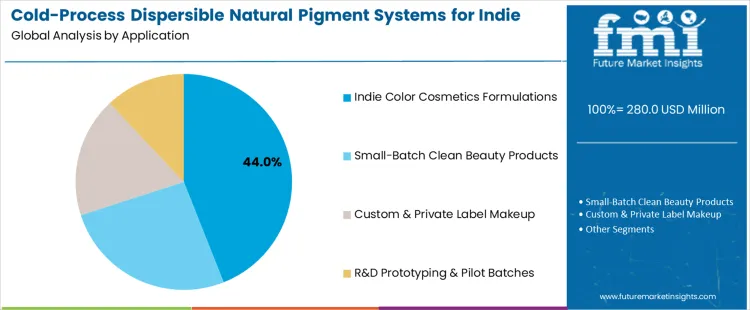
Indie color cosmetics formulations account for 44.0%, making them the largest application segment globally. These formulations prioritize flexibility, rapid iteration, and minimal processing constraints. Small-batch clean beauty products follow at 26.0%, reflecting demand for scalable pigments compatible with limited production runs. Custom and private label makeup represents 18.0%, where repeatable dispersion and shade consistency are required across short cycles. R&D prototyping and pilot batches hold 12.0%, supporting early-stage testing and concept validation.
Key Points:
- Indie cosmetics dominate due to flexible formulation needs
- Clean beauty batches require consistent cold processing
- Prototyping relies on rapid dispersion and iteration
What are the Key Dynamics in the Cold-Process Dispersible Natural Pigment Systems for Indie Formulators Market?
Global demand rises as independent cosmetic formulators adopt cold-process dispersible natural pigment systems that enable color incorporation without heat-dependent dispersion methods. These pigments facilitate simplified formulation workflows suited to small-batch production of natural and artisanal makeup, skincare tints, and body color products. Adoption aligns with growth in indie beauty brands, clean and plant-based positioning, and consumer expectations for transparent ingredient sourcing. Usage spans foundations, cream blushes, mineral powders, and multifunctional tint products formulated without high-temperature processing.
How do indie brand growth and formulation flexibility shape adoption?
Independent formulators focus on agile product development that prioritizes clean ingredient lists, minimal processing steps, and reduced energy input. Cold-process dispersible natural pigment systems allow integration of colorants without requiring elevated temperatures that can degrade sensitive botanical extracts or disrupt texture profiles. Indie brands emphasize natural and sustainable beauty credentials and highlight manual or low-heat methods compatible with artisan production. Retailers and direct-to-consumer platforms support small-batch pigment formulations that appeal to niche consumer segments seeking unique shades, customizable blends, and transparent supply chains. Performance criteria include color uniformity, ease of dispersion, and compatibility with diverse base matrices.
How do raw material cost, pigment stability, and regulatory compliance influence market scalability?
Cold-process dispersible natural pigments often involve specialized milling, surface treatment, and botanical sourcing that increase raw material cost relative to conventional colorants. Stability of natural pigment dispersions can vary with formulation pH, oil phase composition, and ambient storage conditions, requiring careful optimization and quality control. Indie formulators must balance formulation simplicity with efficacy, especially when integrating natural actives and emulsifiers alongside pigments. Regulatory frameworks in major markets enforce purity, labeling transparency, and safety documentation for cosmetic ingredients, influencing selection and compliance burden for independent brands. Variability in raw material availability for high-quality natural pigments affects planning and pricing. Long-term growth depends on innovation in stable, easy-to-use cold-process pigment systems and harmonized safety standards that support indie formulator creativity and reliable product performance worldwide.
How Is Demand for Cold-Process Dispersible Natural Pigment Systems for Indie Formulators Evolving?
Demand for cold-process dispersible natural pigment systems for indie formulators is increasing globally due to small-batch production needs, energy efficiency goals, and rapid product iteration cycles. India leads with an 11.2% CAGR, supported by growth of independent beauty brands and low-capital formulation models. China follows at 10.9%, driven by supplier ecosystems serving emerging brands. USA records a 10.4% CAGR, reflecting indie brand density and demand for simplified processing. South Korea posts 10.1%, shaped by fast trend cycles and agile product launches. Germany records 9.8%, supported by artisanal brands and regulatory-compliant natural formulations. Growth reflects preference for pigments dispersible without heat, milling, or complex processing.
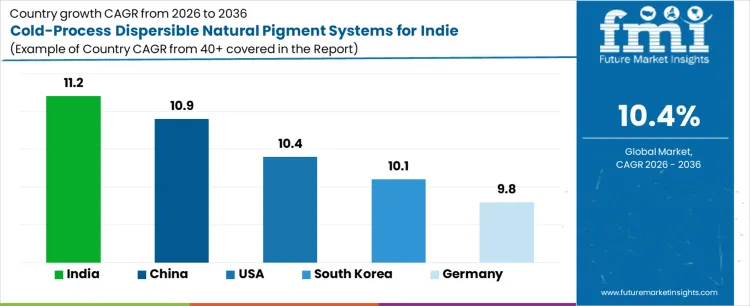
| Country | CAGR (%) |
|---|---|
| India | 11.2% |
| China | 10.9% |
| USA | 10.4% |
| South Korea | 10.1% |
| Germany | 9.8% |
What factors are driving strong adoption of cold-process dispersible natural pigments in India?
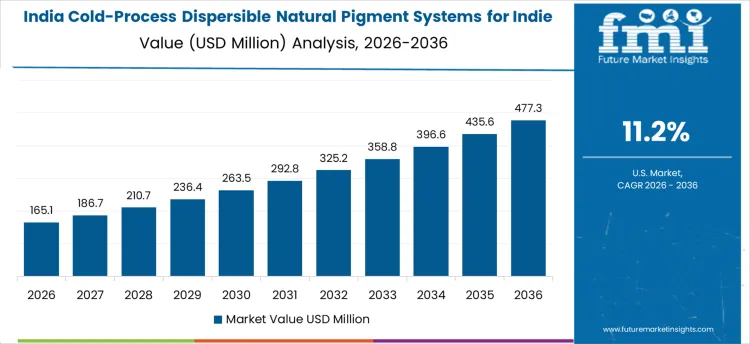
India demand is driven by rapid growth of indie cosmetic brands operating with limited infrastructure. CAGR of 11.2% reflects preference for pigment systems that disperse uniformly at ambient temperatures. Formulators avoid energy-intensive heating and milling steps to reduce costs and production time. Natural positioning aligns with consumer preference for plant-based and mineral-derived ingredients. Local supplier availability supports small-batch flexibility. Export-oriented indie brands select cold-process pigments to meet clean label expectations. Growth remains entrepreneurship-led and formulation-driven, aligned with low-barrier entry and fast commercialization.
- Expansion of indie and small-batch cosmetic brands
- Preference for ambient-temperature processing
- Cost and energy efficiency requirements
- Alignment with clean label positioning
How is China sustaining high growth in cold-process pigment usage?
China demand reflects dense supplier networks serving emerging cosmetic brands and private labels. CAGR of 10.9% is supported by availability of pre-dispersed natural pigments compatible with cold processing. Indie brands prioritize rapid prototyping and short development cycles. Contract manufacturers offer cold-process workflows to reduce turnaround times. Domestic pigment producers expand ready-to-use dispersions. Growth remains scale-driven and ecosystem-aligned, supported by manufacturing flexibility and supplier responsiveness.
- Strong supplier ecosystems for indie brands
- Use of ready-to-disperse natural pigments
- Rapid prototyping and short launch cycles
- Contract manufacturing flexibility
What factors shape demand growth in the USA for cold-process pigment systems?
USA demand is shaped by concentration of indie beauty brands and emphasis on simplified formulation workflows. CAGR of 10.4% reflects adoption of pigments that disperse without heat, high shear, or specialized equipment. Formulators value consistency, reproducibility, and reduced batch failure risk. Clean beauty governance favors minimal processing steps. Retail timelines encourage faster product development. Growth remains brand-led and process-focused, aligned with agile manufacturing and compliance needs.
- High density of indie beauty brands
- Preference for simplified and reproducible processing
- Clean beauty-driven minimal processing
- Faster development and launch timelines
What supports South Korea’s steady growth in cold-process pigment adoption?
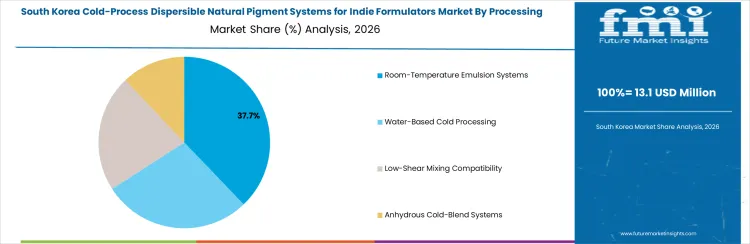
South Korea demand reflects fast-moving indie brands responding to trend volatility. CAGR of 10.1% is supported by need for pigments compatible with rapid formulation and reformulation. Brands emphasize speed to shelf and small production runs. Cold-process pigments enable flexible experimentation without capital-intensive equipment. Export-focused indie brands align formulations with global natural standards. Growth remains trend-driven and process-efficient, aligned with rapid innovation cycles.
- Fast trend turnover requiring agile formulation
- Small production runs and frequent reformulation
- Avoidance of capital-intensive processing
- Alignment with global natural ingredient standards
Why is Germany showing steady growth in cold-process dispersible pigment systems?
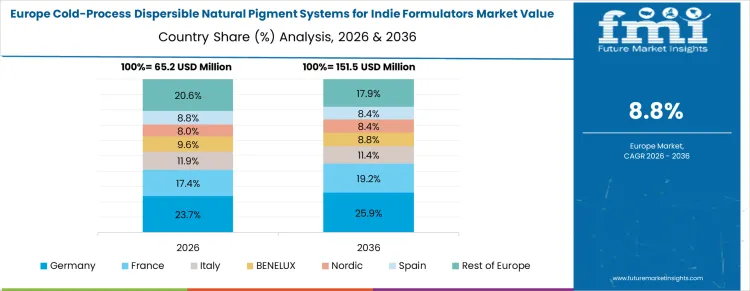
Germany demand reflects presence of artisanal and science-led indie brands operating under strict regulatory frameworks. CAGR of 9.8% is supported by preference for controlled, low-energy processing methods. Cold-process pigments reduce thermal degradation risks and improve batch consistency. Formulators prioritize traceability and documentation. Natural and mineral pigment systems align with regulatory expectations. Growth remains compliance-driven and quality-focused, supported by strong formulation discipline.
- Presence of artisanal and regulated indie brands
- Emphasis on low-energy, controlled processing
- Improved consistency and pigment stability
- Strong traceability and documentation requirements
What is the competitive landscape of demand for cold-process dispersible natural pigment systems for indie formulators?
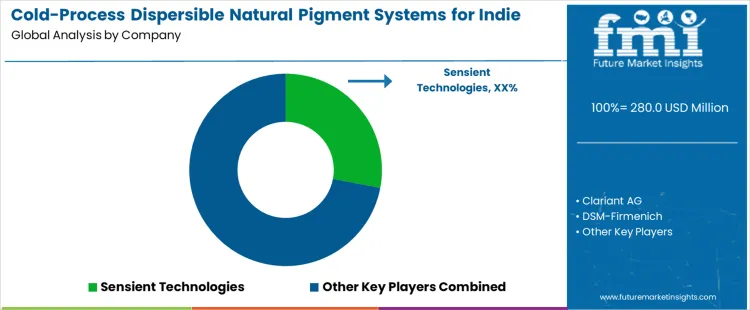
Demand for cold-process dispersible natural pigment systems for indie formulators is driven by small-batch manufacturing, low-energy processing, and rapid product iteration cycles. Indie brands favor pigments that disperse uniformly without heat, high shear, or extended milling, enabling simplified production and reduced equipment investment. Buyers evaluate dispersion ease, shade consistency, sedimentation control, microbial stability, and compatibility with water-based, oil-based, and hybrid formulations. Procurement teams prioritize suppliers offering pre-dispersed or surface-treated natural pigments, low minimum order quantities, and clear documentation supporting natural and clean label positioning. Trend in the global market reflects growth of direct-to-consumer beauty brands, emphasis on artisanal production, and preference for scalable formulations adaptable from pilot to commercial volumes.
Sensient Technologies holds leading positioning through cold-processable natural pigment dispersions and strong application support tailored to emerging brands. Clariant AG supplies easy-to-use natural pigment systems engineered for low-energy dispersion and formulation flexibility. DSM-Firmenich supports indie demand through color science expertise and natural ingredient platforms aligned with clean beauty requirements. Sun Chemical, part of DIC Group, provides stable natural pigment dispersions suitable for small and mid-scale production with consistent batch quality. BASF SE contributes natural pigment technologies and formulation guidance supporting cold-process manufacturing workflows. Competitive differentiation depends on dispersion reliability, shade reproducibility, accessibility for small brands, and ability to support growth without reformulation.
Key Players in the Cold-Process Dispersible Natural Pigment Systems for Indie Formulators Market
- Sensient Technologies
- Clariant AG
- DSM-Firmenich
- Sun Chemical (DIC Group)
- BASF SE
Scope of the Report
| Items | Values |
|---|---|
| Quantitative Units | USD million |
| Pigment System Type | Cold-Process Dispersible Botanical Pigments; Surface-Treated Natural Mineral Pigments; Pre-Dispersed Liquid Natural Pigment Systems; Hybrid Bio-Mineral Pigment Blends |
| Processing Compatibility | Room-Temperature Emulsion Systems; Water-Based Cold Processing; Low-Shear Mixing Compatibility; Anhydrous Cold-Blend Systems |
| Application | Indie Color Cosmetics Formulations; Small-Batch Clean Beauty Products; Custom & Private Label Makeup; R&D Prototyping & Pilot Batches |
| Regions Covered | Asia Pacific, Europe, North America, Latin America, Middle East & Africa |
| Countries Covered | India, China, USA, South Korea, Germany, and 40+ countries |
| Key Companies Profiled | Sensient Technologies; Clariant AG; DSM-Firmenich; Sun Chemical (DIC Group); BASF SE |
| Additional Attributes | Dollar sales by pigment system type and processing compatibility; adoption trends for cold-process and pre-dispersed natural pigments among indie formulators; dispersion efficiency, color consistency, and batch-to-batch reproducibility metrics; compatibility with low-energy, room-temperature manufacturing workflows; shelf stability, microbial control, and handling considerations for small-batch production; cosmetic regulatory compliance and clean-label standards influencing cold-process pigment selection. |
Cold-Process Dispersible Natural Pigment Systems for Indie Formulators Market by Segment
Pigment System Type:
- Cold-Process Dispersible Botanical Pigments
- Surface-Treated Natural Mineral Pigments
- Pre-Dispersed Liquid Natural Pigment Systems
- Hybrid Bio-Mineral Pigment Blends
Processing Compatibility:
- Room-Temperature Emulsion Systems
- Water-Based Cold Processing
- Low-Shear Mixing Compatibility
- Anhydrous Cold-Blend Systems
Application:
- Indie Color Cosmetics Formulations
- Small-Batch Clean Beauty Products
- Custom & Private Label Makeup
- R&D Prototyping & Pilot Batches
Region:
- Asia Pacific
- China
- Japan
- South Korea
- India
- Australia & New Zealand
- ASEAN
- Rest of Asia Pacific
- Europe
- Germany
- United Kingdom
- France
- Italy
- Spain
- Nordic
- BENELUX
- Rest of Europe
- North America
- United States
- Canada
- Mexico
- Latin America
- Brazil
- Chile
- Rest of Latin America
- Middle East & Africa
- Kingdom of Saudi Arabia
- Other GCC Countries
- Turkey
- South Africa
- Other African Union
- Rest of Middle East & Africa
Frequently Asked Questions
How big is the cold-process dispersible natural pigment system market for indie formulators in 2026?
The global cold-process dispersible natural pigment systems for indie formulators market is estimated to be valued at USD 280.0 million in 2026.
What will be the size of cold-process dispersible natural pigment systems for indie formulators market in 2036?
The market size for the cold-process dispersible natural pigment systems for indie formulators market is projected to reach USD 753.1 million by 2036.
How much will be the cold-process dispersible natural pigment systems for indie formulators market growth between 2026 and 2036?
The cold-process dispersible natural pigment systems for indie formulators market is expected to grow at a 10.4% CAGR between 2026 and 2036.
What are the key pigment system types in the cold-process dispersible natural pigment systems for indie formulators market?
The key pigment system types in cold-process dispersible natural pigment systems for indie formulators market are cold-process dispersible botanical pigments, surface-treated natural mineral pigments, pre-dispersed liquid natural pigment systems and hybrid bio-mineral pigment blends.
Which processing compatibility segment will contribute significant share in the cold-process dispersible natural pigment systems for indie formulators market in 2026?
In terms of processing compatibility, room-temperature emulsion systems segment to command 38.0% share in the cold-process dispersible natural pigment systems for indie formulators market in 2026.
Preview the report firsthand - request a free sample
Get SampleGet the brochure for pricing and purchase details.
Get PDFTable of Content
- Executive Summary
- Global Market Outlook
- Demand-side Trends
- Supply-side Trends
- Technology Roadmap Analysis
- Analysis and Recommendations
- Market Overview
- Market Coverage / Taxonomy
- Market Definition / Scope / Limitations
- Market Background
- Market Dynamics
- Drivers
- Restraints
- Opportunity
- Trends
- Scenario Forecast
- Demand in Optimistic Scenario
- Demand in Likely Scenario
- Demand in Conservative Scenario
- Opportunity Map Analysis
- Product Life Cycle Analysis
- Supply Chain Analysis
- Investment Feasibility Matrix
- Value Chain Analysis
- PESTLE and Porter’s Analysis
- Regulatory Landscape
- Regional Parent Market Outlook
- Production and Consumption Statistics
- Import and Export Statistics
- Market Dynamics
- Global Market Analysis 2021 to 2025 and Forecast, 2026 to 2036
- Historical Market Size Value (USD Million) Analysis, 2021 to 2025
- Current and Future Market Size Value (USD Million) Projections, 2026 to 2036
- Y-o-Y Growth Trend Analysis
- Absolute $ Opportunity Analysis
- Global Market Pricing Analysis 2021 to 2025 and Forecast 2026 to 2036
- Global Market Analysis 2021 to 2025 and Forecast 2026 to 2036, By Pigment System Type
- Introduction / Key Findings
- Historical Market Size Value (USD Million) Analysis By Pigment System Type , 2021 to 2025
- Current and Future Market Size Value (USD Million) Analysis and Forecast By Pigment System Type , 2026 to 2036
- Cold-Process Dispersible Botanical Pigments
- Surface-Treated Natural Mineral Pigments
- Pre-Dispersed Liquid Natural Pigment Systems
- Hybrid Bio-Mineral Pigment Blends
- Cold-Process Dispersible Botanical Pigments
- Y-o-Y Growth Trend Analysis By Pigment System Type , 2021 to 2025
- Absolute $ Opportunity Analysis By Pigment System Type , 2026 to 2036
- Global Market Analysis 2021 to 2025 and Forecast 2026 to 2036, By Processing Compatibility
- Introduction / Key Findings
- Historical Market Size Value (USD Million) Analysis By Processing Compatibility, 2021 to 2025
- Current and Future Market Size Value (USD Million) Analysis and Forecast By Processing Compatibility, 2026 to 2036
- Room-Temperature Emulsion Systems
- Water-Based Cold Processing
- Low-Shear Mixing Compatibility
- Anhydrous Cold-Blend Systems
- Room-Temperature Emulsion Systems
- Y-o-Y Growth Trend Analysis By Processing Compatibility, 2021 to 2025
- Absolute $ Opportunity Analysis By Processing Compatibility, 2026 to 2036
- Global Market Analysis 2021 to 2025 and Forecast 2026 to 2036, By Application
- Introduction / Key Findings
- Historical Market Size Value (USD Million) Analysis By Application, 2021 to 2025
- Current and Future Market Size Value (USD Million) Analysis and Forecast By Application, 2026 to 2036
- Indie Color Cosmetics Formulations
- Small-Batch Clean Beauty Products
- Custom & Private Label Makeup
- R&D Prototyping & Pilot Batches
- Indie Color Cosmetics Formulations
- Y-o-Y Growth Trend Analysis By Application, 2021 to 2025
- Absolute $ Opportunity Analysis By Application, 2026 to 2036
- Global Market Analysis 2021 to 2025 and Forecast 2026 to 2036, By Region
- Introduction
- Historical Market Size Value (USD Million) Analysis By Region, 2021 to 2025
- Current Market Size Value (USD Million) Analysis and Forecast By Region, 2026 to 2036
- North America
- Latin America
- Western Europe
- Eastern Europe
- East Asia
- South Asia and Pacific
- Middle East & Africa
- Market Attractiveness Analysis By Region
- North America Market Analysis 2021 to 2025 and Forecast 2026 to 2036, By Country
- Historical Market Size Value (USD Million) Trend Analysis By Market Taxonomy, 2021 to 2025
- Market Size Value (USD Million) Forecast By Market Taxonomy, 2026 to 2036
- By Country
- USA
- Canada
- Mexico
- By Pigment System Type
- By Processing Compatibility
- By Application
- By Country
- Market Attractiveness Analysis
- By Country
- By Pigment System Type
- By Processing Compatibility
- By Application
- Key Takeaways
- Latin America Market Analysis 2021 to 2025 and Forecast 2026 to 2036, By Country
- Historical Market Size Value (USD Million) Trend Analysis By Market Taxonomy, 2021 to 2025
- Market Size Value (USD Million) Forecast By Market Taxonomy, 2026 to 2036
- By Country
- Brazil
- Chile
- Rest of Latin America
- By Pigment System Type
- By Processing Compatibility
- By Application
- By Country
- Market Attractiveness Analysis
- By Country
- By Pigment System Type
- By Processing Compatibility
- By Application
- Key Takeaways
- Western Europe Market Analysis 2021 to 2025 and Forecast 2026 to 2036, By Country
- Historical Market Size Value (USD Million) Trend Analysis By Market Taxonomy, 2021 to 2025
- Market Size Value (USD Million) Forecast By Market Taxonomy, 2026 to 2036
- By Country
- Germany
- UK
- Italy
- Spain
- France
- Nordic
- BENELUX
- Rest of Western Europe
- By Pigment System Type
- By Processing Compatibility
- By Application
- By Country
- Market Attractiveness Analysis
- By Country
- By Pigment System Type
- By Processing Compatibility
- By Application
- Key Takeaways
- Eastern Europe Market Analysis 2021 to 2025 and Forecast 2026 to 2036, By Country
- Historical Market Size Value (USD Million) Trend Analysis By Market Taxonomy, 2021 to 2025
- Market Size Value (USD Million) Forecast By Market Taxonomy, 2026 to 2036
- By Country
- Russia
- Poland
- Hungary
- Balkan & Baltic
- Rest of Eastern Europe
- By Pigment System Type
- By Processing Compatibility
- By Application
- By Country
- Market Attractiveness Analysis
- By Country
- By Pigment System Type
- By Processing Compatibility
- By Application
- Key Takeaways
- East Asia Market Analysis 2021 to 2025 and Forecast 2026 to 2036, By Country
- Historical Market Size Value (USD Million) Trend Analysis By Market Taxonomy, 2021 to 2025
- Market Size Value (USD Million) Forecast By Market Taxonomy, 2026 to 2036
- By Country
- China
- Japan
- South Korea
- By Pigment System Type
- By Processing Compatibility
- By Application
- By Country
- Market Attractiveness Analysis
- By Country
- By Pigment System Type
- By Processing Compatibility
- By Application
- Key Takeaways
- South Asia and Pacific Market Analysis 2021 to 2025 and Forecast 2026 to 2036, By Country
- Historical Market Size Value (USD Million) Trend Analysis By Market Taxonomy, 2021 to 2025
- Market Size Value (USD Million) Forecast By Market Taxonomy, 2026 to 2036
- By Country
- India
- ASEAN
- Australia & New Zealand
- Rest of South Asia and Pacific
- By Pigment System Type
- By Processing Compatibility
- By Application
- By Country
- Market Attractiveness Analysis
- By Country
- By Pigment System Type
- By Processing Compatibility
- By Application
- Key Takeaways
- Middle East & Africa Market Analysis 2021 to 2025 and Forecast 2026 to 2036, By Country
- Historical Market Size Value (USD Million) Trend Analysis By Market Taxonomy, 2021 to 2025
- Market Size Value (USD Million) Forecast By Market Taxonomy, 2026 to 2036
- By Country
- Kingdom of Saudi Arabia
- Other GCC Countries
- Turkiye
- South Africa
- Other African Union
- Rest of Middle East & Africa
- By Pigment System Type
- By Processing Compatibility
- By Application
- By Country
- Market Attractiveness Analysis
- By Country
- By Pigment System Type
- By Processing Compatibility
- By Application
- Key Takeaways
- Key Countries Market Analysis
- USA
- Pricing Analysis
- Market Share Analysis, 2025
- By Pigment System Type
- By Processing Compatibility
- By Application
- Canada
- Pricing Analysis
- Market Share Analysis, 2025
- By Pigment System Type
- By Processing Compatibility
- By Application
- Mexico
- Pricing Analysis
- Market Share Analysis, 2025
- By Pigment System Type
- By Processing Compatibility
- By Application
- Brazil
- Pricing Analysis
- Market Share Analysis, 2025
- By Pigment System Type
- By Processing Compatibility
- By Application
- Chile
- Pricing Analysis
- Market Share Analysis, 2025
- By Pigment System Type
- By Processing Compatibility
- By Application
- Germany
- Pricing Analysis
- Market Share Analysis, 2025
- By Pigment System Type
- By Processing Compatibility
- By Application
- UK
- Pricing Analysis
- Market Share Analysis, 2025
- By Pigment System Type
- By Processing Compatibility
- By Application
- Italy
- Pricing Analysis
- Market Share Analysis, 2025
- By Pigment System Type
- By Processing Compatibility
- By Application
- Spain
- Pricing Analysis
- Market Share Analysis, 2025
- By Pigment System Type
- By Processing Compatibility
- By Application
- France
- Pricing Analysis
- Market Share Analysis, 2025
- By Pigment System Type
- By Processing Compatibility
- By Application
- India
- Pricing Analysis
- Market Share Analysis, 2025
- By Pigment System Type
- By Processing Compatibility
- By Application
- ASEAN
- Pricing Analysis
- Market Share Analysis, 2025
- By Pigment System Type
- By Processing Compatibility
- By Application
- Australia & New Zealand
- Pricing Analysis
- Market Share Analysis, 2025
- By Pigment System Type
- By Processing Compatibility
- By Application
- China
- Pricing Analysis
- Market Share Analysis, 2025
- By Pigment System Type
- By Processing Compatibility
- By Application
- Japan
- Pricing Analysis
- Market Share Analysis, 2025
- By Pigment System Type
- By Processing Compatibility
- By Application
- South Korea
- Pricing Analysis
- Market Share Analysis, 2025
- By Pigment System Type
- By Processing Compatibility
- By Application
- Russia
- Pricing Analysis
- Market Share Analysis, 2025
- By Pigment System Type
- By Processing Compatibility
- By Application
- Poland
- Pricing Analysis
- Market Share Analysis, 2025
- By Pigment System Type
- By Processing Compatibility
- By Application
- Hungary
- Pricing Analysis
- Market Share Analysis, 2025
- By Pigment System Type
- By Processing Compatibility
- By Application
- Kingdom of Saudi Arabia
- Pricing Analysis
- Market Share Analysis, 2025
- By Pigment System Type
- By Processing Compatibility
- By Application
- Turkiye
- Pricing Analysis
- Market Share Analysis, 2025
- By Pigment System Type
- By Processing Compatibility
- By Application
- South Africa
- Pricing Analysis
- Market Share Analysis, 2025
- By Pigment System Type
- By Processing Compatibility
- By Application
- USA
- Market Structure Analysis
- Competition Dashboard
- Competition Benchmarking
- Market Share Analysis of Top Players
- By Regional
- By Pigment System Type
- By Processing Compatibility
- By Application
- Competition Analysis
- Competition Deep Dive
- Sensient Technologies
- Overview
- Product Portfolio
- Profitability by Market Segments (Product/Age /Sales Channel/Region)
- Sales Footprint
- Strategy Overview
- Marketing Strategy
- Product Strategy
- Channel Strategy
- Clariant AG
- DSM-Firmenich
- Sun Chemical (DIC Group)
- BASF SE
- Sensient Technologies
- Competition Deep Dive
- Assumptions & Acronyms Used
- Research Methodology


