

- Industry Size (2026)
- USD 165 Mn
- Forecast (2036)
- USD 431.9 Mn
- CAGR (2026 to 2036)
- 10.1%
Acrylic-Based Binder Systems for High-Performance Battery Separators Market Forecast and Outlook 2026 to 2036
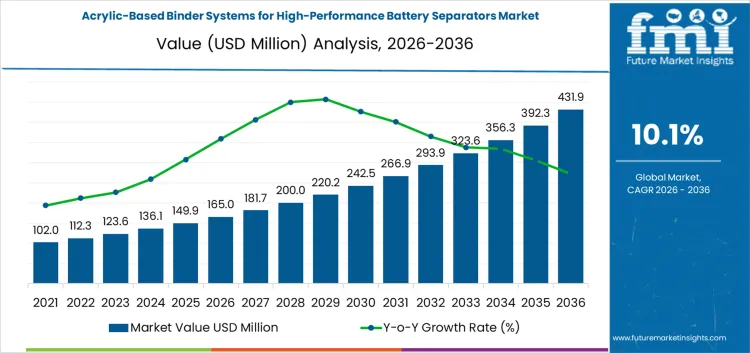
The acrylic-based binder systems for high-performance battery separators market is valued at USD 165 million in 2026 and is projected to reach USD 431.9 million by 2036, reflecting a CAGR of 10.1%. Growth is supported by rising demand for lithium-ion battery separators with enhanced thermal stability, chemical resistance, and mechanical integrity. Binder chemistries include standard acrylic systems, PVDF-acrylic hybrids, water-based acrylic dispersions, and nano-enhanced composite binders. Cost structures are shaped by formulation complexity, raw material pricing, and quality validation. Margin concentration favors operators delivering consistent, application-ready binders rather than simply producing volume.
Between 2026 and 2036, value capture aligns with applications across lithium-ion battery separators, separator surface coatings, ceramic-coated binder layers, and high-temperature systems. Adoption correlates with EV deployment and energy storage expansion in key manufacturing regions. Leading companies such as Arkema, The Lubrizol Corporation, Kureha Corporation, Daikin Industries, DuPont, Solvay SA, and Targray secure higher margins through technological integration, process reliability, and compliance with performance specifications. Operators focusing solely on scale without validated application alignment face lower returns, while those providing certified, high-performance binders achieve concentrated value and sustainable revenue growth over the forecast period.
Quick Stats of the Acrylic-Based Binder Systems for High-Performance Battery Separators Market
- Acrylic-Based Binder Systems for High-Performance Battery Separators Market Value (2026): USD 165 million
- Acrylic-Based Binder Systems for High-Performance Battery Separators Market Forecast Value (2036): USD 431.9 million
- Acrylic-Based Binder Systems for High-Performance Battery Separators Market Forecast CAGR (2026–2036): 10.1%
- Acrylic-Based Binder Systems for High-Performance Battery Separators Market Leading Binder Chemistry: Acrylic binder systems
- Acrylic-Based Binder Systems for High-Performance Battery Separators Market Key Growth Regions: India, China, USA, Brazil, UK
- Acrylic-Based Binder Systems for High-Performance Battery Separators Market Top Players: Arkema, The Lubrizol Corporation, Kureha Corporation, Daikin Industries, DuPont, Solvay SA, Targray
What is the Growth Forecast for Acrylic-Based Binder Systems for High-Performance Battery Separators Market through 2036?
Between 2026 and 2031, the acrylic-based binder systems for high-performance battery separators market is projected to grow from USD 165 million to USD 266 million, generating an absolute increase of USD 101 million and accounting for approximately 37% of total decade growth. Early-stage growth is driven by adoption of acrylic binders in lithium-ion battery separators for electric vehicles and energy storage systems, investments in coating and formulation optimization, and rising demand for high-performance batteries. Cost structures are influenced by polymer sourcing, binder uniformity, and process control. Value capture favors suppliers delivering consistent, high-quality binder systems rather than volume alone.
From 2031 to 2036, the market is expected to expand from USD 266 million to USD 431.9 million, adding USD 175 million and representing roughly 67% of total decade growth. Growth accelerates as EV adoption and stationary storage deployments increase, driving demand for advanced battery separators. Margins increasingly favor operators controlling polymer quality, coating precision, and supply chain reliability. Competitive advantage shifts toward firms offering validated performance, consistent production, and long-term supply agreements, while late entrants optimize operational efficiency and capacity scaling to capture incremental market share.
Acrylic Based Binder Systems for High Performance Battery Separators Market Key Takeaways
| Metric | Value |
|---|---|
| Market Value (2026) | USD 165 million |
| Forecast Value (2036) | USD 431.9 million |
| Forecast CAGR (2026–2036) | 10.1% |
What Is Driving the Adoption of Acrylic-Based Binder Systems in High-Performance Battery Separators?
Acrylic-based binder systems for high-performance battery separators are increasingly deployed to improve mechanical strength, thermal stability, and electrolyte retention in lithium-ion cells. Historically, separators relied on conventional binders with limited adhesion and chemical resistance, constraining cycle life and safety. Acrylic binders enhance particle cohesion, maintain porosity, and provide dimensional stability under high-rate cycling, enabling more reliable performance in electric vehicles, consumer electronics, and stationary energy storage. Separator manufacturers emphasize uniform coating, binder-polymer compatibility, and process scalability. Value capture is concentrated on consistent electrochemical performance, reduced defect rates, and integration efficiency rather than sheer production volume. Early adoption focused on pilot scale trials to optimize formulation and coating parameters.
Future growth is influenced by increasing demand for higher energy density batteries, regulatory safety standards, and lifecycle performance rather than minor product enhancements alone. Compared with earlier binder applications, modern acrylic systems prioritize reproducible coating thickness, controlled viscosity, and thermal resilience for large-scale manufacturing. Cost structures depend on polymer pricing, solvent management, and process yield, concentrating margins among suppliers able to provide high quality, scalable binder solutions. Battery manufacturers adopt these systems to ensure separator durability, dimensional stability, and electrolyte compatibility. By 2036, acrylic-based binder systems are expected to become a core enabling technology for high-performance lithium-ion battery separators, supporting both safety and long-term operational reliability.
What Factors Are Shaping the Demand for Acrylic Based Binder Systems for High Performance Battery Separators in Terms of Binder Chemistry and Application?
The demand for acrylic based binder systems for high performance battery separators is segmented by binder chemistry and application. Binder chemistries include acrylic binder systems, PVDF acrylic hybrid binders, water based acrylic dispersions, and nano enhanced acrylic composite binders. Applications cover lithium ion battery separators, separator surface coatings, ceramic coated separator binders, and high temperature separator systems. Segment adoption is influenced by adhesion performance, thermal stability, and chemical compatibility. Uptake is driven by the need to maintain separator integrity, ionic conductivity, and mechanical durability. Regulatory compliance and reproducibility guide material and application selection more than cost considerations.
What Is Driving the Dominance of Acrylic Binder Systems in High Performance Battery Separators?
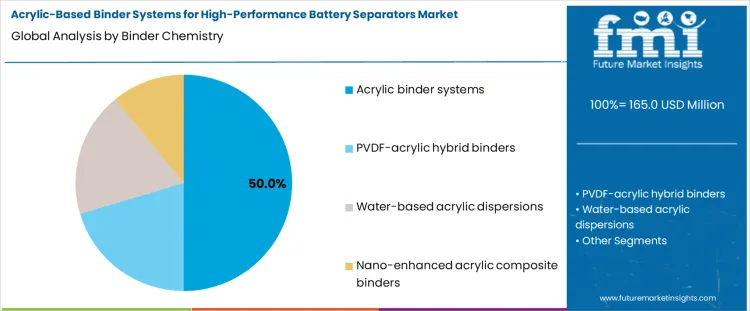
Acrylic binder systems account for approximately 50% of total binder chemistry demand, making them the leading category. This share reflects their ability to provide strong adhesion to separator membranes while maintaining flexibility and chemical stability. Acrylic binders form uniform coatings that enhance mechanical strength and thermal resistance of lithium ion battery separators. Manufacturers favor these systems for compatibility with standard separator fabrication processes, ease of application, and consistent performance in multi layer battery cells.
Demand for acrylic binder systems is driven by separator reliability and cycle life requirements. These binders enable robust adhesion of polymer and ceramic coatings, ensuring uniform ionic pathways and preventing delamination during cycling. Adoption is reinforced by predictable rheology and scalability in coating lines. The segment leads because acrylic binders deliver consistent electrochemical performance, manufacturability, and regulatory alignment, supporting high efficiency lithium ion battery production.
Why Do Lithium Ion Battery Separators Represent the Largest Application Segment for Acrylic Binder Systems?
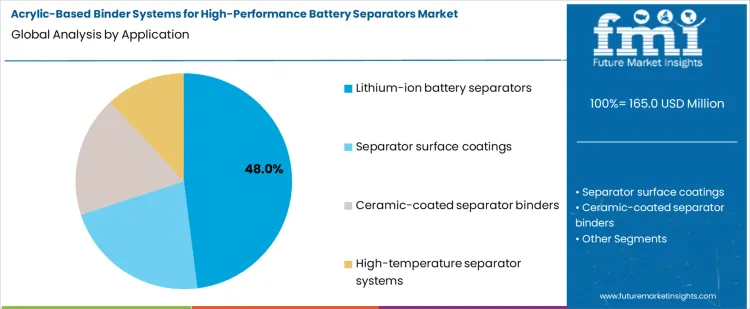
Lithium ion battery separators account for approximately 48% of total application demand, making them the largest segment. This reflects the critical role of separators in maintaining ionic transport, preventing short circuits, and ensuring overall battery safety. Acrylic binders reinforce separator membranes, providing mechanical strength and thermal stability under operating conditions.
Demand in separator applications is shaped by performance, safety, and manufacturing considerations. Battery producers require binders that maintain adhesion, porosity, and flexibility to support high cycle life and energy density. Separator coating processes rely on uniform binder distribution and controlled drying behavior. The segment leads because lithium ion battery separators combine high material demand, critical functional requirements, and process reproducibility, making them the primary target for acrylic based binder integration.
How Are Acrylic-Based Binder Systems Improving High-Performance Battery Separator Functionality?
Acrylic-based binder systems for high-performance battery separators enhance mechanical strength, thermal stability, and electrolyte compatibility in lithium-ion cells. Adoption is driven by battery manufacturers producing electric vehicles, portable electronics, and energy storage systems that demand consistent separator performance. The binders improve coating adhesion, dimensional stability, and cycle life of battery cells. Growth is strongest in regions with concentrated EV and energy storage production. Investment decisions prioritize process reproducibility, binder uniformity, and compatibility with existing coating equipment rather than overall throughput. Material performance, regulatory compliance, and integration reliability are key factors influencing procurement in high-demand regional battery markets.
Why Are Regional EV and Energy Storage Developments Driving Demand for Acrylic Binder Systems?
Demand is concentrated in countries with strong electric vehicle adoption and energy storage deployment, where battery performance and safety are critical. Manufacturers seek binders that maintain separator integrity under thermal and electrochemical stress while supporting high-rate cycling. Suppliers offering reproducible, high-quality acrylic binder formulations gain preferential adoption. Local regulatory frameworks on battery safety, material handling, and solvent emissions further encourage adoption. The driver is performance assurance and compliance with safety standards rather than cost reduction. Binders with documented reliability and compatibility with industrial separator production secure stronger positioning in regional lithium-ion battery manufacturing ecosystems.
What Operational and Technical Constraints Limit Broader Implementation of Acrylic Binder Systems?
Challenges include maintaining consistent binder viscosity, ensuring uniform coating adhesion, and managing solvent recovery in high-speed production lines. Variability in resin quality or processing parameters can compromise separator performance, affecting electrolyte wetting and dimensional stability. Capital-intensive coating and drying equipment limits participation to larger operators. Some manufacturers encounter integration challenges with existing separator handling systems. Regulatory compliance for solvent use and process emissions adds operational complexity. These factors slow widespread adoption and concentrate deployment among experienced suppliers with technical expertise and established quality control protocols in battery separator production.
How Are Process Development and Collaboration Shaping the Adoption of Acrylic Binders in Separators?
Trends include optimizing binder formulations for thermal and chemical stability, improving slurry coating uniformity, and implementing inline quality monitoring to ensure reproducibility. Collaborations between binder suppliers, separator manufacturers, and battery cell producers streamline process integration and material validation. Pilot-scale trials are increasingly used to confirm performance before full-scale production. Digital process tracking and solvent management systems enhance quality control and regulatory compliance. Emphasis is on reproducibility, mechanical performance, and integration reliability rather than throughput or cost efficiency. Collaborative approaches enable consistent production of high-performance separators with acrylic binders suitable for demanding lithium-ion battery applications.
What is the Demand for Acrylic-Based Binder Systems for High-Performance Battery Separators by Country?
| Country | CAGR (%) |
|---|---|
| USA | 9.3 |
| UK | 8.9 |
| China | 10.8 |
| India | 11.5 |
| Brazil | 9.6 |
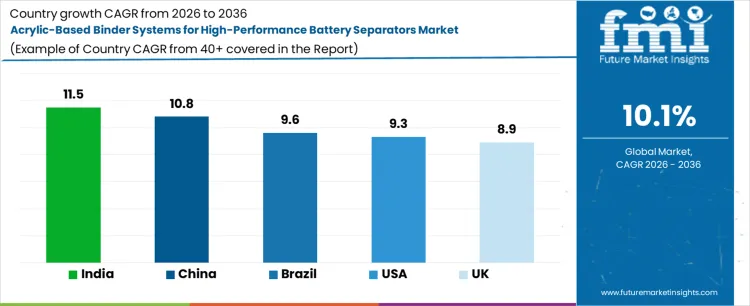
Demand for acrylic-based binder systems for high-performance battery separators is increasing as lithium-ion battery manufacturers enhance adhesion, mechanical stability, and electrochemical performance of separator membranes. India leads with an 11.5% CAGR, supported by rapid EV and energy storage deployment, domestic cell manufacturing growth, and adoption of high-performance acrylic binders to improve cycle life and safety. China follows at 10.8%, driven by large-scale lithium-ion production, stringent quality requirements, and integration of acrylic binder systems in advanced separator designs. Brazil records 9.6% growth, shaped by nascent EV and stationary storage markets and increasing use of high-quality separators. The USA grows at 9.3%, reflecting adoption across EV, consumer electronics, and industrial storage applications. The UK shows 8.9% CAGR, supported by gradual integration of acrylic-based binders in domestic battery manufacturing.
How Are High-Performance Battery Standards Driving Acrylic Binder Adoption in the United States?
In the United States, the acrylic-based binder systems for high-performance battery separators market is expanding at a CAGR of 9.3%, supported by rising demand for lithium-ion batteries in electric vehicles, consumer electronics, and energy storage applications. Manufacturers are implementing advanced binder formulations to enhance separator adhesion, thermal stability, and mechanical integrity. Demand is concentrated among battery producers focused on high-performance and long-cycle-life applications. Investments prioritize binder formulation optimization, coating uniformity, and quality assurance rather than large-scale capacity expansion. Growth reflects strategic upgrades to improve separator reliability and meet regulatory and performance standards.
- EV and energy storage demand drives adoption of acrylic binder systems.
- Binder adhesion, thermal stability, and mechanical strength are critical.
- Battery producers focus on coating uniformity and quality assurance.
- Performance and safety standards guide investment decisions.
Why Are Regulatory and Performance Requirements Supporting Binder Adoption in the United Kingdom?
In the United Kingdom, the acrylic-based binder systems for high-performance battery separators market is growing at a CAGR of 8.9%, driven by energy storage and EV regulations requiring high-quality separators. Manufacturers focus on producing uniform, thermally stable coatings that enhance separator performance. Demand is concentrated among battery producers adhering to automotive and industrial safety and performance standards. Investments emphasize process reproducibility, quality verification, and material reliability rather than rapid expansion. Growth reflects structured adoption aligned with performance specifications and regulatory guidance.
- Regulatory compliance and performance standards drive binder system adoption.
- Uniform coatings and thermal stability are key priorities.
- Battery producers emphasize reproducible, reliable processes.
- Adoption is concentrated in EV and industrial energy storage sectors.
How Is Electric Vehicle and Energy Storage Growth Accelerating Binder Demand in China?
China is witnessing strong growth in acrylic-based binder systems for high-performance battery separators, with a CAGR of 10.8%, fueled by rapid EV production and expanding energy storage installations. Manufacturers are deploying advanced binder formulations to enhance separator adhesion, mechanical strength, and thermal performance. Demand is concentrated in industrial clusters supplying batteries for EVs, energy storage, and consumer electronics. Investments focus on process control, coating uniformity, and quality validation. Growth is influenced by domestic market expansion and international performance requirements for exported batteries.
- EV and energy storage market expansion drives binder adoption.
- Mechanical integrity and thermal performance are critical metrics.
- Industrial battery clusters concentrate demand.
- Quality validation ensures compliance with domestic and export standards.
Why Is Rising Battery Manufacturing Capacity Driving Binder Adoption in India?
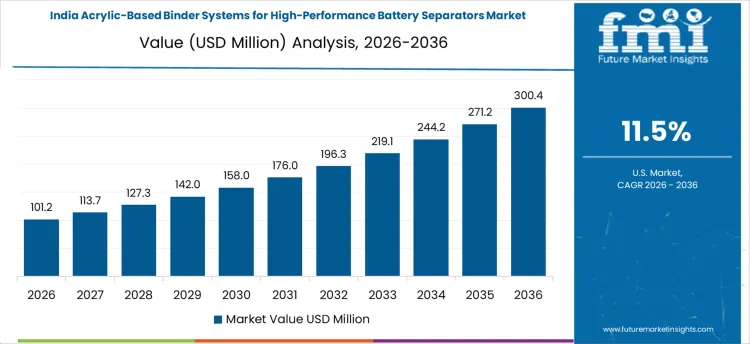
India shows the fastest growth in acrylic-based binder systems for high-performance battery separators, expanding at a CAGR of 11.5%, supported by increasing EV manufacturing, energy storage deployment, and electronics production. Manufacturers are optimizing binder formulations to improve separator adhesion, thermal stability, and cycle life. Demand is concentrated among high-capacity battery producers aiming for long-cycle, high-performance applications. Investments prioritize process reproducibility, coating uniformity, and material reliability. Growth reflects both rising production volumes and strategic adoption to meet safety and performance standards.
- EV and energy storage expansion increases binder system demand.
- Coating uniformity and thermal stability are critical for performance.
- High-capacity battery producers lead adoption.
- Safety and long-cycle performance guide investments.
How Is Industrial and Energy Storage Deployment Supporting Binder Adoption in Brazil?
Brazil is recording steady growth in acrylic-based binder systems for high-performance battery separators at a CAGR of 9.6%, supported by expanding EV and energy storage markets. Manufacturers are investing in binder formulations that enhance separator adhesion, thermal resistance, and mechanical strength. Demand is concentrated in industrial battery clusters supplying automotive and energy storage applications. Investments focus on process control, coating uniformity, and quality assurance rather than rapid capacity expansion. Growth reflects strategic upgrades to ensure high-performance battery separator reliability.
- EV and energy storage adoption drives binder system demand.
- Adhesion, thermal resistance, and mechanical strength are critical.
- Industrial battery clusters concentrate adoption and investment.
- Process control and quality assurance support compliance and performance.
Who Competes in the Acrylic-Based Binder Systems Market for High-Performance Battery Separators and How Do They Differ?
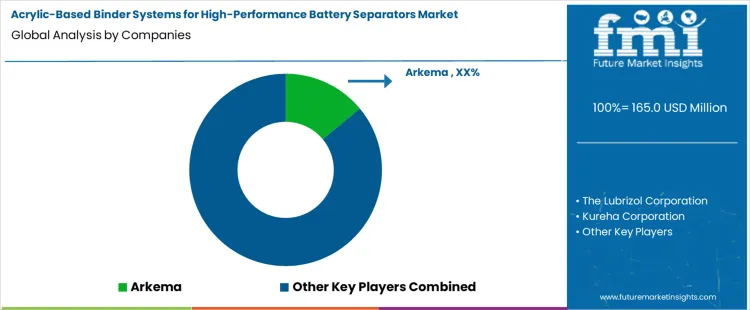
Competition in acrylic based binder systems for high performance battery separators is defined by polymer formulation quality, binder adhesion performance, and compatibility with separator substrates. Arkema focuses on customized acrylic chemistries designed to optimize mechanical stability, thermal resistance, and electrolyte affinity in lithium ion cells. The Lubrizol Corporation emphasizes specialty polymer binders with controlled molecular weight distribution and coating performance for uniform separator application. Kureha Corporation provides advanced acrylic binders tailored for high ionic conductivity and mechanical integrity in high energy density cells.
Other participants differentiate through processing support, formulation flexibility, and integration with separator production lines. Daikin Industries delivers acrylic binder solutions compatible with various solvent systems and substrate treatments. DuPont contributes binder technologies with proven thermal and chemical stability suited for battery cells under high load. Solvay SA offers polymer customization and coating expertise for separator converters, while Targray supports supply chain integration and material consistency. Competitive differentiation arises from binder adhesion performance, coating process compatibility, thermal and chemical resistance, and ability to maintain consistent separator quality under high production volumes. Firms that combine polymer performance with production support and supply reliability secure stronger positioning in the high performance battery separator market.
Key Players in the Acrylic-Based Binder Systems for High-Performance Battery Separators Market
- Arkema
- The Lubrizol Corporation
- Kureha Corporation
- Daikin Industries
- DuPont
- Solvay SA
- Targray
Scope of the Report
| Items | Values |
|---|---|
| Quantitative Units (2026) | USD million |
| Binder Chemistry | Acrylic binder systems, PVDF acrylic hybrid binders, Water based acrylic dispersions, Nano enhanced acrylic composite binders |
| Application | Lithium ion battery separators, Separator surface coatings, Ceramic coated separator binders, High temperature separator systems |
| Region | Asia Pacific, Europe, North America, Latin America, Middle East & Africa |
| Key Countries Covered | China, Japan, South Korea, India, Australia & New Zealand, ASEAN, Germany, United Kingdom, France, Italy, Spain, Nordic, BENELUX, United States, Canada, Mexico, Brazil, Chile, Kingdom of Saudi Arabia, Other GCC Countries, Turkey, South Africa, Other African Union |
| Key Companies Profiled | Arkema, The Lubrizol Corporation, Kureha Corporation, Daikin Industries, DuPont, Solvay SA, Targray |
| Additional Attributes | Dollar sales by binder chemistry and application, adhesion performance, thermal and chemical stability, electrochemical performance support, process reproducibility, compatibility with separator substrates, solvent management, coating uniformity, EV and energy storage alignment, industrial-scale production capability, quality assurance and regulatory compliance |
Acrylic-Based Binder Systems for High-Performance Battery Separators Market Segmentation
Binder Chemistry:
- Acrylic binder systems
- PVDF acrylic hybrid binders
- Water based acrylic dispersions
- Nano enhanced acrylic composite binders
Application:
- Lithium ion battery separators
- Separator surface coatings
- Ceramic coated separator binders
- High temperature separator systems
Region
Asia Pacific
- China
- Japan
- South Korea
- India
- Australia & New Zealand
- ASEAN
- Rest of Asia Pacific
Europe
- Germany
- United Kingdom
- France
- Italy
- Spain
- Nordic
- BENELUX
- Rest of Europe
North America
- United States
- Canada
- Mexico
Latin America
- Brazil
- Chile
- Rest of Latin America
Middle East & Africa
- Kingdom of Saudi Arabia
- Other GCC Countries
- Turkey
- South Africa
- Other African Union
- Rest of Middle East & Africa
Frequently Asked Questions
How big is the acrylic-based binder systems for high-performance battery separators market in 2026?
The global acrylic-based binder systems for high-performance battery separators market is estimated to be valued at USD 165.0 million in 2026.
What will be the size of acrylic-based binder systems for high-performance battery separators market in 2036?
The market size for the acrylic-based binder systems for high-performance battery separators market is projected to reach USD 431.9 million by 2036.
How much will be the acrylic-based binder systems for high-performance battery separators market growth between 2026 and 2036?
The acrylic-based binder systems for high-performance battery separators market is expected to grow at a 10.1% CAGR between 2026 and 2036.
What are the key binder chemistry types in the acrylic-based binder systems for high-performance battery separators market?
The key binder chemistry types in acrylic-based binder systems for high-performance battery separators market are acrylic binder systems, PVDF‑acrylic hybrid binders, water‑based acrylic dispersions and nano‑enhanced acrylic composite binders.
Which application segment will contribute significant share in the acrylic-based binder systems for high-performance battery separators market in 2026?
In terms of application, lithium‑ion battery separators segment to command 48.0% share in the acrylic-based binder systems for high-performance battery separators market in 2026.
Preview the report firsthand - request a free sample
Get SampleGet the brochure for pricing and purchase details.
Get PDFTable of Content
- Executive Summary
- Global Market Outlook
- Demand-side Trends
- Supply-side Trends
- Technology Roadmap Analysis
- Analysis and Recommendations
- Market Overview
- Market Coverage / Taxonomy
- Market Definition / Scope / Limitations
- Market Background
- Market Dynamics
- Drivers
- Restraints
- Opportunity
- Trends
- Scenario Forecast
- Demand in Optimistic Scenario
- Demand in Likely Scenario
- Demand in Conservative Scenario
- Opportunity Map Analysis
- Product Life Cycle Analysis
- Supply Chain Analysis
- Investment Feasibility Matrix
- Value Chain Analysis
- PESTLE and Porter’s Analysis
- Regulatory Landscape
- Regional Parent Market Outlook
- Production and Consumption Statistics
- Import and Export Statistics
- Market Dynamics
- Global Market Analysis 2021 to 2025 and Forecast, 2026 to 2036
- Historical Market Size Value (USD Million) Analysis, 2021 to 2025
- Current and Future Market Size Value (USD Million) Projections, 2026 to 2036
- Y-o-Y Growth Trend Analysis
- Absolute $ Opportunity Analysis
- Global Market Pricing Analysis 2021 to 2025 and Forecast 2026 to 2036
- Global Market Analysis 2021 to 2025 and Forecast 2026 to 2036, By Binder Chemistry
- Introduction / Key Findings
- Historical Market Size Value (USD Million) Analysis By Binder Chemistry , 2021 to 2025
- Current and Future Market Size Value (USD Million) Analysis and Forecast By Binder Chemistry , 2026 to 2036
- Acrylic binder systems
- PVDF‑acrylic hybrid binders
- Water‑based acrylic dispersions
- Nano‑enhanced acrylic composite binders
- Acrylic binder systems
- Y-o-Y Growth Trend Analysis By Binder Chemistry , 2021 to 2025
- Absolute $ Opportunity Analysis By Binder Chemistry , 2026 to 2036
- Global Market Analysis 2021 to 2025 and Forecast 2026 to 2036, By Application
- Introduction / Key Findings
- Historical Market Size Value (USD Million) Analysis By Application, 2021 to 2025
- Current and Future Market Size Value (USD Million) Analysis and Forecast By Application, 2026 to 2036
- Lithium‑ion battery separators
- Separator surface coatings
- Ceramic‑coated separator binders
- High‑temperature separator systems
- Lithium‑ion battery separators
- Y-o-Y Growth Trend Analysis By Application, 2021 to 2025
- Absolute $ Opportunity Analysis By Application, 2026 to 2036
- Global Market Analysis 2021 to 2025 and Forecast 2026 to 2036, By Region
- Introduction
- Historical Market Size Value (USD Million) Analysis By Region, 2021 to 2025
- Current Market Size Value (USD Million) Analysis and Forecast By Region, 2026 to 2036
- North America
- Latin America
- Western Europe
- Eastern Europe
- East Asia
- South Asia and Pacific
- Middle East & Africa
- Market Attractiveness Analysis By Region
- North America Market Analysis 2021 to 2025 and Forecast 2026 to 2036, By Country
- Historical Market Size Value (USD Million) Trend Analysis By Market Taxonomy, 2021 to 2025
- Market Size Value (USD Million) Forecast By Market Taxonomy, 2026 to 2036
- By Country
- USA
- Canada
- Mexico
- By Binder Chemistry
- By Application
- By Country
- Market Attractiveness Analysis
- By Country
- By Binder Chemistry
- By Application
- Key Takeaways
- Latin America Market Analysis 2021 to 2025 and Forecast 2026 to 2036, By Country
- Historical Market Size Value (USD Million) Trend Analysis By Market Taxonomy, 2021 to 2025
- Market Size Value (USD Million) Forecast By Market Taxonomy, 2026 to 2036
- By Country
- Brazil
- Chile
- Rest of Latin America
- By Binder Chemistry
- By Application
- By Country
- Market Attractiveness Analysis
- By Country
- By Binder Chemistry
- By Application
- Key Takeaways
- Western Europe Market Analysis 2021 to 2025 and Forecast 2026 to 2036, By Country
- Historical Market Size Value (USD Million) Trend Analysis By Market Taxonomy, 2021 to 2025
- Market Size Value (USD Million) Forecast By Market Taxonomy, 2026 to 2036
- By Country
- Germany
- UK
- Italy
- Spain
- France
- Nordic
- BENELUX
- Rest of Western Europe
- By Binder Chemistry
- By Application
- By Country
- Market Attractiveness Analysis
- By Country
- By Binder Chemistry
- By Application
- Key Takeaways
- Eastern Europe Market Analysis 2021 to 2025 and Forecast 2026 to 2036, By Country
- Historical Market Size Value (USD Million) Trend Analysis By Market Taxonomy, 2021 to 2025
- Market Size Value (USD Million) Forecast By Market Taxonomy, 2026 to 2036
- By Country
- Russia
- Poland
- Hungary
- Balkan & Baltic
- Rest of Eastern Europe
- By Binder Chemistry
- By Application
- By Country
- Market Attractiveness Analysis
- By Country
- By Binder Chemistry
- By Application
- Key Takeaways
- East Asia Market Analysis 2021 to 2025 and Forecast 2026 to 2036, By Country
- Historical Market Size Value (USD Million) Trend Analysis By Market Taxonomy, 2021 to 2025
- Market Size Value (USD Million) Forecast By Market Taxonomy, 2026 to 2036
- By Country
- China
- Japan
- South Korea
- By Binder Chemistry
- By Application
- By Country
- Market Attractiveness Analysis
- By Country
- By Binder Chemistry
- By Application
- Key Takeaways
- South Asia and Pacific Market Analysis 2021 to 2025 and Forecast 2026 to 2036, By Country
- Historical Market Size Value (USD Million) Trend Analysis By Market Taxonomy, 2021 to 2025
- Market Size Value (USD Million) Forecast By Market Taxonomy, 2026 to 2036
- By Country
- India
- ASEAN
- Australia & New Zealand
- Rest of South Asia and Pacific
- By Binder Chemistry
- By Application
- By Country
- Market Attractiveness Analysis
- By Country
- By Binder Chemistry
- By Application
- Key Takeaways
- Middle East & Africa Market Analysis 2021 to 2025 and Forecast 2026 to 2036, By Country
- Historical Market Size Value (USD Million) Trend Analysis By Market Taxonomy, 2021 to 2025
- Market Size Value (USD Million) Forecast By Market Taxonomy, 2026 to 2036
- By Country
- Kingdom of Saudi Arabia
- Other GCC Countries
- Turkiye
- South Africa
- Other African Union
- Rest of Middle East & Africa
- By Binder Chemistry
- By Application
- By Country
- Market Attractiveness Analysis
- By Country
- By Binder Chemistry
- By Application
- Key Takeaways
- Key Countries Market Analysis
- USA
- Pricing Analysis
- Market Share Analysis, 2025
- By Binder Chemistry
- By Application
- Canada
- Pricing Analysis
- Market Share Analysis, 2025
- By Binder Chemistry
- By Application
- Mexico
- Pricing Analysis
- Market Share Analysis, 2025
- By Binder Chemistry
- By Application
- Brazil
- Pricing Analysis
- Market Share Analysis, 2025
- By Binder Chemistry
- By Application
- Chile
- Pricing Analysis
- Market Share Analysis, 2025
- By Binder Chemistry
- By Application
- Germany
- Pricing Analysis
- Market Share Analysis, 2025
- By Binder Chemistry
- By Application
- UK
- Pricing Analysis
- Market Share Analysis, 2025
- By Binder Chemistry
- By Application
- Italy
- Pricing Analysis
- Market Share Analysis, 2025
- By Binder Chemistry
- By Application
- Spain
- Pricing Analysis
- Market Share Analysis, 2025
- By Binder Chemistry
- By Application
- France
- Pricing Analysis
- Market Share Analysis, 2025
- By Binder Chemistry
- By Application
- India
- Pricing Analysis
- Market Share Analysis, 2025
- By Binder Chemistry
- By Application
- ASEAN
- Pricing Analysis
- Market Share Analysis, 2025
- By Binder Chemistry
- By Application
- Australia & New Zealand
- Pricing Analysis
- Market Share Analysis, 2025
- By Binder Chemistry
- By Application
- China
- Pricing Analysis
- Market Share Analysis, 2025
- By Binder Chemistry
- By Application
- Japan
- Pricing Analysis
- Market Share Analysis, 2025
- By Binder Chemistry
- By Application
- South Korea
- Pricing Analysis
- Market Share Analysis, 2025
- By Binder Chemistry
- By Application
- Russia
- Pricing Analysis
- Market Share Analysis, 2025
- By Binder Chemistry
- By Application
- Poland
- Pricing Analysis
- Market Share Analysis, 2025
- By Binder Chemistry
- By Application
- Hungary
- Pricing Analysis
- Market Share Analysis, 2025
- By Binder Chemistry
- By Application
- Kingdom of Saudi Arabia
- Pricing Analysis
- Market Share Analysis, 2025
- By Binder Chemistry
- By Application
- Turkiye
- Pricing Analysis
- Market Share Analysis, 2025
- By Binder Chemistry
- By Application
- South Africa
- Pricing Analysis
- Market Share Analysis, 2025
- By Binder Chemistry
- By Application
- USA
- Market Structure Analysis
- Competition Dashboard
- Competition Benchmarking
- Market Share Analysis of Top Players
- By Regional
- By Binder Chemistry
- By Application
- Competition Analysis
- Competition Deep Dive
- Arkema
- Overview
- Product Portfolio
- Profitability by Market Segments (Product/Age /Sales Channel/Region)
- Sales Footprint
- Strategy Overview
- Marketing Strategy
- Product Strategy
- Channel Strategy
- The Lubrizol Corporation
- Kureha Corporation
- Daikin Industries
- DuPont
- Solvay SA
- Targray
- Arkema
- Competition Deep Dive
- Assumptions & Acronyms Used
- Research Methodology


