

- Industry Size (2026)
- USD 2100.0 Mn
- Forecast (2036)
- USD 5204.0 Mn
- CAGR (2026 to 2036)
- 9.5%
Battery Fire Retardants Market Forecast and Outlook 2026 to 2036
The battery fire retardants market represents a critical safety technology segment poised for substantial expansion, projected to grow from USD 2,100.0 million in 2026 to USD 5,204.0 million by 2036, achieving a compound annual growth rate of 9.5% throughout the forecast period. This market encompasses specialized chemical formulations designed to prevent, suppress, or delay thermal runaway events in lithium-ion batteries, addressing one of the most significant safety challenges facing the rapidly expanding electric vehicle and energy storage industries. The growing demand reflects heightened awareness of battery fire risks following high-profile incidents and increasingly stringent safety regulations that require comprehensive fire protection systems in battery applications.
Quick Stats for Battery Fire Retardants Market
- Battery Fire Retardants Market Value (2026): USD 2,100.0 million
- Battery Fire Retardants Market Forecast Value (2036): USD 5,204.0 million
- Battery Fire Retardants Market Forecast CAGR: 9.5%
- Leading End Use in Battery Fire Retardants Market: EV packs (60%)
- Key Growth Countries in Battery Fire Retardants Market: China, Brazil, USA., U.K., Germany, South Korea, Japan
- Key Players in Battery Fire Retardants Market: Clariant, ICL Group, Lanxess, Solvay, Albemarle
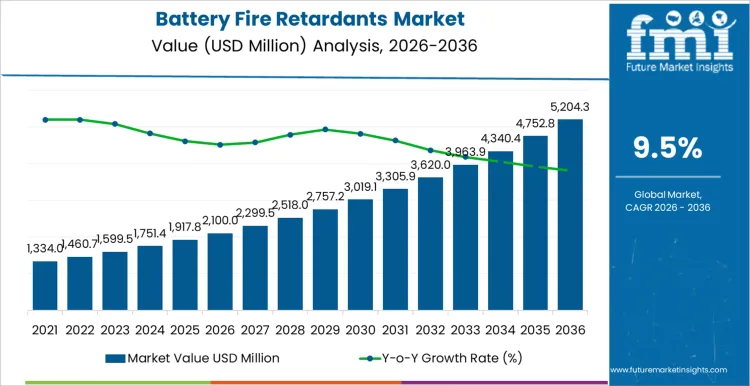
The strategic importance of fire retardants extends beyond immediate safety considerations to encompass regulatory compliance, insurance requirements, and consumer confidence factors that influence electric vehicle market acceptance. Advanced fire retardant systems must address diverse failure modes including overcharging, mechanical damage, manufacturing defects, and aging-related degradation that can trigger thermal runaway cascades across battery modules. Industry development focuses on integrated safety approaches that combine multiple protection mechanisms, including early detection systems, thermal barriers, flame suppressants, and gas management technologies that work synergistically to contain and mitigate battery fire events.
Battery Fire Retardants Market Key Takeaways
| Metric | Value |
|---|---|
| Market Value (2026) | USD 2,100.0 million |
| Market Forecast Value (2036) | USD 5,204.0 million |
| Forecast CAGR 2026 to 2036 | 9.5% |
Why Are Thermal Runaway Incidents Driving Fire Retardant Innovation?
The increasing frequency and severity of lithium-ion battery thermal runaway incidents are fundamentally reshaping fire retardant technology development as manufacturers confront the unique challenges posed by electrochemical energy storage fires. Unlike conventional fires, battery thermal runaway events generate extremely high temperatures exceeding 1000°C, release toxic gases including hydrogen fluoride and carbon monoxide, and can reignite hours or days after apparent extinguishment. These characteristics render traditional fire suppression methods ineffective and demand specialized fire retardant solutions that address both immediate flame suppression and long-term thermal management requirements.
The technical complexity of battery fire retardant development stems from the need to address multiple fire mechanisms simultaneously, including gas phase combustion, surface burning, and thermal propagation between cells. Advanced fire retardant formulations must function effectively in the unique electrochemical environment within battery systems while avoiding interference with ionic conductivity, electrode reactions, or thermal management systems. This multidisciplinary challenge requires collaboration between fire science specialists, electrochemists, materials engineers, and safety experts to develop integrated solutions that provide comprehensive protection without compromising battery functionality.
How Is the Market Structured Across Battery Protection Applications?
The battery fire retardants market exhibits sophisticated segmentation patterns that reflect the diverse protection requirements across different battery components, safety strategies, and application environments. Market structure analysis reveals distinct product categories optimized for specific fire protection mechanisms, from molecular-level flame inhibition in electrolytes to macro-scale thermal barriers in pack encapsulation systems. The segmentation encompasses use areas that address different aspects of battery fire safety, chemistry types that provide various protection mechanisms, and supply formats that enable integration into diverse manufacturing processes.
Understanding market structure requires recognition that fire protection strategies vary significantly based on battery size, chemistry, application environment, and regulatory requirements that influence safety system design. Each use area demands unique fire retardant characteristics related to thermal stability, chemical compatibility, processing requirements, and effectiveness against specific fire scenarios. The market's structural complexity reflects the need for comprehensive fire protection approaches that address multiple failure modes and protection levels within integrated battery systems.
Which Use Area Dominates Fire Protection Applications?
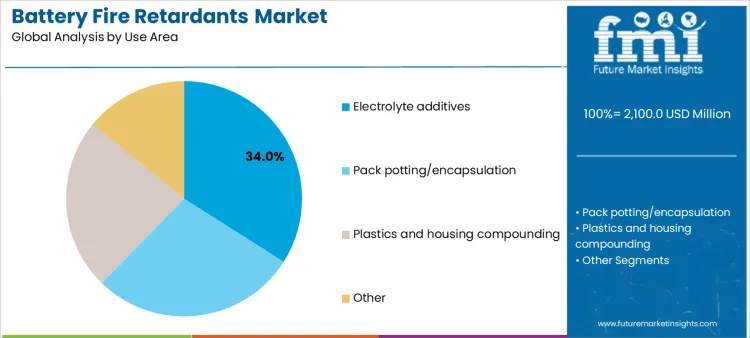
Electrolyte additives command 34.0% market share, representing the largest segment due to their direct integration into the electrochemical system and ability to provide immediate fire suppression at the cellular level. Electrolyte-based fire retardants function by interfering with combustion chemistry when thermal runaway occurs, releasing flame-inhibiting species that suppress gas phase reactions and reduce heat generation rates. These additives must maintain electrochemical compatibility while providing effective fire protection, requiring sophisticated molecular design that balances flame retardancy with ionic conductivity and electrode stability.
The development of electrolyte fire retardant additives represents one of the most challenging applications in battery safety technology, as these materials must function effectively in highly reactive electrochemical environments while avoiding interference with normal battery operation. Advanced formulations incorporate phosphorus-based compounds, ionic liquids, and specialized organic molecules that remain inert during normal operation but activate during thermal runaway events to suppress combustion reactions. The segment benefits from close collaboration between fire retardant chemists and battery electrochemists to optimize additive performance across diverse battery chemistries and operating conditions.
Which Chemistry Platform Leads in Fire Protection Effectiveness?
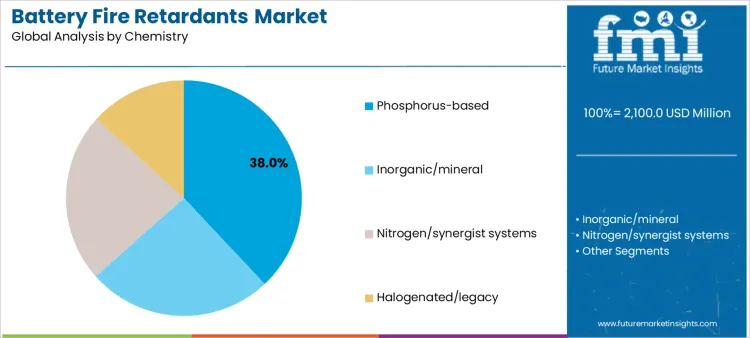
Phosphorus-based fire retardants dominate with 38.0% market share, representing the most effective and versatile chemistry platform for battery fire protection applications. Phosphorus compounds function through multiple mechanisms including gas phase flame inhibition, char formation promotion, and thermal decomposition reactions that absorb heat and dilute combustible gases. The effectiveness of phosphorus-based systems stems from their ability to interfere with combustion chemistry at molecular levels while generating protective char layers that provide thermal barriers against fire propagation.
Phosphorus fire retardants offer particular advantages in battery applications due to their compatibility with organic electrolytes, thermal stability at battery operating temperatures, and effectiveness against the diverse combustion modes present in thermal runaway events. Advanced phosphorus formulations incorporate synergistic systems that combine different phosphorus compounds to optimize performance across varying fire scenarios and battery chemistries. The segment benefits from extensive research and development activities focused on developing environmentally sustainable phosphorus chemistry that provides superior fire protection without generating harmful byproducts.
Which End Use Sector Drives Market Growth?
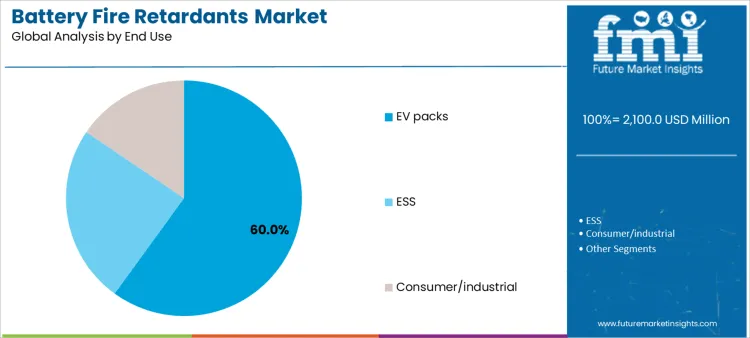
Electric vehicle packs dominate with 60.0% market share, reflecting the automotive industry's commitment to battery safety and the massive scale of global electric vehicle production. EV battery packs require comprehensive fire protection systems that address diverse failure scenarios including collision damage, overcharging events, and manufacturing defects that can trigger thermal runaway cascades. Automotive applications demand fire retardant systems that meet stringent safety standards while maintaining compatibility with vehicle design requirements, weight constraints, and cost targets.
EV fire protection systems must address unique challenges including confined space considerations, toxic gas management, emergency responder safety, and passenger evacuation requirements that influence fire retardant selection and system design. Advanced automotive fire retardant systems incorporate multiple protection levels including cell-level additives, module barriers, pack encapsulation materials, and ventilation systems that work together to contain thermal runaway events and enable safe vehicle operation.
Which Supply Type Enables Optimal Integration?
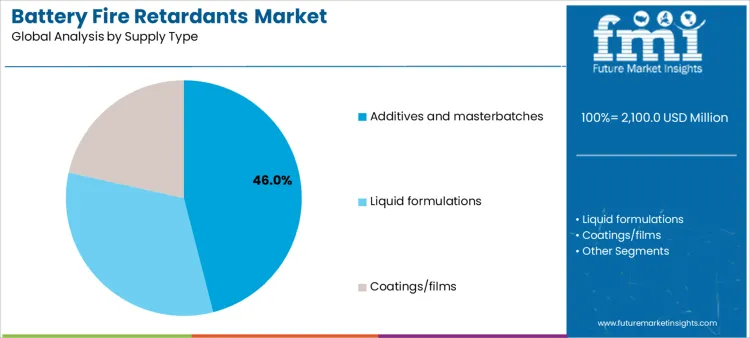
Additives and masterbatches command 46.0% market share, representing the preferred supply format for incorporating fire retardants into polymer components during manufacturing processes. Masterbatch systems enable precise concentration control, consistent dispersion, and simplified handling during injection molding, extrusion, and other polymer processing operations. These supply formats provide advantages in terms of processing consistency, quality control, and inventory management while enabling customization for specific polymer systems and processing conditions.
Masterbatch fire retardant systems typically incorporate carrier polymers, processing aids, and stabilizers that optimize dispersion characteristics and processing compatibility across diverse manufacturing operations. Advanced masterbatch formulations enable high fire retardant loading levels while maintaining good flow properties and minimal impact on mechanical characteristics of finished components. The segment benefits from established supply chain relationships with polymer processors and proven integration methods developed for traditional fire retardant applications.
How Is Regulatory Evolution Shaping Fire Retardant Requirements?
The rapid evolution of battery safety regulations across global markets is fundamentally reshaping fire retardant requirements as regulatory agencies develop comprehensive standards addressing thermal runaway prevention, fire suppression effectiveness, and toxic gas management. Recent regulatory developments include updated UN transportation standards for lithium batteries, enhanced building codes for energy storage installations, and automotive safety requirements that mandate advanced fire protection systems. These regulatory changes create significant market opportunities for fire retardant suppliers who can demonstrate compliance with emerging standards while providing superior safety performance.
Regulatory harmonization efforts across major markets are driving standardization of fire testing protocols, performance criteria, and certification procedures that enable global deployment of advanced fire retardant technologies. International standards organizations are developing comprehensive test methods that evaluate fire retardant effectiveness under realistic battery failure scenarios, including sustained thermal runaway events, gas generation rates, and long-term thermal stability requirements. These standardization efforts reduce development costs and accelerate market adoption while ensuring consistent safety performance across diverse applications and geographic regions.
Do Environmental Concerns Constrain Fire Retardant Development?
Environmental sustainability considerations present both challenges and opportunities for battery fire retardant development as manufacturers seek to balance fire protection effectiveness with environmental compliance requirements. Traditional halogenated fire retardants face increasing regulatory restrictions due to persistence, bioaccumulation, and toxicity concerns that limit their use in consumer and automotive applications. This regulatory pressure drives innovation toward environmentally sustainable chemistry including bio-based phosphorus compounds, inorganic systems, and reactive fire retardants that minimize environmental impact.
The transition toward sustainable fire retardant technologies creates opportunities for manufacturers who can develop high-performance formulations using environmentally acceptable chemistry while maintaining effectiveness against battery fire scenarios. Green chemistry approaches incorporate renewable raw materials, biodegradable components, and non-toxic decomposition products that address environmental concerns while providing superior fire protection performance. These sustainability initiatives often require significant research and development investments but create competitive advantages in markets with stringent environmental requirements.
How Do Integration Challenges Drive Technology Innovation?
The complex integration challenges associated with incorporating fire retardants into battery systems drive continuous innovation in delivery methods, compatibility enhancement, and performance optimization technologies. Fire retardants must maintain effectiveness while avoiding interference with electrochemical reactions, thermal management systems, and mechanical properties that affect battery performance and durability. These integration challenges require sophisticated understanding of materials interactions, processing effects, and long-term stability considerations that influence fire retardant selection and application methods.
Advanced fire retardant technologies incorporate microencapsulation, controlled release mechanisms, and smart activation systems that minimize impact on normal battery operation while providing immediate protection during emergency events. These technologies enable higher fire retardant loading levels without compromising battery performance while ensuring rapid activation when thermal runaway conditions occur. Innovation in integration methods creates competitive advantages for fire retardant suppliers who can provide comprehensive technical support and application expertise to battery manufacturers.
How Is the Battery Fire Retardants Market Expected to Evolve Across Major Nations?
The global battery fire retardants market exhibits distinct regional development patterns reflecting varying approaches to battery management system regulation, manufacturing capabilities, and technology adoption strategies. Major markets demonstrate different priorities regarding fire protection requirements, with some emphasizing performance standards while others focus on environmental compliance or cost optimization. Regional evolution encompasses both established battery manufacturing centers implementing advanced safety technologies and emerging markets developing comprehensive fire protection capabilities.
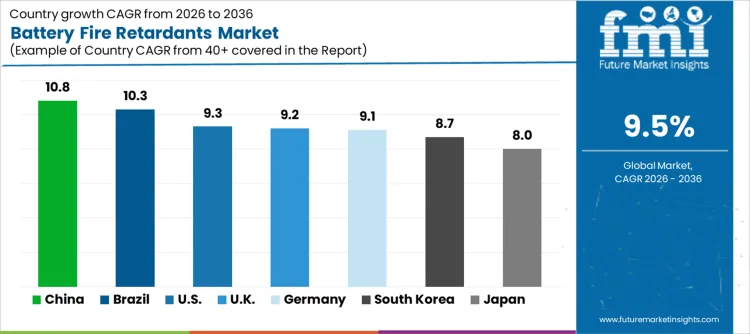
| Country | CAGR (%) |
|---|---|
| China | 10.7% |
| Brazil | 10.3% |
| USA. | 9.3% |
| U.K. | 9.2% |
| Germany | 9.1% |
| South Korea | 8.7% |
| Japan | 8.0% |
What Drives China's Leadership in Fire Retardant Adoption?
China's battery fire retardants market is projected to achieve a CAGR of 10.7%, representing the highest growth rate globally and reflecting the country's massive battery manufacturing capacity and increasing emphasis on safety standards. Market expansion is driven by substantial investments in electric vehicle production, energy storage deployments, and consumer electronics manufacturing that create enormous demand for fire protection technologies. Chinese manufacturers are implementing increasingly sophisticated safety systems as domestic regulations align with international standards and export requirements demand compliance with global safety certifications.
The Chinese government's support for new energy vehicle development includes comprehensive safety requirements that mandate advanced fire protection systems across vehicle platforms and battery applications. Chinese fire retardant manufacturers benefit from access to diverse chemical feedstocks, established polymer processing capabilities, and close relationships with battery manufacturers that enable rapid development and deployment of customized fire protection solutions. The integration of advanced manufacturing technologies and quality control systems in Chinese facilities supports large-scale production of fire retardants meeting international performance standards.
Why Is Brazil Emerging as a Strategic Fire Retardant Market?
Brazil's battery fire retardants market is expected to grow at a CAGR of 10.3%, driven by expanding electric vehicle adoption, growing energy storage deployments, and increasing focus on industrial safety standards across the country's developing battery sector. Market development benefits from Brazil's established chemical industry, growing automotive manufacturing capabilities, and government initiatives promoting electric mobility and renewable energy integration. Brazilian manufacturers are implementing comprehensive safety standards that align with international requirements while addressing local climate and operational conditions.
The establishment of electric vehicle production facilities by major automotive companies creates demand for fire retardant technologies that meet both international safety standards and local regulatory requirements. Brazil's focus on sustainable development and environmental protection drives interest in environmentally friendly fire retardant technologies that support corporate sustainability objectives. The country's strategic location and trade relationships provide opportunities for Brazilian suppliers to serve both domestic and export markets while benefiting from regional manufacturing cost advantages.
How Are US Safety Standards Driving Technology Innovation?
The United States battery fire retardants market is projected to record a CAGR of 9.3%, reflecting the country's leadership in developing advanced safety standards and the substantial investments in domestic battery manufacturing supported by federal incentives and automotive industry commitments. Market growth is driven by stringent safety requirements implemented by regulatory agencies including NHTSA, FAA, and state-level authorities that mandate comprehensive fire protection systems for transportation and stationary applications. US manufacturers prioritize fire retardant technologies that address diverse failure scenarios while meeting environmental and performance requirements.
Government funding for battery safety research through national laboratories and university partnerships accelerates development of next-generation fire retardant technologies that address emerging battery chemistries and applications. US companies focus on developing proprietary fire retardant formulations that provide competitive advantages through superior performance, environmental compliance, and integration capabilities. The emphasis on supply chain security and domestic sourcing creates opportunities for US-based fire retardant manufacturers who can provide reliable access to critical safety technologies.
What Drives the UK's Focus on Integrated Safety Systems?
The United Kingdom's battery fire retardants market is estimated to expand at a CAGR of 9.2%, supported by the country's comprehensive approach to battery safety regulation and commitment to electric vehicle adoption across public and private transportation sectors. Market development is driven by stringent building codes for energy storage installations, automotive safety requirements, and industrial safety standards that mandate advanced fire protection systems. The UK's emphasis on integrated safety approaches creates demand for fire retardant technologies that work synergistically with detection, suppression, and emergency response systems.
Government initiatives supporting electric vehicle infrastructure development and renewable energy storage create sustained demand for fire protection technologies that address diverse installation environments and operational requirements. The UK's strong regulatory framework and safety culture drive adoption of premium fire retardant solutions that provide superior protection while meeting environmental compliance requirements. Research collaborations between UK universities, government agencies, and industry partners advance fundamental understanding of battery fire science and technology development.
How Does Germany's Engineering Standards Shape Fire Protection Requirements?
Germany's battery fire retardants market is likely to rise at a CAGR of 9.1%, reflecting the country's leadership in automotive engineering and commitment to comprehensive safety standards across electric vehicle battery and energy storage applications. Market growth is supported by German automotive manufacturers' emphasis on premium safety systems and the country's stringent environmental regulations that influence fire retardant selection and application methods. German manufacturers prioritize fire retardant solutions that provide exceptional performance consistency, long-term durability, and environmental compatibility.
The country's focus on Industry 4.0 and advanced manufacturing drives adoption of sophisticated fire retardant application technologies that integrate with automated production systems and quality control protocols. German engineering standards emphasize systematic safety approaches that address multiple protection levels and failure modes within integrated battery systems. Research institutions and companies in Germany continue to advance fire retardant science through fundamental research in combustion chemistry, materials science, and safety system integration.
Why Is South Korea's Technology Focus Driving Market Development?
South Korea's battery fire retardants market is projected to increase at a CAGR of 8.7%, driven by the country's advanced battery manufacturing capabilities and emphasis on technology innovation through companies like LG Energy Solution and Samsung SDI. Market expansion reflects South Korea's strategic position as a global battery supplier and ongoing investments in safety technologies that address diverse application requirements. The country's semiconductor and advanced materials expertise translates into sophisticated fire retardant technologies that enable precise control over protection mechanisms and integration methods.
Government support for battery industry development includes substantial funding for safety research and technology commercialization that accelerates fire retardant innovation and deployment. South Korean manufacturers focus on developing high-performance fire retardant systems that address next-generation battery chemistries and applications while maintaining compatibility with established manufacturing processes. The country's export-oriented strategy creates opportunities for Korean fire retardant suppliers to serve global markets while benefiting from advanced domestic technology development capabilities.
How Does Japan's Safety Culture Influence Fire Retardant Adoption?
Japan's battery fire retardants market is likely to expand at a CAGR of 8.0%, reflecting the country's rigorous safety standards and emphasis on reliability that drives adoption of premium fire protection technologies across battery applications. Market growth is supported by Japanese companies' leadership in battery technology development and their commitment to comprehensive safety systems that address both immediate protection and long-term reliability requirements. Japan's focus on consumer safety and product quality creates demand for fire retardant solutions that meet the highest performance and reliability standards.
The Japanese automotive and electronics industries' transition toward electrification emphasizes safety considerations that drive innovation in fire retardant technologies and application methods. Japanese manufacturers prioritize fire retardant systems that address aesthetic considerations, space constraints, and integration challenges while providing superior protection performance. Research institutions and corporate laboratories in Japan advance fire retardant science through interdisciplinary research combining materials chemistry, safety engineering, and electrochemical system design.
How Are Manufacturers Securing Market Share?
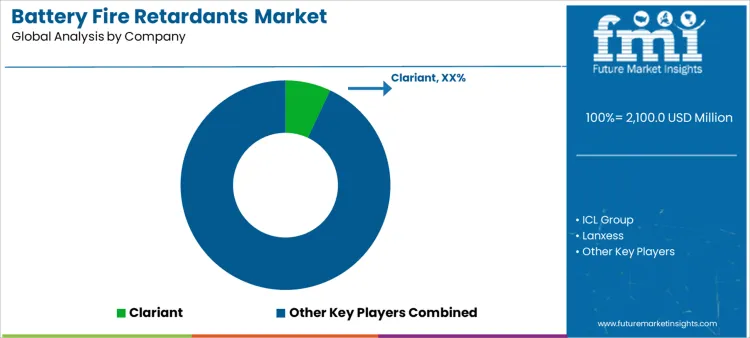
Competition in battery fire retardants is moving fast because safety performance has to be proven, not claimed. Large chemical companies, specialist fire-protection suppliers, and newer tech firms are all chasing the same thing: solutions that slow thermal runaway, limit flame spread, and do it in a way that fits real battery designs and production lines. Suppliers win when they can show repeatable results in recognized test methods, help customers meet local compliance needs, and integrate the chemistry into packs without hurting energy density, cycle life, or manufacturability. Partnerships with cell and pack makers matter because the right answer depends on where the protection sits, such as electrolyte additives, coatings, potting materials, barriers, or venting support.
Development work is accelerating as batteries change. High-energy chemistries, new cell formats, and solid-state roadmaps create different failure modes, so suppliers are investing in labs and fire-testing setups that mimic realistic abuse conditions. Acquisitions and licensing often target niche chemistries, application know-how, or test capability. The strongest players combine material supply with application engineering and regulatory support, and they can serve global programs with consistent quality across regions.
Key Players in the Battery Fire Retardants Market
- Clariant
- ICL Group
- Lanxess
- Solvay
- Albemarle
- Italmatch Chemicals
- ADEKA
- HUBER Engineered Materials
- Zhejiang Wansheng
- Shandong Brother
Scope of Report
| Items | Values |
|---|---|
| Quantitative Units | USD Million |
| Use Area Segments | Electrolyte Additives; Pack Potting/Encapsulation; Plastics and Housing Compounding; Other |
| Chemistry Types | Phosphorus-based; Inorganic/Mineral; Nitrogen/Synergist Systems; Halogenated/Legacy |
| End Use Segments | EV Packs; ESS; Consumer/Industrial |
| Supply Type Categories | Additives and Masterbatches; Liquid Formulations; Coatings/Films |
| Regions Covered | North America, Europe, Asia Pacific, Latin America, Middle East & Africa |
| Key Countries | USA, Germany, China, Brazil, U.K., South Korea, Japan |
| Key Companies Profiled | Clariant, ICL Group, Lanxess, Solvay, Albemarle, and others |
Battery Fire Retardants Market by Segment
By Use Area :
- Electrolyte Additives
- Pack Potting/Encapsulation
- Plastics and Housing Compounding
- Other
By Chemistry :
- Phosphorus-based
- Inorganic/Mineral
- Nitrogen/Synergist Systems
- Halogenated/Legacy
By End Use :
- EV Packs
- ESS
- Consumer/Industrial
By Supply Type :
- Additives and Masterbatches
- Liquid Formulations
- Coatings/Films
Bibliography
- International Electrotechnical Commission. (2024). IEC 62619:2024 - Secondary cells and batteries containing alkaline or other non acid electrolytes - Safety requirements for secondary lithium cells and batteries for use in industrial applications. IEC Publications.
- National Fire Protection Association. (2024). NFPA 855: Standard for the installation of stationary energy storage systems. NFPA Publications.
- National Transportation Safety Board. (2024). Safety risks of lithium ion batteries in transportation: Accident investigation findings and safety recommendations. NTSB Publications.
- USA. Consumer Product Safety Commission. (2024). Lithium ion battery fire hazards: Investigations and safety recommendations. CPSC Safety Report.
Frequently Asked Questions
How big is the battery fire retardants market in 2026?
The global battery fire retardants market is estimated to be valued at USD 2,100.0 million in 2026.
What will be the size of battery fire retardants market in 2036?
The market size for the battery fire retardants market is projected to reach USD 5,204.3 million by 2036.
How much will be the battery fire retardants market growth between 2026 and 2036?
The battery fire retardants market is expected to grow at a 9.5% CAGR between 2026 and 2036.
What are the key product types in the battery fire retardants market?
The key product types in battery fire retardants market are electrolyte additives, pack potting/encapsulation, plastics and housing compounding and other.
Which chemistry segment to contribute significant share in the battery fire retardants market in 2026?
In terms of chemistry, phosphorus-based segment to command 38.0% share in the battery fire retardants market in 2026.
Preview the report firsthand - request a free sample
Get SampleGet the brochure for pricing and purchase details.
Get PDFTable of Content
- Executive Summary
- Global Market Outlook
- Demand-side Trends
- Supply-side Trends
- Technology Roadmap Analysis
- Analysis and Recommendations
- Market Overview
- Market Coverage / Taxonomy
- Market Definition / Scope / Limitations
- Market Background
- Market Dynamics
- Drivers
- Restraints
- Opportunity
- Trends
- Scenario Forecast
- Demand in Optimistic Scenario
- Demand in Likely Scenario
- Demand in Conservative Scenario
- Opportunity Map Analysis
- Product Life Cycle Analysis
- Supply Chain Analysis
- Investment Feasibility Matrix
- Value Chain Analysis
- PESTLE and Porter’s Analysis
- Regulatory Landscape
- Regional Parent Market Outlook
- Production and Consumption Statistics
- Import and Export Statistics
- Market Dynamics
- Global Market Analysis 2021 to 2025 and Forecast, 2026 to 2036
- Historical Market Size Value (USD Million) Analysis, 2021 to 2025
- Current and Future Market Size Value (USD Million) Projections, 2026 to 2036
- Y-o-Y Growth Trend Analysis
- Absolute $ Opportunity Analysis
- Global Market Pricing Analysis 2021 to 2025 and Forecast 2026 to 2036
- Global Market Analysis 2021 to 2025 and Forecast 2026 to 2036, By Use Area
- Introduction / Key Findings
- Historical Market Size Value (USD Million) Analysis By Use Area , 2021 to 2025
- Current and Future Market Size Value (USD Million) Analysis and Forecast By Use Area , 2026 to 2036
- Electrolyte additives
- Pack potting/encapsulation
- Plastics and housing compounding
- Other
- Electrolyte additives
- Y-o-Y Growth Trend Analysis By Use Area , 2021 to 2025
- Absolute $ Opportunity Analysis By Use Area , 2026 to 2036
- Global Market Analysis 2021 to 2025 and Forecast 2026 to 2036, By Chemistry
- Introduction / Key Findings
- Historical Market Size Value (USD Million) Analysis By Chemistry, 2021 to 2025
- Current and Future Market Size Value (USD Million) Analysis and Forecast By Chemistry, 2026 to 2036
- Phosphorus-based
- Inorganic/mineral
- Nitrogen/synergist systems
- Halogenated/legacy
- Phosphorus-based
- Y-o-Y Growth Trend Analysis By Chemistry, 2021 to 2025
- Absolute $ Opportunity Analysis By Chemistry, 2026 to 2036
- Global Market Analysis 2021 to 2025 and Forecast 2026 to 2036, By End Use
- Introduction / Key Findings
- Historical Market Size Value (USD Million) Analysis By End Use, 2021 to 2025
- Current and Future Market Size Value (USD Million) Analysis and Forecast By End Use, 2026 to 2036
- EV packs
- ESS
- Consumer/industrial
- EV packs
- Y-o-Y Growth Trend Analysis By End Use, 2021 to 2025
- Absolute $ Opportunity Analysis By End Use, 2026 to 2036
- Global Market Analysis 2021 to 2025 and Forecast 2026 to 2036, By Supply Type
- Introduction / Key Findings
- Historical Market Size Value (USD Million) Analysis By Supply Type, 2021 to 2025
- Current and Future Market Size Value (USD Million) Analysis and Forecast By Supply Type, 2026 to 2036
- Additives and masterbatches
- Liquid formulations
- Coatings/films
- Additives and masterbatches
- Y-o-Y Growth Trend Analysis By Supply Type, 2021 to 2025
- Absolute $ Opportunity Analysis By Supply Type, 2026 to 2036
- Global Market Analysis 2021 to 2025 and Forecast 2026 to 2036, By Region
- Introduction
- Historical Market Size Value (USD Million) Analysis By Region, 2021 to 2025
- Current Market Size Value (USD Million) Analysis and Forecast By Region, 2026 to 2036
- North America
- Latin America
- Western Europe
- Eastern Europe
- East Asia
- South Asia and Pacific
- Middle East & Africa
- Market Attractiveness Analysis By Region
- North America Market Analysis 2021 to 2025 and Forecast 2026 to 2036, By Country
- Historical Market Size Value (USD Million) Trend Analysis By Market Taxonomy, 2021 to 2025
- Market Size Value (USD Million) Forecast By Market Taxonomy, 2026 to 2036
- By Country
- USA
- Canada
- Mexico
- By Use Area
- By Chemistry
- By End Use
- By Supply Type
- By Country
- Market Attractiveness Analysis
- By Country
- By Use Area
- By Chemistry
- By End Use
- By Supply Type
- Key Takeaways
- Latin America Market Analysis 2021 to 2025 and Forecast 2026 to 2036, By Country
- Historical Market Size Value (USD Million) Trend Analysis By Market Taxonomy, 2021 to 2025
- Market Size Value (USD Million) Forecast By Market Taxonomy, 2026 to 2036
- By Country
- Brazil
- Chile
- Rest of Latin America
- By Use Area
- By Chemistry
- By End Use
- By Supply Type
- By Country
- Market Attractiveness Analysis
- By Country
- By Use Area
- By Chemistry
- By End Use
- By Supply Type
- Key Takeaways
- Western Europe Market Analysis 2021 to 2025 and Forecast 2026 to 2036, By Country
- Historical Market Size Value (USD Million) Trend Analysis By Market Taxonomy, 2021 to 2025
- Market Size Value (USD Million) Forecast By Market Taxonomy, 2026 to 2036
- By Country
- Germany
- UK
- Italy
- Spain
- France
- Nordic
- BENELUX
- Rest of Western Europe
- By Use Area
- By Chemistry
- By End Use
- By Supply Type
- By Country
- Market Attractiveness Analysis
- By Country
- By Use Area
- By Chemistry
- By End Use
- By Supply Type
- Key Takeaways
- Eastern Europe Market Analysis 2021 to 2025 and Forecast 2026 to 2036, By Country
- Historical Market Size Value (USD Million) Trend Analysis By Market Taxonomy, 2021 to 2025
- Market Size Value (USD Million) Forecast By Market Taxonomy, 2026 to 2036
- By Country
- Russia
- Poland
- Hungary
- Balkan & Baltic
- Rest of Eastern Europe
- By Use Area
- By Chemistry
- By End Use
- By Supply Type
- By Country
- Market Attractiveness Analysis
- By Country
- By Use Area
- By Chemistry
- By End Use
- By Supply Type
- Key Takeaways
- East Asia Market Analysis 2021 to 2025 and Forecast 2026 to 2036, By Country
- Historical Market Size Value (USD Million) Trend Analysis By Market Taxonomy, 2021 to 2025
- Market Size Value (USD Million) Forecast By Market Taxonomy, 2026 to 2036
- By Country
- China
- Japan
- South Korea
- By Use Area
- By Chemistry
- By End Use
- By Supply Type
- By Country
- Market Attractiveness Analysis
- By Country
- By Use Area
- By Chemistry
- By End Use
- By Supply Type
- Key Takeaways
- South Asia and Pacific Market Analysis 2021 to 2025 and Forecast 2026 to 2036, By Country
- Historical Market Size Value (USD Million) Trend Analysis By Market Taxonomy, 2021 to 2025
- Market Size Value (USD Million) Forecast By Market Taxonomy, 2026 to 2036
- By Country
- India
- ASEAN
- Australia & New Zealand
- Rest of South Asia and Pacific
- By Use Area
- By Chemistry
- By End Use
- By Supply Type
- By Country
- Market Attractiveness Analysis
- By Country
- By Use Area
- By Chemistry
- By End Use
- By Supply Type
- Key Takeaways
- Middle East & Africa Market Analysis 2021 to 2025 and Forecast 2026 to 2036, By Country
- Historical Market Size Value (USD Million) Trend Analysis By Market Taxonomy, 2021 to 2025
- Market Size Value (USD Million) Forecast By Market Taxonomy, 2026 to 2036
- By Country
- Kingdom of Saudi Arabia
- Other GCC Countries
- Turkiye
- South Africa
- Other African Union
- Rest of Middle East & Africa
- By Use Area
- By Chemistry
- By End Use
- By Supply Type
- By Country
- Market Attractiveness Analysis
- By Country
- By Use Area
- By Chemistry
- By End Use
- By Supply Type
- Key Takeaways
- Key Countries Market Analysis
- USA
- Pricing Analysis
- Market Share Analysis, 2025
- By Use Area
- By Chemistry
- By End Use
- By Supply Type
- Canada
- Pricing Analysis
- Market Share Analysis, 2025
- By Use Area
- By Chemistry
- By End Use
- By Supply Type
- Mexico
- Pricing Analysis
- Market Share Analysis, 2025
- By Use Area
- By Chemistry
- By End Use
- By Supply Type
- Brazil
- Pricing Analysis
- Market Share Analysis, 2025
- By Use Area
- By Chemistry
- By End Use
- By Supply Type
- Chile
- Pricing Analysis
- Market Share Analysis, 2025
- By Use Area
- By Chemistry
- By End Use
- By Supply Type
- Germany
- Pricing Analysis
- Market Share Analysis, 2025
- By Use Area
- By Chemistry
- By End Use
- By Supply Type
- UK
- Pricing Analysis
- Market Share Analysis, 2025
- By Use Area
- By Chemistry
- By End Use
- By Supply Type
- Italy
- Pricing Analysis
- Market Share Analysis, 2025
- By Use Area
- By Chemistry
- By End Use
- By Supply Type
- Spain
- Pricing Analysis
- Market Share Analysis, 2025
- By Use Area
- By Chemistry
- By End Use
- By Supply Type
- France
- Pricing Analysis
- Market Share Analysis, 2025
- By Use Area
- By Chemistry
- By End Use
- By Supply Type
- India
- Pricing Analysis
- Market Share Analysis, 2025
- By Use Area
- By Chemistry
- By End Use
- By Supply Type
- ASEAN
- Pricing Analysis
- Market Share Analysis, 2025
- By Use Area
- By Chemistry
- By End Use
- By Supply Type
- Australia & New Zealand
- Pricing Analysis
- Market Share Analysis, 2025
- By Use Area
- By Chemistry
- By End Use
- By Supply Type
- China
- Pricing Analysis
- Market Share Analysis, 2025
- By Use Area
- By Chemistry
- By End Use
- By Supply Type
- Japan
- Pricing Analysis
- Market Share Analysis, 2025
- By Use Area
- By Chemistry
- By End Use
- By Supply Type
- South Korea
- Pricing Analysis
- Market Share Analysis, 2025
- By Use Area
- By Chemistry
- By End Use
- By Supply Type
- Russia
- Pricing Analysis
- Market Share Analysis, 2025
- By Use Area
- By Chemistry
- By End Use
- By Supply Type
- Poland
- Pricing Analysis
- Market Share Analysis, 2025
- By Use Area
- By Chemistry
- By End Use
- By Supply Type
- Hungary
- Pricing Analysis
- Market Share Analysis, 2025
- By Use Area
- By Chemistry
- By End Use
- By Supply Type
- Kingdom of Saudi Arabia
- Pricing Analysis
- Market Share Analysis, 2025
- By Use Area
- By Chemistry
- By End Use
- By Supply Type
- Turkiye
- Pricing Analysis
- Market Share Analysis, 2025
- By Use Area
- By Chemistry
- By End Use
- By Supply Type
- South Africa
- Pricing Analysis
- Market Share Analysis, 2025
- By Use Area
- By Chemistry
- By End Use
- By Supply Type
- USA
- Market Structure Analysis
- Competition Dashboard
- Competition Benchmarking
- Market Share Analysis of Top Players
- By Regional
- By Use Area
- By Chemistry
- By End Use
- By Supply Type
- Competition Analysis
- Competition Deep Dive
- Clariant
- Overview
- Product Portfolio
- Profitability by Market Segments (Product/Age /Sales Channel/Region)
- Sales Footprint
- Strategy Overview
- Marketing Strategy
- Product Strategy
- Channel Strategy
- ICL Group
- Lanxess
- Solvay
- Albemarle
- Italmatch Chemicals
- ADEKA
- HUBER Engineered Materials
- Zhejiang Wansheng
- Shandong Brother
- Clariant
- Competition Deep Dive
- Assumptions & Acronyms Used
- Research Methodology


