

- Industry Size (2026)
- USD 16.8 Bn
- Forecast (2036)
- USD 43.6 Bn
- CAGR (2026 to 2036)
- 10%
Collaborative Battery Separator Material Innovation Programs Market Forecast and Outlook 2026–2036
The global collaborative battery separator material innovation programs market is expected to grow from USD 16.8 billion in 2026 to USD 43.6 billion by 2036, reflecting a robust CAGR of 10%. This market is fueled by the escalating demand for high-performance separators in lithium-ion batteries, which are crucial for electric vehicles (EVs), energy storage systems (ESS), and consumer electronics. Collaborative innovation programs are central to advancing separator materials, as industry leaders, battery manufacturers, and research institutions work together to enhance battery safety, performance, and durability.
Quick Stats for Collaborative Battery Separator Material Innovation Programs Market
- Collaborative Battery Separator Material Innovation Programs Market Value (2026): USD 16.8 Billion
- Collaborative Battery Separator Material Innovation Programs Market Forecast Value (2036): USD 43.6 Billion
- Collaborative Battery Separator Material Innovation Programs Market Forecast CAGR (2026 to 2036): 10%
- Leading Program Type in Collaborative Battery Separator Material Innovation Programs Market: Industry-Industry Collaborations
- Key Growth Regions in Collaborative Battery Separator Material Innovation Programs Market: Asia Pacific, North America
- Top Key Players in Collaborative Battery Separator Material Innovation Programs Market: SEMCORP Group, CATL, Asahi Kasei Corporation, Toray Industries, Inc., SK Innovation
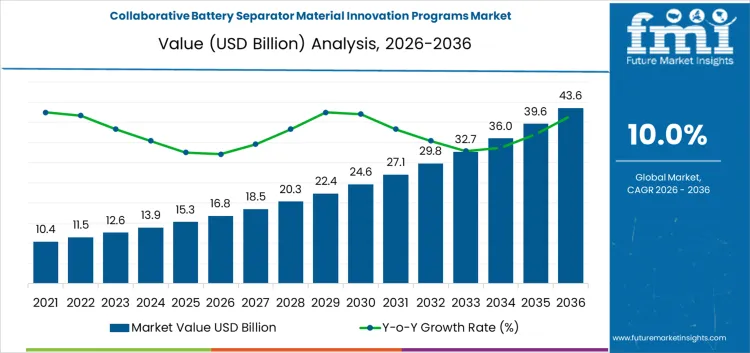
As these collaboration-driven efforts grow, application concentration in EV batteries dominates, accounting for 55% of the market. Growth quality is deeply intertwined with end-use dependencies, particularly in energy storage solutions. The demand for advanced separators is contingent on the rapid adoption of EVs and renewable energy storage. While the collaborative efforts have accelerated the pace of innovation, the challenge of long development cycles, intellectual property concerns, and regulatory hurdles continue to shape outcomes. The stability of supply chains and the evolving partnerships will ultimately determine the capacity for scaling innovative solutions across diverse industries.
Collaborative Battery Separator Material Innovation Programs Market Key Takeaways
| Metric | Value |
|---|---|
| Industry Value (2026) | USD 16.8 Billion |
| Forecast Value (2036) | USD 43.6 Billion |
| Forecast CAGR (2026 to 2036) | 10% |
How is the Global Collaborative Battery Separator Material Innovation Programs Market Advancing?
The global collaborative battery separator material innovation programs market is growing rapidly, fueled by the increasing demand for next-generation battery technologies and the need for enhanced performance and safety in lithium-ion batteries. Collaborative innovation programs between battery manufacturers, material suppliers, and research institutions are playing a key role in advancing the development of new separator materials that are critical for improving battery efficiency, safety, and longevity. These innovations are crucial as the demand for electric vehicles (EVs), renewable energy storage, and portable electronics continues to rise.
The market is being driven by the growing emphasis on high-performance battery systems for EVs and energy storage systems (ESS), where separator materials play a critical role in maintaining battery stability, preventing short circuits, and enhancing overall cell performance. Collaborative efforts are particularly important in addressing the challenges of high-voltage, high-capacity, and fast-charging batteries, which require more durable and efficient separator solutions. These programs facilitate the development of advanced materials that can meet the rigorous demands of next-generation battery technologies.
Technological advancements, such as the development of multi-layer separators, improved polymer and ceramic composites, and more robust and flexible materials, are expected to drive further growth in the market. As the electric vehicle and energy storage industries expand, the demand for innovative and effective battery separator materials will continue to rise, supporting the continued growth of collaborative innovation programs in the coming years.
What is the Segment-Wise Analysis for the Collaborative Battery Separator Material Innovation Programs Market?
The collaborative battery separator material innovation programs market is segmented by program type and application. Industry-industry collaborations lead the market with a 40% share, followed by research consortia, public-private partnerships (PPPs), government-funded innovation grants, and standards & pre-competitive initiatives. These collaborative efforts drive innovation and advancements in battery separator materials. In terms of application, electric vehicle (EV) batteries dominate the market with a 55% share, followed by energy storage systems (ESS), consumer electronics, commercial batteries, and emerging technologies. The growth of these sectors is fueling the demand for cutting-edge separator materials that improve battery performance, safety, and longevity.
Why Do Industry-Industry Collaborations Lead the Market?
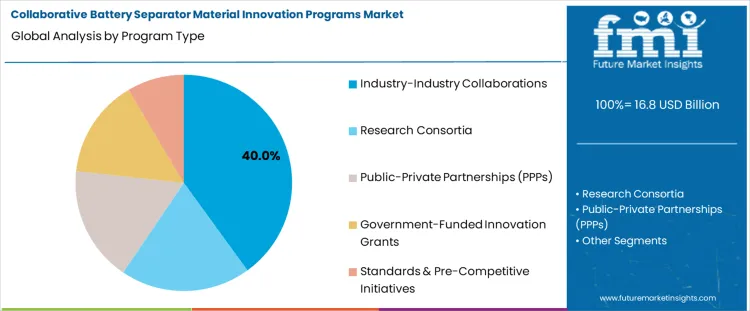
Industry-industry collaborations account for 40% of the market share due to their ability to drive rapid innovation in battery separator materials. These collaborations bring together the expertise of leading companies in battery technology, materials science, and manufacturing, enabling the development of advanced separator materials that enhance performance and safety. Such partnerships are essential for meeting the growing demands of electric vehicle (EV) batteries and energy storage systems (ESS), where high-performance separators are crucial for battery longevity and efficiency. By pooling resources and sharing knowledge, these collaborations accelerate the pace of innovation, ensuring that the battery separator materials meet the evolving needs of the industry.
How Does the Electric Vehicle (EV) Battery Sector Contribute to the Collaborative Battery Separator Material Innovation Programs Market?
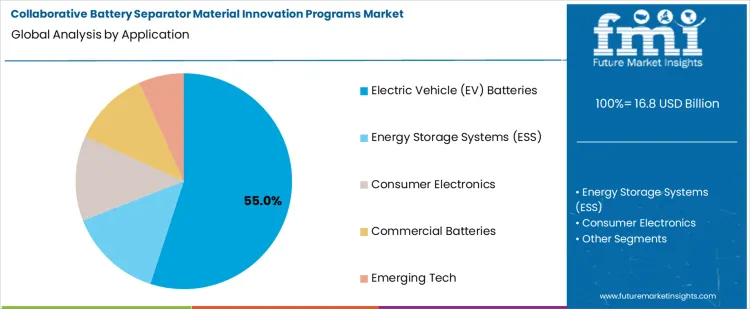
The electric vehicle (EV) batteries sector represents 55% of the application segment in the collaborative battery separator material innovation programs market. The growing demand for electric vehicles requires the development of high-performance battery separators that ensure safety, longevity, and efficient power management. Collaborative programs, such as industry-industry collaborations and research consortia, play a key role in advancing separator technologies that can withstand the high-energy demands of EV batteries. By working together, stakeholders can improve the performance of separators and address critical challenges, including heat resistance and ionic conductivity. The EV sector's growth continues to drive innovation in the separator material market, making it a major contributor to this industry.
What Are the Key Dynamics for the Collaborative Battery Separator Material Innovation Programs Market?
The collaborative battery separator material innovation programs market is shaped by the increasing need for advanced separator technologies that enhance safety, performance, and durability in next-generation lithium-ion batteries. Innovation programs bring together battery OEMs, materials scientists, academic institutions, and chemical suppliers to co-develop novel polymer chemistries, ceramic coatings, and multi-functional separator platforms. These collaborations help accelerate research timelines and share risk, responding to industry pressures for higher energy density, faster charging, and improved thermal stability.
How Are the Key Drivers Shaping the collaborative battery separator material innovation programs market?
The complexity of separator requirements in high-energy and high-voltage applications such as EVs and ESS necessitates cross-sector expertise in polymer science, nano-coatings, and scalable manufacturing. Collaborative research accelerates development of materials with enhanced ionic conductivity, thermal resilience, and mechanical strength. Funding from government initiatives and private investment into battery research fosters partnerships, while global demand for safer, longer-lasting batteries encourages co-innovation models that pool resources, reduce duplication of effort, and help transition innovations from lab to commercial scale more quickly.
Why Are There Restraints Impacting the collaborative battery separator material innovation programs market?
The collaborative battery separator material innovation programs market faces restraints due to the complexity and cost of joint research efforts. Effective collaboration requires significant capital investment, shared intellectual property (IP) frameworks, and aligned objectives among partners, which can be difficult to negotiate. Differences in corporate strategies, regulatory environments, and market priorities across regions can slow program execution. Proprietary concerns and data sharing restrictions may limit open innovation. Long development cycles especially for materials requiring rigorous safety validation can delay commercialization, deterring some organizations from participating in collaborative initiatives without assured timelines or returns.
What is the Growth Outlook for the Collaborative Battery Separator Material Innovation Programs Market by Country?
| Country | CAGR (%) |
|---|---|
| China | 12.5% |
| USA | 11.8% |
| South Korea | 10.9% |
| Japan | 11.2% |
| Germany | 10.6% |
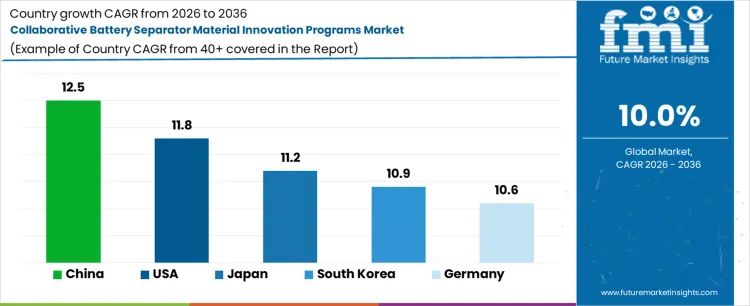
The collaborative battery separator material innovation programs market is seeing substantial growth across key regions, with China leading at 12.5%, driven by its dominance in electric vehicle (EV) production and advancements in battery technologies. The USA follows at 11.8%, fueled by growing demand for high-performance batteries in EVs and energy storage systems, alongside significant R&D investments. South Korea’s market grows at 10.9%, supported by major battery manufacturers focusing on innovation in separator materials for efficient and safe energy storage solutions. Japan’s market grows at 11.2%, driven by the country’s strong automotive and energy storage sectors, which require cutting-edge separator technologies. Germany’s market grows at 10.6%, supported by advancements in automotive battery technologies and the country’s focus on eco-friendly energy solutions.
What is Driving the Growth of the Collaborative Battery Separator Material Innovation Programs Market in China?
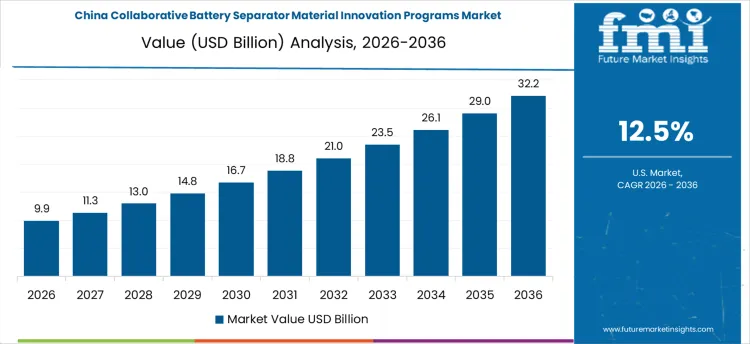
China’s collaborative battery separator material innovation programs market is growing at 12.5%, driven by its leadership in electric vehicle (EV) production and battery manufacturing. As China continues to dominate the global EV market, there is an increasing demand for innovative battery separator materials that ensure safety, performance, and fast-charging capabilities. The government’s commitment to advancing clean energy, along with the rapid adoption of EVs and energy storage solutions, is driving collaboration between automakers, battery manufacturers, and research institutions to develop next-generation separator materials. China’s massive investments in R&D and the push for eco-friendly battery technologies are further accelerating market growth. As the country seeks to maintain its competitive edge in the global EV and battery markets, collaboration in developing high-performance separator materials is expected to continue growing.
What is Contributing to the Growth of the Collaborative Battery Separator Material Innovation Programs Market in the USA?
The collaborative battery separator material innovation programs market in the USA is growing at 11.8%, driven by the country’s emphasis on innovation in electric vehicle (EV) technology and clean energy solutions. As the USA accelerates its transition to eco-friendly energy, there is a growing demand for advanced battery separators that can improve battery efficiency, safety, and longevity. Collaborative programs between automakers, battery manufacturers, and research institutions are critical in developing next-generation separators for EVs and energy storage systems. The increasing focus on achieving carbon neutrality and reducing greenhouse gas emissions is driving investments in cutting-edge battery technologies. The USA’s market for collaborative innovation programs in battery separator materials is expected to expand further as demand for fast-charging, high-density batteries increases.
How is the Collaborative Battery Separator Material Innovation Programs Market Expanding in Japan?
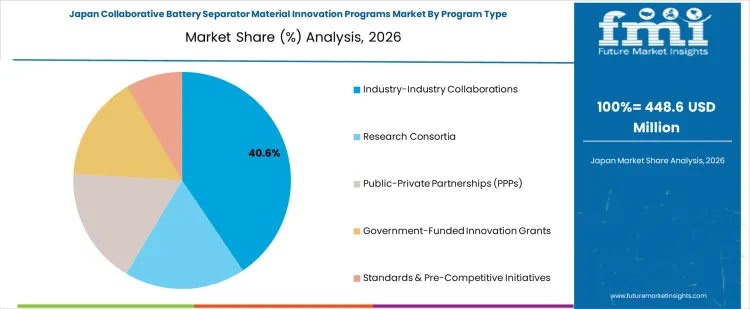
Japan’s collaborative battery separator material innovation programs market is growing at 11.2%, supported by the country’s leadership in the development of electric vehicle (EV) and battery technologies. Japan’s automotive giants, including Toyota and Honda, are investing heavily in EVs, driving the demand for advanced battery materials that enhance performance, energy density, and safety. As the country focuses on eco-friendly mobility and energy storage solutions, collaborations between the automotive and battery industries are increasingly focused on developing innovative separator materials for high-performance batteries. Japan’s strong commitment to research and development, particularly in next-generation battery technologies, further accelerates the growth of the market. With a focus on precision, efficiency, and eco-friendly solutions, Japan’s collaborative battery separator material innovation programs are expected to continue expanding in the coming years.
What is Driving the Growth of the Collaborative Battery Separator Material Innovation Programs Market in South Korea?
South Korea’s collaborative battery separator material innovation programs market is growing at 10.9%, driven by the country’s robust position in the global battery manufacturing sector. Leading battery manufacturers like LG Chem and Samsung SDI are collaborating with research institutions to develop next-generation separator materials that meet the increasing demands for electric vehicles (EVs) and energy storage systems. As South Korea continues to invest in EV adoption and renewable energy solutions, there is a growing need for high-performance separators that ensure safety and efficiency in fast-charging batteries. Collaborative programs are critical to advancing battery technology, including improvements in separator materials that enhance the overall performance of batteries. With South Korea’s focus on innovation and durability, the market for collaborative innovation programs in battery separator materials is poised to continue growing.
What is Contributing to the Growth of the Collaborative Battery Separator Material Innovation Programs Market in Germany?
Germany’s collaborative battery separator material innovation programs market is growing at 10.6%, driven by the country’s leadership in electric vehicle (EV) manufacturing and its focus on green energy. As Germany shifts toward eco-friendly transportation and renewable energy storage solutions, there is an increasing demand for advanced battery technologies, particularly for high-performance separators in EV batteries. Collaborations between automakers, battery manufacturers, and research institutions are essential for the development of next-generation separator materials that improve battery performance, fast-charging capabilities, and safety. Germany’s strong commitment to R&D, its push for carbon-neutral goals, and its emphasis on battery recycling and durability are further supporting the market’s growth. As Germany continues to lead in battery and EV technology innovation, the market for collaborative battery separator material innovation programs is expected to expand steadily.
What Are the Competitive Strategies in the Collaborative Battery Separator Material Innovation Programs Market?
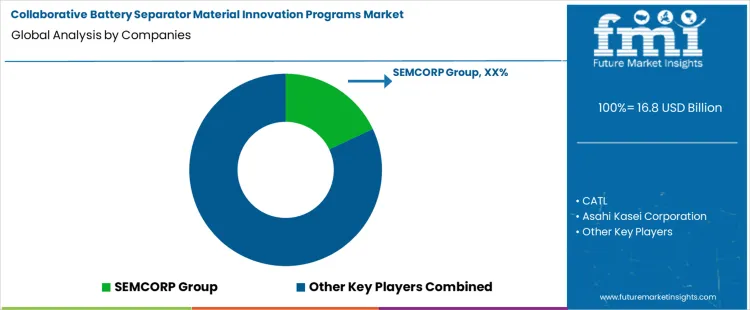
Competition in the collaborative battery separator material innovation programs market is driven by joint R&D efforts, co-development partnerships with OEMs, advanced material performance, and accelerated commercialization pathways. SEMCORP Group engages in collaborative innovation programs that focus on enhancing separator performance for high-energy and fast charging applications. Its materials highlight work with cell makers and equipment partners to refine polymer structures and coating technologies, accelerating adoption in next generation batteries.
CATL leverages its scale as a leading battery manufacturer to co innovate with separator developers, pushing bespoke material solutions that meet stringent OEM requirements for electric vehicles (EVs) and energy storage systems (ESS). Collaborative efforts are often showcased as shared test results and qualification milestones that validate performance under real-world conditions. Asahi Kasei Corporation and Toray Industries, Inc. differentiate by partnering with global EV and cell manufacturers to co design separators with improved thermal stability, mechanical robustness, and ionic transport characteristics, documented as part of joint research initiatives and pilot programs.
SK Innovation participates in joint development programs that combine innovative polymer chemistries and coating techniques to enhance safety and lifetime, with collateral emphasizing integration ease and scalable production workflows. ENTEK International LLC works closely with academic and industrial collaborators to refine separator films that balance shut down features and dimensional stability, often detailed in co authored technical briefs. EVE Energy rounds out the competitive landscape with strategic partnerships targeting advanced cell formats and OEM validation, marketed through case studies and performance data from joint pilot lines. Across vendors, program materials focus on shared innovation frameworks, alignment with OEM roadmaps, and demonstrable material improvements that shorten development cycles and support faster market entry.
Key Players in Collaborative Battery Separator Material Innovation Programs Market
- SEMCORP Group
- CATL
- Asahi Kasei Corporation
- Toray Industries, Inc.
- SK Innovation
- ENTEK International LLC
- EVE Energy
Scope of Report
| Items | Values |
|---|---|
| Quantitative Unit (2026) | USD billion |
| Program Type | Industry-Industry Collaborations, Research Consortia, Public-Private Partnerships (PPPs), Government-Funded Innovation Grants, Standards & Pre-Competitive Initiatives |
| Application | Electric Vehicle (EV) Batteries, Energy Storage Systems (ESS), Consumer Electronics, Commercial Batteries, Emerging Tech |
| Regions Covered | Asia Pacific, Europe, North America, Latin America, Middle East & Africa |
| Countries Covered | USA, China, Japan, South Korea, India, Australia & New Zealand, ASEAN, Germany, UK, France, Italy, Spain, Nordic, BENELUX, Brazil, Chile, Mexico, Saudi Arabia, Other GCC Countries, Turkey, South Africa, Other African Union |
| Key Companies Profiled | SEMCORP Group, CATL, Asahi Kasei Corporation, Toray Industries, Inc., SK Innovation, ENTEK International LLC, EVE Energy |
| Additional Attributes | Dollar sales segmented by program type, application, and region. Regional CAGR and growth outlook for each segment and region, including collaborative trends and future forecasts in the innovation space. |
Collaborative Battery Separator Material Innovation Programs Market by Key Segments
Program Type
- Industry‑Industry Collaborations
- Research Consortia
- Public‑Private Partnerships (PPPs)
- Government‑Funded Innovation Grants
- Standards & Pre‑Competitive Initiatives
Application
- Electric Vehicle (EV) Batteries
- Energy Storage Systems (ESS)
- Consumer Electronics
- Commercial Batteries
- Emerging Tech
Region:
- Asia Pacific
- China
- Japan
- South Korea
- India
- Australia & New Zealand
- ASEAN
- Rest of Asia Pacific
- Europe
- Germany
- United Kingdom
- France
- Italy
- Spain
- Nordic
- BENELUX
- Rest of Europe
- North America
- United States
- Canada
- Mexico
- Latin America
- Brazil
- Chile
- Rest of Latin America
- Middle East & Africa
- Kingdom of Saudi Arabia
- Other GCC Countries
- Turkey
- South Africa
- Other African Union
- Rest of Middle East & Africa
Frequently Asked Questions
How big is the collaborative battery separator material innovation programs market in 2026?
The global collaborative battery separator material innovation programs market is estimated to be valued at USD 16.8 billion in 2026.
What will be the size of collaborative battery separator material innovation programs market in 2036?
The market size for the collaborative battery separator material innovation programs market is projected to reach USD 43.6 billion by 2036.
How much will be the collaborative battery separator material innovation programs market growth between 2026 and 2036?
The collaborative battery separator material innovation programs market is expected to grow at a 10.0% CAGR between 2026 and 2036.
What are the key program types in the collaborative battery separator material innovation programs market?
The key program types in collaborative battery separator material innovation programs market are industry‑industry collaborations, research consortia, public‑private partnerships (PPPs), government‑funded innovation grants, and standards & pre‑competitive initiatives.
Which application segment will contribute a significant share in the collaborative battery separator material innovation programs market in 2026?
In terms of application, electric vehicle (EV) batteries segment to command 55.0% share in the collaborative battery separator material innovation programs market in 2026.
Preview the report firsthand - request a free sample
Get SampleGet the brochure for pricing and purchase details.
Get PDFTable of Content
- Executive Summary
- Global Market Outlook
- Demand-side Trends
- Supply-side Trends
- Technology Roadmap Analysis
- Analysis and Recommendations
- Market Overview
- Market Coverage / Taxonomy
- Market Definition / Scope / Limitations
- Market Background
- Market Dynamics
- Drivers
- Restraints
- Opportunity
- Trends
- Scenario Forecast
- Demand in Optimistic Scenario
- Demand in Likely Scenario
- Demand in Conservative Scenario
- Opportunity Map Analysis
- Product Life Cycle Analysis
- Supply Chain Analysis
- Investment Feasibility Matrix
- Value Chain Analysis
- PESTLE and Porter’s Analysis
- Regulatory Landscape
- Regional Parent Market Outlook
- Production and Consumption Statistics
- Import and Export Statistics
- Market Dynamics
- Global Market Analysis 2021 to 2025 and Forecast, 2026 to 2036
- Historical Market Size Value (USD Million) Analysis, 2021 to 2025
- Current and Future Market Size Value (USD Million) Projections, 2026 to 2036
- Y-o-Y Growth Trend Analysis
- Absolute $ Opportunity Analysis
- Global Market Pricing Analysis 2021 to 2025 and Forecast 2026 to 2036
- Global Market Analysis 2021 to 2025 and Forecast 2026 to 2036, By Program Type
- Introduction / Key Findings
- Historical Market Size Value (USD Million) Analysis By Program Type , 2021 to 2025
- Current and Future Market Size Value (USD Million) Analysis and Forecast By Program Type , 2026 to 2036
- Industry‑Industry Collaborations
- Research Consortia
- Public‑Private Partnerships (PPPs)
- Government‑Funded Innovation Grants
- Standards & Pre‑Competitive Initiatives
- Industry‑Industry Collaborations
- Y-o-Y Growth Trend Analysis By Program Type , 2021 to 2025
- Absolute $ Opportunity Analysis By Program Type , 2026 to 2036
- Global Market Analysis 2021 to 2025 and Forecast 2026 to 2036, By Application
- Introduction / Key Findings
- Historical Market Size Value (USD Million) Analysis By Application, 2021 to 2025
- Current and Future Market Size Value (USD Million) Analysis and Forecast By Application, 2026 to 2036
- Electric Vehicle (EV) Batteries
- Energy Storage Systems (ESS)
- Consumer Electronics
- Commercial Batteries
- Emerging Tech
- Electric Vehicle (EV) Batteries
- Y-o-Y Growth Trend Analysis By Application, 2021 to 2025
- Absolute $ Opportunity Analysis By Application, 2026 to 2036
- Global Market Analysis 2021 to 2025 and Forecast 2026 to 2036, By Region
- Introduction
- Historical Market Size Value (USD Million) Analysis By Region, 2021 to 2025
- Current Market Size Value (USD Million) Analysis and Forecast By Region, 2026 to 2036
- North America
- Latin America
- Western Europe
- Eastern Europe
- East Asia
- South Asia and Pacific
- Middle East & Africa
- Market Attractiveness Analysis By Region
- North America Market Analysis 2021 to 2025 and Forecast 2026 to 2036, By Country
- Historical Market Size Value (USD Million) Trend Analysis By Market Taxonomy, 2021 to 2025
- Market Size Value (USD Million) Forecast By Market Taxonomy, 2026 to 2036
- By Country
- USA
- Canada
- Mexico
- By Program Type
- By Application
- By Country
- Market Attractiveness Analysis
- By Country
- By Program Type
- By Application
- Key Takeaways
- Latin America Market Analysis 2021 to 2025 and Forecast 2026 to 2036, By Country
- Historical Market Size Value (USD Million) Trend Analysis By Market Taxonomy, 2021 to 2025
- Market Size Value (USD Million) Forecast By Market Taxonomy, 2026 to 2036
- By Country
- Brazil
- Chile
- Rest of Latin America
- By Program Type
- By Application
- By Country
- Market Attractiveness Analysis
- By Country
- By Program Type
- By Application
- Key Takeaways
- Western Europe Market Analysis 2021 to 2025 and Forecast 2026 to 2036, By Country
- Historical Market Size Value (USD Million) Trend Analysis By Market Taxonomy, 2021 to 2025
- Market Size Value (USD Million) Forecast By Market Taxonomy, 2026 to 2036
- By Country
- Germany
- UK
- Italy
- Spain
- France
- Nordic
- BENELUX
- Rest of Western Europe
- By Program Type
- By Application
- By Country
- Market Attractiveness Analysis
- By Country
- By Program Type
- By Application
- Key Takeaways
- Eastern Europe Market Analysis 2021 to 2025 and Forecast 2026 to 2036, By Country
- Historical Market Size Value (USD Million) Trend Analysis By Market Taxonomy, 2021 to 2025
- Market Size Value (USD Million) Forecast By Market Taxonomy, 2026 to 2036
- By Country
- Russia
- Poland
- Hungary
- Balkan & Baltic
- Rest of Eastern Europe
- By Program Type
- By Application
- By Country
- Market Attractiveness Analysis
- By Country
- By Program Type
- By Application
- Key Takeaways
- East Asia Market Analysis 2021 to 2025 and Forecast 2026 to 2036, By Country
- Historical Market Size Value (USD Million) Trend Analysis By Market Taxonomy, 2021 to 2025
- Market Size Value (USD Million) Forecast By Market Taxonomy, 2026 to 2036
- By Country
- China
- Japan
- South Korea
- By Program Type
- By Application
- By Country
- Market Attractiveness Analysis
- By Country
- By Program Type
- By Application
- Key Takeaways
- South Asia and Pacific Market Analysis 2021 to 2025 and Forecast 2026 to 2036, By Country
- Historical Market Size Value (USD Million) Trend Analysis By Market Taxonomy, 2021 to 2025
- Market Size Value (USD Million) Forecast By Market Taxonomy, 2026 to 2036
- By Country
- India
- ASEAN
- Australia & New Zealand
- Rest of South Asia and Pacific
- By Program Type
- By Application
- By Country
- Market Attractiveness Analysis
- By Country
- By Program Type
- By Application
- Key Takeaways
- Middle East & Africa Market Analysis 2021 to 2025 and Forecast 2026 to 2036, By Country
- Historical Market Size Value (USD Million) Trend Analysis By Market Taxonomy, 2021 to 2025
- Market Size Value (USD Million) Forecast By Market Taxonomy, 2026 to 2036
- By Country
- Kingdom of Saudi Arabia
- Other GCC Countries
- Turkiye
- South Africa
- Other African Union
- Rest of Middle East & Africa
- By Program Type
- By Application
- By Country
- Market Attractiveness Analysis
- By Country
- By Program Type
- By Application
- Key Takeaways
- Key Countries Market Analysis
- USA
- Pricing Analysis
- Market Share Analysis, 2025
- By Program Type
- By Application
- Canada
- Pricing Analysis
- Market Share Analysis, 2025
- By Program Type
- By Application
- Mexico
- Pricing Analysis
- Market Share Analysis, 2025
- By Program Type
- By Application
- Brazil
- Pricing Analysis
- Market Share Analysis, 2025
- By Program Type
- By Application
- Chile
- Pricing Analysis
- Market Share Analysis, 2025
- By Program Type
- By Application
- Germany
- Pricing Analysis
- Market Share Analysis, 2025
- By Program Type
- By Application
- UK
- Pricing Analysis
- Market Share Analysis, 2025
- By Program Type
- By Application
- Italy
- Pricing Analysis
- Market Share Analysis, 2025
- By Program Type
- By Application
- Spain
- Pricing Analysis
- Market Share Analysis, 2025
- By Program Type
- By Application
- France
- Pricing Analysis
- Market Share Analysis, 2025
- By Program Type
- By Application
- India
- Pricing Analysis
- Market Share Analysis, 2025
- By Program Type
- By Application
- ASEAN
- Pricing Analysis
- Market Share Analysis, 2025
- By Program Type
- By Application
- Australia & New Zealand
- Pricing Analysis
- Market Share Analysis, 2025
- By Program Type
- By Application
- China
- Pricing Analysis
- Market Share Analysis, 2025
- By Program Type
- By Application
- Japan
- Pricing Analysis
- Market Share Analysis, 2025
- By Program Type
- By Application
- South Korea
- Pricing Analysis
- Market Share Analysis, 2025
- By Program Type
- By Application
- Russia
- Pricing Analysis
- Market Share Analysis, 2025
- By Program Type
- By Application
- Poland
- Pricing Analysis
- Market Share Analysis, 2025
- By Program Type
- By Application
- Hungary
- Pricing Analysis
- Market Share Analysis, 2025
- By Program Type
- By Application
- Kingdom of Saudi Arabia
- Pricing Analysis
- Market Share Analysis, 2025
- By Program Type
- By Application
- Turkiye
- Pricing Analysis
- Market Share Analysis, 2025
- By Program Type
- By Application
- South Africa
- Pricing Analysis
- Market Share Analysis, 2025
- By Program Type
- By Application
- USA
- Market Structure Analysis
- Competition Dashboard
- Competition Benchmarking
- Market Share Analysis of Top Players
- By Regional
- By Program Type
- By Application
- Competition Analysis
- Competition Deep Dive
- SEMCORP Group
- Overview
- Product Portfolio
- Profitability by Market Segments (Product/Age /Sales Channel/Region)
- Sales Footprint
- Strategy Overview
- Marketing Strategy
- Product Strategy
- Channel Strategy
- CATL
- Asahi Kasei Corporation
- Toray Industries, Inc.
- SK Innovation
- ENTEK International LLC
- EVE Energy
- SEMCORP Group
- Competition Deep Dive
- Assumptions & Acronyms Used
- Research Methodology


