

- Industry Size (2026)
- USD 2.4 Bn
- Forecast (2036)
- USD 18.1 Bn
- CAGR (2026 to 2036)
- 22.4%
Battery Electrode Dry Coating Materials Market Size, Market Forecast and Outlook By FMI
The battery electrode dry coating materials market crossed a valuation of USD 2.0 billion in 2025. The industry is expected to reach USD 2.4 billion in 2026 at a CAGR of 22.4% during the forecast period. Demand outlook carries the market valuation to USD 18.1 billion by 2036 as solvent-free manufacturing architectures replace traditional slurry-based electrode coating across next-generation gigafactory production lines.
The convergence of electric vehicle price wars and stringent factory emissions regulations forces battery production architects to specify solvent-free processing technologies. Facilities relying on conventional wet-slurry methods face insurmountable constraints regarding drying-oven length, energy expenditure, and N-Methyl-2-Pyrrolidone (NMP) recovery costs. This architectural pivot forces incumbent material suppliers to formulate shear-responsive fluoropolymers and advanced carbon additives capable of forming robust free-standing films. Material developers entering the next tender cycles without validated dry-processable binder systems face a disqualification window they cannot bypass once automotive procurement shortlisting begins.
Summary of Battery Electrode Dry Coating Materials Market
- Battery Electrode Dry Coating Materials Market Definition
- The battery electrode dry coating materials market encompasses engineered binders, active materials, and conductive additives formulated for solvent-free electrode manufacturing. This functional scope fundamentally relies on the material's ability to fibrillate and form cohesive, conductive films under sheer stress without liquid dispersion.
- Demand Drivers in the Market
- Gigafactory operators targeting aggressive reductions in energy consumption and capital expenditure require specialized dry process materials to eliminate massive drying ovens from facility layouts.
- Strict environmental regulations regarding toxic solvent emissions force cell manufacturers to adopt dry coating architectures, driving demand for advanced fibrillating binder systems.
- The commercialization of next-generation solid-state and silicon-dominant batteries necessitates solvent-free fabrication to prevent chemical degradation of sensitive active materials during processing.
- Key Segments Analyzed in the FMI Report
- Binder Systems: 46.5% share in 2026, driven by the absolute necessity of specialized shear-responsive polymers to create the structural backbone of the dry electrode film.
- Lithium-Ion Batteries: 65.2% share in 2026, as incumbent cell manufacturers retrofit existing production lines to utilize dry coating for high-volume automotive applications.
- China: 25.5% compound growth, reflecting aggressive domestic gigafactory scaling and rapid commercialization of innovative battery manufacturing technologies.
- Analyst Opinion at FMI
- Nikhil Kaitwade, Principal Consultant for Chemicals and Materials, opines, "In my analysis, I have observed that the true bottleneck in dry electrode commercialization is not the mixing equipment, but the precise rheological behavior of the binder materials under shear stress. Facilities attempting to scale dry coating with legacy material formulations face unavoidable film degradation and poor current collector adhesion. Material developers who rapidly commercialize specialized, highly fibrillating PTFE alternatives will secure dominant positions before the major 2028 automotive OEM procurement window closes, effectively dictating the cost structure of next-generation gigafactories."
- Strategic Implications / Executive Takeaways
- Chemical material formulators must secure joint development agreements with tier-1 battery cell manufacturers to validate dry binder performance at a continuous roll-to-roll production scale.
- Gigafactory capital project directors should phase out solvent-recovery infrastructure and mandate dry-processable material compatibility in all new facility blueprints.
- Automotive OEM procurement leads must diversify their supply chains for specialized dry coating additives to prevent critical bottlenecks as global production volumes scale.
- Methodology
- Primary Research: FMI conducted detailed technical interviews with principal materials scientists, gigafactory operation directors, and automotive supply chain managers across 40 countries to validate dry process adoption timelines.
- Desk Research: Analysts aggregated public patent filings, environmental compliance registries, corporate material launch sheets, and national advanced battery manufacturing grant programs.
- Market-Sizing and Forecasting: The model applies a bottom-up methodology starting with global installed base metrics for battery production capacity and projecting the conversion rate to dry coating standards.
- Data Validation and Update Cycle: Segment forecasts undergo cross-validation against quarterly specialty fluoropolymer and conductive carbon shipment volumes for energy storage applications.
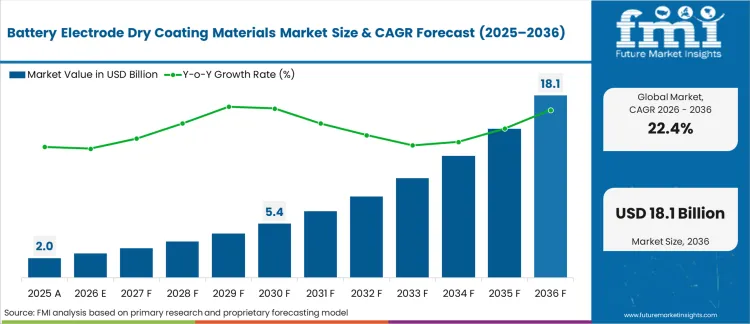
Battery Electrode Dry Coating Materials Market Key Takeaways
| Metric | Details |
|---|---|
| Industry Size (2026) | USD 2.4 billion |
| Industry Value (2036) | USD 18.1 billion |
| CAGR (2026-2036) | 22.4% |
Source: Future Market Insights (FMI) analysis, based on proprietary forecasting model and primary research
The true inflection point occurs when dry coating processes demonstrate parity in cycle life and energy density with legacy wet methods at a gigawatt-hour production scale. Capital project directors planning facility expansions must secure high-performance dry coating material supply chains within the next three years to qualify for impending electric vehicle platform launches. Achieving this transition ultimately establishes a vastly simplified, modular cell manufacturing footprint requiring fractionally less capital expenditure per gigawatt-hour of capacity.
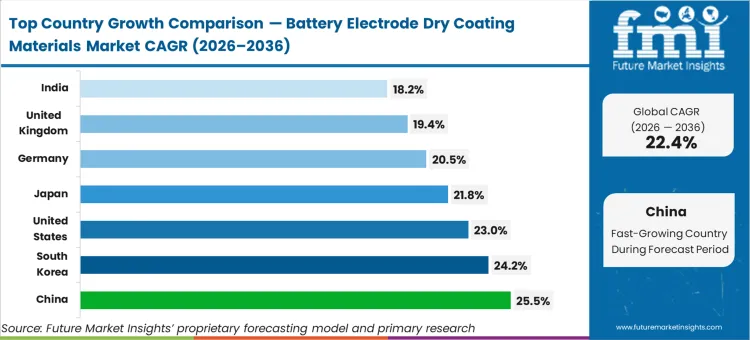
The geographic distribution of this manufacturing transition reveals distinct adoption velocities tied to regional industrial policies and battery ecosystem maturity. China advances at a 25.5% compound rate, driven by aggressive domestic capacity expansion and vertical supply chain integration. South Korea registers a 24.2% expansion as major cell producers optimize high-density chemistries for global export. The United States tracks at 23.0%, supported by localization mandates and green-energy manufacturing incentives. Japan grows at a 21.8% trajectory anchored by established solid-state battery commercialization efforts. Germany expands at 20.5% as automotive OEMs build localized European gigafactories. The United Kingdom follows at 19.4%, while India posts an 18.2% rate, demonstrating a structural shift away from imported legacy cells toward domestic next-generation production.
Battery Electrode Dry Coating Materials Market Definition
The battery electrode dry coating materials market represents the specialized raw materials, primarily engineered binders, active materials, and conductive additives, formulated explicitly for solvent-free battery electrode fabrication. This ecosystem eliminates traditional toxic solvents and energy-intensive drying processes, directly supporting the modern powder-to-film manufacturing paradigm.
Battery Electrode Dry Coating Materials Market Inclusions
The market scope includes highly fibrillating fluoropolymer resins, optimized active cathode and anode powders designed for dry shearing, and engineered carbon nanotubes utilized as conductive matrices. Specialized dry-processable solid electrolyte powders and pre-mixed dry coating precursor blends for advanced battery materials fall entirely within the boundaries.
Battery Electrode Dry Coating Materials Market Exclusions
Standard battery materials formulated strictly for wet-slurry processing, including liquid solvents like N-Methyl-2-pyrrolidone (NMP) and conventional aqueous binders like carboxymethyl cellulose (CMC), are excluded. Pure manufacturing machinery, such as rolling presses or extruders, and finished battery cells fall outside the defined valuation parameters.
Battery Electrode Dry Coating Materials Market Research Methodology
- Primary Research: Analysts engaged with gigafactory procurement leads, advanced materials scientists, and automotive battery engineering directors to map the specific decision gates triggering the transition to solvent-free electrode production.
- Desk Research: The data collection phase aggregated compliance roadmaps from environmental protection agencies, material safety data sheets from global chemical suppliers, and capacity expansion announcements from major cell manufacturers.
- Market-Sizing and Forecasting: The baseline value derives from a bottom-up aggregation of specialized dry binder and additive shipments, applying region-specific gigafactory construction curves to project the future adoption velocity.
- Data Validation and Update Cycle: Projections are rigorously tested against publicly reported capital expenditure guidance and raw material procurement contracts from leading electric vehicle battery producers.
Segmental Analysis
Battery Electrode Dry Coating Materials Market Analysis by Material Type
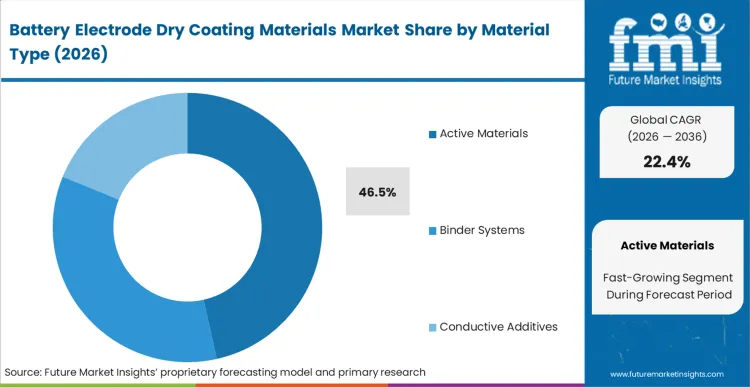
The requirement for mechanical stability without liquid dispersion elevates specialized polymers to the critical enabler of the entire solvent-free process. Binder Systems command a dominant 46.5% share in 2026, reflecting the absolute dependency on highly fibrillating materials to create a conductive matrix under sheer force. Chemical formulators developing these advanced battery binder resins establish the foundation for the entire dry coating ecosystem. This material-level innovation eliminates the need for massive, energy-intensive drying ovens. Material scientists specifying these binders streamline their mixing protocols and significantly reduce overall processing time. FMI analysts opine that facilities transitioning to these engineered resins realize measurable improvements in initial Coulombic efficiency and cycle life. Material vendors unable to supply validated, shear-responsive binders risk immediate exclusion from the next wave of gigafactory RFPs. Gigafactory operators must validate binder fibrillation consistency during pilot-line testing to authorize final production scale-up.
- Fibrillation capacity: Specialized fluoropolymers undergo physical transformation under shear stress to web active particles together, shifting the structural burden away from toxic liquid solvents.
- Adhesion optimization: Engineered binder formulations natively handle current collector bonding, preventing delamination during continuous roll-to-roll pressing operations.
- Thermal resilience: Eliminating solvent evaporation phases protects temperature-sensitive active materials from thermal degradation during the manufacturing sequence.
Battery Electrode Dry Coating Materials Market Analysis by Battery Chemistry
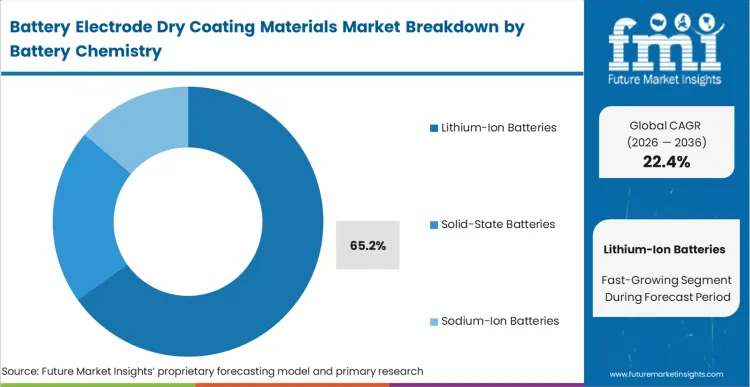
Incumbent cell manufacturers face immense pressure to reduce the carbon footprint and production cost of their existing product portfolios. Lithium-Ion Batteries capture a leading 65.2% share in 2026, as the massive installed base of gigafactories seeks to retrofit legacy wet-coating lines with high-efficiency dry processes. Cell engineering leads deploying these new material blends into standard lithium-ion battery architectures achieve immediate gains in energy density through thicker electrode designs. The elimination of solvent gradients allows for significantly higher active material loading per square centimeter. Production managers optimizing these chemistries bypass the speed limitations traditionally imposed by drying oven lengths. As per FMI's projection, the successful integration of dry materials into mainstream lithium-ion production directly accelerates the path to sub-$100/kWh pack costs. Suppliers failing to demonstrate seamless drop-in compatibility with standard NMC cathode powders lose priority status in critical capacity upgrade cycles. Automotive procurement executives must verify long-term cycle life parity with wet-processed cells to approve dry-coated lithium-ion modules for mass-market vehicle integration.
- Loading density: Solvent-free pressing permits the fabrication of ultra-thick electrodes without the cracking and peeling associated with rapid solvent evaporation.
- Porosity control: Dry mixing techniques ensure a more uniform distribution of active materials and conductive additives, enhancing ion transport kinetics within the cell.
- Chemistry agnostic: The physical nature of the dry coating process allows manufacturers to seamlessly switch between different cathode formulations without redesigning the fluid handling infrastructure.
Battery Electrode Dry Coating Materials Market Analysis by Application
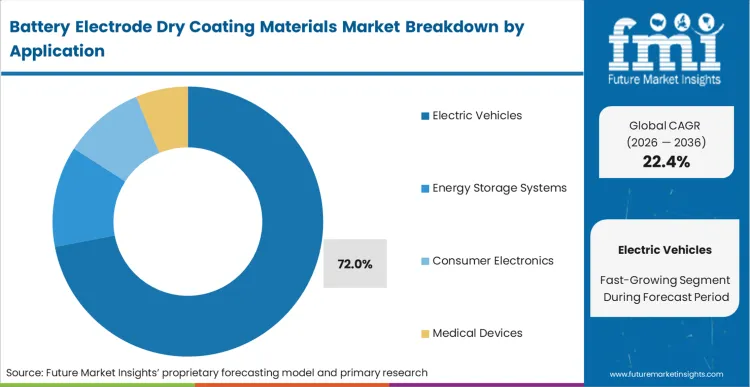
Automotive OEMs scaling massive electric fleets require radical reductions in battery manufacturing costs to achieve price parity with internal combustion engine vehicles. Electric Vehicles emerge as the dominant application area, representing 72.0% of total market share in 2026. Supply chain directors integrating dry-coated cells into their vehicle platforms benefit from enhanced energy density and significantly lower embedded carbon emissions. The transition to dry electrode architectures directly enables the production of structurally integrated, cell-to-pack designs. Based on FMI's assessment, optimizing the material supply for EV applications accelerates the transition to massive, highly automated gigafactory environments. Program managers who ignore the cost advantages of dry-processed batteries will find themselves unable to meet the aggressive pricing targets demanded by the mass consumer market. Vehicle platform engineers must validate the dynamic stress resilience of dry-coated electrodes during rigorous crash testing to authorize final vehicle homologation.
- Range extension: Higher active material loading enabled by dry processing directly translates to increased volumetric energy density and longer vehicle driving ranges.
- Fast charging: Uniform electrode porosity achieved through dry fibrillation improves electrolyte wetting, supporting aggressive ultra-fast charging profiles without lithium plating.
- Carbon reduction: Eliminating the massive energy consumption of drying ovens drastically lowers the Scope 3 emissions profile of the manufactured electric vehicle.
Battery Electrode Dry Coating Materials Market Drivers, Restraints, and Opportunities
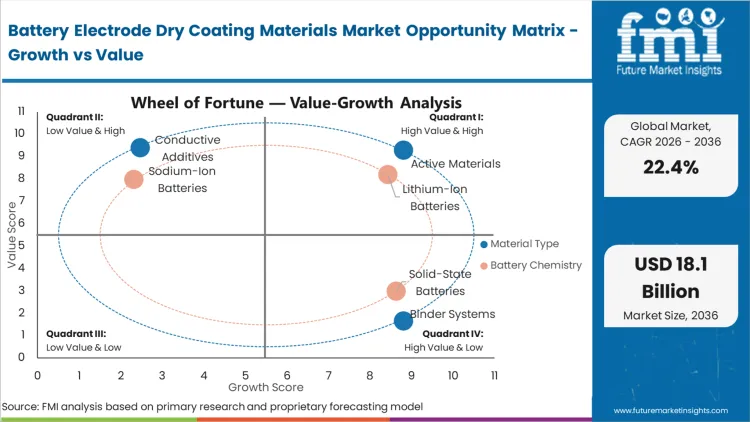
The intense pressure to reduce gigafactory capital expenditure and operating costs forces battery production architects to completely reimagine the electrode fabrication process. This economic requirement drives the rapid adoption of dry coating materials, allowing cell manufacturers to eliminate energy-intensive drying ovens and toxic solvent recovery systems from their facility blueprints. Transitioning to a solvent-free architecture dramatically reduces the physical footprint of the manufacturing line and slashes energy consumption by up to 50%. Cell manufacturers that fail to modernize their production layers with dry-processable materials risk permanently higher cost structures and an inability to compete in the hyper-competitive global electric vehicle market.
The intricate rheological parameters required to optimize dry powder mixing and film formation create severe scaling challenges for traditional material engineers. Achieving uniform dispersion of conductive additives and consistent binder fibrillation across a wide continuous web demands specialized processing expertise that most legacy battery manufacturers lack internally. To overcome this technical gap, process engineering directors increasingly rely on close collaborative partnerships with advanced material suppliers to co-develop proprietary formulations that maintain structural integrity and adhesion during high-speed roll-to-roll calendaring.
Opportunities in the Battery Electrode Dry Coating Materials Market
- Solid-State Battery Integration: The inherent incompatibility of liquid solvents with advanced solid electrolytes allows material developers to position dry coating as the mandatory fabrication method for next-generation solid-state battery production.
- Ultra-Thick Electrode Design: Solvent-free pressing permits cell architects to design highly loaded electrodes that maximize energy density, significantly reducing the ratio of inactive current collector metal within the cell volume.
- Localized Micro-Factories: Eliminating complex solvent handling infrastructure empowers startup cell manufacturers to deploy smaller, highly efficient battery production modules closer to automotive assembly plants.
Regional Analysis
Based on the regional analysis, the Battery Electrode Dry Coating Materials market is segmented into North America, Latin America, Europe, East Asia, South Asia, Oceania and Middle East & Africa across 40+ countries.
.webp "Top Country Growth Comparison Battery Electrode Dry Coating Materials Market Cagr (2026 2036)")
| Country | CAGR (2026 to 2036) |
|---|---|
| China | 25.5% |
| South Korea | 24.2% |
| United States | 23.0% |
| Japan | 21.8% |
| Germany | 20.5% |
| United Kingdom | 19.4% |
| India | 18.2% |
Source: Future Market Insights (FMI) analysis, based on proprietary forecasting model and primary research
Asia Pacific Battery Electrode Dry Coating Materials Market Analysis
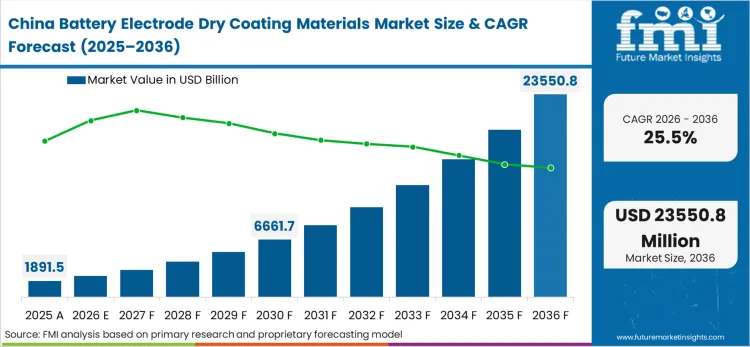
The massive concentration of global battery manufacturing capacity across East Asia establishes the region as the primary proving ground for dry electrode commercialization. Tier-1 cell manufacturers operating massive gigafactories face intense pressure to maximize yield and minimize energy costs, driving rapid adoption of solvent-free production techniques. FMI's analysis indicates that this aggressive scaling strategy entirely reshapes the regional supply chain for specialty polymers and conductive carbon additives. By building native dry-processing capabilities into next-generation facility expansions, regional asset owners establish highly flexible production environments capable of outcompeting global rivals on a cost-per-kilowatt-hour basis.
- China: China's aggressive gigafactory expansion strategy deploys immense capital toward commercializing next-generation solvent-free battery manufacturing lines. Vertical supply chain integration drives a 25.5% CAGR for battery electrode dry coating materials in China. Domestic material suppliers rapidly iterate on novel fibrillating binder formulations to support the massive scale required by local automotive OEMs. This rapid development loop solidifies the nation's dominance in advanced energy storage. Capital project directors must secure high-volume domestic supply agreements for specialized dry binders to guarantee uninterrupted production scaling.
- South Korea: South Korea's advanced battery sector operates under stringent imperatives to maximize energy density for premium export-market electric vehicles. Cell engineering leads mandate the use of high-performance dry coating materials to enable ultra-thick electrode architectures that legacy wet processes cannot support. The concentration of global battery leaders necessitates continuous innovation in solvent-free processing to maintain competitive advantage. This technological leadership anchors South Korea's 24.2% compound expansion to 2036. Material vendors must demonstrate flawless compatibility with advanced high-nickel cathodes to enter the approved supplier list.
- Japan: Japan's legacy in precision material science focuses heavily on the commercialization of solid-state battery technologies, which inherently require solvent-free processing environments. The domestic automotive sector drives a 21.8% compound rate for dry coating materials as manufacturers seek to leapfrog conventional lithium-ion constraints. Advanced chemical conglomerates leverage decades of fluoropolymer expertise to develop highly specialized dry binder systems. This concerted R&D effort positions the nation at the forefront of next-generation cell safety and performance. Procurement specification leads must validate the long-term electrochemical stability of these new materials before authorizing mass market vehicle integration.
- India: India's push for domestic advanced chemistry cell manufacturing relies heavily on greenfield facility construction to bypass legacy production inefficiencies. Process engineers in India specify dry coating architectures to significantly reduce the energy consumption and capital expenditure required for new gigafactories. This clean-slate approach drives an 18.2% annual expansion rate as the nation builds its localized battery supply chain. Facility owners must partner with international material experts to overcome initial dry processing scale-up challenges.
FMI's report includes extensive coverage of the Asia Pacific battery materials landscape. The analysis encompasses Taiwan, Indonesia, Australia, and the broader ASEAN region, highlighting how localized electric two-wheeler production accelerates the demand for cost-effective, high-yield battery manufacturing processes.
North America Battery Electrode Dry Coating Materials Market Analysis
Federal industrial policy and localization mandates across North America actively penalize the reliance on imported battery cells and heavily incentivize domestic manufacturing. Supply chain directors leading these multi-billion-dollar gigafactory investments face strict directives to deploy the most advanced, cost-effective, and environmentally sustainable production technologies available. In FMI's view, the elimination of toxic NMP solvent handling aligns perfectly with stringent North American environmental regulations and worker safety standards. Transitioning to a solvent-free dry coating backbone enables facilities to achieve highly competitive cell costs despite structurally higher regional labor and energy expenses.
- United States: The United States advances at a 23.0% compound trajectory to 2036 as massive federal investments mandate the rapid scaling of a localized, sustainable battery supply chain. Gigafactory operators rapidly deploy dry coating technologies to minimize facility footprint and bypass the complex environmental permitting associated with large-scale toxic solvent recovery systems. The aggressive commercialization of proprietary dry electrode platforms by major domestic electric vehicle manufacturers sets a new competitive baseline for the entire industry. Hardware suppliers lacking integrated, solvent-free material handling solutions face immediate exclusion from federally subsidized expansion projects.
FMI's report includes comprehensive evaluation of the North American battery manufacturing sector. It features specific analysis of the Canadian and Mexican industrial markets, where cross-border automotive supply chain integration forces component suppliers to adopt standardized, high-efficiency cell manufacturing protocols to meet stringent regional content requirements.
Europe Battery Electrode Dry Coating Materials Market Analysis
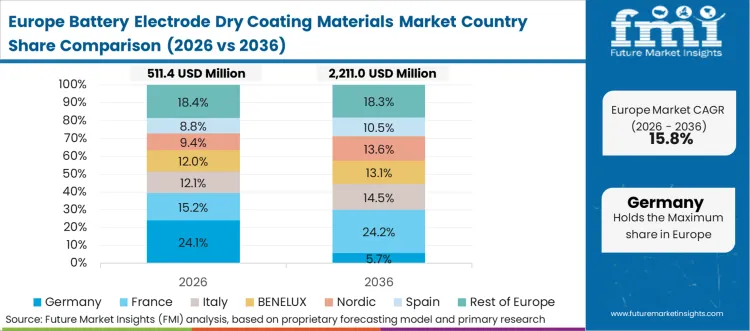
European environmental policy actively targets the reduction of industrial carbon footprints and the strict regulation of hazardous chemicals like NMP used in traditional battery manufacturing. Process engineers redesigning European cell production must integrate solvent-free dry coating to comply with impending REACH regulatory restrictions and sustainability mandates. This regulatory requirement forces the rapid adoption of specialized dry binders and additives to maintain battery production capacity without violating emissions limits. Upgrading the manufacturing infrastructure provides the necessary sustainability metrics to support the continent's ambitious green mobility targets.
- Germany: Germany's premium automotive sector dictates stringent performance and sustainability criteria for all domestically produced electric vehicle batteries. The national transition toward green manufacturing drives a 20.5% CAGR for dry electrode materials as automotive OEMs demand massive reductions in the embedded carbon footprint of their battery packs. Chemical formulators operating in the region leverage deep expertise in engineered polymers to supply specialized, REACH-compliant binder systems. Cell manufacturing directors must validate the energy efficiency gains of the dry process before receiving authorization for final gigafactory commissioning.
- United Kingdom: The United Kingdom's strategy to establish a competitive domestic battery industry heavily relies on leapfrogging legacy wet-coating methods through advanced manufacturing innovations. Facility owners advance at a 19.4% compound rate as they construct highly automated, energy-efficient gigafactories optimized for dry electrode production. The transition away from imported cells forces local manufacturers to prioritize technologies that drastically lower the capital intensity of new plant construction. System integrators unable to demonstrate reliable, high-speed dry powder processing forfeit qualification for national battery infrastructure grants.
FMI's report includes thorough investigation of the European battery materials framework. The analysis encompasses France, Italy, Spain, the Nordics, and the Benelux region, demonstrating how strict carbon footprint tracking mechanisms compel the industry-wide shift toward highly efficient, solvent-free manufacturing architectures.
Competitive Aligners for Market Players
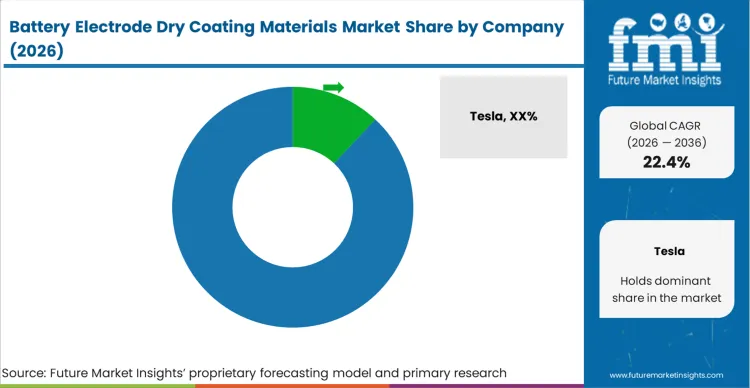
The intense race to commercialize solvent-free battery manufacturing is fundamentally reshaping how material suppliers compete for massive gigafactory contracts. Instead of competing purely on the price of commodity solvents and standard binders, procurement teams now demand highly engineered, proprietary dry powder systems that guarantee consistent fibrillation and uniform dispersion under continuous roll-to-roll pressing. This shift has raised the performance bar across the industry, meaning chemical formulators that continue to rely on legacy wet-slurry material portfolios risk being entirely excluded from the next generation of battery plant expansions.
Industry leaders have already begun adapting by aggressively expanding their advanced polymer and conductive additive capabilities. For example, manufacturers such as Tesla, LiCAP Technologies, AM Batteries, and major chemical conglomerates like BASF and LG Chem have aligned portions of their portfolios to directly support or innovate solvent-free processing, setting a new competitive baseline for others to follow. Companies formulating specialized PTFE resins and highly structured carbon nanotubes gain a significant architectural advantage, as these precise materials dictate the mechanical stability and electrochemical performance of the final dry-coated electric vehicle battery.
The concentration of highly specialized intellectual property surrounding dry binder fibrillation forces tier-1 cell manufacturers to seek strategic co-development partnerships rather than standard transactional supplier relationships. With the fundamental chemistry of dry coating closely guarded, automotive OEMs and battery producers actively invest in emerging material startups to prevent supply chain bottlenecks and avoid long-term vendor lock-in. This expanded flexibility empowers facility owners to optimize their manufacturing costs while structurally limiting the pricing power of any single material conglomerate during the massive scale-up of global gigafactory capacity.
Key Players in Battery Electrode Dry Coating Materials Market
- Tesla
- LiCAP Technologies
- AM Batteries
- Sakuu
- LG Chem
- Panasonic
- BASF
- Daikin Industries
- Solvay
- Arkema
- Zeon Corporation
Scope of the Report
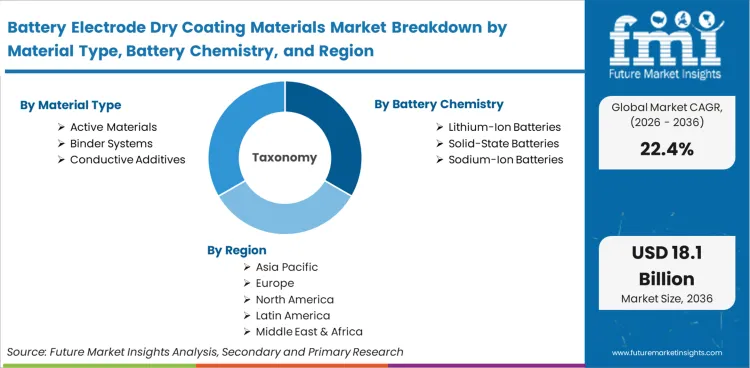
| Metric | Value |
|---|---|
| Quantitative Units | USD 2.4 billion to USD 18.1 billion, at a CAGR of 22.4% |
| Market Definition | The battery electrode dry coating materials market encompasses engineered binders, active materials, and conductive additives formulated for solvent-free electrode manufacturing. |
| Material Type Segmentation | Active Materials, Binder Systems, Conductive Additives |
| Battery Chemistry Segmentation | Lithium-Ion Batteries, Solid-State Batteries, Sodium-Ion Batteries |
| Application Segmentation | Electric Vehicles, Energy Storage Systems, Consumer Electronics, Medical Devices |
| Regions Covered | North America, Latin America, Europe, East Asia, South Asia, Oceania, Middle East & Africa |
| Countries Covered | China, South Korea, United States, Japan, Germany, United Kingdom, India, and 40 plus countries |
| Key Companies Profiled | Tesla, LiCAP Technologies, AM Batteries, Sakuu, LG Chem, Panasonic, BASF, Daikin Industries, Solvay, Arkema, Zeon Corporation |
| Forecast Period | 2026 to 2036 |
| Approach | The baseline value derives from a bottom-up aggregation of specialized dry binder and additive shipments, applying region-specific gigafactory construction curves to project future adoption velocity. |
Battery Electrode Dry Coating Materials Market Analysis by Segments
Material Type:
- Active Materials
- Binder Systems
- Conductive Additives
Battery Chemistry:
- Lithium-Ion Batteries
- Solid-State Batteries
- Sodium-Ion Batteries
Application:
- Electric Vehicles
- Energy Storage Systems
- Consumer Electronics
- Medical Devices
Region:
- Asia Pacific
- India
- China
- Japan
- South Korea
- Indonesia
- Australia & New Zealand
- ASEAN
- Rest of Asia Pacific
- Europe
- Germany
- Italy
- France
- United Kingdom
- Spain
- Benelux
- Nordics
- Central & Eastern Europe
- Rest of Europe
- North America
- United States
- Canada
- Mexico
- Latin America
- Brazil
- Argentina
- Chile
- Rest of Latin America
- Middle East & Africa
- Kingdom of Saudi Arabia
- United Arab Emirates
- South Africa
- Turkey
- Rest of Middle East & Africa
Bibliography
- USA Department of Energy. (2025). Battery R&D. USA Department of Energy.
- International Energy Agency. (2025, May 14). Global EV Outlook 2025. International Energy Agency.
- Fraunhofer Institute for Material and Beam Technology IWS. (2025, June 18). Game changer for battery cell production. Fraunhofer IWS.
- USA Environmental Protection Agency. (2024, June). Risk management for n-Methylpyrrolidone (NMP). USA Environmental Protection Agency.
- Japan Automobile Manufacturers Association, Inc. (2024, September 11). JAMA’s Guidelines on Carbon Footprint of Automobile Products: 2024 Version. Japan Automobile Manufacturers Association, Inc.
This bibliography is provided for reader reference. The full FMI report contains the complete reference list with primary source documentation.
This Report Addresses
- Market sizing for the organized battery electrode dry coating materials layer
- Forecast demand for specialized fibrillating binders from 2026 to 2036
- Material Type analysis across Active Materials, Binder Systems, and Conductive Additives
- Battery Chemistry demand patterns across Lithium-Ion Batteries, Solid-State Batteries, and Sodium-Ion Batteries
- Regional growth comparisons shaped by stringent environmental regulations and aggressive gigafactory scaling
- Competitive positioning factors for chemical material formulators and advanced battery startups
- Revenue opportunities tied to solid-state battery commercialization and ultra-thick electrode designs
- Strategic implications for gigafactory capital project directors and automotive procurement leads
Frequently Asked Questions
How large is the battery electrode dry coating materials market in 2026?
The market is estimated to be valued at USD 2.4 billion in 2026, driven by the intense necessity for cell manufacturers to eliminate energy-intensive drying ovens from facility layouts.
What will the battery electrode dry coating materials market be valued at by 2036?
The market is projected to reach USD 18.1 billion by 2036 as global environmental mandates force automotive OEMs to abandon traditional slurry-based wet coating architectures.
What CAGR is projected for battery electrode dry coating materials market from 2026 to 2036?
The market is expected to grow at a CAGR of 22.4%, sustained by the fundamental restructuring of battery manufacturing economics and massive reductions in capital expenditure per gigawatt-hour.
Which Material Type is poised to lead global sales by 2026?
Binder Systems account for 46.5% share in 2026 due to the absolute dependency on highly fibrillating materials to create a conductive matrix under sheer force.
How significant is the role of Lithium-Ion Batteries in driving market adoption in 2026?
Lithium-Ion Batteries represent 65.2% of segment share as the massive installed base of gigafactories seeks to retrofit legacy wet-coating lines with high-efficiency dry processes.
Which application dominates the market?
Electric Vehicles capture a leading 72.0% share in 2026, as automotive OEMs scaling massive fleets require radical reductions in battery manufacturing costs to achieve price parity.
What makes solid-state battery integration a crucial opportunity?
The inherent incompatibility of liquid solvents with advanced solid electrolytes allows material developers to position dry coating as the mandatory fabrication method for next-generation solid-state cell production.
Why are ultra-thick electrode designs significant in this market?
Solvent-free pressing permits cell architects to design highly loaded electrodes that maximize energy density, significantly reducing the ratio of inactive current collector metal within the cell volume.
What specific operational gap restrains immediate adoption?
Achieving uniform dispersion of conductive additives and consistent binder fibrillation across a wide continuous web demands specialized processing expertise that most legacy battery manufacturers currently lack.
What policy framework accelerates adoption in Europe?
The European Battery Directive's strict carbon footprint tracking mechanisms and impending REACH regulatory restrictions on hazardous solvents compel the industry-wide shift toward highly efficient, solvent-free architectures.
What supports China's growth outlook in this report?
China advances at a 25.5% CAGR as massive investments in vertical supply chain integration accelerate the deployment of solvent-free production lines across the domestic automotive sector.
What drives demand in South Korea?
South Korea registers a 24.2% compound expansion driven by major cell manufacturers optimizing high-density formulations for global premium export-market automotive platforms.
How does the United States perform in this forecast?
The United States grows at a 23.0% rate anchored by massive federal investments mandating the rapid scaling of a localized, environmentally sustainable battery supply chain.
What distinguishes Japan's structural approach?
Japan tracks at a 21.8% trajectory as established electronics conglomerates push the commercialization of solid-state chemistries, leveraging decades of advanced fluoropolymer expertise.
What compliance standards are referenced for Germany?
Germany expands at a 20.5% CAGR supported by the premium automotive sector dictating stringent performance and sustainability criteria for all domestically produced electric vehicle batteries.
What anchors the United Kingdom's expansion?
The United Kingdom advances at a 19.4% rate as the strategy to establish a competitive domestic battery industry heavily relies on leapfrogging legacy wet-coating methods through advanced manufacturing innovations.
What catalyzes growth in India?
India posts an 18.2% CAGR as process engineers specify clean-slate dry coating architectures to significantly reduce the energy consumption and capital expenditure required for new gigafactories.
What primary competitive mechanism dictates vendor success?
Procurement teams now demand highly engineered, proprietary dry powder systems that guarantee consistent fibrillation and uniform dispersion under continuous roll-to-roll pressing.
Why do cell manufacturers pursue joint development partnerships?
With the fundamental chemistry of dry coating closely guarded, battery producers actively invest in emerging material startups to prevent supply chain bottlenecks and avoid long-term vendor lock-in.
What defines the boundary of this specific market?
The scope encompasses engineered binders, active materials, and conductive additives formulated strictly for solvent-free electrode manufacturing, directly supporting the powder-to-film paradigm.
What is explicitly excluded from the market valuation?
Standard battery materials formulated strictly for wet-slurry processing, including liquid solvents like NMP, and pure manufacturing machinery are explicitly omitted.
How is the baseline market value established?
The baseline value derives from a bottom-up aggregation of specialized dry binder and additive shipments, applying region-specific gigafactory construction curves to project future adoption.
What strategic action must gigafactory operators take?
Capital project directors should phase out solvent-recovery infrastructure and mandate dry-processable material compatibility in all new facility blueprints to remain cost-competitive.
What did buyers evaluate differently five years ago?
Historically, buyers focused on the cost of commodity solvents and standard aqueous binders, whereas today they strictly evaluate the shear-responsive rheology and structural integrity of solvent-free polymer matrices.
Preview the report firsthand - request a free sample
Get SampleGet the brochure for pricing and purchase details.
Get PDFTable of Content
- Key Takeaways
- Market Size and CAGR
- Top Growth Driver
- Fastest Growing Segment
- Leading Region
- Key Companies
- Emerging Opportunities
- Executive Summary
- Global Market Outlook
- Demand-side Trends
- Supply-side Trends
- Technology Roadmap Analysis
- Analysis and Recommendations
- Analyst Perspective (What is happening? Why now? What should investors know?)
- Key Questions Answered
- How large is the market?
- What is the CAGR?
- What are key trends?
- Which region dominates?
- Who are the leaders?
- Market Overview
- Market Coverage / Taxonomy
- Market Definition / Scope / Limitations
- Research Methodology
- Chapter Orientation
- Analytical Lens and Working Hypotheses
- Market Structure, Signals, and Trend Drivers
- Benchmarking and Cross-market Comparability
- Market Sizing, Forecasting, and Opportunity Mapping
- Research Design and Evidence Framework
- Desk Research Programme (Secondary Evidence)
- Expert Input and Fieldwork (Primary Evidence)
- Tooling, Models, and Reference Databases
- Data Engineering and Model Build
- Quality Assurance and Audit Trail
- Market Background
- Market Dynamics (Drivers, Restraints, Opportunity, Trends)
- Scenario Forecast (Optimistic, Likely, Conservative)
- Impact Analysis
- AI Impact
- Sustainability Impact
- Regulatory Impact
- Technology Impact
- Consumer / Buyer Analysis
- Purchase Drivers
- Adoption Barriers
- Buyer Journey
- Opportunity Map Analysis
- Product Life Cycle Analysis
- Supply Chain Analysis
- Investment Feasibility Matrix
- Value Chain Analysis
- PESTLE and Porter's Analysis
- Regulatory Landscape
- Regional Parent Market Outlook
- Production and Consumption Statistics
- Import and Export Statistics
- Global Market Analysis and Forecast, 2021 to 2036
- Historical Market Size Value (USD Billion) & Volume (Unit) Analysis, 2021 to 2025
- Current and Future Market Size Value (USD Billion) & Volume (Unit) Projections, 2026 to 2036
- Y-o-Y Growth Trend Analysis
- Absolute $ Opportunity Analysis
- Global Market Pricing Analysis, 2021 to 2036
- Global Market Analysis and Forecast, By Material Type:, 2021 to 2036
- Introduction / Key Findings
- Historical Market Size Value (USD Billion) & Volume (Unit) Analysis By Material Type:, 2021 to 2025
- Current and Future Market Size Value (USD Billion) & Volume (Unit) Analysis and Forecast By Material Type:, 2026 to 2036
- Active Materials
- Binder Systems
- Conductive Additives
- Active Materials
- Y-o-Y Growth Trend Analysis By Material Type:, 2021 to 2025
- Absolute $ Opportunity Analysis By Material Type:, 2026 to 2036
- Global Market Analysis and Forecast, By Battery Chemistry, 2021 to 2036
- Introduction / Key Findings
- Historical Market Size Value (USD Billion) & Volume (Unit) Analysis By Battery Chemistry, 2021 to 2025
- Current and Future Market Size Value (USD Billion) & Volume (Unit) Analysis and Forecast By Battery Chemistry, 2026 to 2036
- Lithium-Ion Batteries
- Solid-State Batteries
- Sodium-Ion Batteries
- Lithium-Ion Batteries
- Y-o-Y Growth Trend Analysis By Battery Chemistry, 2021 to 2025
- Absolute $ Opportunity Analysis By Battery Chemistry, 2026 to 2036
- Global Market Analysis and Forecast, By Application, 2021 to 2036
- Introduction / Key Findings
- Historical Market Size Value (USD Billion) & Volume (Unit) Analysis By Application, 2021 to 2025
- Current and Future Market Size Value (USD Billion) & Volume (Unit) Analysis and Forecast By Application, 2026 to 2036
- Electric Vehicles
- Energy Storage Systems
- Consumer Electronics
- Medical Devices
- Electric Vehicles
- Y-o-Y Growth Trend Analysis By Application, 2021 to 2025
- Absolute $ Opportunity Analysis By Application, 2026 to 2036
- Global Market Analysis and Forecast, By Region, 2021 to 2036
- Introduction
- Historical Market Size Value (USD Billion) & Volume (Unit) Analysis By Region, 2021 to 2025
- Current Market Size Value (USD Billion) & Volume (Unit) Analysis and Forecast By Region, 2026 to 2036
- North America
- Latin America
- Western Europe
- Eastern Europe
- East Asia
- South Asia and Pacific
- Middle East & Africa
- Market Attractiveness Analysis By Region
- North America Market Analysis and Forecast, By Country, 2021 to 2036
- Historical Market Size Value (USD Billion) & Volume (Unit) Trend Analysis By Market Taxonomy, 2021 to 2025
- Market Size Value (USD Billion) & Volume (Unit) Forecast By Market Taxonomy, 2026 to 2036
- By Country
- USA
- Canada
- Mexico
- By Material Type:
- By Battery Chemistry
- By Application
- By Country
- Market Attractiveness Analysis
- By Country
- By Material Type:
- By Battery Chemistry
- By Application
- Key Takeaways
- Latin America Market Analysis and Forecast, By Country
- Historical Market Size Value (USD Billion) & Volume (Unit) Trend Analysis By Market Taxonomy, 2021 to 2025
- Market Size Value (USD Billion) & Volume (Unit) Forecast By Market Taxonomy, 2026 to 2036
- By Country
- Brazil
- Chile
- Rest of Latin America
- By Material Type:
- By Battery Chemistry
- By Application
- By Country
- Market Attractiveness Analysis
- By Country
- By Material Type:
- By Battery Chemistry
- By Application
- Key Takeaways
- Western Europe Market Analysis and Forecast, By Country
- Historical Market Size Value (USD Billion) & Volume (Unit) Trend Analysis By Market Taxonomy, 2021 to 2025
- Market Size Value (USD Billion) & Volume (Unit) Forecast By Market Taxonomy, 2026 to 2036
- By Country
- Germany
- UK
- Italy
- Spain
- France
- Nordic
- BENELUX
- Rest of Western Europe
- By Material Type:
- By Battery Chemistry
- By Application
- By Country
- Market Attractiveness Analysis
- By Country
- By Material Type:
- By Battery Chemistry
- By Application
- Key Takeaways
- Eastern Europe Market Analysis and Forecast, By Country
- Historical Market Size Value (USD Billion) & Volume (Unit) Trend Analysis By Market Taxonomy, 2021 to 2025
- Market Size Value (USD Billion) & Volume (Unit) Forecast By Market Taxonomy, 2026 to 2036
- By Country
- Russia
- Poland
- Hungary
- Balkan & Baltic
- Rest of Eastern Europe
- By Material Type:
- By Battery Chemistry
- By Application
- By Country
- Market Attractiveness Analysis
- By Country
- By Material Type:
- By Battery Chemistry
- By Application
- Key Takeaways
- East Asia Market Analysis and Forecast, By Country
- Historical Market Size Value (USD Billion) & Volume (Unit) Trend Analysis By Market Taxonomy, 2021 to 2025
- Market Size Value (USD Billion) & Volume (Unit) Forecast By Market Taxonomy, 2026 to 2036
- By Country
- China
- Japan
- South Korea
- By Material Type:
- By Battery Chemistry
- By Application
- By Country
- Market Attractiveness Analysis
- By Country
- By Material Type:
- By Battery Chemistry
- By Application
- Key Takeaways
- South Asia and Pacific Market Analysis and Forecast, By Country
- Historical Market Size Value (USD Billion) & Volume (Unit) Trend Analysis By Market Taxonomy, 2021 to 2025
- Market Size Value (USD Billion) & Volume (Unit) Forecast By Market Taxonomy, 2026 to 2036
- By Country
- India
- ASEAN
- Australia & New Zealand
- Rest of South Asia and Pacific
- By Material Type:
- By Battery Chemistry
- By Application
- By Country
- Market Attractiveness Analysis
- By Country
- By Material Type:
- By Battery Chemistry
- By Application
- Key Takeaways
- Middle East & Africa Market Analysis and Forecast, By Country
- Historical Market Size Value (USD Billion) & Volume (Unit) Trend Analysis By Market Taxonomy, 2021 to 2025
- Market Size Value (USD Billion) & Volume (Unit) Forecast By Market Taxonomy, 2026 to 2036
- By Country
- Kingdom of Saudi Arabia
- Other GCC Countries
- Türkiye
- South Africa
- Other African Union
- Rest of Middle East & Africa
- By Material Type:
- By Battery Chemistry
- By Application
- By Country
- Market Attractiveness Analysis
- By Country
- By Material Type:
- By Battery Chemistry
- By Application
- Key Takeaways
- Key Countries Market Analysis
- USA
- Pricing Analysis
- Market Share Analysis, 2025
- By Material Type:
- By Battery Chemistry
- By Application
- Canada
- Pricing Analysis
- Market Share Analysis, 2025
- By Material Type:
- By Battery Chemistry
- By Application
- Mexico
- Pricing Analysis
- Market Share Analysis, 2025
- By Material Type:
- By Battery Chemistry
- By Application
- Brazil
- Pricing Analysis
- Market Share Analysis, 2025
- By Material Type:
- By Battery Chemistry
- By Application
- Chile
- Pricing Analysis
- Market Share Analysis, 2025
- By Material Type:
- By Battery Chemistry
- By Application
- Germany
- Pricing Analysis
- Market Share Analysis, 2025
- By Material Type:
- By Battery Chemistry
- By Application
- UK
- Pricing Analysis
- Market Share Analysis, 2025
- By Material Type:
- By Battery Chemistry
- By Application
- Italy
- Pricing Analysis
- Market Share Analysis, 2025
- By Material Type:
- By Battery Chemistry
- By Application
- Spain
- Pricing Analysis
- Market Share Analysis, 2025
- By Material Type:
- By Battery Chemistry
- By Application
- France
- Pricing Analysis
- Market Share Analysis, 2025
- By Material Type:
- By Battery Chemistry
- By Application
- India
- Pricing Analysis
- Market Share Analysis, 2025
- By Material Type:
- By Battery Chemistry
- By Application
- ASEAN
- Pricing Analysis
- Market Share Analysis, 2025
- By Material Type:
- By Battery Chemistry
- By Application
- Australia & New Zealand
- Pricing Analysis
- Market Share Analysis, 2025
- By Material Type:
- By Battery Chemistry
- By Application
- China
- Pricing Analysis
- Market Share Analysis, 2025
- By Material Type:
- By Battery Chemistry
- By Application
- Japan
- Pricing Analysis
- Market Share Analysis, 2025
- By Material Type:
- By Battery Chemistry
- By Application
- South Korea
- Pricing Analysis
- Market Share Analysis, 2025
- By Material Type:
- By Battery Chemistry
- By Application
- Russia
- Pricing Analysis
- Market Share Analysis, 2025
- By Material Type:
- By Battery Chemistry
- By Application
- Poland
- Pricing Analysis
- Market Share Analysis, 2025
- By Material Type:
- By Battery Chemistry
- By Application
- Hungary
- Pricing Analysis
- Market Share Analysis, 2025
- By Material Type:
- By Battery Chemistry
- By Application
- Kingdom of Saudi Arabia
- Pricing Analysis
- Market Share Analysis, 2025
- By Material Type:
- By Battery Chemistry
- By Application
- Türkiye
- Pricing Analysis
- Market Share Analysis, 2025
- By Material Type:
- By Battery Chemistry
- By Application
- South Africa
- Pricing Analysis
- Market Share Analysis, 2025
- By Material Type:
- By Battery Chemistry
- By Application
- USA
- Market Structure Analysis
- Competition Dashboard
- Competition Benchmarking
- Market Share Analysis of Top Players
- By Regional
- By Material Type:
- By Battery Chemistry
- By Application
- Emerging Startups
- Innovation Benchmarking
- Competition Analysis
- Competition Deep Dive
- Tesla
- Overview
- Product Portfolio
- Profitability by Market Segments (Product/Region/Sales Channel)
- Sales Footprint
- Strategy Overview
- Marketing Strategy
- Product Strategy
- Channel Strategy
- LiCAP Technologies
- AM Batteries
- Sakuu
- LG Chem
- Panasonic
- BASF
- Daikin Industries
- Solvay
- Arkema
- Zeon Corporation
- Tesla
- Case Studies
- Success Stories
- Recent Developments
- Competition Deep Dive
- Assumptions & Acronyms Used


