

- Industry Size (2026)
- USD 1.6 Bn
- Forecast (2036)
- USD 7.7 Bn
- CAGR (2026 to 2036)
- 17.60%
PFAS-Free EV Battery Fire-Protection Coatings Market Forecast and Outlook 2026 to 2036
The global PFAS-free EV battery fire-protection coatings market, valued at USD 1.6 billion in 2026, is projected to grow to USD 7.7 billion by 2036, with a CAGR of 17.60%. The market is driven by the rapid growth of the electric vehicle (EV) market and increasing safety concerns related to battery fires, leading to greater demand for fire-protection solutions.
Intumescent coatings, which account for 30% of the market share, are the most widely used coating type due to their fire-resistant properties and ability to expand when exposed to heat. Liquid coatings, representing 40% of the product form segment, are preferred for their ease of application and effectiveness in protecting EV batteries from fire hazards. The market growth is further supported by the automotive industry's focus on enhancing EV safety standards.
Quick Stats for PFAS-Free EV Battery Fire-Protection Coatings Market
- PFAS-Free EV Battery Fire-Protection Coatings Market Value (2026): USD 1.6 billion
- PFAS-Free EV Battery Fire-Protection Coatings Market Forecast Value (2036): USD 7.7 billion
- PFAS-Free EV Battery Fire-Protection Coatings Market Global Forecast CAGR: 17.60%
- Leading Product Form in PFAS-Free EV Battery Fire-Protection Coatings Market: Liquid coatings (40%)
- Key Growth Regions in PFAS-Free EV Battery Fire-Protection Coatings Market: China, India, USA, UK, Japan
- Top Players in PFAS-Free EV Battery Fire-Protection Coatings Market: FRX Innovations, Fire Terminator International, PPG Industries, Akzo Nobel, Sherwin-Williams, RPM International, Nippon Paint, Axalta Coating Systems, BASF, 3M Company, Jotun Group
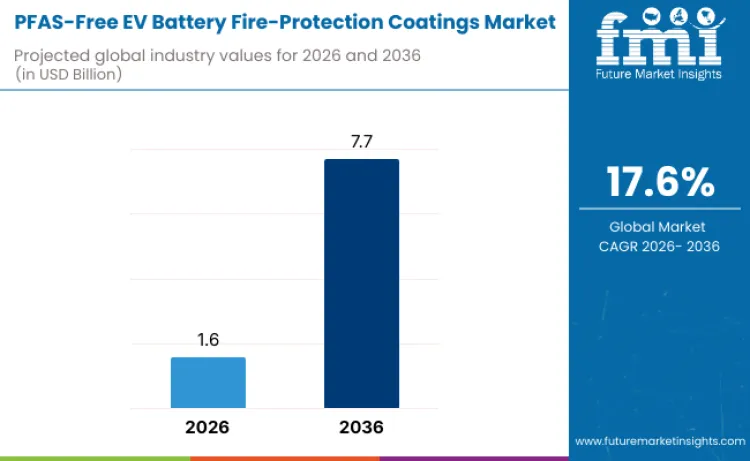
PFAS-Free EV Battery Fire-Protection Coatings Market Key Takeaways
| Metric | Value |
|---|---|
| Industry Sales Value (2026) | USD 1.6 billion |
| Industry Forecast Value (2036) | USD 7.7 billion |
| Industry Forecast CAGR (2026 to 2036) | 17.6% |
What Is Driving the Demand for PFAS Free EV Battery Fire Protection Coatings Globally?
The global demand for PFAS‑free EV battery fire‑protection coatings is driven by the rapid adoption of electric vehicles and growing regulatory and consumer pressure to eliminate hazardous substances from vehicle components. As electric vehicle production expands across major automotive markets, battery safety has emerged as a critical concern. Battery fire‑protection coatings are applied to battery cells, modules, and pack enclosures to slow or prevent thermal runaway events, improve flame retardancy, and enhance crash‑related safety.
Historically some formulations relied on PFAS chemistries for heat and flame resistance, but increasing restrictions on PFAS in consumer and industrial products have pushed manufacturers to seek alternative solutions. Regulatory regimes in North America, Europe, and parts of Asia are tightening controls on PFAS use because of concerns related to persistence, bioaccumulation, and human health, leading OEMs and battery suppliers to adopt PFAS‑free technologies. At the same time, electric vehicle makers and battery developers are seeking materials that align with broader sustainability commitments and chemical transparency goals, especially when communicating safety and environmental attributes to customers.
Future demand for PFAS‑free EV battery fire‑protection coatings is expected to grow as electric vehicle production volumes increase and global safety standards evolve. As regulations continue to restrict or phase out PFAS in automotive materials, alternatives based on non‑PFAS flame‑retardant chemistries will be incorporated more widely into battery packs and associated protective structures. Growth in the EV market’s share of total vehicle production will sustain demand for coatings that improve thermal stability and fire resistance without PFAS.
Ongoing research and development in polymer science, inorganic fire‑retardants, and hybrid coating systems will improve performance and cost competitiveness of PFAS‑free solutions, encouraging adoption by OEMs and Tier suppliers. The rate of adoption will depend on how quickly alternatives can match or exceed the safety performance of legacy PFAS‑based products, as well as how regulatory frameworks and automotive standards evolve across major markets. Overall, the global PFAS‑free EV battery fire‑protection coatings market is expected to expand in line with EV growth and tightening environmental and material safety requirements.
What Are the Key Segments in Global PFAS Free EV Battery Fire Protection Coatings Market?
The global PFAS‑free EV battery fire‑protection coatings market is segmented by coating type and product form. Intumescent coatings hold around 30% of the market share as a key coating type used to defend battery systems against thermal runaway and fire risk. In terms of product form, liquid coatings dominate with 40% of the market. The ongoing shift toward PFAS‑free chemistries is driven by evolving regulatory standards and the need for safer, environmentally acceptable fire protection solutions in electric vehicles (EVs). PFAS‑free alternatives are emerging as coatings and flame‑retardant materials are developed specifically for EV battery protection.
Which Coating Type Drives PFAS‑Free EV Battery Fire‑Protection Coatings Demand Globally?
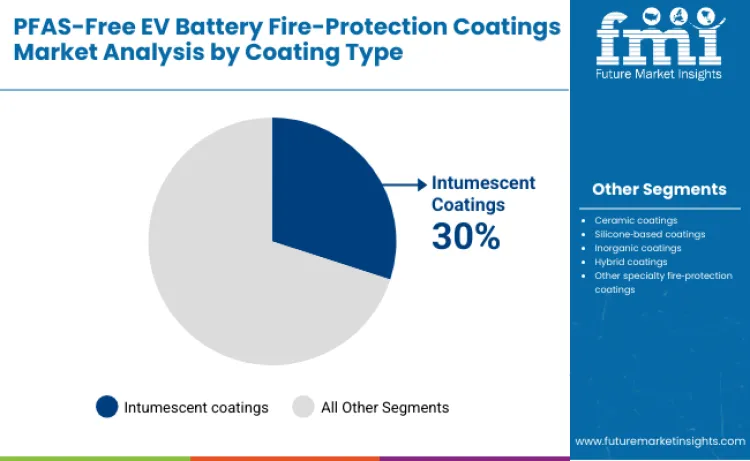
Intumescent coatings account for approximately 30% of the global PFAS‑free EV battery fire‑protection coatings demand. These coatings expand when exposed to high temperatures, creating a protective char barrier that slows heat transfer, which helps prevent or delay thermal runaway in EV battery packs. Traditional fire‑protection materials have included fluorochemical and PFAS‑based components, but newer PFAS‑free formulations using polymeric or non‑toxic flame‑retardant technologies are being developed to meet regulatory and safety requirements.
Which Product Form Drives PFAS‑Free EV Battery Fire‑Protection Coatings Demand Globally?
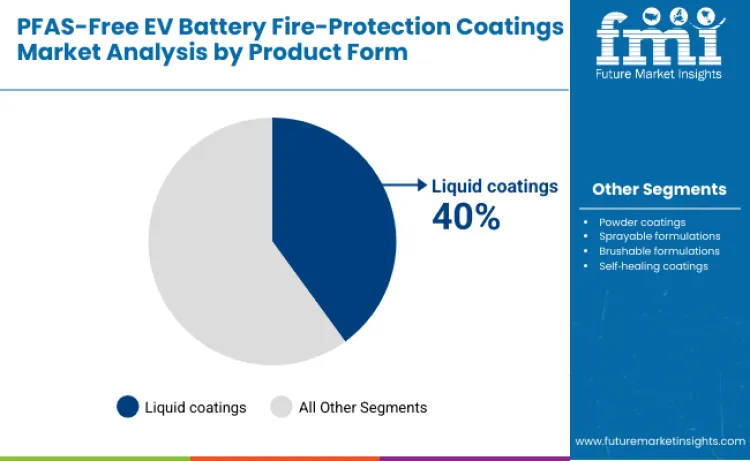
Liquid coatings represent about 40% of the product form share in the PFAS‑free EV battery fire‑protection market. Liquid coatings are widely adopted in EV manufacturing due to their ease of application, ability to conform to complex battery module geometries, and compatibility with existing coating lines. Liquid formulations often serve as the base for intumescent and other passive fire‑protection solutions applied directly to cell packs or battery housing surfaces. The preference for liquid forms reflects their practicality in high‑volume automotive production and the growing trend toward safer, PFAS‑free protective layers in next‑generation EV battery systems.
What are the Key Trends of the Global PFAS Free EV Battery Fire Protection Coatings Market?
The global PFAS‑free EV battery fire‑protection coatings market is being shaped by the rapid adoption of electric vehicles and safety requirements for battery systems. Protective coatings that do not contain PFAS chemistries are being developed to safeguard lithium‑ion packs from fire risks such as thermal runaway, short circuits, and impact damage while addressing environmental and health concerns. Growth is supported by stricter regulations on hazardous substances, rising EV production worldwide, and increased emphasis on safe, sustainable materials in automotive supply chains. These coatings are becoming essential components of battery system design.
What are the Key Drivers for the Global PFAS‑Free EV Battery Fire‑Protection Coatings Market?
One key driver is the accelerating global shift to electric mobility, which increases production of EVs and the need for effective fire‑protection solutions for high‑energy battery systems. Regulatory pressure on hazardous substances in materials used for automotive applications encourages adoption of PFAS‑free coating technologies that meet safety and sustainability criteria. Growing consumer and manufacturer focus on battery safety performance, durability and lifecycle risk mitigation supports investment in advanced protective coatings. Innovation in formulation science enabling high thermal resistance without PFAS strengthens demand as OEMs and suppliers seek compliant, high‑performance alternatives for next‑generation EV platforms.
What are the Restraints for the Global PFAS‑Free EV Battery Fire‑Protection Coatings Market?
A major restraint is the technical challenge of developing PFAS‑free coatings that deliver the same high levels of fire resistance, thermal stability and barrier protection historically offered by fluorinated chemistries. Reformulation requires significant research and development investment, which may slow product introduction and raise costs. Higher price points for advanced PFAS‑free formulations compared with legacy materials can be a barrier for some manufacturers, particularly in cost‑sensitive vehicle segments. Variability in global regulations and timelines for phasing out PFAS can reduce urgency for conversion in some regions, slowing market momentum.
What is the Global Demand Outlook for PFAS-Free EV Battery Fire-Protection Coatings?
The demand for PFAS-free EV battery fire-protection coatings is projected to grow steadily, with China leading the market at a projected CAGR of 12%. India follows closely with a growth rate of 11%, while the USA is expected to grow at 10%. The UK is projected to grow at 9%, and Japan at 8%. The increasing adoption of electric vehicles (EVs) and the rising focus on safety standards for EV batteries are key drivers for the demand for PFAS-free fire-protection coatings. These coatings are crucial for reducing fire risks associated with lithium-ion batteries, and the growing environmental regulations surrounding PFAS are encouraging manufacturers to adopt safer, eco-friendly alternatives.
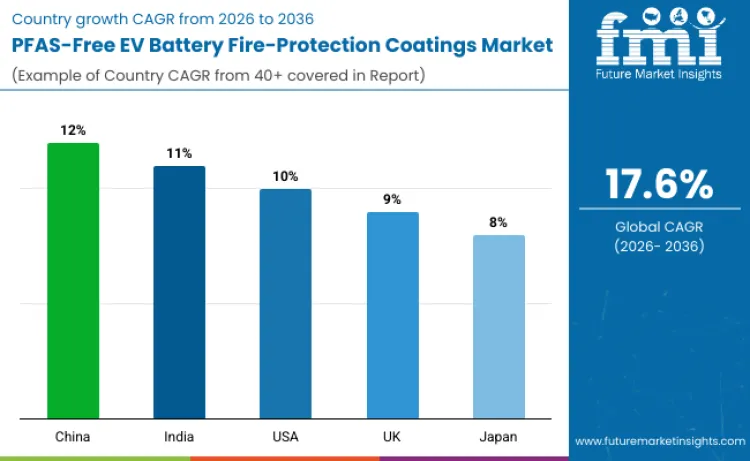
| Country | CAGR (2026 to 2036) |
|---|---|
| China | 12% |
| India | 11% |
| USA | 10% |
| UK | 9% |
| Japan | 8% |
What is Driving the Growth of PFAS-Free EV Battery Fire-Protection Coatings in China?
China is projected to experience the highest growth in the PFAS-free EV battery fire-protection coatings market, with a projected CAGR of 12%. China’s rapidly expanding electric vehicle market, driven by government incentives and increasing consumer demand for EVs, is a primary driver of this growth. As EV manufacturers and battery producers focus on improving the safety of lithium-ion batteries, the demand for fire-protection coatings that reduce the risk of thermal runaway and fires is rising. Additionally, the Chinese government’s strict regulations on PFAS chemicals and its commitment to promoting green technologies are fueling the shift toward PFAS-free coatings. As China continues to lead the global EV revolution, the need for advanced fire-protection solutions is expected to grow significantly.
Why is the PFAS-Free EV Battery Fire-Protection Coatings Market Expanding in India?
In India, the demand for PFAS-free EV battery fire-protection coatings is projected to grow at a CAGR of 11%. The country’s growing electric vehicle market, supported by government initiatives such as the Faster Adoption and Manufacturing of Hybrid and Electric Vehicles (FAME) scheme, is a key driver of this demand. As EV adoption accelerates in India, ensuring the safety of EV batteries becomes increasingly important. The need for effective fire-protection coatings in lithium-ion batteries, especially in the context of a rising number of EVs on the road, is contributing to the market growth. Additionally, the growing awareness of environmental and health risks associated with PFAS is driving manufacturers to seek safer alternatives, further fueling the demand for PFAS-free coatings.
How is the PFAS-Free EV Battery Fire-Protection Coatings Market Growing in the USA?
In the USA, the PFAS-free EV battery fire-protection coatings market is projected to grow at a CAGR of 10%. The USA, with its rapidly expanding electric vehicle market, is seeing increasing demand for advanced safety solutions for EV batteries. As automakers and battery manufacturers focus on improving battery safety and reducing fire risks, the demand for fire-protection coatings is rising. The USA's regulatory landscape, which is becoming stricter regarding the use of hazardous chemicals like PFAS in consumer products, is further driving the shift toward safer alternatives. The growing focus on sustainability, combined with the increasing adoption of EVs, is expected to continue supporting the demand for PFAS-free fire-protection coatings in the US market.
What is Contributing to the Growth of PFAS-Free EV Battery Fire-Protection Coatings in the UK?
In the UK, the demand for PFAS-free EV battery fire-protection coatings is projected to grow at a CAGR of 9%. The UK’s strong commitment to reducing carbon emissions and promoting electric vehicles, as evidenced by its ban on the sale of new gasoline and diesel cars by 2030, is a significant driver of this market. As the EV industry grows, the need for safer battery technologies becomes more critical, driving the adoption of fire-protection coatings that minimize the risk of battery fires. The UK’s focus on stringent environmental and safety regulations is also pushing the demand for PFAS-free alternatives. As manufacturers in the UK prioritize sustainable and safe battery solutions, the market for PFAS-free coatings is expected to continue its steady growth.
What is Influencing the Growth of PFAS-Free EV Battery Fire-Protection Coatings in Japan?
In Japan, the demand for PFAS-free EV battery fire-protection coatings is projected to grow at a CAGR of 8%. Japan’s growing adoption of electric vehicles, supported by government incentives and the country’s commitment to sustainability, is driving the demand for safer and more efficient EV battery technologies. As the Japanese automotive industry invests heavily in EV innovation, the need for fire-protection solutions for lithium-ion batteries becomes more critical. The country’s emphasis on environmental safety and the phase-out of harmful chemicals like PFAS is also contributing to the shift toward PFAS-free coatings. As Japan continues to promote eco-friendly technologies and focus on improving battery safety, the demand for PFAS-free fire-protection coatings is expected to increase steadily.
What is the Competitive Landscape for the Global PFAS Free EV Battery Fire Protection Coatings Market?
Global demand for PFAS‑free EV battery fire‑protection coatings is rising sharply as electric vehicle production accelerates and safety standards evolve. Traditional fire‑protection coatings often relied on PFAS chemistries that are increasingly restricted due to environmental and health concerns. EV battery systems present unique fire risks, and manufacturers, regulators and consumers alike are driving the shift toward fire‑resistant coatings that do not contain persistent, bioaccumulative PFAS substances.
The trend toward electrification in passenger vehicles, commercial fleets and emerging segments such as electric two‑wheelers and off‑highway machines further expands the need for effective, PFAS‑free protective coatings that enhance battery safety without compromising environmental goals. Demand is also shaped by stricter global regulations and sustainability targets, which push automotive OEMs, Tier‑1 suppliers and coating formulators to adopt alternatives that align with zero‑emission strategies and cleaner material portfolios.
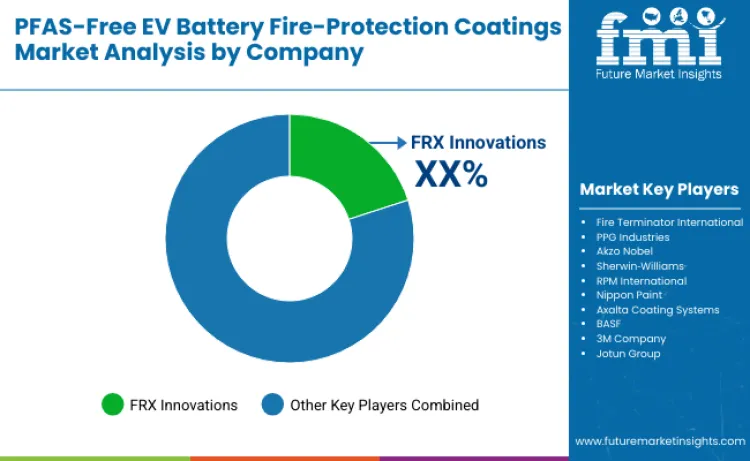
On the supply side, a diverse group of global coatings, materials and specialty chemical firms compete to meet this growing need. FRX Innovations is widely recognised as a leading player with proprietary PFAS‑free fire‑protection technologies tailored for EV battery applications. Other key companies active in the market include Fire Terminator International, PPG Industries, Akzo Nobel, Sherwin‑Williams, RPM International, Nippon Paint, Axalta Coating Systems, BASF, 3M Company and Jotun Group.
These firms offer a range of fire‑protection and thermal‑barrier coating solutions, leveraging flame‑retardant chemistries, intumescent systems, and advanced polymer technologies. Competition among them revolves around fire performance (time to ignition, flame spread control), thermal stability, adhesion to battery pack substrates, regulatory compliance for automotive and transport safety, and alignment with evolving environmental standards. Companies with strong R&D capabilities, proven PFAS‑free performance, broad application expertise and global support networks are best positioned to win business as EV OEMs and battery manufacturers increasingly prioritise both safety and sustainability in their material choices.
Key Players
- FRX Innovations
- Fire Terminator International
- PPG Industries
- Akzo Nobel
- Sherwin‑Williams
- RPM International
- Nippon Paint
- Axalta Coating Systems
- BASF
- 3M Company
- Jotun Group
Scope of the Report
| Items | Values |
|---|---|
| Quantitative Units (2026) | USD Billion |
| Coating Type | Intumescent coatings, Ceramic coatings, Silicone-based coatings, Inorganic coatings, Hybrid coatings, Other specialty fire-protection coatings |
| Product Form | Liquid coatings, Powder coatings, Sprayable formulations, Brushable formulations, Self-healing coatings |
| Application | EV battery modules, EV battery packs, Battery enclosures, Battery thermal management systems, Busbars and connectors, Structural battery components |
| End-Use | Passenger electric vehicles, Commercial electric vehicles, Electric buses and trucks, Two-wheelers and three-wheelers, Off-highway electric vehicles |
| Technology | Thermally protective, Flame-retardant, Heat-insulating, Multi-functional protective systems |
| Performance Grade | Standard performance, High performance, Ultra-high performance |
| Sales Channel | Direct sales to OEMs, Distribution partners, Online/e-commerce channels |
| Companies | FRX Innovations, Fire Terminator International, PPG Industries, Akzo Nobel, Sherwin-Williams, RPM International, Nippon Paint, Axalta Coating Systems, BASF, 3M Company, Jotun Group |
| Regions Covered | North America, Latin America, Western Europe, Eastern Europe, South Asia and Pacific, East Asia, Middle East & Africa |
| Countries Covered | United States, Canada, Mexico, Brazil, Argentina, Germany, France, United Kingdom, Italy, Spain, Netherlands, China, India, Japan, South Korea, ANZ, GCC Countries, South Africa |
| Additional Attributes | Dollar by sales by coating type, product form, application, end-use, technology, performance grade, and region. Includes market trends towards PFAS-free alternatives in EV battery fire protection, performance in various EV battery applications, cost-effectiveness, sustainability practices, regulatory compliance, market share and competitive positioning of key companies, and the role of fire-protection coatings in enhancing safety, durability, and performance of EV battery systems. |
Key Segments in the Fire Protection Coatings Market
By Coating Type:
- Intumescent coatings
- Ceramic coatings
- Silicone‑based coatings
- Inorganic coatings
- Hybrid coatings
- Other specialty fire‑protection coatings
By Product Form:
- Liquid coatings
- Powder coatings
- Sprayable formulations
- Brushable formulations
- Self‑healing coatings
By Application:
- EV battery modules
- EV battery packs
- Battery enclosures
- Battery thermal management systems
- Busbars and connectors
- Structural battery components
By End Use:
- Passenger electric vehicles
- Commercial electric vehicles
- Electric buses and trucks
- Two‑wheelers and three‑wheelers
- Off‑highway electric vehicles
By Technology:
- Thermally protective
- Flame‑retardant
- Heat‑insulating
- Multi‑functional protective systems
By Performance Grade:
- Standard performance
- High performance
- Ultra‑high performance
By Sales Channel:
- Direct sales to OEMs
- Distribution partners
- Online/e‑commerce channels
By Region:
- Asia Pacific
- China
- India
- Japan
- South Korea
- ASEAN
- Rest of Asia Pacific
- Europe
- Germany
- United Kingdom
- France
- Italy
- Spain
- Nordic
- BENELUX
- Rest of Europe
- North America
- United States
- Canada
- Mexico
- Latin America
- Brazil
- Chile
- Rest of Latin America
- Middle East & Africa
- Kingdom of Saudi Arabia
- Other GCC Countries
- Turkey
- South Africa
- Other African Union
- Rest of Middle East & Africa
Frequently Asked Questions
How big is the PFAS-Free EV Battery Fire-Protection Coatings market?
The market is valued at USD 1.6 billion in 2026 and is expected to grow at a CAGR of 17.60%, reaching USD 7.7 billion by 2036.
What is the growth outlook for the PFAS-Free EV Battery Fire-Protection Coatings market?
The market is projected to grow at a CAGR of 17.60% from 2026 to 2036.
Which region is expected to experience the fastest growth in the PFAS-Free EV Battery Fire-Protection Coatings market?
China is expected to lead with a growth rate of 12%, driven by the increasing demand for EV battery safety solutions.
What are the key applications of PFAS-Free EV Battery Fire-Protection Coatings?
PFAS-Free EV Battery Fire-Protection Coatings are primarily used to enhance the safety of electric vehicle batteries by preventing fire hazards.
Who is the major player in the PFAS-Free EV Battery Fire-Protection Coatings market?
The leading player in the market is FRX Innovations.
Preview the report firsthand - request a free sample
Get SampleGet the brochure for pricing and purchase details.
Get PDFTable of Content
- Executive Summary
- Market Overview
- Global Market Value, 2020 to 2026
- Global Market Forecast, 2026 to 2036
- Market Dynamics
- Drivers
- Restraints
- Opportunities
- Regulatory & Standards Landscape
- Technology & Material Innovation Outlook
- Market Segmentation Analysis
- By Coating Type
- Intumescent coatings
- Ceramic coatings
- Silicone-based coatings
- Inorganic coatings
- Hybrid coatings
- Other specialty fire-protection coatings
- By Product Form
- Liquid coatings
- Powder coatings
- Sprayable formulations
- Brushable formulations
- Self-healing coatings
- By Application
- EV battery modules
- EV battery packs
- Battery enclosures
- Battery thermal management systems
- Busbars and connectors
- Structural battery components
- By End-Use
- Passenger electric vehicles
- Commercial electric vehicles
- Electric buses and trucks
- Two-wheelers and three-wheelers
- Off-highway electric vehicles
- By Technology
- Thermally protective systems
- Flame-retardant systems
- Heat-insulating systems
- Multi-functional protective systems
- By Performance Grade
- Standard performance
- High performance
- Ultra-high performance
- By Sales Channel
- Direct sales to OEMs
- Distribution partners
- Online / e-commerce channels
- By Coating Type
- Regional Outlook
- North America
- Latin America
- Western Europe
- Eastern Europe
- South Asia & Pacific
- East Asia
- Middle East & Africa
- Country-Level Outlook
- United States
- Canada
- Mexico
- Brazil
- Argentina
- Germany
- France
- United Kingdom
- Italy
- Spain
- Netherlands
- China
- India
- Japan
- South Korea
- ANZ
- GCC Countries
- South Africa
- Competitive Landscape
- Market Structure Overview
- Company Positioning
- Strategic Initiatives
- Key Player Profiles
- Scope of the Report
- Research Methodology
- Assumptions & Acronyms


