

- Industry Size (2026)
- USD 588 Mn
- Forecast (2036)
- USD 1933 Mn
- CAGR (2026 to 2036)
- 13%
Heat-Shield Coatings for EV Battery Trays Market Forecast and Outlook 2026 to 2036
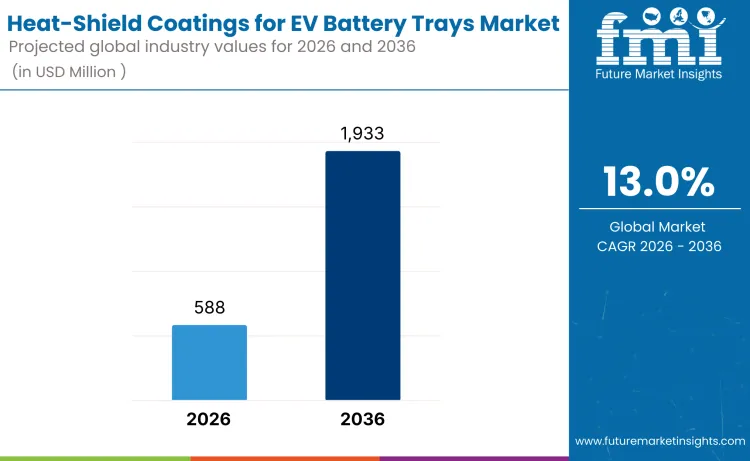
The global heat-shield coatings for EV battery trays market, valued at USD 588 million in 2026, is projected to grow to USD 1,933 million by 2036, with a CAGR of 13%. The market is driven by the increasing demand for electric vehicles (EVs) and the need for enhanced safety and thermal management in EV battery systems.
Ceramic thermal barrier coatings, which account for 30% of the coating type market share, are preferred due to their exceptional heat resistance and ability to protect critical battery components from high temperatures. Battery tray bottoms, representing 28% of the application segment, are the main focus for these coatings, as they provide protection to the battery trays from heat generated during EV operation. The growth is further supported by the push for more efficient, safer, and longer-lasting EV battery systems.
Quick Stats for Heat-Shield Coatings for EV Battery Trays Market
- Heat-Shield Coatings for EV Battery Trays Market Value (2026): USD 588 million
- Heat-Shield Coatings for EV Battery Trays Market Forecast Value (2036): USD 1,933 million
- Heat-Shield Coatings for EV Battery Trays Market Global Forecast CAGR: 13%
- Leading Coating Type in Heat-Shield Coatings for EV Battery Trays Market: Ceramic thermal barrier coatings (30%)
- Key Growth Regions in Heat-Shield Coatings for EV Battery Trays Market: China, India, USA, UK, Japan
- Top Players in Heat-Shield Coatings for EV Battery Trays Market: PPG Industries, AkzoNobel, Henkel, 3M, DuPont, Axalta Coating Systems, H.B. Fuller Company, Sika AG, Wacker Chemie AG, Momentive Performance Materials Inc., Elantas (Altana AG), BASF, Shin-Etsu Chemical Co., Thermal Coatings Inc, IHI Corporation, Fine Ceramic Technology Co Ltd
Heat-Shield Coatings for EV Battery Trays Market Key Takeaways
| Metric | Value |
|---|---|
| Industry Sales Value (2026) | USD 588 million |
| Industry Forecast Value (2036) | USD 1,933 million |
| Industry Forecast CAGR (2026-2036) | 13% |
What Is Driving the Demand for Heat Shield Coatings for EV Battery Trays Globally?
Demand for heat‑shield coatings for EV battery trays is driven by the rapid growth of electric vehicle production and the need for effective thermal management in battery systems. As EV battery packs generate significant heat during use, managing this heat is crucial for performance, safety, and longevity. Battery trays require coatings that prevent excessive heat transfer to sensitive components, reducing the risk of thermal runaway and extending battery life. As EV adoption increases in key markets, demand for coatings that ensure stable operating temperatures in battery modules is growing. Advances in energy‑dense batteries and powerful electrical systems heighten the need for enhanced thermal protection.
Future demand for heat‑shield coatings is expected to rise as EV technologies evolve. The focus will be on coatings that offer higher thermal resistance and faster application while remaining compatible with automated production processes. Growth in battery safety regulations and performance standards will further drive the adoption of heat‑shield solutions. The pace of growth will depend on how well coating developers can balance thermal protection, cost‑effectiveness, and seamless integration with battery assembly lines, contributing to the ongoing expansion of the heat‑shield coatings market.
What Are the Key Segments in Heat-Shield Coatings for EV Battery Trays Market?
Global heat-shield coatings for EV battery trays market is segmented by coating type and application. Ceramic thermal barrier coatings represent 30% of the market, reflecting their popularity in high-performance heat protection. Battery tray bottoms account for 28% of the application share, driven by the need for effective thermal management in electric vehicle battery systems.
Which Coating Type Drives Heat-Shield Coatings for EV Battery Trays Demand Globally?
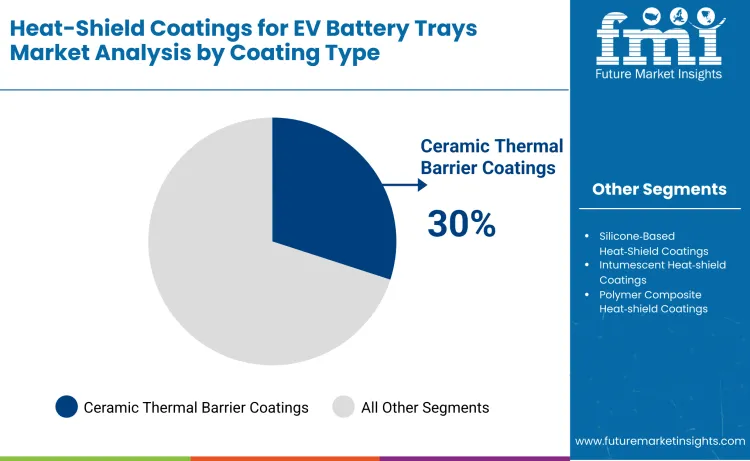
Ceramic thermal barrier coatings account for 30% of the market share. These coatings are highly effective at insulating and protecting battery trays from heat buildup, a crucial factor in maintaining the safety and performance of EV batteries. Ceramic coatings can withstand high temperatures and offer excellent thermal resistance, ensuring that battery systems remain within safe operating temperatures. As electric vehicles use larger battery packs with higher energy density, effective heat management becomes essential to prevent thermal runaway or degradation of the battery cells. Ceramic thermal barrier coatings are preferred in this application due to their high heat resistance, durability, and ability to prolong the lifespan of the battery system. Their demand is growing as manufacturers continue to innovate in thermal management technologies for electric vehicle batteries.
Which Application Drives Heat-Shield Coatings for EV Battery Trays Demand Globally?
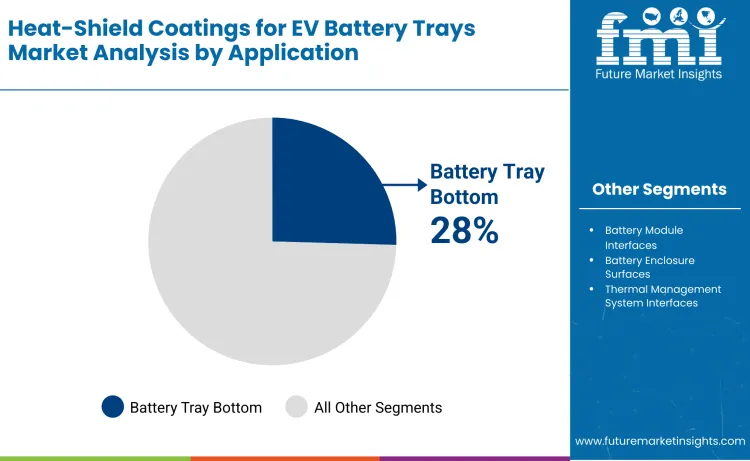
Battery tray bottoms represent 28% of the market share. The battery tray bottom is a critical component of an EV’s battery system, often subjected to high temperatures due to the energy-intensive nature of electric powertrains. Effective heat-shield coatings on the battery tray bottoms help protect the battery cells from thermal damage, ensuring the system operates within safe temperature ranges. As EV battery systems grow in size and power output, the demand for robust thermal management solutions for battery trays has increased. Heat-shield coatings are applied to enhance safety, performance, and reliability, reducing the risk of battery failure due to overheating. The growth of electric vehicle adoption, along with the need for more efficient battery systems, continues to drive the demand for heat-shield coatings in battery tray applications.
What is the Key Trends in the Global Heat Shield Coatings for EV Battery Trays Market?
The global heat‑shield coatings for EV battery trays market is expanding as electric vehicles continue to scale worldwide and safety standards tighten around battery thermal management. Heat‑shield coatings are applied to battery tray surfaces to protect cells from excessive heat, mitigate the propagation of thermal runaway, and improve overall system durability. Adoption is increasing across passenger cars, commercial vehicles, and electrified fleets as manufacturers prioritize safety, performance and compliance. Growth is also supported by advances in material science that enable lightweight, high‑temperature resistant coatings, which help preserve battery life and support energy efficiency in modern EV designs.
What are the Key Drivers for the Global Heat‑Shield Coatings for EV Battery Trays Market?
Key drivers include the rapid global adoption of electric vehicles, which increases focus on battery safety and thermal management solutions. High operating temperatures in EV battery packs create demand for specialized coatings that can reflect, dissipate or block heat to protect cells and structural components. Regulatory and safety requirements for EV battery systems in major markets encourage manufacturers to apply high‑performance thermal protection technologies. Continuous innovation in coating formulations that deliver enhanced thermal stability, corrosion resistance and adhesion supports broader use. Rising investment in EV production capacity and electrified commercial fleets further propels demand for heat‑shield coatings tailored for battery tray applications.
What are the Restraints for the Global Heat‑Shield Coatings for EV Battery Trays Market?
One restraint is the technical challenge of developing coatings that combine high heat resistance with lightweight properties and compatibility with diverse battery tray materials. Formulations must balance thermal protection with electrical insulation and mechanical durability, which complicates research and development. The cost associated with advanced material development, testing, and qualification can be high, especially for emerging coating technologies that have not yet achieved large‑scale production. Price sensitivity in some EV segments may limit adoption of premium coatings. Variability in regional test standards and certification processes can slow global harmonization of coating specifications, delaying broader implementation.
What is the Country-wise Outlook for Heat-Shield Coatings for EV Battery Trays?
Demand for heat-shield coatings for EV battery trays is projected to grow rapidly across various countries, with China leading the market at a projected CAGR of 15%. India follows closely with a growth rate of 13%, while the USA is expected to grow at 11%. The UK is projected to grow at 9%, and Japan at 8%. The increasing adoption of electric vehicles (EVs) and the growing focus on enhancing the safety, efficiency, and durability of EV battery systems are key drivers for the demand for heat-shield coatings. These coatings are critical for protecting EV batteries from overheating, thereby improving overall vehicle performance and safety.
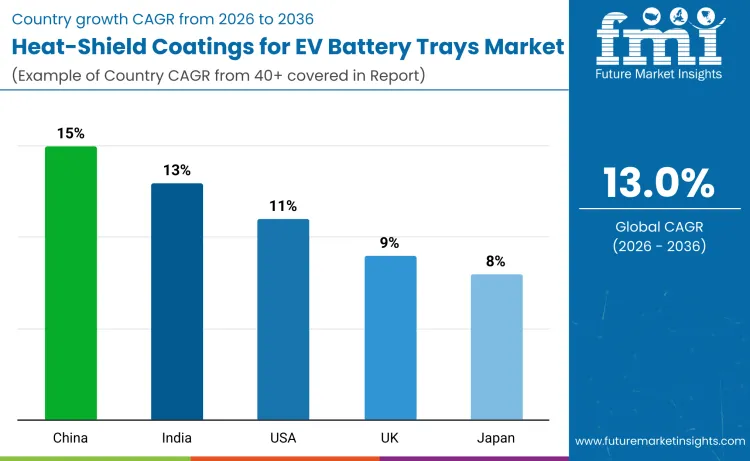
| Country | CAGR (2026-2036) |
|---|---|
| China | 15% |
| India | 13% |
| USA | 11% |
| UK | 9% |
| Japan | 8% |
What is Driving the Growth of Heat-Shield Coatings for EV Battery Trays in China?
China is projected to experience the highest growth in the heat-shield coatings for EV battery trays market, with a projected CAGR of 15%. As the world’s largest producer and consumer of electric vehicles, China plays a pivotal role in driving global demand for EV components, including battery systems. The rapid expansion of the EV market in China is the primary driver for the demand for heat-shield coatings, which are essential for maintaining battery temperature stability and ensuring safety. The Chinese government’s strong support for electric mobility, along with its efforts to reduce carbon emissions, has accelerated the adoption of electric vehicles. China’s commitment to improving vehicle safety and efficiency is further fueling the need for heat-shield coatings to protect EV batteries from heat damage and improve performance.
Why is the Heat-Shield Coatings Market Expanding in India?
In India, the demand for heat-shield coatings for EV battery trays is projected to grow at a CAGR of 13%. India is experiencing rapid growth in the electric vehicle sector, driven by government incentives, growing environmental awareness, and rising fuel costs. As more consumers and businesses adopt electric vehicles, the need for safer and more efficient battery systems has grown. Heat-shield coatings are crucial for maintaining battery performance and preventing overheating, making them essential components in EV battery trays. The increasing focus on sustainability, coupled with regulatory pressure to reduce emissions and carbon footprints, is accelerating the transition to electric mobility in India. As the EV market continues to expand, the demand for heat-shield coatings is expected to grow steadily.
How is the Heat-Shield Coatings Market Growing in the USA?
In the USA, the heat-shield coatings for EV battery trays market is projected to grow at a CAGR of 11%. The USA is one of the largest automotive markets globally, and the transition to electric vehicles is gaining momentum. As the adoption of EVs continues to rise, there is increasing demand for advanced technologies that ensure the safety, performance, and efficiency of EV battery systems. Heat-shield coatings are essential for preventing overheating and thermal runaway in EV batteries, making them critical for enhancing the overall safety of electric vehicles. Regulatory efforts, consumer demand for safer vehicles, and the growing focus on sustainability are driving the shift towards electric mobility in the USA, fueling the demand for heat-shield coatings.
What is Contributing to the Growth of Heat-Shield Coatings for EV Battery Trays in the UK?
In the UK, the demand for heat-shield coatings for EV battery trays is projected to grow at a CAGR of 9%. The UK government has committed to phasing out internal combustion engine vehicles by 2030, which is driving the adoption of electric vehicles. As EV adoption increases, so does the demand for advanced safety features, including heat-shield coatings, which are essential for ensuring that EV batteries maintain optimal operating temperatures and perform safely. The growing emphasis on sustainable and eco-friendly technologies in the UK automotive sector is also contributing to the shift toward electric mobility.
What is Influencing the Growth of Heat-Shield Coatings for EV Battery Trays in Japan?
In Japan, demand for heat-shield coatings for EV battery trays is projected to grow at a CAGR of 8%. Japan, home to some of the world’s leading automotive manufacturers, is heavily investing in electric vehicle development and innovation. As Japan shifts towards more sustainable transportation options, the need for safe and efficient battery systems in EVs is growing. Heat-shield coatings are critical in ensuring that EV batteries remain safe and perform optimally under various operating conditions. Japan’s strong focus on advanced technologies and green initiatives, combined with the automotive industry’s commitment to meeting international environmental standards, is driving the demand for heat-shield coatings for EV battery trays in the country. As Japan’s EV market continues to expand, the demand for such coatings is expected to grow steadily.
What is the Competitive Landscape for the Global Heat‑Shield Coatings for EV Battery Trays Market?
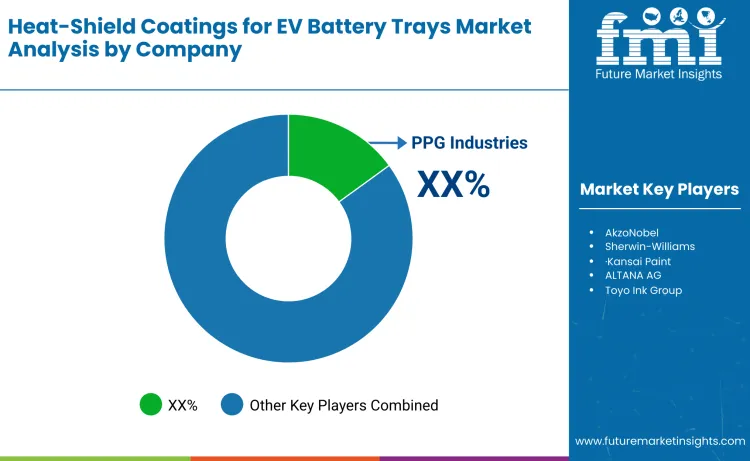
Global demand for heat‑shield coatings for EV battery trays is rising as electric vehicle production expands and manufacturers intensify focus on battery safety, thermal management and longevity. Heat‑shield coatings are applied to battery trays and surrounding structures to protect cells from excessive temperature, improve heat dissipation, and reduce the risk of thermal runaway. Growth in EV adoption across passenger, commercial and fleet segments supports increased need for advanced thermal‑barrier materials. Stricter safety standards and regulatory expectations for battery performance and crash‑safety also contribute to rising uptake. As automakers pursue lighter, more compact battery pack designs, effective thermal protection becomes a critical differentiator for performance and durability. Demand is especially strong in regions with aggressive electrification targets, large EV markets and well‑developed supply chains including North America, Europe and Asia Pacific.
On the supply side, a diverse group of global coatings, materials and speciality chemical firms compete to serve this specialised market. PPG Industries is recognized as a leading supplier, backed by a broad portfolio of high‑performance coating technologies. Other significant competitors include AkzoNobel, Henkel, 3M, DuPont, Axalta Coating Systems, H.B. Fuller Company, Sika AG, Wacker Chemie AG, Momentive Performance Materials Inc., Elantas (Altana AG), BASF, Shin‑Etsu Chemical Co., Thermal Coatings Inc, IHI Corporation and Fine Ceramic Technology Co Ltd. These companies offer heat‑shield coatings formulated for high thermal resistance, adhesion to complex substrates, durability under vibration and environmental exposure, and compatibility with automated EV battery manufacturing processes. Competition among suppliers focuses on coating performance under extreme temperatures, ease of application at scale, regulatory compliance for vehicle safety standards, and the ability to support global EV manufacturers.
Key Players
- PPG Industries
- AkzoNobel
- Henkel
- 3M
- DuPont
- Axalta Coating Systems
- H.B. Fuller Company
- Sika AG
- Wacker Chemie AG
- Momentive Performance Materials Inc.
- Elantas (Altana AG)
- BASF
- Shin‑Etsu Chemical Co.
- Thermal Coatings Inc
- IHI Corporation
- Fine Ceramic Technology Co Ltd
Scope of the Report
| Items | Values |
|---|---|
| Quantitative Units (2026) | USD Million |
| Coating Type | Ceramic thermal barrier coatings, Silicone-based heat-shield coatings, Intumescent heat-shield coatings, Polymer composite heat-shield coatings, Hybrid heat-shield coatings |
| Application | Battery tray bottoms, Battery module interfaces, Battery enclosure surfaces, Thermal management system interfaces, Under-body battery protection areas |
| End-Use | Electric cars, Electric buses, Electric trucks, Electric two-wheelers, Electric commercial vehicles |
| Sales Channel | Direct OEM supply, Distributor channels, Aftermarket suppliers |
| Companies | PPG Industries, AkzoNobel, Henkel, 3M, DuPont, Axalta Coating Systems, H.B. Fuller Company, Sika AG, Wacker Chemie AG, Momentive Performance Materials Inc., Elantas (Altana AG), BASF, Shin-Etsu Chemical Co., Thermal Coatings Inc, IHI Corporation, Fine Ceramic Technology Co Ltd |
| Regions Covered | North America, Latin America, Western Europe, Eastern Europe, South Asia and Pacific, East Asia, Middle East & Africa |
| Countries Covered | United States, Canada, Mexico, Brazil, Argentina, Germany, France, United Kingdom, Italy, Spain, Netherlands, China, India, Japan, South Korea, ANZ, GCC Countries, South Africa |
| Additional Attributes | Dollar by sales by coating type, application, end-use, sales channel, and region. Includes market trends in rain-erosion resistance for offshore blade edge coatings, performance in battery tray, module, and enclosure applications, cost-effectiveness, sustainability practices, regulatory compliance, market share and competitive positioning of key companies, and the role of heat-shield coatings in enhancing safety, durability, and thermal management in electric vehicles and other high-performance applications. |
Key Segments in the Heat-Shield Coatings for EV Battery Trays Market
Coating Type:
- Ceramic thermal barrier coatings
- Silicone‑based heat‑shield coatings
- Intumescent heat‑shield coatings
- Polymer composite heat‑shield coatings
- Hybrid heat‑shield coatings
Application:
- Battery tray bottoms
- Battery module interfaces
- Battery enclosure surfaces
- Thermal management system interfaces
- Under‑body battery protection areas
End Use:
- Electric cars
- Electric buses
- Electric trucks
- Electric two‑wheelers
- Electric commercial vehicles
Sales Channel:
- Direct OEM supply
- Distributor channels
- Aftermarket suppliers
Region:
- Asia Pacific
- China
- India
- Japan
- South Korea
- ASEAN
- Rest of Asia Pacific
- Europe
- Germany
- United Kingdom
- France
- Italy
- Spain
- Nordic
- BENELUX
- Rest of Europe
- North America
- United States
- Canada
- Mexico
- Latin America
- Brazil
- Chile
- Rest of Latin America
- Middle East & Africa
- Kingdom of Saudi Arabia
- Other GCC Countries
- Turkey
- South Africa
- Other African Union
- Rest of Middle East & Africa
Frequently Asked Questions
How big is the Heat-Shield Coatings for EV Battery Trays market?
The market is valued at USD 588 million in 2026 and is expected to grow at a CAGR of 13%, reaching USD 1.933 billion by 2036.
What is the growth outlook for the Heat-Shield Coatings for EV Battery Trays market?
The market is projected to grow at a CAGR of 13% from 2026 to 2036.
Which region is expected to experience the fastest growth in the Heat-Shield Coatings for EV Battery Trays market?
China is expected to lead with a growth rate of 15%, driven by the growing demand for electric vehicles and the need for advanced heat management solutions.
What are the key applications of Heat-Shield Coatings for EV Battery Trays?
Heat-Shield Coatings for EV Battery Trays are primarily used to protect battery trays in electric vehicles from extreme heat, ensuring the safety and longevity of the battery system.
Who is the major player in the Heat-Shield Coatings for EV Battery Trays market?
The leading player in the market is PPG Industries.
Preview the report firsthand - request a free sample
Get SampleGet the brochure for pricing and purchase details.
Get PDFTable of Content
- Executive Summary
- Market Overview
- Global Market Value, 2020-2025
- Global Market Forecast, 2026-2036
- Market Dynamics
- Drivers
- Restraints
- Opportunities
- Regulatory & Standards Landscape
- Technology & Material Innovation Outlook
- Market Segmentation Analysis
- By Coating Type
- Ceramic Thermal Barrier Coatings
- Silicone-Based Heat-Shield Coatings
- Intumescent Heat-Shield Coatings
- Polymer Composite Heat-Shield Coatings
- Hybrid Heat-Shield Coatings
- By Application
- Battery Tray Bottoms
- Battery Module Interfaces
- Battery Enclosure Surfaces
- Thermal Management System Interfaces
- Under-Body Battery Protection Areas
- By End-Use
- Electric Cars
- Electric Buses
- Electric Trucks
- Electric Two-Wheelers
- Electric Commercial Vehicles
- By Sales Channel
- Direct OEM Supply
- Distributor Channels
- Aftermarket Suppliers
- By Coating Type
- Regional Outlook
- North America
- Latin America
- Western Europe
- Eastern Europe
- South Asia & Pacific
- East Asia
- Middle East & Africa
- Country-Level Outlook
- United States
- Canada
- Mexico
- Brazil
- Argentina
- Germany
- France
- United Kingdom
- Italy
- Spain
- Netherlands
- China
- India
- Japan
- South Korea
- ANZ
- GCC Countries
- South Africa
- Competitive Landscape
- Market Structure Overview
- Company Positioning
- Strategic Initiatives
- Key Player Profiles
- Scope of the Report
- Research Methodology
- Assumptions & Acronyms


