

- Industry Size (2026)
- USD 3 Bn
- Forecast (2036)
- USD 7.3 Bn
- CAGR (2026 to 2036)
- 9.30%
EV Battery Bio-Renewable Thermal Films Market Forecast and Outlook 2026 to 2036
The global EV battery bio-renewable thermal films market is valued at USD 3 billion in 2026 and is projected to reach USD 7.3 billion by 2036, growing at a CAGR of 9.30%. This market is commercially significant as the demand for electric vehicles (EVs) and renewability in the automotive sector continues to accelerate. As EV manufacturers prioritize energy-efficient and eco-friendly materials, bio-renewable thermal films are positioned as a key solution for managing battery temperature, enhancing performance, and ensuring safety.
With growing regulatory pressures for cleaner manufacturing processes, buyers are increasingly seeking eco-friendly alternatives that meet both environmental and operational goals. The market's expansion between 2026 and 2036 will be influenced by innovations in bio-based polymers, shifting automotive preferences towards green technologies, and the industry's push to meet carbon reduction targets. The commercial opportunity lies in addressing these industry needs while capitalizing on the growing adoption of EVs and eco-conscious consumer demand.
Quick Stats for EV Battery Bio-Renewable Thermal Films Market
- EV Battery Bio-Renewable Thermal Films Market Value (2026): USD 3 Billion
- EV Battery Bio-Renewable Thermal Films Market Forecast Value (2036): USD 7.3 Billion
- EV Battery Bio-Renewable Thermal Films Market Forecast CAGR 2026 to 2036: 9.30%
- Leading Film Type in EV Battery Bio-Renewable Thermal Films Market: Bio-PE Thermal Films
- Key Growth Regions in EV Battery Bio-Renewable Thermal Films Market: Asia Pacific, North America
- Top Key Players in EV Battery Bio-Renewable Thermal Films Market: BASF SE, LyondellBasell, Dow Inc., Arkema SA, SABIC
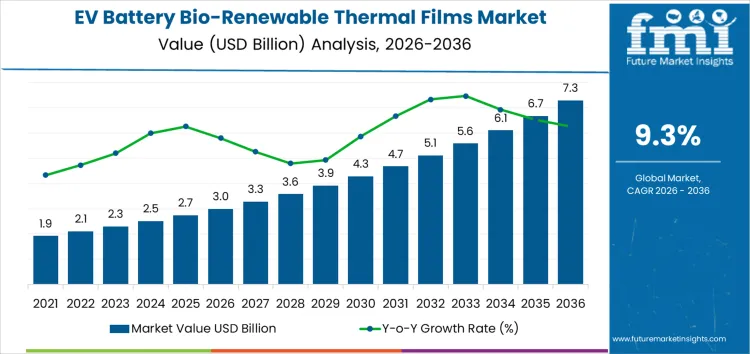
EV Battery Bio-Renewable Thermal Films Market Key Takeaways
| Metric | Value |
|---|---|
| Industry Value (2026) | USD 3 Billion |
| Forecast Value (2036) | USD 7.3 Billion |
| Forecast CAGR 2026 to 2036 | 9.30% |
How is the Global EV Battery Bio-Renewable Thermal Films Market Advancing?
The global EV battery bio-renewable thermal films market is experiencing significant growth, driven by the increasing demand for eco-friendly, efficient thermal management solutions in electric vehicles (EVs). Bio-renewable thermal films are used in EV batteries to enhance their cooling performance, preventing overheating and ensuring the longevity and safety of the battery. These films are made from renewable materials, offering an eco-friendlier alternative to traditional thermal management solutions that rely on petrochemical-based plastics.
A key driver for market growth is the rising demand for electric vehicles and the push for more energy-efficient, eco-friendly automotive technologies. As the adoption of EVs increases, ensuring optimal battery performance and thermal stability is becoming increasingly important to manufacturers. Bio-renewable thermal films help achieve better thermal conductivity and heat dissipation while reducing the overall environmental impact of battery production. As governments and organizations continue to focus on reducing carbon footprints, bio-renewable materials in EV battery production are becoming essential for meeting renewability targets in the automotive industry.
Technological advancements in bio-renewable materials and film production processes are further driving the market's growth. New innovations in bio-based polymers, improved thermal properties, and cost-effective manufacturing techniques are making bio-renewable thermal films more competitive in the market. As the demand for higher efficiency and lower environmental impact in EV battery systems continues to rise, the market for bio-renewable thermal films is set for sustained expansion, contributing to the continued growth of the electric vehicle industry.
What Is the Segment-Wise Analysis for the EV Battery Bio-Renewable Thermal Films Market?
Demand formation is being shaped by scale of battery deployment, safety compliance pressure, and thermal control complexity inside battery packs. Battery type adoption determines baseline volume consumption, while application level integration defines material thickness, performance requirements, and pricing structure. Together, these dimensions explain why certain segments command disproportionate shares despite ongoing material innovation and pilot scale technologies.
What battery types shape demand for EV battery bio renewable thermal films?
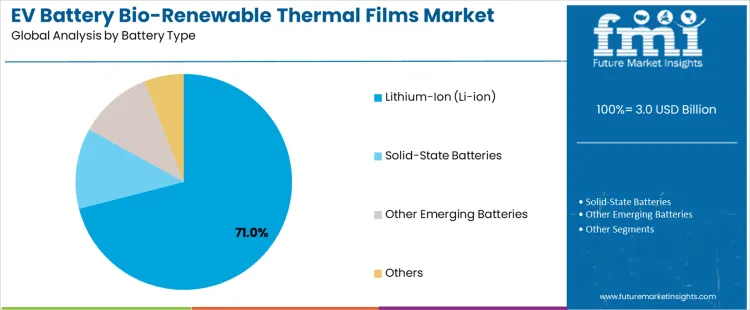
Lithium ion batteries hold a 71% share of EV battery bio renewable thermal films demand, driven by dominant usage across passenger and commercial electric vehicles. High energy density and thermal sensitivity require consistent insulation and heat control layers, supporting strong film penetration. Solid state batteries capture a lower share due to limited commercialization and restricted production volumes. Other emerging battery chemistries contribute a minor share as design diversity and evolving standards slow large scale adoption. Film suppliers remain focused on lithium ion platforms where predictable volumes, repeatable specifications, and regulatory driven safety requirements sustain long term material demand and stable procurement behavior.
Which applications define usage patterns for EV battery bio renewable thermal films?
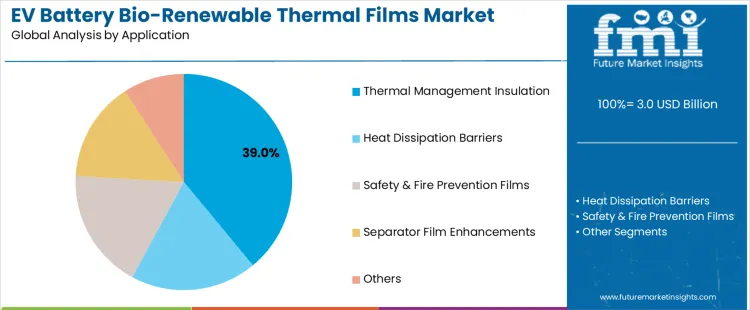
Thermal management insulation accounts for a 39% share of application based demand, reflecting its central role in maintaining temperature uniformity and battery safety. Films used for insulation are widely deployed across modules, packs, and enclosures. Heat dissipation barriers represent a meaningful share as fast charging and higher power densities increase localized heat stress. Safety and fire prevention films maintain steady adoption under stricter compliance norms. Separator film enhancements and other applications hold smaller shares, mainly linked to advanced designs and experimental architectures rather than mainstream EV production platforms.
What Are the Key Dynamics for the EV Battery Bio-Renewable Thermal Films Market?
The EV battery bio-renewable thermal films market is driven by the increasing demand for eco-friendly, high-performance materials in the electric vehicle (EV) sector. Bio-renewable thermal films are used in EV batteries to provide thermal management, improving the efficiency, safety, and lifespan of the batteries. As the global shift towards electric vehicles accelerates, the need for eco-friendly, bio-based materials in battery production is growing. These films offer advantages over traditional materials by being sourced from renewable resources, contributing to the overall renewability of EVs and reducing their carbon footprint.
How Are the Key Drivers Shaping the EV Battery Bio-Renewable Thermal Films Market?
Key drivers shaping the EV battery bio-renewable thermal films market include the growing adoption of electric vehicles, which increases the need for efficient and eco-friendly thermal management solutions. Bio-renewable thermal films offer superior thermal conductivity, reducing the risk of battery overheating and enhancing battery life. The global push for reducing carbon emissions and adopting eco-friendly manufacturing practices is pushing the automotive and battery industries to explore renewable alternatives. Advancements in bio-based materials and their ability to provide similar or improved performance compared to traditional films are driving their adoption in EV battery production.
What Are the Challenges Impacting the EV Battery Bio-Renewable Thermal Films Market?
The EV battery bio-renewable thermal films market faces challenges such as the higher cost of bio-renewable materials compared to traditional thermal management solutions. The production of bio-renewable films often requires advanced technologies and processes, which can increase manufacturing costs. Scalability issues in sourcing and producing bio-renewable materials on a large scale may hinder widespread adoption. There are also concerns about the long-term durability and performance of bio-renewable films under extreme battery operating conditions. Manufacturers must address these challenges to ensure that bio-renewable thermal films provide consistent, reliable performance in EV applications.
What is the Growth Outlook for the EV Battery Bio-Renewable Thermal Films Market by Country?
| Country | CAGR (%) |
|---|---|
| China | 10.1% |
| United States | 9.6% |
| South Korea | 9.2% |
| Germany | 8.9% |
| Japan | 8.7% |
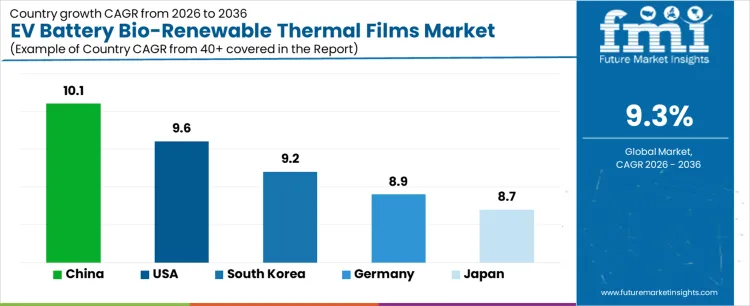
The EV battery bio-renewable thermal films market is expanding across key regions, with China leading at 10.1%, driven by its growing EV market and focus on eco-friendly materials. The United States follows at 9.6%, supported by advancements in battery technologies and the need for eco-friendly solutions. South Korea’s market grows at 9.2%, fueled by its leadership in battery production and green technology initiatives. Germany expands at 8.9%, backed by a strong automotive sector and commitment to renewability. Japan grows at 8.7%, driven by its focus on clean energy and eco-friendly materials in EV production. The increasing adoption of electric vehicles and demand for eco-friendly, high-performance materials are key drivers of the market’s growth across these regions.
What is Driving the Growth of the EV Battery Bio-Renewable Thermal Films Market in China?
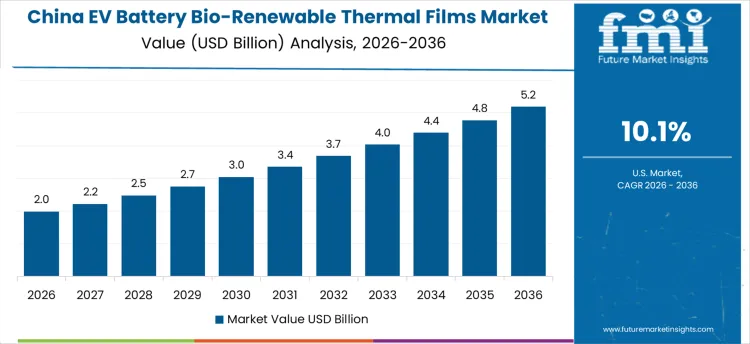
China’s EV battery bio-renewable thermal films market is growing at 10.1%, driven by the country’s rapid growth in electric vehicle production and adoption. China, as the world’s largest producer and consumer of EVs, has seen a sharp increase in the demand for high-performance battery components, including thermal films. Bio-renewable thermal films are increasingly being used in EV batteries due to their renewability, improved thermal management properties, and eco-friendly materials. With China’s government promoting green energy, carbon reduction, and environmentally friendly manufacturing practices, the demand for bio-renewable solutions in EV battery production is rising. As China strengthens its position in the global EV market, the need for advanced, eco-friendly thermal management materials in EV batteries is expected to grow significantly, driving the bio-renewable thermal films market.
How is the EV Battery Bio-Renewable Thermal Films Market Expanding in the United States?
The EV battery bio-renewable thermal films market in the United States is growing at 9.6%, driven by the increasing adoption of electric vehicles and advancements in battery technologies. As the USA works toward reducing carbon emissions and advancing renewable energy solutions, the demand for eco-friendly and eco-friendly materials in the automotive sector is rising. Bio-renewable thermal films are gaining traction in EV battery production due to their superior thermal management capabilities and environmental benefits. The USA’s strong regulatory focus on reducing the environmental footprint of manufacturing processes, along with the push for eco-friendly materials in the EV sector, is driving the market growth. As EV adoption accelerates, the demand for high-performance, eco-friendly thermal management solutions will continue to rise, ensuring the continued growth of this market.
How is the EV Battery Bio-Renewable Thermal Films Market Expanding in South Korea?
South Korea’s EV battery bio-renewable thermal films market is growing at 9.2%, driven by the country’s leadership in electric vehicle production and innovation in battery technologies. South Korea is home to some of the world’s largest battery manufacturers, and as the demand for electric vehicles increases, so does the need for advanced thermal management materials. Bio-renewable thermal films are becoming a key material due to their renewability, cost-effectiveness, and enhanced thermal properties, which improve battery efficiency and safety. South Korea’s strong focus on renewability, combined with government incentives for green technologies, is accelerating the adoption of bio-renewable materials in the EV sector. As the country strengthens its position in the global EV market, the demand for these eco-friendly materials is expected to continue rising.
What is Driving the Growth of the EV Battery Bio-Renewable Thermal Films Market in Germany?
Germany’s EV battery bio-renewable thermal films market is growing at 8.9%, supported by the country’s strong automotive sector and commitment to environmental renewability. As Germany leads the European market in electric vehicle production, there is a rising demand for innovative, eco-friendly materials in EV battery manufacturing. Bio-renewable thermal films are increasingly being used for their superior thermal management and lower environmental impact compared to traditional materials. The German government’s strong focus on green energy, carbon neutrality, and eco-friendly manufacturing processes is driving the adoption of bio-renewable materials in the automotive sector. As German manufacturers continue to prioritize renewability and performance in their EV products, the market for bio-renewable thermal films in EV battery production will continue to expand.
How is the EV Battery Bio-Renewable Thermal Films Market Expanding in Japan?
Japan’s EV battery bio-renewable thermal films market is growing at 8.7%, driven by the country’s commitment to renewability and innovation in the automotive and battery manufacturing sectors. Japan is a key player in the electric vehicle market, with a strong focus on clean technologies and reducing carbon emissions. Bio-renewable thermal films are gaining popularity in EV battery applications due to their ability to provide effective thermal management while being environmentally friendly. The growing demand for electric vehicles, combined with Japan’s regulatory focus on renewability and eco-friendly materials, is fueling the adoption of bio-renewable thermal films in EV battery production. As Japan continues to push for energy efficiency and environmental responsibility in its manufacturing processes, the demand for these eco-friendly materials in EV batteries will continue to rise.
How Are Companies Competing in the EV Battery Bio-Renewable Thermal Films Market?
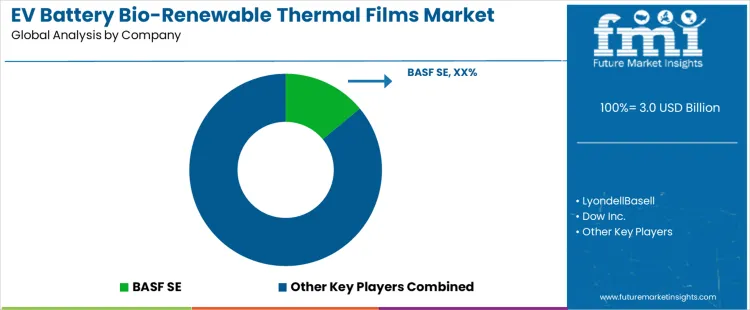
Competition in the EV battery bio-renewable thermal films market centers on thermal stability, bio-renewable content performance, thin-film reliability, processing compatibility with high-volume manufacturing, and alignment with automotive safety requirements. BASF SE positions its bio-renewable thermal films with an emphasis on robust thermal management and dimensional stability, and its product materials highlight consistent heat resistance and compatibility with battery module assembly processes that help OEMs maintain safety and performance targets.
LyondellBasell and Dow Inc. compete by leveraging broad polymer expertise to deliver bio-enhanced film solutions that balance thermal performance with processability, with collateral stressing drop-in fit with existing extrusion and lamination lines. Their documentation underscores mechanical durability and stable performance under repeated thermal cycling common in EV battery systems. Arkema SA differentiates through specialty bio-renewable polymer technologies engineered for enhanced thermal conductivity and controlled shrinkage, with brochures focusing on tailored resin chemistry that supports both safety and manufacturability.
SABIC adds value with bio-content thermal films designed to meet OEM specifications for strength, reliability, and consistent thermal barrier performance, and its product materials highlight formulation flexibility and automotive qualification support. Others in the market contribute with emerging bio-renewable film grades and niche additive technologies aimed at specific performance attributes such as improved flame performance or reduced interfacial stress. Across all vendors, product literature underscores bio-content performance equivalence, thermal reliability, processing ease, and fit with battery manufacturing standards as key differentiators that help battery and automotive makers adopt bio-renewable thermal films without compromising on safety or production efficiency.
Key Players in EV Battery Bio-Renewable Thermal Films Market
- BASF SE
- LyondellBasell
- Dow Inc.
- Arkema SA
- SABIC
- Others
Scope of Report
| Attributes | Description |
|---|---|
| Quantitative Unit (2026) | USD Billion |
| Film Type | Bio-PE Thermal Films, Bio-PP Thermal Films, Bio-PLA or Bio-PHA Thermal Films, Bio-PETG Thermal Films, Others |
| Application | Thermal Management Insulation, Heat Dissipation Barriers, Safety & Fire Prevention Films, Separator Film Enhancements, Others |
| Battery Type | Lithium-Ion (Li-ion), Solid-State Batteries, Other Emerging Batteries, Others |
| Regions Covered | Asia Pacific, Europe, North America, Latin America, Middle East & Africa |
| Countries Covered | China, Japan, South Korea, India, Australia & New Zealand, ASEAN, Germany, United Kingdom, France, Italy, Spain, Nordic, BENELUX, United States, Canada, Mexico, Brazil, Chile, Turkey, South Africa, Other GCC Countries |
| Key Companies Profiled | BASF SE, LyondellBasell, Dow Inc., Arkema SA, SABIC, Others |
| Additional Attributes | Dollar sales by film type, application, and battery type; regional CAGR and growth outlook for the EV battery bio-renewable thermal films market. |
EV Battery Bio-Renewable Thermal Films Market by Key Segments
Film Type
- Bio‑PE Thermal Films
- Bio‑PP Thermal Films
- Bio‑PLA or Bio‑PHA Thermal Films
- Bio‑PETG Thermal Films
- Others
Application
- Thermal Management Insulation
- Heat Dissipation Barriers
- Safety & Fire Prevention Films
- Separator Film Enhancements
- Others
Battery Type
- Lithium‑Ion (Li‑ion)
- Solid‑State Batteries
- Other Emerging Batteries
- Others
Region:
- Asia Pacific
- China
- Japan
- South Korea
- India
- Australia & New Zealand
- ASEAN
- Rest of Asia Pacific
- Europe
- Germany
- United Kingdom
- France
- Italy
- Spain
- Nordic
- BENELUX
- Rest of Europe
- North America
- United States
- Canada
- Mexico
- Latin America
- Brazil
- Chile
- Rest of Latin America
- Middle East & Africa
- Kingdom of Saudi Arabia
- Other GCC Countries
- Turkey
- South Africa
- Other African Union
- Rest of Middle East & Africa
Bibliography
- International Energy Agency (IEA). (2024). Battery materials, sustainability pathways, and thermal safety considerations for electric vehicles. IEA Energy Technology Policy Division.
- United Nations Environment Programme (UNEP). (2024). Bio‑based polymers and renewable material pathways for clean mobility and electric vehicle components. UNEP Chemicals and Health Branch.
- European Commission – Joint Research Centre (JRC). (2024). Thermal management materials and sustainability assessment for lithium‑ion battery systems in electric vehicles. Publications Office of the European Union.
- International Organization for Standardization (ISO). (2024). Electric vehicle battery systems — thermal performance, safety requirements, and material sustainability considerations. ISO Technical Committee on Electrified Transportation.
- International Renewable Energy Agency (IRENA). (2025). Renewable materials and sustainable supply chains for electric mobility and battery technologies. IRENA Innovation and Technology Centre.
Frequently Asked Questions
How big is the ev battery bio-renewable thermal films market in 2026?
The global ev battery bio-renewable thermal films market is estimated to be valued at USD 3.0 billion in 2026.
What will be the size of ev battery bio-renewable thermal films market in 2036?
The market size for the ev battery bio-renewable thermal films market is projected to reach USD 7.3 billion by 2036.
How much will be the ev battery bio-renewable thermal films market growth between 2026 and 2036?
The ev battery bio-renewable thermal films market is expected to grow at a 9.3% CAGR between 2026 and 2036.
What are the key product types in the ev battery bio-renewable thermal films market?
The key product types in ev battery bio-renewable thermal films market are bio‑pe thermal films, bio‑pp thermal films, bio‑pla or bio‑pha thermal films, bio‑petg thermal films and others.
Which application segment to contribute significant share in the ev battery bio-renewable thermal films market in 2026?
In terms of application, thermal management insulation segment to command 39.0% share in the ev battery bio-renewable thermal films market in 2026.
Preview the report firsthand - request a free sample
Get SampleGet the brochure for pricing and purchase details.
Get PDFTable of Content
- Executive Summary
- Global Market Outlook
- Demand-side Trends
- Supply-side Trends
- Technology Roadmap Analysis
- Analysis and Recommendations
- Market Overview
- Market Coverage / Taxonomy
- Market Definition / Scope / Limitations
- Market Background
- Market Dynamics
- Drivers
- Restraints
- Opportunity
- Trends
- Scenario Forecast
- Demand in Optimistic Scenario
- Demand in Likely Scenario
- Demand in Conservative Scenario
- Opportunity Map Analysis
- Product Life Cycle Analysis
- Supply Chain Analysis
- Investment Feasibility Matrix
- Value Chain Analysis
- PESTLE and Porter’s Analysis
- Regulatory Landscape
- Regional Parent Market Outlook
- Production and Consumption Statistics
- Import and Export Statistics
- Market Dynamics
- Global Market Analysis 2021 to 2025 and Forecast, 2026 to 2036
- Historical Market Size Value (USD Million) Analysis, 2021 to 2025
- Current and Future Market Size Value (USD Million) Projections, 2026 to 2036
- Y-o-Y Growth Trend Analysis
- Absolute $ Opportunity Analysis
- Global Market Pricing Analysis 2021 to 2025 and Forecast 2026 to 2036
- Global Market Analysis 2021 to 2025 and Forecast 2026 to 2036, By Film Type
- Introduction / Key Findings
- Historical Market Size Value (USD Million) Analysis By Film Type , 2021 to 2025
- Current and Future Market Size Value (USD Million) Analysis and Forecast By Film Type , 2026 to 2036
- Bio‑PE Thermal Films
- Bio‑PP Thermal Films
- Bio‑PLA or Bio‑PHA Thermal Films
- Bio‑PETG Thermal Films
- Others
- Bio‑PE Thermal Films
- Y-o-Y Growth Trend Analysis By Film Type , 2021 to 2025
- Absolute $ Opportunity Analysis By Film Type , 2026 to 2036
- Global Market Analysis 2021 to 2025 and Forecast 2026 to 2036, By Application
- Introduction / Key Findings
- Historical Market Size Value (USD Million) Analysis By Application, 2021 to 2025
- Current and Future Market Size Value (USD Million) Analysis and Forecast By Application, 2026 to 2036
- Thermal Management Insulation
- Heat Dissipation Barriers
- Safety & Fire Prevention Films
- Separator Film Enhancements
- Others
- Thermal Management Insulation
- Y-o-Y Growth Trend Analysis By Application, 2021 to 2025
- Absolute $ Opportunity Analysis By Application, 2026 to 2036
- Global Market Analysis 2021 to 2025 and Forecast 2026 to 2036, By Battery Type
- Introduction / Key Findings
- Historical Market Size Value (USD Million) Analysis By Battery Type, 2021 to 2025
- Current and Future Market Size Value (USD Million) Analysis and Forecast By Battery Type, 2026 to 2036
- Lithium‑Ion (Li‑ion)
- Solid‑State Batteries
- Other Emerging Batteries
- Others
- Lithium‑Ion (Li‑ion)
- Y-o-Y Growth Trend Analysis By Battery Type, 2021 to 2025
- Absolute $ Opportunity Analysis By Battery Type, 2026 to 2036
- Global Market Analysis 2021 to 2025 and Forecast 2026 to 2036, By Region
- Introduction
- Historical Market Size Value (USD Million) Analysis By Region, 2021 to 2025
- Current Market Size Value (USD Million) Analysis and Forecast By Region, 2026 to 2036
- North America
- Latin America
- Western Europe
- Eastern Europe
- East Asia
- South Asia and Pacific
- Middle East & Africa
- Market Attractiveness Analysis By Region
- North America Market Analysis 2021 to 2025 and Forecast 2026 to 2036, By Country
- Historical Market Size Value (USD Million) Trend Analysis By Market Taxonomy, 2021 to 2025
- Market Size Value (USD Million) Forecast By Market Taxonomy, 2026 to 2036
- By Country
- USA
- Canada
- Mexico
- By Film Type
- By Application
- By Battery Type
- By Country
- Market Attractiveness Analysis
- By Country
- By Film Type
- By Application
- By Battery Type
- Key Takeaways
- Latin America Market Analysis 2021 to 2025 and Forecast 2026 to 2036, By Country
- Historical Market Size Value (USD Million) Trend Analysis By Market Taxonomy, 2021 to 2025
- Market Size Value (USD Million) Forecast By Market Taxonomy, 2026 to 2036
- By Country
- Brazil
- Chile
- Rest of Latin America
- By Film Type
- By Application
- By Battery Type
- By Country
- Market Attractiveness Analysis
- By Country
- By Film Type
- By Application
- By Battery Type
- Key Takeaways
- Western Europe Market Analysis 2021 to 2025 and Forecast 2026 to 2036, By Country
- Historical Market Size Value (USD Million) Trend Analysis By Market Taxonomy, 2021 to 2025
- Market Size Value (USD Million) Forecast By Market Taxonomy, 2026 to 2036
- By Country
- Germany
- UK
- Italy
- Spain
- France
- Nordic
- BENELUX
- Rest of Western Europe
- By Film Type
- By Application
- By Battery Type
- By Country
- Market Attractiveness Analysis
- By Country
- By Film Type
- By Application
- By Battery Type
- Key Takeaways
- Eastern Europe Market Analysis 2021 to 2025 and Forecast 2026 to 2036, By Country
- Historical Market Size Value (USD Million) Trend Analysis By Market Taxonomy, 2021 to 2025
- Market Size Value (USD Million) Forecast By Market Taxonomy, 2026 to 2036
- By Country
- Russia
- Poland
- Hungary
- Balkan & Baltic
- Rest of Eastern Europe
- By Film Type
- By Application
- By Battery Type
- By Country
- Market Attractiveness Analysis
- By Country
- By Film Type
- By Application
- By Battery Type
- Key Takeaways
- East Asia Market Analysis 2021 to 2025 and Forecast 2026 to 2036, By Country
- Historical Market Size Value (USD Million) Trend Analysis By Market Taxonomy, 2021 to 2025
- Market Size Value (USD Million) Forecast By Market Taxonomy, 2026 to 2036
- By Country
- China
- Japan
- South Korea
- By Film Type
- By Application
- By Battery Type
- By Country
- Market Attractiveness Analysis
- By Country
- By Film Type
- By Application
- By Battery Type
- Key Takeaways
- South Asia and Pacific Market Analysis 2021 to 2025 and Forecast 2026 to 2036, By Country
- Historical Market Size Value (USD Million) Trend Analysis By Market Taxonomy, 2021 to 2025
- Market Size Value (USD Million) Forecast By Market Taxonomy, 2026 to 2036
- By Country
- India
- ASEAN
- Australia & New Zealand
- Rest of South Asia and Pacific
- By Film Type
- By Application
- By Battery Type
- By Country
- Market Attractiveness Analysis
- By Country
- By Film Type
- By Application
- By Battery Type
- Key Takeaways
- Middle East & Africa Market Analysis 2021 to 2025 and Forecast 2026 to 2036, By Country
- Historical Market Size Value (USD Million) Trend Analysis By Market Taxonomy, 2021 to 2025
- Market Size Value (USD Million) Forecast By Market Taxonomy, 2026 to 2036
- By Country
- Kingdom of Saudi Arabia
- Other GCC Countries
- Turkiye
- South Africa
- Other African Union
- Rest of Middle East & Africa
- By Film Type
- By Application
- By Battery Type
- By Country
- Market Attractiveness Analysis
- By Country
- By Film Type
- By Application
- By Battery Type
- Key Takeaways
- Key Countries Market Analysis
- USA
- Pricing Analysis
- Market Share Analysis, 2025
- By Film Type
- By Application
- By Battery Type
- Canada
- Pricing Analysis
- Market Share Analysis, 2025
- By Film Type
- By Application
- By Battery Type
- Mexico
- Pricing Analysis
- Market Share Analysis, 2025
- By Film Type
- By Application
- By Battery Type
- Brazil
- Pricing Analysis
- Market Share Analysis, 2025
- By Film Type
- By Application
- By Battery Type
- Chile
- Pricing Analysis
- Market Share Analysis, 2025
- By Film Type
- By Application
- By Battery Type
- Germany
- Pricing Analysis
- Market Share Analysis, 2025
- By Film Type
- By Application
- By Battery Type
- UK
- Pricing Analysis
- Market Share Analysis, 2025
- By Film Type
- By Application
- By Battery Type
- Italy
- Pricing Analysis
- Market Share Analysis, 2025
- By Film Type
- By Application
- By Battery Type
- Spain
- Pricing Analysis
- Market Share Analysis, 2025
- By Film Type
- By Application
- By Battery Type
- France
- Pricing Analysis
- Market Share Analysis, 2025
- By Film Type
- By Application
- By Battery Type
- India
- Pricing Analysis
- Market Share Analysis, 2025
- By Film Type
- By Application
- By Battery Type
- ASEAN
- Pricing Analysis
- Market Share Analysis, 2025
- By Film Type
- By Application
- By Battery Type
- Australia & New Zealand
- Pricing Analysis
- Market Share Analysis, 2025
- By Film Type
- By Application
- By Battery Type
- China
- Pricing Analysis
- Market Share Analysis, 2025
- By Film Type
- By Application
- By Battery Type
- Japan
- Pricing Analysis
- Market Share Analysis, 2025
- By Film Type
- By Application
- By Battery Type
- South Korea
- Pricing Analysis
- Market Share Analysis, 2025
- By Film Type
- By Application
- By Battery Type
- Russia
- Pricing Analysis
- Market Share Analysis, 2025
- By Film Type
- By Application
- By Battery Type
- Poland
- Pricing Analysis
- Market Share Analysis, 2025
- By Film Type
- By Application
- By Battery Type
- Hungary
- Pricing Analysis
- Market Share Analysis, 2025
- By Film Type
- By Application
- By Battery Type
- Kingdom of Saudi Arabia
- Pricing Analysis
- Market Share Analysis, 2025
- By Film Type
- By Application
- By Battery Type
- Turkiye
- Pricing Analysis
- Market Share Analysis, 2025
- By Film Type
- By Application
- By Battery Type
- South Africa
- Pricing Analysis
- Market Share Analysis, 2025
- By Film Type
- By Application
- By Battery Type
- USA
- Market Structure Analysis
- Competition Dashboard
- Competition Benchmarking
- Market Share Analysis of Top Players
- By Regional
- By Film Type
- By Application
- By Battery Type
- Competition Analysis
- Competition Deep Dive
- BASF SE
- Overview
- Product Portfolio
- Profitability by Market Segments (Product/Age /Sales Channel/Region)
- Sales Footprint
- Strategy Overview
- Marketing Strategy
- Product Strategy
- Channel Strategy
- LyondellBasell
- Dow Inc.
- Arkema SA
- SABIC
- Others
- BASF SE
- Competition Deep Dive
- Assumptions & Acronyms Used
- Research Methodology


