

- Industry Size (2026)
- USD 3.1 Bn
- Forecast (2036)
- USD 7.4 Bn
- CAGR (2026 to 2036)
- 9.1%
Dual Battery EV Systems Market Size, Market Forecast and Outlook By FMI
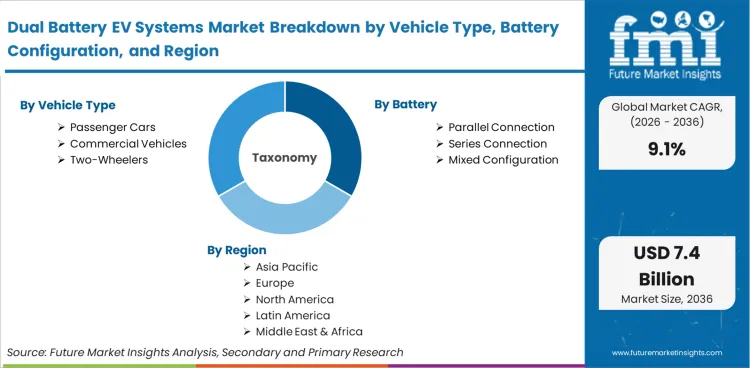
The dual battery EV systems market reached USD 2.8 billion in 2025. Market value is estimated to rise to USD 3.1 billion in 2026 and USD 7.4 billion by 2036. The industry is set to register a CAGR of 9.1% during the forecast period.
The dual battery EV systems market is expanding as electric vehicle manufacturers seek improved energy management and operational flexibility. A dual battery configuration allows one battery pack to support propulsion while the secondary pack manages auxiliary systems such as infotainment, climate control, and onboard electronics. This arrangement improves overall energy efficiency and reduces the load on the primary traction battery. Automotive manufacturers are adopting this architecture to maintain consistent driving performance while supporting the growing number of electronic components installed in modern electric vehicles. The rising integration of advanced driver assistance systems, digital dashboards, and connectivity platforms is increasing power demand inside vehicles, encouraging automakers to implement dual battery systems that stabilize power distribution and maintain vehicle functionality.
Summary of Dual Battery EV Systems Market
- Dual Battery EV Systems Market Definition
- The market covers multi-pack battery system configurations designed for extended range electric vehicles operating in passenger cars, commercial fleets, and urban mobility segments.
- Demand Drivers in the Market
- Increasing concerns regarding limited driving distance encourage adoption of dual battery configurations that support longer vehicle operation between charging cycles.
- Insufficient availability of high-speed charging networks promotes use of battery systems designed to reduce charging frequency.
- Advances in battery management technology simplify system control while ensuring operational safety and performance reliability.
- Key Segments Analyzed in the Report
- Vehicle Type: Passenger Cars (46%) versus commercial vehicles and two-wheeler segments.
- Battery Configuration: Parallel Connection (41%) versus series and mixed configuration systems.
- Geography: High-growth Asia Pacific versus mature North American and European markets.
- Analyst Opinion at FMI
- Nikhil Kaitwade, Senior Consultant for Consumer Products at Future Market Insights, notes, "In the updated edition of the Dual Battery EV Systems Market Report for 2026 to 2036, industry stakeholders will gain insights into system integration requirements where independent battery packs must operate under coordinated vehicle control platforms. My assessment indicates that synchronization between battery management units and vehicle energy control architecture influences design complexity. Thermal regulation frameworks shape product engineering priorities, while safety validation procedures could limit entry opportunities for manufacturers focusing on cost-conscious fleet operators."
- Strategic Implications/Executive Takeaways
- Move product development emphasis from single battery layouts toward scalable dual pack configurations.
- Consider battery swap compatibility as a central engineering parameter during dual battery system design.
- Strengthen thermal control infrastructure to maintain battery stability and sustain long-term performance guarantees.
- Methodology
- Validated through direct vehicle production data and battery installation tracking.
- Zero reliance on speculative battery technology forecasting.
- Based on verifiable manufacturing capacity metrics and verified supply agreements.
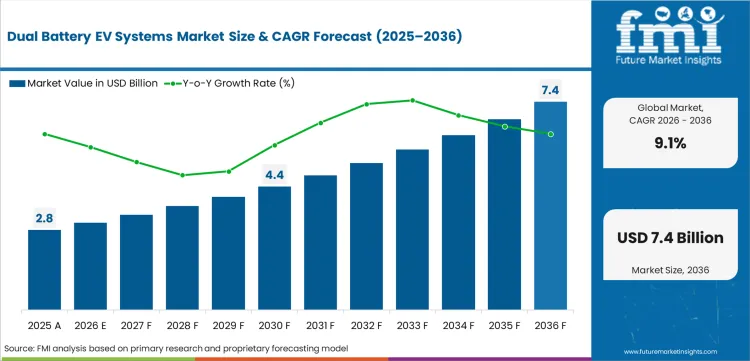
Dual Battery EV Systems Market Key Takeaways
| Metric | Value |
|---|---|
| Market Value (2026) | USD 3.1 billion |
| Market Forecast Value (2036) | USD 7.4 billion |
| Forecast CAGR (2026-2036) | 9.1% |
Source: FMI analysis based on proprietary forecasting model and primary research
Vehicle reliability requirements in electric mobility are strengthening the role of redundant power systems. Dual battery architectures improve operational safety because essential vehicle functions remain active even if one battery experiences a temporary failure or energy depletion. Fleet operators and commercial vehicle manufacturers are increasingly interested in this capability as it ensures vehicle uptime and reduces service interruptions. Electric delivery vans, ride sharing fleets, and autonomous mobility platforms depend on uninterrupted electrical supply for navigation systems, communication modules, and monitoring sensors. Dual battery systems support these needs by maintaining stable power supply across multiple subsystems. Growing investments in electrified transportation infrastructure are encouraging automakers to integrate more sophisticated battery configurations that enhance reliability and system resilience.
Dual Battery EV Systems Market Definition
Dual battery EV systems function as a power redundancy architecture used in extended-range electric vehicles. These systems include configurations enabling independent or coordinated operation of multiple battery packs across passenger and commercial vehicle platforms. The dual battery EV systems market covers global development, manufacturing, and supply of multi-pack battery solutions integrating separate battery management units, thermal regulation mechanisms, and power distribution technologies designed to support electric mobility applications.
Dual Battery EV Systems Market Inclusions
The report delivers detailed evaluation of market dynamics, including global and regional market size analysis in both volume and value terms, along with a ten-year forecast from 2026 to 2036. It presents segmentation across vehicle types such as passenger cars, commercial vehicles, two-wheelers, and three-wheelers. The study reviews battery configuration categories including series connection, parallel connection, mixed configuration, and modular setup. Application analysis covers urban mobility, long-distance travel, fleet operations, and last-mile delivery.
Dual Battery EV Systems Market Exclusions
The scope excludes hybrid vehicle battery systems, plug-in hybrid battery configurations, individual battery pack components, and charging infrastructure equipment. Battery recycling services and stationary energy storage systems remain outside the study coverage. Battery swap station operators are excluded. The analysis focuses on finished dual battery configurations engineered for direct vehicle integration across automotive platforms. Aftermarket battery upgrade services and used battery marketplaces with minimal manufacturer participation remain outside the report scope.
Dual Battery EV Systems Market Research Methodology
- Primary Research: Interviews were conducted with battery manufacturers, automotive OEMs, fleet operators, commercial vehicle distributors, and battery management system suppliers across major markets. Electric vehicle technology consultants clarified configuration standards and integration requirements.
- Desk Research: Vehicle registration data from automotive industry platforms, EV adoption rates from transportation surveys, and battery production statistics from manufacturing associations supported market benchmarking.
- Market-Sizing and Forecasting: A hybrid top-down and bottom-up model was developed. Demand was reconstructed from vehicle production figures, battery pack installation data, and fleet electrification volumes, then validated against manufacturing capacity and supply chain coverage.
- Data Validation and Update Cycle: Outputs undergo variance checks across automotive and battery industry datasets, cross-verification with electric vehicle associations, and structured expert review prior to release.
Segmental Analysis
Dual Battery EV Systems Market Analysis by Vehicle Type
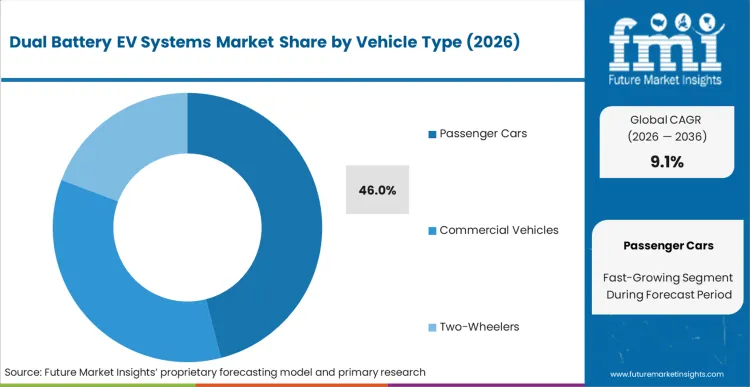
The passenger cars segment is poised to register 46% share in 2026. Passenger cars integrate infotainment screens, ADAS sensors, telematics modules, and digital control units that increase onboard power demand. Dual battery systems distribute electrical load between propulsion and auxiliary functions, maintaining stable vehicle performance. The architecture supports safety systems, climate control, and comfort electronics without draining the main traction battery. Automakers adopt dual battery configurations to improve reliability, ensure uninterrupted operation of electronic features, and sustain driving range across modern connected passenger vehicles.
- Improved Reliability and Start-Up Stability: Passenger vehicle manufacturers are focusing on improving reliability across different driving conditions, especially in urban stop-and-go environments. Dual battery systems provide a dedicated power source for essential vehicle operations such as ignition control units, safety sensors, and communication modules. This arrangement ensures that critical systems remain functional even when the primary battery experiences temporary voltage fluctuations.
- Support for Start-Stop and Idle Energy Management: Passenger vehicles frequently operate in urban traffic conditions that involve repeated start-stop cycles and prolonged idling. Dual battery systems maintain power supply to lighting, navigation systems, and cabin electronics during these operating conditions. This configuration reduces strain on the main traction battery and improves overall energy management. Automakers adopt this setup to stabilize electrical performance while enhancing battery durability and operational efficiency.
Dual Battery EV Systems Market Anal ysis by Battery Configuration
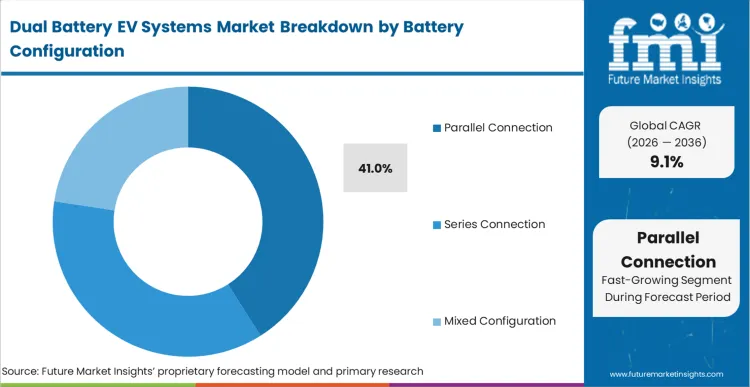
The parallel connection segment is expected to register a 41% market share in 2026. Parallel connection is gaining traction in dual battery EV systems as it enables both battery packs to supply power simultaneously while maintaining stable voltage levels. This configuration increases total current capacity and improves power delivery for propulsion systems and onboard electronics. Automakers adopt parallel architectures to manage higher electrical loads from advanced vehicle technologies. The setup improves energy efficiency, enhances battery utilization, and provides redundancy, allowing vehicles to maintain consistent performance even if one battery experiences temporary imbalance.
- Higher Power Output for Performance-Oriented EVs: Parallel battery configurations allow electric vehicles to draw higher current levels during acceleration and high-speed driving. This capability supports performance-focused passenger cars that require rapid power delivery from the battery system. Automakers utilize parallel setups to enhance torque response and maintain consistent energy flow during demanding driving conditions. The configuration improves drivetrain efficiency and enables electric vehicles to achieve stronger acceleration without overstressing a single battery pack.
- Simplified Battery Expansion and Platform Flexibility: Parallel connection architectures allow manufacturers to expand energy storage capacity by adding battery modules without redesigning the entire electrical system. This flexibility supports modular vehicle platforms that serve multiple vehicle models with different performance requirements. Automakers benefit from simplified battery integration and easier system upgrades. The approach supports scalable EV platforms, enabling manufacturers to develop diverse vehicle variants while maintaining consistent battery architecture.
Dual Battery EV Systems Market Drivers, Restraints, and Opportunities
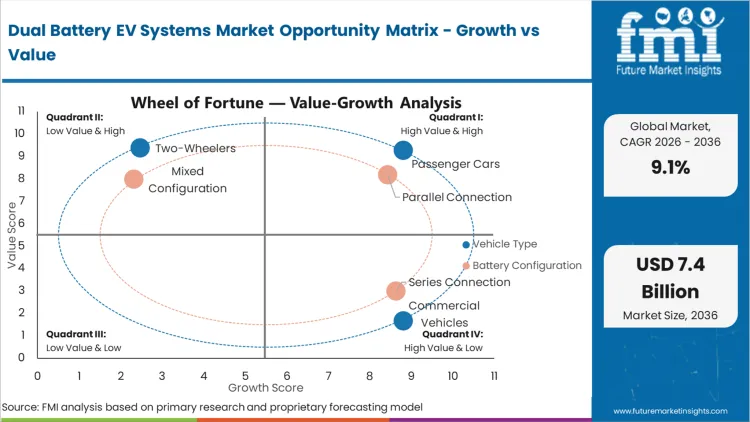
Growing integration of vehicle-to-everything communication systems is encouraging adoption of dual battery EV architectures. Modern vehicles exchange real-time data with EV charging stations, traffic systems, and cloud platforms to support navigation optimization, remote diagnostics, and energy monitoring services. These communication functions require constant electrical supply even when the vehicle is parked or operating at low power states. Dual battery systems allow one battery to sustain communication modules and control units while the primary battery supports propulsion. Automakers deploy this configuration to ensure reliable connectivity and maintain stable operation of digital vehicle platforms that support connected mobility services.
High system complexity and additional integration costs limit widespread deployment of dual battery EV systems. Incorporating two battery units requires advanced battery management systems, additional wiring architecture, and sophisticated control software to balance power distribution effectively. These requirements increase manufacturing costs and engineering complexity for vehicle developers. Space constraints inside compact electric vehicles create challenges when integrating multiple battery units while maintaining vehicle weight efficiency. Maintenance requirements may also increase because dual battery architectures involve additional components that require monitoring and servicing. Smaller EV manufacturers may hesitate to adopt these systems due to higher development costs and limited economies of scale.
Growing development of next generation electric vehicles creates strong opportunities for dual battery system adoption. Automakers are designing modular vehicle architectures that support flexible energy storage configurations across multiple vehicle platforms. Dual battery systems align with this strategy because they enable scalable power management solutions suitable for passenger vehicles, commercial fleets, and autonomous mobility systems. Expansion of advanced driver assistance technologies connected vehicle services, and autonomous driving platforms will increase onboard energy demand. Battery manufacturers are improving thermal management technologies and smart battery control software that enhance performance of multi battery systems. Continuous innovation in battery chemistry and power electronics will support broader integration of dual battery architectures across future electric mobility platforms.
Regional Analysis
Based on regional analysis, the dual battery EV systems market is segmented into North America, Latin America, Europe, East Asia, South Asia, Oceania and Middle East & Africa across 40 countries. The full report also offers market attractiveness analysis based on regional trends.
.webp "Top Country Growth Comparison Dual Battery Ev Systems Market Cagr (2026 2036)")
| Country | CAGR (2026 to 2036) |
|---|---|
| United States | 9.8% |
| United Kingdom | 8.7% |
| Germany | 8.4% |
| China | 10.6% |
| India | 10.2% |
Source: Market analysis based on proprietary forecasting model and primary research
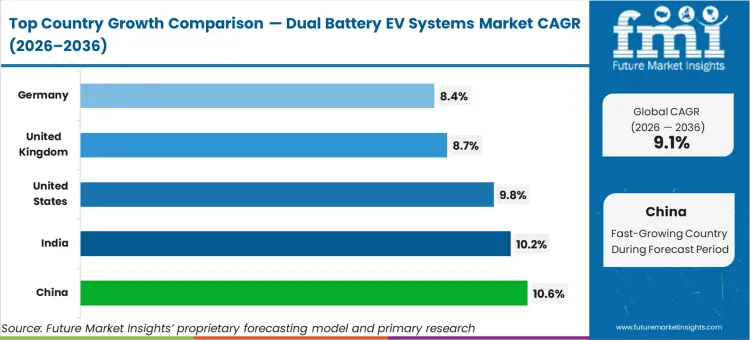
North America Dual Battery EV Systems Market Analysis
Strong investment in electric vehicle infrastructure and battery manufacturing is supporting market expansion across the region. Governments and private companies are investing in battery production facilities, charging networks, and EV supply chain development. These investments are encouraging vehicle manufacturers to introduce technologically advanced battery architectures that improve energy efficiency and vehicle reliability.
- United States: Sales of dual battery EV systems in the United States are projected to grow at 9.8% CAGR from 2026 to 2036. Growing investment in domestic EV battery manufacturing and electrification initiatives is strengthening the market outlook. Several automotive manufacturers are expanding EV production capacity while integrating advanced battery management technologies to improve vehicle efficiency and reliability. Dual battery systems are gaining attention as they enhance electrical stability and support uninterrupted operation of safety systems, communication modules, and onboard sensors.
The study presents comprehensive insights into market growth across the North American region, including country-specific analysis for the United States and Canada. It highlights trends in electric vehicle adoption, evolution of charging infrastructure, and market development across multiple vehicle types and system configuration approaches.
Asia Pacific Dual Battery EV Systems Market Analysis
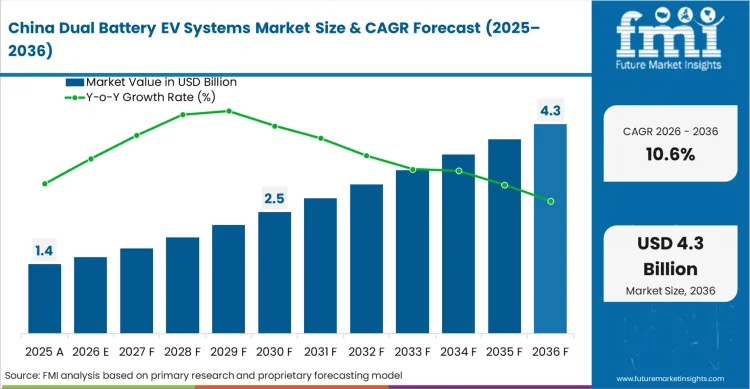
The Asia Pacific dual battery EV systems market is expanding rapidly due to strong electric vehicle adoption across major automotive economies. Countries such as China, Japan, South Korea, and India are accelerating EV production to support emission reduction targets and energy transition goals. Automakers across the region are developing advanced electric vehicle platforms that incorporate sophisticated electronic systems, including digital cockpits, connected vehicle technologies, and driver assistance features. These technologies increase onboard energy demand, encouraging manufacturers to implement dual battery architectures that ensure stable power distribution between propulsion systems and auxiliary vehicle electronics.
- China: The Chinese dual battery EV systems market is set to grow at 10.6% CAGR during the forecast period. Government initiatives supporting electric mobility and battery manufacturing are strengthening market growth. National policies promoting new energy vehicles and investments in large scale battery production facilities are encouraging innovation in EV power systems. Dual battery architectures are gaining traction because they improve power management and ensure reliable operation of vehicle electronics under different driving conditions.
- India: Demand for dual battery EV systems in India is estimated to expand at 10.2% CAGR from 2026 to 2036. Ride sharing services, urban delivery fleets, and logistics operators are gradually adopting electric vehicles to reduce operating costs and emissions. These vehicles rely heavily on navigation systems, communication modules, and monitoring technologies that require continuous electrical supply. Dual battery systems help maintain consistent performance of these systems while preserving traction battery capacity for driving range.
The report presents an extensive assessment of the dual battery EV systems market across East and South Asia from 2021 to 2036. It explores electric vehicle adoption behavior, development of battery configuration technologies, and charging protocol trends in China, Japan, South Korea, India, Singapore, and Australia. The study highlights cost management approaches supporting regional market growth.
Europe Dual Battery EV Systems Market Analysis
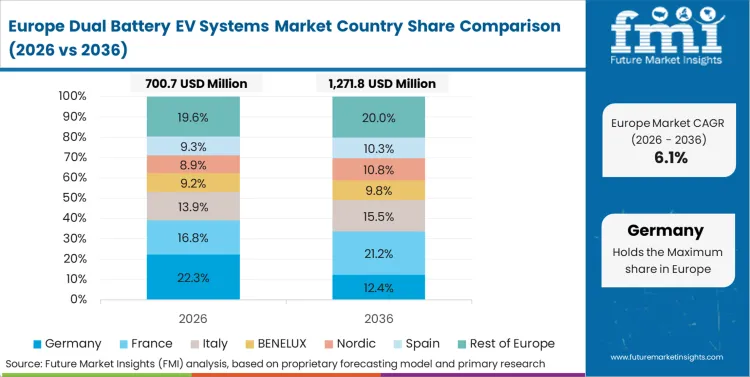
Strong investment in battery production facilities and EV manufacturing across Europe is supporting market expansion. Automotive companies are developing new electric vehicle platforms designed to support higher levels of electrification and advanced vehicle technologies. Dual battery configurations help improve energy management, reduce strain on the main traction battery, and ensure reliable operation of safety systems, communication modules, and onboard sensors.
- Germany: Demand for dual battery EV systems in Germany is poised to expand at 8.4% CAGR during the study period. Leading automotive companies such as Volkswagen, BMW, and Mercedes Benz are accelerating development of advanced EV platforms that integrate digital cockpit systems, driver assistance technologies, and connected mobility features. These technologies increase electrical power demand inside vehicles. Germany is also witnessing strong investment in EV battery manufacturing and research related to next generation battery technologies. Automotive companies and technology developers are focusing on improving battery management systems, thermal control technologies, and vehicle electronics integration.
- United Kingdom: The U.K. dual battery EV systems market is estimated to grow at 8.7% CAGR during the forecast period. Government initiatives supporting low emission mobility and the transition toward electric transportation are encouraging automakers to introduce advanced EV models. [3] Modern electric vehicles in the UK incorporate connected infotainment systems, driver assistance technologies, and digital vehicle management platforms that increase onboard power demand. Dual battery architectures help manage these electrical requirements by separating propulsion energy from auxiliary systems, ensuring stable power distribution and consistent vehicle performance.
European market evaluation for dual battery EV systems includes detailed country analysis across the United Kingdom, Germany, France, Italy, Spain, the Netherlands, and Scandinavia. The report provides insights into emissions regulation requirements and growing fleet electrification trends throughout the region.
Competitive Landscape for Dual Battery EV Systems Market Players
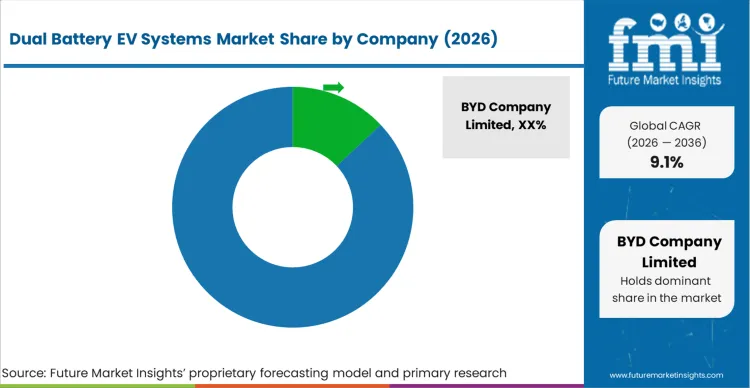
The dual battery EV systems market features strong competition among battery manufacturers, automotive technology developers, and electric vehicle producers focusing on advanced energy management solutions. Companies are prioritizing development of sophisticated battery management systems that allow efficient coordination between primary traction batteries and secondary auxiliary batteries. Manufacturers are investing in improved power distribution technologies, thermal management systems, and intelligent control software to enhance reliability and maintain stable energy flow across vehicle subsystems. Continuous innovation in battery architecture is enabling automakers to support growing electrical demand from advanced driver assistance systems, digital vehicle interfaces, and connected mobility platforms.
Market participants are strengthening their presence through strategic collaborations with automotive manufacturers and electric vehicle platform developers. Partnerships between battery suppliers and vehicle producers are supporting integration of multi battery configurations across new electric vehicle models. Companies are expanding production capacity for lithium ion batteries and auxiliary battery modules to support rising EV manufacturing volumes. Research activities are focused on lightweight battery components, compact energy storage systems, and improved battery durability to support vehicle efficiency. Increasing investment in electric mobility infrastructure and vehicle electrification programs is encouraging technology providers to develop scalable battery solutions that improve vehicle performance, enhance operational reliability, and support the evolving electrical architecture of modern electric vehicles.
Key Players in Dual Battery EV Systems Market
- BYD Company Limited
- Contemporary Amperex Technology Co. Limited
- LG Energy Solution
- Samsung SDI Co., Ltd.
- Panasonic Corporation
- SK Innovation Co., Ltd.
- Northvolt AB
- Tesla, Inc.
- Renault Group
- Rivian Automotive, Inc.
Scope of the Report
| Metric | Value |
|---|---|
| Quantitative Units | USD 3.1 billion (2026) to USD 7.4 billion (2036), at a CAGR of 9.1% |
| Market Definition | The dual battery EV systems market comprises the global development, production, and distribution of multi-pack battery configurations including parallel and series connections designed for extended range electric vehicles across passenger and commercial applications. |
| Vehicle Type Segmentation | Passenger Cars, Commercial Vehicles, Two-Wheelers, Three-Wheelers |
| Battery Configuration Coverage | Series Connection, Parallel Connection, Mixed Configuration, Modular Setup |
| Application Segmentation | Urban Mobility, Long-Distance Travel, Fleet Operations, Last-Mile Delivery |
| Regions Covered | North America, Latin America, Europe, East Asia, South Asia, Oceania, Middle East and Africa |
| Countries Covered | United States, Canada, United Kingdom, Germany, France, China, Japan, India, Brazil, UAE and 40 countries |
| Key Companies Profiled | BYD Company Limited, Contemporary Amperex Technology Co. Limited (CATL), LG Energy Solution, Samsung SDI Co. Ltd., Panasonic Corporation, SK Innovation Co. Ltd., Northvolt AB, Tesla Inc., Renault Group, Rivian Automotive Inc. |
| Forecast Period | 2026 to 2036 |
| Approach | Hybrid top down and bottom up market modeling validated through vehicle production tracking and battery installation surveys, supported by supply chain verification and fleet electrification analysis |
Dual Battery EV Systems Market Analysis by Segments
Vehicle Type:
- Passenger Cars
- Commercial Vehicles
- Two-Wheelers
- Three-Wheelers
Battery Configuration:
- Series Connection
- Parallel Connection
- Mixed Configuration
- Modular Setup
Application:
- Urban Mobility
- Long-Distance Travel
- Fleet Operations
- Last-Mile Delivery
Region:
- Asia Pacific
- China
- Japan
- South Korea
- India
- Australia
- Singapore
- Thailand
- Rest of Asia Pacific
- Europe
- United Kingdom
- Germany
- France
- Italy
- Spain
- Netherlands
- Scandinavia
- Switzerland
- Rest of Europe
- North America
- United States
- Canada
- Latin America
- Brazil
- Mexico
- Argentina
- Rest of Latin America
- Middle East & Africa
- United Arab Emirates
- Saudi Arabia
- South Africa
- Israel
- Rest of Middle East & Africa
Bibliography
- [1] Panasonic Holdings Corporation. (2024, May 20). Panasonic Energy announces initiatives related to automotive battery supply and development (Press release).
- [2] USA Department of Energy. (2024). USA Department of Energy announces USD 131 million to boost America’s battery supply chain and innovation.
- [3] UK Department for Transport. (2024). Vehicle licensing statistics: United Kingdom 2024.
- [4] LG Energy Solution. (2024). LG Energy Solution announces strategic battery supply and partnership developments (Press release).
- [5] Samsung SDI Co., Ltd. (2024). Samsung SDI announces collaboration for next-generation EV battery technologies (Press release).
- [6] BYD Company Limited. (2024, February). BYD and Raízen Power form strategic partnership to boost sustainable electric mobility in Brazil.
This bibliography is provided for reader reference and is not exhaustive. The full report contains the complete reference list and detailed citations.
This Report Addresses
- Market intelligence to enable strategic decision making across established and emerging electric vehicle markets
- Market size estimation and 10-year revenue forecasts from 2026 to 2036, supported by validated vehicle production data and battery installation surveys
- Growth opportunity mapping across vehicle types and application segments with emphasis on range optimization
- Segment and regional revenue forecasts covering passenger cars, commercial vehicles, two-wheelers, and battery configuration networks
- Competition strategy assessment including automotive partnership requirements, battery management system positioning, and configuration standard adoption
- Product development tracking including thermal management innovations, fast-charging integration trends, and modular design capabilities
- Market access analysis covering supply agreements, automotive OEM partnerships, and fleet operator engagement programs
- Market report delivery in PDF, Excel, PPT, and interactive dashboard formats for executive and operational use
Frequently Asked Questions
How large is the demand for Dual Battery EV Systems in the global market in 2026?
Demand for Dual Battery EV Systems in the global market is estimated to be valued at USD 3.1 billion in 2026.
What will be the market size of Dual Battery EV Systems in the global market by 2036?
Market size for Dual Battery EV Systems is projected to reach USD 7.4 billion by 2036.
What is the expected demand growth for Dual Battery EV Systems in the global market between 2026 and 2036?
Demand for Dual Battery EV Systems in the global market is expected to grow at a CAGR of 9.1% between 2026 and 2036.
Which Vehicle Type is poised to lead global sales by 2026?
Passenger Cars is expected to be the dominant vehicle type, capturing approximately 46.0% of global market share in 2026 due to range extension features and fast-charging compatibility.
How significant is the role of Parallel Connection in driving Dual Battery EV Systems adoption in 2026?
Parallel connection represents a primary battery configuration, projected to hold approximately 41% share of the total market in 2026 as power output consistency and system redundancy maintain configuration relevance.
What is Driving Dual Battery EV Systems Demand in the United States?
Commercial fleet conversion mandates and increased range requirements across delivery and logistics categories are driving growth.
What Consumer Trends are Referenced for the United States?
Electric vehicle adoption patterns and fleet electrification programs are referenced as key operator behavior shifts.
What is the United States Growth Outlook in this Report?
The United States is projected to grow at a CAGR of 9.8% during 2026 to 2036.
Why is Europe described as Important for Battery Development in this Report?
Growth is driven by commercial vehicle electrification mandates and fleet conversion requirements that establish standardized equipment specifications.
What Type of Product Development Dominates in Europe?
Battery systems with thermal management integration and fast-charging compatibility dominates regional market segments.
What is Germany Growth Outlook in this Report?
Germany is projected to expand at a CAGR of 8.4% during 2026 to 2036.
What is United Kingdom Growth Outlook in this Report?
United Kingdom is projected to expand at a CAGR of 8.7% during 2026 to 2036.
Does the Report Cover China in its Regional Analysis?
China is included within East Asia under the regional scope of analysis.
What are the Sources referred to for analyzing the Market in China?
Electric vehicle adoption data, battery production statistics, and domestic manufacturer performance tracking covering purchase patterns, cost analysis, and configuration preference evolution are cited as primary reference sources.
What is the Main Development Theme Linked to China in Asia Coverage?
Asia Pacific development is associated with domestic battery manufacturing scale enabling system standardization across commercial segments.
Does the Report Cover India in its Regional Analysis?
India is included within South Asia under the regional coverage framework.
What is the Main India Related Development Theme in Asia Coverage?
Government incentives for electric mobility creating foundation for dual battery adoption and local assembly using cost-effective production methods is emphasized.
Which Configuration Strategies are Strategically Important for Asia Pacific Market Entry?
Modular pack designs and battery swap compatibility are prioritized for cost-effective market penetration across regional segments.
What is Dual Battery EV Systems and What is It Mainly Used For?
Dual battery EV systems involve multi-pack battery configurations primarily used for extended range electric vehicles including passenger cars, commercial fleets, and urban mobility applications.
What does Dual Battery EV Systems Market Mean in this Report?
Dual battery EV systems market refers to global development, manufacturing, and distribution of multi-pack battery configurations across various vehicle categories and user segments.
What is Included in the Scope of this Dual Battery EV Systems Market Report?
Scope covers systems by vehicle type, key battery configurations such as parallel and series connections, and application segments including urban mobility, fleet operations, and last-mile delivery.
What is Excluded from the Scope of this Report?
Hybrid vehicle battery systems, plug-in hybrid configurations, battery pack components, and charging infrastructure equipment are excluded unless part of dual battery system offerings.
What does Market Forecast Mean on this Page?
Market forecast represents model-based projections built on vehicle production trends and battery adoption assumptions for strategic planning purposes.
How is the Dual Battery EV Systems Market Forecast Built and Validated?
Forecast is developed using hybrid modeling validated through vehicle production data, battery installation tracking, and supply chain verification.
What does Zero Reliance on Speculative Third Party Market Research Mean Here?
Market analysis is based on verifiable production figures, battery installation data, and fleet electrification patterns rather than speculative technology trend predictions.
Preview the report firsthand - request a free sample
Get SampleGet the brochure for pricing and purchase details.
Get PDFTable of Content
- Executive Summary
- Global Market Outlook
- Demand-side Trends
- Supply-side Trends
- Technology Roadmap Analysis
- Analysis and Recommendations
- Market Overview
- Market Coverage / Taxonomy
- Market Definition / Scope / Limitations
- Research Methodology
- Chapter Orientation
- Analytical Lens and Working Hypotheses
- Market Structure, Signals, and Trend Drivers
- Desk Research Programme (Secondary Evidence)
- Company Annual and Sustainability Reports
- Peer-reviewed Journals and Academic Literature
- Corporate Websites, Product Literature, and Technical Notes
- Earnings Decks and Investor Briefings
- Statutory Filings and Regulatory Disclosures
- Technical White Papers and Standards Notes
- Trade Journals, Industry Magazines, and Analyst Briefs
- Conference Proceedings, Webinars, and Seminar Materials
- Government Statistics Portals and Public Data Releases
- Press Releases and Reputable Media Coverage
- Specialist Newsletters and Curated Briefings
- Sector Databases and Reference Repositories
- FMI Internal Proprietary Databases and Historical Market Datasets
- Subscription Datasets and Paid Sources
- Social Channels, Communities, and Digital Listening Inputs
- Additional Desk Sources
- Expert Input and Fieldwork (Primary Evidence)
- Primary Modes
- Qualitative Interviews and Expert Elicitation
- Quantitative Surveys and Structured Data Capture
- Blended Approach
- Why Primary Evidence is Used
- Field Techniques
- Interviews
- Surveys
- Focus Groups
- Observational and In-context Research
- Social and Community Interactions
- Stakeholder Universe Engaged
- C-suite Leaders
- Board Members
- Presidents and Vice Presidents
- R&D and Innovation Heads
- Technical Specialists
- Domain Subject-matter Experts
- Scientists
- Physicians and Other Healthcare Professionals
- Governance, Ethics, and Data Stewardship
- Research Ethics
- Data Integrity and Handling
- Primary Modes
- Tooling, Models, and Reference Databases
- Data Engineering and Model Build
- Data Acquisition and Ingestion
- Cleaning, Normalisation, and Verification
- Synthesis, Triangulation, and Analysis
- Quality Assurance and Audit Trail
- Market Background
- Market Dynamics
- Drivers
- Restraints
- Opportunity
- Trends
- Scenario Forecast
- Demand in Optimistic Scenario
- Demand in Likely Scenario
- Demand in Conservative Scenario
- Opportunity Map Analysis
- Product Life Cycle Analysis
- Supply Chain Analysis
- Investment Feasibility Matrix
- Value Chain Analysis
- PESTLE and Porter’s Analysis
- Regulatory Landscape
- Regional Parent Market Outlook
- Production and Consumption Statistics
- Import and Export Statistics
- Market Dynamics
- Global Market Analysis 2021 to 2025 and Forecast, 2026 to 2036
- Historical Market Size Value (USD Million) Analysis, 2021 to 2025
- Current and Future Market Size Value (USD Million) Projections, 2026 to 2036
- Y-o-Y Growth Trend Analysis
- Absolute $ Opportunity Analysis
- Global Market Pricing Analysis 2021 to 2025 and Forecast 2026 to 2036
- Global Market Analysis 2021 to 2025 and Forecast 2026 to 2036, By Vehicle Type
- Introduction / Key Findings
- Historical Market Size Value (USD Million) Analysis By Vehicle Type , 2021 to 2025
- Current and Future Market Size Value (USD Million) Analysis and Forecast By Vehicle Type , 2026 to 2036
- Passenger Cars
- Commercial Vehicles
- Two-Wheelers
- Passenger Cars
- Y-o-Y Growth Trend Analysis By Vehicle Type , 2021 to 2025
- Absolute $ Opportunity Analysis By Vehicle Type , 2026 to 2036
- Global Market Analysis 2021 to 2025 and Forecast 2026 to 2036, By Battery Configuration
- Introduction / Key Findings
- Historical Market Size Value (USD Million) Analysis By Battery Configuration, 2021 to 2025
- Current and Future Market Size Value (USD Million) Analysis and Forecast By Battery Configuration, 2026 to 2036
- Parallel Connection
- Series Connection
- Mixed Configuration
- Parallel Connection
- Y-o-Y Growth Trend Analysis By Battery Configuration, 2021 to 2025
- Absolute $ Opportunity Analysis By Battery Configuration, 2026 to 2036
- Global Market Analysis 2021 to 2025 and Forecast 2026 to 2036, By Region
- Introduction
- Historical Market Size Value (USD Million) Analysis By Region, 2021 to 2025
- Current Market Size Value (USD Million) Analysis and Forecast By Region, 2026 to 2036
- North America
- Latin America
- Western Europe
- Eastern Europe
- East Asia
- South Asia and Pacific
- Middle East & Africa
- Market Attractiveness Analysis By Region
- North America Market Analysis 2021 to 2025 and Forecast 2026 to 2036, By Country
- Historical Market Size Value (USD Million) Trend Analysis By Market Taxonomy, 2021 to 2025
- Market Size Value (USD Million) Forecast By Market Taxonomy, 2026 to 2036
- By Country
- USA
- Canada
- Mexico
- By Vehicle Type
- By Battery Configuration
- By Country
- Market Attractiveness Analysis
- By Country
- By Vehicle Type
- By Battery Configuration
- Key Takeaways
- Latin America Market Analysis 2021 to 2025 and Forecast 2026 to 2036, By Country
- Historical Market Size Value (USD Million) Trend Analysis By Market Taxonomy, 2021 to 2025
- Market Size Value (USD Million) Forecast By Market Taxonomy, 2026 to 2036
- By Country
- Brazil
- Chile
- Rest of Latin America
- By Vehicle Type
- By Battery Configuration
- By Country
- Market Attractiveness Analysis
- By Country
- By Vehicle Type
- By Battery Configuration
- Key Takeaways
- Western Europe Market Analysis 2021 to 2025 and Forecast 2026 to 2036, By Country
- Historical Market Size Value (USD Million) Trend Analysis By Market Taxonomy, 2021 to 2025
- Market Size Value (USD Million) Forecast By Market Taxonomy, 2026 to 2036
- By Country
- Germany
- UK
- Italy
- Spain
- France
- Nordic
- BENELUX
- Rest of Western Europe
- By Vehicle Type
- By Battery Configuration
- By Country
- Market Attractiveness Analysis
- By Country
- By Vehicle Type
- By Battery Configuration
- Key Takeaways
- Eastern Europe Market Analysis 2021 to 2025 and Forecast 2026 to 2036, By Country
- Historical Market Size Value (USD Million) Trend Analysis By Market Taxonomy, 2021 to 2025
- Market Size Value (USD Million) Forecast By Market Taxonomy, 2026 to 2036
- By Country
- Russia
- Poland
- Hungary
- Balkan & Baltic
- Rest of Eastern Europe
- By Vehicle Type
- By Battery Configuration
- By Country
- Market Attractiveness Analysis
- By Country
- By Vehicle Type
- By Battery Configuration
- Key Takeaways
- East Asia Market Analysis 2021 to 2025 and Forecast 2026 to 2036, By Country
- Historical Market Size Value (USD Million) Trend Analysis By Market Taxonomy, 2021 to 2025
- Market Size Value (USD Million) Forecast By Market Taxonomy, 2026 to 2036
- By Country
- China
- Japan
- South Korea
- By Vehicle Type
- By Battery Configuration
- By Country
- Market Attractiveness Analysis
- By Country
- By Vehicle Type
- By Battery Configuration
- Key Takeaways
- South Asia and Pacific Market Analysis 2021 to 2025 and Forecast 2026 to 2036, By Country
- Historical Market Size Value (USD Million) Trend Analysis By Market Taxonomy, 2021 to 2025
- Market Size Value (USD Million) Forecast By Market Taxonomy, 2026 to 2036
- By Country
- India
- ASEAN
- Australia & New Zealand
- Rest of South Asia and Pacific
- By Vehicle Type
- By Battery Configuration
- By Country
- Market Attractiveness Analysis
- By Country
- By Vehicle Type
- By Battery Configuration
- Key Takeaways
- Middle East & Africa Market Analysis 2021 to 2025 and Forecast 2026 to 2036, By Country
- Historical Market Size Value (USD Million) Trend Analysis By Market Taxonomy, 2021 to 2025
- Market Size Value (USD Million) Forecast By Market Taxonomy, 2026 to 2036
- By Country
- Kingdom of Saudi Arabia
- Other GCC Countries
- Turkiye
- South Africa
- Other African Union
- Rest of Middle East & Africa
- By Vehicle Type
- By Battery Configuration
- By Country
- Market Attractiveness Analysis
- By Country
- By Vehicle Type
- By Battery Configuration
- Key Takeaways
- Key Countries Market Analysis
- USA
- Pricing Analysis
- Market Share Analysis, 2025
- By Vehicle Type
- By Battery Configuration
- Canada
- Pricing Analysis
- Market Share Analysis, 2025
- By Vehicle Type
- By Battery Configuration
- Mexico
- Pricing Analysis
- Market Share Analysis, 2025
- By Vehicle Type
- By Battery Configuration
- Brazil
- Pricing Analysis
- Market Share Analysis, 2025
- By Vehicle Type
- By Battery Configuration
- Chile
- Pricing Analysis
- Market Share Analysis, 2025
- By Vehicle Type
- By Battery Configuration
- Germany
- Pricing Analysis
- Market Share Analysis, 2025
- By Vehicle Type
- By Battery Configuration
- UK
- Pricing Analysis
- Market Share Analysis, 2025
- By Vehicle Type
- By Battery Configuration
- Italy
- Pricing Analysis
- Market Share Analysis, 2025
- By Vehicle Type
- By Battery Configuration
- Spain
- Pricing Analysis
- Market Share Analysis, 2025
- By Vehicle Type
- By Battery Configuration
- France
- Pricing Analysis
- Market Share Analysis, 2025
- By Vehicle Type
- By Battery Configuration
- India
- Pricing Analysis
- Market Share Analysis, 2025
- By Vehicle Type
- By Battery Configuration
- ASEAN
- Pricing Analysis
- Market Share Analysis, 2025
- By Vehicle Type
- By Battery Configuration
- Australia & New Zealand
- Pricing Analysis
- Market Share Analysis, 2025
- By Vehicle Type
- By Battery Configuration
- China
- Pricing Analysis
- Market Share Analysis, 2025
- By Vehicle Type
- By Battery Configuration
- Japan
- Pricing Analysis
- Market Share Analysis, 2025
- By Vehicle Type
- By Battery Configuration
- South Korea
- Pricing Analysis
- Market Share Analysis, 2025
- By Vehicle Type
- By Battery Configuration
- Russia
- Pricing Analysis
- Market Share Analysis, 2025
- By Vehicle Type
- By Battery Configuration
- Poland
- Pricing Analysis
- Market Share Analysis, 2025
- By Vehicle Type
- By Battery Configuration
- Hungary
- Pricing Analysis
- Market Share Analysis, 2025
- By Vehicle Type
- By Battery Configuration
- Kingdom of Saudi Arabia
- Pricing Analysis
- Market Share Analysis, 2025
- By Vehicle Type
- By Battery Configuration
- Turkiye
- Pricing Analysis
- Market Share Analysis, 2025
- By Vehicle Type
- By Battery Configuration
- South Africa
- Pricing Analysis
- Market Share Analysis, 2025
- By Vehicle Type
- By Battery Configuration
- USA
- Market Structure Analysis
- Competition Dashboard
- Competition Benchmarking
- Market Share Analysis of Top Players
- By Regional
- By Vehicle Type
- By Battery Configuration
- Competition Analysis
- Competition Deep Dive
- BYD Company Limited
- Overview
- Product Portfolio
- Profitability by Market Segments (Product/Age /Sales Channel/Region)
- Sales Footprint
- Strategy Overview
- Marketing Strategy
- Product Strategy
- Channel Strategy
- Contemporary Amperex Technology Co. Limited
- LG Energy Solution
- Samsung SDI Co., Ltd.
- Panasonic Corporation
- SK Innovation Co., Ltd.
- BYD Company Limited
- Competition Deep Dive
- Assumptions & Acronyms Used


