

- Industry Size (2026)
- USD 0.6 Bn
- Forecast (2036)
- USD 1.8 Bn
- CAGR (2026 to 2036)
- 12.1%
High-Thermal-Conductivity Gap-Fill Adhesives for EV Battery Cooling Plates Market Size, Market Forecast and Outlook By FMI
The high-thermal-conductivity gap-fill adhesives for EV battery cooling plates market was valued at USD 0.5 billion in 2025. Sales are poised to cross USD 0.6 billion in 2026 at a CAGR of 12.1% during the forecast period. Expansion of business in emerging markets is propelling the high-thermal-conductivity gap-fill adhesives for EV battery cooling plates market valuation to USD 1.8 billion through 2036 as automotive OEMs shift from modular battery packs to cell-to-chassis structural integration.
Procurement directors navigating the EV battery cooling plate gap filler adhesives market face intense thermal bottlenecks. Fast-charging targets push cell heat generation past that standard solid pads transfer effectively. Delaying qualification of flowable dispensable formulations forces engineers to throttle charge speeds or accept degraded pack lifespans. Formulators that balance low viscosity with high thermal interface materials conductivity win multi-year platforms alongside major chassis integrations. Measuring pumpability against cure times dictates vendor selection for mass manufacturing.
Summary of High-Thermal-Conductivity Gap-Fill Adhesives for EV Battery Cooling Plates Market
- High-Thermal-Conductivity Gap-Fill Adhesives for EV Battery Cooling Plates Market Definition
- Flowable interface compounds transfer heat from battery cells directly to cooling structures while providing mechanical adhesion. Specialized polymer matrices displace air pockets to manage thermal loads during fast-charging cycles.
- Demand Drivers in the Market
- High-amperage fast-charging targets force battery pack integrators to replace solid pads with conformal liquid-dispensed materials.
- Cell-to-chassis architectural shifts require Tier-1 suppliers to source materials providing simultaneous structural bonding and heat dissipation.
- Extended warranty mandates push automotive OEMs to specify low-outgassing interface formulations preventing long-term cell degradation.
- Key Segments Analyzed in the FMI Report
- Silicone-based gap-fill adhesives: This segment is anticipated to hold 48.0% share in 2026, benefiting from unmatched flexibility during thermal cycling.
- 3-6 W/mK: This segment is expected to account for 44.0% share in 2026, balancing acceptable pumpability with critical heat transfer requirements.
- Cell-to-cooling-plate interface: This segment is projected to capture 37.0% share in 2026, representing highest volumetric consumption per vehicle.
- Battery electric vehicles (BEVs): This segment is poised to record 72.0% share in 2026, driven by massive pack sizes requiring extensive thermal management.
- OEM / Tier-1 direct programs: This segment is estimated to command 79.0% share in 2026, resulting from strict multi-year qualification lock-ins.
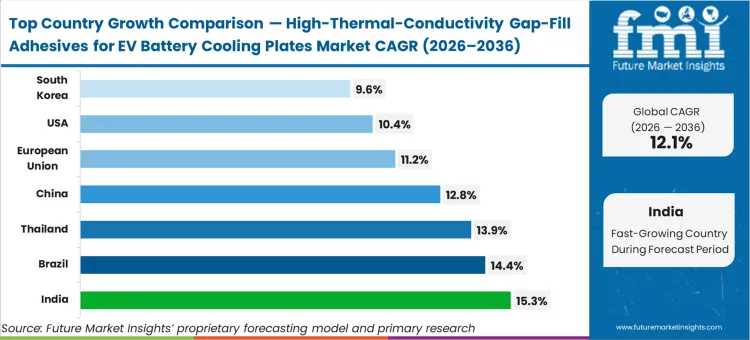
- India: India is set to register 15.3% CAGR, reflecting rapid localization of battery pack assembly lines.
- Analyst Opinion at FMI
- Nikhil Kaitwade, Principal Analyst, Automotive, at FMI, observed that "General procurement models measure thermal materials by cost per kilogram, but battery assembly managers evaluate them by abrasive wear on dispensing equipment. High-conductivity formulations require dense ceramic fillers. Formulators maximizing thermal metrics often create abrasive compounds destroying automated mixing nozzles within weeks. True vendor lock-in occurs at the moment the automotive-qualified thermal gap filler manufacturer formulates a 4 W/mK adhesive flowing smoothly enough to keep production lines running without constant equipment replacement."
- Strategic Implications / Executive Takeaways
- Tier-1 procurement directors secure competitive advantage by qualifying dual suppliers for identical viscosity profiles.
- Chemical formulators targeting fast-charge platforms must prioritize rheology alongside thermal conductivity to win OEM approvals.
- Dispensing equipment manufacturers face opportunities designing hardened nozzles capable of handling highly filled power batteries adhesives.
- Methodology
- Primary Research: Battery pack thermal engineers detail actual material behavior during continuous manufacturing runs.
- Desk Research: EV teardown data and material qualification standards provide structural validation.
- Market-Sizing and Forecasting: Average dispensed volume per EV architecture forms quantitative baselines.
- Data Validation and Update Cycle: Platform production volumes track alongside material delivery contracts.
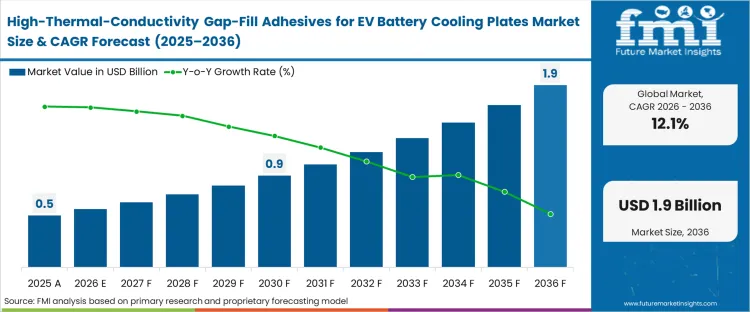
High-Thermal-Conductivity Gap-Fill Adhesives for EV Battery Cooling Plates Market Key Takeaways
| Metric | Details |
|---|---|
| Industry Size (2026) | USD 0.6 billion |
| Industry Value (2036) | USD 1.8 billion |
| CAGR (2026-2036) | 12.1% |
Source: Future Market Insights (FMI) analysis, based on proprietary forecasting model and primary research
Once battery integrators automate two-component dispensing equipment on continuous assembly lines, high-viscosity gap fillers transition from specialty solutions to baseline requirements. High-throughput precision pumping eliminates air voids at cell-to-plate interfaces. Production scale requires material that flows without abrasive wear on mixing nozzles.
India leads at 15.3% as domestic manufacturing localizes cell assembly operations. Brazil tracks at 14.4% on heavy investments targeting local supply chains, while Thailand advances at 13.9% through aggressive hub positioning strategies. China grows at 12.8% from massive baseline production volumes. European Union scales at 11.2% alongside United States expansion at 10.4%, reflecting mature platform qualifications. South Korea expands at 9.6% due to export-heavy structural focus rather than domestic fleet volume. Platform-cycle dynamics dictate regional divergence.
High-Thermal-Conductivity Gap-Fill Adhesives for EV Battery Cooling Plates Market Definition
High-thermal-conductivity gap-fill adhesives function as flowable interface compounds designed to transfer heat from battery cells directly to cooling structures while maintaining structural adhesion. Formulations combine polymer matrices with ceramic or metallic fillers to displace insulating air pockets. Material properties must maintain flexibility across extreme temperature fluctuations without cracking. Thermal conductivity specifications differentiate these EV battery thermal interface materials from basic structural glues.
High-Thermal-Conductivity Gap-Fill Adhesives for EV Battery Cooling Plates Market Inclusions
Scope incorporates two-component silicones, silane-modified polymers, and urethane systems engineered specifically for battery pack thermal management. Liquid-dispensed gap fillers, structural thermal adhesives, and high-conductivity potting compounds qualify under this boundary. Evaluated materials include battery pack sealants demonstrating specified thermal transfer rates. Integration spans cell-to-plate interfaces, cooling ribbons, and adjacent power electronics utilizing liquid-cooled EV battery gap filler materials.
High-Thermal-Conductivity Gap-Fill Adhesives for EV Battery Cooling Plates Market Exclusions
Solid thermal pads, phase change materials, and non-adhesive dielectric fluids fall outside this analysis. Conventional structural glues lacking designed thermal conductivity metrics, along with traditional sealants used for weatherproofing, do not meet criteria. Mechanical fasteners, rigid heat sinks, and active liquid cooling hardware remain excluded from material volume calculations.
High-Thermal-Conductivity Gap-Fill Adhesives for EV Battery Cooling Plates Market Research Methodology
- Primary Research: Battery pack thermal engineers and Tier-1 procurement directors evaluate material qualification timelines.
- Desk Research: EV cell specification sheets, material safety data filings, and automotive platform teardown reports validate baseline assumptions.
- Market-Sizing and Forecasting: Dispensing volume per vehicle platform anchors volumetric baseline estimates.
- Data Validation and Update Cycle: Global EV production schedules cross-validate forecasted material consumption rates.
Segmental Analysis
High-Thermal-Conductivity Gap-Fill Adhesives for EV Battery Cooling Plates Market Analysis by Chemistry
Silicone matrices dominate formulation choices because cross-linked siloxane structures maintain elasticity across extreme temperature swings. Rigid adhesives crack when cells expand during charge cycles. Silicone-based gap-fill adhesives segment commands 48.0% share in 2026, supported by battery engineers prioritizing long-term vibration dampening. Silicone prevents such mechanical failures while carrying conductive fillers effectively. Formulators blend various particle sizes to maximize thermal pathways without turning thermal management materials into un-pumpable paste. What chemical suppliers rarely disclose is that premium low-volatile silicones face severe global feedstock constraints during peak EV production months. Procurement directors searching for a reliable silicone gap filler for EV battery cooling plates often scramble when Tier-2 chemical plants cannot source purified precursors. Selecting silane-modified alternatives sometimes offers better supply chain security, forcing engineers to actively evaluate silicone vs SMP gap filler for EV battery cooling plates despite slightly lower thermal performance ceilings.
- Cost Economics: Formulation costs obscure true production expenses. Procurement directors realize highly filled silicones require constant dispensing nozzle replacements. Total lifecycle calculations must include assembly line downtime.
- Supply Side: Specialty chemical giants control high-purity siloxane precursors. Battery pack integrators navigate supply bottlenecks during peak production seasons. Feedstock availability dictates long-term contract pricing.
- Failure Mode: Incomplete curing traps internal stresses within battery modules. Thermal engineers must ensure dual-component mixtures achieve perfect ratios. Improper mixing causes catastrophic interface delamination.
High-Thermal-Conductivity Gap-Fill Adhesives for EV Battery Cooling Plates Market Analysis by Thermal Conductivity Band
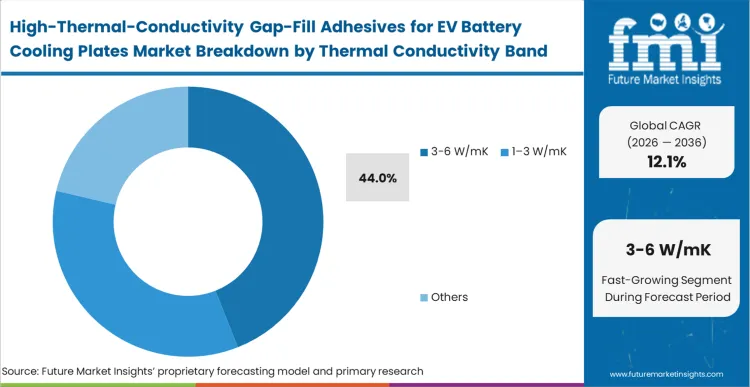
Automotive OEMs target middle-tier thermal performance to balance heat dissipation with manufacturing practicality. According to FMI's estimates, thermal bands above 6 W/mK become exponentially harder to pump through automated factory lines. Heavy ceramic loading turns interface materials formulations abrasive. Battery pack designers optimize cooling plates to function adequately with 4 W/mK materials instead of demanding ultra-high conductivity. Share metrics hiding achieving 5 W/mK in a laboratory environment differs entirely from maintaining 5 W/mK across a 100,000-vehicle production run without batch variations. The 3-6 W/mK segment holds 44.0% share in 2026, reflecting an engineering compromise rather than maximum possible capability. Quality control directors reject numerous shipments when viscosity drifts outside strict tolerances. Specifying 3 W/mK ensures consistent factory application speeds without triggering constant equipment alarms.
- Adoption Sequence: Premium sports car platforms adopt >6 W/mK materials first. Mass-market commuter vehicles follow using 3 W/mK formulations. Commercial fleets prioritize long-term stability over absolute peak thermal transfer.
- Performance Gradient: Nominal thermal conductivity drops under vibration stress. Packaging engineers evaluate compressed state performance rather than uncompressed data sheet claims. Acceptable limits depend on module compression force.
- Buyer Decision: Fast-charging targets trigger initial high-conductivity requirements. Process engineers validate pumpability during pilot runs. Assembly speed dictates ultimate material selection over raw thermal metrics.
High-Thermal-Conductivity Gap-Fill Adhesives for EV Battery Cooling Plates Market Analysis by Battery Architecture / Use Point
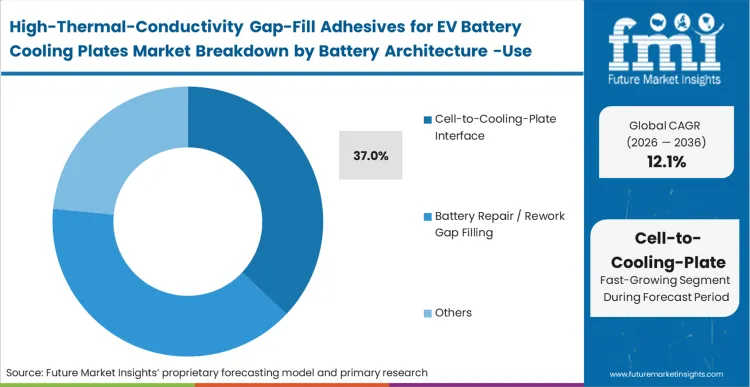
Direct coupling between energy storage components and active cooling hardware consumes massive material volumes. FMI observes that integration trends eliminate intermediary module housings entirely. Bonding cells directly to chassis elements transfers mechanical loads through thermal adhesives. Cell-to-cooling-plate interface segment captures 37.0% share in 2026, as battery thermal plates require continuous contact across broad surface areas. Automotive structural engineers demand shear strength comparable to traditional epoxies but require urethane-like flexibility from a cell-to-cooling-plate adhesive. Interestingly, high-strength cell-to-plate bonding creates an unintentional recycling nightmare: dismantling glued packs without destroying cells remains nearly impossible. Recycling facility managers curse permanent structural gap fillers, pushing next-generation designs toward debondable material formulations. Delayed transition to debondable interface pads alternatives risks future regulatory penalties regarding end-of-life vehicle directives.
- Buyer Decision: Pack simplification targets trigger cell-to-pack architecture transitions. Structural engineers validate shear strength under crash conditions. Assembly simplification drives continuous volume expansion.
- Cost Economics: Eliminating module housings saves massive hardware costs. Procurement directors offset high adhesive prices against eliminated metal components. Total pack cost decreases despite increased chemical spend.
- Failure Mode: Micro-voids at cell interfaces create localized hot spots. Quality control directors utilize ultrasonic scanning to detect dispensing gaps. Undetected voids lead to premature cell degradation.
High-Thermal-Conductivity Gap-Fill Adhesives for EV Battery Cooling Plates Market Analysis by Vehicle Type
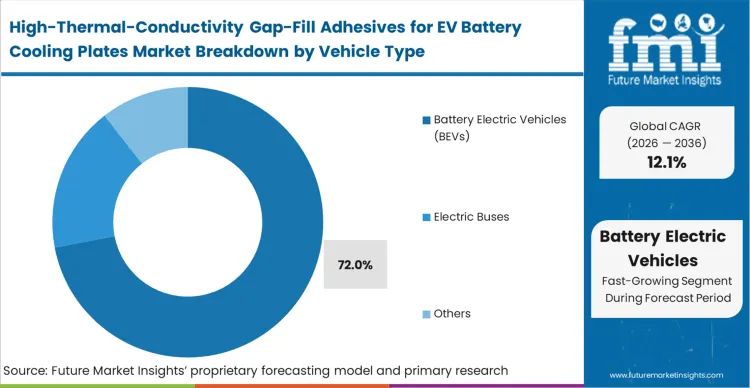
Massive battery capacities inherent to pure electric platforms mandate extensive thermal interface coverage. Battery electric vehicles (BEVs) segment accounts for 72.0% share, driven by energy densities generating unprecedented heat during DC fast charging. Based on FMI's assessment, hybrid platforms utilize smaller packs requiring less aggressive thermal strategies. BEV architectures increasingly utilize heat shield coatings alongside gap fillers. Formulators customize rheology specifically to act as a fast-charging EV battery cooling interface adhesive for BEV skateboard chassis designs. Vehicle share data misses commercial electric trucks consume gap filler at roughly ten times the rate of passenger cars per unit, silently buoying volume metrics despite lower absolute truck sales. Fleet operators replacing heavy-duty BEV components face unique challenges accessing buried cooling plates.
- Supply Side: Global BEV production hubs dictate material distribution networks. Formulators build blending facilities adjacent to major automotive plants. Regional proximity eliminates hazardous material shipping complications.
- Adoption Sequence: Luxury BEVs adopt high-performance formulations immediately. Mass-market sedans follow as formulation costs decrease. Electric buses transition last due to conservative qualification cycles.
- Performance Gradient: Commercial truck duty cycles push adhesives beyond passenger car temperature limits. Fleet maintenance directors demand industrial adhesives durability. Formulations failing heavy-duty tests lose lucrative fleet contracts.
High-Thermal-Conductivity Gap-Fill Adhesives for EV Battery Cooling Plates Market Analysis by Sales Channel
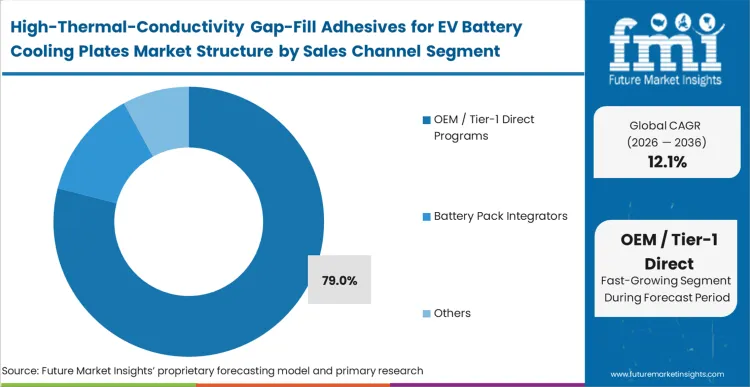
Tier-1 battery integrators dictate material specifications long before vehicles reach showrooms. FMI analysts noticed that rigorous qualification protocols make channel switching extremely rare. Once chemical suppliers secure OEM platform approvals, recurring revenue streams lock in for typical seven-year production lifecycles. Distributors handle niche electronic packaging adhesives applications but rarely supply main assembly lines. An underlying paradox is that while OEMs control approvals, Tier-1 pack assemblers actually purchase these materials, creating misaligned incentives where OEMs demand expensive formulations but Tier-1s pressure suppliers for margin relief. OEM / Tier-1 direct programs segment captures 79.0% share, since aftermarket repairs constitute minimal volume for structural pack components. Chemical sales directors navigate this tension by formulating cost-down material iterations mid-cycle to retain their status as the preferred EV battery cooling plate adhesive supplier.
- Cost Economics: Direct OEM contracts squeeze formulator profit margins. Chemical sales directors trade unit price for guaranteed volume. Mid-cycle renegotiations consistently drive chemical prices downward.
- Failure Mode: Supply chain disruptions halt vehicle assembly lines instantly. Logistics managers require local buffer stock holding facilities. Missed deliveries trigger catastrophic financial penalties.
- Buyer Decision: Platform design phases initiate vendor selection processes. Purchasing managers validate global supply capabilities. Consistent quality across multiple continents secures final contracts.
High-Thermal-Conductivity Gap-Fill Adhesives for EV Battery Cooling Plates Market Drivers, Restraints, and Opportunities
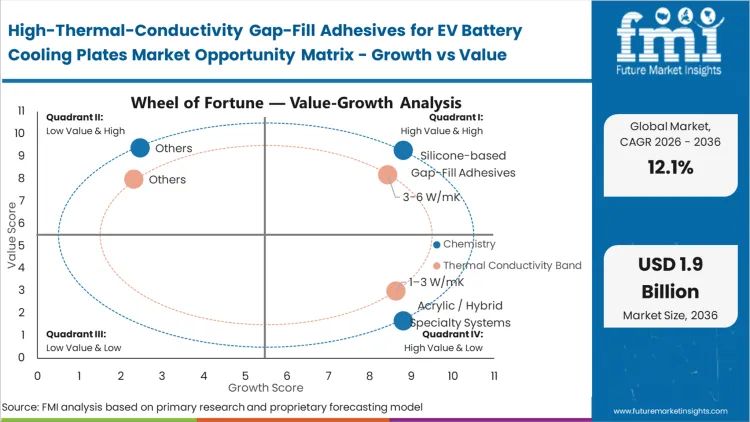
High-amperage fast-charging targets compel automotive R&D directors to abandon solid thermal pads in favor of conformal liquid-dispensed materials. Evaluating the gap filler vs gap pad in EV battery thermal management reveals that solid interfaces trap microscopic insulating air pockets against curved cell casings, creating localized hot spots during 350kW charging sessions. Flowable adhesives displace all air, bonding directly to electrically conductive adhesives and surrounding metal. Delaying this transition forces brands to electronically limit charging speeds, destroying competitive positioning against rivals offering sub-20-minute recharge times. Platform engineers must specify advanced gap fillers to unlock raw battery performance safely.
Dispensing equipment limitations slow factory adoption despite clear thermal advantages. Standard automated mixing nozzles wear out rapidly when pumping highly abrasive ceramic-loaded electronic sealants. Manufacturing directors refuse to stop production lines weekly for equipment maintenance. This operational friction forces compromise: engineers specify lower thermal conductivity formulations simply because they flow better. Emerging wear-resistant carbide nozzles address this constraint partially, but high capital upgrade costs cause Tier-1 assemblers to hesitate.
Opportunities in the High-Thermal-Conductivity Gap-Fill Adhesives for EV Battery Cooling Plates Market
- Debondable formulations: End-of-life recycling mandates require easily dismantled battery packs. Chemical formulators developing thermally triggered debondable adhesives capture massive Tier-1 interest.
- Non-silicone alternatives: Silicone outgassing damages sensitive optical sensors adjacent to battery modules. Acrylic-based formulations meeting high thermal targets win contracts avoiding siloxane contamination.
- Ultra-fast curing systems: Bottlenecks at factory dispensing stations limit vehicle output. Two-component epoxy curing agents utilizing UV-triggered snap-cure mechanisms drastically reduce assembly cycle times.
Regional Analysis
Based on regional analysis, high-thermal-conductivity gap-fill adhesives for ev battery cooling plates market is segmented into North America, Latin America, Western Europe, Eastern Europe, East Asia, South Asia & Pacific, and Middle East & Africa across 40 plus countries.
.webp "Top Country Growth Comparison High Thermal Conductivity Gap Fill Adhesives For Ev Battery Cooling Plates Market Cagr (2026 2036)")
| Country | CAGR (2026 to 2036) |
|---|---|
| India | 15.3% |
| Brazil | 14.4% |
| Thailand | 13.9% |
| China | 12.8% |
| European Union | 11.2% |
| United States | 10.4% |
| South Korea | 9.6% |
Source: Future Market Insights (FMI) analysis, based on proprietary forecasting model and primary research
Asia Pacific High-Thermal-Conductivity Gap-Fill Adhesives for EV Battery Cooling Plates Market Analysis
Massive established cell manufacturing capacity dictates material consumption across East Asian supply chains. Chemical formulators locate blending facilities adjacent to mega-factories to eliminate cross-border logistical friction. As battery energy densities rise, local Tier-1 suppliers aggressively transition toward structural battery packaging material. FMI analysts note that extreme competitive pressure among regional vehicle brands accelerates qualification cycles for experimental thermal compounds within the broader EV battery TIM gap filler market. Government localization incentives transform domestic assembly operations into primary chemical consumption hubs. Two-wheeler and three-wheeler electrification drives unique high-temperature formulation requirements not seen in traditional automotive environments. Fleet operators require robust thermal management to survive extreme ambient climates. Price-sensitive consumer markets push formulators toward highly efficient, low-cost synthetic matrices.
- China: Domestic manufacturers dominate global cell production volumes, pushing intense material demand. Battery plant operators qualify local chemical suppliers to avoid geopolitical supply chain risks. Advancing at 12.8%, volume requirements force formulators to optimize raw material extraction networks. Successful localized formulations secure unprecedented commercial volume.
- South Korea: Export-driven automotive strategies prioritize globally certified thermal tapes alongside liquid gap fillers. Quality control directors maintain strict adherence to international safety standards rather than purely optimizing cost. Tight integration between domestic battery giants and vehicle brands fortifies existing supplier relationships. Expanding at 9.6%, mature platform lifecycles govern chemical uptake rates.
- India: Aggressive localization mandates force Tier-1 pack assemblers to source thermal materials domestically. Two-wheeler EV startups iterate battery designs rapidly, requiring highly adaptable structural adhesives. Leading regional growth at 15.3%, immense unpenetrated automotive segments provide massive expansion runways. Chemical formulators establishing early local manufacturing plants secure dominant long-term positioning.
- Thailand: Regional export hub strategies attract foreign automotive investments requiring specialized thermal management components. Procurement directors leverage established automotive supply chains to source reliable gap fillers. Tracking at 13.9%, steady integration of electric models into legacy manufacturing facilities sustains material demand. Seamless integration into existing supply networks streamlines production ramp-ups.
FMI's report includes ASEAN nations expanding electric vehicle infrastructure. Emerging manufacturing zones prioritize building specialized chemical handling capabilities to attract global battery assemblers.
North America High-Thermal-Conductivity Gap-Fill Adhesives for EV Battery Cooling Plates Market Analysis
Heavy-duty truck electrification initiatives introduce extreme material durability requirements. Commercial fleet operators mandate million-mile battery lifespans, forcing structural adhesives to endure unprecedented vibration and thermal cycling. Regional supply chain legislation heavily favors domestically sourced chemical precursors. According to FMI's estimates, stringent crash-test standards require urethane-based gap fillers demonstrating superior shear strength under sudden impacts.
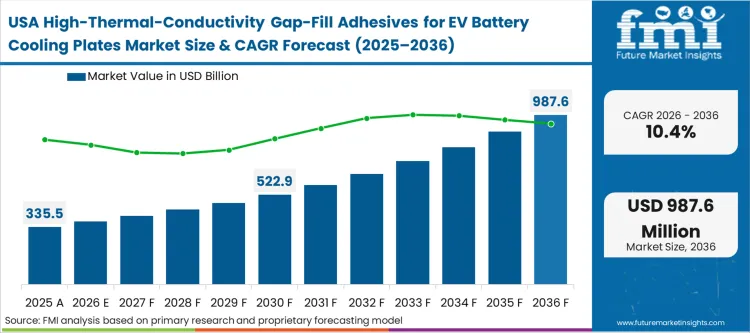
- United States: Advancing at 10.4%, mature automotive supply chains absorb new material requirements systematically. Large-format battery architectures required for electric pickup trucks consume massive adhesive volumes per unit. Engineering directors prioritize structural integrity alongside basic heat transfer metrics. Formulators meeting stringent domestic-content regulations lock in lucrative federal fleet contracts.
FMI's report includes Canada alongside North American expansion. Cold-weather performance requirements compel formulators to develop functional coating material preventing brittle adhesive fracturing at sub-zero temperatures.
Competitive Aligners for Market Players
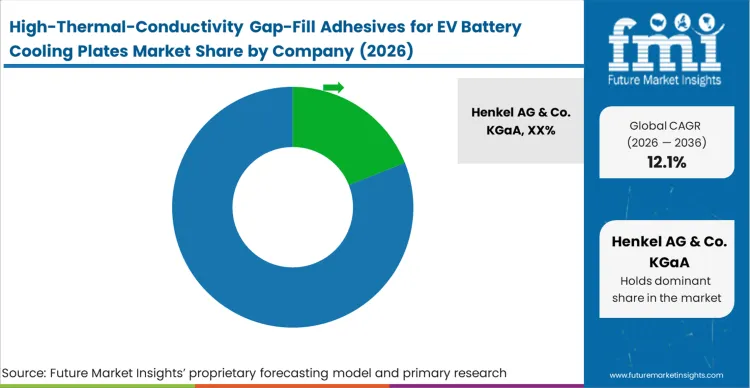
Extreme concentration at top chemical formulation tiers stems from immense capital required for global production footprint scaling. Dow Inc., Henkel AG & Co. KGaA, and Wacker Chemie AG control substantial volume because automotive OEMs demand identical material properties across factories located continents apart. Purchasing managers reject regional chemical suppliers lacking multi-continent blending capabilities. Raw material backward integration provides massive pricing advantages for major silicon producers.
Incumbents defend territory through extensive proprietary testing data validating long-term cell-to-plate adhesion. Startups cannot simulate ten years of thermal cycling quickly. Established giants leverage deep data libraries to guarantee performance over 150,000-mile warranty periods. Deep integration with automated dispensing equipment manufacturers ensures incumbent materials flow flawlessly through factory nozzles. Challengers must develop completely novel fire protection coatings properties to attract Tier-1 attention.
Large automotive buyers aggressively resist single-source dependency by validating secondary suppliers possessing matching viscosity profiles. Procurement directors force leading formulators to license specifications or face platform exclusion, frequently issuing an RFQ for EV battery gap filler adhesive suppliers to test market pricing. Rapid shifts toward debondable structural adhesives threaten entrenched portfolios lacking end-of-life dismantling solutions. Chemical suppliers adapting to circular-economy dismantling requirements capture next-generation platform designs efficiently.
Key Players in High-Thermal-Conductivity Gap-Fill Adhesives for EV Battery Cooling Plates Market
- Henkel AG & Co. KGaA
- Dow Inc.
- Sika AG
- Parker Hannifin Corporation (Chomerics)
- Wacker Chemie AG
- Saint-Gobain
- DuPont de Nemours, Inc.
Scope of the Report
| Metric | Value |
|---|---|
| Quantitative Units | USD 0.5 billion to USD 1.8 billion, at a CAGR of 12.1% |
| Market Definition | Flowable interface compounds transfer heat from battery cells directly to cooling structures while providing mechanical adhesion. |
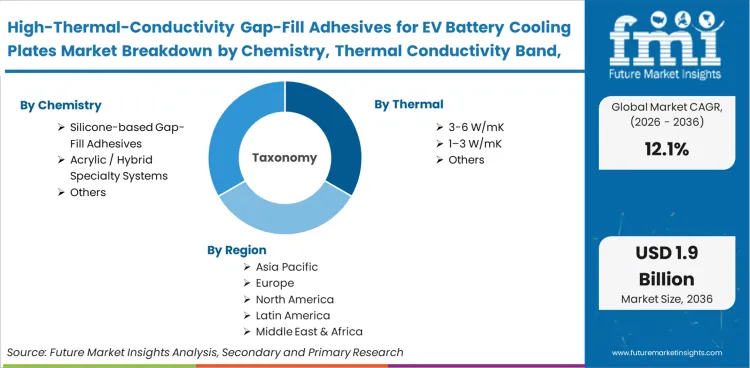
| Segmentation | By Chemistry, By Thermal Conductivity Band, By Battery Architecture / Use Point, By Vehicle Type, By Sales Channel |
| Regions Covered | North America, Latin America, Western Europe, Eastern Europe, East Asia, South Asia & Pacific, Middle East & Africa |
| Countries Covered | United States, Canada, Germany, United Kingdom, France, Italy, Spain, Russia, Poland, China, Japan, South Korea, India, Thailand, Indonesia, Malaysia, Australia, New Zealand, Brazil, Mexico, Argentina, GCC Countries, South Africa |
| Key Companies Profiled | Henkel AG & Co. KGaA, Dow Inc., Sika AG, Parker Hannifin Corporation (Chomerics), Wacker Chemie AG, Saint-Gobain, DuPont de Nemours, Inc. |
| Forecast Period | 2026 to 2036 |
| Approach | Dispensing volume per vehicle platform anchors volumetric baseline estimates. |
Source: Future Market Insights (FMI) analysis, based on proprietary forecasting model and primary research
High-Thermal-Conductivity Gap-Fill Adhesives for EV Battery Cooling Plates Market Analysis by Segments
Chemistry:
- Silicone-based gap-fill adhesives
- Silane-modified polymer / SMP gap-fill adhesives
- Polyurethane-based thermally conductive systems
- Epoxy-based thermally conductive systems
- Acrylic / hybrid specialty systems
Thermal Conductivity Band:
- 3-6 W/mK
- 1-3 W/mK
- Above 6 W/mK
- Below 1 W/mK
Battery Architecture / Use Point:
- Cell-to-cooling-plate interface
- Module-to-cooling-plate interface
- Cell-to-pack thermal coupling
- Battery repair / rework gap filling
- Power electronics adjacent cooling interfaces
Vehicle Type:
- Battery electric vehicles (BEVs)
- Plug-in hybrid electric vehicles (PHEVs)
- Electric buses
- Electric trucks / commercial EVs
Sales Channel:
- OEM / Tier-1 direct programs
- Battery pack integrators
- Aftermarket repair channels
- Specialty distributors / converters
Region:
- North America
- United States
- Canada
- Europe
- Germany
- United Kingdom
- France
- Italy
- Spain
- Asia Pacific
- China
- Japan
- South Korea
- Taiwan
- Singapore
- Latin America
- Brazil
- Mexico
- Argentina
- Middle East & Africa
- GCC Countries
- South Africa
- Israel
- Rest of Middle East & Africa
Bibliography
- Gilich, J., et al. (2025, December). Solvolytically debondable adhesive systems for structural applications. Journal of Adhesion (Taylor & Francis)
- Kumar, S., et al. (2025, February). Polymer-based hybrid nanocomposites for advanced structural and electronic applications. Journal of Materials Chemistry A (RSC Publishing).
- Zhang, X., et al. (2024, July). Electrically insulating yet thermally stable polymer composites for advanced electronics. Advanced Functional Materials (Wiley).
- Maiorino, A., et al. (2024, February). A review on thermal management of battery packs for electric vehicles. Applied Thermal Engineering (Elsevier).
- Kim, D., et al. (2025, April). Debonding-on-demand adhesives for recycling and sustainable electronics. Materials Horizons (RSC Publishing).
This bibliography is provided for reader reference. The full FMI report contains the complete reference list with primary source documentation.
Frequently Asked Questions
To effectively explain the market for high thermal conductivity gap fill adhesives in EV battery cooling plates, what is the core driver of expansion?
Fast-charging mandates force engineers to displace insulating air pockets around battery cells. Conformal liquid formulations transfer extreme heat directly into cooling structures, preventing catastrophic thermal runaway while maintaining critical operating temperatures safely.
Specifically, what are high-thermal-conductivity gap-fill adhesives used for in EV battery cooling plates?
They function as flowable interfaces that bridge the physical gap between energy-dense cells and active liquid cooling hardware, ensuring efficient heat transfer and preventing thermal bottlenecks without creating unwanted rigidity.
From an engineering perspective, why do EV battery cooling plates need gap filler adhesives?
Solid pads fail to conform perfectly to microscopic surface variations on battery casings. Liquid-dispensed gap fillers displace all insulating air pockets completely, maximizing the contact area necessary for high-amperage rapid charging without cell degradation.
During qualification protocols, how conductive should an EV battery gap filler be?
Automotive OEMs typically specify the 3–6 W/mK range. While 8 W/mK materials exist, they often become too abrasive for factory dispensing equipment, forcing a practical compromise between raw thermal transfer and continuous manufacturing reliability.
For procurement teams, what is the difference between gap filler and thermal adhesive in EV batteries?
Standard gap fillers prioritize heat transfer and remain relatively soft to dampen vibration. Thermal adhesives add structural shear strength, permanently bonding cells to chassis elements in modern cell-to-pack architectures, effectively combining two distinct material functions.
When evaluating the supply chain, which companies make EV battery cooling plate gap fillers?
Major global chemical formulators dominate production. The top tier includes Henkel AG & Co. KGaA, Dow Inc., Sika AG, Parker Hannifin Corporation (Chomerics), Wacker Chemie AG, Saint-Gobain, and DuPont de Nemours, Inc.
Who are the top suppliers of EV battery cooling plate gap fillers capable of multi-continent volume?
Dow, Henkel, and Wacker lead global supply because they possess the massive capital required to maintain identical chemical blending facilities near major automotive hubs across North America, Europe, and Asia simultaneously.
When formulators compare silicone and polyurethane gap fillers for EV cooling plates, what dictates the choice?
Silicone maintains unmatched flexibility across extreme temperature swings and dampens vibration effectively. Polyurethane provides vastly superior structural shear strength at a lower cost, making it preferable when battery packs require rigid mechanical reinforcement over pure flexibility.
How does FMI forecast demand for battery cooling plate gap fill adhesives to 2036?
Demand is projected to triple, rising from USD 0.6 billion in 2026 to USD 1.8 billion by 2036. This growth trajectory directly mirrors the shift away from modular battery housings toward structurally integrated, high-capacity cell-to-chassis designs.
How does cell-to-pack architecture change material selection?
Eliminating module housings transfers physical loads directly onto thermal interfaces. Structural engineers require gap fillers delivering polyurethane-like shear strength alongside heat transfer capabilities, fundamentally altering historical material specifications.
What operational friction slows expansion?
Dispensing hardware limitations create massive bottlenecks. Highly viscous gap fillers clog standard application nozzles rapidly, forcing expensive capital upgrades across Tier-1 assembly facilities before advanced compounds see production volume.
Why does India present such high growth potential?
Aggressive domestic manufacturing mandates force rapid supply chain localization. Surging two-wheeler electrification creates massive unpenetrated demand pools requiring entirely new, high-temperature structural adhesive formulations unique to tropical environments.
How do established formulators defend material volume?
Incumbents leverage deep proprietary testing libraries validating ten-year lifespan metrics. Automotive procurement teams refuse to risk multi-billion-dollar vehicle platforms on unproven startups lacking extensive thermal cycling data sets.
What non-obvious cost factor influences procurement?
Dispensing nozzle replacement costs often exceed raw material savings. Procurement directors calculating total lifecycle expenses recognize abrasive formulations destroy factory hardware, wiping out anticipated budget reductions instantly.
Why are debondable materials gaining sudden attention?
Strict recycling regulations penalize manufacturers utilizing permanent structural adhesives. Dismantling glued battery packs destroys valuable cells, pushing chemical suppliers to develop thermally triggered release mechanisms for next-generation platforms.
How do hybrid vehicles differ in material consumption?
Smaller battery capacities reduce absolute gap filler volume per vehicle dramatically. Hybrid architectures experience different thermal stress profiles, allowing engineers to specify lower-tier conductivity formulations compared to pure electric platforms.
What restricts specialty distributors in this sector?
OEM platform lock-ins dictate direct Tier-1 supply channels. Long-term volume contracts exclude middlemen entirely, restricting distributors to niche aftermarket repair applications and low-volume experimental prototype builds.
How does vibration affect thermal interface performance?
Nominal conductivity metrics derived under static laboratory conditions misrepresent real-world capabilities. Continuous road vibration micro-fractures brittle adhesives, severing thermal pathways and drastically reducing effective heat transfer over time.
What dictates pricing for premium gap fillers?
Global siloxane precursor availability controls baseline manufacturing costs. Limited high-purity extraction capacity creates supply bottlenecks during peak EV production months, allowing specialty chemical providers to command substantial price premiums.
Why do commercial trucks require different formulations?
Million-mile warranty targets exceed passenger vehicle requirements tenfold. Fleet maintenance directors specify highly durable industrial-grade matrices capable of surviving decades of continuous thermal cycling without losing structural adhesion.
How do quality control teams detect dispensing failures?
Ultrasonic scanning stations monitor completed battery assemblies for hidden micro-voids. Trapped air pockets create dangerous localized hot spots, forcing engineers to scrap entire modules if dispensing patterns drift.
What structural advantage do urethane systems offer?
Polyurethane matrices deliver exceptional shear strength at lower cost points than specialized epoxies. Engineers utilize urethane when battery pack structural rigidity takes precedence over absolute peak thermal conductivity metrics.
Why is South Korea expanding slower than India?
Mature platform lifecycles and export-focused automotive strategies govern Korean production stability. Indian markets represent fresh electrification waves building entirely new localized supply chains from zero baseline capacity.
How do formulators mitigate abrasive wear?
Advanced chemical engineering blends spherical alumina particles with specialized lubricating additives. Controlling particle geometry allows dense filler loading without transforming flowable liquids into destructive grinding pastes.
Preview the report firsthand - request a free sample
Get SampleGet the brochure for pricing and purchase details.
Get PDFTable of Content
- Executive Summary
- Global Market Outlook
- Demand-side Trends
- Supply-side Trends
- Technology Roadmap Analysis
- Analysis and Recommendations
- Market Overview
- Market Coverage / Taxonomy
- Market Definition / Scope / Limitations
- Research Methodology
- Chapter Orientation
- Analytical Lens and Working Hypotheses
- Market Structure, Signals, and Trend Drivers
- Benchmarking and Cross-market Comparability
- Market Sizing, Forecasting, and Opportunity Mapping
- Research Design and Evidence Framework
- Desk Research Programme (Secondary Evidence)
- Company Annual and Sustainability Reports
- Peer-reviewed Journals and Academic Literature
- Corporate Websites, Product Literature, and Technical Notes
- Earnings Decks and Investor Briefings
- Statutory Filings and Regulatory Disclosures
- Technical White Papers and Standards Notes
- Trade Journals, Industry Magazines, and Analyst Briefs
- Conference Proceedings, Webinars, and Seminar Materials
- Government Statistics Portals and Public Data Releases
- Press Releases and Reputable Media Coverage
- Specialist Newsletters and Curated Briefings
- Sector Databases and Reference Repositories
- FMI Internal Proprietary Databases and Historical Market Datasets
- Subscription Datasets and Paid Sources
- Social Channels, Communities, and Digital Listening Inputs
- Additional Desk Sources
- Expert Input and Fieldwork (Primary Evidence)
- Primary Modes
- Qualitative Interviews and Expert Elicitation
- Quantitative Surveys and Structured Data Capture
- Blended Approach
- Why Primary Evidence is Used
- Field Techniques
- Interviews
- Surveys
- Focus Groups
- Observational and In-context Research
- Social and Community Interactions
- Stakeholder Universe Engaged
- C-suite Leaders
- Board Members
- Presidents and Vice Presidents
- R&D and Innovation Heads
- Technical Specialists
- Domain Subject-matter Experts
- Scientists
- Physicians and Other Healthcare Professionals
- Governance, Ethics, and Data Stewardship
- Research Ethics
- Data Integrity and Handling
- Primary Modes
- Tooling, Models, and Reference Databases
- Desk Research Programme (Secondary Evidence)
- Data Engineering and Model Build
- Data Acquisition and Ingestion
- Cleaning, Normalisation, and Verification
- Synthesis, Triangulation, and Analysis
- Quality Assurance and Audit Trail
- Market Background
- Market Dynamics
- Drivers
- Restraints
- Opportunity
- Trends
- Scenario Forecast
- Demand in Optimistic Scenario
- Demand in Likely Scenario
- Demand in Conservative Scenario
- Opportunity Map Analysis
- Product Life Cycle Analysis
- Supply Chain Analysis
- Investment Feasibility Matrix
- Value Chain Analysis
- PESTLE and Porter’s Analysis
- Regulatory Landscape
- Regional Parent Market Outlook
- Production and Consumption Statistics
- Import and Export Statistics
- Market Dynamics
- Global Market Analysis 2021 to 2025 and Forecast, 2026 to 2036
- Historical Market Size Value (USD Million) Analysis, 2021 to 2025
- Current and Future Market Size Value (USD Million) Projections, 2026 to 2036
- Y-o-Y Growth Trend Analysis
- Absolute $ Opportunity Analysis
- Global Market Pricing Analysis 2021 to 2025 and Forecast 2026 to 2036
- Global Market Analysis 2021 to 2025 and Forecast 2026 to 2036, By Chemistry
- Introduction / Key Findings
- Historical Market Size Value (USD Million) Analysis By Chemistry , 2021 to 2025
- Current and Future Market Size Value (USD Million) Analysis and Forecast By Chemistry , 2026 to 2036
- Silicone-based Gap-Fill Adhesives
- Acrylic / Hybrid Specialty Systems
- Others
- Silicone-based Gap-Fill Adhesives
- Y-o-Y Growth Trend Analysis By Chemistry , 2021 to 2025
- Absolute $ Opportunity Analysis By Chemistry , 2026 to 2036
- Global Market Analysis 2021 to 2025 and Forecast 2026 to 2036, By Thermal Conductivity Band
- Introduction / Key Findings
- Historical Market Size Value (USD Million) Analysis By Thermal Conductivity Band, 2021 to 2025
- Current and Future Market Size Value (USD Million) Analysis and Forecast By Thermal Conductivity Band, 2026 to 2036
- 3-6 W/mK
- 1-3 W/mK
- Others
- 3-6 W/mK
- Y-o-Y Growth Trend Analysis By Thermal Conductivity Band, 2021 to 2025
- Absolute $ Opportunity Analysis By Thermal Conductivity Band, 2026 to 2036
- Global Market Analysis 2021 to 2025 and Forecast 2026 to 2036, By Battery Architecture -Use Point
- Introduction / Key Findings
- Historical Market Size Value (USD Million) Analysis By Battery Architecture -Use Point, 2021 to 2025
- Current and Future Market Size Value (USD Million) Analysis and Forecast By Battery Architecture -Use Point, 2026 to 2036
- Cell-to-Cooling-Plate Interface
- Battery Repair / Rework Gap Filling
- Others
- Cell-to-Cooling-Plate Interface
- Y-o-Y Growth Trend Analysis By Battery Architecture -Use Point, 2021 to 2025
- Absolute $ Opportunity Analysis By Battery Architecture -Use Point, 2026 to 2036
- Global Market Analysis 2021 to 2025 and Forecast 2026 to 2036, By Vehicle Type
- Introduction / Key Findings
- Historical Market Size Value (USD Million) Analysis By Vehicle Type, 2021 to 2025
- Current and Future Market Size Value (USD Million) Analysis and Forecast By Vehicle Type, 2026 to 2036
- Battery Electric Vehicles (BEVs)
- Electric Buses
- Others
- Battery Electric Vehicles (BEVs)
- Y-o-Y Growth Trend Analysis By Vehicle Type, 2021 to 2025
- Absolute $ Opportunity Analysis By Vehicle Type, 2026 to 2036
- Global Market Analysis 2021 to 2025 and Forecast 2026 to 2036, By Sales Channel
- Introduction / Key Findings
- Historical Market Size Value (USD Million) Analysis By Sales Channel, 2021 to 2025
- Current and Future Market Size Value (USD Million) Analysis and Forecast By Sales Channel, 2026 to 2036
- OEM / Tier-1 Direct Programs
- Battery Pack Integrators
- Others
- OEM / Tier-1 Direct Programs
- Y-o-Y Growth Trend Analysis By Sales Channel, 2021 to 2025
- Absolute $ Opportunity Analysis By Sales Channel, 2026 to 2036
- Global Market Analysis 2021 to 2025 and Forecast 2026 to 2036, By Region
- Introduction
- Historical Market Size Value (USD Million) Analysis By Region, 2021 to 2025
- Current Market Size Value (USD Million) Analysis and Forecast By Region, 2026 to 2036
- North America
- Latin America
- Western Europe
- Eastern Europe
- East Asia
- South Asia and Pacific
- Middle East & Africa
- Market Attractiveness Analysis By Region
- North America Market Analysis 2021 to 2025 and Forecast 2026 to 2036, By Country
- Historical Market Size Value (USD Million) Trend Analysis By Market Taxonomy, 2021 to 2025
- Market Size Value (USD Million) Forecast By Market Taxonomy, 2026 to 2036
- By Country
- USA
- Canada
- Mexico
- By Chemistry
- By Thermal Conductivity Band
- By Battery Architecture -Use Point
- By Vehicle Type
- By Sales Channel
- By Country
- Market Attractiveness Analysis
- By Country
- By Chemistry
- By Thermal Conductivity Band
- By Battery Architecture -Use Point
- By Vehicle Type
- By Sales Channel
- Key Takeaways
- Latin America Market Analysis 2021 to 2025 and Forecast 2026 to 2036, By Country
- Historical Market Size Value (USD Million) Trend Analysis By Market Taxonomy, 2021 to 2025
- Market Size Value (USD Million) Forecast By Market Taxonomy, 2026 to 2036
- By Country
- Brazil
- Chile
- Rest of Latin America
- By Chemistry
- By Thermal Conductivity Band
- By Battery Architecture -Use Point
- By Vehicle Type
- By Sales Channel
- By Country
- Market Attractiveness Analysis
- By Country
- By Chemistry
- By Thermal Conductivity Band
- By Battery Architecture -Use Point
- By Vehicle Type
- By Sales Channel
- Key Takeaways
- Western Europe Market Analysis 2021 to 2025 and Forecast 2026 to 2036, By Country
- Historical Market Size Value (USD Million) Trend Analysis By Market Taxonomy, 2021 to 2025
- Market Size Value (USD Million) Forecast By Market Taxonomy, 2026 to 2036
- By Country
- Germany
- UK
- Italy
- Spain
- France
- Nordic
- BENELUX
- Rest of Western Europe
- By Chemistry
- By Thermal Conductivity Band
- By Battery Architecture -Use Point
- By Vehicle Type
- By Sales Channel
- By Country
- Market Attractiveness Analysis
- By Country
- By Chemistry
- By Thermal Conductivity Band
- By Battery Architecture -Use Point
- By Vehicle Type
- By Sales Channel
- Key Takeaways
- Eastern Europe Market Analysis 2021 to 2025 and Forecast 2026 to 2036, By Country
- Historical Market Size Value (USD Million) Trend Analysis By Market Taxonomy, 2021 to 2025
- Market Size Value (USD Million) Forecast By Market Taxonomy, 2026 to 2036
- By Country
- Russia
- Poland
- Hungary
- Balkan & Baltic
- Rest of Eastern Europe
- By Chemistry
- By Thermal Conductivity Band
- By Battery Architecture -Use Point
- By Vehicle Type
- By Sales Channel
- By Country
- Market Attractiveness Analysis
- By Country
- By Chemistry
- By Thermal Conductivity Band
- By Battery Architecture -Use Point
- By Vehicle Type
- By Sales Channel
- Key Takeaways
- East Asia Market Analysis 2021 to 2025 and Forecast 2026 to 2036, By Country
- Historical Market Size Value (USD Million) Trend Analysis By Market Taxonomy, 2021 to 2025
- Market Size Value (USD Million) Forecast By Market Taxonomy, 2026 to 2036
- By Country
- China
- Japan
- South Korea
- By Chemistry
- By Thermal Conductivity Band
- By Battery Architecture -Use Point
- By Vehicle Type
- By Sales Channel
- By Country
- Market Attractiveness Analysis
- By Country
- By Chemistry
- By Thermal Conductivity Band
- By Battery Architecture -Use Point
- By Vehicle Type
- By Sales Channel
- Key Takeaways
- South Asia and Pacific Market Analysis 2021 to 2025 and Forecast 2026 to 2036, By Country
- Historical Market Size Value (USD Million) Trend Analysis By Market Taxonomy, 2021 to 2025
- Market Size Value (USD Million) Forecast By Market Taxonomy, 2026 to 2036
- By Country
- India
- ASEAN
- Australia & New Zealand
- Rest of South Asia and Pacific
- By Chemistry
- By Thermal Conductivity Band
- By Battery Architecture -Use Point
- By Vehicle Type
- By Sales Channel
- By Country
- Market Attractiveness Analysis
- By Country
- By Chemistry
- By Thermal Conductivity Band
- By Battery Architecture -Use Point
- By Vehicle Type
- By Sales Channel
- Key Takeaways
- Middle East & Africa Market Analysis 2021 to 2025 and Forecast 2026 to 2036, By Country
- Historical Market Size Value (USD Million) Trend Analysis By Market Taxonomy, 2021 to 2025
- Market Size Value (USD Million) Forecast By Market Taxonomy, 2026 to 2036
- By Country
- Kingdom of Saudi Arabia
- Other GCC Countries
- Turkiye
- South Africa
- Other African Union
- Rest of Middle East & Africa
- By Chemistry
- By Thermal Conductivity Band
- By Battery Architecture -Use Point
- By Vehicle Type
- By Sales Channel
- By Country
- Market Attractiveness Analysis
- By Country
- By Chemistry
- By Thermal Conductivity Band
- By Battery Architecture -Use Point
- By Vehicle Type
- By Sales Channel
- Key Takeaways
- Key Countries Market Analysis
- USA
- Pricing Analysis
- Market Share Analysis, 2025
- By Chemistry
- By Thermal Conductivity Band
- By Battery Architecture -Use Point
- By Vehicle Type
- By Sales Channel
- Canada
- Pricing Analysis
- Market Share Analysis, 2025
- By Chemistry
- By Thermal Conductivity Band
- By Battery Architecture -Use Point
- By Vehicle Type
- By Sales Channel
- Mexico
- Pricing Analysis
- Market Share Analysis, 2025
- By Chemistry
- By Thermal Conductivity Band
- By Battery Architecture -Use Point
- By Vehicle Type
- By Sales Channel
- Brazil
- Pricing Analysis
- Market Share Analysis, 2025
- By Chemistry
- By Thermal Conductivity Band
- By Battery Architecture -Use Point
- By Vehicle Type
- By Sales Channel
- Chile
- Pricing Analysis
- Market Share Analysis, 2025
- By Chemistry
- By Thermal Conductivity Band
- By Battery Architecture -Use Point
- By Vehicle Type
- By Sales Channel
- Germany
- Pricing Analysis
- Market Share Analysis, 2025
- By Chemistry
- By Thermal Conductivity Band
- By Battery Architecture -Use Point
- By Vehicle Type
- By Sales Channel
- UK
- Pricing Analysis
- Market Share Analysis, 2025
- By Chemistry
- By Thermal Conductivity Band
- By Battery Architecture -Use Point
- By Vehicle Type
- By Sales Channel
- Italy
- Pricing Analysis
- Market Share Analysis, 2025
- By Chemistry
- By Thermal Conductivity Band
- By Battery Architecture -Use Point
- By Vehicle Type
- By Sales Channel
- Spain
- Pricing Analysis
- Market Share Analysis, 2025
- By Chemistry
- By Thermal Conductivity Band
- By Battery Architecture -Use Point
- By Vehicle Type
- By Sales Channel
- France
- Pricing Analysis
- Market Share Analysis, 2025
- By Chemistry
- By Thermal Conductivity Band
- By Battery Architecture -Use Point
- By Vehicle Type
- By Sales Channel
- India
- Pricing Analysis
- Market Share Analysis, 2025
- By Chemistry
- By Thermal Conductivity Band
- By Battery Architecture -Use Point
- By Vehicle Type
- By Sales Channel
- ASEAN
- Pricing Analysis
- Market Share Analysis, 2025
- By Chemistry
- By Thermal Conductivity Band
- By Battery Architecture -Use Point
- By Vehicle Type
- By Sales Channel
- Australia & New Zealand
- Pricing Analysis
- Market Share Analysis, 2025
- By Chemistry
- By Thermal Conductivity Band
- By Battery Architecture -Use Point
- By Vehicle Type
- By Sales Channel
- China
- Pricing Analysis
- Market Share Analysis, 2025
- By Chemistry
- By Thermal Conductivity Band
- By Battery Architecture -Use Point
- By Vehicle Type
- By Sales Channel
- Japan
- Pricing Analysis
- Market Share Analysis, 2025
- By Chemistry
- By Thermal Conductivity Band
- By Battery Architecture -Use Point
- By Vehicle Type
- By Sales Channel
- South Korea
- Pricing Analysis
- Market Share Analysis, 2025
- By Chemistry
- By Thermal Conductivity Band
- By Battery Architecture -Use Point
- By Vehicle Type
- By Sales Channel
- Russia
- Pricing Analysis
- Market Share Analysis, 2025
- By Chemistry
- By Thermal Conductivity Band
- By Battery Architecture -Use Point
- By Vehicle Type
- By Sales Channel
- Poland
- Pricing Analysis
- Market Share Analysis, 2025
- By Chemistry
- By Thermal Conductivity Band
- By Battery Architecture -Use Point
- By Vehicle Type
- By Sales Channel
- Hungary
- Pricing Analysis
- Market Share Analysis, 2025
- By Chemistry
- By Thermal Conductivity Band
- By Battery Architecture -Use Point
- By Vehicle Type
- By Sales Channel
- Kingdom of Saudi Arabia
- Pricing Analysis
- Market Share Analysis, 2025
- By Chemistry
- By Thermal Conductivity Band
- By Battery Architecture -Use Point
- By Vehicle Type
- By Sales Channel
- Turkiye
- Pricing Analysis
- Market Share Analysis, 2025
- By Chemistry
- By Thermal Conductivity Band
- By Battery Architecture -Use Point
- By Vehicle Type
- By Sales Channel
- South Africa
- Pricing Analysis
- Market Share Analysis, 2025
- By Chemistry
- By Thermal Conductivity Band
- By Battery Architecture -Use Point
- By Vehicle Type
- By Sales Channel
- USA
- Market Structure Analysis
- Competition Dashboard
- Competition Benchmarking
- Market Share Analysis of Top Players
- By Regional
- By Chemistry
- By Thermal Conductivity Band
- By Battery Architecture -Use Point
- By Vehicle Type
- By Sales Channel
- Competition Analysis
- Competition Deep Dive
- Henkel AG & Co. KGaA
- Overview
- Product Portfolio
- Profitability by Market Segments (Product/Age /Sales Channel/Region)
- Sales Footprint
- Strategy Overview
- Marketing Strategy
- Product Strategy
- Channel Strategy
- Dow Inc.
- Sika AG
- Parker Hannifin Corporation (Chomerics)
- Wacker Chemie AG
- Saint-Gobain
- Henkel AG & Co. KGaA
- Competition Deep Dive
- Assumptions & Acronyms Used


