

- Industry Size (2026)
- USD 2150 Mn
- Forecast (2036)
- USD 7160 Mn
- CAGR (2026 to 2036)
- 12.8%
Functional Coating Material Market Forecast and Outlook By FMI
The functional coating material market is projected to reach USD 2,150 million in 2026 and expand to USD 7,160 million by 2036, reflecting a 12.8% CAGR over 2026-2036. The growth pattern is being shaped by a structural shift away from single-function, commodity formulations and toward application-engineered, environmentally compliant, and multifunctional coating systems that are increasingly specified as default design requirements across electronics & automotive assemblies, industrial corrosion protection contracts, construction envelope performance specifications, and barrier-driven packaging laminates.
A key expansion engine is electrification-especially the way EV battery packs convert coatings from passive protection into active performance components. Battery environments demand coatings that simultaneously address electrical insulation, thermal pathways, corrosion protection, and mechanical impact resistance, and this drives higher coating intensity per vehicle than internal combustion architectures. The forecast narrative reflects the move toward systems-level coating architectures in which underbody and enclosure durability including high-build stone-chip resistant layers above ~300 µm is paired with thermal management interfaces and high-dielectric protection in areas that cannot tolerate short-circuit risk.
Summary of Functional Coating Material Market
- The functional coating material market comprises advanced coating formulations engineered to deliver intentional performance-enhancing properties beyond conventional decorative or basic protective coatings, including anticorrosion protection, anti-smudge/anti-fingerprint behavior, UV resistance, thermal management, electrical performance support, self-cleaning capability, and antimicrobial activity across automotive, electronics, industrial equipment, construction materials, packaging formats, and other engineered substrates.
- Within FMI taxonomy, the scope is structured by end-use sector, coating function, base material, and region, focusing on coatings where functional performance is the primary value driver and excluding standard decorative paints and non-functional primers as well as downstream application services. The market is forecast to expand from USD 2,150 million (2026) to USD 7,160 million (2036) at a 12.8% CAGR, supported by EV battery safety/performance requirements, infrastructure life-extension economics, PFAS phase-out pressures, green building envelope performance mandates, and sustainable packaging barrier innovation.
- Structurally, competition continues to consolidate toward global coating and specialty chemical corporations with resin synthesis depth, multi-region compliance capability, and OEM qualification track records. India is positioned as the fastest-growing country at 15.2% CAGR, followed by China at 14.8%, with the United States at 12.4%, Germany at 11.0%, and Japan at 9.6%, reflecting differences in localization policy intensity, regulatory enforcement, EV manufacturing investment, and maturity of industrial coating ecosystems.
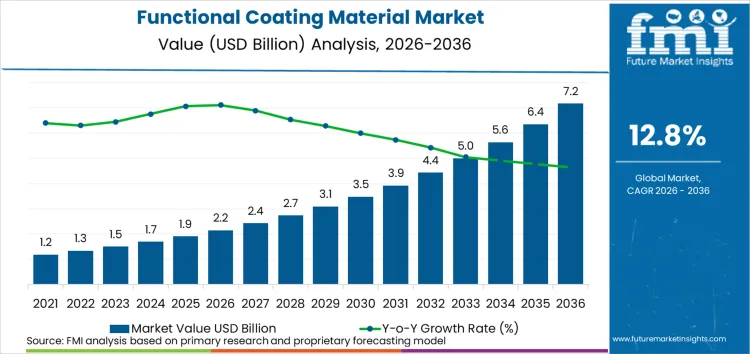
The market outlook is also influenced by the PFAS transition, where functional categories historically dependent on fluorinated chemistry, particularly smudge-resistant and anti-fingerprint performance layers-are undergoing reformulation toward nano-engineered, fluoropolymer-free alternatives. This transition increases qualification costs and places a premium on suppliers capable of delivering documented performance stability under real-world abrasion, humidity, and chemical exposure conditions while also meeting evolving compliance expectations.
Finally, construction and packaging pull additional volume and value. Construction applications increasingly emphasize envelope performance (UV durability, water resistance, mold/mildew resistance) and energy-saving coatings (e.g., cool-roof and weatherable exterior systems). Packaging-linked demand centers on barrier enhancement and PFAS-free food-contact directions, which are raising interest in non-fluorinated hydrophobic and high-barrier coating systems that preserve recyclability pathways.
Functional Coating Material Market Key Takeaways
| Metric | Value |
|---|---|
| Expected Value (2026E) | USD 2,150 million |
| Projected Value (2036F) | USD 7,160 million |
| CAGR (2026-2036) | 12.8% |
Source: FMI analysis based on primary research and proprietary forecasting model
Why is the Functional Coating Material Market Growing?
Demand growth is being propelled by five structural forces: EV battery proliferation, infrastructure corrosion-prevention economics, PFAS regulatory phase-out, green building envelope performance mandates, and sustainable packaging barrier innovation. They are embedded into procurement specifications and qualification gates used by automotive OEMs, asset owners, construction specifiers, and brand owners-making validated functional performance a condition of supply rather than an upgrade choice.
Electrification elevates functional coatings from passive protection into active system enablers inside the battery pack, where coatings may be used across multiple sub-systems: corrosion control on housings, dielectric protection for conductive components, thermally conductive interfaces for cooling architectures, and high-build mechanical protection for underbody exposure. This multiplies coating value per vehicle and increases the share of coatings that must be validated against safety and durability expectations rather than optimized only for cost.
PFAS phase-out pressure is accelerating reformulation of easy-clean, anti-smudge, and anti-fingerprint functional layers, pushing suppliers toward silicone, hydrocarbon-modified, and nano-textured performance pathways. In construction, cool-roof and weatherable exterior specifications increase demand for UV- and moisture-resilient functional systems, while packaging is adding momentum through PFAS-free barrier directions and high-barrier film innovations designed to preserve recyclability compatibility.
How is the Functional Coating Material Market Segmented?
The functional coating material market is segmented by end-use sector, coating function, and base material, because adoption is ultimately dictated by where the coated substrate is deployed, the primary performance function being purchased (corrosion control, easy-clean, UV stability, etc.), and which polymer platform dominates conversion economics and compatibility with installed coating/lamination assets.
From an end-use standpoint, the structure is led by Electronics & Automotive (44%), reflecting the world’s largest advanced manufacturing ecosystems where coatings are specified as reliability and safety enablers, not as decorative upgrades. Industrial coatings (28%) represent the next largest block, serving heavy machinery, oil & gas, marine, and renewable energy infrastructure where durability against saltspray, chemical exposure, and UV degradation defines procurement.
Construction coatings (16%) are tied to architectural finishes, bridge/steel structure protection, and energy-efficient cool-roof systems, while packaging coatings (8%) emphasize barrier enhancement and recyclability, and consumer goods coatings (4%) focus on tactile and aesthetic performance in appliances, furniture, and personal care packs.
Why do Electronics & Automotive applications sustain leadership at 44% share?
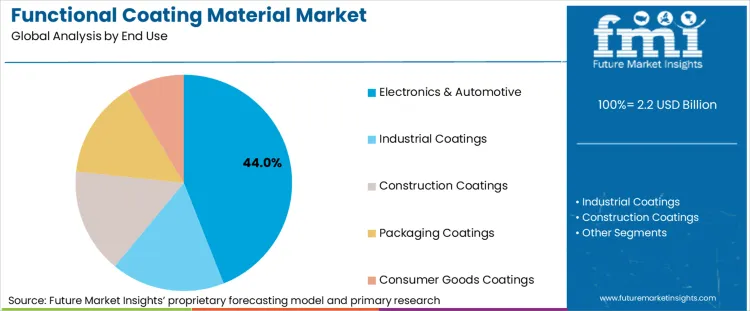
Electronics & automotive accounts for 44% because functional coatings are embedded directly into the reliability architecture of devices and mobility platforms-particularly in EVs, where coating demand expands beyond traditional body protection into battery-centric safety and performance requirements. EV platforms intensify the need for dielectric protection, corrosion prevention, and thermal performance support across housings, pack components, and high-voltage assemblies; this shifts coating procurement toward engineered systems that are qualified to specific thresholds and validation protocols rather than selected primarily on cost.
This segment’s leadership is also reinforced by the scale and complexity of electronics manufacturing. Coatings support moisture/chemical protection for sensitive components and are increasingly associated with performance stability in harsh environments. As electronics and automotive converge around higher computing density and power electronics intensity, coatings become one of the lowest-cost levers to raise operating life and reduce failure risk, explaining why the end-use share remains structurally anchored even as other sectors (construction, packaging) add incremental demand.
Why does Anticorrosion functionality maintain leadership at 46% of coating function demand?
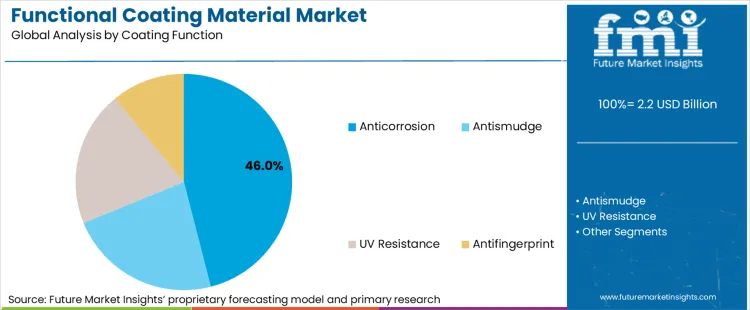
Anticorrosion coatings hold 46% because corrosion remains the most universal and economically material degradation pathway across infrastructure, industrial assets, marine environments, and vehicle structures, making corrosion control the “default” functional requirement whenever service life and maintenance cost matter. The demand is not only broad-it is also durable, because asset owners and governments repeatedly prioritize life-extension economics for bridges, pipelines, ports, and industrial equipment.
The segment is evolving beyond passive barrier layers. The market increasingly rewards anticorrosion systems that enable predictive maintenance and self-healing behavior that automatically repair minor coating breaches, extending service life and lowering inspection burdens. These innovations raise value per coated square meter because they shift the coating from a consumable layer into an asset-management tool.
How does PE / PET as the primary base material drive market volume at 48% share?
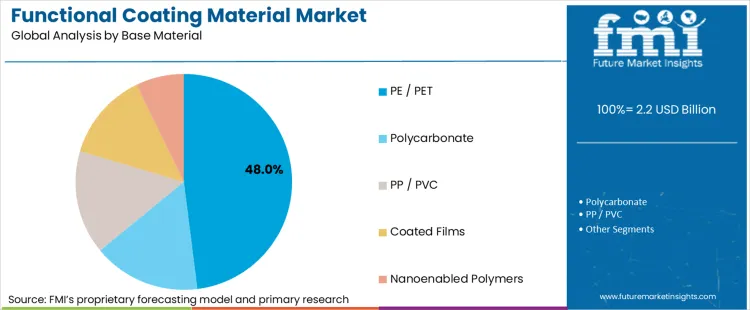
PE/PET accounts for 48% of base material consumption because these polymers sit at the center of global converting economics. PE dominates packaging and industrial film formats through moisture barrier and chemical resistance, while PET is preferred for electronics-related film uses due to dimensional stability, optical clarity, and dielectric performance.
A decisive reason for PE/PET leadership is installed-equipment compatibility: extrusion coating, adhesive lamination, and slot-die coating lines are widely optimized for these commodity polymer platforms, enabling converters to apply functional layers without major capital reconfiguration. This keeps adoption friction low and supports fast scaling once end-users add functional coating specifications into qualification libraries.
The base-material landscape then steps down to polycarbonate (24%) for impact/thermal stability needs in automotive interiors and electronics housings, PP/PVC (14%) for industrial packaging and construction profiles, and coated/pretreated films (8%) that improve adhesion for downstream functional layering.
What Drivers, Restraints, Opportunities, and Trends Prevail in the Functional Coating Material Market?
Market expansion is governed by the convergence of EV battery safety certification pressure, infrastructure life-extension economics, PFAS regulatory phase-out acceleration, green building certification momentum, and sustainable packaging barrier innovation. EV electrification is the most direct demand accelerator because battery systems require multiple coating interventions across the pack ecosystem, and qualification increasingly references safety-driven requirements such as fire protection expectations, dielectric strength minimums, and thermal conductivity targets that commodity coatings cannot meet; this raises both volume and value per vehicle as platforms scale. Infrastructure asset owners add a second durable driver: maintenance backlogs and climate-linked degradation intensify the ROI case for coatings that extend service life of bridges, pipelines, and ports, and this sustains anticorrosion-led demand through repeat budget cycles.
PFAS phase-out pressure acts as both a demand driver and a reformulation catalyst, because proposed restrictions (and internal brand deadlines) force urgent redesign of easy-clean, anti-smudge, and anti-fingerprint chemistries toward silicone, hydrocarbon-modified, and nano-textured alternatives-rewarding first movers with validated compliant portfolios. Green building certification momentum expands demand for envelope performance coatings such as cool-roof systems (including high Solar Reflectance Index targets) and UV-resilient exterior finishes, while brand-owner commitments to remove PFAS from food-contact packaging stimulate development of nanosilica hydrophobic coatings and high-barrier PE/PET functional layers designed to preserve recyclability trajectories.
Key restraints center on input cost instability and qualification friction. Raw material price volatility in resins, pigments, solvents, and specialty nano-additives can exceed large year-to-year swings, creating margin compression for suppliers lacking long-term contracts or backward integration, while the qualification burden for advanced coatings increases time-to-revenue and raises the penalty for formulation changes made to manage costs. These restraints do not eliminate demand, but they shift share toward suppliers with procurement scale, formulation flexibility, and the ability to hold performance constant through feedstock substitution.
Opportunities are increasingly tied to localization and multifunctional integration. Regional manufacturing localization is opening new capacity and partnership pathways as policy frameworks encourage domestic material production near end-use hubs, creating room for regional players to displace imports where they can meet specification and service expectations. At the same time, product strategy is moving toward hybrid architectures that combine multiple functions within a single coating structure, reducing stack complexity and applied cost while strengthening performance accountability.
Trend direction is led by four major themes: multifunctional integration, low-VOC and bio-based acceleration, nano-engineered performance enhancement, and circular-economy design integration. Environmental regulation and corporate sustainability commitments are driving faster adoption of waterborne, powder, and UV-curable systems, including documented movement toward bio-based content in some coating lines and broader electrification-driven shifts away from solvent-heavy systems. Nano-engineered formulations are expanding the functional ceiling, enabling barrier, conductivity, EMI shielding, and superhydrophobic self-clean behavior that command premium pricing because they unlock new use cases rather than merely improving existing ones.
Analysis of Functional Coating Material Market by Key Countries
The global landscape for functional coating material is undergoing regional differentiation based on EV manufacturing investment, electronics assembly localization, construction activity velocity, and regulatory environmental stringency. As of early 2026, the market is characterized by India’s PLI-led acceleration, China’s regulatory-driven conversion, the United States’ EV gigafactory expansion, Germany’s PFAS-compliant innovation push, and Japan’s mature high-value specialization.
Country-wise CAGR Snapshot (2026 to 2036)
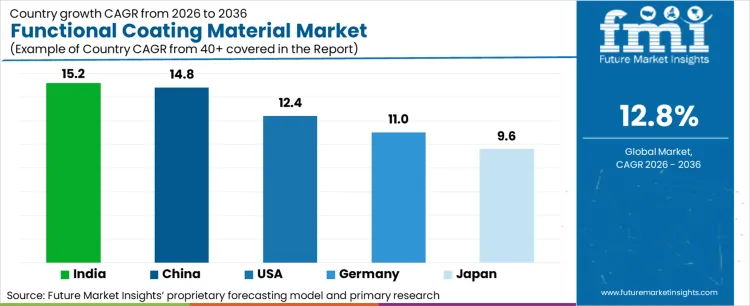
| Country | CAGR (2026 to 2036) |
|---|---|
| India | 15.2% |
| China | 14.8% |
| United States | 12.4% |
| Germany | 11.0% |
| Japan | 9.6% |
Source: FMI analysis based on primary research and proprietary forecasting model
What industrial policy catalyst is accelerating functional coating adoption in India at 15.2% CAGR?
India exhibits the highest market acceleration with a 15.2% CAGR from 2026 to 2036 because functional coatings are being pulled directly into electronics localization requirements under the Production Linked Incentive scheme targeting USD 400 billion in domestic electronics manufacturing by 2030. Expanding assembly footprints for Apple, Samsung, and Foxconn increase localized demand for multiple coating classes-conformal coatings for PCB protection, anti-fingerprint/functional finishes for display glass, and decorative-functional coatings for enclosures-many of which historically entered India through imported supply chains from Japan, Korea, and Taiwan. As localization thresholds rise, coatings transition from “imported supporting materials” into components that need local availability, consistent quality, and faster technical service loops to keep high-volume lines stable.
A second reinforcement is the scaling of India’s EV manufacturing ecosystem, which increases demand for dielectric powder coatings (battery components), thermal management coatings (power electronics), and anticorrosion systems (structural enclosures). In parallel, domestic manufacturers are widening their electronics-grade and industrial functional portfolios to capture localized procurement; the competitive advantage in India tends to be built around distribution reach, procurement depth, and price-performance tuning for local operating conditions-enabling faster conversion once OEM programs start specifying functional performance as a gating requirement. This combination-electronics PLI localization plus EV scale-up-creates unusually favorable adoption economics and sustains India’s lead growth position through 2036.
How is VOC emission standard enforcement driving China’s functional coating market expansion at 14.8% CAGR?
China expands at a 14.8% CAGR over 2026-2036 because VOC regulation enforcement is actively reshaping the technology mix away from solventborne systems toward waterborne, powder, and UV-curable alternatives. Rigorous enforcement of the GB 30981-2020 series national standards for VOC emissions is creating a compliance-driven demand floor: coatings that fail to meet VOC constraints face market access restrictions and escalating penalties, which accelerates conversion of both industrial and manufacturing customers toward compliant functional systems. This shift boosts demand not just in volume but also in reformulation intensity, as customers seek functional performance (corrosion resistance, barrier, thermal/dielectric functions) within low-VOC chemistry constraints.
Chinese domestic coating manufacturers are responding by expanding waterborne/powder capacity and competing aggressively on cost while meeting compliance requirements, enabling faster diffusion across the country’s consolidated EV, electronics, and PV manufacturing clusters. The concentration of manufacturing ecosystems provides immediate pull for functional coatings across smartphones/tablets, photovoltaic modules, and EV subsystems where coatings are embedded into standardized production flows. As domestic suppliers gain qualifications at large assemblers and energy manufacturers, the market’s growth becomes structurally self-reinforcing: compliance pressure raises conversion rates, domestic capacity lowers adoption friction, and qualification wins expand across adjacent manufacturing platforms.
What EV battery manufacturing catalyst is driving United States functional coating demand at 12.4% CAGR?
The United States market expands at a 12.4% CAGR through 2036 because domestic EV battery manufacturing build-out is creating large, durable demand for functional coatings integrated into battery pack and power electronics architectures. IRA-driven advanced manufacturing incentives are associated with major gigafactory projects (including BlueOval City, Metaplant Georgia, Toyota’s North Carolina battery facility, and LG Energy Solution’s Arizona complex), and each greenfield plant requires broad coating consumption across dielectric powder coatings (busbars/cooling plates), anticorrosion e-coat systems (enclosures), thermally conductive interfaces (cooling architectures), and high-build protective coatings for underbody exposure. The growth driver is therefore infrastructure-like: once plants are built, coating demand becomes an ongoing operational input tied to sustained production volumes.
This U.S. demand profile also supports longer-term supplier lock-ins because battery programs emphasize quality traceability and safety-driven qualification, rewarding suppliers with domestic manufacturing footprints and automotive-grade quality credentials. As multiple plants come online across different states, coating suppliers that can standardize performance across multi-site operations gain an edge, since OEMs and tier suppliers seek consistent coating outcomes regardless of plant location. The result is a market where growth is anchored not just in EV sales, but in the physical expansion of production infrastructure that institutionalizes functional coatings as mandatory manufacturing consumables.
How is PFAS-compliant innovation positioning Germany for 11.0% CAGR growth?
Germany grows at an 11.0% CAGR from 2026 to 2036 because Europe’s compliance leadership and the transition toward PFAS-compliant and low-VOC systems- especially in automotive and industrial applications where qualification standards are stringent, increasingly shape functional coating adoption. Germany’s regulatory environment amplifies the premiumization of coatings: buyers place a high value on performance stability under harsh service conditions (chemical exposure, abrasion, UV, thermal cycling) while simultaneously demanding compliance readiness under EU chemical policy trajectories. This creates a structural advantage for suppliers and innovations aligned with compliance-plus-performance rather than performance alone.
Germany’s position as a center for premium automotive engineering adds a second layer of pull. Automotive and tier supply chains demand coatings that support corrosion protection, aesthetic durability, and increasingly functional properties within electrified platforms, all under rigorous qualification protocols. In such environments, reformulating away from restricted chemistries without losing durability becomes a competitive differentiator, not just a compliance checkbox. Consequently, Germany’s growth is driven by a combination of regulatory pressure (which accelerates conversion) and engineering-led qualification barriers (which concentrate share among validated suppliers).
How does Japan’s mature industrial coating ecosystem shape a 9.6% CAGR trajectory?
Japan expands at a 9.6% CAGR through 2036, reflecting a market that is comparatively mature in conventional industrial coatings but continues to generate value growth in high-durability, high-spec functional systems. Japan’s demand profile is shaped by OEM-led specification depth and an established manufacturing culture that rewards incremental performance gains-durability retention, surface integrity, and long-life reliability-rather than rapid commodity volume expansion. This makes Japan’s growth more “value-led” than “area-led,” with adoption concentrated in high-performance functional layers where stability and quality consistency are central purchase criteria.
A second driver is Japan’s specialization in automotive OEM coatings and premium clearcoat performance, which sustains demand for advanced functional layers even when the broader industrial base is mature. As functional performance increasingly intersects with compliance (low-VOC pathways, chemistry transitions) and advanced manufacturing needs, Japan’s ecosystem remains positioned to adopt and refine high-value solutions-supporting steady expansion while maintaining its role as a premium specification market rather than a purely scale-driven growth market.
Competition Outlook
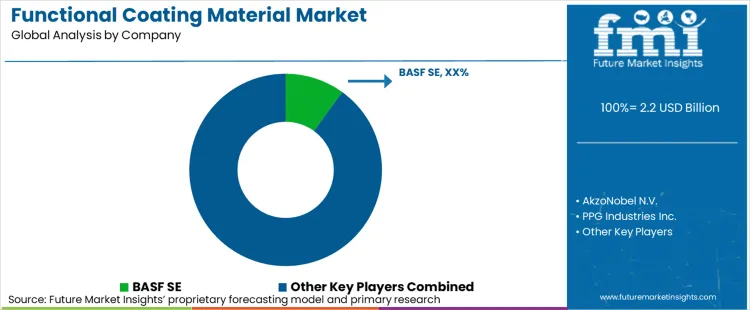
The competitive landscape for functional coating materials has shifted from fragmented regional formulators supplying single-function chemistries to vertically integrated material-science corporations delivering validated, multifunctional coating systems with durability data, regulatory dossiers, and sustainability credentials.
This transition is being reinforced by procurement consolidation. Automotive OEMs, electronics brands, construction specifiers, and packaging converters increasingly prefer “single-supplier” partnerships that can cover resin synthesis, formulation chemistry, compliance documentation, sustainability certifications, and global technical support-raising switching costs and squeezing smaller formulators without full-stack capabilities.
Differentiation is now concentrated across five capability vectors: (1) PFAS-free formulation velocity; (2) multifunctional integration in fewer layers; (3) regulatory compliance infrastructure spanning REACH/TSCA/GB and other regimes; (4) sustainability/circularity credentials such as biobased inputs and delamination-enabling chemistries; and (5) embedded application engineering support for cure schedules, substrate prep, and field troubleshooting.
Regionally, North America is scaling capacity around EV localization needs, Europe is emphasizing PFAS-free innovation and circularity, Japan is defending high-durability and precision segments, while China and India are scaling compliant volume capacity tied to domestic manufacturing incentives and local qualification pathways.
Key Players Profiled
- BASF SE
- AkzoNobel N.V.
- PPG Industries Inc.
- Nippon Paint Holdings Co. Ltd.
- Asian Paints Ltd.
- The Sherwin-Williams Company
- Covestro AG
- Kansai Paint Co. Ltd.
Market Definition
The functional coating material market comprises revenues from advanced coating formulations engineered to deliver performance-enhancing properties beyond conventional decorative/protective coatings-such as corrosion resistance, antismudge/antifingerprint behavior, UV durability, thermal management, electrical conductivity, self-cleaning, and antimicrobial functionality-across automotive, electronics, industrial equipment, construction, and packaging substrates.
Scope includes coating systems segmented by end-use sector, coating function, and base material; it excludes substrate manufacturing, standard decorative paints without engineered functional performance, non-coating surface treatments (e.g., plasma/CVD), and downstream application/maintenance services.
Scope of Report
| Items | Values |
|---|---|
| Quantitative Units (2026) | USD 2,150 million |
| End-Use Sector | Electronics & Automotive; Industrial Coatings; Construction Coatings; Packaging Coatings; Consumer Goods Coatings |
| Coating Function | Anticorrosion; Antismudge; UV Resistance; Antifingerprint; Functional Finishes |
| Base Material | PE / PET; Polycarbonate; PP / PVC; Coated Films; Nanoenabled Polymers |
| Regions Covered | North America; Europe; East Asia; Japan; Rest of World |
| Countries Covered | United States, China, Germany, Japan, India, Canada, Mexico, United Kingdom, France, Italy, Spain, South Korea, Taiwan, Brazil, and additional regional markets |
| Key Companies Profiled | BASF SE; AkzoNobel N.V.; PPG Industries Inc.; Nippon Paint Holdings Co. Ltd.; Asian Paints Ltd. |
Key Segments
By End-Use Sector:
- Electronics & Automotive
- Industrial Coatings
- Construction Coatings
- Packaging Coatings
- Consumer Goods Coatings
By Coating Function:
- Anticorrosion
- Antismudge
- UV Resistance
- Antifingerprint
- Functional Finishes
By Base Material:
- PE / PET
- Polycarbonate
- PP / PVC
- Coated Films
- Nanoenabled Polymers
By Region:
- North America
- Europe
- East Asia
- Japan
- Rest of the World
Bibliography
- AkzoNobel N.V. (2025). RUBBOL WF 3350 launch: Biobased waterborne wood coating. AkzoNobel News.
- Covestro AG. (2025). NIAPFAS compliant polyester resins: Uralac Premium P 8000 and P 9000 series. Covestro Technical Marketing.
- European Coatings. (2025). Market report: From cool roofs to EV batteries. European Coatings.
- The Sherwin-Williams Company. (2025). Acquisition of BASF’s architectural paints business in Brazil (Suvinil). Sherwin-Williams Investor Relations.
- Underwriters Laboratories. (2024). UL 2596: Standard for Test Method for Thermal Runaway Fire Propagation in Battery Energy Storage Systems. UL Standards.
- European Chemicals Agency. (2024). REACH regulation: Substance registration and compliance requirements for chemicals used in coatings. ECHA.
- United States Environmental Protection Agency. (2024). Toxic Substances Control Act (TSCA): Chemical review and reporting requirements relevant to coating chemistries. U.S. EPA.
- Standardization Administration of China. (2024). GB 30981-2020 series: Volatile organic compounds (VOC) emission standards for industrial coatings (implementation/enforcement context). National Standards (China).
Frequently Asked Questions
What is the projected global growth rate for functional coating materials?
The market is projected to expand at a 12.8% CAGR (2026 to 2036), supported by tighter EV battery safety requirements (dielectric/thermal targets), lifecycle economics for corrosion prevention, PFAS phase-out timelines reshaping antismudge/antifingerprint chemistry, and higher-performance building and packaging specifications.
How large will the global functional coating material market be by 2036?
Global revenues are projected to rise from USD 2,150 million in 2026 to approximately USD 7,160 million by 2036, reflecting increased functional-coating content per unit in EVs, electronics, and regulated construction/industrial applications.
What is driving growth structurally (beyond general “demand increase”)?
Growth is being propelled by five structural forces: EV battery proliferation (multiple coating interventions per pack), infrastructure corrosion prevention payback dynamics, PFAS-driven reformulation away from fluorinated chemistries, cool-roof and UV-durability mandates in buildings, and PFAS-free barrier coating innovation in packaging-together expanding both volume and value-per-application.
Which end-use sector and coating function dominate demand?
Electronics & automotive leads end-use (44%) because functional coatings are tightly linked to reliability and safety requirements in advanced manufacturing ecosystems, particularly EV power electronics and battery components. Anticorrosion leads coating function (46%) given the scale and economic impact of corrosion across infrastructure, industrial, and vehicle applications, with newer self-healing and sensing approaches reinforcing value capture.
Which base material accounts for the largest share, and why?
PE/PET accounts for 48% of substrate consumption because these polymers dominate packaging films and high-volume electronics/display substrates, and they remain compatible with existing converting/coating equipment-allowing performance upgrades via functional layers without major process retooling.
Preview the report firsthand - request a free sample
Get SampleGet the brochure for pricing and purchase details.
Get PDFTable of Content
- Executive Summary
- Global Market Outlook
- Demand-side Trends
- Supply-side Trends
- Technology Roadmap Analysis
- Analysis and Recommendations
- Market Overview
- Market Coverage / Taxonomy
- Market Definition / Scope / Limitations
- Research Methodology
- Chapter Orientation
- Analytical Lens and Working Hypotheses
- Market Structure, Signals, and Trend Drivers
- Benchmarking and Cross-market Comparability
- Market Sizing, Forecasting, and Opportunity Mapping
- Research Design and Evidence Framework
- Desk Research Programme (Secondary Evidence)
- Company Annual and Sustainability Reports
- Peer-reviewed Journals and Academic Literature
- Corporate Websites, Product Literature, and Technical Notes
- Earnings Decks and Investor Briefings
- Statutory Filings and Regulatory Disclosures
- Technical White Papers and Standards Notes
- Trade Journals, Industry Magazines, and Analyst Briefs
- Conference Proceedings, Webinars, and Seminar Materials
- Government Statistics Portals and Public Data Releases
- Press Releases and Reputable Media Coverage
- Specialist Newsletters and Curated Briefings
- Sector Databases and Reference Repositories
- FMI Internal Proprietary Databases and Historical Market Datasets
- Subscription Datasets and Paid Sources
- Social Channels, Communities, and Digital Listening Inputs
- Additional Desk Sources
- Expert Input and Fieldwork (Primary Evidence)
- Primary Modes
- Qualitative Interviews and Expert Elicitation
- Quantitative Surveys and Structured Data Capture
- Blended Approach
- Why Primary Evidence is Used
- Field Techniques
- Interviews
- Surveys
- Focus Groups
- Observational and In-context Research
- Social and Community Interactions
- Stakeholder Universe Engaged
- C-suite Leaders
- Board Members
- Presidents and Vice Presidents
- R&D and Innovation Heads
- Technical Specialists
- Domain Subject-matter Experts
- Scientists
- Physicians and Other Healthcare Professionals
- Governance, Ethics, and Data Stewardship
- Research Ethics
- Data Integrity and Handling
- Primary Modes
- Tooling, Models, and Reference Databases
- Desk Research Programme (Secondary Evidence)
- Data Engineering and Model Build
- Data Acquisition and Ingestion
- Cleaning, Normalisation, and Verification
- Synthesis, Triangulation, and Analysis
- Quality Assurance and Audit Trail
- Market Background
- Market Dynamics
- Drivers
- Restraints
- Opportunity
- Trends
- Scenario Forecast
- Demand in Optimistic Scenario
- Demand in Likely Scenario
- Demand in Conservative Scenario
- Opportunity Map Analysis
- Product Life Cycle Analysis
- Supply Chain Analysis
- Investment Feasibility Matrix
- Value Chain Analysis
- PESTLE and Porter’s Analysis
- Regulatory Landscape
- Regional Parent Market Outlook
- Production and Consumption Statistics
- Import and Export Statistics
- Market Dynamics
- Global Market Analysis 2021 to 2025 and Forecast, 2026 to 2036
- Historical Market Size Value (USD Million) Analysis, 2021 to 2025
- Current and Future Market Size Value (USD Million) Projections, 2026 to 2036
- Y-o-Y Growth Trend Analysis
- Absolute $ Opportunity Analysis
- Global Market Pricing Analysis 2021 to 2025 and Forecast 2026 to 2036
- Global Market Analysis 2021 to 2025 and Forecast 2026 to 2036, By End Use
- Introduction / Key Findings
- Historical Market Size Value (USD Million) Analysis By End Use , 2021 to 2025
- Current and Future Market Size Value (USD Million) Analysis and Forecast By End Use , 2026 to 2036
- Electronics & Automotive
- Industrial Coatings
- Construction Coatings
- Packaging Coatings
- Consumer Goods Coatings
- Electronics & Automotive
- Y-o-Y Growth Trend Analysis By End Use , 2021 to 2025
- Absolute $ Opportunity Analysis By End Use , 2026 to 2036
- Global Market Analysis 2021 to 2025 and Forecast 2026 to 2036, By Coating Function
- Introduction / Key Findings
- Historical Market Size Value (USD Million) Analysis By Coating Function, 2021 to 2025
- Current and Future Market Size Value (USD Million) Analysis and Forecast By Coating Function, 2026 to 2036
- Anticorrosion
- Antismudge
- UV Resistance
- Antifingerprint
- Anticorrosion
- Y-o-Y Growth Trend Analysis By Coating Function, 2021 to 2025
- Absolute $ Opportunity Analysis By Coating Function, 2026 to 2036
- Global Market Analysis 2021 to 2025 and Forecast 2026 to 2036, By Base Material
- Introduction / Key Findings
- Historical Market Size Value (USD Million) Analysis By Base Material, 2021 to 2025
- Current and Future Market Size Value (USD Million) Analysis and Forecast By Base Material, 2026 to 2036
- PE / PET
- Polycarbonate
- PP / PVC
- Coated Films
- Nanoenabled Polymers
- PE / PET
- Y-o-Y Growth Trend Analysis By Base Material, 2021 to 2025
- Absolute $ Opportunity Analysis By Base Material, 2026 to 2036
- Global Market Analysis 2021 to 2025 and Forecast 2026 to 2036, By Region
- Introduction
- Historical Market Size Value (USD Million) Analysis By Region, 2021 to 2025
- Current Market Size Value (USD Million) Analysis and Forecast By Region, 2026 to 2036
- North America
- Latin America
- Western Europe
- Eastern Europe
- East Asia
- South Asia and Pacific
- Middle East & Africa
- Market Attractiveness Analysis By Region
- North America Market Analysis 2021 to 2025 and Forecast 2026 to 2036, By Country
- Historical Market Size Value (USD Million) Trend Analysis By Market Taxonomy, 2021 to 2025
- Market Size Value (USD Million) Forecast By Market Taxonomy, 2026 to 2036
- By Country
- USA
- Canada
- Mexico
- By End Use
- By Coating Function
- By Base Material
- By Country
- Market Attractiveness Analysis
- By Country
- By End Use
- By Coating Function
- By Base Material
- Key Takeaways
- Latin America Market Analysis 2021 to 2025 and Forecast 2026 to 2036, By Country
- Historical Market Size Value (USD Million) Trend Analysis By Market Taxonomy, 2021 to 2025
- Market Size Value (USD Million) Forecast By Market Taxonomy, 2026 to 2036
- By Country
- Brazil
- Chile
- Rest of Latin America
- By End Use
- By Coating Function
- By Base Material
- By Country
- Market Attractiveness Analysis
- By Country
- By End Use
- By Coating Function
- By Base Material
- Key Takeaways
- Western Europe Market Analysis 2021 to 2025 and Forecast 2026 to 2036, By Country
- Historical Market Size Value (USD Million) Trend Analysis By Market Taxonomy, 2021 to 2025
- Market Size Value (USD Million) Forecast By Market Taxonomy, 2026 to 2036
- By Country
- Germany
- UK
- Italy
- Spain
- France
- Nordic
- BENELUX
- Rest of Western Europe
- By End Use
- By Coating Function
- By Base Material
- By Country
- Market Attractiveness Analysis
- By Country
- By End Use
- By Coating Function
- By Base Material
- Key Takeaways
- Eastern Europe Market Analysis 2021 to 2025 and Forecast 2026 to 2036, By Country
- Historical Market Size Value (USD Million) Trend Analysis By Market Taxonomy, 2021 to 2025
- Market Size Value (USD Million) Forecast By Market Taxonomy, 2026 to 2036
- By Country
- Russia
- Poland
- Hungary
- Balkan & Baltic
- Rest of Eastern Europe
- By End Use
- By Coating Function
- By Base Material
- By Country
- Market Attractiveness Analysis
- By Country
- By End Use
- By Coating Function
- By Base Material
- Key Takeaways
- East Asia Market Analysis 2021 to 2025 and Forecast 2026 to 2036, By Country
- Historical Market Size Value (USD Million) Trend Analysis By Market Taxonomy, 2021 to 2025
- Market Size Value (USD Million) Forecast By Market Taxonomy, 2026 to 2036
- By Country
- China
- Japan
- South Korea
- By End Use
- By Coating Function
- By Base Material
- By Country
- Market Attractiveness Analysis
- By Country
- By End Use
- By Coating Function
- By Base Material
- Key Takeaways
- South Asia and Pacific Market Analysis 2021 to 2025 and Forecast 2026 to 2036, By Country
- Historical Market Size Value (USD Million) Trend Analysis By Market Taxonomy, 2021 to 2025
- Market Size Value (USD Million) Forecast By Market Taxonomy, 2026 to 2036
- By Country
- India
- ASEAN
- Australia & New Zealand
- Rest of South Asia and Pacific
- By End Use
- By Coating Function
- By Base Material
- By Country
- Market Attractiveness Analysis
- By Country
- By End Use
- By Coating Function
- By Base Material
- Key Takeaways
- Middle East & Africa Market Analysis 2021 to 2025 and Forecast 2026 to 2036, By Country
- Historical Market Size Value (USD Million) Trend Analysis By Market Taxonomy, 2021 to 2025
- Market Size Value (USD Million) Forecast By Market Taxonomy, 2026 to 2036
- By Country
- Kingdom of Saudi Arabia
- Other GCC Countries
- Turkiye
- South Africa
- Other African Union
- Rest of Middle East & Africa
- By End Use
- By Coating Function
- By Base Material
- By Country
- Market Attractiveness Analysis
- By Country
- By End Use
- By Coating Function
- By Base Material
- Key Takeaways
- Key Countries Market Analysis
- USA
- Pricing Analysis
- Market Share Analysis, 2025
- By End Use
- By Coating Function
- By Base Material
- Canada
- Pricing Analysis
- Market Share Analysis, 2025
- By End Use
- By Coating Function
- By Base Material
- Mexico
- Pricing Analysis
- Market Share Analysis, 2025
- By End Use
- By Coating Function
- By Base Material
- Brazil
- Pricing Analysis
- Market Share Analysis, 2025
- By End Use
- By Coating Function
- By Base Material
- Chile
- Pricing Analysis
- Market Share Analysis, 2025
- By End Use
- By Coating Function
- By Base Material
- Germany
- Pricing Analysis
- Market Share Analysis, 2025
- By End Use
- By Coating Function
- By Base Material
- UK
- Pricing Analysis
- Market Share Analysis, 2025
- By End Use
- By Coating Function
- By Base Material
- Italy
- Pricing Analysis
- Market Share Analysis, 2025
- By End Use
- By Coating Function
- By Base Material
- Spain
- Pricing Analysis
- Market Share Analysis, 2025
- By End Use
- By Coating Function
- By Base Material
- France
- Pricing Analysis
- Market Share Analysis, 2025
- By End Use
- By Coating Function
- By Base Material
- India
- Pricing Analysis
- Market Share Analysis, 2025
- By End Use
- By Coating Function
- By Base Material
- ASEAN
- Pricing Analysis
- Market Share Analysis, 2025
- By End Use
- By Coating Function
- By Base Material
- Australia & New Zealand
- Pricing Analysis
- Market Share Analysis, 2025
- By End Use
- By Coating Function
- By Base Material
- China
- Pricing Analysis
- Market Share Analysis, 2025
- By End Use
- By Coating Function
- By Base Material
- Japan
- Pricing Analysis
- Market Share Analysis, 2025
- By End Use
- By Coating Function
- By Base Material
- South Korea
- Pricing Analysis
- Market Share Analysis, 2025
- By End Use
- By Coating Function
- By Base Material
- Russia
- Pricing Analysis
- Market Share Analysis, 2025
- By End Use
- By Coating Function
- By Base Material
- Poland
- Pricing Analysis
- Market Share Analysis, 2025
- By End Use
- By Coating Function
- By Base Material
- Hungary
- Pricing Analysis
- Market Share Analysis, 2025
- By End Use
- By Coating Function
- By Base Material
- Kingdom of Saudi Arabia
- Pricing Analysis
- Market Share Analysis, 2025
- By End Use
- By Coating Function
- By Base Material
- Turkiye
- Pricing Analysis
- Market Share Analysis, 2025
- By End Use
- By Coating Function
- By Base Material
- South Africa
- Pricing Analysis
- Market Share Analysis, 2025
- By End Use
- By Coating Function
- By Base Material
- USA
- Market Structure Analysis
- Competition Dashboard
- Competition Benchmarking
- Market Share Analysis of Top Players
- By Regional
- By End Use
- By Coating Function
- By Base Material
- Competition Analysis
- Competition Deep Dive
- BASF SE
- Overview
- Product Portfolio
- Profitability by Market Segments (Product/Age /Sales Channel/Region)
- Sales Footprint
- Strategy Overview
- Marketing Strategy
- Product Strategy
- Channel Strategy
- AkzoNobel N.V.
- PPG Industries Inc.
- Nippon Paint Holdings Co. Ltd.
- Asian Paints Ltd.
- The Sherwin-Williams Company
- Covestro AG
- BASF SE
- Competition Deep Dive
- Assumptions & Acronyms Used


