

- Industry Size (2026)
- USD 1.5 Bn
- Forecast (2036)
- USD 2.9 Bn
- CAGR (2026 to 2036)
- 6.90%
UV-Curable Urethane Acrylate Oligomers Market Forecast and Outlook 2026 to 2036
In 2026, the UV-curable urethane acrylate oligomers market is sized at USD 1.5 billion and is projected to grow to USD 2.9 billion by 2036 at a CAGR of 6.90%. Market momentum is defined by application concentration rather than widespread diversification, with industrial coatings and wood finishes accounting for a substantial share of ongoing consumption.
These end uses demand consistent curing behavior, mechanical resilience, and repeatable surface quality, creating dependence on proven oligomer systems. Volume stability is reinforced by production environments where UV curing is embedded into high-speed lines, reducing the likelihood of material substitution. Electronics and graphic arts contribute additional demand, but adoption remains tightly linked to performance qualification cycles.
Growth quality therefore reflects durability of customer relationships more than short-term order expansion. Suppliers with formulation-level integration and technical alignment are better positioned to sustain volumes, while market entry barriers remain elevated due to qualification complexity and process lock-in.
Quick Stats for UV-Curable Urethane Acrylate Oligomers Market
- UV-Curable Urethane Acrylate Oligomers Market Value (2026): USD 1.5 Billion
- UV-Curable Urethane Acrylate Oligomers Market Forecast Value (2036): USD 2.9 Billion
- UV-Curable Urethane Acrylate Oligomers Market Forecast CAGR 2026 to 2036: 6.90%
- Leading Oligomer Type in UV-Curable Urethane Acrylate Oligomers Market: Aliphatic Urethane Acrylates (38% share)
- Key Growth Regions in UV-Curable Urethane Acrylate Oligomers Market: Asia Pacific, Europe, North America, Latin America, Middle East & Africa
- Top Key Players in UV-Curable Urethane Acrylate Oligomers Market: Allnex, Covestro, BASF SE, Arkema (Sartomer), Evonik Industries AG, Mitsubishi Chemical Group, IGM Resins, DIC Corporation, Nippon Gohsei, Showa Denko Materials

UV-Curable Urethane Acrylate Oligomers Market Key Takeaways
| Metric | Value |
|---|---|
| UV-Curable Urethane Acrylate Oligomers Market Value (2026) | USD 1.5 Billion |
| UV-Curable Urethane Acrylate Oligomers Market Forecast Value (2036) | USD 2.9 Billion |
| UV-Curable Urethane Acrylate Oligomers Market Forecast CAGR 2026 to 2036 | 6.90% |
How are Performance-Critical Coatings and Fast-Cure Manufacturing Driving the UV-Curable Urethane Acrylate Oligomers Market?
The UV-curable urethane acrylate oligomers market is growing as manufacturers prioritize high-performance surface coatings and adhesives that cure rapidly while delivering durability and flexibility. These oligomers form the backbone of UV-curable formulations, offering a balance of toughness, abrasion resistance, and elasticity that is difficult to achieve with alternative chemistries. For coatings and adhesive producers, urethane acrylates enable fast line speeds, low energy consumption, and reduced floor space compared with thermal curing systems.
Formulation flexibility and end-use performance are central to purchasing decisions. Customers select urethane acrylate oligomers based on viscosity control, hardness-flexibility balance, adhesion to diverse substrates, and resistance to chemicals or weathering. Tailored oligomer architectures aliphatic vs aromatic, soft vs hard segments allow formulators to optimize performance across applications such as wood coatings, industrial flooring, electronics encapsulation, and graphic arts. Suppliers that offer a broad oligomer portfolio and formulation support are better positioned to shorten development cycles and win long-term supply agreements.
Scale production and regulatory alignment are further supporting market expansion. As VOC regulations tighten and manufacturers standardize UV-curable systems globally, demand is increasing for oligomers with consistent quality, reliable supply, and compatibility with LED-UV curing. Growth in packaging, electronics, and automotive interior coatings is reinforcing steady adoption. For oligomer producers, competitive advantage increasingly depends on chemistry innovation, application expertise, and the ability to support high-volume customers positioning UV-curable urethane acrylate oligomers as a stable, performance-driven segment within advanced curing technologies.
How is The UV-Curable Urethane Acrylate Oligomers Market Structured by Oligomer Type and Application?
The UV-curable urethane acrylate oligomers market is segmented by oligomer type and application, reflecting how backbone chemistry influences curing behavior, mechanical properties, and end-use performance. By oligomer type, aliphatic urethane acrylates represent the leading segment, supported by their clarity, weather resistance, and balanced mechanical performance. Other oligomer types include aromatic urethane acrylates, polyether urethane acrylates, and polyester and other urethane acrylates, each selected based on hardness, flexibility, and chemical resistance requirements. By application, industrial coatings form the largest demand segment, followed by wood and furniture coatings, graphic arts and inks, and electronics and other specialized uses where fast curing and durable finishes are required.
Why Do Aliphatic Urethane Acrylates Lead Oligomer Type Adoption In The UV-Curable Urethane Acrylate Oligomers Market?
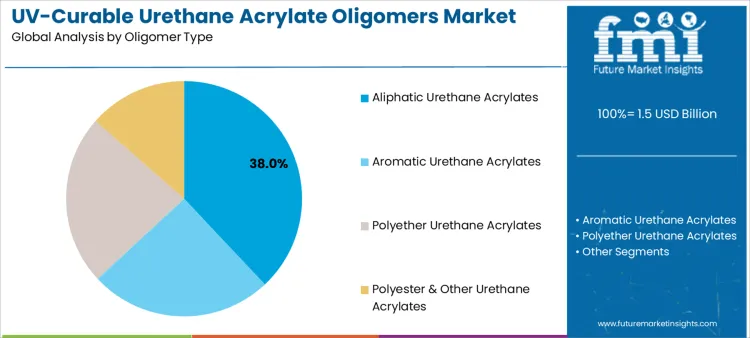
Aliphatic urethane acrylates account for 38% share of the uv-curable urethane acrylate oligomers market because they deliver excellent color stability, non-yellowing behavior, and strong outdoor durability. These properties make them suitable for coatings exposed to light, heat, and mechanical wear. Formulators prefer aliphatic systems for applications requiring long-term surface appearance and consistent curing response. Their compatibility with a wide range of reactive diluents and photoinitiators supports flexible formulation design. Balanced hardness and flexibility enable use across protective and decorative coatings. These performance and formulation advantages explain why aliphatic urethane acrylates remain the dominant oligomer type.
Why Do Industrial Coatings Dominate Application Demand In The UV-Curable Urethane Acrylate Oligomers Market?

Industrial coatings hold 34% share of the uv-curable urethane acrylate oligomers market because manufacturers require fast-curing systems that deliver durable, abrasion-resistant surfaces. UV-curable urethane acrylates enable rapid line speeds and precise control over coating thickness and finish. Industrial applications include metal parts, machinery components, and protective coatings where chemical resistance and mechanical strength are critical. High production volumes and continuous coating operations drive consistent oligomer demand. These efficiency-driven and performance-focused requirements explain why industrial coatings remain the leading application segment in the market.
What Are The Key Dynamics Of The UV-Curable Urethane Acrylate Oligomers Market?
The UV-curable urethane acrylate oligomers market is driven by demand for high-performance, fast-curing materials used in coatings, inks, adhesives, and 3D printing formulations. Urethane acrylate oligomers offer excellent mechanical strength, chemical resistance, flexibility, adhesion, and durability compared with many other UV-curable systems, making them preferred in industrial, electronics, automotive, and wood coatings applications. For chemical manufacturers and formulators, oligomer backbone structure, functional group density, viscosity control, and compatibility with photoinitiators and reactive diluents are central factors that influence selection, processability, and final application performance.
How Are Technology And Application Trends Shaping This Market?
Technology and application trends are shaping the UV-curable urethane acrylate oligomers market through performance optimization, formulation flexibility, and expansion into high-value sectors. Formulators increasingly seek oligomers that support rapid cure at lower energy inputs, exhibit enhanced scratch and abrasion resistance, and maintain performance under thermal and chemical stress. Growth in UV digital printing, protective coatings for electronics, flexible packaging inks, and durable adhesives is expanding opportunity. Development of tailored oligomers that balance rigidity and toughness enables broader use in complex engineering applications. Suppliers that provide technical guidance on formulation design, cure profiling, and performance testing help converters and end users accelerate product development.
Why Do Cost And Technical Compatibility Challenges Restrain Market Growth?
Cost and technical compatibility challenges restrain growth in the UV-curable urethane acrylate oligomers market due to the relative complexity and price of specialty oligomer chemistry. High-performance oligomers typically require multi-step synthesis with controlled molecular architecture, which increases production costs relative to commodity oligomers. Formulators often face compatibility constraints when integrating urethane acrylate oligomers with other formulation components such as pigments, fillers, and specialty additives, which can require extensive iteration to optimize cure behavior and final properties. Sensitivity to oxygen inhibition and substrate interaction further complicates some applications. These challenges increase development time, formulation cost, and perceived risk for converters considering new oligomer grades.
How is the UV-Curable Urethane Acrylate Oligomers Market Growing across Key Countries?
The UV-curable urethane acrylate oligomers market is expanding steadily as manufacturers across coatings, inks, adhesives, and 3D printing shift toward fast-curing, high-performance material systems. These oligomers are valued for their balance of flexibility, abrasion resistance, chemical durability, and adhesion across diverse substrates. Growth varies by country depending on industrial coatings demand, adoption of UV-curing technologies, and regulatory pressure on conventional solvent-based systems. High-growth markets benefit from expanding manufacturing activity and rapid technology adoption, while mature regions emphasize formulation refinement, performance consistency, and integration into advanced printing and coating platforms.

| Country | CAGR (%) |
|---|---|
| China | 8.1 |
| Brazil | 7.7 |
| United States | 6.6 |
| Germany | 6.5 |
| South Korea | 6.1 |
Why is China Leading the UV-Curable Urethane Acrylate Oligomers Market?
Demand for UV-curable urethane acrylate oligomers in China is expanding at a CAGR of 8.1% during 2026 to 2036, driven by large-scale growth in industrial coatings, printing inks, and electronics manufacturing. UV-curable systems are increasingly adopted in wood coatings, plastic coatings, packaging inks, and electronic component finishes due to their rapid curing speed and high throughput suitability. Urethane acrylate oligomers are preferred for delivering toughness, flexibility, and strong adhesion across varied substrates.
Chinese formulators prioritize oligomers with balanced viscosity, fast UV response, and compatibility with commonly used monomers and photoinitiators. Cost efficiency and supply scalability are critical, particularly for high-volume applications such as flooring coatings, furniture finishes, and packaging inks. China’s extensive chemical manufacturing base supports rapid scale-up, localized sourcing, and competitive pricing. Procurement decisions emphasize batch consistency, curing performance under high-speed production lines, and regulatory documentation.
Why is Brazil Experiencing Rising Adoption of UV-Curable Urethane Acrylate Oligomers?
Sale of UV-curable urethane acrylate oligomers in Brazil is growing at a CAGR of 7.7% during 2026 to 2036, supported by increasing adoption of UV-curing technologies in industrial coatings, wood finishes, and printing applications. As manufacturers seek faster production cycles and improved surface durability, UV-curable systems are gaining traction across furniture, flooring, and packaging sectors. Brazilian buyers value urethane acrylate oligomers for their flexibility, abrasion resistance, and performance under high-humidity and temperature-variable conditions.
Adoption is strongest in wood coatings, industrial maintenance coatings, and flexible packaging inks. Cost sensitivity remains an important factor, encouraging demand for formulations that balance performance with economical use levels. Procurement decisions often favor suppliers providing formulation guidance, localized distribution, and reliable technical support. As multinational coatings and ink producers expand local operations, demand for UV-curable oligomers is expected to rise.
What is Driving Demand for UV-Curable Urethane Acrylate Oligomers in the United States?
The United States UV-curable urethane acrylate oligomers market is expanding at a CAGR of 6.6% during 2026 to 2036, driven by strong adoption of UV-curing in industrial coatings, graphic arts, electronics, and additive manufacturing. Urethane acrylate oligomers are widely used for their mechanical durability, chemical resistance, and versatility across rigid and flexible substrates. U.S. buyers emphasize formulation consistency, predictable curing behavior, and long-term performance stability.
Demand is strong in industrial flooring, protective coatings, electronics encapsulation, and advanced printing inks. Adoption is driven by performance requirements rather than volume alone, with a focus on high-value applications. Procurement decisions prioritize supplier reliability, regulatory compliance, and detailed technical data. Market growth is shaped by continued investment in advanced manufacturing, increasing use of UV-curable materials in electronics and medical devices, and steady expansion of high-precision coating and printing applications.
How is Germany Supporting Demand for UV-Curable Urethane Acrylate Oligomers?
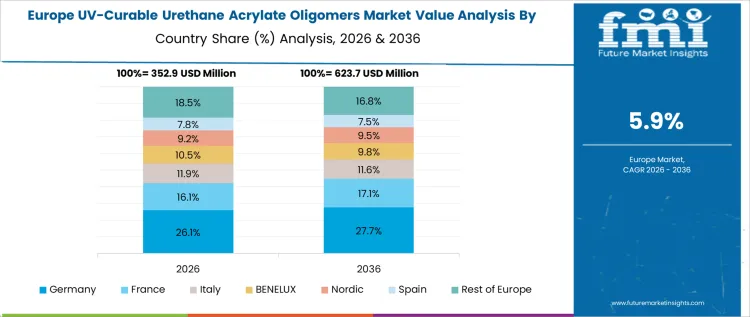
Sale of UV-curable urethane acrylate oligomers in USA is growing at a CAGR of 6.5% during 2026 to 2036, driven by the country’s strong base in industrial coatings, automotive components, and precision manufacturing. German formulators adopt urethane acrylate oligomers to achieve controlled flexibility, scratch resistance, and consistent surface quality in high-performance coatings. Precision, reproducibility, and regulatory compliance are key selection criteria. Buyers prioritize oligomers with well-defined molecular structures and stable curing characteristics.
Adoption is concentrated in automotive interior coatings, industrial equipment finishes, and specialty printing applications. Procurement decisions favor suppliers with robust quality systems, detailed technical documentation, and the ability to support customized formulations. Market growth is reinforced by Germany’s focus on advanced coating technologies, automation-friendly materials, and continuous improvement in surface engineering.
How is South Korea Expanding Use of UV-Curable Urethane Acrylate Oligomers?
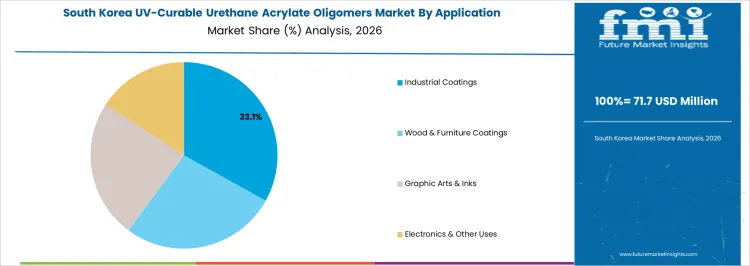
Sale of UV-curable urethane acrylate oligomers in South Korea is expanding at a CAGR of 6.1% during 2026 to 2036, supported by strong demand from electronics, automotive components, and specialty coatings industries. UV-curable systems are increasingly used in electronic displays, protective coatings, and precision industrial finishes. Buyers emphasize fast curing, low defect rates, and compatibility with high-speed automated processes. Urethane acrylate oligomers are valued for delivering mechanical durability without sacrificing flexibility in compact component designs. Procurement decisions are influenced by supplier technical capability, consistent material quality, and alignment with export-market requirements. Market growth is supported by continued investment in electronics manufacturing, expansion of UV-curable coatings market lines, and increasing adoption of advanced surface finishing technologies.
How are Resin Manufacturers Competing in the UV-Curable Urethane Acrylate Oligomers Market?
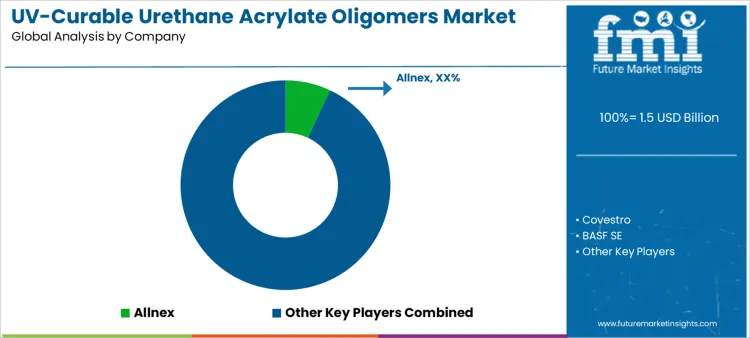
Competition in the UV-curable urethane acrylate oligomers market is shaped by cure efficiency, mechanical performance tuning, and compatibility with low-VOC, high-solids formulations used in coatings, inks, adhesives, and electronics. Allnex anchors the market with a wide portfolio of urethane acrylate oligomers engineered for flexibility-hardness balance, abrasion resistance, and adhesion on wood, plastics, and metals. Its competitive strength lies in formulation versatility and consistent curing behavior under UV and LED systems, enabling use across industrial and decorative applications.
Large chemical producers compete by embedding urethane acrylates into broader radiation-curable platforms. Covestro positions its oligomers around toughness, low yellowing, and chemical resistance, targeting electronics, optical coatings, and high-durability finishes. BASF SE and Arkema (Sartomer) emphasize controlled molecular architecture that supports fast curing, low viscosity, and regulatory compliance. Their strategies focus on helping formulators meet tightening VOC limits while maintaining surface performance and line speed.
Specialty and Asian suppliers add depth through application-driven differentiation. Evonik Industries AG competes with tailored urethane acrylates optimized for scratch resistance, elasticity, and adhesion to difficult substrates. IGM Resins differentiates by pairing oligomers with photoinitiator expertise to maximize cure efficiency. Mitsubishi Chemical Group, DIC Corporation, Nippon Gohsei, and Showa Denko Materials focus on high-purity, stable oligomers for electronics, display, and functional coatings. Across the market, competitive advantage is defined by cure performance, formulation flexibility, and regulatory alignment rather than oligomer pricing alone.
Key Players in UV-Curable Urethane Acrylate Oligomers Market
- Allnex
- Covestro
- BASF SE
- Arkema (Sartomer)
- Evonik Industries AG
- Mitsubishi Chemical Group
- IGM Resins
- DIC Corporation
- Nippon Gohsei
- Showa Denko Materials
Scope of Report
| Attribute | Details |
|---|---|
| Market Size Unit | USD Billion |
| Oligomer Type Covered | Aliphatic Urethane Acrylates, Aromatic Urethane Acrylates, Polyether Urethane Acrylates, Polyester & Other Urethane Acrylates |
| Application Covered | Industrial Coatings, Wood & Furniture Coatings, Graphic Arts & Inks, Electronics & Other UV-Cured Applications |
| Countries Covered | China, Japan, South Korea, India, Australia & New Zealand, ASEAN, Rest of Asia Pacific, Germany, United Kingdom, France, Italy, Spain, Nordic, BENELUX, Rest of Europe, United States, Canada, Mexico, Brazil, Chile, Rest of Latin America, Kingdom of Saudi Arabia, Other GCC Countries, Turkey, South Africa, Other African Union, Rest of Middle East & Africa |
| Regions Covered | Asia Pacific, Europe, North America, Latin America, Middle East & Africa |
| Key Companies Profiled | Allnex, Covestro, BASF SE, Arkema (Sartomer), Evonik Industries AG, Mitsubishi Chemical Group, IGM Resins, DIC Corporation, Nippon Gohsei, Showa Denko Materials |
| Additional Attributes | Dollar sales by oligomer type and end-use application are evaluated across UV-curable coating systems. The scope assesses curing speed, flexibility, abrasion resistance, chemical durability, and compatibility with LED-UV systems. Country-level analysis reflects adoption of low-VOC coatings, electronics manufacturing growth, and regulatory shifts toward energy-efficient curing technologies. |
UV-Curable Urethane Acrylate Oligomers Market by Key Segments
Oligomer Type:
- Aliphatic Urethane Acrylates
- Aromatic Urethane Acrylates
- Polyether Urethane Acrylates
- Polyester & Other Urethane Acrylates
Application:
- Industrial Coatings
- Wood & Furniture Coatings
- Graphic Arts & Inks
- Electronics & Other Uses
Region:
- Asia Pacific
- China
- Japan
- South Korea
- India
- Australia & New Zealand
- ASEAN
- Rest of Asia Pacific
- Europe
- Germany
- United Kingdom
- France
- Italy
- Spain
- Nordic
- BENELUX
- Rest of Europe
- North America
- United States
- Canada
- Mexico
- Latin America
- Brazil
- Chile
- Rest of Latin America
- Middle East & Africa
- Kingdom of Saudi Arabia
- Other GCC Countries
- Turkey
- South Africa
- Other African Union
- Rest of Middle East & Africa
Bibliography
- Crivello, J. V., & Bulut, U. (2023). Photopolymerization mechanisms in urethane acrylate‑based UV‑curable systems.
- International Organization for Standardization. (2023). ISO 11341: Paints and varnishes - Artificial weathering and exposure to artificial radiation.
- European Commission, Joint Research Centre. (2023). Radiation‑curable coatings and inks: Environmental performance and regulatory outlook.
- Organisation for Economic Co‑operation and Development. (2024). Sustainable chemistry pathways for advanced polymer materials. OECD Publishing.
- Liu, Y., Zhang, H., & Chen, X. (2024). Mechanical durability and curing kinetics of UV‑curable urethane acrylate coatings.
Frequently Asked Questions
How big is the uv-curable urethane acrylate oligomers market in 2026?
The global uv-curable urethane acrylate oligomers market is estimated to be valued at USD 1.5 billion in 2026.
What will be the size of uv-curable urethane acrylate oligomers market in 2036?
The market size for the uv-curable urethane acrylate oligomers market is projected to reach USD 2.9 billion by 2036.
How much will be the uv-curable urethane acrylate oligomers market growth between 2026 and 2036?
The uv-curable urethane acrylate oligomers market is expected to grow at a 6.9% CAGR between 2026 and 2036.
What are the key product types in the uv-curable urethane acrylate oligomers market?
The key product types in uv-curable urethane acrylate oligomers market are aliphatic urethane acrylates, aromatic urethane acrylates, polyether urethane acrylates and polyester & other urethane acrylates.
Which application segment to contribute significant share in the uv-curable urethane acrylate oligomers market in 2026?
In terms of application, industrial coatings segment to command 34.0% share in the uv-curable urethane acrylate oligomers market in 2026.
Preview the report firsthand - request a free sample
Get SampleGet the brochure for pricing and purchase details.
Get PDFTable of Content
- Executive Summary
- Global Market Outlook
- Demand-side Trends
- Supply-side Trends
- Technology Roadmap Analysis
- Analysis and Recommendations
- Market Overview
- Market Coverage / Taxonomy
- Market Definition / Scope / Limitations
- Market Background
- Market Dynamics
- Drivers
- Restraints
- Opportunity
- Trends
- Scenario Forecast
- Demand in Optimistic Scenario
- Demand in Likely Scenario
- Demand in Conservative Scenario
- Opportunity Map Analysis
- Product Life Cycle Analysis
- Supply Chain Analysis
- Investment Feasibility Matrix
- Value Chain Analysis
- PESTLE and Porter’s Analysis
- Regulatory Landscape
- Regional Parent Market Outlook
- Production and Consumption Statistics
- Import and Export Statistics
- Market Dynamics
- Global Market Analysis 2021 to 2025 and Forecast, 2026 to 2036
- Historical Market Size Value (USD Million) Analysis, 2021 to 2025
- Current and Future Market Size Value (USD Million) Projections, 2026 to 2036
- Y-o-Y Growth Trend Analysis
- Absolute $ Opportunity Analysis
- Global Market Pricing Analysis 2021 to 2025 and Forecast 2026 to 2036
- Global Market Analysis 2021 to 2025 and Forecast 2026 to 2036, By Oligomer Type
- Introduction / Key Findings
- Historical Market Size Value (USD Million) Analysis By Oligomer Type , 2021 to 2025
- Current and Future Market Size Value (USD Million) Analysis and Forecast By Oligomer Type , 2026 to 2036
- Aliphatic Urethane Acrylates
- Aromatic Urethane Acrylates
- Polyether Urethane Acrylates
- Polyester & Other Urethane Acrylates
- Aliphatic Urethane Acrylates
- Y-o-Y Growth Trend Analysis By Oligomer Type , 2021 to 2025
- Absolute $ Opportunity Analysis By Oligomer Type , 2026 to 2036
- Global Market Analysis 2021 to 2025 and Forecast 2026 to 2036, By Application
- Introduction / Key Findings
- Historical Market Size Value (USD Million) Analysis By Application, 2021 to 2025
- Current and Future Market Size Value (USD Million) Analysis and Forecast By Application, 2026 to 2036
- Industrial Coatings
- Wood & Furniture Coatings
- Graphic Arts & Inks
- Electronics & Other Uses
- Industrial Coatings
- Y-o-Y Growth Trend Analysis By Application, 2021 to 2025
- Absolute $ Opportunity Analysis By Application, 2026 to 2036
- Global Market Analysis 2021 to 2025 and Forecast 2026 to 2036, By Region
- Introduction
- Historical Market Size Value (USD Million) Analysis By Region, 2021 to 2025
- Current Market Size Value (USD Million) Analysis and Forecast By Region, 2026 to 2036
- North America
- Latin America
- Western Europe
- Eastern Europe
- East Asia
- South Asia and Pacific
- Middle East & Africa
- Market Attractiveness Analysis By Region
- North America Market Analysis 2021 to 2025 and Forecast 2026 to 2036, By Country
- Historical Market Size Value (USD Million) Trend Analysis By Market Taxonomy, 2021 to 2025
- Market Size Value (USD Million) Forecast By Market Taxonomy, 2026 to 2036
- By Country
- USA
- Canada
- Mexico
- By Oligomer Type
- By Application
- By Country
- Market Attractiveness Analysis
- By Country
- By Oligomer Type
- By Application
- Key Takeaways
- Latin America Market Analysis 2021 to 2025 and Forecast 2026 to 2036, By Country
- Historical Market Size Value (USD Million) Trend Analysis By Market Taxonomy, 2021 to 2025
- Market Size Value (USD Million) Forecast By Market Taxonomy, 2026 to 2036
- By Country
- Brazil
- Chile
- Rest of Latin America
- By Oligomer Type
- By Application
- By Country
- Market Attractiveness Analysis
- By Country
- By Oligomer Type
- By Application
- Key Takeaways
- Western Europe Market Analysis 2021 to 2025 and Forecast 2026 to 2036, By Country
- Historical Market Size Value (USD Million) Trend Analysis By Market Taxonomy, 2021 to 2025
- Market Size Value (USD Million) Forecast By Market Taxonomy, 2026 to 2036
- By Country
- Germany
- UK
- Italy
- Spain
- France
- Nordic
- BENELUX
- Rest of Western Europe
- By Oligomer Type
- By Application
- By Country
- Market Attractiveness Analysis
- By Country
- By Oligomer Type
- By Application
- Key Takeaways
- Eastern Europe Market Analysis 2021 to 2025 and Forecast 2026 to 2036, By Country
- Historical Market Size Value (USD Million) Trend Analysis By Market Taxonomy, 2021 to 2025
- Market Size Value (USD Million) Forecast By Market Taxonomy, 2026 to 2036
- By Country
- Russia
- Poland
- Hungary
- Balkan & Baltic
- Rest of Eastern Europe
- By Oligomer Type
- By Application
- By Country
- Market Attractiveness Analysis
- By Country
- By Oligomer Type
- By Application
- Key Takeaways
- East Asia Market Analysis 2021 to 2025 and Forecast 2026 to 2036, By Country
- Historical Market Size Value (USD Million) Trend Analysis By Market Taxonomy, 2021 to 2025
- Market Size Value (USD Million) Forecast By Market Taxonomy, 2026 to 2036
- By Country
- China
- Japan
- South Korea
- By Oligomer Type
- By Application
- By Country
- Market Attractiveness Analysis
- By Country
- By Oligomer Type
- By Application
- Key Takeaways
- South Asia and Pacific Market Analysis 2021 to 2025 and Forecast 2026 to 2036, By Country
- Historical Market Size Value (USD Million) Trend Analysis By Market Taxonomy, 2021 to 2025
- Market Size Value (USD Million) Forecast By Market Taxonomy, 2026 to 2036
- By Country
- India
- ASEAN
- Australia & New Zealand
- Rest of South Asia and Pacific
- By Oligomer Type
- By Application
- By Country
- Market Attractiveness Analysis
- By Country
- By Oligomer Type
- By Application
- Key Takeaways
- Middle East & Africa Market Analysis 2021 to 2025 and Forecast 2026 to 2036, By Country
- Historical Market Size Value (USD Million) Trend Analysis By Market Taxonomy, 2021 to 2025
- Market Size Value (USD Million) Forecast By Market Taxonomy, 2026 to 2036
- By Country
- Kingdom of Saudi Arabia
- Other GCC Countries
- Turkiye
- South Africa
- Other African Union
- Rest of Middle East & Africa
- By Oligomer Type
- By Application
- By Country
- Market Attractiveness Analysis
- By Country
- By Oligomer Type
- By Application
- Key Takeaways
- Key Countries Market Analysis
- USA
- Pricing Analysis
- Market Share Analysis, 2025
- By Oligomer Type
- By Application
- Canada
- Pricing Analysis
- Market Share Analysis, 2025
- By Oligomer Type
- By Application
- Mexico
- Pricing Analysis
- Market Share Analysis, 2025
- By Oligomer Type
- By Application
- Brazil
- Pricing Analysis
- Market Share Analysis, 2025
- By Oligomer Type
- By Application
- Chile
- Pricing Analysis
- Market Share Analysis, 2025
- By Oligomer Type
- By Application
- Germany
- Pricing Analysis
- Market Share Analysis, 2025
- By Oligomer Type
- By Application
- UK
- Pricing Analysis
- Market Share Analysis, 2025
- By Oligomer Type
- By Application
- Italy
- Pricing Analysis
- Market Share Analysis, 2025
- By Oligomer Type
- By Application
- Spain
- Pricing Analysis
- Market Share Analysis, 2025
- By Oligomer Type
- By Application
- France
- Pricing Analysis
- Market Share Analysis, 2025
- By Oligomer Type
- By Application
- India
- Pricing Analysis
- Market Share Analysis, 2025
- By Oligomer Type
- By Application
- ASEAN
- Pricing Analysis
- Market Share Analysis, 2025
- By Oligomer Type
- By Application
- Australia & New Zealand
- Pricing Analysis
- Market Share Analysis, 2025
- By Oligomer Type
- By Application
- China
- Pricing Analysis
- Market Share Analysis, 2025
- By Oligomer Type
- By Application
- Japan
- Pricing Analysis
- Market Share Analysis, 2025
- By Oligomer Type
- By Application
- South Korea
- Pricing Analysis
- Market Share Analysis, 2025
- By Oligomer Type
- By Application
- Russia
- Pricing Analysis
- Market Share Analysis, 2025
- By Oligomer Type
- By Application
- Poland
- Pricing Analysis
- Market Share Analysis, 2025
- By Oligomer Type
- By Application
- Hungary
- Pricing Analysis
- Market Share Analysis, 2025
- By Oligomer Type
- By Application
- Kingdom of Saudi Arabia
- Pricing Analysis
- Market Share Analysis, 2025
- By Oligomer Type
- By Application
- Turkiye
- Pricing Analysis
- Market Share Analysis, 2025
- By Oligomer Type
- By Application
- South Africa
- Pricing Analysis
- Market Share Analysis, 2025
- By Oligomer Type
- By Application
- USA
- Market Structure Analysis
- Competition Dashboard
- Competition Benchmarking
- Market Share Analysis of Top Players
- By Regional
- By Oligomer Type
- By Application
- Competition Analysis
- Competition Deep Dive
- Allnex
- Overview
- Product Portfolio
- Profitability by Market Segments (Product/Age /Sales Channel/Region)
- Sales Footprint
- Strategy Overview
- Marketing Strategy
- Product Strategy
- Channel Strategy
- Covestro
- BASF SE
- Arkema (Sartomer)
- Evonik Industries AG
- Mitsubishi Chemical Group
- IGM Resins
- DIC Corporation
- Nippon Gohsei
- Showa Denko Materials
- Allnex
- Competition Deep Dive
- Assumptions & Acronyms Used
- Research Methodology


