

- Industry Size (2026)
- USD 40.1 Bn
- Forecast (2036)
- USD 59.4 Bn
- CAGR (2026 to 2036)
- 4.0%
Polyurethane Resins Paints & Coatings Market Size, Market Forecast and Outlook By FMI
In 2025, the polyurethane resins paints and coatings market was valued at USD 38.6 billion. Based on Future Market Insights' analysis, demand is estimated to reach USD 40.1 billion in 2026 and USD 57.1 billion by 2035, before rising further to approximately USD 59.4 billion by 2036. This trajectory reflects a CAGR of 4.0% during the forecast period.
Absolute dollar growth of more than USD 19.3 billion between 2026 and 2036 signals a market expanding at a steady pace, underpinned by sustained demand from construction and automotive sectors where coating longevity and appearance retention justify specification. By resin type, polyurethane generates significant revenue owing to its abrasion resistance, corrosion protection, thermal stability, and strong adhesion, making it widely used in architectural, automotive, and industrial applications.
Summary of Polyurethane Resins Paints & Coatings Market
- Demand Drivers in the Market:
- Global construction activity drives polyurethane coating consumption due to superior protective properties. The construction industry is expected to grow significantly, with paints and coatings primarily used to protect and decorate infrastructure and buildings, including exterior and interior paints, sealants, primers, stains, and varnishes. Architectural paints offer odorless formulations with enhanced abrasion resistance and are available in numerous textures.
- Automotive production drives demand for polyurethane topcoats in OEM and refinish applications, providing exceptional scratch resistance, color retention, and UV protection. The high demand for paints and coatings in the automotive sector stems from requirements for corrosion resistance, continuous protective film formation, color stability, scratch resistance, abrasion resistance, durability, and flexibility.
- Industrial manufacturing requirements for protective coatings that withstand chemical exposure, abrasion, and extreme conditions in manufacturing facilities and equipment.
- Key Segments Analyzed in the FMI Report:
- Resin Type: Polyurethane resin accounted for a significant share of the global paints and coatings market.
- End-use Industry: Construction leads as the largest consumer, with the architecture segment dominating market share, followed by automotive and industrial manufacturing.
- Analyst Opinion at FMI:
- Nikhil Kaitwade, principal consultant for Chemicals & Materials at Future Market Insights states, "In the updated Polyurethane Resins Paints & Coatings Market Report, formulators and procurement specialists will observe how regulatory pressure has permanently shifted the technology baseline. Environmental regulations across North America and Europe are driving a significant shift toward water-based polyurethane formulations. Suppliers with demonstrated expertise in polyol chemistry and isocyanate handling maintain technical advantages in high-performance segments."
- Strategic Implications/Executive Takeaways:
- Prioritize water-borne polyurethane resin development with documented performance in construction and automotive applications where solvent-borne systems historically dominated, capturing value from regulatory-driven transition. Waterborne coatings hold significant market share due to increased usage in automobiles, plastic, furniture, and wood applications, with benefits including no VOC emissions, quick-dry properties, and easier application.
- Align product portfolios with emerging application requirements including electric vehicle battery coatings and high-performance formulations for industrial applications.
- Build technical service capabilities that help customers optimize formulation and application parameters, reducing failure risk and strengthening long-term supply relationships.
- Methodology:
- The market view is grounded in primary input from coatings manufacturers, raw material suppliers, and end-use industry specifiers, and in technical and policy sources focused on polymer chemistry and environmental regulations, avoiding reliance on secondary market research reports from competing providers.
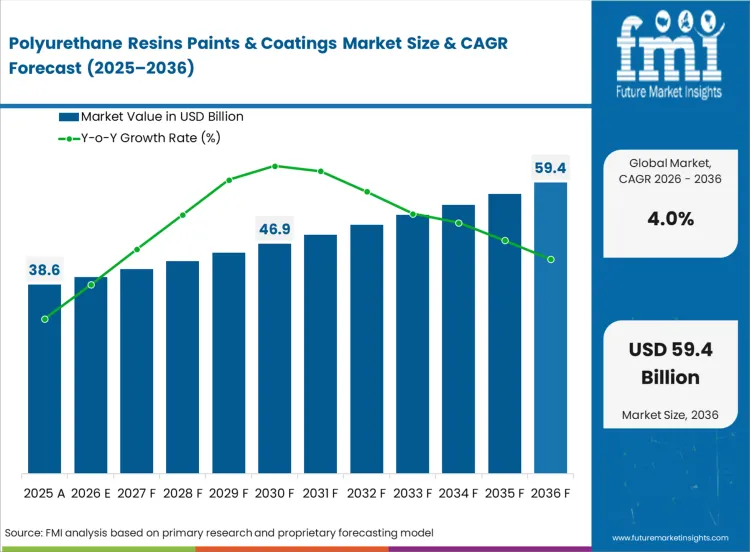
North America, Europe, and Asia-Pacific account for the bulk of incremental revenues through 2036, but the underlying demand logic is distinct in each region. In North America, EPA guidelines limiting VOC emissions drive adoption of water-borne polyurethane systems in architectural and industrial applications. The U.S. paints and coatings market benefits from a vast industrial base encompassing machinery, equipment, consumer goods, aerospace, and heavy industry where coatings are widely used to protect floors, machinery, storage areas, and finished products .
In Europe, REACH compliance and sustainability mandates favor bio-based polyol development and high-performance formulations. Across Asia-Pacific, rapid urbanization, infrastructure investment, and expanding automotive production generate the highest growth rates, with China and India as primary demand centers supported by government infrastructure spending targets.
Polyurethane Resins Paints & Coatings Market Definition
Polyurethane resins are high-performance polymers formed by reacting polyols with diisocyanates, creating coatings with exceptional durability, chemical resistance, and weatherproofing capabilities. These coatings form tough, flexible films when cured, making them ideal for demanding applications across automotive, aerospace, construction, and marine industries.
Polyurethane resins contain properties of scratch resistance, good gloss, thermal stability, and excellent adhesion, with the technology offering both water-based systems with lower VOC emissions and solvent-based variants with superior chemical resistance. For this report, the market covers polyurethane resin systems used in paints and coatings across construction, automotive, industrial manufacturing, marine, and other applications.
Polyurethane Resins Paints & Coatings Market Inclusions
The report provides a comprehensive analysis of the polyurethane resins paints and coatings market, covering global and regional market sizes in value terms and a 10-year forecast from 2026 to 2036. It includes segmental breakdowns by resin type, application, and end-use industry, across core regions including North America, Latin America, Western Europe, Eastern Europe, East Asia, South Asia & Pacific, and the Middle East & Africa.
Polyurethane Resins Paints & Coatings Market Exclusions
The scope excludes polyurethane foams, elastomers, and adhesives where the primary function is not surface coating. It also omits two-component polyurethane systems used in casting applications that fall outside traditional paint and coating categories. Very low-volume, custom-formulated polyurethane resins for specialized restoration or research applications that do not contribute meaningfully to global revenue pools are likewise outside the quantified scope.
Polyurethane Resins Paints & Coatings Market Research Methodology
- Primary research: Structured interviews were conducted with coatings formulators, raw material suppliers, and procurement specialists in automotive OEM and refinish, construction material manufacturing, and industrial maintenance, alongside architects and specifiers on performance requirements and selection criteria.
- Desk research: Technical documentation and application guides from major polyurethane resin manufacturers, together with academic publications on polymer chemistry and end-use sector reports from government agencies, were assessed to benchmark performance and to align market modeling with the latest data on construction activity and automotive production.
- Market-sizing and forecasting: A hybrid top-down and bottom-up modeling framework was applied, reconstructing polyurethane resin demand from automotive production volumes, construction spending, industrial maintenance activity, and marine vessel construction, then validating outputs against publicly available data from government statistical agencies and industry associations.
- Data validation and update cycle: Model outputs undergo consistency checks across regions, resin types, and applications, with iterative calibration using new regulatory guidance, manufacturer capacity announcements, and emerging data on end-use industry activity.
Segment Analysis
Polyurethane Resins Paints & Coatings Market Analysis by Resin Type
Based on FMI's polyurethane resins paints and coatings market assessment, the Polyol segment constitutes the majority of resin consumption, reflecting its role as one of two core components in polyurethane formation. Polyurethane resins contain properties of scratch resistance, good gloss, thermal stability, and excellent adhesion. Due to these properties, growing demand for polyurethane resin coatings contributes significantly to market size expansion.
Organic Diisocyanates, including TDI and MDI, represent the complementary component, reacting with polyols to form the polyurethane polymer. MDI-based systems dominate in coatings requiring superior mechanical properties and chemical resistance, while TDI-based formulations provide faster cure times for certain applications. The balance between polyol and diisocyanate types shifts based on end-use requirements, with formulators selecting combinations to achieve specific performance targets.
Polyurethane Resins Paints & Coatings Market Analysis by Application
Indoor Decorations represents a significant application segment for polyurethane resins, driven by demand for durable and aesthetic finishes in residential and commercial interiors. The architecture segment dominates in revenue and volume throughout the projected period. In architectural applications, paints and coatings are used for decorative purposes for infrastructure and buildings to protect them from UV radiation and environmental damage.
Ship and Marine applications consume polyurethane resins for corrosion protection and anti-fouling coatings that withstand harsh seawater environments. These materials are used on commercial and military ships to protect against environmental effects such as UV radiation, thermal instability, and water. The Chemical Industry utilizes polyurethane coatings for tank linings, pipe coatings, and equipment protection where chemical resistance is critical. Other applications including aerospace and industrial equipment create specialized demand for high-performance formulations.
Polyurethane Resins Paints & Coatings Market Analysis by End-use Industry
The Construction sector accounts for a major share of polyurethane resin consumption, driven by infrastructure development globally. Paints and coatings are used to protect and decorate infrastructure and buildings, with architectural developments including exterior and interior paints, sealants, primers, stains, and varnishes. Architectural paints permit odorless formulations with enhanced abrasion resistance and are available in numerous textures, from uniform to semi-gloss.
The Automotive industry follows as a significant consumer, with polyurethane coatings applied to vehicle bodies, plastic components, and refinish applications. The high demand for paints and coatings in the automotive sector stems from requirements for corrosion resistance, continuous protective film formation, color stability, scratch resistance, abrasion resistance, durability, and flexibility. Industrial Manufacturing applications include equipment coatings, machinery finishes, and protective systems for manufacturing facilities. Marine applications encompass vessel coatings and offshore structure protection.
Polyurethane Resins Paints & Coatings Market Drivers, Restraints, Opportunities and Trends
Drivers
Rising Demand from Construction Industries
Global polyurethane resins paint and coating market growth is driven by increasing demand from the construction sector. The construction industry is expected to grow significantly, with a surge in construction activity and government investment in several public infrastructure projects likely to boost market growth.
In construction applications, polyurethane coatings are widely used for exceptional durability, weather resistance, and aesthetic appeal. Paints and coatings preserve and protect the substrates they are applied to, conserving material resources and energy.
Automotive Sector Expansion Accelerates Market Growth
Automotive manufacturers increasingly adopt polyurethane coatings for exterior protection and interior finishes due to superior scratch resistance, gloss retention, and corrosion protection. The high demand for paints and coatings in the automotive sector is driven by requirements for corrosion resistance, continuous protective film formation, color stability, scratch resistance, abrasion resistance, durability, and flexibility. These coatings provide exceptional resistance to extreme weather conditions while maintaining color and gloss retention, making them particularly valuable for automotive OEMs and refinish applications.
Regulatory Push for Sustainable Coatings Boosts Water-Based Solutions
Strict environmental regulations have created massive demand for sustainable development of coatings products. The sustainability aspect is routinely considered by companies while performing business operations, with main focus on reducing VOCs to include resource conservation and energy, renewable materials, process efficiency enhancement, and waste minimization.
Paint manufacturers are introducing and innovating sustainable paint technology to meet consumer demand, following guidelines implemented by REACH to reduce VOCs and carbon footprint, thereby developing bio-based technologies and attaining recyclability.
Restraints
Raw Material Price Volatility Creating Margin Pressure
The polyurethane coatings market faces significant challenges from fluctuating raw material costs, particularly for isocyanates and polyols which account for a substantial portion of production expenses.
Polyurethane coatings rely heavily on key raw materials such as isocyanates such as TDI and MDI and polyols derived from petrochemical feedstocks. The prices of these materials are significantly dependent on crude oil prices, which tend to fluctuate due to geopolitical tensions, supply chain disruptions, and energy policy changes.
Technical Limitations in Certain Applications
While polyurethane coatings offer excellent performance in many applications, they face competition from alternative technologies in certain niches. For applications requiring exceptional chemical resistance at elevated temperatures, epoxy formulations remain the preferred choice.
Waterborne polyurethane resins face technical challenges in matching performance benchmarks of solvent-based counterparts, including longer drying times under high humidity conditions and reduced chemical resistance in certain applications.
Opportunities
Emerging Economies Presenting Untapped Growth Potential
Rapid industrialization and infrastructure development in emerging markets, particularly in Asia and the Middle East, create significant growth opportunities. Asia Pacific dominated the paints and coatings market with a significant market share in 2025, driven by growing construction activities, rapid urbanization, and increasing automotive production across China, India, and Southeast Asia. India's National Smart Cities and Housing for All initiatives are boosting architectural coatings demand, especially for water-borne and decorative coatings .
Development of Bio-Based Polyurethane Resins
Growing emphasis on sustainability drives innovation in bio-based polyurethane resins derived from renewable resources. DSM offers Decovery, a vegetable resin for paints, with ingredients comprising low VOCs to improve and protect indoor and outdoor air quality, decreasing carbon footprint by up to 34% by replacing crude oil.
These products not only address environmental concerns but also help manufacturers comply with increasingly stringent regulations. This segment represents a high-growth opportunity expected to expand significantly as technology advances and production scales up.
Regional Analysis
.webp "Top Country Growth Comparison Polyurethane Resins Paints & Coatings Market Cagr (2026 2036)")
| Countries | Value CAGR (2026 to 2036) |
|---|---|
| United States | 4.2% |
| Germany | 3.8% |
| China | 5.8% |
| India | 7.2% |
| South Korea | 4.5% |
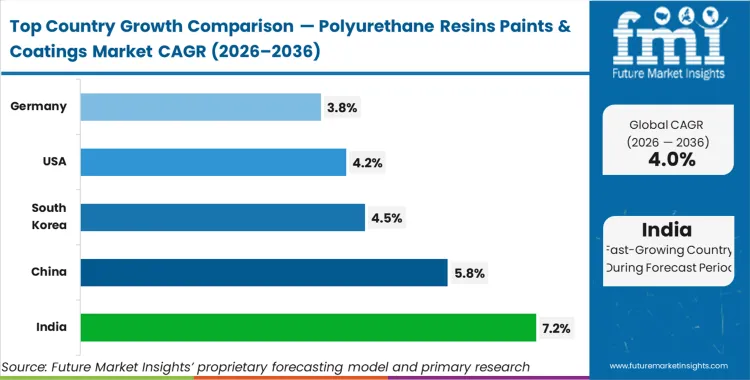
Source: Future Market Insights analysis, supported by proprietary forecasting model and primary research
United States
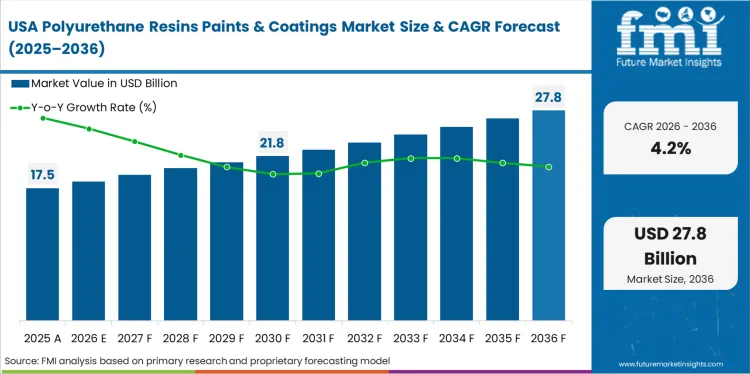
The United States polyurethane resins paints and coatings market is projected to grow at a 4.2% CAGR from 2026 to 2036, driven by stringent environmental regulations favoring low-VOC formulations and steady demand from construction and automotive sectors.
The USA market benefits from a vast industrial base encompassing machinery, equipment, consumer goods, aerospace, and heavy industry where coatings are widely used to protect floors, machinery, storage areas, and finished products . EPA guidelines limiting VOC emissions drive adoption of water-borne polyurethane systems.
Germany
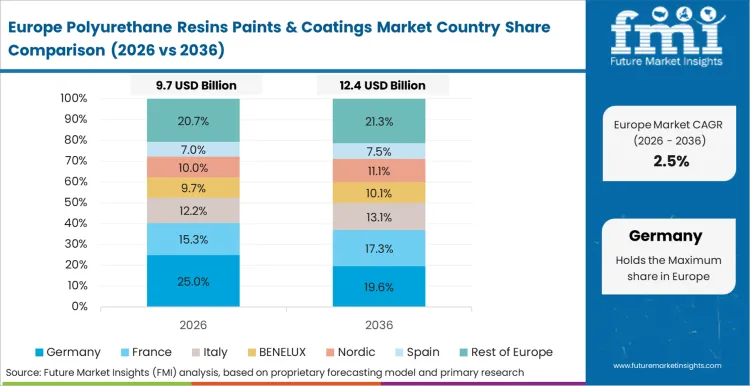
Germany's market is expected to grow at a 3.8% CAGR from 2026 to 2036, reflecting the country's robust manufacturing sector and automotive industry leadership. The European Union's REACH regulations and circular economy practices drive adoption of bio-based polyurethane resins and low-VOC formulations.
The European market is supported by the automotive sector, environmental regulations, and increasing adoption of powder and UV coatings. Countries like Germany lead in sustainability-driven industrial policies accelerating replacement of solvent-based resins. Paint manufacturers follow guidelines implemented by REACH to reduce VOCs and carbon footprint, thereby developing bio-based technologies and attaining recyclability.
China
China's polyurethane resins paints and coatings market is expected to grow at a 5.8% CAGR from 2026 to 2036. China leads the Asia Pacific region in both volume and revenue due to robust residential construction and high automotive output. The country's booming construction activity accounts for significant regional consumption, with Asia-Pacific dominating global consumption patterns.
Growing infrastructure needs boost coating demand, with the country benefiting from government infrastructure spending and rapid urbanization. China's automotive production remains among the highest globally, generating substantial coating consumption for OEM and refinish applications.
India
India's market is projected to expand at a 7.2% CAGR from 2026 to 2036, underpinned by National Smart Cities and Housing for All initiatives boosting architectural coatings demand, especially for water-borne and decorative coatings . India's National Infrastructure Pipeline targets substantial capital expenditure, driving demand for protective coatings in bridges, ports, and railways.
Rapid urbanization and expanding automotive production generate additional demand. The country leads in decorative coatings with strong brand pull and wide dealer networks, with growth in premium low-odor and washable interior ranges capturing rising middle-class spending.
South Korea
South Korea's polyurethane resins paints and coatings market is forecast to grow at a 4.5% CAGR from 2026 to 2036, driven by the country's dominant position in electronics manufacturing and expanding automotive production. Green New Deal policies mandate low-VOC coatings in public procurement, accelerating adoption of water-borne polyurethane systems.
Strong relationships with Japanese and local OEMs support high-performance corrosion-resistant and appearance coatings, with regional R&D adapting to humid and coastal conditions. The country's advanced manufacturing sector requires high-performance coatings for electronics, automotive components, and industrial equipment.
Competitive Aligners for Market Players
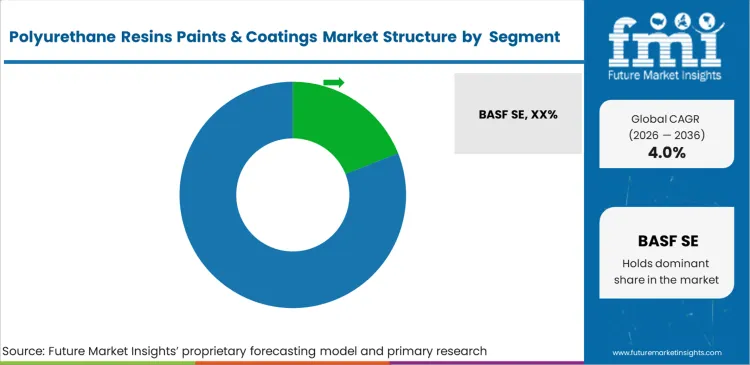
The polyurethane resins paints and coatings market features a mix of global diversified chemical manufacturers and specialized coating companies with deep formulation expertise. Key industry players include BASF SE, Sherwin-Williams Company, PPG Industries, Akzo Nobel N.V., Axalta Coating Systems, DSM, Arkema S.A., Henkel AG & Co. KGaA, Lubrizol Corporation, Allnex Group, Jotun A/S, and RPM International Inc. These industry leaders maintain their positions through continuous product innovation and extensive distribution networks across all key regions.
BASF SE leads the sector with vertically integrated production networks spanning multiple countries. The company's waterborne polyurethane coatings, developed as eco-friendly alternatives, significantly contribute to its market position. BASF has announced plans to integrate renewable propylene into acrylic value chains, demonstrating strategic focus on sustainable raw materials and alignment with European public procurement rules that assign price premiums to materials with bio-based content above 20%.
Sherwin-Williams follows closely, particularly dominating the North American architectural coatings segment. The company has demonstrated continuous technological advancement through new product introductions and strategic acquisitions to strengthen European market penetration.
DSM excels in high-performance coatings for industrial applications, with R&D focus on corrosion-resistant formulations yielding consistent growth. The company offers Decovery, a plant-based resin for paint, with ingredients comprising low VOCs to improve and protect indoor and outdoor air quality, decreasing carbon footprint by up to 34% by replacing crude oil.
From a strategic perspective, differentiation is moving beyond basic resin production toward demonstrable capability in three areas. These include polyurethane formulation expertise with documented performance across applications; regulatory compliance through low-VOC and bio-based product development; and application engineering support helping customers optimize coating selection and application parameters.
Key Players Profiled
- BASF SE
- Sherwin-Williams Company
- PPG Industries, Inc.
- Akzo Nobel N.V.
- Axalta Coating Systems
- DSM
- Arkema S.A.
- Henkel AG & Co. KGaA
- Lubrizol Corporation
- Allnex Group
- Jotun A/S
- RPM International Inc.
Scope of the Report
| Metric | Value |
|---|---|
| Quantitative Units | USD 40.1 billion (2026) to approximately USD 59.4 billion (2036), at a CAGR of 4.0%, with 2025 historic value of USD 38.6 billion |
| Market Definition | Polyurethane resins are high-performance polymers formed by reacting polyols with diisocyanates, creating coatings with exceptional durability, chemical resistance, and weatherproofing capabilities. These coatings form tough, flexible films when cured, making them ideal for demanding applications across automotive, aerospace, construction, and marine industries. Polyurethane resins contain properties of scratch resistance, good gloss, thermal stability, and excellent adhesion. |
| Resin Type Segmentation | Polyol; Organic Diisocyanate |
| Application Coverage | Indoor Decorations; Ship; Chemical Industry; Others |
| End-use Industry Coverage | Construction; Automotive; Industrial Manufacturing; Marine; Others |
| Regions Covered | North America, Latin America, Western Europe, Eastern Europe, East Asia, South Asia & Pacific, Middle East & Africa |
| Countries Covered | United States, Germany, China, India, South Korea |
| Key Companies Profiled | BASF SE; Sherwin-Williams Company; PPG Industries, Inc.; Akzo Nobel N.V.; Axalta Coating Systems; DSM; Arkema S.A.; Henkel AG & Co. KGaA; Lubrizol Corporation; Allnex Group; Jotun A/S; RPM International Inc. |
| Forecast Period | 2026 to 2036 |
| Approach | Hybrid top-down and bottom-up market modeling validated through primary interviews with coatings manufacturers, raw material suppliers, and end-use industry specifiers, supported by benchmarking against construction spending data, automotive production statistics, and regulatory compliance requirements. |
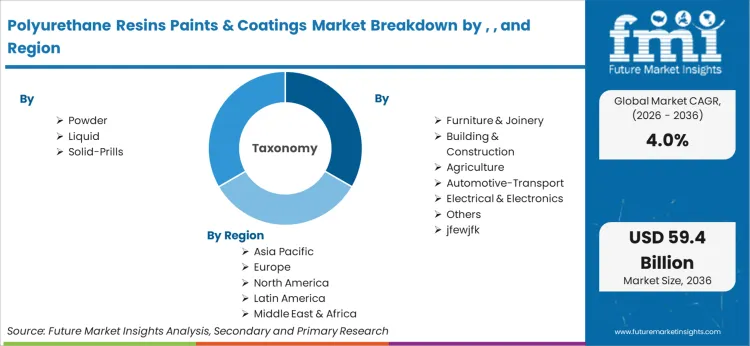
Polyurethane Resins Paints & Coatings Market Analysis by Segments
Resin Type
- Polyol
- Organic Diisocyanate
Application:
- Indoor Decorations
- Ship
- Chemical Industry
- Others
End-use Industry:
- Construction
- Automotive
- Industrial Manufacturing
- Marine
- Others
Region:
- North America
- Latin America
- Western Europe
- Eastern Europe
- East Asia
- South Asia & Pacific
- Middle East & Africa
Bibliography
- European Construction Industry Federation. (2025). Construction activity in Europe 2025-2030. FIEC.
- USA Environmental Protection Agency. (2025). Air Plan Approval; Ohio; Volatile Organic Compounds. Federal Register, EPA-R05-OAR-2025-0232.
- International Organization of Motor Vehicle Manufacturers. (2025). World motor vehicle production statistics. OICA.
- American Coatings Association. (2024). Coatings industry market analysis and sustainability trends. ACA.
- European Chemicals Agency. (2024). REACH restriction roadmap for substances of concern. ECHA.
- USA Energy Information Administration. (2025). Petroleum & other liquids: Spot prices. EIA.
- DSM. (2024). Decovery: Plant-based resin technology for sustainable coatings. DSM Corporate Sustainability Report.
- United Nations Human Settlements Programme. (2025). World Cities Report 2025: Urbanization and infrastructure development. UN-Habitat.
- Government of India, Ministry of Housing and Urban Affairs. (2025). Smart Cities Mission: Progress and achievements. MoHUA.
- USA Department of Commerce. (2025). Construction spending statistics. USA Census Bureau.
- German Federal Statistical Office. (2025). Construction and housing statistics. Destatis.
- National Bureau of Statistics of China. (2025). China statistical yearbook on construction. China Statistics Press.
- Korea International Trade Association. (2025). Korea's chemical industry export trends. KITA.
This Report Addresses
- Market intelligence to enable structured strategic decision-making across polyurethane resin manufacturers, coatings formulators, and industry investors.
- Market size estimation and 10-year revenue forecasts from 2026 to 2036, including validated CAGR and absolute dollar opportunity sizing.
- Growth opportunity mapping across Resin Type, Application, End-use Industry, and regional demand pockets, with emphasis on polyurethane resin applications in construction and automotive.
- Segment and regional forecasting covering polyurethane resin consumption patterns, alongside end-use-specific demand trajectories across industrial manufacturing and marine sectors.
- Competition strategy assessment, including polyurethane chemistry expertise, raw material integration, and buyer leverage dynamics shaping sourcing decisions.
- Product and technology tracking focused on water-borne formulation development, bio-based polyol innovation, and emerging smart coating technologies.
- Regional construction activity analysis covering infrastructure investment, housing starts, and automotive production trends influencing polyurethane resin procurement.
- Report delivery in PDF, Excel, and presentation-ready formats to support executive planning, capacity investment decisions, and competitive benchmarking.
Frequently Asked Questions
What is the size of the global polyurethane resins paints and coatings market in 2025 and how fast is it expected to grow through 2036?
The global polyurethane resins paints and coatings market is valued at USD 38.6 billion in 2025 and is projected to grow at a 4.0% CAGR, reaching about USD 40.1 billion in 2026 and approximately USD 59.4 billion by 2036.
What drives polyurethane resin demand in construction applications?
The construction industry drives polyurethane coating consumption due to superior protective properties, with paints and coatings primarily used to protect and decorate infrastructure and buildings. Architectural paints offer odorless formulations with enhanced abrasion resistance in numerous textures.
How do environmental regulations affect polyurethane coating formulation?
Strict environmental regulations have created massive demand for sustainable coatings development. Paint manufacturers follow REACH guidelines to reduce VOCs and carbon footprint, developing bio-based technologies and attaining recyclability. Companies like DSM offer plant-based resins that reduce carbon footprint by up to 34% by replacing crude oil .
What role does the automotive industry play in market growth?
High demand for paints and coatings in the automotive sector stems from requirements for corrosion resistance, continuous protective film formation, color stability, scratch resistance, abrasion resistance, durability, and flexibility . These coatings provide exceptional resistance to extreme weather conditions while maintaining color and gloss retention.
Why is China projected to lead Asia Pacific market growth?
China leads the Asia Pacific region in both volume and revenue due to robust residential construction and high automotive output . The country's booming construction activity accounts for significant regional consumption, with growing infrastructure needs boosting coating demand.
What drives India's infrastructure-related demand?
India's National Smart Cities and Housing for All initiatives are boosting architectural coatings demand, especially for water-borne and decorative coatings. The National Infrastructure Pipeline targets substantial capital expenditure, driving demand for protective coatings in bridges, ports, and railways.
How do raw material price fluctuations affect the market?
Polyurethane coatings rely heavily on isocyanates and polyols derived from petrochemical feedstocks, with prices significantly dependent on crude oil prices. Geopolitical tensions, supply chain disruptions, and energy policy changes lead to price volatility, making cost management difficult for manufacturers .
What opportunities exist in bio-based polyurethane development?
Growing sustainability emphasis drives innovation in bio-based polyurethane resins from renewable resources. DSM offers plant-based resin with low VOCs to improve indoor and outdoor air quality, decreasing carbon footprint by up to 34%. Major players have introduced partially bio-based formulations, with research continuing to improve performance.
How do smart coatings create premium market segments?
Self-healing polyurethane coatings automatically repair minor scratches and damage, containing microcapsules filled with healing agents that rupture upon surface damage, filling scratches and restoring protective layers. Anti-corrosion polyurethane coatings incorporating nanotechnology create stronger barriers against moisture, chemicals, and extreme temperatures.
What are the main technical limitations of polyurethane coatings?
Waterborne polyurethane resins face challenges matching solvent-based counterparts, including longer drying times under high humidity and reduced chemical resistance. For applications requiring exceptional chemical resistance at elevated temperatures, epoxy formulations remain the preferred choice.
How does the chemical industry utilize polyurethane coatings?
Chemical industry applications include tank linings, pipe coatings, and equipment protection where chemical resistance is critical. Polyurethane coatings provide superior protection against aggressive chemicals and solvents in processing environments, with applications spanning protective industrial coatings and high-performance formulations.
What opportunities exist in emerging economy construction?
Rapid industrialization and infrastructure development in emerging markets, particularly Asia and Middle East, create significant growth opportunities. Asia Pacific dominated the market in 2025, driven by growing construction activities and rapid urbanization across China, India, and Southeast Asia.
How do marine applications contribute to market demand?
Ship and marine applications consume polyurethane resins for corrosion protection and anti-fouling coatings that withstand harsh seawater environments. These materials protect commercial and military ships against UV radiation, thermal instability, and water exposure.
What is the significance of water-borne coatings in the market?
Waterborne coatings hold significant market share due to increased usage in automobiles, plastic, furniture, and wood applications. Benefits include no VOC emissions, quick-dry properties, and easier application, making them preferred for architectural, automotive, and industrial applications.
How does the architecture segment dominate market share?
The architecture segment dominates in revenue and volume throughout the projected period. In architectural applications, paints and coatings are chiefly used for decorative purposes for infrastructure and buildings to protect them from UV radiation and environmental damage.
What role do government infrastructure projects play?
Government investment in public infrastructure projects boosts market growth, with the construction industry expected to grow significantly. Advanced technologies are becoming standard, driving further industry growth and coating demand.
How do sustainability initiatives shape market trends?
Companies focus on reducing volatile organic compounds to include resource conservation and energy, renewable materials, process efficiency enhancement, and waste minimization. Paint manufacturers innovate sustainable paint technology to meet consumer demand, following REACH guidelines to reduce VOCs and carbon footprint .
What are the key properties driving polyurethane resin adoption?
Polyurethane resins contain properties of scratch resistance, good gloss, thermal stability, and excellent adhesion . These properties, combined with abrasion resistance and corrosion protection, make polyurethane widely used in architectural, automotive, and industrial applications.
Preview the report firsthand - request a free sample
Get SampleGet the brochure for pricing and purchase details.
Get PDFTable of Content
- Executive Summary
- Global Market Outlook
- Demand-side Trends
- Supply-side Trends
- Technology Roadmap Analysis
- Analysis and Recommendations
- Market Overview
- Market Coverage / Taxonomy
- Market Definition / Scope / Limitations
- Research Methodology
- Chapter Orientation
- Analytical Lens and Working Hypotheses
- Market Structure, Signals, and Trend Drivers
- Benchmarking and Cross-market Comparability
- Market Sizing, Forecasting, and Opportunity Mapping
- Research Design and Evidence Framework
- Desk Research Programme (Secondary Evidence)
- Company Annual and Sustainability Reports
- Peer-reviewed Journals and Academic Literature
- Corporate Websites, Product Literature, and Technical Notes
- Earnings Decks and Investor Briefings
- Statutory Filings and Regulatory Disclosures
- Technical White Papers and Standards Notes
- Trade Journals, Industry Magazines, and Analyst Briefs
- Conference Proceedings, Webinars, and Seminar Materials
- Government Statistics Portals and Public Data Releases
- Press Releases and Reputable Media Coverage
- Specialist Newsletters and Curated Briefings
- Sector Databases and Reference Repositories
- FMI Internal Proprietary Databases and Historical Market Datasets
- Subscription Datasets and Paid Sources
- Social Channels, Communities, and Digital Listening Inputs
- Additional Desk Sources
- Expert Input and Fieldwork (Primary Evidence)
- Primary Modes
- Qualitative Interviews and Expert Elicitation
- Quantitative Surveys and Structured Data Capture
- Blended Approach
- Why Primary Evidence is Used
- Field Techniques
- Interviews
- Surveys
- Focus Groups
- Observational and In-context Research
- Social and Community Interactions
- Stakeholder Universe Engaged
- C-suite Leaders
- Board Members
- Presidents and Vice Presidents
- R&D and Innovation Heads
- Technical Specialists
- Domain Subject-matter Experts
- Scientists
- Physicians and Other Healthcare Professionals
- Governance, Ethics, and Data Stewardship
- Research Ethics
- Data Integrity and Handling
- Primary Modes
- Tooling, Models, and Reference Databases
- Desk Research Programme (Secondary Evidence)
- Data Engineering and Model Build
- Data Acquisition and Ingestion
- Cleaning, Normalisation, and Verification
- Synthesis, Triangulation, and Analysis
- Quality Assurance and Audit Trail
- Market Background
- Market Dynamics
- Drivers
- Restraints
- Opportunity
- Trends
- Scenario Forecast
- Demand in Optimistic Scenario
- Demand in Likely Scenario
- Demand in Conservative Scenario
- Opportunity Map Analysis
- Product Life Cycle Analysis
- Supply Chain Analysis
- Investment Feasibility Matrix
- Value Chain Analysis
- PESTLE and Porter’s Analysis
- Regulatory Landscape
- Regional Parent Market Outlook
- Production and Consumption Statistics
- Import and Export Statistics
- Market Dynamics
- Global Market Analysis 2021 to 2025 and Forecast, 2026 to 2036
- Historical Market Size Value (USD Million) Analysis, 2021 to 2025
- Current and Future Market Size Value (USD Million) Projections, 2026 to 2036
- Y-o-Y Growth Trend Analysis
- Absolute $ Opportunity Analysis
- Global Market Pricing Analysis 2021 to 2025 and Forecast 2026 to 2036
- Introduction / Key Findings
- Global Market Analysis 2021 to 2025 and Forecast 2026 to 2036, By Region
- Introduction
- Historical Market Size Value (USD Million) Analysis By Region, 2021 to 2025
- Current Market Size Value (USD Million) Analysis and Forecast By Region, 2026 to 2036
- North America
- Latin America
- Western Europe
- Eastern Europe
- East Asia
- South Asia and Pacific
- Middle East & Africa
- Market Attractiveness Analysis By Region
- North America Market Analysis 2021 to 2025 and Forecast 2026 to 2036, By Country
- Historical Market Size Value (USD Million) Trend Analysis By Market Taxonomy, 2021 to 2025
- Market Size Value (USD Million) Forecast By Market Taxonomy, 2026 to 2036
- By Country
- USA
- Canada
- Mexico
- Market Attractiveness Analysis
- By Country
- Key Takeaways
- By Country
- Latin America Market Analysis 2021 to 2025 and Forecast 2026 to 2036, By Country
- Historical Market Size Value (USD Million) Trend Analysis By Market Taxonomy, 2021 to 2025
- Market Size Value (USD Million) Forecast By Market Taxonomy, 2026 to 2036
- By Country
- Brazil
- Chile
- Rest of Latin America
- Market Attractiveness Analysis
- By Country
- Key Takeaways
- By Country
- Western Europe Market Analysis 2021 to 2025 and Forecast 2026 to 2036, By Country
- Historical Market Size Value (USD Million) Trend Analysis By Market Taxonomy, 2021 to 2025
- Market Size Value (USD Million) Forecast By Market Taxonomy, 2026 to 2036
- By Country
- Germany
- UK
- Italy
- Spain
- France
- Nordic
- BENELUX
- Rest of Western Europe
- Market Attractiveness Analysis
- By Country
- Key Takeaways
- By Country
- Eastern Europe Market Analysis 2021 to 2025 and Forecast 2026 to 2036, By Country
- Historical Market Size Value (USD Million) Trend Analysis By Market Taxonomy, 2021 to 2025
- Market Size Value (USD Million) Forecast By Market Taxonomy, 2026 to 2036
- By Country
- Russia
- Poland
- Hungary
- Balkan & Baltic
- Rest of Eastern Europe
- Market Attractiveness Analysis
- By Country
- Key Takeaways
- By Country
- East Asia Market Analysis 2021 to 2025 and Forecast 2026 to 2036, By Country
- Historical Market Size Value (USD Million) Trend Analysis By Market Taxonomy, 2021 to 2025
- Market Size Value (USD Million) Forecast By Market Taxonomy, 2026 to 2036
- By Country
- China
- Japan
- South Korea
- Market Attractiveness Analysis
- By Country
- Key Takeaways
- By Country
- South Asia and Pacific Market Analysis 2021 to 2025 and Forecast 2026 to 2036, By Country
- Historical Market Size Value (USD Million) Trend Analysis By Market Taxonomy, 2021 to 2025
- Market Size Value (USD Million) Forecast By Market Taxonomy, 2026 to 2036
- By Country
- India
- ASEAN
- Australia & New Zealand
- Rest of South Asia and Pacific
- Market Attractiveness Analysis
- By Country
- Key Takeaways
- By Country
- Middle East & Africa Market Analysis 2021 to 2025 and Forecast 2026 to 2036, By Country
- Historical Market Size Value (USD Million) Trend Analysis By Market Taxonomy, 2021 to 2025
- Market Size Value (USD Million) Forecast By Market Taxonomy, 2026 to 2036
- By Country
- Kingdom of Saudi Arabia
- Other GCC Countries
- Turkiye
- South Africa
- Other African Union
- Rest of Middle East & Africa
- Market Attractiveness Analysis
- By Country
- Key Takeaways
- By Country
- Key Countries Market Analysis
- USA
- Pricing Analysis
- Market Share Analysis, 2025
- Canada
- Pricing Analysis
- Market Share Analysis, 2025
- Mexico
- Pricing Analysis
- Market Share Analysis, 2025
- Brazil
- Pricing Analysis
- Market Share Analysis, 2025
- Chile
- Pricing Analysis
- Market Share Analysis, 2025
- Germany
- Pricing Analysis
- Market Share Analysis, 2025
- UK
- Pricing Analysis
- Market Share Analysis, 2025
- Italy
- Pricing Analysis
- Market Share Analysis, 2025
- Spain
- Pricing Analysis
- Market Share Analysis, 2025
- France
- Pricing Analysis
- Market Share Analysis, 2025
- India
- Pricing Analysis
- Market Share Analysis, 2025
- ASEAN
- Pricing Analysis
- Market Share Analysis, 2025
- Australia & New Zealand
- Pricing Analysis
- Market Share Analysis, 2025
- China
- Pricing Analysis
- Market Share Analysis, 2025
- Japan
- Pricing Analysis
- Market Share Analysis, 2025
- South Korea
- Pricing Analysis
- Market Share Analysis, 2025
- Russia
- Pricing Analysis
- Market Share Analysis, 2025
- Poland
- Pricing Analysis
- Market Share Analysis, 2025
- Hungary
- Pricing Analysis
- Market Share Analysis, 2025
- Kingdom of Saudi Arabia
- Pricing Analysis
- Market Share Analysis, 2025
- Turkiye
- Pricing Analysis
- Market Share Analysis, 2025
- South Africa
- Pricing Analysis
- Market Share Analysis, 2025
- USA
- Market Structure Analysis
- Competition Dashboard
- Competition Benchmarking
- Market Share Analysis of Top Players
- By Regional
- Competition Analysis
- Competition Deep Dive
- BASF SE
- Overview
- Product Portfolio
- Profitability by Market Segments (Product/Age /Sales Channel/Region)
- Sales Footprint
- Strategy Overview
- Marketing Strategy
- Product Strategy
- Channel Strategy
- Sherwin-Williams Company
- PPG Industries, Inc.
- Akzo Nobel N.V.
- Axalta Coating Systems
- DSM
- Arkema S.A.
- Henkel AG & Co. KGaA
- Lubrizol Corporation
- Allnex Group
- BASF SE
- Competition Deep Dive
- Assumptions & Acronyms Used


