

- Industry Size (2026)
- USD 30.8 Bn
- Forecast (2036)
- USD 43.9 Bn
- CAGR (2026 to 2036)
- 3.6%
Polyols Market Size, Market Forecast and Outlook By FMI
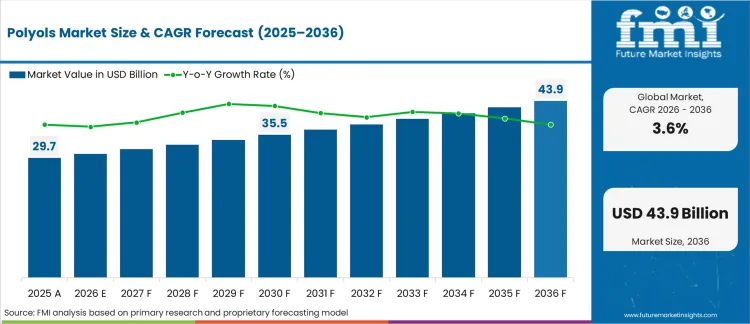
In 2025, the polyols market crossed a valuation of USD 29.7 billion. Based on Future Market Insights’ analysis, demand is estimated to rise to USD 30.8 billion in 2026 and USD 43.9 billion by 2036. FMI projects the market to expand at a CAGR of 3.6% between 2026 and 2036, reflecting sustained investments in energy-efficient building materials, lightweight automotive components, and bio-based chemical integration across global polyurethane value chains.
Absolute dollar growth of USD 11.6 billion over 2026 to 2036 highlights sustained capital deployment toward building efficiency upgrades. According to FMI's estimates, commercial and residential structures account for 26% of global energy-related emissions. [1] Procurement teams must absorb higher upfront chemical costs to secure operational energy savings via high-performance polyester polyol layers.
Summary of Polyols Market
- Polyols Market Definition
- Intermediate organic compounds react with isocyanates to produce diverse polyurethane structures.
- Demand Drivers in the Market
- Building emission reduction policies compel rigid foam insulation upgrades.
- Automotive light-weighting protocols prioritize advanced flexible foams.
- Consumer preference shifts favor renewable agricultural feedstocks.
- Key Segments Analyzed in the FMI Report
- Product Type: Natural polyols dominate (56.3%) versus polyester and polyether variants.
- Application: Rigid foam leads revenue generation across insulation and cold-chain infrastructure.
- Geography: Emerging Asia-Pacific growth hubs versus carbon-regulated mature Europe and North America.
- Analyst Opinion at FMI
- Nandini Roy Choudhury, Principal Consultant for Food and Beverages at Future Market Insights, opines, “In the updated Polyols Market report for 2026 to 2036, my team and I have evaluated how decarbonization mandates and feedstock volatility are reshaping polyurethane economics. Producers can no longer compete on volume alone; backward integration into bio-based inputs and application-specific engineering are becoming decisive levers to protect margins. In a carbon-accounted supply chain, sustainability credentials and performance consistency now determine long-term contract retention.”
- Strategic Implications/Executive Takeaways
- Substitute petroleum precursors with verifiable renewable alternatives.
- Localize production assets near high-volume insulation manufacturing hubs.
- Secure long-term agricultural feedstock contracts to stabilize pricing.
- Methodology
- Validated through first-hand corporate production and capacity data.
- Zero reliance on speculative third-party market research reports.
- Based on verifiable industrial benchmarks and verified sources.
“This acquisition represents a significant milestone in COIM USA’s long-term growth strategy,” said Michelangelo Cavallo, President of COIM USA. He further commented: “The New Boston location broadens our geographic reach, expands our sustainable portfolio, and enhances COIM USA’s ability to serve customers with greater speed, efficiency, and resiliency.” [2]
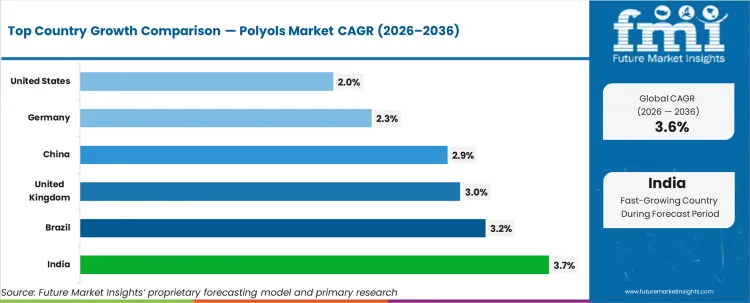
Country dispersion includes USA tracking 2.0% CAGR, Germany noting 2.3% CAGR, and UK logging 3.0% CAGR. Emerging centers feature China at 2.9% CAGR, Brazil posting 3.2% CAGR, and India leading with 3.7% CAGR. Geographic patterns highlight a distinct pivot toward specialized chemical intermediaries inside mature regulatory zones.
Polyols Market Key Takeaways
| Metric | Value |
|---|---|
| Industry Size (2026) | USD 30.8 Billion |
| Industry Value (2036) | USD 43.9 Billion |
| CAGR (2026–2036) | 3.6% |
Polyols Market Definition
Polyols comprise organic compounds featuring multiple hydroxyl groups utilized fundamentally to manufacture polyurethane polymers. As per FMI's projection, bio-polyol green polyol formulations occupy increasing formula shares due to sustainability mandates. Chemical architectures determine final mechanical properties in foams or elastomers.
Polyols Market Inclusions
Analysis encompasses global consumption volumes and revenue generation for natural, polyester, and polyether variants. Assessment tracks downstream absorption across automotive seating, building insulation, and durable goods. Value chains incorporate natural oil polyols NOP originating from renewable agricultural feedstocks.
Polyols Market Exclusions
Coverage excludes finished polyurethane goods. Chemical structures utilized within food manufacturing fall outside defined scope parameters. Analysis ignores unverified artisanal chemical blending lacking verifiable industrial scale.
Polyols Market Research Methodology
- Primary Research: Direct interviews executed with chemical synthesis executives and formulation engineers.
- Desk Research: Output bulletins sourced from national statistical agencies validate baseline tonnages.
- Market-Sizing and Forecasting: Top-down consumption modeling cross-referenced against bottom-up capacity declarations.
- Data Validation and Update Cycle: Verification protocols screen anomalies before finalizing ten-year trend lines.
Segmental Analysis
Polyols Market Analysis by Product Type
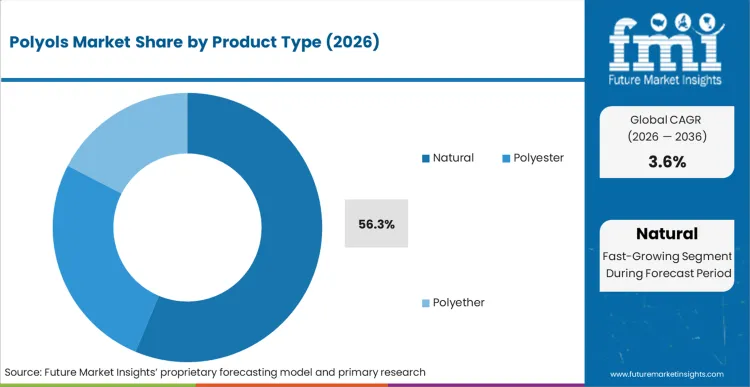
Natural variants capture a dominant 56.3% share within product configurations during 2026. FMI analysts opine that procurement departments prioritize castor oil polyol replacements to satisfy internal environmental targets. Buyers force chemical suppliers to substantiate sustainability claims using verifiable carbon accounting methods.
- Procurement trigger: End-user carbon reporting forces buyers to seek bio-based chemical intermediates. In April 2024, Momentive adopted Cargill BiOH soy-based chemistry to improve flexible foam ecological footprints. [3]
- Technology shift: Chemical engineers formulate hybrid structures blending agricultural derivatives with synthetic baselines. Blending maintains necessary mechanical durability without compromising mandatory ecological benchmarks.
- Supply-side move: Formulators expand renewable portfolios to defend existing commercial accounts. Vendors lacking certified green portfolios risk exclusion from lucrative municipal supply contracts.
Polyols Market Analysis by Application
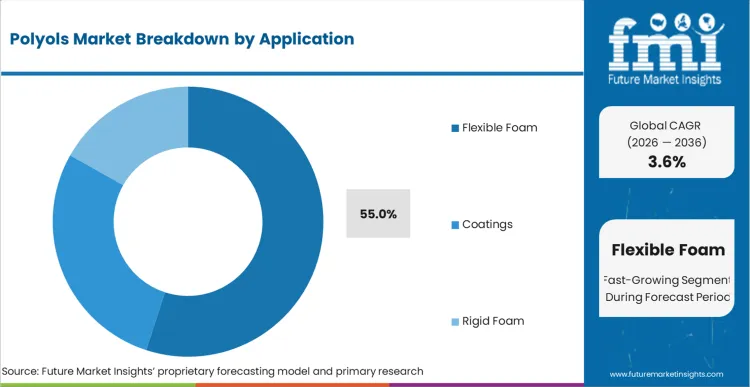
Rigid foam applications represent a high-value consumption node. As per FMI's projection, construction policies dictate strict thermal performance metrics for new commercial structures. Insulating capabilities inherent to rigid polyurethane precursor blends outpace traditional fiberglass alternatives.
- Regulatory signal: Government building codes mandate superior thermal resistance in exterior walls. Constructors switch to spray-applied formulations to eliminate air infiltration pathways, reducing long-term heating expenditures.
- Buyer priority: Automotive assembly plants require lightweight components to maximize fleet fuel efficiency. In 2024, EU-27 and UK motor vehicle production reached 14,307,986 units, sustaining base demand for flexible seating foams. [4]
- Manufacturing constraint: High-performance synthesis requires precise blending ratios on factory floors. Equipment upgrades become necessary to process new high-viscosity bio-based formulations, protecting product consistency.
Polyols Market Drivers, Restraints, and Opportunities
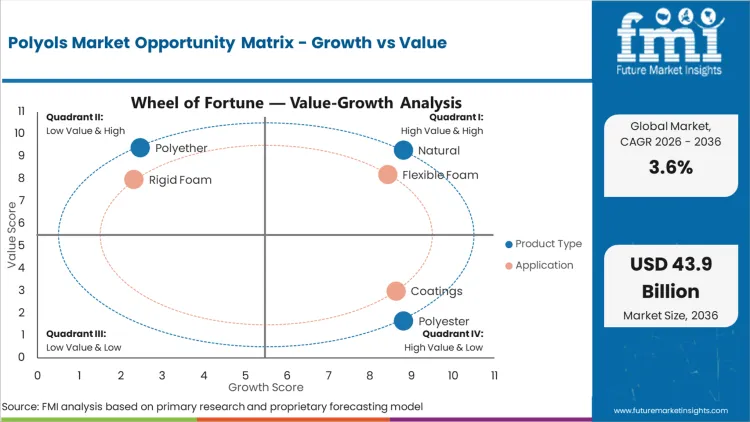
Building energy efficiency mandates constitute a primary demand catalyst. According to FMI's estimates, government regulators enforce stricter insulation requirements to curb excessive heating consumption. In 2024, United States housing starts reached 1,367,100 units, sustaining baseline demand for residential insulation foams. [5] Construction firms respond by specifying rigid materials possessing superior thermal resistance. Expanded material usage inflates upstream chemical order volumes. Manufacturers secure long-term contracts with regional synthesis plants to prevent job site delays, yielding elevated revenue generation for established suppliers.
Agricultural feedstock availability limits natural variant volume expansion. FMI analysts opine that competing industrial sectors aggressively secure crop yields. Biofuel refineries consume vast quantities of vegetable oils, creating direct raw material scarcity for chemical formulators. Formulators offset agricultural volatility by developing green chemicals sourced from municipal waste streams. Blending traditional petroleum molecules with bio-derived variants stabilizes final product pricing, requiring flexible reactors capable of processing diverse organic inputs.
- Formulation Upgrade: Original equipment manufacturers require bespoke chemical profiles to enhance vehicular acoustic dampening. Synthesis firms capture premium margins by engineering proprietary molecules tailored for specific automotive assembly lines.
- Circular Integration: Waste processors isolate functional compounds from discarded materials to synthesize recycled chemical precursors. In 2024, Repsol launched a Recpur chemical recycling plant to output circular intermediates. [6]
- Capacity Localization: Chemical distributors construct regional blending facilities adjacent to heavy manufacturing corridors. Proximity guarantees rapid delivery schedules, allowing downstream buyers to minimize expensive on-site inventory storage.
Regional Analysis
Based on regional analysis, Polyols market is segmented into North America, Latin America, Europe, East Asia, South Asia, Oceania and Middle East & Africa across 40+ countries. Full report offers market attractiveness analysis based on regional trends.
.webp "Top Country Growth Comparison Polyols Market Cagr (2026 2036)")
| Country | CAGR (2026 to 2036) |
|---|---|
| India | 3.7% |
| Brazil | 3.2% |
| United Kingdom | 3.0% |
| China | 2.9% |
| Germany | 2.3% |
| United States | 2.0% |
Source: Future Market Insights (FMI) analysis, based on proprietary forecasting model and primary research
North America Polyols Analysis
North American chemical buyers navigate strict material safety regulations alongside fluctuating construction cycles. Regional building codes require superior thermal management solutions inside commercial real estate. Procurement managers shift capital toward United States green and bio based polyol portfolios to satisfy emerging corporate climate pledges. Chemical synthesis operators expand domestic production capabilities to shield downstream consumers from international transit disruptions.
- United States: Strict environmental mandates prompt formulators to integrate bio-derived molecules inside commercial resins. This 2.0% CAGR trajectory aligns with domestic housing sector recovery, where in 2024 Covestro and Encina finalized an agreement ensuring long-term supply of circular raw materials. [7] Localized chemical synthesis prevents expensive construction site delays, granting domestic suppliers distinct pricing leverage over overseas competitors.
FMI's report includes detailed analysis spanning North America. Assessment covers Canada and Mexico, observing cross-border chemical trade flows. Evolving automotive assembly corridors inside Mexico require uninterrupted chemical precursor supplies. Facility operators secure long-term volume agreements to stabilize regional foam production.
Europe Polyols Analysis
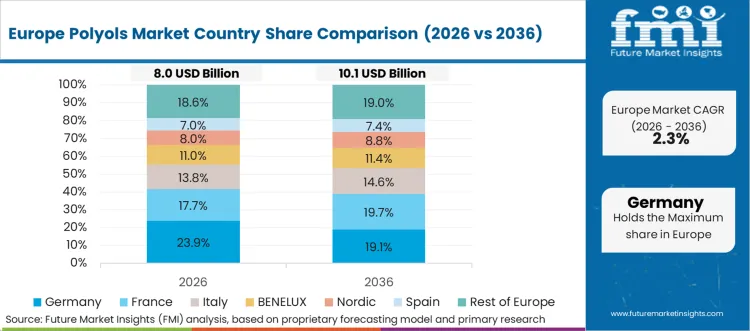
European industrial operators prioritize circular material integration to bypass aggressive carbon taxation mechanisms. Regional authorities penalize manufacturers utilizing high-emission petroleum derivatives. European vehicle assembly lines demand lightweight seating components to maximize electric battery ranges. Formulators must continuously upgrade chemical profiles to retain access to premium automotive contracts.
- Germany: Deep industrial integration forces chemical suppliers to deliver highly specialized resin formulations to local factories. Growth tracks a 2.3% CAGR as automotive manufacturers prioritize low-emission interior components, supported by MOL Group inaugurating a 200,000 tpa polyol complex to strengthen localized supply chains. [8] Regional synthesis plants execute rapid delivery schedules to sustain continuous vehicle assembly operations.
- United Kingdom: Ambitious home retrofitting programs compel contractors to specify advanced rigid polyurethane layers for exterior walls. Expansion at 3.0% CAGR mirrors aggressive national policies targeting reduced building heating loads, helping property developers achieve mandatory energy performance certifications.
FMI's report includes robust analysis evaluating chemical procurement trends throughout Europe. Coverage explores France, Italy, and Spain, highlighting distinct construction material preferences. Advancing regulatory frameworks in France compel constructors to evaluate Germany green and bio based polyol alternatives for commercial projects. Strict municipal codes dictate material selection criteria across urban development zones.
Asia Pacific Polyols Analysis
Asian manufacturing hubs leverage massive chemical synthesis scale to dominate global export channels. Regional factories process vast volumes of intermediate molecules to feed localized consumer appliance production. Environmental directives force facility managers to phase out obsolete formulation methodologies. Manufacturers deploy immense capital to upgrade reactor configurations.
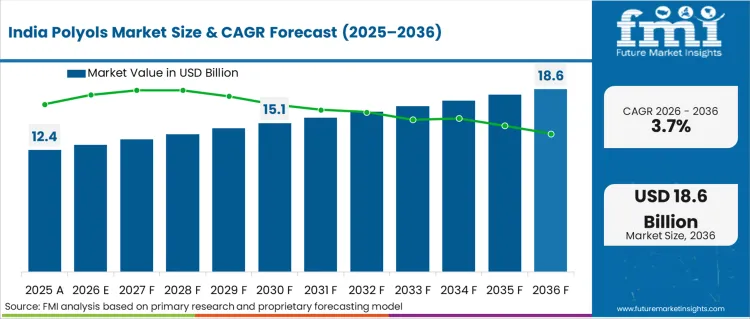
- India: Accelerating cold-chain logistics networks necessitate immense quantities of rigid polyurethane insulation to prevent agricultural spoilage. At 3.7% CAGR, country outlook is shaped by abundant local feedstocks, demonstrated by India maintaining an 88.48% global share in castor seed production. [9] Localized development accelerates commercial deployment of novel bio-based formulations.
- China: Export-oriented furniture manufacturers demand massive volumes of flexible foam precursors to fulfill international retail orders. A CAGR of 2.9% reflects aggressive industrial capacity expansion aimed at absorbing regional chemical output, allowing local factories to maintain aggressive pricing strategies abroad.
FMI's report includes comprehensive data examining chemical output metrics across Asia Pacific. Investigation details Japan and South Korea, tracking advanced material engineering initiatives. Electronics manufacturers within South Korea require specialized resin coatings to protect delicate circuitry. Precision chemical formulation capabilities define vendor success inside these high-tech geographies.
Latin America Polyols Analysis
Latin American industrial zones witness steady expansion in durable goods manufacturing. Regional appliance assemblers require reliable chemical supplies to produce refrigerator insulation panels. Macroeconomic stability allows procurement departments to execute multi-year purchasing strategies. Chemical synthesis firms position distribution centers near major assembly clusters.
- Brazil: Expanding middle-class consumption drives steady demand for flexible polyurethane foams utilized inside domestic bedding. Expansion at 3.2% CAGR is linked to rising consumer goods production, prompting domestic formulators to optimize bio-based recipes leveraging abundant regional agricultural outputs.
FMI's report includes targeted insights dissecting chemical demand dynamics within Latin America. Research profiles Argentina and Chile, mapping infrastructure modernization impacts. Mining sector expansion inside Chile necessitates heavy-duty polyurethane elastomers for equipment maintenance. Mining operators secure durable chemical replacements to minimize expensive machinery downtime.
Competitive Aligners for Market Players
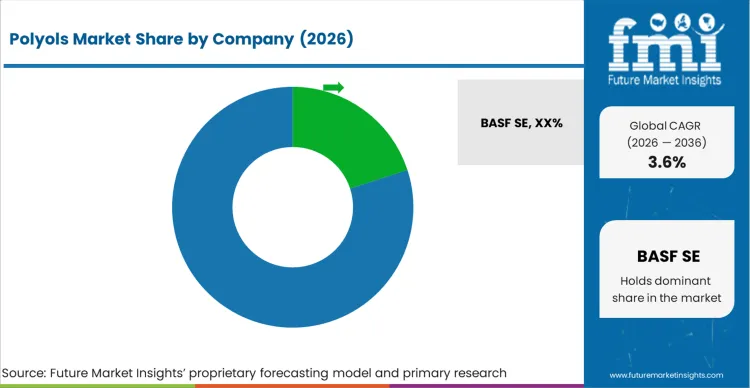
Chemical synthesis operators navigate immense pressure to document precise carbon footprints across supply chains. Original equipment manufacturers refuse supplier contracts lacking verifiable sustainability metrics. Access to non-petroleum feedstocks grants formulators an undeniable bidding advantage during procurement negotiations.
Scale economics dictate survival inside highly commoditized chemical segments. Top-tier producers leverage massive reactor capacities to absorb raw material price shocks. Firms lacking upstream integration suffer severe margin compression when base agricultural commodities spike, forcing localized buyers to seek vertically integrated partners to avoid shipping tariffs.
As per FMI's projection, specialized application engineering isolates premium vendors from aggressive price competition. Chemical engineers collaborate directly with automotive designers to formulate bespoke acoustic dampening foams, supported by BASF launching a Polyurethane Technical Development Center in Mumbai to expand application capabilities. [10] Proprietary molecule configurations prevent buyers from seamlessly switching chemical suppliers, maximizing account retention rates for forward-deployed formulators.
Recent Developments
Report includes full coverage of key trends from competitive benchmarking. Some recent developments covered in reports:
- In May 2024, BASF launched a Polyurethane Technical Development Center to boost local application engineering capabilities. [10]
- In May 2024, MOL Group inaugurated a large-scale polyol complex to secure European chemical supply chains. [8]
Key Players in Polyols
- BASF SE
- Covestro AG
- Dow Chemical Company
- Huntsman Corporation
- Shell Chemicals
- Repsol S.A.
- MOL Group
- COIM Group
- Momentive
- Perstorp
Scope of the Report
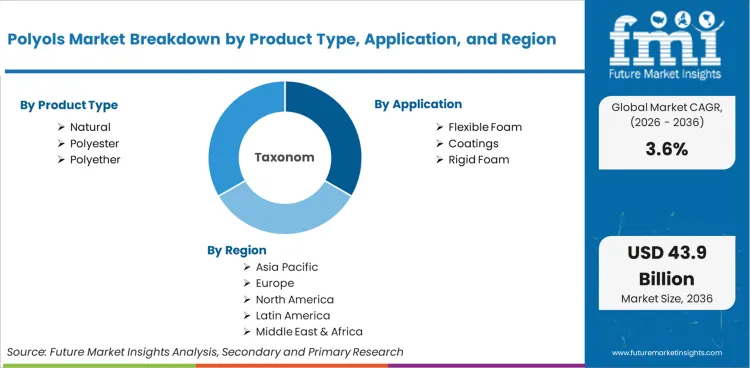
| Metric | Value |
|---|---|
| Quantitative Units | USD 30.8 billion (2026) to USD 43.9 billion (2036), at a CAGR of 3.6% |
| Market Definition | Polyols comprise organic compounds featuring multiple hydroxyl groups utilized fundamentally to manufacture polyurethane polymers. |
| Product Type Segmentation | Natural Polyols, Polyester Polyols, Polyether Polyols |
| Application Segmentation | Flexible Foam, Rigid Foam, Coatings, Adhesives, Sealants and Elastomers |
| Application Coverage | Automotive, Construction, Furniture, Consumer Goods |
| Regions Covered | North America, Latin America, Europe, Asia Pacific, Middle East & Africa |
| Countries Covered | United States, Canada, Mexico, Brazil, Argentina, Germany, France, United Kingdom, Italy, Spain, China, India, Japan, South Korea, Indonesia, Australia and 40 plus countries |
| Key Companies Profiled | BASF SE, Covestro AG, Dow Chemical Company, Huntsman Corporation, Shell Chemicals, Repsol S.A., MOL Group, COIM Group, Momentive, Perstorp |
| Forecast Period | 2026 to 2036 |
| Approach | Top-down consumption modeling cross-referenced against bottom-up capacity declarations |
Polyols Market Analysis by Segments
Product Type
- Natural Polyols
- Polyester Polyols
- Polyether Polyols
Application
- Flexible Foam
- Rigid Foam
- Coatings
- Adhesives
- Sealants and Elastomers
Region
- Asia Pacific
- India
- China
- Japan
- South Korea
- Indonesia
- Australia & New Zealand
- ASEAN
- Rest of Asia Pacific
- Europe
- Germany
- Italy
- France
- United Kingdom
- Spain
- Benelux
- Nordics
- Central & Eastern Europe
- Rest of Europe
- North America
- United States
- Canada
- Mexico
- Latin America
- Brazil
- Argentina
- Chile
- Rest of Latin America
- Middle East & Africa
- Kingdom of Saudi Arabia
- United Arab Emirates
- South Africa
- Turkey
- Rest of Middle East & Africa
Bibliography
- [1] IEA. (2025). Energy Efficiency 2025: Buildings sector demand and emissions framework.
- [2] COIM Group. (2025). COIM USA acquires New Boston, Texas property to expand capacity. Corporate Press Release, May 2025.
- [3] Momentive. (2024). Collaboration utilizing Cargill BiOH soy-based polyols for sustainable flexible foam formulations. Company Announcement, April 2024.
- [4] OICA. (2024). World motor vehicle production statistics. Industry Output Data, 2024.
- [5] US Census Bureau. (2024). New Residential Construction metrics. Government Database, 2024.
- [6] Repsol. (2024). Recpur chemical recycling plant launch. Corporate Sustainability Report, 2024.
- [7] PR Newswire / Covestro. (2024). Covestro and Encina reach an agreement for circular raw materials. Press Release, January 2024.
- [8] Everchem Specialty Chemicals / MOL Group. (2024). MOL inaugurates polyol complex. Industry News, May 2024.
- [9] NITI Aayog. (2024). Pathways and Strategy for Accelerating Growth in Edible Oil. Government Report, September 2024.
- [10] BASF. (2024). Polyurethane Technical Development Center launch in Mumbai. Corporate Press Release, May 2024.
This bibliography is provided for reader reference and is not exhaustive. The full report contains the complete reference list and detailed citations.
This Report Addresses
- Chemical demand mapping across mature and emerging construction economies
- Revenue forecasts from 2026 to 2036 supported by verified capacity metrics
- Growth opportunity identification across natural and synthetic chemical architectures
- Segment analysis covering rigid insulation panels and flexible automotive seating
- Competition strategy evaluation including bio-based feedstock integration models
- Product reformulation tracking responding to strict indoor air quality mandates
- Regulatory impact assessment detailing thermal efficiency code compliance
- Interactive dataset delivery accommodating precise executive strategic planning
Frequently Asked Questions
How large is demand for Polyols in global operations in 2026?
Global consumption valuations reach USD 30.8 billion during 2026.
What will be market size of Polyols in global applications by 2036?
Forecasts project aggregate revenues scaling toward USD 42.4 billion by 2036.
What is expected demand growth for Polyols in global channels between 2026 and 2036?
Consumption patterns indicate steady expansion tracking 3.6% CAGR over ten years.
Which Product Type is poised to lead global sales by 2026?
Natural variants capture 56.3% share amid escalating corporate sustainability reporting pressures.
How significant is role of flexible foam in driving Polyols adoption in 2026?
Automotive seating requirements sustain massive volume pull, anchoring baseline resin procurement.
What is driving demand in India?
Accelerating cold-chain logistics networks necessitate immense quantities of rigid polyurethane insulation.
What compliance standards or regulations are referenced for India?
Agricultural directives promoting domestic castor seed cultivation stabilize regional supply chains.
What is India growth outlook in this report?
India maintains aggressive expansion tracking 3.7% CAGR.
Why is Europe described as priority region in this report?
Strict carbon taxation frameworks force industrial operators to adopt circular material inputs.
What type of demand dominates in Europe?
Retrofit construction programs dictate replacement cycles favoring superior thermal resistance foams.
What is Germany growth outlook in this report?
Germany advances tracking 2.3% CAGR amid auto sector modernization.
Does report cover China in its regional analysis?
Yes, China falls under Asia Pacific coverage parameters.
What are sources referred to for analyzing China?
Output bulletins sourced from national statistical agencies validate regional consumption figures.
What is main demand theme linked to China in its region coverage?
Massive appliance manufacturing corridors require continuous intermediate chemical supplies.
Does report cover United States in its regional analysis?
Yes, United States operates within North America regional boundaries.
What is main United States related demand theme in its region coverage?
Strict environmental mandates prompt formulators to integrate bio-derived molecules inside commercial resins.
Which product formats or configurations are strategically important for North America supply chains?
Locally synthesized natural chemical blends minimize transit disruptions across domestic factory networks.
What is Polyols and what is it mainly used for?
Intermediate organic compounds react with isocyanates to produce diverse polyurethane structures.
What does Polyols mean in this report?
Definitions encompass chemical precursors governing structural properties inside downstream foams.
What is included in scope of this Polyols report?
Assessment tracks consumption volumes mapping natural, polyester, and polyether variant absorption.
What is excluded from scope of this report?
Coverage ignores finished polyurethane goods alongside specialized compounds utilized inside food manufacturing.
What does market forecast mean on this page?
Estimates represent strategic projections built upon documented production capacities.
How does FMI build and validate Polyols forecast?
Top-down consumption modeling undergoes cross-referencing against verified bottom-up facility declarations.
What does zero reliance on speculative third party market research mean here?
Synthesis executives provide direct interview data ensuring complete independence from unverified secondary estimates.
Preview the report firsthand - request a free sample
Get SampleGet the brochure for pricing and purchase details.
Get PDFTable of Content
- Executive Summary
- Global Market Outlook
- Demand-side Trends
- Supply-side Trends
- Technology Roadmap Analysis
- Analysis and Recommendations
- Market Overview
- Market Coverage / Taxonomy
- Market Definition / Scope / Limitations
- Research Methodology
- Chapter Orientation
- Analytical Lens and Working Hypotheses
- Market Structure, Signals, and Trend Drivers
- Benchmarking and Cross-market Comparability
- Market Sizing, Forecasting, and Opportunity Mapping
- Research Design and Evidence Framework
- Desk Research Programme (Secondary Evidence)
- Company Annual and Sustainability Reports
- Peer-reviewed Journals and Academic Literature
- Corporate Websites, Product Literature, and Technical Notes
- Earnings Decks and Investor Briefings
- Statutory Filings and Regulatory Disclosures
- Technical White Papers and Standards Notes
- Trade Journals, Industry Magazines, and Analyst Briefs
- Conference Proceedings, Webinars, and Seminar Materials
- Government Statistics Portals and Public Data Releases
- Press Releases and Reputable Media Coverage
- Specialist Newsletters and Curated Briefings
- Sector Databases and Reference Repositories
- FMI Internal Proprietary Databases and Historical Market Datasets
- Subscription Datasets and Paid Sources
- Social Channels, Communities, and Digital Listening Inputs
- Additional Desk Sources
- Expert Input and Fieldwork (Primary Evidence)
- Primary Modes
- Qualitative Interviews and Expert Elicitation
- Quantitative Surveys and Structured Data Capture
- Blended Approach
- Why Primary Evidence is Used
- Field Techniques
- Interviews
- Surveys
- Focus Groups
- Observational and In-context Research
- Social and Community Interactions
- Stakeholder Universe Engaged
- C-suite Leaders
- Board Members
- Presidents and Vice Presidents
- R&D and Innovation Heads
- Technical Specialists
- Domain Subject-matter Experts
- Scientists
- Physicians and Other Healthcare Professionals
- Governance, Ethics, and Data Stewardship
- Research Ethics
- Data Integrity and Handling
- Primary Modes
- Tooling, Models, and Reference Databases
- Desk Research Programme (Secondary Evidence)
- Data Engineering and Model Build
- Data Acquisition and Ingestion
- Cleaning, Normalisation, and Verification
- Synthesis, Triangulation, and Analysis
- Quality Assurance and Audit Trail
- Market Background
- Market Dynamics
- Drivers
- Restraints
- Opportunity
- Trends
- Scenario Forecast
- Demand in Optimistic Scenario
- Demand in Likely Scenario
- Demand in Conservative Scenario
- Opportunity Map Analysis
- Product Life Cycle Analysis
- Supply Chain Analysis
- Investment Feasibility Matrix
- Value Chain Analysis
- PESTLE and Porter’s Analysis
- Regulatory Landscape
- Regional Parent Market Outlook
- Production and Consumption Statistics
- Import and Export Statistics
- Market Dynamics
- Global Market Analysis 2021 to 2025 and Forecast, 2026 to 2036
- Historical Market Size Value (USD Million) Analysis, 2021 to 2025
- Current and Future Market Size Value (USD Million) Projections, 2026 to 2036
- Y-o-Y Growth Trend Analysis
- Absolute $ Opportunity Analysis
- Global Market Pricing Analysis 2021 to 2025 and Forecast 2026 to 2036
- Global Market Analysis 2021 to 2025 and Forecast 2026 to 2036, By Product Type
- Introduction / Key Findings
- Historical Market Size Value (USD Million) Analysis By Product Type , 2021 to 2025
- Current and Future Market Size Value (USD Million) Analysis and Forecast By Product Type , 2026 to 2036
- Natural
- Polyester
- Polyether
- Natural
- Y-o-Y Growth Trend Analysis By Product Type , 2021 to 2025
- Absolute $ Opportunity Analysis By Product Type , 2026 to 2036
- Global Market Analysis 2021 to 2025 and Forecast 2026 to 2036, By Application
- Introduction / Key Findings
- Historical Market Size Value (USD Million) Analysis By Application, 2021 to 2025
- Current and Future Market Size Value (USD Million) Analysis and Forecast By Application, 2026 to 2036
- Flexible Foam
- Coatings
- Rigid Foam
- Flexible Foam
- Y-o-Y Growth Trend Analysis By Application, 2021 to 2025
- Absolute $ Opportunity Analysis By Application, 2026 to 2036
- Global Market Analysis 2021 to 2025 and Forecast 2026 to 2036, By Region
- Introduction
- Historical Market Size Value (USD Million) Analysis By Region, 2021 to 2025
- Current Market Size Value (USD Million) Analysis and Forecast By Region, 2026 to 2036
- North America
- Latin America
- Western Europe
- Eastern Europe
- East Asia
- South Asia and Pacific
- Middle East & Africa
- Market Attractiveness Analysis By Region
- North America Market Analysis 2021 to 2025 and Forecast 2026 to 2036, By Country
- Historical Market Size Value (USD Million) Trend Analysis By Market Taxonomy, 2021 to 2025
- Market Size Value (USD Million) Forecast By Market Taxonomy, 2026 to 2036
- By Country
- USA
- Canada
- Mexico
- By Product Type
- By Application
- By Country
- Market Attractiveness Analysis
- By Country
- By Product Type
- By Application
- Key Takeaways
- Latin America Market Analysis 2021 to 2025 and Forecast 2026 to 2036, By Country
- Historical Market Size Value (USD Million) Trend Analysis By Market Taxonomy, 2021 to 2025
- Market Size Value (USD Million) Forecast By Market Taxonomy, 2026 to 2036
- By Country
- Brazil
- Chile
- Rest of Latin America
- By Product Type
- By Application
- By Country
- Market Attractiveness Analysis
- By Country
- By Product Type
- By Application
- Key Takeaways
- Western Europe Market Analysis 2021 to 2025 and Forecast 2026 to 2036, By Country
- Historical Market Size Value (USD Million) Trend Analysis By Market Taxonomy, 2021 to 2025
- Market Size Value (USD Million) Forecast By Market Taxonomy, 2026 to 2036
- By Country
- Germany
- UK
- Italy
- Spain
- France
- Nordic
- BENELUX
- Rest of Western Europe
- By Product Type
- By Application
- By Country
- Market Attractiveness Analysis
- By Country
- By Product Type
- By Application
- Key Takeaways
- Eastern Europe Market Analysis 2021 to 2025 and Forecast 2026 to 2036, By Country
- Historical Market Size Value (USD Million) Trend Analysis By Market Taxonomy, 2021 to 2025
- Market Size Value (USD Million) Forecast By Market Taxonomy, 2026 to 2036
- By Country
- Russia
- Poland
- Hungary
- Balkan & Baltic
- Rest of Eastern Europe
- By Product Type
- By Application
- By Country
- Market Attractiveness Analysis
- By Country
- By Product Type
- By Application
- Key Takeaways
- East Asia Market Analysis 2021 to 2025 and Forecast 2026 to 2036, By Country
- Historical Market Size Value (USD Million) Trend Analysis By Market Taxonomy, 2021 to 2025
- Market Size Value (USD Million) Forecast By Market Taxonomy, 2026 to 2036
- By Country
- China
- Japan
- South Korea
- By Product Type
- By Application
- By Country
- Market Attractiveness Analysis
- By Country
- By Product Type
- By Application
- Key Takeaways
- South Asia and Pacific Market Analysis 2021 to 2025 and Forecast 2026 to 2036, By Country
- Historical Market Size Value (USD Million) Trend Analysis By Market Taxonomy, 2021 to 2025
- Market Size Value (USD Million) Forecast By Market Taxonomy, 2026 to 2036
- By Country
- India
- ASEAN
- Australia & New Zealand
- Rest of South Asia and Pacific
- By Product Type
- By Application
- By Country
- Market Attractiveness Analysis
- By Country
- By Product Type
- By Application
- Key Takeaways
- Middle East & Africa Market Analysis 2021 to 2025 and Forecast 2026 to 2036, By Country
- Historical Market Size Value (USD Million) Trend Analysis By Market Taxonomy, 2021 to 2025
- Market Size Value (USD Million) Forecast By Market Taxonomy, 2026 to 2036
- By Country
- Kingdom of Saudi Arabia
- Other GCC Countries
- Turkiye
- South Africa
- Other African Union
- Rest of Middle East & Africa
- By Product Type
- By Application
- By Country
- Market Attractiveness Analysis
- By Country
- By Product Type
- By Application
- Key Takeaways
- Key Countries Market Analysis
- USA
- Pricing Analysis
- Market Share Analysis, 2025
- By Product Type
- By Application
- Canada
- Pricing Analysis
- Market Share Analysis, 2025
- By Product Type
- By Application
- Mexico
- Pricing Analysis
- Market Share Analysis, 2025
- By Product Type
- By Application
- Brazil
- Pricing Analysis
- Market Share Analysis, 2025
- By Product Type
- By Application
- Chile
- Pricing Analysis
- Market Share Analysis, 2025
- By Product Type
- By Application
- Germany
- Pricing Analysis
- Market Share Analysis, 2025
- By Product Type
- By Application
- UK
- Pricing Analysis
- Market Share Analysis, 2025
- By Product Type
- By Application
- Italy
- Pricing Analysis
- Market Share Analysis, 2025
- By Product Type
- By Application
- Spain
- Pricing Analysis
- Market Share Analysis, 2025
- By Product Type
- By Application
- France
- Pricing Analysis
- Market Share Analysis, 2025
- By Product Type
- By Application
- India
- Pricing Analysis
- Market Share Analysis, 2025
- By Product Type
- By Application
- ASEAN
- Pricing Analysis
- Market Share Analysis, 2025
- By Product Type
- By Application
- Australia & New Zealand
- Pricing Analysis
- Market Share Analysis, 2025
- By Product Type
- By Application
- China
- Pricing Analysis
- Market Share Analysis, 2025
- By Product Type
- By Application
- Japan
- Pricing Analysis
- Market Share Analysis, 2025
- By Product Type
- By Application
- South Korea
- Pricing Analysis
- Market Share Analysis, 2025
- By Product Type
- By Application
- Russia
- Pricing Analysis
- Market Share Analysis, 2025
- By Product Type
- By Application
- Poland
- Pricing Analysis
- Market Share Analysis, 2025
- By Product Type
- By Application
- Hungary
- Pricing Analysis
- Market Share Analysis, 2025
- By Product Type
- By Application
- Kingdom of Saudi Arabia
- Pricing Analysis
- Market Share Analysis, 2025
- By Product Type
- By Application
- Turkiye
- Pricing Analysis
- Market Share Analysis, 2025
- By Product Type
- By Application
- South Africa
- Pricing Analysis
- Market Share Analysis, 2025
- By Product Type
- By Application
- USA
- Market Structure Analysis
- Competition Dashboard
- Competition Benchmarking
- Market Share Analysis of Top Players
- By Regional
- By Product Type
- By Application
- Competition Analysis
- Competition Deep Dive
- BASF SE
- Overview
- Product Portfolio
- Profitability by Market Segments (Product/Age /Sales Channel/Region)
- Sales Footprint
- Strategy Overview
- Marketing Strategy
- Product Strategy
- Channel Strategy
- Covestro AG
- Dow Chemical Company
- Huntsman Corporation
- Shell Chemicals
- Repsol S.A.
- MOL Group
- BASF SE
- Competition Deep Dive
- Assumptions & Acronyms Used


