

Low Emission and VOC Safe PCR Material Market Forecast and Outlook 2026 to 2036
The low emission and VOC safe PCR material market is poised to be valued at USD 2.7 billion in 2026 and is projected to reach USD 7.8 billion by 2036, expanding at a CAGR of 11.2%. Growth is being shaped by tightening product specifications in construction materials, automotive interiors, and consumer goods, where emission limits and indoor air quality benchmarks are increasingly embedded in purchasing standards. Manufacturers are integrating post-consumer recycled content that meets defined emission thresholds in order to align product portfolios with regulatory frameworks while maintaining cost, performance, and processing consistency across high volume applications.
Low emission and VOC safe PCR materials are being specified primarily on the basis of compliance, formulation stability, and predictable performance in finished products. In building materials such as coatings, flooring systems, insulation, and interior panels, material selection is governed by certification requirements, testing protocols, and long-term liability considerations. Improvements in feedstock sorting, compounding control, and formulation design have reduced variability and expanded the range of applications where recycled content can be used without compromising qualification standards. Over the forecast period, demand is expected to increase through wider adoption in regulated applications and broader acceptance by OEMs and large project specifiers.
Quick Stats for Low Emission & VOC Safe PCR Material Market
- Low Emission & VOC Safe PCR Material Market Value (2026): USD 2.7 billion
- Low Emission & VOC Safe PCR Material Market Forecast Value (2036): USD 7.8 billion
- Low Emission & VOC Safe PCR Material Market Forecast CAGR 2026 to 2036: 11.2%
- Leading Type in Low Emission & VOC Safe PCR Material Market: Panels, profiles & flooring substrates
- Key Growth Regions in Low Emission & VOC Safe PCR Material Market: Asia Pacific, North America, Europe
- Top Players in Low Emission & VOC Safe PCR Material Market: BASF, Covestro, Owens Corning, CNBM, Kingfa, Greenpanel, Reliance Industries, Duratex, Sekisui Chemical
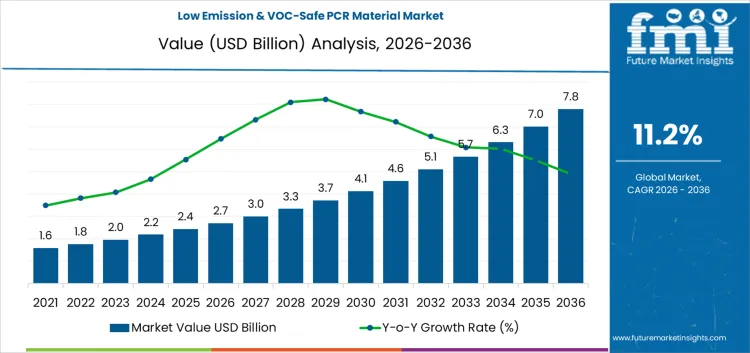
What is the Growth Forecast for Low Emission & VOC-Safe PCR Material Market through 2036?
The low emission and VOC-safe PCR material market is projected to reach USD 2.7 billion in 2026 and grow to USD 7.8 billion by 2036, registering a compound annual growth rate (CAGR) of 11.2%. From 2020 to 2026, the market grows from USD 1.4 billion in 2020 to USD 2.7 billion in 2026, driven by increased demand for materials that comply with stringent environmental and health standards. North America leads in adoption due to strong regulations around indoor air quality and emissions, while Asia Pacific shows rapid growth, spurred by rising manufacturing activity and the increasing need for safer, low-emission materials in a variety of sectors.
From 2026 to 2036, the low emission and VOC-safe PCR material market will continue to expand, reaching USD 7.8 billion by 2036. The market will grow from USD 3 billion in 2027 to USD 6.1 billion by 2034, reflecting an increasing focus on health-conscious and environmentally friendly materials in construction, automotive, and consumer products. With regulations becoming stricter, demand for low-emission and VOC-safe materials will continue to rise, especially in markets with higher health standards. Vendors that offer certified solutions and meet evolving regulatory requirements will be well-positioned to capture growth in both mature and developing markets.
Low Emission & VOC-Safe PCR Material Market Key Takeaways
| Metric | Value |
|---|---|
| Market Value (2026) | USD 2.7 billion |
| Forecast Value (2036) | USD 7.8 billion |
| Forecast CAGR 2026 to 2036 | 11.2% |
How Are Low Emission and VOC-Safe PCR Materials Improving Indoor Air Quality and Safety?
Low emission and VOC-safe post-consumer recycled (PCR) materials are increasingly adopted to reduce indoor air pollutants and provide safer surfaces in residential, commercial, and industrial applications. Historically, conventional PCR and plastic materials emitted higher levels of volatile organic compounds (VOCs), contributing to poor indoor air quality and health concerns. Modern low-emission PCR materials use refined polymer processing and filtration techniques to limit VOC release while maintaining mechanical performance, durability, and compatibility with coatings or adhesives. Building material manufacturers, interior designers, and facility managers prioritize emission standards compliance, material consistency, and long-term performance. Early adoption focused on healthcare and educational facilities, while current demand spans offices, residential buildings, and public spaces, driven by health awareness, indoor air quality requirements, and regulatory guidance. Emission rate, chemical stability, and material durability influence supplier selection.
Increasing attention to indoor air quality, regulatory standards, and long-term occupant health is shaping market growth. Compared with conventional PCR materials, low-emission solutions emphasize reduced VOC output, chemical stability, and reliable performance in enclosed spaces. Cost structures depend on polymer refinement, processing techniques, and testing protocols, concentrating margins among suppliers capable of delivering certified, high-performance materials. Designers and facility operators adopt these materials to improve indoor environments, meet emission standards, and ensure long-term safety.
What Factors Are Shaping the Demand for Low Emission and VOC Safe PCR Materials by Use Environment and Product Format in 2026?
The low emission and VOC safe PCR material market in 2026 is segmented by end use environment and by product type. By end use, demand is divided into interior building materials and finishes, residential and commercial interiors, high density residential buildings, public buildings and housing, commercial construction, and other high specification low emission projects, each with different regulatory and occupancy constraints. By product format, demand is organized around panels, profiles and flooring substrates, insulation boards and wall systems, wall panels and surface systems, interior boards and panels, and other products that vary in installation method and exposure profile. These segments reflect how developers and specifiers manage indoor air quality risk while meeting durability and cost targets.
Why Do Interior Building Materials and Finishes Represent the Largest End Use Segment?
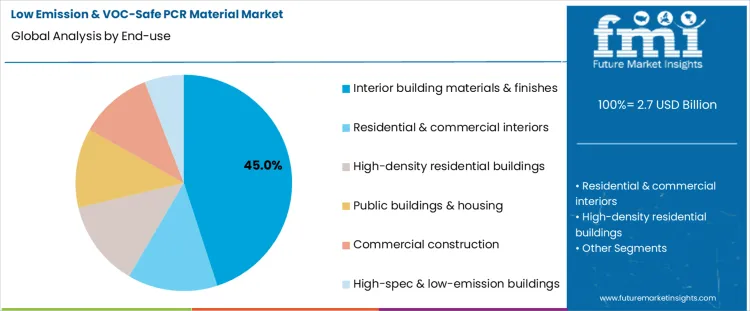
Interior building materials and finishes account for about 45% of demand in 2026, reflecting their direct and continuous contact with occupied spaces. Walls, ceilings, partitions, and fixed surfaces determine most of the exposed area inside buildings, which makes their emission profile central to indoor air quality control. In offices, schools, hospitals, and housing, these materials are installed in large quantities and remain in place for many years. Replacement is disruptive and costly, so specifiers prefer solutions that reduce complaint risk and compliance uncertainty from the start. PCR based low emission materials are selected where documentation and predictable performance matter. This concentration of surface area and long service life explains why interior finishes absorb the largest share of demand.
Other end use segments follow different renovation and procurement patterns. Commercial interiors and offices often change layouts more frequently, which shortens material life cycles even when products remain serviceable. High density residential and public housing projects are driven by budget cycles and public procurement rules, which limits the pace of upgrades. High specification projects apply stricter criteria, yet their total floor area is smaller. These categories are important, yet none combines the same scale of installed surface area with the same sensitivity to occupant exposure. This keeps general interior building materials and finishes as the primary volume driver for low emission PCR material adoption.
Why Do Panels, Profiles, and Flooring Substrates Dominate Product Demand?
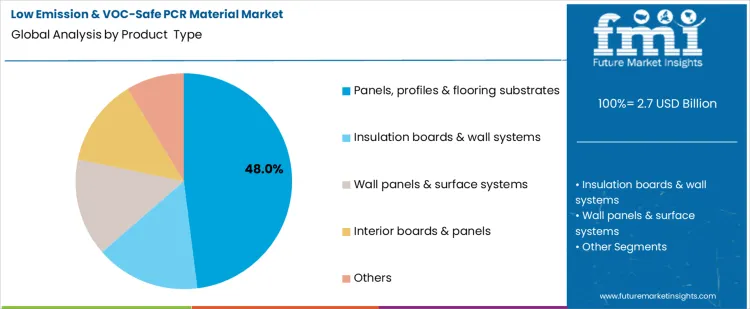
Panels, profiles, and flooring substrates account for about 48% of demand in 2026 because they form the structural base layer for many interior systems. These components sit beneath visible finishes and cover large continuous areas, which makes their emission behavior critical even though they are not always seen. Using low emission PCR materials at this level reduces cumulative exposure from multiple layers of construction. These products are also produced in high volumes and standardized sizes, which supports consistent quality control and certification. From a construction standpoint, they are installed early and remain in place for the life of the interior fit out. This combination of scale, permanence, and foundational role keeps them as the leading product category.
Insulation boards, wall systems, surface panels, and interior boards serve more specific assembly functions. Insulation products are often enclosed, which reduces direct exposure concerns. Decorative wall systems and surface panels cover smaller areas or are used selectively based on design. Interior boards vary by room type and partition layout, which fragments demand. These products are essential within their applications, yet their total installed area per project is usually lower than that of base panels and substrates. As a result, while they contribute meaningfully to overall performance goals, they do not match the volume pull created by the core structural panel and substrate layer.
Why Are Indoor Compliance Standards and Buyer Liability Policies Driving the Low Emission and VOC Safe PCR Material Market through 2036?
Demand is being pulled by risk management inside buildings rather than by material substitution targets. Commercial owners, healthcare groups, and schools increasingly specify emissions limits because complaints, remediation, and legal exposure cost more than the material premium. Fit out cycles now include air quality testing and handover documentation, which makes material choice auditable. Large buyers also standardize specifications across portfolios to avoid site by site disputes. Once a supplier is qualified against emission thresholds, repeat purchasing follows refurbishment schedules and tenant churn. This ties volume to compliance frameworks and occupancy turnover, not to short term construction sentiment or marketing driven product refresh cycles.
What Cost, Verification Burden, and Supply Consistency Risks Are Slowing Wider Adoption?
Constraints come from procurement reality. Low emission formulations often cost more to compound and require tighter process control, which raises prices in competitive tenders. Buyers also ask for test reports, batch traceability, and periodic revalidation, adding time and administrative overhead. PCR feedstock quality varies, and maintaining consistent emission performance across lots is operationally demanding. Installers and contractors prefer familiar materials that carry less callback risk. In price sensitive projects, decision makers still choose the lowest compliant option rather than the safest margin. These factors lengthen qualification cycles, limit supplier pools, and keep adoption concentrated in regulated or reputation sensitive environments.
How Are Portfolio Specifications and Testing Regimes Reshaping This Category?
The structure is shifting toward system level compliance. Large property owners and public buyers increasingly publish approved material lists tied to specific emission classes, which turns products into repeatable, auditable components of fit out programs. Testing is moving upstream, with suppliers certifying families of products rather than single items. This favors those who control formulations and feedstock streams over traders. Some customers align replacement cycles with periodic re testing windows, creating predictable demand patterns. Over time, low emission performance becomes a baseline entry requirement, and competition shifts toward consistency of supply, documentation quality, and ability to support multi-site rollouts without requalification.
What is the Demand for Low Emission and VOC-Safe PCR Material by Country?
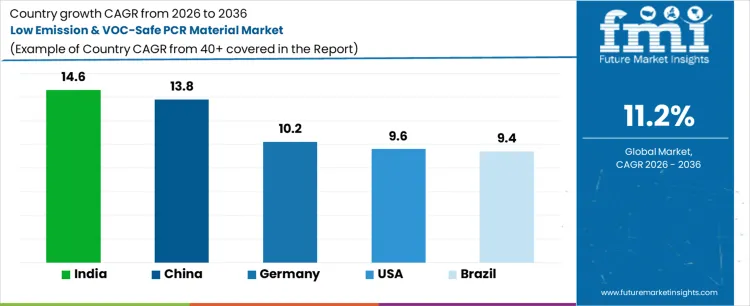
| Country | CAGR (%) |
|---|---|
| Germany | 10.2% |
| USA | 9.6% |
| China | 13.8% |
| India | 14.6% |
| Brazil | 9.4% |
Demand for low emission and VOC-safe post-consumer recycled (PCR) materials is rising as manufacturers and builders adopt materials that meet indoor air quality standards and regulatory requirements. India leads with a 14.6% CAGR, driven by growing construction and manufacturing activities requiring compliant materials. China follows at 13.8%, supported by industrial production and commercial building projects. Germany records 10.2% growth, shaped by use in residential and commercial developments. The USA grows at 9.6%, influenced by upgrades and replacement projects. Brazil shows 9.4% CAGR, reflecting increased adoption of low emission PCR materials in construction and manufacturing applications.
How is Germany experiencing growth in the low emission & VOC safe PCR material market?
Germany is experiencing growth at a CAGR of 10.2%, driven by strict building regulations, indoor air quality standards, and demand from commercial and residential construction projects. Low emission and VOC safe PCR materials are optimized for minimal chemical off-gassing, high durability, and compatibility with modern construction and interior finishing systems. Demand is concentrated in urban industrial regions such as Berlin, Munich, and Hamburg, where sustainable building practices and certification requirements are emphasized. Investments focus on material performance, compliance with EU environmental and building regulations, and integration into large-scale construction projects. Growth reflects the country’s regulatory focus on healthier indoor environments and high-performance materials.
- Regulatory standards and indoor air quality drive adoption.
- Materials optimize durability and low chemical emissions.
- Urban construction hubs concentrate demand.
- Material performance and EU compliance guide investment.
How is the United States witnessing growth in the low emission & VOC safe PCR material market?
United States is witnessing growth at a CAGR of 9.6%, supported by increasing adoption of green building certifications such as LEED, WELL, and stringent state-level air quality requirements. Low emission and VOC safe PCR materials are optimized for indoor air safety, durability, and compatibility with commercial, educational, and residential structures. Demand is concentrated in cities such as New York, Los Angeles, and Chicago, where construction of modern commercial and institutional facilities is high. Investments prioritize product safety, long-term performance, and compliance with federal and state regulations. Growth reflects rising awareness of indoor environmental health and integration of environmentally conscious materials in construction projects.
- Green building initiatives drive adoption.
- Materials enhance indoor air safety and durability.
- Major cities concentrate demand.
- Performance and regulatory compliance guide investment.
How is China experiencing growth in the low emission & VOC safe PCR material market?
China is experiencing growth at a CAGR of 13.8%, fueled by increasing construction of residential, commercial, and industrial facilities in Beijing, Shanghai, and Guangzhou, alongside government emphasis on low-emission building materials. Low emission and VOC safe PCR materials are optimized for long-term durability, chemical stability, and indoor air quality. Demand is concentrated in urban construction districts and industrial hubs. Investments focus on production scalability, quality assurance, and compliance with national environmental and building standards. Growth reflects rising adoption of healthier indoor materials, rapid urban development, and enforcement of low-VOC construction material regulations.
- Urban construction and industrial hubs drive adoption.
- Materials optimize chemical stability and indoor air safety.
- Metro construction zones concentrate demand.
- Production quality and regulatory compliance guide investment.
How is India witnessing growth in the low emission & VOC safe PCR material market?
India is witnessing growth at a CAGR of 14.6%, supported by rising awareness of indoor air quality, increasing high-rise construction, and demand for eco-friendly materials in Mumbai, Delhi, and Bengaluru. Low emission and VOC safe PCR materials are optimized for chemical safety, thermal stability, and compatibility with residential and commercial interior systems. Demand is concentrated in high-density urban construction projects and commercial complexes. Investments focus on material durability, adherence to national building and environmental codes, and integration into modern construction practices. Growth reflects the expansion of urban infrastructure and emphasis on safer indoor environments.
- High-rise and commercial construction drives adoption.
- Materials enhance chemical safety and thermal stability.
- Metro urban projects concentrate demand.
- Material durability and code compliance guide investment.
How is Brazil experiencing growth in the low emission & VOC safe PCR material market?
Brazil is experiencing growth at a CAGR of 9.4%, fueled by growing awareness of indoor environmental health and demand from commercial, residential, and industrial buildings in São Paulo, Rio de Janeiro, and Paraná. Low emission and VOC safe PCR materials are optimized for tropical climate performance, chemical stability, and long-term durability. Demand is concentrated in industrial facilities, office buildings, and housing complexes. Investments prioritize material reliability, thermal performance, and compliance with national environmental and construction standards. Growth reflects adoption of safer indoor building materials, expansion of construction activity, and modernization of building finishes.
- Indoor environmental health drives adoption.
- Materials optimize chemical stability and durability.
- Construction projects concentrate demand.
- Material reliability and regulatory compliance guide investment.
Who Are the Leading Suppliers in the Low Emission and VOC Safe PCR Material Market and How Do They Compete?
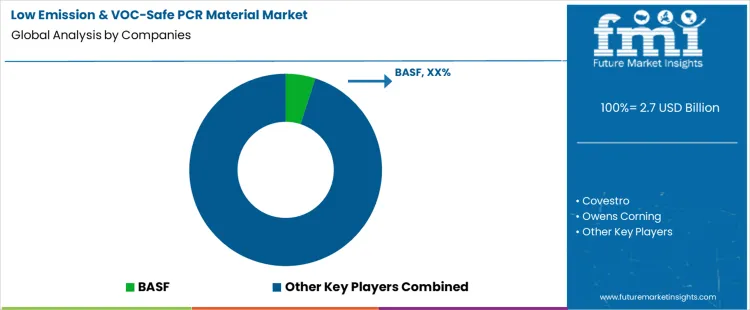
The low emission and VOC safe PCR material market is shaped by the ability to combine recycled content with chemical stability and compliance with indoor air quality standards. BASF produces PCR materials engineered to meet strict emission limits while maintaining structural performance for construction and consumer applications. Covestro develops polymers that balance low VOC output with mechanical strength, enabling use in coatings, panels, and molded products. Owens Corning supplies insulation and composite materials incorporating recycled content and verified low emissions for regulated indoor spaces. CNBM and Kingfa provide PCR resins suited for furniture, flooring, and building interiors where air quality is regulated. Greenpanel, in partnership with Reliance Industries, delivers composite panels with documented VOC compliance and sustainable material integration.
Duratex produces PCR based composites and surface materials optimized for indoor air safety and performance under environmental stress. Sekisui Chemical focuses on polymer solutions combining low emissions with durability for furniture and building applications. Regional manufacturers and niche suppliers offer customized recycled polymers that meet local emission standards or specialized end use requirements. Market differentiation arises from VOC content, recyclate proportion, mechanical properties, regulatory certifications, and processing compatibility. Suppliers that combine tested low emission performance, documentation for regulatory compliance, and versatile material properties position themselves strongly with OEMs, builders, and furniture manufacturers seeking sustainable and safe indoor materials. Adoption continues to rise due to increasing regulatory scrutiny and consumer demand for healthier indoor environments.
Key Players in the Low Emission & VOC-Safe PCR Material Market
- BASF
- Covestro
- Owens Corning
- CNBM
- Kingfa
- Greenpanel
- Reliance Industries
- Duratex
- Sekisui Chemical
Scope of the Report
| Items | Values |
|---|---|
| Quantitative Units (2026) | USD billion |
| End-use | Interior Building Materials & Finishes, Residential & Commercial Interiors, High-Density Residential Buildings, Public Buildings & Housing, Commercial Construction, High-Spec & Low-Emission Buildings |
| Product Type | Panels, Profiles & Flooring Substrates, Insulation Boards & Wall Systems, Wall Panels & Surface Systems, Interior Boards & Panels, Others |
| Material | PCR-PVC, PCR Polymers, PCR Plastics, Others |
| Technology | Low-VOC Compounding & Emission-Controlled Processing, UL GREENGUARD & CDPH-Compliant Formulations, National Low-Emission Certification Systems, Cost-Efficient VOC-Reduction Processing, Others |
| Regions Covered | Asia Pacific, Europe, North America, Latin America, Middle East & Africa |
| Countries Covered | China, Japan, South Korea, India, Australia & New Zealand, ASEAN, Germany, United Kingdom, France, Italy, Spain, Nordic, BENELUX, United States, Canada, Mexico, Brazil, Chile, Saudi Arabia, Turkey, South Africa, and other regional markets |
| Key Companies Profiled | BASF, Covestro, Owens Corning, CNBM, Kingfa, Greenpanel, Reliance Industries, Duratex, Sekisui Chemical |
| Additional Attributes | Dollar sales by end-use, product type, material, and technology; panels and substrates as the leading format; demand driven by indoor air quality rules and emission limits; procurement shaped by VOC certification and batch testing; performance influenced by feedstock consistency, compounding control, and long-term emission stability. |
Low Emission & VOC-Safe PCR Material Market Segmentation
End-use:
- Interior building materials & finishes
- Residential & commercial interiors
- High-density residential buildings
- Public buildings & housing
- Commercial construction
- High-spec & low-emission buildings
Product Type:
- Panels, profiles & flooring substrates
- Insulation boards & wall systems
- Wall panels & surface systems
- Interior boards & panels
- Others
Material:
- PCR-PVC
- PCR polymers
- PCR plastics
- Others
Technology:
- Low-VOC compounding, emission-controlled processing
- UL GREENGUARD & CDPH-compliant formulations
- National low-emission certification systems
- Cost-efficient VOC-reduction processing
- Others
Region
- Asia Pacific
- China
- Japan
- South Korea
- India
- Australia & New Zealand
- ASEAN
- Rest of Asia Pacific
- Europe
- Germany
- United Kingdom
- France
- Italy
- Spain
- Nordic
- BENELUX
- Rest of Europe
- North America
- United States
- Canada
- Mexico
- Latin America
- Brazil
- Chile
- Rest of Latin America
- Middle East & Africa
- Kingdom of Saudi Arabia
- Other GCC Countries
- Turkey
- South Africa
- Other African Union
- Rest of Middle East & Africa
Bibliography
- USA Green Building Council. (2023). LEED v4.1 building design + construction guide. USGBC.
- International WELL Building Institute. (2025). WELL v3 standard. IWBI.
- European Committee for Standardization. (2023). EN 16516: Construction products - Assessment of release of dangerous substances - Determination of emissions into indoor air. CEN.
- Government of Canada. (2023). Canadian construction materials emissions guide (CCMEG). Public Works and Government Services Canada.
- Organisation for Economic Co-operation and Development. (2024). Plastics recycled content requirements (OECD Environment Working Papers No. 236).
Frequently Asked Questions
How big is the low emission & voc-safe pcr material market in 2026?
The global low emission & voc-safe pcr material market is estimated to be valued at USD 2.7 billion in 2026.
What will be the size of low emission & voc-safe pcr material market in 2036?
The market size for the low emission & voc-safe pcr material market is projected to reach USD 7.8 billion by 2036.
How much will be the low emission & voc-safe pcr material market growth between 2026 and 2036?
The low emission & voc-safe pcr material market is expected to grow at a 11.2% CAGR between 2026 and 2036.
What are the key product types in the low emission & voc-safe pcr material market?
The key product types in low emission & voc-safe pcr material market are interior building materials & finishes, residential & commercial interiors, high-density residential buildings, public buildings & housing, commercial construction and high-spec & low-emission buildings.
Which product type segment to contribute significant share in the low emission & voc-safe pcr material market in 2026?
In terms of product type, panels, profiles & flooring substrates segment to command 48.0% share in the low emission & voc-safe pcr material market in 2026.
Preview the report firsthand - request a free sample
Get SampleGet the brochure for pricing and purchase details.
Get PDFTable of Content
- Executive Summary
- Global Market Outlook
- Demand-side Trends
- Supply-side Trends
- Technology Roadmap Analysis
- Analysis and Recommendations
- Market Overview
- Market Coverage / Taxonomy
- Market Definition / Scope / Limitations
- Market Background
- Market Dynamics
- Drivers
- Restraints
- Opportunity
- Trends
- Scenario Forecast
- Demand in Optimistic Scenario
- Demand in Likely Scenario
- Demand in Conservative Scenario
- Opportunity Map Analysis
- Product Life Cycle Analysis
- Supply Chain Analysis
- Investment Feasibility Matrix
- Value Chain Analysis
- PESTLE and Porter’s Analysis
- Regulatory Landscape
- Regional Parent Market Outlook
- Production and Consumption Statistics
- Import and Export Statistics
- Market Dynamics
- Global Market Analysis 2021 to 2025 and Forecast, 2026 to 2036
- Historical Market Size Value (USD Million) Analysis, 2021 to 2025
- Current and Future Market Size Value (USD Million) Projections, 2026 to 2036
- Y-o-Y Growth Trend Analysis
- Absolute $ Opportunity Analysis
- Global Market Pricing Analysis 2021 to 2025 and Forecast 2026 to 2036
- Global Market Analysis 2021 to 2025 and Forecast 2026 to 2036, By End-use
- Introduction / Key Findings
- Historical Market Size Value (USD Million) Analysis By End-use , 2021 to 2025
- Current and Future Market Size Value (USD Million) Analysis and Forecast By End-use , 2026 to 2036
- Interior building materials & finishes
- Residential & commercial interiors
- High-density residential buildings
- Public buildings & housing
- Commercial construction
- High-spec & low-emission buildings
- Interior building materials & finishes
- Y-o-Y Growth Trend Analysis By End-use , 2021 to 2025
- Absolute $ Opportunity Analysis By End-use , 2026 to 2036
- Global Market Analysis 2021 to 2025 and Forecast 2026 to 2036, By Product Type
- Introduction / Key Findings
- Historical Market Size Value (USD Million) Analysis By Product Type, 2021 to 2025
- Current and Future Market Size Value (USD Million) Analysis and Forecast By Product Type, 2026 to 2036
- Panels, profiles & flooring substrates
- Insulation boards & wall systems
- Wall panels & surface systems
- Interior boards & panels
- Others
- Panels, profiles & flooring substrates
- Y-o-Y Growth Trend Analysis By Product Type, 2021 to 2025
- Absolute $ Opportunity Analysis By Product Type, 2026 to 2036
- Global Market Analysis 2021 to 2025 and Forecast 2026 to 2036, By Material
- Introduction / Key Findings
- Historical Market Size Value (USD Million) Analysis By Material, 2021 to 2025
- Current and Future Market Size Value (USD Million) Analysis and Forecast By Material, 2026 to 2036
- PCR-PVC
- PCR polymers
- PCR plastics
- PCR-PVC
- Others
- PCR-PVC
- Y-o-Y Growth Trend Analysis By Material, 2021 to 2025
- Absolute $ Opportunity Analysis By Material, 2026 to 2036
- Global Market Analysis 2021 to 2025 and Forecast 2026 to 2036, By Technology
- Introduction / Key Findings
- Historical Market Size Value (USD Million) Analysis By Technology, 2021 to 2025
- Current and Future Market Size Value (USD Million) Analysis and Forecast By Technology, 2026 to 2036
- Low-VOC compounding, emission-controlled processing
- UL GREENGUARD & CDPH-compliant formulations
- National low-emission certification systems
- Cost-efficient VOC-reduction processing
- Others
- Low-VOC compounding, emission-controlled processing
- Y-o-Y Growth Trend Analysis By Technology, 2021 to 2025
- Absolute $ Opportunity Analysis By Technology, 2026 to 2036
- Global Market Analysis 2021 to 2025 and Forecast 2026 to 2036, By 0.38
- Introduction / Key Findings
- Historical Market Size Value (USD Million) Analysis By 0.38, 2021 to 2025
- Current and Future Market Size Value (USD Million) Analysis and Forecast By 0.38, 2026 to 2036
- 0.26
- 0.22
- 0.1
- 0.02
- 0.02
- 0.26
- Y-o-Y Growth Trend Analysis By 0.38, 2021 to 2025
- Absolute $ Opportunity Analysis By 0.38, 2026 to 2036
- Global Market Analysis 2021 to 2025 and Forecast 2026 to 2036, By Region
- Introduction
- Historical Market Size Value (USD Million) Analysis By Region, 2021 to 2025
- Current Market Size Value (USD Million) Analysis and Forecast By Region, 2026 to 2036
- North America
- Latin America
- Western Europe
- Eastern Europe
- East Asia
- South Asia and Pacific
- Middle East & Africa
- Market Attractiveness Analysis By Region
- North America Market Analysis 2021 to 2025 and Forecast 2026 to 2036, By Country
- Historical Market Size Value (USD Million) Trend Analysis By Market Taxonomy, 2021 to 2025
- Market Size Value (USD Million) Forecast By Market Taxonomy, 2026 to 2036
- By Country
- USA
- Canada
- Mexico
- By End-use
- By Product Type
- By Material
- By Technology
- By 0.38
- By Country
- Market Attractiveness Analysis
- By Country
- By End-use
- By Product Type
- By Material
- By Technology
- By 0.38
- Key Takeaways
- Latin America Market Analysis 2021 to 2025 and Forecast 2026 to 2036, By Country
- Historical Market Size Value (USD Million) Trend Analysis By Market Taxonomy, 2021 to 2025
- Market Size Value (USD Million) Forecast By Market Taxonomy, 2026 to 2036
- By Country
- Brazil
- Chile
- Rest of Latin America
- By End-use
- By Product Type
- By Material
- By Technology
- By 0.38
- By Country
- Market Attractiveness Analysis
- By Country
- By End-use
- By Product Type
- By Material
- By Technology
- By 0.38
- Key Takeaways
- Western Europe Market Analysis 2021 to 2025 and Forecast 2026 to 2036, By Country
- Historical Market Size Value (USD Million) Trend Analysis By Market Taxonomy, 2021 to 2025
- Market Size Value (USD Million) Forecast By Market Taxonomy, 2026 to 2036
- By Country
- Germany
- UK
- Italy
- Spain
- France
- Nordic
- BENELUX
- Rest of Western Europe
- By End-use
- By Product Type
- By Material
- By Technology
- By 0.38
- By Country
- Market Attractiveness Analysis
- By Country
- By End-use
- By Product Type
- By Material
- By Technology
- By 0.38
- Key Takeaways
- Eastern Europe Market Analysis 2021 to 2025 and Forecast 2026 to 2036, By Country
- Historical Market Size Value (USD Million) Trend Analysis By Market Taxonomy, 2021 to 2025
- Market Size Value (USD Million) Forecast By Market Taxonomy, 2026 to 2036
- By Country
- Russia
- Poland
- Hungary
- Balkan & Baltic
- Rest of Eastern Europe
- By End-use
- By Product Type
- By Material
- By Technology
- By 0.38
- By Country
- Market Attractiveness Analysis
- By Country
- By End-use
- By Product Type
- By Material
- By Technology
- By 0.38
- Key Takeaways
- East Asia Market Analysis 2021 to 2025 and Forecast 2026 to 2036, By Country
- Historical Market Size Value (USD Million) Trend Analysis By Market Taxonomy, 2021 to 2025
- Market Size Value (USD Million) Forecast By Market Taxonomy, 2026 to 2036
- By Country
- China
- Japan
- South Korea
- By End-use
- By Product Type
- By Material
- By Technology
- By 0.38
- By Country
- Market Attractiveness Analysis
- By Country
- By End-use
- By Product Type
- By Material
- By Technology
- By 0.38
- Key Takeaways
- South Asia and Pacific Market Analysis 2021 to 2025 and Forecast 2026 to 2036, By Country
- Historical Market Size Value (USD Million) Trend Analysis By Market Taxonomy, 2021 to 2025
- Market Size Value (USD Million) Forecast By Market Taxonomy, 2026 to 2036
- By Country
- India
- ASEAN
- Australia & New Zealand
- Rest of South Asia and Pacific
- By End-use
- By Product Type
- By Material
- By Technology
- By 0.38
- By Country
- Market Attractiveness Analysis
- By Country
- By End-use
- By Product Type
- By Material
- By Technology
- By 0.38
- Key Takeaways
- Middle East & Africa Market Analysis 2021 to 2025 and Forecast 2026 to 2036, By Country
- Historical Market Size Value (USD Million) Trend Analysis By Market Taxonomy, 2021 to 2025
- Market Size Value (USD Million) Forecast By Market Taxonomy, 2026 to 2036
- By Country
- Kingdom of Saudi Arabia
- Other GCC Countries
- Turkiye
- South Africa
- Other African Union
- Rest of Middle East & Africa
- By End-use
- By Product Type
- By Material
- By Technology
- By 0.38
- By Country
- Market Attractiveness Analysis
- By Country
- By End-use
- By Product Type
- By Material
- By Technology
- By 0.38
- Key Takeaways
- Key Countries Market Analysis
- USA
- Pricing Analysis
- Market Share Analysis, 2025
- By End-use
- By Product Type
- By Material
- By Technology
- By 0.38
- Canada
- Pricing Analysis
- Market Share Analysis, 2025
- By End-use
- By Product Type
- By Material
- By Technology
- By 0.38
- Mexico
- Pricing Analysis
- Market Share Analysis, 2025
- By End-use
- By Product Type
- By Material
- By Technology
- By 0.38
- Brazil
- Pricing Analysis
- Market Share Analysis, 2025
- By End-use
- By Product Type
- By Material
- By Technology
- By 0.38
- Chile
- Pricing Analysis
- Market Share Analysis, 2025
- By End-use
- By Product Type
- By Material
- By Technology
- By 0.38
- Germany
- Pricing Analysis
- Market Share Analysis, 2025
- By End-use
- By Product Type
- By Material
- By Technology
- By 0.38
- UK
- Pricing Analysis
- Market Share Analysis, 2025
- By End-use
- By Product Type
- By Material
- By Technology
- By 0.38
- Italy
- Pricing Analysis
- Market Share Analysis, 2025
- By End-use
- By Product Type
- By Material
- By Technology
- By 0.38
- Spain
- Pricing Analysis
- Market Share Analysis, 2025
- By End-use
- By Product Type
- By Material
- By Technology
- By 0.38
- France
- Pricing Analysis
- Market Share Analysis, 2025
- By End-use
- By Product Type
- By Material
- By Technology
- By 0.38
- India
- Pricing Analysis
- Market Share Analysis, 2025
- By End-use
- By Product Type
- By Material
- By Technology
- By 0.38
- ASEAN
- Pricing Analysis
- Market Share Analysis, 2025
- By End-use
- By Product Type
- By Material
- By Technology
- By 0.38
- Australia & New Zealand
- Pricing Analysis
- Market Share Analysis, 2025
- By End-use
- By Product Type
- By Material
- By Technology
- By 0.38
- China
- Pricing Analysis
- Market Share Analysis, 2025
- By End-use
- By Product Type
- By Material
- By Technology
- By 0.38
- Japan
- Pricing Analysis
- Market Share Analysis, 2025
- By End-use
- By Product Type
- By Material
- By Technology
- By 0.38
- South Korea
- Pricing Analysis
- Market Share Analysis, 2025
- By End-use
- By Product Type
- By Material
- By Technology
- By 0.38
- Russia
- Pricing Analysis
- Market Share Analysis, 2025
- By End-use
- By Product Type
- By Material
- By Technology
- By 0.38
- Poland
- Pricing Analysis
- Market Share Analysis, 2025
- By End-use
- By Product Type
- By Material
- By Technology
- By 0.38
- Hungary
- Pricing Analysis
- Market Share Analysis, 2025
- By End-use
- By Product Type
- By Material
- By Technology
- By 0.38
- Kingdom of Saudi Arabia
- Pricing Analysis
- Market Share Analysis, 2025
- By End-use
- By Product Type
- By Material
- By Technology
- By 0.38
- Turkiye
- Pricing Analysis
- Market Share Analysis, 2025
- By End-use
- By Product Type
- By Material
- By Technology
- By 0.38
- South Africa
- Pricing Analysis
- Market Share Analysis, 2025
- By End-use
- By Product Type
- By Material
- By Technology
- By 0.38
- USA
- Market Structure Analysis
- Competition Dashboard
- Competition Benchmarking
- Market Share Analysis of Top Players
- By Regional
- By End-use
- By Product Type
- By Material
- By Technology
- By 0.38
- Competition Analysis
- Competition Deep Dive
- BASF
- Overview
- Product Portfolio
- Profitability by Market Segments (Product/Age /Sales Channel/Region)
- Sales Footprint
- Strategy Overview
- Marketing Strategy
- Product Strategy
- Channel Strategy
- Covestro
- Owens Corning
- CNBM
- Kingfa
- Greenpanel
- Reliance Industries
- Duratex
- Sekisui Chemical
- BASF
- Competition Deep Dive
- Assumptions & Acronyms Used
- Research Methodology


