

- Industry Size (2026)
- USD 1.7 Bn
- Forecast (2036)
- USD 4.6 Bn
- CAGR (2026 to 2036)
- 10.5%
UV & Climate Resistant PCR Roof Material Market Forecast and Outlook 2026 to 2036
The UV and climate resistant PCR roof material market is projected to reach USD 1.7 billion in 2026 and is set to grow to USD 4.6 billion by 2036, with a CAGR of 10.5%. This growth is driven by the increasing demand for durable and high-performance roofing materials that offer protection against harsh weather conditions, including UV exposure and climate variations. Post-consumer recycled (PCR) materials are being increasingly adopted in roofing solutions as they offer both environmental benefits and cost-effectiveness without compromising on performance or longevity.
PCR roof materials, designed to resist UV degradation and climate stresses, provide excellent durability and weather resistance. These materials are gaining popularity in both residential and commercial construction due to their ability to extend roof life while reducing maintenance needs. As construction companies and developers look for cost-efficient solutions to meet performance standards and environmental goals, PCR-based roofing materials are being integrated into projects. Advancements in polymer technology are improving the strength and weather resistance of PCR roof materials, further enhancing their appeal. As demand for more reliable and resource-efficient building materials rises, the UV and climate resistant PCR roof material market is expected to expand steadily.
Quick Stats for UV & Climate Resistant PCR Roof Material Market
- UV & Climate Resistant PCR Roof Material Market Value (2026): USD 1.7 billion
- UV & Climate Resistant PCR Roof Material Market Forecast Value (2036): USD 4.6 billion
- UV & Climate Resistant PCR Roof Material Market Forecast CAGR 2026 to 2036: 10.5%
- Leading Type in UV & Climate Resistant PCR Roof Material Market: Membranes & roofing sheets
- Key Growth Regions in UV & Climate Resistant PCR Roof Material Market: Asia Pacific, North America, Europe
- Top Players in UV & Climate Resistant PCR Roof Material Market: Covestro, Carlisle, Dow, Oriental Yuhong, UFlex Building Materials, Tigre, Toray
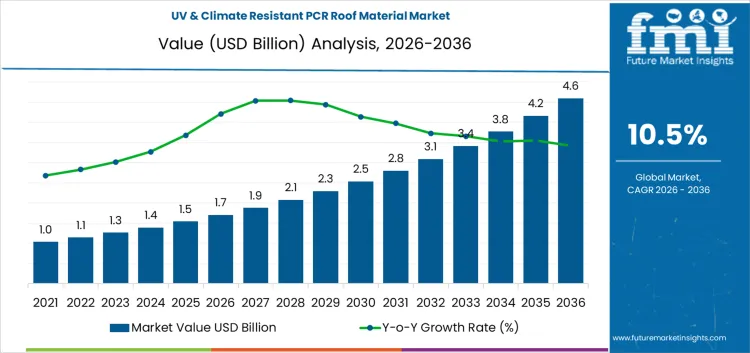
What is the Growth Forecast for UV & Climate Resistant PCR Roof Material Market through 2036?
The UV and climate resistant PCR roof material market is set to expand steadily through the forecast period, supported by growing demand for durable and weather-resilient roofing solutions that align with environmental and regulatory requirements. Adoption is being driven by increasing awareness of sustainable construction practices and the need for roofing materials that can withstand prolonged exposure to sunlight, temperature variations, and harsh climatic conditions. North America remains a key adoption region due to strict building standards, while Asia Pacific continues to gain momentum through expanding construction activity and cost-efficient material demand.
Looking ahead, growth will be sustained by tighter regulations on building materials and rising emphasis on long-lasting, certified roofing products. Manufacturers offering high-performance PCR-based materials with proven climate resistance are expected to strengthen their position, as both developed and emerging markets prioritize resilient and environmentally responsible roofing solutions.
UV & Climate Resistant PCR Roof Material Market Key Takeaways
| Metric | Value |
|---|---|
| Market Value (2026) | USD 1.7 billion |
| Forecast Value (2036) | USD 4.6 billion |
| Forecast CAGR 2026 to 2036 | 10.5% |
What Factors Are Influencing Growth in the UV & Climate Resistant PCR Roof Material Market?
Demand for UV and climate resistant post‑consumer recycled (PCR) roof materials is increasing as builders and specifiers require roofing products capable of withstanding prolonged exposure to sunlight, temperature fluctuations, and moisture. Applications include shingles, tiles, membrane sheets, and ridge caps where resistance to ultraviolet degradation, thermal cycling, and water infiltration is critical to long‑term performance. Architects and roofing contractors reference product data for color retention, tensile strength after UV exposure, and resistance to thermal cracking when comparing PCR roof materials with conventional alternatives. Building codes and construction standards in North America and Asia Pacific are incorporating material performance criteria that emphasize weather endurance alongside mechanical properties. Manufacturers are producing PCR roofing grades that satisfy these criteria and align with project specifications. Procurement teams for large roofing contracts prioritize documentation of performance testing, such as UV aging, wind uplift ratings, and moisture absorption metrics, before authorizing material use on site. As acceptance of PCR roof materials grows, projects across residential, commercial, and industrial construction sectors are increasingly specifying UV and climate resistant PCR products where in‑service durability is a key requirement.
Cost evaluation and supply stability are shaping how PCR roof materials are specified and purchased. Roofing product buyers compare PCR alternatives with traditional materials based on life cycle costs, installation efficiency, and maintenance expectations. Specific use cases include high‑sunlight regions where UV exposure accelerates material degradation and areas prone to temperature extremes that challenge thermal stability. Consistency in PCR feedstock quality and predictable performance outcomes influence supplier selection, as distributors and installers seek materials that perform uniformly across batches. Pricing dynamics relative to virgin inputs affect specification decisions, with buyers balancing material cost with expected performance over the roof service life. Validation protocols embedded in construction contracts require independent testing reports for UV resistance, thermal endurance, and water tightness before materials are accepted on site.
What Are the Key Segments in the UV & Climate Resistant PCR Roof Material Market?
The UV & Climate Resistant PCR Roof Material Market is divided into two primary segments: End-use and Roofing System Type. Commercial & residential roofing dominates the End-use segment with 45% of the market share, while Membranes & roofing sheets lead the Roofing System Type segment at 48%. These segments reflect the increasing need for roof materials that offer resistance to UV degradation, extreme weather, and environmental stress, especially in areas with intense sunlight or fluctuating climates. PCR-based roofing materials are gaining popularity due to their enhanced durability and performance, providing a sustainable solution to meet both commercial and residential roofing demands.
How Does Commercial & Residential Roofing Drive PCR Material Adoption in Roofing Systems?
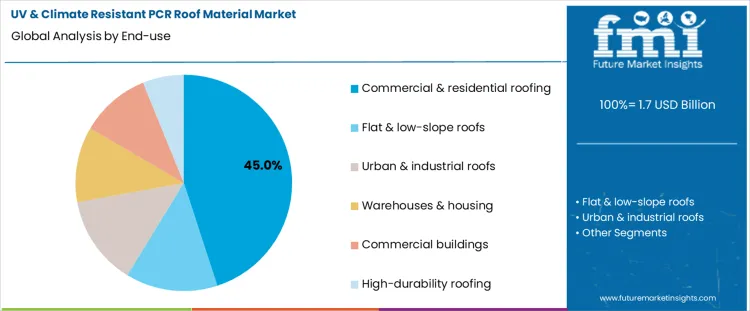
Commercial & residential roofing accounts for 45% of the End-use share in the UV & Climate Resistant PCR Roof Material Market. This segment includes various applications, such as roof coverings for residential homes, apartment buildings, and commercial properties. Roof systems in these applications need to endure exposure to UV rays, rain, and fluctuating temperatures. PCR-based materials are being increasingly adopted in roofing membranes, sheets, and coatings due to their superior climate resistance and longer lifespan. These materials provide an eco-friendly solution, replacing traditional roofing options with recycled content without compromising durability.
The adoption of PCR roofing materials in commercial and residential buildings is driven by the growing need for longer-lasting, cost-effective, and environmentally friendly roofing solutions. Additionally, regulatory pressure to use sustainable materials in construction is pushing the industry toward recycled options. The integration of PCR materials faces challenges such as ensuring consistent performance across different environmental conditions and the initial cost of raw materials. As recycling technologies improve and the cost of PCR materials becomes more competitive, the adoption of these materials in roofing systems is set to increase across both residential and commercial applications.
What Role Do Membranes & Roofing Sheets Play in the PCR Roof Material Market?
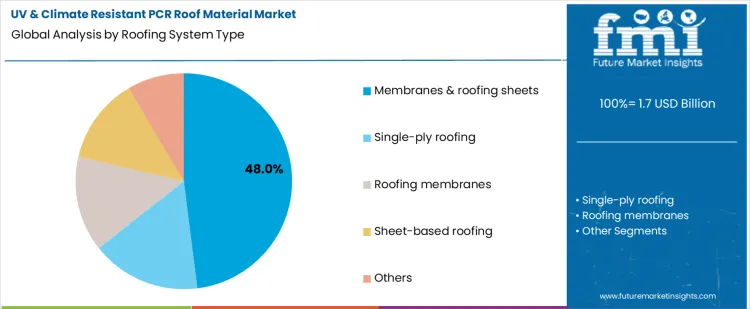
Membranes & roofing sheets dominate the Roofing System Type segment, holding 48% of the market share in the UV & Climate Resistant PCR Roof Material Market. These roofing products are widely used in both residential and commercial buildings due to their ability to offer seamless protection against weather elements. Membranes provide an additional layer of waterproofing and UV protection, while roofing sheets are essential for their durability and ease of installation. The use of PCR-based membranes and sheets enhances the material's sustainability profile while providing long-term climate resistance, making it an attractive option for modern construction projects.
The demand for PCR membranes and roofing sheets is primarily driven by the need for roofing materials that can withstand UV radiation, heat, and moisture while contributing to energy efficiency and sustainability goals. Adoption is further influenced by cost considerations, as PCR-based materials offer a more affordable solution compared to virgin materials. Challenges in the supply chain, such as the quality control of recycled feedstock and the need for consistent manufacturing processes, are being addressed by innovations in recycling and processing technologies. As these challenges are overcome, the market for PCR membranes and roofing sheets in residential, commercial, and industrial roofing applications is expected to grow, driven by their long-term performance and environmental benefits.
What Procurement and Performance Criteria Are Driving Demand for UV & Climate Resistant PCR Roof Materials?
Buyers in commercial and residential construction projects are specifying UV & Climate Resistant PCR Roof Material Market products based on quantifiable performance measures such as UV stability, thermal cycling resistance, and tensile strength. Procurement teams compare post consumer recycled (PCR) roofing membranes and shingles with conventional materials using certified test data from standards like ASTM D822 and ASTM D751. Contractors and specifiers require documentation on long term weathering resistance and color stability under prolonged sun exposure. Cost evaluations weigh material price against documented service performance and installation efficiency. Suppliers that provide batch test reports and reliable delivery schedules gain preference among building planners and roofing system manufacturers.
What Material Quality and Processing Barriers Are Restricting Growth Of UV & Climate Resistant PCR Roof Materials?
Variability in PCR feedstock composition poses challenges for roof materials expected to endure prolonged UV exposure and climatic fluctuations. Differences in polymer blends and residual contaminants can affect photo oxidative stability, moisture resistance, and dimensional integrity of recycled roofing products. Manufacturers must conduct extensive compliance testing such as accelerated weathering, hail impact resistance, and wind uplift performance to satisfy stringent building code requirements. Processing these materials often requires precise formulation and blending controls to achieve uniform properties, which increases production complexity and cost. Regional differences in roofing standards add layers of validation. These material quality and processing constraints slow broader adoption of PCR roof materials in critical roofing applications.
How Are Application Patterns Influencing Use of UV & Climate Resistant PCR Roof Materials?
Architects and roofing system designers are aligning PCR resin grades with specific performance requirements of various roofing applications, such as low slope membranes, pitched roof shingles, and solar reflective roofing systems. Design teams reference mechanical property data and UV exposure performance charts to assign appropriate PCR materials that meet project specifications for thermal expansion, weather resistance, and load bearing capacity. Roof installers conduct field trials to assess ease of handling, seam integrity, and anchoring behavior under expected climatic conditions. Material suppliers provide application guides that map PCR material characteristics to installation methods, enabling planners to match product attributes with environmental demands. These practices are guiding targeted use of PCR roof materials in selected building segments.
What Supply Chain and Cost Constraints Are Limiting Expansion Of UV & Climate Resistant PCR Roof Materials?
The UV & Climate Resistant PCR Roof Material Market faces supply chain challenges due to uneven availability of high quality recycled feedstock suitable for durable roofing applications. Collection systems for post consumer polymers with necessary mechanical and photo stability properties vary across regions, leading to inconsistent input streams. Sorting, cleaning, and preprocessing add handling costs and extend lead times. Limited compounding capacity for weather resistant PCR grades keeps unit costs higher than comparable conventional roofing materials. Price volatility of recycled inputs complicates long term procurement planning for large construction programs. These supply and cost dynamics restrict the ability of suppliers to offer stable pricing and guaranteed volumes of PCR roof materials for demanding environmental conditions.
What Are the Growth Trends for UV & Climate Resistant PCR Roof Materials by Country?
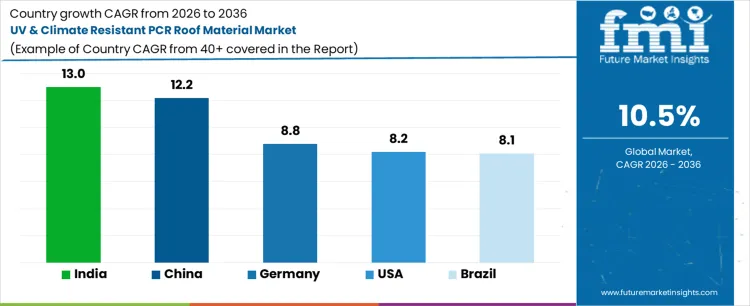
The demand for UV and climate-resistant PCR roof materials is witnessing growth across key global markets. India leads with a 13.0% CAGR, supported by an expanding construction sector, increasing focus on energy-efficient buildings, and growing regulatory initiatives promoting sustainable materials. China follows with a 12.2% growth rate, driven by significant construction and infrastructure development, along with a focus on durable, weather-resistant materials for roofing. Germany records an 8.8% CAGR, reflecting strong adoption of high-performance, environmentally-conscious materials in building construction. The USA shows steady growth at 8.2%, fueled by regulations and market demand for resilient roof materials capable of withstanding extreme weather. Brazil, with an 8.1% CAGR, is gradually increasing its use of UV and climate-resistant PCR roof materials as part of broader construction sector developments and environmental goals.
How is Germany experiencing growth in the UV & climate resistant PCR roof material market?
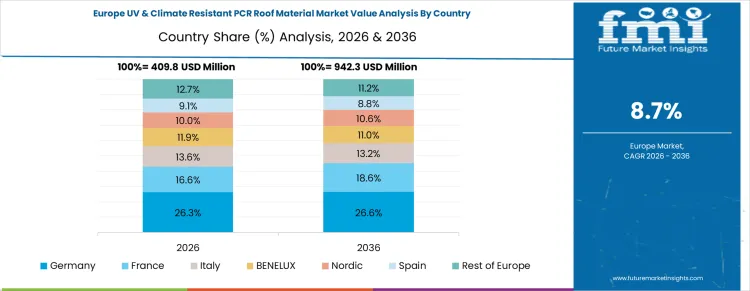
Germany is experiencing growth at a CAGR of 8.8%, supported by large-scale industrial and commercial construction projects in cities such as Berlin, Hamburg, and Munich. UV and climate-resistant PCR roof materials are optimized to handle frequent temperature fluctuations and heavy precipitation common in central Europe. Demand is concentrated in industrial complexes, logistics warehouses, and office buildings where longevity and weather resilience are critical. Investments focus on material strength, long-term thermal performance, and adherence to EU construction regulations. Growth reflects the need for high-durability roofing solutions in regions with variable weather and stringent building standards.
- Industrial and commercial construction drives adoption.
- Materials optimize weather resilience and thermal performance.
- Major industrial hubs concentrate demand.
- Regulatory compliance and material strength guide investment.
How is the United States witnessing growth in the UV & climate resistant PCR roof material market?
United States is witnessing growth at a CAGR of 8.2%, fueled by demand in hurricane-prone and variable climate zones, including Florida, Texas, and Louisiana. UV and climate-resistant PCR roof materials are optimized for high wind and sun exposure, providing long-lasting performance and energy efficiency. Demand is concentrated in residential neighborhoods, commercial complexes, and disaster-resilient infrastructure projects. Investments focus on material durability, wind load resistance, and compliance with ASTM and local building codes. Growth reflects the need for roofing materials that withstand extreme weather while maintaining structural integrity.
- Climate-resilient construction drives adoption.
- Materials enhance UV resistance and wind load capacity.
- Residential and commercial zones concentrate demand.
- Durability and regulatory compliance guide investment.
How is China experiencing growth in the UV & climate resistant PCR roof material market?
China is experiencing growth at a CAGR of 12.2%, driven by urban expansion and high-rise residential and commercial construction in Beijing, Shanghai, and Guangzhou. UV and climate-resistant PCR roof materials are optimized for heavy sun exposure and occasional extreme rainfall, ensuring long-term durability in densely populated regions. Demand is concentrated in rapidly developing urban districts with mixed residential and commercial buildings. Investments prioritize thermal performance, corrosion resistance, and compliance with national construction codes. Growth reflects the high volume of ongoing construction and the preference for long-lasting, low-maintenance roofing solutions in urban centers.
- High-rise urban construction drives adoption.
- Materials optimize sun and rain resistance.
- Rapidly developing districts concentrate demand.
- Material durability and code compliance guide investment.
How is India witnessing growth in the UV & climate resistant PCR roof material market?
India is witnessing growth at a CAGR of 13%, supported by the need for durable roofing in hot and humid climates, particularly in Mumbai, Bengaluru, and Delhi. UV and climate-resistant PCR roof materials are optimized for heat tolerance, long-term performance, and resistance to monsoon rainfall. Demand is concentrated in residential apartments, commercial offices, and industrial parks. Investments focus on material thermal stability, moisture resistance, and adherence to national building codes. Growth reflects the increasing construction of multi-story buildings in tropical regions and the requirement for roofing that withstands high temperatures and seasonal heavy rains.
- Heat and monsoon resistance drive adoption.
- Materials enhance thermal stability and moisture protection.
- Metro cities and industrial parks concentrate demand.
- Material performance and code compliance guide investment.
How is Brazil experiencing growth in the UV & climate resistant PCR roof material market?
Brazil is experiencing growth at a CAGR of 8.1%, driven by roofing demand in tropical and subtropical regions such as São Paulo, Rio de Janeiro, and Paraná. UV and climate-resistant PCR roof materials are optimized for high sun exposure, humidity, and rainfall common in these regions. Demand is concentrated in residential housing, commercial facilities, and light industrial buildings. Investments focus on material longevity, resistance to heat and moisture, and compliance with national construction regulations. Growth reflects the need for reliable roofing materials in regions with extreme weather conditions and expanding urban and semi-urban development.
- Tropical climate adaptation drives adoption.
- Materials optimize UV exposure and moisture resistance.
- Residential and commercial projects concentrate demand.
- Material longevity and regulatory compliance guide investment.
How Are Companies Competing in UV & Climate Resistant PCR Roof Material Market?
Covestro competes with PCR enhanced polycarbonate and polyurethane systems engineered for roof panels and skylights that require high UV resistance and dimensional stability under thermal cycling. Product literature highlights controlled yellowing index, long term impact retention, and consistent mechanical properties after UV exposure. Covestro positions its solutions with validated performance data from accelerated weathering tests that show minimal loss in light transmission and structural integrity. Carlisle focuses on PCR modified thermoplastic membranes designed to resist UV degradation and thermal fatigue in flat and low slope roofing applications. Technical documents detail tensile strength retention, elongation, and resistance to crack formation after prolonged UV exposure. Oriental Yuhong supplies PCR based roofing sheets and membranes with emphasis on consistent thickness and uniform polymer dispersion that support predictable performance under fluctuating temperature and solar load. UFlex Building Materials advances PCR elastomeric and TPO roof materials with calibrated formulations that balance flexibility with UV stability. Competitive strategies revolve around detailed product datasheets showing weathering performance, processing parameters, and test results such as FTIR verified polymer integrity after accelerated UV exposure and thermal cycling.
Tigre and Toray also differentiate with targeted PCR roofing solutions backed by technical validation. Tigre offers PCR enhanced PVC and polyolefin roof systems with product literature reporting controlled thermal expansion coefficients and resistance to microcracking in repeated heat cool cycles. These polymer systems are positioned with tensile and tear strength results that align with regional roofing standards. Toray competes with PCR modified high performance resin grades used in corrugated and structured roofing panels that demand sustained stiffness and impact resistance under severe climate conditions. Toray’s brochures present data on maintained flexural modulus and weathering resistance after extended UV and moisture exposure tests. Dow contributes PCR polyolefin and elastomer composites for roofing applications, with emphasis on consistent extrusion behavior and validated resistance to oxidative breakdown under UV irradiation.
Key Players in the UV & Climate Resistant PCR Roof Material Market
- Covestro
- Carlisle
- Dow
- Oriental Yuhong
- UFlex Building Materials
- Tigre
- Toray
Scope of the Report
| Items | Values |
|---|---|
| Quantitative Units (2026) | USD billion |
| End-use | Commercial & Residential Roofing, Flat & Low-Slope Roofs, Urban & Industrial Roofs, Warehouses & Housing, Commercial Buildings, High-Durability Roofing |
| Roofing System Type | Membranes & Roofing Sheets, Single-Ply Roofing, Roofing Membranes, Sheet-Based Roofing, Others |
| Material | PCR-PVC, PCR-TPO, PCR Polymers, Others |
| Technology | UV Stabilisation & Weathering Resistance, ASTM & FM-Approved Formulations, High-Output Calendaring & Extrusion, Cost-Efficient UV-Resistant Compounding, Others |
| Regions Covered | Asia Pacific, Europe, North America, Latin America, Middle East & Africa |
| Countries Covered | China, Japan, South Korea, India, Australia & New Zealand, ASEAN, Germany, United Kingdom, France, Italy, Spain, Nordic, BENELUX, United States, Canada, Mexico, Brazil, Chile, Saudi Arabia, Turkey, South Africa, and other regional markets |
| Key Companies Profiled | Covestro, Carlisle, Dow, Oriental Yuhong, UFlex Building Materials, Tigre, Toray |
| Additional Attributes | Dollar sales by end-use, roofing system type, material, and technology; membranes and sheets as the leading format; demand driven by UV stability and climate resistance; procurement shaped by ASTM and FM testing, wind uplift, and weathering performance; performance influenced by feedstock quality, compounding control, and compliance with regional roofing standards. |
UV & Climate Resistant PCR Roof Material Market Segmentation
End-use:
- Commercial & residential roofing
- Flat & low-slope roofs
- Urban & industrial roofs
- Warehouses & housing
- Commercial buildings
- High-durability roofing
Roofing System Type:
- Membranes & roofing sheets
- Single-ply roofing
- Roofing membranes
- Sheet-based roofing
- Others
Material:
- PCR-PVC
- PCR-TPO
- PCR polymers
- Others
Technology:
- UV stabilisation & weathering resistance
- ASTM & FM-approved formulations
- High-output calendaring & extrusion
- Cost-efficient UV-resistant compounding
- Others
Region
Asia Pacific
- China
- Japan
- South Korea
- India
- Australia & New Zealand
- ASEAN
- Rest of Asia Pacific
Europe
- Germany
- United Kingdom
- France
- Italy
- Spain
- Nordic
- BENELUX
- Rest of Europe
North America
- United States
- Canada
- Mexico
Latin America
- Brazil
- Chile
- Rest of Latin America
Middle East & Africa
- Kingdom of Saudi Arabia
- Other GCC Countries
- Turkey
- South Africa
- Other African Union
- Rest of Middle East & Africa
Bibliography
- Organisation for Economic Co-operation and Development. (2024). Plastics recycled content requirements (OECD Environment Working Paper No. 236). OECD Publishing.
- European Union. (2024). Construction Products Regulation (Regulation (EU) 2024/3110): Harmonised performance and sustainability requirements for construction products including recycled materials. Official Journal of the European Union.
- International Code Council. (2021). International Green Construction Code (IgCC). ICC.
- United Nations Environment Programme. (2024). Global waste management outlook 2024. UNEP.
Frequently Asked Questions
How big is the uv & climate resistant pcr roof material market in 2026?
The global uv & climate resistant pcr roof material market is estimated to be valued at USD 1.7 billion in 2026.
What will be the size of uv & climate resistant pcr roof material market in 2036?
The market size for the uv & climate resistant pcr roof material market is projected to reach USD 4.6 billion by 2036.
How much will be the uv & climate resistant pcr roof material market growth between 2026 and 2036?
The uv & climate resistant pcr roof material market is expected to grow at a 10.5% CAGR between 2026 and 2036.
What are the key product types in the uv & climate resistant pcr roof material market?
The key product types in uv & climate resistant pcr roof material market are commercial & residential roofing, flat & low-slope roofs, urban & industrial roofs, warehouses & housing, commercial buildings and high-durability roofing.
Which roofing system type segment to contribute significant share in the uv & climate resistant pcr roof material market in 2026?
In terms of roofing system type, membranes & roofing sheets segment to command 48.0% share in the uv & climate resistant pcr roof material market in 2026.
Preview the report firsthand - request a free sample
Get SampleGet the brochure for pricing and purchase details.
Get PDFTable of Content
- Executive Summary
- Global Market Outlook
- Demand-side Trends
- Supply-side Trends
- Technology Roadmap Analysis
- Analysis and Recommendations
- Market Overview
- Market Coverage / Taxonomy
- Market Definition / Scope / Limitations
- Market Background
- Market Dynamics
- Drivers
- Restraints
- Opportunity
- Trends
- Scenario Forecast
- Demand in Optimistic Scenario
- Demand in Likely Scenario
- Demand in Conservative Scenario
- Opportunity Map Analysis
- Product Life Cycle Analysis
- Supply Chain Analysis
- Investment Feasibility Matrix
- Value Chain Analysis
- PESTLE and Porter’s Analysis
- Regulatory Landscape
- Regional Parent Market Outlook
- Production and Consumption Statistics
- Import and Export Statistics
- Market Dynamics
- Global Market Analysis 2021 to 2025 and Forecast, 2026 to 2036
- Historical Market Size Value (USD Million) Analysis, 2021 to 2025
- Current and Future Market Size Value (USD Million) Projections, 2026 to 2036
- Y-o-Y Growth Trend Analysis
- Absolute $ Opportunity Analysis
- Global Market Pricing Analysis 2021 to 2025 and Forecast 2026 to 2036
- Global Market Analysis 2021 to 2025 and Forecast 2026 to 2036, By End-use
- Introduction / Key Findings
- Historical Market Size Value (USD Million) Analysis By End-use , 2021 to 2025
- Current and Future Market Size Value (USD Million) Analysis and Forecast By End-use , 2026 to 2036
- Commercial & residential roofing
- Flat & low-slope roofs
- Urban & industrial roofs
- Warehouses & housing
- Commercial buildings
- High-durability roofing
- Commercial & residential roofing
- Y-o-Y Growth Trend Analysis By End-use , 2021 to 2025
- Absolute $ Opportunity Analysis By End-use , 2026 to 2036
- Global Market Analysis 2021 to 2025 and Forecast 2026 to 2036, By Roofing System Type
- Introduction / Key Findings
- Historical Market Size Value (USD Million) Analysis By Roofing System Type, 2021 to 2025
- Current and Future Market Size Value (USD Million) Analysis and Forecast By Roofing System Type, 2026 to 2036
- Membranes & roofing sheets
- Single-ply roofing
- Roofing membranes
- Sheet-based roofing
- Others
- Membranes & roofing sheets
- Y-o-Y Growth Trend Analysis By Roofing System Type, 2021 to 2025
- Absolute $ Opportunity Analysis By Roofing System Type, 2026 to 2036
- Global Market Analysis 2021 to 2025 and Forecast 2026 to 2036, By Material
- Introduction / Key Findings
- Historical Market Size Value (USD Million) Analysis By Material, 2021 to 2025
- Current and Future Market Size Value (USD Million) Analysis and Forecast By Material, 2026 to 2036
- PCR-PVC
- PCR-TPO
- PCR polymers
- Others
- PCR-PVC
- Y-o-Y Growth Trend Analysis By Material, 2021 to 2025
- Absolute $ Opportunity Analysis By Material, 2026 to 2036
- Global Market Analysis 2021 to 2025 and Forecast 2026 to 2036, By Technology
- Introduction / Key Findings
- Historical Market Size Value (USD Million) Analysis By Technology, 2021 to 2025
- Current and Future Market Size Value (USD Million) Analysis and Forecast By Technology, 2026 to 2036
- UV stabilisation & weathering resistance
- ASTM & FM-approved formulations
- High-output calendaring & extrusion
- Cost-efficient UV-resistant compounding
- Others
- UV stabilisation & weathering resistance
- Y-o-Y Growth Trend Analysis By Technology, 2021 to 2025
- Absolute $ Opportunity Analysis By Technology, 2026 to 2036
- Global Market Analysis 2021 to 2025 and Forecast 2026 to 2036, By 0.36
- Introduction / Key Findings
- Historical Market Size Value (USD Million) Analysis By 0.36, 2021 to 2025
- Current and Future Market Size Value (USD Million) Analysis and Forecast By 0.36, 2026 to 2036
- 0.28
- 0.22
- 0.1
- 0.02
- 0.02
- 0.28
- Y-o-Y Growth Trend Analysis By 0.36, 2021 to 2025
- Absolute $ Opportunity Analysis By 0.36, 2026 to 2036
- Global Market Analysis 2021 to 2025 and Forecast 2026 to 2036, By Region
- Introduction
- Historical Market Size Value (USD Million) Analysis By Region, 2021 to 2025
- Current Market Size Value (USD Million) Analysis and Forecast By Region, 2026 to 2036
- North America
- Latin America
- Western Europe
- Eastern Europe
- East Asia
- South Asia and Pacific
- Middle East & Africa
- Market Attractiveness Analysis By Region
- North America Market Analysis 2021 to 2025 and Forecast 2026 to 2036, By Country
- Historical Market Size Value (USD Million) Trend Analysis By Market Taxonomy, 2021 to 2025
- Market Size Value (USD Million) Forecast By Market Taxonomy, 2026 to 2036
- By Country
- USA
- Canada
- Mexico
- By End-use
- By Roofing System Type
- By Material
- By Technology
- By 0.36
- By Country
- Market Attractiveness Analysis
- By Country
- By End-use
- By Roofing System Type
- By Material
- By Technology
- By 0.36
- Key Takeaways
- Latin America Market Analysis 2021 to 2025 and Forecast 2026 to 2036, By Country
- Historical Market Size Value (USD Million) Trend Analysis By Market Taxonomy, 2021 to 2025
- Market Size Value (USD Million) Forecast By Market Taxonomy, 2026 to 2036
- By Country
- Brazil
- Chile
- Rest of Latin America
- By End-use
- By Roofing System Type
- By Material
- By Technology
- By 0.36
- By Country
- Market Attractiveness Analysis
- By Country
- By End-use
- By Roofing System Type
- By Material
- By Technology
- By 0.36
- Key Takeaways
- Western Europe Market Analysis 2021 to 2025 and Forecast 2026 to 2036, By Country
- Historical Market Size Value (USD Million) Trend Analysis By Market Taxonomy, 2021 to 2025
- Market Size Value (USD Million) Forecast By Market Taxonomy, 2026 to 2036
- By Country
- Germany
- UK
- Italy
- Spain
- France
- Nordic
- BENELUX
- Rest of Western Europe
- By End-use
- By Roofing System Type
- By Material
- By Technology
- By 0.36
- By Country
- Market Attractiveness Analysis
- By Country
- By End-use
- By Roofing System Type
- By Material
- By Technology
- By 0.36
- Key Takeaways
- Eastern Europe Market Analysis 2021 to 2025 and Forecast 2026 to 2036, By Country
- Historical Market Size Value (USD Million) Trend Analysis By Market Taxonomy, 2021 to 2025
- Market Size Value (USD Million) Forecast By Market Taxonomy, 2026 to 2036
- By Country
- Russia
- Poland
- Hungary
- Balkan & Baltic
- Rest of Eastern Europe
- By End-use
- By Roofing System Type
- By Material
- By Technology
- By 0.36
- By Country
- Market Attractiveness Analysis
- By Country
- By End-use
- By Roofing System Type
- By Material
- By Technology
- By 0.36
- Key Takeaways
- East Asia Market Analysis 2021 to 2025 and Forecast 2026 to 2036, By Country
- Historical Market Size Value (USD Million) Trend Analysis By Market Taxonomy, 2021 to 2025
- Market Size Value (USD Million) Forecast By Market Taxonomy, 2026 to 2036
- By Country
- China
- Japan
- South Korea
- By End-use
- By Roofing System Type
- By Material
- By Technology
- By 0.36
- By Country
- Market Attractiveness Analysis
- By Country
- By End-use
- By Roofing System Type
- By Material
- By Technology
- By 0.36
- Key Takeaways
- South Asia and Pacific Market Analysis 2021 to 2025 and Forecast 2026 to 2036, By Country
- Historical Market Size Value (USD Million) Trend Analysis By Market Taxonomy, 2021 to 2025
- Market Size Value (USD Million) Forecast By Market Taxonomy, 2026 to 2036
- By Country
- India
- ASEAN
- Australia & New Zealand
- Rest of South Asia and Pacific
- By End-use
- By Roofing System Type
- By Material
- By Technology
- By 0.36
- By Country
- Market Attractiveness Analysis
- By Country
- By End-use
- By Roofing System Type
- By Material
- By Technology
- By 0.36
- Key Takeaways
- Middle East & Africa Market Analysis 2021 to 2025 and Forecast 2026 to 2036, By Country
- Historical Market Size Value (USD Million) Trend Analysis By Market Taxonomy, 2021 to 2025
- Market Size Value (USD Million) Forecast By Market Taxonomy, 2026 to 2036
- By Country
- Kingdom of Saudi Arabia
- Other GCC Countries
- Turkiye
- South Africa
- Other African Union
- Rest of Middle East & Africa
- By End-use
- By Roofing System Type
- By Material
- By Technology
- By 0.36
- By Country
- Market Attractiveness Analysis
- By Country
- By End-use
- By Roofing System Type
- By Material
- By Technology
- By 0.36
- Key Takeaways
- Key Countries Market Analysis
- USA
- Pricing Analysis
- Market Share Analysis, 2025
- By End-use
- By Roofing System Type
- By Material
- By Technology
- By 0.36
- Canada
- Pricing Analysis
- Market Share Analysis, 2025
- By End-use
- By Roofing System Type
- By Material
- By Technology
- By 0.36
- Mexico
- Pricing Analysis
- Market Share Analysis, 2025
- By End-use
- By Roofing System Type
- By Material
- By Technology
- By 0.36
- Brazil
- Pricing Analysis
- Market Share Analysis, 2025
- By End-use
- By Roofing System Type
- By Material
- By Technology
- By 0.36
- Chile
- Pricing Analysis
- Market Share Analysis, 2025
- By End-use
- By Roofing System Type
- By Material
- By Technology
- By 0.36
- Germany
- Pricing Analysis
- Market Share Analysis, 2025
- By End-use
- By Roofing System Type
- By Material
- By Technology
- By 0.36
- UK
- Pricing Analysis
- Market Share Analysis, 2025
- By End-use
- By Roofing System Type
- By Material
- By Technology
- By 0.36
- Italy
- Pricing Analysis
- Market Share Analysis, 2025
- By End-use
- By Roofing System Type
- By Material
- By Technology
- By 0.36
- Spain
- Pricing Analysis
- Market Share Analysis, 2025
- By End-use
- By Roofing System Type
- By Material
- By Technology
- By 0.36
- France
- Pricing Analysis
- Market Share Analysis, 2025
- By End-use
- By Roofing System Type
- By Material
- By Technology
- By 0.36
- India
- Pricing Analysis
- Market Share Analysis, 2025
- By End-use
- By Roofing System Type
- By Material
- By Technology
- By 0.36
- ASEAN
- Pricing Analysis
- Market Share Analysis, 2025
- By End-use
- By Roofing System Type
- By Material
- By Technology
- By 0.36
- Australia & New Zealand
- Pricing Analysis
- Market Share Analysis, 2025
- By End-use
- By Roofing System Type
- By Material
- By Technology
- By 0.36
- China
- Pricing Analysis
- Market Share Analysis, 2025
- By End-use
- By Roofing System Type
- By Material
- By Technology
- By 0.36
- Japan
- Pricing Analysis
- Market Share Analysis, 2025
- By End-use
- By Roofing System Type
- By Material
- By Technology
- By 0.36
- South Korea
- Pricing Analysis
- Market Share Analysis, 2025
- By End-use
- By Roofing System Type
- By Material
- By Technology
- By 0.36
- Russia
- Pricing Analysis
- Market Share Analysis, 2025
- By End-use
- By Roofing System Type
- By Material
- By Technology
- By 0.36
- Poland
- Pricing Analysis
- Market Share Analysis, 2025
- By End-use
- By Roofing System Type
- By Material
- By Technology
- By 0.36
- Hungary
- Pricing Analysis
- Market Share Analysis, 2025
- By End-use
- By Roofing System Type
- By Material
- By Technology
- By 0.36
- Kingdom of Saudi Arabia
- Pricing Analysis
- Market Share Analysis, 2025
- By End-use
- By Roofing System Type
- By Material
- By Technology
- By 0.36
- Turkiye
- Pricing Analysis
- Market Share Analysis, 2025
- By End-use
- By Roofing System Type
- By Material
- By Technology
- By 0.36
- South Africa
- Pricing Analysis
- Market Share Analysis, 2025
- By End-use
- By Roofing System Type
- By Material
- By Technology
- By 0.36
- USA
- Market Structure Analysis
- Competition Dashboard
- Competition Benchmarking
- Market Share Analysis of Top Players
- By Regional
- By End-use
- By Roofing System Type
- By Material
- By Technology
- By 0.36
- Competition Analysis
- Competition Deep Dive
- Covestro
- Overview
- Product Portfolio
- Profitability by Market Segments (Product/Age /Sales Channel/Region)
- Sales Footprint
- Strategy Overview
- Marketing Strategy
- Product Strategy
- Channel Strategy
- Carlisle
- Oriental Yuhong
- UFlex Building Materials
- Tigre
- Toray
- Dow
- Covestro
- Competition Deep Dive
- Assumptions & Acronyms Used
- Research Methodology


