

- Industry Size (2026)
- USD 1720.0 Mn
- Forecast (2036)
- USD 5438.2 Mn
- CAGR (2026 to 2036)
- 12.2%
Heat-Resistant PCR ABS Market Forecast and Outlook 2026 to 2036
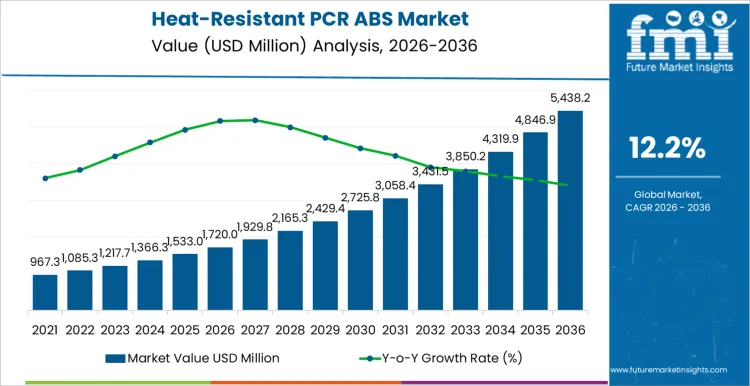
The heat-resistant PCR ABS market is likely to reach USD 1,720.0 million in 2026 and is set to expand to USD 5,438.2 million by 2036, at a CAGR of 12.2% as manufacturers replace virgin ABS in thermally demanding applications. Automotive interiors, electrical housings, and consumer electronics increasingly rely on recycled ABS grades that retain dimensional stability and impact strength under sustained heat exposure. Heat-stabilised PCR ABS formulations with controlled molecular architecture and additive systems enable use in components exposed to cabin heat, soldering processes, and continuous operating temperatures without deformation or surface degradation. OEM sustainability targets accelerate qualification of these grades across visible and functional parts.
Adoption patterns are shaped by the ability of compounders to manage feedstock variability while meeting tight thermal and mechanical tolerances. Advanced sorting, decontamination, and re-compounding processes improve consistency in melt flow and heat deflection performance, supporting injection-molded housings and precision components. Qualification cycles remain rigorous, particularly in automotive and electronics, where long-term heat ageing, odor control, and surface quality are critical. Cost sensitivity persists in mass-market segments, but performance parity with virgin ABS positions heat-resistant PCR ABS as a viable material choice across regulated and durability-driven applications.
Quick Stats for Heat-Resistant PCR ABS Market
- Heat-Resistant PCR ABS Market Value (2026): USD 1,720.0 million
- Heat-Resistant PCR ABS Market Forecast Value (2036): USD 5,438.2 million
- Heat-istant PCR ABS Market Forecast CAGR (2026-2036): 12.2%
- Leading Material Grade by Demand Share: Heat-stabilised PCR-ABS
- Fastest-Growing Countries: India, China, USA, Germany, Japan
- Top Players in Global Demand: Lanxess, BASF, Avient, SABIC, Toray
Heat-Resistant PCR ABS Market Key Takeaways
| Metric | Value |
|---|---|
| Market Value (2026) | USD 1,720.0 million |
| Market Forecast Value (2036) | USD 5,438.2 million |
| Forecast CAGR (2026-2036) | 12.2% |
Why is the Demand for Heat-Resistant PCR ABS Growing?
Automotive and consumer electronics manufacturers are increasingly specifying heat-resistant post-consumer recycled ABS (PCR ABS) for components exposed to elevated temperatures during operation or processing. Under-hood clips, connectors near engine compartments, and fuse box housings must withstand prolonged heat cycles without warping or losing dimensional stability. Traditional PCR ABS grades often lack the thermal performance needed for these applications, leading compounders to develop heat-resistant formulations with controlled molecular weight and tailored impact modifiers that maintain strength at higher service temperatures. Electronics OEMs selecting PCR ABS for speakers, bezels, and handheld housings require stable thermal properties to ensure reliability during soldering, reflow processes, and field use.
Packaging producers in hot-fill and sterilized product lines are also driving interest in heat-resistant PCR ABS because these operations expose plastic components to conditions that can compromise mechanical integrity. The shift toward sustainable materials in rigid packaging for cosmetics and durable goods encourages converters to adopt PCR ABS that resists distortion during thermal cycles. Material engineers focus on refining contaminant removal and compatibilization to restore performance attributes lost during prior use and recycling. Technical teams conduct differential scanning calorimetry and thermal aging tests to verify that PCR ABS meets specific heat deflection requirements and maintains tensile and impact performance across expected temperature ranges.
How Is the Heat-Resistant PCR ABS Industry Segmented by Material Grade, Performance Technology, and End Use?
Demand for heat-resistant PCR ABS is driven by electronics thermal exposure, durability expectations, and recycled content integration targets. Manufacturers require recycled ABS compounds that maintain dimensional stability, impact strength, and surface quality under elevated operating temperatures. Selection criteria include heat ageing resistance, processing consistency, and compatibility with injection-molded housings. Segmentation by material grade, performance technology, and end use explains how formulation strategies align with thermal performance needs across consumer electronics, appliances, and precision electrical components.
Which Material Grade Holds the Largest Share in Heat-Resistant PCR ABS?
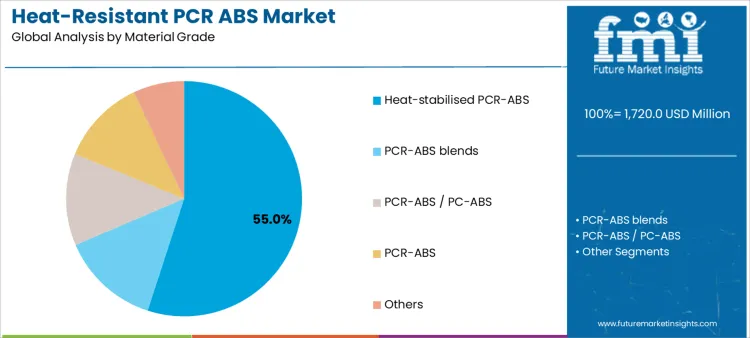
Heat-stabilised PCR-ABS holds 55.0%, reflecting priority placed on thermal endurance and mechanical reliability in recycled ABS applications. These grades incorporate stabilisation packages designed to counter heat-induced degradation and color shift during service life. Adoption is strongest in applications exposed to continuous operating temperatures and internal heat build-up. Other grades, including PCR-ABS blends, PCR-ABS or PC-ABS hybrids, base PCR-ABS, and other formulations, support varied cost or performance objectives without disclosed share values. Material-grade segmentation highlights strong concentration around stabilised solutions capable of replacing virgin ABS in heat-sensitive components.
Key Points
- Heat-stabilised grades address thermal durability requirements.
- Stabilisation improves long-term mechanical consistency.
- Alternative grades support differentiated cost or design needs.
How Does Performance Technology Influence Heat-Resistant PCR ABS Adoption?
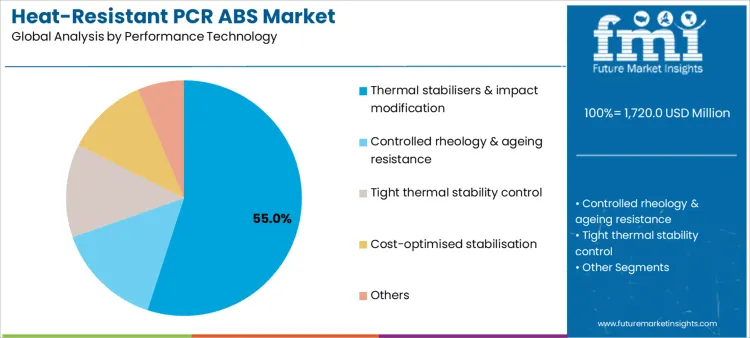
Thermal stabilisers and impact modification account for 55.0%, underscoring the importance of maintaining toughness under repeated heat exposure. These technologies enhance resistance to embrittlement, warpage, and surface degradation. Controlled rheology and ageing resistance, tight thermal stability control, cost-optimised stabilisation, and other approaches address specific processing or economic priorities without quantified shares. Performance-technology segmentation reflects how compounders balance thermal endurance, flow behavior, and lifecycle reliability to meet electronics and appliance specifications.
Key Points
- Thermal stabilisation protects against heat ageing.
- Impact modification preserves toughness at elevated temperatures.
- Rheology control supports consistent molding behavior.
Which End Uses Drive Demand for Heat-Resistant PCR ABS?
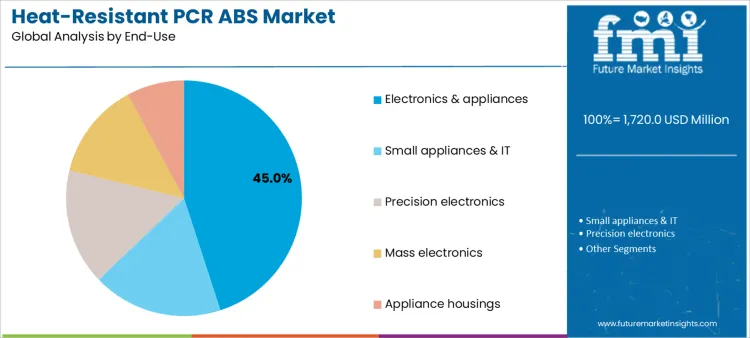
Electronics and appliances account for 45.0%, driven by enclosure requirements for heat dissipation, dimensional stability, and surface quality. These applications include housings subjected to internal heat sources and long operating cycles. Small appliances and IT equipment, precision electronics, mass electronics, and appliance housings contribute additional demand without disclosed share values. End-use segmentation shows concentration where recycled ABS must meet strict thermal and mechanical specifications while supporting sustainability commitments from electronics manufacturers.
Key Points
- Electronics demand stable performance under heat exposure.
- Appliance housings require long-term dimensional integrity.
- Sustainability goals accelerate PCR ABS adoption in electronics.
What are the Key Dynamics in the Heat-Resistant PCR ABS Market?
Demand in the heat-resistant PCR ABS market is propelled by manufacturers seeking recycled engineering plastics that maintain thermal performance in demanding applications. Industries such as automotive interior components, appliance housings, and industrial equipment panels require ABS grades that can withstand elevated service temperatures without deformation or loss of mechanical integrity. Post-consumer recycled (PCR) ABS must balance sustainability goals with performance demands that are traditionally met by virgin heat-stabilized ABS. Buyers prioritize consistent thermal resistance, impact strength, and dimensional stability to support functional and aesthetic requirements in finished parts.
How do thermal performance requirements in targeted applications influence adoption?
In automotive interiors, heat-resistant PCR ABS is specified for components exposed to prolonged sun and cabin heat, such as instrument panels, door trim, and console bezels. These parts must retain shape and surface quality at temperatures that can exceed 80 °C during summer operation, and PCR variants are evaluated for their ability to match virgin resin performance under thermal cycling. Household appliances like vacuum cleaners and microwave oven housings also demand materials that resist heat during use and cleaning. Industrial control panels and enclosures, which may be subjected to elevated ambient temperatures near motors or electronics, require PCR ABS grades with stable mechanical properties to avoid creep or stress cracking. Material engineers assess heat deflection temperature, tensile modulus, and impact resistance across multiple production lots to ensure reliability.
How do feedstock quality variability and processing considerations affect market growth?
Growth of the heat-resistant PCR ABS market is influenced by the availability of high-quality recycled ABS feedstock and by how well PCR grades process on standard equipment. Recovered ABS from post-consumer sources can contain contaminants or additives that compromise thermal stability unless effectively removed during recycling. Advanced sorting and decontamination, as well as controlled re-compounding techniques, help generate PCR ABS with predictable melt flow and stabilized performance, though these steps add cost relative to virgin resin. Processing conditions such as extrusion temperature and residence time must be carefully managed to avoid degradation that could reduce heat resistance or mechanical properties. The need for rigorous qualification and testing, particularly in safety-critical applications like automotive interiors, extends time to market for new PCR ABS grades. Price sensitivity in value-oriented segments also influences adoption, as premium heat-resistant PCR ABS must compete with established virgin ABS while delivering comparable performance and compliance with regional safety standards.
How Is Demand for the Heat-Resistant PCR ABS Market Evolving Globally?
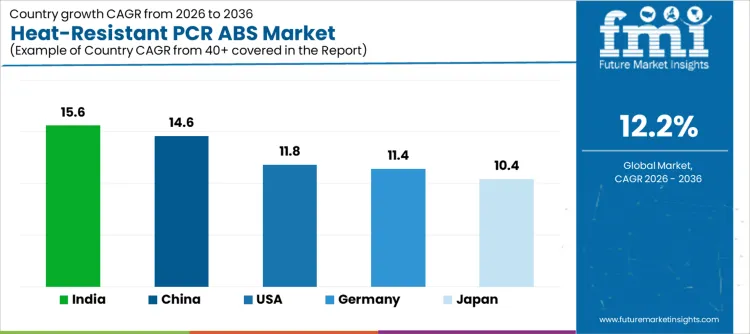
Global demand for heat-resistant PCR ABS is rising as manufacturers replace virgin ABS in high-temperature consumer and industrial applications. Growth reflects expanding use of recycled ABS in electronics housings, automotive interiors, electrical components, and durable consumer goods requiring thermal stability and impact resistance. Regulatory pressure on recycled content and OEM sustainability targets accelerate qualification of heat-resistant PCR grades. Performance parity with virgin ABS remains a core requirement. India records 15.6% CAGR, China records 14.6% CAGR, USA records 11.8% CAGR, Germany records 11.4% CAGR, and Japan records 10.4% CAGR. Adoption is driven by engineering validation and material certification cycles rather than volume substitution alone.
|
Country |
CAGR (%) |
|
India |
15.6% |
|
China |
14.6% |
|
USA |
11.8% |
|
Germany |
11.4% |
|
Japan |
10.4% |
What is driving growth of heat-resistant PCR ABS demand in India?
Demand for heat-resistant PCR ABS in India is expanding as electronics, electrical appliances, and automotive suppliers integrate recycled engineering plastics. Growth at 15.6% CAGR reflects rising production of air conditioners, appliances, EV components, and consumer electronics requiring thermal stability. Government policies on recycled content and waste reduction increase material substitution pressure. Local compounders improve sorting, stabilization, and compounding to meet heat deflection requirements. Cost sensitivity supports blends balancing recycled content with performance retention. Demand concentrates within appliance housings, electrical enclosures, and automotive interior parts serving fast-growing domestic manufacturing clusters.
- Expansion of appliance and electronics manufacturing
- Rising EV and automotive interior production
- Regulatory push for recycled engineering plastics
- Local compounding capability improvements
Why is China seeing expansion in heat-resistant PCR ABS adoption?
Heat-resistant PCR ABS demand in China is rising as large OEMs scale recycled material usage across electronics and automotive platforms. Growth at 14.6% CAGR reflects high-volume production of appliances, EVs, and electrical equipment requiring stable thermal and mechanical properties. Regulatory mandates on recycled plastics accelerate qualification programs. Domestic recyclers invest in advanced sorting, deodorization, and additive packages to achieve performance consistency. Export-oriented manufacturers prioritize PCR ABS grades meeting international safety and durability standards. Demand remains centered on centralized manufacturing hubs supplying global consumer electronics and automotive supply chains.
- High-volume electronics and EV production
- Regulatory mandates on recycled plastics
- Investment in advanced ABS recycling technologies
- Export compliance driven material qualification
What factors are shaping heat-resistant PCR ABS sales in the USA?
Sales of heat-resistant PCR ABS in the USA are increasing as OEMs execute sustainability roadmaps across durable goods and automotive components. Growth at 11.8% CAGR reflects adoption in appliance housings, EV interiors, power tools, and electrical enclosures. Performance validation focuses on heat deflection temperature, impact strength, and long-term durability. Brand risk management drives conservative qualification timelines. Retail and OEM recycled content targets influence procurement strategies. Demand is driven by portfolio-wide material transitions rather than new product categories.
- OEM recycled content commitments
- Growth of EV and durable goods segments
- Emphasis on thermal and impact performance
- Conservative material qualification processes
How is Germany supporting growth of heat-resistant PCR ABS demand?
Heat-resistant PCR ABS demand in Germany is advancing as automotive and industrial manufacturers align with circular economy regulations. Growth at 11.4% CAGR reflects strong adoption in automotive interiors, electrical components, and industrial equipment housings. EU regulations on recycled plastics increase substitution pressure for virgin ABS. German compounders emphasize traceability, consistency, and certified performance data. High engineering standards require tight control over thermal stability and emissions. Demand remains anchored in regulated industrial and automotive applications rather than consumer-driven substitution.
- EU circular economy compliance pressure
- Automotive interior material substitution
- High standards for traceability and certification
- Focus on thermal stability and emissions control
What is driving expansion of heat-resistant PCR ABS demand in Japan?
Demand for heat-resistant PCR ABS in Japan is rising as manufacturers integrate recycled materials within high-precision engineering applications. Growth at 10.4% CAGR reflects usage in electronics, appliances, and automotive components requiring strict dimensional and thermal stability. Conservative material approval processes extend qualification timelines. Emphasis on surface finish, odor control, and long-term reliability shapes adoption strategies. Domestic recyclers focus on high-purity feedstocks and controlled compounding. Demand remains concentrated within premium electronics and automotive suppliers prioritizing gradual recycled content integration.
- High precision manufacturing requirements
- Conservative material validation processes
- Focus on odor and surface quality
- Gradual recycled content integration strategies
What is the competitive landscape of demand for the heat-resistant PCR ABS market globally?
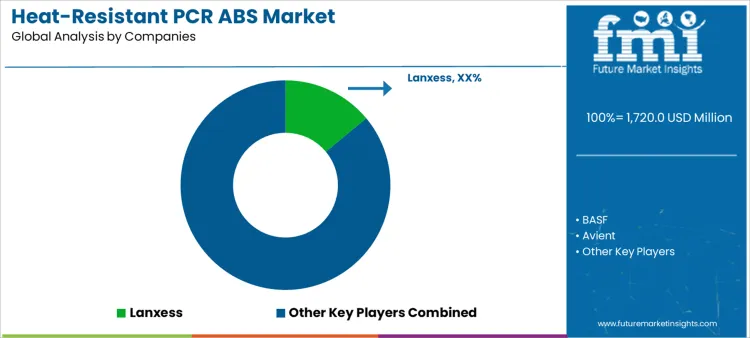
Electronics housings, automotive interiors, and appliances are driving demand for heat-resistant PCR ABS capable of retaining dimensional stability and surface quality. OEMs and compounders evaluate heat deflection temperature retention, impact strength, color stability, and odor control when recycled content is introduced. Buyer assessment includes consistency across recycled feedstock batches, processability in injection molding, flame retardant compatibility, and compliance with electrical and automotive standards. Procurement behavior favors suppliers offering certified recycled content, application-specific compounding, and predictable supply at scale. Trend in the heat-resistant PCR ABS market reflects substitution of virgin ABS in visible, high-temperature applications without sacrificing performance.
LANXESS leads competitive positioning through engineered PCR ABS compounds delivering controlled heat resistance for automotive and electrical components. BASF competes by leveraging polymer modification expertise to stabilize recycled ABS under thermal stress. Avient supports demand with customized PCR ABS formulations focused on colorability and processing consistency. SABIC maintains relevance by aligning recycled ABS compounds with its circular polymer programs serving appliance and electronics OEMs. Toray participates with specialty ABS materials emphasizing thermal performance and surface finish for demanding molded parts. Competitive differentiation centers on thermal stability retention, feedstock control, compounding capability, and ability to meet OEM qualification standards.
Key Players in the Heat-Resistant PCR ABS Market
- Lanxess
- BASF
- Avient
- SABIC
- Toray
- Mitsubishi Chemical
- Kingfa
- Wanhua
- Others
Scope of the Report
| Items | Values |
|---|---|
| Quantitative Units | USD million |
| Material Grade | Heat-stabilised PCR-ABS; PCR-ABS blends; PCR-ABS / PC-ABS; PCR-ABS; Others |
| Performance Technology | Thermal stabilisers & impact modification; Controlled rheology & ageing resistance; Tight thermal stability control; Cost-optimised stabilisation; Others |
| End-Use | Electronics & appliances; Small appliances & IT; Precision electronics; Mass electronics; Appliance housings |
| Regions Covered | Asia Pacific, Europe, North America, Latin America, Middle East & Africa |
| Countries Covered | India, China, USA, Germany, Japan, and 40+ countries |
| Key Companies Profiled | Lanxess; BASF; Avient; SABIC; Toray; Mitsubishi Chemical; Kingfa; Wanhua; Others |
| Additional Attributes | Grade-wise demand trends across appliance and electronics housings; impact of thermal stabilisation on long-term heat ageing performance; adoption of PCR-ABS/PC-ABS blends in high-temperature appliance applications; recyclability and colour stability considerations for premium electronics; procurement shifts driven by OEM sustainability and heat-resistance specifications. |
Heat-Resistant PCR ABS Market by Segment
Material Grade:
- Heat-stabilised PCR-ABS
- PCR-ABS blends
- PCR-ABS / PC-ABS
- PCR-ABS
- Others
Performance Technology:
- Thermal stabilisers & impact modification
- Controlled rheology & ageing resistance
- Tight thermal stability control
- Cost-optimised stabilisation
- Others
End-Use:
- Electronics & appliances
- Small appliances & IT
- Precision electronics
- Mass electronics
- Appliance housings
Region:
- Asia Pacific
- China
- Japan
- South Korea
- India
- Australia & New Zealand
- ASEAN
- Rest of Asia Pacific
- Europe
- Germany
- United Kingdom
- France
- Italy
- Spain
- Nordic
- BENELUX
- Rest of Europe
- North America
- United States
- Canada
- Mexico
- Latin America
- Brazil
- Chile
- Rest of Latin America
- Middle East & Africa
- Kingdom of Saudi Arabia
- Other GCC Countries
- Turkey
- South Africa
- Other African Union
- Rest of Middle East & Africa
Bibliography
- European Commission. (2023). Proposal for a regulation on packaging and packaging waste: Recyclability and recycled‑content requirements for plastic materials. Publications Office of the European Union.
- International Electrotechnical Commission. (2023). Plastics used in electrical and electronic equipment—Thermal endurance and material performance requirements (IEC TR 62680:2023). International Electrotechnical Commission.
- International Organization for Standardization. (2023). Plastics—Recycled plastics—Characterization of recycled ABS materials (ISO 15270:2023). International Organization for Standardization.
- International Organization for Standardization. (2024). Plastics—Determination of heat deflection temperature and thermal ageing behavior of recycled polymers (ISO 75‑3:2024). International Organization for Standardization.
Frequently Asked Questions
How big is the heat-resistant PCR ABS market in 2026?
The global heat-resistant PCR ABS market is estimated to be valued at USD 1,720.0 million in 2026.
What will be the size of heat-resistant PCR ABS market in 2036?
The market size for the heat-resistant PCR ABS market is projected to reach USD 5,438.2 million by 2036.
How much will be the heat-resistant PCR ABS market growth between 2026 and 2036?
The heat-resistant PCR ABS market is expected to grow at a 12.2% CAGR between 2026 and 2036.
What are the key product types in the heat-resistant PCR ABS market?
The key product types in heat-resistant PCR ABS market are heat-stabilized PCR-ABS, PCR-ABS blends, PCR-ABS/PC-ABS, PCR-ABS, and others.
Which performance technology segment to contribute significant share in the heat-resistant PCR ABS market in 2026?
In terms of performance technology, thermal stabilisers & impact modification segment to command 55.0% share in the heat-resistant PCR ABS market in 2026.
Preview the report firsthand - request a free sample
Get SampleGet the brochure for pricing and purchase details.
Get PDFTable of Content
- Executive Summary
- Global Market Outlook
- Demand-side Trends
- Supply-side Trends
- Technology Roadmap Analysis
- Analysis and Recommendations
- Market Overview
- Market Coverage / Taxonomy
- Market Definition / Scope / Limitations
- Market Background
- Market Dynamics
- Drivers
- Restraints
- Opportunity
- Trends
- Scenario Forecast
- Demand in Optimistic Scenario
- Demand in Likely Scenario
- Demand in Conservative Scenario
- Opportunity Map Analysis
- Product Life Cycle Analysis
- Supply Chain Analysis
- Investment Feasibility Matrix
- Value Chain Analysis
- PESTLE and Porter’s Analysis
- Regulatory Landscape
- Regional Parent Market Outlook
- Production and Consumption Statistics
- Import and Export Statistics
- Market Dynamics
- Global Market Analysis 2021 to 2025 and Forecast, 2026 to 2036
- Historical Market Size Value (USD Million) Analysis, 2021 to 2025
- Current and Future Market Size Value (USD Million) Projections, 2026 to 2036
- Y-o-Y Growth Trend Analysis
- Absolute $ Opportunity Analysis
- Global Market Pricing Analysis 2021 to 2025 and Forecast 2026 to 2036
- Global Market Analysis 2021 to 2025 and Forecast 2026 to 2036, By Material Grade
- Introduction / Key Findings
- Historical Market Size Value (USD Million) Analysis By Material Grade , 2021 to 2025
- Current and Future Market Size Value (USD Million) Analysis and Forecast By Material Grade , 2026 to 2036
- Heat-stabilised PCR-ABS
- PCR-ABS blends
- PCR-ABS / PC-ABS
- PCR-ABS
- Others
- Heat-stabilised PCR-ABS
- Y-o-Y Growth Trend Analysis By Material Grade , 2021 to 2025
- Absolute $ Opportunity Analysis By Material Grade , 2026 to 2036
- Global Market Analysis 2021 to 2025 and Forecast 2026 to 2036, By Performance Technology
- Introduction / Key Findings
- Historical Market Size Value (USD Million) Analysis By Performance Technology, 2021 to 2025
- Current and Future Market Size Value (USD Million) Analysis and Forecast By Performance Technology, 2026 to 2036
- Thermal stabilisers & impact modification
- Controlled rheology & ageing resistance
- Tight thermal stability control
- Cost-optimised stabilisation
- Others
- Thermal stabilisers & impact modification
- Y-o-Y Growth Trend Analysis By Performance Technology, 2021 to 2025
- Absolute $ Opportunity Analysis By Performance Technology, 2026 to 2036
- Global Market Analysis 2021 to 2025 and Forecast 2026 to 2036, By End-Use
- Introduction / Key Findings
- Historical Market Size Value (USD Million) Analysis By End-Use, 2021 to 2025
- Current and Future Market Size Value (USD Million) Analysis and Forecast By End-Use, 2026 to 2036
- Electronics & appliances
- Small appliances & IT
- Precision electronics
- Mass electronics
- Appliance housings
- Electronics & appliances
- Y-o-Y Growth Trend Analysis By End-Use, 2021 to 2025
- Absolute $ Opportunity Analysis By End-Use, 2026 to 2036
- Global Market Analysis 2021 to 2025 and Forecast 2026 to 2036, By Region
- Introduction
- Historical Market Size Value (USD Million) Analysis By Region, 2021 to 2025
- Current Market Size Value (USD Million) Analysis and Forecast By Region, 2026 to 2036
- North America
- Latin America
- Western Europe
- Eastern Europe
- East Asia
- South Asia and Pacific
- Middle East & Africa
- Market Attractiveness Analysis By Region
- North America Market Analysis 2021 to 2025 and Forecast 2026 to 2036, By Country
- Historical Market Size Value (USD Million) Trend Analysis By Market Taxonomy, 2021 to 2025
- Market Size Value (USD Million) Forecast By Market Taxonomy, 2026 to 2036
- By Country
- USA
- Canada
- Mexico
- By Material Grade
- By Performance Technology
- By End-Use
- By Country
- Market Attractiveness Analysis
- By Country
- By Material Grade
- By Performance Technology
- By End-Use
- Key Takeaways
- Latin America Market Analysis 2021 to 2025 and Forecast 2026 to 2036, By Country
- Historical Market Size Value (USD Million) Trend Analysis By Market Taxonomy, 2021 to 2025
- Market Size Value (USD Million) Forecast By Market Taxonomy, 2026 to 2036
- By Country
- Brazil
- Chile
- Rest of Latin America
- By Material Grade
- By Performance Technology
- By End-Use
- By Country
- Market Attractiveness Analysis
- By Country
- By Material Grade
- By Performance Technology
- By End-Use
- Key Takeaways
- Western Europe Market Analysis 2021 to 2025 and Forecast 2026 to 2036, By Country
- Historical Market Size Value (USD Million) Trend Analysis By Market Taxonomy, 2021 to 2025
- Market Size Value (USD Million) Forecast By Market Taxonomy, 2026 to 2036
- By Country
- Germany
- UK
- Italy
- Spain
- France
- Nordic
- BENELUX
- Rest of Western Europe
- By Material Grade
- By Performance Technology
- By End-Use
- By Country
- Market Attractiveness Analysis
- By Country
- By Material Grade
- By Performance Technology
- By End-Use
- Key Takeaways
- Eastern Europe Market Analysis 2021 to 2025 and Forecast 2026 to 2036, By Country
- Historical Market Size Value (USD Million) Trend Analysis By Market Taxonomy, 2021 to 2025
- Market Size Value (USD Million) Forecast By Market Taxonomy, 2026 to 2036
- By Country
- Russia
- Poland
- Hungary
- Balkan & Baltic
- Rest of Eastern Europe
- By Material Grade
- By Performance Technology
- By End-Use
- By Country
- Market Attractiveness Analysis
- By Country
- By Material Grade
- By Performance Technology
- By End-Use
- Key Takeaways
- East Asia Market Analysis 2021 to 2025 and Forecast 2026 to 2036, By Country
- Historical Market Size Value (USD Million) Trend Analysis By Market Taxonomy, 2021 to 2025
- Market Size Value (USD Million) Forecast By Market Taxonomy, 2026 to 2036
- By Country
- China
- Japan
- South Korea
- By Material Grade
- By Performance Technology
- By End-Use
- By Country
- Market Attractiveness Analysis
- By Country
- By Material Grade
- By Performance Technology
- By End-Use
- Key Takeaways
- South Asia and Pacific Market Analysis 2021 to 2025 and Forecast 2026 to 2036, By Country
- Historical Market Size Value (USD Million) Trend Analysis By Market Taxonomy, 2021 to 2025
- Market Size Value (USD Million) Forecast By Market Taxonomy, 2026 to 2036
- By Country
- India
- ASEAN
- Australia & New Zealand
- Rest of South Asia and Pacific
- By Material Grade
- By Performance Technology
- By End-Use
- By Country
- Market Attractiveness Analysis
- By Country
- By Material Grade
- By Performance Technology
- By End-Use
- Key Takeaways
- Middle East & Africa Market Analysis 2021 to 2025 and Forecast 2026 to 2036, By Country
- Historical Market Size Value (USD Million) Trend Analysis By Market Taxonomy, 2021 to 2025
- Market Size Value (USD Million) Forecast By Market Taxonomy, 2026 to 2036
- By Country
- Kingdom of Saudi Arabia
- Other GCC Countries
- Turkiye
- South Africa
- Other African Union
- Rest of Middle East & Africa
- By Material Grade
- By Performance Technology
- By End-Use
- By Country
- Market Attractiveness Analysis
- By Country
- By Material Grade
- By Performance Technology
- By End-Use
- Key Takeaways
- Key Countries Market Analysis
- USA
- Pricing Analysis
- Market Share Analysis, 2025
- By Material Grade
- By Performance Technology
- By End-Use
- Canada
- Pricing Analysis
- Market Share Analysis, 2025
- By Material Grade
- By Performance Technology
- By End-Use
- Mexico
- Pricing Analysis
- Market Share Analysis, 2025
- By Material Grade
- By Performance Technology
- By End-Use
- Brazil
- Pricing Analysis
- Market Share Analysis, 2025
- By Material Grade
- By Performance Technology
- By End-Use
- Chile
- Pricing Analysis
- Market Share Analysis, 2025
- By Material Grade
- By Performance Technology
- By End-Use
- Germany
- Pricing Analysis
- Market Share Analysis, 2025
- By Material Grade
- By Performance Technology
- By End-Use
- UK
- Pricing Analysis
- Market Share Analysis, 2025
- By Material Grade
- By Performance Technology
- By End-Use
- Italy
- Pricing Analysis
- Market Share Analysis, 2025
- By Material Grade
- By Performance Technology
- By End-Use
- Spain
- Pricing Analysis
- Market Share Analysis, 2025
- By Material Grade
- By Performance Technology
- By End-Use
- France
- Pricing Analysis
- Market Share Analysis, 2025
- By Material Grade
- By Performance Technology
- By End-Use
- India
- Pricing Analysis
- Market Share Analysis, 2025
- By Material Grade
- By Performance Technology
- By End-Use
- ASEAN
- Pricing Analysis
- Market Share Analysis, 2025
- By Material Grade
- By Performance Technology
- By End-Use
- Australia & New Zealand
- Pricing Analysis
- Market Share Analysis, 2025
- By Material Grade
- By Performance Technology
- By End-Use
- China
- Pricing Analysis
- Market Share Analysis, 2025
- By Material Grade
- By Performance Technology
- By End-Use
- Japan
- Pricing Analysis
- Market Share Analysis, 2025
- By Material Grade
- By Performance Technology
- By End-Use
- South Korea
- Pricing Analysis
- Market Share Analysis, 2025
- By Material Grade
- By Performance Technology
- By End-Use
- Russia
- Pricing Analysis
- Market Share Analysis, 2025
- By Material Grade
- By Performance Technology
- By End-Use
- Poland
- Pricing Analysis
- Market Share Analysis, 2025
- By Material Grade
- By Performance Technology
- By End-Use
- Hungary
- Pricing Analysis
- Market Share Analysis, 2025
- By Material Grade
- By Performance Technology
- By End-Use
- Kingdom of Saudi Arabia
- Pricing Analysis
- Market Share Analysis, 2025
- By Material Grade
- By Performance Technology
- By End-Use
- Turkiye
- Pricing Analysis
- Market Share Analysis, 2025
- By Material Grade
- By Performance Technology
- By End-Use
- South Africa
- Pricing Analysis
- Market Share Analysis, 2025
- By Material Grade
- By Performance Technology
- By End-Use
- USA
- Market Structure Analysis
- Competition Dashboard
- Competition Benchmarking
- Market Share Analysis of Top Players
- By Regional
- By Material Grade
- By Performance Technology
- By End-Use
- Competition Analysis
- Competition Deep Dive
- Lanxess
- Overview
- Product Portfolio
- Profitability by Market Segments (Product/Age /Sales Channel/Region)
- Sales Footprint
- Strategy Overview
- Marketing Strategy
- Product Strategy
- Channel Strategy
- BASF
- Avient
- SABIC
- Toray
- Mitsubishi Chemical
- Kingfa
- Wanhua
- Others
- Lanxess
- Competition Deep Dive
- Assumptions & Acronyms Used
- Research Methodology


