

- Industry Size (2026)
- USD 1080 Mn
- Forecast (2036)
- USD 3240 Mn
- CAGR (2026 to 2036)
- 11.6%
Heat-Stable PCR ABS for Small Appliances Market Forecast and Outlook 2026 to 2036
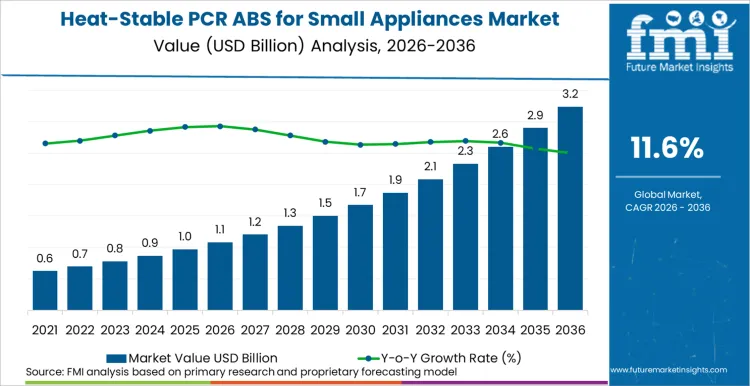
The heat-stable PCR ABS for small appliances market revenue is likely to total USD 1,080 million in 2026, rising further to USD 3,240 million by 2036, at a CAGR of 11.6%. Future Market Insights analysis indicates this market is transitioning from limited-use components to mainstream adoption in structural and aesthetic parts. This expansion through 2026 is propelled by regulatory pressures on plastic waste from durable goods, brand commitments to circularity, and breakthroughs in stabilization chemistry that allow PCR-ABS to meet UL and IEC heat resistance standards for appliances.
A primary market catalyst is the integration of recycled content into corporate sustainability scorecards for home appliance brands. BSH Hausgeräte GmbH, in its 2024 sustainability report, committed to increasing the share of recycled plastics in its products to 40% by 2030, explicitly highlighting the need for new material solutions for heat-exposed components in food processors and coffee makers. This creates a direct and scaled demand signal for qualified materials.
The technical challenge of heat-aging resistance in recycled ABS is increasingly being addressed through advanced stabilization strategies. In 2024, Trinseo continued to develop recycled-content ABS formulations within its MAGNUM™ portfolio for appliance and durable-goods applications. These materials leverage optimized antioxidant and stabilizer systems designed to mitigate oxidative degradation associated with post-consumer recycled feedstocks. By improving resistance to thermal aging and color shift, Trinseo’s PCR-ABS developments support the use of recycled content in small appliances that operate under sustained elevated-temperature conditions.
Odor control remains a critical performance requirement for polymers used in enclosed consumer appliances. Covestro has focused its material development efforts on reducing emissions and sensory impact in recycled-content ABS and PC-ABS materials used for appliance housings. Through enhanced compounding control, impurity management, and formulation optimization, recycled and circular grades within the Bayblend® and Novodur® families are engineered to meet stringent odor and heat-aging expectations. This capability is increasingly important for applications such as kitchen and personal-care appliances, where consumer acceptance depends on both long-term thermal stability and low odor generation.
The economic model is reinforced by waste stream monetization and compliance. The EU’s Ecodesign for Sustainable Products Regulation (ESPR) framework is expected to set material efficiency and recycled content requirements for appliances. Utilizing PCR-ABS helps manufacturers comply with future regulations while potentially lowering material costs compared to prime virgin ABS, especially when integrated with take-back programs that secure feedstock.
Summary of Heat-Stable PCR ABS for Small Appliances Market
What is the Long-Term Growth Outlook for the Heat-Stable PCR ABS Market?
FMI projects the global heat-stable PCR ABS for small appliances market to expand from USD 1,080 million in 2026 to USD 3,240 million by 2036, registering an 11.6% CAGR. This growth reflects the small appliance industry's strategic pivot toward circularity, necessitating materials that perform reliably under thermal stress. The market is evolving from secondary structural parts to primary housings and components in direct contact with heat sources, enabled by advancements in polymer stabilization science.
FMI Research Approach: This projection is derived from FMI's proprietary model analyzing small appliance production volumes, brand sustainability roadmaps, regulatory trends in durable goods waste, and capacity expansions for ABS recycling and compounding.
How do FMI Analysts Expect the Heat-Stable PCR ABS Market to Evolve Structurally?
FMI analysts anticipate a shift from using PCR-ABS in non-critical, non-visible parts to its adoption in high-heat, high-visibility applications. This will be driven by the development of co-stabilizer systems that protect the rubber phase (polybutadiene) within ABS from thermal embrittlement. The market will also see greater use of impact modifiers tailored for PCR to compensate for ductility loss, and the integration of inorganic heat stabilizers like metal stearates to extend service life.
FMI Research Approach: Insights are informed by tracking patent filings in ABS stabilization, analyzing heat deflection temperature (HDT) and aging data from new material data sheets, and monitoring revisions to appliance safety standards (IEC, UL) concerning material longevity.
Which Geographies Command Strategic Importance in the Heat-Stable PCR ABS Market?
Strategic growth is concentrated in regions with dense appliance manufacturing and stringent sustainability policies. China is the dominant volume producer and consumer. Europe and North America are key regulatory and innovation drivers where product longevity and recyclability are emphasized. India represents a high-growth market driven by local manufacturing expansion and new EPR rules. Japan and South Korea focus on high-precision, high-reliability applications.
FMI Research Approach: Regional market sizing is based on appliance manufacturing output, the strength of e-waste and durable goods recycling regulations, consumer purchasing power, and the localization of key material suppliers.
What Will Be the Market Size of Heat-Stable PCR ABS for Small Appliances by 2036?
By 2036, the heat-stable PCR ABS market is expected to reach USD 3,240 million. This expansion will coincide with the full integration of circular design principles into next-generation appliance platforms. The scaling of dedicated recycling streams for ABS from end-of-life appliances and the economic viability of chemically recycled ABS as a complementary feedstock to mechanical PCR will sustain growth.
FMI Research Approach: The long-term outlook incorporates forecasts for small appliance sales, projected improvements in ABS recycling yields, and the anticipated cost reduction of advanced stabilization additives at scale.
What are some Globally Distinct Trends Shaping the Heat-Stable PCR ABS Market?
Globally, the market is shaped by the demand for low VOC emissions, the need for color consistency in PCR materials, and the adoption of digital product passports. Appliances operating in enclosed spaces (e.g., kitchens) require low-VOC materials. The variable color of PCR flake drives innovation in deep-dye masterbatches. Furthermore, digital tracing of PCR content from recycler to final product is becoming important for verifying sustainability claims and complying with emerging product passport regulations.
FMI Research Approach: Trend identification involves monitoring indoor air quality standards for appliances, reviewing developments in color compounding for PCR, and analyzing pilot programs for blockchain or QR-code-based material tracking in the appliance supply chain.
Heat-Stable PCR ABS for Small Appliances Market Key Takeaways
| Metrics | Values |
|---|---|
| Expected Value (2026E) | USD 1,080 million |
| Projected Value (2036F) | USD 3,240 million |
| CAGR (2026-2036) | 11.6% |
Source: Future Market Insights (FMI) analysis, based on proprietary forecasting model and primary research
Why is the Heat-Stable PCR ABS for Small Appliances Market Growing?
The primary growth catalyst is the appliance industry's response to consumer electronics and housewares recycling laws. Regulations like the EU's Waste Electrical and Electronic Equipment Directive impose recycling targets on manufacturers, creating a direct incentive to design products for recyclability and to use recycled materials. Incorporating PCR-ABS helps close the material loop, potentially reducing future compliance costs and pre-empting more stringent recycled content mandates specific to durable goods.
Corporate carbon neutrality goals are translating into material procurement strategies. The carbon footprint of PCR-ABS is significantly lower than that of virgin ABS. Appliance brands are using life-cycle assessment data to quantify these savings, making PCR-ABS a strategic lever for reducing Scope 3 emissions. This environmental accounting is factored into supplier selection and product design, pushing OEMs to source qualified heat-stable grades.
Advancements in compatibilizer and stabilizer chemistry are enabling higher performance. The butadiene rubber phase in ABS is particularly susceptible to thermal-oxidative degradation, leading to embrittlement. New stabilizer systems, including HALS with enhanced thermal activity and phosphite-based processing stabilizers, are being tailored for the degraded matrix of PCR-ABS. These systems scavenge free radicals generated during heat aging, preserving both the rubber's impact-modifying function and the overall mechanical integrity of the part.
How is Heat-Stable PCR ABS for Small Appliances Market Segmented?
The market segment landscape is defined by the appliance industry's need for reliability, aesthetics, and cost-effectiveness in high-volume production. Kitchen and home appliances represent the largest application, requiring heat-stabilized ABS grades that can incorporate PCR content. The core material is PCR-ABS, and the enabling technology is a compounding process focused on thermal stabilization and odor control.
How are Kitchen and Home Appliances Driving Volume and Innovation?
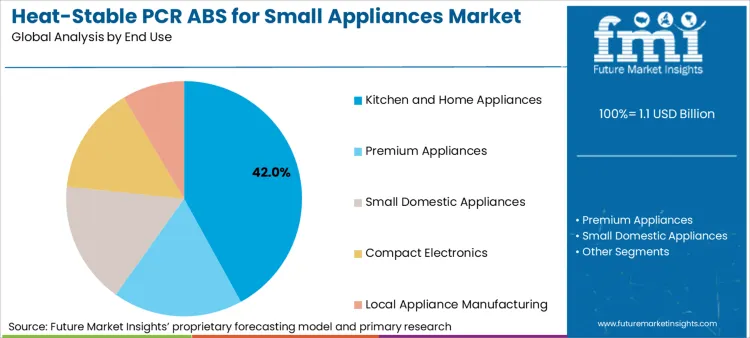
Kitchen and home appliances constitute the largest end-use segment with a 42.0% share. This includes blenders, coffee makers, kettles, vacuum cleaners, and hair styling tools. These applications demand a combination of heat resistance for parts near motors or heating elements, good surface finish for branding, and high impact strength for durability. The push to use PCR-ABS in these highly visible, touch-point products validates the material's parity with virgin ABS and serves as a powerful marketing tool for brands promoting sustainability.
This segment's requirements are rigorous. A blender jar base made from PCR-ABS must withstand cyclical heating from friction and hot liquids without warping or losing its seal, and must maintain its impact resistance to survive drops. Successfully meeting these specs with significant PCR content is the benchmark for market maturity.
Which Grade Type is optimized for PCR Integration?
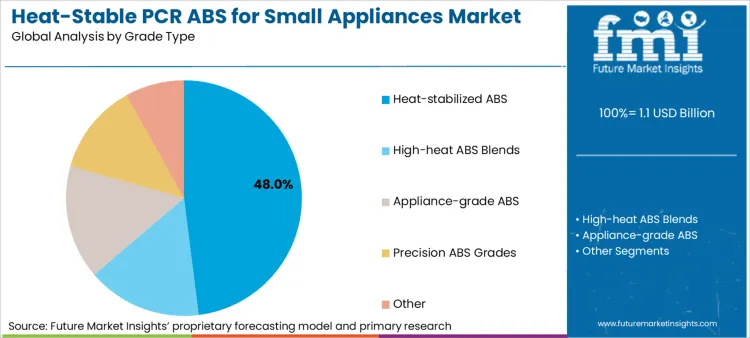
Heat-stabilized ABS grades represent the leading grade type segment with a 48.0% share. These are not standard ABS grades with added PCR; they are specifically formulated compounds. The formulation includes a base of PCR-ABS flake blended with virgin ABS to achieve a target molecular weight, fortified with a tailored package of heat stabilizers and often additional impact modifiers to counteract the embrittling effect of both the PCR and the stabilizers themselves. The compound is engineered as a system to ensure performance.
What is the Primary Recycled Feedstock?
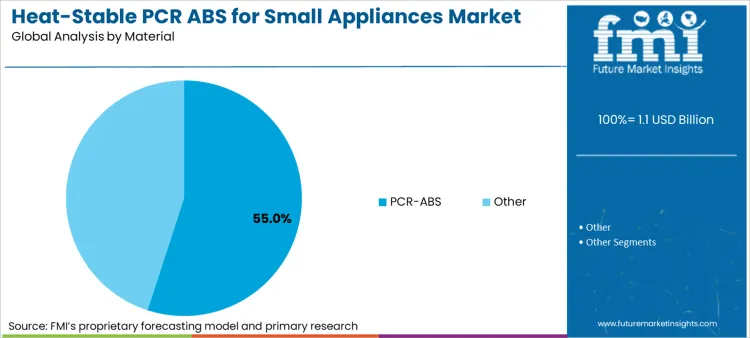
PCR-ABS constitutes the leading material segment with a 55.0% share. The primary source is ABS recovered from end-of-life electronics and appliances, such as old computer monitors, small kitchen gadgets, and toy housings.
The quality of this feedstock is paramount. Leading compounders source closed-loop or deep-clean PCR-ABS flake from specialized recyclers who use advanced washing and extrusion filtration to remove impurities, paint residues, and other polymers that could act as degradation initiators under heat.
Which Technology is Central to Performance Guarantee?
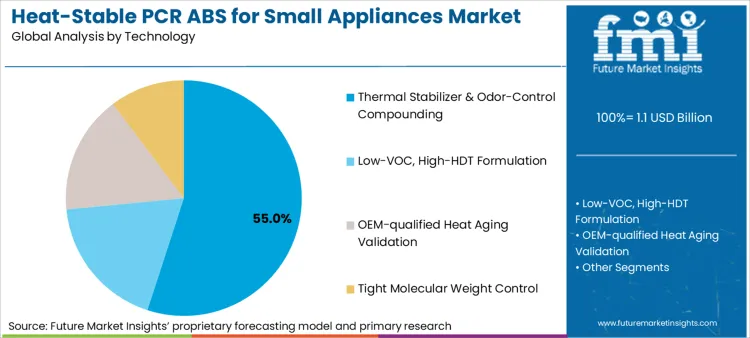
Thermal stabilizer and odor-control compounding is the dominant technology segment with a 55.0% share. This encompasses the complete process of incorporating complex additive systems into the PCR-ABS melt. It requires precise dosing and dispersion equipment to ensure uniform distribution of stabilizers.
The compounding process itself must be managed at optimized temperatures and under inert gas or vacuum where necessary to prevent thermal-oxidative damage to the polymer during processing, which would undermine the very stability the additives are meant to provide.
What Drivers, Restraints, Opportunities, and Trends Prevail in the Heat-Stable PCR ABS Market?
Expansion is driven by retailer and certification body requirements. Large retailers are implementing sustainability scorecards for home goods, and eco-labels like UL Ecologo or TCO Certified for appliances include criteria for recycled content. To access these markets and meet procurement requirements of large buyers, appliance manufacturers must incorporate certified sustainable materials, creating a top-down pull for qualified PCR-ABS compounds.
A fundamental restraint is the limited supply of high-heat, food-contact suitable PCR-ABS. While general PCR-ABS from mixed e-waste is available, the subset that can be certified for repeated food contact and continuous high-temperature service is much smaller. This scarcity creates supply chain bottlenecks and price volatility, slowing the adoption rate for applications like food processor bowls or kettle bodies, where material safety certification is lengthy and costly.
A significant opportunity lies in developing PCR-ABS for the electrification of outdoor power equipment. Cordless electric lawn mowers, leaf blowers, and trimmers have housings that can be exposed to sun and heat from motors. Developing UV-stabilized, heat-resistant PCR-ABS for these growing markets represents an adjacent sector with similar material performance needs but potentially less stringent color and aesthetic demands, allowing for a broader PCR feedstock.
A key technical trend is the use of molecular scavengers for legacy additives. PCR from old appliances may contain stabilizer systems that are now restricted or can interfere with modern additive packages. New scavenger additives can selectively bind to these legacy substances, neutralizing their negative effects and allowing a wider range of historical PCR feedstock to be upcycled into new high-performance compounds.
The trend toward monolithic part design in appliances aids PCR use. To simplify disassembly, brands are reducing the number of material types in a single appliance. Designing a vacuum cleaner body or power tool housing entirely from ABS makes the end-of-life recycling stream cleaner and more valuable, creating a positive feedback loop that improves the future supply and quality of PCR-ABS, supporting long-term circularity.
Analysis of Heat-Stable PCR ABS Market by Key Countries
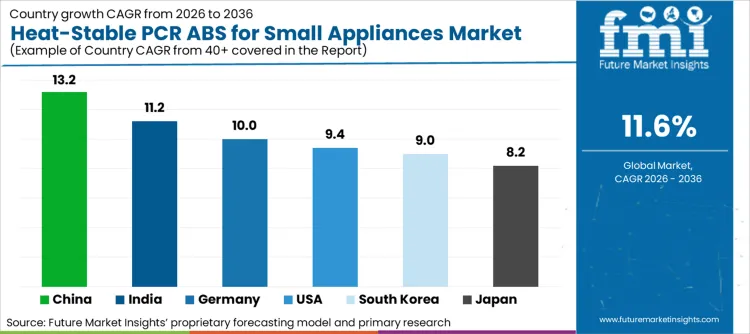
| Country | CAGR (2026-2036) |
|---|---|
| China | 13.2% |
| India | 11.2% |
| Germany | 10.0% |
| USA | 9.4% |
| South Korea | 9.0% |
| Japan | 8.2% |
Source: Future Market Insights (FMI) analysis, based on proprietary forecasting model and primary research
How are Scale, Policy, and Export Demand Converging in China?
China is projected to expand at a 13.2% CAGR through 2036, driven by its position as the workshop of the world for small appliances. Domestic policies under the Dual Carbon strategy encourage green manufacturing, while export customers demand sustainable products.
Compounders such as Kingfa and Chi Mei leverage massive production scale to produce cost-competitive heat-stable PCR-ABS. The focus is on high-volume grades for the domestic market and global OEMs, often prioritizing cost-effective stabilization systems for applications where extreme heat resistance is not the primary concern.
How is Local Manufacturing Growth and EPR Shaping the Indian Market?
India’s market is growing at an 11.2% CAGR, fueled by the Make in India initiative in appliance manufacturing and new Extended Producer Responsibility rules for plastic packaging and e-waste. Domestic OEMs serving a price-conscious market seek affordable PCR-ABS solutions.
This drives innovation in using locally collected PCR feedstock and optimizing stabilizer loadings to meet basic heat requirements at the lowest cost, making recycled content a key component of local value engineering.
Which Regulatory Leadership and Quality Focus Define the German Market?
Germany’s market, expanding at a 10.0% CAGR, is shaped by the EU's circular economy framework and Germany's own high quality and chemical safety standards such as the GS mark, Blue Angel. German appliance brands demand materials with validated long-term heat aging performance and ultra-low VOC emissions.
Compounders like Trinseo and Covestro focus on developing low-VOC, high-HDT formulations with thoroughly documented environmental and health profiles, often involving extensive OEM-specific validation testing.
How do Brand Sustainability Goals and Retailer Pressure Drive the US Market?
USA, with a 9.4% CAGR, is influenced by the sustainability commitments of global appliance brands with US operations and by retailer sustainability programs. The focus is on OEM qualification of specific PCR-ABS grades against existing internal material standards. US-based compounders like Avient and Teknor Apex work on formulating grades that pass rigorous heat aging and food contact tests where applicable to meet the validation requirements of major brands, securing supply agreements for specific product lines.
What Role does Chemical Industry Innovation Play in the South Korean Market?
South Korea’s market, with a 9.0% CAGR, is closely linked to its advanced petrochemical and electronics industries. Companies like LG Chem and LOTTE Chemical are developing high-heat PCR-ABS blends that leverage their expertise in engineering plastics.
The focus is on applications in premium, compact appliances where space constraints lead to higher operating temperatures, requiring materials with superior heat deflection temperatures and resistance to creep under load, often using blends of PCR-ABS with other heat-resistant polymers.
How do Precision, Miniaturization, and Longevity Demands Influence Japan?
Japan’s market, growing at an 8.2% CAGR, is defined by extreme demands for precision, reliability, and product longevity. Japanese appliance brands require materials with exceptionally consistent flow properties for thin-walled parts and guaranteed performance over a product's entire lifespan, which can exceed 10 years.
Material suppliers like Toray and Asahi Kasei emphasize tight molecular weight control during compounding and the use of high-purity, highly effective stabilizers to ensure that PCR-ABS performs with absolute predictability in demanding applications like high-end rice cookers or precision personal care devices.
What is the Competition Outlook for Heat-Stable PCR ABS?
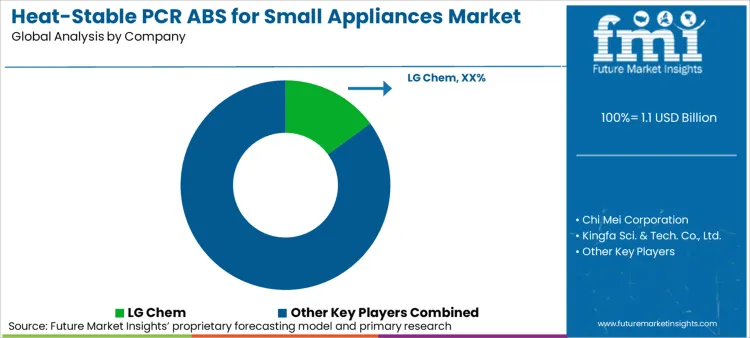
Competitive intensity centers on the dual challenge of securing consistent, clean PCR feedstock and mastering the complex science of long-term thermal stabilization. Leaders are those who can offer not just a compound, but a full package including technical data from extended heat aging tests, regulatory support for food contact or RoHS compliance, and supply chain transparency. The landscape features competition between large, integrated styrenics producers, specialized engineering compounders, and strategic alliances between recyclers and compounders.
Strategic moves are focused on creating "certified circular" value chains. This involves compounders partnering with or investing in advanced recycling facilities that can process mixed ABS waste into purified, pelletized feedstock. By controlling or tightly specifying the upstream PCR supply, they can ensure the consistency required for high-performance compounding. Success depends on building these integrated, traceable systems and securing long-term offtake agreements from appliance OEMs.
Recent Developments
- In 2024, Trinseo continued to strengthen its access to recycled ABS feedstocks through strategic engagement with European recycling partners focused on waste electrical and electronic equipment (WEEE). These initiatives support the expansion of recycled-content ABS formulations within Trinseo’s MAGNUM™ portfolio for appliance and durable-goods applications, helping to improve feedstock consistency and long-term supply security.
- In 2024, Avient Corporation advanced its colorant and additive solutions for recycled engineering thermoplastics, addressing one of the key barriers to PCR-ABS adoption in visible appliance components. By optimizing color dispersion, opacity control, and thermal stability in recycled matrices, Avient’s material technologies enable appliance manufacturers to meet tight color-matching and aesthetic specifications despite inherent variability in post-consumer ABS feedstocks.
- In 2024, European academic–industry research programs, including consortium-based initiatives such as the MATADOR project, published findings on advanced stabilization approaches for recycled styrenic polymers. These studies demonstrated that multi-component antioxidant and stabilizer systems can significantly improve the heat-aging resistance of PCR-ABS, highlighting a pathway toward next-generation additive technologies that support higher recycled content in thermally demanding appliance applications.
Key Players Profiled
- LG Chem
- Chi Mei Corporation
- Kingfa Sci. & Tech. Co., Ltd.
- Trinseo PLC
- Covestro AG
- Avient Corporation
- Teknor Apex Company
- Toray Industries, Inc.
- Asahi Kasei Corporation
- Supreme Petrochem Ltd.
- LOTTE Chemical Corporation
Market Definition
The heat-stable PCR ABS for small appliances market comprises revenue generated from the sale of acrylonitrile butadiene styrene compounds that contain significant post-consumer recycled content and are engineered to maintain their mechanical properties, dimensional stability, and aesthetic qualities when exposed to elevated temperatures typical in small appliance operation. This includes temperatures ranging from 60°C to over 100°C for sustained periods.
The market scope includes compounded, pelletized resins sold to small appliance manufacturers and their molding suppliers. Specific heat deflection temperatures, validated heat aging performance, and often certifications for food contact or low VOC emissions characterize these materials. The market excludes virgin heat-stable ABS, non-heat-stable PCR plastics, and compounds where the recycled content is primarily post-industrial.
Scope of Report
| Items | Values |
|---|---|
| Quantitative Units | USD 1,080 Million |
| End-use | Kitchen & Home Appliances, Premium Appliances, Small Domestic Appliances, Compact Electronics, Local Appliance Manufacturing |
| Grade Type | Heat-stabilized ABS, High-heat ABS Blends, Appliance-grade ABS, Precision ABS Grades, Other |
| Material | PCR-ABS, Other |
| Technology | Thermal Stabilizer & Odor-Control Compounding, Low-VOC, High-HDT Formulation, OEM-qualified Heat Aging Validation, Tight Molecular Weight Control, Other |
| Regions Covered | North America, Europe, Asia-Pacific, Latin America, Middle East & Africa |
| Countries | USA, Germany, China, Japan, India, South Korea and 40+ countries |
| Key Companies | LG Chem, Chi Mei, Kingfa, Trinseo, Covestro, Avient, Teknor Apex, Toray, Asahi Kasei, Supreme Petrochem, LOTTE Chemical |
Source: Future Market Insights (FMI) analysis, based on proprietary forecasting model and primary research
Heat-Stable PCR ABS for Small Appliances Market Key Segments
End-use
- Kitchen & Home Appliances
- Premium Appliances
- Small Domestic Appliances
- Compact Electronics
- Local Appliance Manufacturing
Grade Type
- Heat-stabilized ABS
- High-heat ABS Blends
- Appliance-grade ABS
- Precision ABS Grades
- Other
Material
- PCR-ABS
- Other
Technology
- Thermal Stabilizer & Odor-Control Compounding
- Low-VOC, High-HDT Formulation
- OEM-qualified Heat Aging Validation
- Tight Molecular Weight Control
- Other
Region
- North America
- Europe
- Asia-Pacific
- Latin America
- Middle East & Africa
Bibliography
- BSH Hausgeräte GmbH. (2024). Sustainability report 2023: Circular materials and resource efficiency in home appliances. BSH Group.
- UL Solutions. (2024). Polymeric materials for appliances: Heat aging, long-term thermal performance, and recycled content considerations. UL Solutions.
- International Electrotechnical Commission. (2024). IEC 60335 series: Safety of household and similar electrical appliances - Materials and heat resistance requirements. IEC.
- Fraunhofer Institute for Structural Durability and System Reliability LBF. (2024). Heat aging and lifetime prediction of recycled styrenic polymers for consumer goods. Fraunhofer-Gesellschaft.
- Trinseo PLC. (2024). MAGNUM™ recycled-content ABS for appliances and durable goods [Technical product bulletin].
- Covestro AG. (2024). Low-odor, heat-stable recycled polymer solutions for household appliances. Covestro Technical Publications.
Frequently Asked Questions
How big is the heat-stable pcr abs for small appliances market in 2026?
The global heat-stable pcr abs for small appliances market is estimated to be valued at USD 1.1 billion in 2026.
What will be the size of heat-stable pcr abs for small appliances market in 2036?
The market size for the heat-stable pcr abs for small appliances market is projected to reach USD 3.2 billion by 2036.
How much will be the heat-stable pcr abs for small appliances market growth between 2026 and 2036?
The heat-stable pcr abs for small appliances market is expected to grow at a 11.6% CAGR between 2026 and 2036.
What are the key product types in the heat-stable pcr abs for small appliances market?
The key product types in heat-stable pcr abs for small appliances market are kitchen and home appliances , premium appliances, small domestic appliances, compact electronics and local appliance manufacturing.
Which grade type segment to contribute significant share in the heat-stable pcr abs for small appliances market in 2026?
In terms of grade type, heat-stabilized abs segment to command 48.0% share in the heat-stable pcr abs for small appliances market in 2026.
Preview the report firsthand - request a free sample
Get SampleGet the brochure for pricing and purchase details.
Get PDFTable of Content
- Executive Summary
- Global Market Outlook
- Demand-side Trends
- Supply-side Trends
- Technology Roadmap Analysis
- Analysis and Recommendations
- Market Overview
- Market Coverage / Taxonomy
- Market Definition / Scope / Limitations
- Research Methodology
- Chapter Orientation
- Analytical Lens and Working Hypotheses
- Market Structure, Signals, and Trend Drivers
- Benchmarking and Cross-market Comparability
- Market Sizing, Forecasting, and Opportunity Mapping
- Research Design and Evidence Framework
- Desk Research Programme (Secondary Evidence)
- Company Annual and Sustainability Reports
- Peer-reviewed Journals and Academic Literature
- Corporate Websites, Product Literature, and Technical Notes
- Earnings Decks and Investor Briefings
- Statutory Filings and Regulatory Disclosures
- Technical White Papers and Standards Notes
- Trade Journals, Industry Magazines, and Analyst Briefs
- Conference Proceedings, Webinars, and Seminar Materials
- Government Statistics Portals and Public Data Releases
- Press Releases and Reputable Media Coverage
- Specialist Newsletters and Curated Briefings
- Sector Databases and Reference Repositories
- FMI Internal Proprietary Databases and Historical Market Datasets
- Subscription Datasets and Paid Sources
- Social Channels, Communities, and Digital Listening Inputs
- Additional Desk Sources
- Expert Input and Fieldwork (Primary Evidence)
- Primary Modes
- Qualitative Interviews and Expert Elicitation
- Quantitative Surveys and Structured Data Capture
- Blended Approach
- Why Primary Evidence is Used
- Field Techniques
- Interviews
- Surveys
- Focus Groups
- Observational and In-context Research
- Social and Community Interactions
- Stakeholder Universe Engaged
- C-suite Leaders
- Board Members
- Presidents and Vice Presidents
- R&D and Innovation Heads
- Technical Specialists
- Domain Subject-matter Experts
- Scientists
- Physicians and Other Healthcare Professionals
- Governance, Ethics, and Data Stewardship
- Research Ethics
- Data Integrity and Handling
- Primary Modes
- Tooling, Models, and Reference Databases
- Desk Research Programme (Secondary Evidence)
- Data Engineering and Model Build
- Data Acquisition and Ingestion
- Cleaning, Normalisation, and Verification
- Synthesis, Triangulation, and Analysis
- Quality Assurance and Audit Trail
- Market Background
- Market Dynamics
- Drivers
- Restraints
- Opportunity
- Trends
- Scenario Forecast
- Demand in Optimistic Scenario
- Demand in Likely Scenario
- Demand in Conservative Scenario
- Opportunity Map Analysis
- Product Life Cycle Analysis
- Supply Chain Analysis
- Investment Feasibility Matrix
- Value Chain Analysis
- PESTLE and Porter’s Analysis
- Regulatory Landscape
- Regional Parent Market Outlook
- Production and Consumption Statistics
- Import and Export Statistics
- Market Dynamics
- Global Market Analysis 2021 to 2025 and Forecast, 2026 to 2036
- Historical Market Size Value (USD Million) Analysis, 2021 to 2025
- Current and Future Market Size Value (USD Million) Projections, 2026 to 2036
- Y-o-Y Growth Trend Analysis
- Absolute $ Opportunity Analysis
- Global Market Pricing Analysis 2021 to 2025 and Forecast 2026 to 2036
- Global Market Analysis 2021 to 2025 and Forecast 2026 to 2036, By End Use
- Introduction / Key Findings
- Historical Market Size Value (USD Million) Analysis By End Use , 2021 to 2025
- Current and Future Market Size Value (USD Million) Analysis and Forecast By End Use , 2026 to 2036
- Kitchen and Home Appliances
- Premium Appliances
- Small Domestic Appliances
- Compact Electronics
- Local Appliance Manufacturing
- Kitchen and Home Appliances
- Y-o-Y Growth Trend Analysis By End Use , 2021 to 2025
- Absolute $ Opportunity Analysis By End Use , 2026 to 2036
- Global Market Analysis 2021 to 2025 and Forecast 2026 to 2036, By Grade Type
- Introduction / Key Findings
- Historical Market Size Value (USD Million) Analysis By Grade Type, 2021 to 2025
- Current and Future Market Size Value (USD Million) Analysis and Forecast By Grade Type, 2026 to 2036
- Heat-stabilized ABS
- High-heat ABS Blends
- Appliance-grade ABS
- Precision ABS Grades
- Other
- Heat-stabilized ABS
- Y-o-Y Growth Trend Analysis By Grade Type, 2021 to 2025
- Absolute $ Opportunity Analysis By Grade Type, 2026 to 2036
- Global Market Analysis 2021 to 2025 and Forecast 2026 to 2036, By Material
- Introduction / Key Findings
- Historical Market Size Value (USD Million) Analysis By Material, 2021 to 2025
- Current and Future Market Size Value (USD Million) Analysis and Forecast By Material, 2026 to 2036
- PCR-ABS
- Other
- PCR-ABS
- Y-o-Y Growth Trend Analysis By Material, 2021 to 2025
- Absolute $ Opportunity Analysis By Material, 2026 to 2036
- Global Market Analysis 2021 to 2025 and Forecast 2026 to 2036, By Technology
- Introduction / Key Findings
- Historical Market Size Value (USD Million) Analysis By Technology, 2021 to 2025
- Current and Future Market Size Value (USD Million) Analysis and Forecast By Technology, 2026 to 2036
- Thermal Stabilizer & Odor-Control Compounding
- Low-VOC, High-HDT Formulation
- OEM-qualified Heat Aging Validation
- Tight Molecular Weight Control
- Thermal Stabilizer & Odor-Control Compounding
- Y-o-Y Growth Trend Analysis By Technology, 2021 to 2025
- Absolute $ Opportunity Analysis By Technology, 2026 to 2036
- Global Market Analysis 2021 to 2025 and Forecast 2026 to 2036, By Region
- Introduction
- Historical Market Size Value (USD Million) Analysis By Region, 2021 to 2025
- Current Market Size Value (USD Million) Analysis and Forecast By Region, 2026 to 2036
- North America
- Latin America
- Western Europe
- Eastern Europe
- East Asia
- South Asia and Pacific
- Middle East & Africa
- Market Attractiveness Analysis By Region
- North America Market Analysis 2021 to 2025 and Forecast 2026 to 2036, By Country
- Historical Market Size Value (USD Million) Trend Analysis By Market Taxonomy, 2021 to 2025
- Market Size Value (USD Million) Forecast By Market Taxonomy, 2026 to 2036
- By Country
- USA
- Canada
- Mexico
- By End Use
- By Grade Type
- By Material
- By Technology
- By Country
- Market Attractiveness Analysis
- By Country
- By End Use
- By Grade Type
- By Material
- By Technology
- Key Takeaways
- Latin America Market Analysis 2021 to 2025 and Forecast 2026 to 2036, By Country
- Historical Market Size Value (USD Million) Trend Analysis By Market Taxonomy, 2021 to 2025
- Market Size Value (USD Million) Forecast By Market Taxonomy, 2026 to 2036
- By Country
- Brazil
- Chile
- Rest of Latin America
- By End Use
- By Grade Type
- By Material
- By Technology
- By Country
- Market Attractiveness Analysis
- By Country
- By End Use
- By Grade Type
- By Material
- By Technology
- Key Takeaways
- Western Europe Market Analysis 2021 to 2025 and Forecast 2026 to 2036, By Country
- Historical Market Size Value (USD Million) Trend Analysis By Market Taxonomy, 2021 to 2025
- Market Size Value (USD Million) Forecast By Market Taxonomy, 2026 to 2036
- By Country
- Germany
- UK
- Italy
- Spain
- France
- Nordic
- BENELUX
- Rest of Western Europe
- By End Use
- By Grade Type
- By Material
- By Technology
- By Country
- Market Attractiveness Analysis
- By Country
- By End Use
- By Grade Type
- By Material
- By Technology
- Key Takeaways
- Eastern Europe Market Analysis 2021 to 2025 and Forecast 2026 to 2036, By Country
- Historical Market Size Value (USD Million) Trend Analysis By Market Taxonomy, 2021 to 2025
- Market Size Value (USD Million) Forecast By Market Taxonomy, 2026 to 2036
- By Country
- Russia
- Poland
- Hungary
- Balkan & Baltic
- Rest of Eastern Europe
- By End Use
- By Grade Type
- By Material
- By Technology
- By Country
- Market Attractiveness Analysis
- By Country
- By End Use
- By Grade Type
- By Material
- By Technology
- Key Takeaways
- East Asia Market Analysis 2021 to 2025 and Forecast 2026 to 2036, By Country
- Historical Market Size Value (USD Million) Trend Analysis By Market Taxonomy, 2021 to 2025
- Market Size Value (USD Million) Forecast By Market Taxonomy, 2026 to 2036
- By Country
- China
- Japan
- South Korea
- By End Use
- By Grade Type
- By Material
- By Technology
- By Country
- Market Attractiveness Analysis
- By Country
- By End Use
- By Grade Type
- By Material
- By Technology
- Key Takeaways
- South Asia and Pacific Market Analysis 2021 to 2025 and Forecast 2026 to 2036, By Country
- Historical Market Size Value (USD Million) Trend Analysis By Market Taxonomy, 2021 to 2025
- Market Size Value (USD Million) Forecast By Market Taxonomy, 2026 to 2036
- By Country
- India
- ASEAN
- Australia & New Zealand
- Rest of South Asia and Pacific
- By End Use
- By Grade Type
- By Material
- By Technology
- By Country
- Market Attractiveness Analysis
- By Country
- By End Use
- By Grade Type
- By Material
- By Technology
- Key Takeaways
- Middle East & Africa Market Analysis 2021 to 2025 and Forecast 2026 to 2036, By Country
- Historical Market Size Value (USD Million) Trend Analysis By Market Taxonomy, 2021 to 2025
- Market Size Value (USD Million) Forecast By Market Taxonomy, 2026 to 2036
- By Country
- Kingdom of Saudi Arabia
- Other GCC Countries
- Turkiye
- South Africa
- Other African Union
- Rest of Middle East & Africa
- By End Use
- By Grade Type
- By Material
- By Technology
- By Country
- Market Attractiveness Analysis
- By Country
- By End Use
- By Grade Type
- By Material
- By Technology
- Key Takeaways
- Key Countries Market Analysis
- USA
- Pricing Analysis
- Market Share Analysis, 2025
- By End Use
- By Grade Type
- By Material
- By Technology
- Canada
- Pricing Analysis
- Market Share Analysis, 2025
- By End Use
- By Grade Type
- By Material
- By Technology
- Mexico
- Pricing Analysis
- Market Share Analysis, 2025
- By End Use
- By Grade Type
- By Material
- By Technology
- Brazil
- Pricing Analysis
- Market Share Analysis, 2025
- By End Use
- By Grade Type
- By Material
- By Technology
- Chile
- Pricing Analysis
- Market Share Analysis, 2025
- By End Use
- By Grade Type
- By Material
- By Technology
- Germany
- Pricing Analysis
- Market Share Analysis, 2025
- By End Use
- By Grade Type
- By Material
- By Technology
- UK
- Pricing Analysis
- Market Share Analysis, 2025
- By End Use
- By Grade Type
- By Material
- By Technology
- Italy
- Pricing Analysis
- Market Share Analysis, 2025
- By End Use
- By Grade Type
- By Material
- By Technology
- Spain
- Pricing Analysis
- Market Share Analysis, 2025
- By End Use
- By Grade Type
- By Material
- By Technology
- France
- Pricing Analysis
- Market Share Analysis, 2025
- By End Use
- By Grade Type
- By Material
- By Technology
- India
- Pricing Analysis
- Market Share Analysis, 2025
- By End Use
- By Grade Type
- By Material
- By Technology
- ASEAN
- Pricing Analysis
- Market Share Analysis, 2025
- By End Use
- By Grade Type
- By Material
- By Technology
- Australia & New Zealand
- Pricing Analysis
- Market Share Analysis, 2025
- By End Use
- By Grade Type
- By Material
- By Technology
- China
- Pricing Analysis
- Market Share Analysis, 2025
- By End Use
- By Grade Type
- By Material
- By Technology
- Japan
- Pricing Analysis
- Market Share Analysis, 2025
- By End Use
- By Grade Type
- By Material
- By Technology
- South Korea
- Pricing Analysis
- Market Share Analysis, 2025
- By End Use
- By Grade Type
- By Material
- By Technology
- Russia
- Pricing Analysis
- Market Share Analysis, 2025
- By End Use
- By Grade Type
- By Material
- By Technology
- Poland
- Pricing Analysis
- Market Share Analysis, 2025
- By End Use
- By Grade Type
- By Material
- By Technology
- Hungary
- Pricing Analysis
- Market Share Analysis, 2025
- By End Use
- By Grade Type
- By Material
- By Technology
- Kingdom of Saudi Arabia
- Pricing Analysis
- Market Share Analysis, 2025
- By End Use
- By Grade Type
- By Material
- By Technology
- Turkiye
- Pricing Analysis
- Market Share Analysis, 2025
- By End Use
- By Grade Type
- By Material
- By Technology
- South Africa
- Pricing Analysis
- Market Share Analysis, 2025
- By End Use
- By Grade Type
- By Material
- By Technology
- USA
- Market Structure Analysis
- Competition Dashboard
- Competition Benchmarking
- Market Share Analysis of Top Players
- By Regional
- By End Use
- By Grade Type
- By Material
- By Technology
- Competition Analysis
- Competition Deep Dive
- LG Chem
- Overview
- Product Portfolio
- Profitability by Market Segments (Product/Age /Sales Channel/Region)
- Sales Footprint
- Strategy Overview
- Marketing Strategy
- Product Strategy
- Channel Strategy
- Chi Mei Corporation
- Kingfa Sci. & Tech. Co., Ltd.
- Trinseo PLC
- Covestro AG
- Avient Corporation
- LG Chem
- Competition Deep Dive
- Assumptions & Acronyms Used


