

- Industry Size (2026)
- USD 855 Mn
- Forecast (2036)
- USD 2046 Mn
- CAGR (2026 to 2036)
- 9.1%
UV-Stabilized PCR Polymer Market Forecast and Outlook 2026 to 2036
The UV-Stabilized PCR Polymer market is projected to grow from USD 855 million in 2026 to USD 2,046 million by 2036, reflecting a CAGR of 9.1%. Outdoor and durable packaging represents the largest application, accounting for 38% of the market, primarily in bottles, crates, and pallets made from PCR-HDPE and PCR-PP. UV absorbers and HALS stabilizer systems dominate technology adoption, ensuring long-term performance in harsh UV-exposure environments. Automotive, industrial, and logistics packaging further drive demand for rPP/rPE and cost-efficient UV masterbatch compounding solutions.
Agriculture packaging and outdoor FMCG use canisters, drums, and reusable crates, leveraging additive dose optimization to balance performance and cost. Market growth is supported by regulatory emphasis on recycled polymer usage, rising demand for sustainable outdoor and industrial packaging, and the adoption of high-performance UV-stabilized masterbatches. Key players like BASF, Clariant, and Kingfa focus on product innovation and polymer-specific stabilization solutions to extend the service life of recycled plastics across applications.
Quick Stats of the UV-Stabilized PCR Polymer Market:
- UV-Stabilized PCR Polymer Market Value (2026): USD 855 million
- UV-Stabilized PCR Polymer Market Forecast Value (2036): USD 2,046 million
- UV-Stabilized PCR Polymer Market Forecast CAGR (2026–2036): 9.1%
- Leading End Use in the Market: Outdoor & Durable Packaging (38%)
- Key Growth Regions in the Market: India, China, USA, Brazil, Germany, Japan
- Top Players in the Market: BASF, Clariant, Kingfa, Bhansali Engineering, Braskem, Mitsubishi Chemical, Avient, Dow, Lanxess
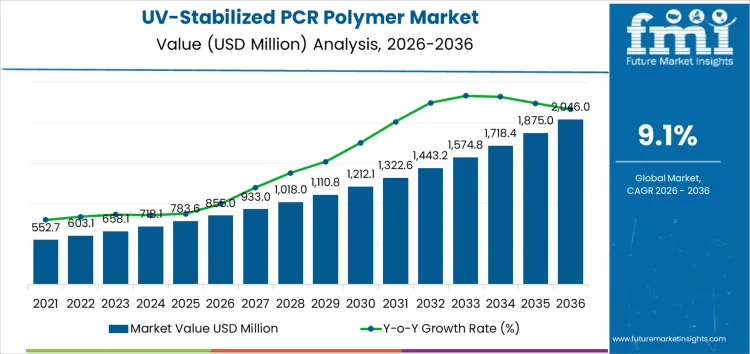
What is the Growth Forecast for the UV-Stabilized PCR Polymer Market through 2036?
From 2026 to 2031, the UV-stabilized PCR polymer market grows from USD 855 million to approximately USD 1,334 million, reflecting the early adoption phase. Annual value additions increase from USD 71 million in 2026 to USD 111 million in 2031. Growth is driven by demand in food and beverage packaging, consumer goods, and industrial applications requiring enhanced UV resistance in recycled polymers. Early adoption is concentrated in North America and Europe, which account for roughly 60% of market value, with pilot programs validating UV stabilization performance, color retention, and mechanical durability in PCR applications.
Between 2031 and 2036, the market expands from roughly USD 1,334 million to USD 2,046 million, illustrating the late adoption curve characterized by broader portfolio deployment and global commercialization. Annual increments rise from USD 111 million to USD 138 million, supported by multi-SKU adoption, repeat procurement, and integration into automated production lines. Growth is reinforced by regulatory encouragement for recycled content, increasing consumer demand for high-performance sustainable packaging, and structural adoption across industrial, consumer, and packaging segments. Early growth relied on selective pilot deployments, while later expansion is driven by standardized implementation and scale-up across global PCR supply chains.
UV Stabilized PCR Polymer Market Key Takeaways
| Metric | Value |
|---|---|
| Market Value (2026) | USD 855 million |
| Forecast Value (2036) | USD 2,046 million |
| Forecast CAGR (2026–2036) | 9.1% |
Why Is UV Stability Now Defining Where PCR Polymers Can Be Used?
Early use of PCR polymers was limited less by strength and more by how they aged in real conditions. Products made from recycled plastics showed rapid colour change, surface brittleness, and loss of toughness when exposed to sunlight. These failures appeared in outdoor bins, garden items, and construction products, even when initial mechanical tests passed. Manufacturers responded by restricting PCR to hidden or indoor components. UV stabilisation was applied only after field issues emerged, often as a corrective step. Historical demand for UV stabilized PCR was therefore defensive, shaped by warranty claims, rejected parts, and narrow application boundaries.
Future demand reflects a shift in expectations rather than problem response. PCR polymers are now specified for visible, long life products where sunlight exposure is unavoidable. Brands and OEMs require recycled materials to meet the same durability thresholds as virgin polymers. UV stabilisation is built into compound design from the outset, matched to exposure duration and colour stability requirements. Growth follows recycled content mandates and expanded outdoor use cases. UV resistance becomes a qualification requirement, not a remedial upgrade.
What Factors Are Affecting the Demand for UV Stabilized PCR Polymer Market in Terms of End Use Application and Packaging Format and Type?
Demand for UV stabilized PCR polymers is segmented by end use application and packaging format and type across environments exposed to prolonged sunlight and outdoor conditions. Outdoor and durable packaging accounts for about 38% of total demand, making it the leading end use segment. Automotive and industrial uses, logistics and bulk packs, agriculture packaging, outdoor FMCG, and specialty polymer applications represent additional segments without disclosed share splits. These applications differ in exposure duration, mechanical stress, and service life expectations. Packaging format and type influence stabilizer loading and performance retention. Bottles, crates, and pallets account for about 40% of demand, followed by containers and housings, reusable crates, canisters and drums, and other formats. Together, these segments explain demand formation shaped by weathering risk and material durability requirements rather than recycled polymer availability alone.
What Drives Demand by End Use Application in the UV Stabilized PCR Polymer Market?
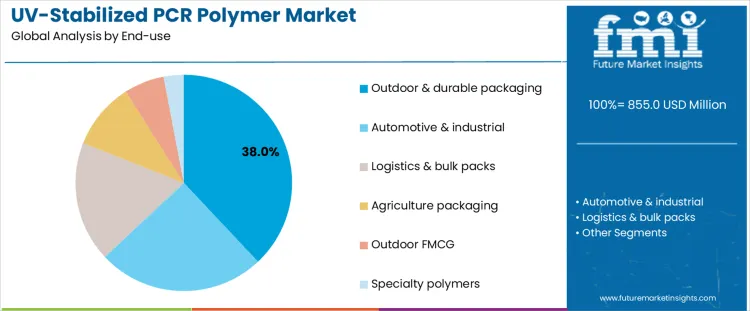
Outdoor and durable packaging leads demand with a 38% share because UV exposure accelerates degradation in recycled polymers without stabilization. These applications require resistance to embrittlement, discoloration, and loss of mechanical strength. Automotive and industrial components adopt UV stabilized PCR where parts are exposed during storage or use. Logistics and bulk packs rely on stabilized materials to withstand repeated outdoor handling. Agriculture packaging applies UV protection to maintain integrity across growing cycles. Outdoor FMCG products require appearance stability during distribution. End use demand therefore reflects exposure severity and lifespan expectations rather than packaging turnover rates.
Application driven demand remains stable because UV exposure profiles are predictable. Outdoor packaging specifications embed stabilizer requirements. Industrial and automotive uses qualify materials over extended testing cycles. Logistics systems standardize crate materials to avoid premature failure. Agriculture packaging follows seasonal exposure needs. These patterns limit short term volatility. End use segmentation highlights reliance on stabilized PCR in applications where degradation risk is unavoidable rather than optional.
How Does Packaging Format and Type Shape Demand for UV Stabilized PCR Polymer Market?
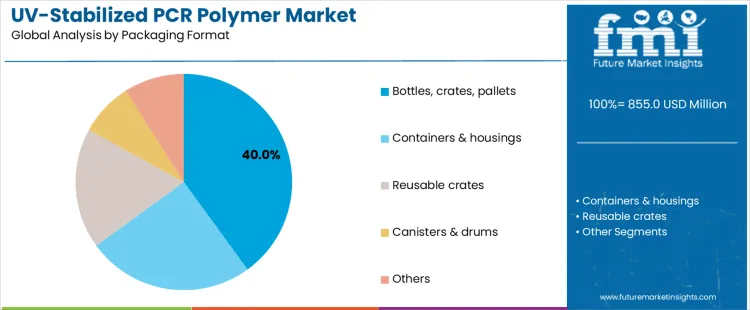
Bottles, crates, and pallets account for about 40% of total demand, making them the leading packaging format. Their dominance reflects high outdoor exposure and repeated handling. Containers and housings adopt UV stabilized PCR where structural integrity must be retained. Reusable crates require stabilizers to support multiple circulation cycles. Canisters and drums used in agriculture and industrial settings rely on UV resistance to prevent cracking. Other formats address niche outdoor uses. Packaging format selection depends on exposure time, wall thickness, and reuse frequency. Demand follows durability risk and lifecycle requirements rather than format innovation.
Bottles and pallets maintain leadership due to constant exposure and volume usage. Reusable crates apply higher stabilizer levels to extend service life. Drums and canisters adopt where replacement is costly. Producers avoid altering formulations once outdoor performance is validated. This stabilizes format driven demand. Packaging format and type therefore reinforces concentration in high exposure PCR packaging components.
How Are UV Stabilized PCR Polymers Being Applied Across Packaging and Outdoor Products?
Use appears in recycled polymers where exposure to sunlight could degrade mechanical and aesthetic properties. Beverage, personal care, and household brands incorporate UV-stabilized PCR resins into bottles, containers, and caps to maintain strength, color, and clarity during outdoor storage and transport. Outdoor furniture, playground equipment, and garden products use treated PCR plastics to extend product lifespan and resist discoloration. These applications reflect operational and durability priorities rather than purely decorative purposes, with adoption driven by UV resistance, material performance, and recyclate utilization.
What Operational and Material Conditions Support Adoption of UV Stabilized PCR Polymers?
Selection aligns with post-consumer resin streams prone to UV-induced degradation. Additives are optimized for compatibility with extrusion, injection molding, or blow molding processes while maintaining color, tensile strength, and thermal stability. Manufacturers rely on UV-stabilized PCR to meet durability, aesthetic, and regulatory standards without compromising recyclate content. Packaging engineers design products to balance exposure risk with mechanical performance. These conditions emerge from operational reliability, material longevity, and compliance priorities in structured manufacturing workflows.
Which Practical Considerations Limit Wider Use of UV Stabilized PCR Polymers?
Effectiveness depends on feedstock quality, contaminant levels, and additive dispersion. Cost per unit may be higher than untreated PCR resins, influencing adoption in low-margin products. UV stabilization may interact with pigments or other functional additives, requiring testing. Regulatory approval for food-contact or sensitive applications may restrict certain chemistries. Variability across batches necessitates quality control to ensure consistent UV performance. These factors lead to selective deployment where material durability, UV resistance, and recyclate integration justify incremental cost and processing management.
What is the Demand for UV Stabilized PCR Polymer by Country?
| Country | CAGR (%) |
|---|---|
| USA | 8.0% |
| Germany | 7.0% |
| China | 10.5% |
| India | 11.5% |
| Brazil | 7.5% |
| Japan | 4.6% |
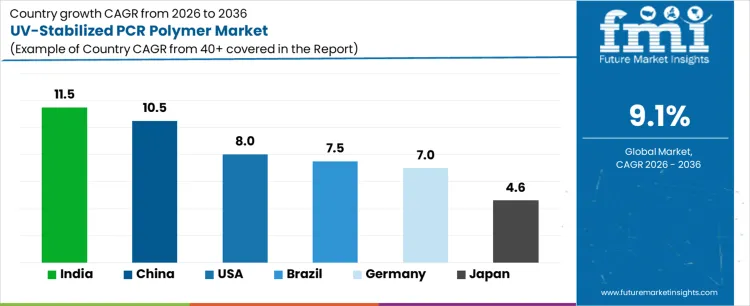
The demand for UV stabilized PCR polymer varies across countries, driven by recycled plastic adoption, UV resistance requirements, and sustainable packaging initiatives. India leads with an 11.5% CAGR, supported by growing incorporation of recycled plastics in packaging, construction, and consumer goods requiring enhanced UV stability. China follows at 10.5%, driven by large scale recycling operations and adoption in industrial and packaging applications. The USA grows at 8.0%, reflecting adoption in consumer goods, electronics, and packaging. Brazil records 7.5%, shaped by organized recycling and packaging industries. Germany posts 7.0%, supported by regulatory compliance and quality standards, while Japan grows at 4.6%, reflecting mature markets and steady demand.
How Is UV Stabilization Driving Growth in PCR Polymers in the United States?
In the United States, revenue from the UV-Stabilized PCR Polymer Market is expanding at a CAGR of 8% through 2036, driven by adoption of chemical additives that enhance ultraviolet (UV) resistance and weatherability of post-consumer recycled (PCR) polymers. Manufacturers are integrating UV stabilizers in packaging, automotive components, outdoor furniture, and industrial applications to prevent color degradation, brittleness, and surface cracking. Demand is concentrated in food and beverage packaging, automotive interiors, and outdoor consumer products. Domestic suppliers provide high-performance additives compatible with extrusion, injection molding, and blow-molding processes. Recurring PCR processing, product performance requirements, and regulatory compliance are sustaining predictable procurement nationwide.
- Food and beverage packaging, automotive interiors, and outdoor products drive adoption
- Additives improve UV resistance and prevent color and surface degradation
- Domestic suppliers provide processing-compatible, high-performance UV stabilizers
- Recurring PCR processing sustains predictable procurement
How Are Recycling and Durability Standards Supporting Growth in Germany?
Germany continues to record steady growth in the UV-Stabilized PCR Polymer Market at a CAGR of 7% through 2036, supported by stringent recycling quality standards and industrial durability requirements. Manufacturers are adopting UV stabilizers to improve the weatherability and service life of PCR plastics used in packaging, automotive components, and consumer goods. Demand is concentrated in food packaging, household products, and industrial applications. Domestic suppliers provide additives compatible with extrusion, injection molding, and blow-molding processes. Compliance with durability and recycling standards, along with recurring PCR use, is sustaining measured adoption nationwide.
- Food packaging, household products, and industrial applications anchor demand
- Additives enhance UV resistance and service life of PCR polymers
- Domestic suppliers provide processing-compatible UV stabilizers
- Recurring PCR usage sustains steady adoption
How Is Industrial and Consumer Recycling Expansion Accelerating Adoption in China?
In China, revenue from the UV-Stabilized PCR Polymer Market is growing at a CAGR of 10.5% through 2036, driven by rapid adoption of post-consumer recycled polymers in packaging, automotive, and consumer goods applications. Manufacturers are integrating UV stabilizers to improve material durability, prevent degradation, and enhance product performance. Demand is strong across food and beverage packaging, automotive interiors, and outdoor products. Domestic suppliers are scaling production of high-performance additives compatible with extrusion, injection molding, and blow-molding processes. Expanding PCR recycling infrastructure and structured polymer processing are sustaining rapid adoption nationwide.
- Food and beverage packaging, automotive interiors, and outdoor products drive adoption
- Additives improve UV resistance and prevent material degradation
- Domestic suppliers scale processing-compatible, high-performance UV stabilizers
- PCR recycling infrastructure sustains consistent adoption
How Is Polymer Recycling and Industrial Application Supporting Growth in India?
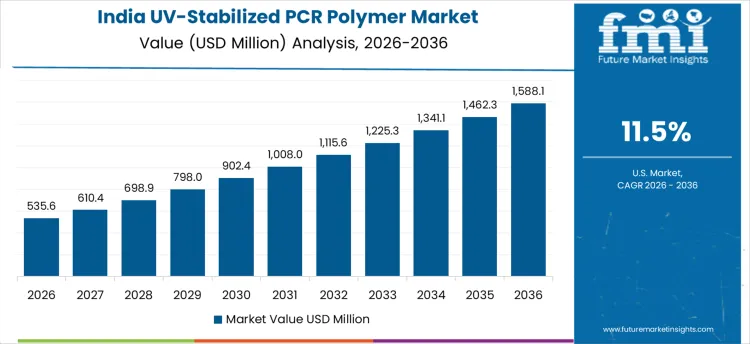
In India, revenue from the UV-Stabilized PCR Polymer Market is expanding at a CAGR of 11.5% through 2036, supported by increasing use of recycled polymers in packaging, automotive, and consumer products. Manufacturers are adopting UV stabilizers to enhance weatherability, maintain color, and prevent brittleness in PCR plastics. Demand is concentrated in food and beverage packaging, automotive interiors, and outdoor consumer goods. Domestic suppliers provide high-performance, extrusion- and molding-compatible UV additives. Growth in PCR processing, durability standards, and recurring recycling operations are sustaining robust adoption nationwide.
- Food and beverage packaging, automotive interiors, and outdoor products drive adoption
- Additives enhance weatherability, color stability, and durability
- Domestic suppliers provide processing-compatible high-performance UV stabilizers
- Recurring PCR recycling sustains robust adoption
How Is Recycling and Product Durability Driving Adoption in Brazil?
Brazil is seeing strong growth in the UV-Stabilized PCR Polymer Market at a CAGR of 7.5% through 2036, supported by increasing PCR usage in packaging, consumer goods, and automotive applications. Manufacturers are integrating UV stabilizers to prevent degradation, maintain color, and improve polymer longevity. Demand is concentrated in food packaging, industrial products, and automotive interiors. Domestic suppliers are expanding production of high-performance, processing-compatible UV additives suitable for extrusion, injection molding, and blow molding. Growth in PCR adoption and recurring recycling operations are sustaining robust procurement nationwide.
- Food packaging, industrial products, and automotive interiors drive adoption
- Additives improve UV resistance and material longevity
- Domestic suppliers expand processing-compatible, high-performance UV stabilizers
- Recurring PCR recycling sustains robust procurement
How Is Industrial and Consumer PCR Usage Driving Growth in Japan?
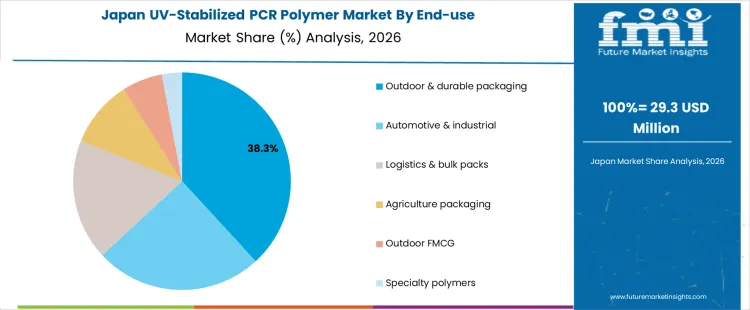
Japan is witnessing growth in the UV-Stabilized PCR Polymer Market at a CAGR of 4.6% through 2036, driven by adoption of UV stabilizers in post-consumer recycled plastics for packaging, automotive, and outdoor consumer products. Manufacturers are integrating additives to maintain polymer color, prevent brittleness, and improve UV resistance. Demand is concentrated in food and beverage packaging, automotive interiors, and outdoor applications. Domestic suppliers provide high-performance, processing-compatible UV additives suitable for extrusion, injection molding, and blow molding. Recurring PCR processing, regulatory compliance, and durability standards are sustaining predictable procurement nationwide.
- Food and beverage packaging, automotive interiors, and outdoor products anchor demand
- Additives maintain color, prevent brittleness, and improve UV resistance
- Domestic suppliers provide processing-compatible high-performance UV additives
- Recurring PCR processing sustains predictable procurement
Which Companies Are Shaping Competition in The UV Stabilized PCR Polymer Market Through Material Durability and End Use Qualification?
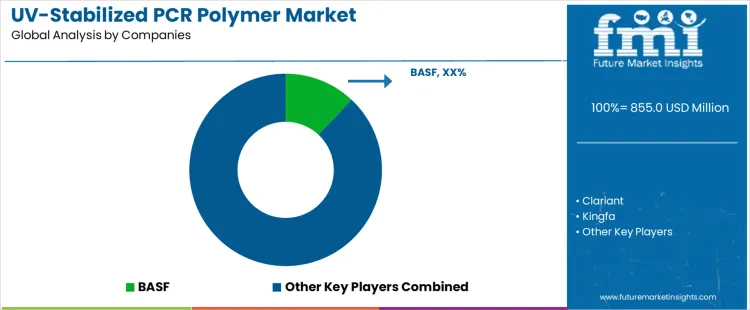
UV stabilized PCR polymers are specified where recycled content must withstand prolonged outdoor or high light exposure without rapid degradation. Competition in this market is shaped by how effectively stabilizer systems compensate for the lower and variable molecular integrity of recycled feedstocks. BASF and Clariant influence adoption through light stabilization packages incorporated during compounding to protect PCR polymers used in packaging, automotive, and consumer products. Avient supports this segment through functional masterbatches that combine UV protection with color and process control. Dow and Mitsubishi Chemical participate through polymer and additive expertise applied to PCR compatible formulations. Material selection is driven by retention of mechanical properties, color stability, and predictable aging behavior rather than recycled content claims alone.
Regional polymer producers and compounders play a decisive role in market execution. Kingfa integrates UV stabilization directly into recycled polymer grades supplied to domestic and export customers, particularly for molded and extruded products. Bhansali Engineering supports demand through engineering polymers where UV resistance is required alongside recycled content. Braskem contributes through PCR polyolefin initiatives aligned with durability focused applications. LANXESS participates through specialty polymers and additives used in technical parts rather than commodity packaging. Local compounders validate UV performance at the application level, often under customer specific testing protocols. Competitive positioning depends on long term weathering data, processing consistency, and alignment with end use qualification requirements rather than formulation novelty or supplier scale.
Key Players in the UV Stabilized PCR Polymer Market
- BASF
- Clariant
- Kingfa
- Bhansali Engineering
- Braskem
- Mitsubishi Chemical
- Avient
- Dow
- Lanxess
Scope of the Report
| Items | Values |
|---|---|
| Quantitative Units (2026) | USD million |
| End-use / Application | Outdoor & durable packaging, Automotive & industrial, Logistics & bulk packs, Agriculture packaging, Outdoor FMCG, Specialty polymers |
| Packaging Format / Type | Bottles, crates, pallets; Containers & housings; Reusable crates; Canisters & drums; Others |
| Material | PCR-HDPE / PCR-PP, rPP / rPE, PCR polyolefins, PCR-HDPE, Others |
| Technology | UV absorbers + HALS stabilizer systems, Long-life UV stabilization packages, Cost-efficient UV masterbatch compounding, Additive dose optimization, Others |
| Region | Asia Pacific (China, Japan, South Korea, India, Australia & New Zealand, ASEAN, Rest of Asia Pacific), Europe (Germany, United Kingdom, France, Italy, Spain, Nordic, BENELUX, Rest of Europe), North America (United States, Canada, Mexico), Latin America (Brazil, Chile, Rest of Latin America), Middle East & Africa (KSA, Other GCC Countries, Turkey, South Africa, Other African Union, Rest of Middle East & Africa) |
| Key Companies Profiled | BASF, Clariant, Kingfa, Bhansali Engineering, Braskem, Mitsubishi Chemical, Avient, Dow, LANXESS |
| Additional Attributes | Dollar by sales adoption by end-use and packaging type, material-specific UV stabilization performance, technology deployment, regional penetration, regulatory compliance, integration into recycled polymer supply chains, product durability and exposure risk, operational and processing compatibility |
UV Stabilized PCR Polymer Market Segmentation
End-use / Application:
- Outdoor & durable packaging
- Automotive & industrial
- Logistics & bulk packs
- Agriculture packaging
- Outdoor FMCG
- Specialty polymers
Packaging Format / Type:
- Bottles, crates, pallets
- Containers & housings
- Reusable crates
- Canisters & drums
- Others
Material:
- PCR-HDPE / PCR-PP
- rPP / rPE
- PCR polyolefins
- PCR-HDPE
- Others
Technology:
- UV absorbers + HALS stabilizer systems
- Long-life UV stabilization packages
- Cost-efficient UV MB compounding
- Additive dose optimization
- Others
Region
Asia Pacific
- China
- Japan
- South Korea
- India
- Australia & New Zealand
- ASEAN
- Rest of Asia Pacific
Europe
- Germany
- United Kingdom
- France
- Italy
- Spain
- Nordic
- BENELUX
- Rest of Europe
North America
- United States
- Canada
- Mexico
Latin America
- Brazil
- Chile
- Rest of Latin America
Middle East & Africa
- Kingdom of Saudi Arabia
- Other GCC Countries
- Turkey
- South Africa
- Other African Union
- Rest of Middle East & Africa
Frequently Asked Questions
How big is the UV-stabilized PCR polymer market in 2026?
The global UV-stabilized PCR polymer market is estimated to be valued at USD 855.0 million in 2026.
What will be the size of UV-stabilized PCR polymer market in 2036?
The market size for the UV-stabilized PCR polymer market is projected to reach USD 2,046.0 million by 2036.
How much will be the UV-stabilized PCR polymer market growth between 2026 and 2036?
The UV-stabilized PCR polymer market is expected to grow at a 9.1% CAGR between 2026 and 2036.
What are the key product types in the UV-stabilized PCR polymer market?
The key product types in UV-stabilized PCR polymer market are outdoor & durable packaging, automotive & industrial, logistics & bulk packs, agriculture packaging, outdoor fmcg and specialty polymers.
Which packaging format segment to contribute significant share in the UV-stabilized PCR polymer market in 2026?
In terms of packaging format, bottles, crates, pallets segment to command 40.0% share in the UV-stabilized PCR polymer market in 2026.
Preview the report firsthand - request a free sample
Get SampleGet the brochure for pricing and purchase details.
Get PDFTable of Content
- Executive Summary
- Global Market Outlook
- Demand-side Trends
- Supply-side Trends
- Technology Roadmap Analysis
- Analysis and Recommendations
- Market Overview
- Market Coverage / Taxonomy
- Market Definition / Scope / Limitations
- Market Background
- Market Dynamics
- Drivers
- Restraints
- Opportunity
- Trends
- Scenario Forecast
- Demand in Optimistic Scenario
- Demand in Likely Scenario
- Demand in Conservative Scenario
- Opportunity Map Analysis
- Product Life Cycle Analysis
- Supply Chain Analysis
- Investment Feasibility Matrix
- Value Chain Analysis
- PESTLE and Porter’s Analysis
- Regulatory Landscape
- Regional Parent Market Outlook
- Production and Consumption Statistics
- Import and Export Statistics
- Market Dynamics
- Global Market Analysis 2021 to 2025 and Forecast, 2026 to 2036
- Historical Market Size Value (USD Million) Analysis, 2021 to 2025
- Current and Future Market Size Value (USD Million) Projections, 2026 to 2036
- Y-o-Y Growth Trend Analysis
- Absolute $ Opportunity Analysis
- Global Market Pricing Analysis 2021 to 2025 and Forecast 2026 to 2036
- Global Market Analysis 2021 to 2025 and Forecast 2026 to 2036, By End-use
- Introduction / Key Findings
- Historical Market Size Value (USD Million) Analysis By End-use , 2021 to 2025
- Current and Future Market Size Value (USD Million) Analysis and Forecast By End-use , 2026 to 2036
- Outdoor & durable packaging
- Automotive & industrial
- Logistics & bulk packs
- Agriculture packaging
- Outdoor FMCG
- Specialty polymers
- Outdoor & durable packaging
- Y-o-Y Growth Trend Analysis By End-use , 2021 to 2025
- Absolute $ Opportunity Analysis By End-use , 2026 to 2036
- Global Market Analysis 2021 to 2025 and Forecast 2026 to 2036, By Packaging Format
- Introduction / Key Findings
- Historical Market Size Value (USD Million) Analysis By Packaging Format, 2021 to 2025
- Current and Future Market Size Value (USD Million) Analysis and Forecast By Packaging Format, 2026 to 2036
- Bottles, crates, pallets
- Containers & housings
- Reusable crates
- Canisters & drums
- Others
- Bottles, crates, pallets
- Y-o-Y Growth Trend Analysis By Packaging Format, 2021 to 2025
- Absolute $ Opportunity Analysis By Packaging Format, 2026 to 2036
- Global Market Analysis 2021 to 2025 and Forecast 2026 to 2036, By Material
- Introduction / Key Findings
- Historical Market Size Value (USD Million) Analysis By Material, 2021 to 2025
- Current and Future Market Size Value (USD Million) Analysis and Forecast By Material, 2026 to 2036
- PCR-HDPE
- rPP
- PCR polyolefins
- PCR-HDPE
- Others
- PCR-HDPE
- Y-o-Y Growth Trend Analysis By Material, 2021 to 2025
- Absolute $ Opportunity Analysis By Material, 2026 to 2036
- Global Market Analysis 2021 to 2025 and Forecast 2026 to 2036, By Technology
- Introduction / Key Findings
- Historical Market Size Value (USD Million) Analysis By Technology, 2021 to 2025
- Current and Future Market Size Value (USD Million) Analysis and Forecast By Technology, 2026 to 2036
- UV absorbers + HALS stabilizer systems
- Long-life UV stabilization packages
- Cost-efficient UV MB compounding
- Additive dose optimization
- Others
- UV absorbers + HALS stabilizer systems
- Y-o-Y Growth Trend Analysis By Technology, 2021 to 2025
- Absolute $ Opportunity Analysis By Technology, 2026 to 2036
- Global Market Analysis 2021 to 2025 and Forecast 2026 to 2036, By Region
- Introduction
- Historical Market Size Value (USD Million) Analysis By Region, 2021 to 2025
- Current Market Size Value (USD Million) Analysis and Forecast By Region, 2026 to 2036
- North America
- Latin America
- Western Europe
- Eastern Europe
- East Asia
- South Asia and Pacific
- Middle East & Africa
- Market Attractiveness Analysis By Region
- North America Market Analysis 2021 to 2025 and Forecast 2026 to 2036, By Country
- Historical Market Size Value (USD Million) Trend Analysis By Market Taxonomy, 2021 to 2025
- Market Size Value (USD Million) Forecast By Market Taxonomy, 2026 to 2036
- By Country
- USA
- Canada
- Mexico
- By End-use
- By Packaging Format
- By Material
- By Technology
- By Country
- Market Attractiveness Analysis
- By Country
- By End-use
- By Packaging Format
- By Material
- By Technology
- Key Takeaways
- Latin America Market Analysis 2021 to 2025 and Forecast 2026 to 2036, By Country
- Historical Market Size Value (USD Million) Trend Analysis By Market Taxonomy, 2021 to 2025
- Market Size Value (USD Million) Forecast By Market Taxonomy, 2026 to 2036
- By Country
- Brazil
- Chile
- Rest of Latin America
- By End-use
- By Packaging Format
- By Material
- By Technology
- By Country
- Market Attractiveness Analysis
- By Country
- By End-use
- By Packaging Format
- By Material
- By Technology
- Key Takeaways
- Western Europe Market Analysis 2021 to 2025 and Forecast 2026 to 2036, By Country
- Historical Market Size Value (USD Million) Trend Analysis By Market Taxonomy, 2021 to 2025
- Market Size Value (USD Million) Forecast By Market Taxonomy, 2026 to 2036
- By Country
- Germany
- UK
- Italy
- Spain
- France
- Nordic
- BENELUX
- Rest of Western Europe
- By End-use
- By Packaging Format
- By Material
- By Technology
- By Country
- Market Attractiveness Analysis
- By Country
- By End-use
- By Packaging Format
- By Material
- By Technology
- Key Takeaways
- Eastern Europe Market Analysis 2021 to 2025 and Forecast 2026 to 2036, By Country
- Historical Market Size Value (USD Million) Trend Analysis By Market Taxonomy, 2021 to 2025
- Market Size Value (USD Million) Forecast By Market Taxonomy, 2026 to 2036
- By Country
- Russia
- Poland
- Hungary
- Balkan & Baltic
- Rest of Eastern Europe
- By End-use
- By Packaging Format
- By Material
- By Technology
- By Country
- Market Attractiveness Analysis
- By Country
- By End-use
- By Packaging Format
- By Material
- By Technology
- Key Takeaways
- East Asia Market Analysis 2021 to 2025 and Forecast 2026 to 2036, By Country
- Historical Market Size Value (USD Million) Trend Analysis By Market Taxonomy, 2021 to 2025
- Market Size Value (USD Million) Forecast By Market Taxonomy, 2026 to 2036
- By Country
- China
- Japan
- South Korea
- By End-use
- By Packaging Format
- By Material
- By Technology
- By Country
- Market Attractiveness Analysis
- By Country
- By End-use
- By Packaging Format
- By Material
- By Technology
- Key Takeaways
- South Asia and Pacific Market Analysis 2021 to 2025 and Forecast 2026 to 2036, By Country
- Historical Market Size Value (USD Million) Trend Analysis By Market Taxonomy, 2021 to 2025
- Market Size Value (USD Million) Forecast By Market Taxonomy, 2026 to 2036
- By Country
- India
- ASEAN
- Australia & New Zealand
- Rest of South Asia and Pacific
- By End-use
- By Packaging Format
- By Material
- By Technology
- By Country
- Market Attractiveness Analysis
- By Country
- By End-use
- By Packaging Format
- By Material
- By Technology
- Key Takeaways
- Middle East & Africa Market Analysis 2021 to 2025 and Forecast 2026 to 2036, By Country
- Historical Market Size Value (USD Million) Trend Analysis By Market Taxonomy, 2021 to 2025
- Market Size Value (USD Million) Forecast By Market Taxonomy, 2026 to 2036
- By Country
- Kingdom of Saudi Arabia
- Other GCC Countries
- Turkiye
- South Africa
- Other African Union
- Rest of Middle East & Africa
- By End-use
- By Packaging Format
- By Material
- By Technology
- By Country
- Market Attractiveness Analysis
- By Country
- By End-use
- By Packaging Format
- By Material
- By Technology
- Key Takeaways
- Key Countries Market Analysis
- USA
- Pricing Analysis
- Market Share Analysis, 2025
- By End-use
- By Packaging Format
- By Material
- By Technology
- Canada
- Pricing Analysis
- Market Share Analysis, 2025
- By End-use
- By Packaging Format
- By Material
- By Technology
- Mexico
- Pricing Analysis
- Market Share Analysis, 2025
- By End-use
- By Packaging Format
- By Material
- By Technology
- Brazil
- Pricing Analysis
- Market Share Analysis, 2025
- By End-use
- By Packaging Format
- By Material
- By Technology
- Chile
- Pricing Analysis
- Market Share Analysis, 2025
- By End-use
- By Packaging Format
- By Material
- By Technology
- Germany
- Pricing Analysis
- Market Share Analysis, 2025
- By End-use
- By Packaging Format
- By Material
- By Technology
- UK
- Pricing Analysis
- Market Share Analysis, 2025
- By End-use
- By Packaging Format
- By Material
- By Technology
- Italy
- Pricing Analysis
- Market Share Analysis, 2025
- By End-use
- By Packaging Format
- By Material
- By Technology
- Spain
- Pricing Analysis
- Market Share Analysis, 2025
- By End-use
- By Packaging Format
- By Material
- By Technology
- France
- Pricing Analysis
- Market Share Analysis, 2025
- By End-use
- By Packaging Format
- By Material
- By Technology
- India
- Pricing Analysis
- Market Share Analysis, 2025
- By End-use
- By Packaging Format
- By Material
- By Technology
- ASEAN
- Pricing Analysis
- Market Share Analysis, 2025
- By End-use
- By Packaging Format
- By Material
- By Technology
- Australia & New Zealand
- Pricing Analysis
- Market Share Analysis, 2025
- By End-use
- By Packaging Format
- By Material
- By Technology
- China
- Pricing Analysis
- Market Share Analysis, 2025
- By End-use
- By Packaging Format
- By Material
- By Technology
- Japan
- Pricing Analysis
- Market Share Analysis, 2025
- By End-use
- By Packaging Format
- By Material
- By Technology
- South Korea
- Pricing Analysis
- Market Share Analysis, 2025
- By End-use
- By Packaging Format
- By Material
- By Technology
- Russia
- Pricing Analysis
- Market Share Analysis, 2025
- By End-use
- By Packaging Format
- By Material
- By Technology
- Poland
- Pricing Analysis
- Market Share Analysis, 2025
- By End-use
- By Packaging Format
- By Material
- By Technology
- Hungary
- Pricing Analysis
- Market Share Analysis, 2025
- By End-use
- By Packaging Format
- By Material
- By Technology
- Kingdom of Saudi Arabia
- Pricing Analysis
- Market Share Analysis, 2025
- By End-use
- By Packaging Format
- By Material
- By Technology
- Turkiye
- Pricing Analysis
- Market Share Analysis, 2025
- By End-use
- By Packaging Format
- By Material
- By Technology
- South Africa
- Pricing Analysis
- Market Share Analysis, 2025
- By End-use
- By Packaging Format
- By Material
- By Technology
- USA
- Market Structure Analysis
- Competition Dashboard
- Competition Benchmarking
- Market Share Analysis of Top Players
- By Regional
- By End-use
- By Packaging Format
- By Material
- By Technology
- Competition Analysis
- Competition Deep Dive
- BASF
- Overview
- Product Portfolio
- Profitability by Market Segments (Product/Age /Sales Channel/Region)
- Sales Footprint
- Strategy Overview
- Marketing Strategy
- Product Strategy
- Channel Strategy
- Clariant
- Kingfa
- Bhansali Engineering
- Braskem
- Mitsubishi Chemical
- Avient
- Dow
- Lanxess
- BASF
- Competition Deep Dive
- Assumptions & Acronyms Used
- Research Methodology


