

- Industry Size (2026)
- USD 1.1 Bn
- Forecast (2036)
- USD 3.1 Bn
- CAGR (2026 to 2036)
- 10.9%
Thermal Aging Resistant PCR Polymers Market Forecast and Outlook 2026 to 2036
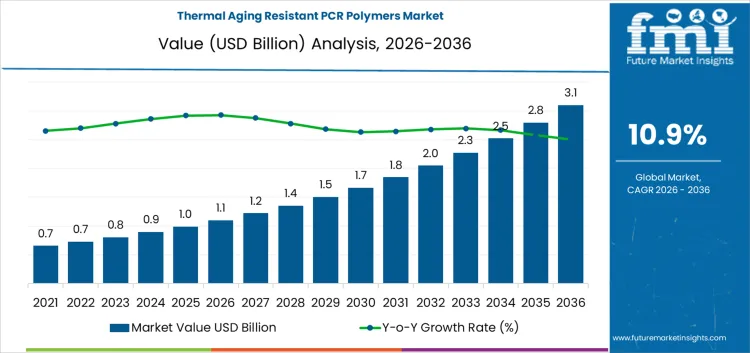
The thermal aging resistant PCR polymers market is set to reach USD 1.1 billion in 2026 and is projected to grow to USD 3.1 billion by 2036, with a CAGR of 10.9% over the forecast period. This growth is driven by the increasing demand for durable, sustainable materials in various industries. Thermal aging resistant polymers are crucial for improving the performance and lifespan of products made from post-consumer recycled (PCR) materials, which are becoming more popular in industries such as automotive, packaging, and electronics due to the environmental benefits of recycling.
As the need for eco-friendly alternatives intensifies, industries are focusing on materials that can withstand thermal stress and extend the service life of their products. Thermal aging resistant PCR polymers provide the necessary durability and performance for applications in challenging environments, particularly in automotive and packaging industries where longevity and sustainability are key. The market is also driven by stricter regulatory frameworks, pushing for the increased use of recycled materials. With ongoing advancements in polymer chemistry, the development of more efficient and cost-effective thermal aging resistant solutions is expected to further stimulate market growth, providing a strong foundation for the future.
Quick Stats of the Thermal Aging Resistant PCR Polymers Market
- Thermal Aging Resistant PCR Polymers Market Value (2026): USD 1.1 billion
- Thermal Aging Resistant PCR Polymers Market Forecast Value (2036): USD 3.1 billion
- Thermal Aging Resistant PCR Polymers Market Forecast CAGR 2026 to 2036: 10.9%
- Thermal Aging Resistant PCR Polymers Market Leading Polymer Type: Heat-stabilized compounds (45 % share)
- Thermal Aging Resistant PCR Polymers Market Leading Material: PCR-PP and PCR-PA (55 % share)
- Thermal Aging Resistant PCR Polymers Market Key Growth Regions: Asia Pacific, North America, Europe, Latin America, Middle East & Africa
- Thermal Aging Resistant PCR Polymers Market Top Players: BASF, Celanese, Kingfa, Reliance Industries, Braskem, Mitsubishi Chemical, Lanxess, Avient, Wanhua
What is the Growth Forecast for Thermal Aging Resistant PCR Polymers Market through 2036?
The thermal aging resistant PCR polymers market is expected to reach USD 1.1 billion in 2026 and grow to USD 3.1 billion by 2036, registering a compound annual growth rate (CAGR) of 10.9%. From 2020 to 2026, the market shows steady growth, increasing from USD 0.6 billion in 2020 to USD 1.1 billion in 2026. This continued expansion indicates the rising demand for durable, sustainable polymers with enhanced thermal resistance in various industries, particularly in automotive and packaging applications.
From 2026 to 2036, the market is set to continue its upward trend, reaching USD 3.1 billion by 2036. Key drivers include the growing focus on reducing environmental impact and enhancing product lifespan, which is pushing manufacturers to explore advanced recycling solutions like PCR polymers. Between 2026 and 2030, the market will grow from USD 1.2 billion to USD 2 billion, further expanding to USD 2.8 billion by 2034. The demand for thermal aging resistant polymers will continue to be fueled by their widespread applications in high-performance sectors that prioritize sustainability and longevity.
Thermal Aging Resistant PCR Polymers Market Key Takeaways
| Metric | Value |
|---|---|
| Market Value (2026) | USD 1.1 billion |
| Forecast Value (2036) | USD 3.1 billion |
| Forecast CAGR 2026 to 2036 | 10.9% |
What Are the Growth Dynamics in the Thermal Aging Resistant PCR Polymers Market?
The thermal aging resistant post consumer recycled (PCR) polymers market is expanding as demand rises for durable, sustainable materials across multiple industries. Manufacturers in automotive, electronics, and industrial sectors seek polymers capable of retaining mechanical and chemical properties after prolonged exposure to elevated temperatures. Regulatory pressure linked to waste reduction and extended producer responsibility has increased interest in recycled polymers that match virgin material performance. Existing recycling infrastructure is adapting to supply higher quality PCR feedstock, enabling producers to develop formulations with improved resistance to thermal degradation. Applications that once relied on virgin high performance plastics are shifting toward PCR options that extend component life. Industry reports indicate that shifts in procurement strategies are prioritizing recycled polymers where long term thermal stability is essential, with growth supported by European Union and North American recycling mandates focused on material circularity.
Development of new compounding techniques and additive packages has played a central role in market growth. Polymer scientists are refining stabilizer blends and processing methods to enhance the thermal aging profiles of PCR resins. Automated quality control systems are allowing processors to maintain tighter tolerances and ensure consistent performance from batch to batch. End users are conducting field validation tests to assess lifetime performance in high temperature environments. Investment in R&D by established resin suppliers and partnerships with recycling firms are expanding product portfolios. Economic factors such as raw material cost volatility are strengthening the case for PCR alternatives where performance thresholds can be met. These combined trends are shaping procurement decisions and creating pathways for broader adoption of thermal aging resistant PCR polymers.
What Are the Key Segments in the Thermal Aging Resistant PCR Polymers Market?
The Thermal Aging Resistant PCR Polymers Market is driven by two main segments which is Polymer Type and Material. The Heat-stabilized compounds in the polymer type segment hold 45% of the market share, with PCR-PP / PCR-PA leading in the material category at 55%. These segments highlight the ongoing trends in the market, focusing on polymers that offer enhanced durability against thermal degradation, meeting the growing demand for more sustainable and long-lasting materials in various industries, including automotive and packaging.
What Is the Role of the Polymer Type Segment in the Thermal Aging Resistant PCR Polymers Market?
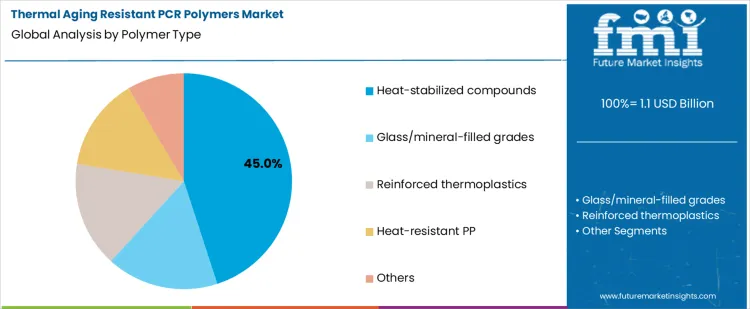
The Polymer Type Segment in the Thermal Aging Resistant PCR Polymers market is primarily driven by Heat-stabilized compounds, which capture 45% of the market share. These compounds are specially designed to resist thermal degradation over extended periods, making them essential in applications where materials are exposed to high temperatures. The demand for heat-stabilized compounds has been increasing due to their ability to enhance the longevity and performance of recycled polymers. By incorporating stabilizers, these compounds offer superior heat resistance compared to standard PCR materials, making them a popular choice for automotive and industrial applications.
The adoption of heat-stabilized compounds is largely driven by the growing emphasis on sustainability and the need for recycled materials that retain high performance over time. The material’s ability to resist aging and maintain structural integrity under thermal stress is key to its widespread use. However, the supply logic is shaped by the need for specialized additives to improve the stability of these polymers. While the costs of adding stabilizers can be higher, the long-term benefits, including reduced waste and longer product lifespans, make them increasingly attractive for various industries, despite challenges such as price volatility and supply chain constraints.
What Are the Key Dynamics of the Material Segment in the Thermal Aging Resistant PCR Polymers Market?
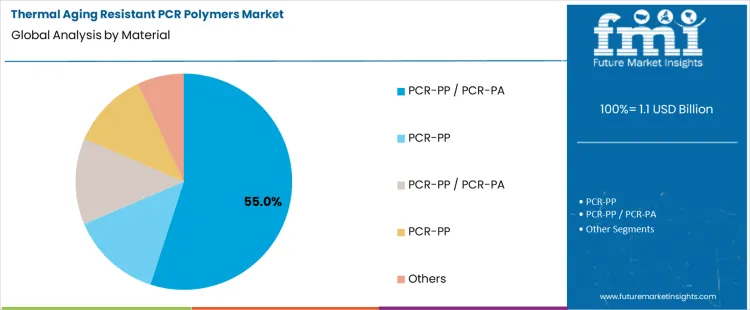
The Material Segment of the Thermal Aging Resistant PCR Polymers market is predominantly focused on PCR-PP / PCR-PA, which represents 55% of the market share. This material combination is recognized for its balance of durability and cost-effectiveness, particularly in automotive and industrial applications where thermal resistance is essential. PCR-PP (Post-Consumer Recycled Polypropylene) and PCR-PA (Post-Consumer Recycled Polyamide) are gaining traction due to their sustainability credentials and the increasing demand for materials that can withstand high temperatures without significant degradation. These materials are essential for products that require both thermal stability and environmental responsibility.
The growing demand for PCR-PP and PCR-PA is fueled by their environmental benefits, as they reduce the need for virgin polymer materials. This trend is driven by the automotive and packaging industries, which are increasingly prioritizing the use of recycled materials to meet sustainability goals. The adoption of these materials is influenced by their ability to maintain performance while reducing environmental impact. However, challenges include ensuring consistent quality and performance across batches of recycled materials. As infrastructure for recycling improves and technology advances, the adoption of PCR-PP and PCR-PA is expected to expand, driving growth in this segment.
What Procurement and Performance Considerations Are Driving Demand for Thermal Aging Resistant PCR Polymers?
Procurement teams in automotive and electrical sectors are focusing on polymers that maintain properties after prolonged heat exposure. Thermal aging resistant post consumer recycled (PCR) polymers reduce reliance on virgin resins subject to raw material price swings. Buyers evaluate long term performance metrics such as tensile strength retention and elongation after heat cycles to ensure component reliability. Specifiers face mandates to increase recycled content, prompting testing of high temperature grades for connectors, housings, and under hood parts. Resin processors report higher inquiries for materials with predictable thermal performance over lifecycle. This linkage between supply risk management and product durability underpins elevated interest in these PCR polymers.
What Technical, Regulatory, And Supply Chain Constraints Are Limiting Uptake of Thermal Aging Resistant PCR Polymers?
Manufacturers encounter challenges in sourcing consistent PCR streams with minimal contamination. Variability in feedstock quality affects thermal stability outcomes and requires intensive sorting and cleaning systems that raise processing costs. Certification standards for heat resistant components demand extensive validation, extending development cycles for new formulations. Regions with strict chemical and waste regulations impose additional compliance costs on recyclers and compounders. Limited conversion capacity for specialty PCR grades creates bottlenecks during peak ordering cycles. OEMs with complex approval protocols delay qualification of recycled materials, keeping some applications anchored to virgin polymers. These obstacles constrain broader adoption despite expressed interest from end users.
What Material Innovation and Application Patterns Are Emerging In Thermal Aging Resistant PCR Polymers?
Developers are focusing on compatibilizers that enhance interfacial adhesion between recycled polymer fractions to preserve heat performance. Advances in selective depolymerization enable recovery of high integrity monomers that form PCR grades with narrower property spreads. Collaborative programs between recyclers and OEMs aim to tailor formulations for specific thermal cycles seen in electronics and powertrain parts. Industry forums are promoting data sharing on long term aging tests, helping set benchmarks for service temperatures and degradation rates. Demand is growing for predictive analytics that correlate processing history with end use performance, enabling processors to adjust compounding recipes early. These shifts influence how designers and specifiers approach material selection.
What Are the Growth Trends for Thermal Aging Resistant PCR Polymers by Country?
| Country | CAGR (%) |
|---|---|
| Germany | 9.4% |
| USA | 8.8% |
| China | 12.6% |
| India | 13.4% |
| Brazil | 8.6% |
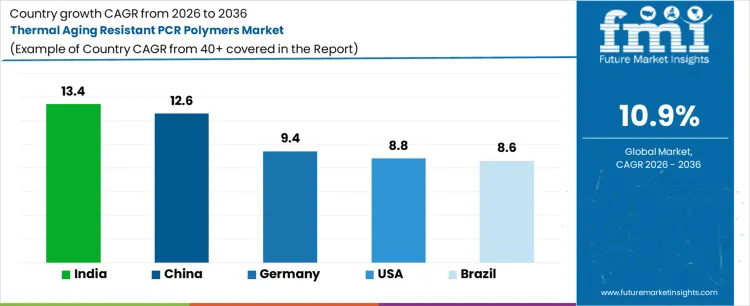
The demand for thermal aging resistant post-consumer recycled (PCR) polymers is experiencing notable growth across various global markets. India leads with a 13.4% CAGR, driven by its expanding recycling industry, rising environmental consciousness, and increasing adoption of sustainable polymers in manufacturing. China follows with a growth rate of 12.6%, fueled by its large-scale plastic recycling initiatives and strong government support for sustainable material use. Germany records a 9.4% CAGR, supported by robust sustainability regulations and the integration of PCR polymers in the automotive and packaging sectors. The USA shows steady growth at 8.8%, with growing emphasis on sustainable product solutions in multiple industries. Brazil experiences a slightly lower CAGR of 8.6%, reflecting a developing market with increasing interest in recycling technologies and polymer sustainability.
What Drives Growth in the Thermal Aging Resistant PCR Polymers Market in Germany?
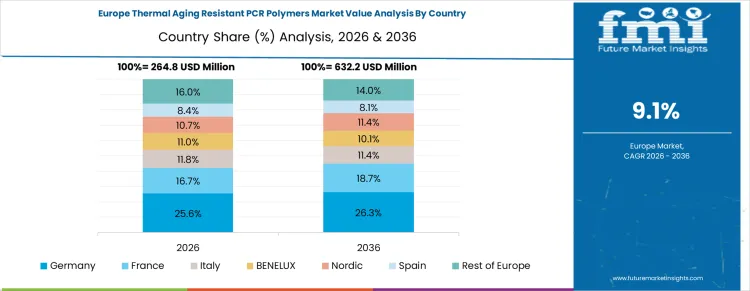
Demand for thermal aging resistant PCR polymers in Germany is expected to grow at a CAGR of 9.4%. The country’s automotive sector plays a significant role in this growth, as industries look for durable and sustainable materials that can withstand high temperatures. Germany’s strict environmental regulations and a strong emphasis on recycling are encouraging the use of high-performance recycled materials. Furthermore, investments in advanced polymer technology are helping improve the efficiency and cost-effectiveness of these materials. As the demand for eco-friendly solutions continues to rise, Germany is positioned to lead the European market in thermal aging resistant PCR polymers, contributing to the global transition toward more sustainable practices.
- Automotive sector expansion boosts demand for durable materials.
- Strict environmental regulations drive the use of recycled polymers.
- Technological advancements in recycling support market growth.
What Is Driving the Growth of Thermal Aging Resistant PCR Polymers in the USA?
Sales of thermal aging resistant PCR polymers in the USA are projected to grow at a CAGR of 8.8%. The country’s industries are increasingly adopting sustainable practices, particularly in automotive, packaging, and construction, where the demand for durable, eco-friendly materials is rising. USA government regulations promoting recycling and reducing plastic waste are further boosting the demand for recycled polymers. Additionally, technological innovations in chemical recycling are making it more feasible to use recycled materials in high-performance applications. As consumer awareness of environmental issues grows and industries shift toward greener solutions, the USA market for thermal aging resistant PCR polymers is expected to continue expanding over the forecast period.
- USA industries shift toward more sustainable, high-performance materials.
- Government policies promote recycling and reduce plastic waste.
- Advancements in recycling technologies accelerate adoption.
How Is China Shaping the Thermal Aging Resistant PCR Polymers Market?
Thermal aging resistant PCR polymers demand in China is expected to grow at a robust 12.6% CAGR. As one of the world’s largest automotive producers, China faces significant pressure to adopt more sustainable practices, driving the demand for high-performance polymers that can withstand extreme conditions. The government’s increasing focus on circular economy principles and stringent environmental policies are encouraging the use of recycled materials. In response, Chinese manufacturers are investing in advanced polymer technologies to meet both regulatory requirements and growing market demands. As these efforts continue, China is poised to lead the global market in the adoption of thermal aging resistant PCR polymers, further boosting its competitive edge.
- China’s automotive industry accelerates demand for durable polymers.
- Government initiatives support the use of recycled, sustainable materials.
- Innovations in polymer technology drive market expansion.
What Factors Are Contributing to the Growth of Thermal Aging Resistant PCR Polymers in India?
Sales of thermal aging resistant PCR polymers in India are forecasted to grow at a CAGR of 13.4%. India’s automotive and packaging sectors are seeing rapid expansion, creating increased demand for durable and high-performance materials. As industries focus on reducing their environmental footprint, the use of recycled polymers is gaining traction. Additionally, government policies aimed at improving waste management and promoting recycling are further encouraging the adoption of sustainable materials. Rising consumer awareness about the environmental impact of plastic waste is also pushing businesses to embrace more eco-friendly practices. With these trends, India is well-positioned for significant growth in the thermal aging resistant PCR polymers market over the next decade.
- Expanding automotive and packaging sectors drive polymer demand.
- Government incentives support recycling and waste management solutions.
- Rising environmental awareness accelerates the adoption of sustainable materials.
What Is Influencing the Demand for Thermal Aging Resistant PCR Polymers in Brazil?
Brazil’s thermal aging resistant PCR polymers industry is projected to grow at a CAGR of 8.6%. As the automotive and construction sectors expand, there is a rising demand for durable and high-performance materials that can endure harsh conditions. Brazil’s government has implemented policies encouraging recycling and sustainable waste management, which is driving the use of recycled polymers in various applications. Local manufacturers are also focusing on technological advancements to improve the quality and cost-effectiveness of these materials. The growing awareness of the environmental impact of plastic waste, combined with these government incentives, is expected to contribute to significant market growth for thermal aging resistant PCR polymers in Brazil.
- Brazil’s automotive and construction industries increase polymer demand.
- Government initiatives encourage the use of sustainable, recycled materials.
- Technological advancements in polymer production boost market growth.
How Are Companies Competing in Thermal Aging Resistant PCR Polymers?
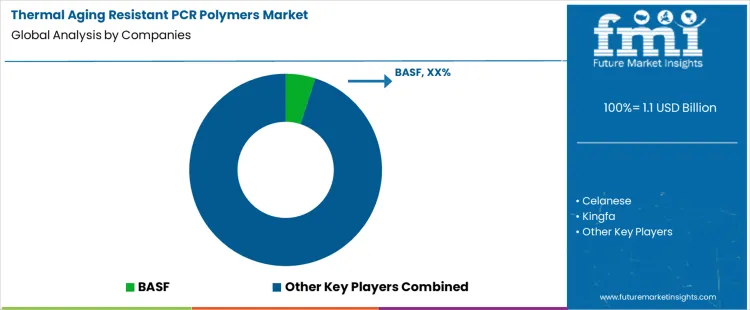
BASF and Lanxess compete by integrating high performance recycled polymers with thermal aging resistance for engineering applications. BASF’s engineering plastics portfolio includes polyamides and high temperature polymers that retain mechanical properties under prolonged heat exposure. BASF positions post consumer recycled (PCR) content as a way to improve material circularity while maintaining resistance to thermal degradation. Lanxess focuses on specialty polymers and elastomers engineered for heat and chemical stability. Lanxess highlights PCR grades that meet stringent industry specifications for automotive under hood and electrical applications, where thermal aging resistance influences longevity. Both firms publish product brochures that emphasize technical data on heat deflection, tensile strength retention after thermal exposure, and compatibility with compounded additives designed to extend service life.
Celanese and Avient advance competition with tailored recycled polymer grades that combine thermal stability with enhanced processability for molded components. Celanese offers ECO range polymers with defined recycled content and targeted performance metrics, including elevated temperature endurance. Avient leverages its color and additive expertise to develop PCR polymers with consistent performance across heat cycles. Kingfa and Wanhua contribute by blending engineering resins with recycled feedstock to achieve a balance between thermal aging resistance and cost efficiency. Braskem expands its PCR portfolio into broader engineering uses, aligning with industry demand for recycled high temperature materials. Mitsubishi Chemical competes by offering specialty and high heat resistant resin grades with PCR integration. Reliance Industries participates through its broader polymer production capabilities, supplying base resins that can be compounded with recycled content and heat stabilizers, though it is not widely marketed specifically as a thermal aging resistant PCR provider.
Key Players in the Thermal Aging Resistant PCR Polymers Market
- BASF
- Celanese
- Kingfa
- Reliance Industries
- Braskem
- Mitsubishi Chemical
- Lanxess
- Avient
- Wanhua
Scope of the Report
| Items | Values |
|---|---|
| Quantitative Units (2026) | USD billion |
| End-use | Under-hood & Interior Structural Parts, HVAC Housings and Ducts, Mass-Platform Vehicles, Compact and EV Platforms, Automotive Components, High-Durability Parts |
| Polymer Type | Heat-Stabilized Compounds, Glass and Mineral-Filled Grades, Reinforced Thermoplastics, Heat-Resistant PP, Others |
| Material | PCR-PP and PCR-PA, PCR-PP, Others |
| Technology | Long-Life Antioxidant and Stabilizer Packages, High-Temperature Compounding and Filtration, High-Throughput Twin-Screw Compounding, Cost-Optimised Stabilisation, Others |
| Regions Covered | Asia Pacific, Europe, North America, Latin America, Middle East & Africa |
| Countries Covered | China, Japan, South Korea, India, Australia & New Zealand, ASEAN, Germany, United Kingdom, France, Italy, Spain, Nordic, BENELUX, United States, Canada, Mexico, Brazil, Chile, Saudi Arabia, Turkey, South Africa, and other regional markets |
| Key Companies Profiled | BASF, Celanese, Kingfa, Reliance Industries, Braskem, Mitsubishi Chemical, Lanxess, Avient, Wanhua |
| Additional Attributes | Dollar sales by end-use, polymer type, material, and technology, heat-stabilized compounds representing the largest polymer type segment due to resistance to long-term thermal degradation, PCR-PP and PCR-PA representing the leading material category because of balance between durability and cost, market demand driven by automotive, electronics, and industrial applications requiring retention of mechanical properties after heat exposure, procurement shaped by mandates to increase recycled content and reduce reliance on virgin resins, performance economics influenced by stabilizer packages, compounding quality, and feedstock consistency, growing importance of certification and lifetime testing for heat-resistant components, and competitive positioning based on ability to deliver consistent thermal aging performance, batch-to-batch quality control, and compliance with automotive and electrical application standards. |
Thermal Aging Resistant PCR Polymers Market Segmentation
End-use:
- Under-hood & interior structural parts
- HVAC housings, ducts
- Mass-platform vehicles
- Compact & EV platforms
- Automotive components
- High-durability parts
Polymer Type:
- Heat-stabilized compounds
- Glass and mineral-filled grades
- Reinforced thermoplastics
- Heat-resistant PP
- Others
Material:
- PCR-PP and PCR-PA
- PCR-PP
- PCR-PP and PCR-PA
- PCR-PP
- Others
Technology:
- Long-life antioxidant & stabilizer packages
- High-temperature compounding & filtration
- High-throughput twin-screw compounding
- Cost-optimised stabilisation
- Others
Region
Asia Pacific
- China
- Japan
- South Korea
- India
- Australia & New Zealand
- ASEAN
- Rest of Asia Pacific
Europe
- Germany
- United Kingdom
- France
- Italy
- Spain
- Nordic
- BENELUX
- Rest of Europe
North America
- United States
- Canada
- Mexico
Latin America
- Brazil
- Chile
- Rest of Latin America
Middle East & Africa
- Kingdom of Saudi Arabia
- Other GCC Countries
- Turkey
- South Africa
- Other African Union
- Rest of Middle East & Africa
Bibliography
- United Nations Environment Programme. (2024). Global Waste Management Outlook 2024. UNEP.
- United Nations Environment Programme. (2024). Reducing Plastic Pollution through Extended Producer Responsibility. UNEP.
- European Commission. (2023). End of Life Vehicles policy overview. European Union.
- United Nations Environment Assembly. (2023). Global Framework on Chemicals. UNEP.
- Organisation for Economic Co operation and Development. (2024). Policy scenarios for eliminating plastic pollution by 2040. OECD Publishing.
Frequently Asked Questions
How big is the thermal aging resistant pcr polymers market in 2026?
The global thermal aging resistant pcr polymers market is estimated to be valued at USD 1.1 billion in 2026.
What will be the size of thermal aging resistant pcr polymers market in 2036?
The market size for the thermal aging resistant pcr polymers market is projected to reach USD 3.1 billion by 2036.
How much will be the thermal aging resistant pcr polymers market growth between 2026 and 2036?
The thermal aging resistant pcr polymers market is expected to grow at a 10.9% CAGR between 2026 and 2036.
What are the key product types in the thermal aging resistant pcr polymers market?
The key product types in thermal aging resistant pcr polymers market are under-hood & interior structural parts, hvac housings, ducts, mass-platform vehicles, compact & ev platforms, automotive components and high-durability parts.
Which polymer type segment to contribute significant share in the thermal aging resistant pcr polymers market in 2026?
In terms of polymer type, heat-stabilized compounds segment to command 45.0% share in the thermal aging resistant pcr polymers market in 2026.
Preview the report firsthand - request a free sample
Get SampleGet the brochure for pricing and purchase details.
Get PDFTable of Content
- Executive Summary
- Global Market Outlook
- Demand-side Trends
- Supply-side Trends
- Technology Roadmap Analysis
- Analysis and Recommendations
- Market Overview
- Market Coverage / Taxonomy
- Market Definition / Scope / Limitations
- Market Background
- Market Dynamics
- Drivers
- Restraints
- Opportunity
- Trends
- Scenario Forecast
- Demand in Optimistic Scenario
- Demand in Likely Scenario
- Demand in Conservative Scenario
- Opportunity Map Analysis
- Product Life Cycle Analysis
- Supply Chain Analysis
- Investment Feasibility Matrix
- Value Chain Analysis
- PESTLE and Porter’s Analysis
- Regulatory Landscape
- Regional Parent Market Outlook
- Production and Consumption Statistics
- Import and Export Statistics
- Market Dynamics
- Global Market Analysis 2021 to 2025 and Forecast, 2026 to 2036
- Historical Market Size Value (USD Million) Analysis, 2021 to 2025
- Current and Future Market Size Value (USD Million) Projections, 2026 to 2036
- Y-o-Y Growth Trend Analysis
- Absolute $ Opportunity Analysis
- Global Market Pricing Analysis 2021 to 2025 and Forecast 2026 to 2036
- Global Market Analysis 2021 to 2025 and Forecast 2026 to 2036, By End-use
- Introduction / Key Findings
- Historical Market Size Value (USD Million) Analysis By End-use , 2021 to 2025
- Current and Future Market Size Value (USD Million) Analysis and Forecast By End-use , 2026 to 2036
- Under-hood & interior structural parts
- HVAC housings, ducts
- Mass-platform vehicles
- Compact & EV platforms
- Automotive components
- High-durability parts
- Under-hood & interior structural parts
- Y-o-Y Growth Trend Analysis By End-use , 2021 to 2025
- Absolute $ Opportunity Analysis By End-use , 2026 to 2036
- Global Market Analysis 2021 to 2025 and Forecast 2026 to 2036, By Polymer Type
- Introduction / Key Findings
- Historical Market Size Value (USD Million) Analysis By Polymer Type, 2021 to 2025
- Current and Future Market Size Value (USD Million) Analysis and Forecast By Polymer Type, 2026 to 2036
- Heat-stabilized compounds
- Glass/mineral-filled grades
- Reinforced thermoplastics
- Heat-resistant PP
- Others
- Heat-stabilized compounds
- Y-o-Y Growth Trend Analysis By Polymer Type, 2021 to 2025
- Absolute $ Opportunity Analysis By Polymer Type, 2026 to 2036
- Global Market Analysis 2021 to 2025 and Forecast 2026 to 2036, By Material
- Introduction / Key Findings
- Historical Market Size Value (USD Million) Analysis By Material, 2021 to 2025
- Current and Future Market Size Value (USD Million) Analysis and Forecast By Material, 2026 to 2036
- PCR-PP / PCR-PA
- PCR-PP
- PCR-PP / PCR-PA
- PCR-PP
- Others
- PCR-PP / PCR-PA
- Y-o-Y Growth Trend Analysis By Material, 2021 to 2025
- Absolute $ Opportunity Analysis By Material, 2026 to 2036
- Global Market Analysis 2021 to 2025 and Forecast 2026 to 2036, By Technology
- Introduction / Key Findings
- Historical Market Size Value (USD Million) Analysis By Technology, 2021 to 2025
- Current and Future Market Size Value (USD Million) Analysis and Forecast By Technology, 2026 to 2036
- Long-life antioxidant & stabilizer packages
- High-temperature compounding & filtration
- High-throughput twin-screw compounding
- Cost-optimised stabilisation
- Others
- Long-life antioxidant & stabilizer packages
- Y-o-Y Growth Trend Analysis By Technology, 2021 to 2025
- Absolute $ Opportunity Analysis By Technology, 2026 to 2036
- Global Market Analysis 2021 to 2025 and Forecast 2026 to 2036, By 0.36
- Introduction / Key Findings
- Historical Market Size Value (USD Million) Analysis By 0.36, 2021 to 2025
- Current and Future Market Size Value (USD Million) Analysis and Forecast By 0.36, 2026 to 2036
- 0.28
- 0.22
- 0.1
- 0.02
- 0.02
- 0.28
- Y-o-Y Growth Trend Analysis By 0.36, 2021 to 2025
- Absolute $ Opportunity Analysis By 0.36, 2026 to 2036
- Global Market Analysis 2021 to 2025 and Forecast 2026 to 2036, By Region
- Introduction
- Historical Market Size Value (USD Million) Analysis By Region, 2021 to 2025
- Current Market Size Value (USD Million) Analysis and Forecast By Region, 2026 to 2036
- North America
- Latin America
- Western Europe
- Eastern Europe
- East Asia
- South Asia and Pacific
- Middle East & Africa
- Market Attractiveness Analysis By Region
- North America Market Analysis 2021 to 2025 and Forecast 2026 to 2036, By Country
- Historical Market Size Value (USD Million) Trend Analysis By Market Taxonomy, 2021 to 2025
- Market Size Value (USD Million) Forecast By Market Taxonomy, 2026 to 2036
- By Country
- USA
- Canada
- Mexico
- By End-use
- By Polymer Type
- By Material
- By Technology
- By 0.36
- By Country
- Market Attractiveness Analysis
- By Country
- By End-use
- By Polymer Type
- By Material
- By Technology
- By 0.36
- Key Takeaways
- Latin America Market Analysis 2021 to 2025 and Forecast 2026 to 2036, By Country
- Historical Market Size Value (USD Million) Trend Analysis By Market Taxonomy, 2021 to 2025
- Market Size Value (USD Million) Forecast By Market Taxonomy, 2026 to 2036
- By Country
- Brazil
- Chile
- Rest of Latin America
- By End-use
- By Polymer Type
- By Material
- By Technology
- By 0.36
- By Country
- Market Attractiveness Analysis
- By Country
- By End-use
- By Polymer Type
- By Material
- By Technology
- By 0.36
- Key Takeaways
- Western Europe Market Analysis 2021 to 2025 and Forecast 2026 to 2036, By Country
- Historical Market Size Value (USD Million) Trend Analysis By Market Taxonomy, 2021 to 2025
- Market Size Value (USD Million) Forecast By Market Taxonomy, 2026 to 2036
- By Country
- Germany
- UK
- Italy
- Spain
- France
- Nordic
- BENELUX
- Rest of Western Europe
- By End-use
- By Polymer Type
- By Material
- By Technology
- By 0.36
- By Country
- Market Attractiveness Analysis
- By Country
- By End-use
- By Polymer Type
- By Material
- By Technology
- By 0.36
- Key Takeaways
- Eastern Europe Market Analysis 2021 to 2025 and Forecast 2026 to 2036, By Country
- Historical Market Size Value (USD Million) Trend Analysis By Market Taxonomy, 2021 to 2025
- Market Size Value (USD Million) Forecast By Market Taxonomy, 2026 to 2036
- By Country
- Russia
- Poland
- Hungary
- Balkan & Baltic
- Rest of Eastern Europe
- By End-use
- By Polymer Type
- By Material
- By Technology
- By 0.36
- By Country
- Market Attractiveness Analysis
- By Country
- By End-use
- By Polymer Type
- By Material
- By Technology
- By 0.36
- Key Takeaways
- East Asia Market Analysis 2021 to 2025 and Forecast 2026 to 2036, By Country
- Historical Market Size Value (USD Million) Trend Analysis By Market Taxonomy, 2021 to 2025
- Market Size Value (USD Million) Forecast By Market Taxonomy, 2026 to 2036
- By Country
- China
- Japan
- South Korea
- By End-use
- By Polymer Type
- By Material
- By Technology
- By 0.36
- By Country
- Market Attractiveness Analysis
- By Country
- By End-use
- By Polymer Type
- By Material
- By Technology
- By 0.36
- Key Takeaways
- South Asia and Pacific Market Analysis 2021 to 2025 and Forecast 2026 to 2036, By Country
- Historical Market Size Value (USD Million) Trend Analysis By Market Taxonomy, 2021 to 2025
- Market Size Value (USD Million) Forecast By Market Taxonomy, 2026 to 2036
- By Country
- India
- ASEAN
- Australia & New Zealand
- Rest of South Asia and Pacific
- By End-use
- By Polymer Type
- By Material
- By Technology
- By 0.36
- By Country
- Market Attractiveness Analysis
- By Country
- By End-use
- By Polymer Type
- By Material
- By Technology
- By 0.36
- Key Takeaways
- Middle East & Africa Market Analysis 2021 to 2025 and Forecast 2026 to 2036, By Country
- Historical Market Size Value (USD Million) Trend Analysis By Market Taxonomy, 2021 to 2025
- Market Size Value (USD Million) Forecast By Market Taxonomy, 2026 to 2036
- By Country
- Kingdom of Saudi Arabia
- Other GCC Countries
- Turkiye
- South Africa
- Other African Union
- Rest of Middle East & Africa
- By End-use
- By Polymer Type
- By Material
- By Technology
- By 0.36
- By Country
- Market Attractiveness Analysis
- By Country
- By End-use
- By Polymer Type
- By Material
- By Technology
- By 0.36
- Key Takeaways
- Key Countries Market Analysis
- USA
- Pricing Analysis
- Market Share Analysis, 2025
- By End-use
- By Polymer Type
- By Material
- By Technology
- By 0.36
- Canada
- Pricing Analysis
- Market Share Analysis, 2025
- By End-use
- By Polymer Type
- By Material
- By Technology
- By 0.36
- Mexico
- Pricing Analysis
- Market Share Analysis, 2025
- By End-use
- By Polymer Type
- By Material
- By Technology
- By 0.36
- Brazil
- Pricing Analysis
- Market Share Analysis, 2025
- By End-use
- By Polymer Type
- By Material
- By Technology
- By 0.36
- Chile
- Pricing Analysis
- Market Share Analysis, 2025
- By End-use
- By Polymer Type
- By Material
- By Technology
- By 0.36
- Germany
- Pricing Analysis
- Market Share Analysis, 2025
- By End-use
- By Polymer Type
- By Material
- By Technology
- By 0.36
- UK
- Pricing Analysis
- Market Share Analysis, 2025
- By End-use
- By Polymer Type
- By Material
- By Technology
- By 0.36
- Italy
- Pricing Analysis
- Market Share Analysis, 2025
- By End-use
- By Polymer Type
- By Material
- By Technology
- By 0.36
- Spain
- Pricing Analysis
- Market Share Analysis, 2025
- By End-use
- By Polymer Type
- By Material
- By Technology
- By 0.36
- France
- Pricing Analysis
- Market Share Analysis, 2025
- By End-use
- By Polymer Type
- By Material
- By Technology
- By 0.36
- India
- Pricing Analysis
- Market Share Analysis, 2025
- By End-use
- By Polymer Type
- By Material
- By Technology
- By 0.36
- ASEAN
- Pricing Analysis
- Market Share Analysis, 2025
- By End-use
- By Polymer Type
- By Material
- By Technology
- By 0.36
- Australia & New Zealand
- Pricing Analysis
- Market Share Analysis, 2025
- By End-use
- By Polymer Type
- By Material
- By Technology
- By 0.36
- China
- Pricing Analysis
- Market Share Analysis, 2025
- By End-use
- By Polymer Type
- By Material
- By Technology
- By 0.36
- Japan
- Pricing Analysis
- Market Share Analysis, 2025
- By End-use
- By Polymer Type
- By Material
- By Technology
- By 0.36
- South Korea
- Pricing Analysis
- Market Share Analysis, 2025
- By End-use
- By Polymer Type
- By Material
- By Technology
- By 0.36
- Russia
- Pricing Analysis
- Market Share Analysis, 2025
- By End-use
- By Polymer Type
- By Material
- By Technology
- By 0.36
- Poland
- Pricing Analysis
- Market Share Analysis, 2025
- By End-use
- By Polymer Type
- By Material
- By Technology
- By 0.36
- Hungary
- Pricing Analysis
- Market Share Analysis, 2025
- By End-use
- By Polymer Type
- By Material
- By Technology
- By 0.36
- Kingdom of Saudi Arabia
- Pricing Analysis
- Market Share Analysis, 2025
- By End-use
- By Polymer Type
- By Material
- By Technology
- By 0.36
- Turkiye
- Pricing Analysis
- Market Share Analysis, 2025
- By End-use
- By Polymer Type
- By Material
- By Technology
- By 0.36
- South Africa
- Pricing Analysis
- Market Share Analysis, 2025
- By End-use
- By Polymer Type
- By Material
- By Technology
- By 0.36
- USA
- Market Structure Analysis
- Competition Dashboard
- Competition Benchmarking
- Market Share Analysis of Top Players
- By Regional
- By End-use
- By Polymer Type
- By Material
- By Technology
- By 0.36
- Competition Analysis
- Competition Deep Dive
- BASF
- Overview
- Product Portfolio
- Profitability by Market Segments (Product/Age /Sales Channel/Region)
- Sales Footprint
- Strategy Overview
- Marketing Strategy
- Product Strategy
- Channel Strategy
- Celanese
- Kingfa
- Reliance Industries
- Braskem
- Mitsubishi Chemical
- Lanxess
- Avient
- Wanhua
- BASF
- Competition Deep Dive
- Assumptions & Acronyms Used
- Research Methodology


