

- Industry Size (2026)
- USD 8.4 Bn
- Forecast (2036)
- USD 15.9 Bn
- CAGR (2026 to 2036)
- 6.6%
PCR Polyolefins Market Size, Market Forecast and Outlook By FMI
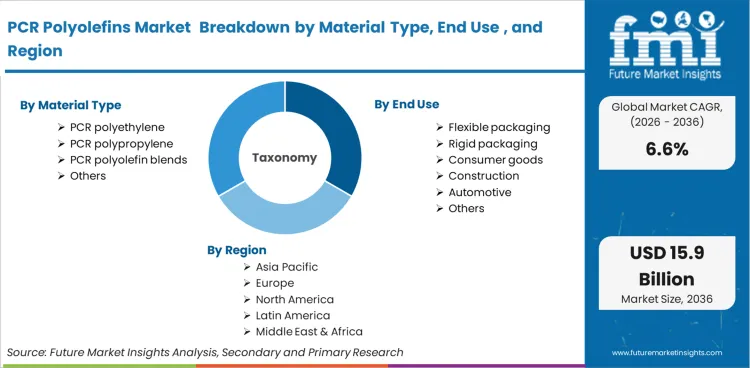
The PCR polyolefins market was valued at USD 7.8 billion in 2025. The market is projected to reach USD 8.4 billion in 2026 and USD 15.9 billion by 2036, expanding at a CAGR of 6.6% during the forecast period. PCR polyethylene is expected to lead material type with a 46.8% share in 2026. Flexible packaging is projected to remain the leading end-use industry with a 34.6% share in 2026. Resins and pellets are expected to lead product form demand with a 41.2% share in 2026.
Summary of PCR Polyolefins Market
- Key Drivers
- Feedstock Circularity: Packaging regulation and brand recycled-content targets are forcing converters to qualify post-consumer recycled resin in large-volume polyethylene and polypropylene applications.
- Flexible-Packaging Pull: Recyclable film redesign is widening the addressable market for recycled polyolefins, especially in PE-rich flexible structures.
- Approval Momentum: Food-contact clearances and better odor-control technologies are making higher-value uses of recycled polyolefins commercially realistic.
- Key Segments Analyzed in the Report
- Material Type: PCR polyethylene, PCR polypropylene, PCR polyolefin blends, and others
- Product Form: resins and pellets, films, sheets, compounds, and others
- End Use Industry: flexible packaging, rigid packaging, consumer goods, construction, automotive, and others
- Region: North America, Latin America, Western Europe, Eastern Europe, East Asia, South Asia Pacific, and Middle East and Africa
- Analyst Opinion
- Ismail Sutaria, Senior Consultant at FMI says, "Value in this market does not pool where recycled tonnage is cheapest. It pools where recycled polyolefins can be qualified into repeat packaging programs with stable performance and documentation."
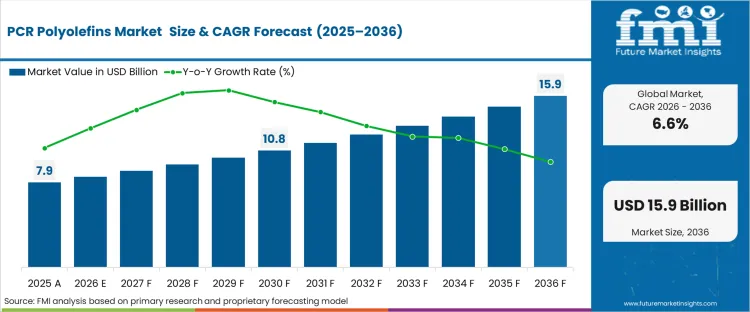
PCR Polyolefins Market Definition
The market covers polyolefin materials recovered from post-consumer waste streams and reprocessed into commercially usable resins, compounds, sheets, films, and packaging-grade intermediates. It includes recycled polyethylene, recycled polypropylene, and blended post-consumer recycled polyolefin formulations sold for conversion into packaging, consumer, construction, and industrial applications. These materials serve converters, compounders, brand owners, and manufacturers seeking to reduce virgin polymer dependence while preserving functional performance.
PCR Polyolefins Market Inclusions
- Revenue from post-consumer recycled polyethylene, polypropylene, and blended polyolefin materials sold as pellets, compounds, sheets, or films.
- Packaging, consumer, construction, and industrial conversion demand tied to recycled polyolefin use.
- Regional demand across all major flexible and rigid plastic-conversion markets.
PCR Polyolefins Market Exclusions
- Virgin-only polyolefin resin sales, except where used as a blending benchmark in commercial qualification.
- Finished consumer packaged goods revenue.
- General waste-management services not tied to recycled polyolefin material sales.
PCR Polyolefins Market Research Methodology
This study evaluates the Post-Consumer Recycled (PCR) polyolefins market across material type, product form, end use industry, and geography, using 2025 as the base year and 2026 to 2036 as the forecast period. Market value is presented in revenue terms. Evidence inputs include OECD plastics-flow assessments, European Union packaging regulation, company recycling-platform disclosures, FDA letters supporting recycled polyolefin use in packaging, and product-launch documentation from resin producers and converters. Triangulation combines recycler output, packaging conversion demand, recycled-content adoption targets, and realized commercial launches to convert circularity momentum into addressable revenue by application and region.
Key Drivers, Restraints, and Trends in PCR Polyolefins Market
Drivers
Demand is being pushed by two hard forces. The first is regulation that ties future packaging compliance to recyclable design and minimum recycled-content use. The second is procurement pressure from global brand owners that now expect recycled polyethylene and polypropylene to move from pilot lots into routine packaging programs. That pressure lifts demand for post-consumer recycled material because converters can no longer rely on virgin resin alone to meet customer specifications. Growth also comes from improving food-contact pathways and better sorting, washing, and deodorization technologies, which make higher-value recycled polyolefin applications more commercially viable.
Restraints
Feedstock quality remains uneven, which limits how far recycled-content loading can go in premium applications. Odor, haze, gels, and color variation still matter, especially in visible packaging formats. Smaller converters also face qualification costs and supply-risk concerns when shifting to recycled resin. Multi-vendor approval processes add complexity because the resin, film, and converter all affect performance. These frictions slow adoption even when the strategic direction is clear.
Trends
Buyers are moving away from one-off recycled-resin substitutions and toward formal circular material platforms. More packaging development now centers on PE and PP families that can be recycled and reintroduced into the same broad application pool. Suppliers are also repositioning recycled polyolefins from low-value utility plastics to documented packaging grades with application-specific support. The weight of commercial value is shifting toward suppliers that can pair resin quality, compliance support, and converter-ready formulation.
Segmental Analysis
PCR Polyolefins Analysis by Material Type
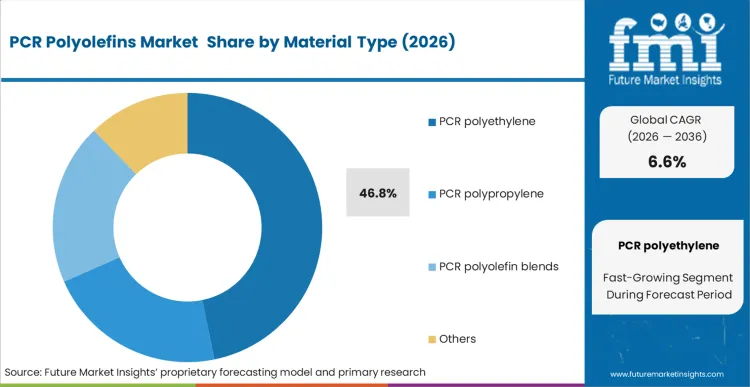
PCR polyethylene is projected to hold the leading 46.8% share in 2026 because flexible film, overwrap, collation and hygiene applications still absorb the broadest commercial volume of recycled polyolefins. That lead is structural. Polyethylene has the deepest packaging demand base, the widest mechanical-recycling pathways, and the largest pool of converters trying to raise recycled-content loading without redesigning the entire pack. The commercial logic therefore favors grades that can drop into film and blow-molding programs at scale. Borealis underscored that trend in 2025 when it launched a Borcycle M linear low density flexible-packaging grade with 85% post-consumer recycled content, aimed at high-end film applications.
PCR Polyolefins Analysis by End Use Industry
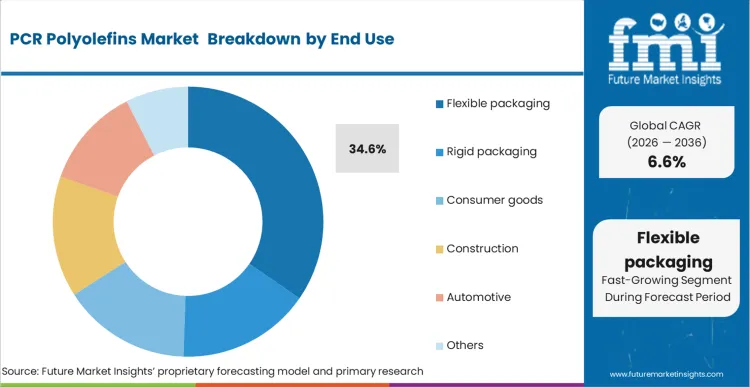
Flexible packaging is projected to account for 34.6% of market revenue in 2026 because it sits at the collision point of regulation, brand commitments, and converter redesign. Film structures consume large volumes of polyethylene and polypropylene, so even modest increases in recycled content shift material demand meaningfully. The segment also benefits from redesign work around store-drop-off PE films and emerging mono-material PP structures. LyondellBasell's 2026 CirculenRecover portfolio explicitly positions recycled polyethylene and polypropylene for flexibles such as collation shrink film and hygienic film, reinforcing where recycled polyolefin value is concentrating.
Competitive Aligners for Market Players
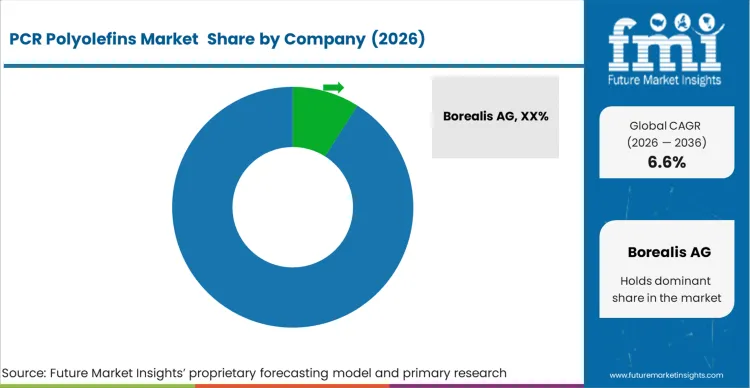
Competitive position in PCR polyolefins depends on whether a supplier can deliver resin that works in real packaging production. Buyers want steady feedstock access and predictable quality. They also want recycled grades that do not create trouble on existing converting lines. Problems such as odor variation, uneven color, or yield loss can quickly weaken the value of a recycled-content program. That is where stronger suppliers are separating themselves. They are building tighter control over sourcing, compounding, and application support. This matters because recycled polyolefins are rarely judged on specification sheets alone. Converters and brand owners want proof that the resin can run cleanly, hold performance, and support commercial packaging formats without constant adjustment.
Borealis showed that direction with its 2025 Borcycle M launch for flexible packaging. LyondellBasell has also kept expanding the role of CirculenRecover in film and packaging uses. Berry Global’s 2025 work with Mars gave the market another visible example of recycled-content packaging moving into scaled consumer applications. SABIC’s circular polyethylene programs point to the same shift, though through a certified circular route rather than a pure PCR model. What buyers are rewarding now is confidence. They want resin suppliers that can reduce risk during conversion and help protect pack performance after launch. In that environment, leadership is being built through quality assurance, technical support, and commercial reliability. Volume still matters, but it is no longer enough on its own.
Key Players in PCR Polyolefins Market
- Borealis AG
- LyondellBasell Industries N.V.
- Berry Global Group, Inc.
- SABIC
- ExxonMobil
- TotalEnergies
- Mitsui Chemicals, Inc.
- Dow Inc.
- ALPLA Group
- Veolia
Strategic Outlook by FMI on PCR Polyolefins Market
The market is moving from opportunistic recycled-resin substitution to engineered circular material programs. The next phase will be shaped by access to high-quality post-consumer feedstock, food-contact approvals, and converter confidence in film-grade performance. Companies with closed-loop partnerships, formulation depth, and the ability to support packaging qualification across polyethylene and polypropylene families will capture the best margins.
Scope of the Report
| Metric | Value |
|---|---|
| Market Value | USD 7.8 billion in 2025 to USD 15.9 billion by 2036 |
| CAGR | 6.6% from 2026 to 2036 |
| Base Year | 2025 |
| Forecast Period | 2026 to 2036 |
| Primary Segmentation | Material type | PCR polyethylene, PCR polypropylene, PCR polyolefin blends, and others |
| Secondary Segmentation | Product form | resins and pellets, films, sheets, compounds, and others |
| End Use Segmentation | End use industry | flexible packaging, rigid packaging, consumer goods, construction, automotive, and others |
| Regions Covered | North America, Latin America, Western Europe, Eastern Europe, East Asia, South Asia Pacific, and Middle East and Africa |
Bibliography
- OECD. 2022. Global Plastics Outlook: Economic Drivers, Environmental Impacts and Policy Options.
- European Commission. 2025. Packaging Waste.
- European Union. 2025. Regulation (EU) 2025/40 of the European Parliament and of the Council of 19 December 2024 on packaging and packaging waste.
- Borealis AG. 2025. Borealis launches Borcycle M linear low density flexible packaging grade with 85% PCR content.
- LyondellBasell Industries N.V. 2023. LyondellBasell launches new product grades of CirculenRecover in North America.
- Berry Global Group, Inc. 2025. Berry Global and Mars Announce Packaging with 100% Recycled Content.
- SABIC. 2024. Packaging made with fully recycled post-consumer plastic.
Preview the report firsthand - request a free sample
Get SampleGet the brochure for pricing and purchase details.
Get PDFTable of Content
- Executive Summary
- Global Market Outlook
- Demand-side Trends
- Supply-side Trends
- Technology Roadmap Analysis
- Analysis and Recommendations
- Market Overview
- Market Coverage / Taxonomy
- Market Definition / Scope / Limitations
- Research Methodology
- Chapter Orientation
- Analytical Lens and Working Hypotheses
- Market Structure, Signals, and Trend Drivers
- Benchmarking and Cross-market Comparability
- Market Sizing, Forecasting, and Opportunity Mapping
- Research Design and Evidence Framework
- Desk Research Programme (Secondary Evidence)
- Company Annual and Sustainability Reports
- Peer-reviewed Journals and Academic Literature
- Corporate Websites, Product Literature, and Technical Notes
- Earnings Decks and Investor Briefings
- Statutory Filings and Regulatory Disclosures
- Technical White Papers and Standards Notes
- Trade Journals, Industry Magazines, and Analyst Briefs
- Conference Proceedings, Webinars, and Seminar Materials
- Government Statistics Portals and Public Data Releases
- Press Releases and Reputable Media Coverage
- Specialist Newsletters and Curated Briefings
- Sector Databases and Reference Repositories
- FMI Internal Proprietary Databases and Historical Market Datasets
- Subscription Datasets and Paid Sources
- Social Channels, Communities, and Digital Listening Inputs
- Additional Desk Sources
- Expert Input and Fieldwork (Primary Evidence)
- Primary Modes
- Qualitative Interviews and Expert Elicitation
- Quantitative Surveys and Structured Data Capture
- Blended Approach
- Why Primary Evidence is Used
- Field Techniques
- Interviews
- Surveys
- Focus Groups
- Observational and In-context Research
- Social and Community Interactions
- Stakeholder Universe Engaged
- C-suite Leaders
- Board Members
- Presidents and Vice Presidents
- R&D and Innovation Heads
- Technical Specialists
- Domain Subject-matter Experts
- Scientists
- Physicians and Other Healthcare Professionals
- Governance, Ethics, and Data Stewardship
- Research Ethics
- Data Integrity and Handling
- Primary Modes
- Tooling, Models, and Reference Databases
- Desk Research Programme (Secondary Evidence)
- Data Engineering and Model Build
- Data Acquisition and Ingestion
- Cleaning, Normalisation, and Verification
- Synthesis, Triangulation, and Analysis
- Quality Assurance and Audit Trail
- Market Background
- Market Dynamics
- Drivers
- Restraints
- Opportunity
- Trends
- Scenario Forecast
- Demand in Optimistic Scenario
- Demand in Likely Scenario
- Demand in Conservative Scenario
- Opportunity Map Analysis
- Product Life Cycle Analysis
- Supply Chain Analysis
- Investment Feasibility Matrix
- Value Chain Analysis
- PESTLE and Porter’s Analysis
- Regulatory Landscape
- Regional Parent Market Outlook
- Production and Consumption Statistics
- Import and Export Statistics
- Market Dynamics
- Global Market Analysis 2021 to 2025 and Forecast, 2026 to 2036
- Historical Market Size Value (USD Million) Analysis, 2021 to 2025
- Current and Future Market Size Value (USD Million) Projections, 2026 to 2036
- Y-o-Y Growth Trend Analysis
- Absolute $ Opportunity Analysis
- Global Market Pricing Analysis 2021 to 2025 and Forecast 2026 to 2036
- Global Market Analysis 2021 to 2025 and Forecast 2026 to 2036, By Material Type
- Introduction / Key Findings
- Historical Market Size Value (USD Million) Analysis By Material Type , 2021 to 2025
- Current and Future Market Size Value (USD Million) Analysis and Forecast By Material Type , 2026 to 2036
- PCR polyethylene
- PCR polypropylene
- PCR polyolefin blends
- Others
- PCR polyethylene
- Y-o-Y Growth Trend Analysis By Material Type , 2021 to 2025
- Absolute $ Opportunity Analysis By Material Type , 2026 to 2036
- Global Market Analysis 2021 to 2025 and Forecast 2026 to 2036, By End Use
- Introduction / Key Findings
- Historical Market Size Value (USD Million) Analysis By End Use, 2021 to 2025
- Current and Future Market Size Value (USD Million) Analysis and Forecast By End Use, 2026 to 2036
- Flexible packaging
- Rigid packaging
- Consumer goods
- Construction
- Automotive
- Others
- Flexible packaging
- Y-o-Y Growth Trend Analysis By End Use, 2021 to 2025
- Absolute $ Opportunity Analysis By End Use, 2026 to 2036
- Global Market Analysis 2021 to 2025 and Forecast 2026 to 2036, By Region
- Introduction
- Historical Market Size Value (USD Million) Analysis By Region, 2021 to 2025
- Current Market Size Value (USD Million) Analysis and Forecast By Region, 2026 to 2036
- North America
- Latin America
- Western Europe
- Eastern Europe
- East Asia
- South Asia and Pacific
- Middle East & Africa
- Market Attractiveness Analysis By Region
- North America Market Analysis 2021 to 2025 and Forecast 2026 to 2036, By Country
- Historical Market Size Value (USD Million) Trend Analysis By Market Taxonomy, 2021 to 2025
- Market Size Value (USD Million) Forecast By Market Taxonomy, 2026 to 2036
- By Country
- USA
- Canada
- Mexico
- By Material Type
- By End Use
- By Country
- Market Attractiveness Analysis
- By Country
- By Material Type
- By End Use
- Key Takeaways
- Latin America Market Analysis 2021 to 2025 and Forecast 2026 to 2036, By Country
- Historical Market Size Value (USD Million) Trend Analysis By Market Taxonomy, 2021 to 2025
- Market Size Value (USD Million) Forecast By Market Taxonomy, 2026 to 2036
- By Country
- Brazil
- Chile
- Rest of Latin America
- By Material Type
- By End Use
- By Country
- Market Attractiveness Analysis
- By Country
- By Material Type
- By End Use
- Key Takeaways
- Western Europe Market Analysis 2021 to 2025 and Forecast 2026 to 2036, By Country
- Historical Market Size Value (USD Million) Trend Analysis By Market Taxonomy, 2021 to 2025
- Market Size Value (USD Million) Forecast By Market Taxonomy, 2026 to 2036
- By Country
- Germany
- UK
- Italy
- Spain
- France
- Nordic
- BENELUX
- Rest of Western Europe
- By Material Type
- By End Use
- By Country
- Market Attractiveness Analysis
- By Country
- By Material Type
- By End Use
- Key Takeaways
- Eastern Europe Market Analysis 2021 to 2025 and Forecast 2026 to 2036, By Country
- Historical Market Size Value (USD Million) Trend Analysis By Market Taxonomy, 2021 to 2025
- Market Size Value (USD Million) Forecast By Market Taxonomy, 2026 to 2036
- By Country
- Russia
- Poland
- Hungary
- Balkan & Baltic
- Rest of Eastern Europe
- By Material Type
- By End Use
- By Country
- Market Attractiveness Analysis
- By Country
- By Material Type
- By End Use
- Key Takeaways
- East Asia Market Analysis 2021 to 2025 and Forecast 2026 to 2036, By Country
- Historical Market Size Value (USD Million) Trend Analysis By Market Taxonomy, 2021 to 2025
- Market Size Value (USD Million) Forecast By Market Taxonomy, 2026 to 2036
- By Country
- China
- Japan
- South Korea
- By Material Type
- By End Use
- By Country
- Market Attractiveness Analysis
- By Country
- By Material Type
- By End Use
- Key Takeaways
- South Asia and Pacific Market Analysis 2021 to 2025 and Forecast 2026 to 2036, By Country
- Historical Market Size Value (USD Million) Trend Analysis By Market Taxonomy, 2021 to 2025
- Market Size Value (USD Million) Forecast By Market Taxonomy, 2026 to 2036
- By Country
- India
- ASEAN
- Australia & New Zealand
- Rest of South Asia and Pacific
- By Material Type
- By End Use
- By Country
- Market Attractiveness Analysis
- By Country
- By Material Type
- By End Use
- Key Takeaways
- Middle East & Africa Market Analysis 2021 to 2025 and Forecast 2026 to 2036, By Country
- Historical Market Size Value (USD Million) Trend Analysis By Market Taxonomy, 2021 to 2025
- Market Size Value (USD Million) Forecast By Market Taxonomy, 2026 to 2036
- By Country
- Kingdom of Saudi Arabia
- Other GCC Countries
- Turkiye
- South Africa
- Other African Union
- Rest of Middle East & Africa
- By Material Type
- By End Use
- By Country
- Market Attractiveness Analysis
- By Country
- By Material Type
- By End Use
- Key Takeaways
- Key Countries Market Analysis
- USA
- Pricing Analysis
- Market Share Analysis, 2025
- By Material Type
- By End Use
- Canada
- Pricing Analysis
- Market Share Analysis, 2025
- By Material Type
- By End Use
- Mexico
- Pricing Analysis
- Market Share Analysis, 2025
- By Material Type
- By End Use
- Brazil
- Pricing Analysis
- Market Share Analysis, 2025
- By Material Type
- By End Use
- Chile
- Pricing Analysis
- Market Share Analysis, 2025
- By Material Type
- By End Use
- Germany
- Pricing Analysis
- Market Share Analysis, 2025
- By Material Type
- By End Use
- UK
- Pricing Analysis
- Market Share Analysis, 2025
- By Material Type
- By End Use
- Italy
- Pricing Analysis
- Market Share Analysis, 2025
- By Material Type
- By End Use
- Spain
- Pricing Analysis
- Market Share Analysis, 2025
- By Material Type
- By End Use
- France
- Pricing Analysis
- Market Share Analysis, 2025
- By Material Type
- By End Use
- India
- Pricing Analysis
- Market Share Analysis, 2025
- By Material Type
- By End Use
- ASEAN
- Pricing Analysis
- Market Share Analysis, 2025
- By Material Type
- By End Use
- Australia & New Zealand
- Pricing Analysis
- Market Share Analysis, 2025
- By Material Type
- By End Use
- China
- Pricing Analysis
- Market Share Analysis, 2025
- By Material Type
- By End Use
- Japan
- Pricing Analysis
- Market Share Analysis, 2025
- By Material Type
- By End Use
- South Korea
- Pricing Analysis
- Market Share Analysis, 2025
- By Material Type
- By End Use
- Russia
- Pricing Analysis
- Market Share Analysis, 2025
- By Material Type
- By End Use
- Poland
- Pricing Analysis
- Market Share Analysis, 2025
- By Material Type
- By End Use
- Hungary
- Pricing Analysis
- Market Share Analysis, 2025
- By Material Type
- By End Use
- Kingdom of Saudi Arabia
- Pricing Analysis
- Market Share Analysis, 2025
- By Material Type
- By End Use
- Turkiye
- Pricing Analysis
- Market Share Analysis, 2025
- By Material Type
- By End Use
- South Africa
- Pricing Analysis
- Market Share Analysis, 2025
- By Material Type
- By End Use
- USA
- Market Structure Analysis
- Competition Dashboard
- Competition Benchmarking
- Market Share Analysis of Top Players
- By Regional
- By Material Type
- By End Use
- Competition Analysis
- Competition Deep Dive
- Borealis AG
- Overview
- Product Portfolio
- Profitability by Market Segments (Product/Age /Sales Channel/Region)
- Sales Footprint
- Strategy Overview
- Marketing Strategy
- Product Strategy
- Channel Strategy
- LyondellBasell Industries N.V.
- Berry Global Group, Inc.
- SABIC
- ExxonMobil
- TotalEnergies
- Mitsui Chemicals, Inc.
- Dow Inc.
- ALPLA Group
- Veolia
- Borealis AG
- Competition Deep Dive
- Assumptions & Acronyms Used


