

- Industry Size (2026)
- USD 1460.0 Mn
- Forecast (2036)
- USD 4783.4 Mn
- CAGR (2026 to 2036)
- 12.6%
PCR Market for Child-Safe & Heavy-Duty Closures Forecast and Outlook 2026 to 2036
The PCR market for child-safe and heavy-duty closures is likely to be valued at USD 1,460.0 million in 2026 and is projected to reach USD 4,783.4 million by 2036, at a CAGR of 12.6% over the forecast period. Growth is driven by rising use of recycled polymers in regulated packaging segments where safety, durability, and compliance remain mandatory. Child-resistant closures and heavy-duty caps used in pharmaceuticals, agrochemicals, household chemicals, and industrial liquids increasingly incorporate PCR-HDPE and PCR-PP grades engineered to meet torque consistency, sealing integrity, and impact resistance requirements. Adoption is supported by improvements in PCR compounding that preserve dimensional accuracy and mechanical strength on high-cavitation molding and automated capping lines.
Market expansion reflects alignment between recycled content mandates and performance validation frameworks governing hazardous and child-sensitive packaging. Closure manufacturers prioritize PCR solutions that maintain certified child-resistance functionality and stress crack resistance under repeated use and transport conditions. Demand remains concentrated in CRCs and industrial closures due to mandatory safety standards and high-volume usage across chemicals and pharmaceuticals. Growth follows engineering qualification cycles, safety certification continuity, and traceability readiness rather than rapid material substitution, supporting measured but sustained integration of PCR materials across global child-safe and heavy-duty closure applications.
Quick Stats for PCR Market for Child-Safe & Heavy-Duty Closures
- PCR Market for Child-Safe & Heavy-Duty Closures Value (2026): USD 1,460.0 million
- PCR Market for Child-Safe & Heavy-Duty Closures Forecast Value (2036): USD 4,783.4 million
- PCR Market for Child-Safe & Heavy-Duty Closures Forecast CAGR (2026-2036): 12.6%
- Leading Closure Type by Demand Share: CRCs & industrial closures
- Fastest-Growing Countries: India, China, USA, Germany, Brazil
- Top Players in Global Demand: Aptar, Silgan Closures, Berry Global, ALPLA Closures, Zhejiang B.I. Packaging
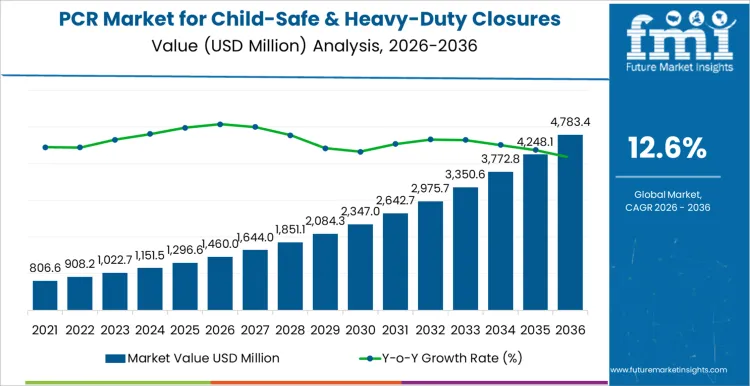
PCR Market for Child-Safe & Heavy-Duty Closures Key Takeaways
| Metric | Value |
|---|---|
| Market Value (2026) | USD 1,460.0 million |
| Market Forecast Value (2036) | USD 4,783.4 million |
| Forecast CAGR (2026-2036) | 12.6% |
Why is the Demand for PCR Market for Child-Safe & Heavy-Duty Closures Growing?
Child-safe and heavy-duty closures used in pharmaceuticals, chemicals, and consumer products are increasingly specified with post-consumer recycled (PCR) resins because safety and sustainability are now core procurement criteria. Closures designed to resist tampering, maintain secure seals, and withstand repeated torque cycles must deliver consistent mechanical strength and dimensional precision. PCR grades engineered for high mechanical performance in polypropylene and high-density polyethylene are replacing virgin materials in tamper-evident child-safe caps and heavy-duty closures for industrial containers. Pharmaceutical brands require PCR closures that meet dosage integrity and safety standards, while chemical manufacturers need rugged closures that resist stress cracking when exposed to aggressive contents. These demanding applications stimulate interest in PCR formulations tailored with reinforcement additives and optimized melt flow to preserve functional performance on automated capping equipment.
Expansion of recycled content mandates and corporate sustainability commitments further influence procurement of PCR closures. In regulated markets where minimum recycled content thresholds apply to packaging, brand owners and packagers work with compounders to validate PCR resin streams and confirm compliance through testing and traceability documentation. Technical teams verify torque retention, impact resistance, and environmental stress crack resistance in PCR closures to ensure they perform reliably under repeated use conditions. Development of PCR materials that meet these rigorous functional benchmarks supports broader adoption across consumer and industrial sectors, helping manufacturers reduce reliance on virgin polymers while upholding safety and durability standards.
How Is the PCR Segment for Child-Safe & Heavy-Duty Closures Structured by Closure Type, Material, and End Use?
Demand for PCR-based child-safe and heavy-duty closures is shaped by regulatory safety requirements, chemical resistance needs, and recycled content targets. Closure manufacturers focus on torque consistency, thread integrity, and tamper performance while integrating recycled polymers. Compliance with child-resistance standards and hazardous material handling drives conservative material selection. Segmentation by closure type, material, and end use explains how performance thresholds, safety certification, and operational risk influence PCR adoption across chemicals, pharmaceuticals, industrial liquids, and household products.
Which Closure Type Holds the Largest Share in PCR Child-Safe and Heavy-Duty Closures?
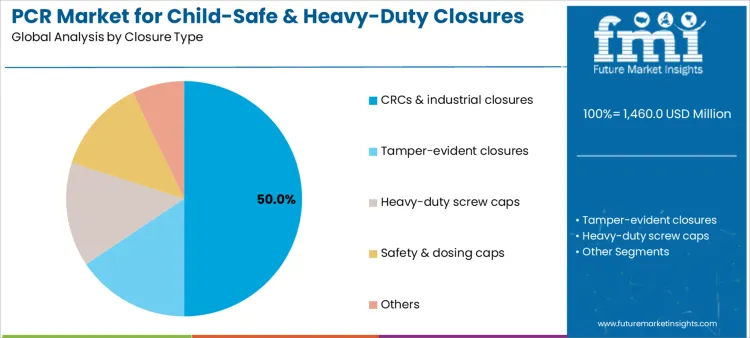
CRCs and industrial closures hold 50.0%, reflecting mandatory safety requirements and widespread use across regulated product categories. These closures demand precise molding, repeatable opening forces, and resistance to stress cracking. Tamper-evident closures support product integrity during distribution and storage. Heavy-duty screw caps address high-torque applications involving viscous or hazardous contents. Safety and dosing caps enable controlled dispensing in pharmaceutical and household formulations. Other closure types address niche packaging formats. Closure-type segmentation reflects prioritization of certified safety performance, durability, and compatibility with automated filling operations.
Key Points
- CRCs dominate due to regulatory safety obligations.
- Heavy-duty caps support high-stress applications.
- Tamper features protect product integrity.
How Does Material Selection Influence PCR Closure Performance?
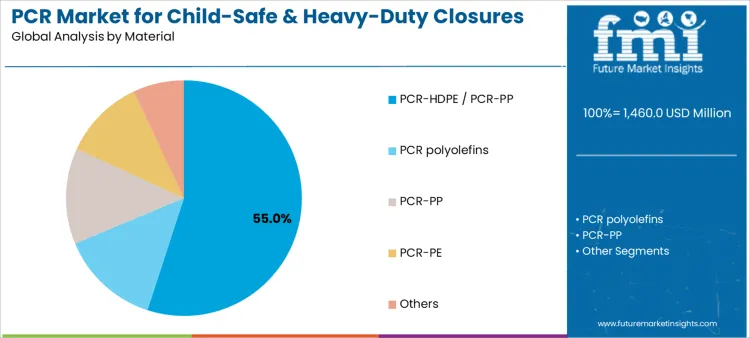
PCR-HDPE and PCR-PP account for 55.0%, supported by chemical resistance, stiffness, and established recyclability. These materials deliver consistent molding behavior and mechanical strength required for safety closures. PCR polyolefins extend use into mixed-grade applications prioritizing recycled content targets. PCR-PP supports higher heat resistance and dimensional stability, while PCR-PE offers toughness and impact resistance. Other materials serve transitional or specialty requirements. Material segmentation reflects alignment between polymer performance, certification needs, and processing reliability under high-volume closure manufacturing conditions.
Key Points
- PCR-HDPE and PCR-PP meet strength and resistance needs.
- Polyolefin streams ensure supply continuity.
- Material choice balances safety certification and recyclability.
Which End-Use Categories Drive Demand for PCR Heavy-Duty Closures?
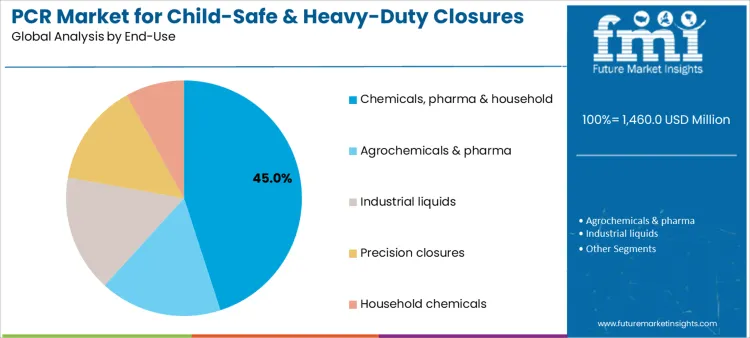
Chemicals, pharmaceuticals, and household products account for 45.0%, reflecting strict safety labeling and child-resistance mandates. Agrochemicals and pharmaceutical uses emphasize containment integrity and controlled dispensing. Industrial liquids require closures that withstand handling stress and exposure conditions. Precision closures support dosing accuracy in regulated formulations. Household chemicals contribute volume demand through widespread retail distribution. End-use segmentation highlights concentration where safety compliance, scale, and sustainability commitments intersect.
Key Points
- Regulated chemicals and pharma drive primary demand.
- Industrial liquids require robust closure performance.
- Household products support high-volume adoption.
What are the Key Dynamics in the PCR Market for Child-Safe & Heavy-Duty Closures?
Demand in the PCR market for child-safe and heavy-duty closures is driven by manufacturers of household chemicals, pharmaceuticals, automotive fluids, and industrial products that must meet stringent functional performance while advancing sustainability goals. Child-resistant closures on OTC medicines, cleaning products, and hazardous liquids require precise torque performance and reliable locking mechanisms. Heavy-duty closures for drums, jugs, and pails used in agrochemicals, lubricants, and construction chemicals demand impact resistance and dimensional stability under stress. Brand owners increasingly seek PCR content that does not compromise these critical safety and performance attributes.
How do safety requirements and mechanical performance expectations shape material adoption?
Material selection for child-safe and heavy-duty closures hinges on predictable mechanical behavior under repeated torque cycles and drop impacts. Closures designed to meet regulatory standards for child resistance need PCR resins with tight control over stiffness and creep resistance so that locking tabs, ramps, and serrations maintain functionality over the product’s life. Heavy-duty closures exposed to vibration and rough handling in transport require PCR formulations that sustain high impact strength and fatigue resistance without cracking or deformation. Automotive and industrial markets specify PCR compounds that retain thread integrity and sealing force when mated with compatible containers, avoiding leaks that can lead to safety incidents or product spoilage. Evaluations of PCR resin melt flow and additive profiles guide converters in producing closures that meet torque curve specifications and comply with dimensional tolerances essential to closure performance.
How do feedstock quality constraints and testing requirements influence market scale?
Expansion of the PCR market in child-safe and heavy-duty closures is influenced by the need for consistently high-quality recycled feedstock and rigorous testing to validate performance under defined conditions. PCR streams used for closures must be free of contaminants that affect mechanical properties, requiring advanced sorting and decontamination processes before compounding. Variability in recycled resin properties can lead to inconsistent torque performance or reduced impact resistance, pushing converters to blend PCR with virgin materials to manage risk, which alters declared recycled content levels. Regulatory and industry standards for child-resistant closure testing require repeated cycle verification and torque profiling, adding development time and cost before new PCR grades can be qualified for production. Price sensitivity in value-oriented industrial segments affects how much PCR content buyers can incorporate without compromising closure performance or increasing warranty exposure. Regional differences in recycled content mandates and safety certification protocols further shape where specific PCR closure solutions are adopted without extensive requalification.
How Is Demand for the PCR Market for Child-Safe & Heavy-Duty Closures Evolving Globally?
Global demand for PCR materials in child-safe and heavy-duty closures is rising as regulated packaging segments increase recycled content adoption. Growth reflects stricter safety compliance, brand sustainability commitments, and expanding use of recycled polymers in closures for chemicals, pharmaceuticals, and household products. Performance requirements emphasize torque control, mechanical strength, and long-term durability. Qualification cycles focus on safety certification, material consistency, and regulatory traceability. India records 15.6% CAGR, China records 14.2% CAGR, USA records 11.8% CAGR, Germany records 11.4% CAGR, and Brazil records 11.2% CAGR. Market expansion follows compliance readiness and engineering validation rather than packaging volume growth.
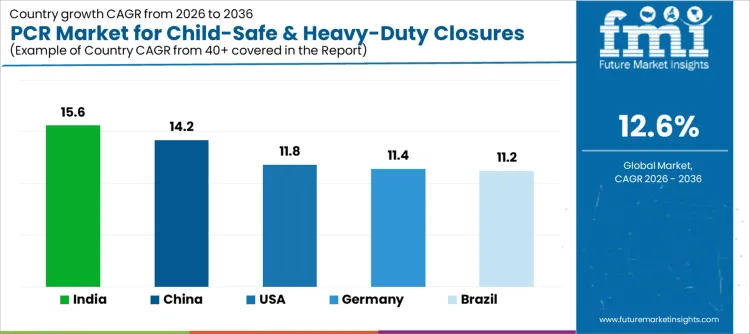
| Country | CAGR (%) |
|---|---|
| India | 15.6% |
| China | 14.2% |
| USA | 11.8% |
| Germany | 11.4% |
| Brazil | 11.2% |
What is driving growth of PCR demand for child-safe and heavy-duty closures in India?
Demand for PCR materials in child-safe and heavy-duty closures in India is expanding as regulated packaging volumes increase. Growth at 15.6% CAGR reflects rising production of closures for agrochemicals, pharmaceuticals, and household chemicals requiring safety certification. Regulatory pressure on plastic waste encourages recycled content integration within rigid packaging components. Closure manufacturers prioritize PCR grades meeting torque retention and mechanical reliability standards. Cost sensitivity drives blended material strategies balancing recycled content with performance stability. Demand remains concentrated within domestic manufacturing clusters supplying fast-growing agricultural and consumer chemical markets.
- Expansion of regulated chemical packaging
- Rising safety-certified closure production
- Regulatory pressure on recycled plastics
- Focus on torque and durability performance
Why is China seeing expansion in PCR adoption for child-safe and heavy-duty closures?
PCR demand for child-safe and heavy-duty closures in China is rising as large packaging suppliers scale recycled material usage. Growth at 14.2% CAGR reflects high-volume production of closures for industrial chemicals, pharmaceuticals, and export-oriented consumer goods. Regulatory mandates on recycled plastics accelerate substitution within non-food closures. Centralized manufacturing supports consistent quality control and safety validation. Export compliance requirements increase reliance on certified PCR materials. Demand remains centered on heavy-duty screw caps, child-resistant mechanisms, and tamper-evident systems serving domestic and international markets.
- High-volume industrial closure manufacturing
- Regulatory mandates on recycled content
- Export compliance driven material qualification
- Focus on certified child-resistant mechanisms
What factors are shaping PCR sales for child-safe and heavy-duty closures in the USA?
Sales of PCR materials for child-safe and heavy-duty closures in the USA are increasing as brands execute sustainability commitments. Growth at 11.8% CAGR reflects adoption across pharmaceutical, household chemical, and specialty packaging. Regulatory oversight emphasizes child resistance, tamper evidence, and mechanical reliability. Brand risk management drives conservative material qualification and extensive testing. Retail and distributor requirements influence recycled content targets. Demand is driven by portfolio-wide packaging transitions rather than new closure format introductions.
- Brand sustainability commitments
- Strict child-safety compliance requirements
- Emphasis on mechanical reliability
- Conservative qualification timelines
How is Germany supporting growth of PCR demand for child-safe and heavy-duty closures?
PCR demand for child-safe and heavy-duty closures in Germany is advancing as circular economy regulations tighten packaging standards. Growth at 11.4% CAGR reflects adoption within chemical, pharmaceutical, and industrial packaging segments. EU compliance frameworks increase pressure for certified recycled content and traceability. German closure manufacturers prioritize precision molding, material consistency, and safety performance. Advanced recycling infrastructure supports availability of high-quality PCR resins. Demand remains compliance-driven and focused on regulated closure applications.
- EU circular economy compliance pressure
- High standards for traceability and safety
- Focus on precision closure manufacturing
- Availability of high-quality PCR supply
What is driving expansion of PCR demand for child-safe and heavy-duty closures in Brazil?
Demand for PCR materials in child-safe and heavy-duty closures in Brazil is rising as chemical and household product packaging expands. Growth at 11.2% CAGR reflects increased use of safety closures for agrochemicals, cleaners, and industrial products. Regional recycling improvements support PCR availability for rigid packaging components. Manufacturers balance safety certification requirements with cost constraints. Climate conditions influence material selection for long-term durability. Demand concentrates within domestic markets supplying agriculture and consumer chemical distribution networks.
- Growth of agrochemical and household packaging
- Improvement in regional recycling capacity
- Focus on safety-certified closure performance
- Cost-sensitive material optimization
What is the competitive landscape of demand for the PCR market for child-safe & heavy-duty closures globally?
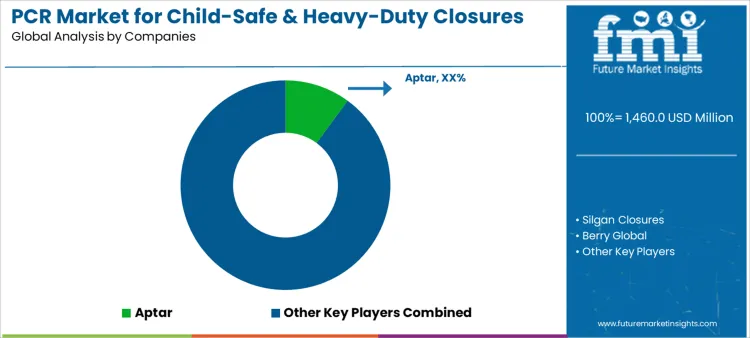
Regulatory pressure around child resistance and safe handling of hazardous contents is shaping demand for PCR-based closures. Buyers in pharma, household chemicals, and agrochemicals scrutinize torque accuracy, certified child-resistance performance, seal integrity, and durability under repeated opening cycles. Evaluation extends to stress cracking resistance, compatibility with solvents and concentrates, and dimensional stability when recycled polymers are introduced. Procurement behavior prioritizes suppliers that can document CRC certification continuity, maintain tight molding tolerances, and ensure consistent PCR resin quality. Trend in the PCR market for child-safe and heavy-duty closures reflects cautious PCR adoption, focused on compliance preservation rather than rapid material substitution.
Aptar holds leading positioning through CRC and dispensing closure platforms already validated with recycled content across regulated end uses. Silgan Closures competes by leveraging high-cavitation manufacturing and torque control expertise suited for heavy-duty container formats. Berry Global maintains relevance through industrial and household closures engineered for chemical resistance while incorporating PCR. ALPLA Closures supports demand with system-aligned caps optimized alongside PCR bottles and regional recycling loops. Zhejiang B.I. Packaging participates by supplying cost-competitive PCR child-safe closures for regional chemical and household brands. Competitive differentiation centers on certification depth, torque repeatability, PCR feedstock control, and reliability in regulated supply chains.
Key Players in the PCR Market for Child-Safe & Heavy-Duty Closures
- Aptar
- Silgan Closures
- Berry Global
- ALPLA Closures
- Zhejiang B.I. Packaging
- Zijiang
- Nippon Closures
- Yoshino Kogyosho
- Others
Scope of the Report
| Items | Values |
|---|---|
| Quantitative Units | USD million |
| Closure Type | CRCs & industrial closures; Tamper-evident closures; Heavy-duty screw caps; Safety & dosing caps; Others |
| Material | PCR-HDPE / PCR-PP; PCR polyolefins; PCR-PP; PCR-PE; Others |
| End-Use | Chemicals, pharma & household; Agrochemicals & pharma; Industrial liquids; Precision closures; Household chemicals |
| Regions Covered | Asia Pacific, Europe, North America, Latin America, Middle East & Africa |
| Countries Covered | India, China, USA, Germany, Brazil, and 40+ countries |
| Key Companies Profiled | Aptar; Silgan Closures; Berry Global; ALPLA Closures; Zhejiang B.I. Packaging; Zijiang; Nippon Closures; Yoshino Kogyosho; Others |
| Additional Attributes | Dollar sales by closure type, material, and end-use application across regulated and industrial packaging segments; performance validation of PCR closures for torque consistency and child-resistance compliance; adoption trends for tamper-evident and heavy-duty PCR caps; sourcing strategies balancing recycled content mandates with mechanical strength, sealing integrity, and chemical compatibility requirements. |
PCR Market for Child-Safe & Heavy-Duty Closures by Segment
Closure Type:
- CRCs & industrial closures
- Tamper-evident closures
- Heavy-duty screw caps
- Safety & dosing caps
- Others
Material:
- PCR-HDPE / PCR-PP
- PCR polyolefins
- PCR-PP
- PCR-PE
- Others
End-Use:
- Chemicals, pharma & household
- Agrochemicals & pharma
- Industrial liquids
- Precision closures
- Household chemicals
Region:
- Asia Pacific
- China
- Japan
- South Korea
- India
- Australia & New Zealand
- ASEAN
- Rest of Asia Pacific
- Europe
- Germany
- United Kingdom
- France
- Italy
- Spain
- Nordic
- BENELUX
- Rest of Europe
- North America
- United States
- Canada
- Mexico
- Latin America
- Brazil
- Chile
- Rest of Latin America
- Middle East & Africa
- Kingdom of Saudi Arabia
- Other GCC Countries
- Turkey
- South Africa
- Other African Union
- Rest of Middle East & Africa
Bibliography
- European Commission. (2023). Packaging and packaging waste regulation: Recycled content, safety, and compliance requirements. Publications Office of the European Union.
- International Organization for Standardization. (2023). ISO 22095:2023—Chain of custody: General terminology and models. ISO.
- International Organization for Standardization. (2024). ISO 19728:2024—Plastics—Polyethylene (PE) and polypropylene (PP) recyclates—Characterisation and quality requirements. ISO.
Frequently Asked Questions
How big is the PCR market for child-safe and heavy-duty closures in 2026?
The PCR market for child-safe and heavy-duty closures is projected to be valued at USD 1,460.0 million in 2026.
What will be the size of the PCR market for child-safe and heavy-duty closures in 2036?
The market size for PCR child-safe and heavy-duty closures is projected to reach USD 4,783.4 million by 2036.
How much will the demand for PCR child-safe and heavy-duty closures grow between 2026 and 2036?
Demand for PCR child-safe and heavy-duty closures is projected to grow at a 12.6% CAGR between 2026 and 2036.
Which closure type holds a significant share in the PCR child-safe and heavy-duty closures market in 2026?
Which closure type holds a significant share in the PCR child-safe and heavy-duty closures market in 2026?
Which closure type holds a significant share in the PCR child-safe and heavy-duty closures market in 2026?
The chemicals, pharmaceuticals, and household segment is expected to command a 45.0% share in the PCR child-safe and heavy-duty closures market in 2026.
Preview the report firsthand - request a free sample
Get SampleGet the brochure for pricing and purchase details.
Get PDFTable of Content
- Executive Summary
- Global Market Outlook
- Demand-side Trends
- Supply-side Trends
- Technology Roadmap Analysis
- Analysis and Recommendations
- Market Overview
- Market Coverage / Taxonomy
- Market Definition / Scope / Limitations
- Market Background
- Market Dynamics
- Drivers
- Restraints
- Opportunity
- Trends
- Scenario Forecast
- Demand in Optimistic Scenario
- Demand in Likely Scenario
- Demand in Conservative Scenario
- Opportunity Map Analysis
- Product Life Cycle Analysis
- Supply Chain Analysis
- Investment Feasibility Matrix
- Value Chain Analysis
- PESTLE and Porter’s Analysis
- Regulatory Landscape
- Regional Parent Market Outlook
- Production and Consumption Statistics
- Import and Export Statistics
- Market Dynamics
- Global Market Analysis 2021 to 2025 and Forecast, 2026 to 2036
- Historical Market Size Value (USD Million) Analysis, 2021 to 2025
- Current and Future Market Size Value (USD Million) Projections, 2026 to 2036
- Y-o-Y Growth Trend Analysis
- Absolute $ Opportunity Analysis
- Global Market Pricing Analysis 2021 to 2025 and Forecast 2026 to 2036
- Global Market Analysis 2021 to 2025 and Forecast 2026 to 2036, By Closure Type
- Introduction / Key Findings
- Historical Market Size Value (USD Million) Analysis By Closure Type , 2021 to 2025
- Current and Future Market Size Value (USD Million) Analysis and Forecast By Closure Type , 2026 to 2036
- CRCs & industrial closures
- Tamper-evident closures
- Heavy-duty screw caps
- Safety & dosing caps
- Others
- CRCs & industrial closures
- Y-o-Y Growth Trend Analysis By Closure Type , 2021 to 2025
- Absolute $ Opportunity Analysis By Closure Type , 2026 to 2036
- Global Market Analysis 2021 to 2025 and Forecast 2026 to 2036, By Material
- Introduction / Key Findings
- Historical Market Size Value (USD Million) Analysis By Material, 2021 to 2025
- Current and Future Market Size Value (USD Million) Analysis and Forecast By Material, 2026 to 2036
- PCR-HDPE / PCR-PP
- PCR polyolefins
- PCR-PP
- PCR-PE
- Others
- PCR-HDPE / PCR-PP
- Y-o-Y Growth Trend Analysis By Material, 2021 to 2025
- Absolute $ Opportunity Analysis By Material, 2026 to 2036
- Global Market Analysis 2021 to 2025 and Forecast 2026 to 2036, By End-Use
- Introduction / Key Findings
- Historical Market Size Value (USD Million) Analysis By End-Use, 2021 to 2025
- Current and Future Market Size Value (USD Million) Analysis and Forecast By End-Use, 2026 to 2036
- Chemicals, pharma & household
- Agrochemicals & pharma
- Industrial liquids
- Precision closures
- Household chemicals
- Chemicals, pharma & household
- Y-o-Y Growth Trend Analysis By End-Use, 2021 to 2025
- Absolute $ Opportunity Analysis By End-Use, 2026 to 2036
- Global Market Analysis 2021 to 2025 and Forecast 2026 to 2036, By Region
- Introduction
- Historical Market Size Value (USD Million) Analysis By Region, 2021 to 2025
- Current Market Size Value (USD Million) Analysis and Forecast By Region, 2026 to 2036
- North America
- Latin America
- Western Europe
- Eastern Europe
- East Asia
- South Asia and Pacific
- Middle East & Africa
- Market Attractiveness Analysis By Region
- North America Market Analysis 2021 to 2025 and Forecast 2026 to 2036, By Country
- Historical Market Size Value (USD Million) Trend Analysis By Market Taxonomy, 2021 to 2025
- Market Size Value (USD Million) Forecast By Market Taxonomy, 2026 to 2036
- By Country
- USA
- Canada
- Mexico
- By Closure Type
- By Material
- By End-Use
- By Country
- Market Attractiveness Analysis
- By Country
- By Closure Type
- By Material
- By End-Use
- Key Takeaways
- Latin America Market Analysis 2021 to 2025 and Forecast 2026 to 2036, By Country
- Historical Market Size Value (USD Million) Trend Analysis By Market Taxonomy, 2021 to 2025
- Market Size Value (USD Million) Forecast By Market Taxonomy, 2026 to 2036
- By Country
- Brazil
- Chile
- Rest of Latin America
- By Closure Type
- By Material
- By End-Use
- By Country
- Market Attractiveness Analysis
- By Country
- By Closure Type
- By Material
- By End-Use
- Key Takeaways
- Western Europe Market Analysis 2021 to 2025 and Forecast 2026 to 2036, By Country
- Historical Market Size Value (USD Million) Trend Analysis By Market Taxonomy, 2021 to 2025
- Market Size Value (USD Million) Forecast By Market Taxonomy, 2026 to 2036
- By Country
- Germany
- UK
- Italy
- Spain
- France
- Nordic
- BENELUX
- Rest of Western Europe
- By Closure Type
- By Material
- By End-Use
- By Country
- Market Attractiveness Analysis
- By Country
- By Closure Type
- By Material
- By End-Use
- Key Takeaways
- Eastern Europe Market Analysis 2021 to 2025 and Forecast 2026 to 2036, By Country
- Historical Market Size Value (USD Million) Trend Analysis By Market Taxonomy, 2021 to 2025
- Market Size Value (USD Million) Forecast By Market Taxonomy, 2026 to 2036
- By Country
- Russia
- Poland
- Hungary
- Balkan & Baltic
- Rest of Eastern Europe
- By Closure Type
- By Material
- By End-Use
- By Country
- Market Attractiveness Analysis
- By Country
- By Closure Type
- By Material
- By End-Use
- Key Takeaways
- East Asia Market Analysis 2021 to 2025 and Forecast 2026 to 2036, By Country
- Historical Market Size Value (USD Million) Trend Analysis By Market Taxonomy, 2021 to 2025
- Market Size Value (USD Million) Forecast By Market Taxonomy, 2026 to 2036
- By Country
- China
- Japan
- South Korea
- By Closure Type
- By Material
- By End-Use
- By Country
- Market Attractiveness Analysis
- By Country
- By Closure Type
- By Material
- By End-Use
- Key Takeaways
- South Asia and Pacific Market Analysis 2021 to 2025 and Forecast 2026 to 2036, By Country
- Historical Market Size Value (USD Million) Trend Analysis By Market Taxonomy, 2021 to 2025
- Market Size Value (USD Million) Forecast By Market Taxonomy, 2026 to 2036
- By Country
- India
- ASEAN
- Australia & New Zealand
- Rest of South Asia and Pacific
- By Closure Type
- By Material
- By End-Use
- By Country
- Market Attractiveness Analysis
- By Country
- By Closure Type
- By Material
- By End-Use
- Key Takeaways
- Middle East & Africa Market Analysis 2021 to 2025 and Forecast 2026 to 2036, By Country
- Historical Market Size Value (USD Million) Trend Analysis By Market Taxonomy, 2021 to 2025
- Market Size Value (USD Million) Forecast By Market Taxonomy, 2026 to 2036
- By Country
- Kingdom of Saudi Arabia
- Other GCC Countries
- Turkiye
- South Africa
- Other African Union
- Rest of Middle East & Africa
- By Closure Type
- By Material
- By End-Use
- By Country
- Market Attractiveness Analysis
- By Country
- By Closure Type
- By Material
- By End-Use
- Key Takeaways
- Key Countries Market Analysis
- USA
- Pricing Analysis
- Market Share Analysis, 2025
- By Closure Type
- By Material
- By End-Use
- Canada
- Pricing Analysis
- Market Share Analysis, 2025
- By Closure Type
- By Material
- By End-Use
- Mexico
- Pricing Analysis
- Market Share Analysis, 2025
- By Closure Type
- By Material
- By End-Use
- Brazil
- Pricing Analysis
- Market Share Analysis, 2025
- By Closure Type
- By Material
- By End-Use
- Chile
- Pricing Analysis
- Market Share Analysis, 2025
- By Closure Type
- By Material
- By End-Use
- Germany
- Pricing Analysis
- Market Share Analysis, 2025
- By Closure Type
- By Material
- By End-Use
- UK
- Pricing Analysis
- Market Share Analysis, 2025
- By Closure Type
- By Material
- By End-Use
- Italy
- Pricing Analysis
- Market Share Analysis, 2025
- By Closure Type
- By Material
- By End-Use
- Spain
- Pricing Analysis
- Market Share Analysis, 2025
- By Closure Type
- By Material
- By End-Use
- France
- Pricing Analysis
- Market Share Analysis, 2025
- By Closure Type
- By Material
- By End-Use
- India
- Pricing Analysis
- Market Share Analysis, 2025
- By Closure Type
- By Material
- By End-Use
- ASEAN
- Pricing Analysis
- Market Share Analysis, 2025
- By Closure Type
- By Material
- By End-Use
- Australia & New Zealand
- Pricing Analysis
- Market Share Analysis, 2025
- By Closure Type
- By Material
- By End-Use
- China
- Pricing Analysis
- Market Share Analysis, 2025
- By Closure Type
- By Material
- By End-Use
- Japan
- Pricing Analysis
- Market Share Analysis, 2025
- By Closure Type
- By Material
- By End-Use
- South Korea
- Pricing Analysis
- Market Share Analysis, 2025
- By Closure Type
- By Material
- By End-Use
- Russia
- Pricing Analysis
- Market Share Analysis, 2025
- By Closure Type
- By Material
- By End-Use
- Poland
- Pricing Analysis
- Market Share Analysis, 2025
- By Closure Type
- By Material
- By End-Use
- Hungary
- Pricing Analysis
- Market Share Analysis, 2025
- By Closure Type
- By Material
- By End-Use
- Kingdom of Saudi Arabia
- Pricing Analysis
- Market Share Analysis, 2025
- By Closure Type
- By Material
- By End-Use
- Turkiye
- Pricing Analysis
- Market Share Analysis, 2025
- By Closure Type
- By Material
- By End-Use
- South Africa
- Pricing Analysis
- Market Share Analysis, 2025
- By Closure Type
- By Material
- By End-Use
- USA
- Market Structure Analysis
- Competition Dashboard
- Competition Benchmarking
- Market Share Analysis of Top Players
- By Regional
- By Closure Type
- By Material
- By End-Use
- Competition Analysis
- Competition Deep Dive
- Aptar
- Overview
- Product Portfolio
- Profitability by Market Segments (Product/Age /Sales Channel/Region)
- Sales Footprint
- Strategy Overview
- Marketing Strategy
- Product Strategy
- Channel Strategy
- Silgan Closures
- Berry Global
- ALPLA Closures
- Zhejiang B.I. Packaging
- Zijiang
- Nippon Closures
- Yoshino Kogyosho
- Others
- Aptar
- Competition Deep Dive
- Assumptions & Acronyms Used
- Research Methodology


