

- Industry Size (2026)
- USD 478.6 Mn
- Forecast (2036)
- USD 965.4 Mn
- CAGR (2026 to 2036)
- 7.28%
Paper Canister End Closures Market Size, Market Forecast and Outlook By FMI
The paper canister end closures market was valued at USD 445.2 million in 2025. The industry is poised to reach USD 478.6 million in 2026 at a CAGR of 7.28% during the forecast period. Revenue expansion propels the total opportunity to USD 965.4 million through 2036 as the structural shift toward hybrid paper-based primary packaging necessitates specialized barrier closures that maintain product integrity while reducing overall plastic intensity.
Brand managers in the premium snack and specialty coffee sectors are no longer just choosing a lid; they are deciding between a total recyclability profile and a guaranteed shelf-life threshold. This transformation forces a move away from legacy multi-component assemblies toward integrated packaging closures that can be easily separated or repulped. The stakes for delay are significant, as tier-1 retailers increasingly penalize non-circular designs through "green" shelf-space fees or outright listing exclusions. A non-obvious observation surfaces here: while the body of the canister is often fully fiber-based, the closure remains the primary failure point for moisture ingress, making the engineering of the "end" more critical than the tube itself.
Summary of Paper Canister End Closures Market
- Paper Canister End Closures Market Definition:
- The market centers on the engineering of functional interfaces that seal fiber-based canisters, providing the necessary barrier properties and consumer accessibility for premium dry goods and industrial powders.
- Demand Drivers in the Market:
- Corporate sustainability mandates force procurement heads at snack companies to replace all-metal cans with fiber-based hybrid containers.
- The rise of e-commerce shipping requires more durable easy open ends that can withstand vertical pressure without popping or losing seal integrity.
- Regulatory pressure on single-use plastics compels personal care brands to adopt fiber-based canisters with repulpable closures for powders and balms.
- Key Segments Analyzed in the FMI Report:
- Metal: Metal is expected to garner 42.1% share in 2026, as it remains the only material providing the absolute moisture barrier required for international composite cans distribution.
- Easy-Open Ends: Easy-open ends are projected to lead the closure type segment through 2036 because they satisfy the consumer demand for tool-free accessibility in convenience food.
- Food and Beverage: Food and beverage is estimated to account for 55.4% share in 2026, driven by the massive migration of nut and potato chip brands to paper canisters.
- India: India tracks a 9.4% compound growth due to the rapid modernization of domestic dairy and spice packaging standards.
- Analyst Opinion at FMI:
- Ismail Sutaria, Principal Analyst, Packaging, at FMI, opines, “Practitioners in the closure space recognize a timing disconnect that the broader market often misses: while brands want 100% fiber canisters, the current high-speed filling infrastructure is optimized for metal ends. The real growth won't come from 'better' paper lids, but from metal-end designs that use 30% less aluminum while maintaining the same seaming speed. We are seeing a transition period where 'hybridity' is the dominant engineering goal, rather than pure material substitution, because the operational cost of slowing down a filling line to accommodate a fragile paper lid is simply too high for mass-market players.”
- Strategic Implications / Executive Takeaways:
- Packaging engineers must prioritize "plug-and-play" closures that fit existing seamer configurations to avoid massive capital expenditure for brand owners.
- Material scientists should focus on developing high-barrier coatings for fiber lids to close the performance gap with aluminum foils.
- Recycling coordinators face a structural constraint where metal-ended canisters are often rejected by paper mills, requiring clearer consumer instructions on "end" removal.
- Methodology:
- Primary Research: Focused on decision-maker roles including Supply Chain Managers and Quality Control Heads at major FMCG firms.
- Desk Research: Utilized certification registries and patent filing databases to track material innovation in barrier coatings.
- Market-Sizing and Forecasting: Anchored to annual composite can consumption metrics across 40 plus countries.
- Data Validation and Update Cycle: Triangulated through secondary trade associations and regional manufacturing output data.
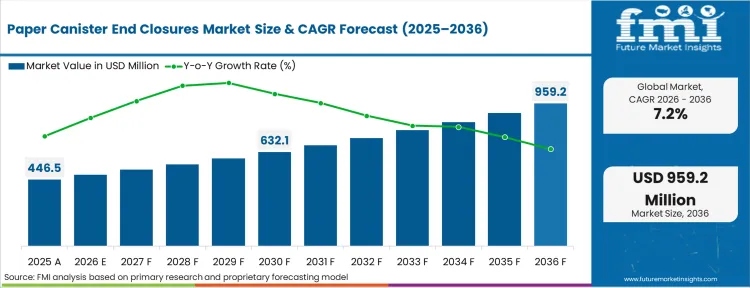
Growth becomes self-reinforcing once the industry passes the structural gate of high-speed application compatibility for fiber-based ends. Currently, metal and plastic ends dominate because they survive the torque and pressure of standard seaming lines, whereas fiber ends often require lower speeds. Once specialized application equipment is standardized across contract packaging hubs, the move toward sustainable packaging formats will accelerate beyond niche premium brands into mass-market commodity lines.
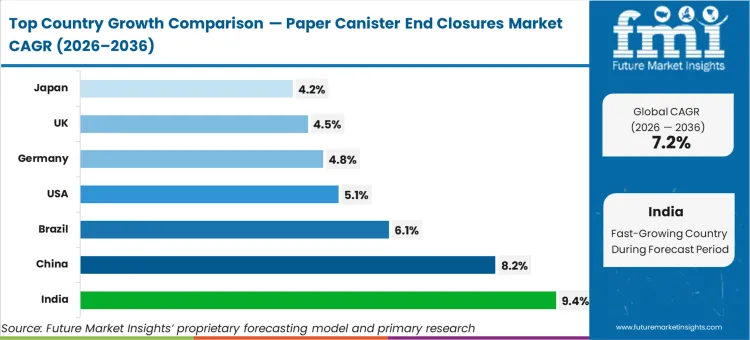
Demand for paper canister end closures in India is set to grow at 9.4% as organized retail expansion outpaces domestic supply of specialized food packaging solutions. China is expected to record a CAGR of 8.2% following massive infrastructure investment in composite can manufacturing hubs. The Brazil market for closures is likely to post a CAGR of 6.1% as regional coffee exporters modernize their retail formats. In the United States, the sector is poised to expand at 5.1% driven by strict plastic-reduction mandates in coastal states. Germany's industry is projected to witness growth at a CAGR of 4.8% through 2036, followed by the United Kingdom at 4.5%. Japan is expected to see its sector grow at a compound annual rate of 4.2%. Structural divergence across these regions is defined by the localized availability of aluminum versus specialty polymers for the closure substrates.
Paper Canister End Closures Market Key Takeaways
| Metric | Details |
|---|---|
| Industry Size (2026) | USD 478.6 million |
| Industry Value (2036) | USD 965.4 million |
| CAGR (2026-2036) | 7.28% |
Source: Future Market Insights (FMI) analysis, based on proprietary forecasting model and primary research
Paper Canister End Closures Market Definition
The paper canister end closures market comprises the specialized top and bottom sealing components designed for composite or fiberboard tubes. These closures are functionally distinct from standard container lids as they must provide a hermetic or semi-hermetic seal to a porous paper substrate. The market focuses on the structural interface between the closure material and the canister body, ensuring barrier properties for dry and semi-liquid products.
Paper Canister End Closures Market Inclusions
This market includes metal easy-open ends, aluminum peel-off foils, plastic snap-on overcaps, and fiber-based recessed plugs specifically engineered for paper canisters. It covers closures used in spiral-wound, convolute-wound, and square fiber cans. Also included are the specialized coatings and liners applied to these closures to prevent migration and enhance oxygen scavenge capabilities in high-barrier applications.
Paper Canister End Closures Market Exclusions
Explicitly excluded are closures for metal tinplate cans, all-plastic bottles, and glass jars that do not utilize a paperboard body. Functional exclusions include secondary outer-packaging like cardboard boxes or shrink-wraps. The scope also excludes general-purpose industrial drums and large-format fiber tubes that do not utilize consumer-facing closure mechanisms such as easy-open tabs or reclosable lids.
Paper Canister End Closures Market Research Methodology
- Primary Research: FMI conducted interviews with Packaging Procurement Directors, Composite Can Production Engineers, and Brand Managers at global snack food conglomerates.
- Desk Research: Data was aggregated from aluminum foil production registries, plastic resin consumption databases for closures, and corporate ESG filings from top-tier packaging manufacturers.
- Market-Sizing and Forecasting: The baseline anchors to the global production volume of composite cans, cross-referenced with closure-to-can ratios across different end-use sectors.
- Data Validation and Update Cycle: Forecasts were triangulated using independent shipping data for aluminum ends and proprietary resin-pricing models to validate revenue projections.
Segmental Analysis
Paper Canister End Closures Market Analysis by Material
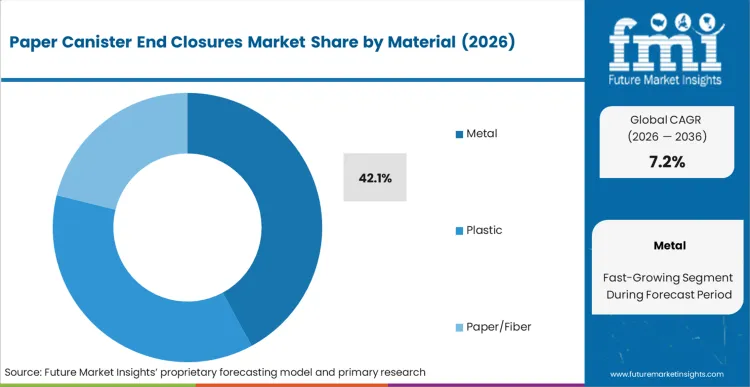
The transition away from rigid plastic and all-metal containers has reached a critical displacement point where legacy materials are failing to meet the carbon-intensity targets set by global retailers. This shift favors material combinations that can be integrated into the flexible packaging ecosystem or repulped alongside corrugated waste. Metal ends hold 42.1% of this market because they provide a non-negotiable functional requirement: oxygen barrier parity for oily snacks. According to FMI's estimates, the decision to use metal versus fiber is rarely a branding choice; it is a logistics choice based on the length of the supply chain. Buyers who opt for fiber lids in long-haul distribution often face high return rates due to product staling, whereas metal provides the "seal and forget" reliability that international brands require.
- Pre-consumer scrap value: Aluminum and tinplate ends offer a clear secondary market value that offsets the initial procurement premium. Procurement heads in high-volume plants use this recovery value to justify the higher unit cost of metal over plastic overcaps.
- Barrier-to-weight ratio: Metal closures provide a superior barrier with a significantly lower weight than rigid plastic lids. Distribution managers utilize this weight reduction to optimize freight costs while maintaining premium shelf-life for luxury packaging formats.
- Supply chain resilience: The established global network for aluminum ends ensures consistent lead times compared to specialty fiber-based alternatives. Manufacturing directors plan their production around these reliable lead times to avoid line stoppages during peak seasonal demand.
Paper Canister End Closures Market Analysis by Closure Type
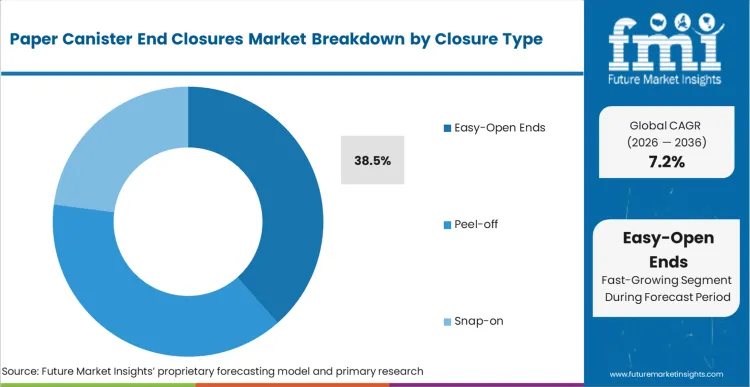
Easy-open ends dominate the closure type segment because they represent the structural resolution of the "convenience versus barrier" tension. A share of 38.5% is sustained by the fact that these closures require no secondary tools, a feature that has become a baseline expectation for the modern consumer. Buyers are choosing these ends because they facilitate immediate consumption while the underlying aluminum foil provides a tamper-evident seal. As noted by FMI, the adoption of plastic closures as overcaps remains high purely for reclosability after the initial seal is broken. The operational consequence of choosing a lid without an overcap is often a decrease in consumer satisfaction for multi-serve products, forcing brands to invest in dual-closure systems.
- Initial tamper evidence: Consumers validate product safety at the point of purchase through the physical resistance of the easy-open pull-tab. Brands that utilize non-destructive openings face higher rates of in-store shrinkage and consumer distrust.
- Repeat purchase validation: The tactile "pop" of a well-engineered snap-on lid reinforces brand quality during every subsequent use. Quality control managers monitor this interaction to ensure the closure fit does not degrade over the product's consumption cycle.
- Expansion into multi-serve: Larger diameter canisters require reinforced closure mechanisms to prevent the lid from bowing under stacking pressure. Brands that move into family-sized formats expand their closure specifications to include rib-reinforced plastic overcaps.
Paper Canister End Closures Market Analysis by End-Use
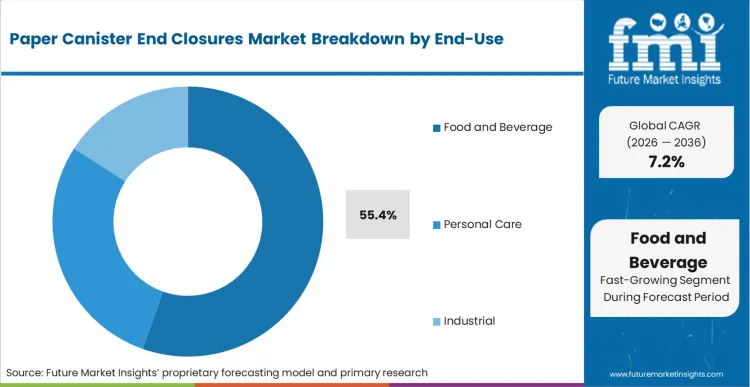
The decision facing food and beverage brands today is whether to prioritize the "zero-plastic" narrative or the "freshness-at-all-costs" reality. This sector dominates with 55.4% share because the canister format has become the de facto standard for giftable and premium dry goods. According to FMI's assessment, personal care brands are the fastest-growing niche, as they look for ways to de-plasticize their talc and dry shampoo lines. The stakes for delay are highest in the food sector, where a failure in the closure seal leads to immediate spoilage and potential brand-wide recalls.
- Moisture ingress prevention: Food brands specify high-barrier metal ends to prevent salt and sugar clumping in high-humidity markets. Formulators choose these closures to avoid the need for expensive desiccant inserts within the canister.
- Chemical compatibility gaps: Personal care brands often find that standard plastic lids interact with the essential oils in their products. Packaging engineers must specify lined or treated closures to prevent material degradation and scent loss over 12-month shelf cycles.
- Late-adopter conversion: Industrial powder manufacturers are the last to arrive at paper canisters due to the heavy-duty nature of their products. These buyers finally convert once specialised reinforced fibre ends are proven to withstand 15kg stacking loads under optimised humidity conditions.
Paper Canister End Closures Market Drivers, Restraints, and Opportunities
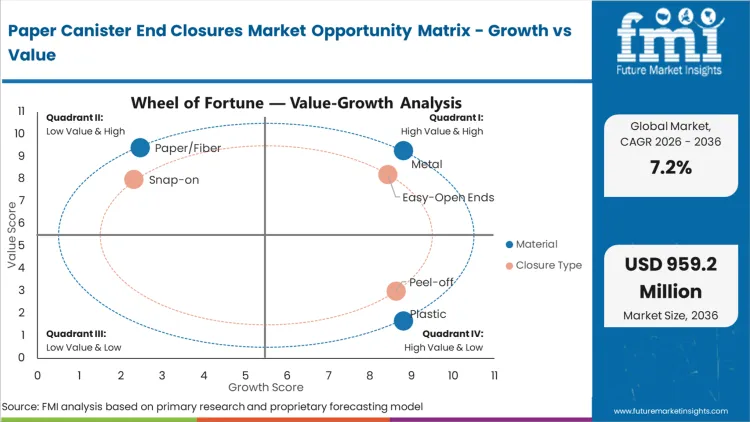
The structural forcing condition driving this market is the "circularity mandate" issued by global retail giants, which compels snack brands to eliminate all-metal cans. This is not about consumer preference; it is a procurement requirement to meet 2030 ESG targets. Brand owners are being asked to decide whether they will pay the premium for fiber-based ends now or risk being de-listed from "sustainable" product aisles in the future. The commercial stakes of acting are clear: early adopters of fiber-hybrid canisters are capturing prime shelf space previously held by legacy metal-can competitors. FMI notes that the shift is most aggressive in European and North American markets where plastic-alternative legislation is most advanced.
The primary structural friction slowing adoption is "application speed variance." Fiber-based lids and paper ends often cannot be applied at the 400-plus cans-per-minute speeds that metal seaming lines achieve. This is an organizational obstacle because it creates a bottleneck in the filling plant that cannot be solved by simply buying "better" lids; it requires a total re-engineering of the seaming process. This friction is structural because the capital investment required to replace high-speed seamers is massive, and most contract manufacturers are unwilling to absorb that cost without long-term volume guarantees from brands.
Opportunities in the Paper Canister End Closures Market
- High-barrier fiber coatings: The development of repulpable aqueous coatings that offer metal-like oxygen barriers enables the "all-paper" canister dream. Specialty chemical firms can capture this market by providing drop-in coating solutions for lid manufacturers.
- Integrated reclosability features: Brands that develop paper-based "snap" lids that do not require a secondary plastic overcap can significantly reduce their plastic intensity scores. Consumer goods firms capture this by marketing a truly "plastic-free" primary pack.
- Digital tamper-evidence: Smart closures with NFC or QR-coded seals provide a digital layer of security for premium spirits and metal closures applications. Luxury brands capture this by using the closure as a bridge to post-purchase digital engagement.
Regional Analysis
Based on the regional analysis, the Paper Canister End Closures market is segmented into North America, Latin America, Europe, East Asia, South Asia, Oceania, and Middle East and Africa across 40 plus countries.
.webp "Top Country Growth Comparison Paper Canister End Closures Market Cagr (2026 2036)")
| Country | CAGR (2026 to 2036) |
|---|---|
| India | 9.4% |
| China | 8.2% |
| Brazil | 6.1% |
| United States | 5.1% |
| Germany | 4.8% |
| United Kingdom | 4.5% |
| Japan | 4.2% |
Source: Future Market Insights (FMI) analysis, based on proprietary forecasting model and primary research
South Asia Paper Canister End Closures Market Analysis
The structural condition defining the South Asian market is the rapid conversion of loose-commodity sales to branded, packaged formats in the dairy and spice sectors. FMI analysts opine that this region's adoption pattern is buyer behavior-led, specifically the burgeoning middle class's demand for Western-style premium snacking experiences. The leading role of India signals a broader regional shift toward specialized packaging closures that can protect sensitive products in tropical climates without the cost of a full glass or metal container.
- India: India's massive spice and infant formula industries are moving toward paper canisters to reduce packaging costs while maintaining a premium shelf presence. Local mill operators are investing in high-speed composite can lines that require imported aluminum easy-open ends to meet food safety standards. The industry is forecast to register a CAGR of 9.4%. This trajectory creates a sustained competitive advantage for local snack brands that can now reach pan-Indian distribution with a lightweight, durable pack format.
FMI's report includes additional markets such as Bangladesh and Sri Lanka. The structural pattern across these markets reveals a focus on the "export-ready" packaging of tea and coffee, where the closure's barrier properties are the primary procurement variable.
East Asia Paper Canister End Closures Market Analysis
East Asia's market dynamic is infrastructure-led, characterized by a highly concentrated manufacturing base that produces a significant portion of the world's metal closures. Based on FMI's assessment, the region's adoption of fiber-based ends is being slowed by the massive existing capacity for aluminum and tinplate production. However, the domestic demand for high-end gift packaging in China, Japan, and South Korea provides a robust counter-cycle for innovative closure designs.
- China: China's dominance in aluminum foil production ensures a low-cost environment for peel-off closures, making the hybrid canister a very affordable option for domestic brands. The market for paper canister end closures in China is projected to grow at an average annual rate of 8.2%. Regional manufacturers who act now are capturing preferred supplier status in global supply chains as brands look to diversify their sourcing away from Western-only vendors.
- Japan: Japan's specific structural condition is an aging population that demands ultra-convenient, low-effort opening mechanisms. The Japan Paper Canister End Closures sector is poised to expand at a CAGR of 4.2%. Operational changes are being achieved as brands transition to soft-touch peel-off ends that reduce the risk of injury during opening.
FMI's report includes South Korea and Taiwan. A structural pattern emerges here where "micro-segmentation" of closure sizes is used to cater to the growing single-serve convenience store market.
North America Paper Canister End Closures Market Analysis
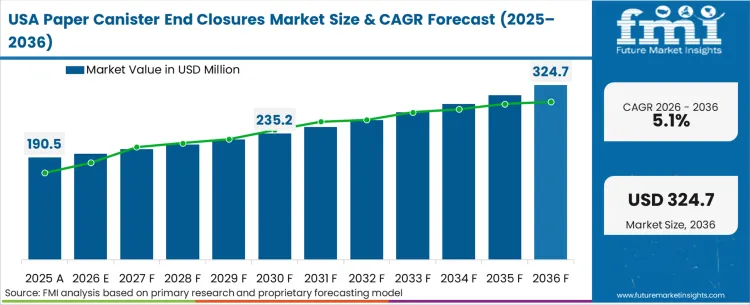
North American market is policy-led, with state-level plastic bans and EPR (Extended Producer Responsibility) fees acting as the primary catalysts for closure innovation. According to FMI's view, procurement directors at tier-1 brands are no longer asking if they should move to paper canisters, but how they can do so without losing the "snap" and "seal" that American consumers associate with freshness.
- United States: The U.S. market is driven by the aggressive plastic-reduction targets of major retailers like Walmart and Target, which essentially force brands into fiber-hybrid formats. Demand for closures in the United States is set to grow at 5.1%. Companies that successfully integrate repulpable ends capture a market segment that is increasingly insulated from the price volatility of plastic resins.
FMI's report includes Canada and Mexico. The structural trajectory here is defined by the harmonization of packaging standards across the USMCA region, ensuring that a closure qualified in Mexico meets the shelf-life requirements for the Canadian winter.
Europe Paper Canister End Closures Market Analysis
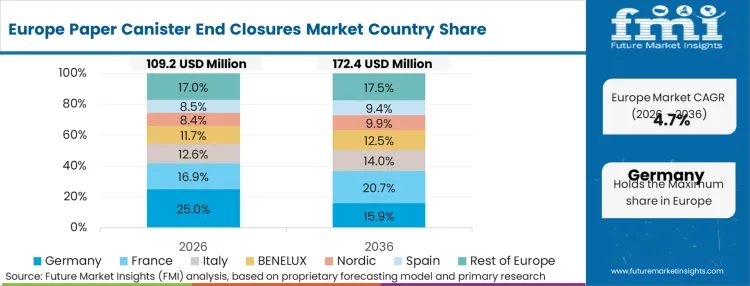
The European market is defined by a high degree of regulatory maturity, where the circularity of the closure is scrutinized as intensely as the canister itself. This region operates under an economics-led lens, where the rising cost of carbon credits and plastic taxes makes the investment in fiber-based closures a financial necessity. FMI notes that German and British manufacturers are leading the development of recessed paper plugs that eliminate the need for secondary overcaps.
- Germany: Germany's updated packaging legislation creates a direct cost differential between legacy metal ends and repulpable fiber alternatives. Pharmaceutical and specialty chemical firms in the region are migrating toward these formats to lower their carbon footprints ahead of 2030 targets. The market for closures in Germany is likely to post a CAGR of 4.8%. This shift provides a commercial opportunity for local manufacturers to export their technical expertise in high-barrier paper coatings to the rest of the EU.
- United Kingdom: The UK market is witnessing a surge in premium snack launches that utilize the paper canister as a primary brand differentiator. Demand for paper canister end closures in the UK is anticipated to increase by a CAGR of 4.5%. Retailers are increasingly favoring brands that utilize easy-to-separate metal ends, creating a competitive positioning where material ease-of-recovery dictates shelf placement.
FMI's report includes France, Italy, and Spain. The structural pattern across these markets involves a focus on artisanal and luxury food exports where closure aesthetics are as critical as barrier performance.
Latin America Paper Canister End Closures Market Analysis
In Latin America, the market is primarily driven by the export-oriented coffee and cocoa sectors, using a buyer behavior-led lens. Procurement standards are dictated by the requirements of North American and European importers, forcing local producers to adopt global closure standards to maintain market access.
- Brazil: Brazil's position as a global agricultural powerhouse necessitates massive volumes of high-barrier canisters for its premium coffee exports. The Brazil paper canister end closures industry is projected to witness growth at a CAGR of 6.1%. This expansion signals a structural trajectory where local brands move from bulk shipping to retail-ready packaging, capturing more value within the domestic economy.
FMI's report includes Mexico, Argentina, and Chile. The structural pattern reveals a growing reliance on imported metal easy-open ends while domestic fiber-lid production remains in its early stages of development.
Competitive Aligners for Market Players
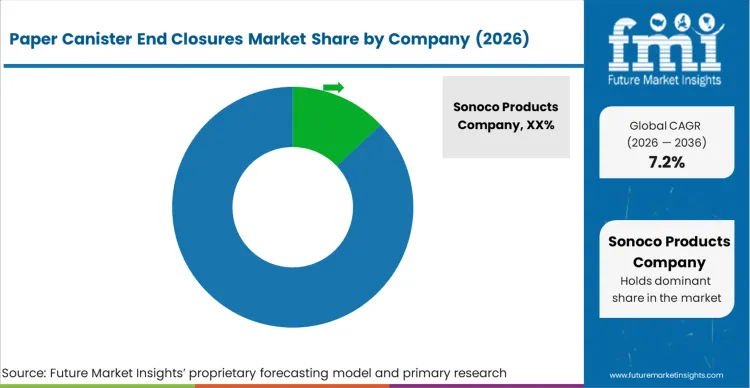
The structural reason for the market's moderate concentration level comes down to the specialized nature of the seaming equipment. Leading companies like Sonoco Products Company and Smurfit WestRock maintain dominance not just by selling closures, but by providing the integrated seaming machinery that brand owners need to apply them. Buyers use "line compatibility" as the primary variable to distinguish qualified vendors. A vendor who can provide a closure that runs on existing equipment without modification holds a massive structural advantage over a challenger who requires a proprietary seamer.
Incumbents like Mondi Group and Amcor possess a structural advantage in their global material sourcing networks, allowing them to hedge against aluminum price spikes that can cripple smaller challengers. What a challenger must build to replicate this is not just a better lid, but a "total-system" capability that includes material science, equipment engineering, and regional technical support. FMI analysts note that the competitive landscape is shifting toward "material-agnostic" vendors who can offer both metal and fiber ends, allowing brands to transition at their own pace without switching suppliers.
Large buyers resist lock-in by maintaining dual-sourcing strategies for closures, often qualifying a high-barrier metal end from one vendor and a reclosable plastic overcap from another. The structural tension between buyer preferences for "all-paper" and vendor incentives to stick with "proven-metal" will define the trajectory toward 2036. The market is becoming more consolidated as tier-1 players acquire niche lid manufacturers to complete their "sustainable" product portfolios, leaving smaller players to focus on highly customized, low-volume gift packaging applications.
Key Players in Paper Canister End Closures Market
- Sonoco Products Company
- Smurfit WestRock
- Mondi Group
- Amcor
- Silgan Holdings
- Canusa-Hershman
- Visican Ltd
- Ace Paper Tube
- Irwin Packaging Pty Ltd
- Nagel Paper
- Yazoo Mills Inc.
Scope of the Report
| Metric | Value |
|---|---|
| Quantitative Units | USD 478.6 million to USD 965.4 million, at a CAGR of 7.28% |
| Market Definition | The engineering and production of specialized closure mechanisms designed specifically to seal fiberboard and composite canisters for retail and industrial use. |
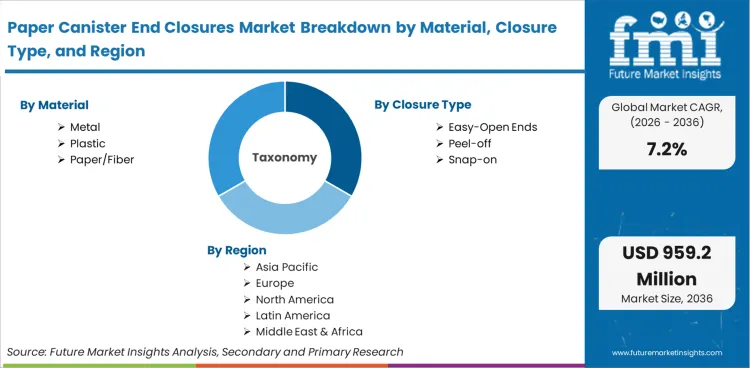
| Material Segmentation | Metal, Plastic, Paper/Fiber |
| Closure Type Segmentation | Easy-Open Ends, Peel-off, Snap-on, Plug/Lid |
| End-Use Segmentation | Food and Beverage, Personal Care, Industrial |
| Regions Covered | North America, Latin America, Europe, East Asia, South Asia, Oceania, Middle East and Africa |
| Countries Covered | India, China, Brazil, USA, Germany, UK, Japan, and 40 plus countries |
| Key Companies Profiled | Sonoco, Smurfit WestRock, Mondi, Amcor, Silgan, Canusa-Hershman, Visican Ltd, Ace Paper Tube |
| Forecast Period | 2026 to 2036 |
| Approach | Forecasts anchored to composite can manufacturing output and closure-to-can ratios. Primary interviews with packaging engineers validated seaming speed requirements. Forecasts cross-validated with aluminum and resin consumption data. |
Source: Future Market Insights (FMI) analysis, based on proprietary forecasting model and primary research
Paper Canister End Closures Market Analysis by Segments
Material:
- Metal
- Plastic
- Paper/Fiber
Closure Type:
- Easy-Open Ends
- Peel-off
- Snap-on
- Plug/Lid
End-Use:
- Food and Beverage
- Personal Care
- Industrial
Region:
- North America
- Europe
- Asia-Pacific
- Rest of the World
- Latin America
- Middle East, and Africa
Bibliography
- Environment Agency. (2025, July 7). Extended producer responsibility for packaging: Fibre-based composite and paper and board obligations: RPS 351. GOV.UK.
- PackUK. (2025, June 30). Extended producer responsibility for packaging: 2025 base fees. GOV.UK.
- HM Revenue & Customs. (2025, August 28). Plastic Packaging Tax (PPT) statistics background and references. GOV.UK.
- UK Parliament. (2024). The Producer Responsibility Obligations (Packaging and Packaging Waste) Regulations 2024.
- Confederation of Paper Industries. (2024). Design for recyclability guidelines.
This bibliography is provided for reader reference. The full FMI report contains the complete reference list with primary source documentation.
This Report Addresses
- Market intelligence to support strategic decision-making across metal, plastic, and fibre-based end closure systems for composite cans.
- Market size estimation and 10-year revenue forecasts from 2026 to 2036, supported by composite can production volume tracking.
- Growth opportunity mapping across food and personal care sectors with emphasis on high-speed seaming compatibility.
- Segment and regional revenue forecasts covering easy-open and peel-off formats across different regulatory environments in India and China.
- Competition strategy assessment, including seamer-integration, material hedging, and global sourcing networks.
- Capability development tracking, including high-barrier aqueous coatings and ultra-lightweight aluminum ends.
- Market access analysis covering plastic-reduction mandates and EPR compliance standards for hybrid packaging.
- Market report delivery in PDF, Excel, PPT, and interactive dashboard formats for executive strategy, procurement planning, and operational benchmarking use.
Frequently Asked Questions
How large is the Paper Canister End Closures Market in 2026?
The market is projected to reach USD 478.6 million in 2026. This figure signals the baseline scale of the closure industry as it enters a phase of rapid material transition from all-metal to hybrid fiber formats.
What will it be valued at by 2036?
FMI projects the market to cross USD 965.4 million by 2036. This value reflects the long-term capital refresh cycles of filling plants as they modernize their seaming equipment to accommodate more sustainable closure types.
What CAGR is projected?
The market is expected to expand at a 7.28% CAGR between 2026 and 2036. This rate is constrained by the multi-year qualification periods required for new barrier materials in the high-stakes food packaging sector.
Which Material segment leads?
Metal currently leads with a 42.1% share because it remains the only material that provides a absolute oxygen and moisture barrier for international distribution. This dominance persists because most global supply chains are still optimized for the "seal and forget" reliability of aluminum ends.
Which Closure Type segment leads?
Easy-open ends lead with a 38.5% share due to the non-negotiable consumer demand for tool-free accessibility. These ends are chosen because they satisfy both the functional need for a hermetic seal and the consumer need for convenience.
Which End-Use segment leads?
The food and beverage sector leads with 55.4% share, driven by the massive migration of snack brands to paper canisters. This segment leads because the "giftable" nature of canister packaging makes it the de facto standard for premium dry goods.
What drives rapid growth?
Growth is driven by the structural "circularity mandate" where retailers require brands to reduce plastic and metal intensity. This forces a move toward fiber-based canisters, which in turn creates a massive replacement market for specialized end closures.
What is the primary restraint?
The primary restraint is the variance in application speed between legacy metal ends and newer fiber-based alternatives. Most high-speed filling lines are not yet optimized for fragile lids, creating a bottleneck that limits mass-market adoption.
Which country grows fastest?
India is the fastest-growing market at a 9.4% CAGR, outpacing China at 8.2%. The structural difference lies in India's rapid shift from loose to packaged commodity sales, which is happening alongside the adoption of modern retail standards.
How do EPR mandates affect closure selection?
Extended Producer Responsibility (EPR) mandates in Europe and North America penalize multi-material packs that are difficult to separate. This compels procurement heads to choose closures that are either fully repulpable or easily removable by the consumer.
Are fiber ends ready for high-moisture products?
Currently, most fiber ends are limited to dry or semi-dry products because they lack the absolute barrier properties of aluminum. While coatings are improving, the performance gap still forces most high-barrier brands to stick with metal ends for long-haul logistics.
Why are plastic overcaps still used with metal ends?
Plastic overcaps are used to provide reclosability once the hermetic metal seal is broken. Without an overcap, a multi-serve canister of snacks would lose its freshness within hours of opening, leading to consumer dissatisfaction.
Does the report cover the seaming equipment used to apply these closures?
The report analyzes seaming equipment as a key competitive variable, as "line compatibility" is a major barrier to entry for new closure manufacturers. Leading vendors often provide the machines as part of a total packaging solution.
What is the impact of aluminum price volatility on this market?
Price volatility creates a structural incentive for brands to reduce the gauge of their aluminum ends or switch to fiber-based alternatives. Large vendors use their scale to hedge these costs, while smaller players are forced to innovate with cheaper substrates.
How does India's market differ from China's structurally?
India's growth is driven by a ground-up modernization of the food supply chain, while China's is driven by a top-down infrastructure push to dominate global packaging exports. India's market is more focused on domestic consumption trends.
Are these closures recyclable in standard paper streams?
Most metal ends are recyclable if separated from the canister, but they are often rejected if they reach a paper mill still attached. This "recycling gap" is a major focus for brand owners looking to improve their sustainability scores.
What is the role of "tamper evidence" in closure design?
Tamper evidence is a non-negotiable safety requirement for the food sector. Easy-open pull-tabs and peel-off foils provide an immediate visual and tactile confirmation that the product has not been opened since it left the factory.
Can paper canister closures be used for liquids?
While specialized canisters exist for liquids (like motor oil), the majority of the market remains focused on dry powders and snacks. The closure requirement for liquids is significantly more complex, requiring fused liners and reinforced seams.
What is the significance of the "premiumization" trend?
Premiumization drives brands to use more decorative and tactile closures, such as embossed metal lids or high-finish plastic overcaps. This trend is strongest in the spirits and specialty tea markets.
How does the e-commerce boom affect closure engineering?
E-commerce shipping subjects canisters to significant vertical and lateral pressure. Closures must be engineered to withstand "popping" during transit, leading to a demand for reinforced seams and more robust snap-on features.
What is the forecast for fully compostable closures?
Compostable closures are a high-growth niche, but they currently lack the barrier performance required for long shelf-life products. We expect this segment to grow as biopolymer technology matures toward 2036.
Does the report include industrial-grade closures?
Yes, the report covers industrial applications for powders and chemicals, though this is a smaller and slower-growing segment compared to retail consumer packaging.
Preview the report firsthand - request a free sample
Get SampleGet the brochure for pricing and purchase details.
Get PDFTable of Content
- Executive Summary
- Global Market Outlook
- Demand-side Trends
- Supply-side Trends
- Technology Roadmap Analysis
- Analysis and Recommendations
- Market Overview
- Market Coverage / Taxonomy
- Market Definition / Scope / Limitations
- Research Methodology
- Chapter Orientation
- Analytical Lens and Working Hypotheses
- Market Structure, Signals, and Trend Drivers
- Benchmarking and Cross-market Comparability
- Market Sizing, Forecasting, and Opportunity Mapping
- Research Design and Evidence Framework
- Desk Research Programme (Secondary Evidence)
- Company Annual and Sustainability Reports
- Peer-reviewed Journals and Academic Literature
- Corporate Websites, Product Literature, and Technical Notes
- Earnings Decks and Investor Briefings
- Statutory Filings and Regulatory Disclosures
- Technical White Papers and Standards Notes
- Trade Journals, Industry Magazines, and Analyst Briefs
- Conference Proceedings, Webinars, and Seminar Materials
- Government Statistics Portals and Public Data Releases
- Press Releases and Reputable Media Coverage
- Specialist Newsletters and Curated Briefings
- Sector Databases and Reference Repositories
- FMI Internal Proprietary Databases and Historical Market Datasets
- Subscription Datasets and Paid Sources
- Social Channels, Communities, and Digital Listening Inputs
- Additional Desk Sources
- Expert Input and Fieldwork (Primary Evidence)
- Primary Modes
- Qualitative Interviews and Expert Elicitation
- Quantitative Surveys and Structured Data Capture
- Blended Approach
- Why Primary Evidence is Used
- Field Techniques
- Interviews
- Surveys
- Focus Groups
- Observational and In-context Research
- Social and Community Interactions
- Stakeholder Universe Engaged
- C-suite Leaders
- Board Members
- Presidents and Vice Presidents
- R&D and Innovation Heads
- Technical Specialists
- Domain Subject-matter Experts
- Scientists
- Physicians and Other Healthcare Professionals
- Governance, Ethics, and Data Stewardship
- Research Ethics
- Data Integrity and Handling
- Primary Modes
- Tooling, Models, and Reference Databases
- Desk Research Programme (Secondary Evidence)
- Data Engineering and Model Build
- Data Acquisition and Ingestion
- Cleaning, Normalisation, and Verification
- Synthesis, Triangulation, and Analysis
- Quality Assurance and Audit Trail
- Market Background
- Market Dynamics
- Drivers
- Restraints
- Opportunity
- Trends
- Scenario Forecast
- Demand in Optimistic Scenario
- Demand in Likely Scenario
- Demand in Conservative Scenario
- Opportunity Map Analysis
- Product Life Cycle Analysis
- Supply Chain Analysis
- Investment Feasibility Matrix
- Value Chain Analysis
- PESTLE and Porter’s Analysis
- Regulatory Landscape
- Regional Parent Market Outlook
- Production and Consumption Statistics
- Import and Export Statistics
- Market Dynamics
- Global Market Analysis 2021 to 2025 and Forecast, 2026 to 2036
- Historical Market Size Value (USD Million) Analysis, 2021 to 2025
- Current and Future Market Size Value (USD Million) Projections, 2026 to 2036
- Y-o-Y Growth Trend Analysis
- Absolute $ Opportunity Analysis
- Global Market Pricing Analysis 2021 to 2025 and Forecast 2026 to 2036
- Global Market Analysis 2021 to 2025 and Forecast 2026 to 2036, By Material
- Introduction / Key Findings
- Historical Market Size Value (USD Million) Analysis By Material , 2021 to 2025
- Current and Future Market Size Value (USD Million) Analysis and Forecast By Material , 2026 to 2036
- Metal
- Plastic
- Paper/Fiber
- Metal
- Y-o-Y Growth Trend Analysis By Material , 2021 to 2025
- Absolute $ Opportunity Analysis By Material , 2026 to 2036
- Global Market Analysis 2021 to 2025 and Forecast 2026 to 2036, By Closure Type
- Introduction / Key Findings
- Historical Market Size Value (USD Million) Analysis By Closure Type, 2021 to 2025
- Current and Future Market Size Value (USD Million) Analysis and Forecast By Closure Type, 2026 to 2036
- Easy-Open Ends
- Peel-off
- Snap-on
- Easy-Open Ends
- Y-o-Y Growth Trend Analysis By Closure Type, 2021 to 2025
- Absolute $ Opportunity Analysis By Closure Type, 2026 to 2036
- Global Market Analysis 2021 to 2025 and Forecast 2026 to 2036, By End-Use
- Introduction / Key Findings
- Historical Market Size Value (USD Million) Analysis By End-Use, 2021 to 2025
- Current and Future Market Size Value (USD Million) Analysis and Forecast By End-Use, 2026 to 2036
- Food and Beverage
- Personal Care
- Industrial
- Food and Beverage
- Y-o-Y Growth Trend Analysis By End-Use, 2021 to 2025
- Absolute $ Opportunity Analysis By End-Use, 2026 to 2036
- Global Market Analysis 2021 to 2025 and Forecast 2026 to 2036, By Region
- Introduction
- Historical Market Size Value (USD Million) Analysis By Region, 2021 to 2025
- Current Market Size Value (USD Million) Analysis and Forecast By Region, 2026 to 2036
- North America
- Latin America
- Western Europe
- Eastern Europe
- East Asia
- South Asia and Pacific
- Middle East & Africa
- Market Attractiveness Analysis By Region
- North America Market Analysis 2021 to 2025 and Forecast 2026 to 2036, By Country
- Historical Market Size Value (USD Million) Trend Analysis By Market Taxonomy, 2021 to 2025
- Market Size Value (USD Million) Forecast By Market Taxonomy, 2026 to 2036
- By Country
- USA
- Canada
- Mexico
- By Material
- By Closure Type
- By End-Use
- By Country
- Market Attractiveness Analysis
- By Country
- By Material
- By Closure Type
- By End-Use
- Key Takeaways
- Latin America Market Analysis 2021 to 2025 and Forecast 2026 to 2036, By Country
- Historical Market Size Value (USD Million) Trend Analysis By Market Taxonomy, 2021 to 2025
- Market Size Value (USD Million) Forecast By Market Taxonomy, 2026 to 2036
- By Country
- Brazil
- Chile
- Rest of Latin America
- By Material
- By Closure Type
- By End-Use
- By Country
- Market Attractiveness Analysis
- By Country
- By Material
- By Closure Type
- By End-Use
- Key Takeaways
- Western Europe Market Analysis 2021 to 2025 and Forecast 2026 to 2036, By Country
- Historical Market Size Value (USD Million) Trend Analysis By Market Taxonomy, 2021 to 2025
- Market Size Value (USD Million) Forecast By Market Taxonomy, 2026 to 2036
- By Country
- Germany
- UK
- Italy
- Spain
- France
- Nordic
- BENELUX
- Rest of Western Europe
- By Material
- By Closure Type
- By End-Use
- By Country
- Market Attractiveness Analysis
- By Country
- By Material
- By Closure Type
- By End-Use
- Key Takeaways
- Eastern Europe Market Analysis 2021 to 2025 and Forecast 2026 to 2036, By Country
- Historical Market Size Value (USD Million) Trend Analysis By Market Taxonomy, 2021 to 2025
- Market Size Value (USD Million) Forecast By Market Taxonomy, 2026 to 2036
- By Country
- Russia
- Poland
- Hungary
- Balkan & Baltic
- Rest of Eastern Europe
- By Material
- By Closure Type
- By End-Use
- By Country
- Market Attractiveness Analysis
- By Country
- By Material
- By Closure Type
- By End-Use
- Key Takeaways
- East Asia Market Analysis 2021 to 2025 and Forecast 2026 to 2036, By Country
- Historical Market Size Value (USD Million) Trend Analysis By Market Taxonomy, 2021 to 2025
- Market Size Value (USD Million) Forecast By Market Taxonomy, 2026 to 2036
- By Country
- China
- Japan
- South Korea
- By Material
- By Closure Type
- By End-Use
- By Country
- Market Attractiveness Analysis
- By Country
- By Material
- By Closure Type
- By End-Use
- Key Takeaways
- South Asia and Pacific Market Analysis 2021 to 2025 and Forecast 2026 to 2036, By Country
- Historical Market Size Value (USD Million) Trend Analysis By Market Taxonomy, 2021 to 2025
- Market Size Value (USD Million) Forecast By Market Taxonomy, 2026 to 2036
- By Country
- India
- ASEAN
- Australia & New Zealand
- Rest of South Asia and Pacific
- By Material
- By Closure Type
- By End-Use
- By Country
- Market Attractiveness Analysis
- By Country
- By Material
- By Closure Type
- By End-Use
- Key Takeaways
- Middle East & Africa Market Analysis 2021 to 2025 and Forecast 2026 to 2036, By Country
- Historical Market Size Value (USD Million) Trend Analysis By Market Taxonomy, 2021 to 2025
- Market Size Value (USD Million) Forecast By Market Taxonomy, 2026 to 2036
- By Country
- Kingdom of Saudi Arabia
- Other GCC Countries
- Turkiye
- South Africa
- Other African Union
- Rest of Middle East & Africa
- By Material
- By Closure Type
- By End-Use
- By Country
- Market Attractiveness Analysis
- By Country
- By Material
- By Closure Type
- By End-Use
- Key Takeaways
- Key Countries Market Analysis
- USA
- Pricing Analysis
- Market Share Analysis, 2025
- By Material
- By Closure Type
- By End-Use
- Canada
- Pricing Analysis
- Market Share Analysis, 2025
- By Material
- By Closure Type
- By End-Use
- Mexico
- Pricing Analysis
- Market Share Analysis, 2025
- By Material
- By Closure Type
- By End-Use
- Brazil
- Pricing Analysis
- Market Share Analysis, 2025
- By Material
- By Closure Type
- By End-Use
- Chile
- Pricing Analysis
- Market Share Analysis, 2025
- By Material
- By Closure Type
- By End-Use
- Germany
- Pricing Analysis
- Market Share Analysis, 2025
- By Material
- By Closure Type
- By End-Use
- UK
- Pricing Analysis
- Market Share Analysis, 2025
- By Material
- By Closure Type
- By End-Use
- Italy
- Pricing Analysis
- Market Share Analysis, 2025
- By Material
- By Closure Type
- By End-Use
- Spain
- Pricing Analysis
- Market Share Analysis, 2025
- By Material
- By Closure Type
- By End-Use
- France
- Pricing Analysis
- Market Share Analysis, 2025
- By Material
- By Closure Type
- By End-Use
- India
- Pricing Analysis
- Market Share Analysis, 2025
- By Material
- By Closure Type
- By End-Use
- ASEAN
- Pricing Analysis
- Market Share Analysis, 2025
- By Material
- By Closure Type
- By End-Use
- Australia & New Zealand
- Pricing Analysis
- Market Share Analysis, 2025
- By Material
- By Closure Type
- By End-Use
- China
- Pricing Analysis
- Market Share Analysis, 2025
- By Material
- By Closure Type
- By End-Use
- Japan
- Pricing Analysis
- Market Share Analysis, 2025
- By Material
- By Closure Type
- By End-Use
- South Korea
- Pricing Analysis
- Market Share Analysis, 2025
- By Material
- By Closure Type
- By End-Use
- Russia
- Pricing Analysis
- Market Share Analysis, 2025
- By Material
- By Closure Type
- By End-Use
- Poland
- Pricing Analysis
- Market Share Analysis, 2025
- By Material
- By Closure Type
- By End-Use
- Hungary
- Pricing Analysis
- Market Share Analysis, 2025
- By Material
- By Closure Type
- By End-Use
- Kingdom of Saudi Arabia
- Pricing Analysis
- Market Share Analysis, 2025
- By Material
- By Closure Type
- By End-Use
- Turkiye
- Pricing Analysis
- Market Share Analysis, 2025
- By Material
- By Closure Type
- By End-Use
- South Africa
- Pricing Analysis
- Market Share Analysis, 2025
- By Material
- By Closure Type
- By End-Use
- USA
- Market Structure Analysis
- Competition Dashboard
- Competition Benchmarking
- Market Share Analysis of Top Players
- By Regional
- By Material
- By Closure Type
- By End-Use
- Competition Analysis
- Competition Deep Dive
- Sonoco Products Company
- Overview
- Product Portfolio
- Profitability by Market Segments (Product/Age /Sales Channel/Region)
- Sales Footprint
- Strategy Overview
- Marketing Strategy
- Product Strategy
- Channel Strategy
- Smurfit WestRock
- Mondi Group
- Amcor
- Silgan Holdings
- Canusa-Hershman
- Sonoco Products Company
- Competition Deep Dive
- Assumptions & Acronyms Used


