

- Market Size (2026)
- USD 206.0 Mn
- Forecast (2036)
- USD 485.0 Mn
- CAGR (2026 to 2036)
- 8.9%
End-of-Life Vehicle Polymer and Composite Material Recycling in EU Dismantling Industry Size, Market Forecast and Outlook By FMI
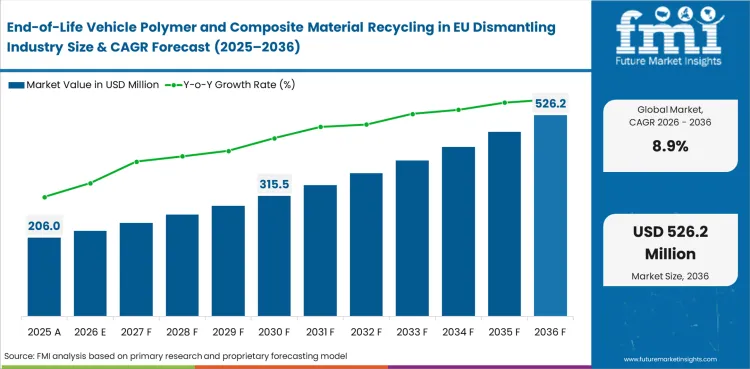
End-of-life vehicle polymer and composite material recycling in EU dismantling industry reached USD 189.0 million in 2025 and is expected to reach USD 206.0 million in 2026. Industry value is projected to expand at a CAGR of 8.9% from 2026 to 2036 and approach USD 485.0 million by 2036. Cleaner polymer recovery and stronger fit with downstream compounders support this expansion. Value improves when sorted material can meet tighter expectations on purity and outlet usability.
Summary of End-of-Life Vehicle Polymer and Composite Material Recycling in EU Dismantling Industry
- The end-of-life vehicle polymer and composite material recycling in EU dismantling industry is forecast to reach USD 485.0 million by 2036.
- The market is projected to expand at a CAGR of 8.9% from 2026 to 2036.
- Industry value recorded USD 189.0 million in 2025.
- Market value is estimated at USD 206.0 million in 2026.
- Polypropylene is expected to account for 34.0% share in 2026 by polymer type.
- Mechanical recycling is projected to contribute 62.0% share in 2026 by recovery route.
- Authorized treatment facilities are forecast to represent 68.0% share in 2026. Regulated handling and traceable dismantling support that lead position.
- Poland leads country growth, while Germany and France retain commercial weight across the forecast period.
Key Takeaways, Market Size, and Forecast
- End-of-Life Vehicle Polymer and Composite Material Recycling in EU Dismantling Industry is projected to grow from USD 206.0 million in 2026 to USD 485.0 million by 2036, at a CAGR of 8.9%.
- The industry was valued at USD 189.0 million in 2025.
- By 2036, the industry is expected to be worth USD 485.0 million.
- From 2026 to 2036, the industry is forecast to expand at a CAGR of 8.9%.
- The industry is projected to create an incremental opportunity of USD 279.0 million between 2026 and 2036.
- In 2026, Polypropylene is expected to account for 34.0% of the polymer type segment.
- Poland (9.6%) and Germany (9.3%) are two of the fastest growing markets.
End-of-Life Vehicle Polymer and Composite Material Recycling in EU Dismantling Industry Key Takeaways
| Parameter | Details |
|---|---|
| Market value (2026) | USD 206.0 million |
| Forecast value (2036) | USD 485.0 million |
| CAGR (2026 to 2036) | 8.9% |
| Estimated market value (2025) | USD 189.0 million |
| Incremental opportunity | USD 279.0 million |
| Primary value condition | Cleaner sorted polymer streams command stronger value than mixed dismantling output |
| Higher-grade realization | Higher-value realization is linked to traceable, low-contamination material accepted in technical applications |
| Premium outlet condition | Better pricing is achieved when recovered bumper, trim, and composite fractions meet repeat compounder requirements |
| Lead commercial qualifier | Demand is organized around polymer type, recovery route, and dismantling channel |
| Brands referenced in market landscape | The Future Is NEUTRAL, INDRA Automobile Recycling, GAIA, Galloo, Scholz Recycling, Stena Recycling, Pollini Group |
Source: Future Market Insights (FMI) analysis, based on proprietary forecasting model and primary research
Authorized treatment facilities and OEM-linked recovery programs face a sharper commercial decision. Dismantling can stay a compliance-led step or move toward a more disciplined materials recovery model. Sorted bumper and composite streams carry more value than mixed shredder output because compounders want cleaner feedstock and more predictable input quality. Market progress depends less on collecting higher plastic volumes and more on building repeatable separation, grading, and outlet acceptance for automotive polymer streams.
A stronger supply model begins once recovered bumper and composite fractions are graded with enough consistency to support repeat business. Dismantlers, compounders, and vehicle manufacturers influence that shift when part identification, contamination control, and material acceptance follow the same discipline. Chemical depolymerization then serves as a selective route for harder fractions instead of a fallback for poorly sorted waste. Better grading improves the commercial case for broader FRP recycling where composite recovery needs clearer outlet discipline.
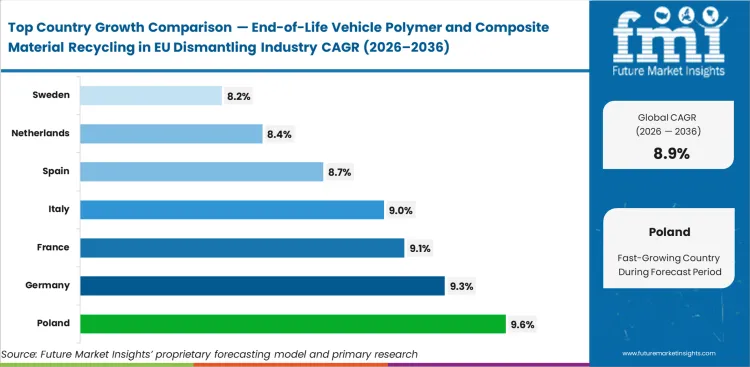
Demand for this industry in Poland is expected to rise at a CAGR of 9.6% through 2036 as formal dismantling discipline and sorting quality improve. Germany is projected to record a CAGR of 9.3% over the forecast period because industrial recycling capacity and circularity programs are deeper. France is likely to post 9.1% CAGR through 2036. Italy follows at 9.0%, while Spain is set to reach 8.7%. The Netherlands is expected to grow at 8.4% and Sweden at 8.2% because quality improvement matters more than first-time capacity buildout.
Segmental Analysis
Key Facts About Segments
- Polypropylene is expected to account for 34.0% share in 2026. Large bumper, trim, and liner streams keep it commercially workable because resin identity can be preserved more easily than in mixed automotive plastics.
- GFRP is anticipated to represent 31.0% share in 2026 within composite type. Glass-fiber material is easier to handle than carbon-heavy structures because outlet expectations and contamination behavior are better understood.
- Mechanical recycling is projected to contribute 62.0% share in 2026. Existing dismantling yards and washing systems keep this route closest to current operating practice.
- Bumpers are forecast to secure 29.0% share in 2026 by source component. Large removable parts with clearer material character are easier to identify, detach, and resell than smaller mixed assemblies.
- Passenger cars are expected to account for 72.0% share in 2026 by vehicle type. High retirement volumes and familiar dismantling routines keep this class central to EU ELV polymer recovery.
- Automotive compounds are set to represent 37.0% share in 2026 by end use. Recyclers retain stronger value when recovered polymers stay technically credible enough to serve demanding formulations.
- Authorized treatment facilities are likely to hold 68.0% share in 2026 by treatment channel. Regulated depollution and documented handling make ATFs more trusted for higher-grade secondary applications.
End-of-Life Vehicle Polymer and Composite Material Recycling in EU Dismantling Industry Analysis by Polymer Type
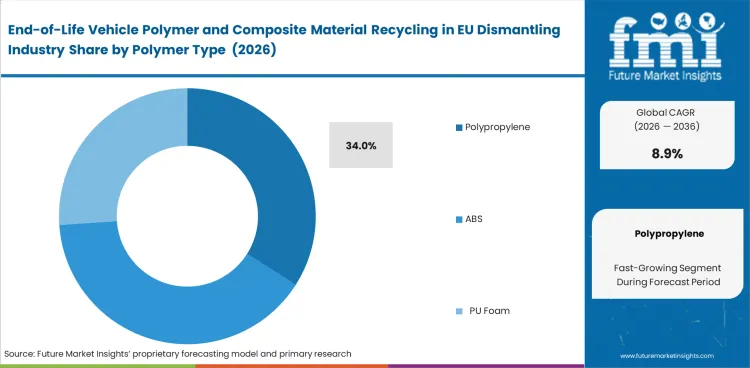
Polypropylene is expected to represent 34.0% share in 2026. Large exterior and interior parts keep polymer recovery practical when dismantlers can isolate materials that downstream compounders already know how to absorb. Bumpers, trims, liners, and molded parts give a clearer route to stable sorting and resale than mixed automotive plastics. ABS and PU foam retain relevance, but each carries narrower outlet acceptance or greater contamination sensitivity. Recovery programs that miss early resin separation often sell technically useful plastic as downgraded waste.
- Sorting priority: Early removal of resin-rich parts helps dismantlers protect material value before mixed handling weakens buyer confidence.
- Outlet stability: Compounders prefer streams that arrive with steadier origin and cleaner composition because formulation losses stay easier to control.
- Downgrade pressure: Mixed recovery reduces pricing power and pushes usable polymers toward lower-grade applications that absorb inconsistency.
End-of-Life Vehicle Polymer and Composite Material Recycling in EU Dismantling Industry Analysis by Composite Type
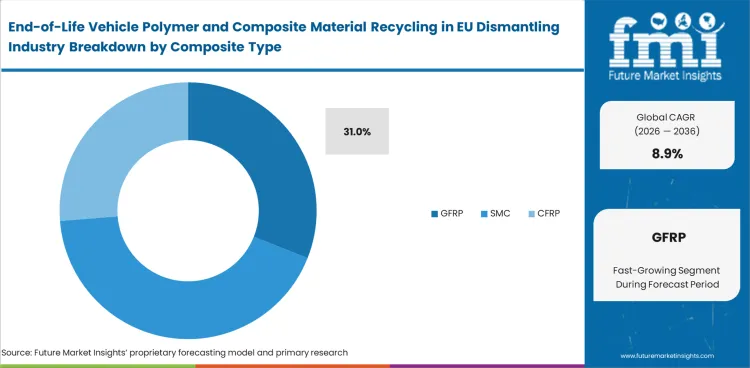
Composite recovery carries a different constraint set because materials that look durable in the vehicle become harder to classify once coatings, mixed construction, and damage enter the waste stream. GFRP is anticipated to account for 31.0% of the composite-type segment in 2026 because it appears in broader vehicle waste flows than carbon-heavy structures. Recyclers are more comfortable with glass-fiber material because handling routines and likely contaminants are better understood. Carbon-based recovery will keep drawing attention and glass-fiber parts are likely to remain more workable starting point because availability is higher and dismantling practice is more familiar.
- Material familiarity: Glass-fiber flows remain easier for recyclers to handle because outlet expectations are more established.
- Processing limit: Coatings, fillers, and mixed assembly design still restrict how far recovered composite fractions can move upward.
- Value screening: Buyers keep testing whether recovered composite output can stay consistent enough for repeat industrial use.
End-of-Life Vehicle Polymer and Composite Material Recycling in EU Dismantling Industry Analysis by Recovery Route
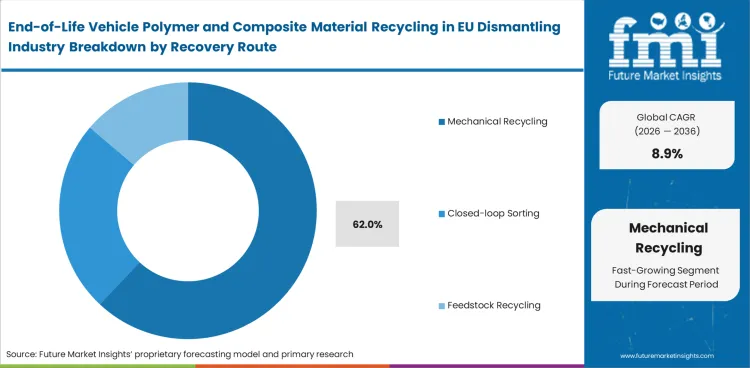
Mechanical recovery remains the working route for most operators because it fits current dismantling yards, washing systems, and the type of polymer streams that leave ELV sites today. FMI places mechanical recycling at 62.0% share in 2026. Closed-loop sorting and energy recovery all retain a role when streams are too dirty or too mixed for straightforward recompounding. Even so, dismantlers preserve more value when separation quality is high enough to keep material in mechanical routes before higher-cost treatment becomes necessary.
- Cost discipline: Mechanical routes work best where yards can isolate clean fractions without adding heavy process complexity.
- Feed threshold: Chemical or feedstock paths become more relevant only when mixed output cannot meet compounder acceptance.
- Margin retention: Cleaner input lets recyclers stay in routes that preserve more material value and reduce treatment loss.
End-of-Life Vehicle Polymer and Composite Material Recycling in EU Dismantling Industry Analysis by Source Component
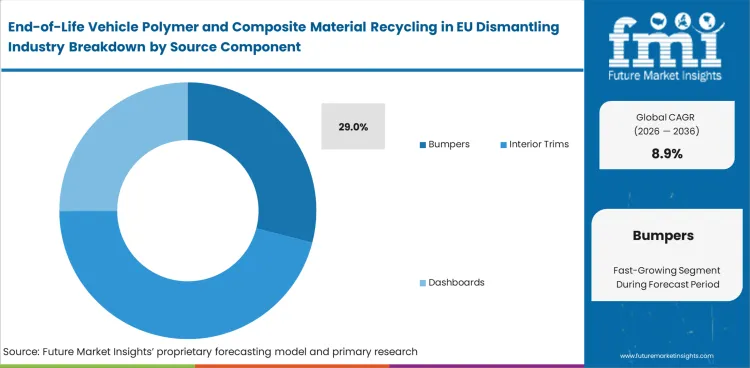
Component-level recovery starts with what dismantlers can remove quickly and place into known outlets without a long correction cycle. Bumpers segment is set to lead because they combine recoverable size and stronger resale potential than many smaller assemblies. Output from bumper recovery sits closer to technical reuse logic where dimensional stability and repeatable resin behavior matter more than raw collection volume. Bumpers are likely to secure 29.0% share in 2026 for that reason. Recovery loses value quickly when identification happens late or after the part has been damaged during removal.
- Removal ease: Large exterior parts are favored because they can be detached earlier and graded with fewer identification errors.
- Contamination burden: Interior and mixed-material parts demand more labor because foams, fabrics, clips, and coatings complicate separation.
- Resale confidence: Buyers pay closer attention to origin when recycled polymers are expected to move into technical compounds.
End-of-Life Vehicle Polymer and Composite Material Recycling in EU Dismantling Industry Analysis by Vehicle Type
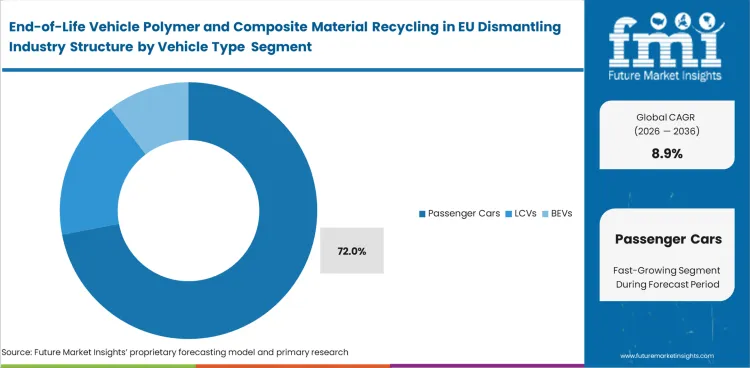
Passenger are predicted to remain the main feed source because EU end-of-life vehicle volumes are shaped by high retirement counts in private and fleet light-duty vehicles. Commercial leadership is tied to unit volume, part standardization, and dismantling familiarity. Recovery routines built around passenger-car bumpers, trims, shields, and housings align more easily with secondary demand than flows from specialized vehicle classes. In 2026, passenger cars are expected to contribute 72.0% of total segment demand. Electrified vehicle retirement will matter more over time, but the current commercial base still rests on the scale and repeatability of passenger-car dismantling streams.
- Volume base: Passenger cars provide the steadiest flow of recoverable polymer parts across EU dismantling networks.
- Design familiarity: Standard part formats help operators build repeatable separation routines and reduce grading errors.
- Future shift: EV and hybrid growth changes recoverable plastic mix, but it does not remove current passenger-car dominance.
End-of-Life Vehicle Polymer and Composite Material Recycling in EU Dismantling Industry Analysis by End Use
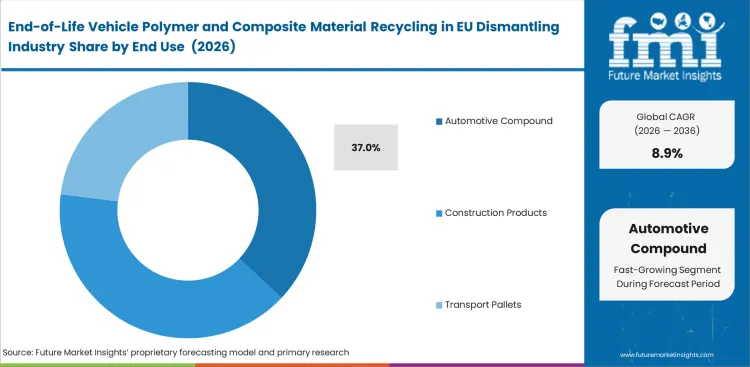
Recovered material earns stronger value when downstream demand can absorb it in applications that expect performance, consistency, and traceable input quality. Automotive compounds are leading as recovered polymers hold more value when they stay close to their original performance band. Construction products, transport pallets, consumer durables, and technical compounds remain viable, though price realization falls when quality slips. Automotive compounds are set to account for 37.0% share in 2026. Recyclers usually gain more pricing strength when recovered polymers stay technically credible enough for demanding secondary formulations.
- Application value: Automotive compounds reward recyclers that preserve cleaner material identity and steadier performance.
- Fallback outlets: Lower-spec applications still matter because they absorb output that cannot meet tighter quality screens.
- Qualification reward: Better grading gives recycled polymers a stronger chance of staying in technical demand.
End-of-Life Vehicle Polymer and Composite Material Recycling in EU Dismantling Industry Analysis by Treatment Channel
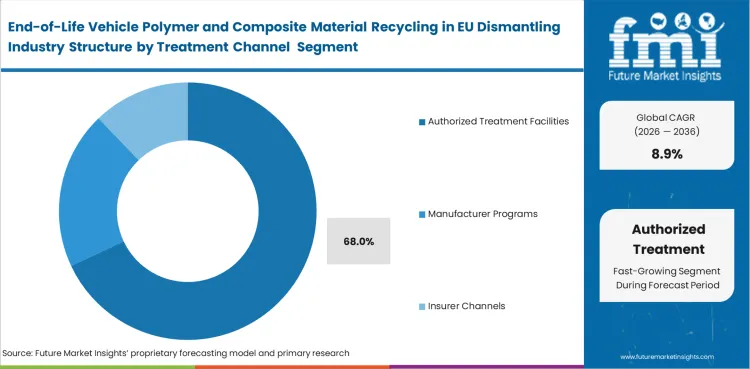
Treatment channel choice determines whether polymer recovery stays disciplined or becomes diluted inside broader scrap handling systems. Authorized treatment facilities lead because regulated depollution and documented part handling provide a more credible base for material recovery than loosely managed flows. This, as per FMI analysis, lead to proximity with compliance controls and downstream buyers that want predictable input conditions. Authorized treatment facilities are forecast to represent 68.0% share in 2026. Buyers in demanding secondary applications place greater trust in materials that pass through controlled handling routes.
- Compliance base: ATFs remain central because depollution and formal dismantling routines support cleaner material handling.
- Channel leakage: Recovery value weakens when polymers are absorbed too early into mixed scrap flows built around metal economics.
- Trust advantage: Traceable handling improves buyer comfort where recycled output is expected to enter more demanding applications.
End-of-Life Vehicle Polymer and Composite Material Recycling in EU Dismantling Industry Analysis by Material-Value Priority
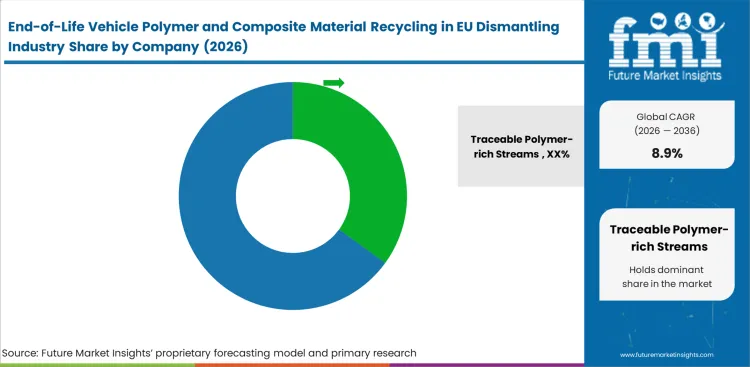
Commercial performance in this market depends on whether dismantlers preserve resin identity before labor pressure and uncertain outlet quality erode value. Polymer recovery becomes more attractive when yards separate saleable thermoplastics early enough to avoid unnecessary downgrading. Composite fractions are harder to place at scale, but they retain value where recovery channels can tolerate variation without excessive reprocessing. Traceable polymer-rich streams are expected to influence 35.0% of value-oriented recovery decisions in 2026 because commercial buyers increasingly screen output on consistency before price.
- Identity protection: Early separation helps dismantlers keep commercially useful resin streams from falling into mixed low-grade output.
- Outlet discipline: Buyers reward recovered material that arrives with clearer composition and fewer unresolved contamination questions.
- Value preservation: Stronger sorting practice protects pricing power across both polymer and composite recovery channels.
End-of-Life Vehicle Polymer and Composite Material Recycling in EU Dismantling Industry Drivers, Restraints, and Opportunities
Aluminum Inflation Continues to Outpace Polymer Cost Relief
Polymer‑linked packaging formats are becoming easier for operators in this industry to budget compared with metal‑intensive alternatives. World Bank data from April 2025 indicate that Brent crude averaged USD 64 per barrel in 2025, down from USD 81 per barrel in 2024, while aluminum prices, although easing, remain elevated at a forecast USD 2,175 per metric ton in 2025 compared with USD 2,419 per metric ton in 2024. As a result, downstream packaging inflation remains uneven rather than broadly deflationary. USA Bureau of Labor Statistics data from January 2026 show that plastic resins and raw polymer materials declined 3.8% year on year, while finished plastic packaging products rose modestly by 1.4%. In contrast, aluminum mill shapes increased sharply by 30.5% over the same period, reinforcing the cost pressure associated with metal‑based formats.
Paper and Glass Require Selective Application
Paper and glass do not provide EU ELV recyclers with a consistently low‑cost substitute for flexible polymer packaging. January 2026 BLS data show paperboard prices rising 3.8% year on year, with paper boxes and containers increasing by 3.9%, even as prices for recyclable paper declined by 25.8%. Glass pricing has firmed again, with BLS index values for glass containers increasing from 298.882 in October 2025 to 311.156 in February 2026. Over the same period, specialty bags, pouches, and liners showed minimal movement, rising only from 281.220 to 281.624. These trends indicate that substitution away from polymers toward paper or glass must be application‑specific rather than cost‑driven across the board.
Regional Analysis
Key Facts About Country
- Demand for the industry in Poland is expected to rise at a CAGR of 9.6% through 2036 because sorting discipline and formal recovery channels still have room to deepen.
- Germany is projected to record a CAGR of 9.3% from 2026 to 2036 as industrial recycling depth supports cleaner polymer and composite recovery.
- France is likely to post 9.1% CAGR through 2036 because OEM-linked circularity programs support organized recovery routes and better separation.
- Italy is set to post 9.0% CAGR by 2036. Specialized dismantling activity and familiarity with reusable parts keep the country commercially relevant.
- Spain is anticipated to grow at a CAGR of 8.7% through 2036 as formal recovery channels improve and bumper plus trim separation becomes more disciplined.
- Industry growth in the Netherlands is estimated at 8.4% CAGR through 2036. Gains depend more on purity improvement than on first-time infrastructure buildout.
- Sales in Sweden are expected to rise at a CAGR of 8.2% through 2036 because mature recovery systems rely more on cleaner separation and better use of existing capability.
Based on the regional analysis, the end-of-life vehicle polymer and composite material recycling in EU dismantling industry is segmented into Western Europe, Southern Europe, and Northern plus Central Europe across the main EU dismantling clusters. Growth rates vary because dismantling depth, recycler discipline, and downstream outlet quality do not move at the same pace across the region.
.webp "Top Country Growth Comparison End Of Life Vehicle Polymer And Composite Material Recycling In Eu Dismantling Industry Cagr (2026 2036)")
| Country | CAGR (2026 to 2036) |
|---|---|
| Poland | 9.6% |
| Germany | 9.3% |
| France | 9.1% |
| Italy | 9.0% |
| Spain | 8.7% |
| Netherlands | 8.4% |
| Sweden | 8.2% |
Source: Future Market Insights (FMI) analysis, based on proprietary forecasting model and primary research
Western Europe End-of-Life Vehicle Polymer and Composite Material Recycling in EU Dismantling Industry Analysis
Western Europe sets the tone for material quality more than for raw dismantling volume alone. Buyers in this part of the EU place more weight on traceability, cleaner grading, and technical acceptance because recovered polymers are expected to move into higher-value channels instead of bulk secondary uses. FMI sees stronger discipline here in how yards, processors, and downstream users define acceptable input. That focus makes the region more relevant to quality-led pricing than to simple volume accumulation.
Germany is expected to advance at a CAGR of 9.3% from 2026 to 2036, and industrial recycling capacity gives the country a stronger base for disciplined polymer and composite recovery. Vehicle dismantling flows are supported by a large installed car base and a mature secondary materials system that can absorb cleaner output into technical channels. Material buyers in Germany screen more closely for repeatability because stable input quality matters when recovered polymer moves toward higher-grade compounds. Operators that do not protect part identity early lose much of the advantage that the recovery network can provide.
France is projected to post 9.1% CAGR over the forecast period, and OEM-linked circularity thinking keeps the country near the top of the EU growth range. Dismantling yards benefit when recovered polymers move into organized reuse and compounding routes instead of being treated as low-grade residue. France shows how recovery value improves when dismantling is tied more closely to industrial reuse logic. Better separation at source gives French operators more room to protect margins.
Demand for this segment in the Netherlands is estimated to rise at a CAGR of 8.4% over the forecast years. Logistics strength and efficient waste handling support steady progress, though a more mature base keeps growth below the faster-advancing EU countries. Opportunity comes from upgrading purity and process control instead of building first-time dismantling infrastructure. Recyclers that can prove cleaner material streams are better positioned to serve technical outlets.
FMI’s report also evaluates Belgium, Austria, and Luxembourg within the broader Western Europe cluster. Shared strength across these markets comes from organized recovery systems and stronger downstream acceptance for sorted material, yet pricing still depends on whether dismantlers can deliver consistent output rather than occasional clean lots.
Southern Europe End-of-Life Vehicle Polymer and Composite Material Recycling in EU Dismantling Industry Analysis
Southern Europe combines high dismantling relevance with a more uneven path in material upgrading. Vehicle age, repair culture, and dismantling specialization support recoverable part flows, yet outlet quality varies by site and by material stream. FMI treats this region as commercially important because it still has room to improve recovery discipline without rebuilding the whole chain from scratch.
Italy is set to record 9.0% CAGR in this industry by 2036, and specialized dismantling activity gives the country a useful foundation. Recovery programs benefit from familiarity with reusable parts and secondary vehicle component flows, which helps polymer recovery stay closer to commercial decision-making than to pure disposal. Composite and mixed-material assemblies still create delays where separation is labor-intensive. Buyers in Italy gain most when polymer-rich parts are removed early and directed into clear resale or recycling routes.
A CAGR of 8.7% is anticipated for Spain through 2036 as vehicle dismantling and materials sorting become more disciplined. Growth is steadier than in faster-moving countries because outlet development still depends on cleaner collection and grading at source. Yards that move quickly on bumper and trim separation protect more material value. Spain's opportunity lies in converting steady ELV flows into better-quality feed instead of simply processing more volume.
FMI’s report includes Portugal and Greece in its wider Southern Europe review. Common direction across this cluster comes from improving dismantling routines and stronger outlet linkage for recoverable plastics, but margin expansion still depends on how much contamination is removed before material reaches processors.
Northern and Central Europe End-of-Life Vehicle Polymer and Composite Material Recycling in EU Dismantling Industry Analysis
Northern and Central Europe show the widest contrast in growth pace. Poland still has room to deepen formal dismantling and materials recovery, while Sweden operates from a more mature base where incremental quality gains matter more than broad capacity addition. FMI reads this cluster as a useful indicator of how market maturity changes the source of growth.
Recovery capacity is still building depth in Poland, and the industry there is expected to expand at a CAGR of 9.6% through 2036. Formal dismantling and recycler specialization are improving, which helps more polymer-rich output stay in recognized recovery channels. Poland’s faster pace reflects a lower maturity base than Germany or Sweden. Commercial upside is strongest where yards upgrade sorting discipline quickly and move cleaner streams into stable downstream demand.
FMI estimates the Swedish industry will grow at a CAGR of 8.2% through 2036. Mature recovery systems give Sweden a more measured growth path, though buyer standards remain comparatively high. Better performance comes from purity improvement and stronger use of existing recycling capability instead of rapid capacity build-out. Operators that align dismantling with downstream technical demand can still protect strong value.
FMI’s report also reviews Denmark, Finland, and the Czech Republic as part of the broader Northern and Central Europe picture. Structural direction across these countries depends less on first-time policy adoption and more on how efficiently existing systems convert clean dismantled material into repeatable industrial feed.
Competitive Aligners for Market Players
Competition in this market is anchored in how well operators control material purity across recovery stages. Buyers place limited weight on brand recognition alone and evaluate consistency in depollution, dismantling, and grading practices. Output reliability is essential because even small fluctuations in recovered polymer quality can reduce acceptance in downstream outlets. Confidence improves when recyclers show they can move recovered streams into technical plastic applications without compromising composition stability.
Larger established operators hold an advantage when expansive collection capability is matched with disciplined downstream handling. Galloo and Scholz Recycling illustrate that position because they can absorb mixed flows while protecting higher-value fractions when sorting protocols are enforced. Their advantage comes from operational breadth rather than simple throughput. Even so, that edge disappears when internal controls allow material blending to erode resale benchmarks.
Vehicle-circularity operators follow a more selective approach. The Future Is NEUTRAL works within systems that favor cleaner reintegration into automotive circularity routes while protecting polymer recovery from broader mixed-plastic alternatives. Specialized dismantlers such as Pollini Group benefit where early-stage separation improves material selection before mixed processing begins. Buyer leverage stays high because outlet approval can shift quickly when recovered output becomes inconsistent.
Key Players in End-of-Life Vehicle Polymer and Composite Material Recycling in EU Dismantling Industry
- The Future Is NEUTRAL
- INDRA Automobile Recycling
- GAIA
- Galloo
- Scholz Recycling
- Stena Recycling
- Pollini Group
Scope of the Report
| Metric | Value |
|---|---|
| Quantitative Units | USD 206.0 million to USD 485.0 million, at a CAGR of 8.9% |
| Market Definition | Recovery and recycling of polymer and composite materials separated from ELVs during dismantling across the EU. Scope is limited to dismantling-stage material value and excludes the broader metal-led ELV recycling pool. |
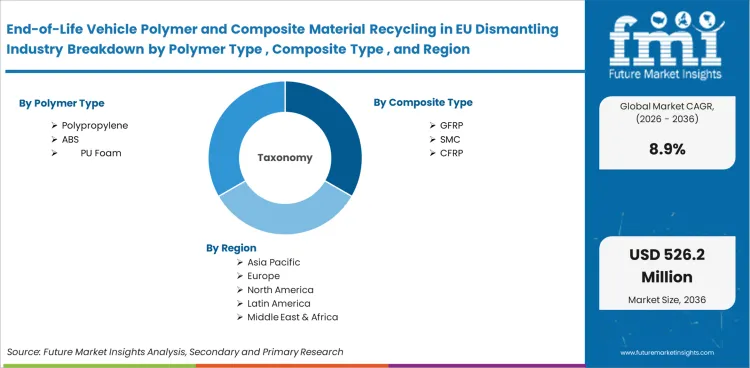
| Polymer Type Segmentation | Polypropylene, ABS, PU Foam, Polyethylene, Polyamide |
| Composite Type Segmentation | GFRP, SMC, CFRP, Mixed Thermosets |
| Recovery Route Segmentation | Mechanical Recycling, Closed-loop Sorting, Feedstock Recycling, Energy Recovery |
| Source Component Segmentation | Bumpers, Interior Trims, Dashboards, Wheel Liners, Underbody Shields, Battery Housings, Composite Panels |
| Vehicle Type Segmentation | Passenger Cars, LCVs, BEVs, Hybrids, Premium Vehicles |
| End Use Segmentation | Automotive Compounds, Construction Products, Transport Pallets, Consumer Durables, Technical Compounds |
| Treatment Channel Segmentation | Authorized Treatment Facilities, Manufacturer Programs, Insurer Channels, Independent Dismantlers, Refactory Hubs |
| Regions Covered | Western Europe, Southern Europe, Northern and Central Europe |
| Countries Covered | Poland, Germany, France, Italy, Spain, Netherlands, Sweden |
| Key Companies Profiled | The Future Is NEUTRAL, INDRA Automobile Recycling, GAIA, Galloo, Scholz Recycling, Stena Recycling, Pollini Group |
| Forecast Period | 2026 to 2036 |
| Approach | FMI combines primary interviews with dismantlers, recyclers, and downstream material buyers. Baseline estimates are built from recoverable polymer and composite content in EU ELV flows and the realized value of sorted output. Forecast validation reflects country-level dismantling maturity and downstream acceptance for secondary automotive materials. |
Source: Future Market Insights (FMI) analysis, based on proprietary forecasting model and primary research
End-of-Life Vehicle Polymer and Composite Material Recycling in EU Dismantling Industry Analysis by Segments
Polymer Type
- Polypropylene
- ABS
- PU Foam
- Polyethylene
- Polyamide
Composite Type
- GFRP
- SMC
- CFRP
- Mixed Thermosets
Recovery Route
- Mechanical Recycling
- Closed-loop Sorting
- Feedstock Recycling
- Energy Recovery
Source Component
- Bumpers
- Interior Trims
- Dashboards
- Wheel Liners
- Underbody Shields
- Battery Housings
- Composite Panels
Vehicle Type
- Passenger Cars
- LCVs
- BEVs
- Hybrids
- Premium Vehicles
End Use
- Automotive Compounds
- Construction Products
- Transport Pallets
- Consumer Durables
- Technical Compounds
Treatment Channel
- Authorized Treatment Facilities
- Manufacturer Programs
- Insurer Channels
- Independent Dismantlers
- Refactory Hubs
Region
- Western Europe
- Germany
- France
- Netherlands
- Belgium
- Austria
- Switzerland
- Luxembourg
- Northern Europe
- Denmark
- Sweden
- Norway
- Finland
- Ireland
- Iceland
- Southern Europe
- Italy
- Spain
- Portugal
- Greece
- Malta
- Cyprus
- Eastern Europe
- Poland
- Czech Republic
- Hungary
- Romania
- Slovakia
- Bulgaria
- Croatia
- Slovenia
- Estonia
- Latvia
- Lithuania
Bibliography
- The World Bank. (2025, April). Commodity Markets Outlook-April 2025. World Bank.
- USA Bureau of Labor Statistics. (2026, January 30). Producer Price Index News Release - 2025 M12 Results. USA Department of Labor.
- USA Bureau of Labor Statistics. (2026, March 18). Table 9. Producer price indexes for commodity and service groupings and individual items.
- PlasticsEurope. (2024). A focus on the automotive sector. PlasticsEurope.
- European Environment Agency. (2024, June 18). The role of plastics in Europe’s circular economy. European Environment Agency.
- Government of the Netherlands. (2024, June). Biobased plastics in vehicles. Government of the Netherlands.
- The Future Is NEUTRAL. (2025, April). The Remakers at Rematec. The Future Is NEUTRAL.
- Stena Recycling. (2024, September 5). Stena Recycling aims to set a new standard in battery recycling. Stena Recycling.
- European Road Transport Research Advisory Council. (2026, March 25). ELV recycling in the EU. ERTRAC.
This bibliography is provided for reader reference. The full FMI report contains the complete reference list with primary source documentation.
This Report Addresses
- Market intelligence to support strategic decisions across polypropylene recovery, composite sorting, dismantling-stage recycling routes, and secondary automotive compound demand.
- Market size estimation and ten-year revenue forecasts from 2026 to 2036 supported by EU ELV treatment logic, dismantling economics, and downstream outlet analysis.
- Growth opportunity mapping across polymer type, composite type, recovery route, source component, vehicle type, end use, and treatment channel with emphasis on cleaner material recovery.
- Segment and regional forecasts covering polypropylene, GFRP, mechanical recycling, bumpers, passenger cars, automotive compounds, and authorized treatment facilities across major EU dismantling clusters.
- Competition assessment covering sorting discipline, outlet reliability, traceability, downstream acceptance, and recovery-channel positioning across key recyclers and dismantling networks.
- Recovery route analysis covering mechanical recycling, closed-loop sorting, feedstock recycling, and energy recovery where material purity changes resale outcomes.
- Country outlooks for Poland, Germany, France, Italy, Spain, Netherlands, and Sweden with emphasis on dismantling maturity, recycler depth, and circular materials demand.
- Report delivery in document format for executive planning, circular materials strategy, and market-entry review in EU vehicle dismantling and recycling.
Frequently Asked Questions
How large is the end-of-life vehicle polymer and composite material recycling in EU dismantling industry in 2025?
It is estimated at USD 189.0 million in 2025.
What value is expected for EU dismantling-based polymer and composite recycling by 2036?
Industry value is projected to reach USD 485.0 million by 2036.
What CAGR is forecast for ELV polymer and composite recycling from 2026 to 2036?
The market is expected to expand at a CAGR of 8.9% over 2026 to 2036.
Which polymer type leads the ELV plastics recovery mix in this report?
Polypropylene is expected to account for 34.0% share in 2026.
Which composite stream holds the lead in vehicle dismantling recovery?
GFRP is anticipated to represent 31.0% of the market in 2026.
Which recycling route remains dominant in EU end-of-life vehicle dismantling?
Mechanical recycling is estimated to make up 62.0% share in 2026.
Which dismantled vehicle component contributes the largest polymer recovery share?
Bumpers are projected to contribute 29.0% share in 2026.
Which vehicle type supports the largest ELV materials recovery base?
Passenger cars are likely to secure 72.0% of market share in 2026.
Which end use leads demand for recovered automotive polymers and composites?
Automotive compounds are expected to account for 37.0% share in 2026.
Which treatment channel leads the EU dismantling stream for recovered materials?
Authorized treatment facilities are set to represent 68.0% share in 2026.
What is pushing demand for automotive polymer and composite recycling in Europe?
Demand is being supported by tighter circularity expectations, stronger dismantling discipline, and wider use of recycled automotive materials.
Why does bumper recovery matter so much in ELV plastic recycling?
Bumper recovery matters because it provides one of the clearest and most recoverable polypropylene-rich streams in dismantling operations.
Why does mechanical recycling stay ahead in end-of-life vehicle plastics processing?
Mechanical recycling stays ahead because it fits current dismantling, sorting, and material handling practice more easily than more complex recovery routes.
What keeps EU dismantling-based polymer recycling from scaling faster?
Material contamination, mixed assemblies, and uneven dismantling depth continue to limit recovery quality and resale value.
Which country leads growth in ELV polymer and composite recycling across Europe?
Poland is projected to record the fastest growth at 9.6% CAGR through 2036.
How is Germany positioned in the EU vehicle dismantling recycling outlook?
Germany is expected to expand at 9.3% CAGR through 2036, supported by a larger industrial base and stronger automotive circularity alignment.
What does the report project for France in recovered automotive material recycling?
France is forecast to post 9.1% CAGR through 2036.
How does Italy compare in the EU ELV dismantling recovery outlook?
Italy is expected to grow at 9.0% CAGR through 2036, keeping it near the upper end of the country range covered in the report.
What is the outlook for Spain in vehicle polymer recovery?
Spain is projected to advance at 8.7% CAGR through 2036.
How are the Netherlands and Sweden expected to perform in dismantling-led recycling?
The Netherlands is likely to grow at 8.4% CAGR and Sweden at 8.2% CAGR through 2036.
Which companies are identified as key participants in EU automotive materials recycling?
The report profiles The Future Is NEUTRAL, INDRA Automobile Recycling, GAIA, Galloo, Scholz Recycling, Stena Recycling, and Pollini Group.
What does this ELV dismantling recycling study include and exclude?
It includes dismantling-stage recovery and recycling of polymer and composite fractions from ELVs, while excluding the broader metal recycling pool, whole-vehicle shredding revenues, and stand-alone battery black-mass recycling.
Preview the report firsthand - request a free sample
Get SampleGet the brochure for pricing and purchase details.
Get PDFTable of Content
- Executive Summary
- Global Market Outlook
- Demand-side Trends
- Supply-side Trends
- Technology Roadmap Analysis
- Analysis and Recommendations
- Market Overview
- Market Coverage / Taxonomy
- Market Definition / Scope / Limitations
- Research Methodology
- Chapter Orientation
- Analytical Lens and Working Hypotheses
- Market Structure, Signals, and Trend Drivers
- Benchmarking and Cross-market Comparability
- Market Sizing, Forecasting, and Opportunity Mapping
- Research Design and Evidence Framework
- Desk Research Programme (Secondary Evidence)
- Company Annual and Sustainability Reports
- Peer-reviewed Journals and Academic Literature
- Corporate Websites, Product Literature, and Technical Notes
- Earnings Decks and Investor Briefings
- Statutory Filings and Regulatory Disclosures
- Technical White Papers and Standards Notes
- Trade Journals, Industry Magazines, and Analyst Briefs
- Conference Proceedings, Webinars, and Seminar Materials
- Government Statistics Portals and Public Data Releases
- Press Releases and Reputable Media Coverage
- Specialist Newsletters and Curated Briefings
- Sector Databases and Reference Repositories
- FMI Internal Proprietary Databases and Historical Market Datasets
- Subscription Datasets and Paid Sources
- Social Channels, Communities, and Digital Listening Inputs
- Additional Desk Sources
- Expert Input and Fieldwork (Primary Evidence)
- Primary Modes
- Qualitative Interviews and Expert Elicitation
- Quantitative Surveys and Structured Data Capture
- Blended Approach
- Why Primary Evidence is Used
- Field Techniques
- Interviews
- Surveys
- Focus Groups
- Observational and In-context Research
- Social and Community Interactions
- Stakeholder Universe Engaged
- C-suite Leaders
- Board Members
- Presidents and Vice Presidents
- R&D and Innovation Heads
- Technical Specialists
- Domain Subject-matter Experts
- Scientists
- Physicians and Other Healthcare Professionals
- Governance, Ethics, and Data Stewardship
- Research Ethics
- Data Integrity and Handling
- Primary Modes
- Tooling, Models, and Reference Databases
- Desk Research Programme (Secondary Evidence)
- Data Engineering and Model Build
- Data Acquisition and Ingestion
- Cleaning, Normalisation, and Verification
- Synthesis, Triangulation, and Analysis
- Quality Assurance and Audit Trail
- Market Background
- Market Dynamics
- Drivers
- Restraints
- Opportunity
- Trends
- Scenario Forecast
- Demand in Optimistic Scenario
- Demand in Likely Scenario
- Demand in Conservative Scenario
- Opportunity Map Analysis
- Product Life Cycle Analysis
- Supply Chain Analysis
- Investment Feasibility Matrix
- Value Chain Analysis
- PESTLE and Porter’s Analysis
- Regulatory Landscape
- Regional Parent Market Outlook
- Production and Consumption Statistics
- Import and Export Statistics
- Market Dynamics
- Global Market Analysis 2021 to 2025 and Forecast, 2026 to 2036
- Historical Market Size Value (USD Million) Analysis, 2021 to 2025
- Current and Future Market Size Value (USD Million) Projections, 2026 to 2036
- Y-o-Y Growth Trend Analysis
- Absolute $ Opportunity Analysis
- Global Market Pricing Analysis 2021 to 2025 and Forecast 2026 to 2036
- Global Market Analysis 2021 to 2025 and Forecast 2026 to 2036, By Polymer Type
- Introduction / Key Findings
- Historical Market Size Value (USD Million) Analysis By Polymer Type , 2021 to 2025
- Current and Future Market Size Value (USD Million) Analysis and Forecast By Polymer Type , 2026 to 2036
- Polypropylene
- ABS
- PU Foam
- Polypropylene
- Y-o-Y Growth Trend Analysis By Polymer Type , 2021 to 2025
- Absolute $ Opportunity Analysis By Polymer Type , 2026 to 2036
- Global Market Analysis 2021 to 2025 and Forecast 2026 to 2036, By Composite Type
- Introduction / Key Findings
- Historical Market Size Value (USD Million) Analysis By Composite Type, 2021 to 2025
- Current and Future Market Size Value (USD Million) Analysis and Forecast By Composite Type, 2026 to 2036
- GFRP
- SMC
- CFRP
- GFRP
- Y-o-Y Growth Trend Analysis By Composite Type, 2021 to 2025
- Absolute $ Opportunity Analysis By Composite Type, 2026 to 2036
- Global Market Analysis 2021 to 2025 and Forecast 2026 to 2036, By Recovery Route
- Introduction / Key Findings
- Historical Market Size Value (USD Million) Analysis By Recovery Route, 2021 to 2025
- Current and Future Market Size Value (USD Million) Analysis and Forecast By Recovery Route, 2026 to 2036
- Mechanical Recycling
- Closed-loop Sorting
- Feedstock Recycling
- Mechanical Recycling
- Y-o-Y Growth Trend Analysis By Recovery Route, 2021 to 2025
- Absolute $ Opportunity Analysis By Recovery Route, 2026 to 2036
- Global Market Analysis 2021 to 2025 and Forecast 2026 to 2036, By Source Component
- Introduction / Key Findings
- Historical Market Size Value (USD Million) Analysis By Source Component, 2021 to 2025
- Current and Future Market Size Value (USD Million) Analysis and Forecast By Source Component, 2026 to 2036
- Bumpers
- Interior Trims
- Dashboards
- Bumpers
- Y-o-Y Growth Trend Analysis By Source Component, 2021 to 2025
- Absolute $ Opportunity Analysis By Source Component, 2026 to 2036
- Global Market Analysis 2021 to 2025 and Forecast 2026 to 2036, By Vehicle Type
- Introduction / Key Findings
- Historical Market Size Value (USD Million) Analysis By Vehicle Type, 2021 to 2025
- Current and Future Market Size Value (USD Million) Analysis and Forecast By Vehicle Type, 2026 to 2036
- Passenger Cars
- LCVs
- BEVs
- Passenger Cars
- Y-o-Y Growth Trend Analysis By Vehicle Type, 2021 to 2025
- Absolute $ Opportunity Analysis By Vehicle Type, 2026 to 2036
- Global Market Analysis 2021 to 2025 and Forecast 2026 to 2036, By End Use
- Introduction / Key Findings
- Historical Market Size Value (USD Million) Analysis By End Use, 2021 to 2025
- Current and Future Market Size Value (USD Million) Analysis and Forecast By End Use, 2026 to 2036
- Automotive Compound
- Construction Products
- Transport Pallets
- Automotive Compound
- Y-o-Y Growth Trend Analysis By End Use, 2021 to 2025
- Absolute $ Opportunity Analysis By End Use, 2026 to 2036
- Global Market Analysis 2021 to 2025 and Forecast 2026 to 2036, By Treatment Channel
- Introduction / Key Findings
- Historical Market Size Value (USD Million) Analysis By Treatment Channel, 2021 to 2025
- Current and Future Market Size Value (USD Million) Analysis and Forecast By Treatment Channel, 2026 to 2036
- Authorized Treatment Facilities
- Manufacturer Programs
- Insurer Channels
- Authorized Treatment Facilities
- Y-o-Y Growth Trend Analysis By Treatment Channel, 2021 to 2025
- Absolute $ Opportunity Analysis By Treatment Channel, 2026 to 2036
- Global Market Analysis 2021 to 2025 and Forecast 2026 to 2036, By Region
- Introduction
- Historical Market Size Value (USD Million) Analysis By Region, 2021 to 2025
- Current Market Size Value (USD Million) Analysis and Forecast By Region, 2026 to 2036
- North America
- Latin America
- Western Europe
- Eastern Europe
- East Asia
- South Asia and Pacific
- Middle East & Africa
- Market Attractiveness Analysis By Region
- North America Market Analysis 2021 to 2025 and Forecast 2026 to 2036, By Country
- Historical Market Size Value (USD Million) Trend Analysis By Market Taxonomy, 2021 to 2025
- Market Size Value (USD Million) Forecast By Market Taxonomy, 2026 to 2036
- By Country
- USA
- Canada
- Mexico
- By Polymer Type
- By Composite Type
- By Recovery Route
- By Source Component
- By Vehicle Type
- By End Use
- By Treatment Channel
- By Country
- Market Attractiveness Analysis
- By Country
- By Polymer Type
- By Composite Type
- By Recovery Route
- By Source Component
- By Vehicle Type
- By End Use
- By Treatment Channel
- Key Takeaways
- Latin America Market Analysis 2021 to 2025 and Forecast 2026 to 2036, By Country
- Historical Market Size Value (USD Million) Trend Analysis By Market Taxonomy, 2021 to 2025
- Market Size Value (USD Million) Forecast By Market Taxonomy, 2026 to 2036
- By Country
- Brazil
- Chile
- Rest of Latin America
- By Polymer Type
- By Composite Type
- By Recovery Route
- By Source Component
- By Vehicle Type
- By End Use
- By Treatment Channel
- By Country
- Market Attractiveness Analysis
- By Country
- By Polymer Type
- By Composite Type
- By Recovery Route
- By Source Component
- By Vehicle Type
- By End Use
- By Treatment Channel
- Key Takeaways
- Western Europe Market Analysis 2021 to 2025 and Forecast 2026 to 2036, By Country
- Historical Market Size Value (USD Million) Trend Analysis By Market Taxonomy, 2021 to 2025
- Market Size Value (USD Million) Forecast By Market Taxonomy, 2026 to 2036
- By Country
- Germany
- UK
- Italy
- Spain
- France
- Nordic
- BENELUX
- Rest of Western Europe
- By Polymer Type
- By Composite Type
- By Recovery Route
- By Source Component
- By Vehicle Type
- By End Use
- By Treatment Channel
- By Country
- Market Attractiveness Analysis
- By Country
- By Polymer Type
- By Composite Type
- By Recovery Route
- By Source Component
- By Vehicle Type
- By End Use
- By Treatment Channel
- Key Takeaways
- Eastern Europe Market Analysis 2021 to 2025 and Forecast 2026 to 2036, By Country
- Historical Market Size Value (USD Million) Trend Analysis By Market Taxonomy, 2021 to 2025
- Market Size Value (USD Million) Forecast By Market Taxonomy, 2026 to 2036
- By Country
- Russia
- Poland
- Hungary
- Balkan & Baltic
- Rest of Eastern Europe
- By Polymer Type
- By Composite Type
- By Recovery Route
- By Source Component
- By Vehicle Type
- By End Use
- By Treatment Channel
- By Country
- Market Attractiveness Analysis
- By Country
- By Polymer Type
- By Composite Type
- By Recovery Route
- By Source Component
- By Vehicle Type
- By End Use
- By Treatment Channel
- Key Takeaways
- East Asia Market Analysis 2021 to 2025 and Forecast 2026 to 2036, By Country
- Historical Market Size Value (USD Million) Trend Analysis By Market Taxonomy, 2021 to 2025
- Market Size Value (USD Million) Forecast By Market Taxonomy, 2026 to 2036
- By Country
- China
- Japan
- South Korea
- By Polymer Type
- By Composite Type
- By Recovery Route
- By Source Component
- By Vehicle Type
- By End Use
- By Treatment Channel
- By Country
- Market Attractiveness Analysis
- By Country
- By Polymer Type
- By Composite Type
- By Recovery Route
- By Source Component
- By Vehicle Type
- By End Use
- By Treatment Channel
- Key Takeaways
- South Asia and Pacific Market Analysis 2021 to 2025 and Forecast 2026 to 2036, By Country
- Historical Market Size Value (USD Million) Trend Analysis By Market Taxonomy, 2021 to 2025
- Market Size Value (USD Million) Forecast By Market Taxonomy, 2026 to 2036
- By Country
- India
- ASEAN
- Australia & New Zealand
- Rest of South Asia and Pacific
- By Polymer Type
- By Composite Type
- By Recovery Route
- By Source Component
- By Vehicle Type
- By End Use
- By Treatment Channel
- By Country
- Market Attractiveness Analysis
- By Country
- By Polymer Type
- By Composite Type
- By Recovery Route
- By Source Component
- By Vehicle Type
- By End Use
- By Treatment Channel
- Key Takeaways
- Middle East & Africa Market Analysis 2021 to 2025 and Forecast 2026 to 2036, By Country
- Historical Market Size Value (USD Million) Trend Analysis By Market Taxonomy, 2021 to 2025
- Market Size Value (USD Million) Forecast By Market Taxonomy, 2026 to 2036
- By Country
- Kingdom of Saudi Arabia
- Other GCC Countries
- Turkiye
- South Africa
- Other African Union
- Rest of Middle East & Africa
- By Polymer Type
- By Composite Type
- By Recovery Route
- By Source Component
- By Vehicle Type
- By End Use
- By Treatment Channel
- By Country
- Market Attractiveness Analysis
- By Country
- By Polymer Type
- By Composite Type
- By Recovery Route
- By Source Component
- By Vehicle Type
- By End Use
- By Treatment Channel
- Key Takeaways
- Key Countries Market Analysis
- USA
- Pricing Analysis
- Market Share Analysis, 2025
- By Polymer Type
- By Composite Type
- By Recovery Route
- By Source Component
- By Vehicle Type
- By End Use
- By Treatment Channel
- Canada
- Pricing Analysis
- Market Share Analysis, 2025
- By Polymer Type
- By Composite Type
- By Recovery Route
- By Source Component
- By Vehicle Type
- By End Use
- By Treatment Channel
- Mexico
- Pricing Analysis
- Market Share Analysis, 2025
- By Polymer Type
- By Composite Type
- By Recovery Route
- By Source Component
- By Vehicle Type
- By End Use
- By Treatment Channel
- Brazil
- Pricing Analysis
- Market Share Analysis, 2025
- By Polymer Type
- By Composite Type
- By Recovery Route
- By Source Component
- By Vehicle Type
- By End Use
- By Treatment Channel
- Chile
- Pricing Analysis
- Market Share Analysis, 2025
- By Polymer Type
- By Composite Type
- By Recovery Route
- By Source Component
- By Vehicle Type
- By End Use
- By Treatment Channel
- Germany
- Pricing Analysis
- Market Share Analysis, 2025
- By Polymer Type
- By Composite Type
- By Recovery Route
- By Source Component
- By Vehicle Type
- By End Use
- By Treatment Channel
- UK
- Pricing Analysis
- Market Share Analysis, 2025
- By Polymer Type
- By Composite Type
- By Recovery Route
- By Source Component
- By Vehicle Type
- By End Use
- By Treatment Channel
- Italy
- Pricing Analysis
- Market Share Analysis, 2025
- By Polymer Type
- By Composite Type
- By Recovery Route
- By Source Component
- By Vehicle Type
- By End Use
- By Treatment Channel
- Spain
- Pricing Analysis
- Market Share Analysis, 2025
- By Polymer Type
- By Composite Type
- By Recovery Route
- By Source Component
- By Vehicle Type
- By End Use
- By Treatment Channel
- France
- Pricing Analysis
- Market Share Analysis, 2025
- By Polymer Type
- By Composite Type
- By Recovery Route
- By Source Component
- By Vehicle Type
- By End Use
- By Treatment Channel
- India
- Pricing Analysis
- Market Share Analysis, 2025
- By Polymer Type
- By Composite Type
- By Recovery Route
- By Source Component
- By Vehicle Type
- By End Use
- By Treatment Channel
- ASEAN
- Pricing Analysis
- Market Share Analysis, 2025
- By Polymer Type
- By Composite Type
- By Recovery Route
- By Source Component
- By Vehicle Type
- By End Use
- By Treatment Channel
- Australia & New Zealand
- Pricing Analysis
- Market Share Analysis, 2025
- By Polymer Type
- By Composite Type
- By Recovery Route
- By Source Component
- By Vehicle Type
- By End Use
- By Treatment Channel
- China
- Pricing Analysis
- Market Share Analysis, 2025
- By Polymer Type
- By Composite Type
- By Recovery Route
- By Source Component
- By Vehicle Type
- By End Use
- By Treatment Channel
- Japan
- Pricing Analysis
- Market Share Analysis, 2025
- By Polymer Type
- By Composite Type
- By Recovery Route
- By Source Component
- By Vehicle Type
- By End Use
- By Treatment Channel
- South Korea
- Pricing Analysis
- Market Share Analysis, 2025
- By Polymer Type
- By Composite Type
- By Recovery Route
- By Source Component
- By Vehicle Type
- By End Use
- By Treatment Channel
- Russia
- Pricing Analysis
- Market Share Analysis, 2025
- By Polymer Type
- By Composite Type
- By Recovery Route
- By Source Component
- By Vehicle Type
- By End Use
- By Treatment Channel
- Poland
- Pricing Analysis
- Market Share Analysis, 2025
- By Polymer Type
- By Composite Type
- By Recovery Route
- By Source Component
- By Vehicle Type
- By End Use
- By Treatment Channel
- Hungary
- Pricing Analysis
- Market Share Analysis, 2025
- By Polymer Type
- By Composite Type
- By Recovery Route
- By Source Component
- By Vehicle Type
- By End Use
- By Treatment Channel
- Kingdom of Saudi Arabia
- Pricing Analysis
- Market Share Analysis, 2025
- By Polymer Type
- By Composite Type
- By Recovery Route
- By Source Component
- By Vehicle Type
- By End Use
- By Treatment Channel
- Turkiye
- Pricing Analysis
- Market Share Analysis, 2025
- By Polymer Type
- By Composite Type
- By Recovery Route
- By Source Component
- By Vehicle Type
- By End Use
- By Treatment Channel
- South Africa
- Pricing Analysis
- Market Share Analysis, 2025
- By Polymer Type
- By Composite Type
- By Recovery Route
- By Source Component
- By Vehicle Type
- By End Use
- By Treatment Channel
- USA
- Market Structure Analysis
- Competition Dashboard
- Competition Benchmarking
- Market Share Analysis of Top Players
- By Regional
- By Polymer Type
- By Composite Type
- By Recovery Route
- By Source Component
- By Vehicle Type
- By End Use
- By Treatment Channel
- Competition Analysis
- Competition Deep Dive
- Traceable Polymer-rich Streams
- Overview
- Product Portfolio
- Profitability by Market Segments (Product/Age /Sales Channel/Region)
- Sales Footprint
- Strategy Overview
- Marketing Strategy
- Product Strategy
- Channel Strategy
- Others
- Traceable Polymer-rich Streams
- Competition Deep Dive
- Assumptions & Acronyms Used


