

- Market Size (2026)
- USD 41.2 Mn
- Forecast (2036)
- USD 66.5 Mn
- CAGR (2026 to 2036)
- 4.9%
PVC Window Profile and Roller Shutter Recycling Plants in EU Industry Size, Market Forecast and Outlook By FMI
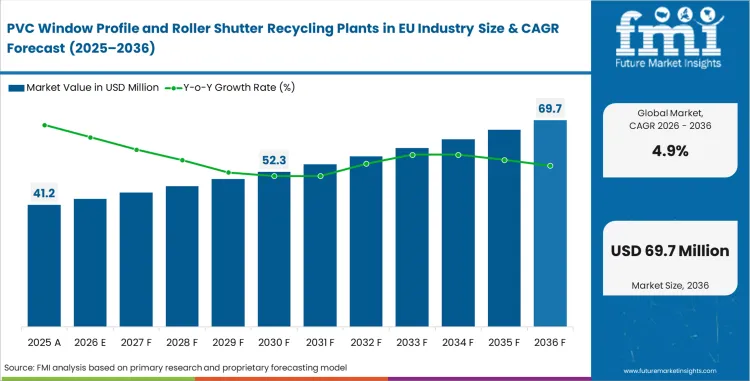
The PVC window profile and roller shutter recycling plants in the EU industry crossed a valuation of USD 39.3 million in 2025. The sector is expected to reach USD 41.2 million in 2026 at a CAGR of 4.9% during the forecast period. Demand buildup takes the valuation to USD 66.5 million by 2036 as replacement windows, demolition waste, and circular PVC targets keep recyclers investing in better separation, washing, and output finishing systems.
Summary of PVC Window Profile and Roller Shutter Recycling Plants in EU Industry
- The PVC window profile and roller shutter recycling plants in the EU industry is projected to reach USD 66.5 million by 2036.
- Market expansion is forecast at a 4.9% CAGR from 2026 to 2036.
- Industry value stood at USD 39.3 million in 2025.
- Demand is expected to reach USD 41.2 million in 2026.
- Window profiles are expected to lead feedstock source demand with 58.0% share in 2026.
- Mechanical recycling is projected to remain the leading route with 86.0% share in 2026.
- Integrated plants are likely to account for 31.0% share in 2026, while the 5 to 15 ktpa capacity band is expected to hold 43.0% share.
- Country-level growth is strongest in Poland, where demand is projected to rise at 5.8% CAGR through 2036.
Key Takeaways, Market Size, and Forecast
- PVC Window Profile and Roller Shutter Recycling Plants in EU Industry is expected to rise from USD 41.2 million in 2026 to USD 66.5 million by 2036, reflecting a CAGR of 4.9%.
- The PVC window profile and roller shutter recycling plants in EU industry was valued at USD 39.3 million in 2025.
- By 2036, the PVC Window Profile and Roller Shutter Recycling Plants in EU Industry is expected to reach USD 66.5 million.
- The industry is anticipated to advance at a CAGR of 4.9% between 2026 and 2036.
- The forecast period points to an incremental opportunity of USD 25.3 million.
- In 2026, Window Profiles are expected to account for 58.0% of the feedstock source segment.
- Poland (5.8%) and France (5.2%) are two of the fastest growing markets.
PVC Window Profile and Roller Shutter Recycling Plants in EU Industry Key Takeaways
| Parameter | Details |
|---|---|
| Market value (2026) | USD 41.2 million |
| Forecast value (2036) | USD 66.5 million |
| CAGR (2026 to 2036) | 4.9% |
| Estimated market value (2025) | USD 39.3 million |
| Incremental opportunity | USD 25.3 million |
| Leading feedstock source and recycling route | Window profiles and mechanical recycling |
| Leading plant setup | Integrated plants in the 5 to 15 ktpa capacity band |
| Leading automation and output form | Semi-automatic systems and flakes |
| Leading end use and buyer type | Window profiles and independent recyclers |
| Key supplier brands referenced in market landscape | EREMA, Coperion Herbold, Lindner Washtech, Vecoplan, NGR |
Source: Future Market Insights (FMI) analysis, based on proprietary forecasting model and primary research.
Replacement cycles across old PVC window stock are changing how recyclers buy plants. Basic size reduction is no longer enough once output must move back into profile-grade compounds and related building uses. Plant owners now lean toward lines that connect sorting, washing, metal removal, and finishing in one flow because mixed joinery waste can quickly erode yield when each step is handled separately. Similar material-quality pressure sits behind low-carbon PVC for window profile and door systems, where recycled content only works when feedstock quality stays dependable.
Collection security is the real gate for this niche. Growth becomes easier once demolition contractors, fabricators, and profile processors can feed plants with repeat volumes instead of occasional lots. That is the point where spending shifts from minor add-ons to fuller plant layouts with stronger cleaning and grading capability. Comparable investment logic can also be seen in integrated recycling hubs, where feedstock coordination matters almost as much as machine counts.
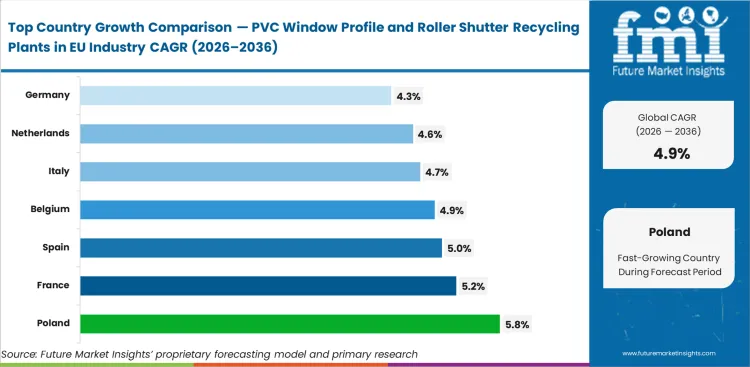
Poland is expected to record the fastest growth in the window profile and roller shutter recycling plants in EU industry, with demand projected to rise at a 5.8% CAGR through 2036. France is estimated at 5.2%, followed by Spain at 5.0%, Belgium at 4.9%, Italy at 4.7%, the Netherlands at 4.6%, and Germany at 4.3% over the forecast period. Poland is moving ahead more quickly because retrofit activity, export-oriented profile production, and newer recycling-capacity requirements are creating a stronger near-term case for plant investment. Demand across the more mature markets remains relevant, particularly where replacement cycles are linked to energy efficient window and door upgrades, but expansion there is being shaped more by process improvement and capacity refinement than by first-time plant installation.
Legacy Additives Are Reshaping Feedstock Strategy
Legacy additives, especially lead in older PVC streams, are changing how plants evaluate feedstock, blending strategy, and final-market positioning. The EU restriction on lead in PVC bans imports of lead-containing PVC products while setting a framework for recycling legacy material in a way intended to safeguard health and the environment. That creates a two-speed market. Plants able to sort, certify, and channel older rigid PVC into compliant applications will retain access to circular volumes that others may avoid. Plants without that capability face narrower offtake options and more compliance friction.
Traceability Is Moving From Nice-to-Have to Necessary
Buyers often assume recycled PVC plants compete mainly on processing yield. In practice, documentation is becoming just as important as throughput. The revised EU Construction Products Regulation provides the common technical language for construction products and is being expanded through new harmonized technical specifications, environmental sustainability provisions, and a Digital Product Passport architecture. For window-profile and roller-shutter recyclers, that shifts the competitive bar. Plants that can prove input origin, polymer composition, recycled content, and downstream suitability will be easier for converters to integrate into construction-product supply chains. Those that cannot will be pushed toward lower-value outlets.
Segmental Analysis
Key Facts of Segments
- Window profiles are expected to account for 58.0% of feedstock demand in 2026. Larger rigid sections give recyclers a steadier intake, lower cleaning variability, and a more workable route to stable plant loading.
- Mechanical recycling is projected to contribute 86.0% share in 2026. Buyers continue to prefer it because it fits established rigid-PVC sorting, washing, grinding, and reprocessing economics at industrial scale.
- Integrated plants are likely to represent 31.0% of demand in 2026. Linked layouts help reduce transfer loss, tighten contamination control, and improve yield management across one coordinated process flow.
- The 5 to 15 ktpa capacity band is expected to hold 43.0% share in 2026. This range stays closest to regional collection density and gives operators more room to protect utilization without oversizing the plant.
- Semi-automatic systems are forecast to make up 47.0% of market share in 2026. Mixed joinery waste still benefits from operator judgment at sorting and control points, which keeps this balance of labor and automation commercially practical.
- By 2026, flakes are projected to contribute 41.0% of total market share. They remain the most practical intermediate form for monetizing cleaned rigid PVC before pelletizing or more advanced finishing is added.
- Window profiles are expected to account for 52.0% of end-use demand in 2026. Recovered PVC continues to find its clearest reuse path where profile-grade output can move back into related construction applications.
- Independent recyclers are set to represent 48.0% share in 2026. Their role stays strong because they remain closest to decentralized feedstock capture and early-stage regional expansion opportunities.
PVC Window Profile and Roller Shutter Recycling Plants in EU Industry Analysis by Feedstock Source
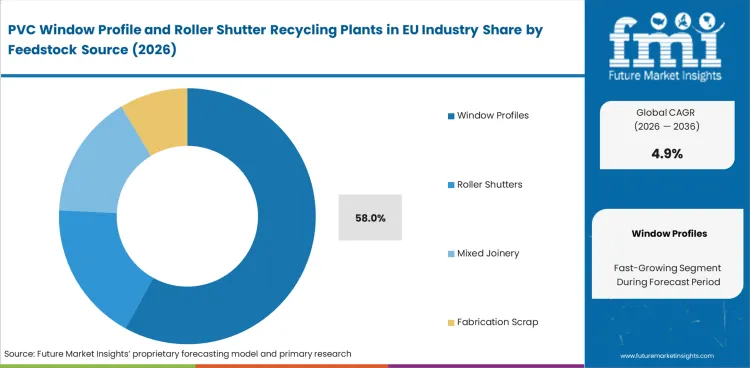
Window-profile scrap gives plant builders the clearest volume case in this market because frame and sash sections arrive in larger rigid formats and still retain material value after removal from buildings. Recyclers usually favor this stream when they want steadier inflow, more predictable plant loading, and less variation in cleaning intensity from batch to batch. Roller shutters and mixed joinery remain relevant, but those streams often bring more design variation, more embedded contamination, and less consistent dismantling quality. Similar closed-loop logic also appears in low-carbon PVC piping and water distribution systems, where material purity determines whether recycled content can move back into durable applications. Feedstock planning therefore stays tied to who can secure a profile-heavy intake and keep line settings stable over time. Market estimates place window profiles at 58.0% share in 2026. Recyclers that begin with a cleaner, more uniform profile stream usually protect yield more effectively than operators trying to correct heavy variability later in the line.
- Volume continuity: Profile-heavy waste gives plants a steadier base load and reduces stop-start operating patterns that weaken yield.
- Dismantling efficiency: Large rigid sections are easier to sort and clean than mixed smaller components carrying attached foreign material.
- Composition stability: Cleaner profile streams help recyclers run tighter settings and reduce value loss from downgraded output.
PVC Window Profile and Roller Shutter Recycling Plants in EU Industry Analysis by Recycling Route
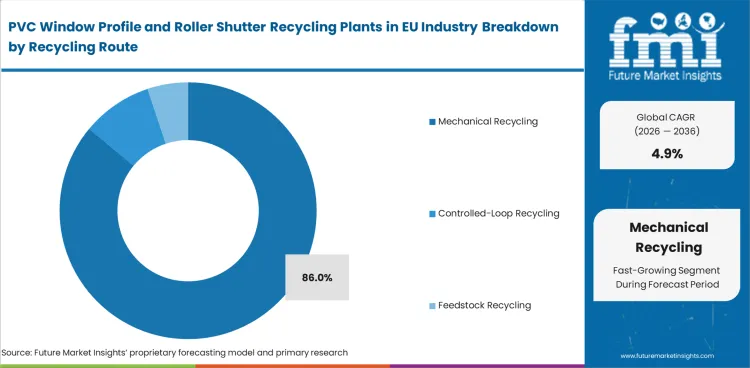
Mechanical recycling stays ahead because most EU window and shutter waste still needs a route that can work at industrial plant scale without relying on chemistry-heavy conversion. Buyers usually choose the process that protects reclaimed PVC resale value, keeps running hours predictable, and supports known rigid-PVC economics rather than experimental output claims. Controlled-loop systems continue to grow inside established profile networks, while feedstock recycling remains the smaller route where cost, qualification, and output acceptance are harder to defend. A similar preference for established equipment logic appears in mechanical recycling systems for food-grade plastic, even though the downstream specification burden is much stricter in that adjacent category. Familiar line design also reduces commissioning friction and speeds operator learning when waste composition changes across incoming loads. In 2026, mechanical recycling is anticipated to represent 86.0% of the market. Its lead comes less from novelty and more from dependable throughput, recognized process discipline, and a clearer route to commercially usable recycled output.
- Process familiarity: Proven line logic lowers commissioning risk and shortens operator learning curves on mixed rigid PVC waste.
- Qualification ease: Buyers trust routes that already carry a usable history in construction-grade recycled output.
- Output consistency: Stable flow through known steps helps recyclers protect color, contamination limits, and usable product form.
PVC Window Profile and Roller Shutter Recycling Plants in EU Industry Analysis by Plant Configuration
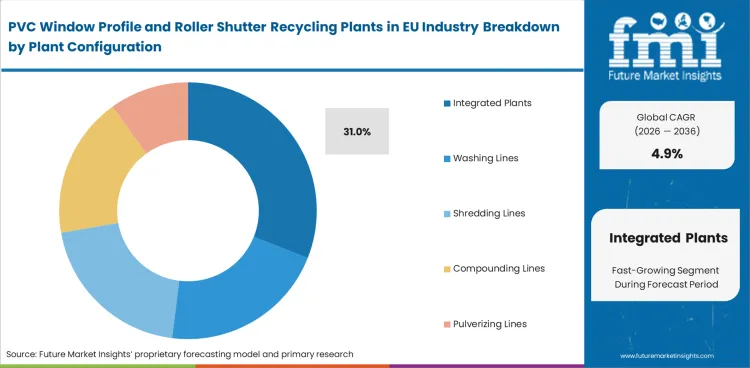
Capital spending often shifts toward fuller line design once recyclers see how much yield is lost between separate handling steps and loosely connected machines. Buyers increasingly value layouts that reduce transfer loss, tighten contamination control, and keep output quality under one coordinated operating logic from the first cut to the final form. Stand-alone washing, shredding, compounding, and pulverizing modules still sell where users expand in stages, but that route can leave visible bottlenecks between one process block and the next. FMI sees related thinking in AI-enabled recycling infrastructure, where coordination across the full plant often matters more than adding isolated machines with limited integration. Integrated plants are likely to secure 31.0% share in 2026 because linked flow gives operators stronger command over yield and cleaning discipline. Pilot systems and modular layouts remain useful under phased investment conditions, though they rarely match the control advantage of a more unified setup. Plant performance improves when fewer handoff points interrupt material flow and introduce avoidable quality loss.
- Yield control: Linked equipment flow reduces handling loss and makes contamination events easier to isolate early.
- Labor balance: Integrated layouts trim repeated manual transfers that raise sorting error and cleaning burden.
- Layout discipline: One-process flow often uses space better than separate add-on islands spread across the plant floor.
PVC Window Profile and Roller Shutter Recycling Plants in EU Industry Analysis by Capacity Band
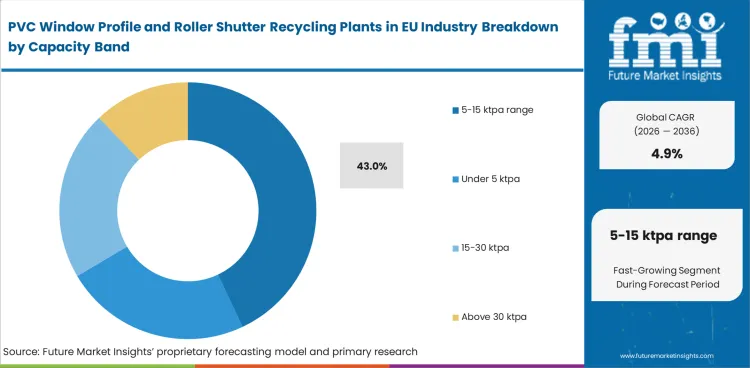
Plants in the mid-scale band remain the closest fit with how this niche develops across Europe because feedstock density and regional collection volumes rarely support oversized facilities without compromising input quality. Smaller plants can serve local streams effectively, but they often struggle to spread fixed costs across enough output to justify stronger washing and finishing capabilities. Much larger facilities become viable only when inbound contracts and downstream demand remain stable enough to sustain high utilization without forcing operators to accept lower-quality feedstock. A similar scale logic appears in FRP recycling, where plant efficiency also depends on whether material density is sufficient to keep the line commercially balanced. In practice, capacity choice depends less on headline size and more on whether the system can stay full with commercially workable material. The 5-15 ktpa range is expected to hold 43.0% share in 2026 because it aligns more closely with regional collection realities, utilization discipline, and capital efficiency than either smaller or larger plant formats. Mid-scale operators are also better positioned to preserve margins because they are less likely to depend on weaker inbound material simply to keep capacity occupied.
- Volume fit: Mid-scale plants align better with regional collection reality than very large facilities that need constant inflow.
- Capital discipline: This capacity band gives buyers room to improve quality without forcing oversized first-step investment.
- Utilization risk: Larger lines lose appeal quickly when incoming material quality or volume turns uneven.
PVC Window Profile and Roller Shutter Recycling Plants in EU Industry Analysis by Automation Level
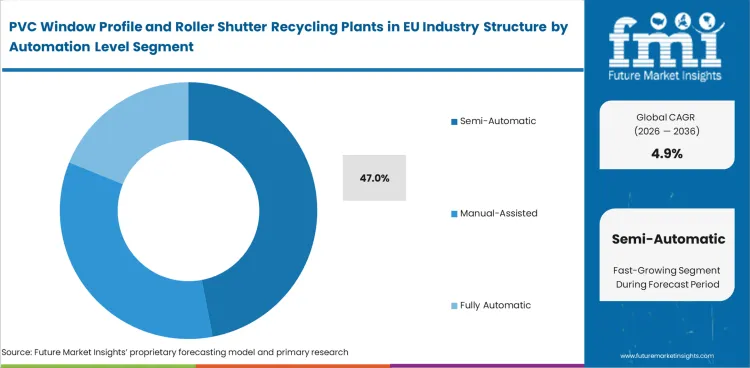
Labor availability and feedstock variation keep semi-automatic systems at the center of this market because mixed rigid-PVC waste still benefits from operator judgment at key sorting and control points. Buyers do not usually pursue automation for its own sake; they choose the level that protects yield, reduces visible sorting error, and fits the actual skill base inside the plant. Fully automatic lines become more attractive where inflow is cleaner and more repetitive, while manual-assisted operations remain relevant for smaller processors that need to control spending tightly. Similar control logic can be seen in food contact recycled plastics decontamination, where process reliability depends heavily on how operators manage variation rather than simply how much code is written into the line. Semi-automatic setups are forecast to make up 47.0% of market share in 2026 because they allow human intervention without sacrificing broader process discipline. That balance matters when waste batches differ in joinery mix, contamination level, and dismantling quality. Plants generally scale more successfully when automation is added to stabilize a workable process, not to hide a volatile one.
- Operator control: Semi-automatic lines let staff intervene when unusual batches would confuse a fixed program.
- Sorting response: Mixed joinery waste still benefits from human checks at points where visual judgment matters.
- Upgrade path: Buyers can start with practical automation and add deeper control once feedstock quality becomes more repeatable.
PVC Window Profile and Roller Shutter Recycling Plants in EU Industry Analysis by Output Form
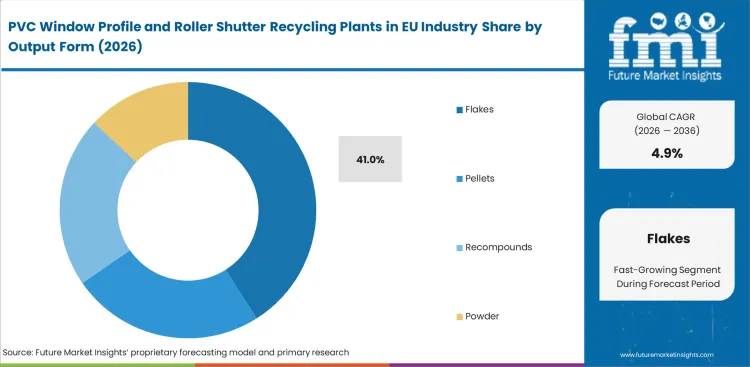
Flakes remain the easiest commercial bridge between collected rigid PVC and later conversion steps because they create a saleable intermediate form without forcing every recycler into pelletizing or advanced formulation investment. Pellets, powders, and recompounds still matter where end users want narrower processing behavior, but those forms typically require more finishing cost and tighter quality control before they become commercially worthwhile. Output strategy therefore follows downstream customer requirements more than plant ambition alone. Demand patterns near wider PVC decarbonization programs show the same logic, where intermediate forms can still hold clear value if converters want flexibility in how they finish the recycled material. By 2026, flakes are projected to contribute 41.0% of total market share because they allow recyclers to monetize material earlier in the chain while keeping room for later upgrading. That makes them especially useful where not every site can justify full downstream conversion capacity. Commercial flexibility improves when recyclers can sell a clean intermediate product without overbuilding the final finishing stage.
- Intermediate value: Clean flakes give recyclers a sellable form even before deeper upgrading is added on site.
- Finishing cost: Extra conversion to pellets or powders makes sense only when buyers pay for tighter specification.
- Buyer flexibility: Some converters prefer to take intermediate material and finish it around their own process needs.
PVC Window Profile and Roller Shutter Recycling Plants in EU Industry Analysis by End Use
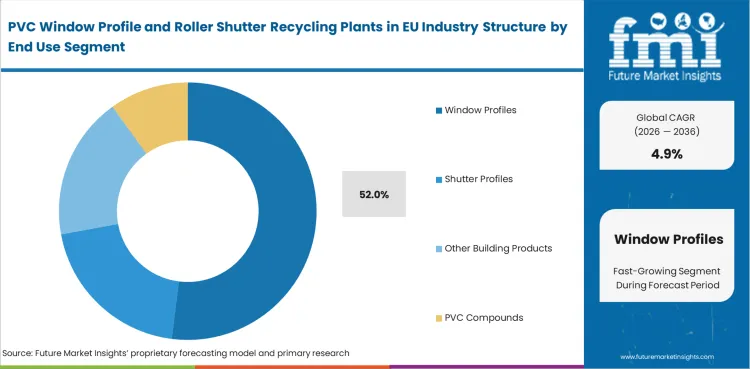
Window profiles remain at the heart of this market because they offer the clearest route back into construction-grade PVC applications with established reuse logic and stronger output economics. Shutter profiles and other building-product uses help widen outlet options, yet profile demand still shapes how many plants are specified, how tightly they clean the material, and which output form they target. End-use pull matters almost as much as feedstock supply because recyclers need confidence that higher-grade recovered PVC will move into a repeatable application rather than a downgrade outlet. Retrofit-heavy segments such as residential energy efficient windows also matter indirectly here, since replacement activity strengthens both the waste stream and the downstream case for profile-grade reuse. FMI estimates that window profiles will account for 52.0% of the end-use segment in 2026. That lead reflects established profile networks and a clearer destination for better-quality recycled PVC. Plant economics usually remain stronger when the recovered output can return to a related building product with fewer compromises in specification and value.
- Closed-loop pull: Profile reuse keeps plant economics stronger because higher-grade output has a clearer destination.
- Quality threshold: Output aimed at profile production needs tighter contamination control than lower-value secondary uses.
- Outlet security: Stable end markets reduce the risk of operating a line without dependable buyers for recovered PVC.
PVC Window Profile and Roller Shutter Recycling Plants in EU Industry Analysis by Buyer Type
Independent recyclers generate much of the buying activity in this niche because they usually respond faster to regional feedstock openings and gaps in local plant capacity. Window and shutter waste still moves through specialist processors in many cases before the material returns to compounders or profile producers, which keeps these buyers commercially important. Integrated extruders continue to gain ground where rPVC supply security becomes more strategic, while waste firms and compounders often enter with a narrower plant objective. Equipment choice changes with buyer type, since specialist recyclers typically want flexible lines first, whereas captive users push harder on output consistency from the outset. Performance and cost choices seen in composite door & window applications also remind integrated buyers that recycled PVC still has to meet practical product demands after recovery. Independent recyclers are set to account for 48.0% share in 2026 because they remain closest to decentralized feedstock capture and early expansion opportunities. Purchasing patterns become more disciplined once buyers are balancing local agility against downstream specification pressure.
- Local agility: Specialist recyclers can move quickly when regional demolition or replacement work creates fresh feedstock flow.
- Captive production pull: Integrated users invest when recycled PVC becomes too important to leave to outside suppliers alone.
- Specification discipline: Buyers with downstream manufacturing usually ask for tighter output control from the beginning.
PVC Window Profile and Roller Shutter Recycling Plants in EU Industry Drivers, Restraints, and Opportunities
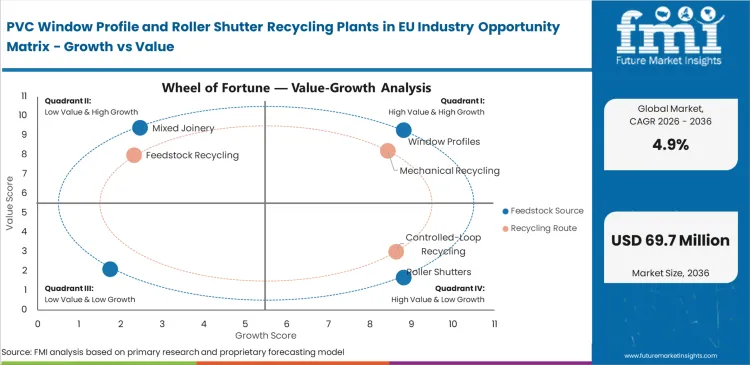
Replacement windows, demolition waste, and circular-content targets are pushing this niche from opportunistic recycling toward repeat plant spending. Recyclers now need lines that do more than reduce size. They need to remove metal, seal material, dirt, and mixed polymer carryover without giving away too much usable PVC. That changes plant buying from a low-cost machine decision into a yield decision. Better cleaning and finishing support output that can move back into profiles, shutter parts, and related building uses. Similar retrofit logic shapes feedstock availability around residential energy efficient windows, where replacement activity later feeds recycling demand.
Feedstock inconsistency keeps growth more measured than circularity plans alone would suggest. Window and shutter waste rarely arrives in one clean stream. Hardware, coatings, composites, rubber, and variable age profiles all change how hard a line must work and how much value it can recover. Companies hesitate when inbound volumes are uncertain, or outlet demand for higher-grade rPVC is not secure. Spending slows further when virgin PVC prices undercut recyclate economics. Buyers then postpone full-line investment and settle for smaller upgrades. Material competition visible in composite door & window also shows why recycled PVC must still meet practical performance expectations.
Opportunities in the PVC Window Profile and Roller Shutter Recycling Plants in EU Industry
- Urban replacement stock: Older housing and renovation-heavy city belts create the clearest clusters where collection and plant utilization can improve together.
- Captive profile loops: Profile producers that want steadier recycled content can justify in-house or closely aligned recycling capacity once feedstock contracts become repeatable.
- Design-for-recycling alignment: Simpler profile design and cleaner dismantling practices improve output quality and reduce the cost penalty attached to mixed or legacy waste streams.
Regional Analysis
Regional demand does not move in one straight line across the EU. Plant spending follows a mix of window replacement activity, profile production depth, export orientation, and how mature each country already is in collection and audited recycling. Faster-growth countries are still building or upgrading plant capability, while established bases are spending more on refinement, line balance, and output control. That split matters because the same circularity target can produce very different buying behavior from one market to another.
.webp "Top Country Growth Comparison Pvc Window Profile And Roller Shutter Recycling Plants In Eu Industry Cagr (2026 2036)")
Key Facts of Country
- Profile manufacturing depth and export exposure give Poland the strongest growth outlook in this study. Demand in Poland is expected to rise at a 5.8% CAGR through 2036.
- Renovation programs and building-performance upgrades support France, where plant owners still have room to improve sorting, washing, and finishing capability. France is anticipated to expand at a 5.2% CAGR over the forecast period.
- Retrofit activity and mixed rigid-PVC recovery needs keep Spain on a growth path. The market in Spain is expected to grow at a 5.0% CAGR during 2026 to 2036.
- Shorter transport loops and cross-border material movement continue to support Belgium. Demand in Belgium is expected to run at a 4.9% CAGR through 2036.
- Broad building stock and practical interest in circular PVC use sustain Italy, though buyers often remain cautious on larger plant layouts. Italy is projected to record 4.7% CAGR over the forecast period.
- More exacting circular-material handling keeps the Netherlands commercially relevant for upgrade-led demand. The Netherlands is expected to post 4.6% CAGR through 2036.
- A mature recycling base gives Germany a steadier expansion profile than faster-build markets. Sales in Germany are expected to increase at a 4.3% CAGR during the forecast period.
| Country | CAGR (2026 to 2036) |
|---|---|
| Poland | 5.8% |
| France | 5.2% |
| Spain | 5.0% |
| Belgium | 4.9% |
| Italy | 4.7% |
| Netherlands | 4.6% |
| Germany | 4.3% |
Source: Future Market Insights (FMI) analysis, based on proprietary forecasting model and primary research
Western Europe PVC Window Profile and Roller Shutter Recycling Plants in EU Industry Analysis
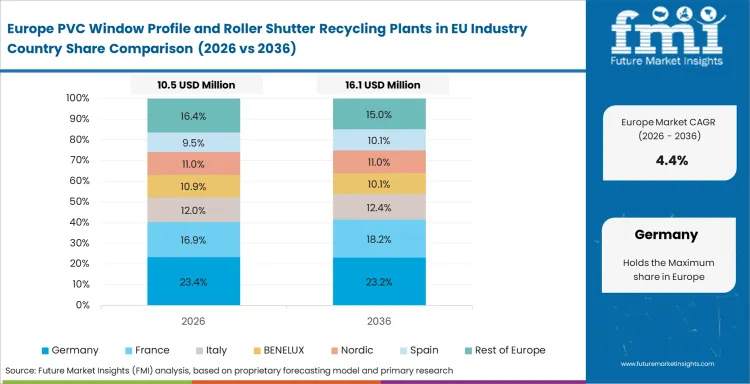
Western Europe remains commercially important because replacement windows, strict material handling expectations, and shorter logistics corridors all support more disciplined plant economics. France, Belgium, and the Netherlands do not move for the same reason, yet all three benefit from a buyer base that places real value on cleaner output and lower processing loss. Plant owners in this cluster usually spend a clear quality target in mind rather than chasing tonnage alone. Residential replacement patterns visible in vinyl sliding window also reinforce the case for steady rigid-PVC recovery across renovation-led markets.
- France: Renovation programs and a steady push toward better building performance keep France near the top of the EU growth range. Demand for this PVC window profile and roller shutter recycling plants in the EU industry in France is anticipated to rise at a CAGR of 5.2% from 2026 to 2036 because plant owners still have room to upgrade sorting, washing, and finishing capability around growing recovery volumes. Buyers here tend to focus on whether recovered PVC can return to higher-value construction uses rather than just leaving the waste stream. Spending, therefore, leans toward quality improvement and repeat feedstock access. Plants that fail to secure those two conditions risk running below their cleaning and separation potential.
- Belgium: Export-heavy plastics activity and close industrial geography give Belgium a useful edge in line economics. Buyers can move material over shorter distances and still protect enough value to justify better plant steps. Demand for this niche in Belgium is expected to run at a CAGR of 4.9% during the forecast period, supported by the country’s role in cross-border material movement and conversion. Capex tends to stay selective rather than broad. Projects advance when operators can tie collection, processing, and outlet demand together with little drift between each stage.
- Netherlands: Tight circular-material handling standards keep the PVC window profile and roller shutter recycling plants industry in the Netherlands more quality-sensitive than volume-led. Recyclers favor flexible line setups because incoming scrap often differs by project source and dismantling condition. Demand for these plants in the Netherlands is anticipated to rise at a CAGR of 4.6% through 2036, supported by steady equipment upgrades rather than a sudden wave of greenfield capacity. Investment decisions depend on whether operators can control contamination well enough to secure reliable downstream use. Cost discipline remains important, so buyers usually avoid oversized systems unless feedstock visibility is strong.
Western Europe stands out less for raw scale and more for operating discipline. Buyers in this group reward equipment choices that reduce rework, loss, and avoidable material downgrading. Markets here often set up the tone for how quality-led plant upgrades spread into the rest of the region.
Central Europe PVC Window Profile and Roller Shutter Recycling Plants in EU Industry Analysis
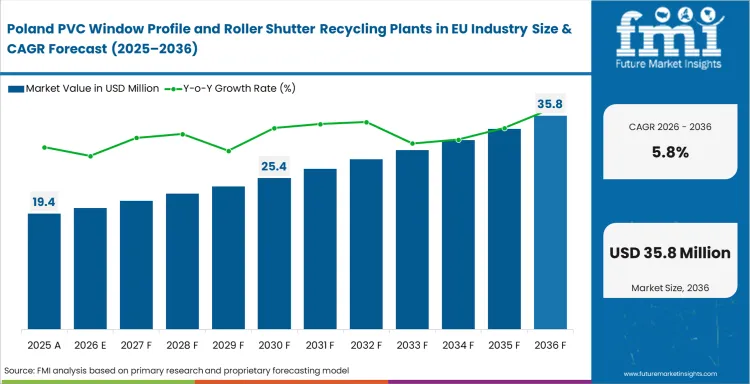
Central Europe carries the clearest mix of installed recycling depth and new expansion needs. Germany gives the region a mature collection and processing base, while Poland offers a faster growth path tied to production scale and export strength in PVC windows. Plant buyers in this cluster pay close attention to whether equipment can handle both stable fabrication scrap and more variable post-consumer inflow.
- Germany: Germany already has one of the region’s most established PVC window recycling systems, so demand here grows from a mature starting point. Instead of chasing first-time capacity, buyers are more likely to improve line balance, output consistency, and contamination removal around existing operations. Sales of this segment in Germany are expected to increase at a CAGR of 4.3% from 2026 to 2036, which is slower than Poland but still meaningful because the installed base is large and technically experienced. Spending stays practical. Operators want upgrades that protect yield and reduce variability, not oversized lines that duplicate capability already in place.
- Poland: Profile manufacturing depth and export exposure give Poland the strongest growth case in this study. Plant demand rises here because more waste can be collected close to active production and replacement channels, which improves the payback case for better sorting and washing systems. Poland is projected to record a CAGR of 5.8% in this industry during the forecast period, and that lead reflects both feedstock potential and room for plant expansion. Buyers remain careful about quality. Faster growth only turns into durable returns when recovered PVC can move back into consistent downstream use instead of lower-value outlets.
Central Europe matters because it combines proof and expansion in one regional block. Germany shows what a mature loop looks like, while Poland shows where the next round of plant spending can build faster. That contrast gives equipment suppliers a clearer read on what to sell and where to simplify their offer.
Southern Europe PVC Window Profile and Roller Shutter Recycling Plants in EU Industry Analysis
Southern Europe brings a different mix of drivers into the market. Roller shutters have a more visible role in building stock, and refurbishment work often sits alongside climate-control upgrades in older homes and mixed-use buildings. Spain and Italy both support plant demand, yet project economics can change quickly with feedstock quality and outlet confidence. Renovation-led window activity visible in bays and bows window and other replacement formats also feeds the longer-term case for better rigid-PVC recovery in the south.
- Spain: Spain combines renovation demand with a building base where shutters and exterior protection elements remain commercially relevant. Manufacturers look beyond frame scrap and pay attention to mixed rigid-PVC flows that need more careful cleaning and separation. The PVC Window Profile and Roller Shutter Recycling Plants in EU industry in Spain is expected to grow at a CAGR of 5.0% during the study period, and that pace reflects both retrofit activity and room to improve recycling capability. Projects tend to advance when recyclers can secure enough volume from demolition and replacement work. Weak collection discipline can still slow utilization even when demand looks healthy.
- Italy: Italy benefits from a broad building stock and an active conversion base, yet buyers often keep a close eye on cost recovery before moving into larger plant layouts. Mid-scale equipment remains attractive because it can match regional inflow without forcing too much unused capacity. By 2036, the demand in Italy is expected to grow at a CAGR of 4.7%, supported by steady replacement demand and practical interest in circular PVC use. Output quality remains at the real checkpoint. Recyclers that cannot hold a dependable cleaning standard find it harder to win repeat downstream orders.
Southern Europe is therefore a good example of why feedstock type and building habits matter as much as headline circularity goals. Buyers in this block respond well to flexible plant layouts that can handle variable waste without losing too much usable material. Growth is steady here, though it stays selective when collection and outlet quality drift apart.
Competitive Aligners for Market Players
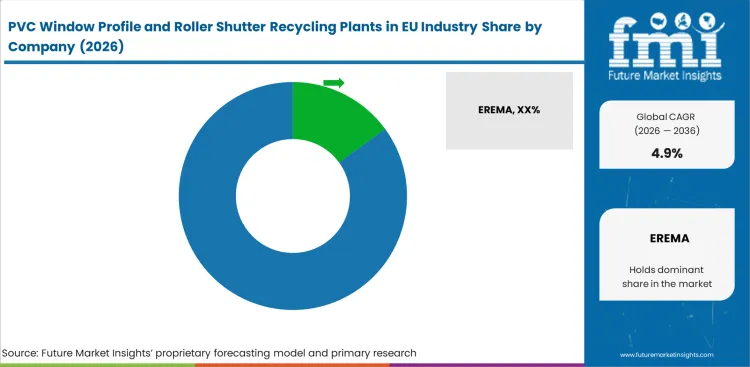
Buyers of rigid PVC recycling plants typically assess suppliers based on operational reliability, depth of material handling capability, and the speed at which service teams can address contamination or throughput disruptions. While several established names often appear within the same bidding pool, they tend to be evaluated for different strengths. Some suppliers are considered first when overall line confidence is the priority, while others are introduced later to address specific stages such as washing or size reduction. This dynamic results in a shared project pipeline, but not a uniform basis of competition across suppliers such as EREMA or Lindner Washtech.
Market positioning is more strongly influenced by process familiarity and long-term plant trust than by scale alone. Recyclers value suppliers that demonstrate a practical understanding of rigid PVC challenges, including impurity control, metal separation, seal removal, and consistent output quality. Providers that can align recycling performance with downstream handling expectations often gain preference, particularly when buyers are also considering adjacent systems such as vinyl extrusion equipment. While a narrower offering may still secure a single module, it typically has limited influence on overarching plant configuration decisions.
From a sourcing perspective, large operators continue to favor mixed sourcing strategies to reduce reliance on any single equipment provider. This approach allows flexibility in service negotiations, targeted upgrades, and phased capacity expansion without full system replacement. As a result, market concentration remains constrained even among frequently shortlisted suppliers like Vecoplan or NGR. Through 2036, competition is expected to remain fragmented, with suppliers that combine strong after-sales support and clear expertise in rigid PVC output stability more likely to secure complex and high-specification projects.
Key Players in PVC Window Profile and Roller Shutter Recycling Plants in EU Industry
- EREMA
- Coperion Herbold
- Lindner Washtech
- Vecoplan
- NGR
- B+B Anlagenbau
- NEUE HERBOLD
Scope of the Report
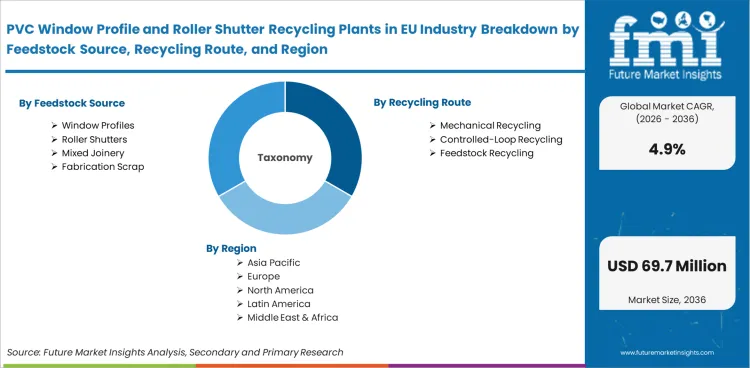
| Metric | Value |
|---|---|
| Quantitative Units | USD 41.2 million to USD 66.5 million, at a CAGR of 4.9% |
| Market Definition | Industrial plant systems and major process modules used to recycle rigid PVC window profiles, roller shutters, mixed joinery waste, and related fabrication scrap in the European Union. |
| Feedstock Source Segmentation | Window Profiles, Roller Shutters, Mixed Joinery, Fabrication Scrap |
| Recycling Route Segmentation | Mechanical Recycling, Controlled-Loop Recycling, Feedstock Recycling |
| Plant Configuration Segmentation | Integrated Plants, Washing Lines, Shredding Lines, Compounding Lines, Pulverizing Lines |
| Capacity and Automation | Under 5 ktpa, 5-15 ktpa, 15-30 ktpa, Above 30 ktpa; Manual-Assisted, Semi-Automatic, Fully Automatic |
| Output Form and End Use | Flakes, Pellets, Recompounds, Powder; Window Profiles, Shutter Profiles, Other Building Products, PVC Compounds |
| Regions Covered | Western Europe, Central Europe, Southern Europe, and the wider EU context |
| Countries Covered | Poland, France, Spain, Belgium, Italy, Netherlands, Germany |
| Key Companies Profiled | EREMA, Coperion Herbold, Lindner Washtech, Vecoplan, NGR, B+B Anlagenbau, NEUE HERBOLD |
| Forecast Period | 2026 to 2036 |
| Approach | FMI combines primary interviews with recyclers, profile processors, and equipment suppliers with public circular-economy, construction, and PVC recycling datasets to size plant demand and validate segment and country direction. |
Source: Future Market Insights (FMI) analysis, based on proprietary forecasting model and primary research
PVC Window Profile and Roller Shutter Recycling Plants in EU Industry Analysis by Segments
Feedstock Source
- Window Profiles
- Roller Shutters
- Mixed Joinery
- Fabrication Scrap
Recycling Route
- Mechanical Recycling
- Controlled-Loop Recycling
- Feedstock Recycling
Plant Configuration
- Integrated Plants
- Washing Lines
- Shredding Lines
- Compounding Lines
- Pulverizing Lines
Capacity Band
- Under 5 ktpa
- 5-15 ktpa
- 15-30 ktpa
- Above 30 ktpa
Automation Level
- Manual-Assisted
- Semi-Automatic
- Fully Automatic
Output Form
- Flakes
- Pellets
- Recompounds
- Powder
End Use
- Window Profiles
- Shutter Profiles
- Other Building Products
- PVC Compounds
Buyer Type
- Independent Recyclers
- Integrated Extruders
- Waste Firms
- Compounders
Region
- Western Europe
- France
- Belgium
- Netherlands
- Central Europe
- Germany
- Poland
- Southern Europe
- Spain
- Italy
Bibliography
- European Commission. (2024). Regulation (EU) 2024/3110 of the European Parliament and of the Council of 27 November 2024 laying down harmonised rules for the marketing of construction products and repealing Regulation (EU) No 305/2011.
- European Environment Agency. (2024). The role of plastics in Europe’s circular economy.
- Lahl, U., & Zeschmar-Lahl, B. (2024). More than 30 Years of PVC Recycling in Europe-A Critical Inventory.
- Schmidt, S., Gibon, T., Navarrete Gutiérrez, T., Lindemann, K.-M., & Laner, D. (2024). The environmental costs of clean cycles: Quantitative analysis for the case of PVC window profile recycling in Germany.
This bibliography is provided for reader reference. The full FMI report contains the complete reference list with primary source documentation.
This Report Addresses
- Market intelligence to support strategic decisions across rigid PVC profile recycling plants, roller shutter recovery lines, washing systems, shredding systems, and compounding equipment.
- Market size estimation and a 10-year forecast from 2026 to 2036 supported by plant-capex logic, recycling capacity signals, and country-level demand mapping.
- Growth opportunity mapping across feedstock source, recycling route, plant configuration, capacity band, automation level, output form, end use, and buyer type.
- Segment and regional analysis covering Window Profiles, Mechanical Recycling, Integrated Plants, 5–15 ktpa systems, Semi-Automatic layouts, Flakes, and the seven tracked EU countries.
- Competitive assessment across service reliability, rigid-PVC handling depth, contamination control capability, after-sales support, and module-versus-full-line buying behavior.
- Scope definition covering what is included in plant demand, what is excluded from finished-product markets, and where adjacent PVC construction outlets support plant economics.
- Practical guidance on how feedstock consistency, output quality, and downstream reuse pull shape capex decisions in this market.
- Delivery of a structured report format for strategy, investment screening, commercial planning, and operating benchmark use.
Frequently Asked Questions
How large is the EU industry for PVC window profile and roller shutter recycling plants in 2025?
FMI estimates the PVC Window Profile and Roller Shutter Recycling Plants in EU Market at USD 39.3 million in 2025.
What value is projected for this market by 2036?
Demand for PVC window profile and roller shutter recycling plants in the EU is expected to reach USD 66.5 million by 2036.
What CAGR is forecast for the assessment period?
FMI projects the market to expand at a CAGR of 4.9% from 2026 to 2036.
Which feedstock source leads demand for recycling plants in this report?
Window profiles are expected to remain the leading feedstock source, with an estimated 58.0% share in 2026, because they form the largest and most consistent rigid PVC recovery stream in this value chain.
Why do window-profile recycling lines stay ahead of roller shutter recycling lines?
PVC window profile recycling plants stay ahead because profile waste enters collection channels in larger volumes and fits closed-loop reuse more easily than roller shutter scrap.
Which recycling route dominates the market?
Mechanical recycling is projected to account for about 86.0% of the market in 2026, supported by its established fit with rigid PVC sorting, washing, grinding, and reprocessing workflows.
What plant capacity band is expected to lead in 2026?
Plants in the 5–15 ktpa range are expected to hold around 43.0% share in 2026, as this size suits regional feedstock availability without pushing plant economics too far.
Which automation level is most common across EU recycling plants?
Semi-automatic systems are estimated to represent nearly 47.0% of demand in 2026, since they balance labor control, line flexibility, and investment discipline.
What output form leads this recycling plant market?
Flakes are expected to lead with an estimated 41.0% share in 2026, because many operators first target clean regrind output before moving into pelletizing or more advanced compounding.
Which buyer group leads spending on these recycling plants?
Independent recyclers are projected to account for about 48.0% of the market in 2026, as they remain the most active buyers of dedicated rigid PVC recovery and processing lines.
Which country grows fastest in this EU industry?
Poland is expected to be the fastest-growing country market, with demand for PVC window profile and roller shutter recycling plants rising at a CAGR of 5.8% through 2036.
Why does Germany remain important even though its CAGR is lower than Poland’s or France’s?
Germany stays important because its PVC window recycling base is more mature, so demand leans more toward upgrades, process refinement, and controlled-loop efficiency than first-stage build-out.
What does this report include within market scope?
This report covers EU spending on mechanical and controlled-loop recycling plants, line modules, and major upgrades used for PVC window profiles and PVC roller shutters.
What is excluded from the scope of this market study?
Finished windows, finished shutters, recycled PVC resin sales, aluminum-only shutter systems, and broad municipal mixed-waste sorting lines are outside the scope of this report.
How does roller shutter recycling fit into the market analyzed here?
Roller shutter recycling remains a smaller but relevant part of the market because shutter waste often enters the same rigid PVC processing logic used for profile-based recycling plants.
What do buyers usually compare before selecting a PVC recycling plant supplier?
Buyers usually compare washing efficiency, contamination handling, line integration, rigid-plastic processing reliability, and service support before finalizing a recycling plant supplier.
Is this a concentrated or fragmented machinery market?
This report views the market as fragmented, with the leading supplier estimated at about 18.0% share, because projects are often built from modular shredding, washing, separation, and reprocessing systems rather than one fixed plant format.
Which end-use segment leads demand for recycled output from these plants?
Window profiles are expected to lead end use with an estimated 52.0% share in 2026, reflecting the strength of closed-loop reuse back into profile extrusion and adjacent building products.
Why does this market not grow faster despite clear circularity pressure in Europe?
Growth remains measured because recycler economics, feedstock quality, plant utilization, and investment timing still matter as much as circularity targets in this niche.
Preview the report firsthand - request a free sample
Get SampleGet the brochure for pricing and purchase details.
Get PDFTable of Content
- Executive Summary
- Global Market Outlook
- Demand-side Trends
- Supply-side Trends
- Technology Roadmap Analysis
- Analysis and Recommendations
- Market Overview
- Market Coverage / Taxonomy
- Market Definition / Scope / Limitations
- Research Methodology
- Chapter Orientation
- Analytical Lens and Working Hypotheses
- Market Structure, Signals, and Trend Drivers
- Benchmarking and Cross-market Comparability
- Market Sizing, Forecasting, and Opportunity Mapping
- Research Design and Evidence Framework
- Desk Research Programme (Secondary Evidence)
- Company Annual and Sustainability Reports
- Peer-reviewed Journals and Academic Literature
- Corporate Websites, Product Literature, and Technical Notes
- Earnings Decks and Investor Briefings
- Statutory Filings and Regulatory Disclosures
- Technical White Papers and Standards Notes
- Trade Journals, Industry Magazines, and Analyst Briefs
- Conference Proceedings, Webinars, and Seminar Materials
- Government Statistics Portals and Public Data Releases
- Press Releases and Reputable Media Coverage
- Specialist Newsletters and Curated Briefings
- Sector Databases and Reference Repositories
- FMI Internal Proprietary Databases and Historical Market Datasets
- Subscription Datasets and Paid Sources
- Social Channels, Communities, and Digital Listening Inputs
- Additional Desk Sources
- Expert Input and Fieldwork (Primary Evidence)
- Primary Modes
- Qualitative Interviews and Expert Elicitation
- Quantitative Surveys and Structured Data Capture
- Blended Approach
- Why Primary Evidence is Used
- Field Techniques
- Interviews
- Surveys
- Focus Groups
- Observational and In-context Research
- Social and Community Interactions
- Stakeholder Universe Engaged
- C-suite Leaders
- Board Members
- Presidents and Vice Presidents
- R&D and Innovation Heads
- Technical Specialists
- Domain Subject-matter Experts
- Scientists
- Physicians and Other Healthcare Professionals
- Governance, Ethics, and Data Stewardship
- Research Ethics
- Data Integrity and Handling
- Primary Modes
- Tooling, Models, and Reference Databases
- Desk Research Programme (Secondary Evidence)
- Data Engineering and Model Build
- Data Acquisition and Ingestion
- Cleaning, Normalisation, and Verification
- Synthesis, Triangulation, and Analysis
- Quality Assurance and Audit Trail
- Market Background
- Market Dynamics
- Drivers
- Restraints
- Opportunity
- Trends
- Scenario Forecast
- Demand in Optimistic Scenario
- Demand in Likely Scenario
- Demand in Conservative Scenario
- Opportunity Map Analysis
- Product Life Cycle Analysis
- Supply Chain Analysis
- Investment Feasibility Matrix
- Value Chain Analysis
- PESTLE and Porter’s Analysis
- Regulatory Landscape
- Regional Parent Market Outlook
- Production and Consumption Statistics
- Import and Export Statistics
- Market Dynamics
- Global Market Analysis 2021 to 2025 and Forecast, 2026 to 2036
- Historical Market Size Value (USD Million) Analysis, 2021 to 2025
- Current and Future Market Size Value (USD Million) Projections, 2026 to 2036
- Y-o-Y Growth Trend Analysis
- Absolute $ Opportunity Analysis
- Global Market Pricing Analysis 2021 to 2025 and Forecast 2026 to 2036
- Global Market Analysis 2021 to 2025 and Forecast 2026 to 2036, By Feedstock Source
- Introduction / Key Findings
- Historical Market Size Value (USD Million) Analysis By Feedstock Source , 2021 to 2025
- Current and Future Market Size Value (USD Million) Analysis and Forecast By Feedstock Source , 2026 to 2036
- Window Profiles
- Roller Shutters
- Mixed Joinery
- Fabrication Scrap
- Window Profiles
- Y-o-Y Growth Trend Analysis By Feedstock Source , 2021 to 2025
- Absolute $ Opportunity Analysis By Feedstock Source , 2026 to 2036
- Global Market Analysis 2021 to 2025 and Forecast 2026 to 2036, By Recycling Route
- Introduction / Key Findings
- Historical Market Size Value (USD Million) Analysis By Recycling Route, 2021 to 2025
- Current and Future Market Size Value (USD Million) Analysis and Forecast By Recycling Route, 2026 to 2036
- Mechanical Recycling
- Controlled-Loop Recycling
- Feedstock Recycling
- Mechanical Recycling
- Y-o-Y Growth Trend Analysis By Recycling Route, 2021 to 2025
- Absolute $ Opportunity Analysis By Recycling Route, 2026 to 2036
- Global Market Analysis 2021 to 2025 and Forecast 2026 to 2036, By Plant Configuration
- Introduction / Key Findings
- Historical Market Size Value (USD Million) Analysis By Plant Configuration, 2021 to 2025
- Current and Future Market Size Value (USD Million) Analysis and Forecast By Plant Configuration, 2026 to 2036
- Integrated Plants
- Washing Lines
- Shredding Lines
- Compounding Lines
- Pulverizing Lines
- Integrated Plants
- Y-o-Y Growth Trend Analysis By Plant Configuration, 2021 to 2025
- Absolute $ Opportunity Analysis By Plant Configuration, 2026 to 2036
- Global Market Analysis 2021 to 2025 and Forecast 2026 to 2036, By Capacity Band
- Introduction / Key Findings
- Historical Market Size Value (USD Million) Analysis By Capacity Band, 2021 to 2025
- Current and Future Market Size Value (USD Million) Analysis and Forecast By Capacity Band, 2026 to 2036
- 5-15 ktpa range
- Under 5 ktpa
- 15-30 ktpa
- Above 30 ktpa
- 5-15 ktpa range
- Y-o-Y Growth Trend Analysis By Capacity Band, 2021 to 2025
- Absolute $ Opportunity Analysis By Capacity Band, 2026 to 2036
- Global Market Analysis 2021 to 2025 and Forecast 2026 to 2036, By Automation Level
- Introduction / Key Findings
- Historical Market Size Value (USD Million) Analysis By Automation Level, 2021 to 2025
- Current and Future Market Size Value (USD Million) Analysis and Forecast By Automation Level, 2026 to 2036
- Semi-Automatic
- Manual-Assisted
- Fully Automatic
- Semi-Automatic
- Y-o-Y Growth Trend Analysis By Automation Level, 2021 to 2025
- Absolute $ Opportunity Analysis By Automation Level, 2026 to 2036
- Global Market Analysis 2021 to 2025 and Forecast 2026 to 2036, By Output Form
- Introduction / Key Findings
- Historical Market Size Value (USD Million) Analysis By Output Form, 2021 to 2025
- Current and Future Market Size Value (USD Million) Analysis and Forecast By Output Form, 2026 to 2036
- Flakes
- Pellets
- Recompounds
- Powder
- Flakes
- Y-o-Y Growth Trend Analysis By Output Form, 2021 to 2025
- Absolute $ Opportunity Analysis By Output Form, 2026 to 2036
- Global Market Analysis 2021 to 2025 and Forecast 2026 to 2036, By End Use
- Introduction / Key Findings
- Historical Market Size Value (USD Million) Analysis By End Use, 2021 to 2025
- Current and Future Market Size Value (USD Million) Analysis and Forecast By End Use, 2026 to 2036
- Window Profiles
- Shutter Profiles
- Other Building Products
- PVC Compounds
- Window Profiles
- Y-o-Y Growth Trend Analysis By End Use, 2021 to 2025
- Absolute $ Opportunity Analysis By End Use, 2026 to 2036
- Global Market Analysis 2021 to 2025 and Forecast 2026 to 2036, By Region
- Introduction
- Historical Market Size Value (USD Million) Analysis By Region, 2021 to 2025
- Current Market Size Value (USD Million) Analysis and Forecast By Region, 2026 to 2036
- North America
- Latin America
- Western Europe
- Eastern Europe
- East Asia
- South Asia and Pacific
- Middle East & Africa
- Market Attractiveness Analysis By Region
- North America Market Analysis 2021 to 2025 and Forecast 2026 to 2036, By Country
- Historical Market Size Value (USD Million) Trend Analysis By Market Taxonomy, 2021 to 2025
- Market Size Value (USD Million) Forecast By Market Taxonomy, 2026 to 2036
- By Country
- USA
- Canada
- Mexico
- By Feedstock Source
- By Recycling Route
- By Plant Configuration
- By Capacity Band
- By Automation Level
- By Output Form
- By End Use
- By Country
- Market Attractiveness Analysis
- By Country
- By Feedstock Source
- By Recycling Route
- By Plant Configuration
- By Capacity Band
- By Automation Level
- By Output Form
- By End Use
- Key Takeaways
- Latin America Market Analysis 2021 to 2025 and Forecast 2026 to 2036, By Country
- Historical Market Size Value (USD Million) Trend Analysis By Market Taxonomy, 2021 to 2025
- Market Size Value (USD Million) Forecast By Market Taxonomy, 2026 to 2036
- By Country
- Brazil
- Chile
- Rest of Latin America
- By Feedstock Source
- By Recycling Route
- By Plant Configuration
- By Capacity Band
- By Automation Level
- By Output Form
- By End Use
- By Country
- Market Attractiveness Analysis
- By Country
- By Feedstock Source
- By Recycling Route
- By Plant Configuration
- By Capacity Band
- By Automation Level
- By Output Form
- By End Use
- Key Takeaways
- Western Europe Market Analysis 2021 to 2025 and Forecast 2026 to 2036, By Country
- Historical Market Size Value (USD Million) Trend Analysis By Market Taxonomy, 2021 to 2025
- Market Size Value (USD Million) Forecast By Market Taxonomy, 2026 to 2036
- By Country
- Germany
- UK
- Italy
- Spain
- France
- Nordic
- BENELUX
- Rest of Western Europe
- By Feedstock Source
- By Recycling Route
- By Plant Configuration
- By Capacity Band
- By Automation Level
- By Output Form
- By End Use
- By Country
- Market Attractiveness Analysis
- By Country
- By Feedstock Source
- By Recycling Route
- By Plant Configuration
- By Capacity Band
- By Automation Level
- By Output Form
- By End Use
- Key Takeaways
- Eastern Europe Market Analysis 2021 to 2025 and Forecast 2026 to 2036, By Country
- Historical Market Size Value (USD Million) Trend Analysis By Market Taxonomy, 2021 to 2025
- Market Size Value (USD Million) Forecast By Market Taxonomy, 2026 to 2036
- By Country
- Russia
- Poland
- Hungary
- Balkan & Baltic
- Rest of Eastern Europe
- By Feedstock Source
- By Recycling Route
- By Plant Configuration
- By Capacity Band
- By Automation Level
- By Output Form
- By End Use
- By Country
- Market Attractiveness Analysis
- By Country
- By Feedstock Source
- By Recycling Route
- By Plant Configuration
- By Capacity Band
- By Automation Level
- By Output Form
- By End Use
- Key Takeaways
- East Asia Market Analysis 2021 to 2025 and Forecast 2026 to 2036, By Country
- Historical Market Size Value (USD Million) Trend Analysis By Market Taxonomy, 2021 to 2025
- Market Size Value (USD Million) Forecast By Market Taxonomy, 2026 to 2036
- By Country
- China
- Japan
- South Korea
- By Feedstock Source
- By Recycling Route
- By Plant Configuration
- By Capacity Band
- By Automation Level
- By Output Form
- By End Use
- By Country
- Market Attractiveness Analysis
- By Country
- By Feedstock Source
- By Recycling Route
- By Plant Configuration
- By Capacity Band
- By Automation Level
- By Output Form
- By End Use
- Key Takeaways
- South Asia and Pacific Market Analysis 2021 to 2025 and Forecast 2026 to 2036, By Country
- Historical Market Size Value (USD Million) Trend Analysis By Market Taxonomy, 2021 to 2025
- Market Size Value (USD Million) Forecast By Market Taxonomy, 2026 to 2036
- By Country
- India
- ASEAN
- Australia & New Zealand
- Rest of South Asia and Pacific
- By Feedstock Source
- By Recycling Route
- By Plant Configuration
- By Capacity Band
- By Automation Level
- By Output Form
- By End Use
- By Country
- Market Attractiveness Analysis
- By Country
- By Feedstock Source
- By Recycling Route
- By Plant Configuration
- By Capacity Band
- By Automation Level
- By Output Form
- By End Use
- Key Takeaways
- Middle East & Africa Market Analysis 2021 to 2025 and Forecast 2026 to 2036, By Country
- Historical Market Size Value (USD Million) Trend Analysis By Market Taxonomy, 2021 to 2025
- Market Size Value (USD Million) Forecast By Market Taxonomy, 2026 to 2036
- By Country
- Kingdom of Saudi Arabia
- Other GCC Countries
- Turkiye
- South Africa
- Other African Union
- Rest of Middle East & Africa
- By Feedstock Source
- By Recycling Route
- By Plant Configuration
- By Capacity Band
- By Automation Level
- By Output Form
- By End Use
- By Country
- Market Attractiveness Analysis
- By Country
- By Feedstock Source
- By Recycling Route
- By Plant Configuration
- By Capacity Band
- By Automation Level
- By Output Form
- By End Use
- Key Takeaways
- Key Countries Market Analysis
- USA
- Pricing Analysis
- Market Share Analysis, 2025
- By Feedstock Source
- By Recycling Route
- By Plant Configuration
- By Capacity Band
- By Automation Level
- By Output Form
- By End Use
- Canada
- Pricing Analysis
- Market Share Analysis, 2025
- By Feedstock Source
- By Recycling Route
- By Plant Configuration
- By Capacity Band
- By Automation Level
- By Output Form
- By End Use
- Mexico
- Pricing Analysis
- Market Share Analysis, 2025
- By Feedstock Source
- By Recycling Route
- By Plant Configuration
- By Capacity Band
- By Automation Level
- By Output Form
- By End Use
- Brazil
- Pricing Analysis
- Market Share Analysis, 2025
- By Feedstock Source
- By Recycling Route
- By Plant Configuration
- By Capacity Band
- By Automation Level
- By Output Form
- By End Use
- Chile
- Pricing Analysis
- Market Share Analysis, 2025
- By Feedstock Source
- By Recycling Route
- By Plant Configuration
- By Capacity Band
- By Automation Level
- By Output Form
- By End Use
- Germany
- Pricing Analysis
- Market Share Analysis, 2025
- By Feedstock Source
- By Recycling Route
- By Plant Configuration
- By Capacity Band
- By Automation Level
- By Output Form
- By End Use
- UK
- Pricing Analysis
- Market Share Analysis, 2025
- By Feedstock Source
- By Recycling Route
- By Plant Configuration
- By Capacity Band
- By Automation Level
- By Output Form
- By End Use
- Italy
- Pricing Analysis
- Market Share Analysis, 2025
- By Feedstock Source
- By Recycling Route
- By Plant Configuration
- By Capacity Band
- By Automation Level
- By Output Form
- By End Use
- Spain
- Pricing Analysis
- Market Share Analysis, 2025
- By Feedstock Source
- By Recycling Route
- By Plant Configuration
- By Capacity Band
- By Automation Level
- By Output Form
- By End Use
- France
- Pricing Analysis
- Market Share Analysis, 2025
- By Feedstock Source
- By Recycling Route
- By Plant Configuration
- By Capacity Band
- By Automation Level
- By Output Form
- By End Use
- India
- Pricing Analysis
- Market Share Analysis, 2025
- By Feedstock Source
- By Recycling Route
- By Plant Configuration
- By Capacity Band
- By Automation Level
- By Output Form
- By End Use
- ASEAN
- Pricing Analysis
- Market Share Analysis, 2025
- By Feedstock Source
- By Recycling Route
- By Plant Configuration
- By Capacity Band
- By Automation Level
- By Output Form
- By End Use
- Australia & New Zealand
- Pricing Analysis
- Market Share Analysis, 2025
- By Feedstock Source
- By Recycling Route
- By Plant Configuration
- By Capacity Band
- By Automation Level
- By Output Form
- By End Use
- China
- Pricing Analysis
- Market Share Analysis, 2025
- By Feedstock Source
- By Recycling Route
- By Plant Configuration
- By Capacity Band
- By Automation Level
- By Output Form
- By End Use
- Japan
- Pricing Analysis
- Market Share Analysis, 2025
- By Feedstock Source
- By Recycling Route
- By Plant Configuration
- By Capacity Band
- By Automation Level
- By Output Form
- By End Use
- South Korea
- Pricing Analysis
- Market Share Analysis, 2025
- By Feedstock Source
- By Recycling Route
- By Plant Configuration
- By Capacity Band
- By Automation Level
- By Output Form
- By End Use
- Russia
- Pricing Analysis
- Market Share Analysis, 2025
- By Feedstock Source
- By Recycling Route
- By Plant Configuration
- By Capacity Band
- By Automation Level
- By Output Form
- By End Use
- Poland
- Pricing Analysis
- Market Share Analysis, 2025
- By Feedstock Source
- By Recycling Route
- By Plant Configuration
- By Capacity Band
- By Automation Level
- By Output Form
- By End Use
- Hungary
- Pricing Analysis
- Market Share Analysis, 2025
- By Feedstock Source
- By Recycling Route
- By Plant Configuration
- By Capacity Band
- By Automation Level
- By Output Form
- By End Use
- Kingdom of Saudi Arabia
- Pricing Analysis
- Market Share Analysis, 2025
- By Feedstock Source
- By Recycling Route
- By Plant Configuration
- By Capacity Band
- By Automation Level
- By Output Form
- By End Use
- Turkiye
- Pricing Analysis
- Market Share Analysis, 2025
- By Feedstock Source
- By Recycling Route
- By Plant Configuration
- By Capacity Band
- By Automation Level
- By Output Form
- By End Use
- South Africa
- Pricing Analysis
- Market Share Analysis, 2025
- By Feedstock Source
- By Recycling Route
- By Plant Configuration
- By Capacity Band
- By Automation Level
- By Output Form
- By End Use
- USA
- Market Structure Analysis
- Competition Dashboard
- Competition Benchmarking
- Market Share Analysis of Top Players
- By Regional
- By Feedstock Source
- By Recycling Route
- By Plant Configuration
- By Capacity Band
- By Automation Level
- By Output Form
- By End Use
- Competition Analysis
- Competition Deep Dive
- EREMA
- Overview
- Product Portfolio
- Profitability by Market Segments (Product/Age /Sales Channel/Region)
- Sales Footprint
- Strategy Overview
- Marketing Strategy
- Product Strategy
- Channel Strategy
- Coperion Herbold
- Lindner Washtech
- Vecoplan
- NGR
- B+B Anlagenbau
- NEUE HERBOLD
- EREMA
- Competition Deep Dive
- Assumptions & Acronyms Used


