

- Industry Size (2026)
- USD 0.6 Bn
- Forecast (2036)
- USD 1.8 Bn
- CAGR (2026 to 2036)
- 12.5%
EU PS Foodservice Article Phase-Out and Mechanical Recycling Transition Industry Size, Industry Forecast and Outlook By FMI
The EU PS foodservice article phase-out industry was valued at USD 0.5 billion in 2025. Revenue is expected to hit USD 0.6 billion in 2026 at a CAGR of 12.5% during this forecast period. Cumulative output propels total valuation to USD 1.8 billion through 2036 as converters rebuild extrusion footprints accommodating alternative melt flows under strict compliance schedules.
Procurement heads focused on restaurant chain packaging compliance in Europe face strict deadlines regarding legacy foam bans. Missed qualification windows guarantee immediate supply lockouts alongside severe financial penalties across multiple jurisdictions. Securing compliant volumes forces buyers to prioritize packaging waste recycling above historical unit-cost metrics within this EU polystyrene foodservice packaging transition market. Many operators miscalculate how profoundly localized waste infrastructure dictates which substrate avoids incoming taxes.
Summary of EU PS Foodservice Article Phase-Out and Mechanical Recycling Transition Industry
- EU PS Foodservice Article Phase-Out and Mechanical Recycling Transition Industry Definition
- This category tracks operational shifts required to eliminate polystyrene from European foodservice supply chains. Analysis quantifies capital deployed for new thermoforming molds, alternative resin procurement, and advanced sorting technologies enabling true circularity.
- Demand Drivers in the Market
- Punitive taxation structures force catering procurement directors to abandon legacy foam formats immediately.
- Brand ESG commitments compel fast-food sustainability officers to mandate tray-to-tray recycling Europe food packaging circularity across franchise networks.
- Municipal landfill bans prompt waste management operators to upgrade near‑infrared sorting lines for alternative polymer identification.
- Key Segments Analyzed in the FMI Report
- PP is expected to capture 34.0% share in 2026, due to excellent thermal properties supporting this food-grade rPP Europe industry.
- Material switch is poised to hold dominant transition share through 2036, requiring massive immediate capital outlays.
- Takeaway boxes is set to record 27.0% share in 2026 due to extreme regulatory pressure on takeaway delivery packaging geometries.
- Converters is projected to lead value chain segments with 31.0% share in 2026, bearing primary re-tooling burdens.
- Restaurant chains is estimated to command 36.0% adoption share in 2026, leveraging scale to force upstream standardizations.
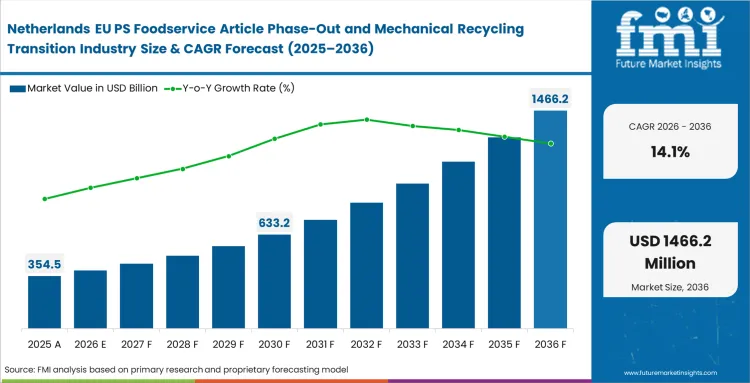
- The Netherlands is expected to show a 14.1% compound growth, anchored by highly optimized post-consumer collection networks enabling immediate material recovery.
- Analyst Opinion at FMI
- Ismail Sutaria, Principal Analyst, Packaging, at FMI, observes that, " What often gets overlooked in transition planning is how drastically material behavior can disrupt established production lines. Polypropylene’s shrinkage profile diverges sharply from polystyrene, leading converters who attempt quick drop‑ins to end up with warped trays that jam automated lidding equipment in fast‑food operations. This leaves packaging engineers stuck between two costly options: spend months re‑cutting precision aluminum molds or risk major line failures during peak delivery hours, both of which ultimately complicate recyclability scoring across European markets. "
- Strategic Implications / Executive Takeaways
- Tooling directors must secure precision mold-making capacity years ahead of scheduled polystyrene phase-out deadlines.
- Purchasing managers face intense margin compression until recycled alternative resin supplies stabilize across regional borders.
- Sustainability officers risk greenwashing accusations if newly adopted substrates lack actual sorting viability in local municipal facilities.
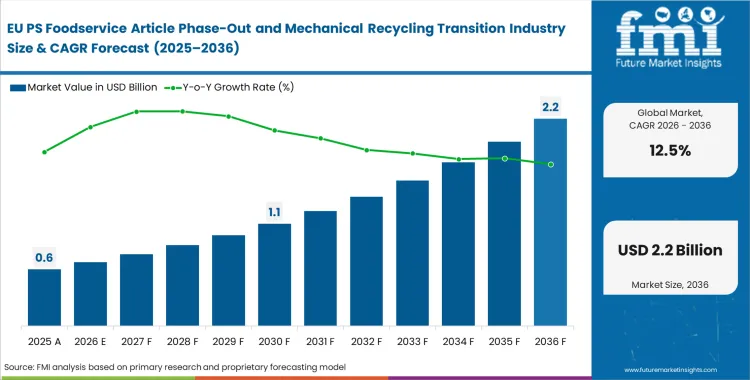
Source: Future Market Insights (FMI) analysis, based on proprietary forecasting model and primary research
Once polymer compounders deliver impact-modified formulations matching legacy rigidity, Europe mechanical recycling transition foodservice packaging upgrades accelerate exponentially. Overcoming this specific performance gap unlocks massive substitution waves previously blocked by cold-chain logistics failures. Sorters currently wait for standardized substrate streams before deploying advanced optical separation units.
Netherlands leads at 14.1% via active tray-to-tray recycling Europe food packaging models. Belgium tracks at 13.8% through intensive closed-loop infrastructure investments. Germany advances at 13.2% as deep collection networks force rapid material substitution. Poland expands at 12.7% when multinational QSRs standardise regional packaging protocols. Spain progresses at 12.4% while navigating aggressive national waste tax rollouts. Italy grows at 12.1% through localised material recovery facility upgrades. France expands at 11.3%, where collection limits compound compliance burdens despite intense policy pressure. Varying municipal sorting capabilities split European adoption between immediate mechanical integration and delayed format switching.
Segmental Analysis
EU PS Foodservice Article Phase-Out and Mechanical Recycling Transition Industry Analysis by Material Route
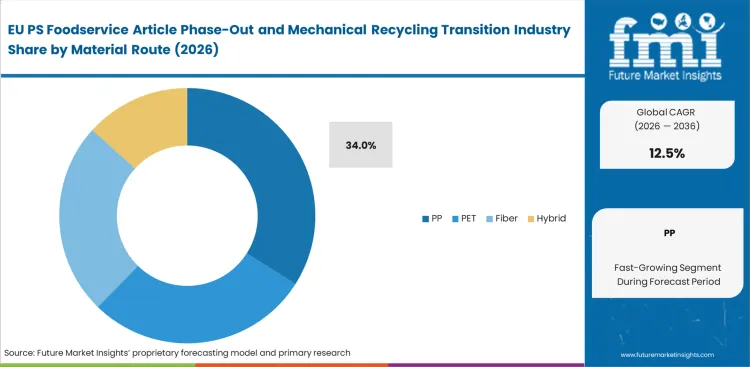
Legacy polystyrene formats fail current circularity audits, forcing immediate conversions toward compatible polymers. PP commands 34.0% share because established mechanical networks readily process clear polypropylene trays without requiring massive infrastructure overhauls. Polypropylene substitution allows recycled plastic packaging engineers to maintain thermal insulation properties while passing stringent regional compliance checks. FMI analysts note this polymer switch masks severe underlying friction; PP demands entirely different tooling draft angles compared to polystyrene, generating massive hidden CAPEX shocks across legacy thermoforming floors. Procurement officers evaluating PP vs PET foodservice packaging Europe metrics who miss this draft-angle reality inevitably stall factory outputs during changeovers. Converters who delay mold investments face complete production shutdowns once final regulatory bans activate.
- Initial validation: Tooling experts assess legacy molds against alternative polymer shrinkage rates. Packaging engineers determine if existing thermoformers accommodate new melt flows without stalling production.
- Factory qualification: Sourcing directors run extensive line trials measuring defect rates. Factory managers face severe margin erosion if cycle times drop during initial scaling phases.
- Volume lock: Procurement teams commit long-term contracts once scrap rates stabilize. Operational directors secure guaranteed resin streams, avoiding intense supplier bottlenecks across Western Europe.
EU PS Foodservice Article Phase-Out and Mechanical Recycling Transition Industry Analysis by Transition Stage
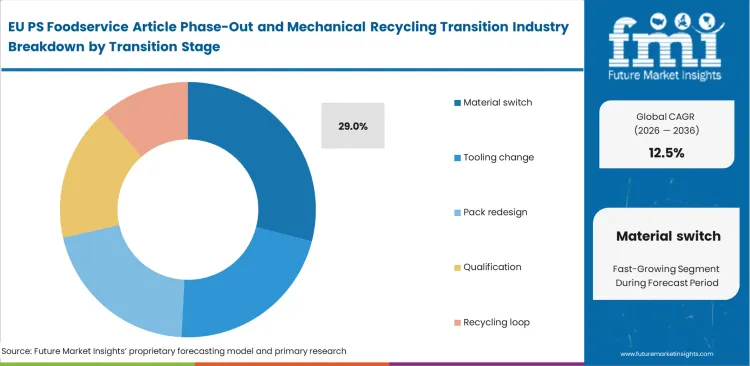
Substituting base polymers alters sealing parameters instantly, ruining shelf life if legacy lidding films remain in use. Material switch leads with 29.0% share as brands prioritize immediate compliance over long-term optimisation strategies. Switching substrates causes complex re-validation procedures across entire recycled pet supply networks. According to FMI's estimates, this immediate shift focuses entirely on raw material compliance rather than true end-of-life recoverability within this PET food trays Europe recycling market. What sustainability reports rarely mention is that substituting polystyrene with heavy-gauge alternatives often increases total carbon footprints due to higher transport weights. Supply chain directors who ignore these secondary environmental impacts risk trading plastics-tax penalties for carbon-tax liabilities.
- Resin procurement: Buyers source virgin alternatives meeting strict food-contact criteria. Sourcing managers incur immediate premium costs compared to highly commoditized legacy foams.
- Line integration: Maintenance engineers adjust extrusion heat profiles managing new material flow characteristics. Plant directors discover hidden electricity costs as alternative polymers require higher processing temperatures.
- Lifecycle reconciliation: Finance officers audit total transition expenses against avoided compliance penalties. Operations heads confirm if long-term operating costs justify initial conversion capital.
EU PS Foodservice Article Phase-Out and Mechanical Recycling Transition Industry Analysis by End-use Format
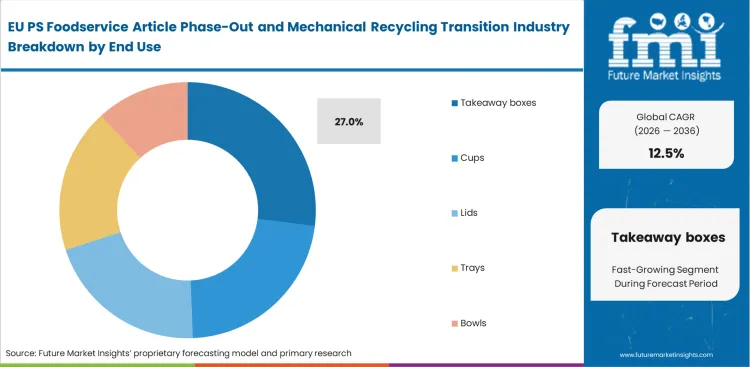
Specific geometries dictate sorting success; flat shapes often misidentify as paper during automated facility screening. Takeaway boxes hold 27.0% share because high market visibility attracts maximum regulatory scrutiny from regional authorities. Clamshell redesigns force post consumer recycled plastic designers to balance rigidity against strict stackability requirements for delivery logistics. Based on FMI's assessment, clamshell architecture remains uniquely vulnerable to poor sorting outcomes regardless of material choice across this ready meal tray recycling Europe sector. Hinge designs performing perfectly in dining environments routinely snap during waste collection, creating fragmented plastic shards bypassing optical sorters entirely. Packaging technologists ignoring integrity during end-of-life handling ensure their theoretically recyclable boxes end up incinerated.
- Structural collapse: Hinge failures create fragmented pieces bypassing recovery screens. Waste operators lose valuable material yields due to poor initial box engineering.
- Stacking interference: Over-engineered ribs trap food residue preventing proper washing. Recycling plant managers downgrade contaminated batches, destroying secondary material values.
- Format optimization: Industrial designers adjust hinge flexibility matching collection realities. Logistics directors capture full circularity value once designs survive municipal handling environments.
EU PS Foodservice Article Phase-Out and Mechanical Recycling Transition Industry Analysis by Value Chain
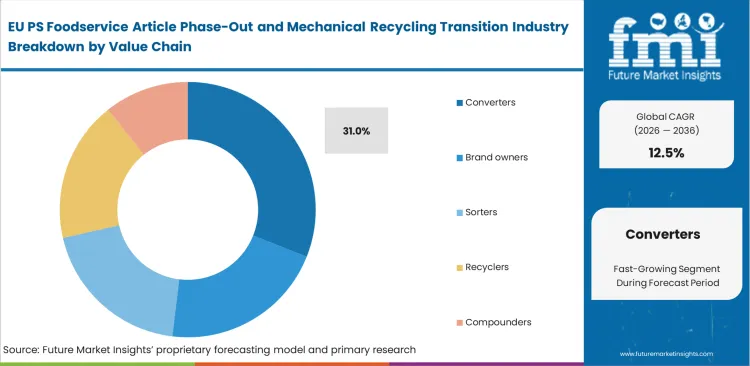
Converters bear all initial qualification costs while brand owners reap public ESG benefits. Converters dominate with 31.0% share, executing actual physical manufacturing changes required by new legislation. Thermoforming specialists must finance entire mold replacements before securing guaranteed volume commitments from restaurant clients. In FMI's view, this power dynamic forces participating recyclable foodservice packaging manufacturers Europe cohorts into precarious financial positions. While major brands publicly celebrate design for recycling milestones, factory owners quietly absorb massive debt burdens to retool functional extrusion lines. Production facilities failing to self-finance these upgrades rapidly lose key accounts to better-capitalized competitors.
- Capital deployment: Thermoformers finance new mold sets handling alternative resins. Plant owners absorb heavy upfront costs hoping to retain major restaurant contracts.
- Resin allocation: Compounders restrict premium recycled material access to largest buyers. Mid-tier converters struggle filling orders when prime recycled feedstock vanishes from spot markets.
- Capacity consolidation: Better-capitalized manufacturers absorb smaller struggling competitors. Regional procurement heads face shrinking supplier bases capable of meeting new regulatory specs.
EU PS Foodservice Article Phase-Out and Mechanical Recycling Transition Industry Analysis by Adoption Model
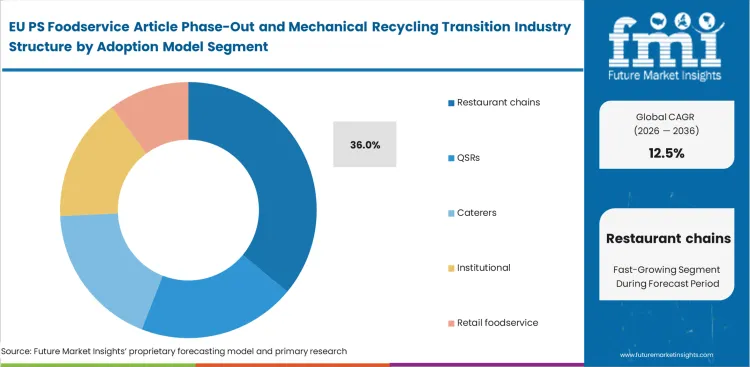
Franchise networks push customized geometries actively defeating municipal sorting efficiency across varying regions. Restaurant chains lead with 36.0% share, leveraging massive purchasing volume to force downstream supplier adaptations. National food brands implement sweeping substrate changes dictating what materials enter local waste streams. FMI's analysis indicates this centralized purchasing approach creates localized recycling disasters for quick service restaurant packaging Europe buyers. Custom-colored trays engineered perfectly for brand identity frequently register as unidentifiable dark plastic within older reusable food container pooling recovery facilities. Franchise operators prioritizing brand aesthetics over near-infrared detectability inadvertently lead to EPR penalties they thought they avoided.
- Premium aesthetic: Brands demand custom colors mimicking legacy upscale presentations. Marketing directors discover dark colorants render new materials invisible to optical sorters.
- Functional drift: Heavy-duty applications warp under intense microwave heating. Quality control managers recall packaging batches when alternative resins fail thermal stress tests.
- Standardized geometry: Chains adopt clear unpigmented formats matching universal sorting capabilities. Sustainability officers finally achieve true circularity rates avoiding subsequent taxation hits.
EU PS Foodservice Article Phase-Out and Mechanical Recycling Transition Industry Drivers, Restraints, and Opportunities
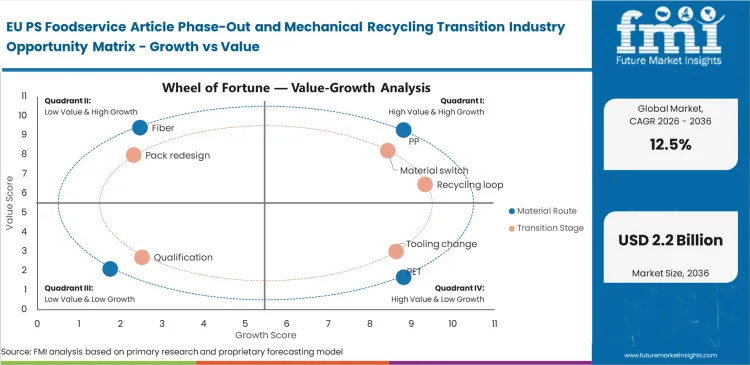
Supply chain lockouts regarding non-compliant materials force catering directors into immediate substrate substitutions. Under recently formalized regulatory timelines, EU PPWR recyclability requirements food packaging mandates force all formats to achieve strict performance grades, accelerating immediate compliance redesigns. Missing regional phase-out deadlines guarantees complete removal from preferred vendor lists across major institutional buyers. Institutional procurement teams cannot risk associating operations with illegal packaging formats, compelling sudden shifts toward reverse logistics platforms regardless of transition costs. Immediate compliance overrides traditional pricing negotiations, accelerating conversion timelines and determining what replaces EPS takeaway containers in the EU far beyond organic innovation cycles.
Tooling draft-angle mismatches between legacy polystyrene and replacement polymers create massive operational friction delaying factory changeovers. Converting facilities cannot simply drop alternative resins into existing molds without experiencing catastrophic part-ejection failures. This physical engineering constraint forces lengthy mold-redesign cycles, severely limiting how quickly manufacturers can scale compliant alternative packaging volumes and establishing viable decontamination recycling food-contact plastics Europe processes.
Opportunities in the EU PS Foodservice Article Phase-Out and Mechanical Recycling Transition Industry
- Optical sorting upgrades: Regional waste operators integrate advanced near-infrared scanners. Facility directors capture highly valuable clear polymer streams.
- Mold engineering optimization: Precision machining firms develop hybrid tooling solutions. Operations managers bypass lengthy full-mold replacements.
- Closed-loop recovery: Major venues implement captive reusable packaging return systems. Sustainability officers lock in dedicated recycled resin supply.
Regional Analysis
Based on regional analysis, the EU PS Foodservice Article Phase-Out and Mechanical Recycling Transition Market is segmented into Western Europe, Eastern Europe, and Southern Europe across 40 plus countries.
.webp "Top Country Growth Comparison Eu Ps Foodservice Article Phase Out And Mechanical Recycling Transition Industry Cagr (2026 2036)")
| Country | CAGR (2026 to 2036) |
|---|---|
| Netherlands | 14.1% |
| Belgium | 13.8% |
| Germany | 13.2% |
| Poland | 12.7% |
| Spain | 12.4% |
| Italy | 12.1% |
| France | 11.3% |
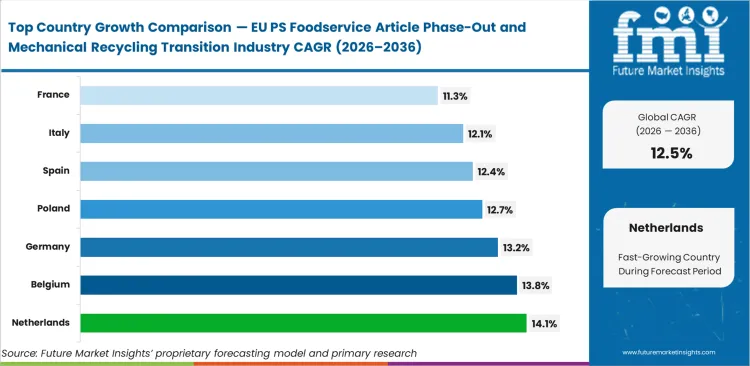
Source: Future Market Insights (FMI) analysis, based on proprietary forecasting model and primary research
Western Europe EU PS Foodservice Article Phase-Out and Mechanical Recycling Transition Industry Analysis
Policy mandates across Western jurisdictions move from incentive models to strict penalty frameworks. Mature waste collection infrastructure allows faster implementation timelines compared to adjacent geographies. Regional brands face immediate pressure reconciling material choices with hyper-local sorting capabilities. FMI analysts note this geography serves as ground zero for advanced food packaging testing protocols.
- Netherlands: Municipal planners in the Netherlands direct high-density collection networks that enable rapid material substitution. Due to this advanced tray-to-tray circularity positioning, the Netherlands tray recycling market is maturing rapidly. Within the broader Europe EU PS Foodservice Article Phase-Out and Mechanical Recycling Transition industry, Dutch demand for replacement formats and related tooling upgrades is projected to expand at a 14.1% CAGR between 2026 and 2036. Packaging engineers actively capitalize on highly optimized post-consumer recovery infrastructure capable of physically separating transparent polypropylene formats from legacy opaque waste. Operations directors auditing local material recovery facilities quickly realize that funding immediate compliance redesigns directly offsets their rising extended producer responsibility taxes. Furthermore, procurement teams navigating these localized capabilities capture significant cost advantages by securing domestic recycled feedstock straight from regional waste management operators, effectively bypassing the volatile pricing of imported virgin resins.
- Belgium: Intensive investments in closed-loop infrastructure are currently driving systematic changeovers across Belgian converting plants. Facility directors are upgrading sorting lines to recognize subtle polymer variations instantly. Belgian segment of the EU PS Foodservice Article Phase-Out and Mechanical Recycling Transition industry is forecast to grow at a 13.8% CAGR from 2026 to 2036, reflecting the heavy capital deployed for these recovery upgrades. Plant managers executing these material substitutions operate under incredibly strict parameters, especially when hybrid fiber alternatives must exactly match the thermal insulation properties of legacy foam. Sustainability officers mapping out these complex regional supply chains understand that securing dedicated optical sorting capacity dictates their final compliance status far more than their initial substrate selection. Early adopters who master these local processing requirements ultimately cement a dominant competitive position against imported packaging alternatives that face intense border scrutiny.
- Germany: Deep packaging collection capabilities compel rapid legacy material elimination across the German recyclable foodservice packaging industry. Factory operators are executing sweeping tooling upgrades to meet strict EPR guidelines. Reflecting this shift, the German segment within the Europe EU PS Foodservice Article Phase-Out and Mechanical Recycling Transition Industry will register a 13.2% CAGR over the 2026 to 2036 forecast period. Sourcing directors operate under intense pressure to validate that newly adopted rigid plastics survive automated municipal screening processes without shattering into unidentifiable fragments. Concurrently, logistics managers replacing expanded clamshells frequently discover that high-density alternative formats drastically reduce the available storage space inside fast-food distribution centers. These mandatory re-tooling investments, paired with subsequent physical volume shifts, permanently alter the internal cost structures for major catering distributors operating in the country.
- France: Severe recycling limitations compound the burdens of transition, deeply defining the French foodservice packaging transition segment. Supply chains constantly struggle to align their alternative resins with actual municipal processing realities. As a result of these friction points, France portion of the European EU PS Foodservice Article Phase-Out and Mechanical Recycling Transition industry anticipates a slower 11.3% CAGR during the 2026 to 2036 timeframe for compliant substrate adoption. Quality control specialists repeatedly reject technically compliant packaging batches simply because regional recovery facilities lack the near-infrared scanning capability needed to accurately identify specific food-grade polymers. Institutional buyers are learning a harsh lesson where theoretical recyclability scores mean absolutely nothing if local waste haulers continue diverting heavy-gauge substitute materials directly toward incineration. These persistent local sorting gaps consistently frustrate corporate sustainability executives who expected smooth circularity outcomes after funding expensive factory redesigns.
FMI's report includes Austria and Switzerland. Tight border regulations regarding cross-border waste shipments further complicate centralized recovery strategies for multinational converters.
Southern Europe EU PS Foodservice Article Phase-Out and Mechanical Recycling Transition Industry Analysis
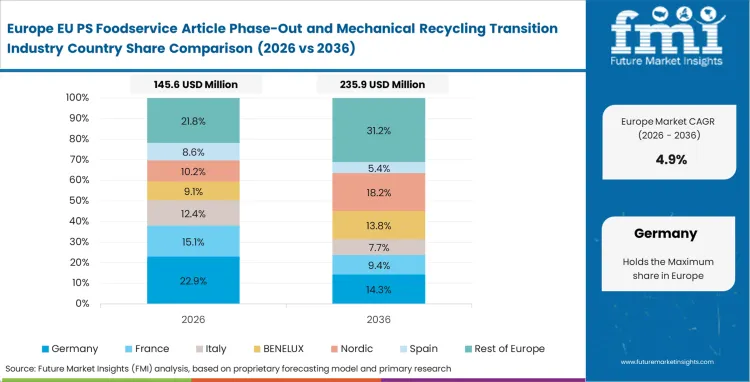
Aggressive national plastics taxes fundamentally alter procurement mathematics across Mediterranean supply networks. Historical reliance on cheap foam formats creates steep financial hurdles during mandatory transition periods. Local converters scramble securing financing for essential sustainable packaging extrusion upgrades. FMI observes that tourism-heavy economies face unique demand spikes complicating standardized compliance rollouts.
- Spain: Spanish compliance investments within the European Union PS Foodservice Article Phase-Out and Mechanical Recycling Transition Industry are slated to expand at a 12.4% CAGR from 2026 through 2036. Sweeping national waste tax implementations shape the immediate pivot occurring within the Spanish recyclable foodservice packaging industry. Catering companies are abandoning polystyrene entirely to avoid severe per-kilogram financial penalties. Supply chain heads servicing coastal tourism sectors must confront urgent seasonal demand spikes that drastically complicate standardized tooling changeovers across fragmented regional converting sites. Purchasing teams are forced to coordinate massive raw material swaps right before summer distribution schedules lock in any non-compliant inventory. First-movers willing to absorb these immediate capital shocks secure lucrative hospitality contracts by bypassing paralyzed competitors who decided to delay their essential extrusion machinery upgrades.
- Italy: Propelled by the localized investments, the Italian segment of the Europe EU PS Foodservice Article Phase-Out and Mechanical Recycling Transition Industry is projected to record a 12.1% CAGR for alternative material transitions throughout the 2026 to 2036 forecast period. Highly localized material recovery facility upgrades are driving isolated adoption pockets across Italy. Sourcing managers must navigate deeply fragmented municipal rules dictating which acceptable polymer variants can be processed. Tooling engineers encounter massive friction when attempting to standardize extrusion draft angles across disparate northern and southern manufacturing facilities handling varied replacement resins. Operations directors trying to centralize procurement quickly realize that highly localized taxation frameworks actively penalize centralized packaging distribution strategies. Ultimately, inconsistent local enforcement creates chaotic supply chain realities for national distributors forced into managing multiple distinct packaging architectures simultaneously.
FMI's report includes Portugal and Greece. Coastal tourism sectors face amplified scrutiny regarding marine litter prevention directives.
Eastern Europe EU PS Foodservice Article Phase-Out and Mechanical Recycling Transition Industry Analysis
Multinational restaurant franchise expansion forces standardized packaging protocols across developing regional infrastructure. Global brands refuse maintaining separate non-compliant supply chains simply saving marginal local costs. This top-down pressure accelerates paper packaging adoption faster than domestic regulation alone requires. According to FMI's estimates, this creates temporary mismatches between advanced packaging formats and developing waste management facilities.
- Poland: Standardized QSR supply chains are aggressively pulling domestic converters into compliance across the Poland foodservice packaging alternatives industry. Factory floors are implementing modern thermoforming techniques to secure lucrative multinational accounts. Acting as a critical manufacturing node in the Europe EU PS Foodservice Article Phase-Out and Mechanical Recycling Transition Industry, Polish transition expenditure is anticipated to achieve a 12.7% CAGR between 2026 and 2036. Production managers actively apply their lower baseline operating costs to absorb the heavy initial capital requirements associated with cutting precision aluminum molds for polypropylene substitution. Sourcing teams validating these new supplier capabilities are quickly shifting regional volume allocations away from slower Western European manufacturers. Facilities that achieve these strict international certification standards now dominate regional export opportunities, supporting major global brand networks.
FMI's report includes Czech Republic and Hungary. Regional converters leverage lower operating costs capturing outsourced production from Western European brand owners.
Competitive Aligners for Market Players
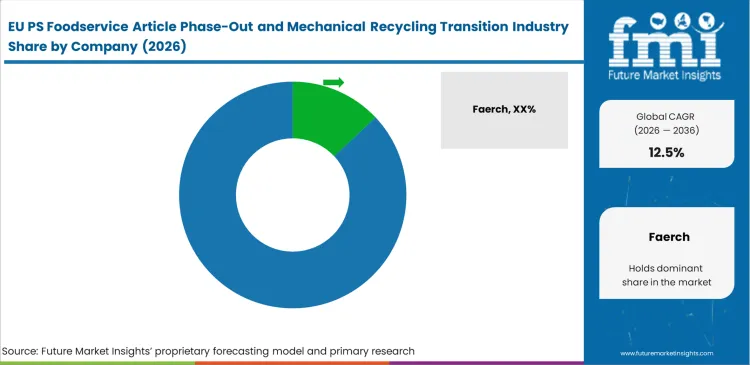
Faerch and Huhtamaki dominate early transition phases by securing massive food-grade recycled resin streams before smaller converters realize supply constraints exist. Competition focuses entirely on molded fiber packaging qualification speeds rather than traditional pricing wars. Sabert captures premium accounts by engineering hybrid formats surviving complex delivery logistics without relying on legacy foam structures. Mid-tier players among significant recyclable takeaway packaging companies in Europe struggle matching these rapid development cycles, losing historical contracts when they miss strict compliance deadlines.
Incumbents leverage deep proprietary knowledge regarding specific tooling draft angles required for smooth material changeovers. Challengers can purchase identical alternative resins yet cannot easily replicate decades of thermoforming optimization data. Veolia and SUEZ possess unique advantages controlling actual post-consumer recovery networks, offering converters guaranteed circularity metrics that independent PET tray recycling companies Europe cannot verify. FMI analysts point out this physical infrastructure control builds an insurmountable moat around moulded fibre pulp packaging claims.
Large restaurant networks actively resist vendor lock-in by forcing multiple food-grade rPET tray suppliers Europe to use identical open-source packaging geometries. This strategy prevents specialized proprietary designs from bottlenecking national rollout plans. Procurement teams mandate interchangeable tooling standards across varying converter facilities. Massive foodservice operators wield volume leverage dictating exact polymer specifications, ensuring waste streams remain highly desirable to regional recyclers.
Key Players in EU PS Foodservice Article Phase-Out and Mechanical Recycling Transition Industry
- Faerch
- Huhtamaki
- Sabert
- Coveris
- TOMRA
- Veolia
- SUEZ
Scope of the Report
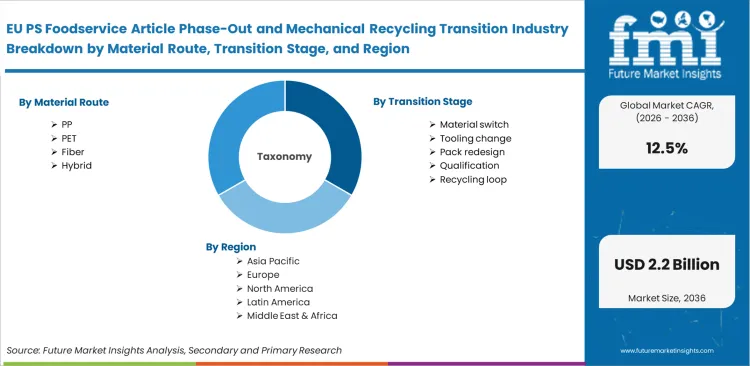
| Metric | Value |
|---|---|
| Quantitative Units | USD 0.6 billion to USD 1.8 billion, at a CAGR of 12.5% |
| Market Definition | This category tracks operational shifts capturing EU foodservice packaging phase-out industry size metrics to eliminate polystyrene from European foodservice supply chains. Analysis quantifies capital deployed for new thermoforming molds, alternative resin procurement, and advanced sorting technologies enabling true circularity. |
| Segmentation | Material route, Transition stage, End-use format, Value chain, Adoption model, and Region |
| Regions Covered | Western Europe, Eastern Europe, Southern Europe, Northern Europe, Central Europe |
| Countries Covered | Netherlands, Belgium, Germany, Poland, Spain, Italy, France |
| Key Companies Profiled | Faerch, Huhtamaki, Sabert, Coveris, TOMRA, Veolia, SUEZ |
| Forecast Period | 2026 to 2036 |
| Approach | Base valuations anchor on legacy polystyrene volume displacement rates and associated re-tooling capital expenditures. |
Source: Future Market Insights (FMI) analysis, based on proprietary forecasting model and primary research
EU PS Foodservice Article Phase-Out and Mechanical Recycling Transition Industry Analysis by Segments
Material route:
- PP
- PET
- Fiber
- Hybrid
Transition stage:
- Material switch
- Tooling change
- Pack redesign
- Qualification
- Recycling loop
End-use format:
- Takeaway boxes
- Cups
- Lids
- Trays
- Bowls
Value chain:
- Converters
- Brand owners
- Sorters
- Recyclers
- Compounders
Adoption model:
- Restaurant chains
- QSRs
- Caterers
- Institutional
- Retail foodservice
Region:
- Western Europe
- Germany
- France
- Netherlands
- Belgium
- Southern Europe
- Spain
- Italy
- Eastern Europe
- Poland
- Northern Europe
- Central Europe
Bibliography
- European Bioplastics. (2024). Bioplastics market development update 2024. European Bioplastics.
- EUMEPS. (2025, February 3). Activity report 2024. EUMEPS.
- Eurostat. (2025, October 22). Plastic packaging waste in the EU: 35.3 kg per person. Eurostat.
- Joint Research Centre. (2024). Exploring the environmental performance of alternative food packaging products in the European Union. Publications Office of the European Union.
- Plastics Europe. (2024, March). The circular economy for plastics - A European analysis 2024. Plastics Europe.
- RecyClass. (2025, June 30). Navigating PET thermoforms recycling. RecyClass.
- Rethink Plastic Alliance. (2024, December). Evaluation report SUP final text. Rethink Plastic Alliance.
- Sama, V. (2025, August 6). Establishing the tray-to-tray recycling market: Technology, scale and challenges. TOMRA Recycling.
This bibliography is provided for reader reference. The full FMI report contains the complete reference list with primary source documentation.
This Report Addresses
- Identifies tooling CAPEX required shifting converting lines away from legacy polystyrene materials.
- Quantifies molded fiber trays adoption rates across varying European regulatory frameworks.
- Analyzes draft angle modifications essential processing alternative resins through existing thermoformers.
- Details sorting infrastructure bottlenecks preventing true tray-to-tray circularity models from scaling rapidly.
- Evaluates molded fiber containers performance against strict thermal insulation requirements common within food delivery.
- Maps localized EPR taxation impacts on procurement decisions favoring compostable foodservice packaging.
- Explores hinge failure rates hampering clamshell recovery efforts across multiple foodservice paper bags formats.
- Assess eco fee preferred paper strategies driving brand compliance initiatives.
Frequently Asked Questions
Explain the EU PS foodservice phase-out market?
This sector encompasses massive capital deployment redirecting thermoforming lines toward compliant polymers. Beyond simple resin swaps, substitution demands complete re-tooling across extrusion machinery alongside advanced near-infrared sorting upgrades at material recovery facilities.
What is driving the EU polystyrene foodservice packaging transition?
Punitive taxation structures targeting non-recyclable formats fundamentally alter unit economics. Paying premium prices for compliant alternative resins becomes significantly cheaper than absorbing compounding per-kilogram fines across multiple jurisdictions.
Which companies benefit from the EU EPS food container ban?
Integrated operators controlling post-consumer collection infrastructure gain high leverage. Manufacturers securing dedicated recycled resin streams and precision mold-makers executing rapid draft-angle conversions dominate market share while mid-tier converters struggle financing required factory upgrades.
Summarize the EU foodservice packaging shift from PS to recyclable materials?
Catering operators abandon legacy foams facing punitive taxation, pivoting toward PP, PET, and engineered fibers. Transitioning requires overcoming severe tooling-draft incompatibilities, sorting-visibility failures, and cold-chain performance gaps before achieving true tray-to-tray circularity.
What products are banned under the EU single-use plastics directive?
Data anchors show specific expanded polystyrene food and beverage containers facing total prohibition. Rigidities forced regulatory bodies targeting clamshells and cups, where historical recycling rates remained statistically zero across municipal audits.
Are polystyrene food containers banned in Europe?
Yes, regulatory frameworks mandate complete phase-outs for expanded formats. Extruded rigid variants face severe EPR taxation penalties, effectively banning them commercially as procurement directors refuse absorbing crippling per-kilogram compliance fees.
What replaces EPS takeaway containers in the EU?
Purchasing departments validate clear polypropylene, PET thermoforms, and molded fiber alternatives. These substrates pass emerging compliance checks provided their specific geometric designs survive automated sorting processes without fragmenting.
Can foodservice trays be mechanically recycled in Europe?
Clear unpigmented PET and PP trays process successfully through modern recovery facilities. Heavy contamination, custom dark pigments, and over-engineered structural ribs frequently downgrade secondary material values, preventing closed-loop recovery despite theoretical polymer compatibility.
What limits immediate polypropylene adoption across legacy converting facilities?
Tooling draft angles present massive friction points. Polypropylene shrinks differently than expanded polystyrene, causing warped trays that jam automated lidding equipment unless operators invest heavily in new precision aluminum molds.
How do clamshell geometries affect post-consumer recovery efforts?
Hinge designs frequently snap during automated municipal collection processes. Fragmented plastic shards bypass optical scanners entirely, reducing high-value material yields and forcing theoretically recyclable containers into incineration streams.
Why do multinational QSRs struggle with localized compliance rules?
Franchise networks demand standardized brand colors across global operations. Dark pigments render alternative polymers invisible to older near-infrared sorters, resulting in local EPR penalties despite corporate sustainability mandates.
What financial risks accompany material switching protocols?
Substitute polymers often require higher extrusion temperatures and longer cooling cycles. Factory managers face severe margin erosion from increased electricity consumption and lowered daily unit output during initial scaling phases.
How does Faerch maintain competitive dominance during substitution?
Securing massive food-grade recycled resin off-take agreements prevents smaller competitors from sourcing reliable prime material. Controlling input supply proves more valuable than optimizing individual manufacturing speeds.
Why do Netherlands and France diverge on transition timelines?
Netherlands leverages deep tray-to-tray collection infrastructure supporting immediate material swaps. France struggles matching strict policy mandates against underdeveloped municipal sorting capabilities, delaying actual circularity outcomes.
What role do polymer compounders play during qualification stages?
Compounders engineer specific impact modifiers matching legacy foam rigidity. Resolving these physical performance gaps unlocks substitution waves previously stalled by catastrophic cold-chain logistics failures.
Why are tooling engineers critical for successful substrate pivots?
Evaluating legacy mold cavities against new melt flow dynamics prevents catastrophic production stalls. Engineers determine whether existing thermoforming equipment survives intense thermal profile adjustments required by alternative plastics.
What specific advantage does TOMRA provide sorting facilities?
Deploying advanced optical separation technology ensures facilities capture high-value clear polymer streams accurately. Upgrading near-infrared detection capabilities separates compliant alternatives from legacy contaminants reliably.
How do restaurant chains avoid vendor lock-in regarding new formats?
Procurement teams mandate interchangeable open-source tooling standards across multiple converting partners. Forcing universal geometries prevents specialized proprietary designs from bottlenecking urgent national rollout schedules.
What unintended environmental consequences emerge from material switching?
Substituting lightweight foam with heavy-gauge rigid alternatives increases transport weights significantly. Supply chains risk elevating total carbon emissions while simultaneously attempting to resolve localized plastic waste challenges.
Why do mid-tier converters face elevated bankruptcy risks currently?
Financing complete mold replacements requires massive upfront capital deployment. Facilities unable to self-finance these mandated upgrades rapidly lose major accounts to better-capitalized competitors possessing ready capacity.
How does Spain navigate aggressive national waste tax rollouts?
Catering companies abandon legacy foams immediately avoiding severe financial penalties. Early adopters secure lucrative hospitality contracts by offering compliant alternatives while paralyzed competitors debate transition costs.
What prevents immediate standardization across European supply chains?
Varying municipal sorting capabilities dictate which material formats achieve local circularity. Brands cannot deploy universal solutions until cross-border material recovery facilities standardize their optical detection thresholds.
Preview the report firsthand - request a free sample
Get SampleGet the brochure for pricing and purchase details.
Get PDFTable of Content
- Executive Summary
- Global Market Outlook
- Demand-side Trends
- Supply-side Trends
- Technology Roadmap Analysis
- Analysis and Recommendations
- Market Overview
- Market Coverage / Taxonomy
- Market Definition / Scope / Limitations
- Research Methodology
- Chapter Orientation
- Analytical Lens and Working Hypotheses
- Market Structure, Signals, and Trend Drivers
- Benchmarking and Cross-market Comparability
- Market Sizing, Forecasting, and Opportunity Mapping
- Research Design and Evidence Framework
- Desk Research Programme (Secondary Evidence)
- Company Annual and Sustainability Reports
- Peer-reviewed Journals and Academic Literature
- Corporate Websites, Product Literature, and Technical Notes
- Earnings Decks and Investor Briefings
- Statutory Filings and Regulatory Disclosures
- Technical White Papers and Standards Notes
- Trade Journals, Industry Magazines, and Analyst Briefs
- Conference Proceedings, Webinars, and Seminar Materials
- Government Statistics Portals and Public Data Releases
- Press Releases and Reputable Media Coverage
- Specialist Newsletters and Curated Briefings
- Sector Databases and Reference Repositories
- FMI Internal Proprietary Databases and Historical Market Datasets
- Subscription Datasets and Paid Sources
- Social Channels, Communities, and Digital Listening Inputs
- Additional Desk Sources
- Expert Input and Fieldwork (Primary Evidence)
- Primary Modes
- Qualitative Interviews and Expert Elicitation
- Quantitative Surveys and Structured Data Capture
- Blended Approach
- Why Primary Evidence is Used
- Field Techniques
- Interviews
- Surveys
- Focus Groups
- Observational and In-context Research
- Social and Community Interactions
- Stakeholder Universe Engaged
- C-suite Leaders
- Board Members
- Presidents and Vice Presidents
- R&D and Innovation Heads
- Technical Specialists
- Domain Subject-matter Experts
- Scientists
- Physicians and Other Healthcare Professionals
- Governance, Ethics, and Data Stewardship
- Research Ethics
- Data Integrity and Handling
- Primary Modes
- Tooling, Models, and Reference Databases
- Desk Research Programme (Secondary Evidence)
- Data Engineering and Model Build
- Data Acquisition and Ingestion
- Cleaning, Normalisation, and Verification
- Synthesis, Triangulation, and Analysis
- Quality Assurance and Audit Trail
- Market Background
- Market Dynamics
- Drivers
- Restraints
- Opportunity
- Trends
- Scenario Forecast
- Demand in Optimistic Scenario
- Demand in Likely Scenario
- Demand in Conservative Scenario
- Opportunity Map Analysis
- Product Life Cycle Analysis
- Supply Chain Analysis
- Investment Feasibility Matrix
- Value Chain Analysis
- PESTLE and Porter’s Analysis
- Regulatory Landscape
- Regional Parent Market Outlook
- Production and Consumption Statistics
- Import and Export Statistics
- Market Dynamics
- Global Market Analysis 2021 to 2025 and Forecast, 2026 to 2036
- Historical Market Size Value (USD Million) Analysis, 2021 to 2025
- Current and Future Market Size Value (USD Million) Projections, 2026 to 2036
- Y-o-Y Growth Trend Analysis
- Absolute $ Opportunity Analysis
- Global Market Pricing Analysis 2021 to 2025 and Forecast 2026 to 2036
- Global Market Analysis 2021 to 2025 and Forecast 2026 to 2036, By Material Route
- Introduction / Key Findings
- Historical Market Size Value (USD Million) Analysis By Material Route , 2021 to 2025
- Current and Future Market Size Value (USD Million) Analysis and Forecast By Material Route , 2026 to 2036
- PP
- PET
- Fiber
- Hybrid
- PP
- Y-o-Y Growth Trend Analysis By Material Route , 2021 to 2025
- Absolute $ Opportunity Analysis By Material Route , 2026 to 2036
- Global Market Analysis 2021 to 2025 and Forecast 2026 to 2036, By Transition Stage
- Introduction / Key Findings
- Historical Market Size Value (USD Million) Analysis By Transition Stage, 2021 to 2025
- Current and Future Market Size Value (USD Million) Analysis and Forecast By Transition Stage, 2026 to 2036
- Material switch
- Tooling change
- Pack redesign
- Qualification
- Recycling loop
- Material switch
- Y-o-Y Growth Trend Analysis By Transition Stage, 2021 to 2025
- Absolute $ Opportunity Analysis By Transition Stage, 2026 to 2036
- Global Market Analysis 2021 to 2025 and Forecast 2026 to 2036, By End Use
- Introduction / Key Findings
- Historical Market Size Value (USD Million) Analysis By End Use, 2021 to 2025
- Current and Future Market Size Value (USD Million) Analysis and Forecast By End Use, 2026 to 2036
- Takeaway boxes
- Cups
- Lids
- Trays
- Bowls
- Takeaway boxes
- Y-o-Y Growth Trend Analysis By End Use, 2021 to 2025
- Absolute $ Opportunity Analysis By End Use, 2026 to 2036
- Global Market Analysis 2021 to 2025 and Forecast 2026 to 2036, By Value Chain
- Introduction / Key Findings
- Historical Market Size Value (USD Million) Analysis By Value Chain, 2021 to 2025
- Current and Future Market Size Value (USD Million) Analysis and Forecast By Value Chain, 2026 to 2036
- Converters
- Brand owners
- Sorters
- Recyclers
- Compounders
- Converters
- Y-o-Y Growth Trend Analysis By Value Chain, 2021 to 2025
- Absolute $ Opportunity Analysis By Value Chain, 2026 to 2036
- Global Market Analysis 2021 to 2025 and Forecast 2026 to 2036, By Adoption Model
- Introduction / Key Findings
- Historical Market Size Value (USD Million) Analysis By Adoption Model, 2021 to 2025
- Current and Future Market Size Value (USD Million) Analysis and Forecast By Adoption Model, 2026 to 2036
- Restaurant chains
- QSRs
- Caterers
- Institutional
- Retail foodservice
- Restaurant chains
- Y-o-Y Growth Trend Analysis By Adoption Model, 2021 to 2025
- Absolute $ Opportunity Analysis By Adoption Model, 2026 to 2036
- Global Market Analysis 2021 to 2025 and Forecast 2026 to 2036, By Region
- Introduction
- Historical Market Size Value (USD Million) Analysis By Region, 2021 to 2025
- Current Market Size Value (USD Million) Analysis and Forecast By Region, 2026 to 2036
- North America
- Latin America
- Western Europe
- Eastern Europe
- East Asia
- South Asia and Pacific
- Middle East & Africa
- Market Attractiveness Analysis By Region
- North America Market Analysis 2021 to 2025 and Forecast 2026 to 2036, By Country
- Historical Market Size Value (USD Million) Trend Analysis By Market Taxonomy, 2021 to 2025
- Market Size Value (USD Million) Forecast By Market Taxonomy, 2026 to 2036
- By Country
- USA
- Canada
- Mexico
- By Material Route
- By Transition Stage
- By End Use
- By Value Chain
- By Adoption Model
- By Country
- Market Attractiveness Analysis
- By Country
- By Material Route
- By Transition Stage
- By End Use
- By Value Chain
- By Adoption Model
- Key Takeaways
- Latin America Market Analysis 2021 to 2025 and Forecast 2026 to 2036, By Country
- Historical Market Size Value (USD Million) Trend Analysis By Market Taxonomy, 2021 to 2025
- Market Size Value (USD Million) Forecast By Market Taxonomy, 2026 to 2036
- By Country
- Brazil
- Chile
- Rest of Latin America
- By Material Route
- By Transition Stage
- By End Use
- By Value Chain
- By Adoption Model
- By Country
- Market Attractiveness Analysis
- By Country
- By Material Route
- By Transition Stage
- By End Use
- By Value Chain
- By Adoption Model
- Key Takeaways
- Western Europe Market Analysis 2021 to 2025 and Forecast 2026 to 2036, By Country
- Historical Market Size Value (USD Million) Trend Analysis By Market Taxonomy, 2021 to 2025
- Market Size Value (USD Million) Forecast By Market Taxonomy, 2026 to 2036
- By Country
- Germany
- UK
- Italy
- Spain
- France
- Nordic
- BENELUX
- Rest of Western Europe
- By Material Route
- By Transition Stage
- By End Use
- By Value Chain
- By Adoption Model
- By Country
- Market Attractiveness Analysis
- By Country
- By Material Route
- By Transition Stage
- By End Use
- By Value Chain
- By Adoption Model
- Key Takeaways
- Eastern Europe Market Analysis 2021 to 2025 and Forecast 2026 to 2036, By Country
- Historical Market Size Value (USD Million) Trend Analysis By Market Taxonomy, 2021 to 2025
- Market Size Value (USD Million) Forecast By Market Taxonomy, 2026 to 2036
- By Country
- Russia
- Poland
- Hungary
- Balkan & Baltic
- Rest of Eastern Europe
- By Material Route
- By Transition Stage
- By End Use
- By Value Chain
- By Adoption Model
- By Country
- Market Attractiveness Analysis
- By Country
- By Material Route
- By Transition Stage
- By End Use
- By Value Chain
- By Adoption Model
- Key Takeaways
- East Asia Market Analysis 2021 to 2025 and Forecast 2026 to 2036, By Country
- Historical Market Size Value (USD Million) Trend Analysis By Market Taxonomy, 2021 to 2025
- Market Size Value (USD Million) Forecast By Market Taxonomy, 2026 to 2036
- By Country
- China
- Japan
- South Korea
- By Material Route
- By Transition Stage
- By End Use
- By Value Chain
- By Adoption Model
- By Country
- Market Attractiveness Analysis
- By Country
- By Material Route
- By Transition Stage
- By End Use
- By Value Chain
- By Adoption Model
- Key Takeaways
- South Asia and Pacific Market Analysis 2021 to 2025 and Forecast 2026 to 2036, By Country
- Historical Market Size Value (USD Million) Trend Analysis By Market Taxonomy, 2021 to 2025
- Market Size Value (USD Million) Forecast By Market Taxonomy, 2026 to 2036
- By Country
- India
- ASEAN
- Australia & New Zealand
- Rest of South Asia and Pacific
- By Material Route
- By Transition Stage
- By End Use
- By Value Chain
- By Adoption Model
- By Country
- Market Attractiveness Analysis
- By Country
- By Material Route
- By Transition Stage
- By End Use
- By Value Chain
- By Adoption Model
- Key Takeaways
- Middle East & Africa Market Analysis 2021 to 2025 and Forecast 2026 to 2036, By Country
- Historical Market Size Value (USD Million) Trend Analysis By Market Taxonomy, 2021 to 2025
- Market Size Value (USD Million) Forecast By Market Taxonomy, 2026 to 2036
- By Country
- Kingdom of Saudi Arabia
- Other GCC Countries
- Turkiye
- South Africa
- Other African Union
- Rest of Middle East & Africa
- By Material Route
- By Transition Stage
- By End Use
- By Value Chain
- By Adoption Model
- By Country
- Market Attractiveness Analysis
- By Country
- By Material Route
- By Transition Stage
- By End Use
- By Value Chain
- By Adoption Model
- Key Takeaways
- Key Countries Market Analysis
- USA
- Pricing Analysis
- Market Share Analysis, 2025
- By Material Route
- By Transition Stage
- By End Use
- By Value Chain
- By Adoption Model
- Canada
- Pricing Analysis
- Market Share Analysis, 2025
- By Material Route
- By Transition Stage
- By End Use
- By Value Chain
- By Adoption Model
- Mexico
- Pricing Analysis
- Market Share Analysis, 2025
- By Material Route
- By Transition Stage
- By End Use
- By Value Chain
- By Adoption Model
- Brazil
- Pricing Analysis
- Market Share Analysis, 2025
- By Material Route
- By Transition Stage
- By End Use
- By Value Chain
- By Adoption Model
- Chile
- Pricing Analysis
- Market Share Analysis, 2025
- By Material Route
- By Transition Stage
- By End Use
- By Value Chain
- By Adoption Model
- Germany
- Pricing Analysis
- Market Share Analysis, 2025
- By Material Route
- By Transition Stage
- By End Use
- By Value Chain
- By Adoption Model
- UK
- Pricing Analysis
- Market Share Analysis, 2025
- By Material Route
- By Transition Stage
- By End Use
- By Value Chain
- By Adoption Model
- Italy
- Pricing Analysis
- Market Share Analysis, 2025
- By Material Route
- By Transition Stage
- By End Use
- By Value Chain
- By Adoption Model
- Spain
- Pricing Analysis
- Market Share Analysis, 2025
- By Material Route
- By Transition Stage
- By End Use
- By Value Chain
- By Adoption Model
- France
- Pricing Analysis
- Market Share Analysis, 2025
- By Material Route
- By Transition Stage
- By End Use
- By Value Chain
- By Adoption Model
- India
- Pricing Analysis
- Market Share Analysis, 2025
- By Material Route
- By Transition Stage
- By End Use
- By Value Chain
- By Adoption Model
- ASEAN
- Pricing Analysis
- Market Share Analysis, 2025
- By Material Route
- By Transition Stage
- By End Use
- By Value Chain
- By Adoption Model
- Australia & New Zealand
- Pricing Analysis
- Market Share Analysis, 2025
- By Material Route
- By Transition Stage
- By End Use
- By Value Chain
- By Adoption Model
- China
- Pricing Analysis
- Market Share Analysis, 2025
- By Material Route
- By Transition Stage
- By End Use
- By Value Chain
- By Adoption Model
- Japan
- Pricing Analysis
- Market Share Analysis, 2025
- By Material Route
- By Transition Stage
- By End Use
- By Value Chain
- By Adoption Model
- South Korea
- Pricing Analysis
- Market Share Analysis, 2025
- By Material Route
- By Transition Stage
- By End Use
- By Value Chain
- By Adoption Model
- Russia
- Pricing Analysis
- Market Share Analysis, 2025
- By Material Route
- By Transition Stage
- By End Use
- By Value Chain
- By Adoption Model
- Poland
- Pricing Analysis
- Market Share Analysis, 2025
- By Material Route
- By Transition Stage
- By End Use
- By Value Chain
- By Adoption Model
- Hungary
- Pricing Analysis
- Market Share Analysis, 2025
- By Material Route
- By Transition Stage
- By End Use
- By Value Chain
- By Adoption Model
- Kingdom of Saudi Arabia
- Pricing Analysis
- Market Share Analysis, 2025
- By Material Route
- By Transition Stage
- By End Use
- By Value Chain
- By Adoption Model
- Turkiye
- Pricing Analysis
- Market Share Analysis, 2025
- By Material Route
- By Transition Stage
- By End Use
- By Value Chain
- By Adoption Model
- South Africa
- Pricing Analysis
- Market Share Analysis, 2025
- By Material Route
- By Transition Stage
- By End Use
- By Value Chain
- By Adoption Model
- USA
- Market Structure Analysis
- Competition Dashboard
- Competition Benchmarking
- Market Share Analysis of Top Players
- By Regional
- By Material Route
- By Transition Stage
- By End Use
- By Value Chain
- By Adoption Model
- Competition Analysis
- Competition Deep Dive
- Faerch
- Overview
- Product Portfolio
- Profitability by Market Segments (Product/Age /Sales Channel/Region)
- Sales Footprint
- Strategy Overview
- Marketing Strategy
- Product Strategy
- Channel Strategy
- Huhtamaki
- Sabert
- Coveris
- TOMRA
- Veolia
- SUEZ
- Faerch
- Competition Deep Dive
- Assumptions & Acronyms Used


