

- Industry Size (2026)
- USD 318.0 Mn
- Forecast (2036)
- USD 944.4 Mn
- CAGR (2026 to 2036)
- 11.5%
Mechanical Recycling of Cotton-Rich Post-Industrial Textile Waste in Europe Industry Size, Forecast and Outlook By FMI
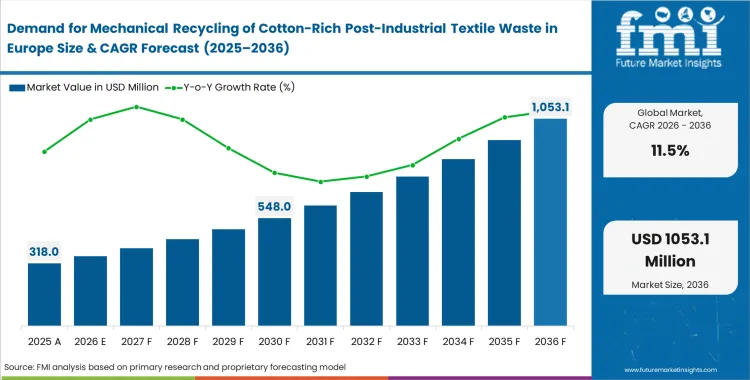
The mechanical recycling of cotton-rich post-industrial textile waste in Europe industry crossed a valuation of Demand for Mechanical Recycling of Cotton-Rich Post-Industrial Textile Waste in Europe in 2025. The industry is expected to reach USD 318.0 million in 2026 at a CAGR of 11.5% during the forecast period. Demand outlook carries the market valuation to USD 944.4 million by 2036 as increased investment in recycling capacity enables spinning mills to expand the use of certified secondary cotton feedstock.
Summary of Demand for Mechanical Recycling of Cotton-Rich Post-Industrial Textile Waste in Europe
- Market Snapshot
- The industry is valued at USD 285.2 million in 2025 and is projected to reach USD 944.4 million by 2036.
- The industry is expected to grow at 11.5% CAGR from 2026 to 2036, creating an incremental opportunity of USD 626.4 million.
- The industry remains a feedstock-quality and conversion-efficiency category where fiber length retention, color sorting, and downstream respinning viability shape commercial success.
- Europe’s broader textile-waste base is large enough to support this niche as the EU generated 6.95 million tonnes of textile waste in 2020, while the non-post-consumer share came from manufacturing and unsold textiles.
- Demand and Growth Drivers
- The demand is rising as manufacturers are under greater pressure to divert cleaner production waste into circular routes rather than disposal, and OECD notes that post-production textile recycling is becoming more common in manufacturing chains.
- Mechanical cotton recycling is gaining preference because Refashion identifies single-material cotton textiles as a primary feedstock for yarn-spinning pathways, making cotton-rich post-industrial waste easier to process than mixed garments.
- Growth is being supported by Europe’s policy shift, as the EU moved to separate textile collection from 2025 and the revised Waste Framework Directive entered into force in October 2025.
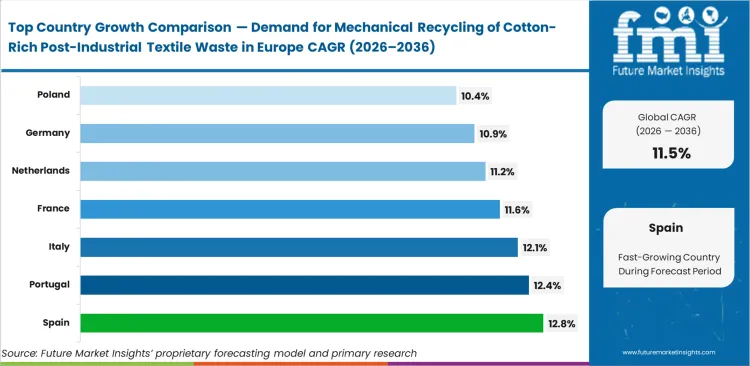
- Among key countries, Spain leads at 12.8% CAGR, followed by Portugal at 12.4%, Italy at 12.1%, France at 11.6%, Netherlands at 11.2%, Germany at 10.9%, and Poland at 10.4%.
- Growth is constrained by fiber shortening during processing, continued dependence on carrier fibers, and the reality that recycled fiber content in yarns often remains around 30% to 40% under current mechanical recycling routes.
- Product and Segment View
- The industry covers cotton-rich cutting scraps, yarn waste, rejected fabrics, and overstock rolls processed through shredding, defibration, carding, blending, and respinning routes.
- These outputs move mainly into apparel yarns, home-textile yarns, nonwovens, padding, and lower-grade insulation or filler applications.
- Cutting scraps and cutting-room offcuts lead the Waste Form segment with 38.0% share, as they are cleaner and easier to segregate by composition and color than mixed factory leftovers.
- 100% cotton waste leads the Cotton Content segment with 34.0% share, because mechanical recycling performs best with mono-material or highly cotton-dominant streams.
- Fiber regeneration for respinning leads the Recycling Route segment with 37.0% share, because the highest-value pathway remains recycled staple prepared for yarn formation.
- Recycled staple fiber leads the Output Form segment with 41.0% share, because it is the base intermediate for open-end spinning, blends, and several adjacent textile applications.
- Apparel yarn spinning leads the End Use segment with 36.0% share, supported by active European yarn groups already commercializing mechanically recycled cotton inputs.
- The scope includes mechanical recycling of cotton-rich post-industrial textile waste into fibers, blends, and yarn-grade inputs, though it excludes chemical dissolution recycling, bottle-to-textile polyester loops, resale channels, and garment repair.
- Geography and Competitive Outlook
- Spain, Portugal, and Italy are the fastest-growing markets as they combine cotton-apparel manufacturing density with active recycling and yarn-conversion players.
- Competitive activity is still fragmented and partnership-led, with Recover™, Ferre Yarns, Marchi & Fildi, Filatures du Parc, Frankenhuis, and RE&UP covering different parts of the value chain from defibration to yarn conversion.
- Recover™ is estimated to hold the largest share because it has a strong market position in mechanically recycled cotton fiber sourced from textile waste streams.
- The industry is likely to stay fragmented through the medium term because sorting constraints, color management, and yarn-performance limits still keep many operators specialized rather than fully integrated.
European spinning mills are facing a tightening supply of traceable cotton-rich offcuts. Securing dedicated feedstock from garment assembly hubs is becoming a core operating requirement rather than a sustainability-led initiative. Fast-fashion brands are pressing suppliers to meet minimum recycled content targets in seasonal collections. Mills without long-term access to high-quality pre-consumer waste often turn to spot purchases at elevated prices. The situation is becoming more difficult as garment manufacturers adopt AI-based marker systems that reduce fabric waste generation at the factory level.
Mass-scale continuous processing becomes economically viable once automated optical sorting systems achieve high composition accuracy at commercial speed. Independent recyclers are driving this transition by installing inline spectroscopic scanners that separate polyester-blended offcuts from pure cotton streams before material enters tearing cylinders. Better sorting precision reduces reliance on chemical testing and allows textile waste mechanical recycling operations in Europe to move faster with higher throughput.
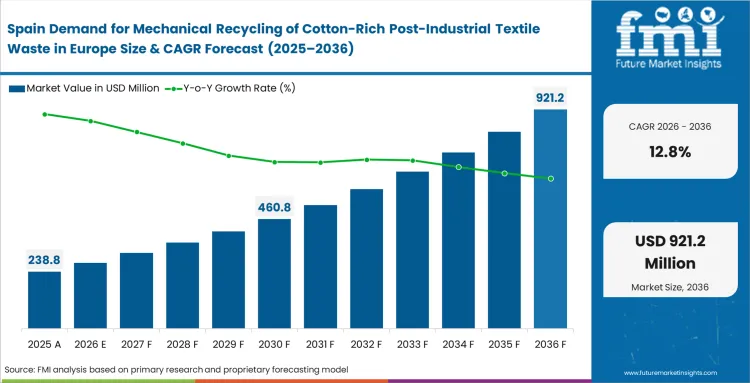
Spain is projected to lead this market in Europe, with demand expected to rise at a CAGR of 12.8% through 2036. Its advantage comes from a vertically integrated spinning industry that connects smoothly with garment assembly operations across Iberia, helping sorted textile waste move into production more efficiently. Portugal follows with sales likely to increase at a CAGR of 12.4% during the forecast period, supported by its strong home textile manufacturing base and steady need for premium sorted feedstock. Italy is anticipated to witness 12.1% CAGR by 2036, driven by luxury brands building closed-loop recovery networks. France is set to register 11.6% CAGR, backed by anti-waste legislation that continues to shape textile recovery and reuse practices. The Netherlands is expected to grow at 11.2% CAGR through 2036 due to early investment in advanced sorting hubs. Germany is likely to post 10.9% CAGR as offcuts increasingly move into technical nonwovens. Poland is forecast to record 10.4% CAGR, though reliance on legacy virgin-spinning infrastructure slows wider recycled feedstock adoption.
Segmental Analysis
Mechanical Recycling of Cotton-Rich Post-Industrial Textile Waste in Europe Analysis by Waste Form
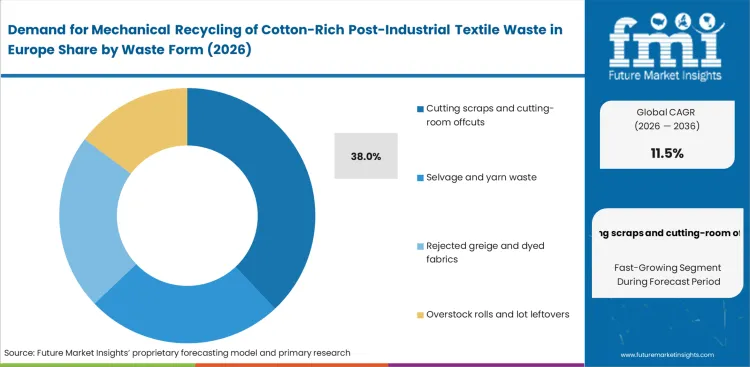
Cutting scraps and cutting-room offcuts hold 38.0% share as facility managers at mechanical tearing plants can bypass exhaustive composition testing. Sourcing directors at recycling firms actively hunt these offcuts since garment manufacturers provide exact fiber blend data directly from fabric rolls. When a tearing facility inputs clean, segregated offcuts, blade wear decreases and output consistency rises. According to FMI's estimates, operational predictability allows recyclers to run continuous shifts without recalibrating pin cylinders for varying synthetic contaminants. Some garment manufacturers retain premium white offcuts for internal reuse or supply negotiations, which can tighten availability for recyclers.
- Supplier validation sequence: Procurement teams test initial offcut batches for elastane contamination before signing long-term collection contracts. Facility managers evaluate tearing resistance during trial runs. Recyclers expand intake volumes only when garment hubs prove consistent color segregation across multiple seasons.
- Elastane contamination friction: Elastane content exceeding 3% gums up fine wire clothing on carding machines. Maintenance supervisors face extended machine downtime for cleaning. Operations heads mandate strict elastane thresholds in purchasing agreements to maintain throughput speeds.
- Color-sorted premiums: White and natural offcuts bypass bleaching processes entirely, solving the color sorting recycled cotton waste bottleneck. Spinning mills often pay a premium for undyed cotton-rich feedstock because it gives them more flexibility in downstream processing. Recyclers capturing pure white streams achieve significantly higher margins than those processing mixed-color batches.
Mechanical Recycling of Cotton-Rich Post-Industrial Textile Waste in Europe Analysis by Cotton Content
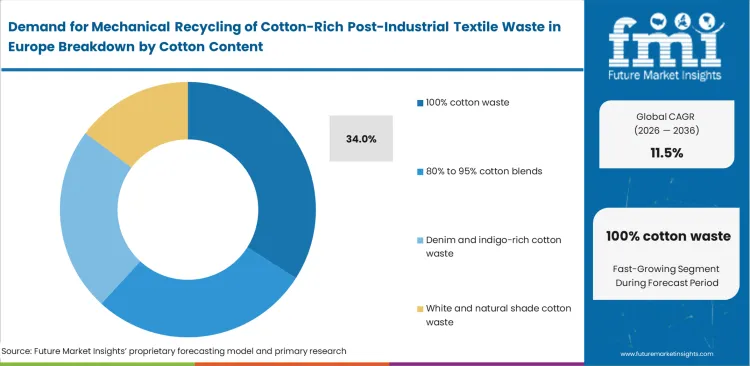
Direct compatibility with legacy open-end spinning frames keeps pure cotton feedstocks at the center of mill purchasing strategies. 100% cotton waste captures 34.0% share, driven by yarn production directors who require predictable staple lengths to maintain yarn strength. When spinning mills blend pure secondary material with virgin cotton, they avoid complex drafting adjustments required when handling synthetic blends. Physical properties of pure cotton allow torn fibers to draft smoothly through drawing frames.
- Tensile preservation check: Quality control technicians measure average staple length of incoming pure cotton waste. Short-fiber content exceeding 40% triggers immediate rejection. Spinning supervisors require specific length profiles to prevent excessive frame stoppages.
- Dye affinity advantage: Pure cotton fibers require no dual-dyeing processes. Dyehouse managers cut chemical usage and processing time by treating recycled yarn identical to virgin stock. Brands achieve exact color matching without formulating complex disperse-dye recipes.
- Thermal friction risk: High-speed tearing of pure cotton generates immense friction heat. Plant engineers install specialized water-misting systems over pin cylinders. Failure to control heat results in fiber yellowing and severe degradation of final staple quality.
Mechanical Recycling of Cotton-Rich Post-Industrial Textile Waste in Europe Analysis by Recycling Route
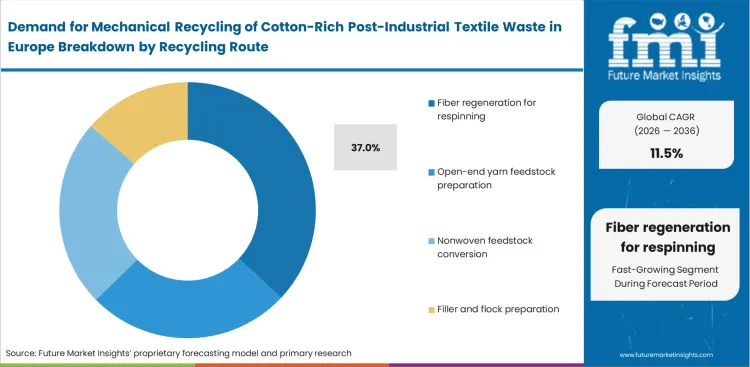
Fiber regeneration for respinning is gaining strong traction in this industry as fast-fashion sustainability mandates push suppliers toward circular garment production. Major brands now require tier-2 spinning mills to incorporate regenerated textile staples into core denim and jersey programs. Holding 37.0% share, this route depends on gentle multi-stage tearing lines that open fabric structures gradually rather than applying harsh mechanical force. Commercial success still depends on preserving enough staple length for yarn drafting. Machinery may be promoted for heavy canvas recovery, though real commercial volume is more often linked to loosely woven knits that release fibers more easily. Mills pushing tightly woven fabrics through respinning systems often face faster blade wear and generate dust instead of usable fiber, which weakens process economics.
- Progressive tearing control: Machinery operators adjust cylinder pin density across six sequential tearing stages. Careful progression maximizes unbroken fiber yield. Plant managers balance throughput speed against fiber preservation to meet spinning mill specifications.
- Dust extraction burden: Mechanical opening generates massive volumes of micro-dust. Maintenance crews empty filtration systems multiple times per shift to prevent fire hazards. Facility designers must allocate significant capital toward high-capacity air handling infrastructure.
- Blend dependency trap: Regenerated fibers cannot be spun independently into fine counts. Spinning directors must subsidize recycled content with a recycled cotton carrier fiber requirement using long-staple virgin cotton. Commercial claims around 100% recycled fine-count apparel yarns remain difficult to sustain because torn fibers have physical performance limits.
Mechanical Recycling of Cotton-Rich Post-Industrial Textile Waste in Europe Analysis by Output Form
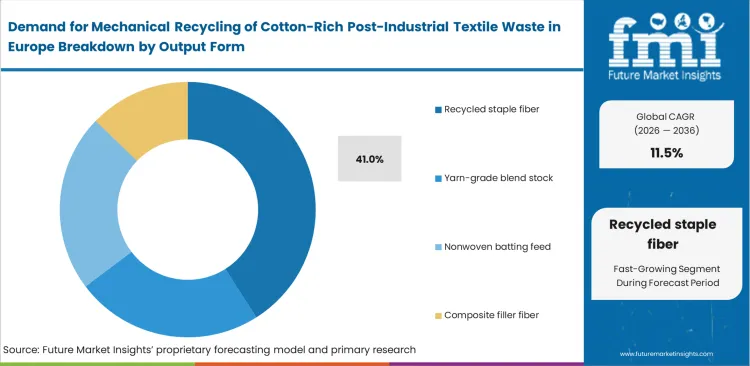
Physical format of secondary material dictates integration readiness at spinning mills. Recycled staple fiber leads with 41.0% share, serving as universal input for open-end spinning recycled cotton waste applications across Europe. Plant managers at spinning facilities demand material delivered in tightly pressed bales, identical in format to virgin cotton deliveries. Standardized staple fibers formats allow bale-plucking machines to blend recycled and virgin materials seamlessly at blowroom lines. Based on FMI's assessment, producing uniform staple fiber requires recyclers to pass torn material through intensive carding recycled cotton fibers stages to parallelize chaotic mass into cohesive sliver before baling. What procurement directors miss when negotiating staple fiber contracts is that moisture regain properties of mechanically stressed fibers differ vastly from virgin cotton, often causing unpredictable weight variations during transit.
- Bale density economics: Logistics managers require highly compressed bales to minimize shipping costs across European borders. Inadequate pressing equipment ships excessive air. Recyclers without high-tonnage balers lose competitive pricing edge due to inflated freight expenses.
- Neps and neppiness flaws: Aggressive mechanical tearing creates tiny tangled knots called neps. Quality control officers downgrade batches with high nep counts. Recyclers must continually replace expensive tearing pins to prevent nep formation and maintain premium grade status.
- Moisture regain disputes: Mechanically damaged cellulose absorbs ambient moisture erratically. Warehouse supervisors struggle to maintain consistent bale weights. Suppliers failing to strictly control baling environment humidity face constant financial clawbacks from spinning mill buyers.
Mechanical Recycling of Cotton-Rich Post-Industrial Textile Waste in Europe Analysis by End Use
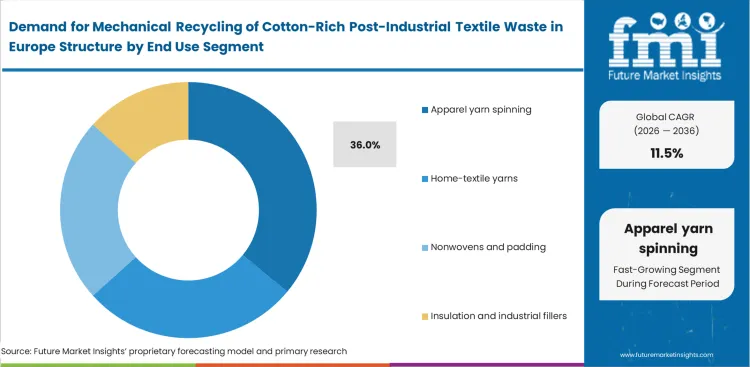
Apparel yarn spinning is expected to account for 36.0% of end use demand in 2026, supported by brand commitments to higher recycled fiber content. Category managers at fashion retailers demand apparel yarn from recycled cotton waste in core product lines like denim jeans and heavy knitwear. This specific end use absorbs highest quality, longest-staple recycled fibers available in the industry.
- Yarn strength limits: Knitting floor supervisors monitor yarn breakage rates continuously. Mechanically recycled blends weaken overall yarn structure. Spinners must carefully manage virgin and recycled fiber blends to maintain yarn performance and avoid production interruptions.
- Traceability documentation: Compliance officers at apparel brands audit entire chains of custody. Any gap in Global Recycled Standard certification disqualifies final garments. Recyclers must implement strict digital tracking for every lot to remain on approved vendor lists.
- Acoustic batting fallback: Operations managers route fibers too short for spinning directly into nonwoven needle-punch lines. Automotive buyers purchase batting for door panel insulation. Facilities without this outlet face mounting warehouse costs for unusable short-staple dust.
Mechanical Recycling of Cotton-Rich Post-Industrial Textile Waste in Europe Drivers, Restraints, and Opportunities
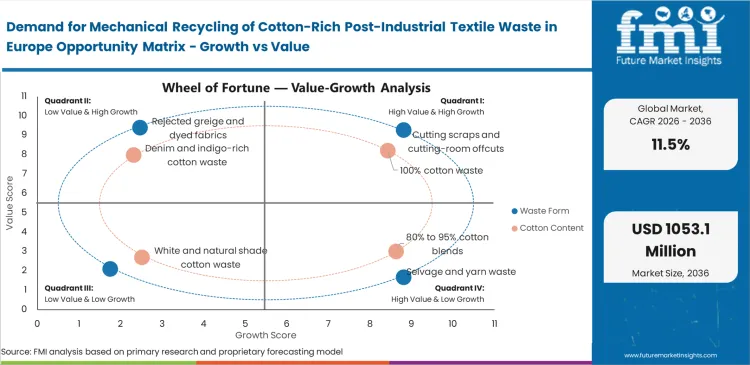
EU textile waste separate collection rules taking effect in 2025 are pushing garment assembly operators to move cutting-room offcuts away from incineration and into certified cotton recycling networks across Europe. National authorities are also advancing tax models that link industrial waste costs more directly to disposal volumes. Tier-1 fashion brands are adding more pressure by asking spinning mills to secure post-industrial feedstock ahead of 2030 circularity targets. Competition for high-volume, clean scrap is becoming more intense across the supply chain. Mills that delay supply agreements may be forced to buy processed staple fiber on spot markets at higher prices as compliance deadlines approach.
Elastane and synthetic stitching remain major barriers to continuous mechanical processing of cotton-rich offcuts. Tearing equipment can become entangled even when stretch fiber content is low. Maintenance teams often need to stop lines and remove melted elastane from cylinders by hand. Optical sorting can identify broad fabric composition, though minor synthetic threads hidden in the weave are harder to detect. Contamination from these materials limits line speed and keeps facility throughput below installed capacity, even when feedstock volumes are available.
Opportunities in the Mechanical Recycling of Cotton-Rich Post-Industrial Textile Waste in Europe
- Automated elastane detection: Engineers designing inline spectroscopic scanners that accurately flag stretch fabrics before tearing bypass primary causes of machine downtime. Tearing facility managers capture higher daily tonnage.
- Direct garment-hub integration: Recyclers placing pre-sorting equipment directly inside poly cotton fabric cutting rooms eliminate secondary handling costs. Assembly plant directors monetize waste instantly.
- Closed-loop denim systems: Mills developing localized supply chains linking jeans manufacturers directly to nearby tearing facilities reduce logistics overhead. Procurement officers guarantee consistent indigo-rich feedstock.
Regional Analysis
Based on regional analysis, Mechanical recycling of cotton-rich post-industrial textile waste in Europe is segmented into Southern Europe, Western Europe, and Eastern Europe across 40 plus countries.
.webp "Top Country Growth Comparison Demand For Mechanical Recycling Of Cotton Rich Post Industrial Textile Waste In Europe Cagr (2026 2036)")
| Country | CAGR (2026 to 2036) |
|---|---|
| Spain | 12.8% |
| Portugal | 12.4% |
| Italy | 12.1% |
| France | 11.6% |
| Netherlands | 11.2% |
| Germany | 10.9% |
| Poland | 10.4% |
Source: Future Market Insights (FMI) analysis, based on proprietary forecasting model and primary research
Southern Europe Mechanical Recycling of Cotton-Rich Post-Industrial Textile Waste in Europe Analysis
Geographic proximity to massive North African garment assembly hubs gives Southern Europe a feedstock advantage. Spain, Portugal, and Italy operate highly integrated textile clusters where physical distance between waste generation and recycling infrastructure is minimal. Logistics directors exploit short shipping routes across the Mediterranean, bringing high volumes of segregated cutting scraps directly into regional tearing facilities. This minimizes carbon footprints of reverse supply chains, a metric closely monitored by European brands. In FMI's view, the region benefits from legacy mechanical recycling expertise; technicians here possess decades of experience tuning tearing cylinders for specific fabric weights.
- Spain: Demand for mechanical recycling of cotton-rich post-industrial textile waste in Spain is anticipated to rise at a CAGR of 12.8% through 2036. The country benefits from closely connected spinning mills that work alongside Moroccan assembly hubs to secure clean and consistent offcut volumes. Procurement teams often avoid spot buying and prefer direct sourcing arrangements that improve quality control. This structure helps Spanish recyclers aggregate regional supply efficiently and strengthen their pricing power in regenerated apparel fiber sales.
- Portugal: Sales of mechanical recycling of cotton-rich post-industrial textile waste in Portugal are expected to increase at a CAGR of 12.4% during the forecast period. High-end home textile producers in the country require premium, color-sorted secondary feedstocks for bedding and toweling applications. Quality teams place strong emphasis on contamination-free bale preparation before materials move into processing. Portuguese facilities respond by using gentler fiber opening methods that help retain staple length for heavier premium fabric production.
- Italy: The mechanical recycling of cotton-rich post-industrial textile waste market in Italy is poised to expand at a CAGR of 12.1% through 2036. Luxury fashion houses maintain tightly controlled closed-loop recycling networks and rarely allow proprietary offcuts to enter open trade channels. Mill managers work in close coordination with brand sustainability teams to manage material recovery and reuse. This gives Italian recyclers access to exclusive processing contracts with stronger margins and lower exposure to general feedstock price competition.
Western Europe Mechanical Recycling of Cotton-Rich Post-Industrial Textile Waste in Europe Industry Analysis
Strict national anti-waste legislation forces aggressive capacity expansion across Western Europe. France, Netherlands, and Germany lead the continent in deploying automated optical sorting hubs to handle complex pre-consumer waste streams. Facility managers here operate under intense regulatory scrutiny, compelled to hit specific diversion targets mandated by revised waste framework directive textiles 2025 guidelines or face severe corporate penalties. Rather than focusing solely on apparel yarn, Western European recyclers funnel massive volumes of torn fiber into technical applications. According to FMI's estimates, heavy presence of automotive manufacturing creates reliable baseline demand for recycled cotton acoustic insulation, providing financial safety nets for tearing operations.
- France: National extended producer responsibility laws are tightening waste diversion requirements for industrial textile operations in France. Compliance teams are under pressure to document clear recycling pathways that meet these rules. French recyclers are projected to grow at an 11.6% CAGR from 2026 to 2036 in this industry, supported by state-backed infrastructure grants. Public funding is helping operators install advanced automated sorting lines and expand processing capacity.
- Netherlands: Port-adjacent logistics hubs make the Netherlands an important consolidation point for textile waste flows across Europe. Supply chain teams aggregate scrap from nearby countries before sending it to specialized tearing facilities. Dutch facilities are projected to grow at an 11.2% CAGR from 2026 to 2036. Their role helps balance uneven waste generation with more stable mill demand.
- Germany: A large share of torn cotton scrap in Germany moves into nonwoven acoustic batting because of strong ties with the domestic automotive sector. Production teams often prioritize high-throughput processing over preserving longer fiber length for respinning. In Germany, the Mechanical Recycling of Cotton-Rich Post-Industrial Textile Waste Market is projected to expand at a 10.9% CAGR from 2026 to 2036. Multi-year industrial supply agreements help recyclers reduce dependence on fluctuating demand from the fashion sector.
Eastern Europe Mechanical Recycling of Cotton-Rich Post-Industrial Textile Waste in Europe Market Analysis
Legacy virgin-spinning infrastructure limits speed at which Eastern Europe can absorb mechanically recycled cotton. While the region possesses significant garment assembly capacity, local spinning mills lack specialized blowroom equipment required to blend short, torn fibers effectively. Plant managers hesitate to modify highly tuned virgin-cotton lines, fearing unacceptable drops in machine efficiency. FMI observes Eastern European recycling relies heavily on exporting baled cutting scraps westward or converting them into low-value industrial wipers.
- Poland: Massive local furniture and upholstery manufacturing sectors generate substantial cutting waste, but local mills struggle to process heavy canvas offcuts. Facility engineers face severe blade wear when attempting to tear these dense fabrics. Demand in Poland is projected to rise at a CAGR of 10.4% from 2026 to 2036, though higher-value yarn-grade processing will require further equipment upgrades.
FMI's report includes detailed supply chain mapping for United Kingdom, Belgium, and Romania. Specialized denim-tearing hubs emerge rapidly in these secondary markets as brands push for localized closed-loop jeans manufacturing.
Competitive Aligners for Market Players
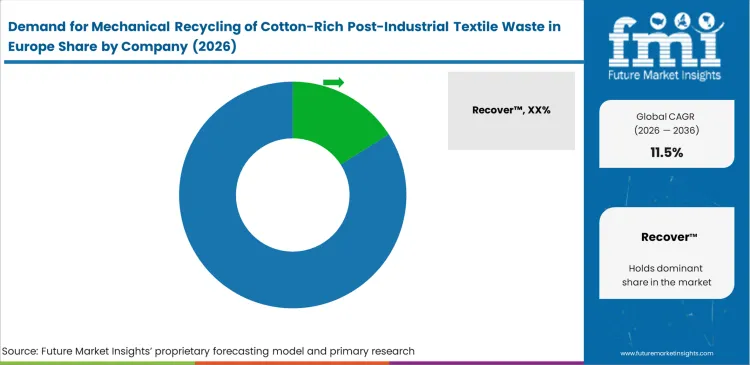
High-value sorting and tearing capacity sits with a relatively small group of recyclers, while collection remains dispersed among many local operators. Companies such as Recover, Ferre Yarns, and Marchi & Fildi compete by delivering stronger fiber quality, not by building the largest collection networks. European spinning mills judge recycled cotton suppliers mainly on staple length retention in baled output. Higher tearing speeds can lift throughput, though they often produce shorter fibers and more dust, which apparel yarn producers tend to reject. Commercial performance depends on a controlled, multi-stage opening process that protects usable fiber and limits material loss.
Established recyclers hold a practical advantage through process data accumulated from repeated runs across different fabric types and blends. Filatures du Parc, for instance, can shift between denim and jersey inputs with less operational disruption because of that experience. New entrants may invest heavily in optical sorting systems, though equipment alone does not address the central commercial hurdle. Access to the market depends on securing offtake agreements with cotton and polyester spinning mills. These buyers usually take time to qualify recycled fiber before approving it for production use.
Spinning mills manage supply risk by setting blending systems that can absorb recycled input from multiple partners. Procurement teams divide volumes across suppliers to avoid overreliance on one recycler. When access to premium sorted bales becomes too restricted, mills may increase virgin cotton use or move toward chemically recycled substitutes. Bargaining power usually stays with spinning mills, since recyclers holding excess fiber inventory face storage pressure and reduced pricing control.
Key Players in Mechanical Recycling of Cotton-Rich Post-Industrial Textile Waste in Europe Market
- Recover™
- Ferre Yarns
- Marchi & Fildi
- Filatures du Parc
- Frankenhuis
- RE&UP
Scope of the Report
| Metric | Value |
|---|---|
| Quantitative Units | USD 318.0 million to USD 944.4 million, at a CAGR of 11.5% |
| Market Definition | Mechanical Recycling of Cotton-Rich Post-Industrial Textile Waste in Europe Market comprises systematic collection, sorting, and physical breakdown of pre-consumer fabric scraps into reusable fibers. The defining characteristic is a tearing process that preserves fiber length without chemical dissolution. |
| Segmentation | Waste Form, Cotton Content, Recycling Route, Output Form, End Use, and Region |
| Regions Covered | Europe |
| Countries Covered | Spain, Portugal, Italy, France, Netherlands, Germany, Poland |
| Key Companies Profiled | Recover™, Ferre Yarns, Marchi & Fildi, Filatures du Parc, Frankenhuis, RE&UP |
| Forecast Period | 2026 to 2036 |
| Approach | Installed capacity of mechanical tearing cylinders across Southern Europe anchors baseline production modeling for the continent. |
Source: Future Market Insights (FMI) analysis, based on proprietary forecasting model and primary research
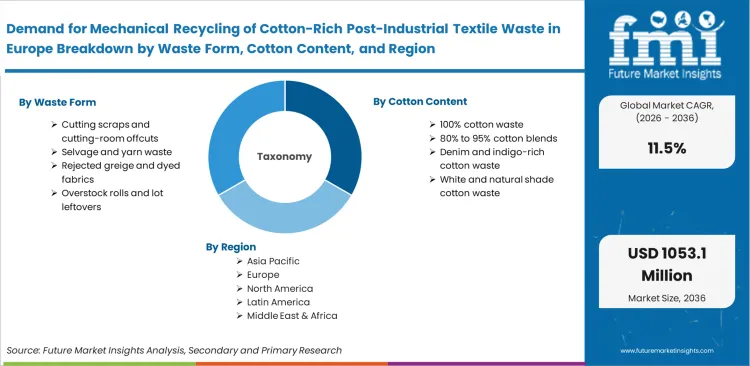
Mechanical Recycling of Cotton-Rich Post-Industrial Textile Waste in Europe Market Analysis by Segments
Waste Form:
- Cutting scraps and cutting-room offcuts
- Selvage and yarn waste
- Rejected greige and dyed fabrics
- Overstock rolls and lot leftovers
Cotton Content:
- 100% cotton waste
- 80% to 95% cotton blends
- Denim and indigo-rich cotton waste
- White and natural shade cotton waste
Recycling Route:
- Fiber regeneration for respinning
- Open-end yarn feedstock preparation
- Nonwoven feedstock conversion
- Filler and flock preparation
Output Form:
- Recycled staple fiber
- Yarn-grade blend stock
- Nonwoven batting feed
- Composite filler fiber
End Use:
- Apparel yarn spinning
- Home-textile yarns
- Nonwovens and padding
- Insulation and industrial fillers
Region:
- Southern Europe
- Western Europe
- Eastern Europe
Bibliography
- European Environment Agency. (2024, May 21). Management of used and waste textiles in Europe’s circular economy.
- European Commission, Joint Research Centre. (2024, December 9). Preparatory study on textile products.
- European Topic Centre on Circular Economy and Resource Use. (2024). Textile waste management in Europe’s circular economy.
- Kanan, M., Wannassi, B., Azouz, B., Ben Hassen, M., Assaf, R., & Barham, A. S. (2024). Cotton recycling: An experimental study of the mechanical preparation process. Case Studies in Chemical and Environmental Engineering, 10, 100849.
- Lanz, I. E., Laborda, E., Chaine, C., & Blecua, M. (2024). A mapping of textile waste recycling technologies in Europe and Spain. Textiles, 4(3), 359–390.
This bibliography is provided for reader reference. The full FMI report contains the complete reference list with primary source documentation.
This Report Addresses
- The exact tonnage of cutting-room offcuts diverted into mechanical tearing facilities across the European Union.
- How spinning mill procurement directors secure pure cotton scrap streams ahead of upcoming brand mandates.
- The operational limits of running elastane-contaminated offcuts through high-speed carding and tearing lines.
- Cost differentials between white sorted pre-consumer waste and mixed-color lot leftovers.
- Integration rates of mechanically torn staple fibers into legacy open-end spinning hoppers.
- Sourcing strategies deployed by Spanish vertically integrated mills to capture Moroccan garment waste.
- The critical threshold for staple length preservation when converting heavy denim back into yarn.
- The shift routing short-fiber waste away from apparel and into technical automotive acoustic batting.
Frequently Asked Questions
What is mechanical recycling of cotton-rich post-industrial textile waste in Europe?
This process involves the systematic collection, sorting, and mechanical breakdown of pre-consumer cotton fabric scraps into reusable fibers without utilizing chemical dissolution.
How large is the market in 2025, 2026, and 2036?
The market was valued at USD 285.2 million in 2025, before expanding to USD 318.0 million in 2026. Consistent adoption of secondary material propels total value to USD 944.4 million by 2036.
What specific CAGR defines the forecast period?
A steady 11.5% CAGR tracks growth from 2026 to 2036. The rate relies entirely on the rapid deployment of automated optical sorting machines capable of accurately separating polyester blends from pure cotton scraps.
Why is post-industrial cotton waste easier to recycle than post-consumer waste?
Factory cutting scraps provide exact chemical provenance directly from garment manufacturers. This predictable material bypasses expensive composition testing and complex manual sorting required for post-consumer garments.
Which countries lead this market in Europe?
Spain leads with a 12.8% expansion rate due to vertically integrated mills linking with North African hubs. Portugal follows closely at 12.4%, prioritizing high-end home textile fiber preservation.
Which companies are active in recycled cotton fiber and yarn production?
Key organizations driving fiber regeneration include Recover™, Ferre Yarns, Marchi & Fildi, Filatures du Parc, Frankenhuis, and RE&UP. They compete heavily on staple length integrity.
What are the main technical limits of mechanical cotton recycling?
Addressing the cotton recycling fiber length challenge requires supervisors to prevent excessive shortening during tearing. Elastane contamination also quickly entangles mechanical pins, causing severe machine downtime.
Which end uses absorb recycled cotton fibers today?
Apparel yarn spinning commands 36.0% share due to fast-fashion marketing demands. However, shorter torn fibers flow heavily into acoustic nonwovens and technical automotive insulation as a commercial fallback.
How do EU policy changes affect adoption?
Impending textile EPR Europe recycling fibers mandates force manufacturers to divert cutting offcuts from incinerators. National authorities establish heavy taxation models tied directly to industrial waste tonnage.
How does Portugal compare to Spain?
While Spain focuses on high-volume apparel yarn, Portuguese recyclers prioritize gentle fiber opening to supply the region's specialized high-end home textile and premium bedding manufacturing base.
What barrier slows continuous processing?
Elastane contamination remains the primary friction point. Mechanical tearing pins quickly become entangled with stretch fibers, forcing maintenance supervisors to halt lines completely to manually clear melted synthetics from cylinders.
How do brands influence recycler operations?
Tier-1 brands enforce strict Global Recycled Standard tracking. Recyclers must implement digital chain-of-custody documentation for every bale, as any missing certification disqualifies final garments from bearing sustainability hangtags.
What happens to fibers that become too short for spinning?
Operations managers route heavily damaged, short fibers directly into nonwoven needle-punch lines. Automotive manufacturers purchase this acoustic batting for door insulation, providing a critical financial fallback for recyclers.
How do Spanish mills avoid spot market price spikes?
Procurement directors in Spain establish multi-year offtake agreements directly with cutting rooms in Morocco. This closed-loop sourcing shields them from volatile open markets when brand mandates suddenly spike demand.
Why are white offcuts priced higher than mixed colors?
White and natural scraps bypass bleaching stages completely. Spinning directors pay a premium because dyehouse managers treat the resulting yarn exactly like virgin stock, saving immense chemical and water costs.
How does optical sorting change facility economics?
Inline spectroscopic scanners eliminate manual sorting bottlenecks. Facility managers increase daily tonnage because scanners accurately flag synthetic contaminants before they reach tearing cylinders, preventing costly machine jams.
Preview the report firsthand - request a free sample
Get SampleGet the brochure for pricing and purchase details.
Get PDFTable of Content
- Executive Summary
- Global Market Outlook
- Demand-side Trends
- Supply-side Trends
- Technology Roadmap Analysis
- Analysis and Recommendations
- Market Overview
- Market Coverage / Taxonomy
- Market Definition / Scope / Limitations
- Research Methodology
- Chapter Orientation
- Analytical Lens and Working Hypotheses
- Market Structure, Signals, and Trend Drivers
- Benchmarking and Cross-market Comparability
- Market Sizing, Forecasting, and Opportunity Mapping
- Research Design and Evidence Framework
- Desk Research Programme (Secondary Evidence)
- Company Annual and Sustainability Reports
- Peer-reviewed Journals and Academic Literature
- Corporate Websites, Product Literature, and Technical Notes
- Earnings Decks and Investor Briefings
- Statutory Filings and Regulatory Disclosures
- Technical White Papers and Standards Notes
- Trade Journals, Industry Magazines, and Analyst Briefs
- Conference Proceedings, Webinars, and Seminar Materials
- Government Statistics Portals and Public Data Releases
- Press Releases and Reputable Media Coverage
- Specialist Newsletters and Curated Briefings
- Sector Databases and Reference Repositories
- FMI Internal Proprietary Databases and Historical Market Datasets
- Subscription Datasets and Paid Sources
- Social Channels, Communities, and Digital Listening Inputs
- Additional Desk Sources
- Expert Input and Fieldwork (Primary Evidence)
- Primary Modes
- Qualitative Interviews and Expert Elicitation
- Quantitative Surveys and Structured Data Capture
- Blended Approach
- Why Primary Evidence is Used
- Field Techniques
- Interviews
- Surveys
- Focus Groups
- Observational and In-context Research
- Social and Community Interactions
- Stakeholder Universe Engaged
- C-suite Leaders
- Board Members
- Presidents and Vice Presidents
- R&D and Innovation Heads
- Technical Specialists
- Domain Subject-matter Experts
- Scientists
- Physicians and Other Healthcare Professionals
- Governance, Ethics, and Data Stewardship
- Research Ethics
- Data Integrity and Handling
- Primary Modes
- Tooling, Models, and Reference Databases
- Desk Research Programme (Secondary Evidence)
- Data Engineering and Model Build
- Data Acquisition and Ingestion
- Cleaning, Normalisation, and Verification
- Synthesis, Triangulation, and Analysis
- Quality Assurance and Audit Trail
- Market Background
- Market Dynamics
- Drivers
- Restraints
- Opportunity
- Trends
- Scenario Forecast
- Demand in Optimistic Scenario
- Demand in Likely Scenario
- Demand in Conservative Scenario
- Opportunity Map Analysis
- Product Life Cycle Analysis
- Supply Chain Analysis
- Investment Feasibility Matrix
- Value Chain Analysis
- PESTLE and Porter’s Analysis
- Regulatory Landscape
- Regional Parent Market Outlook
- Production and Consumption Statistics
- Import and Export Statistics
- Market Dynamics
- Global Market Analysis 2021 to 2025 and Forecast, 2026 to 2036
- Historical Market Size Value (USD Million) Analysis, 2021 to 2025
- Current and Future Market Size Value (USD Million) Projections, 2026 to 2036
- Y-o-Y Growth Trend Analysis
- Absolute $ Opportunity Analysis
- Global Market Pricing Analysis 2021 to 2025 and Forecast 2026 to 2036
- Global Market Analysis 2021 to 2025 and Forecast 2026 to 2036, By Waste Form
- Introduction / Key Findings
- Historical Market Size Value (USD Million) Analysis By Waste Form , 2021 to 2025
- Current and Future Market Size Value (USD Million) Analysis and Forecast By Waste Form , 2026 to 2036
- Cutting scraps and cutting-room offcuts
- Selvage and yarn waste
- Rejected greige and dyed fabrics
- Overstock rolls and lot leftovers
- Cutting scraps and cutting-room offcuts
- Y-o-Y Growth Trend Analysis By Waste Form , 2021 to 2025
- Absolute $ Opportunity Analysis By Waste Form , 2026 to 2036
- Global Market Analysis 2021 to 2025 and Forecast 2026 to 2036, By Cotton Content
- Introduction / Key Findings
- Historical Market Size Value (USD Million) Analysis By Cotton Content, 2021 to 2025
- Current and Future Market Size Value (USD Million) Analysis and Forecast By Cotton Content, 2026 to 2036
- 100% cotton waste
- 80% to 95% cotton blends
- Denim and indigo-rich cotton waste
- White and natural shade cotton waste
- 100% cotton waste
- Y-o-Y Growth Trend Analysis By Cotton Content, 2021 to 2025
- Absolute $ Opportunity Analysis By Cotton Content, 2026 to 2036
- Global Market Analysis 2021 to 2025 and Forecast 2026 to 2036, By Recycling Route
- Introduction / Key Findings
- Historical Market Size Value (USD Million) Analysis By Recycling Route, 2021 to 2025
- Current and Future Market Size Value (USD Million) Analysis and Forecast By Recycling Route, 2026 to 2036
- Fiber regeneration for respinning
- Open-end yarn feedstock preparation
- Nonwoven feedstock conversion
- Filler and flock preparation
- Fiber regeneration for respinning
- Y-o-Y Growth Trend Analysis By Recycling Route, 2021 to 2025
- Absolute $ Opportunity Analysis By Recycling Route, 2026 to 2036
- Global Market Analysis 2021 to 2025 and Forecast 2026 to 2036, By Output Form
- Introduction / Key Findings
- Historical Market Size Value (USD Million) Analysis By Output Form, 2021 to 2025
- Current and Future Market Size Value (USD Million) Analysis and Forecast By Output Form, 2026 to 2036
- Recycled staple fiber
- Yarn-grade blend stock
- Nonwoven batting feed
- Composite filler fiber
- Recycled staple fiber
- Y-o-Y Growth Trend Analysis By Output Form, 2021 to 2025
- Absolute $ Opportunity Analysis By Output Form, 2026 to 2036
- Global Market Analysis 2021 to 2025 and Forecast 2026 to 2036, By End Use
- Introduction / Key Findings
- Historical Market Size Value (USD Million) Analysis By End Use, 2021 to 2025
- Current and Future Market Size Value (USD Million) Analysis and Forecast By End Use, 2026 to 2036
- Apparel yarn spinning
- Home-textile yarns
- Nonwovens and padding
- Insulation and industrial fillers
- Apparel yarn spinning
- Y-o-Y Growth Trend Analysis By End Use, 2021 to 2025
- Absolute $ Opportunity Analysis By End Use, 2026 to 2036
- Global Market Analysis 2021 to 2025 and Forecast 2026 to 2036, By Region
- Introduction
- Historical Market Size Value (USD Million) Analysis By Region, 2021 to 2025
- Current Market Size Value (USD Million) Analysis and Forecast By Region, 2026 to 2036
- North America
- Latin America
- Western Europe
- Eastern Europe
- East Asia
- South Asia and Pacific
- Middle East & Africa
- Market Attractiveness Analysis By Region
- North America Market Analysis 2021 to 2025 and Forecast 2026 to 2036, By Country
- Historical Market Size Value (USD Million) Trend Analysis By Market Taxonomy, 2021 to 2025
- Market Size Value (USD Million) Forecast By Market Taxonomy, 2026 to 2036
- By Country
- USA
- Canada
- Mexico
- By Waste Form
- By Cotton Content
- By Recycling Route
- By Output Form
- By End Use
- By Country
- Market Attractiveness Analysis
- By Country
- By Waste Form
- By Cotton Content
- By Recycling Route
- By Output Form
- By End Use
- Key Takeaways
- Latin America Market Analysis 2021 to 2025 and Forecast 2026 to 2036, By Country
- Historical Market Size Value (USD Million) Trend Analysis By Market Taxonomy, 2021 to 2025
- Market Size Value (USD Million) Forecast By Market Taxonomy, 2026 to 2036
- By Country
- Brazil
- Chile
- Rest of Latin America
- By Waste Form
- By Cotton Content
- By Recycling Route
- By Output Form
- By End Use
- By Country
- Market Attractiveness Analysis
- By Country
- By Waste Form
- By Cotton Content
- By Recycling Route
- By Output Form
- By End Use
- Key Takeaways
- Western Europe Market Analysis 2021 to 2025 and Forecast 2026 to 2036, By Country
- Historical Market Size Value (USD Million) Trend Analysis By Market Taxonomy, 2021 to 2025
- Market Size Value (USD Million) Forecast By Market Taxonomy, 2026 to 2036
- By Country
- Germany
- UK
- Italy
- Spain
- France
- Nordic
- BENELUX
- Rest of Western Europe
- By Waste Form
- By Cotton Content
- By Recycling Route
- By Output Form
- By End Use
- By Country
- Market Attractiveness Analysis
- By Country
- By Waste Form
- By Cotton Content
- By Recycling Route
- By Output Form
- By End Use
- Key Takeaways
- Eastern Europe Market Analysis 2021 to 2025 and Forecast 2026 to 2036, By Country
- Historical Market Size Value (USD Million) Trend Analysis By Market Taxonomy, 2021 to 2025
- Market Size Value (USD Million) Forecast By Market Taxonomy, 2026 to 2036
- By Country
- Russia
- Poland
- Hungary
- Balkan & Baltic
- Rest of Eastern Europe
- By Waste Form
- By Cotton Content
- By Recycling Route
- By Output Form
- By End Use
- By Country
- Market Attractiveness Analysis
- By Country
- By Waste Form
- By Cotton Content
- By Recycling Route
- By Output Form
- By End Use
- Key Takeaways
- East Asia Market Analysis 2021 to 2025 and Forecast 2026 to 2036, By Country
- Historical Market Size Value (USD Million) Trend Analysis By Market Taxonomy, 2021 to 2025
- Market Size Value (USD Million) Forecast By Market Taxonomy, 2026 to 2036
- By Country
- China
- Japan
- South Korea
- By Waste Form
- By Cotton Content
- By Recycling Route
- By Output Form
- By End Use
- By Country
- Market Attractiveness Analysis
- By Country
- By Waste Form
- By Cotton Content
- By Recycling Route
- By Output Form
- By End Use
- Key Takeaways
- South Asia and Pacific Market Analysis 2021 to 2025 and Forecast 2026 to 2036, By Country
- Historical Market Size Value (USD Million) Trend Analysis By Market Taxonomy, 2021 to 2025
- Market Size Value (USD Million) Forecast By Market Taxonomy, 2026 to 2036
- By Country
- India
- ASEAN
- Australia & New Zealand
- Rest of South Asia and Pacific
- By Waste Form
- By Cotton Content
- By Recycling Route
- By Output Form
- By End Use
- By Country
- Market Attractiveness Analysis
- By Country
- By Waste Form
- By Cotton Content
- By Recycling Route
- By Output Form
- By End Use
- Key Takeaways
- Middle East & Africa Market Analysis 2021 to 2025 and Forecast 2026 to 2036, By Country
- Historical Market Size Value (USD Million) Trend Analysis By Market Taxonomy, 2021 to 2025
- Market Size Value (USD Million) Forecast By Market Taxonomy, 2026 to 2036
- By Country
- Kingdom of Saudi Arabia
- Other GCC Countries
- Turkiye
- South Africa
- Other African Union
- Rest of Middle East & Africa
- By Waste Form
- By Cotton Content
- By Recycling Route
- By Output Form
- By End Use
- By Country
- Market Attractiveness Analysis
- By Country
- By Waste Form
- By Cotton Content
- By Recycling Route
- By Output Form
- By End Use
- Key Takeaways
- Key Countries Market Analysis
- USA
- Pricing Analysis
- Market Share Analysis, 2025
- By Waste Form
- By Cotton Content
- By Recycling Route
- By Output Form
- By End Use
- Canada
- Pricing Analysis
- Market Share Analysis, 2025
- By Waste Form
- By Cotton Content
- By Recycling Route
- By Output Form
- By End Use
- Mexico
- Pricing Analysis
- Market Share Analysis, 2025
- By Waste Form
- By Cotton Content
- By Recycling Route
- By Output Form
- By End Use
- Brazil
- Pricing Analysis
- Market Share Analysis, 2025
- By Waste Form
- By Cotton Content
- By Recycling Route
- By Output Form
- By End Use
- Chile
- Pricing Analysis
- Market Share Analysis, 2025
- By Waste Form
- By Cotton Content
- By Recycling Route
- By Output Form
- By End Use
- Germany
- Pricing Analysis
- Market Share Analysis, 2025
- By Waste Form
- By Cotton Content
- By Recycling Route
- By Output Form
- By End Use
- UK
- Pricing Analysis
- Market Share Analysis, 2025
- By Waste Form
- By Cotton Content
- By Recycling Route
- By Output Form
- By End Use
- Italy
- Pricing Analysis
- Market Share Analysis, 2025
- By Waste Form
- By Cotton Content
- By Recycling Route
- By Output Form
- By End Use
- Spain
- Pricing Analysis
- Market Share Analysis, 2025
- By Waste Form
- By Cotton Content
- By Recycling Route
- By Output Form
- By End Use
- France
- Pricing Analysis
- Market Share Analysis, 2025
- By Waste Form
- By Cotton Content
- By Recycling Route
- By Output Form
- By End Use
- India
- Pricing Analysis
- Market Share Analysis, 2025
- By Waste Form
- By Cotton Content
- By Recycling Route
- By Output Form
- By End Use
- ASEAN
- Pricing Analysis
- Market Share Analysis, 2025
- By Waste Form
- By Cotton Content
- By Recycling Route
- By Output Form
- By End Use
- Australia & New Zealand
- Pricing Analysis
- Market Share Analysis, 2025
- By Waste Form
- By Cotton Content
- By Recycling Route
- By Output Form
- By End Use
- China
- Pricing Analysis
- Market Share Analysis, 2025
- By Waste Form
- By Cotton Content
- By Recycling Route
- By Output Form
- By End Use
- Japan
- Pricing Analysis
- Market Share Analysis, 2025
- By Waste Form
- By Cotton Content
- By Recycling Route
- By Output Form
- By End Use
- South Korea
- Pricing Analysis
- Market Share Analysis, 2025
- By Waste Form
- By Cotton Content
- By Recycling Route
- By Output Form
- By End Use
- Russia
- Pricing Analysis
- Market Share Analysis, 2025
- By Waste Form
- By Cotton Content
- By Recycling Route
- By Output Form
- By End Use
- Poland
- Pricing Analysis
- Market Share Analysis, 2025
- By Waste Form
- By Cotton Content
- By Recycling Route
- By Output Form
- By End Use
- Hungary
- Pricing Analysis
- Market Share Analysis, 2025
- By Waste Form
- By Cotton Content
- By Recycling Route
- By Output Form
- By End Use
- Kingdom of Saudi Arabia
- Pricing Analysis
- Market Share Analysis, 2025
- By Waste Form
- By Cotton Content
- By Recycling Route
- By Output Form
- By End Use
- Turkiye
- Pricing Analysis
- Market Share Analysis, 2025
- By Waste Form
- By Cotton Content
- By Recycling Route
- By Output Form
- By End Use
- South Africa
- Pricing Analysis
- Market Share Analysis, 2025
- By Waste Form
- By Cotton Content
- By Recycling Route
- By Output Form
- By End Use
- USA
- Market Structure Analysis
- Competition Dashboard
- Competition Benchmarking
- Market Share Analysis of Top Players
- By Regional
- By Waste Form
- By Cotton Content
- By Recycling Route
- By Output Form
- By End Use
- Competition Analysis
- Competition Deep Dive
- Recover™
- Overview
- Product Portfolio
- Profitability by Market Segments (Product/Age /Sales Channel/Region)
- Sales Footprint
- Strategy Overview
- Marketing Strategy
- Product Strategy
- Channel Strategy
- Ferre Yarns
- Marchi & Fildi
- Filatures du Parc
- Frankenhuis
- RE&UP
- Recover™
- Competition Deep Dive
- Assumptions & Acronyms Used


