

- Industry Size (2026)
- USD 280 Mn
- Forecast (2036)
- USD 690 Mn
- CAGR (2026 to 2036)
- 41.0%
EU Outdoor and Sportswear Textile Returns Refurbishment and Recycling Industry Size, Forecast and Outlook By FMI
The EU Outdoor and Sportswear Textile Returns Refurbishment and Recycling market was valued at USD 260 million in 2025. Revenue is estimated to reach USD 280 million in 2026 at a CAGR of 9.4% during the forecast period. Total valuation is expected to reach USD 690 million by 2036 as localized processing capacity expands to handle rising e-commerce return volumes for technical textiles.
Apparel brands actively calculate reverse logistics expenses against virgin production. Margin recovery from returned inventory changes operating decisions among supply managers. Delayed investment in localized processing can weaken quarterly profitability when cross-border shipping costs for textile recycling exceed retained garment value. Operations directors currently focus on high-yield optical grading lines to capture value from lightly worn items.
Summary of EU Outdoor and Sportswear Textile Returns Refurbishment and Recycling Market
- EU Outdoor and Sportswear Textile Returns Refurbishment and Recycling Industry
- EU outdoor and sportswear textile returns refurbishment and recycling industry is valued at USD 260 million in 2025 and is projected to reach USD 690 million by 2036.
- The industry is expected to expand at a 9.4% CAGR from 2026 to 2036, creating an incremental opportunity of USD 410 million.
- The market comes within Europe’s wider textile circularity shift, where separate textile collection from 2025 is increasing the volume of garments moving into sorting, refurbishment, and recycling channels.
- Market value is created through inspection, cleaning, repair, re-commerce preparation, and fiber recovery, making process efficiency and material handling capability central to commercial performance.
- EU Outdoor and Sportswear Textile Returns Refurbishment and Recycling Industry Demand and Growth Drivers
- Industry outlook is improving as EU member states move more textile volumes into formal collection systems, widening the feedstock base available for refurbishment and recycling.
- Outdoor and sportswear garments are showing stronger refurbishment potential because technical jackets, shells, fleeces, and performance layers retain resale value more effectively after cleaning and repair than lower-value apparel categories.
- E-commerce return intensity is also supporting market expansion, as clothing purchased online moves back into reverse-logistics networks at a higher rate than many other retail categories.
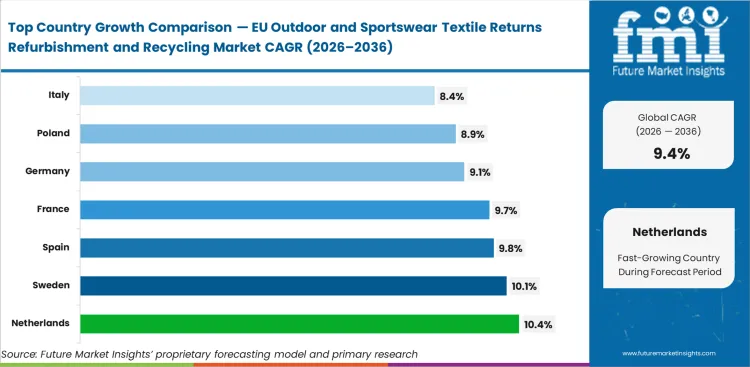
- Among key countries, the Netherlands is set to rise at 10.4% CAGR from 2026 to 2036, followed by Sweden at 10.1%, Spain at 9.8%, France at 9.7%, Germany at 9.1%, Poland at 8.9%, and Italy at 8.4% through 2036.
- Industry advancement still faces a capacity constraint, as Europe does not yet have enough sorting, disassembly, and fiber-to-fiber processing infrastructure to handle rising volumes of complex blended textiles efficiently.
- EU Outdoor and Sportswear Textile Returns Refurbishment and Recycling Industry Product and Segment View
- The market covers returned and post-use outdoor and sportswear textiles processed through refurbishment, mechanical recycling, chemical recycling, and lower-value recovery routes.
- E-commerce returns, store take-back, brand buy-back, and second-life resale pipelines form the main intake channels feeding this market.
- Refurbishment remains the leading route in Process Type because technical garments often justify inspection, repair, and relisting more effectively than direct material recovery, and the segment is expected to account for 41% share in 2026.
- Within Material Type, polyester is estimated to represent 38% share in 2026 because performance sportswear and outdoor apparel remain heavily weighted toward synthetic fiber constructions.
- Return Source continues to lean toward online channels, as apparel bought through e-commerce tends to move back into reverse-logistics systems more frequently across Europe. E-commerce returns are projected to secure 46% share in 2026.
- Performance apparel is likely to account for 34% share in 2026 under Product Type, as it offers better resale prospects, stronger brand retention, and smoother refurbishment economics than more heavily worn accessories.
- Brand-controlled second-life channels are becoming more important in End Channel as retailers look to retain value and manage returned stock more efficiently. Brand resale is set to capture 37% share in 2026.
- Market scope includes inspection, cleaning, repair, reconditioning, take-back sorting, and textile-to-textile recovery for outdoor and sportswear items, while excluding footwear-only loops, hardgoods, and broader municipal textile waste unrelated to these apparel categories.
- EU Outdoor and Sportswear Textile Returns Refurbishment and Recycling Industry Geography and Competitive Outlook
- Netherlands, Sweden, and France are emerging as the fastest-rising markets, while Germany remains the most established large-volume base because of its scale in collection, processing, and circular-textile activity.
- Competitive positioning is being shaped by textile-to-textile recycling scale-up, industrial disassembly capability, branded second-life programs, and outsourced reverse-logistics networks.
- Industry concentration remains low because collection, refurbishment, resale, and recycling activity is still distributed across specialist processors, brands, and regional service providers. Scale matters, but buyer requirements still vary by garment type, return condition, and channel economics.
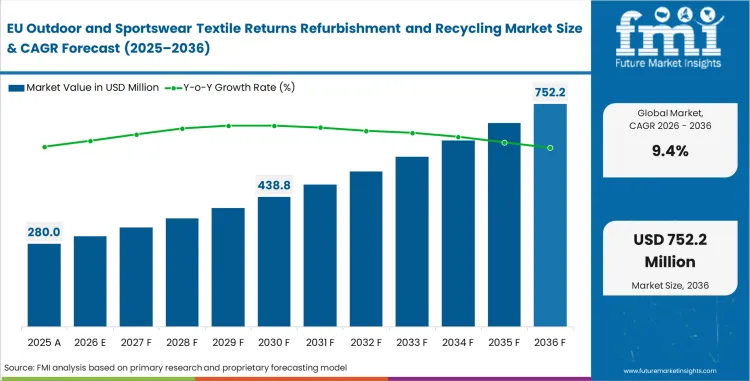
| Metric | Details |
|---|---|
| Industry Size (2026) | USD 280 million |
| Industry Value (2036) | USD 690 million |
| CAGR (2026 to 2036) | 9.4% |
Source: Future Market Insights (FMI) analysis, based on proprietary forecasting model and primary research
Once optical sorting systems reach higher material identification accuracy on blended performance fabrics, automated triage becomes more workable at scale. Near-infrared scanning arrays are central to this shift because they reduce the manual effort previously required to sort waterproof-breathable membranes and other technically complex garments. Daily throughput was often constrained when facilities had to rely on labor-intensive inspection for mixed-material sportswear, which limited processing efficiency across the outdoor apparel recycling industry in Europe. Better identification capability is now improving line speed, reducing sorting errors, and helping operators route garments into refurbishment or recycling channels with greater consistency.
Netherlands is set to record a 10.4% CAGR through 2036, supported by dense logistics networks that improve collection and processing efficiency. Sweden follows with the industry expected to advance at a 10.1% CAGR as producer responsibility frameworks keep recovery activity on a firmer footing. Spain is likely to post a 9.8% CAGR over the forecast period, helped by expanding localized sorting capacity. France, backed by anti-waste rules restricting destruction of unsold goods, is anticipated to see the industry rise at a 9.7% CAGR through 2036. Germany remains a stable processing base and industry valuation is projected to move at a 9.1% CAGR, supported by established collection systems for technical garments. Poland is expected to register an 8.9% CAGR as its central location supports handling of Western European return flows, while Italy is forecast to record 8.4% CAGR through 2036, reflecting its experience in premium textile recovery. Differences in national compliance timing continue to influence which countries attract facility investment earlier.
Segmental Analysis
EU Outdoor and Sportswear Textile Returns Refurbishment and Recycling Analysis by Process Type
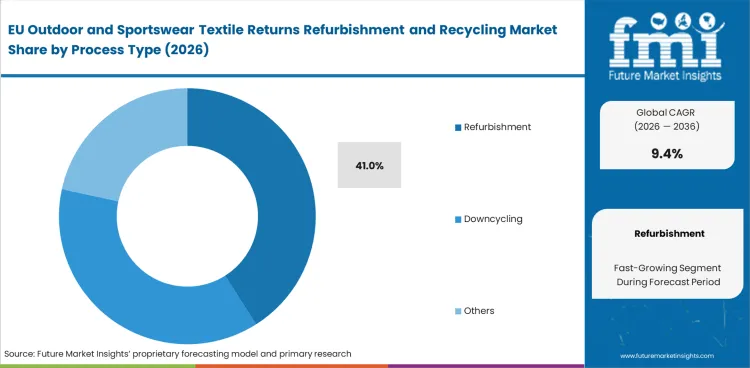
Repairing minor defects consumes far less energy than breaking garments down into raw fibers, which is why refurbishment remains the most commercially viable route for a large share of returned technical apparel. Chemical recycling of blended sportswear remains expensive and capacity-limited across the EU, while manual sorting still struggles when garments arrive without clear material identification. Misclassification pushes repairable items into lower-value shredding streams and weakens margin recovery across the chain. Refurbishment is expected to account for 41.0% share in 2026 within Process Type because it gives brands a more efficient route to preserve product value before degradation sets in.
- Margin realization: Restoring technical outerwear to functional condition can recover up to seventy percent of original retail value. This reduces write-down pressure that usually follows liquidation of used secondhand apparel.
- Sorting bottleneck: Identifying the right replacement parts for discontinued performance gear slows grading lines and extends handling time. Accurate repairs depend on access to historical product catalogs and component references.
- Yield degradation: Sending lightly worn garments straight into shredding erases embodied value from complex textile manufacturing. Recovery performance weakens when repairable stock enters destructive processing too early.
EU Outdoor and Sportswear Textile Returns Refurbishment and Recycling Analysis by Material Type
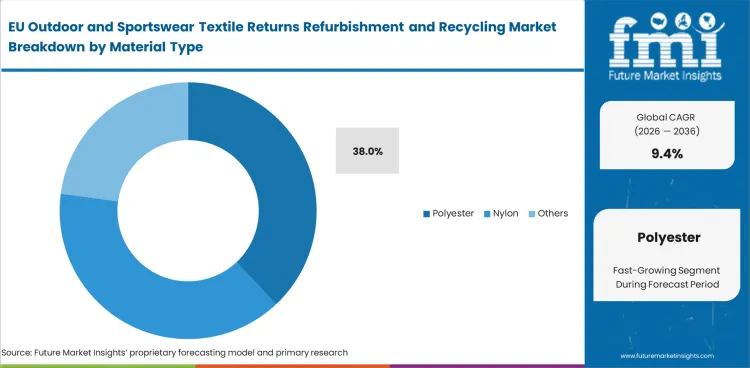
Polyester remains central to recovery economics because material composition determines which end-of-life route is commercially and technically viable. In 2026, polyester is estimated to represent 38.0% share within material type, reflecting its broad use across outdoor and sportswear garment construction. That position keeps polyester-heavy products easier to channel into dedicated recycling systems, as EU processing lines are increasingly aligned with high-volume synthetic streams. Mixed-material garments create more friction through sorting and treatment, especially when elastane bindings, coated finishes, and bonded layers reduce identification accuracy, slow throughput, and increase contamination risk. Operators that cannot isolate cleaner synthetic fractions therefore face more stoppages and weaker output consistency across both mechanical and chemical recovery routes.
- Input contamination: Stretch fabrics containing elastane interfere with shredding systems and contaminate chemical processing baths. Cleaner polyester recovery depends on precise pre-sorting before garments enter the line.
- Depolymerization yield: Pure polyester outerwear offers a stronger route to high-quality monomer recovery suitable for Recycled Polyester Apparel Fiber applications. Output quality remains far more reliable when feedstock composition is tightly controlled.
- Thermal sensitivity: High-heat friction during aggressive mechanical tearing melts synthetic performance fibers rather than separating them. Equipment technicians calibrate shredding speeds carefully to preserve fiber staple length.
EU Outdoor and Sportswear Textile Returns Refurbishment and Recycling Analysis by Return Source
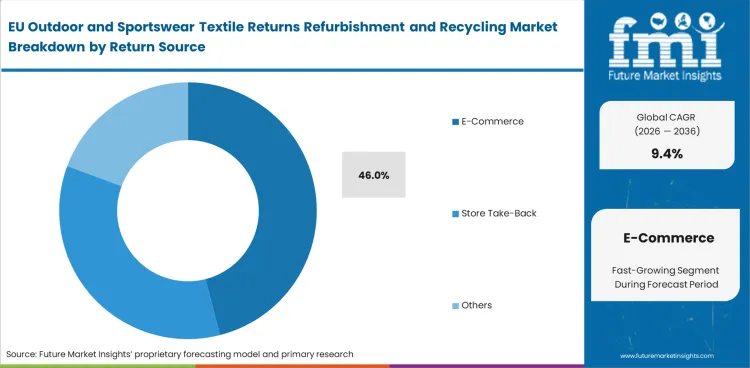
Online return flows continue to shape this industry because generous return policies send large volumes of lightly used garments back through reverse-logistics networks. Volume spikes during promotional periods put immediate pressure on receiving centers, where fast inspection and grading determine whether products move into refurbishment, resale, or recycling. A meaningful portion of returned outdoor gear arrives with limited wear but still requires close review for odor, abrasion, membrane damage, or contamination that affects resale suitability. Internal handling also gives brands access to valuable information on fit problems, product durability, and repeat defect patterns. E-commerce returns are projected to secure 46.0% share in 2026, making them the primary intake channel for this industry in Europe.
- Volume volatility: Online campaigns can send sudden surges of parcels into processing centers and disrupt normal workflow. Temporary labor and rapid triage become essential during these peaks.
- Condition grading: Hidden flaws such as micro-tears in waterproof membranes are difficult to detect without careful inspection. Resale quality depends on rigorous grading before garments return to market.
- Data capture: Internal processing allows recurring fit issues and product defects to be tracked more accurately. Product teams can use this feedback to improve future technical apparel lines.
EU Outdoor and Sportswear Textile Returns Refurbishment and Recycling Analysis by Product Type
In 2026, performance apparel is likely to account for 34.0% share under Product Type, supported by its stronger refurbishment potential and premium contract value. Performance apparel remains the most commercially attractive category in this industry because higher product value can justify specialized restoration work. Waterproof membranes, glued seams, seam taping, and durable water repellent finishes all require controlled handling, and facilities with those capabilities can retain more value than operators limited to standard cleaning or bulk recycling.
- Membrane restoration: Reapplying durable water repellent finishes requires controlled conditions and dedicated curing equipment. Restored garments need to return with performance characteristics close to original specification.
- Seam sealing: Repairing delaminated internal taping depends on heat-press precision and correct adhesive use. Successful seam restoration extends the usable life of high-value outerwear.
- Hardware replacement: Proprietary zippers, toggles, and fastening systems complicate repair planning for technical gear. Broad component libraries are necessary to support multiple apparel brands efficiently.
EU Outdoor and Sportswear Textile Returns Refurbishment and Recycling Analysis by End Channel
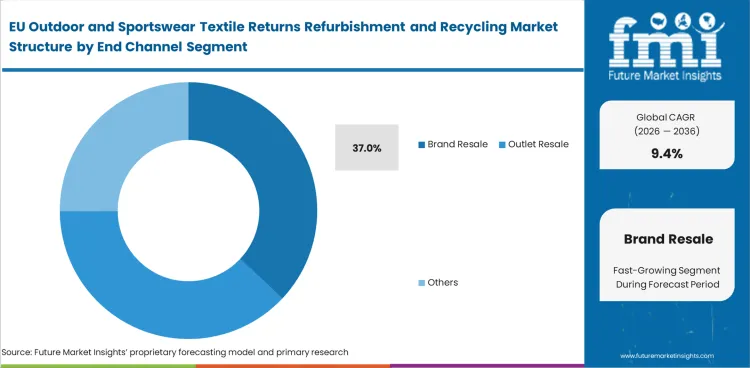
Brand-controlled resale is gaining importance because labels want to recover value from returned garments without surrendering product presentation, pricing discipline, or customer relationships to external liquidators. Refurbished items placed through managed apparel re-commerce channels can be integrated alongside new collections, helping brands reach more price-sensitive consumers while keeping tighter control over quality and positioning. Secondary-market control also matters for technical garments, where condition, functionality, and authenticity influence brand reputation long after first sale. Operators that lack a branded resale route often recover less value and lose oversight of how products perform in later-use channels. Brand resale is set to capture 37.0% share in 2026 as controlled second-life platforms continue expanding across the region.
- Customer acquisition: Certified refurbished gear opens access to younger consumers who are priced out of premium new products. Repeat engagement improves when second-life offerings remain within the same brand ecosystem.
- Authentication protocols: Verifying returned technical outerwear protects resale credibility and reduces counterfeit risk. Digital product identification can improve traceability through the grading process.
- Pricing algorithms: Condition-based and season-sensitive pricing improves recovery from refurbished inventory. Automated tools help clear stock faster without undermining premium positioning.
EU Outdoor and Sportswear Textile Returns Refurbishment and Recycling Drivers, Restraints, and Opportunities
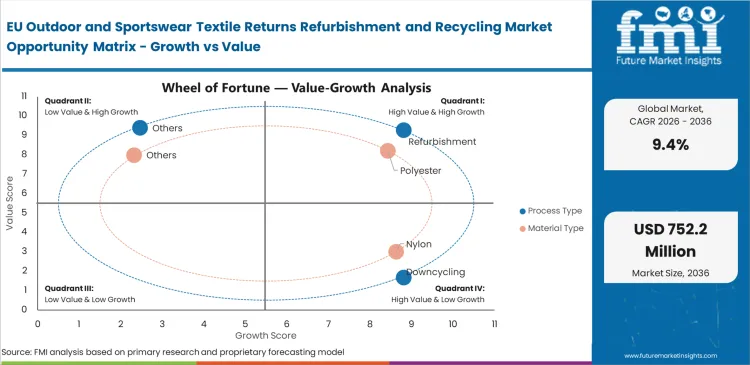
Industry outlook is on a positive trend as high return rates in e-commerce push brands to build localized repair and recovery loops that protect retained value. Cross-border reverse logistics often consume too much of the margin on lightly worn technical garments, making regional processing a more workable model for returned stock. Rules restricting destruction of unsold textiles are also pushing more volumes into refurbishment, resale, and recycling channels across the EU. Virgin synthetic fiber price volatility adds another layer of support, as processors and apparel brands look for cleaner post-consumer feedstock streams that can reduce exposure to raw material swings. Landfill costs across Western Europe are rising as well, which improves the commercial case for repair-led and recycling-led recovery routes.
Multi-layer garment construction remains the main restraint because glued seams, waterproof membranes, coated finishes, and hidden stretch elements are difficult to separate without damaging the base material. Mechanical recycling loses efficiency when garments jam equipment or produce inconsistent shredded output, while chemical recovery struggles when input quality is mixed or poorly identified. Sorting remains slow where products arrive without reliable composition data, and manual lines often lack the throughput needed to process rising return volumes profitably. Margin pressure intensifies when high-value items stay too long in staging or move into the wrong recovery stream.
Opportunities in the EU Outdoor and Sportswear Textile Returns Refurbishment and Recycling
- Digital passport integration: Traceable identifiers embedded in garments can give sorting lines faster access to composition and construction data. Triage becomes quicker and more accurate when product information is available at intake.
- Automated delamination: Solvents designed to target seam adhesives can improve separation of complex outerwear layers. Cleaner fiber recovery creates better downstream suitability for recycled polyester apparel fiber processing.
- Localized micro-factories: Small repair hubs positioned near major distribution clusters can reduce transport intensity and shorten turnaround time. Faster re-entry into resale channels improves working recovery rates for returned inventory.
Regional Analysis
.webp "Top Country Growth Comparison Eu Outdoor And Sportswear Textile Returns Refurbishment And Recycling Market Cagr (2026 2036)")
Based on regional analysis, EU Outdoor and Sportswear Textile Returns Refurbishment and Recycling is segmented into key European countries.
| Country | CAGR (2026 to 2036) |
|---|---|
| Netherlands | 10.4% |
| Sweden | 10.1% |
| Spain | 9.8% |
| France | 9.7% |
| Germany | 9.1% |
| Poland | 8.9% |
| Italy | 8.4% |
Source: Future Market Insights (FMI) analysis, based on proprietary forecasting model and primary research
Northern Europe EU Outdoor and Sportswear Textile Returns Refurbishment and Recycling Analysis
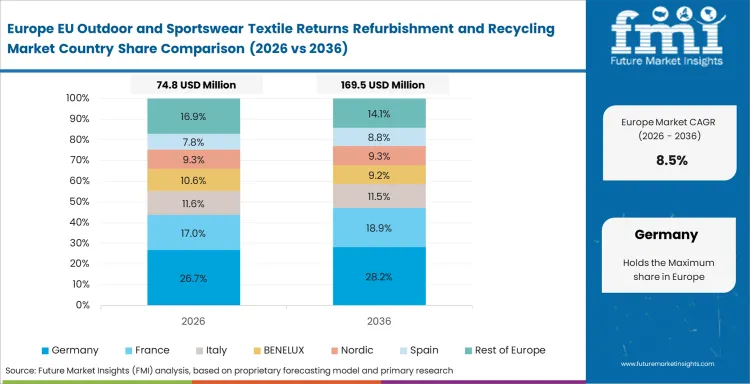
Northern Europe benefits from dense logistics coverage, established port access, and earlier adoption of circular fashion practices, which make regional processing more efficient for returned technical apparel. Processing hubs in this part of the EU can aggregate garments from multiple nearby countries with lower handling friction, while the concentration of major apparel groups supports closer alignment between product development and end-of-life recovery operations. This combination is keeping refurbishment, sorting, and higher-value recycling routes on an ascending path across the region.
- Netherlands: Demand for EU Outdoor and Sportswear Textile Returns Refurbishment and Recycling in the Netherlands is anticipated to rise at a 10.4% CAGR through 2036. Advanced near-infrared scanning supports high-volume handling of mixed synthetic athletic wear, while centralized collection systems reduce inbound freight pressure. Automated triage capability also helps operators improve processing speed and throughput consistency.
- Sweden: Strict environmental controls and a strong technical focus are helping this industry remain on a positive trend in Sweden. Solvent-based separation work for multi-layer waterproof garments is receiving close attention, especially where emission management and process control determine plant efficiency. The industry in Sweden is expected to register a 10.1% CAGR through 2036, which gives the country a strong position in higher-specification recovery activity.
FMI’s report includes detailed analysis of textile returns refurbishment flows, resale channel development, sorting technologies, and synthetic garment recovery trends across the Netherlands and Sweden.
Western Europe EU Outdoor and Sportswear Textile Returns Refurbishment and Recycling Analysis
Western Europe is benefiting from tighter anti-waste rules, high public awareness of textile disposal issues, and strong participation in organized take-back channels. Dense urban collection flows support specialized refurbishment and recycling operations, while the regional industry is steadily inclining toward more advanced separation and recovery methods for post-consumer sportswear. Processing activity across this part of the EU is moving beyond basic collection into more controlled repair, grading, and material recovery systems.
- France: The industry in France is poised to expand at a 9.7% CAGR through 2036. Domestic repair capability is becoming more important as operators work to keep functional outerwear in circulation for longer periods, while inventory systems help match incoming returns with spare components more efficiently. Localized repair networks also improve turnaround time and reduce dependence on longer cross-border recovery routes.
- Germany: Established collection systems give Germany a reliable flow of end-of-use technical garments, which supports both refurbishment and synthetic textile recovery. Mechanical shredding efficiency and cleaner feedstock preparation remain important because output quality depends heavily on consistency at intake. Industry valuation in Germany advances at a 9.1% CAGR through 2036, and stronger use of digital product identification is improving sorting accuracy across processing lines.
FMI’s report includes assessment of anti-waste policy impact, repair network economics, reverse-logistics efficiency, and sorting and recycling activity across France and Germany.
Southern & Eastern Europe EU Outdoor and Sportswear Textile Returns Refurbishment and Recycling Analysis
Southern and Eastern Europe are gaining relevance as operators look for more cost-effective ways to manage rising e-commerce return volumes. Repair hubs and sorting centers are expanding in this part of the region because lower operating costs and available industrial space improve the economics of handling returned technical garments. Regional policy support is also helping textile recovery activity rise, particularly where job creation and local processing capacity move together.
- Spain: Cost-efficient repair operations are helping the industry outlook in Spain remain on a positive trend. Lightweight performance apparel and running gear move through local facilities in high volumes, while grading software supports faster categorization of returned products. Spain is forecast to record a 9.8% CAGR in EU Outdoor and Sportswear Textile Returns Refurbishment and Recycling through 2036, which strengthens its role as a repair-oriented processing base.
- Poland: Central processing hubs in Poland handle large cross-border flows of returned apparel from Western Europe, giving the country a practical role in manual grading and bulk sorting. Geographic positioning supports efficient transfer of inbound volumes, while continued capacity additions are improving handling scale. The industry across Poland is expected to rise at an 8.9% CAGR through 2036. This keeps the country relevant for outsourced returns processing.
- Italy: EU outdoor and sportswear textile returns refurbishment and recycling in Italy is likely to post an 8.4% CAGR through 2036, supported by ongoing upgrades in machinery and handling precision. Historical expertise in premium textile recovery is helping Italy adapt advanced sorting and depolymerization methods for higher-value technical outerwear. Local operators are refining processing quality for synthetic blends where brand standards remain strict and restoration quality matters.
FMI’s report includes evaluation of localized repair hubs, grading and sorting expansion, cross-border returns handling, and textile recovery capacity trends across Spain, Poland, and Italy.
Competitive Aligners for Market Players
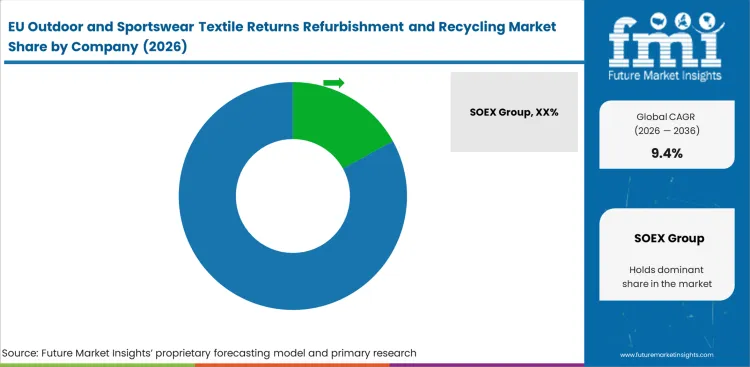
Capability in handling multi-layer waterproof membranes, bonded fabrics, and technical garment constructions remains a key separator among leading processors. Competitive strength in this industry is moving more toward processing speed, grading precision, and recovery consistency than toward basic collection reach alone. Control over high-value active wear returns depends on proving reliable turnaround and accurate disposition decisions across refurbishment, resale, and recycling channels.
Proprietary knowledge of historical garment builds, repair pathways, and component matching also strengthens competitive positioning. Operators with deeper experience in seam sealing, zipper replacement, panel repair, and technical garment restoration can return more products to usable condition and preserve greater retained value. Replicating that capability is difficult without a strong repair base, trained technical labor, and access to an advanced textile waste recycling machine for items that are no longer suitable for refurbishment. Competitive pressure is therefore rising around repair depth, material recovery yield, and the ability to manage both restoration and recycling within the same operating model.
Brand requirements continue to shape industry alignment because refurbished inventory must meet strict quality thresholds before it can return to controlled resale channels. Real-time visibility into recovery rates and second-life availability is becoming more important as brands seek tighter control over product flow after return. Commercial advantage increasingly rests on operational discipline, technical repair capability, and consistent execution across branded recovery programs.
Key Players in EU Outdoor and Sportswear Textile Returns Refurbishment and Recycling
- SOEX Group
- ACS Clothing
- Recover
- Infinited Fiber Company
- Reju
- Resortecs
- Decathlon Second Life
Scope of the Report
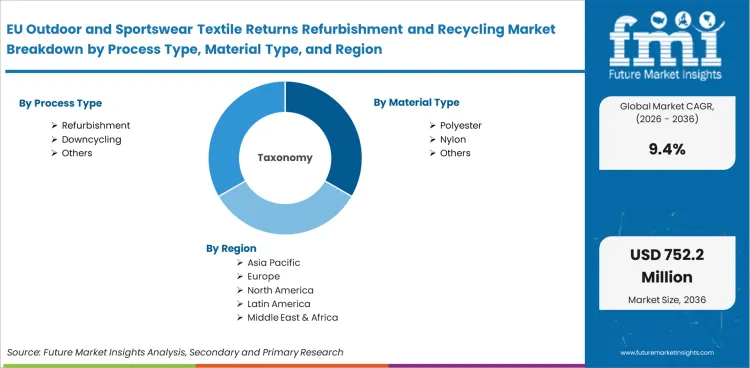
| Metric | Value |
|---|---|
| Quantitative Units | USD 280 million to USD 690 million, at a CAGR of 9.4% |
| Market Definition | Processing operations dedicated to recovering value from returned technical athletic apparel define this sector. Operations span inspection, cleaning, repair, and material recovery. |
| Segmentation | Process Type, Material Type, Return Source, Product Type, End Channel, Condition Grade, Technology Stack, Region |
| Regions Covered | North America, Latin America, Western Europe, Eastern Europe, Asia Pacific |
| Countries Covered | Germany, France, Netherlands, Sweden, Spain, Italy, Poland |
| Key Companies Profiled | SOEX Group, ACS Clothing, Recover, Infinited Fiber Company, Reju, Resortecs, Decathlon Second Life |
| Forecast Period | 2026 to 2036 |
| Approach | Tonnage of returned e-commerce technical apparel processed through commercial sorting facilities anchored baseline valuation. |
Source: Future Market Insights (FMI) analysis, based on proprietary forecasting model and primary research
EU Outdoor and Sportswear Textile Returns Refurbishment and Recycling Analysis by Segments
Process Type
- Refurbishment
- Mechanical recycling
- Chemical recycling
- Downcycling
Material Type
- Polyester
- Nylon
- Cotton blends
- Elastane blends
Return Source
- E-commerce returns
- Store take-back
- Brand buy-back
- Rental returns
Product Type
- Performance apparel
- Outerwear
- Base layers
- Sports accessories
End Channel
- Brand resale
- Outlet resale
- Fiber recovery
- Industrial wiping
Condition Grade
- Resalable
- Repairable
- Recyclable
- Reject
Technology Stack
- Inspection
- Cleaning
- Repair
- Digital ID
Region
- North America
- Latin America
- Western Europe
- Eastern Europe
- Asia Pacific
Bibliography
- European Commission. (2025, October 16). Revised Waste Framework Directive enters into force.
- European Environment Agency. (2024, March 4). The destruction of returned and unsold textiles in Europe’s circular economy.
- European Environment Agency. (2025, March 26). Circularity of the EU textiles value chain in numbers.
- European Parliamentary Research Service. (2024, June). Digital product passport for the textile sector.
- Eurostat. (2025, February 20). Online shopping in the EU keeps growing.
This bibliography is provided for reader reference. The full FMI report contains the complete reference list with primary source documentation.
This Report Addresses
- Margin erosion risks forcing brand operations managers to implement localized repair loops across Western Europe.
- Processing bottlenecks caused by multi-layer waterproof garments entering standard mechanical shredding facilities.
- Capacity constraints at chemical depolymerization plants handling elastane-blended athletic performance apparel.
- E-commerce return volatility impacting staffing requirements at dedicated technical outerwear sorting centers.
- Revenue recovery strategies utilized by e-commerce directors deploying proprietary brand resale platforms.
- Compliance pressures driving sourcing directors to secure chemically recycled feedstock from post-consumer technical wear.
- Capital expenditure barriers preventing smaller facility operators from deploying near-infrared material identification arrays.
- Contractual tensions between outdoor labels setting strict grading criteria and third-party repair processors.
Frequently Asked Questions
How large is the EU outdoor and sportswear textile recycling market?
Sector valuation stood at USD 280 million in 2026, driven by reverse logistics and brand margin recovery requirements.
What is driving sportswear refurbishment growth in Europe?
High cross-border shipping costs and European waste directives penalizing unsold inventory destruction compel local repair network expansion.
Which countries lead outdoor apparel recycling in Europe?
Netherlands leads through dense logistics networks, while Sweden drives progress via aggressive producer responsibility frameworks and compliance mandates.
Why are sportswear returns high in e-commerce?
Generous online return policies generate massive inbound volumes as consumers frequently return gear after single-use weekend trips.
What limits chemical recycling yields in this specific sector?
Complex multi-layer constructions designed for extreme weather resistance actively resist chemical breakdown during depolymerization.
Why does refurbishment dominate processing types?
Repairing minor defects requires significantly less energy than breaking down garments into raw fibers, retaining original retail value.
How do elastane bindings disrupt mechanical processing?
Stretch fabrics containing elastane disrupt mechanical shredding teeth and contaminate chemical solvent baths, degrading output quality.
What creates logistical friction for regional distribution centers?
Reverse logistics managers struggle to staff sorting lines adequately during volatile peak periods tied to promotional calendars.
Why is standard garment cleaning insufficient for performance apparel?
Specialized re-waterproofing chemistry requires dedicated application booths to restore original functional specifications on technical outerwear.
How do outdoor labels utilize brand resale channels?
Companies utilize controlled platforms to manage brand equity and prevent unauthorized liquidators from dumping valuable inventory.
Why are localized micro-factories gaining traction?
Establishing small-scale repair hubs near major distribution centers helps reverse logistics managers reduce transport emissions.
What limits the adoption of near-infrared scanning arrays?
Capital expenditure required to install and calibrate advanced optical sorting technology remains prohibitive for smaller regional processors.
How do brands capture data from internally processed returns?
Processing returns internally allows brands to identify recurring manufacturing defects causing customer dissatisfaction.
Why do manual grading lines struggle with performance gear?
Identifying correct replacement components for discontinued performance gear slows manual grading lines significantly.
What risk do unauthorized liquidators pose to outdoor brands?
Labels relying on third-party liquidators for complex returns forfeit critical customer data regarding product fit failures.
How do environmental regulations impact recycling facility operations?
Strict environmental regulations drive continuous improvement in emission controls at recycling facilities across Europe.
Why do sourcing directors secure chemically recycled feedstock early?
Virgin synthetic fiber price volatility pushes sourcing directors to secure alternative feedstock from post-consumer technical wear.
Preview the report firsthand - request a free sample
Get SampleGet the brochure for pricing and purchase details.
Get PDFTable of Content
- Executive Summary
- Global Market Outlook
- Demand-side Trends
- Supply-side Trends
- Technology Roadmap Analysis
- Analysis and Recommendations
- Market Overview
- Market Coverage / Taxonomy
- Market Definition / Scope / Limitations
- Research Methodology
- Chapter Orientation
- Analytical Lens and Working Hypotheses
- Market Structure, Signals, and Trend Drivers
- Benchmarking and Cross-market Comparability
- Market Sizing, Forecasting, and Opportunity Mapping
- Research Design and Evidence Framework
- Desk Research Programme (Secondary Evidence)
- Company Annual and Sustainability Reports
- Peer-reviewed Journals and Academic Literature
- Corporate Websites, Product Literature, and Technical Notes
- Earnings Decks and Investor Briefings
- Statutory Filings and Regulatory Disclosures
- Technical White Papers and Standards Notes
- Trade Journals, Industry Magazines, and Analyst Briefs
- Conference Proceedings, Webinars, and Seminar Materials
- Government Statistics Portals and Public Data Releases
- Press Releases and Reputable Media Coverage
- Specialist Newsletters and Curated Briefings
- Sector Databases and Reference Repositories
- FMI Internal Proprietary Databases and Historical Market Datasets
- Subscription Datasets and Paid Sources
- Social Channels, Communities, and Digital Listening Inputs
- Additional Desk Sources
- Expert Input and Fieldwork (Primary Evidence)
- Primary Modes
- Qualitative Interviews and Expert Elicitation
- Quantitative Surveys and Structured Data Capture
- Blended Approach
- Why Primary Evidence is Used
- Field Techniques
- Interviews
- Surveys
- Focus Groups
- Observational and In-context Research
- Social and Community Interactions
- Stakeholder Universe Engaged
- C-suite Leaders
- Board Members
- Presidents and Vice Presidents
- R&D and Innovation Heads
- Technical Specialists
- Domain Subject-matter Experts
- Scientists
- Physicians and Other Healthcare Professionals
- Governance, Ethics, and Data Stewardship
- Research Ethics
- Data Integrity and Handling
- Primary Modes
- Tooling, Models, and Reference Databases
- Desk Research Programme (Secondary Evidence)
- Data Engineering and Model Build
- Data Acquisition and Ingestion
- Cleaning, Normalisation, and Verification
- Synthesis, Triangulation, and Analysis
- Quality Assurance and Audit Trail
- Market Background
- Market Dynamics
- Drivers
- Restraints
- Opportunity
- Trends
- Scenario Forecast
- Demand in Optimistic Scenario
- Demand in Likely Scenario
- Demand in Conservative Scenario
- Opportunity Map Analysis
- Product Life Cycle Analysis
- Supply Chain Analysis
- Investment Feasibility Matrix
- Value Chain Analysis
- PESTLE and Porter’s Analysis
- Regulatory Landscape
- Regional Parent Market Outlook
- Production and Consumption Statistics
- Import and Export Statistics
- Market Dynamics
- Global Market Analysis 2021 to 2025 and Forecast, 2026 to 2036
- Historical Market Size Value (USD Million) Analysis, 2021 to 2025
- Current and Future Market Size Value (USD Million) Projections, 2026 to 2036
- Y-o-Y Growth Trend Analysis
- Absolute $ Opportunity Analysis
- Global Market Pricing Analysis 2021 to 2025 and Forecast 2026 to 2036
- Global Market Analysis 2021 to 2025 and Forecast 2026 to 2036, By Process Type
- Introduction / Key Findings
- Historical Market Size Value (USD Million) Analysis By Process Type , 2021 to 2025
- Current and Future Market Size Value (USD Million) Analysis and Forecast By Process Type , 2026 to 2036
- Refurbishment
- Downcycling
- Others
- Refurbishment
- Y-o-Y Growth Trend Analysis By Process Type , 2021 to 2025
- Absolute $ Opportunity Analysis By Process Type , 2026 to 2036
- Global Market Analysis 2021 to 2025 and Forecast 2026 to 2036, By Material Type
- Introduction / Key Findings
- Historical Market Size Value (USD Million) Analysis By Material Type, 2021 to 2025
- Current and Future Market Size Value (USD Million) Analysis and Forecast By Material Type, 2026 to 2036
- Polyester
- Nylon
- Others
- Polyester
- Y-o-Y Growth Trend Analysis By Material Type, 2021 to 2025
- Absolute $ Opportunity Analysis By Material Type, 2026 to 2036
- Global Market Analysis 2021 to 2025 and Forecast 2026 to 2036, By Return Source
- Introduction / Key Findings
- Historical Market Size Value (USD Million) Analysis By Return Source, 2021 to 2025
- Current and Future Market Size Value (USD Million) Analysis and Forecast By Return Source, 2026 to 2036
- E-Commerce
- Store Take-Back
- Others
- E-Commerce
- Y-o-Y Growth Trend Analysis By Return Source, 2021 to 2025
- Absolute $ Opportunity Analysis By Return Source, 2026 to 2036
- Global Market Analysis 2021 to 2025 and Forecast 2026 to 2036, By Product Type
- Introduction / Key Findings
- Historical Market Size Value (USD Million) Analysis By Product Type, 2021 to 2025
- Current and Future Market Size Value (USD Million) Analysis and Forecast By Product Type, 2026 to 2036
- Performance Apparel
- Outerwear
- Base Layers
- Performance Apparel
- Y-o-Y Growth Trend Analysis By Product Type, 2021 to 2025
- Absolute $ Opportunity Analysis By Product Type, 2026 to 2036
- Global Market Analysis 2021 to 2025 and Forecast 2026 to 2036, By End Channel
- Introduction / Key Findings
- Historical Market Size Value (USD Million) Analysis By End Channel, 2021 to 2025
- Current and Future Market Size Value (USD Million) Analysis and Forecast By End Channel, 2026 to 2036
- Brand Resale
- Outlet Resale
- Others
- Brand Resale
- Y-o-Y Growth Trend Analysis By End Channel, 2021 to 2025
- Absolute $ Opportunity Analysis By End Channel, 2026 to 2036
- Global Market Analysis 2021 to 2025 and Forecast 2026 to 2036, By Region
- Introduction
- Historical Market Size Value (USD Million) Analysis By Region, 2021 to 2025
- Current Market Size Value (USD Million) Analysis and Forecast By Region, 2026 to 2036
- North America
- Latin America
- Western Europe
- Eastern Europe
- East Asia
- South Asia and Pacific
- Middle East & Africa
- Market Attractiveness Analysis By Region
- North America Market Analysis 2021 to 2025 and Forecast 2026 to 2036, By Country
- Historical Market Size Value (USD Million) Trend Analysis By Market Taxonomy, 2021 to 2025
- Market Size Value (USD Million) Forecast By Market Taxonomy, 2026 to 2036
- By Country
- USA
- Canada
- Mexico
- By Process Type
- By Material Type
- By Return Source
- By Product Type
- By End Channel
- By Country
- Market Attractiveness Analysis
- By Country
- By Process Type
- By Material Type
- By Return Source
- By Product Type
- By End Channel
- Key Takeaways
- Latin America Market Analysis 2021 to 2025 and Forecast 2026 to 2036, By Country
- Historical Market Size Value (USD Million) Trend Analysis By Market Taxonomy, 2021 to 2025
- Market Size Value (USD Million) Forecast By Market Taxonomy, 2026 to 2036
- By Country
- Brazil
- Chile
- Rest of Latin America
- By Process Type
- By Material Type
- By Return Source
- By Product Type
- By End Channel
- By Country
- Market Attractiveness Analysis
- By Country
- By Process Type
- By Material Type
- By Return Source
- By Product Type
- By End Channel
- Key Takeaways
- Western Europe Market Analysis 2021 to 2025 and Forecast 2026 to 2036, By Country
- Historical Market Size Value (USD Million) Trend Analysis By Market Taxonomy, 2021 to 2025
- Market Size Value (USD Million) Forecast By Market Taxonomy, 2026 to 2036
- By Country
- Germany
- UK
- Italy
- Spain
- France
- Nordic
- BENELUX
- Rest of Western Europe
- By Process Type
- By Material Type
- By Return Source
- By Product Type
- By End Channel
- By Country
- Market Attractiveness Analysis
- By Country
- By Process Type
- By Material Type
- By Return Source
- By Product Type
- By End Channel
- Key Takeaways
- Eastern Europe Market Analysis 2021 to 2025 and Forecast 2026 to 2036, By Country
- Historical Market Size Value (USD Million) Trend Analysis By Market Taxonomy, 2021 to 2025
- Market Size Value (USD Million) Forecast By Market Taxonomy, 2026 to 2036
- By Country
- Russia
- Poland
- Hungary
- Balkan & Baltic
- Rest of Eastern Europe
- By Process Type
- By Material Type
- By Return Source
- By Product Type
- By End Channel
- By Country
- Market Attractiveness Analysis
- By Country
- By Process Type
- By Material Type
- By Return Source
- By Product Type
- By End Channel
- Key Takeaways
- East Asia Market Analysis 2021 to 2025 and Forecast 2026 to 2036, By Country
- Historical Market Size Value (USD Million) Trend Analysis By Market Taxonomy, 2021 to 2025
- Market Size Value (USD Million) Forecast By Market Taxonomy, 2026 to 2036
- By Country
- China
- Japan
- South Korea
- By Process Type
- By Material Type
- By Return Source
- By Product Type
- By End Channel
- By Country
- Market Attractiveness Analysis
- By Country
- By Process Type
- By Material Type
- By Return Source
- By Product Type
- By End Channel
- Key Takeaways
- South Asia and Pacific Market Analysis 2021 to 2025 and Forecast 2026 to 2036, By Country
- Historical Market Size Value (USD Million) Trend Analysis By Market Taxonomy, 2021 to 2025
- Market Size Value (USD Million) Forecast By Market Taxonomy, 2026 to 2036
- By Country
- India
- ASEAN
- Australia & New Zealand
- Rest of South Asia and Pacific
- By Process Type
- By Material Type
- By Return Source
- By Product Type
- By End Channel
- By Country
- Market Attractiveness Analysis
- By Country
- By Process Type
- By Material Type
- By Return Source
- By Product Type
- By End Channel
- Key Takeaways
- Middle East & Africa Market Analysis 2021 to 2025 and Forecast 2026 to 2036, By Country
- Historical Market Size Value (USD Million) Trend Analysis By Market Taxonomy, 2021 to 2025
- Market Size Value (USD Million) Forecast By Market Taxonomy, 2026 to 2036
- By Country
- Kingdom of Saudi Arabia
- Other GCC Countries
- Turkiye
- South Africa
- Other African Union
- Rest of Middle East & Africa
- By Process Type
- By Material Type
- By Return Source
- By Product Type
- By End Channel
- By Country
- Market Attractiveness Analysis
- By Country
- By Process Type
- By Material Type
- By Return Source
- By Product Type
- By End Channel
- Key Takeaways
- Key Countries Market Analysis
- USA
- Pricing Analysis
- Market Share Analysis, 2025
- By Process Type
- By Material Type
- By Return Source
- By Product Type
- By End Channel
- Canada
- Pricing Analysis
- Market Share Analysis, 2025
- By Process Type
- By Material Type
- By Return Source
- By Product Type
- By End Channel
- Mexico
- Pricing Analysis
- Market Share Analysis, 2025
- By Process Type
- By Material Type
- By Return Source
- By Product Type
- By End Channel
- Brazil
- Pricing Analysis
- Market Share Analysis, 2025
- By Process Type
- By Material Type
- By Return Source
- By Product Type
- By End Channel
- Chile
- Pricing Analysis
- Market Share Analysis, 2025
- By Process Type
- By Material Type
- By Return Source
- By Product Type
- By End Channel
- Germany
- Pricing Analysis
- Market Share Analysis, 2025
- By Process Type
- By Material Type
- By Return Source
- By Product Type
- By End Channel
- UK
- Pricing Analysis
- Market Share Analysis, 2025
- By Process Type
- By Material Type
- By Return Source
- By Product Type
- By End Channel
- Italy
- Pricing Analysis
- Market Share Analysis, 2025
- By Process Type
- By Material Type
- By Return Source
- By Product Type
- By End Channel
- Spain
- Pricing Analysis
- Market Share Analysis, 2025
- By Process Type
- By Material Type
- By Return Source
- By Product Type
- By End Channel
- France
- Pricing Analysis
- Market Share Analysis, 2025
- By Process Type
- By Material Type
- By Return Source
- By Product Type
- By End Channel
- India
- Pricing Analysis
- Market Share Analysis, 2025
- By Process Type
- By Material Type
- By Return Source
- By Product Type
- By End Channel
- ASEAN
- Pricing Analysis
- Market Share Analysis, 2025
- By Process Type
- By Material Type
- By Return Source
- By Product Type
- By End Channel
- Australia & New Zealand
- Pricing Analysis
- Market Share Analysis, 2025
- By Process Type
- By Material Type
- By Return Source
- By Product Type
- By End Channel
- China
- Pricing Analysis
- Market Share Analysis, 2025
- By Process Type
- By Material Type
- By Return Source
- By Product Type
- By End Channel
- Japan
- Pricing Analysis
- Market Share Analysis, 2025
- By Process Type
- By Material Type
- By Return Source
- By Product Type
- By End Channel
- South Korea
- Pricing Analysis
- Market Share Analysis, 2025
- By Process Type
- By Material Type
- By Return Source
- By Product Type
- By End Channel
- Russia
- Pricing Analysis
- Market Share Analysis, 2025
- By Process Type
- By Material Type
- By Return Source
- By Product Type
- By End Channel
- Poland
- Pricing Analysis
- Market Share Analysis, 2025
- By Process Type
- By Material Type
- By Return Source
- By Product Type
- By End Channel
- Hungary
- Pricing Analysis
- Market Share Analysis, 2025
- By Process Type
- By Material Type
- By Return Source
- By Product Type
- By End Channel
- Kingdom of Saudi Arabia
- Pricing Analysis
- Market Share Analysis, 2025
- By Process Type
- By Material Type
- By Return Source
- By Product Type
- By End Channel
- Turkiye
- Pricing Analysis
- Market Share Analysis, 2025
- By Process Type
- By Material Type
- By Return Source
- By Product Type
- By End Channel
- South Africa
- Pricing Analysis
- Market Share Analysis, 2025
- By Process Type
- By Material Type
- By Return Source
- By Product Type
- By End Channel
- USA
- Market Structure Analysis
- Competition Dashboard
- Competition Benchmarking
- Market Share Analysis of Top Players
- By Regional
- By Process Type
- By Material Type
- By Return Source
- By Product Type
- By End Channel
- Competition Analysis
- Competition Deep Dive
- SOEX Group
- Overview
- Product Portfolio
- Profitability by Market Segments (Product/Age /Sales Channel/Region)
- Sales Footprint
- Strategy Overview
- Marketing Strategy
- Product Strategy
- Channel Strategy
- ACS Clothing
- Recover
- Infinited Fiber Company
- Reju
- Resortecs
- SOEX Group
- Competition Deep Dive
- Assumptions & Acronyms Used


