

- Market Size (2026)
- USD 171.4 Mn
- Forecast (2036)
- USD 312.8 Mn
- CAGR (2026 to 2036)
- 6.2%
Recycled Technical Textiles for EU Automotive Acoustic Insulation Industry Size, Market Forecast and Outlook by FMI
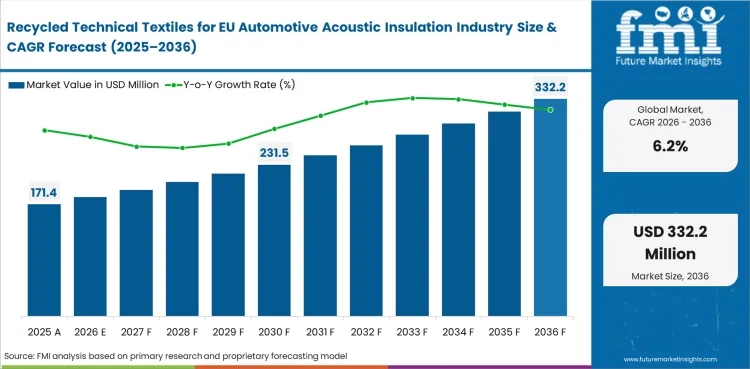
Recycled technical textiles for EU automotive acoustic insulation industry was valued at USD 161.4 million in 2025. As per FMI, industry is expected to cross a value of USD 171.4 million in 2026. Market value is projected to reach USD 312.8 million by 2036 at a 6.2% CAGR.
Summary of Recycled Technical Textiles for EU Automotive Acoustic Insulation Market
- Recycled Technical textiles for EU automotive acoustic insulation industry is expected to reach USD 312.8 million by 2036.
- Industry is estimated to rise at a CAGR of 6.2% CAGR from 2026 to 2036.
- Industry valuation totaled USD 161.4 million in 2025.
- Market size is estimated at USD 171.4 million in 2026.
- Incremental opportunity across the forecast period totals USD 141.4 million.
- rPET is projected to account for 38.0% share in 2026 by material type because converters prefer a recycled fiber base with more stable forming behavior.
- The floor insulators is anticipated to hold around 24% share in 2026 by application because acoustic loading per vehicle is higher in this part than in smaller trim inserts.
- Passenger cars are expected to represent 52.0% share in 2026 by vehicle type as EU vehicle production stays concentrated in this class.
- Share contribution from needlepunch is estimated at 41.0% in 2026 by manufacturing process because reclaimed fibers are easier to process through this route.
- OEM fitment is projected to hold 81.0% of distribution demand in 2026 since acoustic insulation is specified during platform engineering, not after vehicle sale.
Key Takeaways, Market Size, and Forecast
- Recycled Technical Textiles for EU Automotive Acoustic Insulation Industry is projected to grow from USD 171.4 million in 2026 to USD 312.8 million by 2036, at a CAGR of 6.2%.
- The recycled technical textiles for EU automotive acoustic insulation industry was valued at USD 161.4 million in 2025.
- By 2036, the Recycled Technical Textiles for EU Automotive Acoustic Insulation Industry is expected to be worth USD 312.8 million.
- From 2026 to 2036, the industry is anticipated to expand at a CAGR of 6.2%.
- The industry is predicted to create an incremental opportunity of USD 141.4 million between 2026 and 2036.
- In 2026, rPET is expected to account for 38.0% of the material type segment.
- Spain (6.7%) and Poland (6.5%) are projected to be two of the fastest growing markets.
Recycled Technical Textiles for EU Automotive Acoustic Insulation Industry Key Takeaways
| Parameter | Details |
|---|---|
| Market Value (2026) | USD 171.4 million |
| Forecast Value (2036) | USD 312.8 million |
| CAGR (2026 to 2036) | 6.2% |
| Estimated Market Value (2025) | USD 161.4 million |
| Incremental Opportunity | USD 141.4 million |
| Leading Material Type | rPET (38% of material type segment) |
| Leading Feedstock Source | Post-consumer (34% of feedstock source segment) |
| Leading Application | Floor insulators (24% of application segment) |
| Leading Sales Channel | OEM fitment (81% of sales channel) |
| Key Companies Profiled | Autoneum; Adler Pelzer; Trèves; AUNDE Group; Freudenberg Performance Materials; Autins Group; Toray |
Source: Future Market Insights, 2026
Incremental opportunity across 2026 to 2036 is estimated at USD 141.4 million. One of the primary factors influencing the industry includes sourcing method which is moving closer to automotive nonwoven fabric requirements and automotive NVH qualification as recycled content becomes a necessary check in material selection. Floor system sourcing has completely changed over the past few years as OEM acoustic packages move toward recycled-content targets and lower-mass part design. Recycled polyester used in interior parts shares common fiber sources with headliner and automotive fabric applications. Sorting quality is crucial factor propelling demand as density variation or mixed-fiber contamination can push acoustic parts out of standard validation windows.
Spain is projected to grow at a 6.7% CAGR through 2036, while Poland is expected to expand at 6.5% CAGR and Czechia at 6.4% CAGR as assembly growth and supplier localization support faster program wins. Slovakia is forecast to grow at a CAGR of 6.1%, Germany is poised to expand at 6.0% CAGR, France follows at 5.8% CAGR, and Italy at 5.6% CAGR over the same period. Germany carries the largest value base because platform engineering and validation work are concentrated there across higher-spec passenger vehicles. Supplier access will depend less on sustainability claims and more on stable part geometry and repeatable acoustic output.
Recycled Technical Textiles for EU Automotive Acoustic Insulation Industry Definition
Recycled Technical Textiles for EU Automotive Acoustic Insulation covers reclaimed fiber felts and mats used to absorb or block noise in passenger vehicles and light commercial vehicles. Scope extends to molded nonwovens and laminated textile systems supplied into OEM and tier manufacturing programs. Material coverage includes recycled polyester and reclaimed mixed fibers, with selected polypropylene blends used for primary acoustic performance.
Recycled Technical Textiles for EU Automotive Acoustic Insulation Industry Inclusions
Inclusions cover recycled felts and mats used in floor insulation and wheelhouse trim. Molded and laminated systems are included where acoustic control is the primary function. The analysis segments the market by material type and feedstock source, with detailed review of product form, application, vehicle type, and manufacturing process. Density class and sales channel are assessed across the forecast period. Revenue estimates use 2025 as the base year and 2026-2036 as the forecast window.
Recycled Technical Textiles for EU Automotive Acoustic Insulation Industry Exclusions
Scope excludes virgin-only insulation products and building acoustic textiles. Upholstery fabrics without an acoustic function are outside the study. General textile recycling revenue with no automotive acoustic end use is excluded.
Recycled Technical Textiles for EU Automotive Acoustic Insulation Industry Research Methodology
- Primary Research: FMI analysts conducted interviews with acoustic component manufacturers and recycled textile processors across Europe.
- Desk Research: Data collection aggregated ACEA production statistics and EU circularity publications to establish baseline demand.
- Market Sizing and Forecasting: Baseline values derive from a bottom-up aggregation of vehicle output and acoustic textile content per vehicle. Growth assumptions were adjusted for recycled fiber qualification rates and forecast adoption curves through 2036.
- Data Validation and Update Cycle: Quarterly validation compares projections against company filings and trade association disclosures to detect demand deviation.
Why Is the Recycled Technical Textiles for EU Automotive Acoustic Insulation Industry Growing?
- EU vehicle programs are using more recycled acoustic materials because circular-content pressure is moving material choice earlier in the design cycle.
- EV and hybrid cabins need better noise control, which lifts demand for recycled felts and molded insulation parts across floor and trunk applications.
- Separate textile collection in Europe from 2025 improves feedstock visibility, which gives converters and automotive interior suppliers a better base for planned recycled-fiber sourcing.
EU vehicle output gives this market its production base, though revenue growth comes more from material replacement inside existing acoustic parts. Carmakers and interior suppliers face pressure to lower embedded material impact in insulation programs. Recycled technical textiles match this requirement when the weight stays stable and the acoustic performance is consistent. Floor insulators and trunk liners move first because part geometry is easier to standardize and approval routes are less strict than in visible cabin surfaces.
Electric and hybrid vehicles add another demand layer because lower powertrain noise exposes road and vibration sound more clearly inside the cabin. Recycled PET felts and similar nonwovens suit this use because they combine sound absorption with lower mass and easier recyclability than older mixed constructions. OEM-fit programs account for most demand because insulation parts are specified during platform engineering. Suppliers with better molding discipline and cleaner fiber input are more likely to win approved part supply.
Feedstock access across Europe is improving as separate textile collection expands the pool of recoverable fibers. Quality variation limits conversion economics, so density control and forming consistency matter at the material stage. Germany provides the largest value base because of its vehicle production depth. Spain and Poland are forecast to expand faster as assembly activity and supplier localization lift adoption. Commercial progress is determined by whether recyclers can deliver usable fiber streams with rejection rates low enough for automotive part conversion.
Segmental Analysis
Key Facts About Segments
- Material and feedstock demand is anticipated to remain polyester‑led in 2026, with rPET expected to account for about 38% of material type demand and post‑consumer sources projected to contribute roughly 34% in 2026.
- Product form, application, and vehicle mix are forecast to favor high‑volume, function‑driven use cases, as felts are expected to represent around 36% of product segment in 2026.
- Manufacturing, density, and sales channel dynamics are expected to be shaped by process robustness and early program integration, with needlepunch projected to account for roughly 41% of process demand.
Segment coverage spans material type and feedstock source. Product form and application determine the entry points for recycled textiles in the vehicle. Vehicle type and manufacturing process explain fit across the EU supply chain. Density class and sales channel complete the operating picture. Recycled fibers overlap with soft‑trim programs through the transition from appearance‑led trim to function‑led acoustic layers.
Recycled Technical Textiles for EU Automotive Acoustic Insulation Industry Analysis by Material Type
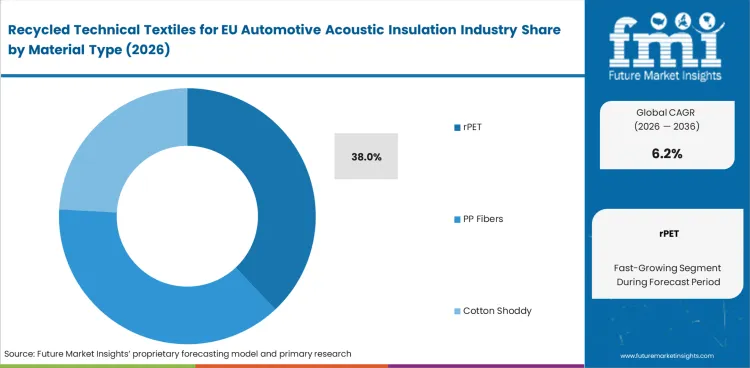
Material choice decides which recycled fibers can move into repeat programs without forcing repeated reformulation. rPET is estimated to account for 38% of material type demand in 2026 because polyester felt routes are already familiar in interior acoustic conversion. Part design teams use it in floor systems and wheelhouse parts as weight reduction and compressibility support recycled‑content verification.
Recycled Technical Textiles for EU Automotive Acoustic Insulation Industry Analysis by Feedstock Source
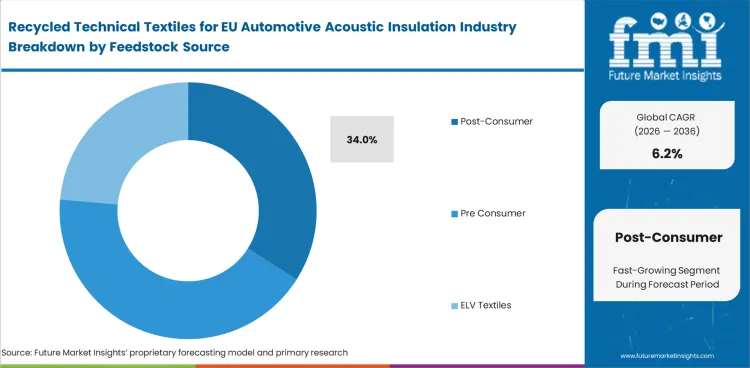
Post-consumer input is projected to contribute 34% of feedstock source demand in 2026. Clearer recycled-content evidence explains much of thislead. Bottle-linked polyester and sorted textile streams give converters a cleaner chain of custody than mixed post-industrial blends. Acoustic parts benefit because sourcing claims and part consistency can be reviewed in the same qualification cycle. ELV textile recovery will expand over time. Near-term commercial volume stays more limited because dismantling and sorting routes are less standardized for fiber recovery.
Recycled Technical Textiles for EU Automotive Acoustic Insulation Industry Analysis by Product Form
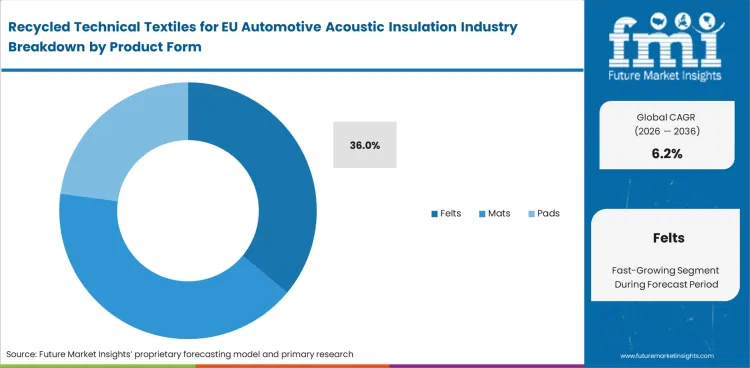
Sheet-based acoustic packages keep felts at about 36% of product form demand in 2026. Layering and compression molding explain a significant portion of the performance advantage. Pads and molded parts carry value in more defined part geometries. Felt structures win early because they can be tuned across multiple floor and trunk applications without redesigning the full system. Lower tooling dependence supports faster quoting. Thus, felt becomes the easier commercial entry point when recycled input quality is not uniform.
Recycled Technical Textiles for EU Automotive Acoustic Insulation Industry Analysis by Application
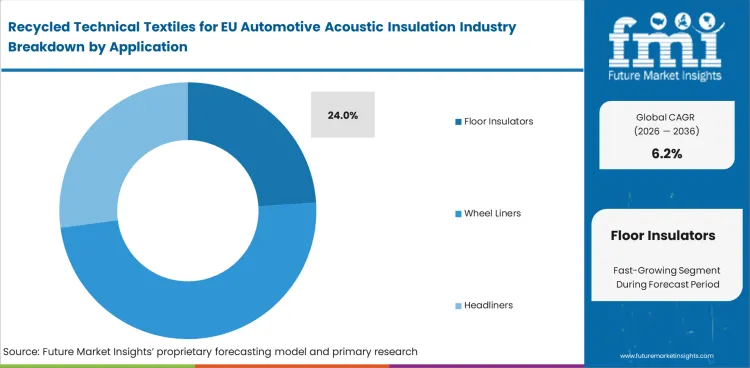
Floor insulators absorb the largest material load in many vehicle builds. The usage pattern lifts them to an estimated 24% share of application demand in 2026. Wheelhouse parts and trunk liners follow close behind commercial relevance. Floor systems win because acoustic mass can be distributed across large surface areas with limited visible-surface risk. Program teams can introduce recycled textile content here without reopening as many cabin finish questions. Commercial adoption moves fastest when acoustic functions and hidden placement work together.
Recycled Technical Textiles for EU Automotive Acoustic Insulation Industry Analysis by Vehicle Type
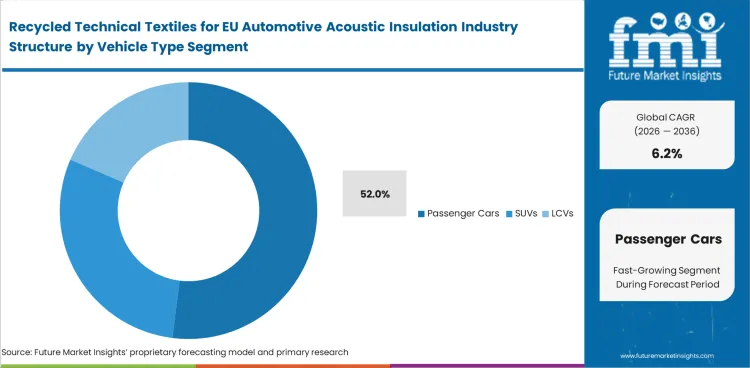
Passenger cars are projected to hold 52% of vehicle type demand in 2026 because EU output volume and comfort-led NVH programs are concentrated there. SUV programs use more material per unit in some cases. Cabin mix inside the EU keeps passenger cars in front. Platform diversity in passenger vehicles creates repeated opportunities for floor and trunk systems. EV passenger cars add another layer of demand because quieter propulsion makes tire and road noise easier to hear. Recycled acoustic textiles work effectively once part consistency is proven early.
Recycled Technical Textiles for EU Automotive Acoustic Insulation Industry Analysis by Manufacturing Process
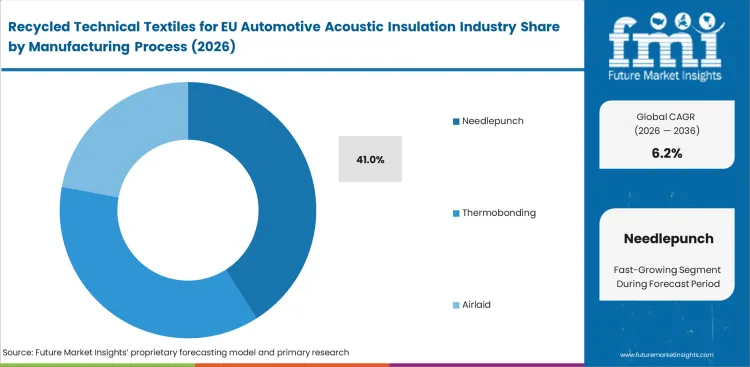
Needlepunch is estimated to account for 41% of manufacturing process demand in 2026 because it can stabilize loose fibers into acoustic sheets without heavier chemistry dependence. Needlepunch is widely suited to medium‑density felts and layered systems. As feedstock quality varies, simple and robust processes become more important. Converters therefore prefer solutions that can handle input variability without compromising acoustic performance or dimensional stability.
Recycled Technical Textiles for EU Automotive Acoustic Insulation Industry Demand Drivers and Scale Limits
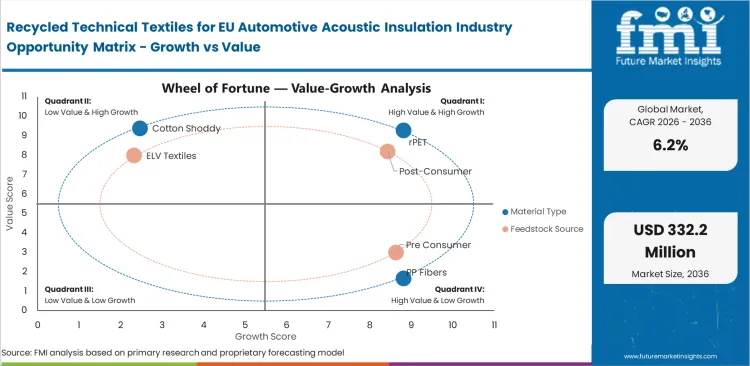
Growth in this market is shaped by two visible commercial tests. Recycled fiber must meet acoustic performance and molding requirements, while feedstock supply must reach vehicle programs with sufficient consistency to avoid requalification costs. EU policy support strengthens the underlying demand case, but qualification cycles and sorting losses continue to slow full demand realization.
- EU separate textile collection supports better feedstock visibility for acoustic-grade inputs.
- Sorting variation limits conversion yield because density and thickness drift can fail part validation.
- PCR interior programs widen addressable demand as recycled content becomes a formal sourcing screen.
Separate Collection Improves Feedstock Access
Separate textile collection across the EU improves the raw-material base that feeds higher-value acoustic applications. More polyester-rich waste is moving into sorting systems with clearer fiber origin. Acoustic parts benefit as material processors isolate cleaner fractions for felt and nonwoven production. Better source visibility lowers the risk of density drift or contamination inside molded parts. OEM sourcing groups value this because acoustic programs carry narrow tolerance windows. Value growth improves as reclaimed input moves from low-grade wiping routes into consistent automotive feedstock.
Automotive Interior Softness Is Capping Price Recovery
Pricing momentum for recycled acoustic felts and mats remains constrained, largely due to continuos demand across automotive interior applications rather than extreme supply‑side disruption. This pressure is evident in EDANA’s April 2026 assessment, which reported a 2.2% decline in overall European nonwovens production in 2025 to 2.92 million tonnes, alongside nearly flat drylaid output at -0.7% and modest growth of 0.8% in needle‑punched bonding.
More directly relevant to recycled technical textiles for EU automotive acoustic insulation, sales tonnage into automotive interiors fell by 0.9% during the year. These conditions signal a market where pricing remains under stress but avoids sharp correction, as weak automotive demand limits premium pass‑through while stable drylaid volumes and slightly firmer needle‑punched activity continue to support conversion capacity and reduce the risk of abrupt price breaks across qualified supply contracts.
EU Nonwoven Benchmarks Point to Stabilization, Not Relief
Upstream pricing indicators across the EU nonwovens sector suggest stabilization rather than meaningful cost relief, reinforcing the limited scope for downstream price adjustment. Eurostat producer‑price data for nonwovens and related articles show only marginal easing, with the EU index declining from 105.80 in November 2025 to 104.90 by February 2026, and the euro area moving from 105.90 to 105.10 over the same period. However, such incremental upstream shifts rarely translate into lower finished acoustic pad pricing once carding, layering, density consistency, and automotive‑spec conversion requirements are incorporated. As a result, pricing behaviour in recycled automotive acoustic textiles continues to be governed primarily by technical specifications and performance requirements rather than by reference price benchmarks.
Regional Analysis
.webp "Top Country Growth Comparison Recycled Technical Textiles For Eu Automotive Acoustic Insulation Industry Cagr (2026 2036)")
- Germany anchors the largest value base in the region, while Spain is expected to post the fastest growth at a 6.7% CAGR through 2036.
- Poland at 6.5% CAGR and Czechia at 6.4% benefit from concentrated vehicle assembly and closer supplier links with OEM production clusters.
- France is projected to expand at a 5.8% CAGR and Italy at 5.6%, reflecting steadier adoption linked with model refresh cycles and interior specification mix.
Demand across the EU varies by country, as differences in production scale and supplier concentration influence how quickly recycled acoustic textiles are adopted in vehicle programs. Differences in vehicle program mix act as an additional filter on demand.
Recycled Technical Textiles for EU Automotive Acoustic Insulation Industry Demand Outlook for Germany
Germany carries the deepest engineering base for acoustic parts in the EU. Demand is expected to grow at 6% CAGR through 2036 as recycled fiber programs move from pilot parts into floor and wheelhouse systems. Program qualification takes longer because part consistency and vehicle fit are tested closely. Slower pace does not reduce value potential. Higher-spec passenger vehicles and tighter cabin sound targets lift content value per unit. Repeatable density and stable surface behavior in molded parts improve supplier access.
Future Sales Outlook for Recycled Technical Textiles for EU Automotive Acoustic Insulation Industry in Spain
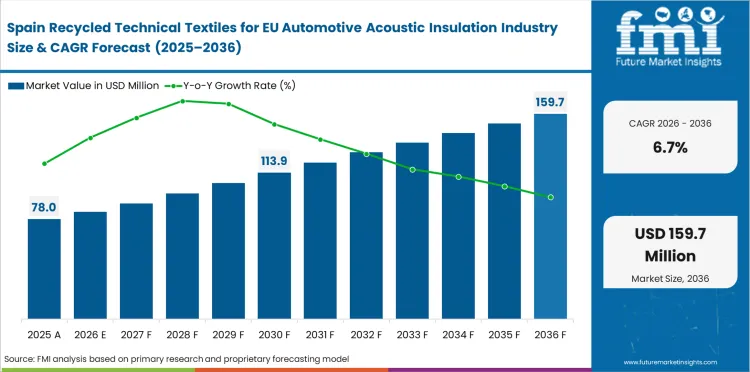
Spain is set to record 6.7% CAGR in this industry through 2036 as vehicle assembly and supplier localization support faster sourcing decisions. New recycled acoustic parts can move faster here because platform cost control and lighter interior packages receive close attention. Floor systems and trunk parts fit this pattern. Program awards tend to favor suppliers who combine recycled-content proof with stable molding behavior. Local conversion strength improves lead-time discipline. Thus, Spain becomes one of the entry points for recycled felt and molded nonwoven programs.
Growth Analysis for Recycled Technical Textiles for EU Automotive Acoustic Insulation Industry in Czechia
Czechia benefits from export-linked vehicle production and dense tier manufacturing around compact platforms. Proximity to assembly plants supports the use of recycled acoustic textiles in floor systems and wheelhouse parts.. Cost control matters more than visual trim appeal in many of these programs, which supports practical felt-based solutions. Feedstock quality must stay predictable because thinner margins leave less room for rework. Demand in Czechia is projected to rise at 6.4% CAGR through 2036. Qualification speed will depend on how cleanly suppliers convert reclaimed fibers into repeatable part thickness.
Market Prospects for Recycled Technical Textiles for EU Automotive Acoustic Insulation Industry in Poland
Poland combines a growing manufacturing base with expanding interest in lower-impact interior materials. Industry demand is likely to rise at 6.5% CAGR through 2036 because suppliers can pair recycled fiber sourcing with competitive conversion cost. Acoustic parts gain ground in floor and trunk applications that allow material substitution without major visible‑surface risk. Program entry is easier in hidden or semi-hidden parts than in highly exposed cabin trim. Sorting quality and logistics discipline matter because long fiber routes can erode price advantage. Producers who keep density and cut accuracy within program limits will have the clearest path.
Commercial Outlook for Recycled Technical Textiles for EU Automotive Acoustic Insulation Industry in France
France carries demand through passenger vehicle programs and places greater weight on cabin comfort and lower-emission material choices. Recycled acoustic textiles fit this setting when suppliers can exhibitstable performance in floor systems and dash insulation layers. Policy pressure around circular materials supports the direction of travel. Validation cycles are stricter where acoustic and durability targets lieclose together. Demand for industry in France is anticipated to increase at 5.8% CAGR through 2036. Further value lift will depend on whether recycled fiber parts reach program timing with fewer reformulation loops.
Adoption Outlook for Recycled Technical Textiles for EU Automotive Acoustic Insulation Industry in Italy
Italy is expected to post 5.6% CAGR in this industry through 2036, supported by interior-focused vehicle sourcing and an established base in automotive textile conversion. Demand improves when recycled felt and laminate systems can enter trunk or floor applications without surface inconsistency. Hood applications add another route. Style-led cabin programs create opportunity, but they raise scrutiny on finish and dimensional control. As a result, hidden acoustic layers easier to penetrate than exposed trim zones. Supply access depends on stable recycled feedstock and disciplined molding output. Commercial traction is expected to remain stronger in function‑driven part categories than in appearance based applications.
Sales Potential for Recycled Technical Textiles for EU Automotive Acoustic Insulation Industry in Slovakia
Slovakia draws demand from high assembly density and compact supplier distances inside a smaller national base. Recycled acoustic textile adoption is supported by fast plant schedules without added supplier risk. Floor insulators and wheelhouse components suit theprofile because they offer volume with limited visual exposure. Industry sales in Slovakia are estimated to expand at 6.1% CAGR through 2036. Scale concentration can narrow the number of immediate entry points. Once a supplier clears platform approval, the country offers efficient repeat volumes from closely linked assembly programs.
Broader EU demand will widen as more vehicle programs connect recycled fiber sourcing with mainstream acoustic parts. Technical insulation priorities in light vehicle design support this move because weight and sound control are reviewed together more often. Noise & Vibration control PCR material demand adds another pull as recycled‑content language becomes part of the same sourcing brief. Slower country growth is likely to persist because sorting output and qualification timing dilute the cost case before program award.
Competitive Aligners for Market Players
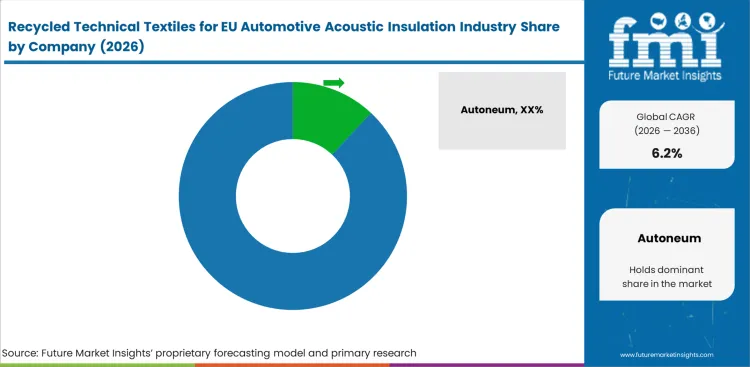
- OEM fitment is projected to account for 81.0% of channel demand in 2026, which keeps competition centered on platform awards and repeat part approval.
- Autoneum is estimated to lead the industry, with Adler Pelzer, Trèves, AUNDE Group, Freudenberg Performance Materials, Autins Group, and Toray active across recycled acoustic components.
- Supplier advantage comes from molded-part capability and recycled-fiber consistency because weak fit or unstable weight can delay program acceptance.
The competition in the industry is fragmented as no single firm controls recycled fiber sourcing and acoustic sheet conversion across the full chain. Autoneum and Adler Pelzer start from a stronger position in full acoustic systems. Trèves and AUNDE Group add depth with strong interior textile knowledge and program supply support. Freudenberg Performance Materials, Autins Group, and Toray widen the field through nonwoven and polyester-based acoustic media. Competitive distance comes from part consistency and nomination access more than from broad sustainability language.
Players in the industry who can link recycled feedstock verification with repeatable molding behavior are more likely to be favored. Floor systems and wheelhouse parts provide the easiest route because surface appearance pressure is lower than in exposed cabin trims. Autoneum and Adler Pelzer are likely to compete most intensely as OEM acoustic modules move toward scale. Trèves participates in the same competitive set through its depth in interior acoustic systems. AUNDE Group and Freudenberg Performance Materials align well with programs that prioritize broad textile conversion capability. Autins Group and Toray gain relevance in specifications led by polyester media or fiber‑based acoustic layers. Overall, market structure is expected to remain decentralized until feedstock preparation and part validation become easier to standardize.
Major Industry Players
- Autoneum
- Adler Pelzer
- Trèves
- AUNDE Group
- Freudenberg Performance Materials
- Autins Group
- Toray
Competitive Benchmarking for Recycled Technical Textiles for EU Automotive Acoustic Insulation Industry
| Company | Acoustic Parts Breadth | Recycled Fiber Capability | OEM Program Access | European Footprint |
|---|---|---|---|---|
| Autoneum | High | High | Strong | Pan-European |
| Adler Pelzer | High | Medium | Strong | Pan-European |
| Trèves | High | Medium | Strong | Europe-focused |
| AUNDE Group | Medium | Medium | Strong | Pan-European |
| Freudenberg Performance Materials | Medium | High | Moderate | Pan-European |
| Autins Group | Medium | Medium | Moderate | United Kingdom and EU |
| Toray | Medium | High | Moderate | Central Europe |
Source: Future Market Insights, 2026.
Recent Developments
- July 2025: Autoneum launched N-Join1, an adhesive-free automotive carpet made with recycled material inputs that improves recyclability while supporting interior noise insulation.
- March 2026: Toray Textiles Central Europe presented its Airlite™ All-PP recyclable acoustic nonwoven solution for automotive interior trim applications including door panels, pillars, trunk trim, and wheel arch liners.
- 2026: Walki Group highlighted recyclable thermoformable automotive material solutions for carpets, headliners, and underbody applications, supporting lighter acoustic insulation structures in vehicles.
Key Players in the Recycled Technical Textiles for EU Automotive Acoustic Insulation Industry
Major Global Players
- Autoneum
- Adler Pelzer
- Trèves
- AUNDE Group
- Freudenberg Performance Materials
Regional and Specialized Participants
- Autins Group
- Toray
Scope of the Report
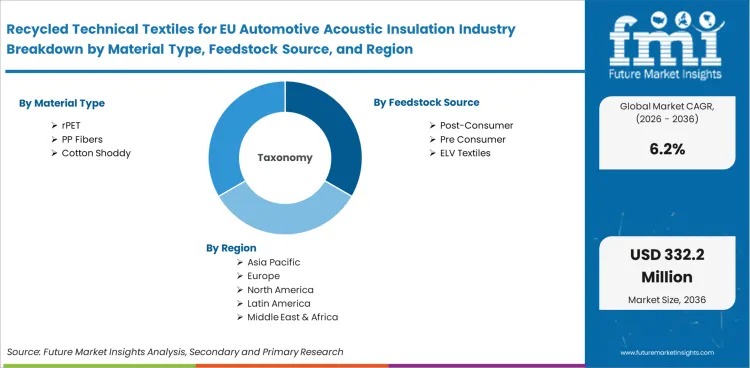
| Metric | Value |
|---|---|
| Quantitative Units | USD 171.4 million to USD 312.8 million at a CAGR of 6.2% |
| Market Definition | Reclaimed fiber felts, mats, molded nonwovens, and laminated textile systems used for acoustic control in EU passenger vehicles and light commercial vehicles. |
| Segmentation |
|
| Regions Covered | European Union |
| Countries Covered | Germany | Spain | Czechia | Poland | France | Italy | Slovakia | Rest of EU |
| Key Companies Profiled | Autoneum Adler Pelzer Trèves AUNDE Group Freudenberg Performance Materials Autins Group Toray |
| Forecast Period | 2026 to 2036 |
| Approach | Bottom-up model using EU light vehicle output and acoustic textile content per vehicle. Validation used public company materials and EU industry sources. |
Recycled Technical Textiles for EU Automotive Acoustic Insulation Industry by Segments
Segmented by Material Type
- rPET
- Blended fibers
- PP fibers
- Cotton shoddy
- Bio blends
Classified by Feedstock Source
- Post-consumer
- Pre-consumer
- ELV textiles
- Mixed waste
- Bottle flake
Segmented by Product Form
- Felts
- Mats
- Pads
- Molded parts
- Composites
Classified by Application
- Floor insulators
- Wheel liners
- Headliners
- Trunk liners
- Dash insulators
- Door panels
- Hood liners
Segmented by Vehicle Type
- Passenger cars
- SUVs
- LCVs
- BEVs
- Hybrids
Analysed by Manufacturing Process
- Needlepunch
- Thermobonding
- Airlaid
- Compression molding
- Lamination
Market by Region and Country
- Western Europe
- Germany
- France
- Netherlands
- Belgium
- Austria
- Switzerland
- Luxembourg
- Northern Europe
- Denmark
- Sweden
- Norway
- Finland
- Ireland
- Iceland
- Southern Europe
- Italy
- Spain
- Portugal
- Greece
- Malta
- Cyprus
- Eastern Europe
- Poland
- Czech Republic
- Hungary
- Romania
- Slovakia
- Bulgaria
- Croatia
- Slovenia
- Estonia
- Latvia
- Lithuania
Bibliography
- Trading Economics. (2026, April). European Union - Producer prices in industry: Manufacture of non-wovens and articles made from non-wovens, except apparel - 2026 Data 2027 Forecast 2002 Historical. Trading Economics.
- Cossio Cuartero, F. (2026, April 7). 2025 Nonwoven Production in Greater Europe: European Nonwovens Industry Remains Strong Amid Challenging Market Conditions. EDANA.
- Autoneum. (2025, July 1). N-Join1: An innovative, adhesive-free carpet that supports the circular economy. Autoneum.
- Toray Textiles Central Europe s.r.o. (2026, March 27). Airlite™ All-PP recyclable acoustic solution. Automotive Interiors Expo Europe.
- Walki Group. (2026). Thermoformable automotive materials | Lightweight & recyclable solutions. Walki
- Autoneum Holding AG. (2025). Annual Report 2025.
- Autoneum Holding AG. (2025, July 8). Flexi-Light PET: Outstanding, sustainable sound insulation for vehicles.
- Baldassarre, B., Maury, T., Huygens, D., & Ardente, F. (2025, May 15). Increasing plastic circularity in the automotive sector. Resources, Conservation and Recycling, 217, 108310.
- European Automobile Manufacturers’ Association. (2025, March). Economic and Market Report: Global and EU auto industry - Full year 2024.
- European Environment Agency. (2024, May 21). Management of used and waste textiles in Europe’s circular economy.
- European Topic Centre on Circular Economy and Resource Use. (2024, May). Textile waste management in Europe’s circular economy.
- EURATEX. (2024, March). Facts & Key Figures 2024.
This bibliography is provided for reader reference and is not exhaustive. The full report contains the complete reference list and detailed citations.
This Report Addresses
- How large the market is in 2025, 2026, and 2036
- Which material type, feedstock source, and product form lead demand
- Which applications and vehicle types offer the clearest commercial entry points
- How demand differs across Germany, Spain, Czechia, Poland, France, Italy, and Slovakia
- How supplier structure and qualification rationale affect competitive positioning
- What scope boundaries and research method define this study
Frequently Asked Questions
How big was the market in 2025?
The recycled technical textiles market for EU automotive acoustic insulation was valued at approximately USD 161.4 million in 2025.
What will the market size be by 2036?
The market is projected to reach a value of around USD 312.8 million by 2036.
What is the forecast CAGR?
Demand for recycled technical textiles in EU automotive acoustic insulation is expected to grow at a 6.2% CAGR from 2026 to 2036.
Which material type leads demand?
rPET is expected to lead material type demand, accounting for an estimated 38% share in 2026.
Which feedstock source leads demand?
Post consumer feedstock is projected to dominate feedstock sourcing, contributing approximately 34% of demand in 2026.
Which application leads demand?
Floor insulators are anticipated to be the leading application segment, with an estimated 24% share of demand in 2026.
Which sales channel leads demand?
OEM fitment is expected to remain the dominant sales channel, accounting for about 81% of total demand in 2026.
Which country is expected to grow the fastest?
Spain is forecast to post the fastest growth, with demand expanding at a 6.7% CAGR through 2036.
Preview the report firsthand - request a free sample
Get SampleGet the brochure for pricing and purchase details.
Get PDFTable of Content
- Executive Summary
- Global Market Outlook
- Demand-side Trends
- Supply-side Trends
- Technology Roadmap Analysis
- Analysis and Recommendations
- Market Overview
- Market Coverage / Taxonomy
- Market Definition / Scope / Limitations
- Research Methodology
- Chapter Orientation
- Analytical Lens and Working Hypotheses
- Market Structure, Signals, and Trend Drivers
- Benchmarking and Cross-market Comparability
- Market Sizing, Forecasting, and Opportunity Mapping
- Research Design and Evidence Framework
- Desk Research Programme (Secondary Evidence)
- Company Annual and Sustainability Reports
- Peer-reviewed Journals and Academic Literature
- Corporate Websites, Product Literature, and Technical Notes
- Earnings Decks and Investor Briefings
- Statutory Filings and Regulatory Disclosures
- Technical White Papers and Standards Notes
- Trade Journals, Industry Magazines, and Analyst Briefs
- Conference Proceedings, Webinars, and Seminar Materials
- Government Statistics Portals and Public Data Releases
- Press Releases and Reputable Media Coverage
- Specialist Newsletters and Curated Briefings
- Sector Databases and Reference Repositories
- FMI Internal Proprietary Databases and Historical Market Datasets
- Subscription Datasets and Paid Sources
- Social Channels, Communities, and Digital Listening Inputs
- Additional Desk Sources
- Expert Input and Fieldwork (Primary Evidence)
- Primary Modes
- Qualitative Interviews and Expert Elicitation
- Quantitative Surveys and Structured Data Capture
- Blended Approach
- Why Primary Evidence is Used
- Field Techniques
- Interviews
- Surveys
- Focus Groups
- Observational and In-context Research
- Social and Community Interactions
- Stakeholder Universe Engaged
- C-suite Leaders
- Board Members
- Presidents and Vice Presidents
- R&D and Innovation Heads
- Technical Specialists
- Domain Subject-matter Experts
- Scientists
- Physicians and Other Healthcare Professionals
- Governance, Ethics, and Data Stewardship
- Research Ethics
- Data Integrity and Handling
- Primary Modes
- Tooling, Models, and Reference Databases
- Desk Research Programme (Secondary Evidence)
- Data Engineering and Model Build
- Data Acquisition and Ingestion
- Cleaning, Normalisation, and Verification
- Synthesis, Triangulation, and Analysis
- Quality Assurance and Audit Trail
- Market Background
- Market Dynamics
- Drivers
- Restraints
- Opportunity
- Trends
- Scenario Forecast
- Demand in Optimistic Scenario
- Demand in Likely Scenario
- Demand in Conservative Scenario
- Opportunity Map Analysis
- Product Life Cycle Analysis
- Supply Chain Analysis
- Investment Feasibility Matrix
- Value Chain Analysis
- PESTLE and Porter’s Analysis
- Regulatory Landscape
- Regional Parent Market Outlook
- Production and Consumption Statistics
- Import and Export Statistics
- Market Dynamics
- Global Market Analysis 2021 to 2025 and Forecast, 2026 to 2036
- Historical Market Size Value (USD Million) Analysis, 2021 to 2025
- Current and Future Market Size Value (USD Million) Projections, 2026 to 2036
- Y-o-Y Growth Trend Analysis
- Absolute $ Opportunity Analysis
- Global Market Pricing Analysis 2021 to 2025 and Forecast 2026 to 2036
- Global Market Analysis 2021 to 2025 and Forecast 2026 to 2036, By Material Type
- Introduction / Key Findings
- Historical Market Size Value (USD Million) Analysis By Material Type , 2021 to 2025
- Current and Future Market Size Value (USD Million) Analysis and Forecast By Material Type , 2026 to 2036
- rPET
- PP Fibers
- Cotton Shoddy
- rPET
- Y-o-Y Growth Trend Analysis By Material Type , 2021 to 2025
- Absolute $ Opportunity Analysis By Material Type , 2026 to 2036
- Global Market Analysis 2021 to 2025 and Forecast 2026 to 2036, By Feedstock Source
- Introduction / Key Findings
- Historical Market Size Value (USD Million) Analysis By Feedstock Source, 2021 to 2025
- Current and Future Market Size Value (USD Million) Analysis and Forecast By Feedstock Source, 2026 to 2036
- Post-Consumer
- Pre Consumer
- ELV Textiles
- Post-Consumer
- Y-o-Y Growth Trend Analysis By Feedstock Source, 2021 to 2025
- Absolute $ Opportunity Analysis By Feedstock Source, 2026 to 2036
- Global Market Analysis 2021 to 2025 and Forecast 2026 to 2036, By Product Form
- Introduction / Key Findings
- Historical Market Size Value (USD Million) Analysis By Product Form, 2021 to 2025
- Current and Future Market Size Value (USD Million) Analysis and Forecast By Product Form, 2026 to 2036
- Felts
- Mats
- Pads
- Felts
- Y-o-Y Growth Trend Analysis By Product Form, 2021 to 2025
- Absolute $ Opportunity Analysis By Product Form, 2026 to 2036
- Global Market Analysis 2021 to 2025 and Forecast 2026 to 2036, By Application
- Introduction / Key Findings
- Historical Market Size Value (USD Million) Analysis By Application, 2021 to 2025
- Current and Future Market Size Value (USD Million) Analysis and Forecast By Application, 2026 to 2036
- Floor Insulators
- Wheel Liners
- Headliners
- Floor Insulators
- Y-o-Y Growth Trend Analysis By Application, 2021 to 2025
- Absolute $ Opportunity Analysis By Application, 2026 to 2036
- Global Market Analysis 2021 to 2025 and Forecast 2026 to 2036, By Vehicle Type
- Introduction / Key Findings
- Historical Market Size Value (USD Million) Analysis By Vehicle Type, 2021 to 2025
- Current and Future Market Size Value (USD Million) Analysis and Forecast By Vehicle Type, 2026 to 2036
- Passenger Cars
- SUVs
- LCVs
- Passenger Cars
- Y-o-Y Growth Trend Analysis By Vehicle Type, 2021 to 2025
- Absolute $ Opportunity Analysis By Vehicle Type, 2026 to 2036
- Global Market Analysis 2021 to 2025 and Forecast 2026 to 2036, By Manufacturing Process
- Introduction / Key Findings
- Historical Market Size Value (USD Million) Analysis By Manufacturing Process, 2021 to 2025
- Current and Future Market Size Value (USD Million) Analysis and Forecast By Manufacturing Process, 2026 to 2036
- Needlepunch
- Thermobonding
- Airlaid
- Needlepunch
- Y-o-Y Growth Trend Analysis By Manufacturing Process, 2021 to 2025
- Absolute $ Opportunity Analysis By Manufacturing Process, 2026 to 2036
- Global Market Analysis 2021 to 2025 and Forecast 2026 to 2036, By Region
- Introduction
- Historical Market Size Value (USD Million) Analysis By Region, 2021 to 2025
- Current Market Size Value (USD Million) Analysis and Forecast By Region, 2026 to 2036
- North America
- Latin America
- Western Europe
- Eastern Europe
- East Asia
- South Asia and Pacific
- Middle East & Africa
- Market Attractiveness Analysis By Region
- North America Market Analysis 2021 to 2025 and Forecast 2026 to 2036, By Country
- Historical Market Size Value (USD Million) Trend Analysis By Market Taxonomy, 2021 to 2025
- Market Size Value (USD Million) Forecast By Market Taxonomy, 2026 to 2036
- By Country
- USA
- Canada
- Mexico
- By Material Type
- By Feedstock Source
- By Product Form
- By Application
- By Vehicle Type
- By Manufacturing Process
- By Country
- Market Attractiveness Analysis
- By Country
- By Material Type
- By Feedstock Source
- By Product Form
- By Application
- By Vehicle Type
- By Manufacturing Process
- Key Takeaways
- Latin America Market Analysis 2021 to 2025 and Forecast 2026 to 2036, By Country
- Historical Market Size Value (USD Million) Trend Analysis By Market Taxonomy, 2021 to 2025
- Market Size Value (USD Million) Forecast By Market Taxonomy, 2026 to 2036
- By Country
- Brazil
- Chile
- Rest of Latin America
- By Material Type
- By Feedstock Source
- By Product Form
- By Application
- By Vehicle Type
- By Manufacturing Process
- By Country
- Market Attractiveness Analysis
- By Country
- By Material Type
- By Feedstock Source
- By Product Form
- By Application
- By Vehicle Type
- By Manufacturing Process
- Key Takeaways
- Western Europe Market Analysis 2021 to 2025 and Forecast 2026 to 2036, By Country
- Historical Market Size Value (USD Million) Trend Analysis By Market Taxonomy, 2021 to 2025
- Market Size Value (USD Million) Forecast By Market Taxonomy, 2026 to 2036
- By Country
- Germany
- UK
- Italy
- Spain
- France
- Nordic
- BENELUX
- Rest of Western Europe
- By Material Type
- By Feedstock Source
- By Product Form
- By Application
- By Vehicle Type
- By Manufacturing Process
- By Country
- Market Attractiveness Analysis
- By Country
- By Material Type
- By Feedstock Source
- By Product Form
- By Application
- By Vehicle Type
- By Manufacturing Process
- Key Takeaways
- Eastern Europe Market Analysis 2021 to 2025 and Forecast 2026 to 2036, By Country
- Historical Market Size Value (USD Million) Trend Analysis By Market Taxonomy, 2021 to 2025
- Market Size Value (USD Million) Forecast By Market Taxonomy, 2026 to 2036
- By Country
- Russia
- Poland
- Hungary
- Balkan & Baltic
- Rest of Eastern Europe
- By Material Type
- By Feedstock Source
- By Product Form
- By Application
- By Vehicle Type
- By Manufacturing Process
- By Country
- Market Attractiveness Analysis
- By Country
- By Material Type
- By Feedstock Source
- By Product Form
- By Application
- By Vehicle Type
- By Manufacturing Process
- Key Takeaways
- East Asia Market Analysis 2021 to 2025 and Forecast 2026 to 2036, By Country
- Historical Market Size Value (USD Million) Trend Analysis By Market Taxonomy, 2021 to 2025
- Market Size Value (USD Million) Forecast By Market Taxonomy, 2026 to 2036
- By Country
- China
- Japan
- South Korea
- By Material Type
- By Feedstock Source
- By Product Form
- By Application
- By Vehicle Type
- By Manufacturing Process
- By Country
- Market Attractiveness Analysis
- By Country
- By Material Type
- By Feedstock Source
- By Product Form
- By Application
- By Vehicle Type
- By Manufacturing Process
- Key Takeaways
- South Asia and Pacific Market Analysis 2021 to 2025 and Forecast 2026 to 2036, By Country
- Historical Market Size Value (USD Million) Trend Analysis By Market Taxonomy, 2021 to 2025
- Market Size Value (USD Million) Forecast By Market Taxonomy, 2026 to 2036
- By Country
- India
- ASEAN
- Australia & New Zealand
- Rest of South Asia and Pacific
- By Material Type
- By Feedstock Source
- By Product Form
- By Application
- By Vehicle Type
- By Manufacturing Process
- By Country
- Market Attractiveness Analysis
- By Country
- By Material Type
- By Feedstock Source
- By Product Form
- By Application
- By Vehicle Type
- By Manufacturing Process
- Key Takeaways
- Middle East & Africa Market Analysis 2021 to 2025 and Forecast 2026 to 2036, By Country
- Historical Market Size Value (USD Million) Trend Analysis By Market Taxonomy, 2021 to 2025
- Market Size Value (USD Million) Forecast By Market Taxonomy, 2026 to 2036
- By Country
- Kingdom of Saudi Arabia
- Other GCC Countries
- Turkiye
- South Africa
- Other African Union
- Rest of Middle East & Africa
- By Material Type
- By Feedstock Source
- By Product Form
- By Application
- By Vehicle Type
- By Manufacturing Process
- By Country
- Market Attractiveness Analysis
- By Country
- By Material Type
- By Feedstock Source
- By Product Form
- By Application
- By Vehicle Type
- By Manufacturing Process
- Key Takeaways
- Key Countries Market Analysis
- USA
- Pricing Analysis
- Market Share Analysis, 2025
- By Material Type
- By Feedstock Source
- By Product Form
- By Application
- By Vehicle Type
- By Manufacturing Process
- Canada
- Pricing Analysis
- Market Share Analysis, 2025
- By Material Type
- By Feedstock Source
- By Product Form
- By Application
- By Vehicle Type
- By Manufacturing Process
- Mexico
- Pricing Analysis
- Market Share Analysis, 2025
- By Material Type
- By Feedstock Source
- By Product Form
- By Application
- By Vehicle Type
- By Manufacturing Process
- Brazil
- Pricing Analysis
- Market Share Analysis, 2025
- By Material Type
- By Feedstock Source
- By Product Form
- By Application
- By Vehicle Type
- By Manufacturing Process
- Chile
- Pricing Analysis
- Market Share Analysis, 2025
- By Material Type
- By Feedstock Source
- By Product Form
- By Application
- By Vehicle Type
- By Manufacturing Process
- Germany
- Pricing Analysis
- Market Share Analysis, 2025
- By Material Type
- By Feedstock Source
- By Product Form
- By Application
- By Vehicle Type
- By Manufacturing Process
- UK
- Pricing Analysis
- Market Share Analysis, 2025
- By Material Type
- By Feedstock Source
- By Product Form
- By Application
- By Vehicle Type
- By Manufacturing Process
- Italy
- Pricing Analysis
- Market Share Analysis, 2025
- By Material Type
- By Feedstock Source
- By Product Form
- By Application
- By Vehicle Type
- By Manufacturing Process
- Spain
- Pricing Analysis
- Market Share Analysis, 2025
- By Material Type
- By Feedstock Source
- By Product Form
- By Application
- By Vehicle Type
- By Manufacturing Process
- France
- Pricing Analysis
- Market Share Analysis, 2025
- By Material Type
- By Feedstock Source
- By Product Form
- By Application
- By Vehicle Type
- By Manufacturing Process
- India
- Pricing Analysis
- Market Share Analysis, 2025
- By Material Type
- By Feedstock Source
- By Product Form
- By Application
- By Vehicle Type
- By Manufacturing Process
- ASEAN
- Pricing Analysis
- Market Share Analysis, 2025
- By Material Type
- By Feedstock Source
- By Product Form
- By Application
- By Vehicle Type
- By Manufacturing Process
- Australia & New Zealand
- Pricing Analysis
- Market Share Analysis, 2025
- By Material Type
- By Feedstock Source
- By Product Form
- By Application
- By Vehicle Type
- By Manufacturing Process
- China
- Pricing Analysis
- Market Share Analysis, 2025
- By Material Type
- By Feedstock Source
- By Product Form
- By Application
- By Vehicle Type
- By Manufacturing Process
- Japan
- Pricing Analysis
- Market Share Analysis, 2025
- By Material Type
- By Feedstock Source
- By Product Form
- By Application
- By Vehicle Type
- By Manufacturing Process
- South Korea
- Pricing Analysis
- Market Share Analysis, 2025
- By Material Type
- By Feedstock Source
- By Product Form
- By Application
- By Vehicle Type
- By Manufacturing Process
- Russia
- Pricing Analysis
- Market Share Analysis, 2025
- By Material Type
- By Feedstock Source
- By Product Form
- By Application
- By Vehicle Type
- By Manufacturing Process
- Poland
- Pricing Analysis
- Market Share Analysis, 2025
- By Material Type
- By Feedstock Source
- By Product Form
- By Application
- By Vehicle Type
- By Manufacturing Process
- Hungary
- Pricing Analysis
- Market Share Analysis, 2025
- By Material Type
- By Feedstock Source
- By Product Form
- By Application
- By Vehicle Type
- By Manufacturing Process
- Kingdom of Saudi Arabia
- Pricing Analysis
- Market Share Analysis, 2025
- By Material Type
- By Feedstock Source
- By Product Form
- By Application
- By Vehicle Type
- By Manufacturing Process
- Turkiye
- Pricing Analysis
- Market Share Analysis, 2025
- By Material Type
- By Feedstock Source
- By Product Form
- By Application
- By Vehicle Type
- By Manufacturing Process
- South Africa
- Pricing Analysis
- Market Share Analysis, 2025
- By Material Type
- By Feedstock Source
- By Product Form
- By Application
- By Vehicle Type
- By Manufacturing Process
- USA
- Market Structure Analysis
- Competition Dashboard
- Competition Benchmarking
- Market Share Analysis of Top Players
- By Regional
- By Material Type
- By Feedstock Source
- By Product Form
- By Application
- By Vehicle Type
- By Manufacturing Process
- Competition Analysis
- Competition Deep Dive
- Autoneum
- Overview
- Product Portfolio
- Profitability by Market Segments (Product/Age /Sales Channel/Region)
- Sales Footprint
- Strategy Overview
- Marketing Strategy
- Product Strategy
- Channel Strategy
- Adler Pelzer
- Trèves
- AUNDE Group
- Freudenberg Performance Materials
- Autins Group
- Toray
- Autoneum
- Competition Deep Dive
- Assumptions & Acronyms Used


