

- Market Size (2026)
- USD 18.6 Mn
- Forecast (2036)
- USD 93.3 Mn
- CAGR (2026 to 2036)
- 17.5%
Recycled Polyurethanes from Seating Foams in EU Vehicles Industry Size, Market Forecast and Outlook by FMI
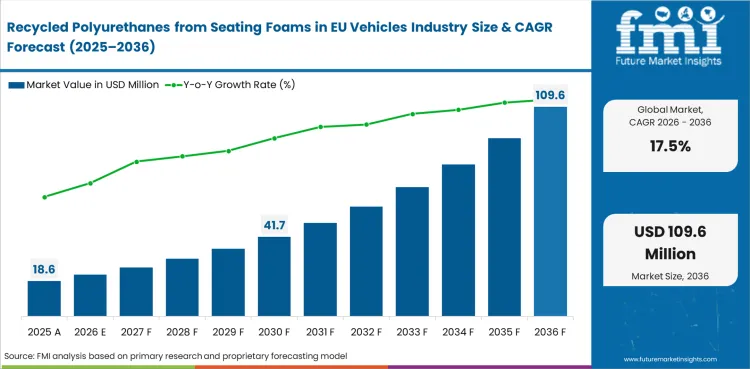
The recycled polyurethanes from seating foams in the EU vehicles industry reached USD 15.8 million in 2025 and is projected at USD 18.6 million in 2026. FMI projects the industry to reach USD 93.3 million by 2036, pointing to a CAGR of 17.5% during the forecast period.
Summary of Recycled Polyurethanes from Seating Foams in EU Vehicles Industry
- The market is forecast to reach USD 93.3 million by 2036.
- Market demand is expected to grow at a CAGR of 17.5% from 2026 to 2036.
- Market valuation was estimated at USD 15.8 million in 2025.
- Market size is expected to reach USD 18.6 million in 2026.
- Glycolysis is estimated to account for 31.0% share of the recycling route segment in 2026 because it offers a practical path to recycled polyol output.
- Post-industrial scrap is projected to hold 58.0% share of the source stream segment in 2026 because cleaner foam waste is easier to qualify for reuse.
- Flexible molded foam is expected to capture 72.0% share of the foam type segment in 2026 because it makes up most seating foam used in EU vehicles.
- Direct OEM sales are anticipated to represent 61.0% share of distribution in 2026 because material approval and supply flow are led by automakers and Tier 1 seating companies.
Key Takeaways
- The Recycled Polyurethanes from Seating Foams in EU Vehicles Industry was valued at USD 15.8 million in 2025.
- By 2036, the market is expected to reach USD 93.3 million.
- From 2026 to 2036, the industry is projected to expand at a CAGR of 17.5%.
- The market is estimated at USD 18.6 million in 2026.
- The industry is projected to create an incremental opportunity of USD 74.7 million between 2026 and 2036.
- In 2026, glycolysis is expected to account for 31.0% of the recycling route segment, driven by its direct path to recycled polyol production.
- Post-industrial scrap is projected to hold 58.0% of the source stream segment in 2026 due to cleaner and more consistent feedstock.
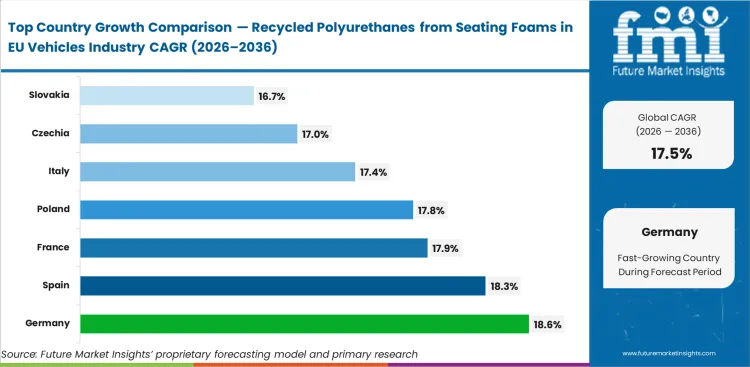
- Germany (18.6%) and Spain (18.3%) are among the fastest-growing markets in the EU.
Recycled Polyurethanes from Seating Foams in EU Vehicles Industry Key Takeaways
| Parameter | Details |
|---|---|
| Market Value (2026) | USD 18.6 million |
| Forecast Value (2036) | USD 93.3 million |
| CAGR (2026 to 2036) | 17.5% |
| Estimated Market Value (2025) | USD 15.8 million |
| Incremental Opportunity | USD 74.7 million |
| Leading Recycling Route | Glycolysis at 31.0% of route demand |
| Leading Source Stream | Post-industrial scrap at 58.0% of source stream demand |
| Leading Product Form | Recycled polyol at 54.0% of product form demand |
| Leading Application | New seat cushions at 36.0% of application demand |
| Leading Distribution Channel | Direct OEM at 61.0% of channel demand |
| Key Companies | Dow, Adient, Lear, Covestro, BASF |
Source: Future Market Insights, 2026
The demand for recycled polyurethanes from seating foams in the EU is set to garner an incremental opportunity at USD 74.7 million across 2026 to 2036. EU end-of-life vehicle rules and OEM circular material programs are changing demand patterns.
Vehicle seating creates one of the clearest polyurethane recovery pools in Europe because seat cushions carry a large share of flexible foam volume in each car. Work in automotive foams and automotive seating supports this as the automakers need lower waste and more verified interior materials.
Output quality is of more importance than raw waste collection alone. Re-entry into seat applications is decided by polyol quality and repeat foam performance under automotive validation. Activity in green and bio-based polyol and polyurethane foam points to the same buying rationale. Material selection moves forward only when formulation performance and documentation quality hold at program level.
Seat foam recovery moves ahead when automakers, seat suppliers, and recyclers follow one material qualification path. EU recycled polyurethanes from seating foams in vehicles demand in Germany is projected to advance at 18.6% CAGR by 2036. Spain is expected to follow at a CAGR of 18.3% while the demand in France is estimated to grow at 17.9% CAGR and Poland at 17.8% CAGR. Italy is likely to grow at 17.4% CAGR during the same period. Czechia is forecast at 17.0% CAGR and Slovakia at 16.7% CAGR as adoption spreads through EU vehicle production networks and approved polyols supply routes.
Recycled Polyurethanes from Seating Foams in EU Vehicles Industry Definition
Recycled polyurethanes from seating foams in EU vehicles industry covers recovered polyurethane materials and recycled polyol derived from vehicle seating foams for reuse in seat systems and interior components across EU vehicle manufacturing.
Recycled Polyurethanes from Seating Foams in EU Vehicles Industry Inclusions
Coverage includes recycling route and source stream. Coverage includes foam type and vehicle type. Coverage includes seat area and product form. Coverage includes application and sales channel across the 2026 to 2036 forecast period.
Recycled Polyurethanes from Seating Foams in EU Vehicles Industry Exclusions
Scope excludes virgin polyurethane seating materials. Scope excludes non-seat polyurethane waste. Scope excludes furniture foam recycling and bedding foam recovery. Scope excludes recycled plastics used outside polyurethane chemistry.
Recycled Polyurethanes from Seating Foams in EU Vehicles Industry Research Methodology
- Primary Research: FMI analysts interviewed polyurethane recyclers and automotive seating manufacturers across major EU vehicle hubs.
- Desk Research: Data from ACEA and Eurostat set the vehicle production baseline. Public OEM disclosures and EU end-of-life vehicle texts added recovery and adoption inputs.
- Market Sizing and Forecasting: Baseline values come from a bottom-up count of EU vehicle output and polyurethane intensity per vehicle. Adoption rates for recycled polyol use in seating and adjacent interior applications were used to project demand through 2036.
- Data Validation and Update Cycle: Forecast models are checked against OEM circular-material disclosures and EU policy updates each quarter.
Why Is the Recycled Polyurethanes from Seating Foams in EU Vehicles Industry Growing?
- EU circularity rules are increasing the value of recoverable seat foam in vehicle material planning.
- Passenger cars provide the largest feedstock base because they dominate EU vehicle output.
- Recycled polyol use grows first in controlled foam programs with cleaner scrap input.
Growth starts with material streams that are easy to collect and sort, and show limited variation in chemical composition. Seat production scrap matchesthis requirement better than mixed end-of-life foam because it comes from a controlled manufacturing environment. Automakers are under pressure to raise recycled content in interior materials without losing comfort or durability. This keeps demand focused on recycled inputs which can show stable and repeatable performance.
Segmental Analysis
Key Facts About Segments
- Glycolysis is expected to account for 31.0% share in 2026 by recycling route because it gives seat foam recyclers a direct path into recycled polyol.
- Post-industrial scrap is projected to contribute 58.0% share in 2026 by source stream because cleaner waste cuts sorting effort and lowers rejection risk.
- Flexible molded foam is likely to hold 72.0% share in 2026 by foam type because it makes up most seating foam used in EU vehicle programs.
- Passenger cars are set to represent 76.0% share in 2026 by vehicle type because EU car production creates the widest seating foam base.
- Recycled polyol is estimated at 54.0% share in 2026 by product form because foam formulators can place it back into controlled seating blends.
- New seat cushions are anticipated to account for 36.0% share in 2026 by application because closed-loop seat programs start with the largest foam volume in the vehicle.
The market is segmented across recycling route and source stream. Foam type and vehicle type add the next layer. Product form and application show how recovered chemistry moves back into automotive use through 2036. Product form carries the most weight because recycled polyol decides how much recovered chemistry returns to seat foam instead of lower-value outlets.
Recycled Polyurethanes from Seating Foams in EU Vehicles Industry Analysis by Recycling Route
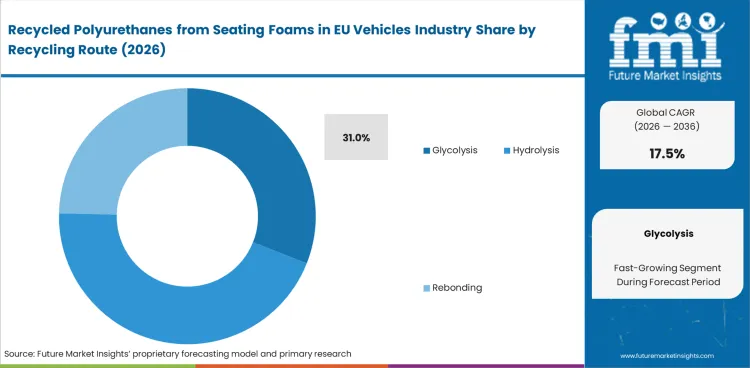
Glycolysis leads route demand because seat foam recovery needs a process to return chemistry to a usable form. The segment is expected to hold 31.0% share in 2026 by recycling route. Thelead comes from its fit with recycled polyol production for molded seating foam. Approval moves faster when feedstock purity stays within narrow automotive limits. Route choiceis crucial where foam performance needs tight control.
- Direct polyol recovery improves reuse potential in molded seating foam.
- Stable feedstock quality supports faster approval work in seat programs.
- Chemical recovery gives better value than low-grade outlet conversion.
Recycled Polyurethanes from Seating Foams in EU Vehicles Industry Analysis by Source Stream
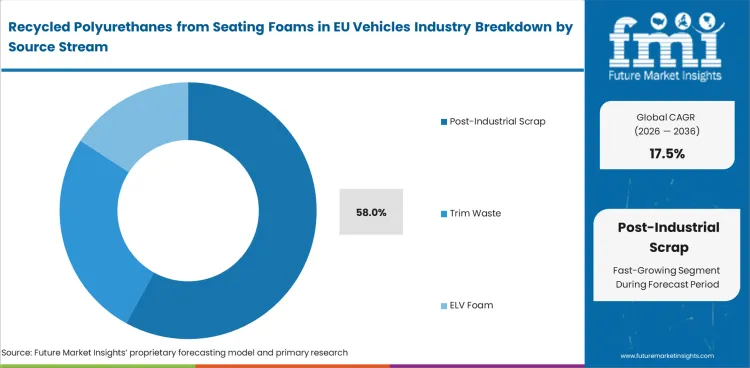
Post-industrial scrap is expected to account for 58.0% share in 2026 by source stam because chemistry and grade are easier to document at the point of generation. This lowers rejection risk and gives recyclers a more dependable raw material base. Early program scale requires control as poor traceability quickly undermines reuse value.
- Known foam grade reduces uncertainty in recycled output quality.
- Lower contamination cuts sorting time and conversion loss.
- Cleaner scrap gives recyclers a more reliable supply base.
Recycled Polyurethanes from Seating Foams in EU Vehicles Industry Analysis by Foam Type
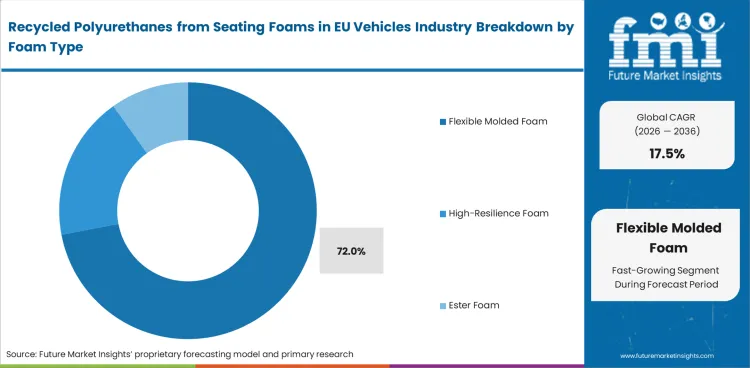
Flexible molded foam forms the core of EU vehicle seating and gives this segment its commercial weight. Seat cushions and backrests depend heavily on this material format across the wider flexible foam category. Industry estimates place flexible molded foam at 72.0% share in 2026 by foam type. Recovery volume starts here because the installed base is deeper and easier to isolate than smaller specialty foam formats. Reuse work becomes more practical when chemistry and part function are already well understood.
- Seat cushion and backrest systems depend heavily on molded foam.
- Larger installed volume creates a broader recovery base.
- Familiar foam chemistry supports easier matching in recycled blends.
Recycled Polyurethanes from Seating Foams in EU Vehicles Industry Analysis by Vehicle Type
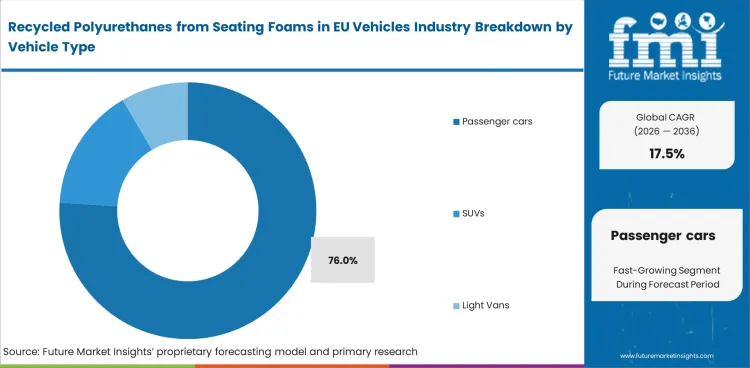
Passenger vehicle production gives recyclers and seat suppliers the broadest foam base to work with across EU programs. Platform count is higher in cars, which opens more windows for approval and repeat use. Passenger cars are anticipated to account for 76.0% of the total share in 2026 by vehicle type. Passenger car seat links closely with this pattern because seating volume and program repetition improve the path for recycled chemistry. Wider production scale gives this segment the clearest route into recurring demand.
- Higher production volume expands recoverable seat foam availability.
- More seat programs create more windows for material qualification.
- Broad platform coverage helps recycled content enter one program at a time.
Recycled Polyurethanes from Seating Foams in EU Vehicles Industry Analysis by Product Form
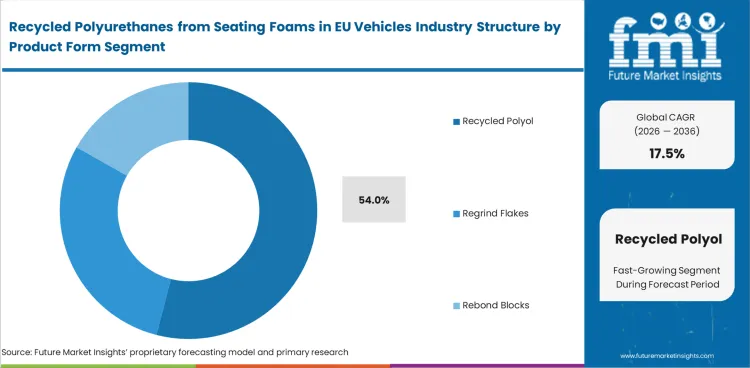
Recovered chemistry needs a form to move back into seat foam with limited formulation drift. Recycled polyol provides way for foam formulators working within strict material windows. In 2026, recycled polyol is projected to represent 54.0% share by product form because it is more suitable for controlled blends than simple regrind. Advanced automotive materials adds a useful adjacent reference because material acceptance is affected by whether recovered inputs can match established performance needs.
- Recycled polyol fits directly into foam formulation work.
- Controlled blends reduce the risk of wide performance variation.
- Higher-value reuse stays closer to original seat foam demand.
Recycled Polyurethanes from Seating Foams in EU Vehicles Industry Analysis by Application
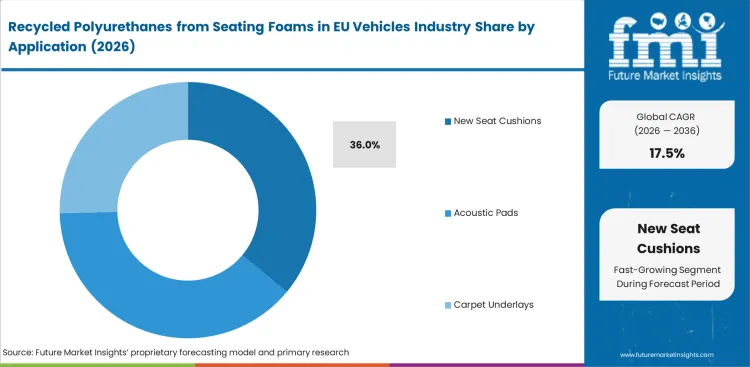
Closed-loop use starts in the part that carries the largest seat foam volume and the clearest material criteria . Cushion programs give automakers visible circular content without forcing a change in unrelated interior parts. Therefore, new seat cushions are expected to represent 36.0% share in 2026 by application. Automotive soft trim interior materials helps explain the nearby opportunity because interior programs value comfort and material efficiency at the same time. Application depth improves first where validation can stay inside an already familiar seating component.
- Cushion foam carries more material volume than smaller seat parts.
- Closed-loop trials are easier to justify in a core seating component.
- Approved seat programs create a direct route for circular content use
What Are the Drivers, Restraints, and Key Trends of the Recycled Polyurethanes from Seating Foams in EU Vehicles Industry?
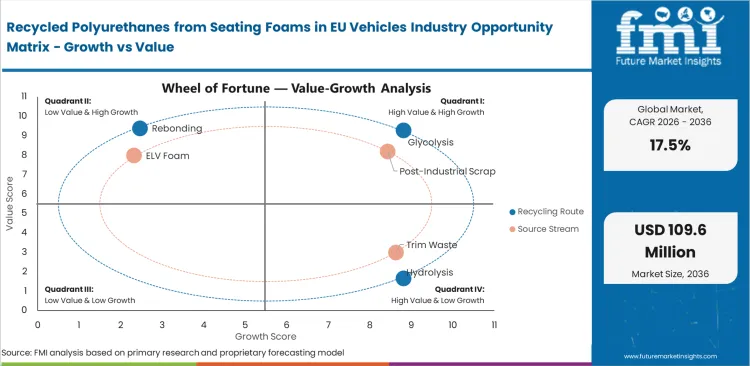
- EU end of life vehicle rules are lifting demand for verified seat foam recovery across major EU vehicle industrys.
- Automotive validation slows program entry because recycled chemistry needs repeated testing before seat approval.
- Recycled polyol improvement is narrowing the performance gap between recovered and virgin inputs.
The recycled polyurethanes from seating foams market is growing because EU circularity pressure is rising and automakers want verified recycled content in interior materials. The main barrier is long qualification cycles and tight foam performance limits. The main trend is higher-value recovery through polyol regeneration instead of simple grinding. Smaller recyclers face the most pressure because automotive approval work needs funding and stable feedstock access.
EU Vehicle Rules Raise Recovery Value
EU vehicle design and end-of-life rules are moving seat foam from general waste treatment into material planning. Seat systems carry enough polyurethane volume to justify dedicated recovery. Revenue improves when recovered chemistry can re-enter seats or interior parts instead of moving into low-value fill products. Project economics depend on early separation and clean handling.
Broader Urethane Foam Pricing Has Softened
A broader urethane foam benchmark also suggests a softer near-term pricing environment. FRED data show the producer price index for urethane and other foam product manufacturing primary products at 190.713 in November 2025 and December 2025, then lower at 188.842 in January, February, and March 2026. That is roughly a 1.0% decline before prices flattened again. It reduces the price umbrella that can make recycled inputs easier to place. When broader urethane prices ease, buyers tend to tighten cost comparisons and place more weight on consistent performance, traceability, and contract reliability than on circularity messaging alone.
Eurostat Input Costs Keep Recyclers Under Pressure
In the EU vehicle seating market, the cleaner public cost signal comes from Eurostat rather than from upstream oil and gas benchmarks. Eurostat reported that in January 2026 EU industrial producer prices increased 0.9% month on month for intermediate goods and 0.5% for total industry excluding energy. Cost pressure in recycled polyurethane from seating foams is coming less from a sharp virgin-material repricing cycle and more from the broader conversion environment around processing, bonding, and material preparation. Pricing power is more likely to depend on conversion efficiency and buyer recognition of recycled-content value than on any strong market-wide cost relief.
Recycled Polyurethanes from Seating Foams in EU Vehicles Industry Analysis by Key Countries
- Germany and France form the largest value tier because vehicle output and interior material programs are broad.
- Spain posts one of the fastest growth rates at 18.3% because seat manufacturing and circular material work are moving up together.
- Poland and Czechia add feedstock scale through Central European vehicle production.
- Slovakia starts from a smaller base yet vehicle concentration gives it a clear opening for future volume.
.webp "Top Country Growth Comparison Recycled Polyurethanes From Seating Foams In Eu Vehicles Industry Cagr (2026 2036)")
| Country | CAGR |
|---|---|
| Germany | 18.6% |
| Spain | 18.3% |
| France | 17.9% |
| Poland | 17.8% |
| Italy | 17.4% |
| Czechia | 17.0% |
| Slovakia | 16.7% |
FMI covers seven priority EU countries with the global CAGR at 17.5% through 2036. Germany leads the range at 18.6%. Spain follows at 18.3%. France and Poland sit close behind at 17.9% and 17.8%. Italy, Czechia, and Slovakia form the next group with growth rates from 16.7% to 17.4%.
Demand Outlook for Recycled Polyurethanes from Seating Foams in EU Vehicles Industry in Germany
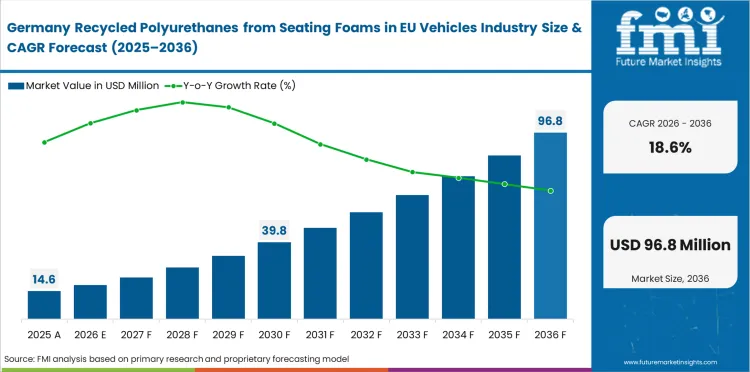
Large vehicle production and strong seat supplier activity give Germany the deepest near-term base for recycled seat foam use. Demand in Germany is anticipated to rise at a CAGR of 18.6% through 2036. Bavaria and Baden-Wurttemberg are crucial hubs as because premium vehicle programs and supplier networks are dense there. Adoption is increasing at a stable rate automakers can source validated materials close to assembly and seat molding sites. Supplier access relies on qualification depth and steady feedstock quality.
- Premium vehicle programs create early demand for validated circular materials.
- Seat system suppliers near major assembly hubs reduce logistics friction.
- Qualification discipline decides which recycled chemistry suppliers enter serial work.
Future Outlook for Recycled Polyurethanes from Seating Foams in EU Vehicles Industry in Spain
Spain vehicle manufacturing gives this industry a broad supply base for seat foam scrap and a practical route into new seat programs. Valencia and Catalonia support much of thisactivity through vehicle and component production. Sales in Spain are expected to increase at a CAGR of 18.3% during the forecast period. Growth is driven by export-oriented vehicle plantswhich require materials aligned with wider European circular targets. Re-entry into seat programs is decided by whether recycled polyol suppliers can hold batch quality across multiple vehicle platforms.
- Export-linked vehicle plants pull circular material standards into seat programs.
- Seat foam scrap quality is easier to control in organized plant networks.
- Program approvals narrow the supplier pool for chemistry inputs.
Opportunity Analysis of Recycled Polyurethanes from Seating Foams in EU Vehicles Industry in France
French demand benefits from vehicle circularity policy and from a broad industrial base in interior materials. Hauts-de-France and eastern industrial zones are witnessing demand as vehicle and parts production are concentrated there. The industry in France is expected to grow at a CAGR of 17.9% during the study period. Material entry is helped by a policy environment as it puts more weight on reuse and recycled content in vehicle design. Scale reflects how much ELV‑derived foam can be collected with usable chemistry.
Recovery value drops fast when dismantling and sorting happens too late.
- Circularity policy helps justify material recovery investments.
- ELV handling quality decides whether post-consumer foam can move into higher value routes.
- Interior parts conversion sites broaden outlet options beyond seat programs.
Sales Outlook for Recycled Polyurethanes from Seating Foams in EU Vehicles Industry in Poland
Poland is projected to record 17.8% CAGR in the recycled polyurethanes from seating foams in the EU vehicles industry by 2036. Central European vehicle output gives Poland a practical role in both feedstock supply and seat component demand. The importance of Silesia and western industrial corridors reflects the concentration of vehicle assembly and parts operations.
Material flow improves when seating suppliers combine local scrap capture with regional vehicle platform supply. Growth is supported by Poland’s role in the wider European automotive production chain. Price pressure can rise when recycled chemistry competes with lower-cost virgin input during weak raw material cycles.
- Vehicle and parts concentration support steady scrap generation.
- Regional supply links help recover material move across program networks.
- Virgin input price moves can pressure recycled content economics.
Demand Analysis of Recycled Polyurethanes from Seating Foams in EU Vehicles Industry in Italy
Italy is garnering stable expansion owing to dismantling capability and materials processing. Northern manufacturing districts are witnessing demand as vehicle components, and polymer processing are concentrated there. Recycled polyurethane demand across Italy is set to rise at 17.4% CAGR from 2026 to 2036. Growth hinges on recyclers’ ability to connect ELV foam capture with interior‑grade conversion pathways.
- Feedstock handling must preserve chemistry quality before depolymerization or rebond use. Local scale is good enough for pilot work, though broad serial volume needs tighter coordination across recyclers and seat material suppliers.
- Northern industrial districts support polymer handling and conversion work.
- ELV foam quality decides how much chemistry can re-enter vehicle use.
- Serial volume needs cleaner coordination across collection and processing.
Growth Outlook for Recycled Polyurethanes from Seating Foams in EU Vehicles Industry in Czechia
Vehicle manufacturing density makes Czechia a relevant country even with a smaller domestic base than Germany or Spain . Czechia is likely to post a CAGR of 17.0% in this sector during the assessment period. Demand grows when recovered seat foam can move through regional supplier networks without long transport loops. Material adoption works best for programs with fewer approved grades and stable seat designs. Small supplier groups without testing depth face slower entry into closed-loop work.
- Dense vehicle production keeps seat foam recovery commercially relevant.
- Regional logistics support faster movement of qualified recovered materials.
- Testing depth separates pilot suppliers from serial supply candidates.
Market Perspective for Recycled Polyurethanes from Seating Foams in EU Vehicles Industry in Slovakia
Demand in Slovakia is anticipated to rise at a CAGR of 16.7% over the forecast years. Slovakia starts from a smaller value base though vehicle concentration gives it useful long-term leverage Material use can rise when Slovak vehicle programs draw from certified chemistry produced elsewhere in Central Europe. Progress hinges on supplier access and platform approval timing.
- Vehicle concentration supports future pull for approved recycled materials.
- Regional sourcing links are more important than local recovery scale.
- Platform approvals decide how much imported recycled chemistry enters programs.
Competitive Landscape of Recycled Polyurethanes from Seating Foams in EU Vehicles Industry
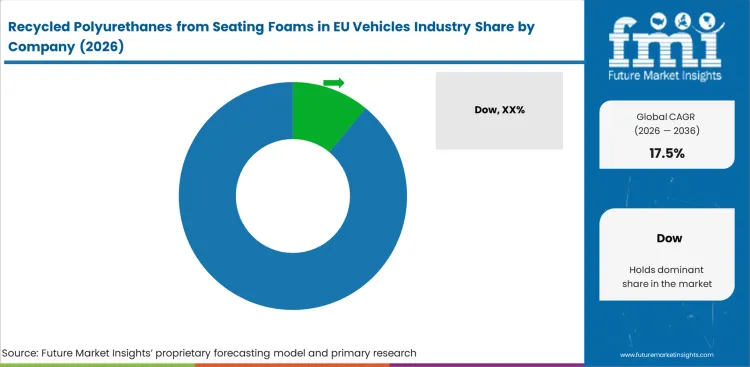
- Top suppliers are differentiated by recycled chemistry control and seat program access.
- European recyclers add value when feedstock quality and documentation are clear.
- Competitive pressure is highest where post-consumer foam needs fast qualification.
Competition in this market divides between chemical groups and seat system suppliers. Recyclers with foam recovery capability add a third layer. Dow and Covestro are central to the landscape, given that recycled polyol quality directly influences technical approval and qualification. BASF and Huntsman contribute formulation depth that supports foam system performance across variable recovered inputs. Adient and Lear are pivotal, as seat program access determines where and how recovered chemistry can progress into serial production. Gruppo Fiori plays a defining role through feedstock access from vehicle recovery, which directly shapes achievable cost structures and available volumes.
Dow is projected to hold the broadest visible position in the market in 2026. Its edge comes from recycled polyol capability and direct relevance to automotive seating programs. Covestro, BASF, and Huntsman brings formulation depth to ensure recovered inputs meet density and comfort targets. Material suppliers without strong testing support face longer approval cycles and lower share of serial business.
Adient and Lear bring influence from the seat side of the chain. Seat suppliers can move faster when a vehicle platform accepts recycled chemistry under an approved foam system. Links with automotive seating Accessories help here because seat content is specified early in vehicle development. Competitive standing improves when seat suppliers can align foam quality with platform timing. Feedstock quality decides how much value survives through each approval step.
Gruppo Fiori adds importance through recovery and feedstock handling. Recyclers in this market are judged on foam purity and on documentation quality. Supply does not favor scale alone because automotive programs need consistent chemistry and consistent proof. Suppliers with weak traceability lose access even when raw foam volume is available. Program entry is determined by who can connect recovery and chemistry with seat validation using fewer handoffs.
Competitive Benchmarking for Recycled Polyurethanes from Seating Foams in EU Vehicles Industry
| Company | Closed-Loop Seat Foam Execution | PU Recycling & Formulation Depth | Automotive Program Access | Geographic Footprint |
|---|---|---|---|---|
| Dow | High | High | Strong | Global |
| Adient | High | Medium | Strong | Global |
| JLR | Medium | Low | Strong | Multi-region |
| Gruppo Fiori | Medium | Low | Moderate | Country-focused |
| Covestro | Low | Medium | Moderate | Global |
| BASF | Low | Medium | Moderate | Global |
| Huntsman | Low | Medium | Low | Global |
Key Developments
- December 2025: Autoneum and Polestar announced recyclable polyester-based outer dashes and Ultra-Silent concealing panels for the Polestar 5, supporting vehicle noise and thermal insulation with a direct application in a named model program.
- September 2025: Dow and Gruppo Fiori developed a process to recover polyurethane seat foam from end-of-life vehicles without disassembly.
- February 2026: Adient, JLR, and Dow advanced a pilot using 20% end-of-life vehicle PU foam re-polyol in automotive seating.
Key Players in the Recycled Polyurethanes from Seating Foams in EU Vehicles Industry
Major Global Companies
- Dow
- Adient
- Lear
- Covestro
- BASF
Other Active Companies
- Huntsman
- Gruppo Fiori
Scope of the Report
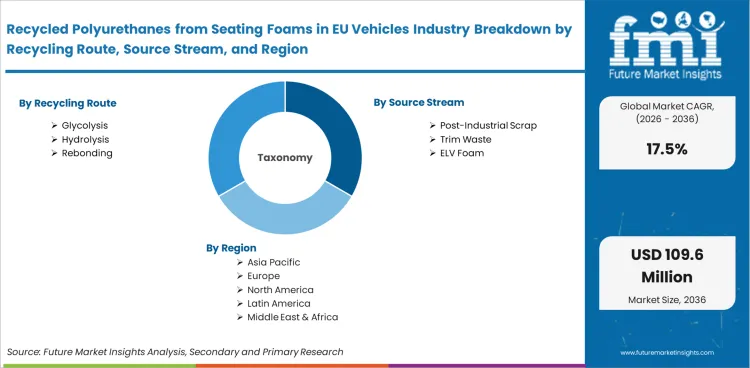
| Metric | Value |
|---|---|
| Quantitative Units | USD 18.6 million to USD 93.3 million at a CAGR of 17.5% |
| Market Definition | Recovered polyurethane materials and recycled polyol derived from vehicle seating foams for reuse in seat systems and interior components across EU vehicle programs. |
| Segmentation | Recycling Route / Source Stream / Foam Type / Vehicle Type / Seat Area / Product Form / Application / Sales Channel |
| Regions Covered | Europe |
| Countries Covered | 7 priority EU countries |
| Key Companies Profiled | Dow / Adient / Lear / Covestro / BASF / Huntsman / Gruppo Fiori |
| Forecast Period | 2026 to 2036 |
Recycled Polyurethanes from Seating Foams in EU Vehicles Industry by Segments
Recycled Polyurethanes from Seating Foams in EU Vehicles Industry Segmented by Recycling Route
- Glycolysis
- Hydrolysis
- Rebonding
- Mechanical Grind
- Depolymerized Polyol
Recycled Polyurethanes from Seating Foams in EU Vehicles Industry Classified by Source Stream
- Post-industrial Scrap
- Post-consumer Foam
- Trim Waste
- Cushion Offcuts
- ELV Foam
Recycled Polyurethanes from Seating Foams in EU Vehicles Industry Analyzed by Foam Type
- Flexible Molded Foam
- High-resilience Foam
- Viscoelastic Foam
- Ester Foam
- Ether Foam
Recycled Polyurethanes from Seating Foams in EU Vehicles Industry Classified by Vehicle Type
- Passenger Cars
- SUVs
- Light Vans
- Trucks
- Buses
Recycled Polyurethanes from Seating Foams in EU Vehicles Industry Classified by Product Form
- Recycled Polyol
- Regrind Flakes
- Rebond Blocks
- Molded Inserts
- Acoustic Sheets
Recycled Polyurethanes from Seating Foams in EU Vehicles Industry Classified by Application
- New Seat Cushions
- Acoustic Pads
- Carpet Underlays
- Trunk Liners
- Load Floors
Recycled Polyurethanes from Seating Foams in EU Vehicles Industry by Region and Country
- Western Europe
- Germany
- France
- Southern Europe
- Italy
- Spain
- Eastern Europe
- Poland
- Czechia
- Slovakia
Bibliography
- USA Bureau of Labor Statistics. (2026, April 14). Producer Price Index by Industry: Urethane and Other Foam Product Manufacturing: Primary Products (PCU326150326150P). FRED, Federal Reserve Bank of St. Louis.
- APA 7 bibliography: USA Bureau of Labor Statistics. (2026, March). Table 9. Producer price indexes for commodity and service groupings and individual items. U.S. Department of Labor.
- APA 7 bibliography: World Bank. (2025, April). World Bank Commodities Price Data (The Pink Sheet). World Bank.
- Jaguar Land Rover. (2025, January 29). JLR delivers robust Q3 financial performance with best Q3 revenue on record. JLR Media Newsroom.
- Adient. (2026, February 4). Adient reports solid first quarter 2026 financial results. Adient Investor Relations.
- Adient. (2024, December 2). Adient, Jaguar Land Rover and Dow develop closed-loop polyurethane foam seats.
- European Automobile Manufacturers’ Association. (2026, April). Economic and market report: Full year 2025.
- Eurostat. (2025, November). End-of-life vehicle statistics.
- Jaguar Land Rover. (2024, November 27). JLR closes the loop with industry first breakthrough using recycled seat foam.
- Belsare, N., et al. (2025, April). Sustainable polyurethane foam formulation with bio-polyol for automotive seating application. Industrial Crops and Products, 233, 120041.
- Dow. (2025, September 3). Dow and Gruppo Fiori develop breakthrough recycling process for automotive polyurethane waste.
- European Chemical Industry Council. (2025, June 16). From old seats to new rides: The future of closed-loop foam recycling in cars.
This bibliography is for reader reference. The full FMI report includes the complete reference list with primary research documentation.
This Report Addresses
- Market sizing and revenue forecasting for recycled polyurethane feedstock and recycled polyol from 2026 to 2036.
- Segmentation analysis across recycling route and source stream. Analysis of foam type and vehicle type. Analysis across seat area and product form. Analysis across application and sales channel.
- Country analysis covers seven EU industries with comparative growth rates.
- Regulatory analysis covering EU vehicle circularity rules and end of life vehicle recovery pressure.
- Competitive structure assessment covering supplier roles and validation depth. Assessment covers feedstock access.
- Opportunity mapping across seat systems and acoustic parts. Opportunity mapping across interior underlay uses too.
- Supply chain coverage from seat foam recovery to recycled chemistry reuse in vehicle programs.
- Data delivery in document format with segment and country breakdowns.
Frequently Asked Questions
What is the current value of the Recycled Polyurethanes from Seating Foams in EU Vehicles Industry?
FMI values this market at USD 15.8 million in 2025.
What is the Recycled Polyurethanes from Seating Foams in EU Vehicles Industry projected to reach by 2036?
Revenue is projected to reach USD 93.3 million by 2036.
What CAGR is forecast from 2026 to 2036?
Growth is forecast at a CAGR of 17.5% from 2026 to 2036.
Which recycling route leads the market in 2026?
Glycolysis leads recycling route demand with a 31.0% share in 2026 because it offers a direct path into recycled polyol.
Which source stream holds the largest share in 2026?
Post-industrial scrap holds 58.0% of source stream demand in 2026 because cleaner foam waste is easier to qualify.
Why does Germany lead the country growth forecast?
Germany is expected to grow at a CAGR of 18.6% through 2036 because vehicle output and seat supplier density are stronger there.
What is included in the market scope?
Scope includes recovered polyurethane materials and recycled polyol from vehicle seating foams used in seat systems and interior components within EU vehicle programs.
How was the market forecast built?
FMI used a hybrid model based on EU vehicle production and polyurethane intensity per vehicle. The model used seating foam share and early recycled polyol adoption too.
Preview the report firsthand - request a free sample
Get SampleGet the brochure for pricing and purchase details.
Get PDFTable of Content
- Executive Summary
- Global Market Outlook
- Demand-side Trends
- Supply-side Trends
- Technology Roadmap Analysis
- Analysis and Recommendations
- Market Overview
- Market Coverage / Taxonomy
- Market Definition / Scope / Limitations
- Research Methodology
- Chapter Orientation
- Analytical Lens and Working Hypotheses
- Market Structure, Signals, and Trend Drivers
- Benchmarking and Cross-market Comparability
- Market Sizing, Forecasting, and Opportunity Mapping
- Research Design and Evidence Framework
- Desk Research Programme (Secondary Evidence)
- Company Annual and Sustainability Reports
- Peer-reviewed Journals and Academic Literature
- Corporate Websites, Product Literature, and Technical Notes
- Earnings Decks and Investor Briefings
- Statutory Filings and Regulatory Disclosures
- Technical White Papers and Standards Notes
- Trade Journals, Industry Magazines, and Analyst Briefs
- Conference Proceedings, Webinars, and Seminar Materials
- Government Statistics Portals and Public Data Releases
- Press Releases and Reputable Media Coverage
- Specialist Newsletters and Curated Briefings
- Sector Databases and Reference Repositories
- FMI Internal Proprietary Databases and Historical Market Datasets
- Subscription Datasets and Paid Sources
- Social Channels, Communities, and Digital Listening Inputs
- Additional Desk Sources
- Expert Input and Fieldwork (Primary Evidence)
- Primary Modes
- Qualitative Interviews and Expert Elicitation
- Quantitative Surveys and Structured Data Capture
- Blended Approach
- Why Primary Evidence is Used
- Field Techniques
- Interviews
- Surveys
- Focus Groups
- Observational and In-context Research
- Social and Community Interactions
- Stakeholder Universe Engaged
- C-suite Leaders
- Board Members
- Presidents and Vice Presidents
- R&D and Innovation Heads
- Technical Specialists
- Domain Subject-matter Experts
- Scientists
- Physicians and Other Healthcare Professionals
- Governance, Ethics, and Data Stewardship
- Research Ethics
- Data Integrity and Handling
- Primary Modes
- Tooling, Models, and Reference Databases
- Desk Research Programme (Secondary Evidence)
- Data Engineering and Model Build
- Data Acquisition and Ingestion
- Cleaning, Normalisation, and Verification
- Synthesis, Triangulation, and Analysis
- Quality Assurance and Audit Trail
- Market Background
- Market Dynamics
- Drivers
- Restraints
- Opportunity
- Trends
- Scenario Forecast
- Demand in Optimistic Scenario
- Demand in Likely Scenario
- Demand in Conservative Scenario
- Opportunity Map Analysis
- Product Life Cycle Analysis
- Supply Chain Analysis
- Investment Feasibility Matrix
- Value Chain Analysis
- PESTLE and Porter’s Analysis
- Regulatory Landscape
- Regional Parent Market Outlook
- Production and Consumption Statistics
- Import and Export Statistics
- Market Dynamics
- Global Market Analysis 2021 to 2025 and Forecast, 2026 to 2036
- Historical Market Size Value (USD Million) Analysis, 2021 to 2025
- Current and Future Market Size Value (USD Million) Projections, 2026 to 2036
- Y-o-Y Growth Trend Analysis
- Absolute $ Opportunity Analysis
- Global Market Pricing Analysis 2021 to 2025 and Forecast 2026 to 2036
- Global Market Analysis 2021 to 2025 and Forecast 2026 to 2036, By Recycling Route
- Introduction / Key Findings
- Historical Market Size Value (USD Million) Analysis By Recycling Route , 2021 to 2025
- Current and Future Market Size Value (USD Million) Analysis and Forecast By Recycling Route , 2026 to 2036
- Glycolysis
- Hydrolysis
- Rebonding
- Glycolysis
- Y-o-Y Growth Trend Analysis By Recycling Route , 2021 to 2025
- Absolute $ Opportunity Analysis By Recycling Route , 2026 to 2036
- Global Market Analysis 2021 to 2025 and Forecast 2026 to 2036, By Source Stream
- Introduction / Key Findings
- Historical Market Size Value (USD Million) Analysis By Source Stream, 2021 to 2025
- Current and Future Market Size Value (USD Million) Analysis and Forecast By Source Stream, 2026 to 2036
- Post-Industrial Scrap
- Trim Waste
- ELV Foam
- Post-Industrial Scrap
- Y-o-Y Growth Trend Analysis By Source Stream, 2021 to 2025
- Absolute $ Opportunity Analysis By Source Stream, 2026 to 2036
- Global Market Analysis 2021 to 2025 and Forecast 2026 to 2036, By Foam Type
- Introduction / Key Findings
- Historical Market Size Value (USD Million) Analysis By Foam Type, 2021 to 2025
- Current and Future Market Size Value (USD Million) Analysis and Forecast By Foam Type, 2026 to 2036
- Flexible Molded Foam
- High-Resilience Foam
- Ester Foam
- Flexible Molded Foam
- Y-o-Y Growth Trend Analysis By Foam Type, 2021 to 2025
- Absolute $ Opportunity Analysis By Foam Type, 2026 to 2036
- Global Market Analysis 2021 to 2025 and Forecast 2026 to 2036, By Vehicle Type
- Introduction / Key Findings
- Historical Market Size Value (USD Million) Analysis By Vehicle Type, 2021 to 2025
- Current and Future Market Size Value (USD Million) Analysis and Forecast By Vehicle Type, 2026 to 2036
- Passenger cars
- SUVs
- Light Vans
- Passenger cars
- Y-o-Y Growth Trend Analysis By Vehicle Type, 2021 to 2025
- Absolute $ Opportunity Analysis By Vehicle Type, 2026 to 2036
- Global Market Analysis 2021 to 2025 and Forecast 2026 to 2036, By Product Form
- Introduction / Key Findings
- Historical Market Size Value (USD Million) Analysis By Product Form, 2021 to 2025
- Current and Future Market Size Value (USD Million) Analysis and Forecast By Product Form, 2026 to 2036
- Recycled Polyol
- Regrind Flakes
- Rebond Blocks
- Recycled Polyol
- Y-o-Y Growth Trend Analysis By Product Form, 2021 to 2025
- Absolute $ Opportunity Analysis By Product Form, 2026 to 2036
- Global Market Analysis 2021 to 2025 and Forecast 2026 to 2036, By Application
- Introduction / Key Findings
- Historical Market Size Value (USD Million) Analysis By Application, 2021 to 2025
- Current and Future Market Size Value (USD Million) Analysis and Forecast By Application, 2026 to 2036
- New Seat Cushions
- Acoustic Pads
- Carpet Underlays
- New Seat Cushions
- Y-o-Y Growth Trend Analysis By Application, 2021 to 2025
- Absolute $ Opportunity Analysis By Application, 2026 to 2036
- Global Market Analysis 2021 to 2025 and Forecast 2026 to 2036, By Region
- Introduction
- Historical Market Size Value (USD Million) Analysis By Region, 2021 to 2025
- Current Market Size Value (USD Million) Analysis and Forecast By Region, 2026 to 2036
- North America
- Latin America
- Western Europe
- Eastern Europe
- East Asia
- South Asia and Pacific
- Middle East & Africa
- Market Attractiveness Analysis By Region
- North America Market Analysis 2021 to 2025 and Forecast 2026 to 2036, By Country
- Historical Market Size Value (USD Million) Trend Analysis By Market Taxonomy, 2021 to 2025
- Market Size Value (USD Million) Forecast By Market Taxonomy, 2026 to 2036
- By Country
- USA
- Canada
- Mexico
- By Recycling Route
- By Source Stream
- By Foam Type
- By Vehicle Type
- By Product Form
- By Application
- By Country
- Market Attractiveness Analysis
- By Country
- By Recycling Route
- By Source Stream
- By Foam Type
- By Vehicle Type
- By Product Form
- By Application
- Key Takeaways
- Latin America Market Analysis 2021 to 2025 and Forecast 2026 to 2036, By Country
- Historical Market Size Value (USD Million) Trend Analysis By Market Taxonomy, 2021 to 2025
- Market Size Value (USD Million) Forecast By Market Taxonomy, 2026 to 2036
- By Country
- Brazil
- Chile
- Rest of Latin America
- By Recycling Route
- By Source Stream
- By Foam Type
- By Vehicle Type
- By Product Form
- By Application
- By Country
- Market Attractiveness Analysis
- By Country
- By Recycling Route
- By Source Stream
- By Foam Type
- By Vehicle Type
- By Product Form
- By Application
- Key Takeaways
- Western Europe Market Analysis 2021 to 2025 and Forecast 2026 to 2036, By Country
- Historical Market Size Value (USD Million) Trend Analysis By Market Taxonomy, 2021 to 2025
- Market Size Value (USD Million) Forecast By Market Taxonomy, 2026 to 2036
- By Country
- Germany
- UK
- Italy
- Spain
- France
- Nordic
- BENELUX
- Rest of Western Europe
- By Recycling Route
- By Source Stream
- By Foam Type
- By Vehicle Type
- By Product Form
- By Application
- By Country
- Market Attractiveness Analysis
- By Country
- By Recycling Route
- By Source Stream
- By Foam Type
- By Vehicle Type
- By Product Form
- By Application
- Key Takeaways
- Eastern Europe Market Analysis 2021 to 2025 and Forecast 2026 to 2036, By Country
- Historical Market Size Value (USD Million) Trend Analysis By Market Taxonomy, 2021 to 2025
- Market Size Value (USD Million) Forecast By Market Taxonomy, 2026 to 2036
- By Country
- Russia
- Poland
- Hungary
- Balkan & Baltic
- Rest of Eastern Europe
- By Recycling Route
- By Source Stream
- By Foam Type
- By Vehicle Type
- By Product Form
- By Application
- By Country
- Market Attractiveness Analysis
- By Country
- By Recycling Route
- By Source Stream
- By Foam Type
- By Vehicle Type
- By Product Form
- By Application
- Key Takeaways
- East Asia Market Analysis 2021 to 2025 and Forecast 2026 to 2036, By Country
- Historical Market Size Value (USD Million) Trend Analysis By Market Taxonomy, 2021 to 2025
- Market Size Value (USD Million) Forecast By Market Taxonomy, 2026 to 2036
- By Country
- China
- Japan
- South Korea
- By Recycling Route
- By Source Stream
- By Foam Type
- By Vehicle Type
- By Product Form
- By Application
- By Country
- Market Attractiveness Analysis
- By Country
- By Recycling Route
- By Source Stream
- By Foam Type
- By Vehicle Type
- By Product Form
- By Application
- Key Takeaways
- South Asia and Pacific Market Analysis 2021 to 2025 and Forecast 2026 to 2036, By Country
- Historical Market Size Value (USD Million) Trend Analysis By Market Taxonomy, 2021 to 2025
- Market Size Value (USD Million) Forecast By Market Taxonomy, 2026 to 2036
- By Country
- India
- ASEAN
- Australia & New Zealand
- Rest of South Asia and Pacific
- By Recycling Route
- By Source Stream
- By Foam Type
- By Vehicle Type
- By Product Form
- By Application
- By Country
- Market Attractiveness Analysis
- By Country
- By Recycling Route
- By Source Stream
- By Foam Type
- By Vehicle Type
- By Product Form
- By Application
- Key Takeaways
- Middle East & Africa Market Analysis 2021 to 2025 and Forecast 2026 to 2036, By Country
- Historical Market Size Value (USD Million) Trend Analysis By Market Taxonomy, 2021 to 2025
- Market Size Value (USD Million) Forecast By Market Taxonomy, 2026 to 2036
- By Country
- Kingdom of Saudi Arabia
- Other GCC Countries
- Turkiye
- South Africa
- Other African Union
- Rest of Middle East & Africa
- By Recycling Route
- By Source Stream
- By Foam Type
- By Vehicle Type
- By Product Form
- By Application
- By Country
- Market Attractiveness Analysis
- By Country
- By Recycling Route
- By Source Stream
- By Foam Type
- By Vehicle Type
- By Product Form
- By Application
- Key Takeaways
- Key Countries Market Analysis
- USA
- Pricing Analysis
- Market Share Analysis, 2025
- By Recycling Route
- By Source Stream
- By Foam Type
- By Vehicle Type
- By Product Form
- By Application
- Canada
- Pricing Analysis
- Market Share Analysis, 2025
- By Recycling Route
- By Source Stream
- By Foam Type
- By Vehicle Type
- By Product Form
- By Application
- Mexico
- Pricing Analysis
- Market Share Analysis, 2025
- By Recycling Route
- By Source Stream
- By Foam Type
- By Vehicle Type
- By Product Form
- By Application
- Brazil
- Pricing Analysis
- Market Share Analysis, 2025
- By Recycling Route
- By Source Stream
- By Foam Type
- By Vehicle Type
- By Product Form
- By Application
- Chile
- Pricing Analysis
- Market Share Analysis, 2025
- By Recycling Route
- By Source Stream
- By Foam Type
- By Vehicle Type
- By Product Form
- By Application
- Germany
- Pricing Analysis
- Market Share Analysis, 2025
- By Recycling Route
- By Source Stream
- By Foam Type
- By Vehicle Type
- By Product Form
- By Application
- UK
- Pricing Analysis
- Market Share Analysis, 2025
- By Recycling Route
- By Source Stream
- By Foam Type
- By Vehicle Type
- By Product Form
- By Application
- Italy
- Pricing Analysis
- Market Share Analysis, 2025
- By Recycling Route
- By Source Stream
- By Foam Type
- By Vehicle Type
- By Product Form
- By Application
- Spain
- Pricing Analysis
- Market Share Analysis, 2025
- By Recycling Route
- By Source Stream
- By Foam Type
- By Vehicle Type
- By Product Form
- By Application
- France
- Pricing Analysis
- Market Share Analysis, 2025
- By Recycling Route
- By Source Stream
- By Foam Type
- By Vehicle Type
- By Product Form
- By Application
- India
- Pricing Analysis
- Market Share Analysis, 2025
- By Recycling Route
- By Source Stream
- By Foam Type
- By Vehicle Type
- By Product Form
- By Application
- ASEAN
- Pricing Analysis
- Market Share Analysis, 2025
- By Recycling Route
- By Source Stream
- By Foam Type
- By Vehicle Type
- By Product Form
- By Application
- Australia & New Zealand
- Pricing Analysis
- Market Share Analysis, 2025
- By Recycling Route
- By Source Stream
- By Foam Type
- By Vehicle Type
- By Product Form
- By Application
- China
- Pricing Analysis
- Market Share Analysis, 2025
- By Recycling Route
- By Source Stream
- By Foam Type
- By Vehicle Type
- By Product Form
- By Application
- Japan
- Pricing Analysis
- Market Share Analysis, 2025
- By Recycling Route
- By Source Stream
- By Foam Type
- By Vehicle Type
- By Product Form
- By Application
- South Korea
- Pricing Analysis
- Market Share Analysis, 2025
- By Recycling Route
- By Source Stream
- By Foam Type
- By Vehicle Type
- By Product Form
- By Application
- Russia
- Pricing Analysis
- Market Share Analysis, 2025
- By Recycling Route
- By Source Stream
- By Foam Type
- By Vehicle Type
- By Product Form
- By Application
- Poland
- Pricing Analysis
- Market Share Analysis, 2025
- By Recycling Route
- By Source Stream
- By Foam Type
- By Vehicle Type
- By Product Form
- By Application
- Hungary
- Pricing Analysis
- Market Share Analysis, 2025
- By Recycling Route
- By Source Stream
- By Foam Type
- By Vehicle Type
- By Product Form
- By Application
- Kingdom of Saudi Arabia
- Pricing Analysis
- Market Share Analysis, 2025
- By Recycling Route
- By Source Stream
- By Foam Type
- By Vehicle Type
- By Product Form
- By Application
- Turkiye
- Pricing Analysis
- Market Share Analysis, 2025
- By Recycling Route
- By Source Stream
- By Foam Type
- By Vehicle Type
- By Product Form
- By Application
- South Africa
- Pricing Analysis
- Market Share Analysis, 2025
- By Recycling Route
- By Source Stream
- By Foam Type
- By Vehicle Type
- By Product Form
- By Application
- USA
- Market Structure Analysis
- Competition Dashboard
- Competition Benchmarking
- Market Share Analysis of Top Players
- By Regional
- By Recycling Route
- By Source Stream
- By Foam Type
- By Vehicle Type
- By Product Form
- By Application
- Competition Analysis
- Competition Deep Dive
- Dow
- Overview
- Product Portfolio
- Profitability by Market Segments (Product/Age /Sales Channel/Region)
- Sales Footprint
- Strategy Overview
- Marketing Strategy
- Product Strategy
- Channel Strategy
- Adient
- Lear
- Covestro
- BASF
- Huntsman
- Gruppo Fiori
- Dow
- Competition Deep Dive
- Assumptions & Acronyms Used


