

- Industry Size (2026):
- USD 94.2 Mn
- Forecast (2036):
- USD 263.3 Mn
- CAGR (2026 to 2036)
- 10.8%
Space Debris Reusable Orbital Vehicles Market Forecast and Outlook 2026 to 2036
The space debris reusable orbital vehicles market is valued at USD 94.2 million in 2026 and is projected to reach USD 263.3 million by 2036, reflecting a CAGR of 10.8%. Market performance is shaped by high capital requirements, specialized manufacturing, and compliance with orbital safety regulations. Cost structures vary depending on vehicle design, propulsion systems, and on-orbit recovery technologies. Pricing control is concentrated among providers able to demonstrate repeatable, certified operational performance. Margin concentration favors companies integrating design, testing, and debris mitigation capabilities, capturing value from technological reliability rather than launch volume.
Market outcomes depend on alignment with satellite operators, space agencies, and commercial orbital programs. Adoption varies according to orbital debris mitigation mandates, launch frequency, and vehicle compatibility. Operators offering certified reusable vehicles with proven recovery systems achieve higher margins. Smaller or emerging providers face constraints due to development costs and regulatory certification. Value accrues to firms controlling production, testing, and fleet integration, while volume alone does not guarantee market positioning or profitability.
Quick Stats of the Space Debris Reusable Orbital Vehicles Market
- Space Debris Reusable Orbital Vehicles Market Value (2026): USD 94.2 million
- Space Debris Reusable Orbital Vehicles Forecast Value (2036): USD 263.3 million
- Space Debris Reusable Orbital Vehicles Forecast CAGR 2026 to 2036: 10.8%
- Leading Mission Type in Space Debris Reusable Orbital Vehicles Market: Active Debris Removal (38 % share)
- Leading Orbit in Space Debris Reusable Orbital Vehicles Market: Low Earth Orbit (LEO) (68 % share)
- Key Growth Regions in Space Debris Reusable Orbital Vehicles Market: USA, Japan, UK, France
- Top Players in Space Debris Reusable Orbital Vehicles Market: Astroscale, Clear Space, Northrop Grumman, Airbus Defence & Space, Lockheed Martin, Thales Alenia Space
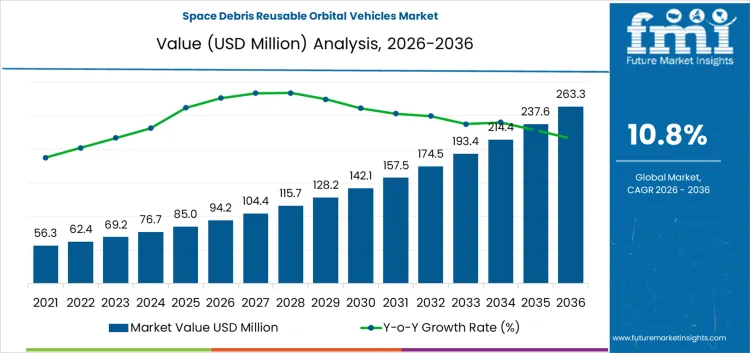
What is the Growth Forecast for Space Debris Reusable Orbital Vehicles Market through 2036?
The space debris reusable orbital vehicles space is expected to experience robust, sustained growth through 2036, supported by rising orbital congestion and the global emphasis on long-term space sustainability. Demand continues to strengthen as government agencies, commercial satellite operators, and defense organizations expand the use of active debris removal, in-orbit servicing, and controlled end-of-life deorbit missions across low-, medium-, and geostationary Earth orbits.
Growth momentum accelerates in the latter half of the forecast period due to increasing satellite density, more frequent servicing requirements, and the expansion of national and commercial space programs. Regulatory pressure related to orbital safety, collision avoidance, and responsible space operations further reinforces adoption. Reusable orbital vehicle platforms gain preference for their ability to reduce mission costs, enable repeat operations, and deliver higher operational reliability.
Value creation increasingly favors providers offering mission-proven, reusable vehicle technologies, advanced autonomous navigation, and strong integration capabilities with existing satellite fleets. Competitive advantage rests with companies that maintain close partnerships with space agencies and commercial operators, positioning them to benefit from the growing emphasis on sustainable and secure orbital environments through 2036.
Space Debris Reusable Orbital Vehicles Market Key Takeaways
| Metric | Value |
|---|---|
| Market Value (2026) | USD 94.2 million |
| Forecast Value (2036) | USD 263.3 million |
| Forecast CAGR 2026 to 2036 | 10.80% |
What Is Driving Demand for Space Debris Reusable Orbital Vehicles?
Space debris reusable orbital vehicles are increasingly adopted to support satellite deployment, orbital servicing, and debris mitigation in low Earth orbit (LEO). Historically, single-use launch vehicles contributed to orbital debris and increased mission costs. Modern reusable vehicles incorporate modular designs, precision navigation, and reentry capability to perform multiple missions while minimizing material loss and operational expense. Aerospace manufacturers, satellite operators, and government space agencies prioritize reliability, reusability, and compliance with orbital debris mitigation guidelines. Early adoption focused on experimental missions and demonstration launches, while current demand extends to commercial satellite operators, space logistics providers, and international space programs driven by cost efficiency, orbital sustainability, and regulatory compliance. Vehicle durability, propulsion reliability, and mission adaptability influence design and supplier selection.
Rising satellite deployment, regulatory emphasis on orbital debris management, and cost reduction objectives are shaping market growth. Compared with conventional expendable vehicles, reusable orbital platforms emphasize structural integrity, precision control, and rapid turnaround between missions. Cost structures depend on vehicle design, propulsion systems, and refurbishment processes, concentrating margins among suppliers capable of delivering reliable, certified vehicles. Space operators adopt reusable orbital vehicles to reduce launch costs, extend operational lifecycles, and comply with space debris regulations. By 2036, these vehicles are expected to become standard in commercial and governmental space operations, supporting orbital traffic management, cost efficiency, and mission sustainability.
What Factors Are Shaping the Demand for Space Debris Reusable Orbital Vehicles in Terms of Mission Type and Orbit?
The demand for space debris reusable orbital vehicles is segmented by mission type and orbit. Mission types include active debris removal, life-extension servicing, end-of-life deorbit, collision avoidance, and inspection and diagnosis. Orbit categories cover low Earth orbit (LEO), medium Earth orbit (MEO), and geostationary orbit (GEO). Adoption is influenced by orbital congestion, regulatory requirements, and spacecraft operational safety. Uptake is driven by the need to mitigate collision risks, extend satellite lifespans, and support sustainable space operations. Mission type and orbit selection depend on target debris, orbital altitude, and vehicle capabilities, ensuring effective, safe, and reliable orbital debris management and satellite servicing.
Why Is Active Debris Removal Leading the Mission Type Segment in Reusable Orbital Vehicles?
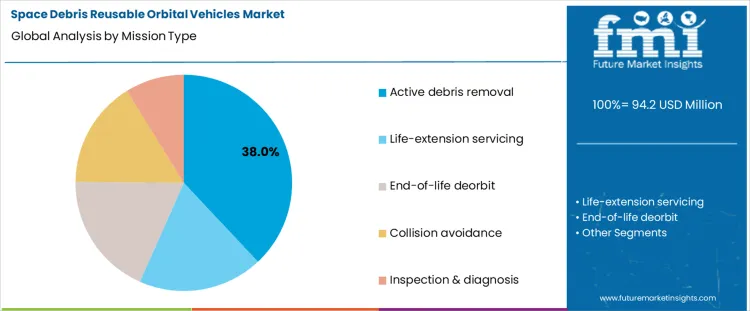
Active debris removal accounts for approximately 38% of total mission type demand, making it the leading category. These missions involve capturing, deorbiting, or relocating space debris to mitigate collision risks with operational satellites. Adoption is driven by the increasing density of LEO debris, regulatory pressure on satellite operators, and international guidelines for orbital safety. Reusable vehicles for debris removal are designed to handle varying object sizes, velocities, and shapes while maintaining operational reliability. Operational planning includes trajectory analysis, rendezvous control, and safe deorbit execution. The segment leads because active debris removal directly addresses critical orbital congestion, ensuring long-term operational sustainability for satellites.
Technical factors further shape adoption. Vehicles must withstand microgravity, thermal fluctuations, and radiation exposure while maintaining maneuverability and precise control. Integration with tracking systems and ground-based coordination ensures successful debris capture and removal. The segment leads because active debris removal missions provide measurable mitigation of collision risks, operational reliability, and compliance with orbital safety standards.
Why Is Low Earth Orbit (LEO) Representing the Largest Orbit Segment in Reusable Orbital Vehicles?
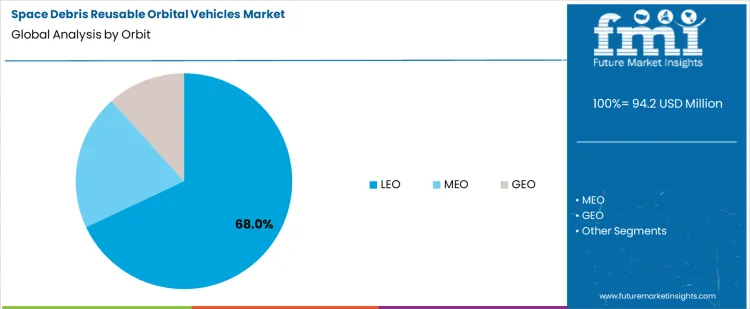
LEO accounts for approximately 68% of total orbit segment demand, making it the largest category. Adoption is driven by high satellite density, frequent debris generation, and commercial and scientific satellite deployment. Reusable orbital vehicles in LEO are used for debris removal, inspection, collision avoidance, and servicing of operational satellites. Vehicle design emphasizes rapid maneuvering, energy efficiency, and endurance for repeated missions. Maintenance protocols include trajectory verification, system checks, and fuel management to ensure continuous operational readiness.
Operational and functional factors influence adoption. Vehicles must operate reliably under variable gravity, radiation, and orbital debris conditions while maintaining precise control for rendezvous and capture. Integration with ground control and satellite tracking ensures successful mission execution. LEO leads because it represents the primary orbital region with the highest debris density, requiring reusable vehicles to provide safety, sustainability, and long-term operational reliability for space assets.
How Are Reusable Orbital Vehicles Shaping Sustainable Space Operations?
Reusable orbital vehicles are increasingly deployed to actively remove defunct satellites and debris while supporting repeated orbital missions. Adoption is strongest in regions with high-density satellite constellations and active space commercialization. Vehicles are valued for precision maneuvering, modular capture tools, and fuel efficiency in repeated operations. Growth is driven by escalating collision risks, rising satellite insurance costs, and the operational need to preserve orbital pathways. Investment focuses on autonomous docking systems, debris detection sensors, and vehicle reusability cycles. Operators prioritize designs that maximize mission frequency while maintaining safety in congested orbital zones.
What Emerging Space Traffic Challenges Are Driving Investment?
Demand is fueled by increased satellite launches, miniaturized constellations, and unpredictable debris fragments threatening operational assets. Agencies and private operators adopt reusable vehicles to minimize mission downtime and prevent costly satellite replacements. Vehicles with advanced sensing, autonomous navigation, and adaptive capture mechanisms gain preference. Adoption is concentrated in orbital regions with heavy traffic and collision probability. Operational risk mitigation and insurance cost reduction drive investment more than procurement price. Providers offering multi-mission, high-precision systems secure competitive advantages among satellite operators and government agencies.
What Operational Complexities Restrict Wider Deployment?
Mission planning complexity, unpredictable debris trajectories, and fuel limitations constrain adoption. Performance can degrade due to high-speed impacts, uncooperative debris, or failure in autonomous capture algorithms. Safety verification and international coordination for orbital clearance add additional hurdles. Smaller space programs or regions lacking launch and refueling infrastructure adopt solutions more slowly. These factors concentrate early deployment among government agencies, well-funded private aerospace companies, and regions with established space situational awareness networks.
How Are Innovative Partnerships and Advanced Mission Architectures Shaping Market Trends?
Recent trends include modular robotic arms, swarm-based capture approaches, and predictive AI navigation for debris interception. Collaboration between space agencies, satellite operators, and research institutes ensures mission planning accuracy, regulatory alignment, and risk mitigation. Pilot missions test multi-debris capture, reusability cycles, and autonomous operations before commercial deployment. Emphasis is on orbital safety, mission repeatability, and operational cost reduction rather than scale or speed. These cooperative approaches drive adoption in regions prioritizing sustainable space utilization and long-term orbital traffic management.
What is the Demand for Space Debris Reusable Orbital Vehicles by Country?
| Country | CAGR (%) |
|---|---|
| USA | 10.5 |
| Japan | 10.0 |
| UK | 9.5 |
| France | 9.0 |
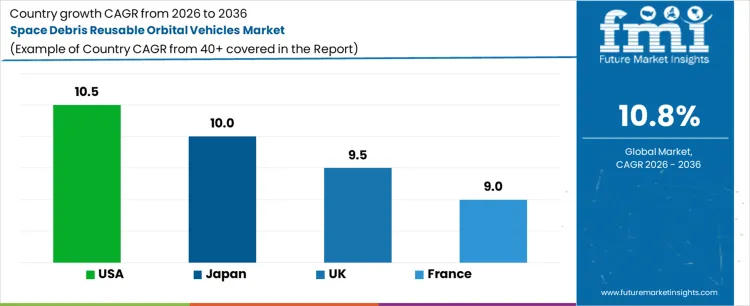
Demand for space debris reusable orbital vehicles is rising as governments and private space operators prioritize debris mitigation, cost-effective orbital operations, and sustainable satellite deployment. The USA leads with a 10.5% CAGR, driven by investments in reusable launch systems, active debris removal programs, and commercial space initiatives. Japan follows at 10.0%, supported by national space programs and technological advancements in reusable orbital platforms. The UK records 9.5% growth, shaped by emerging private space ventures and government-backed debris mitigation strategies. France grows at 9.0%, influenced by aerospace research initiatives, collaborative space missions, and adoption of reusable orbital technologies for debris management.
How Is the United States Experiencing Growth in the Space Debris Reusable Orbital Vehicles Market?
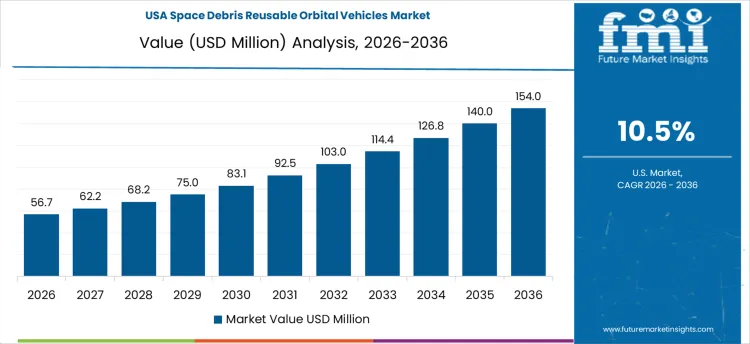
United States is experiencing growth at a CAGR of 10.5%, supported by adoption of reusable orbital vehicles for space debris management and satellite servicing missions. Aerospace manufacturers and technology providers are deploying vehicles optimized for repeated orbital operations, structural durability, and precision maneuvering in debris-rich environments. Demand is concentrated in major aerospace hubs, satellite launch centers, and research and development facilities. Investments focus on vehicle design, material performance, and compliance with international space regulations rather than large-scale deployment. Growth reflects increasing satellite launches, government initiatives for orbital debris mitigation, and industrial adoption of reusable space technologies.
- Reusable orbital vehicles drive adoption.
- Vehicles optimize maneuverability and structural durability.
- Aerospace hubs and launch centers concentrate demand.
- Vehicle design and regulatory compliance guide investment.
How Is Japan Witnessing Rapid Growth with Orbital Debris Management Programs?
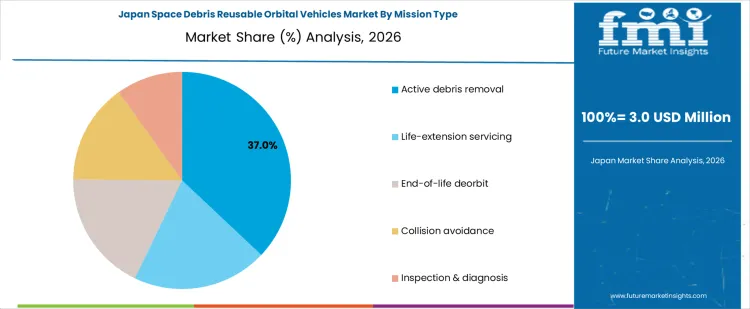
Japan is witnessing growth at a CAGR of 10%, fueled by adoption of reusable orbital vehicles for satellite servicing and space debris mitigation. Manufacturers and technology providers are producing vehicles designed for repeated orbital operations, structural resilience, and precise navigation in debris-prone environments. Demand is concentrated in aerospace R&D centers, launch facilities, and satellite operation hubs. Investments prioritize material performance, vehicle reliability, and regulatory adherence rather than fleet expansion. Growth reflects government-backed orbital debris programs, increasing satellite deployment, and industrial focus on reusable spacecraft technologies.
- Orbital debris management drives adoption.
- Vehicles ensure structural resilience and precise navigation.
- Aerospace R&D centers and launch facilities concentrate demand.
- Material performance and vehicle reliability guide investment.
How Is the United Kingdom Experiencing Expansion with Reusable Space Technologies?
United Kingdom is experiencing growth at a CAGR of 9.5%, supported by adoption of reusable orbital vehicles to mitigate space debris and support satellite servicing. Aerospace manufacturers and suppliers are deploying vehicles optimized for durability, maneuverability, and precision orbital operations. Demand is concentrated in aerospace research hubs, satellite operation centers, and launch facilities. Investments focus on material innovation, vehicle reliability, and compliance with space regulations rather than large-scale fleet deployment. Growth reflects government initiatives for orbital debris mitigation, satellite program expansion, and industrial adoption of reusable spacecraft.
- Reusable space technologies drive adoption.
- Vehicles provide durability and precision maneuverability.
- Aerospace research hubs and launch centers concentrate demand.
- Material innovation and regulatory compliance guide investment.
How Is France Witnessing Growth with Satellite Debris Mitigation Programs?
France is witnessing growth at a CAGR of 9%, fueled by adoption of reusable orbital vehicles for space debris management and satellite servicing missions. Aerospace manufacturers and technology providers are implementing vehicles optimized for repeated orbital use, structural durability, and precise orbital maneuvering. Demand is concentrated in aerospace research centers, launch facilities, and satellite operation hubs. Investments prioritize material performance, vehicle reliability, and compliance with international space regulations rather than large-scale fleet expansion. Growth reflects industrial adoption of reusable space technologies, increasing satellite deployments, and government-backed orbital debris mitigation initiatives.
- Satellite debris mitigation drives adoption.
- Vehicles optimize structural durability and orbital precision.
- Aerospace research centers and launch facilities concentrate demand.
- Material performance and vehicle reliability guide investment.
Who Competes in the Space Debris Reusable Orbital Vehicles Market and What Defines Their Capabilities?
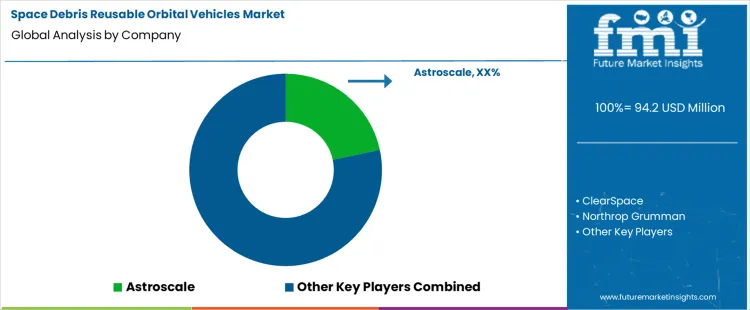
Competition in the space debris reusable orbital vehicles market is defined by orbital maneuvering capability, capture technology, and reliability for repeated mission operations. Astroscale develops reusable vehicles designed for active debris removal, employing magnetic and robotic capture systems compatible with multiple orbital regimes. ClearSpace focuses on autonomous rendezvous and robotic capture vehicles engineered to remove large debris objects with high precision. Northrop Grumman supplies orbital vehicles capable of servicing and debris mitigation with advanced propulsion and control systems. Airbus Defence & Space develops modular reusable orbital vehicles designed for capture, towing, and deorbiting of defunct satellites. Lockheed Martin provides vehicles engineered for autonomous orbital operations and debris mitigation missions.
Thales Alenia Space focuses on modular, reusable platforms for orbital debris removal, integrating advanced guidance, navigation, and control systems. Other competitors include emerging startups and regional space system developers specializing in debris capture, rendezvous technology, and reusable propulsion solutions. Differentiation in this market arises from maneuverability precision, capture method innovation, system reusability, and integration with ground control operations. Market participants are evaluated based on vehicle reliability, multi-mission flexibility, and capability to safely deorbit debris in compliance with orbital safety standards and international space regulations.
Key Players in the Space Debris Reusable Orbital Vehicles Market
- Astroscale
- ClearSpace
- Northrop Grumman
- Airbus Defence & Space
- Lockheed Martin
- Thales Alenia Space
Scope of the Report
| Items | Values |
|---|---|
| Quantitative Units (2026) | USD million |
| Mission Type | Active debris removal, Life-extension servicing, End-of-life deorbit, Collision avoidance, Inspection & diagnosis |
| Orbit | LEO, MEO, GEO, Other |
| Customer | Government agencies, Commercial operators, Defense, Other |
| Region | Asia Pacific, Europe, North America, Latin America, Middle East & Africa |
| Key Countries Covered | China, Japan, South Korea, India, Australia & New Zealand, Germany, United Kingdom, France, Italy, Spain, Nordic, BENELUX, United States, Canada, Mexico, Brazil, Chile, Kingdom of Saudi Arabia, Other GCC Countries, Turkey, South Africa, Other African Union |
| Key Companies Profiled | Astroscale, ClearSpace, Northrop Grumman, Airbus Defence & Space, Lockheed Martin, Thales Alenia Space |
| Additional Attributes | Dollar sales by mission type and orbit; regional CAGR, volume and value growth projections; adoption across LEO, MEO, GEO orbits; integration with government, defense, and commercial satellite programs; certification compliance and safety adherence; operational reliability and repeated mission performance; advanced capture, navigation, and reusable propulsion technologies; fleet integration and orbital traffic management. |
Space Debris Reusable Orbital Vehicles Market Segmentation
Mission Type:
- Active debris removal
- Life-extension servicing
- End-of-life deorbit
- Collision avoidance
- Inspection & diagnosis
Orbit:
- LEO
- MEO
- GEO
- Other
Customer:
- Govt agencies
- Commercial operators
- Defense
- Other
Region
- Asia Pacific
- China
- Japan
- South Korea
- India
- Australia & New Zealand
- ASEAN
- Rest of Asia Pacific
- Europe
- Germany
- United Kingdom
- France
- Italy
- Spain
- Nordic
- BENELUX
- Rest of Europe
- North America
- United States
- Canada
- Mexico
- Latin America
- Brazil
- Chile
- Rest of Latin America
- Middle East & Africa
- Kingdom of Saudi Arabia
- Other GCC Countries
- Turkey
- South Africa
- Other African Union
- Rest of Middle East & Africa
Bibliography
- European Space Agency. (2025). ESA’s Annual Space Environment Report (Issue 9.1). ESA Space Debris Office (ESOC).
- European Space Agency. (2023). ESA’s new Space Debris Mitigation Policy: Towards Zero Debris. European Space Agency.
- Inter-Agency Space Debris Coordination Committee. (2025). IADC Report on the Status of the Space Debris Environment (A/AC.105/C.1/2025/CRP.10). United Nations Office for Outer Space Affairs.
- Federal Communications Commission. (2024). Space Innovation: Order on Reconsideration and Further Notice of Proposed Rulemaking (FCC 24-6). Federal Communications Commission.
- National Aeronautics and Space Administration. (2025). US Space Debris Environment and Activity Updates. NASA Technical Reports Server (NTRS).
Frequently Asked Questions
How big is the space debris reusable orbital vehicles market in 2026?
The global space debris reusable orbital vehicles market is estimated to be valued at USD 94.2 million in 2026.
What will be the size of space debris reusable orbital vehicles market in 2036?
The market size for the space debris reusable orbital vehicles market is projected to reach USD 263.3 million by 2036.
How much will be the space debris reusable orbital vehicles market growth between 2026 and 2036?
The space debris reusable orbital vehicles market is expected to grow at a 10.8% CAGR between 2026 and 2036.
What are the key product types in the space debris reusable orbital vehicles market?
The key product types in space debris reusable orbital vehicles market are active debris removal, life-extension servicing, end-of-life deorbit, collision avoidance and inspection & diagnosis.
Which orbit segment to contribute significant share in the space debris reusable orbital vehicles market in 2026?
In terms of orbit, leo segment to command 68.0% share in the space debris reusable orbital vehicles market in 2026.
Preview the report firsthand - request a free sample
Get SampleGet the brochure for pricing and purchase details.
Get PDFTable of Content
- Executive Summary
- Global Market Outlook
- Demand-side Trends
- Supply-side Trends
- Technology Roadmap Analysis
- Analysis and Recommendations
- Market Overview
- Market Coverage / Taxonomy
- Market Definition / Scope / Limitations
- Market Background
- Market Dynamics
- Drivers
- Restraints
- Opportunity
- Trends
- Scenario Forecast
- Demand in Optimistic Scenario
- Demand in Likely Scenario
- Demand in Conservative Scenario
- Opportunity Map Analysis
- Product Life Cycle Analysis
- Supply Chain Analysis
- Investment Feasibility Matrix
- Value Chain Analysis
- PESTLE and Porter’s Analysis
- Regulatory Landscape
- Regional Parent Market Outlook
- Production and Consumption Statistics
- Import and Export Statistics
- Market Dynamics
- Global Market Analysis 2021 to 2025 and Forecast, 2026 to 2036
- Historical Market Size Value (USD Million) Analysis, 2021 to 2025
- Current and Future Market Size Value (USD Million) Projections, 2026 to 2036
- Y-o-Y Growth Trend Analysis
- Absolute $ Opportunity Analysis
- Global Market Pricing Analysis 2021 to 2025 and Forecast 2026 to 2036
- Global Market Analysis 2021 to 2025 and Forecast 2026 to 2036, By Mission Type
- Introduction / Key Findings
- Historical Market Size Value (USD Million) Analysis By Mission Type , 2021 to 2025
- Current and Future Market Size Value (USD Million) Analysis and Forecast By Mission Type , 2026 to 2036
- Active debris removal
- Life-extension servicing
- End-of-life deorbit
- Collision avoidance
- Inspection & diagnosis
- Active debris removal
- Y-o-Y Growth Trend Analysis By Mission Type , 2021 to 2025
- Absolute $ Opportunity Analysis By Mission Type , 2026 to 2036
- Global Market Analysis 2021 to 2025 and Forecast 2026 to 2036, By Orbit
- Introduction / Key Findings
- Historical Market Size Value (USD Million) Analysis By Orbit, 2021 to 2025
- Current and Future Market Size Value (USD Million) Analysis and Forecast By Orbit, 2026 to 2036
- LEO
- MEO
- GEO
- LEO
- Y-o-Y Growth Trend Analysis By Orbit, 2021 to 2025
- Absolute $ Opportunity Analysis By Orbit, 2026 to 2036
- Global Market Analysis 2021 to 2025 and Forecast 2026 to 2036, By Customer
- Introduction / Key Findings
- Historical Market Size Value (USD Million) Analysis By Customer, 2021 to 2025
- Current and Future Market Size Value (USD Million) Analysis and Forecast By Customer, 2026 to 2036
- Govt agencies
- Commercial operators
- Defense
- Govt agencies
- Y-o-Y Growth Trend Analysis By Customer, 2021 to 2025
- Absolute $ Opportunity Analysis By Customer, 2026 to 2036
- Global Market Analysis 2021 to 2025 and Forecast 2026 to 2036, By Region
- Introduction
- Historical Market Size Value (USD Million) Analysis By Region, 2021 to 2025
- Current Market Size Value (USD Million) Analysis and Forecast By Region, 2026 to 2036
- North America
- Latin America
- Western Europe
- Eastern Europe
- East Asia
- South Asia and Pacific
- Middle East & Africa
- Market Attractiveness Analysis By Region
- North America Market Analysis 2021 to 2025 and Forecast 2026 to 2036, By Country
- Historical Market Size Value (USD Million) Trend Analysis By Market Taxonomy, 2021 to 2025
- Market Size Value (USD Million) Forecast By Market Taxonomy, 2026 to 2036
- By Country
- USA
- Canada
- Mexico
- By Mission Type
- By Orbit
- By Customer
- By Country
- Market Attractiveness Analysis
- By Country
- By Mission Type
- By Orbit
- By Customer
- Key Takeaways
- Latin America Market Analysis 2021 to 2025 and Forecast 2026 to 2036, By Country
- Historical Market Size Value (USD Million) Trend Analysis By Market Taxonomy, 2021 to 2025
- Market Size Value (USD Million) Forecast By Market Taxonomy, 2026 to 2036
- By Country
- Brazil
- Chile
- Rest of Latin America
- By Mission Type
- By Orbit
- By Customer
- By Country
- Market Attractiveness Analysis
- By Country
- By Mission Type
- By Orbit
- By Customer
- Key Takeaways
- Western Europe Market Analysis 2021 to 2025 and Forecast 2026 to 2036, By Country
- Historical Market Size Value (USD Million) Trend Analysis By Market Taxonomy, 2021 to 2025
- Market Size Value (USD Million) Forecast By Market Taxonomy, 2026 to 2036
- By Country
- Germany
- UK
- Italy
- Spain
- France
- Nordic
- BENELUX
- Rest of Western Europe
- By Mission Type
- By Orbit
- By Customer
- By Country
- Market Attractiveness Analysis
- By Country
- By Mission Type
- By Orbit
- By Customer
- Key Takeaways
- Eastern Europe Market Analysis 2021 to 2025 and Forecast 2026 to 2036, By Country
- Historical Market Size Value (USD Million) Trend Analysis By Market Taxonomy, 2021 to 2025
- Market Size Value (USD Million) Forecast By Market Taxonomy, 2026 to 2036
- By Country
- Russia
- Poland
- Hungary
- Balkan & Baltic
- Rest of Eastern Europe
- By Mission Type
- By Orbit
- By Customer
- By Country
- Market Attractiveness Analysis
- By Country
- By Mission Type
- By Orbit
- By Customer
- Key Takeaways
- East Asia Market Analysis 2021 to 2025 and Forecast 2026 to 2036, By Country
- Historical Market Size Value (USD Million) Trend Analysis By Market Taxonomy, 2021 to 2025
- Market Size Value (USD Million) Forecast By Market Taxonomy, 2026 to 2036
- By Country
- China
- Japan
- South Korea
- By Mission Type
- By Orbit
- By Customer
- By Country
- Market Attractiveness Analysis
- By Country
- By Mission Type
- By Orbit
- By Customer
- Key Takeaways
- South Asia and Pacific Market Analysis 2021 to 2025 and Forecast 2026 to 2036, By Country
- Historical Market Size Value (USD Million) Trend Analysis By Market Taxonomy, 2021 to 2025
- Market Size Value (USD Million) Forecast By Market Taxonomy, 2026 to 2036
- By Country
- India
- ASEAN
- Australia & New Zealand
- Rest of South Asia and Pacific
- By Mission Type
- By Orbit
- By Customer
- By Country
- Market Attractiveness Analysis
- By Country
- By Mission Type
- By Orbit
- By Customer
- Key Takeaways
- Middle East & Africa Market Analysis 2021 to 2025 and Forecast 2026 to 2036, By Country
- Historical Market Size Value (USD Million) Trend Analysis By Market Taxonomy, 2021 to 2025
- Market Size Value (USD Million) Forecast By Market Taxonomy, 2026 to 2036
- By Country
- Kingdom of Saudi Arabia
- Other GCC Countries
- Turkiye
- South Africa
- Other African Union
- Rest of Middle East & Africa
- By Mission Type
- By Orbit
- By Customer
- By Country
- Market Attractiveness Analysis
- By Country
- By Mission Type
- By Orbit
- By Customer
- Key Takeaways
- Key Countries Market Analysis
- USA
- Pricing Analysis
- Market Share Analysis, 2025
- By Mission Type
- By Orbit
- By Customer
- Canada
- Pricing Analysis
- Market Share Analysis, 2025
- By Mission Type
- By Orbit
- By Customer
- Mexico
- Pricing Analysis
- Market Share Analysis, 2025
- By Mission Type
- By Orbit
- By Customer
- Brazil
- Pricing Analysis
- Market Share Analysis, 2025
- By Mission Type
- By Orbit
- By Customer
- Chile
- Pricing Analysis
- Market Share Analysis, 2025
- By Mission Type
- By Orbit
- By Customer
- Germany
- Pricing Analysis
- Market Share Analysis, 2025
- By Mission Type
- By Orbit
- By Customer
- UK
- Pricing Analysis
- Market Share Analysis, 2025
- By Mission Type
- By Orbit
- By Customer
- Italy
- Pricing Analysis
- Market Share Analysis, 2025
- By Mission Type
- By Orbit
- By Customer
- Spain
- Pricing Analysis
- Market Share Analysis, 2025
- By Mission Type
- By Orbit
- By Customer
- France
- Pricing Analysis
- Market Share Analysis, 2025
- By Mission Type
- By Orbit
- By Customer
- India
- Pricing Analysis
- Market Share Analysis, 2025
- By Mission Type
- By Orbit
- By Customer
- ASEAN
- Pricing Analysis
- Market Share Analysis, 2025
- By Mission Type
- By Orbit
- By Customer
- Australia & New Zealand
- Pricing Analysis
- Market Share Analysis, 2025
- By Mission Type
- By Orbit
- By Customer
- China
- Pricing Analysis
- Market Share Analysis, 2025
- By Mission Type
- By Orbit
- By Customer
- Japan
- Pricing Analysis
- Market Share Analysis, 2025
- By Mission Type
- By Orbit
- By Customer
- South Korea
- Pricing Analysis
- Market Share Analysis, 2025
- By Mission Type
- By Orbit
- By Customer
- Russia
- Pricing Analysis
- Market Share Analysis, 2025
- By Mission Type
- By Orbit
- By Customer
- Poland
- Pricing Analysis
- Market Share Analysis, 2025
- By Mission Type
- By Orbit
- By Customer
- Hungary
- Pricing Analysis
- Market Share Analysis, 2025
- By Mission Type
- By Orbit
- By Customer
- Kingdom of Saudi Arabia
- Pricing Analysis
- Market Share Analysis, 2025
- By Mission Type
- By Orbit
- By Customer
- Turkiye
- Pricing Analysis
- Market Share Analysis, 2025
- By Mission Type
- By Orbit
- By Customer
- South Africa
- Pricing Analysis
- Market Share Analysis, 2025
- By Mission Type
- By Orbit
- By Customer
- USA
- Market Structure Analysis
- Competition Dashboard
- Competition Benchmarking
- Market Share Analysis of Top Players
- By Regional
- By Mission Type
- By Orbit
- By Customer
- Competition Analysis
- Competition Deep Dive
- Astroscale
- Overview
- Product Portfolio
- Profitability by Market Segments (Product/Age /Sales Channel/Region)
- Sales Footprint
- Strategy Overview
- Marketing Strategy
- Product Strategy
- Channel Strategy
- ClearSpace
- Northrop Grumman
- Airbus Defence & Space
- Lockheed Martin
- Thales Alenia Space
- Astroscale
- Competition Deep Dive
- Assumptions & Acronyms Used
- Research Methodology


