

- Industry Size (2026)
- USD 3.0 Bn
- Forecast (2036)
- USD 5.9 Bn
- CAGR (2026 to 2036)
- 7.0%
Space Grade Microcontrollers Market Forecast and Outlook 2026 to 2036
The space grade microcontrollers market is projected to grow from USD 3.0 billion in 2026 to USD 5.9 billion by 2036, reflecting a steady CAGR of 7.0%. Procurement priorities in this market are shaped by the critical need for reliability, radiation tolerance, and long-term performance under extreme conditions. Buyer’s exhibit high risk aversion, as failure in space missions can lead to significant financial and operational setbacks. Vendor lock-in is a common occurrence due to the specialized nature of space-grade components, with suppliers providing long-term solutions that meet stringent certifications. Switching costs are elevated, as alternative suppliers may not offer the same level of compatibility, quality assurance, or testing procedures required for space applications. Consequently, procurement decisions are made with a focus on established track records, regulatory compliance, and the ability to deliver mission-critical components that meet the required standards for space environments.
Quick Stats for Space Grade Microcontrollers Market
- Space Grade Microcontrollers Market Value (2026): USD 3.0 Billion
- Space Grade Microcontrollers Market Forecast Value (2036): USD 5.9 Billion
- Space Grade Microcontrollers Market Forecast CAGR 2026 to 2036: 7.0%
- Leading Type of Space Grade Microcontrollers: Radiation Hardened Grade (55% share)
- Leading Application in Space Grade Microcontrollers Market: Satellites (45% share)
- Key Growth Regions in Space Grade Microcontrollers Market: North America, Asia Pacific, Europe, Latin America, Middle East & Africa
- Top Key Players in Space Grade Microcontrollers Market: Northrop Grumman Corporation, Teledyne Technologies Incorporated, Infineon Technologies AG, STMicroelectronics N.V., Texas Instruments Incorporated
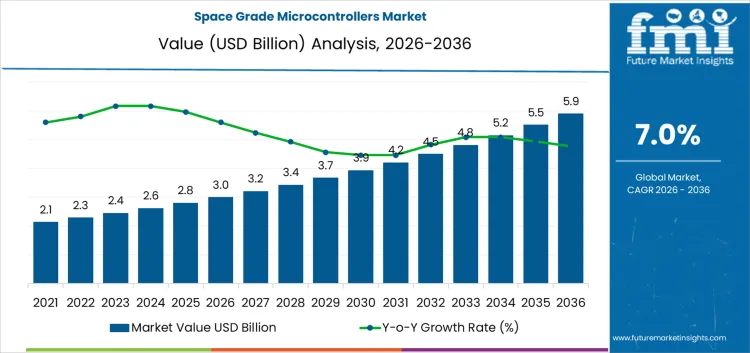
Space Grade Microcontrollers Market Key Takeaways
| Metric | Value |
|---|---|
| Space Grade Microcontrollers Market Value (2026) | USD 3.0 Billion |
| Space Grade Microcontrollers Market Forecast Value (2036) | USD 5.9 Billion |
| Space Grade Microcontrollers Market Forecast CAGR 2026 to 2036 | 7.0% |
Why is the Space Grade Microcontrollers Market Growing Steadily?
The space grade microcontrollers market is experiencing steady growth due to the increasing demand for advanced and reliable semiconductor solutions for space exploration, satellite technology, and defense applications. As space missions become more complex, the need for highly durable, radiation-resistant microcontrollers that can operate under extreme conditions is driving the market. These components are crucial for controlling systems in satellites, rovers, and other space-based equipment, where failure is not an option.
Technological advancements are supporting growth in the space grade microcontrollers market. Developments in semiconductor materials, process nodes, and radiation-hardened designs have enhanced the performance, reliability, and power efficiency of space-grade microcontrollers. These innovations help manufacturers meet the stringent requirements for space applications, including extended lifecycle, fault tolerance, and environmental resilience.
Increasing investments in space exploration, satellite launches, and defense technologies are further boosting the market. Government agencies and private space companies are expanding their space programs, leading to higher demand for microcontroller solutions. As space infrastructure and commercial space activities continue to grow, the space grade microcontrollers market is set to witness a steady rise, with the market expected to see consistent growth over the next decade.
What Does The Segment Overview Indicate About The Space Grade Microcontrollers Market?
The space grade microcontrollers market is segmented by type and application, highlighting the critical role of microcontroller reliability and radiation resistance in space operations. Radiation-hardened grade microcontrollers lead the type segment with an estimated 55% share, as they are essential for protecting electronic systems from the damaging effects of space radiation. Radiation-tolerant grade and other microcontrollers serve less demanding environments. On the application side, satellites represent the largest share with 45%, reflecting their dependence on reliable microcontroller systems for communication, navigation, and control.
Why Do Radiation Hardened Grade Microcontrollers Hold The Leading Type Share In The Space Grade Microcontrollers Market?
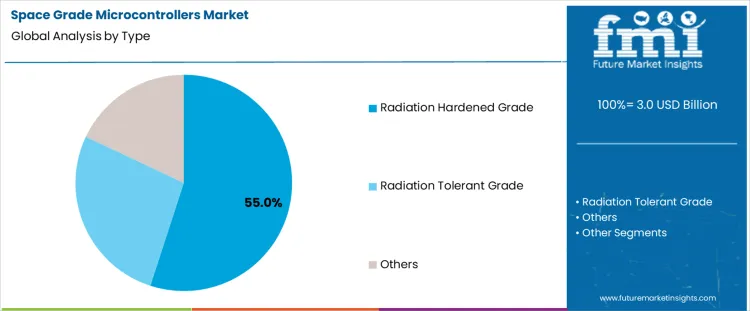
Radiation-hardened grade microcontrollers hold the leading 55% share in the space grade microcontrollers market due to their ability to withstand the harsh radiation environment of space. These microcontrollers are specifically designed to function reliably in space applications, where they face high levels of ionizing radiation from solar flares, cosmic rays, and the Earth's radiation belts. The space industry requires electronics that can operate without failure over extended periods, making radiation-hardened microcontrollers the preferred choice for mission-critical applications such as satellites, space stations, and deep-space exploration systems. Their high tolerance for radiation, thermal stability, and overall durability under extreme conditions continue to make them the dominant choice in space-grade electronics.
How Does Satellites Drive Application Demand In The Space Grade Microcontrollers Market?
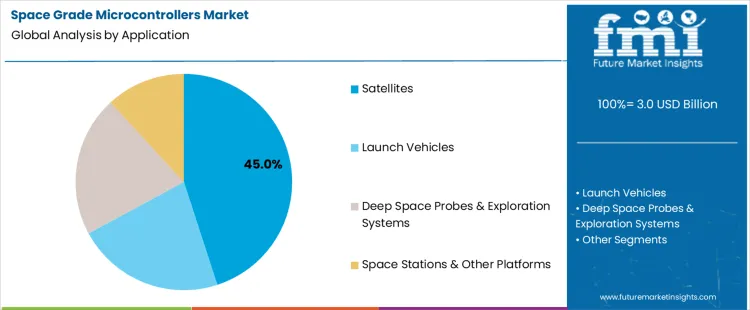
Satellites represent the largest application segment in the space grade microcontrollers market, accounting for approximately 45% share, as they are central to communications, navigation, weather forecasting, and Earth observation. Space-grade microcontrollers are vital in ensuring reliable operation of satellite systems, particularly for power management, data handling, and fault detection. The growing demand for commercial satellite constellations, government satellites for defense and communication, and research satellites in scientific missions continue to drive demand for radiation-hardened microcontrollers. The increasing use of small satellites (smallsats) and advancements in satellite technology further support market growth, as these systems require microcontrollers that can withstand space radiation while ensuring system reliability over long mission durations.
What is Driving Demand in the Space Grade Microcontrollers Market?
The space grade microcontrollers market is expanding as satellite, launch vehicle, and deep space probe programs increase global investment in aerospace and defense sectors. Space grade microcontrollers are designed to operate reliably under extreme radiation, temperature variation, and vacuum conditions, which make them essential for mission critical avionics and payload control systems. Growing small satellite constellations, rideshare launches, and modular spacecraft architectures are driving demand for compact, high performance microcontrollers. Space agencies and commercial space firms prioritize components with traceable quality, long life cycles, and predictable failure modes. Rising international space activity, including Earth observation, communications, and scientific exploration missions, continues to support adoption across both established and emerging players.
Why Are Reliability and Radiation Hardening Key Drivers of Adoption?
Reliability and radiation hardening are fundamental drivers in the space grade microcontrollers market because space environments expose electronics to charged particles and cosmic rays that can induce single event upsets and latch ups. Space grade microcontrollers incorporate error detection and correction, hardened fabrication processes, and redundancy schemes to mitigate these effects, ensuring mission continuity. Satellite bus systems, attitude control units, and payload processors depend on these controllers to maintain stability and data integrity. CubeSats and small satellites increasingly integrate hardened microcontrollers to meet longer mission durations. As cost pressures rise, suppliers are offering radiation tolerant variants that balance performance with affordability for medium duration orbital missions.
What Challenges Are Limiting Broader Use of Space Grade Microcontrollers?
The space grade microcontrollers market faces adoption constraints due to long qualification cycles, high certification costs, and limited production capacity. Qualification for space use requires extensive testing under radiation, shock, and thermal cycling, which increases development timelines and procurement lead times. Manufacturing yields for radiation hardened processes are lower compared with commercial counterparts, driving up unit costs. Supply chain concentration among a few qualified vendors limits competition and can cause delivery bottlenecks for large satellite programs. Some design teams consider commercial off the shelf (COTS) microcontrollers with software mitigation to reduce cost and lead time, but this approach can introduce reliability trade offs under harsh conditions. Export controls and ITAR restrictions further complicate sourcing for international spacecraft developers.
What Is the Country Wise Growth Outlook for the Space Grade Microcontrollers Market?
The space grade microcontrollers market is expanding as demand rises for reliable, radiation hardened processing units in satellites, launch vehicles, deep space probes, and defense platforms. India leads the outlook with a 10.2% CAGR, underpinned by growing national and commercial space missions. China follows at 8.3% CAGR, supported by increased satellite manufacturing and space electronics integration. Japan records a 7.1% CAGR, driven by advanced satellite systems and exploration hardware. Germany grows at 6.5% CAGR, reflecting strong European manufacturing of space qualified electronics. The United States, the largest current consumer of space grade microcontrollers, expands at 5.7% CAGR, powered by federal and commercial aerospace programs.
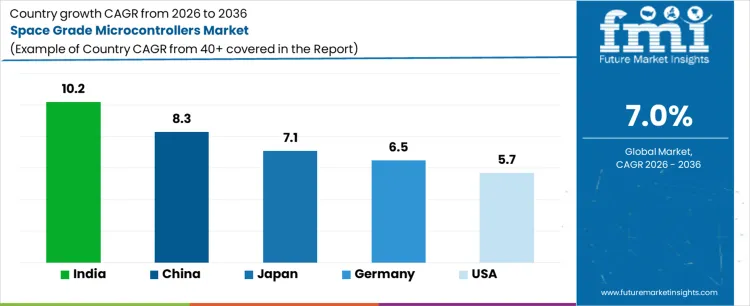
| Country | CAGR |
|---|---|
| India | 10.2% |
| China | 8.3% |
| Japan | 7.1% |
| Germany | 6.5% |
| USA | 5.7% |
Why is India Leading Growth in the Space Grade Microcontrollers Market?
Demand for space grade microcontrollers in India is increasing at a CAGR of 10.2%, supported by the country’s rapidly expanding national space missions, including satellite launches and space exploration programs. India’s space agency, ISRO, has significantly increased its satellite deployment and exploration initiatives, which require highly reliable, radiation-hardened microcontrollers to operate in the harsh conditions of space. The demand is also fueled by India’s commercial space ventures, which are growing in both domestic and international markets. With a focus on low-cost, high-efficiency microcontrollers, India has seen strong growth in space electronics. The growing participation of private companies in satellite manufacturing and space-based services further boosts demand for advanced, space-grade microcontrollers. The government’s continued support for space exploration, along with advancements in semiconductor technology, ensures that India’s space sector remains a key driver in the global market for space grade microcontrollers.
What Is Driving China’s Growth in the Space Grade Microcontrollers Market?
Sales for space grade microcontrollers in China are growing at a CAGR of 8.3%, driven by the country’s ambitious space exploration programs and satellite production capacity. China’s government is heavily investing in space infrastructure, including its ambitious plans for lunar missions, Mars exploration, and Earth observation satellites. These missions require advanced, space-grade microcontrollers capable of withstanding radiation, extreme temperatures, and other harsh environmental conditions. China’s growing space industry, led by agencies such as CNSA (China National Space Administration), is a major consumer of space electronics, including microcontrollers. China’s focus on enhancing its satellite communication networks and the development of large-scale space missions, including lunar and Mars exploration, are creating significant demand for high-performance, space-qualified components. The country’s ability to produce cost-effective and reliable microcontrollers also supports its growth as a key player in the global space grade microcontroller market.
Why Is Japan Expanding in the Space Grade Microcontrollers Market?
Demand for space grade microcontrollers in Japan is increasing at a CAGR of 7.1%, fueled by strong demand in satellite manufacturing, exploration missions, and autonomous systems for space. Japan’s space industry, driven by the Japan Aerospace Exploration Agency (JAXA), is expanding its focus on both domestic and international satellite systems, deep-space missions, and robotic exploration projects. Japanese satellite manufacturers and research labs require robust microcontroller solutions capable of operating under extreme conditions in orbit. Additionally, Japan’s growing interest in miniaturized satellites, space-based research platforms, and lunar exploration missions drives the demand for advanced space-grade microcontrollers. The country’s expertise in high-quality manufacturing and precision engineering ensures that Japan remains a major player in space electronics, offering both innovation and reliability. The government’s continued investment in space programs, along with advancements in microcontroller technology, will continue to fuel Japan’s steady growth in the global space grade microcontroller market.
What Is Fueling the Growth of the Space Grade Microcontrollers Market in Germany?
Sales for space grade microcontrollers in Germany are rising at a CAGR of 6.5%, supported by the country’s leadership in European space exploration and satellite manufacturing. Germany plays a pivotal role in the development of space electronics and is a key contributor to the European Space Agency’s (ESA) space missions. The growing demand for space-based applications, including Earth observation, satellite communications, and interplanetary exploration, has driven the need for advanced, high-performance microcontrollers. Germany’s strong manufacturing base and expertise in precision engineering make it a significant hub for producing space-grade microcontrollers that meet stringent European standards. The country’s commitment to sustainability and green space exploration is also pushing for energy-efficient, cost-effective solutions in space electronics. As Germany continues to invest in its space infrastructure and deepen collaborations with global space agencies, the demand for space grade microcontrollers will remain strong in the coming years.
Why Is the United States a Key Market for Space Grade Microcontrollers?
Demand for space grade microcontrollers in the United States is growing at a CAGR of 5.7%, driven by the country’s extensive government space programs and commercial space sector. USA government agencies such as NASA, as well as defense contractors, are major consumers of space-grade microcontrollers for satellite systems, space probes, and scientific missions. The commercial space sector, including companies like SpaceX, Boeing, and Blue Origin, is also driving growth by adopting advanced space electronics in their spacecraft and satellite systems. The USA continues to invest heavily in space exploration, including lunar missions, Mars exploration, and deep-space research, which require high-reliability microcontrollers. Additionally, advancements in space-based technologies for global communications, Earth observation, and space tourism are boosting demand for cutting-edge microcontroller solutions. As the USA leads many global initiatives in space technology, its strong investment in space infrastructure continues to support a stable demand for space-grade microcontrollers.
How Are Leading Companies Competing And Differentiating In The Space Grade Microcontrollers Market?
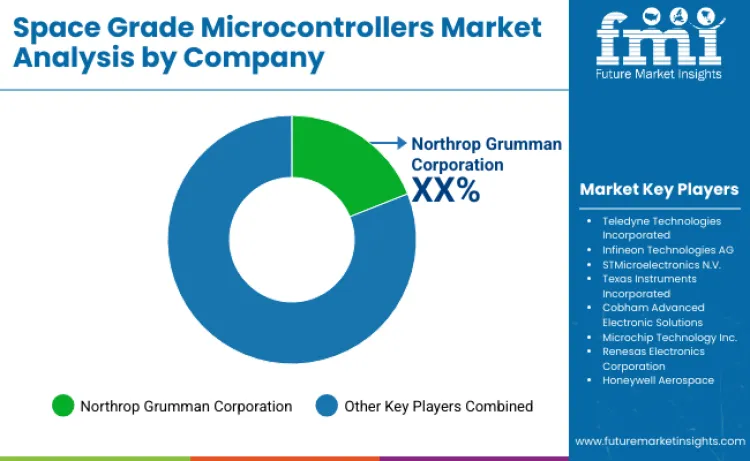
Competition in the space grade microcontrollers market is being shaped by radiation tolerance, reliability, and integration with space systems. Northrop Grumman Corporation is being positioned around highly ruggedized microcontrollers tailored for spacecraft and satellite applications, with product brochures emphasizing advanced radiation-hardening techniques, low failure rates, and long-term performance in harsh environments. Teledyne Technologies Incorporated focuses on precision electronics and microcontroller solutions for space exploration, highlighting high reliability and exceptional performance under extreme conditions, such as radiation and temperature fluctuations.
Advanced processing power and scalability are being leveraged by Infineon Technologies AG, STMicroelectronics N.V., and Texas Instruments Incorporated. Infineon is differentiating through power-efficient, high-performance microcontrollers for satellite communications, payload control, and space systems management. STMicroelectronics emphasizes a broad portfolio of space-grade components, with a focus on reliability, energy efficiency, and suitability for complex space missions. Texas Instruments highlights integration with various space applications, offering radiation-hardened microcontrollers with robust processing capabilities, targeting both low and high-orbit missions.
A different competitive approach is being taken by Cobham Advanced Electronic Solutions, Microchip Technology Inc., Renesas Electronics Corporation, and Honeywell Aerospace. Cobham focuses on space-grade microcontrollers for avionics and communications systems, promoting extensive qualification processes and comprehensive testing for critical missions. Microchip Technology is targeting custom solutions for spacecraft power management and telemetry systems, with an emphasis on flexibility and ease of integration. Renesas positions its microcontrollers with high processing power and low power consumption for various satellite applications, while Honeywell Aerospace emphasizes rugged, high-reliability microcontrollers with long operational lifespans for deep-space missions. Across the market, differentiation is driven by radiation tolerance, mission-specific adaptability, and integration capabilities for space systems, ensuring dependable and efficient performance in the most demanding environments.
Key Players in Space Grade Microcontrollers Market
- Northrop Grumman Corporation
- Teledyne Technologies Incorporated
- Infineon Technologies AG
- STMicroelectronics N.V.
- Texas Instruments Incorporated
- Cobham Advanced Electronic Solutions
- Microchip Technology Inc.
- Renesas Electronics Corporation
- Honeywell Aerospace
Scope of Report
| Attributes | Description |
|---|---|
| Quantitative Unit | USD Million |
| Type | Radiation Hardened Grade, Radiation Tolerant Grade, Others |
| Application | Satellites, Launch Vehicles, Deep Space Probes & Exploration Systems, Space Stations & Other Platforms |
| Regions Covered | Asia Pacific, Europe, North America, Latin America, Middle East & Africa |
| Countries Covered | China, Japan, South Korea, India, Australia & New Zealand, ASEAN, Rest of Asia Pacific, Germany, United Kingdom, France, Italy, Spain, Nordic, BENELUX, Rest of Europe, United States, Canada, Mexico, Brazil, Chile, Rest of Latin America, Kingdom of Saudi Arabia, Other GCC Countries, Turkey, South Africa, Other African Union, Rest of Middle East & Africa |
| Key Companies Profiled | Northrop Grumman Corporation, Teledyne Technologies Incorporated, Infineon Technologies AG, STMicroelectronics N.V., Texas Instruments Incorporated, Cobham Advanced Electronic Solutions, Microchip Technology Inc., Renesas Electronics Corporation, Honeywell Aerospace |
| Additional Attributes | Market revenue by microcontroller type and application; regional growth analysis; projected market size and CAGR for 2026-2036; technological advancements in space-grade microcontroller development; competitive landscape with strategy and portfolio analysis of leading players; supply chain and distribution overview; space exploration trends and impact on microcontroller demand; regulations governing space technology and microcontroller use. |
Space Grade Microcontrollers Market by Key Segments
Type:
- Radiation Hardened Grade
- Radiation Tolerant Grade
- Others
Application:
- Satellites
- Launch Vehicles
- Deep Space Probes & Exploration Systems
- Space Stations & Other Platforms
Region:
- Asia Pacific
- China
- Japan
- South Korea
- India
- Australia & New Zealand
- ASEAN
- Rest of Asia Pacific
- Europe
- Germany
- United Kingdom
- France
- Italy
- Spain
- Nordic
- BENELUX
- Rest of Europe
- North America
- United States
- Canada
- Mexico
- Latin America
- Brazil
- Chile
- Rest of Latin America
- Middle East & Africa
- Kingdom of Saudi Arabia
- Other GCC Countries
- Turkey
- South Africa
- Other African Union
- Rest of Middle East & Africa
Bibliography
- NASA. (2025, March 5). Small Spacecraft Avionics (SSA). National Aeronautics and Space Administration.
- NASA. (2023, April 24-28). Hardened Electronics and Radiation Technology Conference Presentation.
- ECSS-Q-ST-60-15C Rev. 1 - Radiation Hardness Assurance (RHA) Issued: March 20 2025 - formal radiation hardness assurance requirements for electronic components in space projects.
- ECSS-E-ST-20-08C Rev. 2 - Space Engineering Standard (general systems)
- Published: April 20 2023 - part of broader space systems engineering standards (design, products).
Frequently Asked Questions
How big is the space grade microcontrollers market in 2026?
The global space grade microcontrollers market is estimated to be valued at USD 3.0 billion in 2026.
What will be the size of space grade microcontrollers market in 2036?
The market size for the space grade microcontrollers market is projected to reach USD 5.9 billion by 2036.
How much will be the space grade microcontrollers market growth between 2026 and 2036?
The space grade microcontrollers market is expected to grow at a 7.0% CAGR between 2026 and 2036.
What are the key product types in the space grade microcontrollers market?
The key product types in space grade microcontrollers market are radiation hardened grade, radiation tolerant grade and others.
Which application segment to contribute significant share in the space grade microcontrollers market in 2026?
In terms of application , satellites segment to command 45.0% share in the space grade microcontrollers market in 2026.
Preview the report firsthand - request a free sample
Get SampleGet the brochure for pricing and purchase details.
Get PDFTable of Content
- Executive Summary
- Global Market Outlook
- Demand-side Trends
- Supply-side Trends
- Technology Roadmap Analysis
- Analysis and Recommendations
- Market Overview
- Market Coverage / Taxonomy
- Market Definition / Scope / Limitations
- Market Background
- Market Dynamics
- Drivers
- Restraints
- Opportunity
- Trends
- Scenario Forecast
- Demand in Optimistic Scenario
- Demand in Likely Scenario
- Demand in Conservative Scenario
- Opportunity Map Analysis
- Product Life Cycle Analysis
- Supply Chain Analysis
- Investment Feasibility Matrix
- Value Chain Analysis
- PESTLE and Porter’s Analysis
- Regulatory Landscape
- Regional Parent Market Outlook
- Production and Consumption Statistics
- Import and Export Statistics
- Market Dynamics
- Global Market Analysis 2021 to 2025 and Forecast, 2026 to 2036
- Historical Market Size Value (USD Million) Analysis, 2021 to 2025
- Current and Future Market Size Value (USD Million) Projections, 2026 to 2036
- Y-o-Y Growth Trend Analysis
- Absolute $ Opportunity Analysis
- Global Market Pricing Analysis 2021 to 2025 and Forecast 2026 to 2036
- Global Market Analysis 2021 to 2025 and Forecast 2026 to 2036, By Type
- Introduction / Key Findings
- Historical Market Size Value (USD Million) Analysis By Type, 2021 to 2025
- Current and Future Market Size Value (USD Million) Analysis and Forecast By Type, 2026 to 2036
- Radiation Hardened Grade
- Radiation Tolerant Grade
- Others
- Radiation Hardened Grade
- Y-o-Y Growth Trend Analysis By Type, 2021 to 2025
- Absolute $ Opportunity Analysis By Type, 2026 to 2036
- Global Market Analysis 2021 to 2025 and Forecast 2026 to 2036, By Application
- Introduction / Key Findings
- Historical Market Size Value (USD Million) Analysis By Application, 2021 to 2025
- Current and Future Market Size Value (USD Million) Analysis and Forecast By Application, 2026 to 2036
- Satellites
- Launch Vehicles
- Deep Space Probes & Exploration Systems
- Space Stations & Other Platforms
- Satellites
- Y-o-Y Growth Trend Analysis By Application, 2021 to 2025
- Absolute $ Opportunity Analysis By Application, 2026 to 2036
- Global Market Analysis 2021 to 2025 and Forecast 2026 to 2036, By Region
- Introduction
- Historical Market Size Value (USD Million) Analysis By Region, 2021 to 2025
- Current Market Size Value (USD Million) Analysis and Forecast By Region, 2026 to 2036
- North America
- Latin America
- Western Europe
- Eastern Europe
- East Asia
- South Asia and Pacific
- Middle East & Africa
- Market Attractiveness Analysis By Region
- North America Market Analysis 2021 to 2025 and Forecast 2026 to 2036, By Country
- Historical Market Size Value (USD Million) Trend Analysis By Market Taxonomy, 2021 to 2025
- Market Size Value (USD Million) Forecast By Market Taxonomy, 2026 to 2036
- By Country
- USA
- Canada
- Mexico
- By Type
- By Application
- By Country
- Market Attractiveness Analysis
- By Country
- By Type
- By Application
- Key Takeaways
- Latin America Market Analysis 2021 to 2025 and Forecast 2026 to 2036, By Country
- Historical Market Size Value (USD Million) Trend Analysis By Market Taxonomy, 2021 to 2025
- Market Size Value (USD Million) Forecast By Market Taxonomy, 2026 to 2036
- By Country
- Brazil
- Chile
- Rest of Latin America
- By Type
- By Application
- By Country
- Market Attractiveness Analysis
- By Country
- By Type
- By Application
- Key Takeaways
- Western Europe Market Analysis 2021 to 2025 and Forecast 2026 to 2036, By Country
- Historical Market Size Value (USD Million) Trend Analysis By Market Taxonomy, 2021 to 2025
- Market Size Value (USD Million) Forecast By Market Taxonomy, 2026 to 2036
- By Country
- Germany
- UK
- Italy
- Spain
- France
- Nordic
- BENELUX
- Rest of Western Europe
- By Type
- By Application
- By Country
- Market Attractiveness Analysis
- By Country
- By Type
- By Application
- Key Takeaways
- Eastern Europe Market Analysis 2021 to 2025 and Forecast 2026 to 2036, By Country
- Historical Market Size Value (USD Million) Trend Analysis By Market Taxonomy, 2021 to 2025
- Market Size Value (USD Million) Forecast By Market Taxonomy, 2026 to 2036
- By Country
- Russia
- Poland
- Hungary
- Balkan & Baltic
- Rest of Eastern Europe
- By Type
- By Application
- By Country
- Market Attractiveness Analysis
- By Country
- By Type
- By Application
- Key Takeaways
- East Asia Market Analysis 2021 to 2025 and Forecast 2026 to 2036, By Country
- Historical Market Size Value (USD Million) Trend Analysis By Market Taxonomy, 2021 to 2025
- Market Size Value (USD Million) Forecast By Market Taxonomy, 2026 to 2036
- By Country
- China
- Japan
- South Korea
- By Type
- By Application
- By Country
- Market Attractiveness Analysis
- By Country
- By Type
- By Application
- Key Takeaways
- South Asia and Pacific Market Analysis 2021 to 2025 and Forecast 2026 to 2036, By Country
- Historical Market Size Value (USD Million) Trend Analysis By Market Taxonomy, 2021 to 2025
- Market Size Value (USD Million) Forecast By Market Taxonomy, 2026 to 2036
- By Country
- India
- ASEAN
- Australia & New Zealand
- Rest of South Asia and Pacific
- By Type
- By Application
- By Country
- Market Attractiveness Analysis
- By Country
- By Type
- By Application
- Key Takeaways
- Middle East & Africa Market Analysis 2021 to 2025 and Forecast 2026 to 2036, By Country
- Historical Market Size Value (USD Million) Trend Analysis By Market Taxonomy, 2021 to 2025
- Market Size Value (USD Million) Forecast By Market Taxonomy, 2026 to 2036
- By Country
- Kingdom of Saudi Arabia
- Other GCC Countries
- Turkiye
- South Africa
- Other African Union
- Rest of Middle East & Africa
- By Type
- By Application
- By Country
- Market Attractiveness Analysis
- By Country
- By Type
- By Application
- Key Takeaways
- Key Countries Market Analysis
- USA
- Pricing Analysis
- Market Share Analysis, 2025
- By Type
- By Application
- Canada
- Pricing Analysis
- Market Share Analysis, 2025
- By Type
- By Application
- Mexico
- Pricing Analysis
- Market Share Analysis, 2025
- By Type
- By Application
- Brazil
- Pricing Analysis
- Market Share Analysis, 2025
- By Type
- By Application
- Chile
- Pricing Analysis
- Market Share Analysis, 2025
- By Type
- By Application
- Germany
- Pricing Analysis
- Market Share Analysis, 2025
- By Type
- By Application
- UK
- Pricing Analysis
- Market Share Analysis, 2025
- By Type
- By Application
- Italy
- Pricing Analysis
- Market Share Analysis, 2025
- By Type
- By Application
- Spain
- Pricing Analysis
- Market Share Analysis, 2025
- By Type
- By Application
- France
- Pricing Analysis
- Market Share Analysis, 2025
- By Type
- By Application
- India
- Pricing Analysis
- Market Share Analysis, 2025
- By Type
- By Application
- ASEAN
- Pricing Analysis
- Market Share Analysis, 2025
- By Type
- By Application
- Australia & New Zealand
- Pricing Analysis
- Market Share Analysis, 2025
- By Type
- By Application
- China
- Pricing Analysis
- Market Share Analysis, 2025
- By Type
- By Application
- Japan
- Pricing Analysis
- Market Share Analysis, 2025
- By Type
- By Application
- South Korea
- Pricing Analysis
- Market Share Analysis, 2025
- By Type
- By Application
- Russia
- Pricing Analysis
- Market Share Analysis, 2025
- By Type
- By Application
- Poland
- Pricing Analysis
- Market Share Analysis, 2025
- By Type
- By Application
- Hungary
- Pricing Analysis
- Market Share Analysis, 2025
- By Type
- By Application
- Kingdom of Saudi Arabia
- Pricing Analysis
- Market Share Analysis, 2025
- By Type
- By Application
- Turkiye
- Pricing Analysis
- Market Share Analysis, 2025
- By Type
- By Application
- South Africa
- Pricing Analysis
- Market Share Analysis, 2025
- By Type
- By Application
- USA
- Market Structure Analysis
- Competition Dashboard
- Competition Benchmarking
- Market Share Analysis of Top Players
- By Regional
- By Type
- By Application
- Competition Analysis
- Competition Deep Dive
- Northrop Grumman Corporation
- Overview
- Product Portfolio
- Profitability by Market Segments (Product/Age /Sales Channel/Region)
- Sales Footprint
- Strategy Overview
- Marketing Strategy
- Product Strategy
- Channel Strategy
- Teledyne Technologies Incorporated
- Infineon Technologies AG
- STMicroelectronics N.V.
- Texas Instruments Incorporated
- Cobham Advanced Electronic Solutions
- Microchip Technology Inc.
- Renesas Electronics Corporation
- Honeywell Aerospace
- Northrop Grumman Corporation
- Competition Deep Dive
- Assumptions & Acronyms Used
- Research Methodology


