

- Industry Size (2026)
- USD 125.4 Mn
- Forecast (2036)
- USD 256.1 Mn
- CAGR (2026 to 2036)
- 7.4%
Reusable Produce Mesh Bag Market Size, Market Forecast and Outlook By FMI
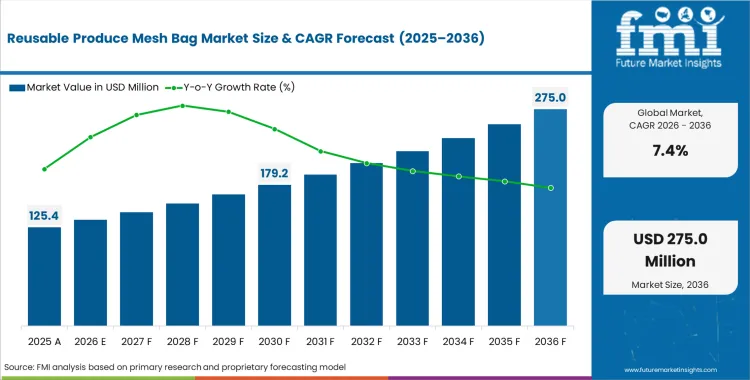
The reusable produce mesh bag market crossed a valuation of USD 116.8 million in 2025. Revenue is projected to surpass USD 125.4 million in 2026, expanding at a CAGR of 7.4% during the forecast period. Steady growth drives total valuation to USD 256.1 million by 2036 as regional single-use plastic bans shift sustainability initiatives into mandatory retail compliance requirements.
Summary of Reusable Produce Mesh Bag Market
- The market is forecast to reach USD 256.1 million by 2036.
- The market is expected to grow at a CAGR of 7.4% from 2026 to 2036.
- The market was estimated at USD 116.8 million in 2025.
- The forecast period represents an incremental opportunity of USD 130.7 million.
- The market focuses on reusable, breathable mesh bags designed specifically for carrying and storing fresh produce.
- Growth is driven by increasing bans on single-use plastic bags and rising adoption of zero-waste lifestyles.
- Consumer preference for washable, durable, and transparent storage solutions is shaping product demand.
- India, Australia, and Canada are among the fastest-growing markets, with India leading at a 9.1% CAGR through 2036.
- Organic cotton materials and drawstring designs dominate due to sustainability and ease of use.
- Online retail leads distribution, supported by eco-conscious branding and product education.
- Key players in the market include ECOBAGS, Earthwise, ChicoBag, Onya Life, Simple Ecology, Colony Co., and Purifyou.
Grocery retailers are under pressure to replace disposable plastic rolls in produce sections as plastic reduction rules tighten and shopper expectations shift toward reusable alternatives. Reusable produce bags change more than shelf assortment. Checkout routines, weighing accuracy, item scanning, and fixture layout all need adjustment once these bags move into regular store operations. Placement also matters because shoppers expect breathable storage bags to sit close to fresh produce, which pushes retailers to rethink display design and everyday replenishment. Regional grocers often face added strain here, as integrating a new reusable item into standard inventory flow is harder when store formats and operating budgets are less flexible.
Adoption improves once retailers and suppliers align around simple checkout standards. Standard weight labeling on eco friendly bags makes cashier handling easier and reduces friction at the point of sale. Repeat use also tends to rise when shoppers can take produce from store to home storage without repacking, giving the product a clearer everyday use case. Convenience at checkout and at home does more to support repeat purchase than sustainability messaging alone.
Regional growth still depends on whether adoption is being pushed by regulation or by consumer habit. Demand for reusable produce bags in India is projected to rise at a CAGR of 9.1% during the forecast period, supported by tighter municipal restrictions on single use plastics. Australia is expected to record 8.8% CAGR through 2036 as zero waste shopping habits remain more established in food retail. Canada is likely to expand at a CAGR of 8.1% over the assessment period, with national plastic reduction measures supporting adoption. Sales in the United Kingdom are estimated to increase at a CAGR of 7.4% through 2036, while Germany is forecast to grow at 6.9% and France at 6.7% during the same period. New Zealand is projected to register a CAGR of 6.3% by 2036, with growth moderating in a market that has already seen earlier consumer uptake.
Segmental Analysis
Reusable Produce Mesh Bag Market Analysis by Material
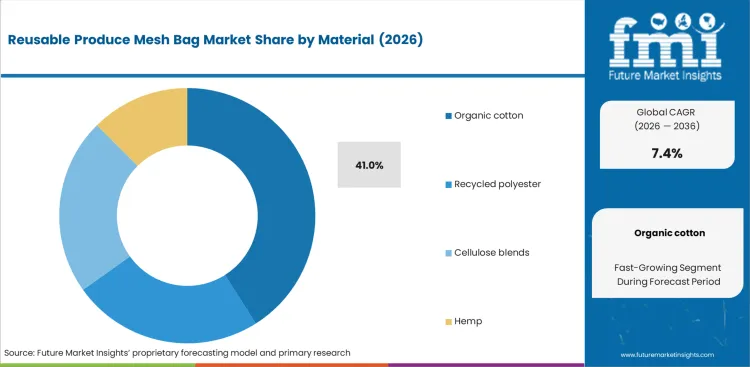
Shoppers buying loose vegetables tend to favor natural fibers over synthetic options because disposal outcome matters as much as in-store use. Synthetic blends create a weaker fit with zero-waste purchasing behavior, especially when buyers expect the product to break down more naturally at end of life. FMI estimates organic cotton to account for 41.0% share in 2026. Its lead reflects consumer trust in familiar plant-based materials and stronger confidence in certified textile sourcing on the retail shelf. Repeat purchase also benefits from cotton's familiar texture and everyday usability in produce shopping. Brands selling unverified conventional cotton face a higher risk of credibility loss, which makes clear certification important for any grocery bag assortment.
- End-of-life Disposal: Buyers place clear weight on biodegradability when worn-out bags are discarded. Synthetic blends can weaken product appeal among shoppers focused on lower-waste routines.
- Certification Trust: Shoppers often look for recognized textile certification on pack or tag. Missing verification can reduce shelf conversion where competing options carry clearer claims.
- Moisture Management: Cotton fibers can absorb excess humidity released by fresh vegetables. This supports produce storage performance better than sealed plastics in many everyday grocery bag use cases.
Reusable Produce Mesh Bag Market Analysis by Product Type
Reusable produce bag selection is shaped primarily by how well the closure keeps loose items contained during store handling and the trip home. Flat formats without a reliable seal create inconvenience at checkout, as shoppers resort to tying knots that slow access and disrupt transaction flow. Drawstring bags are estimated to account for 48.0% share in 2026, reflecting their practical advantage in holding rolling or heavy produce more securely than open-top alternatives. Closure design also matters at the register, where quick visual access helps cashiers inspect content and locate tags without delay. Simple pull-string systems support that requirement without adding unnecessary handling friction. Product durability depends on hardware choices as well, since bulky plastic toggles tend to trap residue during washing and are more prone to breakage over repeated use. Reusable grocery stores built with simpler, rust-resistant closure components are better aligned with weekly wash cycles and longer replacement intervals.
- Transit Security: Quick-pull closures are estimated to remain important because they reduce produce loss during transport, especially for round or heavy items that shift easily inside the bag. Bags that fail to keep content contained are less likely to sustain repeat use.
- Checkout Speed: Unobstructed bag access remains essential at checkout, where cashiers need to verify contents and identify tags quickly. Closure systems that add extra handling steps are likely to create lane delays and weaken ease-of-use.
- Maintenance Ease: Frequent washing is expected to remain a basic requirement for bags used with fresh produce and food-contact items. Closure hardware that degrades, traps dirt, or fails in wash cycles is likely to shorten product life and reduce consumer retention.
Reusable Produce Mesh Bag Market Analysis by Distribution Channel
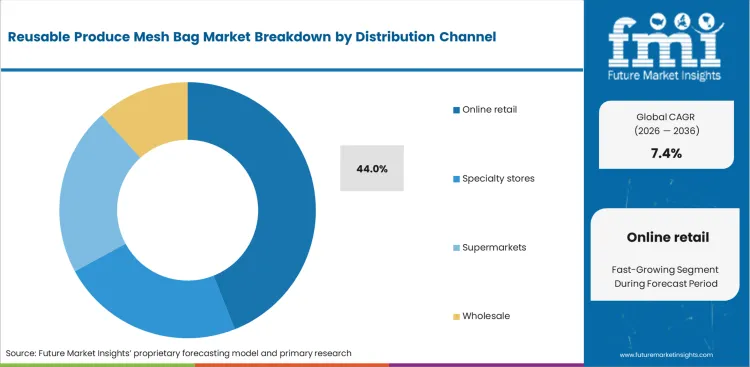
Online retail is expected to account for 44.0% of market share in 2026, reflecting its role as the leading sales channel for specialty eco-brands. Digital storefronts give smaller brands enough room to explain product utility in practical terms, especially around cost savings, reuse cycles, size selection, and waste reduction. Physical retail often gives these products limited visibility, which weakens purchase conversion for items that depend on quick consumer understanding at the point of need. Placement matters in this category, since shoppers are most likely to consider it reusable to produce bags while selecting fresh fruits and vegetables rather than while browsing general household aisles. Online sellers offset this weakness by presenting clearer product details, including tare weight information and sizing guidance that is difficult to communicate on compact in-store tags. Wider assortment depth also strengthens online performance, as digital channels can offer broader pack configurations without shelf-space constraints.
- Educational Marketing: Digital channels are estimated to remain important because they allow brands to explain tare weights, fabric composition, and reuse benefits in greater detail. Limited on-pack communication in stores makes that education harder to deliver at the point of purchase.
- Impulse Placement: Purchase intent often forms near fresh produce sections, where shoppers are making immediate packaging choices. Absence of displays near weighing stations or vegetable fixtures is likely to reduce conversion and keep disposable options in circulation.
- Inventory Depth: Online retail is expected to maintain an advantage in assortment breadth, with more room for multi-pack bundles, size variations, and use-specific formats. Physical outlets are more likely to remain focused on narrower pack options due to shelf allocation limits.
Reusable Produce Mesh Bag Market Analysis by End Use
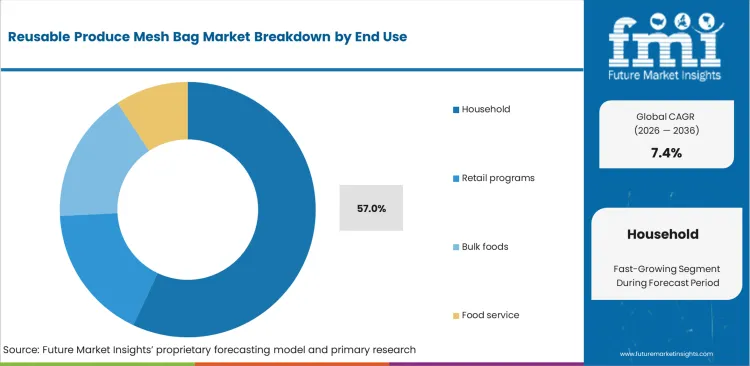
Household use is expected to account for 57.0% of market share in 2026, reflecting the category’s close link to everyday grocery shopping and home meal preparation. Demand is centered on families looking for a simple substitute for disposable produce packaging as city-level plastic restrictions become more common. Commercial foodservice operations remain less relevant to this segment, since bulk ingredient handling continues to rely on standardized high-volume packaging formats. Adoption at the household level depends less on product awareness and more on routine fit. Reusable mesh bags need to be easy to store, carry, and retrieve before each shopping trip, or repeat usage weakens quickly. Bulky sets without compact pouches are more likely to be left in cars, kitchen drawers, or at home, which reduces long-term usage consistency. Products that match household shopping habits more closely are better positioned to sustain repeat use.
- Routine Integration: Household adoption is likely to depend on how easily reusable bags fit into weekly shopping routines. Sets without compact storage features are more likely to be forgotten before store visits, limiting repeat usage.
- Volume Requirements: Families are expected to prefer mixed-size configurations that suit different produce types and purchase volumes. Uniform pack formats offer less flexibility for routine household meal planning.
- Cleaning Frequency: Regular washing remains important in domestic use, where repeated contact with fresh produce raises hygiene expectations. Materials that are difficult to clean or slow to dry are less likely to remain in active use.
Reusable Produce Mesh Bag Market Analysis by Pack Size
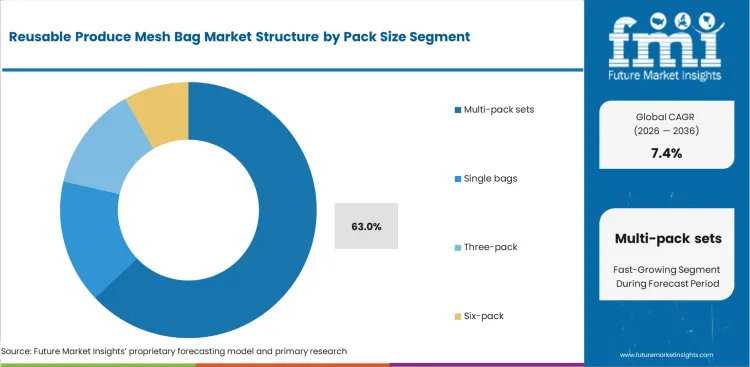
Multi-pack sets are expected to account for 63.0% of market share in 2026, as shoppers typically need several bags in one trip to replace disposable produce packaging in practical terms. A single reusable unit rarely meets weekly grocery needs when households are buying multiple fruit and vegetable types at once. Bundled formats align more closely with actual shopping behavior by offering enough capacity to substitute for several plastic bags in one purchase. Mixed-size configurations add further appeal because buying patterns vary across leafy items, root vegetables, and loose produce with different weight and volume needs. Single units remain more relevant for cautious first-time buyers, though they are less effective as a long-term household solution. Price comparison also favors bundles, since shoppers often judge value on total usable capacity rather than on the cost of one item alone. A recycled fabric bag bundle strengthens that value perception and gives manufacturers a better route to serve households aiming to reduce single-use plastic dependence more fully.
- System Replacement: Shoppers are likely to prefer pack formats that replace several disposable bags in a single purchase. Bundled sets offer closer functional alignment with weekly produce-buying volume.
- Size Variety: Mixed-size packs are estimated to remain important because produce purchases vary by weight, shape, and storage need. A broader size range reduces guesswork and improves day-to-day usability.
- Perceived Value: Multi-pack sets are expected to perform better on value perception, especially among budget-conscious supermarket buyers. Single-item pricing can appear less attractive when compared with the utility of a full recycled fabric bag bundle.
Reusable Produce Mesh Bag Market Drivers, Restraints, and Opportunities
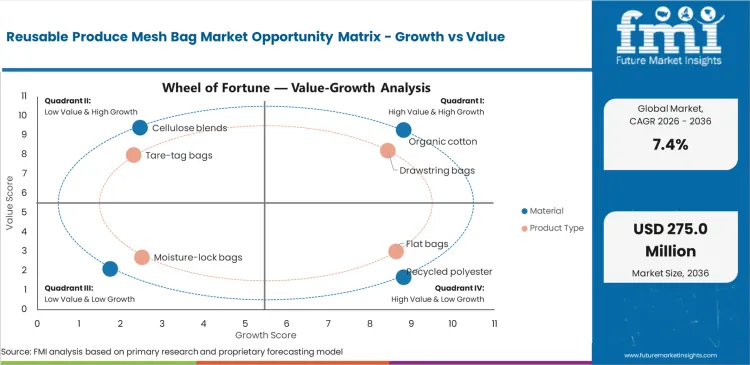
Plastic restrictions at the local level are increasing pressure on grocery retailers to replace single-use produce packaging with washable alternatives. Compliance depends on making reusable options visible and easy to access at the point of produce selection, since removing disposable rolls without a workable substitute can disrupt routine purchasing behavior. Product placement carries operational importance in this category. Reusable woven bags displayed near vegetable bins and weighing stations are more likely to support legal compliance, maintain shopper convenience, and keep loose produce purchases moving through the store without added friction.
Consumer forgetfulness remains a practical barrier to repeat use. Many shoppers buy reusable produce bags with clear intent, yet leave them in cars, kitchen drawers, or at home during routine grocery trips. This gap between purchase and actual use limits the effectiveness of store-level plastic reduction efforts, especially when shoppers make unplanned produce purchases and lack a ready alternative. Compact storage features can improve portability, though habit formation in grocery behavior tends to build gradually rather than immediately.
Opportunities in the Reusable Produce Mesh Bag Market
- Produce Aisle Displays: Display racks placed near produce scales and loose vegetable sections are expected to improve conversion by reaching shoppers at the point of need. Placement in separate household aisles is less likely to support immediate purchase decisions.
- Checkout Software Updates: Cash register systems configured to account for standard fabric tare weights are likely to reduce manual input errors and improve transaction flow. Faster processing becomes more important in stores handling higher volumes of personal or reusable produce bags.
- Private-Label Branding: Custom-branded mesh bags can help large retail chains align compliance needs with in-store brand visibility. Manufacturers offering private-label production are better positioned to support larger retail supply programs over time.
Regional Analysis
Global adoption of washable checkout accessories depends heavily on local waste regulations and existing consumer habits. Regions enforcing strict municipal plastic bans show rapid sales growth, while areas with voluntary guidelines rely on eco-conscious shoppers to organically drive transaction volume.
.webp "Top Country Growth Comparison Reusable Produce Mesh Bag Market Cagr (2026 2036)")
| Country | CAGR (2026 to 2036) |
|---|---|
| India | 9.1% |
| Australia | 8.8% |
| Canada | 8.1% |
| United Kingdom | 7.4% |
| Germany | 6.9% |
| France | 6.7% |
| New Zealand | 6.3% |
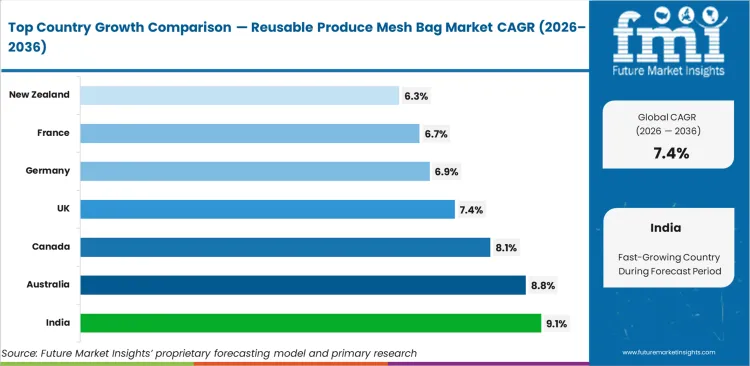
Source: Future Market Insights (FMI) analysis, based on proprietary forecasting model and primary research
Asia-Pacific Reusable Produce Mesh Bag Market Analysis
Urban growth and mounting landfill pressure are increasing regulatory action against disposable plastics across this region. Grocery retailers are responding by sourcing compliant produce bag alternatives that can support day-to-day store operations without disrupting shopper convenience. Reusable food bags placed near checkout or produce sections are likely to help modern retail formats meet packaging rules while creating an additional source of low-value but recurring basket spend.
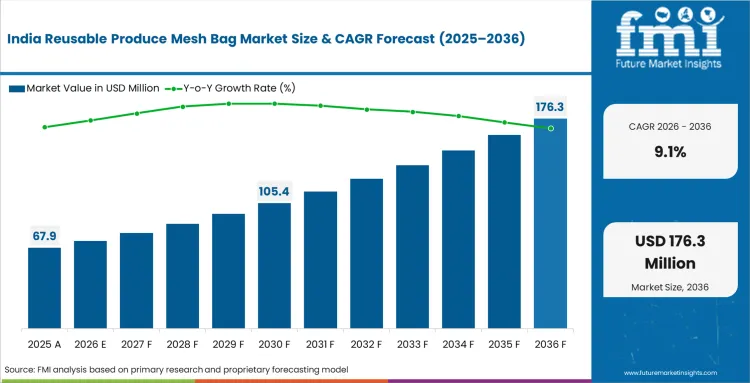
- India: City-level restrictions on single-use polythene are estimated to be accelerating change in routine shopping behavior across India. Demand for reusable produce mesh bags in India is expected to rise at a CAGR of 9.1% from 2026 to 2036. Domestic textile manufacturing also supports wider retail adoption by improving supply continuity and keeping cotton-based alternatives competitively priced.
- Australia: Durable and reusable shopping formats are already well aligned with consumer expectations in Australia’s grocery channel. Sales of reusable produce mesh bags in Australia are projected to expand at a CAGR of 8.8% during 2026 to 2036. Product quality remains important in this market, particularly where shoppers expect strong stitching, repeated washability, and easy handling in fresh produce aisles.
- New Zealand: Sustainable packaging habits are more established in New Zealand, creating steadier demand conditions for reusable checkout and produce-carry solutions. New Zealand is likely to register a CAGR of 6.3% in the reusable produce mesh bag market over 2026 to 2036. Buyer preference in this market is more closely tied to material credibility and end-of-life disposal characteristics, which keeps product claims under closer scrutiny.
Rising middle-income consumer bases across Southeast Asia are expected to widen demand for affordable multi-pack formats. Several developing markets in the region are moving toward reusable packaging adoption earlier in the retail cycle, which improves the outlook for lower-cost alternatives suited to daily grocery use. Manufacturers able to supply price-sensitive mesh bag formats alongside other compostable carry solutions are better positioned to serve expanding retail demand across emerging urban markets.
North America & Latin America Reusable Produce Mesh Bag Market Analysis
Fragmented state and provincial rules create a messy compliance environment for national grocery chains. Certain areas enforce hard bans on plastic bags, while neighboring towns just suggest voluntary reductions. This scattered approach forces big supermarkets to adopt universal sustainable packaging strategies just to keep their supply chain logistics simple.
- Canada: Federal measures to phase out single-use plastics are expected to keep compliance pressure elevated across Canada’s grocery sector. Demand for reusable produce bags in Canada is projected to expand at a CAGR of 8.1% from 2026 to 2036 as retailers reduce reliance on plastic rolls in produce sections. National grocery networks are likely to favor coordinated supply arrangements that support multi-location rollout, which strengthens volume visibility for manufacturers able to meet scale and consistency requirements.
Online platforms play an essential role in reaching consumers living far outside major urban centers where physical stores lack eco-friendly inventory. Integrating food storage bags into broader zero-waste marketing campaigns connects perfectly with younger demographics across the Americas. Expanding these product lines into bulk food specialty stores will likely shape the next phase of regional growth.
Europe Reusable Produce Mesh Bag Market Analysis
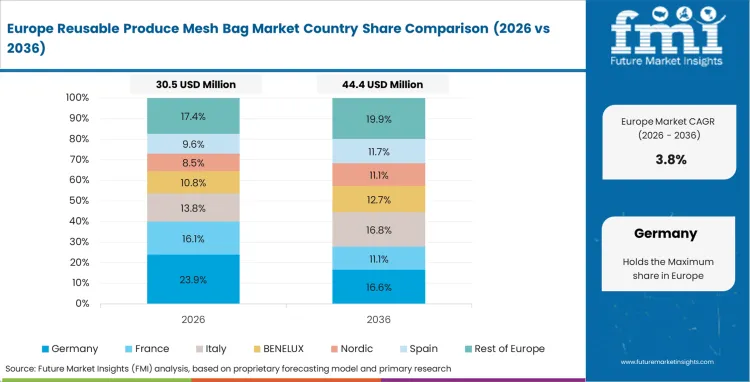
Strict European Union waste directives act as the ultimate benchmark for retail compliance globally. Supermarkets operate under intense daily pressure to prove they are actively shrinking their plastic footprint. Shoppers naturally expect stores to ditch disposable rolls and provide accessible, sustainable options right next to the fresh produce bins.
- United Kingdom: Major supermarkets fulfilling aggressive pledges to eliminate plastic waste poise for the market in the UK to register an anticipated CAGR of 7.4% through 2036. Consumers heavily favor compact and highly portable designs that fit easily into a daily transit bag. Brands optimizing their packaging for simple storage easily capture this busy urban commuter demographic.
- Germany: High environmental awareness dictates extremely strict preferences for organic and recycled materials among local shoppers. Germany is forecast to record steady growth in reusable produce bags at an estimated CAGR of 6.9% from 2026 to 2036, though retail success depends entirely on precise tare weight labeling. Products missing accurate weight tags face immediate rejection from stores running highly automated checkout lanes.
- France: National laws banning plastic wrapping for raw fruits and vegetables forced an immediate behavioral shift across all consumer demographics. Shoppers rapidly switched to personal carrying solutions to navigate these strict point-of-sale limits, meaning the reusable produce mesh bag market in France is anticipated to see adoption grow at a predicted CAGR of 6.7% over the forecast period. This immediate daily necessity completely overrode previous price sensitivities among average buyers.
FMI analyses, cross-border retail partnerships give successful sustainable brands a clear path to expand rapidly across neighboring European countries. Manufacturers must prove their materials are sustainably harvested and ethically produced to even enter these major retail networks. Promoting produce packaging solutions with fully transparent tracing mechanisms remains the best way to secure premium shelf placement across the continent.
Competitive Aligners for Market Players
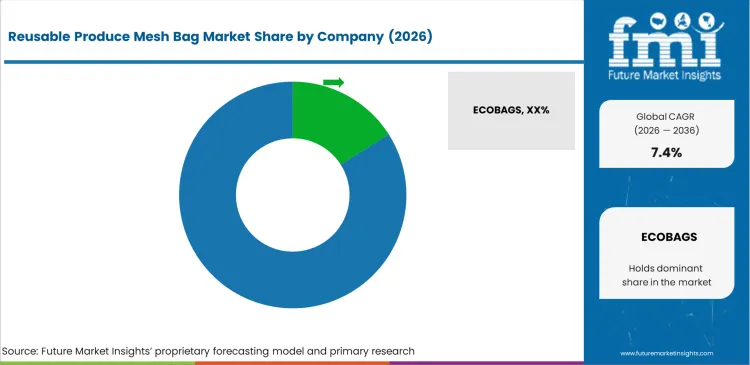
Competition in this market is shaped by a divide between dedicated eco-focused brands and larger textile producers seeking access to organized retail channels. Shelf access in supermarkets depends less on broad positioning and more on execution reliability, especially where buyers require consistent product specifications, barcode-ready tare labeling, and repeatable shipment quality across locations. Larger suppliers tend to perform better in this environment when they can support uniform output at scale. Smaller brands are more likely to build traction through direct-to-consumer channels, where product education, zero-waste positioning, and detailed usage guidance can influence purchase decisions without the constraints of in-store merchandising. Strong online pull can later improve the likelihood of retail listing discussions, particularly when consumer recognition is already established.
Verified sourcing and material traceability remain important competitive barriers. Retailers placing reusable produce bags into formal assortments are likely to seek clearer validation around organic cotton, recycled plastic content, and related material claims, as claim accuracy affects packaging credibility and merchandising risk. Building a traceable supply chain with reliable documentation takes time, supplier coordination, and sustained investment. Established participants with stronger certification coverage are therefore better positioned to meet organized retail requirements and defend shelf access against lower-cost but less verified alternatives. Integration with existing produce handling and labeling practices also improves long-term retail relevance.
Retail chains are also expected to maintain secondary supplier relationships to reduce overdependence on a single source. This keeps competition active on pricing, lead times, and order consistency rather than on fabric quality alone. Custom store-branded product options can strengthen supplier positioning where retailers want category compliance, private-label visibility, and dependable replenishment from the same partner.
Key Players in Reusable Produce Mesh Bag Market
- ECOBAGS
- Earthwise
- ChicoBag
- Onya Life
- Simple Ecology
- Colony Co.
- Purifyou
Scope of the Report
| Metric | Value |
|---|---|
| Quantitative Units | USD 125.4 million to USD 256.1 million, at a CAGR of 7.4% |
| Market Definition | Washable, breathable transport solutions for fresh fruits and vegetables replace single-use plastics in retail settings and require accurate tare weights for scale integration. |
| Segmentation | By Material, By Product Type, By Distribution Channel, By End Use, By Pack Size, By Region |
| Regions Covered | North America & Latin America, Europe, Asia-Pacific, Middle East & Africa |
| Countries Covered | India, Australia, Canada, United Kingdom, Germany, France, New Zealand |
| Key Companies Profiled | ECOBAGS, Earthwise, ChicoBag, Onya Life, Simple Ecology, Colony Co., Purifyou |
| Forecast Period | 2026 to 2036 |
| Approach | Baseline metrics derived from retail point-of-sale data and textile import volumes. |
Source: Future Market Insights (FMI) analysis, based on proprietary forecasting model and primary research
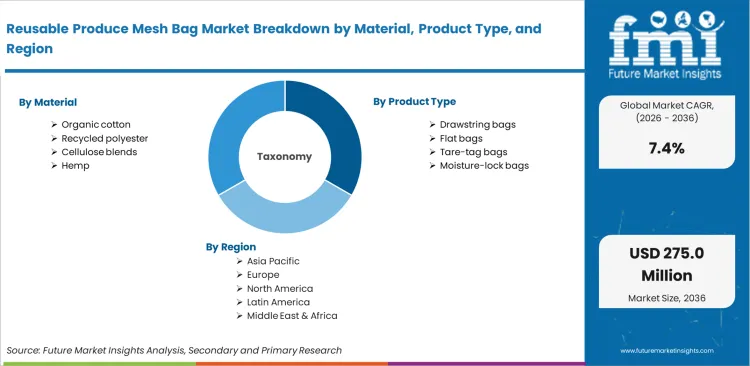
Segments
- By Material
- Organic cotton
- Recycled polyester
- Cellulose blends
- Hemp
- By Product Type
- Drawstring bags
- Flat bags
- Tare-tag bags
- Moisture-lock bags
- By Distribution Channel
- Online retail
- Specialty stores
- Supermarkets
- Wholesale
- By End Use
- Household
- Retail programs
- Bulk foods
- Food service
- By Pack Size
- Multi-pack sets
- Single bags
- Three-pack
- Six-pack
Regions:
- Asia Pacific
- India
- China
- Japan
- South Korea
- Indonesia
- Australia
- New Zealand
- ASEAN
- Rest of Asia Pacific
- Europe
- Germany
- Italy
- France
- United Kingdom
- Spain
- Benelux
- Nordics
- Central & Eastern Europe
- Rest of Europe
- North America
- United States
- Canada
- Mexico
- Latin America
- Brazil
- Argentina
- Chile
- Rest of Latin America
- Middle East & Africa
- Kingdom of Saudi Arabia
- United Arab Emirates
- South Africa
- Turkey
- Rest of Middle East & Africa
Bibliography
- Blok, A. E., & Steenbekkers, B. L. P. A. (2026). Exploring Dutch consumer practices and preferences regarding purchase, storage and packaging of fresh fruits and vegetables. British Food Journal, 128(13).
- Bócoli, P. F. J., Gomes, V. E. de S., Maia, A. A. D., & Marangoni Júnior, L. (2025). Perspectives on eco-friendly food packaging: Challenges, solutions, and trends. Foods, 14(17), 3062.
- Department of Water and Environmental Regulation. (2024). Plan for Plastics - Stage 2 regulations (barrier bags) - consultation survey for businesses. Government of Western Australia.
- Drechsel, P., Kracklauer, A. H., Menrad, K., & Decker, T. (2026). From bag to better: A field study on the drivers of packaging choices for loose fruits and vegetables at the point of sale in Germany. Resources, Conservation and Recycling, 224, 108545.
- European Food Safety Authority. (2025). Literature review on micro- and nanoplastic release from food contact materials during their use.
This bibliography is provided for reader reference. The full FMI report contains the complete reference list with primary source documentation.
Frequently Asked Questions
What is the reusable produce mesh bag market size in 2026 and 2036?
Demand is projected to hit USD 125.4 million in 2026 and expand to USD 256.1 million by 2036 as regional single-use plastic bans become universal standards.
How fast is the reusable produce mesh bag market growing?
The sector is expected to expand at a steady 7.4% CAGR from 2026 to 2036, driven primarily by strict municipal waste reduction targets.
What is driving demand for reusable produce mesh bags globally?
Legislative bans on single-use plastics compel global retail chains to actively source sustainable transport alternatives to avoid regulatory fines.
Which materials dominate reusable produce mesh bags?
Consumers prioritize end-of-life biodegradability and trust certified organic cotton fibers over synthetic alternatives.
Are reusable produce mesh bags replacing plastic produce bags?
These washable alternatives function as direct replacements for disposable plastic film at point-of-sale checkout stations.
Which countries are growing fastest in reusable produce mesh bags?
India is anticipated to lead with an estimated 9.1% CAGR due to strict municipal bans, likely to be followed by Australia at a projected 8.8% due to established eco-conscious habits.
Who are the top companies in reusable produce mesh bags?
Key manufacturers include ECOBAGS, Earthwise, ChicoBag, Onya Life, Simple Ecology, Colony Co., and Purifyou.
What segments are included in the reusable produce mesh bag market?
The analysis covers segmentation by material, product type, distribution channel, end use, pack size, and geographic region.
How do reusable produce mesh bags compare with plastic produce bags?
Breathable fabrics allow airflow to extend produce shelf life while requiring standardized tare weights for accurate retail checkout.
What channels sell the most reusable produce mesh bags?
Online retail leads distribution because digital storefronts provide the necessary space for brands to educate consumers on product lifecycle benefits.
Why does organic cotton lead the material segment?
Shoppers prioritize biodegradability and consistently favor materials they perceive as environmentally benign over durable synthetic options.
What drives the high share for drawstring products?
Quick-pull closures prevent loose vegetables from spilling during transit while allowing cashiers easy internal access.
How do multi-pack sets dominate pack size preferences?
Shoppers require five to seven assorted bags per trip to entirely replace disposable rolls for weekly meal ingredients.
What structural constraint limits consistent household usage?
Shoppers frequently leave reusable options in their vehicles, forcing a reversion to available store-provided plastics.
How do cashiers impact product adoption?
Checkout staff require standardized tare weight tags to quickly deduct fabric weight, preventing transaction bottlenecks.
Why are flat bags losing traction among buyers?
Products without reliable closures require manual tying, which complicates checkout inspections and frustrates users.
What differentiates the United Kingdom's consumer demographic?
Urban commuters strongly favor compact, easily portable designs that fit seamlessly into daily transit habits.
Why is precise tare weight labeling critical in Germany?
Retailers enforce strict automated checkout efficiency standards that immediately reject products lacking accurate weight tags.
How do commercial food service operations approach this transition?
High-volume kitchens remain slower to adopt due to their heavy reliance on standardized bulk deliveries rather than individual shopping trips.
What separates market leaders from basic commodity suppliers?
The capability to offer customized private-label manufacturing for specific grocery chains ensures guaranteed high-volume turnover.
Why do synthetic blends face resistance despite durability?
Eco-conscious shoppers prioritize zero-waste end-of-life disposal, viewing non-biodegradable synthetics as contradictory to their primary motivation.
How do retail buyers actively resist vendor lock-in?
Supermarkets continually qualify secondary suppliers for their reusable merchandise programs to guarantee competitive pricing and delivery reliability.
Preview the report firsthand - request a free sample
Get SampleGet the brochure for pricing and purchase details.
Get PDFTable of Content
- Executive Summary
- Global Market Outlook
- Demand-side Trends
- Supply-side Trends
- Technology Roadmap Analysis
- Analysis and Recommendations
- Market Overview
- Market Coverage / Taxonomy
- Market Definition / Scope / Limitations
- Research Methodology
- Chapter Orientation
- Analytical Lens and Working Hypotheses
- Market Structure, Signals, and Trend Drivers
- Benchmarking and Cross-market Comparability
- Market Sizing, Forecasting, and Opportunity Mapping
- Research Design and Evidence Framework
- Desk Research Programme (Secondary Evidence)
- Company Annual and Sustainability Reports
- Peer-reviewed Journals and Academic Literature
- Corporate Websites, Product Literature, and Technical Notes
- Earnings Decks and Investor Briefings
- Statutory Filings and Regulatory Disclosures
- Technical White Papers and Standards Notes
- Trade Journals, Industry Magazines, and Analyst Briefs
- Conference Proceedings, Webinars, and Seminar Materials
- Government Statistics Portals and Public Data Releases
- Press Releases and Reputable Media Coverage
- Specialist Newsletters and Curated Briefings
- Sector Databases and Reference Repositories
- FMI Internal Proprietary Databases and Historical Market Datasets
- Subscription Datasets and Paid Sources
- Social Channels, Communities, and Digital Listening Inputs
- Additional Desk Sources
- Expert Input and Fieldwork (Primary Evidence)
- Primary Modes
- Qualitative Interviews and Expert Elicitation
- Quantitative Surveys and Structured Data Capture
- Blended Approach
- Why Primary Evidence is Used
- Field Techniques
- Interviews
- Surveys
- Focus Groups
- Observational and In-context Research
- Social and Community Interactions
- Stakeholder Universe Engaged
- C-suite Leaders
- Board Members
- Presidents and Vice Presidents
- R&D and Innovation Heads
- Technical Specialists
- Domain Subject-matter Experts
- Scientists
- Physicians and Other Healthcare Professionals
- Governance, Ethics, and Data Stewardship
- Research Ethics
- Data Integrity and Handling
- Primary Modes
- Tooling, Models, and Reference Databases
- Desk Research Programme (Secondary Evidence)
- Data Engineering and Model Build
- Data Acquisition and Ingestion
- Cleaning, Normalisation, and Verification
- Synthesis, Triangulation, and Analysis
- Quality Assurance and Audit Trail
- Market Background
- Market Dynamics
- Drivers
- Restraints
- Opportunity
- Trends
- Scenario Forecast
- Demand in Optimistic Scenario
- Demand in Likely Scenario
- Demand in Conservative Scenario
- Opportunity Map Analysis
- Product Life Cycle Analysis
- Supply Chain Analysis
- Investment Feasibility Matrix
- Value Chain Analysis
- PESTLE and Porter’s Analysis
- Regulatory Landscape
- Regional Parent Market Outlook
- Production and Consumption Statistics
- Import and Export Statistics
- Market Dynamics
- Global Market Analysis 2021 to 2025 and Forecast, 2026 to 2036
- Historical Market Size Value (USD Million) Analysis, 2021 to 2025
- Current and Future Market Size Value (USD Million) Projections, 2026 to 2036
- Y-o-Y Growth Trend Analysis
- Absolute $ Opportunity Analysis
- Global Market Pricing Analysis 2021 to 2025 and Forecast 2026 to 2036
- Global Market Analysis 2021 to 2025 and Forecast 2026 to 2036, By Material
- Introduction / Key Findings
- Historical Market Size Value (USD Million) Analysis By Material , 2021 to 2025
- Current and Future Market Size Value (USD Million) Analysis and Forecast By Material , 2026 to 2036
- Organic cotton
- Recycled polyester
- Cellulose blends
- Hemp
- Organic cotton
- Y-o-Y Growth Trend Analysis By Material , 2021 to 2025
- Absolute $ Opportunity Analysis By Material , 2026 to 2036
- Global Market Analysis 2021 to 2025 and Forecast 2026 to 2036, By Product Type
- Introduction / Key Findings
- Historical Market Size Value (USD Million) Analysis By Product Type, 2021 to 2025
- Current and Future Market Size Value (USD Million) Analysis and Forecast By Product Type, 2026 to 2036
- Drawstring bags
- Flat bags
- Tare-tag bags
- Moisture-lock bags
- Drawstring bags
- Y-o-Y Growth Trend Analysis By Product Type, 2021 to 2025
- Absolute $ Opportunity Analysis By Product Type, 2026 to 2036
- Global Market Analysis 2021 to 2025 and Forecast 2026 to 2036, By Distribution Channel
- Introduction / Key Findings
- Historical Market Size Value (USD Million) Analysis By Distribution Channel, 2021 to 2025
- Current and Future Market Size Value (USD Million) Analysis and Forecast By Distribution Channel, 2026 to 2036
- Online retail
- Specialty stores
- Supermarkets
- Wholesale
- Online retail
- Y-o-Y Growth Trend Analysis By Distribution Channel, 2021 to 2025
- Absolute $ Opportunity Analysis By Distribution Channel, 2026 to 2036
- Global Market Analysis 2021 to 2025 and Forecast 2026 to 2036, By End Use
- Introduction / Key Findings
- Historical Market Size Value (USD Million) Analysis By End Use, 2021 to 2025
- Current and Future Market Size Value (USD Million) Analysis and Forecast By End Use, 2026 to 2036
- Household
- Retail programs
- Bulk foods
- Food service
- Household
- Y-o-Y Growth Trend Analysis By End Use, 2021 to 2025
- Absolute $ Opportunity Analysis By End Use, 2026 to 2036
- Global Market Analysis 2021 to 2025 and Forecast 2026 to 2036, By Pack Size
- Introduction / Key Findings
- Historical Market Size Value (USD Million) Analysis By Pack Size, 2021 to 2025
- Current and Future Market Size Value (USD Million) Analysis and Forecast By Pack Size, 2026 to 2036
- Multi-pack sets
- Single bags
- Three-pack
- Six-pack
- Multi-pack sets
- Y-o-Y Growth Trend Analysis By Pack Size, 2021 to 2025
- Absolute $ Opportunity Analysis By Pack Size, 2026 to 2036
- Global Market Analysis 2021 to 2025 and Forecast 2026 to 2036, By Region
- Introduction
- Historical Market Size Value (USD Million) Analysis By Region, 2021 to 2025
- Current Market Size Value (USD Million) Analysis and Forecast By Region, 2026 to 2036
- North America
- Latin America
- Western Europe
- Eastern Europe
- East Asia
- South Asia and Pacific
- Middle East & Africa
- Market Attractiveness Analysis By Region
- North America Market Analysis 2021 to 2025 and Forecast 2026 to 2036, By Country
- Historical Market Size Value (USD Million) Trend Analysis By Market Taxonomy, 2021 to 2025
- Market Size Value (USD Million) Forecast By Market Taxonomy, 2026 to 2036
- By Country
- USA
- Canada
- Mexico
- By Material
- By Product Type
- By Distribution Channel
- By End Use
- By Pack Size
- By Country
- Market Attractiveness Analysis
- By Country
- By Material
- By Product Type
- By Distribution Channel
- By End Use
- By Pack Size
- Key Takeaways
- Latin America Market Analysis 2021 to 2025 and Forecast 2026 to 2036, By Country
- Historical Market Size Value (USD Million) Trend Analysis By Market Taxonomy, 2021 to 2025
- Market Size Value (USD Million) Forecast By Market Taxonomy, 2026 to 2036
- By Country
- Brazil
- Chile
- Rest of Latin America
- By Material
- By Product Type
- By Distribution Channel
- By End Use
- By Pack Size
- By Country
- Market Attractiveness Analysis
- By Country
- By Material
- By Product Type
- By Distribution Channel
- By End Use
- By Pack Size
- Key Takeaways
- Western Europe Market Analysis 2021 to 2025 and Forecast 2026 to 2036, By Country
- Historical Market Size Value (USD Million) Trend Analysis By Market Taxonomy, 2021 to 2025
- Market Size Value (USD Million) Forecast By Market Taxonomy, 2026 to 2036
- By Country
- Germany
- UK
- Italy
- Spain
- France
- Nordic
- BENELUX
- Rest of Western Europe
- By Material
- By Product Type
- By Distribution Channel
- By End Use
- By Pack Size
- By Country
- Market Attractiveness Analysis
- By Country
- By Material
- By Product Type
- By Distribution Channel
- By End Use
- By Pack Size
- Key Takeaways
- Eastern Europe Market Analysis 2021 to 2025 and Forecast 2026 to 2036, By Country
- Historical Market Size Value (USD Million) Trend Analysis By Market Taxonomy, 2021 to 2025
- Market Size Value (USD Million) Forecast By Market Taxonomy, 2026 to 2036
- By Country
- Russia
- Poland
- Hungary
- Balkan & Baltic
- Rest of Eastern Europe
- By Material
- By Product Type
- By Distribution Channel
- By End Use
- By Pack Size
- By Country
- Market Attractiveness Analysis
- By Country
- By Material
- By Product Type
- By Distribution Channel
- By End Use
- By Pack Size
- Key Takeaways
- East Asia Market Analysis 2021 to 2025 and Forecast 2026 to 2036, By Country
- Historical Market Size Value (USD Million) Trend Analysis By Market Taxonomy, 2021 to 2025
- Market Size Value (USD Million) Forecast By Market Taxonomy, 2026 to 2036
- By Country
- China
- Japan
- South Korea
- By Material
- By Product Type
- By Distribution Channel
- By End Use
- By Pack Size
- By Country
- Market Attractiveness Analysis
- By Country
- By Material
- By Product Type
- By Distribution Channel
- By End Use
- By Pack Size
- Key Takeaways
- South Asia and Pacific Market Analysis 2021 to 2025 and Forecast 2026 to 2036, By Country
- Historical Market Size Value (USD Million) Trend Analysis By Market Taxonomy, 2021 to 2025
- Market Size Value (USD Million) Forecast By Market Taxonomy, 2026 to 2036
- By Country
- India
- ASEAN
- Australia & New Zealand
- Rest of South Asia and Pacific
- By Material
- By Product Type
- By Distribution Channel
- By End Use
- By Pack Size
- By Country
- Market Attractiveness Analysis
- By Country
- By Material
- By Product Type
- By Distribution Channel
- By End Use
- By Pack Size
- Key Takeaways
- Middle East & Africa Market Analysis 2021 to 2025 and Forecast 2026 to 2036, By Country
- Historical Market Size Value (USD Million) Trend Analysis By Market Taxonomy, 2021 to 2025
- Market Size Value (USD Million) Forecast By Market Taxonomy, 2026 to 2036
- By Country
- Kingdom of Saudi Arabia
- Other GCC Countries
- Turkiye
- South Africa
- Other African Union
- Rest of Middle East & Africa
- By Material
- By Product Type
- By Distribution Channel
- By End Use
- By Pack Size
- By Country
- Market Attractiveness Analysis
- By Country
- By Material
- By Product Type
- By Distribution Channel
- By End Use
- By Pack Size
- Key Takeaways
- Key Countries Market Analysis
- USA
- Pricing Analysis
- Market Share Analysis, 2025
- By Material
- By Product Type
- By Distribution Channel
- By End Use
- By Pack Size
- Canada
- Pricing Analysis
- Market Share Analysis, 2025
- By Material
- By Product Type
- By Distribution Channel
- By End Use
- By Pack Size
- Mexico
- Pricing Analysis
- Market Share Analysis, 2025
- By Material
- By Product Type
- By Distribution Channel
- By End Use
- By Pack Size
- Brazil
- Pricing Analysis
- Market Share Analysis, 2025
- By Material
- By Product Type
- By Distribution Channel
- By End Use
- By Pack Size
- Chile
- Pricing Analysis
- Market Share Analysis, 2025
- By Material
- By Product Type
- By Distribution Channel
- By End Use
- By Pack Size
- Germany
- Pricing Analysis
- Market Share Analysis, 2025
- By Material
- By Product Type
- By Distribution Channel
- By End Use
- By Pack Size
- UK
- Pricing Analysis
- Market Share Analysis, 2025
- By Material
- By Product Type
- By Distribution Channel
- By End Use
- By Pack Size
- Italy
- Pricing Analysis
- Market Share Analysis, 2025
- By Material
- By Product Type
- By Distribution Channel
- By End Use
- By Pack Size
- Spain
- Pricing Analysis
- Market Share Analysis, 2025
- By Material
- By Product Type
- By Distribution Channel
- By End Use
- By Pack Size
- France
- Pricing Analysis
- Market Share Analysis, 2025
- By Material
- By Product Type
- By Distribution Channel
- By End Use
- By Pack Size
- India
- Pricing Analysis
- Market Share Analysis, 2025
- By Material
- By Product Type
- By Distribution Channel
- By End Use
- By Pack Size
- ASEAN
- Pricing Analysis
- Market Share Analysis, 2025
- By Material
- By Product Type
- By Distribution Channel
- By End Use
- By Pack Size
- Australia & New Zealand
- Pricing Analysis
- Market Share Analysis, 2025
- By Material
- By Product Type
- By Distribution Channel
- By End Use
- By Pack Size
- China
- Pricing Analysis
- Market Share Analysis, 2025
- By Material
- By Product Type
- By Distribution Channel
- By End Use
- By Pack Size
- Japan
- Pricing Analysis
- Market Share Analysis, 2025
- By Material
- By Product Type
- By Distribution Channel
- By End Use
- By Pack Size
- South Korea
- Pricing Analysis
- Market Share Analysis, 2025
- By Material
- By Product Type
- By Distribution Channel
- By End Use
- By Pack Size
- Russia
- Pricing Analysis
- Market Share Analysis, 2025
- By Material
- By Product Type
- By Distribution Channel
- By End Use
- By Pack Size
- Poland
- Pricing Analysis
- Market Share Analysis, 2025
- By Material
- By Product Type
- By Distribution Channel
- By End Use
- By Pack Size
- Hungary
- Pricing Analysis
- Market Share Analysis, 2025
- By Material
- By Product Type
- By Distribution Channel
- By End Use
- By Pack Size
- Kingdom of Saudi Arabia
- Pricing Analysis
- Market Share Analysis, 2025
- By Material
- By Product Type
- By Distribution Channel
- By End Use
- By Pack Size
- Turkiye
- Pricing Analysis
- Market Share Analysis, 2025
- By Material
- By Product Type
- By Distribution Channel
- By End Use
- By Pack Size
- South Africa
- Pricing Analysis
- Market Share Analysis, 2025
- By Material
- By Product Type
- By Distribution Channel
- By End Use
- By Pack Size
- USA
- Market Structure Analysis
- Competition Dashboard
- Competition Benchmarking
- Market Share Analysis of Top Players
- By Region
- By Material
- By Product Type
- By Distribution Channel
- By End Use
- By Pack Size
- Competition Analysis
- Competition Deep Dive
- ECOBAGS
- Overview
- Product Portfolio
- Profitability by Market Segments (Product/Age /Sales Channel/Region)
- Sales Footprint
- Strategy Overview
- Marketing Strategy
- Product Strategy
- Channel Strategy
- Earthwise
- ChicoBag
- Onya Life
- Simple Ecology
- Colony Co.
- Purifyou
- ECOBAGS
- Competition Deep Dive
- Assumptions & Acronyms Used


