

- Industry Size (2026)
- USD 690.8 Mn
- Forecast (2036)
- USD 1333.7 Mn
- CAGR (2026 to 2036)
- 6.8%
Bag Dump Stations Market Size, Market Forecast and Outlook By FMI
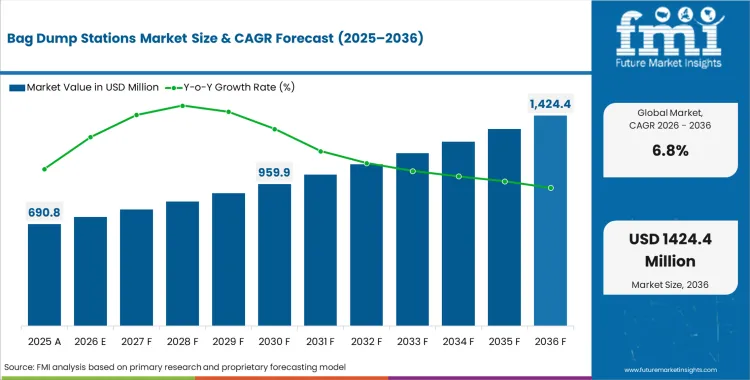
The bag dump stations market garnered a value of USD 646.8 million in 2025 and is projected to reach USD 690.8 million in 2026. Sector is expected to expand at a CAGR of 6.8% during 2026 to 2036, with total valuation projected at USD 1,333.7 million by 2036. Growth is supported by increasing adoption of controlled powder handling systems across manufacturing environments where dust exposure and material loss are key concerns.
Summary of Bag Dump Stations Market
- The market is estimated at USD 646.8 million in 2025.
- The market is projected to reach USD 1,333.7 million by 2036.
- The market is expected to grow at a CAGR of 6.8% from 2026 to 2036.
- The forecast period represents an incremental opportunity of USD 642.9 million.
- Manual configurations lead the product type segment with a 57% share.
- Food processing dominates the end-use segment with a 26% share.
- 500-1500 kg/hr systems lead the throughput segment with a 43% share.
- Stainless steel construction leads the material segment with a 61% share.
- Chemicals (24%) and pharmaceuticals (18%) are key supporting end-use segments.
- India (7.4%), China (6.5%), and the United States (5.7%) are among the fastest-growing markets.
Material intake points are becoming a focus area for process optimization. Open bag emptying generates airborne particulates that affect workplace safety and product quality. Enclosed dump stations improve containment by capturing dust at the source and integrating with filtration or conveying systems. These systems also support consistent feeding into downstream processes, reducing spillage and improving material utilization.
Operational constraints related to manual handling are driving system upgrades. Facilities processing large volumes of bagged materials face limitations in throughput when relying on manual tipping. Integrated dump stations connected to conveying systems improve flow continuity and support higher processing rates. This transition helps eliminate bottlenecks at the intake stage and improves overall production efficiency, particularly for cohesive or fine powders.
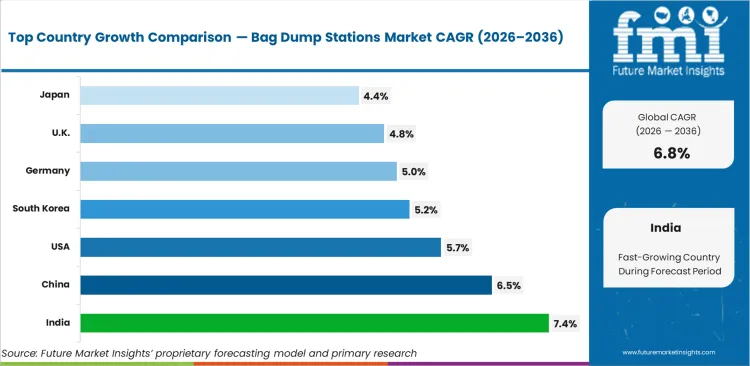
India is estimated to record a CAGR of 7.4% in the bag dump stations market during 2026 to 2036, driven by expansion in pharmaceutical and contract manufacturing. China is projected to grow at 6.5%, supported by chemical industry scale-up. The United States is expected to register 5.7%, reflecting upgrades in existing facilities. South Korea is anticipated to grow at 5.2%, followed by Germany at 5.0% CAGR by 2036, where stricter occupational exposure standards influence adoption.
Segmental Analysis
Bag Dump Stations Market Analysis by Configuration
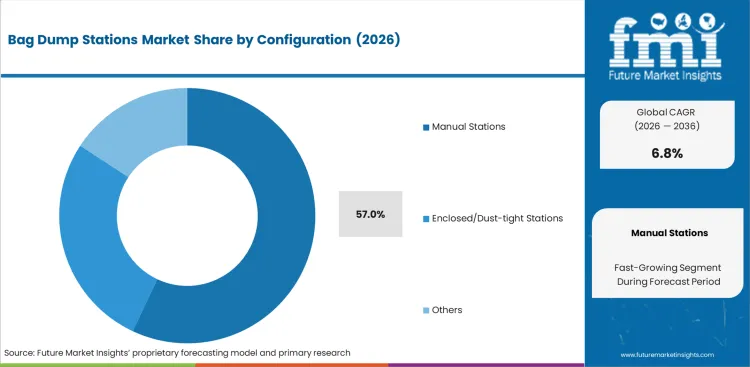
Manual configurations are expected to account for 57.0% share of the bag dump stations market in 2026, reflecting their continued use across industrial facilities. These systems remain widely adopted due to simple operation and direct compatibility with gravity-fed mixers and existing plant layouts. Their ease of installation and lower initial cost make them suitable for standard material intake applications. However, selection between manual and enclosed systems depends on operational requirements.
Manual stations require ongoing filter maintenance and offer limited containment compared to enclosed designs. Enclosed bag dump stations introduce controlled negative pressure, improving dust capture and workplace cleanliness. Integration with vacuum conveying systems further enhances performance by enabling sealed material transfer and reducing flow interruptions such as bridging.
- Open configurations require frequent filter cleaning, as dust accumulation reduces airflow efficiency and affects overall system performance during continuous operation
- Enclosed systems improve containment by maintaining negative pressure, reducing airborne particulates and supporting cleaner transfer environments
- Integration with conveying systems enhances material flow consistency, minimizing bridging issues during transfer into downstream processing equipment
Bag Dump Stations Market Analysis by End Use
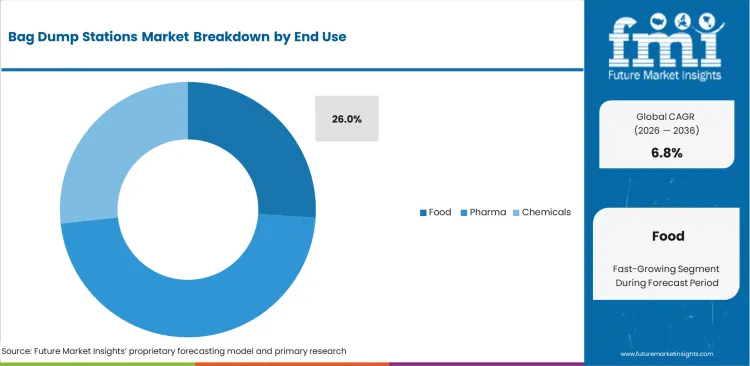
Application requirements vary depending on contamination sensitivity and material characteristics across industries. Food processing is likely to record 26.0% share of bag dump station usage over the study period, driven by hygiene-focused handling of fine ingredients. Smooth internal surfaces and easy disassembly support cleaning requirements in sensitive environments. Chemical and plastics applications introduce different priorities, including dust extraction and abrasion resistance. Equipment design must adapt to these varied conditions while maintaining consistent flow and minimizing contamination risks during material transfer.
- Hygienic design reduces contamination risk, ensuring safe handling of ingredients that require strict sanitation standards during processing
- Dust extraction systems support safe operation in chemical handling, preventing exposure to hazardous particulates during unloading
- Screening mechanisms improve material quality by removing foreign objects before transfer into processing systems
Bag Dump Stations Market Analysis by Throughput
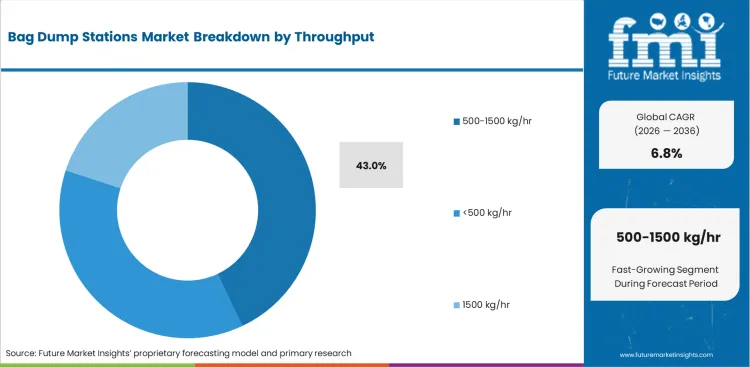
Material handling capacity must align with operator capability and downstream process requirements. The 500-1500 kg/hr range is expected to reach 43.0% share of bag dump station throughput demand in 2026. This range supports manual handling without exceeding ergonomic limits, maintaining operational safety. Higher capacities introduce physical strain and increase error rates during loading. Equipment sizing also depends on available installation space, as larger systems require additional clearance. Performance optimization focuses on balancing throughput with handling efficiency and spatial constraints.
- Matching throughput with operator capacity reduces handling fatigue, improving consistency and safety during manual loading operations
- Oversized systems introduce spatial challenges, limiting installation flexibility within constrained processing environments
- Improper discharge design affects material flow, increasing the likelihood of bridging when handling cohesive powders
Bag Dump Stations Market Analysis by Material of Construction
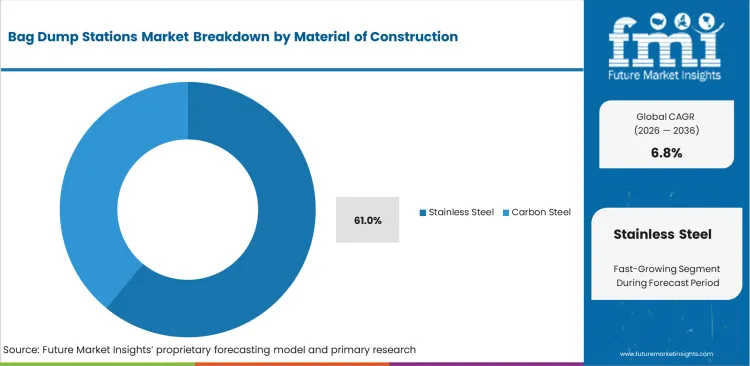
Stainless steel construction is expected to account for 61.0% share of the market over the forecast period, reflecting strong adoption across hygiene-sensitive industries. Processing environments in food and pharmaceutical sectors require materials that resist corrosion and support frequent washdown procedures. Stainless steel surfaces maintain structural integrity under exposure to cleaning agents and moisture, making them suitable for controlled production conditions.
Material selection also affects operational efficiency. Smooth, polished stainless steel finishes support better product flow and reduce material buildup during unloading. This helps minimize cleaning time and lowers the risk of cross-contamination between batches. Facilities operating under strict hygiene standards continue to prefer stainless steel configurations due to their durability, cleanability, and compatibility with sanitation protocols.
- Corrosion resistance ensures long-term durability, particularly in environments exposed to cleaning chemicals and moisture during routine sanitation cycles
- Smooth surface finishes improve material flow, reducing residue accumulation and minimizing cleaning effort between processing runs
- Compatibility with aggressive cleaning protocols supports compliance with hygiene standards across sensitive processing applications
Bag Dump Stations Market Drivers, Restraints, and Opportunities
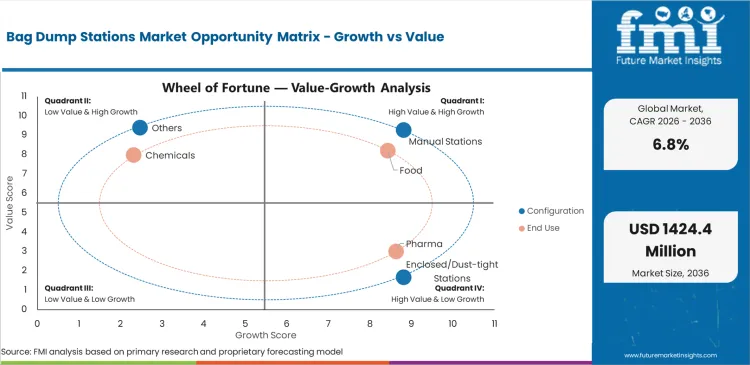
Escalating regulatory penalties regarding combustible dust environments force plant managers to contact specialized bag dump station manufacturers. Buyers preparing to buy bag dump station hardware recognize that upgrading these receiving nodes represents the most effective method to stop fugitive particulate at the point of origin. Engineering teams quickly realize that containing the dust not only satisfies compliance auditors but also reclaims significant volumes of expensive raw material that previously vanished into the ambient air.
Chronic space limitations within legacy manufacturing plants severely restrict the installation of modern, high-extraction dumping stations. Piping engineers attempting to retrofit a sanitary bag dump station frequently encounter immovable structural beams or conflicting utility lines. This architectural friction forces equipment buyers to compromise on hood size or filter capacity, directly undermining the containment efficiency of the new station.
Opportunities
- Integrated compaction and downdraft filtration upgrades are creating new opportunities, as facilities look to improve dust control and overall material handling efficiency at the intake stage.
- Adoption of dust-controlled bag dump stations supports cleaner operations by capturing airborne particles during unloading and improving workplace safety conditions.
- Positioning bag dump stations alongside pneumatic lifting systems reduces manual handling effort, enabling operators to manage heavier loads more efficiently while maintaining consistent throughput.
Regional Analysis
Based on regional analysis, Bag Dump Stations Market is segmented into North America, Latin America, Western Europe, Eastern Europe, Asia Pacific, Middle East, and Africa across 40 plus countries.
.webp "Top Country Growth Comparison Bag Dump Stations Market Cagr (2026 2036)")
| Country | CAGR (2026 to 2036) |
|---|---|
| India | 7.4% |
| China | 6.5% |
| USA | 5.7% |
| South Korea | 5.2% |
| Germany | 5.0% |
| UK | 4.8% |
| Japan | 4.4% |
Source: Future Market Insights (FMI) analysis, based on proprietary forecasting model and primary research
Asia Pacific Bag Dump Stations Market Analysis
Industrial expansion across Asia Pacific is shifting material handling from open processing to enclosed systems that improve safety and control. Manufacturers prioritize contained dumping solutions to reduce contamination and protect operators during bulk material transfer. Continuous production environments require equipment that withstands high usage without compromising containment performance. Demand is closely linked to sectors handling fine powders and sensitive materials.
- India: India is projected to record 7.4% CAGR in the bag dump stations market from 2026 to 2036. Growth in contract manufacturing across pharmaceuticals and specialty chemicals increases the need for controlled material intake systems. Facility operators prioritize stations that prevent foreign particle entry during ingredient loading. Compact and sealed designs support installation within space-constrained production lines. Equipment must allow quick handling of multiple batches without cross-contamination. Regulatory compliance in pharma manufacturing strengthens the need for high-containment solutions. These factors continue to drive adoption across facilities focused on quality and process consistency.
- China: Battery material processing and chemical manufacturing expansion drive equipment demand across China. Facilities handling metallic powders require robust containment systems to manage safety risks during material transfer. The bag dump stations market in China is expected to grow at 6.5% through 2036. Operators select heavy-duty stations built with durable materials that withstand continuous operation. Containment efficiency and operator safety remain key priorities. Equipment is often integrated with dust extraction systems to maintain clean working environments. These requirements support steady demand across large industrial processing zones.
- Japan: Manufacturing environments in Japan emphasize precision, cleanliness, and process control across all material handling stages. Bag dump stations are selected based on their ability to prevent contamination and maintain consistent intake conditions. Growth in Japan is likely to ascend at a 4.4% CAGR over the 2026 to 2036 period, reflecting stable adoption across high-specification industries. Operators prioritize systems with controlled airflow and efficient filtration. Equipment design focuses on maintaining product integrity during transfer. These requirements support usage across food processing, specialty chemicals, and advanced material production. Reliability remains central to equipment selection.
North America Bag Dump Stations Market Analysis
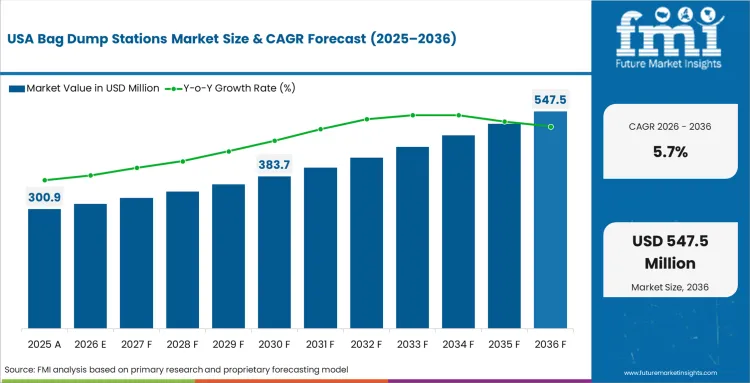
Decades of accumulated facility modifications force American project engineers to navigate incredibly complex retrofit scenarios when upgrading dry bulk receiving lines. Quality assurance teams demand verifiable containment metrics before authorizing any intake hardware.
- USA: The United States bag dump stations sector is anticipated to expand at 5.7% CAGR between 2026 and 2036. Food processing and dry bulk handling facilities are replacing legacy intake systems with enclosed stations. Operators require integrated features such as magnetic separation and dust filtration to protect product quality. Retrofitting remains a key driver, as existing plants operate within limited space and fixed layouts. Equipment that supports quick installation and minimal downtime gains preference. Regulatory compliance around food safety influences procurement decisions. These factors sustain demand across processing and manufacturing sectors.
Western Europe Bag Dump Stations Market Analysis
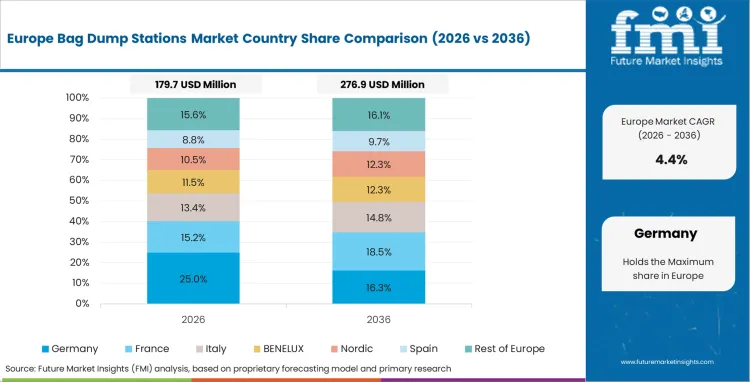
Uncompromising occupational health directives define the European equipment procurement landscape. Corporate sustainability initiatives require plant operators to virtually eliminate all fugitive emissions from the factory floor.
- Germany: Germany bag dump stations industry is likely to grow at 5.0% from 2026 to 2036. Chemical and industrial processing facilities require systems that protect workers from exposure to fine and hazardous powders. Operators specify stations with sealed enclosures and controlled pressure environments. Glove-box access and negative pressure systems are commonly used to maintain containment during operation. Equipment reliability and safety certification remain critical selection factors. These requirements support adoption across industries handling sensitive or regulated materials. Demand continues to align with strict occupational safety standards.
Other countries, including South Korea and the United Kingdom, also contribute to overall demand. Expanding industrial activity and tightening safety standards across these regions support continued adoption of bag dump stations in controlled material handling applications
Competitive Aligners for Market Players
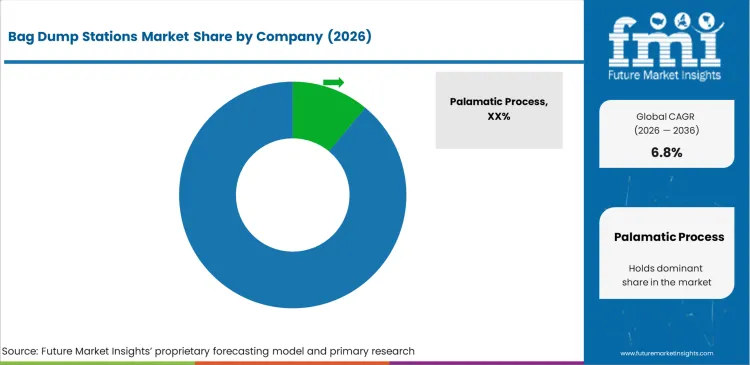
Supplier positioning in the bag dump stations market is strongly influenced by the ability to adapt designs to specific plant layouts. Buyers evaluating multiple vendors prefer modular configurations that can fit within existing mezzanines and process lines without requiring structural changes. Flexible engineering approaches improve installation efficiency and reduce retrofit complexity, making customization a key factor in vendor selection.
Performance in hygienic and powder-handling environments also differentiates suppliers. Equipment design must support smooth material flow while meeting strict cleanability standards. Internal surface finish, weld quality, and geometry influence whether powders discharge consistently without bridging or buildup. Solutions that meet clean-in-place requirements and maintain flow stability are preferred over lower-cost alternatives that may fail validation checks.
System compatibility is becoming a critical requirement across facilities. End users increasingly expect bag dump stations to integrate seamlessly with different conveying systems and plant controls. This focus on interoperability shifts competition toward airflow performance, containment efficiency, and operator ergonomics. Equipment that supports easy integration while maintaining high dust control standards is gaining wider adoption across industries.
Key Players in Bag Dump Stations Market
- Palamatic Process
- Volkmann
- AZO
- Gericke
- Flexicon
- Bühler
- Coperion
Scope of the Report
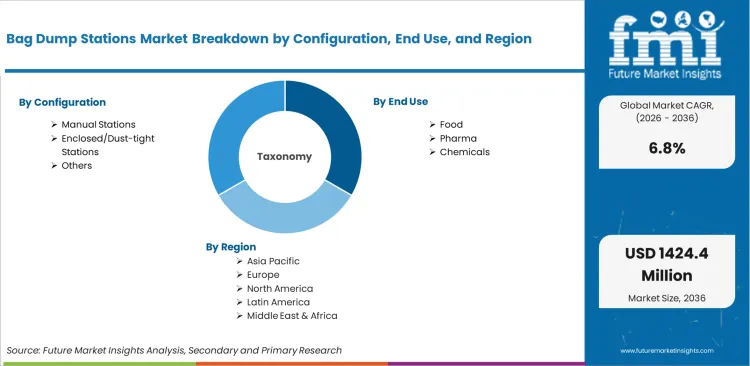
| Metric | Value |
|---|---|
| Quantitative Units | USD 690.8 million to USD 1333.7 million, at a CAGR of 6.8% |
| Market Definition | Bag dump stations function as enclosed, highly ventilated receiving platforms specifically engineered to facilitate the manual unloading of dry bulk solids from 25-kilogram to 50-kilogram bags directly into downstream processing pipelines safely. |
| Segmentation | Configuration, End Use, Throughput, Material of Construction |
| Regions Covered | North America, Latin America, Europe, Asia Pacific, Middle East & Africa |
| Countries Covered | USA, Germany, UK, China, India, Japan, South Korea |
| Key Companies Profiled | Palamatic Process, Volkmann, AZO, Gericke, Flexicon, Bühler, Coperion |
| Forecast Period | 2026 to 2036 |
| Approach | FMI analysts deployed a top-down evaluation of global pneumatic conveying infrastructure upgrades, cross-referencing these installation volumes against strict occupational health enforcement trends. |
Source: Future Market Insights (FMI) analysis, based on proprietary forecasting model and primary research
Bag Dump Stations Market Analysis by Segments
By Configuration
- Manual Stations
- Enclosed/Dust-tight Stations
- Integrated with Vacuum Conveying
By End Use
- Food
- Pharma
- Chemicals
- Plastics
- Other
By Throughput
- <500 kg/hr
- 500-1500 kg/hr
- 1500 kg/hr
By Material of Construction
- Carbon Steel
- Stainless Steel
Region:
- North America
- United States
- Canada
- Europe
- Germany
- United Kingdom
- France
- Italy
- Spain
- Asia Pacific
- China
- Japan
- South Korea
- Taiwan
- Singapore
- Latin America
- Brazil
- Mexico
- Argentina
- Middle East & Africa
- GCC Countries
- South Africa
- Israel
Bibliography
- AZO GmbH + Co. KG. (2026). AZO Bag Discharge Station OEB3.
- Coperion. (2026). Bag Dump Stations.
- Flexicon Corporation. (2025). Bag Dump Stations | Dust-Controlled Unloading.
- Gericke AG. (2026). Bag Dump Stations: Flexible integration for safe material receiving.
- Coperion Food, Health & Nutrition. (2026). Hygienic bag dump station (HBD) for food processing.
This bibliography is provided for reader reference and is not exhaustive. The full report contains the complete reference list with primary source documentation.
Frequently Asked Questions
What is the difference between a bag dump station and a big bag unloader?
A bag dump station vs big bag unloader comparison highlights scale. Dump stations handle 25 to 50-kilogram manually lifted sacks, whereas unloader structures suspend massive one-ton super sacks using hoists or forklifts, allowing bulk bags to discharge freely.
What is the difference between a bag dump station and a sack tip station?
There is practically no difference when asking what is the difference between a bag dump station and a sack tip station. Both the sack tip stations market and the bag dumping stations market describe identical equipment; "sack tip" is simply more prevalent in European industrial terminology.
How do bag dump stations work?
Operators place a sack onto a resting grid, slice the bottom, and empty the contents into a hopper. For those exploring how do bag dump stations work, internal fans pull airborne dust into filter cartridges, keeping the surrounding air clean and recovering valuable product.
Which industries use bag dump stations?
Processors across food, pharmaceuticals, chemicals, and plastics constantly answer which industries use bag dump stations by relying on these nodes to introduce minor ingredients safely without generating combustible dust hazards.
Which countries are growing fastest in bag dump stations?
India leads the global growth trajectory, driven by pharmaceutical expansion. When asked which countries are growing fastest in bag dump stations, industry analysts also point to China and the U.S. as massive growth bases due to battery chemicals and food plant retrofits.
Explain the bag dump stations market trajectory?
To fully explain the bag dump stations market, it is expanding rapidly because regulatory bodies enforce zero-tolerance policies on airborne factory dust, shifting the bag dump station industry entirely toward contained, enclosed architectures over the coming decade.
Preview the report firsthand - request a free sample
Get SampleGet the brochure for pricing and purchase details.
Get PDFTable of Content
- Executive Summary
- Global Market Outlook
- Demand-side Trends
- Supply-side Trends
- Technology Roadmap Analysis
- Analysis and Recommendations
- Market Overview
- Market Coverage / Taxonomy
- Market Definition / Scope / Limitations
- Research Methodology
- Chapter Orientation
- Analytical Lens and Working Hypotheses
- Market Sizing, Forecasting, and Opportunity Mapping
- Research Design and Evidence Framework
- Desk Research Programme (Secondary Evidence)
- Company Annual and Sustainability Reports
- Peer-reviewed Journals and Academic Literature
- Corporate Websites, Product Literature, and Technical Notes
- Earnings Decks and Investor Briefings
- Statutory Filings and Regulatory Disclosures
- Technical White Papers and Standards Notes
- Trade Journals, Industry Magazines, and Analyst Briefs
- Conference Proceedings, Webinars, and Seminar Materials
- Government Statistics Portals and Public Data Releases
- Press Releases and Reputable Media Coverage
- Specialist Newsletters and Curated Briefings
- Sector Databases and Reference Repositories
- FMI Internal Proprietary Databases and Historical Market Datasets
- Subscription Datasets and Paid Sources
- Social Channels, Communities, and Digital Listening Inputs
- Additional Desk Sources
- Expert Input and Fieldwork (Primary Evidence)
- Primary Modes
- Qualitative Interviews and Expert Elicitation
- Quantitative Surveys and Structured Data Capture
- Blended Approach
- Why Primary Evidence is Used
- Observational and In-context Research
- Social and Community Interactions
- Primary Modes
- Stakeholder Universe Engaged
- C-suite Leaders
- Board Members
- Presidents and Vice Presidents
- R&D and Innovation Heads
- Technical Specialists
- Domain Subject-matter Experts
- Scientists
- Physicians and Other Healthcare Professionals
- Governance, Ethics, and Data Stewardship
- Research Ethics
- Data Integrity and Handling
- Desk Research Programme (Secondary Evidence)
- Tooling, Models, and Reference Databases
- Data Engineering and Model Build
- Data Acquisition and Ingestion
- Cleaning, Normalisation, and Verification
- Synthesis, Triangulation, and Analysis
- Quality Assurance and Audit Trail
- Market Background
- Market Dynamics
- Drivers
- Restraints
- Opportunity
- Trends
- Scenario Forecast
- Demand in Optimistic Scenario
- Demand in Likely Scenario
- Demand in Conservative Scenario
- Opportunity Map Analysis
- Product Life Cycle Analysis
- Supply Chain Analysis
- Investment Feasibility Matrix
- Value Chain Analysis
- PESTLE and Porter’s Analysis
- Regulatory Landscape
- Regional Parent Market Outlook
- Production and Consumption Statistics
- Import and Export Statistics
- Market Dynamics
- Global Market Analysis 2021 to 2025 and Forecast, 2026 to 2036
- Historical Market Size Value (USD Million) Analysis, 2021 to 2025
- Current and Future Market Size Value (USD Million) Projections, 2026 to 2036
- Y-o-Y Growth Trend Analysis
- Absolute $ Opportunity Analysis
- Global Market Pricing Analysis 2021 to 2025 and Forecast 2026 to 2036
- Global Market Analysis 2021 to 2025 and Forecast 2026 to 2036, By Configuration
- Introduction / Key Findings
- Historical Market Size Value (USD Million) Analysis By Configuration , 2021 to 2025
- Current and Future Market Size Value (USD Million) Analysis and Forecast By Configuration , 2026 to 2036
- Manual Stations
- Enclosed/Dust-tight Stations
- Others
- Manual Stations
- Y-o-Y Growth Trend Analysis By Configuration , 2021 to 2025
- Absolute $ Opportunity Analysis By Configuration , 2026 to 2036
- Global Market Analysis 2021 to 2025 and Forecast 2026 to 2036, By End Use
- Introduction / Key Findings
- Historical Market Size Value (USD Million) Analysis By End Use, 2021 to 2025
- Current and Future Market Size Value (USD Million) Analysis and Forecast By End Use, 2026 to 2036
- Food
- Pharma
- Chemicals
- Food
- Y-o-Y Growth Trend Analysis By End Use, 2021 to 2025
- Absolute $ Opportunity Analysis By End Use, 2026 to 2036
- Global Market Analysis 2021 to 2025 and Forecast 2026 to 2036, By Throughput
- Introduction / Key Findings
- Historical Market Size Value (USD Million) Analysis By Throughput, 2021 to 2025
- Current and Future Market Size Value (USD Million) Analysis and Forecast By Throughput, 2026 to 2036
- 500-1500 kg/hr
- <500 kg/hr
- 1500 kg/hr
- 500-1500 kg/hr
- Y-o-Y Growth Trend Analysis By Throughput, 2021 to 2025
- Absolute $ Opportunity Analysis By Throughput, 2026 to 2036
- Global Market Analysis 2021 to 2025 and Forecast 2026 to 2036, By Material of Construction
- Introduction / Key Findings
- Historical Market Size Value (USD Million) Analysis By Material of Construction, 2021 to 2025
- Current and Future Market Size Value (USD Million) Analysis and Forecast By Material of Construction, 2026 to 2036
- Stainless Steel
- Carbon Steel
- Stainless Steel
- Y-o-Y Growth Trend Analysis By Material of Construction, 2021 to 2025
- Absolute $ Opportunity Analysis By Material of Construction, 2026 to 2036
- Global Market Analysis 2021 to 2025 and Forecast 2026 to 2036, By Region
- Introduction
- Historical Market Size Value (USD Million) Analysis By Region, 2021 to 2025
- Current Market Size Value (USD Million) Analysis and Forecast By Region, 2026 to 2036
- North America
- Latin America
- Western Europe
- Eastern Europe
- East Asia
- South Asia and Pacific
- Middle East & Africa
- Market Attractiveness Analysis By Region
- North America Market Analysis 2021 to 2025 and Forecast 2026 to 2036, By Country
- Historical Market Size Value (USD Million) Trend Analysis By Market Taxonomy, 2021 to 2025
- Market Size Value (USD Million) Forecast By Market Taxonomy, 2026 to 2036
- By Country
- USA
- Canada
- Mexico
- By Configuration
- By End Use
- By Throughput
- By Material of Construction
- By Country
- Market Attractiveness Analysis
- By Country
- By Configuration
- By End Use
- By Throughput
- By Material of Construction
- Key Takeaways
- Latin America Market Analysis 2021 to 2025 and Forecast 2026 to 2036, By Country
- Historical Market Size Value (USD Million) Trend Analysis By Market Taxonomy, 2021 to 2025
- Market Size Value (USD Million) Forecast By Market Taxonomy, 2026 to 2036
- By Country
- Brazil
- Chile
- Rest of Latin America
- By Configuration
- By End Use
- By Throughput
- By Material of Construction
- By Country
- Market Attractiveness Analysis
- By Country
- By Configuration
- By End Use
- By Throughput
- By Material of Construction
- Key Takeaways
- Western Europe Market Analysis 2021 to 2025 and Forecast 2026 to 2036, By Country
- Historical Market Size Value (USD Million) Trend Analysis By Market Taxonomy, 2021 to 2025
- Market Size Value (USD Million) Forecast By Market Taxonomy, 2026 to 2036
- By Country
- Germany
- UK
- Italy
- Spain
- France
- Nordic
- BENELUX
- Rest of Western Europe
- By Configuration
- By End Use
- By Throughput
- By Material of Construction
- By Country
- Market Attractiveness Analysis
- By Country
- By Configuration
- By End Use
- By Throughput
- By Material of Construction
- Key Takeaways
- Eastern Europe Market Analysis 2021 to 2025 and Forecast 2026 to 2036, By Country
- Historical Market Size Value (USD Million) Trend Analysis By Market Taxonomy, 2021 to 2025
- Market Size Value (USD Million) Forecast By Market Taxonomy, 2026 to 2036
- By Country
- Russia
- Poland
- Hungary
- Balkan & Baltic
- Rest of Eastern Europe
- By Configuration
- By End Use
- By Throughput
- By Material of Construction
- By Country
- Market Attractiveness Analysis
- By Country
- By Configuration
- By End Use
- By Throughput
- By Material of Construction
- Key Takeaways
- East Asia Market Analysis 2021 to 2025 and Forecast 2026 to 2036, By Country
- Historical Market Size Value (USD Million) Trend Analysis By Market Taxonomy, 2021 to 2025
- Market Size Value (USD Million) Forecast By Market Taxonomy, 2026 to 2036
- By Country
- China
- Japan
- South Korea
- By Configuration
- By End Use
- By Throughput
- By Material of Construction
- By Country
- Market Attractiveness Analysis
- By Country
- By Configuration
- By End Use
- By Throughput
- By Material of Construction
- Key Takeaways
- South Asia and Pacific Market Analysis 2021 to 2025 and Forecast 2026 to 2036, By Country
- Historical Market Size Value (USD Million) Trend Analysis By Market Taxonomy, 2021 to 2025
- Market Size Value (USD Million) Forecast By Market Taxonomy, 2026 to 2036
- By Country
- India
- ASEAN
- Australia & New Zealand
- Rest of South Asia and Pacific
- By Configuration
- By End Use
- By Throughput
- By Material of Construction
- By Country
- Market Attractiveness Analysis
- By Country
- By Configuration
- By End Use
- By Throughput
- By Material of Construction
- Key Takeaways
- Middle East & Africa Market Analysis 2021 to 2025 and Forecast 2026 to 2036, By Country
- Historical Market Size Value (USD Million) Trend Analysis By Market Taxonomy, 2021 to 2025
- Market Size Value (USD Million) Forecast By Market Taxonomy, 2026 to 2036
- By Country
- Kingdom of Saudi Arabia
- Other GCC Countries
- Turkiye
- South Africa
- Other African Union
- Rest of Middle East & Africa
- By Configuration
- By End Use
- By Throughput
- By Material of Construction
- By Country
- Market Attractiveness Analysis
- By Country
- By Configuration
- By End Use
- By Throughput
- By Material of Construction
- Key Takeaways
- Key Countries Market Analysis
- USA
- Pricing Analysis
- Market Share Analysis, 2025
- By Configuration
- By End Use
- By Throughput
- By Material of Construction
- Canada
- Pricing Analysis
- Market Share Analysis, 2025
- By Configuration
- By End Use
- By Throughput
- By Material of Construction
- Mexico
- Pricing Analysis
- Market Share Analysis, 2025
- By Configuration
- By End Use
- By Throughput
- By Material of Construction
- Brazil
- Pricing Analysis
- Market Share Analysis, 2025
- By Configuration
- By End Use
- By Throughput
- By Material of Construction
- Chile
- Pricing Analysis
- Market Share Analysis, 2025
- By Configuration
- By End Use
- By Throughput
- By Material of Construction
- Germany
- Pricing Analysis
- Market Share Analysis, 2025
- By Configuration
- By End Use
- By Throughput
- By Material of Construction
- UK
- Pricing Analysis
- Market Share Analysis, 2025
- By Configuration
- By End Use
- By Throughput
- By Material of Construction
- Italy
- Pricing Analysis
- Market Share Analysis, 2025
- By Configuration
- By End Use
- By Throughput
- By Material of Construction
- Spain
- Pricing Analysis
- Market Share Analysis, 2025
- By Configuration
- By End Use
- By Throughput
- By Material of Construction
- France
- Pricing Analysis
- Market Share Analysis, 2025
- By Configuration
- By End Use
- By Throughput
- By Material of Construction
- India
- Pricing Analysis
- Market Share Analysis, 2025
- By Configuration
- By End Use
- By Throughput
- By Material of Construction
- ASEAN
- Pricing Analysis
- Market Share Analysis, 2025
- By Configuration
- By End Use
- By Throughput
- By Material of Construction
- Australia & New Zealand
- Pricing Analysis
- Market Share Analysis, 2025
- By Configuration
- By End Use
- By Throughput
- By Material of Construction
- China
- Pricing Analysis
- Market Share Analysis, 2025
- By Configuration
- By End Use
- By Throughput
- By Material of Construction
- Japan
- Pricing Analysis
- Market Share Analysis, 2025
- By Configuration
- By End Use
- By Throughput
- By Material of Construction
- South Korea
- Pricing Analysis
- Market Share Analysis, 2025
- By Configuration
- By End Use
- By Throughput
- By Material of Construction
- Russia
- Pricing Analysis
- Market Share Analysis, 2025
- By Configuration
- By End Use
- By Throughput
- By Material of Construction
- Poland
- Pricing Analysis
- Market Share Analysis, 2025
- By Configuration
- By End Use
- By Throughput
- By Material of Construction
- Hungary
- Pricing Analysis
- Market Share Analysis, 2025
- By Configuration
- By End Use
- By Throughput
- By Material of Construction
- Kingdom of Saudi Arabia
- Pricing Analysis
- Market Share Analysis, 2025
- By Configuration
- By End Use
- By Throughput
- By Material of Construction
- Turkiye
- Pricing Analysis
- Market Share Analysis, 2025
- By Configuration
- By End Use
- By Throughput
- By Material of Construction
- South Africa
- Pricing Analysis
- Market Share Analysis, 2025
- By Configuration
- By End Use
- By Throughput
- By Material of Construction
- USA
- Market Structure Analysis
- Competition Dashboard
- Competition Benchmarking
- Market Share Analysis of Top Players
- By Region
- By Configuration
- By End Use
- By Throughput
- By Material of Construction
- Competition Analysis
- Competition Deep Dive
- Palamatic Process
- Overview
- Product Portfolio
- Profitability by Market Segments (Product/Age /Sales Channel/Region)
- Sales Footprint
- Strategy Overview
- Marketing Strategy
- Product Strategy
- Channel Strategy
- Volkmann
- AZO
- Gericke
- Flexicon
- Bühler
- Coperion
- Palamatic Process
- Competition Deep Dive
- Assumptions & Acronyms Used


