

- Industry Size (2026)
- USD 1.5 Bn
- Forecast (2036)
- USD 2.2 Bn
- CAGR (2026 to 2036)
- 4.1%
Wood Dust Extraction System Market Forecast and Outlook 2026 to 2036
The wood dust extraction system market is likely to be valued at USD 1.5 billion in 2026 and is expected to reach USD 2.2 billion by 2036, reflecting a CAGR of 4.10%. These systems function as part of the production environment rather than as optional accessories, since dust control affects surface quality, equipment uptime, and workplace conditions at the same time. In furniture, panel, and joinery operations, extraction performance influences sanding results, coating defects, and machine maintenance intervals. Demand therefore follows the structure of woodworking operations and finishing requirements rather than workshop counts alone. Regions with large export oriented furniture and panel manufacturing bases account for a substantial share of installed capacity.
Investment decisions are driven by workshop layout, machine density, and process sequencing rather than by nominal airflow ratings. Once a ducting layout and central unit are integrated into a plant, changes become infrequent because relocation disrupts production flow and requires new balancing and certification work. Buyers focus on reliability, filtration efficiency, and energy consumption under continuous load rather than on initial purchase price. Smaller shops rely on modular or mobile units, while large factories standardize central systems across lines. The market grows through gradual workshop modernization and tighter quality expectations, not through rapid expansion of woodworking capacity or short cycle equipment replacement.
Quick Stats for Wood Dust Extraction System Market
- Wood Dust Extraction System Market Value (2026): USD 1.5 billion
- Wood Dust Extraction System Market Forecast Value (2036): USD 2.2 billion
- Wood Dust Extraction System Market Forecast CAGR 2026 to 2036: 4.1%
- Leading System Type in Wood Dust Extraction System Market: Portable dust extraction systems
- Leading End-Use Industry in Wood Dust Extraction System Market: Furniture manufacturing
- Key Growth Regions in Wood Dust Extraction System Market: Asia Pacific, Europe, North America
- Top Players in Wood Dust Extraction System Market: Festool, Bosch, DeWalt (Stanley Black & Decker), Makita, Jet Tools, Laguna Tools, Grizzly Industrial
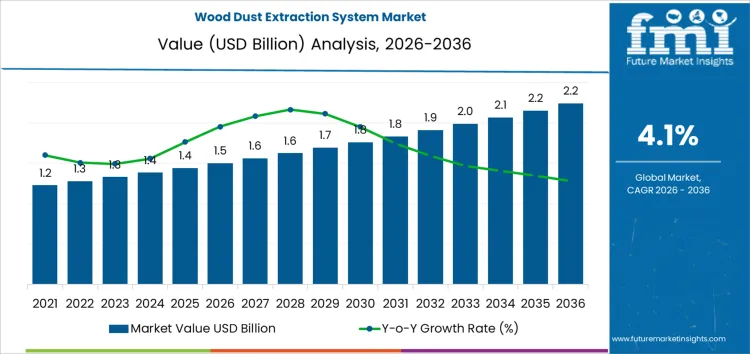
What is the Growth Forecast for the Wood Dust Extraction System Market through 2036?
The wood dust extraction system market is increasingly shaped by how woodworking plants manage surface quality, machine uptime, and rework rates rather than by safety considerations alone. In 2020, when the wood dust extraction system market is near USD 1.2 billion, many facilities still rely on fragmented, machine-level extraction that leaves fine dust circulating in production areas. As the wood dust extraction system market moves to around USD 1.4 billion by 2024 and reaches approximately USD 1.5 billion in 2026, more producers begin investing in centralized systems to stabilize sanding quality, improve coating adhesion, and reduce cleaning downtime between production runs. At this stage, extraction is no longer treated only as a hygiene function but as a process stability tool that directly affects yield and finish consistency.
Further growth of the wood dust extraction system market is driven by the rising cost of defects, rework, and unplanned stoppages in high-throughput furniture and panel plants. By 2030, when the wood dust extraction system market reaches roughly USD 1.7 billion, demand is increasingly supported by plants running continuous lines where dust accumulation disrupts sensors, conveyors, and finishing equipment. As the wood dust extraction system market approaches about USD 2.0 billion in 2033-2034 and reaches approximately USD 2.2 billion by 2036, investment is focused on higher-capacity, better-balanced airflow systems and smarter filtration layouts rather than on basic compliance upgrades. Purchasing decisions prioritize airflow stability, system balancing, and integration with production layouts because output quality and throughput stability now depend on dust control performance as much as on the machines doing the cutting and sanding.
Wood Dust Extraction System Market Key Takeaways
| Metric | Value |
|---|---|
| Market Value (2026) | USD 1.5 billion |
| Forecast Value (2036) | USD 2.2 billion |
| Forecast CAGR 2026 to 2036 | 4.1% |
How Is the Wood Dust Extraction System Market Supporting Safer and Cleaner Work Environments?
Wood dust extraction systems are increasingly adopted to remove airborne particles generated during cutting, sanding, and milling in woodworking operations. Historically, dust was controlled through manual sweeping or basic ventilation, which often led to poor indoor air quality, respiratory hazards, and compliance issues. Modern extraction systems integrate high-efficiency filters, cyclonic separation, and automated airflow control to capture fine dust particles at the source, maintain clean workspaces, and protect worker health. Furniture manufacturers, woodworking shops, and industrial facilities prioritize system efficiency, filter performance, and integration with existing machinery. Early adoption focused on large-scale manufacturing plants, while current demand spans small workshops, educational training facilities, and commercial wood processing sites, driven by health standards, workplace safety regulations, and operational cleanliness. Suction capacity, filtration efficiency, and maintenance accessibility influence supplier selection.
Ensuring occupational safety and reducing maintenance challenges are shaping market expansion. Compared with conventional ventilation or manual cleanup methods, modern dust extraction systems provide targeted particle removal, reduce fire hazards, and maintain consistent air quality. Cost structures depend on airflow capacity, filter lifespan, and automated control features, concentrating margins among suppliers capable of delivering reliable, high-performance systems. Woodworking operators adopt these systems to protect workers, reduce equipment contamination, and maintain regulatory compliance. Over the next decade, wood dust extraction systems are expected to become integral to workshops and industrial facilities, enabling cleaner operations, improved worker health, and sustained productivity across woodworking applications.
How is the Wood Dust Extraction System Market Segmented?
The Wood Dust Extraction System Market in 2026 is structured primarily by occupational safety regulation, fire and explosion risk management, and production layout constraints rather than by airflow capacity specifications alone. By system type, demand in the Wood Dust Extraction System Market is distributed across portable dust extraction systems, stationary and central dust extraction systems, cyclone dust collectors, and baghouse or cartridge collectors. By end-use industry, demand in the Wood Dust Extraction System Market is concentrated in furniture manufacturing, construction and woodworking shops, cabinet and joinery production, and panel processing and MDF factories.
How Do Layout Constraints and Safety Compliance Shape System Type Demand in the Wood Dust Extraction System Market?
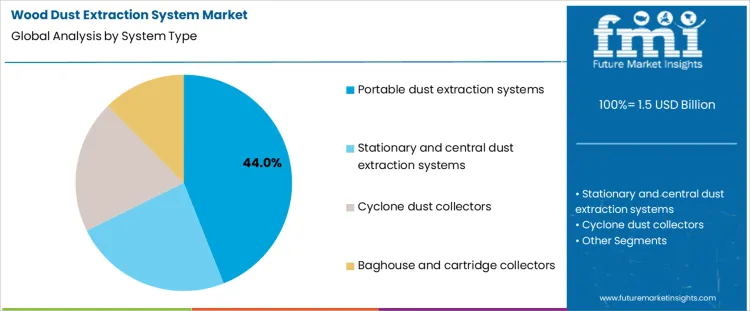
Portable dust extraction systems account for approximately 44% of demand in the Wood Dust Extraction System Market because they provide a compliant solution for environments where production layouts change frequently or where permanent ducting infrastructure is not economically justified. Small and medium workshops, as well as mixed-use facilities, often operate multiple machines in flexible configurations. In such settings, portable systems allow compliance with dust exposure limits without requiring major building modifications. Stationary and central systems are adopted in larger, more stable production environments where machine positions are fixed and material flow is predictable. Cyclone collectors are selected where coarse particle separation and pre-filtration are required to protect downstream filters, while baghouse and cartridge systems are specified where fine dust capture and high air quality standards are enforced. The structure of the Wood Dust Extraction System Market is therefore determined less by nominal performance ratings and more by how easily a system can be integrated into an existing facility while meeting fire safety, explosion prevention, and occupational health requirements.
Why Does Furniture Manufacturing Represent the Largest End Use Segment in the Wood Dust Extraction System Market?

Furniture manufacturing accounts for approximately 47% of demand in the Wood Dust Extraction System Market because this segment combines high material removal rates with stringent surface quality and workplace safety requirements. Furniture production involves continuous cutting, sanding, routing, and finishing operations, all of which generate large volumes of fine wood dust. This dust not only presents a health risk to workers but also creates contamination issues for finishing processes and increases fire and explosion hazards. As a result, dust extraction systems in furniture plants are treated as essential production infrastructure rather than as auxiliary equipment. Construction and general woodworking shops also generate significant dust, but these operations are often smaller in scale and more tolerant of intermittent extraction solutions. Cabinet and joinery producers and panel processing facilities operate high-throughput lines, but their number of production sites is more limited. Furniture manufacturing combines large site populations, continuous operation, and high regulatory and insurance scrutiny. This combination sustains structurally higher and more consistent investment in dust extraction capacity and explains why this segment remains the dominant source of demand in the Wood Dust Extraction System Market.
How Are the Key Dynamics Reshaping the Wood Dust Extraction System Market?
The Wood Dust Extraction System Market is being reshaped by how workshops organize airflow, material flow, and labor flow at the same time. In many plants, dust control is no longer an afterthought bolted onto machines. It is becoming a layout decision that affects where machines can sit, how fast they can run, and how often lines must stop for cleaning. As panel sizes grow, sanding becomes more aggressive, and automation reduces tolerance for fouling, extraction systems start to behave like production infrastructure rather than safety accessories. The Wood Dust Extraction System Market therefore grows when factories redesign how work moves, not when they simply replace old fans.
Why the Wood Dust Extraction System Market Is Layout Driven?
In woodworking, dust follows the process, not the machine. A change in cutter width, feed speed, or sanding method can double the load in one zone and starve another. When plants move from scattered standalone machines to organized lines or cells, extraction must be redesigned as a network, not a collection of hoses. This is where the Wood Dust Extraction System Market gets pulled in. New ducting, zoning, and airflow balancing become part of the production concept. Demand follows plant reconfiguration, new line builds, and consolidation of work areas, not the age of individual tools.
Why the Wood Dust Extraction System Market Is Shaped by Downtime Economics?
Cleaning stops production. Clogged filters, overflowing bins, and dust settling on sensors or conveyors quietly steal hours. In automated or high throughput shops, these interruptions become more expensive than the electricity used to prevent them. This changes how extraction is justified. Instead of being seen as an overhead cost, it becomes a way to protect uptime and schedule reliability. The Wood Dust Extraction System Market grows where managers start counting lost hours instead of just kilowatts. In low intensity shops, manual cleanup remains acceptable. In dense, fast lines, it becomes a bottleneck that must be engineered away.
Why the Wood Dust Extraction System Market Follows Process Intensity?
Not all woodworking is equal. Heavy sanding lines, MDF processing, and high speed CNC routing generate dust loads that overwhelm basic systems. As more value is added through surface finishing and tight tolerances, air cleanliness becomes a process variable. This pushes the Wood Dust Extraction System Market toward higher capacity, better separation, and smarter control rather than simple suction. Where production stays light and slow, simple systems remain. Where cutting energy and throughput rise, extraction architecture must change. The Wood Dust Extraction System Market therefore follows how aggressively wood is processed, not how many saws are installed.
What is the Demand for Wood Dust Extraction Systems by Country?

| Country | CAGR (%) |
|---|---|
| USA | 3.8% |
| UK | 3.5% |
| China | 4.5% |
| India | 4.8% |
| Brazil | 4.0% |
Demand for wood dust extraction systems is rising as woodworking, furniture, and construction industries adopt equipment to improve workplace safety, maintain air quality, and comply with health regulations. India leads with a 4.8% CAGR, driven by growing furniture production, workshop modernization, and adoption of dust extraction solutions. China follows at 4.5%, supported by industrial-scale woodworking and manufacturing operations. Brazil records 4.0% growth, shaped by adoption in small and large-scale workshops. The USA grows at 3.8%, influenced by replacement demand and regulatory compliance. The UK shows 3.5% CAGR, reflecting steady adoption of dust extraction systems across woodworking and industrial facilities.
How do insurance and fire risk policies shape wood dust extraction system spend in the United States?
Factory risk management and insurance requirements govern investment timing in United States woodworking plants, with wood dust extraction system demand expanding at a 3.8% CAGR. Spending follows audit findings, line expansion projects, and changes in material mix. Central systems are selected for large furniture and panel plants while smaller sites favor modular units. Engineering firms and system integrators influence layout decisions and airflow sizing. Filter technology, spark detection, and explosion protection features drive specification depth. Replacement follows plant reconfiguration rather than equipment aging alone. Energy consumption and maintenance access shape lifecycle cost evaluation. Domestic suppliers compete on installation capability and service coverage. Project approvals align with insurance renewal cycles and compliance reviews. Commercial success depends on presence in plant upgrade programs rather than sale of standalone collectors to fragmented workshops.
Why do compliance audits drive demand patterns in the United Kingdom?
Workplace air quality enforcement and fire safety inspection regimes guide capital allocation in United Kingdom woodworking facilities, with wood dust extraction system purchases growing at a 3.5% CAGR. Spending concentrates on upgrading older ducting networks and filtration units rather than building new plants. System design focuses on airflow balance, noise control, and compatibility with existing machining lines. Engineering consultants and integrators shape early layout choices. Filter certification and documentation readiness influence supplier acceptance. Installation timing follows inspection outcomes and insurance recommendations. Centralized systems dominate in panel and joinery factories while smaller shops adopt cell based solutions. Energy efficiency targets affect fan and filter selection. Commercial visibility depends on inclusion in compliance driven upgrade projects rather than selling equipment into discretionary workshop budgets.
What structural forces govern scale adoption in China?
Industrial safety enforcement and factory modernization programs keep China on a 4.5% growth path for wood dust extraction system installations. Volume concentrates in furniture clusters, panel plants, and export oriented woodworking zones. New factory construction and large line expansions account for a significant share of projects. Domestic integrators dominate ducting, installation, and basic filtration supply. International suppliers retain roles in advanced filtration and explosion protection systems. Project scope is defined during plant layout planning rather than equipment replacement cycles. Procurement follows multi-year factory investment plans. Energy use and maintenance staffing influence system sizing. Commercial success depends on participation in large plant buildouts and line reconfiguration projects rather than selling small units to individual workshops.
Why does plant formalization accelerate investment in India?
Expansion of organized furniture, panel, and interior component manufacturing keeps India on a 4.8% growth track for wood dust extraction system demand. Movement from informal workshops toward regulated factories increases attention to dust control and fire risk. New plant projects and line expansions drive most system orders. Engineering contractors and turnkey plant builders influence specification and layout. Central systems serve large factories while modular solutions cover smaller units. Import equipment appears in high capacity or specialized filtration applications. Energy cost and maintenance access shape design choices. Spending decisions follow factory construction schedules and compliance milestones. Commercial success depends on alignment with new plant development and formalization programs rather than replacement of small standalone collectors.
How do production consolidation trends influence Brazil demand?
Factory consolidation and quality control programs shape Brazil investment behavior, with wood dust extraction system demand advancing at a 4% CAGR. Larger furniture and panel plants expand centralized dust collection to support higher throughput and safety requirements. System upgrades focus on airflow stability, filtration efficiency, and fire prevention features. Engineering firms influence duct layout and equipment selection. Import systems serve higher performance filtration needs. Local suppliers compete on installation and service response. Spending follows line reconfiguration and capacity expansion more than routine equipment replacement. Insurance guidance and inspection findings influence project timing. Energy efficiency targets affect fan and control system choices. Commercial position depends on participation in plant upgrade and consolidation projects rather than selling into fragmented small workshop segments.
How Are Regional Growth Patterns Emerging in the Wood Dust Extraction System Market?

Wood dust extraction system demand varies across regions as industrial woodworking and regulatory focus on air quality evolve. In India, the market grows rapidly as small and medium woodworking shops adopt extraction systems to meet emerging workplace safety norms and reduce airborne particulate exposure, supporting furniture, joinery, and panel production. China exhibits strong growth driven by large-scale manufacturing sectors and tightening environmental enforcement that encourages installation of dust capture equipment in production lines. The United States reflects stable expansion with investment concentrated in facility upgrades and compliance with occupational exposure limits, while Brazil’s growth is tied to mechanization of wood processing and rising awareness of respiratory health risks. The United Kingdom shows moderate momentum supported by craft and commercial workshops integrating extraction for cleaner work environments and regulatory compliance.
Variations in regional market growth reflect differences in industry structure, safety regulation enforcement, and adoption of automation. In India and China, expanding woodworking capacity and heightened focus on worker health drive investments in dust extraction as part of broader dust management strategies. The United States and United Kingdom see continued replacement and upgrade demand in established woodworking sectors where legacy systems are retrofitted with more efficient extractors. Brazil’s woodworking industry is incrementally modernizing, with growth supported by regional standards and facility improvement cycles. Across these regions, buyers weigh extraction performance, filter efficiency, and ease of integration with existing shop layouts. Adoption also depends on service availability and maintenance networks that ensure system uptime. Competitive differentiation in local markets arises from suppliers that offer robust filtration technology, energy-efficient operation, and compliance documentation that aligns with regional occupational and environmental standards.
Key Players in the Wood Dust Extraction System Market
- Festool
- Bosch
- DeWalt (Stanley Black & Decker)
- Makita
- Jet Tools
- Laguna Tools
- Grizzly Industrial
Scope of the Report
| Items | Values |
|---|---|
| Quantitative Units (2026) | USD billion |
| System Type | Portable dust extraction systems, Stationary and central dust extraction systems, Cyclone dust collectors, Baghouse and cartridge collectors |
| End-Use Industry | Furniture manufacturing, Construction and woodworking shops, Cabinet and joinery production, Panel processing and MDF factories |
| Region | Asia Pacific, Europe, North America, Latin America, Middle East & Africa |
| Countries Covered | China, Japan, South Korea, India, Australia & New Zealand, ASEAN, Germany, United Kingdom, France, Italy, Spain, Nordic, BENELUX, United States, Canada, Mexico, Brazil, Chile, Saudi Arabia, Turkey, South Africa, and other regional markets |
| Key Companies Profiled | Festool, Bosch, DeWalt (Stanley Black & Decker), Makita, Jet Tools, Laguna Tools, Grizzly Industrial |
| Additional Attributes | Dollar by sales by system type and end-use; demand driven by workshop layout, fire risk control, and finish quality requirements; growth led by plant modernization and centralized extraction adoption; purchasing shaped by airflow stability, filtration efficiency, system balancing, and integration with production layouts rather than nominal capacity ratings. |
Wood Dust Extraction System Market Segmentation
System Type:
- Portable dust extraction systems
- Stationary and central dust extraction systems
- Cyclone dust collectors
- Baghouse and cartridge collectors
End-Use Industry:
- Furniture manufacturing
- Construction and woodworking shops
- Cabinet and joinery production
- Panel processing and MDF factories
Region:
- Asia Pacific
- China
- Japan
- South Korea
- India
- Australia & New Zealand
- ASEAN
- Rest of Asia Pacific
- Europe
- Germany
- United Kingdom
- France
- Italy
- Spain
- Nordic
- BENELUX
- Rest of Europe
- North America
- United States
- Canada
- Mexico
- Latin America
- Brazil
- Chile
- Rest of Latin America
- Middle East & Africa
- Kingdom of Saudi Arabia
- Other GCC Countries
- Turkey
- South Africa
- Other African Union
- Rest of Middle East & Africa
Bibliography
- Occupational Safety and Health Administration. (2023). Combustible dust national emphasis program (Directive CPL 03-00-008). U.S. Department of Labor.
- Occupational Safety and Health Administration. (2024). Wood dust: Engineering controls and local exhaust ventilation. U.S. Department of Labor.
- Health and Safety Executive. (2024). Controlling fire and explosion risks in woodworking. UK Government.
- Safe Work Australia. (2024). Workplace exposure standards for airborne contaminants. Australian Government.
- European Agency for Safety and Health at Work. (2023). Wood dust exposure in woodworking industries and control measures. European Union.
Frequently Asked Questions
How big is the wood dust extraction system market in 2026?
The global wood dust extraction system market is estimated to be valued at USD 1.5 billion in 2026.
What will be the size of wood dust extraction system market in 2036?
The market size for the wood dust extraction system market is projected to reach USD 2.2 billion by 2036.
How much will be the wood dust extraction system market growth between 2026 and 2036?
The wood dust extraction system market is expected to grow at a 4.1% CAGR between 2026 and 2036.
What are the key product types in the wood dust extraction system market?
The key product types in wood dust extraction system market are portable dust extraction systems, stationary and central dust extraction systems, cyclone dust collectors and baghouse and cartridge collectors.
Which end‑use industry segment to contribute significant share in the wood dust extraction system market in 2026?
In terms of end‑use industry, furniture manufacturing segment to command 47.0% share in the wood dust extraction system market in 2026.
Preview the report firsthand - request a free sample
Get SampleGet the brochure for pricing and purchase details.
Get PDFTable of Content
- Executive Summary
- Global Market Outlook
- Demand-side Trends
- Supply-side Trends
- Technology Roadmap Analysis
- Analysis and Recommendations
- Market Overview
- Market Coverage / Taxonomy
- Market Definition / Scope / Limitations
- Market Background
- Market Dynamics
- Drivers
- Restraints
- Opportunity
- Trends
- Scenario Forecast
- Demand in Optimistic Scenario
- Demand in Likely Scenario
- Demand in Conservative Scenario
- Opportunity Map Analysis
- Product Life Cycle Analysis
- Supply Chain Analysis
- Investment Feasibility Matrix
- Value Chain Analysis
- PESTLE and Porter’s Analysis
- Regulatory Landscape
- Regional Parent Market Outlook
- Production and Consumption Statistics
- Import and Export Statistics
- Market Dynamics
- Global Market Analysis 2021 to 2025 and Forecast, 2026 to 2036
- Historical Market Size Value (USD Million) Analysis, 2021 to 2025
- Current and Future Market Size Value (USD Million) Projections, 2026 to 2036
- Y-o-Y Growth Trend Analysis
- Absolute $ Opportunity Analysis
- Global Market Pricing Analysis 2021 to 2025 and Forecast 2026 to 2036
- Global Market Analysis 2021 to 2025 and Forecast 2026 to 2036, By System Type
- Introduction / Key Findings
- Historical Market Size Value (USD Million) Analysis By System Type , 2021 to 2025
- Current and Future Market Size Value (USD Million) Analysis and Forecast By System Type , 2026 to 2036
- Portable dust extraction systems
- Stationary and central dust extraction systems
- Cyclone dust collectors
- Baghouse and cartridge collectors
- Portable dust extraction systems
- Y-o-Y Growth Trend Analysis By System Type , 2021 to 2025
- Absolute $ Opportunity Analysis By System Type , 2026 to 2036
- Global Market Analysis 2021 to 2025 and Forecast 2026 to 2036, By End‑Use Industry
- Introduction / Key Findings
- Historical Market Size Value (USD Million) Analysis By End‑Use Industry, 2021 to 2025
- Current and Future Market Size Value (USD Million) Analysis and Forecast By End‑Use Industry, 2026 to 2036
- Furniture manufacturing
- Construction and woodworking shops
- Cabinet and joinery production
- Panel processing and MDF factories
- Furniture manufacturing
- Y-o-Y Growth Trend Analysis By End‑Use Industry, 2021 to 2025
- Absolute $ Opportunity Analysis By End‑Use Industry, 2026 to 2036
- Global Market Analysis 2021 to 2025 and Forecast 2026 to 2036, By Region
- Introduction
- Historical Market Size Value (USD Million) Analysis By Region, 2021 to 2025
- Current Market Size Value (USD Million) Analysis and Forecast By Region, 2026 to 2036
- North America
- Latin America
- Western Europe
- Eastern Europe
- East Asia
- South Asia and Pacific
- Middle East & Africa
- Market Attractiveness Analysis By Region
- North America Market Analysis 2021 to 2025 and Forecast 2026 to 2036, By Country
- Historical Market Size Value (USD Million) Trend Analysis By Market Taxonomy, 2021 to 2025
- Market Size Value (USD Million) Forecast By Market Taxonomy, 2026 to 2036
- By Country
- USA
- Canada
- Mexico
- By System Type
- By End‑Use Industry
- By Country
- Market Attractiveness Analysis
- By Country
- By System Type
- By End‑Use Industry
- Key Takeaways
- Latin America Market Analysis 2021 to 2025 and Forecast 2026 to 2036, By Country
- Historical Market Size Value (USD Million) Trend Analysis By Market Taxonomy, 2021 to 2025
- Market Size Value (USD Million) Forecast By Market Taxonomy, 2026 to 2036
- By Country
- Brazil
- Chile
- Rest of Latin America
- By System Type
- By End‑Use Industry
- By Country
- Market Attractiveness Analysis
- By Country
- By System Type
- By End‑Use Industry
- Key Takeaways
- Western Europe Market Analysis 2021 to 2025 and Forecast 2026 to 2036, By Country
- Historical Market Size Value (USD Million) Trend Analysis By Market Taxonomy, 2021 to 2025
- Market Size Value (USD Million) Forecast By Market Taxonomy, 2026 to 2036
- By Country
- Germany
- UK
- Italy
- Spain
- France
- Nordic
- BENELUX
- Rest of Western Europe
- By System Type
- By End‑Use Industry
- By Country
- Market Attractiveness Analysis
- By Country
- By System Type
- By End‑Use Industry
- Key Takeaways
- Eastern Europe Market Analysis 2021 to 2025 and Forecast 2026 to 2036, By Country
- Historical Market Size Value (USD Million) Trend Analysis By Market Taxonomy, 2021 to 2025
- Market Size Value (USD Million) Forecast By Market Taxonomy, 2026 to 2036
- By Country
- Russia
- Poland
- Hungary
- Balkan & Baltic
- Rest of Eastern Europe
- By System Type
- By End‑Use Industry
- By Country
- Market Attractiveness Analysis
- By Country
- By System Type
- By End‑Use Industry
- Key Takeaways
- East Asia Market Analysis 2021 to 2025 and Forecast 2026 to 2036, By Country
- Historical Market Size Value (USD Million) Trend Analysis By Market Taxonomy, 2021 to 2025
- Market Size Value (USD Million) Forecast By Market Taxonomy, 2026 to 2036
- By Country
- China
- Japan
- South Korea
- By System Type
- By End‑Use Industry
- By Country
- Market Attractiveness Analysis
- By Country
- By System Type
- By End‑Use Industry
- Key Takeaways
- South Asia and Pacific Market Analysis 2021 to 2025 and Forecast 2026 to 2036, By Country
- Historical Market Size Value (USD Million) Trend Analysis By Market Taxonomy, 2021 to 2025
- Market Size Value (USD Million) Forecast By Market Taxonomy, 2026 to 2036
- By Country
- India
- ASEAN
- Australia & New Zealand
- Rest of South Asia and Pacific
- By System Type
- By End‑Use Industry
- By Country
- Market Attractiveness Analysis
- By Country
- By System Type
- By End‑Use Industry
- Key Takeaways
- Middle East & Africa Market Analysis 2021 to 2025 and Forecast 2026 to 2036, By Country
- Historical Market Size Value (USD Million) Trend Analysis By Market Taxonomy, 2021 to 2025
- Market Size Value (USD Million) Forecast By Market Taxonomy, 2026 to 2036
- By Country
- Kingdom of Saudi Arabia
- Other GCC Countries
- Turkiye
- South Africa
- Other African Union
- Rest of Middle East & Africa
- By System Type
- By End‑Use Industry
- By Country
- Market Attractiveness Analysis
- By Country
- By System Type
- By End‑Use Industry
- Key Takeaways
- Key Countries Market Analysis
- USA
- Pricing Analysis
- Market Share Analysis, 2025
- By System Type
- By End‑Use Industry
- Canada
- Pricing Analysis
- Market Share Analysis, 2025
- By System Type
- By End‑Use Industry
- Mexico
- Pricing Analysis
- Market Share Analysis, 2025
- By System Type
- By End‑Use Industry
- Brazil
- Pricing Analysis
- Market Share Analysis, 2025
- By System Type
- By End‑Use Industry
- Chile
- Pricing Analysis
- Market Share Analysis, 2025
- By System Type
- By End‑Use Industry
- Germany
- Pricing Analysis
- Market Share Analysis, 2025
- By System Type
- By End‑Use Industry
- UK
- Pricing Analysis
- Market Share Analysis, 2025
- By System Type
- By End‑Use Industry
- Italy
- Pricing Analysis
- Market Share Analysis, 2025
- By System Type
- By End‑Use Industry
- Spain
- Pricing Analysis
- Market Share Analysis, 2025
- By System Type
- By End‑Use Industry
- France
- Pricing Analysis
- Market Share Analysis, 2025
- By System Type
- By End‑Use Industry
- India
- Pricing Analysis
- Market Share Analysis, 2025
- By System Type
- By End‑Use Industry
- ASEAN
- Pricing Analysis
- Market Share Analysis, 2025
- By System Type
- By End‑Use Industry
- Australia & New Zealand
- Pricing Analysis
- Market Share Analysis, 2025
- By System Type
- By End‑Use Industry
- China
- Pricing Analysis
- Market Share Analysis, 2025
- By System Type
- By End‑Use Industry
- Japan
- Pricing Analysis
- Market Share Analysis, 2025
- By System Type
- By End‑Use Industry
- South Korea
- Pricing Analysis
- Market Share Analysis, 2025
- By System Type
- By End‑Use Industry
- Russia
- Pricing Analysis
- Market Share Analysis, 2025
- By System Type
- By End‑Use Industry
- Poland
- Pricing Analysis
- Market Share Analysis, 2025
- By System Type
- By End‑Use Industry
- Hungary
- Pricing Analysis
- Market Share Analysis, 2025
- By System Type
- By End‑Use Industry
- Kingdom of Saudi Arabia
- Pricing Analysis
- Market Share Analysis, 2025
- By System Type
- By End‑Use Industry
- Turkiye
- Pricing Analysis
- Market Share Analysis, 2025
- By System Type
- By End‑Use Industry
- South Africa
- Pricing Analysis
- Market Share Analysis, 2025
- By System Type
- By End‑Use Industry
- USA
- Market Structure Analysis
- Competition Dashboard
- Competition Benchmarking
- Market Share Analysis of Top Players
- By Regional
- By System Type
- By End‑Use Industry
- Competition Analysis
- Competition Deep Dive
- Festool
- Overview
- Product Portfolio
- Profitability by Market Segments (Product/Age /Sales Channel/Region)
- Sales Footprint
- Strategy Overview
- Marketing Strategy
- Product Strategy
- Channel Strategy
- Bosch
- DeWalt (Stanley Black & Decker)
- Makita
- Jet Tools
- Laguna Tools
- Grizzly Industrial
- Festool
- Competition Deep Dive
- Assumptions & Acronyms Used
- Research Methodology


